Fiscal Solvency

Solvency, in finance or business, is the degree to which the current assets of an individual or entity exceed the current liabilities of that individual or entity. Solvency can also be described as the ability of a corporation to meet its long-term fixed expenses and to accomplish long-term expansion and growth. This is best measured using the net liquid balance (NLB) formula. In this formula solvency is calculated by adding cash and cash equivalents to short-term investments, then subtracting notes payable.

Principles of Sound and Functional finance

According to the classical economists, however, fiscal policy should have the minimum range of operations and the budget should be balanced annually. They firmly stuck to the doctrine of laissez faire and Say’s law of markets. As such, they believed that when supply creates its own demand, general overproduction or involuntary unemployment is well-nigh impossible.

According to Adam Smith, economic equilibrium and progress are attained through inherent and self-oriented endogenous forces of the economic system. In classical opinion, thus, when full employment is supposed to reach automatically, productivity of government services in the economic field is nil.

And, since government services are rendered at the cost of the national product (because any government spending causes transfer of resources from the private sector to the government thereby causing reduction in the output of private enterprises), it amounts to a cut in the aggregate national product.

Thus, when government’s productivity is zero in a free enterprise economy, it is desirable that government confines itself only to its primary functions of protection and security of life and property and does not interfere with the free working of the economic system.

Even if government efforts are productive, it cannot increase national income and level of economic activity above the level reached without its intervention. Thus, when full employment, optimal allocation of resources and equitable distribution can be achieved automatically through the operation of free economic forces, fiscal operations have to be of a non-regulatory, non-interfering nature.

As such, the smallest budget was considered to be the best in the classical era. Further, the classicists condemned all budget deficits which necessitated borrowing by the government, for they led to inflation and even if they did not, they caused reduction in the accumulation of private capital (because, the resources in private hands were depleted due to government borrowings), thus, inhibiting the rate of progress.

As such, classicists firmly advocated a balanced budget, in the sense that current annual revenue and expenses of the government must be equal. It, thus, does not provide for borrowings. The balanced budget principle was thus recognised as a principle of sound finance in orthodox economics.

Under the theory of sound finance, classicists favoured a balanced budget criterion for the following reasons:

(i) If the budget is unbalanced, the government has to borrow. The government’s market borrowings cause reduction in loanable funds available to private productive employment and investment activities.

(ii) Unbalanced budgets imply a wide extension of state functions beyond the capacity of the government, which may invite irresponsible governmental action.

(iii) Unbalanced budgets may generate inflation on account of large and unproductive public expenditure.

(iv) A balanced budget, on the other hand, is a limited budget designed in a rational way.

(v) Economic stability is secured by the adoption of a balanced budget policy. Unbalanced budgets, on the other hand, cause economic uncertainty and promote instability.

(vi) A series of unbalanced budgets imply an increase in the burden of public debt.

Furthermore, when the public debts mature, the government will have to impose additional taxes to obtain resources for their repayment. Thus, additional taxation would again tend to have an adverse effect on the incentive to work and save. It would also cause the accentuation of income distribution.

Moreover, government borrowings cause the rate of interest in the money market to rise, as the demand for loanable funds rises. A rise in the rate of interest adversely affects investment activity in the private sector.

In short, according to the principles of sound finance, a budget must be balanced annually and the gap between. revenue and expenditure should be minimum. That is, a government should tax the least and spend the least, and it should not resort to borrowing as far as possible.

Thus, classical economists firmly advocated a laissez faire policy and were confident of the unhampered optimum operations of the free enterprise economic system. Neo-classical economists however, realized the socially undesirable effects of unregulated free enterprise on the economic system.

Marshall stated that in conditions of laissez faire, maximum social advantage is hardly realized. It was argued that careful state action for raising income and public spending was essential to attain maximum social welfare under the concept of welfare state developed in the neo-classical era.

Under the welfare state criterion, it was accepted that the state should take up the responsibility of correcting the misallocation of resources guided by private profit motive. The state has, therefore, to discourage private investment in certain sectors of the economy through fiscal restrictions and encourage private as well as public investment in essential sectors through appropriate public spendings. Pigou and Marshall, in this regard, favoured equimarginal social sacrifice and benefits as essential in the government budget.

The concept of fiscal policy, however, received a new vista with the inception of “new economics” (Keynesian economics) in modern times. Keynesian theory shattered the basic foundations of the classical doctrine when the former asserted that the competitive process of free enterprise economy does not necessarily ensure an effective demand such as to absorb all productive resources at full employment, supply does not create its own demand and the economy may attain equilibrium at underemployment level.

Unemployment may persist due to secular forces causing under-consumption and over-saving in an advanced economy, thereby creating a condition of plenty in the midst of poverty on account of deficiency of aggregate demand. Keynes, therefore, regarded the inevitability of a positive fiscal policy as follows.

At a level of income corresponding to full employment, the gap between total income and total consumption is so high in a mature economy that private investment is inadequate to fill it. If unemployment is to be avoided, the gap must be filled either by government expenditure or by increasing the propensity to consume.

But, in a capitalist economy, which is characterized by wide inequalities in the distribution of income and other institutional factors which make for a high propensity to save, the propensity to consume cannot easily be raised enough to have a significant effect on employment.

Therefore, the chief responsibility for maintaining high levels falls on the public sector expenditure, designed to narrow the gap between income and consumption at full employment. Further, in Keynes’ view, a depression in an advanced industrial economy occurs due to the deficiency of aggregate demand.

Thus, during a depression, when the aggregate spending is inadequate to achieve full employment, the government must increase spending directly by undertaking public works programmes on a large scale and indirectly by inducing people to spend more.

In short, the Keynesian fiscal policy for attaining full employment implies a technique by which total outlay in manipulated, i.e., when private outlays are deficient, public outlays should be increased which ensures the full use of economic resources available in the country.

Functional finance

Though the lead in the development of “functional finance” concept was taken by Keynes, credit goes to Prof. A.P. Lerner for coining this concept. Lerner puts that: The principle of judging fiscal measures by the way they work or function in the economy, we may call functional finance.

He contends that the fiscal operation of the government — taxing, borrowing; public spending, management of public debt, etc., deficit financing, etc. — should be designed with the objective of fulfilling certain functions which have an immediate bearing and far-reaching effects on the economic system as a whole.

In economic philosophy, the term functional finance embraces public expenditure, public revenue and debt management which were regarded as fiscal instruments effectively used to achieve objectives like attainment and maintenance of full employment with economic stability.

As Prof. Chelliah points out, the functional concept of fixed policy, thus, implies that:

(i) the fiscal operations of the government should be conducted on a functional basis and public finance should not be considered as being induced solely by the need for securing social goods meant for collective consumption

(ii) the budget need not always be balanced. As a matter of fact, the fiscal norm of functional finance is the complete antithesis of the orthodox rule of balanced budget. The functional finance norm suggests the formation of large budgets with a wider functional coverage of government spending to promote basic economic goals, e.g., (a) to obtain optimal allocation and efficient use of scarce resources at full-employment level, (b) to achieve economic stability and bring about an equitable distribution of income and wealth in the best possible manner.

Quite contrary to the classical notion, the concept of functional fiscal policy suggests that the state need not and should not assume a passive role in the economic affairs of the country.

It implies that public spending may be incurred not merely for the sake of its direct benefits, but for the sake of indirect effect it produces in raising the level of income, output and employment; and the public revenue may be raised not to meet an anticipated expenditure, but to curtail excessive demand and curb inflationary potentials in the economy. Taxation is, thus, regarded as an important and effective weapon in the hands of government to promote economic progress with stability.

Lerner suggests the following rules for government’s responsibility and activity under functional finance:

(i) The government budget should be directed towards the achievement of full employment and price stability. For this purpose, the government budget need not necessarily be balanced.

(ii) The government should incur public debt by borrowing money from the private sector only during inflation when it is, absolutely essential to mop up the excessive purchasing power from the public, thereby reducing the pressure of excess monetary demand.

(iii) During depression only, public expenditure in excess of current public revenue may be met by deficit financing, i.e., printing additional currency notes.

In short the main tenet of functional finance is the formation of unbalanced budget from time to time for perfecting the counter-cyclical goal of fiscal policy. A surplus budget is recommended during inflation and a deficit budget for recovery through excessive public spending during a deflation or depression.

Functional finance, thus, deliberately aims at unbalancing the budgets with a view to attaining and maintaining full employment level in a developed economy. In an underdeveloped economy, however, the main problem is not one of full employment but that of rapid economic growth. In a developing economy, thus, the functional aspect of fiscal policy is to be conceived in the context of a planned process of economic development.

Public Debt and it’s Types

Public Debt refers to “Obligation of Government particularly those evidenced by securities, to pay certain sums to the holders at some future date.

In simple words, Public Debt can be defined as the amount of debt taken by government from internal as well as external sources to meet out its deficit. Government needs to borrow when current revenue falls short of public expenditure.

Government debt, also known as public interest, public debt, national debt and sovereign debt, contrasts to the annual government budget deficit, which is a flow variable that equals the difference between government receipts and spending in a single year. The debt is a stock variable, measured at a specific point in time, and it is the accumulation of all prior deficits.

Government debt can be categorized as internal debt (owed to lenders within the country) and external debt (owed to foreign lenders). Another common division of government debt is by duration until repayment is due. Short term debt is generally considered to be for one year or less, and long-term debt is for more than ten years. Medium term debt falls between these two boundaries. A broader definition of government debt may consider all government liabilities, including future pension payments and payments for goods and services which the government has contracted but not yet paid.

Governments create debt by issuing government bonds and bills. Less creditworthy countries sometimes borrow directly from a supranational organization (e.g. the World Bank) or international financial institutions.

  1. Internal and External Debt:

Public loans floated within the country are called internal debt. Public borrowings from other countries are referred as external debt. External debt represents a claim of foreigners against the real income (GNP) of the country, when it borrows from other countries and has to repay at the time of maturity.

External public debt permits import of real resources. It enables the country to consume more than it produces.

The following points of distinction between internal and external debts are noteworthy:

  1. An internal loan may be voluntary or compulsory, but an external loan is normally voluntary in nature. Only in the case of a colony, an external loan can be raised by compulsion.
  2. An internal loan is controllable and can be estimated before hand with certainty, while external loans are always uncertain and cannot be estimated so confidently. Its realisation is very much conditioned by international politics and foreign policies of the lending government.
  3. Internal loan is in terms of the domestic currency, while external loans are in terms of foreign currencies.

An important feature of external debt is, that usually foreign exchange resources of the borrowing country increase when the loans are received in terms of foreign currencies. But, when there is repayment of such loans, i. e., debt servicing charges, foreign exchange reserve is depleted to that extent.

Sometimes, however, external loans are repayable in the borrowing country’s domestic currency, so that foreign exchange resources are least affected. For instance, in the post-independence period India received loans from U.S.A. under P.L. 480, which were repayable in Indian rupees.

Since under internal debts, borrowing takes place within the country, the availability of total resources does not arise. Simply the resources are transferred from the bond-holders individuals and institutions to the public treasury, and the government can spend, these for public purposes.

Similarly, payment of interest for repayment of principal of internal loans would transfer resources from tax-payers to bond-holders. An internally- held public debt, thus, represents only a commitment to effect a certain transfer of purchasing power among the people within the country. It has, therefore, no direct net money burden as such. It amounts to only a redistribution of income in the community from one section to the other.

External debt, on the other hand, leads to a transfer of wealth from the lender nation to the borrower nation. When the loan is made through the means of external loans the resources available to the borrowing nation increase.

However, when a foreign loan is repaid or interest is paid on such loans, there would be a transfer of resources from the debtor to the creditor countries, causing a decline in total resources of the debtor country.

The Structure of the Internal Public Debt:

The structure of the internal public debt may be constituted by various types of loan instruments/obligations of the government. It may be classified as follows:

In particular, for instance, the government of India’s debt obligations includes:

(1) Dated and non-terminable Rupee loans consisting:

(a) Marketable long-term loans including the portion subscribed by the State Bank of India out of the rupee counterpart funds;

(b) Dated loans issued by the Government to the Reserve Bank of India in exchange for ad hoc Treasury Bills outstanding; and

(c) Miscellaneous debt such as the Prize Bonds issued in 1961.

(2) Treasury Bills: The short-term issues (90/ 180 days) of the Government in order to bridge the gap between revenue and expenditure.

(3) Small Savings: A non-inflationary means of finance effectuated/tapped through instruments such as Post Office Savings Bank Deposits, Cumulative Time Deposits, Post Office Recurring Deposits, National Defence Certificates, 15-year Annuity Certificates, National Savings Certificates, National Savings Annuity Scheme, National Development Banks, National Savings Account, Indira Vikas Patra, Kisan Vikas Patra.

(4) Other miscellaneous obligations of the Central Government constituting the internal public debt in India are: Compulsory Deposit Scheme, Gold Bonds, Public Provident Funds, and items of unfunded debts and special securities issued to the United States Embassy for the Rupee Counterpart funds since 1961, unclaimed balance of State Provident Funds, and other accounts such as General Family Pension Fund, the Hindu Family Annuity Fund, the Postal Insurance, Life Insurance, Life Annuity Fund, etc. and unclaimed balance in respect of three-year Interest-free Prize Bonds.

  1. Productive and Unproductive Debt:

Public debt is said to be productive or reproductive, when government loans are invested in productive assets or enterprises such as railways, irrigation, multipurpose projects etc., which yield a sufficient income to the public authority to pay out annual interest on the debt as well as help in repaying the principal in the long run.

As such, a productive public debt is self-liquidating in nature; so the community experiences no net burden of such debt.

An unproductive debt, on the other hand, is one which does not add to the productive assets of a country. When the government borrows for unproductive purposes like financing a war, or for lavish expenditure on public administration, etc., such public loans are regarded as unproductive.

Unproductive loans do not add to the productive capacity of the economy, so they are not self-liquidating. Unproductive public loans thus cast a net burden on the community, as for their servicing and repayment purpose, government will have to resort to additional taxation.

  1. Compulsory and Voluntary Debt:

When government borrows from people by using coercive methods, loans so raised are referred to as compulsory public debt. Under the Compulsory Deposit Scheme in India, tax-payers have to compulsorily deposit a prescribed amount and defaulters are punished. This is a case of compulsory debt.

Usually, public borrowings are voluntary in nature. When the government floats a loan by issuing securities, members of the public and institutions like commercial banks may subscribe to them.

  1. Redeemable and Irredeemable Debts:

On the criterion of maturity, public debts may be classified as redeemable or irredeemable. Loans which the government promises to pay off at some future date are called redeemable debts. For redeemable debts, the government has to make some arrangement for their repayment. They are, therefore, terminable loans.

Whereas loans for which no promise is made by the government regarding the exact date of maturity, and all that the government does is to agree to pay interest regularly for the bonds issued, are called irredeemable debts.

Their maturity period is not fixed. They are generally of a long duration. Under such loans, society is burdened with a perpetual debt, as tax-payers would have to pay heavily in the end. Therefore, redeemable debts are preferred on grounds of sound finance and convenience.

  1. Short-term, Medium-term and Long-term loans:

According to their duration, redeemable loans may further be classified as short-term, medium-term or long­-term debts. Short-term debts mature within a short period say, of 3 to 9 months. For instance, Treasury Bills are an instrument of credit extensively used as a means of short-term (usually 90 days) borrowing by the government, generally, for covering temporary deficits in the budgets. Interest rates on such loans are generally low.

Long-term debts, on the other hand, are those repayable after a long period of time, generally, ten years or more. For development finance, such loans are usually raised by the government. Long-term loans usually bear a high rate of interest.

Similarly, loans of medium-term (in between short-term and long-term) are floated by the government, bearing intermediate interest rates. For war finance, or to meet expenditure on education, health, relief work, etc., such loans are generally preferred.

  1. Funded and Unfunded Debt:

Funded debt is, in fact, a long-term debt, exceeding the duration of at least a year. It comprises securities which are marketable on the stock exchange. Funded debt in its proper sense is, however, an obligation to pay a fixed sum of interest, subject to the option of the government to repay the principal. In such debts, the creditor bond-holder has no right to anything but the interest.

Unfunded debts, on the other hand, are for a comparatively short duration. They are generally redeemable within a year. Unfunded debts are, thus, incurred always in anticipation of public revenue, a temporary measure to meet current needs.

Role of a Government to provide Public goods

Public finance deals with the question how the Government raises its resources to meet its ever-rising expenditure. As Dalton puts it,” public finance is “concerned with the income and expenditure of public authorities and with the adjustment of one to the other.”

Accordingly, effects of taxation, Gov­ernment expenditure, public borrowing and deficit financing on the economy constitutes the subject matter of public finance. Thus, Prof. Otto Eckstein writes “Public Finance is the study of the effects of budgets on the economy, particularly the effect on the achievement of the major economic objects growth, stability, equity and efficiency.”

Further, it also deals with fiscal policies which ought to be adopted to achieve certain objectives such as price stability, economic growth, more equal distribution of income. Economic thinking about the role that public finance is expected to play has changed from time to time according to the changes in economic situ­ation.

Before the Great Depression that gripped the Western industrialised countries during the thirties, the role of public finance was considered to be raising sufficient resources for carrying out the Government functions of civil administration and defence from foreign countries. During this period, the classical economists considered it prudent to keep expenditure to the minimum so that taxing of the people is avoided as far as possible.

Further, it was thought that Government budget must be balanced. Public borrowing was recommended mainly for production purposes. During a war, of course, public borrowing was considered legitimate but it was thought that the Government should repay or reduce the debt as soon as possible.

Economists have a strict definition of a public good, and it does not necessarily include all goods financed through taxes. To understand the defining characteristics of a public good, first consider an ordinary private good, like a piece of pizza. A piece of pizza can be bought and sold fairly easily because it is a separate and identifiable item. However, public goods are not separate and identifiable in this way.

Even though new technology typically creates positive externalities through which one-third to one-half of the social benefit of new inventions spills over to others, the inventor still receives some private return. But what about a situation where the positive externalities are so extensive that private firms could not expect to receive any of the social benefit? This kind of good is called a public good.

Instead, public goods have two defining characteristics: they are nonexcludable and nonrivalrous. The first characteristic, that a public good is nonexcludable, means that it is costly or impossible to exclude someone from using the good. If Larry buys a private good like a piece of pizza, then he can exclude others, like Lorna, from eating that pizza. However, if national defense is being provided, then it includes everyone. Even if you strongly disagree with America’s defense policies or with the level of defense spending, the national defense still protects you. You cannot choose to be unprotected, and national defense cannot protect everyone else and exclude you.

The second main characteristic of a public good that it is nonrivalrous means that when one person uses the public good, another can also use it. With a private good like pizza, if Max is eating the pizza, then Michelle cannot also eat it it the two people are rivals in consumption. With a public good like national defense, Max’s consumption of national defense does not reduce the amount left for Michelle, so they are nonrivalrous in this area.

A number of government services are examples of public goods. For instance, it would not be easy to provide fire and police service so that some people in a neighborhood would be protected from the burning and burglary of their property, while others would not be protected at all. Protecting some necessarily means protecting others, too.

Positive externalities and public goods are closely related concepts. Public goods have positive externalities, like police protection or public health funding. Not all goods and services with positive externalities, however, are public goods. Investments in education have huge positive spillovers but can be provided by a private company. Private companies can invest in new inventions such as the Apple iPad and reap profits that may not capture all of the social benefits.

Key Character

  • A public good has two key characteristics: it is nonexcludable and nonrivalrous. These characteristics make it difficult for market producers to sell the good to individual consumers.
  • Nonexcludable means that it is costly or impossible for one user to exclude others from using a good.
  • Nonrivalrous means that when one person uses a good, it does not prevent others from using it.

It is apparent that public goods will not be adequately supplied by the private sector. The reason is plain: because people can’t be excluded from using public goods, they can’t be charged money for using them, so a private supplier can’t make money from providing them. … Because public goods are generally not adequately supplied by the private sector, they have to be supplied by the public sector.

Economists have often jumped from the observation that public goods are susceptible to underproduction to the conclusion that the government should tax people and use the revenues to provide public goods.

Public goods are regularly supplied by private actors without government coercion. For example:

  • Having one’s downtown be free of impoverished beggars is a benefit that is both non-rivalrous and non-excludable, yet privately funded homeless shelters and soup kitchens are common.
  • A beautiful, well-kept garden provides a vista that multiple users can enjoy without depletion (non-rivalrous) and from which passersby cannot easily be barred (non-excludable), yet many homeowners in populated areas expend significant sums, not to mention hours of hard labor, tending their yards.
  • A highly educated citizenry tends to make better political decisions and to generate a richer cultural environment—both benefits that are non-rivalrous and largely non-excludable—yet people routinely spend great sums educating their children.
  • Private groups regularly clean up roadsides, even though the benefit they are creating is not depleted as more drivers use the road (non-rivalrous) and cannot be limited to people who contribute to the clean-up (non-excludable).
  • Millions of people make donations on “crowd-funding” websites like Kickstarter to finance projects like community theatre spaces, thereby creating the non-excludable, non-rivalrous benefit of more cultured communities.

Overcoming the Free-Rider

Direct provision of a public good by the government can help to overcome the free-rider problem which leads to market failure

  • The non-rival nature of consumption provides a strong case for the government rather than the market to provide and pay for public goods.
  • Many public goods are provided more or less free at the point of use and then paid for out of general taxation or another general form of charge such as a license fee.
  • State provision may help to prevent the under-provision and under-consumption of public goods so that social welfare is improved.
  • If the government provides public goods, they may be able to do so more efficiently because of economies of scale.

Public goods an example of market failure

  • Pure public goods are not normally provided by the private sector because they would be unable to supply them for a profit.
  • It is up to the government to decide what output of public goods is appropriate for society.
  • To do this, it must estimate the social benefits from making public goods available.

Free Rider Problem

  • Because public goods are non-excludable it is difficult to charge people for benefitting form a good or service once it is provided
  • The free rider problem leads to under-provision of a good and thus causes market failure

Quasi-Public Goods

A quasi-public good is a near-public good i.e. it has many but not all the characteristics of a public good. Quasi-public goods are:

  • Semi-non-rival: up to a point, extra consumers using a park, beach or road do not reduce the space available for others. Eventually beaches become crowded as do parks and other leisure facilities. Open access Wi-Fi networks become crowded
  • Semi-non-excludable: it is possible but often difficult or expensive to exclude non-paying consumers. E.g. fencing a park or beach and charging an entrance fee; building toll booths to charge for road usage on congested routes
  • The air waves – a public good or quasi public good?
  • The airwaves used by mobile phone companies, radio stations and television companies are owned by the government.
  • Do they count as a pure public good? One person’s use of the airwaves rarely limits how other people can benefit from utilising them.
  • At peak times, the airwaves become crowded

Effects of taxation Significance of Public expenditure

Public expenditure is spending made by the government of a country on collective needs and wants such as pension, provisions (such as education, healthcare and housing), security, infrastructure, etc. Until the 19th century, public expenditure was limited as laissez faire philosophies believed that money left in private hands could bring better returns. In the 20th century, John Maynard Keynes argued the role of public expenditure in determining levels of income and distribution in the economy. Since then, government expenditures has shown an increasing trend. Sources of government revenue include taxes, and non-tax revenues.

In the 17th and the 18th centuries, public expenditure was considered a wastage of money. Thinkers believed government should stay with their traditional functions of spending on defense and maintaining law and order.

Causes of growth of public expenditure

There are several factors that have led to an enormous increase in public expenditure through the years

1) Defense expenditure due to modernization of defense equipment by the navy, army and air force to prepare the country for war or for prevention causes-for-growth-of-public-expenditure.

2) Population growth: It increases with the increase in population, more of investment is required to be done by government on law and order, education, infrastructure, etc. investment in different fields depending on the different age group is required.

3) Welfare activities: Welfare, mid-day meals, pension provisions etc.

  • Provision of public and utility services: Provision of basic public goods given by government (their maintenance and installation) such as transportation.
  • Accelerating economic growth: In order to raise the standard of living of the people.
  • Price rise: Higher price level compels the government to spend an increased amount on purchase of goods and services.
  • Increase in public revenue: With the rise in public revenue government is bound to increase the public expenditure.
  • International obligation: maintenance of socio-economic obligation, cultural exchange etc. (these are indirect expenses of government)

4) Wars and social crises: Fighting amongst people and communities, and prolonged drought or unemployment, earthquake, hurricanes or tornadoes may lead to an increase in public expenditure of a country. This is because it will involve governments to re-plan and allocate resources to finance the reconstruction.

5) Creation of super national organizations: E.g., the United Nations, NATO, European community and other multinational organizations that are responsible for the provision of public goods and services on an international basis, have to be financed out of funds subscribed by member states, thereby adding to their public expenditure.

6) Foreign aid: Acceptance by the richer industrialized countries of their responsibility to help the poor developing countries has channelled some of the increased public expenditure of the donor country into foreign aid programmes.

7) Inflation: This is the general rise in the price level of goods and services. It increases the cost of all activities of the public sector and thus a major factor in growth in money terms of public expenditure.

Principle of maximum social advantage

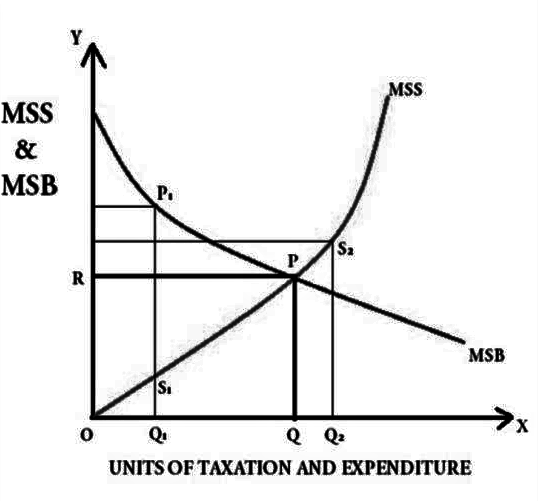
The criteria and pre-conditions for arriving at this solution are collectively referred to as the principle of maximum social advantage. Taxation (government revenue) and government expenditure are the two tools. Neither of excess is good for the society, it has to be balanced to achieve maximum social benefit. Dalton called this principle as “Maximum Social Advantage” and Pigou termed it as “Maximum Aggregate Welfare”.

Dalton’s Principle of Maximum Social Advantage maximum satisfaction should be yield by striking a balance between public revenue and expenditure by the government. Economic welfare is achieved when marginal utility of expenditure = marginal disutility of taxation. He explains this principle with reference to

  • Maximum Social Benefit (MSB)
  • Maximum Social Sacrifice (MSS)

Social security contributions, Low-income Support and Social Income Policy

India’s social security system is composed of a number of schemes and programs spread throughout a variety of laws and regulations. Keep in mind, however, that the government-controlled social security system in India applies to only a small portion of the population.

Furthermore, the social security system in India includes not just an insurance payment of premiums into government funds (like in China), but also lump sum employer obligations.

Generally, India’s social security schemes cover the following types of social insurances:

  • Pension
  • Health Insurance and Medical Benefit
  • Disability Benefit
  • Maternity Benefit

The Code on Social Security, 2020

Foreign companies should note that when The Code of Social Security, 2020, one of the four new labor codes introduced by the Ministry of Labor and Employment comes into force, it will subsume the following enactments:

  • The Employees’ Compensation Act, 1923
  • The Employees’ State Insurance Act, 1948
  • The Employees’ Provident Funds and Miscellaneous Provisions Act, 1952
  • The Employment Exchanges (Compulsory Notification of Vacancies) Act, 1959
  • The Maternity Benefit Act, 1961
  • The Payment of Gratuity Act, 1972
  • The Cine- Workers Welfare Fund Act, 1981
  • The Building and Other Construction Workers Welfare Cess Act, 1996
  • The Unorganised Workers’ Social Security Act, 2008

Rules for the new labor codes on industrial relations, social security, and occupational safety health & working conditions (OSH) are likely to be finalized by the end of January, according to Labor Secretary Apurva Chandra. If that is the case, it may result in implementation of the labor codes by April 1, 2021, which was the deadline put by the labor ministry. However, this timeline is subject to change, depending on interventions made by key stakeholders and lobby groups and other exigencies, such as the impact of the ongoing pandemic.

The Labor Secretary was also quoted in the media saying that the draft model standing orders for the manufacturing, mining, and service sectors will be finalized by February. These draft orders set the standards for service conditions and employees’ conduct in the respective sectors and were notified on December 31, 2020 to seek feedback (within a period of 30 days from the date of notification).

Pension or Employees’ Provident Fund

The Employees’ Provident Fund Organization (EPFO), under the Ministry of Labor and Employment, ensures superannuation pension and family pension in case of death during service. Presently, only about 35 million out of a labor force of 400 million have access to formal social security in the form of old-age income protection in India. Out of these 35 million, 26 million workers are members of the Employees’ Provident Fund Organization, which comprises private sector workers, civil servants, military personnel, and employees of State Public Sector Undertakings (PSUs).

The schemes under the EPFO apply to businesses with at least 20 employees. Contributions to the Employees’ Provident Fund (EPF) Scheme are obligatory for both the employer and the employee when the employee is earning up to INR 15,000 (US$205) per month, and voluntary, when the employee earns more than this amount. If the pay of any employee exceeds this amount, the contribution payable by the employer will be limited to the amount payable on the first INR 15,000 only.

Three schemes are supervised by the Employees’ Provident Fund Organization:

  • The Employees’ Provident Fund Scheme, 1952;
  • The Employees’ Pension Scheme, 1995; and,
  • The Employees’ Deposit Linked Insurance Scheme, 1976.

Four main types of pension (all monthly) are offered:

  • Pension upon superannuation or disability
  • Widows’ pension for death while in service
  • Children’s pension
  • Orphan’s pension

Health Insurance and Medical Benefit

India has a national health service, but this does not include free medical care for the whole population. The Employees’ State Insurance (ESI) Act, 1948 created a fund to provide medical care to employees and their families, as well as cash benefits during sickness and maternity, and monthly payments in case of death or disablement for those working in factories and establishments with 10 or more employees. (As on March 31, 2017, the total number of ESI beneficiaries were 123.7 million.)

Coverage under the ESI scheme has extended to hotels, shops, cinemas and preview theaters, restaurants, newspaper establishments, and road-motor transport undertakings. The scheme has also been extended to private educational and medical institutions that have employed 10 or more employee. This is applicable in certain states and union territories only.

The ESI (Central) Amendment Rules, 2016 – notified on December 22, 2016 – expanded coverage to include employees earning INR 21,000 (US$287) or less in a month from January 1, 2017; previously, the wage limit for ESI subscribers was INR 15,000 per month.

An employee who earns less than INR 21,000 per month contributes 1.75 percent of their salary towards the ESI while the employer pays 4.75 percent making a total contribution of 6.5 percent. The company or establishment can apply for an ESI registration within 15 days from the time the ESI Act becomes applicable to that entity. The Employees’ State Insurance (Central) Amendment Rules, 2017 was notified on January 20, 2017 detailing new maternity benefits for women who have insurance.

Sickness benefit under ESI coverage is 70 percent of the average daily wage and is payable for a maximum of 91 days in a year. To qualify for sickness benefit, the insured worker is required to contribute for 78 days in a contribution period of six months. There are provisions for extended sickness benefits and corresponding eligibility criteria.

ESI also provides disablement benefit, which is applicable from day one of entering insurable employment for temporary disablement benefit. In case of permanent disablement benefit, it is paid at the rate of 90 percent of wage in the form of monthly payment, depending upon the extent of loss of earning capacity as certified by a Medical Board.

Besides sickness and disability pay outs, the ESI provides for dependents’ benefits (DB). The DB paid is at the rate of 90 percent of the wage in the form of monthly payment to the dependents of a deceased insured person – in cases where the death has occurred due to employment injury or occupational hazards.

Other benefits that are offered with ESI are:

  • Medical benefits;
  • Maternity benefits;
  • Unemployment allowance;
  • Confinement expenses;
  • Funeral expenses;
  • Physical rehabilitation;
  • Vocational training; and
  • Skill upgradation training under Rajiv Gandhi Shramik Kalyan Yojana (RGSKY).

A one-time relaxation has been extended to employers who could not file the return of ESI contribution for the contribution period from April 1, 2020 to September 30, 2020 due to the extenuating circumstances faced by enterprises last year. The new deadline to file this return is January 15, 2021. This does not impact employees contributing to and receiving benefits from the ESI. Also, no further relaxations have been provided for older or newer contribution periods.

Disability Benefit

The Employee’s Compensation Act, 1923, formerly known as the ‘Workmen’s Compensation Act, 1923’, requires the employer to pay compensation to employees or their families in cases of employment related injuries that result in death or disability.

In addition, workers employed in certain types of occupations are exposed to the risk of contracting certain diseases, which are peculiar and inherent to those occupations. A worker contracting an occupational disease is deemed to have suffered an accident out of and in the course of employment, and the employer is liable to pay compensation for the same. Injuries resulting in permanent total and partial disablement are listed in parts I and II of Schedule I of the Employee’s Compensation Act, while occupational diseases have been defined in parts A, B, and C of Schedule III of the Employee’s Compensation Act.

Last year, the central government changed the wage amount to be considered for calculation of compensation to workers under the Employee’s Compensation Act, 1923 vide notification S.O.71 (E) dated January 3, 2020. Now, it will be INR 15,000 (US$205), according to the notification by the Ministry of Labor and Employment. The previous wage amount considered for the calculation of compensation was just INR 8,000 (US$109).

Compensation calculation depends on the situation of occupational disability:

(a) Death

50 percent of the monthly wage multiplied by the relevant factor or an amount of INR 120,000 (US$1,640), whichever is more.

(b) Total permanent disablement

60 percent of the monthly wage multiplied by the relevant factor or an amount of INR 120,000 (US$1,640), whichever is more.

The relevant factor for computation is mentioned in Schedule IV of the Employee’s Compensation Act.

Maternity Benefit

The Maternity Benefit (Amendment) Act, 2017 came into force on April 1, 2017, and increases some of the key benefits mandated under the previous Maternity Benefit Act of 1961. The amended law provides women in the organized sector with paid maternity leave of 26 weeks, up from 12 weeks, for the first two children. For the third child, the maternity leave entitled will be 12 weeks. India now has the third most maternity leave in the world, following Canada (50 weeks) and Norway (44 weeks).

The Act also secures 12 weeks of maternity leave for mothers adopting a child below the age of three months as well as to commissioning mothers (biological mothers) who opt for surrogacy. The 12-week period in these cases will be calculated from the date the child is handed over to the adoptive or commissioning mother.

In other provisions, the law mandates that every establishment with over 50 employees must provide crèche facilities within easy distance, which the mother can visit up to four times a day. For compliance purposes, companies should note that this particular provision will come into effect from July 1, 2017.

The Maternity Benefit (Amendment) Act introduces the option for women to negotiate work-from-home, if they reach an understanding with their employers, after the maternity leave ends.

Under the pre-existing Maternity Benefit Act of 1961, every woman is entitled to, and her employer is liable for, the payment of maternity benefit at the rate of the average daily wage for the period of the employee’s actual absence from work. Apart from 12 weeks of salary, a female worker is entitled to a medical bonus of INR 3,500.

The 1961 Act states that in the event of miscarriage or medical termination of pregnancy, the employee is entitled to six weeks of paid maternity leave. Employees are also entitled to an additional month of paid leave in case of complications arising due to pregnancy, delivery, premature birth, miscarriage, medical termination, or a tubectomy operation (two weeks in this case).

In addition to the above, the 1961 Act states that no company shall compel its female employees to do tasks of a laborious nature or tasks that involve long hours of standing or which in any way are likely to interfere with her pregnancy or the normal development of the fetus, or are likely to cause her miscarriage or otherwise adversely affect her health.

Gratuity

The Payment of Gratuity Act, 1972 directs establishments with 10 or more employees to provide the payment of 15 days of additional wages for each year of service to employees who have worked at a company for five years or more.

Gratuity is provided as a lump sum payout by a company. In the event of the death or disablement of the employee, the gratuity must still be paid to the nominee or the heir of the employee.

The employer can, however, reject the payment of gratuity to an employee if the individual has been terminated from the job due to any misconduct. In such a case of forfeiture, there must be a termination order containing the charges and the misconduct of the employee.

Gratuity is calculated through the formula mentioned below:

Gratuity = Last Drawn Salary × 15/26 × Tenure of Service, where:

  • The ratio 15/26 represents 15 days out of 26 working days in a month.
  • Last Drawn Salary = Basic Salary + Dearness Allowance.
  • Tenure of Service is rounded up or down to the nearest full year. For example, if the employee has a total service of 10 years, 10 months and 25 days, 11 years will be factored into the calculation.

Union Budget Structure, Budget Deficit

The budget is an estimate of income and expenditure for a definite duration. In economics, budget is a systematic list of revenue and expenditure or we can say it’s a plan for income and expenditure.

The word ‘budget’ has been borrowed from the English word “Bowgette” which traces its origin from the French word “Bougette”.  Word “Bougette” has arrived from the word, ‘Bouge’ which means a leather bag.

The Union Budget of India, also referred to as the Annual Financial Statement in the Article 112 of the Constitution of India, is the annual budget of the Republic of India. The Government presents it on the first day of February so that it could be materialised before the beginning of new financial year in April. Until 2016 it was presented on the last working day of February by the Finance Minister in Parliament. The budget, which is presented by means of the Finance bill and the Appropriation bill has to be passed by Lok Sabha before it can come into effect on 1 April, the start of India’s financial year.

An interim budget is not the same as a ‘Vote on Account’. While a ‘Vote on Account’ deals only with the expenditure side of the government’s budget. An interim budget is a complete set of accounts, including both expenditure and receipts. An interim budget gives the complete financial statement, very similar to a full budget. While the law does not disqualify the Union government from introducing tax changes, normally during an election year, successive governments have avoided making any major changes in income tax laws during an interim budget.

As of September 2017, Morarji Desai has presented 10 budgets which is the highest count followed by P Chidambaram’s 9 and Pranab Mukherjee’s 8. Yashwant Sinha, Yashwantrao Chavan and C.D. Deshmukh have presented 7 budgets each while Manmohan Singh and T.T. Krishnamachari have presented 6 budgets.

Reason OF Union Budget

The Government performs two important functions by making a budget every year:

  1. The Government estimates the expected expenditures for developmental works in different sectors of the economy e.g. Industry, Manufacturing, Education, Health, Transport, etc.
  2. To meet the expenditures for the coming financial year, the Government tries to work out the sources of revenue. ( i.e. by imposing new taxes or increasing or decreasing the previous rates of taxes, or to remove or impose subsidy on any commodity.

Components of the Union (Central) Budget of India:

The budget is divided into two parts:

(i) Revenue Budget and

(ii) Capital Budget.

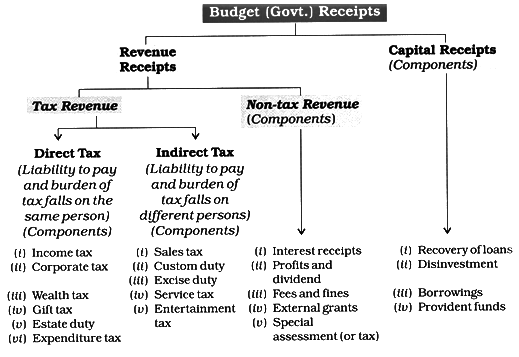
The Revenue Budget comprises revenue receipts and expenditure met from these revenues. The revenue receipts include both tax revenue (like income tax, excise duty) and non-tax revenue (like interest receipts, profits). Capital Budget consists of capital receipts {like borrowing, disinvestment) and long period capital expenditure (creation of assets, investment).

Capital receipts are receipts of the government which create liabilities or reduce financial assets, e.g., market borrowing, recovery of loan, etc. Capital expenditure is the expenditure of the government which either creates assets or reduces liability. Capital budget is an account of assets and liabilities of the government which takes into consideration changes in capital.

Structure or components of a government budget broadly consists of two parts Budget Receipts and Budget Expenditure as shown in the following chart with their classification.

Types of Budget

  1. Traditional or General Budget: The initial structure of the present-day general budget is known as the Traditional Budget. The main aim of the General Budget is to set up financial control over the Executive and the Legislative. This budget contains the details of income and expenditure of the Government.

This budget contains the details of the expenditure in different sectors done by the Government. However, the result of this expenditure is not explained in this budget. Thus, the main idea behind the traditional budget that is to solve the problems of independent India and to achieve the developmental targets was defeated.

As a result, the need and importance of drafting a ‘Performance Budget was accepted and it was presented as a complimentary budget to the earlier Traditional budget.

  1. Performance Budget: When the outcome of any activity is taken as the base of any budget, such a budget is known as ‘Performance Budget’. For the first time in the world, the performance budget was made in the USA. An Administrative Reforms Commission was set up in 1949 in America under Sir Hooper. This commission recommended for making a ‘Performance Budget’ in the USA. In the Performance Budget, it is the compulsion of the government to tell that ‘what is done’, ‘how much done’ by it for the betterment of the people. In India, the Performance Budget is also known as the ‘Outcome Budget’.
  2. Zero Based Budget: There are two primary reasons for adopting this type of Budget in India.

(i) The continuous revenue deficit in the budget of the country.

(ii) Poor implementation of the Performance Budget.

In the zero-based budget, neither expenses incurred during the previous financial years are not considered nor the expenditure of the last financial year used for the coming years.

Under Zero-based budgets, every activity is decided based on Zero basis i.e. the previous expenditures are not considered. This budget is also known as ‘Sun Set Budget’ which means the finance department has to present the zero-based budget before the end of the financial year.

Outcome Budget: In India, development-related schemes such as MGNREGA, NRHM, Mid Day Meal, PMGSY, Digital India, Prime Minister Skill Development Council, etc. are started every year. The large sum of money is spent on these schemes every year. However, at present, the government doesn’t have any parameters to measure the results of these schemes.

Budget Deficit

A budget deficit occurs when government expenditures exceed revenues from taxes and other sources. Although the concept of a budget deficit applies to any organization with operating revenues and expenses, the term is most commonly applied to government budgets.

Components

  1. Revenues

For national governments, a majority of revenue comes from income taxes, corporate taxes, consumption taxes, and social insurance taxes. For non-governmental organizations and companies, revenues come from the sale of goods and services.

  1. Expenses

For governments, expenses include government spending on healthcare, infrastructure, defense, subsidies, pensions, and other items that contribute to the health of the overall economy. For non-governmental organizations and companies, expenses include the amount that is spent on daily operations and factors of production, including rent and wages.

Implications

Contrary to what it may sound like, a budget deficit is not always a negative indicator of economic health. Some of the implications of a budget deficit are described below:

  1. Increase aggregate demand

A budget deficit implies a reduction in taxes and an increase in government spending, which results in an increase in the aggregate demand of the country and subsequent economic growth, ceteris paribus.

  1. Boost the economy during a recession

During a recession, the economy tends to experience a decrease in investment spending from the private sector, along with lower aggregate consumption and demand. A government may choose to borrow and run a deficit to combat the situation by taking measures to spend effectively.

  1. Increase government spending

Government spending serves many purposes, including investments in infrastructure, healthcare, human capital, unemployment benefits, pension programs, and so on. A nation’s government may choose to spend more than its revenues allow by running a deficit.

  1. Fiscal policy

A budget deficit may be used to finance an expansionary fiscal policy, which involves lowering income and corporate taxes (therefore reducing revenue for the government) and increasing government spending on infrastructure and investments to attract foreign capital and boost economic growth.

  1. Higher taxes in the future

A current budget deficit that runs persistently often implies that the government will need to increase taxes in the future to pay off the accumulated debt since taxes are one of the primary sources of revenue for the government.

  1. Higher interest rates and bond yields

In order to borrow large amounts, governments often offer higher interest rates to investors and international banks that lend them money. Increased government borrowing results in higher interest rates and bond yields since investors and banks require compensation for the risk through interest payments.

Theories

  1. Ricardian Equivalence Theory

The Ricardian Equivalence Theory argues that using budget deficit or borrowing to stimulate the economy exerts no effect. It relies on many assumptions, including one that states that the government will increase taxes to pay off the current deficit.

According to the theory, households take it into account while making investment and saving decisions and choose to save more to compensate for the future increase in taxes. Therefore, consumption in the economy decreases, and the increase in government spending financed by a deficit does not impact the economy.

  1. Crowding Out Theory

The Crowding Out Theory states that an increase in government spending and borrowing leads to a decrease in investments from the private sector. It is because governments borrow by selling bonds to the private sector and by borrowing from foreign sources, such as other countries and international banks.

However, it often results in higher interest rates, as well as higher spending on bonds by the private sector which leads to lower funds for private sector investments and a higher cost of borrowing (due to higher interest rates).

Therefore, the increase in government spending is often met with a relatively smaller decrease in private sector investments, which offsets the overall effect of the expansionary move.

Types of Budget Deficit

There are three types of budget deficit, which are explained below

  • Fiscal Deficit
  • Revenue Deficit
  • Primary Deficit

Fiscal Deficit

Fiscal deficit is defined as the excess of total expenditures over the total receipts excluding the borrowings in a year. In other words, this can be defined as the amount that the government needs to borrow in order to meet all expenses.

The more the fiscal deficit more will be the amount borrowed. Fiscal deficit helps in understanding the shortfall that the government faces while paying for the expenditures in the absence of lack of funds.

The formula for calculating fiscal deficit is as follows

Fiscal deficit = Total expenditures – Total Receipts excluding borrowings.

Impact of Fiscal Deficit

The following impacts of fiscal deficit can be seen

  • Unnecessary expenditure: A high fiscal deficit leads to unnecessary expenditure done by the government that leads to potential inflationary pressure on the economy.
  • Printing more currency by RBI for meeting the deficit, also called deficit financing leads to the availability of more money in the market, leading to inflation.
  • Borrowing more will hinder the future growth of the economy as most of the revenue will be utilised towards meeting debt payments.

Remedial measures for Fiscal Deficit

  • Reduced public expenditure
  • Reduction in bonus, leave encashments and subsidies
  • Increase tax to generate revenue
  • Disinvestment of public sector units

Revenue Deficit

Revenue expenditure is defined as the excess of total revenue expenditure over the total revenue receipts. In other words, the shortfall of revenue receipts as compared to the revenue expenditure is known as revenue deficit

Revenue deficit signals to the economists that the revenue earned by the government is insufficient to meet the requirements of the expenditures required for the essential government functions.

The formula for revenue deficit can be expressed as

Revenue Deficit = Total Revenue expenditure – Total Revenue receipts

Impact of Revenue Deficit

  • Reduction in assets: For meeting the shortfall in the form of revenue deficit, the government has to sell some assets.
  • It leads to conditions of inflation in the economy
  • A large number of borrowing leads to a greater debt burden on the economy.

Remedial measures for Fiscal Deficit

  • By reducing unnecessary spending.
  • By raising the rate of taxes and applying new taxes, wherever possible.

Primary Deficit

Primary deficit is said to be the fiscal deficit of the current year minus the interest payments that are pending on previous borrowings, or it can be said that primary deficit is the requirement of borrowing without the interest payment.

Primary deficit, therefore, shows the expenses that government borrowings are going to fulfil while not paying for the income interest payment.

A zero deficit shows that there is a requirement for availing credit or borrowing for clearing the interest payments pending.

The formula for the primary deficit is expressed as follows

Primary Deficit = Fiscal Deficit – Interest Payments

Measures to reduce the primary deficit can be similar to the steps taken to reduce the fiscal deficit as the primary deficit is any borrowings that are above the existing deficit or borrowings.

Factors influencing Velocity of Circulation of Money

Velocity of Circulation refers to the average number of times a single unit of money changes hands in an economy during a given period of time. It can also be referred to as the velocity of money or velocity of circulation of money. It is the frequency with which the total money supply in the economy turns over in a given period of time.

If the velocity of money is increasing, then the velocity of circulation is an indicator that transactions between individuals are occurring more frequently. A higher velocity is a sign that the same amount of money is being used for a number of transactions. A high velocity indicates a high degree of inflation.

Factors Affecting the Velocity of Circulation

  • Money Supply:

Money supply and the velocity of money are inversely proportional. If the money supply in an economy falls short, then the velocity of money will rise, and vice versa.

Velocity of money depends upon the supply of money in the economy. If the supply of money in the economy is less than its requirements, then the velocity of money will increase and if the money supply is less than its requirement, the velocity of money will fall.

  • Frequency of Transactions:

As the number of transactions increases, so does the velocity of circulation.

With the increase in the frequency of transactions, the number of payments and receipts increases and, as a result, velocity of money increases. Similarly, with the decrease in the frequency of transactions, the velocity of money decreases.

  • Regularity of Income: Regularity of income enables people to spend their money more freely, leading to a rise in the velocity of circulation.
  • Payment System: It is also affected by the frequency with which labor is paid (weekly, monthly, bi-monthly) and how fast the bills for various goods and services are settled. The velocity of money is also determined by the frequency with which the labour force is paid (i.e., weekly or monthly) and the speed with which the bills for goods are settled.
  • Regularity of Income: If people receive income at regular intervals, they will spend their income more freely and the velocity of money will increase. But, if people receive their income at irregular intervals, they will prefer to hold more cash balances to meet the uncertain conditions in future and the velocity of money will fall.
  • Propensity to Consume: Greater the tendency of the people to consume, other things remaining the same, higher will be the velocity of money. On the contrary, lower the propensity to consume, lesser will t3 the velocity of money. Saving, or not consuming, has an adverse effect on the velocity of money.

There are several other factors involved, including the value of money, the volume of trade, credit facilities available in the economy, business conditions, etc.

Monetarism and Keynesian Economics

There is a conflict of belief between Monetarists and Keynesian economists regarding the concept. Monetarists believe in the stability of the velocity of circulation and argue that there is a direct relationship between money supply and price levels, and between the rate of growth of money supply and rate of inflation. On the other hand, Keynesian economists believe that the velocity of circulation is an unstable concept that can change rapidly, leading to changes in the money supply.

Formula:

The GDP equation is as follows:

Gross Domestic Product (GDP) = Money Supply x Velocity of Circulation

Therefore, the formula for velocity is the following:

Velocity of Circulation = Gross Domestic Product (GDP) / Money Supply

Demand for Money

In monetary economics, the demand for money is the desired holding of financial assets in the form of money: that is, cash or bank deposits rather than investments. It can refer to the demand for money narrowly defined as M1 (directly spendable holdings), or for money in the broader sense of M2 or M3.

Money in the sense of M1 is dominated as a store of value (even a temporary one) by interest-bearing assets. However, M1 is necessary to carry out transactions; in other words, it provides liquidity. This creates a trade-off between the liquidity advantage of holding money for near-future expenditure and the interest advantage of temporarily holding other assets. The demand for M1 is a result of this trade-off regarding the form in which a person’s funds to be spent should be held. In macroeconomics motivations for holding one’s wealth in the form of M1 can roughly be divided into the transaction motive and the precautionary motive. The demand for those parts of the broader money concept M2 that bear a non-trivial interest rate is based on the asset demand. These can be further subdivided into more microeconomically founded motivations for holding money.

Generally, the nominal demand for money increases with the level of nominal output (price level times real output) and decreases with the nominal interest rate. The real demand for money is defined as the nominal amount of money demanded divided by the price level. For a given money supply the locus of income-interest rate pairs at which money demand equals money supply is known as the LM curve.

The magnitude of the volatility of money demand has crucial implications for the optimal way in which a central bank should carry out monetary policy and its choice of a nominal anchor.

Types of demand for money

  • Transaction demand: Money needed to buy goods; this is related to income.
  • Precautionary demand: Money needed for financial emergencies.
  • Asset motive/speculative demand: When people wish to hold money rather than buy assets/bonds/risky investment.

Asset motive

The asset motive states that people demand money as a way to hold wealth. This may occur during periods of deflation or periods where investors expect bonds to fall in value.

Precautionary demand for money

 Precautionary demand for money, the money we may need for unexpected purchases or emergencies.

Money Balances Held for Precautionary Reasons

Precautionary money balances are held to moderate the impact of unexpected spending needs that can occur in the future. The factors that drive the demand for precautionary money balances are similar to those analyzed for transaction money balances.

  • As the level of economic activity and GDP rises, companies and consumers will increase the level of precautionary money balances for unforeseen spending needs. it is a natural consequence of trends, such as increasing consumer spending habits and rising inflation.
  • The availability of credit and level of interest rates affect the level of precautionary money balances. Other conditions held equal, when credit is easily (hardly) available and interest rates are low (high), such money balances are expected to rise (decline).
  • The balances held for precautionary reasons must be consistent with the level of spending of a company, family, or individual. For example, a precautionary balance of $500 would not be enough for a family that is spending $5,000 per month.

Transaction demand for money

The money we need to purchase goods and services in day-to-day life.

In the classical quantity theory of money. The demand for money is a function of prices and income (assuming the velocity of circulation is stable.) If income rises, demand for money will rise.

In an inventory model, the demand for holding money depends on the frequency of getting paid, and the cost of depositing money in a bank. When employees are paid, they will hold some money to buy goods. If they are paid once a month, they may deposit half to benefit from interest payments, and then withdraw after two months. However, electronic transfers and debit cards have made this less relevant.

Money Held for Transactions

The amount of money held for such a reason is called transaction money balances. Transaction money balances depend on several factors, but mainly:

  • The overall conditions in the economy analyzed. When macroeconomic conditions improve, in the form of higher nominal GDP growth, lower unemployment, or higher salaries, it’s reasonable to assume that spending in the economy will improve. The conditions determine an increase in the demand for money needed to finance the purchase of goods and services.
  • The citizens’ propensity to spend. Regardless of the overall macroeconomic conditions, the citizens of an economy may possess a higher propensity to spend on goods and services than another economy with similar characteristics, which would create, other conditions held equal, higher demand for money.

Money Held for Speculative Reasons

Money held for speculative reasons is also known as the portfolio demand for money. The money is held to take advantage of speculative opportunities or for covering/offsetting risks in other assets or the economy. There are several cases in which money is used as a speculative instrument:

  • When there is deflation or when it is expected in the future. If prices decline, the money stored today will be more valuable tomorrow.
  • When conditions in other markets are not favorable and are expected to deteriorate. For example, if the bond market doesn’t offer good returns, investors may prefer holding speculative cash balances to wait for better market conditions. In addition, if the prices of certain assets are expected to go down, investors may increase their cash positions for speculative purposes.
  • When people want to speculate on changes in currency rates. For example, if somebody expects its domestic currency to depreciate significantly against a foreign currency, they can buy the foreign currency and store it and wait for its appreciation against the domestic currency.

Speculative Demand for Money and Asset Prices

We said that speculative demand also depends on the conditions in other markets, such as the bond market and the expectations of returns in those markets.

In general, an investor who chooses to hold money instead of financial instruments, such as bonds, is giving up the return he/she can earn holding such instruments.

That is why:

  • The demand for money tends to increase when the potential returns in other asset classes decline or when the perceived risk of such investments increases.
  • The demand for money tends to decline if the potential returns in other asset classes increase or when the perceived risk of such investments declines.

As a general rule, we can say that there is:

  • A direct relationship between speculative demand for money and returns in other financial assets.
  • An inverse relationship between speculative demand for money and risks in other financial assets.

Classical and Keynesian approaches of Demand of Money

The Classical Approach:

The classical economists did not explicitly formulate demand for money theory but their views are inherent in the quantity theory of money. They emphasized the transactions demand for money in terms of the velocity of circulation of money. This is because money acts as a medium of exchange and facilitates the exchange of goods and services. In Fisher’s “Equation of Exchange”,

MV = PT

Where M is the total quantity of money, V is its velocity of circulation, P is the price level, and T is the total amount of goods and services exchanged for money.

The right-hand side of this equation PT represents the demand for money which, in fact, “depends upon the value of the transactions to be undertaken in the economy, and is equal to a constant fraction of those transactions.” MV represents the supply of money which is given and in equilibrium equals the demand for money. Thus, the equation becomes MV = PT

This transactions demand for money, in turn, is determined by the level of full employment income. This is because the classicists believed in Say’s Law whereby supply created its own demand, assuming the full employment level of income. Thus, the demand for money in Fisher’s approach is a constant proportion of the level of transactions, which in turn, bears a constant relationship to the level of national income. Further, the demand for money is linked to the volume of trade going on in an economy at any time. Thus, its underlying assumption is that people hold money to buy goods.

But people also hold money for other reasons, such as to earn interest and to provide against unforeseen events. It is, therefore, not possible to say that V will remain constant when M is changed. The most important thing about money in Fisher’s theory is that it is transferable. But it does not explain fully why people hold money. It does not clarify whether to include as money such items as time deposits or savings deposits that are not immediately available to pay debts without first being converted into currency.

It was the Cambridge cash balances approach which raised a further question: Why do people actually want to hold their assets in the form of money? With larger incomes, people want to make larger volumes of transactions and that larger cash balances will, therefore, be demanded. The Cambridge demand equation for money is Md = kPY

where Md is the demand for money which must equal the supply of money (Md=Ms) in equilibrium in the economy, k is the fraction of the real money income (PY) which people wish to hold in cash and demand deposits or the ratio of money stock to income, P is the price level, and Y is the aggregate real income. This equation tells us that “other things being equal, the demand for money in normal terms would be proportional to the nominal level of income for each individual, and hence for the aggregate economy as well.”

Its Critical Evaluation:

This approach includes time and saving deposits and other convertible funds in the demand for money. It also stresses the importance of factors that make money more or less useful, such as the costs of holding it, uncertainty about the future and so on. But it says little about the nature of the relationship that one expects to prevail between its variables, and it does not say too much about which ones might be important.

One of its major criticisms arises from the neglect of store of value function of money. The classicists emphasized only the medium of exchange function of money which simply acted as a go-between to facilitate buying and selling. For them, money performed a neutral role in the economy. It was barren and would not multiply, if stored in the form of wealth.

This was an erroneous view because money performed the “asset” function when it is transformed into other forms of assets like bills, equities, debentures, real assets (houses, cars, TVs, and so on), etc. Thus, the neglect of the asset function of money was the major weakness of the classical approach to the demand for money which Keynes remedied.

The Keynesian Approach: Liquidity Preference:

Keynes in his General Theory used a new term “liquidity preference” for the demand for money. Keynes suggested three motives which led to the demand for money in an economy: (1) the transactions demand, (2) the precautionary demand, and (3) the speculative demand.

The Transactions Demand for Money:

The transactions demand for money arises from the medium of exchange function of money in making regular payments for goods and services. According to Keynes, it relates to “the need of cash for the current transactions of personal and business exchange” It is further divided into income and business motives. The income motive is meant “to bridge the interval between the receipt of income and its disbursement.”

Similarly, the business motive is meant “to bridge the interval between the time of incurring business costs and that of the receipt of the sale proceeds.” If the time between the incurring of expenditure and receipt of income is small, less cash will be held by the people for current transactions, and vice versa. There will, however, be changes in the transactions demand for money depending upon the expectations of income recipients and businessmen. They depend upon the level of income, the interest rate, the business turnover, the normal period between the receipt and disbursement of income, etc.

Given these factors, the transactions demand for money is a direct proportional and positive function of the level of income, and is expressed as

L1 = kY

Where L1 is the transactions demand for money, k is the proportion of income which is kept for transactions purposes, and Y is the income.

Interest Rate and Transactions Demand:

Regarding the rate of interest as the determinant of the transactions demand for money Keynes made the LT function interest inelastic. But the pointed out that the “demand for money in the active circulation is also the some extent a function of the rate of interest, since a higher rate of interest may lead to a more economical use of active balances.” “However, he did not stress the role of the rate of interest in this part of his analysis, and many of his popularizes ignored it altogether.” In recent years, two post-Keynesian economists William J. Baumol and James Tobin have shown that the rate of interest is an important determinant of transactions demand for money.

They have also pointed out the relationship, between transactions demand for money and income is not linear and proportional. Rather, changes in income lead to proportionately smaller changes in transactions demand.

Transactions balances are held because income received once a month is not spent on the same day. In fact, an individual spreads his expenditure evenly over the month. Thus a portion of money meant for transactions purposes can be spent on short-term interest-yielding securities. It is possible to “put funds to work for a matter of days, weeks, or months in interest-bearing securities such as U.S. Treasury bills or commercial paper and other short-term money market instruments.

The problem here is that there is a cost involved in buying and selling. One must weigh the financial cost and inconvenience of frequent entry to and exit from the market for securities against the apparent advantage of holding interest-bearing securities in place of idle transactions balances.

Among other things, the cost per purchase and sale, the rate of interest, and the frequency of purchases and sales determine the profitability of switching from ideal transactions balances to earning assets. Nonetheless, with the cost per purchase and sale given, there is clearly some rate of interest at which it becomes profitable to switch what otherwise would-be transactions balances into interest-bearing securities, even if the period for which these funds may be spared from transactions needs is measured only in weeks. The higher the interest rate, the larger will be the fraction of any given amount of transactions balances that can be profitably diverted into securities.”

The Precautionary Demand for Money:

The Precautionary motive relates to “the desire to provide for contingencies requiring sudden expenditures and for unforeseen opportunities of advantageous purchases.” Both individuals and businessmen keep cash in reserve to meet unexpected needs. Individuals hold some cash to provide for illness, accidents, unemployment and other unforeseen contingencies.

Similarly, businessmen keep cash in reserve to tide over unfavourable conditions or to gain from unexpected deals. Therefore, “money held under the precautionary motive is rather like water kept in reserve in a water tank.” The precautionary demand for money depends upon the level of income, and business activity, opportunities for unexpected profitable deals, availability of cash, the cost of holding liquid assets in bank reserves, etc.

Keynes held that the precautionary demand for money, like transactions demand, was a function of the level of income. But the post-Keynesian economists believe that like transactions demand, it is inversely related to high interest rates. The transactions and precautionary demand for money will be unstable, particularly if the economy is not at full employment level and transactions are, therefore, less than the maximum, and are liable to fluctuate up or down.

The Speculative Demand for Money:

The speculative (or asset or liquidity preference) demand for money is for securing profit from knowing better than the market what the future will bring forth”. Individuals and businessmen having funds, after keeping enough for transactions and precautionary purposes, like to make a speculative gain by investing in bonds. Money held for speculative purposes is a liquid store of value which can be invested at an opportune moment in interest-bearing bonds or securities.

Bond prices and the rate of interest are inversely related to each other. Low bond prices are indicative of high interest rates, and high bond prices reflect low interest rates. A bond carries a fixed rate of interest. For instance, if a bond of the value of Rs 100 carries 4 per cent interest and the market rate of interest rises to 8 per cent, the value of this bond falls to Rs 50 in the market. If the market rate of interest falls to 2 per cent, the value of the bond will rise to Rs 200 in the market.

error: Content is protected !!