Parameters for Judging Organisational Effectiveness

Causal Variables: Causal variables are those independent variables that determine the course of developments within an organization and the objectives achieved by an organization. These causal variables include only those independent variables, which can be altered by organization and its management. Causal variables include organization and management’s policies, decisions, business and leadership strategies, skills and behavior.

End-Result Variables: End-Result variables are the dependent variables that reflect achievements of an organization such as its loss, costs, productivity and earnings.

Intervening Variables: Intervening variables according to Likert are those variables that reflect the internal state and health of an organization. For example, loyalties, attitudes, motivations, performance goals and perceptions of all the members and their collective capacity for effective interaction, communication and decision-making.

The three variables such as causal, intervening and end-result ore interrelated. The inter-relationship may be visualized as psychological process where stimuli or causal variables acting upon the organism or intervening variables and creating certain responses or end-result variables. The causal, intervening and end-result variables comprise a complex network with many interdependent relationships. The causal variables are the key to organizational effectiveness.   Hence, to make organization effective, attempt should be made to improve the causal variables, while other variables will be corrected or improved automatically because of causal variables.

Organizational Effectiveness Model

The organizational effectiveness model can be presented in a more complex way i.e. at three different levels such as the individual, group and organizational levels in order to make the organization more effective. The effective organization is built of effective individuals who work collectively in groups.

The extent to which individual and organizational goals are integrated, affects the degree of organizational effectiveness, i.e., each individual tries to satisfy his goal by working in an organization and simultaneously satisfying organizational goals. He may see his goal satisfaction in satisfying organizational goals. If there is no perfect integration of individual and organizational goals then organizational effectiveness is affected adversely. However, organizational effectiveness is not a result of integration between individual and organizational goals only but there are other causal variables affecting it.

Values in OD: Meaning, Professional Values, Value Conflict and Dilemma

Development is a continuous process and it accommodates in itself many changes that occur in science and technology, economic, market, political environment, education, knowledge, values, attitude and behaviour of people, culture etc. Organisation development is a part of overall development in general. It cannot remain unaffected by the developmental process. The organisation has to change the beliefs, values and its structure to accommodate the new ideas, beliefs and new technologies for progress.

Organisation development constitutes various people, professionals, technocrats, researchers, managers and a host of other employees working in the organisation contributing to the accomplishment of organisational objectives. They behave differently. Authority and power, conflicts, control takes backseat during OD process.

The following are the values in OD efforts:

Confidence and Support:

Organisations are made up of people and they are to be believed and supported in order to have effective organisation. The healthy environment prevails when people are trusted and taken into confidence and a necessary support is extended to them as and when needed.

Respect People:

People are the raison d’etre of organisation and they are responsible for creating opportunities for growth. They must, therefore, be treated with respect and dignified manners.

Confrontation:

Any conflict on any issue should not be suppressed. It should be dealt with openness. Suppression leads to dampening of morale. Identifying the problem and its causes, discussing it openly and finding out feasible solution leads to boosting up morale of the employees and creating good environment.

Expression:

Human beings differ in experience, maturity, ideas, opinions, and outlook. The organisation is at the receiving end. It gains from the differences in quality, ideas, opinions and experiences of its people. Human beings are social animals; they have feelings, emotions, anger and sentiments etc. They should be allowed to express their feelings and sentiments. This will result in building up high morale and the people will be motivated towards hard work ultimately resulting in increased efficiency.

Employee Participation:

The participation of employees who will be affected by the OD should be sought in decision-making.

Seeking Cooperation:

Managers should learn to seek cooperation from each of the employees working under him in his department. This will develop in creating the atmosphere of cooperation leading to organisational effectiveness and willingness to accept change in the event of organisation development process.

Professional Values

Professional values encompass the traits that many employees look for in their employees. Your professional values are the character traits you adopt and demonstrate in the workplace that showcase how successful you are. Additionally, these professional values often include the soft skills and behaviors that are necessary for advancing in your career.

Professional values to adopt in the workplace

Professional values are the traits that showcase your overall work ethic and ability to meet objectives and be successful in your career. Here are several important traits you can use to showcase your core values:

Responsibility

Being responsible not only means following through on commitments you’ve made, but it also means offering your support or help when it’s needed. Demonstrate your responsible nature by meeting objectives, completing tasks that you take on and ensuring you’re performing in your job to the best of your abilities. These responsible traits will show your managers that you are committed to achieving goals and contributing to the growth of your company.

Strong work ethic

Work ethic is a trait that most employers look for right away in an employee. Your ability to work hard, overcome challenges and offer support to your colleagues demonstrates a strong work ethic and can help you be successful while building positive relationships, too. Additionally, having a strong work ethic means understanding what’s expected of you and staying motivated to achieve your goals.

Integrity

Having integrity means being trustworthy and committed to carrying out the duties you are responsible for. Integrity is an important trait that can help you build positive and supportive relationships at work. It also means that you are dependable and honest in your interactions, communications and relationships with others.

Reliability

Being reliable means you are punctual, on track with your work objectives and always follow through on your commitments. Demonstrating your dependability can also lead to more advanced or challenging projects that can help you advance in your career, as your supervisors will be more likely to trust you with important tasks because they know you will follow through on your work commitments.

Honesty

Honesty is an aspect of integrity, and both of these traits can help you form a strong foundation of professional values. When you remain honest and open in your communication with your work colleagues and supervisors, they will be more likely to refer to you when they have questions, need extra help or need some input on important tasks. Additionally, remaining honest in your work will demonstrate your trustworthiness, which is highly important for building strong relationships at work.

Adaptability

The ability to adapt to different situations and navigate interactions with diverse individuals is extremely important in the workplace. No matter what field you work in, challenges or problems can arise. In challenging situations, your adaptability will demonstrate your ability to change your approach to how you overcome problems.

Self motivation

Self-motivation is extremely important to have as a core value. Keeping yourself motivated at work will help you stay satisfied with your job, stay passionate about your work and find meaning in your daily activities. This self-motivation is also a highly desired trait that many employers look for in their employees, as it demonstrates a strong desire to achieve personal and company-wide success.

Accountability

Being accountable in the workplace means taking responsibility for your actions and conduct in the workplace. When you’re accountable for your actions and conduct in the workplace, you demonstrate more than one core value. You’re demonstrating your honesty, adaptability, responsibility and a positive attitude, especially when you seek feedback and input that helps you improve.

Confidence

Confidence in the workplace is something you can develop the more you perform challenging tasks, solve problems and apply feedback for improvement. Focusing on your professional development and improving your skills shows that you are confident in your ability to grow and succeed in your career. Additionally, you can build your confidence by taking on challenges that are outside your comfort zone like leading a team meeting or giving a presentation.

Compassion

Compassionate employees are supportive of each other, offer help when it’s necessary and generally find ways to let others know they care. Having compassion can also lead to deeper understanding of others’ feelings and is beneficial for building meaningful relationships. Remaining compassionate in the workplace is also extremely important for resolving conflict, giving and receiving constructive feedback and solving problems.

Loyalty

Employers often look for employees that will remain loyal to their teams and company as a whole. This means that you perform your job for the benefit of your team, supervisors and employers and that you remain committed to supporting your organization’s growth and development. When you demonstrate your loyalty, you’re showing your employers that you care about how the company achieves success and that your work is important to you.

Empathy

Understanding others’ points of view, ideas and feelings is what it means to have empathy. Additionally, empathy can help you relate to others and find common interests and traits with your co-workers. Being empathetic will help you build relationships and friendships in the office that can be fulfilling and supportive. Additionally, having empathy in the workplace will also help you adapt to different interactions with others, which can make it easier to relate to others’ thoughts and emotions.

Value Conflict and Dilemma

Value Conflicts

A value conflict occurs when individuals or groups of people hold strong personal beliefs that are in disagreement within themselves or in disagreement with the institution’s/ organization’s values. These may include religious differences, cultural differences or differences in upbringing.

Values-based conflicts are particularly pervasive in public policy. Indeed, nearly all public (policy) controversies entail divergent beliefs about what is right and what is wrong, what is just and what is unjust. Many policy decisions are essentially choices among competing values. Simply consider how:

  • Efforts to promote equal opportunity might result in conflicts among values such as efficiency, justice, equality, diversity, merit, and individual achievement;
  • Crime prevention policies might trigger competition among values such as liberty, safety, due process, equity, effectiveness, access, and justice; and
  • Domestic security policies might produce conflict among values such as knowledge generation, information sharing, confidentiality, privacy, civil liberties, individual rights, and safety.

Dilemma

There are three conditions that must be present for a situation to be considered an ethical dilemma. The first condition occurs in situations when an individual, called the “agent,” must make a decision about which course of action is best. Situations that are uncomfortable but that don’t require a choice, are not ethical dilemmas. For example, students in their internships are required to be under the supervision of an appropriately credentialed social work field instructor. Therefore, because there is no choice in the matter, there is no ethical violation or breach of confidentiality when a student discusses a case with the supervisor. The second condition for ethical dilemma is that there must be different courses of action to choose from. Third, in an ethical dilemma, no matter what course of action is taken, some ethical principle is compromised. In other words, there is no perfect solution.

Two Types of Dilemmas   

An “absolute” or “pure” ethical dilemma only occurs when two (or more) ethical standards apply to a situation but are in conflict with each other. For example, a social worker in a rural community with limited mental health care services is consulted on a client with agoraphobia, an anxiety disorder involving a fear of open and public spaces. Although this problem is outside of the clinician’s general competence, the limited options for treatment, coupled with the client`s discomfort in being too far from home, would likely mean the client might not receive any services if the clinician declined on the basis of a lack of competence. Denying to see the patient then would be potentially in conflict with our commitment to promote the well-being of clients. This is a pure ethical dilemma because two ethical standards conflict. It can be resolved by looking at Ethical Standard, which states that social workers should only accept employment (or in this case, a client) on the basis of existing competence or with “the intention to acquire the necessary competence.” The social worker can accept the case, discussing the present limits of her expertise with the client and following through on her obligation to seek training or supervision in this area.

Ways to Enhance Organisational Effectiveness

Performance

Human resources are the most valuable asset of a company, and this is why the proper emphasis is given on hiring and retaining the best of the best. It is essential to find the right fit for the job and develop their skills and know-how through training and other learning methods to increase organizational effectiveness.

Business entities are particular about rewarding knowledge, talent, and expertise to boost employee performances so that they can ultimately have a positive impact on organizational effectiveness.

Accountability

Organizational effectiveness is to a great extent dependent on the concept of accountability. A company should build an environment where every individual, as well as a group, is accountable for the tasks he participates in.

It is the accountability that determines how effectively the people perform the given functions. The organizations must make sure that there are performance accountability systems in place to clarify the expectations of the company and align the rewards as well as consequences with actual accomplishments.

Leadership

One of the critical steps in organization effectiveness is developing leadership within the company. It is leaders who create a vision for their company, define, refine and execute critical processes, translate values into strategies, take action and be accountable. A leader has to answer three things

Value: What is the value he is offering to the customers to gain a competitive advantage in the market.

Approach: How is he fulfilling the unique needs of his stakeholders and which strategy is going to support the vision for achieving competitive advantage.

Alignment: What is the designed alignment of processes, practices, strategy, structure culture, etc and will they be able to create maximum conditions for achieving company vision.

Measurement

It is imperative to measure organizational effectiveness. A business entity must set a standard set of metrics and develop a system of reviews and parameters to analyze and measure, tasks, projects, productivity, behavior, processes, and results.

It is leaders who establish and maintain the measurement system to track progress and review status regularly.

Delivery Efficiency Strategy

The next step in the six systems of organizational effectiveness is the delivery of products and services. It is a fact that consumers and markets are ever-changing, and this means that a company should be prepared to shift and make adjustments to accommodate these changes as well as changes caused by advancements in technology. A straightforward delivery process will ensure the delivery to the right customers and their engagement in full.

This is why business entities try to create simple procedures that are adaptable, responsive. There is no scope for complexity because the onus is on satisfying customer experience. When organizations align initiative and operations with strategy using the best technique, they can pursue breakthroughs in critical areas and build future capability.

Communication

Every organization needs an effective communication system so that the flow of information is smooth. Leaders can be successful when they can communicate their message to other people in a precise manner. Everything happens in a company because of the exchange of information, and this is why strategic communication is considered a critical element in the success chain.

It makes sure that the impact of the message is in alignment with the intention so that it will lead to a better and complete understanding. What, where, when, how everything matters hence keep track of your words and communicate effectually. An essential way for organizational effectiveness is by making sure that the leader is aligning with the people around him and teaching regularly.

Third-Party Peace-Making Intervention

Activities designed and conducted by a skilled consultant to manage interpersonal conflict in the process of organizational change.

Third-Party Intervention is an involvement of person/team into on-going conflict of two parties like management and union to resolve conflict. Generally, third party interventions help parties analyse consequence of their action and manages/ resolve conflict in mutually beneficial way. There are various levels of third-party interventions mandated by laws in employer and labour relations in collective bargaining framework.

Voluntary Arbitration:

In this first phase of third-party intervention, parties mutually agree on name of person who can resolve conflict. This third party person is appointed by free will and consent of both parties to conflict. As this appointment is voluntary, it is believed that solution reached in this level stand on highest footing than solution reached in next level of conflict resolution by third party intervention.

But in case parties does reach consensus in this level then conflict resolution enters into next level.

Conciliations by third party like government appointed officer:

In conciliations, parties to conflict are brought to negotiating table. The government appointed officer act as facilitator of discussion. Officer help parties to reach amicable solution to conflict. If any solution is reached in this process, then parties sign agreement with the government appointed officer.

At times, conciliations process may not be able to reach its logical end as suggested above. In such case, conflict resolution reach next level where there is higher level of third-party interventions.

Adjudication by Tribunal or labour courts:

When parties fails to reach conflict resolution in previous two levels, third levels make them compulsory to do negations in tribunal or labour court. Here parties have to accept judgement proclaimed by third party like tribunal or court.

We can see third party interventions are given in three level mechanism to solve conflict. As parties to conflict enter next level, accepting decision taken by third party becomes compulsory.

Traditional Intervention; Sensitive Training, Grid Training, Survey Feedback

Sensitivity Training:

It is quite popular OD intervention. It is also known as laboratory training. Under this technique the employees in groups are asked to interact. The aim of sensitivity training is to help people understand each other and gain insight so that they feel free and become fearless.

Abraham Korman has rightly observed that, “the assumptions of sensitivity training procedure are that, if these goals are achieved, one will become defensive about himself, less fearful of the intentions of others, more responsive to others and their needs, and less likely to misinterpret others’ behaviours in a negative fashion.

“Under this technique the different groups of employees are allowed to mix up with each other and communicate freely and build up interpersonal relationship. They learn the reflection of their behaviour and try to improve it. In the words of Chris Argyris, “sensitivity training is a group experience designed to provide maximum possible opportunity for the individuals to expose their behaviour, give and receive feedback, experiment with new behaviour and develop awareness of self and of others.”

The employees through this technique know others feelings and behaviour and the impact of their behaviour on others. It builds up openness, improves listening skills, tolerate individual differences and the art of resolving conflicts. It helps in reducing interpersonal conflicts in the organisation.

It is up to the executives at the top level of management in the organisation to take decision regarding appropriateness of this technique but they must see that the objectives of organisational development are achieved with the help of this method.

However there is every likelihood that some culprits will exploit the opportunity to fulfill their vested goals at the cost of organisation’s interests. There is one more serious drawback of the method that it may give rise to groupism in the organisation which will defeat the purpose of OD. To make this technique effective and fulfill the purpose of OD, the selection of trainer must be cautiously made. He must be a man of integrity and responsibility and must command respect from the participating groups.

He plays a crucial role in making the OD programme successful. He should maintain cordial atmosphere throughout the training programme. He must see that each member of the groups learn the behaviour of others and to be creative and get more exposure to group life.

Managerial Grid:

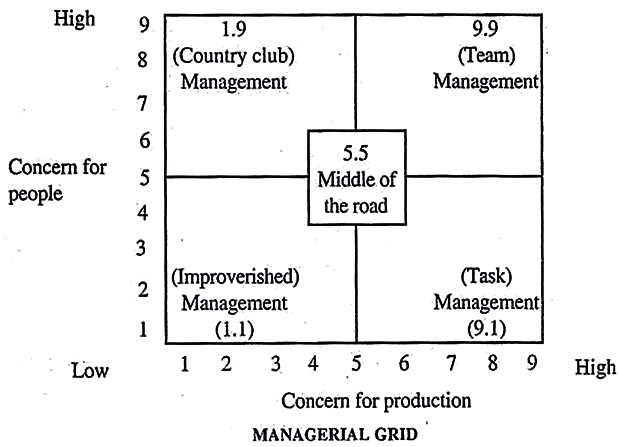
This technique is developed by industrial psychologists duo Robert Blake and Jane Mouton. The concept of managerial grid identifies two major dimensions of management behaviour. They are people oriented and production-oriented behaviours. Attempts are made to pay increased attention to both the variables.

In the diagram given below, production-oriented behaviour is shown on X axis and people oriented behaviour is shown on Y axis. The point A having coordinates 1.1 managerial style shows low people oriented and low production-oriented behaviour.

It is impoverished management. There are many managers come under this category. Such managers do not face any trouble and they do not carry any risk too. The point B having coordinates 1.9 represents a managerial style which is highly people oriented and low production oriented. This is a Country Club pattern of management. This type of management style keeps the employees happy without much concern for production.

The next point C or 9.1 represents a managerial style which shows high concern for production and low in people orientation. The managers who come under this category who usually fix high targets of production for their subordinates and employees and do not pay any attention to the needs and wants of their people.

The point D having coordinates 9.9 represent a managerial style which is highly production oriented and highly people oriented. Robert Blake and Jane Mouton say that this is the most effective managerial style. Under this category of management style managers put their best efforts and have commitment to the people and organisation. This is the most favoured style and efforts must be made to develop the style accordingly.

Phases of Managerial Grid:

The following are the six phases of managerial grid training programme:

  1. Phase or step one consists of seminar training. The seminars usually conducted up to a week. Through seminars the participants learn about their own grid concept and style. This can help them assess their management style. It also helps them to improve their skill within their group. They develop problem solving techniques and develop their own grid programme.
  2. The second phase gives more stress on team development. The teams consisting of managers make necessary efforts to prepare plans to attain point D or 9.9 managerial styles. Through this they learn how to develop smooth relationship with their subordinates and to develop communication skill with other members of the organisation.
  3. The third phase is intergroup development for improving coordination between different departments of the organisation. Participants learn to develop problem solving methods.
  4. The fourth phase deals with the creation of ideal models organisation. Managers and their immediate subordinates sit together, set the goals, test and evaluate them. Superiors acquired knowledge through reading of books. They prepare ideal strategy for the organisation.
  5. The fifth phase deals with goal accomplishment. The teams of various departments make survey of the resources available in the departments or which can be procured to accomplish the goals of the organisation.
  6. The sixth deals with evaluation of the programmes and to see if necessary alteration or adjustment can be made for execution. The managerial grid technique is quite complicated and its benefits cannot be visualized immediately, hence its evaluation can be done after pretty long time.

Survey Feedback

Information is collected through survey method. This is the most popular and widely used method of data collection. The managers use this information collected through survey for making decisions. The wide range of data is collected regarding working conditions, quality of work, working hours, wages and salaries, attitude of employees relating to above.

These data are then analyzed by the team of managers. They find out the problem, evaluate the results and find out solutions. Information is collected from all the members of the organisation. Managers conduct meetings with their subordinates and discuss the information, allow subordinates to interpret the data. After this plans are prepared for making necessary changes. This procedure is followed at all levels of management involving all the employees of the organisation.

Levels of Organisational Diagnosis

Organizational Level

An organization is considered an open system when it is impacted and influenced in many ways by the environment in which it exists. In order to function properly, the external environment must be taken into consideration at all times. The organization must understand the environment to respond to it effectively while accomplishing its mission. This type of organization can be diagnosed at three different levels: Organizational, Group and Individual.

The Organizational level is looked at in three phases: Inputs, System Designs and Outputs. First, the practitioner wants to look at the inputs which require them to understand the general environment and industry structure. Secondly, it is necessary to look at the design components which consist of technology, strategy, structure, human resource systems, and measurement systems that exist internally. This creates a process through which the organization arrives at its goals or outputs.  This is seen in organizational effectiveness, productivity, and stakeholder satisfaction. Once the practitioner and the key stakeholders review this information, they have a useful starting  point to determine how well the organization is functioning.

Group Level

The second level of diagnosis would be on the Group level. On this level the focus would primarily be on the input of organizational design. This speaks to how the organization is designed to function within the general structure of the organization with a greater focus on its inner workings. The internal systems have key components that need to be observed such as task structure, goal clarity, team functioning, group composition, and group norms. The Group level gives the practitioner a closer look at what the culture is, how communication flows, and how well each component is aligned with the overarching design of the organization. The outputs examined in this case are team effectiveness, quality of work life, and performance. Observations on this level must consider whether or not the group design is properly aligned and embedded in the larger group. It is very important that each segment of the organization is in sync and balanced with the other so that all the components of the system flow properly for the most effective results.

Individual Level

Individual jobs have specific designs to accomplish specific tasks that need to be performed through certain processes. Characteristics of individuals working these jobs will be effective based on the level of skills, maturity, education, and experience with the jobs. In addition, individual needs and expectations have to be considered on the Individual level of diagnoses. Individual growth levels can be a factor in self-direction, learning, and motivation when it comes to the job fit. Inputs on the Individual level focuses on organizational design, group design and personal characteristics. Design components consist of skill variety, task identity, task significance, autonomy, and feedback.

Skill variety is the degree to which a job requires a range of activities and abilities to perform the work. Task identity measures the degree to which a job requires the completion of a relatively whole, identifiable piece of work. Task significance identifies the degree to which a job has a significant impact on other people’s lives.  Autonomy indicates the degree to which a job provides freedom and discretion in scheduling the work and determining work methods.  Feedback speaks to the degree by which the job provides employees with direct and clear information about the effectiveness of task performance. The Individual level of diagnosis is important to ensuring that the right people are fitted to the right job which in turn promotes good attitudes and work environments that are conducive to productivity. Ultimately, the goal is to create opportunity for individual effectiveness, job satisfaction, performance, and personal development.

OD and Leadership Development

Organization development (OD) is an effort that focuses on improving an organization’s capability through the alignment of strategy, structure, people, rewards, metrics, and management processes. It is a science-backed, interdisciplinary field rooted in psychology, culture, innovation, social sciences, adult education, human resource management, change management, organization behavior, and research analysis and design, among others.

Organization development involves an ongoing, systematic, long-range process of driving organizational effectiveness, solving problems, and improving organizational performance.

Organization development initiatives are typically categorized as:

  • Techno-structural initiatives that include restructuring organizations (for example, mergers and acquisitions, flexible work design, downsizing, business process engineering, total quality management, quality of work life, Six Sigma, and Agile).
  • Human process initiatives that include team building, interpersonal and group process approaches, and coaching.
  • Strategic initiatives that include organization transformation, culture change, leadership development, and attraction and retention initiatives.
  • Human resource management initiatives that include employee engagement, employee experience, performance management, employee development, succession planning, coaching and mentoring, career development, and diversity awareness.

Leadership has been defined as the process by which an individual determines direction, influences a group, and directs the group toward a specific goal or mission. In a sense, leadership is what leaders do. The following have been observed:

  • Leaders do not just tell people what to do. Great leaders empower people to make decisions that support the goals and vision of the community, ultimately developing smarter solutions. Their job is to inspire and coach. Leaders coach to build a community that is fully participating, both responsibly and accountably. Leaders create buy-in at every level and ensure that all members of their community know that their contributions are important.
  • Leadership is a behavior, not a position. Leadership is inspiring people to live the vision, mission and values of the organization.
  • Management is not synonymous with leadership. Managers facilitate people, process and product. Good managers implement strategies and find solutions to problems. In contrast, the goal of any leader should be to get as many people living the vision as possible.
  • Leaders are not necessarily born; people can learn leadership behaviors. People who excel in performing their job and who take full responsibility within their communities are acting like leaders. Someone who looks to find a better, smarter or faster way of making things happen is acting like a leader. Yet some people are “born leaders,” and they are becoming ever more valuable.

Building a Leadership Development Strategy

Leaders deal with rapid changes brought about by new technologies, globalization, politics, environmental concerns and war, transforming the basic values, beliefs and attitudes of followers to build organizational capacity for positive change.

SHRM research indicates that both HR professionals and executives view leadership development as a major human capital challenge now and in the foreseeable future. In addition, executives would like to see stronger leadership qualities among the ranks of HR professionals themselves.

Challenges

The exponential pace of change creates significant challenges to the development of new leaders. These challenges press against the limits of human capabilities both for leadership candidates and the people charged with nurturing new leaders. Even when the need to develop new leaders is recognized and actively pursued, significant institutional and individual obstacles may impede accomplishing this goal.

  • Limited resources, such as funding and time.
  • Lack of top management support in terms of priority and mindset.
  • Lack of commitment in the organization/culture.
  • Leadership development activities being too ad hoc (i.e., lack of strategy and plan).
  • Lack of administrative and learning systems.
  • The practice of looking for leadership only among employees already at the management level.
  • The practice of affording only management-level employees leadership development opportunities.
  • Failure to effectively assimilate new executives and new hires into existing leadership development programs.
  • Efficiencies of scale of larger organizations versus smaller organizations.
  • Lack of knowledge about how to implement a leadership development program.
  • Lack of long-term commitment to a leadership development program.
  • Lack of or failure to use sophisticated metrics to measure leadership skills or the effectiveness of leadership development programs.
  • The tendency to perceive leadership development as a luxury item subject to quick cost-cutting.

Metrics

Organizations should consider different types of data when designing a leadership development scorecard to measure the effectiveness of leadership development programs and activities. Such data may include:

  • Participants’ level of satisfaction with leadership development activities and programs.
  • Indicators of the scope and volume of leadership development.
  • Learning and the acquisition of leadership knowledge and skills.
  • Business impact of applying leadership knowledge and new skills.
  • Application of leadership skills to various job situations.
  • Return on investment comparing monetary benefits with program costs.
  • Intangible benefits related to business measures such as work climate, job attitudes and initiative that cannot be converted into monetary values.

Organisational Change Meaning

An organization may have no other choice but to change. There are many reasons for an organization to change, such as a sudden change of the economic climate or the arising threat of competition. Through understanding the process and theory of organizational change, you and your organization can handle change in the best possible way.

In Gareth R. Jones and Jennifer M. George’s book, Contemporary Management, organizational change is defined as “the movement of an organization away from its present state and toward some desired future state to increase its efficiency and effectiveness.” During organizational change, managers must balance the need to improve current operations with the need to respond to new and unpredictable events.

Lewin’s Force-Field Theory of Change

Kurt Lewin developed a theory about organizational change called the force-field theory. George and Jones describe the force-field theory as follows: a “wide variety of forces arise from the way an organization operates, from its structure, culture and control systems that make it resistant to change. At the same time, a wide variety of forces arise from changing task and general environments that push organizations toward change. These two sets of forces are always in opposition in an organization.” For an organization to change, managers must find ways to increase the forces for change, decrease the resistance of change, or do both at the same time.

Evolutionary Change

Evolutionary change is described by George and Jones as “gradual, incremental, and narrowly focused.” It is not drastic or sudden, but a constant attempt to improve. An example of evolutionary change is total quality management that is consistently applied and shows improvement over the long term.

Revolutionary Change

Some organizations need change fast. When faced with drastic and unexpected change, an organization may have no other choice but to implement revolutionary change. George and Jones describe this as “change that is rapid, dramatic, and broadly focused. This bold shift may be due to a change in the economic climate or a new technological advancement that is integral to the function of the organization.”

Managing Change

Four steps exist in organizational change. First, assess the need for change through recognizing that a problem exists and identifying the problem’s source. Secondly, decide on the change needed to be made by deciding what is the organization’s ideal future state, as well as the obstacles that may occur during change. Thirdly, apply the change and decide whether change will occur from the top down or bottom up, then introduce and manage change. Lastly, evaluate the change by comparing the situation before and after the change or using benchmarking.

Organizational Change Models

According to an article in Forbes, Change Management Guru is the world’s oldest profession. Almost everyone has a few theories about change management.

While there are many change management models, most companies will choose at least one of the following three models to operate under:

  • Lewin’s Change Management Model
  • McKinsey 7-S Model
  • Kotter’s 8 Step Change Model

Lewin’s Change Management Model

This change management model was created in the 1950s by psychologist Kurt Lewin. Lewin noted that the majority of people tend to prefer and operate within certain zones of safety. He recognized three stages of change:

Unfreeze: Most people make an active effort to resist change. In order to overcome this tendency, a period of thawing or unfreezing must be initiated through motivation.

Transition: Once change is initiated, the company moves into a transition period, which may last for some time. Adequate leadership and reassurance is necessary for the process to be successful.

Refreeze: After change has been accepted and successfully implemented, the company becomes stable again, and staff refreezes as they operate under the new guidelines.

While this change management model remains widely used today, it is takes time to implement. Of course, since it is easy to use, most companies tend to prefer this model to enact major changes.

McKinsey 7-S Model

The McKinsey 7-S model offers a holistic approach to organization. This model, created by Robert Waterman, Tom Peters, Richard Pascale, and Anthony Athos during a meeting in 1978, has 7 factors that operate as collective agent of change:

  • Shared values
  • Strategy
  • Structure
  • Systems
  • Style
  • Staff
  • Skills

The McKinsey 7-S Model offers four primary benefits:

  • It offers an effective method to diagnose and understand an organization.
  • It provides guidance in organizational change.
  • It combines rational and emotional components.
  • All parts are integral and must be addressed in a unified manner.

The disadvantages of the McKinsey 7-S Model are:

  • When one part changes, all parts change, because all factors are interrelated.
  • Differences are ignored.
  • The model is complex.
  • Companies using this model have been known to have a higher incidence of failure.

Kotter’s 8 Step Change Model

This model, created by Harvard University Professor John Kotter, causes change to become a campaign. Employees buy into the change after leaders convince them of the urgent need for change to occur. There are 8 steps are involved in this model:

  • Increase the urgency for change.
  • Build a team dedicated to change.
  • Create the vision for change.
  • Communicate the need for change.
  • Empower staff with the ability to change.
  • Create short term goals.
  • Stay persistent.
  • Make the change permanent.

Significant advantages to the model are:

  • The process is an easy step-by-step model.
  • The focus is on preparing and accepting change, not the actual change.
  • Transition is easier with this model.

Disadvantages offered by this model:

  • Steps can’t be skipped.
  • The process takes a great deal of time.

ADKAR model

ADKAR is a change management model that’s goal focused. According to the model, everything you do during the change management process is sequential: you must achieve cumulative goals during the process to achieve your overall change goal. Successful change happens when phases of change for your business and your employees happen simultaneously.

Change steps to achieve in the ADKAR model.

A: Awareness

Recognize the need for change.

D: Desire

Participate and support the change.

K: Knowledge

Know how to change and identify what the change will look like in terms of skills and behaviours.

A: Ability

Implement the change on a daily basis.

R: Reinforcement

Organisational Life Cycle

The organizational life cycle is the life cycle of an organization from its creation to its termination. It also refers to the expected sequence of advancements experienced by an organization, as opposed to a randomized occurrence of events. The relevance of a biological life cycle relating to the growth of an organization, was discovered by organizational researchers many years ago. This was apparent as organizations had a distinct conception, periods of expansion and eventually, termination.

Comparisons between organisations and living organisms originated as early as 1890 by the economist Alfred Marshall who compared firms with trees in the forest, using the metaphor: “But here we may read a lesson from the young trees of the forest as they struggle upwards through the benumbing shade of their older rivals”. Sixty years later, Kenneth Boulding presented the idea that organisations pass through a lifecycle similar to that of living organisms. Shortly after, Mason Haire was among the initial researchers who suggested that organisations may adhere to a certain path of uniformity in their course of expansion.

Subsequently, research has been done on the organizational life cycle for more than 120 years and can be found in various literature on organizations. Examples include the various stages in an organization’s life cycle, phases of growth experienced by an organization during expansion and implications for these phases of growth. Review of the main organizational life cycle theories, with stages, main idea and authors is given in the table below.

Stages

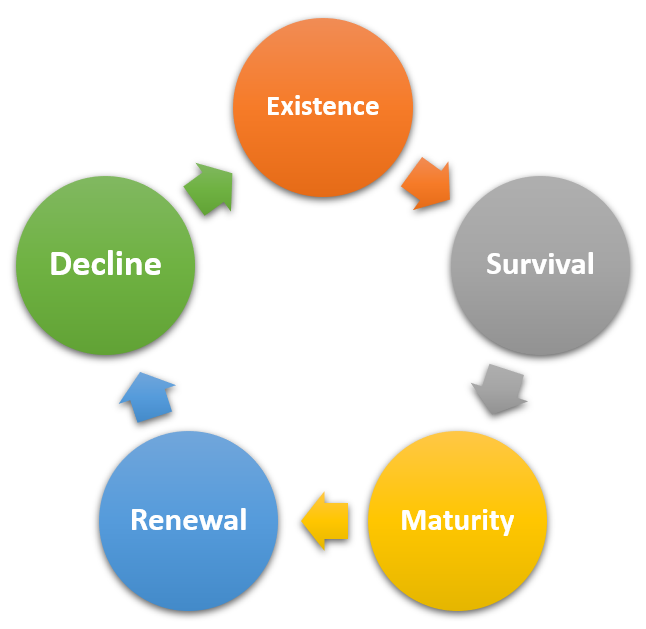
Generally, there are five stages to an organization’s life cycle

Stage 1: Existence: Commonly known as the birth or entrepreneurial stage, “existence” signifies the start of an organization’s expansion. The main importance is centered around the acknowledgement of having an adequate number of customers to keep the organization or business active.

Stage 2: Survival: At this stage, organizations look to pursue growth, establish a framework and develop their capabilities. There is a focus on regularly setting targets for the organization, with the main aim being to generate sufficient revenue for survival and expansion. Some organizations enjoy adequate growth to be able to enter the next stage, whilst others are unsuccessful in achieving this and consequently fail to survive.

Stage 3: Maturity: This stage signifies the organization entering a more formal hierarchy of management (hierarchical organization). A frequent problem encountered at this stage would be those associated with “Red Tape”.[40] Organizations look to safeguard their growth as opposed to focusing on expansion. Top and middle-level management specialize in different tasks, such as planning and routine work respectively.

Stage 4: Renewal: Organizations experience a renewal in their structure of management, from a hierarchical to a matrix style, which encourages creativity and flexibility.

Stage 5: Decline: This stage initiates the death of an organization. The decline is identified by the focus on political agenda and authority within an organization, whereby individuals start to become preoccupied with personal objectives, instead of focusing on the objectives of the organization itself. This slowly destroys the functionality and feasibility of the entire organization.

Limitations

According to the organizational life cycle models, growth in size leads to business issues that firms can solve by adopting only one possible organizational configuration, following a deterministic organizational approach. Recently, scholars challenged this view and propose conceiving of organizational life cycle as an evolutionary process, which calls for a variety of equifinal organizational solutions.

Organizational Renewal, Re-energizing

Organizational renewal can occur as an ongoing, continuous process or as episodic change. Organizations need continuous renewal because it adds a level of stability in the midst of internal and external triggers of change.

(1) To emphasize the need for continuous organizational renewal

(2) To elucidate the respective roles of organizational culture, the external environment, and internal organizational processes as well as strategic decisions and actions in both continuous and episodic organizational renewal.

Organizations should be involved in implementing planned organizational renewal initiatives based on standards of excellence, market awareness, people development and the right balance between internal and external environments of the organization. Organizational renewal is a deliberate strategy for organizational performance and long term survival.

Organizational renewal may be sporadic or continuous. If sporadic renewal is a dramatic, rapid response to either an external or internal change, it will require an immediate quantum shift in the organizational leaders’ strategic and tactical thinking in order to achieve short-term as well as long-term, sustainable performance. The need for sporadic, i.e., episodic, as well as continuous organizational renewal may be the result of drastic, rapidly occurring events caused by external or internal triggers. External triggers of organizational renewal may be weather, global events, economic conditions, technological changes (including the internet as well as technology products), political and legal environment (including deregulation and regulation), socio-cultural changes, terrorism, and/or competition. These external triggers can also affect an organization’s capability to change and renew itself continuously. Examples of internal negative triggers of organizational renewal are: the loss of a large contract, failure to do adequate succession planning, theft, violence in the workplace, product safety problems, the loss of key employees, and failure to follow procedures. However, there are many positive internal triggers of organizational renewal. For example, the continuous development of capabilities (product, service, and manpower) can also lead to breakthrough innovations resulting in competitive advantage for the organization.

Strategic Renewal

Peter Drucker’s student, Cohen said that he learned from Drucker “You can’t predict the future, but you can invent it.” Such invention of the future is an integral part of strategic management, i.e., the result of strategic decisions and actions. “Strategic management is the formulation and implementation of strategies to achieve the mission, vision, goals, and objectives of an organization. It includes the analysis of the organization’s internal and external environments, the establishment of the overall direction of the organization, and coordination with all the firms’ functional areas. Strategic and tactical planning is an organization’s process to determine where the organization stands, what it needs to do, where it needs to go, and how it will get there”.

Portfolio theory, Scenario planning, Resource allocation models, Corporate culture, Leadership craft, Metrics that matter, and Strategic alliances). We concur with Pryor, et al. (2010) who stated that they “find it interesting, but not surprising, that strategy implementation or strategy execution did not make the top 10 list. For many years, various authors (e.g., Chandler, 1962/1998, 1977; Mintzberg, 1994; Mintzberg, Ahlstrand, and Lampel, 1998, 2005; Porter, 2008, 1990, 1986, 1985, 1980; and Pryor, et al., 2007) provided in the literature robust examinations of strategic management (particularly strategy formulation). However, Beer and Eisenstat (2000) emphasized that efforts to extend strategic implementation paradigms failed to provide an integrated representation that would be helpful in the effective realignment of “structure, systems, leadership behavior, human resource policies, culture, values, and management processes.”.

Six Silent Killers Six Principles to Overcome Silent Killers
Top-down or laissez-faire senior

management style

Turn top-down or laissez-faire management style into engaged leadership.
Unclear strategy and conflicting

Priorities

Turn unclear strategy and conflicting priorities into a clear and compelling business direction.
An ineffective senior management team Turn an ineffective senior management team into an

effective (both qualitative and quantitative aspects).

Poor coordination across functions,

businesses, or borders

Turn poor coordination into teamwork through realigning roles, responsibilities, and accountabilities with strategy.
Poor vertical communication  
Inadequate, down-the-line leadership

skills and development

Turn inadequate down-the-line leadership skills into strong leadership with a general management perspective.

Re-energizing

Re-Align Talent: Be sure that your personnel are better aligned to reflect the renewed focus areas. Redeploy the “best and brightest” to the places in your business where they can make the greatest impact. In this way, you stack the deck for success and reduce the risk of investing in growth areas.

Renew Focus: Usually there’s been some “sprawl” in the business during its growth spurts. Examine all of the products and services that your business now offers and determine which ones are most profitable and the ones that hold the greatest potential to grow and prospers. Double-down on those business areas by shifting investments away from lower performing business interests.

Optimize and “Right-Size” Support Functions: During periods of transition, support areas like IT, Marketing, HR, and Finance, often don’t get the attention that they deserve in order to be positioned to continue to deliver the “right” services to their internal customers. Take a look at those support areas, retool their processes so that they’ll align with the firm’s new direction (e.g., what worked when your business was smaller may not work when you’re larger) and retool those areas with people who have the skills and competencies needed to support future growth.

Lose the Dead Weight: Once compensation models are properly aligned, it is essential to recognize that not all boats should rise equally. So, be sure to determine exit strategies for the bottom 10% of your contributors. This exercise can help to move the rest of business out of its comfort zone, too. If a business goes through this “thinning” exercise consistently over time, sluggishness never sets in. New talent is regularly brought in to renew the energy level and raise the business past its perceived limits whatever they may happen to be.

Redefine Compensation Models: Make sure that everyone is working on achieving the same goals. If I’m only compensated on my book of business, then chances are very high that I’m not helping my colleague build hers. If you want to be successful over time, change the mindset of the business to one where staff feel like they are “in it together.” This is done by aligning compensation and rewarding everyone on the growth and profitability of the “whole” business (and, not just on the part of the business that they work within).

Institute “Stickiness”: We all want our businesses to become indispensable. This “stickiness” can be accomplished with a focus on customer intimacy. Define what your customers want from your business by putting yourself in their shoes. Learn what keeps them up at night. Identify their greatest challenges once that’s done, determine how you can help them in some way.

Align Measurements with Desired Behavior People work by what is measured. So, measure outcomes, not effort. Determine which measurements generate the desired change in behavior, while generating growth and profitability. Put those in place, manage to them and monitor results.

error: Content is protected !!