Important Terminologies: Variable, Quantitative Variable, Qualitative Variable, Discrete Variable, Continuous Variable, Dependent Variable, Independent Variable, Frequency, Class Interval, Tally Bar

Important Terminologies:

  • Variable:

Variable is any characteristic, number, or quantity that can be measured or quantified. It can take on different values, which may vary across individuals, objects, or conditions, and is essential in data analysis for observing relationships and patterns.

  • Quantitative Variable:

Quantitative variable is a variable that is measured in numerical terms, such as age, weight, or income. It represents quantities and can be used for mathematical operations, making it suitable for statistical analysis.

  • Qualitative Variable:

Qualitative variable represents categories or attributes, rather than numerical values. Examples include gender, color, or occupation. These variables are non-numeric and are often used in classification and descriptive analysis.

  • Discrete Variable:

Discrete variable is a type of quantitative variable that takes distinct, separate values. These values are countable and cannot take on intermediate values. For example, the number of children in a family is a discrete variable.

  • Continuous Variable:

Continuous variable is a quantitative variable that can take an infinite number of values within a given range. These variables can have decimals or fractions. Examples include height, temperature, or time.

  • Dependent Variable:

Dependent variable is the outcome or response variable that is being measured in an experiment or study. Its value depends on the changes in one or more independent variables. It is the variable of interest in hypothesis testing.

  • Independent Variable:

An independent variable is the variable that is manipulated or controlled in an experiment. It is used to observe its effect on the dependent variable. For example, in a study on plant growth, the amount of water given would be the independent variable.

  • Frequency:

Frequency refers to the number of times a particular value or category occurs in a dataset. It is used in statistical analysis to summarize the distribution of data points within various categories or intervals.

  • Class Interval:

A class interval is a range of values within which data points fall in grouped data. It is commonly used in frequency distributions to organize data into specific ranges, such as “0-10,” “11-20,” etc.

  • Tally Bar:

A tally bar is a method of recording data frequency by using vertical lines. Every group of five tallies (four vertical lines and a fifth diagonal line) represents five occurrences, helping to visually track counts in surveys or experiments.

Important Terminologies in Statistics: Data, Raw Data, Primary Data, Secondary Data, Population, Census, Survey, Sample Survey, Sampling, Parameter, Unit, Variable, Attribute, Frequency, Seriation, Individual, Discrete and Continuous

Statistics is the branch of mathematics that involves the collection, analysis, interpretation, presentation, and organization of data. It helps in drawing conclusions and making decisions based on data patterns, trends, and relationships. Statistics uses various methods such as probability theory, sampling, and hypothesis testing to summarize data and make predictions. It is widely applied across fields like economics, medicine, social sciences, business, and engineering to inform decisions and solve real-world problems.

1. Data

Data is information collected for analysis, interpretation, and decision-making. It can be qualitative (descriptive, such as color or opinions) or quantitative (numerical, such as age or income). Data serves as the foundation for statistical studies, enabling insights into patterns, trends, and relationships.

2. Raw Data

Raw data refers to unprocessed or unorganized information collected from observations or experiments. It is the initial form of data, often messy and requiring cleaning or sorting for meaningful analysis. Examples include survey responses or experimental results.

3. Primary Data

Primary data is original information collected directly by a researcher for a specific purpose. It is firsthand and authentic, obtained through methods like surveys, experiments, or interviews. Primary data ensures accuracy and relevance to the study but can be time-consuming to collect.

4. Secondary Data

Secondary data is pre-collected information used by researchers for analysis. It includes published reports, government statistics, and historical data. Secondary data saves time and resources but may lack relevance or accuracy for specific studies compared to primary data.

5. Population

A population is the entire group of individuals, items, or events that share a common characteristic and are the subject of a study. It includes every possible observation or unit, such as all students in a school or citizens in a country.

6. Census

A census involves collecting data from every individual or unit in a population. It provides comprehensive and accurate information but requires significant resources and time. Examples include national population censuses conducted by governments.

7. Survey

A survey gathers information from respondents using structured tools like questionnaires or interviews. It helps collect opinions, behaviors, or characteristics. Surveys are versatile and widely used in research, marketing, and public policy analysis.

8. Sample Survey

A sample survey collects data from a representative subset of the population. It saves time and costs while providing insights that can generalize to the entire population, provided the sampling method is unbiased and rigorous.

9. Sampling

Sampling is the process of selecting a portion of the population for study. It ensures efficiency and feasibility in data collection. Sampling methods include random, stratified, and cluster sampling, each suited to different study designs.

10. Parameter

A parameter is a measurable characteristic that describes a population, such as the mean, median, or standard deviation. Unlike a statistic, which pertains to a sample, a parameter is specific to the entire population.

11. Unit

A unit is an individual entity in a population or sample being studied. It can represent a person, object, transaction, or observation. Each unit contributes to the dataset, forming the basis for analysis.

12. Variable

A variable is a characteristic or property that can change among individuals or items. It can be quantitative (e.g., age, weight) or qualitative (e.g., color, gender). Variables are the focus of statistical analysis to study relationships and trends.

13. Attribute

An attribute is a qualitative feature that describes a characteristic of a unit. Attributes are non-measurable but observable, such as eye color, marital status, or type of vehicle.

14. Frequency

Frequency represents how often a specific value or category appears in a dataset. It is key in descriptive statistics, helping to summarize and visualize data patterns through tables, histograms, or frequency distributions.

15. Seriation

Seriation is the arrangement of data in sequential or logical order, such as ascending or descending by size, date, or importance. It aids in identifying patterns and organizing datasets for analysis.

16. Individual

An individual is a single member or unit of the population or sample being analyzed. It is the smallest element for data collection and analysis, such as a person in a demographic study or a product in a sales dataset.

17. Discrete Variable

A discrete variable takes specific, separate values, often integers. It is countable and cannot assume fractional values, such as the number of employees in a company or defective items in a batch.

18. Continuous Variable

A continuous variable can take any value within a range and represents measurable quantities. Examples include temperature, height, and time. Continuous variables are essential for analyzing trends and relationships in datasets.

Perquisites of Good Classification of Data

Good classification of data is essential for organizing, analyzing, and interpreting the data effectively. Proper classification helps in understanding the structure and relationships within the data, enabling informed decision-making.

1. Clear Objective

Good classification should have a clear objective, ensuring that the classification scheme serves a specific purpose. It should be aligned with the goal of the study, whether it’s identifying trends, comparing categories, or finding patterns in the data. This helps in determining which variables or categories should be included and how they should be grouped.

2. Homogeneity within Classes

Each class or category within the classification should contain items or data points that are similar to each other. This homogeneity within the classes allows for better analysis and comparison. For example, when classifying people by age, individuals within a particular age group should share certain characteristics related to that age range, ensuring that each class is internally consistent.

3. Heterogeneity between Classes

While homogeneity is crucial within classes, there should be noticeable differences between the various classes. A good classification scheme should maximize the differences between categories, ensuring that each group represents a distinct set of data. This helps in making meaningful distinctions and drawing useful comparisons between groups.

4. Exhaustiveness

Good classification system must be exhaustive, meaning that it should cover all possible data points in the dataset. There should be no omission, and every item must fit into one and only one class. Exhaustiveness ensures that the classification scheme provides a complete understanding of the dataset without leaving any data unclassified.

5. Mutually Exclusive

Classes should be mutually exclusive, meaning that each data point can belong to only one class. This avoids ambiguity and ensures clarity in analysis. For example, if individuals are classified by age group, someone who is 25 years old should only belong to one age class (such as 20-30 years), preventing overlap and confusion.

6. Simplicity

Good classification should be simple and easy to understand. The classification categories should be well-defined and not overly complicated. Simplicity ensures that the classification scheme is accessible and can be easily used for analysis by various stakeholders, from researchers to policymakers. Overly complex classification schemes may lead to confusion and errors.

7. Flexibility

Good classification system should be flexible enough to accommodate new data or changing circumstances. As new categories or data points emerge, the classification scheme should be adaptable without requiring a complete overhaul. Flexibility allows the classification to remain relevant and useful over time, particularly in dynamic fields like business or technology.

8. Consistency

Consistency in classification is essential for maintaining reliability in data analysis. A good classification system ensures that the same criteria are applied uniformly across all classes. For example, if geographical regions are being classified, the same boundaries and criteria should be consistently applied to avoid confusion or inconsistency in reporting.

9. Appropriateness

Good classification should be appropriate for the type of data being analyzed. The classification scheme should fit the nature of the data and the specific objectives of the analysis. Whether classifying data by geographical location, age, or income, the scheme should be meaningful and suited to the research question, ensuring that it provides valuable insights.

Quantitative and Qualitative Classification of Data

Data refers to raw, unprocessed facts and figures that are collected for analysis and interpretation. It can be qualitative (descriptive, like colors or opinions) or quantitative (numerical, like age or sales figures). Data is the foundation of statistics and research, providing the basis for drawing conclusions, making decisions, and discovering patterns or trends. It can come from various sources such as surveys, experiments, or observations. Proper organization and analysis of data are crucial for extracting meaningful insights and informing decisions across various fields.

Quantitative Classification of Data:

Quantitative classification of data involves grouping data based on numerical values or measurable quantities. It is used to organize continuous or discrete data into distinct classes or intervals to facilitate analysis. The data can be categorized using methods such as frequency distributions, where values are grouped into ranges (e.g., 0-10, 11-20) or by specific numerical characteristics like age, income, or height. This classification helps in summarizing large datasets, identifying patterns, and conducting statistical analysis such as finding the mean, median, or mode. It enables clearer insights and easier comparisons of quantitative data across different categories.

Features of Quantitative Classification of Data:

  • Based on Numerical Data

Quantitative classification specifically deals with numerical data, such as measurements, counts, or any variable that can be expressed in numbers. Unlike qualitative data, which deals with categories or attributes, quantitative classification groups data based on values like height, weight, income, or age. This classification method is useful for data that can be measured and involves identifying patterns in numerical values across different ranges.

  • Division into Classes or Intervals

In quantitative classification, data is often grouped into classes or intervals to make analysis easier. These intervals help in summarizing a large set of data and enable quick comparisons. For example, when classifying income levels, data can be grouped into intervals such as “0-10,000,” “10,001-20,000,” etc. The goal is to reduce the complexity of individual data points by organizing them into manageable segments, making it easier to observe trends and patterns.

  • Class Limits

Each class in a quantitative classification has defined class limits, which represent the range of values that belong to that class. For example, in the case of age, a class may be defined with the limits 20-30, where the class includes all data points between 20 and 30 (inclusive). The lower and upper limits are crucial for ensuring that data is classified consistently and correctly into appropriate ranges.

  • Frequency Distribution

Frequency distribution is a key feature of quantitative classification. It refers to how often each class or interval appears in a dataset. By organizing data into classes and counting the number of occurrences in each class, frequency distributions provide insights into the spread of the data. This helps in identifying which ranges or intervals contain the highest concentration of values, allowing for more targeted analysis.

  • Continuous and Discrete Data

Quantitative classification can be applied to both continuous and discrete data. Continuous data, like height or temperature, can take any value within a range and is often classified into intervals. Discrete data, such as the number of people in a group or items sold, involves distinct, countable values. Both types of quantitative data are classified differently, but the underlying principle of grouping into classes remains the same.

  • Use of Central Tendency Measures

Quantitative classification often involves calculating measures of central tendency, such as the mean, median, and mode, for each class or interval. These measures provide insights into the typical or average values within each class. For example, by calculating the average income within specific income brackets, researchers can better understand the distribution of income across the population.

  • Graphical Representation

Quantitative classification is often complemented by graphical tools such as histograms, bar charts, and frequency polygons. These visual representations provide a clear view of how data is distributed across different classes or intervals, making it easier to detect trends, outliers, and patterns. Graphs also help in comparing the frequencies of different intervals, enhancing the understanding of the dataset.

Qualitative Classification of Data:

Qualitative classification of data involves grouping data based on non-numerical characteristics or attributes. This classification is used for categorical data, where the values represent categories or qualities rather than measurable quantities. Examples include classifying individuals by gender, occupation, marital status, or color. The data is typically organized into distinct groups or classes without any inherent order or ranking. Qualitative classification allows researchers to analyze patterns, relationships, and distributions within different categories, making it easier to draw comparisons and identify trends. It is often used in fields such as social sciences, marketing, and psychology for descriptive analysis.

Features of  Qualitative Classification of Data:

  • Based on Categories or Attributes

Qualitative classification deals with data that is based on categories or attributes, such as gender, occupation, religion, or color. Unlike quantitative data, which is measured in numerical values, qualitative data involves sorting or grouping items into distinct categories based on shared qualities or characteristics. This type of classification is essential for analyzing data that does not have a numerical relationship.

  • No Specific Order or Ranking

In qualitative classification, the categories do not have a specific order or ranking. For instance, when classifying individuals by their profession (e.g., teacher, doctor, engineer), the categories do not imply any hierarchy or ranking order. The lack of a natural sequence or order distinguishes qualitative classification from ordinal data, which involves categories with inherent ranking (e.g., low, medium, high). The focus is on grouping items based on their similarity in attributes.

  • Mutual Exclusivity

Each data point in qualitative classification must belong to one and only one category, ensuring mutual exclusivity. For example, an individual cannot simultaneously belong to both “Male” and “Female” categories in a gender classification scheme. This feature helps to avoid overlap and ambiguity in the classification process. Ensuring mutual exclusivity is crucial for clear analysis and accurate data interpretation.

  • Exhaustiveness

Qualitative classification should be exhaustive, meaning that all possible categories are covered. Every data point should fit into one of the predefined categories. For instance, if classifying by marital status, categories like “Single,” “Married,” “Divorced,” and “Widowed” must encompass all possible marital statuses within the dataset. Exhaustiveness ensures no data is left unclassified, making the analysis complete and comprehensive.

  • Simplicity and Clarity

A good qualitative classification should be simple, clear, and easy to understand. The categories should be well-defined, and the criteria for grouping data should be straightforward. Complexity and ambiguity in categorization can lead to confusion, misinterpretation, or errors in analysis. Simple and clear classification schemes make the data more accessible and improve the quality of research and reporting.

  • Flexibility

Qualitative classification is flexible and can be adapted as new categories or attributes emerge. For example, in a study of professions, new job titles or fields may develop over time, and the classification system can be updated to include these new categories. Flexibility in qualitative classification allows researchers to keep the data relevant and reflective of changes in society, industry, or other fields of interest.

  • Focus on Descriptive Analysis

Qualitative classification primarily focuses on descriptive analysis, which involves summarizing and organizing data into meaningful categories. It is used to explore patterns and relationships within the data, often through qualitative techniques such as thematic analysis or content analysis. The goal is to gain insights into the characteristics or behaviors of individuals, groups, or phenomena rather than making quantitative comparisons.

Sampling and Sampling Distribution

Sample design is the framework, or road map, that serves as the basis for the selection of a survey sample and affects many other important aspects of a survey as well. In a broad context, survey researchers are interested in obtaining some type of information through a survey for some population, or universe, of interest. One must define a sampling frame that represents the population of interest, from which a sample is to be drawn. The sampling frame may be identical to the population, or it may be only part of it and is therefore subject to some under coverage, or it may have an indirect relationship to the population.

Sampling is the process of selecting a subset of individuals, items, or observations from a larger population to analyze and draw conclusions about the entire group. It is essential in statistics when studying the entire population is impractical, time-consuming, or costly. Sampling can be done using various methods, such as random, stratified, cluster, or systematic sampling. The main objectives of sampling are to ensure representativeness, reduce costs, and provide timely insights. Proper sampling techniques enhance the reliability and validity of statistical analysis and decision-making processes.

Steps in Sample Design

While developing a sampling design, the researcher must pay attention to the following points:

  • Type of Universe:

The first step in developing any sample design is to clearly define the set of objects, technically called the Universe, to be studied. The universe can be finite or infinite. In finite universe the number of items is certain, but in case of an infinite universe the number of items is infinite, i.e., we cannot have any idea about the total number of items. The population of a city, the number of workers in a factory and the like are examples of finite universes, whereas the number of stars in the sky, listeners of a specific radio programme, throwing of a dice etc. are examples of infinite universes.

  • Sampling unit:

A decision has to be taken concerning a sampling unit before selecting sample. Sampling unit may be a geographical one such as state, district, village, etc., or a construction unit such as house, flat, etc., or it may be a social unit such as family, club, school, etc., or it may be an individual. The researcher will have to decide one or more of such units that he has to select for his study.

  • Source list:

It is also known as ‘sampling frame’ from which sample is to be drawn. It contains the names of all items of a universe (in case of finite universe only). If source list is not available, researcher has to prepare it. Such a list should be comprehensive, correct, reliable and appropriate. It is extremely important for the source list to be as representative of the population as possible.

  • Size of Sample:

This refers to the number of items to be selected from the universe to constitute a sample. This a major problem before a researcher. The size of sample should neither be excessively large, nor too small. It should be optimum. An optimum sample is one which fulfills the requirements of efficiency, representativeness, reliability and flexibility. While deciding the size of sample, researcher must determine the desired precision as also an acceptable confidence level for the estimate. The size of population variance needs to be considered as in case of larger variance usually a bigger sample is needed. The size of population must be kept in view for this also limits the sample size. The parameters of interest in a research study must be kept in view, while deciding the size of the sample. Costs too dictate the size of sample that we can draw. As such, budgetary constraint must invariably be taken into consideration when we decide the sample size.

  • Parameters of interest:

In determining the sample design, one must consider the question of the specific population parameters which are of interest. For instance, we may be interested in estimating the proportion of persons with some characteristic in the population, or we may be interested in knowing some average or the other measure concerning the population. There may also be important sub-groups in the population about whom we would like to make estimates. All this has a strong impact upon the sample design we would accept.

  • Budgetary constraint:

Cost considerations, from practical point of view, have a major impact upon decisions relating to not only the size of the sample but also to the type of sample. This fact can even lead to the use of a non-probability sample.

  • Sampling procedure:

Finally, the researcher must decide the type of sample he will use i.e., he must decide about the technique to be used in selecting the items for the sample. In fact, this technique or procedure stands for the sample design itself. There are several sample designs (explained in the pages that follow) out of which the researcher must choose one for his study. Obviously, he must select that design which, for a given sample size and for a given cost, has a smaller sampling error.

Types of Samples

  • Probability Sampling (Representative samples)

Probability samples are selected in such a way as to be representative of the population. They provide the most valid or credible results because they reflect the characteristics of the population from which they are selected (e.g., residents of a particular community, students at an elementary school, etc.). There are two types of probability samples: random and stratified.

  • Random Sample

The term random has a very precise meaning. Each individual in the population of interest has an equal likelihood of selection. This is a very strict meaning you can’t just collect responses on the street and have a random sample.

The assumption of an equal chance of selection means that sources such as a telephone book or voter registration lists are not adequate for providing a random sample of a community. In both these cases there will be a number of residents whose names are not listed. Telephone surveys get around this problem by random-digit dialling but that assumes that everyone in the population has a telephone. The key to random selection is that there is no bias involved in the selection of the sample. Any variation between the sample characteristics and the population characteristics is only a matter of chance.

  • Stratified Sample

A stratified sample is a mini-reproduction of the population. Before sampling, the population is divided into characteristics of importance for the research. For example, by gender, social class, education level, religion, etc. Then the population is randomly sampled within each category or stratum. If 38% of the population is college-educated, then 38% of the sample is randomly selected from the college-educated population.

Stratified samples are as good as or better than random samples, but they require fairly detailed advance knowledge of the population characteristics, and therefore are more difficult to construct.

  • Non-probability Samples (Non-representative samples)

As they are not truly representative, non-probability samples are less desirable than probability samples. However, a researcher may not be able to obtain a random or stratified sample, or it may be too expensive. A researcher may not care about generalizing to a larger population. The validity of non-probability samples can be increased by trying to approximate random selection, and by eliminating as many sources of bias as possible.

  • Quota Sample

The defining characteristic of a quota sample is that the researcher deliberately sets the proportions of levels or strata within the sample. This is generally done to insure the inclusion of a particular segment of the population. The proportions may or may not differ dramatically from the actual proportion in the population. The researcher sets a quota, independent of population characteristics.

Example: A researcher is interested in the attitudes of members of different religions towards the death penalty. In Iowa a random sample might miss Muslims (because there are not many in that state). To be sure of their inclusion, a researcher could set a quota of 3% Muslim for the sample. However, the sample will no longer be representative of the actual proportions in the population. This may limit generalizing to the state population. But the quota will guarantee that the views of Muslims are represented in the survey.

  • Purposive Sample

A purposive sample is a non-representative subset of some larger population, and is constructed to serve a very specific need or purpose. A researcher may have a specific group in mind, such as high level business executives. It may not be possible to specify the population they would not all be known, and access will be difficult. The researcher will attempt to zero in on the target group, interviewing whoever is available.

  • Convenience Sample

A convenience sample is a matter of taking what you can get. It is an accidental sample. Although selection may be unguided, it probably is not random, using the correct definition of everyone in the population having an equal chance of being selected. Volunteers would constitute a convenience sample.

Non-probability samples are limited with regard to generalization. Because they do not truly represent a population, we cannot make valid inferences about the larger group from which they are drawn. Validity can be increased by approximating random selection as much as possible, and making every attempt to avoid introducing bias into sample selection.

Sampling Distribution

Sampling Distribution is a statistical concept that describes the probability distribution of a given statistic (e.g., mean, variance, or proportion) derived from repeated random samples of a specific size taken from a population. It plays a crucial role in inferential statistics, providing the foundation for making predictions and drawing conclusions about a population based on sample data.

Concepts of Sampling Distribution

A sampling distribution is the distribution of a statistic (not raw data) over all possible samples of the same size from a population. Commonly used statistics include the sample mean (Xˉ\bar{X}), sample variance, and sample proportion.

Purpose:

It allows statisticians to estimate population parameters, test hypotheses, and calculate probabilities for statistical inference.

Shape and Characteristics:

    • The shape of the sampling distribution depends on the population distribution and the sample size.
    • For large sample sizes, the Central Limit Theorem states that the sampling distribution of the mean will be approximately normal, regardless of the population’s distribution.

Importance of Sampling Distribution

  • Facilitates Statistical Inference:

Sampling distributions are used to construct confidence intervals and perform hypothesis tests, helping to infer population characteristics.

  • Standard Error:

The standard deviation of the sampling distribution, called the standard error, quantifies the variability of the sample statistic. Smaller standard errors indicate more reliable estimates.

  • Links Population and Samples:

It provides a theoretical framework that connects sample statistics to population parameters.

Types of Sampling Distributions

  • Distribution of Sample Means:

Shows the distribution of means from all possible samples of a population.

  • Distribution of Sample Proportions:

Represents the proportion of a certain outcome in samples, used in binomial settings.

  • Distribution of Sample Variances:

Explains the variability in sample data.

Example

Consider a population of students’ test scores with a mean of 70 and a standard deviation of 10. If we repeatedly draw random samples of size 30 and calculate the sample mean, the distribution of those means forms the sampling distribution. This distribution will have a mean close to 70 and a reduced standard deviation (standard error).

Range and co-efficient of Range

The range is a measure of dispersion that represents the difference between the highest and lowest values in a dataset. It provides a simple way to understand the spread of data. While easy to calculate, the range is sensitive to outliers and does not provide information about the distribution of values between the extremes.

Range of a distribution gives a measure of the width (or the spread) of the data values of the corresponding random variable. For example, if there are two random variables X and Y such that X corresponds to the age of human beings and Y corresponds to the age of turtles, we know from our general knowledge that the variable corresponding to the age of turtles should be larger.

Since the average age of humans is 50-60 years, while that of turtles is about 150-200 years; the values taken by the random variable Y are indeed spread out from 0 to at least 250 and above; while those of X will have a smaller range. Thus, qualitatively you’ve already understood what the Range of a distribution means. The mathematical formula for the same is given as:

Range = L – S

where

L: The Largets/maximum value attained by the random variable under consideration

S: The smallest/minimum value.

Properties

  • The Range of a given distribution has the same units as the data points.
  • If a random variable is transformed into a new random variable by a change of scale and a shift of origin as:

Y = aX + b

where

Y: the new random variable

X: the original random variable

a,b: constants.

Then the ranges of X and Y can be related as:

RY = |a|RX

Clearly, the shift in origin doesn’t affect the shape of the distribution, and therefore its spread (or the width) remains unchanged. Only the scaling factor is important.

  • For a grouped class distribution, the Range is defined as the difference between the two extreme class boundaries.
  • A better measure of the spread of a distribution is the Coefficient of Range, given by:

Coefficient of Range (expressed as a percentage) = L – SL + S × 100

Clearly, we need to take the ratio between the Range and the total (combined) extent of the distribution. Besides, since it is a ratio, it is dimensionless, and can, therefore, one can use it to compare the spreads of two or more different distributions as well.

  • The range is an absolute measure of Dispersion of a distribution while the Coefficient of Range is a relative measure of dispersion.

Due to the consideration of only the end-points of a distribution, the Range never gives us any information about the shape of the distribution curve between the extreme points. Thus, we must move on to better measures of dispersion. One such quantity is Mean Deviation which is we are going to discuss now.

Interquartile range (IQR)

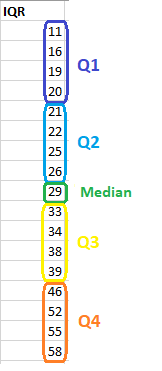
The interquartile range is the middle half of the data. To visualize it, think about the median value that splits the dataset in half. Similarly, you can divide the data into quarters. Statisticians refer to these quarters as quartiles and denote them from low to high as Q1, Q2, Q3, and Q4. The lowest quartile (Q1) contains the quarter of the dataset with the smallest values. The upper quartile (Q4) contains the quarter of the dataset with the highest values. The interquartile range is the middle half of the data that is in between the upper and lower quartiles. In other words, the interquartile range includes the 50% of data points that fall in Q2 and

The IQR is the red area in the graph below.

The interquartile range is a robust measure of variability in a similar manner that the median is a robust measure of central tendency. Neither measure is influenced dramatically by outliers because they don’t depend on every value. Additionally, the interquartile range is excellent for skewed distributions, just like the median. As you’ll learn, when you have a normal distribution, the standard deviation tells you the percentage of observations that fall specific distances from the mean. However, this doesn’t work for skewed distributions, and the IQR is a great alternative.

I’ve divided the dataset below into quartiles. The interquartile range (IQR) extends from the low end of Q2 to the upper limit of Q3. For this dataset, the range is 21 – 39.

Karl Pearson and Spearman Rank Correlation

Karl Pearson Coefficient of Correlation

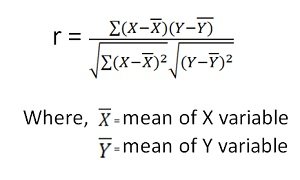
Karl Pearson Coefficient of Correlation (also called the Pearson correlation coefficient or Pearson’s r) is a measure of the strength and direction of the linear relationship between two variables. It ranges from -1 to +1, where +1 indicates a perfect positive linear relationship, -1 indicates a perfect negative linear relationship, and 0 indicates no linear relationship. The formula for Pearson’s r is calculated by dividing the covariance of the two variables by the product of their standard deviations. It is widely used in statistics to analyze the degree of correlation between paired data.

The following are the main properties of correlation.

1. Coefficient of Correlation lies between -1 and +1:

The coefficient of correlation cannot take value less than -1 or more than one +1. Symbolically,

-1<=r<= + 1 or | r | <1.

2. Coefficients of Correlation are independent of Change of Origin:

This property reveals that if we subtract any constant from all the values of X and Y, it will not affect the coefficient of correlation.

3. Coefficients of Correlation possess the property of symmetry:

The degree of relationship between two variables is symmetric as shown below:

4. Coefficient of Correlation is independent of Change of Scale:

This property reveals that if we divide or multiply all the values of X and Y, it will not affect the coefficient of correlation.

5. Co-efficient of correlation measures only linear correlation between X and Y.

6. If two variables X and Y are independent, coefficient of correlation between them will be zero.

Karl Pearson’s Coefficient of Correlation is widely used mathematical method wherein the numerical expression is used to calculate the degree and direction of the relationship between linear related variables.

Pearson’s method, popularly known as a Pearsonian Coefficient of Correlation, is the most extensively used quantitative methods in practice. The coefficient of correlation is denoted by “r”.

If the relationship between two variables X and Y is to be ascertained, then the following formula is used:

Properties of Coefficient of Correlation

  • The value of the coefficient of correlation (r) always lies between±1. Such as:r = +1, perfect positive correlation

    r = -1, perfect negative correlation

    r = 0, no correlation

  • The coefficient of correlation is independent of the origin and scale.By origin, it means subtracting any non-zero constant from the given value of X and Y the vale of “r” remains unchanged. By scale it means, there is no effect on the value of “r” if the value of X and Y is divided or multiplied by any constant.
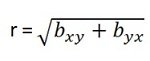
  • The coefficient of correlation is a geometric mean of two regression coefficient. Symbolically it is represented as:
  • The coefficient of correlation is “ zero” when the variables X and Y are independent. But, however, the converse is not true.

Assumptions of Karl Pearson’s Coefficient of Correlation

  • The relationship between the variables is “Linear”, which means when the two variables are plotted, a straight line is formed by the points plotted.
  • There are a large number of independent causes that affect the variables under study so as to form a Normal Distribution. Such as, variables like price, demand, supply, etc. are affected by such factors that the normal distribution is formed.
  • The variables are independent of each other.                                     

Note: The coefficient of correlation measures not only the magnitude of correlation but also tells the direction. Such as, r = -0.67, which shows correlation is negative because the sign is “-“ and the magnitude is 0.67.

Spearman Rank Correlation

Spearman rank correlation is a non-parametric test that is used to measure the degree of association between two variables.  The Spearman rank correlation test does not carry any assumptions about the distribution of the data and is the appropriate correlation analysis when the variables are measured on a scale that is at least ordinal.

The Spearman correlation between two variables is equal to the Pearson correlation between the rank values of those two variables; while Pearson’s correlation assesses linear relationships, Spearman’s correlation assesses monotonic relationships (whether linear or not). If there are no repeated data values, a perfect Spearman correlation of +1 or −1 occurs when each of the variables is a perfect monotone function of the other.

Intuitively, the Spearman correlation between two variables will be high when observations have a similar (or identical for a correlation of 1) rank (i.e. relative position label of the observations within the variable: 1st, 2nd, 3rd, etc.) between the two variables, and low when observations have a dissimilar (or fully opposed for a correlation of −1) rank between the two variables.

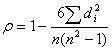
The following formula is used to calculate the Spearman rank correlation:

ρ = Spearman rank correlation

di = the difference between the ranks of corresponding variables

n = number of observations

Assumptions

The assumptions of the Spearman correlation are that data must be at least ordinal and the scores on one variable must be monotonically related to the other variable.

Data Tabulation

Tabulation is the systematic arrangement of the statistical data in columns or rows. It involves the orderly and systematic presentation of numerical data in a form designed to explain the problem under consideration. Tabulation helps in drawing the inference from the statistical figures.

Tabulation prepares the ground for analysis and interpretation. Therefore a suitable method must be decided carefully taking into account the scope and objects of the investigation, because it is very important part of the statistical methods.

Types of Tabulation

In general, the tabulation is classified in two parts, that is a simple tabulation, and a complex tabulation.

Simple tabulation, gives information regarding one or more independent questions. Complex tabulation gives information regarding two mutually dependent questions.

  • Two-Way Table

These types of table give information regarding two mutually dependent questions. For example, question is, how many millions of the persons are in the Divisions; the One-Way Table will give the answer. But if we want to know that in the population number, who are in the majority, male, or female. The Two-Way Tables will answer the question by giving the column for female and male. Thus the table showing the real picture of divisions sex wise is as under:

  • Three-Way Table

Three-Way Table gives information regarding three mutually dependent and inter-related questions.

For example, from one-way table, we get information about population, and from two-way table, we get information about the number of male and female available in various divisions. Now we can extend the same table to a three way table, by putting a question, “How many male and female are literate?” Thus the collected statistical data will show the following, three mutually dependent and inter-related questions:

  1. Population in various division.
  2. Their sex-wise distribution.
  3. Their position of literacy.

Presentation of Data

Presentation of data is of utter importance nowadays. Afterall everything that’s pleasing to our eyes never fails to grab our attention. Presentation of data refers to an exhibition or putting up data in an attractive and useful manner such that it can be easily interpreted. The three main forms of presentation of data are:

  1. Textual presentation
  2. Data tables
  3. Diagrammatic presentation

Textual Presentation

The discussion about the presentation of data starts off with it’s most raw and vague form which is the textual presentation. In such form of presentation, data is simply mentioned as mere text, that is generally in a paragraph. This is commonly used when the data is not very large.

This kind of representation is useful when we are looking to supplement qualitative statements with some data. For this purpose, the data should not be voluminously represented in tables or diagrams. It just has to be a statement that serves as a fitting evidence to our qualitative evidence and helps the reader to get an idea of the scale of a phenomenon.

For example, “the 2002 earthquake proved to be a mass murderer of humans. As many as 10,000 citizens have been reported dead”. The textual representation of data simply requires some intensive reading. This is because the quantitative statement just serves as an evidence of the qualitative statements and one has to go through the entire text before concluding anything.

Further, if the data under consideration is large then the text matter increases substantially. As a result, the reading process becomes more intensive, time-consuming and cumbersome.

Data Tables or Tabular Presentation

A table facilitates representation of even large amounts of data in an attractive, easy to read and organized manner. The data is organized in rows and columns. This is one of the most widely used forms of presentation of data since data tables are easy to construct and read.

Components of Data Tables

  • Table Number: Each table should have a specific table number for ease of access and locating. This number can be readily mentioned anywhere which serves as a reference and leads us directly to the data mentioned in that particular table.
  • Title: A table must contain a title that clearly tells the readers about the data it contains, time period of study, place of study and the nature of classification of data.
  • Headnotes: A headnote further aids in the purpose of a title and displays more information about the table. Generally, headnotes present the units of data in brackets at the end of a table title.
  • Stubs: These are titles of the rows in a table. Thus a stub display information about the data contained in a particular row.
  • Caption: A caption is the title of a column in the data table. In fact, it is a counterpart if a stub and indicates the information contained in a column.
  • Body or field: The body of a table is the content of a table in its entirety. Each item in a body is known as a ‘cell’.
  • Footnotes: Footnotes are rarely used. In effect, they supplement the title of a table if required.
  • Source: When using data obtained from a secondary source, this source has to be mentioned below the footnote.

Construction of Data Tables

There are many ways for construction of a good table. However, some basic ideas are:

  • The title should be in accordance with the objective of study: The title of a table should provide a quick insight into the table.
  • Comparison: If there might arise a need to compare any two rows or columns then these might be kept close to each other.
  • Alternative location of stubs: If the rows in a data table are lengthy, then the stubs can be placed on the right-hand side of the table.
  • Headings: Headings should be written in a singular form. For example, ‘good’ must be used instead of ‘goods’.
  • Footnote: A footnote should be given only if needed.
  • Size of columns: Size of columns must be uniform and symmetrical.
  • Use of abbreviations: Headings and sub-headings should be free of abbreviations.
  • Units: There should be a clear specification of units above the columns.

Advantages of Tabular Presentation:

  • Ease of representation: A large amount of data can be easily confined in a data table. Evidently, it is the simplest form of data presentation.
  • Ease of analysis: Data tables are frequently used for statistical analysis like calculation of central tendency, dispersion etc.
  • Helps in comparison: In a data table, the rows and columns which are required to be compared can be placed next to each other. To point out, this facilitates comparison as it becomes easy to compare each value.
  • Economical: Construction of a data table is fairly easy and presents the data in a manner which is really easy on the eyes of a reader. Moreover, it saves time as well as space.

Classification of Data and Tabular Presentation

Qualitative Classification

In this classification, data in a table is classified on the basis of qualitative attributes. In other words, if the data contained attributes that cannot be quantified like rural-urban, boys-girls etc. it can be identified as a qualitative classification of data.

Sex Urban Rural
Boys 200 390
Girls 167 100

Quantitative Classification

In quantitative classification, data is classified on basis of quantitative attributes.

Marks No. of Students
0-50 29
51-100 64

Temporal Classification

Here data is classified according to time. Thus when data is mentioned with respect to different time frames, we term such a classification as temporal.

Year Sales
2016 10,000
2017 12,500

Spatial Classification

When data is classified according to a location, it becomes a spatial classification.

Country No. of Teachers
India 139,000
Russia 43,000

Advantages of Tabulation

  1. The large mass of confusing data is easily reduced to reasonable form that is understandable to kind.
  2. The data once arranged in a suitable form, gives the condition of the situation at a glance, or gives a bird eye view.
  3. From the table it is easy to draw some reasonable conclusion or inferences.
  4. Tables gave grounds for analysis of the data.
  5. Errors, and omission if any are always detected in tabulation.

Mean (AM, Weighted, Combined)

Arithmetic Mean

The arithmetic mean,’ mean or average is calculated by summ­ing all the individual observations or items of a sample and divid­ing this sum by the number of items in the sample. For example, as the result of a gas analysis in a respirometer an investigator obtains the following four readings of oxygen percentages:

14.9
10.8
12.3
23.3
Sum = 61.3

He calculates the mean oxygen percentage as the sum of the four items divided by the number of items here, by four. Thus, the average oxygen percentage is

Mean = 61.3 / 4 =15.325%

Calculating a mean presents us with the opportunity for learning statistical symbolism. An individual observation is symbo­lized by Yi, which stands for the ith observation in the sample. Four observations could be written symbolically as Yi, Y2, Y3, Y4.

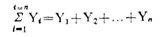
We shall define n, the sample size, as the number of items in a sample. In this particular instance, the sample size n is 4. Thus, in a large sample, we can symbolize the array from the first to the nth item as follows: Y1, Y2…, Yn. When we wish to sum items, we use the following notation:

The capital Greek sigma, Ʃ, simply means the sum of items indica­ted. The i = 1 means that the items should be summed, starting with the first one, and ending with the nth one as indicated by the i = n above the Ʃ. The subscript and superscript are necessary to indicate how many items should be summed. Below are seen increasing simplifications of the complete notation shown at the extreme left:

Properties of Arithmetic Mean:

  1. The sum of deviations of the items from the arithmetic mean is always zero i.e.

∑(X–X) =0.

  1. The Sum of the squared deviations of the items from A.M. is minimum, which is less than the sum of the squared deviations of the items from any other values.
  2. If each item in the series is replaced by the mean, then the sum of these substitutions will be equal to the sum of the individual items.                       

Merits of A.M:

  1. It is simple to understand and easy to calculate.
  2. It is affected by the value of every item in the series.
  3. It is rigidly defined.
  4. It is capable of further algebraic treatment.
  5. It is calculated value and not based on the position in the series.

Demerits of A.M:

  1. It is affected by extreme items i.e., very small and very large items.
  2. It can hardly be located by inspection.
  3. In some cases A.M. does not represent the actual item. For example, average patients admitted in a hospital is 10.7 per day.
  4. M. is not suitable in extremely asymmetrical distributions.

Weighted Mean

In some cases, you might want a number to have more weight. In that case, you’ll want to find the weighted mean. To find the weighted mean:

  1. Multiply the numbers in your data set by the weights.
  2. Add the results up.

For that set of number above with equal weights (1/5 for each number), the math to find the weighted mean would be:
1(*1/5) + 3(*1/5) + 5(*1/5) + 7(*1/5) + 10(*1/5) = 5.2.

Sample problem: You take three 100-point exams in your statistics class and score 80, 80 and 95. The last exam is much easier than the first two, so your professor has given it less weight. The weights for the three exams are:

  • Exam 1: 40 % of your grade. (Note: 40% as a decimal is .4.)
  • Exam 2: 40 % of your grade.
  • Exam 3: 20 % of your grade.

What is your final weighted average for the class?

  1. Multiply the numbers in your data set by the weights:

    .4(80) = 32

    .4(80) = 32

    .2(95) = 19

  2. Add the numbers up. 32 + 32 + 19 = 83.

The percent weight given to each exam is called a weighting factor.

Weighted Mean Formula

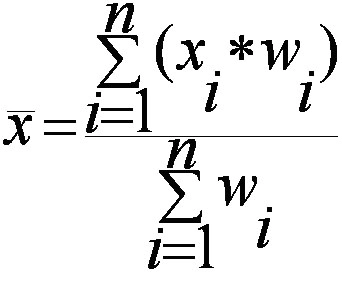
The weighted mean is relatively easy to find. But in some cases the weights might not add up to 1. In those cases, you’ll need to use the weighted mean formula. The only difference between the formula and the steps above is that you divide by the sum of all the weights.

The image above is the technical formula for the weighted mean. In simple terms, the formula can be written as:

Weighted mean = Σwx / Σw

Σ = the sum of (in other words…add them up!).
w = the weights.
x = the value.

To use the formula:

  1. Multiply the numbers in your data set by the weights.
  2. Add the numbers in Step 1 up. Set this number aside for a moment.
  3. Add up all of the weights.
  4. Divide the numbers you found in Step 2 by the number you found in Step 3.

In the sample grades problem above, all of the weights add up to 1 (.4 + .4 + .2) so you would divide your answer (83) by 1:
83 / 1 = 83.

However, let’s say your weighted means added up to 1.2 instead of 1. You’d divide 83 by 1.2 to get:
83 / 1.2 = 69.17.

Combined Mean

A combined mean is a mean of two or more separate groups, and is found by:

  1. Calculating the mean of each group,
  2. Combining the results.

Combined Mean Formula

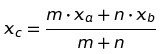
More formally, a combined mean for two sets can be calculated by the formula :

Where:

  • xa = the mean of the first set,
  • m = the number of items in the first set,
  • xb = the mean of the second set,
  • n = the number of items in the second set,
  • xc the combined mean.

A combined mean is simply a weighted mean, where the weights are the size of each group.

Baye’s Theorem

Bayes’ Theorem is a way to figure out conditional probability. Conditional probability is the probability of an event happening, given that it has some relationship to one or more other events. For example, your probability of getting a parking space is connected to the time of day you park, where you park, and what conventions are going on at any time. Bayes’ theorem is slightly more nuanced. In a nutshell, it gives you the actual probability of an event given information about tests.

“Events” Are different from “tests.” For example, there is a test for liver disease, but that’s separate from the event of actually having liver disease.

Tests are flawed:

Just because you have a positive test does not mean you actually have the disease. Many tests have a high false positive rate. Rare events tend to have higher false positive rates than more common events. We’re not just talking about medical tests here. For example, spam filtering can have high false positive rates. Bayes’ theorem takes the test results and calculates your real probability that the test has identified the event.

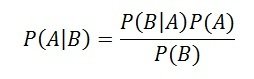
Bayes’ Theorem (also known as Bayes’ rule) is a deceptively simple formula used to calculate conditional probability. The Theorem was named after English mathematician Thomas Bayes (1701-1761). The formal definition for the rule is:

In most cases, you can’t just plug numbers into an equation; You have to figure out what your “tests” and “events” are first. For two events, A and B, Bayes’ theorem allows you to figure out p(A|B) (the probability that event A happened, given that test B was positive) from p(B|A) (the probability that test B happened, given that event A happened). It can be a little tricky to wrap your head around as technically you’re working backwards; you may have to switch your tests and events around, which can get confusing. An example should clarify what I mean by “switch the tests and events around.”

Bayes’ Theorem Example

You might be interested in finding out a patient’s probability of having liver disease if they are an alcoholic. “Being an alcoholic” is the test (kind of like a litmus test) for liver disease.

A could mean the event “Patient has liver disease.” Past data tells you that 10% of patients entering your clinic have liver disease. P(A) = 0.10.

B could mean the litmus test that “Patient is an alcoholic.” Five percent of the clinic’s patients are alcoholics. P(B) = 0.05.

You might also know that among those patients diagnosed with liver disease, 7% are alcoholics. This is your B|A: the probability that a patient is alcoholic, given that they have liver disease, is 7%.

Bayes’ theorem tells you:

P(A|B) = (0.07 * 0.1)/0.05 = 0.14

In other words, if the patient is an alcoholic, their chances of having liver disease is 0.14 (14%). This is a large increase from the 10% suggested by past data. But it’s still unlikely that any particular patient has liver disease.

error: Content is protected !!