Layout of Letter Writing

When writing a business letter, the layout of your letter is important, so that it will be easy to read and looks professional. So is your use of an appropriate salutation and closing, your spelling and grammar, and the tone you employ.

Here’s information on business letters, including selecting a font, paragraph spacing, formatting, margins, what to include in each paragraph, how to close the letter, and an example of the proper layout for a business letter.

Letter Font and Spacing

  • Properly space the layout of the business letters you write, with space between the heading, the greeting, each paragraph, the closing, and your signature.
  • Single space your letter and leave a space between each paragraph. When sending typed letters, leave two spaces before and after your written signature.
  • Left justify your letter, so that your contact information, the date, the letter, and your signature are all aligned to the left.
  • Use a plain font like Arial, Times New Roman, Courier New, Calibri, or Verdana. Make sure that the font size you use is large enough that your reader won’t need to reach for their glasses: the standard font size for these fonts is 10 point or 12 point.

Business Letter Etiquette and Tone

  • Salutation: It is still standard to use the recipient’s title (Mr., Mrs., Ms., Dr., Professor, Judge) before their last names in the salutation of formal business correspondence (Example: “Dear Mr. Smith”). The word “Dear” should always precede the recipient’s name; don’t simply use their name by itself as you might do in casual correspondence. By the same token, avoid beginning business correspondence with openings like “Hello,” “Hi,” or “Good morning” – business letters should always begin with “Dear [recipient’s title and name]” unless you use the salutation “To Whom It May Concern” (in instances when you do not know the name of the recipient).
  • Closing: Your closing needs to err on the side of the conservative. Acceptable closings to use include: “Sincerely,” “Sincerely yours,” “Best regards,” “Regards,” “Thank you,” “Thank you for your consideration,” “Respectfully,” and “Very Respectfully” (this, often abbreviated “V/R,” is common in military business correspondence). Do not use casual closings like: “Later,” “Cheers,” “Cordially,” “Thanks!,” “TTYL,” or “Warmly.”
  • Word Choice and Grammar: Although your word choice for business letters should not be too stilted, flowery, or ornate, you should also avoid using slang, abbreviations/acronyms, emojis, or text-speak. By no means should you use the sentence fragments that are commonly used when texting. Instead, use complete sentences, watching out for comma splices (where two complete sentences are joined by a comma). Proofread carefully for spelling errors and grammatical mistakes.
  • Paper: If you are drafting a formal business letter to be mailed as opposed to an email, the paper you use should be a standard white bond paper of a decent weight – don’t use the sort of colored or flamboyant stationery that might be used in marketing “junk mail.” It’s fine to include a simple business logo at the top of the paper.

Types of Letter Writing

There are broadly two types of letter, namely Formal Letters, and Informal Letters. But then there are also a few types of letters based on their contents, formalities, the purpose of letter writing etc. Let us have a look at the few types of letters.

  1. Formal Letter

These letters follow a certain pattern and formality. They are strictly kept professional in nature, and directly address the issues concerned. Any type of business letter or letter to authorities falls within this given category.

  1. Informal Letter

These are personal letters. They need not follow any set pattern or adhere to any formalities. They contain personal information or are a written conversation. Informal letters are generally written to friends, acquaintances, relatives etc.

  1. Business Letter

This letter is written among business correspondents, generally contains commercial information such as quotations, orders, complaints, claims, letters for collections etc. Such letters are always strictly formal and follow a structure and pattern of formalities.

  1. Official Letter

This type of letter is written to inform offices, branches, subordinates of official information. It usually relays official information like rules, regulations, procedures, events, or any other such information. Official letters are also formal in nature and follow certain structure and decorum.

  1. Social Letter

A personal letter written on the occasion of a special event is known as a social letter. Congratulatory letter, condolence letter, invitation letter etc are all social letters.

  1. Circular Letter

A letter that announces information to a large number of people is a circular letter. The same letter is circulated to a large group of people to correspond some important information like a change of address, change in management, the retirement of a partner etc.

  1. Employment Letters

Any letters with respect to the employment process, like joining letter, promotion letter, application letter etc.

Letter Writing Tips

Now that we have learned the basics of communicating via letters and the types of letters as well, let us focus on some tips for the actual letter writing.

  1. Identify the type of letter

This obviously is the first step of the letter writing process. You must be able to identify the type of letter you are to be writing. This will be dictated by the person the letter is addressed to and the information that will be conveyed through the letter. Suppose you were writing to the principal of your college to ask for leave, this would be a formal letter (Types of formal letters with samples). But say you were writing to your old college professor catching up after a long time. Then this would be a personal (informal) letter.

  1. Make sure you open and close the letter correctly

Opening a letter in the correct manner is of utmost importance. Formal letters open with a particular structure and greeting that is formal in nature. Informal letters can be addressed to the person’s name or any informal greeting as the writer wishes.

Even when closing the letter, it must be kept in mind what type of letter is being written. Formal letters end respectfully and impersonally, whereas informal letters may end with a more personal touch.

  1. Establish the main intent of the letter

Once you start writing, make sure to get to the point as soon as possible. Especially in formal letters, it is important to immediately make clear the purpose of the letter.

  1. Be careful of the language

A letter is always supposed to be polite and considerate. Even if it is a complaint letter, the point must be made in a careful and courteous manner. So it is necessary to use polite expressions and civil language in all types of letters.

  1. Length of the letter

And the other important factor to be considered is the length of the letter you are writing. It should be kept in mind that formal letters are generally to the point, precise and short. Lengthy formal letters tend to not have the desired effect on the reader. The length of an informal letter is determined by the message in the letter and the relation to the recipient.

Report Writing Problems

Report writing is an essential skill in business communication, used for providing detailed information, analysis, and recommendations on specific topics. However, it comes with its own set of challenges.

1. Lack of Clear Purpose

One of the most common issues in report writing is a lack of clarity regarding the report’s purpose. A report must have a defined goal, whether it’s to inform, analyze, or recommend actions. Without a clear purpose, the report becomes vague, unfocused, and fails to convey the intended message effectively. Report writers should be clear about the objective, whether they’re presenting findings, making a recommendation, or analyzing data.

2. Insufficient Research

A well-researched report is based on accurate, relevant, and credible data. Insufficient research leads to incomplete, inaccurate, or unsupported claims. Writers often make the mistake of relying on secondary sources or generalizations without validating the information. This can undermine the credibility of the report. To avoid this, one must thoroughly research the topic, ensuring that all facts, figures, and opinions are substantiated by reliable sources.

3. Poor Structure and Organization

Report writing requires a structured approach. The most common complaint about reports is their lack of organization. A report that lacks a logical flow can confuse the reader. It should follow a clear and systematic structure: introduction, body, and conclusion. Each section must seamlessly connect with the next, with headings and subheadings guiding the reader. Poorly structured reports lead to misunderstandings and misinterpretation of the data.

4. Overuse of Jargon

Business reports often suffer from excessive use of jargon or technical language, making them difficult for a broad audience to understand. While some technical terms may be necessary, they should be used sparingly and explained clearly. Overcomplicating the language makes the report less accessible, especially for readers who are not familiar with the subject matter. Striking a balance between formal language and clarity is essential in ensuring the report is comprehensible.

5. Inconsistent Formatting

Consistency in formatting is essential for professional-looking reports. Inconsistent fonts, font sizes, and spacing can make a report appear unprofessional. Formatting issues can distract readers from the content and affect the report’s overall impact. Standardizing the font, title size, headings, and bullet points ensures that the report is easy to follow. Using templates and styles can help maintain consistency and professionalism in the final product.

6. Overloading with Information

Another issue in report writing is including too much information, often at the expense of relevance. Including extraneous details or overwhelming the reader with data makes the report unnecessarily lengthy and difficult to follow. It’s essential to focus on the most pertinent information and exclude anything that doesn’t directly contribute to the report’s objectives. Editing and refining content to eliminate irrelevant details is key to improving report quality.

7. Lack of Visual Aids

Reports can often become tedious and difficult to digest if they consist solely of text. Data-heavy reports, in particular, can benefit from the use of charts, graphs, and tables to present complex information in a more digestible format. The absence of visual aids such as graphs and tables reduces the clarity and appeal of the report. Using visuals to support arguments and highlight key points makes the report more engaging and easier to understand.

8. Failure to Tailor the Report to the Audience

A common mistake in report writing is failing to consider the intended audience. A report for executives will be different from one aimed at employees or clients. Writers often neglect to tailor the content to the knowledge level, expectations, and needs of their audience. Understanding the reader’s background, interests, and what they expect to gain from the report is crucial. A well-targeted report ensures that the content resonates with the audience and addresses their specific concerns.

9. Inadequate Proofreading and Editing

Errors in grammar, spelling, and punctuation are common in many reports. These errors detract from the professionalism and clarity of the document. Poorly written reports can leave a negative impression on the reader and diminish the impact of the content. Inadequate proofreading can also result in inconsistencies, missing facts, or unclear sentences. Before submitting the report, it’s essential to proofread and edit it thoroughly to ensure that it is free from errors and is clearly written.

10. Lack of a Clear Conclusion or Recommendations

A report should conclude with a clear summary of the findings and, where appropriate, recommendations. A lack of a clear conclusion or actionable recommendations leaves the reader without a clear understanding of the report’s implications. The absence of a strong conclusion can make the report seem incomplete. The conclusion should effectively summarize the key findings and offer practical recommendations or solutions based on the analysis.

Organization and Techniques of Writing

Writing is a critical skill for conveying ideas, sharing knowledge, and influencing others. Whether it’s for business, academic, or creative purposes, organizing content effectively is essential to ensure clarity, coherence, and impact. The organization and techniques of writing refer to how writers structure and present their ideas, employing specific strategies to guide readers through the material. This process involves several steps, including planning, drafting, organizing, and revising, each of which plays a crucial role in producing well-structured and impactful writing.

1. Understanding the Purpose and Audience

Before beginning to write, the first step is to clearly understand the purpose of the writing and the target audience. The purpose could vary, such as informing, persuading, or entertaining. The audience’s level of knowledge and interest in the topic must also be considered. By defining these parameters, writers can tailor their approach, tone, and style to meet the audience’s expectations.

For instance, a business report targeting executives will differ significantly from a piece intended for a general public audience. Understanding these variables allows the writer to adjust the complexity of language, the type of information presented, and the writing style, ensuring it is relevant and effective.

2. Planning and Brainstorming

The next step is brainstorming and planning, which involves gathering ideas, organizing thoughts, and structuring the content. Planning is essential because it serves as a roadmap for writing, ensuring that the ideas are logically presented.

During this stage, writers often create outlines, mind maps, or lists of key points they wish to cover. This helps them visualize the flow of the material and ensures no important points are overlooked. A good outline can help writers stay on track and prevent them from wandering off-topic. For example, a typical business report might begin with an introduction, followed by the main body containing sections on findings, analysis, and recommendations, and conclude with a summary.

3. Introduction: Grabbing Attention

The introduction is the first impression a reader has of the piece, making it essential to grab attention and set the tone. A strong introduction provides a clear preview of the content while engaging the reader’s interest. It may start with an interesting fact, a question, or a brief overview of the problem or topic to be addressed.

A good introduction not only introduces the subject matter but also outlines the writer’s purpose and the approach they will take. In academic or business writing, it often includes a thesis statement or objective that gives the reader a clear idea of what to expect in the following sections.

4. Organizing the Body: Clear Structure

The body of the writing is where the core ideas are presented, analyzed, and discussed. The key to organizing the body effectively is to divide it into logically connected sections or paragraphs. Each section should cover a specific subtopic or point, and paragraphs should begin with a clear topic sentence that summarizes the main idea of the paragraph.

In business writing, the body may contain sections such as findings, analysis, and recommendations. In academic essays, it could be divided into literature review, methodology, and results. The key here is coherence—ideas should flow naturally from one paragraph to the next, helping the reader follow the argument or discussion. Transition words and phrases like “however,” “on the other hand,” and “therefore” help guide the reader and establish connections between ideas.

5. Using Evidence and Examples

In any form of writing, it is important to back up claims with evidence or examples. In business writing, this could include data, research findings, or case studies that substantiate a point. In academic writing, it might involve referencing scholarly work or empirical studies to support arguments. This not only strengthens the credibility of the writing but also convinces the reader that the points being made are valid and well-founded.

Examples can be used to clarify complex concepts or to make abstract ideas more concrete. For example, if the topic is customer satisfaction in a business report, examples from real-world companies or statistics can highlight trends and demonstrate the application of theory in practice.

6. Conclusion: Summarizing and Closing

The conclusion is the final part of the writing, summarizing the main points and reinforcing the key message. In a business report, this is where the writer might provide actionable recommendations or next steps based on the analysis in the body. In academic writing, the conclusion may restate the thesis and suggest areas for further research or exploration.

A good conclusion also wraps up the writing smoothly, leaving the reader with a sense of closure. It may also address the broader implications of the topic or provide a call to action, prompting the reader to think about what comes next.

7. Revising and Editing: Refining the Content

Once the first draft is completed, revising and editing are essential steps in the writing process. Revision involves reorganizing content, rewriting sections for clarity, and ensuring logical coherence. Writers should also check that the purpose of the writing is fulfilled and that the tone is consistent with the intended audience.

Editing, on the other hand, focuses on polishing the writing by eliminating grammar, spelling, and punctuation errors. It also involves checking sentence structure, clarity, and style. Many writers find it helpful to read the text aloud during the editing process, as this can help identify awkward phrasing or missing elements.

8. Writing Style and Tone

Writing style refers to the way a writer expresses ideas and the choice of words. It can vary depending on the type of writing and the intended audience. Business writing, for instance, tends to be formal, clear, and concise, while creative writing allows more freedom in style and expression. The tone, which conveys the writer’s attitude toward the subject, should match the purpose of the writing. For example, a persuasive essay might adopt a confident and assertive tone, while a research report may be more neutral and objective.

9. Feedback and Revisions

Feedback from others, such as colleagues, peers, or supervisors, is invaluable in the writing process. It provides an external perspective and helps identify areas that might need improvement. Based on feedback, the writer can make final adjustments to the content, organization, or style.

Keynes Theory of Trade cycle

Keynes did not build up his own exclusive theory of the trade cycle. But he made such important contributions to the analysis of depressions and inflation that his disciples could give a systematic account of the upturn and the downturn in economic activity. In his General Theory, Keynes thought it sufficient to add “Notes on the Trade Cycle.”

These notes did not comprise a complete theory of the trade cycle because no attempt was made here to give a detailed account of the various phases of the trade cycle. Keynes did not examine closely the empirical data of cyclical fluctuations. All the same, Keynes provided the analytical tools for the purpose of building a complete theory.

According to Keynes, business cycle is caused by variations in the rate of investment caused by fluctuations in the Marginal Efficiency of Capital. The term ‘marginal efficiency of capital’ means the expected profits from new investments. Entrepreneurial activity depends upon profit expec­tations. In his business cycle theory, Keynes assigns the major role to expectations.

Business cycles are periodic fluctuations of employment, income and output. According to Keynes, income and output depend upon the volume of employment. The volume of employment is determined by three vari­ables: the marginal efficiency of capital, the rate of interest and the propen­sity to consume.

In the short period the rate of interest and the propensity to consume are more or less stable. Therefore, fluctuations in the volume of employment are caused by fluctuations in the marginal efficiency of capital.

The Keynesian theory of trade cycle is summarised below:

  1. Crucial Role of Investment

Keynes maintained that trade cycles are essentially caused by variations in the rate of investment due to the fluctuations in the marginal efficiency of capital. The changes in investment are made worse by the changes induced by the cycle itself in propensity to consume and the state can be described and analyzed in terms of the fluctuations of the marginal efficiency of capital relatively to the rate of interest.” Thus fluctuations in MEC were considered by Keynes to be the root cause of the trade cycle.

In Keynes’ view, the marginal efficiency of capital depends mainly upon two factors:

  • The series of prospective yields from investment in the new capital assets, and
  • The supply price (replacement cost) of the new capital assets.

These two factors are based upon the psychology of the investors. Therefore, they can change at any time and very rapidly. MEC is based on expectations of the businessmen. At one time, there can be wave of optimism which pushes up the MEC. At another time, there can be a pessimistic mood in the market for new capital assets which depresses the MEC considerably.

In Keynes’ view, introduction of the sudden changes in MEC and hence of investment was the key to the understanding of business cycles. Both the downturn and the upturn in economic activity are the result of sudden and substantial changes in investment.

  1. The Upswing in Economic Activity

During the expansion phase of the trade cycles, the investors have an optimistic outlook. They have a firm confidence of the high profitability of the investment in new capital assets. They have a multiplier effect. Income rises much faster than the rise in investment. In a period of rising income, output and employment, the optimism of the investor gets further support. Therefore, expansion of economic activity goes on automatically till full employment of resources is reached.

The movement of the economy towards full employment is called a boom. The rate of interest rises fast during the boom phase. But the exclusive optimism on the part of investors’ does not allow the rate of interest to act as a brake on rising investment. If investment were to be done on the basis of cold calculations, new investments would not take place once the rate of interest gets equaled with the MEC.

As the boom proceeds, the profitability of investment must fall owing to three factors:

(i) The tendency towards diminishing marginal return due to the growing supply of capital assets;

(ii) The rising cost of production of capital assets; and

(iii) Rise in the rate of interest.

But businessmen tend to ignore the fall in MEC because of over-optimism on their part. To quote Keynes, “A boom is a situation in which over-optimism triumphs over a rate of interest which, in a cooler light, would be seen to be excessive.

  1. Recession and Depression

The continued rise in investment approaches progressively a point where the additional capital goods would not be demanded. It is a point of saturation of demand for capital goods. Rising cost of production of capital assets, the declining prospective yields, appearance of shortages and bottlenecks in production, excessive competition and the abundance of manufactured goods are unmistakable signs of the impending recession. Consequently, the over-optimism of the boom condition is followed by pessimism.

The wave of pessimism spreads fast. In this situation, the marginal efficiency of capital collapses with a suddenness which is catastrophic. Share markets often collapse. Investors lose confidence, output falls, unemployment increases. There seems to be glut of capital goods in the market. Thus, the contraction phase sets in.

Economic contraction proceeds at a rapid pace because the multiplier operates in the reverse direction and reduces income much faster than the decline in investment. Another force which speeds up the contraction is the rapid rise in the rate of interests after the collapse of investment markets. The relatively faster rise in the rate of interest during the contraction phase is due to the sudden increase in liquidity preference of the people during a period of falling prices.

Keynes attributed sudden rise in liquidity preference to the following three factors which operate in depression:

(a) People expect the security prices to fall further which leads the owners of securities to sell them before they suffer a further capital loss. Since there are few buyers of securities, their prices fall and the rate of interest rises to the extent the security prices fall.

(b) When the general price level is falling, consumers continue to postpone their purchases and hold on to cash. As the value of money increases, the demand for cash jumps up.

(c) The producers are forced to liquidate their inventories to meet their contractual obligations in the form of rents and salaries to permanent staff. They try to raise loans for the purpose which further adds to the demand for cash.

All these three factors raise the liquidity preference of the people and hence the rate of interest. While the rate of interest thus rises, the MEC continues to fall. This dampens investment activity further. The business world is overtaken by depression. Actually, the situation should not be as bad as it looks, but investors become over- pessimistic. It is very difficult for the government to revive their confidence in the investment market.

This is because the government can try to reduce the rate of interest through increased money supply. The governments cannot guarantee profitability of investment. Banks may offer loans at concessional rates but investors may not avail of these loans. Thus, monetary policy alone fails to revive economic activity in a depression. The low rate of investment generates a low level of equilibrium income in the economy. This is what Keynes called ‘Under-employment Equilibrium’. This equilibrium tends to be stable for some time.

Recovery of the economy from the state of depression necessitates the use of fiscal policy. Tax concessions and other incentives for investment activity along with public investment alone take the economy out of the depths of depression.

  1. Recovery is a Slow and Halting Process

The process of expansion of economic activity is slow after depression.

The time taken by the economy to recover depends among others upon the following three factors:

One, the normal rate of growth of the economy. This may be relatively high or relatively low. A high normal rate of growth hastens recovery a low rate of growth retards it.

Two, the time period of obsolescence/wearing out of the capital goods. The longer the life of capital goods, the longer it takes the economy to recover and vice-versa. Shorter life-spans of the capital goods require investments at an early date for replacement of these goods. This reduces the time for recovery.

Three, the time taken to dispose of accumulated stocks from the boom period. If the entrepreneurs happen to have already sold off the stocks of semi-finished and finished goods during the recession phase of the cycle, even a slight improvement in the climate of investment facilitates recovery. On the opposite, revival of economic activity shall be delayed to the extent producers have unsold stocks. Till old stocks get exhausted, new investments cannot be made.

The recovery is thereby slowed down. Generally it takes 3 to 5 years to absorb the stocks of the firms which they accumulate from the boom phase. Therefore, this is the minimum time for a depression to last. The maximum time of a depression depends upon the other factors, most important of which is the level of consumption of the people during depression.

We are now in a position to summarise the distinct contributions Keynes made to the explanation of trade cycles. Firstly, Keynes made it clear that trade cycles are fluctuations of economic activity around an equilibrium level. The equilibrium level of economic activity is determined mainly by non-induced (autonomous) investment.

Secondly, Keynes could provide, for the first time, a convincing explanation of the turning points of the trade cycle. This he could successfully do with the help of his theory of the consumption function. The collapse in the investment market is caused by excessive investment as compared to real savings under the consumption function of the people.

The lower turning point is marked where income becomes equal to consumption and there is no net saving or investment Thirdly, Keynes could show why the downturn of the economy is sudden while the recovery process is generally slow. Thirdly, the cumulative nature of the upswing and downswing was explained by Keynes with the help of his concept of the investment multiplier. The multiplier works in the upswing to raise income fast while it works in the backward direction to reduce income fast in the downswing.

Hicks Theory of Trade Cycle

Hicks put forward a complete theory of business cycles based on the interaction between the multiplier and accelerator by choosing certain values of marginal propensity to consume (c) and capital- output ratio (v) which he thinks are representative of the real world situation.

According to Hicks, the values of marginal propensity to consume and capital-output ratio fall in either region C or D of Fig. 1.

As seen above, in case values of these parameters lie in the region C, they produce cyclical movements (i.e., oscillations) whose amplitude increases overtime and if they fall in region D1 they produce an explosive upward movement of income or output without oscillations. To explain business cycles of the real world which do not tend to explode, Hicks has incorporated in his analysis the role of buffers.

On the one hand, he introduces output ceiling when all the given resources are fully employed and prevent income and output to go beyond it, and, on the other hand, he visualizes a floor or the lower limit below which income and output cannot go because some autonomous investment is always taking place.

Another important features of Hicks’ theory is that business cycles in the economy occur in the background of economic growth (i.e., the rising trend of real income of output over time). In other words, cyclical fluctuations in real output of goods and services take place above and below this rising line of trend or growth of income and output. Thus in his theory he explains business cycles along with an equilibrium rate of growth.

In Hicks’ theory of long-run equilibrium growth that is determined by rate of increase of autonomous investment over time and, therefore, long-run equilibrium growth of income is determined by the autonomous investment and the magnitudes of multiplier and accelerator. Hicks assumes that autonomous investment, depending as it is on technological progress, innovations and population growth, grows at a constant rate.

With further assumptions of stable multiplier and accelerator, equilibrium income will grow at the same rate as autonomous investment. It follows therefore that the failure of actual output to increase along the equilibrium growth path, sometimes to move above it and sometimes to move below it, determines the business cycles.

Hicks’ theory of business cycles has been explained with the help of Fig. 13.7. In this figure, AA line represents autonomous investment. Autonomous investment is that investment which is not induced by changes in income and is made by entrepreneur as a result of technological progress or innovations or population growth. Hicks assumes that autonomous investment grows annually at a constant rate given by the slope of the line AA.

Given the marginal propensity to consume, the simple multiplier is determined. Then the magnitude of multiplier and autonomous investment together determine the equilibrium path of income shown by the line LL. Hicks calls this the floor line as this sets the lower limits below which income (output) cannot fall because of a given rate of growth of autonomous investment and the given size of the multiplier. But induced investment has not yet been taken into account.

If national income grows from one year to the next, as it would move along the line LL, there is some amount of induced investment via accelerator. The line EE shows the equilibrium growth path of national income determined by autonomous investment and the combined effect of the multiplier and accelerator. FF is the full employment ceiling. It is a line that shows the maximum national output at any period of time when all the available resources of the economy are fully employed.

Given the constant growth of autonomous investment, the magnitude of multiplier and the induced investment determined by the accelerator, the economy will be moving along the equilibrium growth path line EE. Thus starting from point E, the economy will be in equilibrium moving along the path EE determined by the combined effect of multiplier and accelerator and the growing level of the autonomous investment.

Suppose when the economy reaches point P0 along the path EE, there is an external shock—say an outburst of investment due to certain innovation or jump in governmental investment. When the economy experiences such an outburst of autonomous investment it pushes the economy above the equilibrium growth path EE after point P0.

The rise in autonomous investment due to external shock causes national income to increase at a greater rate than that shown by the slope of EE. This greater increase in national income will cause further increase in induced investment through acceleration effect. This increase in induced investment causes national income to increase by a magnified amount through multiplier.

So under the combined effect of multiplier and accelerator, national income or output will rapidly expand along the path from P0 to P1. Movement from PQ to P1 represents the upswing or expansion phase of the business cycle. But this expansion must stop at P1 because this is the full employment output ceiling. The limited human and material resources of the economy do not permit a greater expansion of national income than shown by the ceiling line CC.

Therefore, when point P1 is reached the rapid growth of national income must come to an end. Prof. Hicks assumes that the full employment ceiling grows at the same rate as autonomous investment. Therefore, CC slopes gently unlike the very steep slope of the line from P0 to P1. When point P1 is reached the economy must grow at the same rate as the usual growth in autonomous investment.

For a short time the economy may crawl along the full employment ceiling CC. But because national income has ceased to increase at the rapid rate, the induced investment via accelerator falls off to the level consistent with the modest rate of growth determined by the constant rate of growth of autonomous investment. But the economy cannot crawl along its full employment ceiling for a long time.

The sharp decline in growth of income and consumption when the economy strikes the ceiling causes a sharp decline in induced investment. Thus with the sharp decline in induced investment when national income and hence consumption ceases to increase rapidly, the contraction in the level of the income and business actually must begin.

Once the downswing starts, the accelerator works in the reverse direction. That is, since the change in income is now negative the inducement to invest must begin to decrease. Thus there is slackening off at point P2 and national income starts moving toward equilibrium growth path EE. This movement from P2 downward therefore represents the downswing or contraction phase of the business cycle.

In this downswing investment falls off rapidly and therefore multiplier works in the reverse direction. The fall in national income and output resulting from the sharp fall in induced investment will not stop on touching the level EE but will go further down. The economy must consequently move all the way down from point P2 to point Q1. But at point Q1 the floor has been reached.

Whereas the upswing was limited by the output ceiling set by the full employment of available resources, in the downswing the national income cannot fall below the level of output represented by the floor. This is because the floor level is determined by simple multiplier and autonomous investment growing at constant rate, while during the downswing after a point accelerator ceases to operate.

It may be noted that during downswing the limit to negative investment (disinvestment) and therefore the limit to the contraction of output is set by the depreciation of capital stock. There is no way for the businessmen to make disinvestment at a desired rate higher than the depreciation.

When during downswing such conditions arise, accelerator becomes inoperative. After hitting the floor the economy may for some time crawl along the floor through the path Q1 to Q2. In doing so, there is some growth in the level of national income. This rate of growth as before induces investment and both the multiplier and accelerator come into operation and the economy will move towards Q3 and the full employment ceiling CC. This is how the upswing of cyclical movement again starts.

Assumptions of Hicks Theory of Trade Cycle

The following assumptions were made to develop his theory of the trade cycle:

(i) In Hicksian analysis, a progressive economy is assumed in which autonomous investment is increasing at a regular rate, so that system is such which could remain in progressive equilibrium.

(ii) The saving and investment coefficients are such that an upward displacement from the equilibrium path will tend to cause a movement away from equilibrium, though this movement may be lagged.

(iii) There is no direct restraint upon upward expansion in the form of a scarcity of employable resources provided by the full employment ceiling i.e., it is impossible for the output to expand beyond full employment level.

(iv) Though there is no direct constraint on the contraction yet the transformation of accelerator in the downswing (i.e., disinvestment cannot exceed depreciation) provides an indirect constraint.

(v) There are fixed values of the multiplier and accelerator throughout the different phases of a cycle, i.e., consumption function and investment function are both assumed to be constant.

(vi) However, in Hicksian analysis both the multiplier and accelerator are treated with a lag. He treats multiplier as a lagged relation, so that consumption in period t is regarded as a function of income of the previous period t – 1 and not of current period t. He also uses accelerator with a time lag i.e., induced investment in present period also responds to output changes in the previous period.

Various Phases of Trade Cycle

Trade Cycle, also known as the business cycle, refers to the recurring fluctuations in economic activity characterized by periods of expansion, peak, contraction, and trough. These cycles reflect the natural rhythm of economic growth and contraction within a market economy. During expansion phases, economic output, employment, and consumer spending increase, leading to prosperity. Peaks mark the highest point of economic activity. Contractions, or recessions, follow, characterized by decreased production, rising unemployment, and reduced consumer spending. Finally, troughs represent the lowest point of the cycle, before the economy begins to recover. Understanding trade cycles is crucial for policymakers, businesses, and investors to anticipate and manage the impacts of economic fluctuations on various sectors and stakeholders.

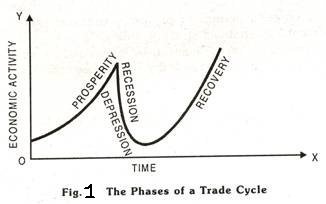
Four Phases of a Trade cycle are:

  1. Prosperity phase: Expansion or the upswing.
  2. Recessionary phase: A turn from prosperity to depression (or upper turning point).
  3. Depressionary phase: Contraction or downswing.
  4. Revival or recovery phase: The turn from depression to prosperity (or lower turning point).

The above four phases of a trade cycle are shown in Fig. 1. These phases are recurrent and follow a regular sequence.

Phases of a Trade Cycle

1. Expansion Phase:

The expansion phase marks the beginning of the trade cycle. It is characterized by increasing economic activity across various sectors of the economy. During this phase, several key indicators typically show positive trends:

  • Gross Domestic Product (GDP) Growth:

GDP, which measures the total value of goods and services produced within a country’s borders, tends to rise during the expansion phase. Increased production, consumer spending, and investment contribute to this growth.

  • Employment:

As economic activity expands, businesses experience rising demand for goods and services. This often leads to increased hiring to meet the growing demand, resulting in lower unemployment rates.

  • Consumer Spending:

Consumers tend to have more disposable income during periods of economic expansion, leading to increased spending on goods and services. This increased consumer demand further fuels economic growth.

  • Business Investment:

Businesses are more likely to invest in capital goods, such as machinery and equipment, during the expansion phase. Higher confidence in future economic prospects encourages firms to expand their productive capacity to meet growing demand.

  • Stock Market Performance:

Stock prices typically rise during the expansion phase as investors anticipate higher corporate profits and economic growth. Bull markets, characterized by rising stock prices, are common during this phase.

2. Peak Phase:

The peak phase represents the highest point of economic activity within the trade cycle. It is characterized by several key features:

  • Full Capacity Utilization:

During the peak phase, resources such as labor and capital are fully utilized as demand for goods and services reaches its highest levels. Production may be operating at or near maximum capacity.

  • Inflationary Pressures:

As demand outstrips supply during the peak phase, prices tend to rise, leading to inflationary pressures. This can be reflected in higher consumer prices, wage growth, and increased production costs.

  • Tight Labor Market:

With low unemployment rates and high demand for labor, competition for workers intensifies during the peak phase. This can lead to wage increases and labor shortages in certain industries.

  • Business Confidence:

Businesses may become increasingly optimistic about future economic prospects during the peak phase, leading to higher levels of investment and expansion plans.

  • Stock Market Volatility:

While stock prices may continue to rise during the peak phase, volatility often increases as investors become more cautious about the sustainability of economic growth.

3. Contraction Phase:

Following the peak phase, the economy enters the contraction phase, also known as a recession or downturn. This phase is characterized by declining economic activity and several negative trends:

  • GDP Contraction:

Economic output, as measured by GDP, begins to decline during the contraction phase as demand for goods and services weakens. This can be driven by factors such as reduced consumer spending, declining investment, and falling exports.

  • Rising Unemployment:

As businesses cut back on production and investment in response to weakening demand, unemployment rates tend to rise. Layoffs and hiring freezes become more common as companies adjust to the downturn.

  • Decreased Consumer Spending:

Consumer confidence often declines during the contraction phase, leading to reduced spending on discretionary goods and services. Consumers may prioritize essential purchases and cut back on non-essential items.

  • Declining Business Investment:

Businesses become more cautious about investing in new capital projects and expansion plans during the contraction phase. Uncertainty about future economic conditions and weak demand can lead to a decrease in business investment.

  • Stock Market Decline:

Stock prices typically fall during the contraction phase as investors react to negative economic news and uncertainty about future earnings prospects. Bear markets, characterized by falling stock prices, are common during recessions.

4. Trough Phase:

The trough phase represents the lowest point of the trade cycle and marks the end of the contraction phase. While economic conditions remain challenging, there are signs of stabilization and the beginning of recovery:

  • Stabilization of Economic Indicators:

Economic indicators such as GDP, employment, and consumer spending may stabilize or show signs of improvement during the trough phase. The rate of decline in economic activity begins to slow down.

  • Policy Responses:

Governments and central banks often implement monetary and fiscal policies to stimulate economic growth during the trough phase. These may include interest rate cuts, fiscal stimulus measures, and efforts to restore confidence in the financial system.

  • Inventory Rebuilding:

Businesses may start to rebuild inventories during the trough phase in anticipation of future demand. This can contribute to a gradual increase in production and economic activity.

  • Bottoming Out of Stock Market:

While stock prices may still be volatile during the trough phase, there may be signs that the market is bottoming out as investors anticipate a recovery in corporate earnings and economic growth.

  • Early Signs of Recovery:

Some sectors of the economy may begin to show signs of improvement during the trough phase, signaling the start of the recovery process. These early indicators can include increased consumer confidence, rising business investment, and stabilization in housing markets.

Trade Cycle: Introduction and Theories of Trade Cycle

Trade Cycle refers to fluctuations in economic activities specially in employment, output and income, prices, profits etc. It has been defined differently by different economists. According to Mitchell, “Business cycles are of fluctuations in the economic activities of organized communities. The adjective ‘business’ restricts the concept of fluctuations in activities which are systematically conducted on commercial basis.

Features of a Trade Cycle

  • A business cycle is synchronic. When cyclical fluctuations start in one sector it spreads to other sectors.
  • In a trade cycle, a period of prosperity is followed by a period of depression. Hence trade cycle is a wave like movement.
  • Business cycle is recurrent and rhythmic; prosperity is followed by depression and vice versa.
  • Trade cycle is cumulative and self-reinforcing. Each phase feeds on itself and creates further movement in the same direction.
  • Trade cycle is asymmetrical. The prosperity phase is slow and gradual and the phase of depression is rapid.
  • The business cycle is not periodical. Some trade cycles last for three or four years, while others last for six or eight or even more years.
  • The impact of a trade cycle is differential. It affects different industries in different ways.
  • Trade cycle is international in character. Through international trade, booms and depressions in one country are passed to other countries.

Theories of Trade Cycle

Many theories have been put forward from time to time to explain the phenomenon of trade cycles. These theories can be classified into non-monetary and monetary theories.

Non-Monetary Theories of Trade Cycle

(a) Sunspot Theory or Climatic Theory

It is the oldest theory of trade cycle. It is associated with W.S.Jevons and later on developed by H.C.Moore. According to this theory, the spot that appears on the sun influences the climatic conditions. When the spot appears, it will affect rainfall and hence agricultural crops.

When there is crop failure, that will result in depression. On the other hand, if the spot did not appear on the sun, rainfall is good leading to prosperity. Thus, the variations in climate are so regular that depression is followed by prosperity.

However, this theory is not accepted today. Trade cycle is a complex phenomenon and it cannot be associated with climatic conditions. If this theory is correct, then industrialised countries should be free from cyclical fluctuations. But it is the advanced, industrialised countries which are affected by trade cycles.

(b) Psychological Theory

This theory was developed by A.C. Pigou. He emphasized the role of psychological factor in the generation of trade cycles. According to Pigou, the main cause for trade cycle is optimism and pessimism among business people and bankers. During the period of good trade, entrepreneurs become optimistic which would lead to increase in production.

The feeling of optimism is spread to other. Hence investments are increased beyond limits and there is over production, which results in losses. Entrepreneurs become pessimistic and reduce their investment and production. Thus, fluctuations are due to optimism leading to prosperity and pessimism resulting depression.

Though there is an element of truth in this theory, this theory is unable to explain the occurrence of boom and starting of revival. Further this theory fails to explain the periodicity of trade cycle.

(c) Overinvestment Theory

Arthur Spiethoff and D.H. Robertson have developed the over investment theory. It is based on Say’s law of markets. It believes that over production in one sector leads to over production in other sectors. Suppose, there is over production and excess supply in one sector, that will result in fall in price and income of the people employed in that sector. Fall in income will lead to a decline in demand for goods and services produced by other sectors. This will create over production in other sectors.

Spiethoff has pointed out that over investment is the cause for trade cycle. Over investment is due to indivisibility of investment and excess supply of bank credit. He gives the example of a railway company which lays down one more track to avoid traffic congestion. But this may result in excess capacity because the additional traffic may not be sufficient to utilise the second track fully.

Over investment and overproduction are encouraged by monetary factors. If the banking system places more money in the hands of entrepreneurs, prices will increase. The rise in prices may induce the entrepreneurs to increase their investments leading to over-investment. Thus Prof. Robertson has successfully combined real and monetary factors to explain business cycle.

This theory is realistic in the sense that it considers over investment as the cause of trade cycle. But it has failed to explain revival.

(d) Over-Saving or Under Consumption Theory

This theory is the oldest explanation of the cyclical fluctuations. This theory has been formulated by Malthus, Marx and Hobson. According to this theory, depression is due to over-saving. In the modern society, there is great inequalities of income. Rich people have large income but their marginal propensity to consume is less.

Hence they save and invest which results in an increase in the volume of goods. This causes a general glut in the market. At the same time, as majority of the people are poor, they have low propensity to consume. Therefore, consumption will not increase. Increase in the supply of goods and decline in the demand create under consumption and hence over production.

This theory is not free from criticism. This theory explains only the turning point from prosperity to depression. It does not say anything about recovery. This theory assumes that the amount saved would be automatically invested. But this is not true. It pays too much attention on saving and too little on others.

(e) Keynes’ Theory of Trade Cycles

Keynes doesn’t develop a complete and pure theory of trade cycles. According to Keynes, effective demand is composed of consumption and investment expenditure. It is effective demand which determines the level of income and employment.

Therefore, changes in total expenditure i.e., consumption and investment expenditures, affect effective demand and this will bring about fluctuation in economic activity. Keynes believes that consumption expenditure is stable and it is the fluctuation in investment expenditure which is responsible for changes in output, income and employment.

Investment depends on rate of interest and marginal efficiency of capital. Since rate of interest is more or less stable, marginal efficiency of capital determines investment. Marginal efficiency of capital depends on two factors – prospective yield and supply price of the capital asset. An increase in MEC will create more employment, output and income leading to prosperity. On the other hand, a decline in MEC leads to unemployment and fall in income and output. It results in depression.

During the period of expansion businessmen are optimistic. MEC is rapidly increasing and rate of interest is sticky. So entrepreneurs undertake new investment. The process of expansion goes on till the boom is reached. As the process of expansion continues, cost of production increases, due to scarcity of factors of production. This will lead to a fall in MEC. Further, price of the product falls due to abundant supply leading to a decline in profits.

This leads to depression. As time passes, existing machinery becomes worn out and has to be replaced. Surplus stocks of goods are exhausted. As there is a fall in price of raw-materials and equipment, costs fall. Wages also go down. MEC increases leading to recovery. Keynes states that, “Trade cycle can be described and analyzed in terms of the fluctuations of the marginal efficiency of capital relatively to the rate of interest”.

The merit of Keynes’ theory lies in explaining the turning points-the lower and upper turning points of a trade cycle. The earlier economists considered the changes in the amount of credit given by banking system to be responsible for cyclical fluctuations. But for Keynes, the change in consumption function with its effect on MEC is responsible for trade cycle. Keynes, thus, has given a satisfactory explanation of the turning points of the trade cycle, “Keynes consumption function filled a serious gap and corrected a serious error in the previous theory of the business cycle”.

Critics have pointed out the weakness of Keynes’ theory. Firstly, according to Keynes the main cause for trade cycle is the fluctuations in MEC. But the term marginal efficiency of capital is vague. MEC depends on the expectations of the entrepreneur about future. In this sense, it is similar to that of Pigou’s psychological theory. He has ignored real factors.

Secondly, Keynes assumes that rate of interest is stable. But rate of interest does play an important role in decision making process of entrepreneurs.

Thirdly, Keynes does not explain periodicity of trade cycle. In a period of recession and depression, according to Keynes, rate of interest should be high due to strong liquidity preference. But, during this period, rate of interest is very low. Similarly during boom, rate of interest should be low because of weak liquidity preference; but actually the rate of interest is high.

(f) Schumpeter’s Innovation Theory

Joseph A. Schumpeter has developed innovation theory of trade cycles. An innovation includes the discovery of a new product, opening of a new market, reorganization of an industry and development of a new method of production. These innovations may reduce the cost of production and may shift the demand curve. Thus innovations may bring about changes in economic conditions.

Suppose, at the full employment level, an innovation in the form of a new product has been introduced. Innovation is financed by bank loans. As there is full employment already, factors of production have to be withdrawn from others to manufacture the new product. Hence, due to competition for factors of production costs may go up, leading to an increase in price.

When the new product becomes successful, other entrepreneurs will also produce similar products. This will result in cumulative expansion and prosperity. When the innovation is adopted by many, supernormal profits will be competed away. Firms incurring losses will go out of business. Employment, output and income fall resulting in depression.

Schumpeter’s theory has been criticised on the following grounds.

Firstly, Schumpter’s theory is based on two assumptions viz., full employment and that innovation is being financed by banks. But full employment is an unrealistic assumption, as no country in the world has achieved full employment. Further innovation is usually financed by the promoters and not by banks. Secondly, innovation is not the only cause of business cycle. There are many other causes which have not been analysed by Schumpter.

Monetary Theories of Trade Cycles

(a) Over-Investment Theory

Prof. Von Hayek in his books on “Monetary Theory and Trade Cycle” and “Prices and Production” has developed a theory of trade cycle. He has distinguished between equilibrium or natural rate of interest and market rate of interest. Market rate of interest is one at which demand for and supply of money are equal.

Equilibrium rate of interest is one at which savings are equal to investment. If both equilibrium rate of interest and market rate of interest are equal, there will be stability in the economy. If equilibrium rate of interest is higher than market rate of interest there will be prosperity and vice versa.

For instance, if the market rate of interest is lower than equilibrium rate of interest due to increase in money supply, investment will go up. The demand for capital goods will increase leading to a rise in price of these goods. As a result, there will be a diversion of resources from consumption goods industries to capital goods industries. Employment and income of the factors of production in capital goods industries will increase.

This will increase the demand for consumption goods. There will be competition for factors of production between capital goods and consumption good industries. Factor prices go up. Cost of production increases. At this time, banks will decide to reduce credit expansion. This will lead to rise in market rate of interest above the equilibrium rate of interest. Investment will fall; production declines leading to depression.

Hayek’s theory has certain weaknesses:-

  • It is not easy to transfer resources from capital goods industries to consumer goods industries and vice versa.
  • This theory does not explain all the phases of trade cycle.
  • It gives too much importance to rate of interest in determining investment. It has neglected other factors determining investment.
  • Hayek has suggested that the volume of money supply should be kept neutral to solve the problem of cyclical fluctuations. But this concept of neutrality of money is based on old quantity theory of money which has lost its validity.

(b) Hawtrey’s Monetary Theory

Prof. Hawtrey considers trade cycle to be a purely monetary phenomenon. According to him non-monetary factors like wars, strike, floods, drought may cause only temporary depression. Hawtrey believes that expansion and contraction of money are the basic causes of trade cycle. Money supply changes due to changes in rates of interest.

When rate of interest is reduced by banks, entrepreneurs will borrow more and invest. This causes an increase in money supply and rise in price leading to expansion. On the other hand, an increase in the rate of interest will lead to reduction in borrowing, investment, prices and business activity and hence depression.

Hawtrey believes that trade cycle is nothing but small scale replica of inflation and deflation. An increase in money supply will lead to boom and vice versa, a decrease in money supply will result in depression.

Banks will give more loans to traders and merchants by lowering the rate of interest. Merchants place more orders which induce the entrepreneurs to increase production by employing more labourers. This results in increase in employment and income leading to an increase in demand for goods. Thus the phase of expansion starts.

Business expands; factors of production are fully employed; price increases further, resulting in boom conditions. At this time, the banks call off loans from the borrowers. In order to repay the loans, the borrowers sell their stocks. This sudden disposal of goods leads to fall in prices and liquidation of marginal firms. Banks will further contract credit.

Thus the period of contraction starts making the producers reduce their output. The process of contraction becomes cumulative leading to depression. When the economy is at the level of depression, banks have excess reserves. Therefore, banks will lend at a low rate of interest which makes the entrepreneurs to borrow more. Thus revival starts, becomes cumulative and leads to boom.

Hawtrey’s theory has been criticised on many grounds

  • Hawtrey’s theory is considered to be an incomplete theory as it does not take into account the non-monetary factors which cause trade cycles.
  • It is wrong to say that banks alone cause business cycle. Credit expansion and contraction do not lead to boom and depression. But they are accentuated by bank credit.
  • The theory exaggerates the importance of bank credit as a means of financing development. In recent years, all firms resort to plough back of profits for expansion.
  • Mere contraction of bank credit will not lead to depression if marginal efficiency of capital is high. Businessmen will undertake investment in-spite of high rate of interest if they feel that the future prospects are bright.
  • Rate of interest does not determine the level of borrowing and investment. A high rate of interest will not prevent the people to borrow. Therefore, it may be stated that banking system cannot originate a trade cycle. Expansion and contraction of credit may be a supplementary cause but not the main and sole cause of trade cycle.

Difficulties in Measuring National Income

There are many conceptual and statistical problems involved in measuring national income by the income method, product method, and expenditure method.

We discuss them separately in the light of the three methods:

  1. Problems in Income Method

The following problems arise in the computation of National Income by income method:

(i) Owner-occupied Houses

A person who rents a house to another earns rental income, but if he occupies the house himself, will the services of the house-owner be included in national income. The services of the owner-occupied house are included in national income as if the owner sells to himself as a tenant its services.

For the purpose of national income accounts, the amount of imputed rent is estimated as the sum for which the owner-occupied house could have been rented. The imputed net rent is calculated as that portion of the amount that would have accrued to the house-owner after deducting all expenses.

(ii) Self-employed Persons

Another problem arises with regard to the income of self-employed persons. In their case, it is very difficult to find out the different inputs provided by the owner himself. He might be contributing his capital, land, labour and his abilities in the business. But it is not possible to estimate the value of each factor input to production. So he gets a mixed income consisting of interest, rent, wage and profits for his factor services. This is included in national income.

(iii) Goods meant for Self-consumption

In under-developed countries like India, farmers keep a large portion of food and other goods produced on the farm for self-consumption. The problem is whether that part of the produce which is not sold in the market can be included in national income or not. If the farmer were to sell his entire produce in the market, he will have to buy what he needs for self-consumption out of his money income. If, instead he keeps some produce for his self-consumption, it has money value which must be included in national income.

(iv) Wages and Salaries paid in Kind

Another problem arises with regard to wages and salaries paid in kind to the employees in the form of free food, lodging, dress and other amenities. Payments in kind by employers are included in national income. This is because the employees would have received money income equal to the value of free food, lodging, etc. from the employer and spent the same in paying for food, lodging, etc.

2. Problems in Product Method

The following problems arise in the computation of national income by product method:

(i) Services of Housewives

The estimation of the unpaid services of the housewife in the national income presents a serious difficulty. A housewife renders a number of useful services like preparation of meals, serving, tailoring, mending, washing, cleaning, bringing up children, etc.

She is not paid for them and her services are not including in national income. Such services performed by paid servants are included in national income. The national income is, therefore, underestimated by excluding the services of a housewife.

The reason for the exclusion of her services from national income is that the love and affection of a housewife in performing her domestic work cannot be measured in monetary terms. That is why when the owner of a firm marries his lady secretary, her services are not included in national income when she stops working as a secretary and becomes a housewife.

When a teacher teaches his own children, his work is also not included in national income. Similarly, there are a number of goods and services which are difficult to be assessed in money terms for the reason stated above, such as painting, singing, dancing, etc. as hobbies.

(ii) Intermediate and Final Goods

The greatest difficulty in estimating national income by product method is the failure to distinguish properly between intermediate and final goods. There is always the possibility of including a good or service more than once, whereas only final goods are included in national income estimates. This leads to the problem of double counting which leads to the overestimation of national income.

(iii) Second-hand Goods and Assets

Another problem arises with regard to the sale and purchase of second-hand goods and assets. We find that old scooters, cars, houses, machinery, etc. are transacted daily in the country. But they are not included in national income because they were counted in the national product in the year they were manufactured.

If they are included every time they are bought and sold, national income would increase many times. Similarly, the sale and purchase of old stocks, shares, and bonds of companies are not included in national income because they were included in national income when the companies were started for the first time. Now they are simply financial transactions and represent claims.

But the commission or fees charged by the brokers in the repurchase and resale of old shares, bonds, houses, cars or scooters, etc. are included in national income. For these are the payments they receive for their productive services during the year.

(iv) Illegal Activities

Income earned through illegal activities like gambling, smuggling, illicit extraction of wine, etc. is not included in national income. Such activities have value and satisfy the wants of the people but they are not considered productive from the point of view of society. But in countries like Nepal and Monaco where gambling is legalised, it is included in national income. Similarly, horse-racing is a legal activity in England and is included in national income.

(v) Consumers’ Service

There are a number of persons in society who render services to consumers but they do not produce anything tangible. They are the actors, dancers, doctors, singers, teachers, musicians, lawyers, barbers, etc. The problem arises about the inclusion of their services in national income since they do not produce tangible commodities. But as they satisfy human wants and receive payments for their services, their services are included as final goods in estimating national income.

(vi) Capital Gains

The problem also arises with regard to capital gains. Capital gains arise when a capital asset such as a house, some other property, stocks or shares, etc. is sold at higher price than was paid for it at the time of purchase. Capital gains are excluded from national income because these do not arise from current economic activities. Similarly, capital losses are not taken into account while estimating national income.

(vii) Inventory Changes

All inventory changes (or changes in stocks) whether positive or negative are included in national income. The procedure is to take changes in physical units of inventories for the year valued at average current prices paid for them.

The value of changes in inventories may be positive or negative which is added or subtracted from the current production of the firm. Remember, it is the change in inventories and not total inventories for the year that are taken into account in national income estimates.

(viii) Depreciation

Depreciation is deducted from GNP in order to arrive at NNP. Thus depreciation lowers the national income. But the problem is of estimating the current depreciated value of, say, a machine, whose expected life is supposed to be thirty years. Firms calculate the depreciation value on the original cost of machines for their expected life. This does not solve the problem because the prices of machines change almost every year.

(ix) Price Changes

National income by product method is measured by the value of final goods and services at current market prices. But prices do not remain stable. They rise or fall. When the price level rises, the national income also rises, though the national production might have fallen.

On the contrary, with the fall in the price level, the national income also falls, though the national production might have increased. So price changes do not adequately measure national income. To solve this problem, economists calculate the real national income at a constant price level by the consumer price index.

3. Problems in Expenditure Method

The following problems arise in the calculation of national income by expenditure method:

(i) Government Services

In calculating national income by, expenditure method, the problem of estimating government services arises. Government provides a number of services, such as police and military services, administrative and legal services. Should expenditure on government services be included in national income?

If they are final goods, then only they would be included in national income. On the other hand, if they are used as intermediate goods, meant for further production, they would not be included in national income. There are many divergent views on this issue.

One view is that if police, military, legal and administrative services protect the lives, property and liberty of the people, they are treated as final goods and hence form part of national income. If they help in the smooth functioning of the production process by maintaining peace and security, then they are like intermediate goods that do not enter into national income.

In reality, it is not possible to make a clear demarcation as to which service protects the people and which protects the productive process. Therefore, all such services are regarded as final goods and are included in national income.

(ii) Transfer Payments

There arises the problem of including transfer payments in national income. Government makes payments in the form of pensions, unemployment allowance, subsidies, interest on national debt, etc. These are government expenditures but they are not included in national income because they are paid without adding anything to the production process during the current year.

For instance, pensions and unemployment allowances are paid to individuals by the government without doing any productive work during the year. Subsidies tend to lower the market price of the commodities. Interest on national or public debt is also considered a transfer payment because it is paid by the government to individuals and firms on their past savings without any productive work.

(iii) Durable-use Consumers’ Goods

Durable-use consumers’ goods also pose a problem. Such durable-use consumers’ goods as scooters, cars, fans, TVs, furniture’s, etc. are bought in one year but they are used for a number of years. Should they be included under investment expenditure or consumption expenditure in national income estimates? The expenditure on them is regarded as final consumption expenditure because it is not possible to measure their used up value for the subsequent years.

But there is one exception. The expenditure on a new house is regarded as investment expenditure and not consumption expenditure. This is because the rental income or the imputed rent which the house-owner gets is for making investment on the new house. However, expenditure on a car by a household is consumption expenditure. But if he spends the amount for using it as a taxi, it is investment expenditure.

(iv) Public Expenditure

Government spends on police, military, administrative and legal services, parks, street lighting, irrigation, museums, education, public health, roads, canals, buildings, etc. The problem is to find out which expenditure is consumption expenditure and which investment expenditure is.

Expenses on education, museums, public health, police, parks, street lighting, civil and judicial administration are consumption expenditure. Expenses on roads, canals, buildings, etc. are investment expenditure. But expenses on defence equipment are treated as consumption expenditure because they are consumed during a war as they are destroyed or become obsolete. However, all such expenses including the salaries of armed personnel are included in national income.

Various Methods of Measurement of National Income

National income is an uncertain term which is used interchangeably with national dividend, national output and national expenditure. On this basis, national income has been defined in a number of ways. In common parlance, national income means the total value of goods and services produced annually in a country.

Methods of Measurement of National Income

There are four methods of measuring national income. Which method is to be used depends on the availability of data in a country and the purpose in hand.

  1. Product Method

According to this method, the total value of final goods and services produced in a country during a year is calculated at market prices. To find out the GNP, the data of all productive activities, such as agricultural products, wood received from forests, minerals received from mines, commodities produced by industries, the contributions to production made by transport, communications, insurance companies, lawyers, doctors, teachers, etc. are collected and assessed at market prices. Only the final goods and services are included and the intermediary goods and services are left out.

  1. Income Method

According to this method, the net income payments received by all citizens of a country in a particular year are added up, i.e., net incomes that accrue to all factors of production by way of net rents, net wages, net interest and net profits are all added together but incomes received in the form of transfer payments are not included in it. The data pertaining to income are obtained from different sources, for instance, from income tax department in respect of high income groups and in case of workers from their wage bills.

  1. Expenditure Method

According to this method, the total expenditure incurred by the society in a particular year is added together and includes personal consumption expenditure, net domestic investment, government expenditure on goods and services, and net foreign investment. This concept is based on the assumption that national income equals national expenditure

  1. Value Added Method

Another method of measuring national income is the value added by industries. The difference between the value of material outputs and inputs at each stage of production is the value added. If all such differences are added up for all industries in the economy, we arrive at the gross domestic product.

Limitations in Measuring National Income

There are many conceptual and statistical problems involved in measuring national income by the income method, product method, and expenditure method.

  1. Problems in Income Method

The following problems arise in the computation of National Income by income method:

(i) Owner-occupied Houses

A person who rents a house to another earns rental income, but if he occupies the house himself, will the services of the house-owner be included in national income. The services of the owner-occupied house are included in national income as if the owner sells to himself as a tenant its services.

For the purpose of national income accounts, the amount of imputed rent is estimated as the sum for which the owner-occupied house could have been rented. The imputed net rent is calculated as that portion of the amount that would have accrued to the house-owner after deducting all expenses.

(ii) Self-employed Persons

Another problem arises with regard to the income of self-employed persons. In their case, it is very difficult to find out the different inputs provided by the owner himself. He might be contributing his capital, land, labour and his abilities in the business. But it is not possible to estimate the value of each factor input to production. So he gets a mixed income consisting of interest, rent, wage and profits for his factor services. This is included in national income.

(iii) Goods meant for Self-consumption

In under-developed countries like India, farmers keep a large portion of food and other goods produced on the farm for self-consumption. The problem is whether that part of the produce which is not sold in the market can be included in national income or not. If the farmer were to sell his entire produce in the market, he will have to buy what he needs for self-consumption out of his money income. If, instead he keeps some produce for his self-consumption, it has money value which must be included in national income.

(iv) Wages and Salaries paid in Kind

Another problem arises with regard to wages and salaries paid in kind to the employees in the form of free food, lodging, dress and other amenities. Payments in kind by employers are included in national income. This is because the employees would have received money income equal to the value of free food, lodging, etc. from the employer and spent the same in paying for food, lodging, etc.

2. Problems in Product Method

The following problems arise in the computation of national income by product method:

(i) Services of Housewives

The estimation of the unpaid services of the housewife in the national income presents a serious difficulty. A housewife renders a number of useful services like preparation of meals, serving, tailoring, mending, washing, cleaning, bringing up children, etc.

She is not paid for them and her services are not including in national income. Such services performed by paid servants are included in national income. The national income is, therefore, underestimated by excluding the services of a housewife.

The reason for the exclusion of her services from national income is that the love and affection of a housewife in performing her domestic work cannot be measured in monetary terms. That is why when the owner of a firm marries his lady secretary, her services are not included in national income when she stops working as a secretary and becomes a housewife.

When a teacher teaches his own children, his work is also not included in national income. Similarly, there are a number of goods and services which are difficult to be assessed in money terms for the reason stated above, such as painting, singing, dancing, etc. as hobbies.

(ii) Intermediate and Final Goods

The greatest difficulty in estimating national income by product method is the failure to distinguish properly between intermediate and final goods. There is always the possibility of including a good or service more than once, whereas only final goods are included in national income estimates. This leads to the problem of double counting which leads to the overestimation of national income.

(iii) Second-hand Goods and Assets

Another problem arises with regard to the sale and purchase of second-hand goods and assets. We find that old scooters, cars, houses, machinery, etc. are transacted daily in the country. But they are not included in national income because they were counted in the national product in the year they were manufactured.

If they are included every time they are bought and sold, national income would increase many times. Similarly, the sale and purchase of old stocks, shares, and bonds of companies are not included in national income because they were included in national income when the companies were started for the first time. Now they are simply financial transactions and represent claims.

But the commission or fees charged by the brokers in the repurchase and resale of old shares, bonds, houses, cars or scooters, etc. are included in national income. For these are the payments they receive for their productive services during the year.

(iv) Illegal Activities

Income earned through illegal activities like gambling, smuggling, illicit extraction of wine, etc. is not included in national income. Such activities have value and satisfy the wants of the people but they are not considered productive from the point of view of society. But in countries like Nepal and Monaco where gambling is legalised, it is included in national income. Similarly, horse-racing is a legal activity in England and is included in national income.

(v) Consumers’ Service

There are a number of persons in society who render services to consumers but they do not produce anything tangible. They are the actors, dancers, doctors, singers, teachers, musicians, lawyers, barbers, etc. The problem arises about the inclusion of their services in national income since they do not produce tangible commodities. But as they satisfy human wants and receive payments for their services, their services are included as final goods in estimating national income.

(vi) Capital Gains

The problem also arises with regard to capital gains. Capital gains arise when a capital asset such as a house, some other property, stocks or shares, etc. is sold at higher price than was paid for it at the time of purchase. Capital gains are excluded from national income because these do not arise from current economic activities. Similarly, capital losses are not taken into account while estimating national income.

(vii) Inventory Changes

All inventory changes (or changes in stocks) whether positive or negative are included in national income. The procedure is to take changes in physical units of inventories for the year valued at average current prices paid for them.

The value of changes in inventories may be positive or negative which is added or subtracted from the current production of the firm. Remember, it is the change in inventories and not total inventories for the year that are taken into account in national income estimates.

(viii) Depreciation

Depreciation is deducted from GNP in order to arrive at NNP. Thus depreciation lowers the national income. But the problem is of estimating the current depreciated value of, say, a machine, whose expected life is supposed to be thirty years. Firms calculate the depreciation value on the original cost of machines for their expected life. This does not solve the problem because the prices of machines change almost every year.

(ix) Price Changes

National income by product method is measured by the value of final goods and services at current market prices. But prices do not remain stable. They rise or fall. When the price level rises, the national income also rises, though the national production might have fallen.

On the contrary, with the fall in the price level, the national income also falls, though the national production might have increased. So price changes do not adequately measure national income. To solve this problem, economists calculate the real national income at a constant price level by the consumer price index.

3. Problems in Expenditure Method

The following problems arise in the calculation of national income by expenditure method:

(i) Government Services

In calculating national income by, expenditure method, the problem of estimating government services arises. Government provides a number of services, such as police and military services, administrative and legal services. Should expenditure on government services be included in national income?

If they are final goods, then only they would be included in national income. On the other hand, if they are used as intermediate goods, meant for further production, they would not be included in national income. There are many divergent views on this issue.

One view is that if police, military, legal and administrative services protect the lives, property and liberty of the people, they are treated as final goods and hence form part of national income. If they help in the smooth functioning of the production process by maintaining peace and security, then they are like intermediate goods that do not enter into national income.

In reality, it is not possible to make a clear demarcation as to which service protects the people and which protects the productive process. Therefore, all such services are regarded as final goods and are included in national income.

(ii) Transfer Payments

There arises the problem of including transfer payments in national income. Government makes payments in the form of pensions, unemployment allowance, subsidies, interest on national debt, etc. These are government expenditures but they are not included in national income because they are paid without adding anything to the production process during the current year.

For instance, pensions and unemployment allowances are paid to individuals by the government without doing any productive work during the year. Subsidies tend to lower the market price of the commodities. Interest on national or public debt is also considered a transfer payment because it is paid by the government to individuals and firms on their past savings without any productive work.

(iii) Durable-use Consumers’ Goods

Durable-use consumers’ goods also pose a problem. Such durable-use consumers’ goods as scooters, cars, fans, TVs, furniture’s, etc. are bought in one year but they are used for a number of years. Should they be included under investment expenditure or consumption expenditure in national income estimates? The expenditure on them is regarded as final consumption expenditure because it is not possible to measure their used up value for the subsequent years.

But there is one exception. The expenditure on a new house is regarded as investment expenditure and not consumption expenditure. This is because the rental income or the imputed rent which the house-owner gets is for making investment on the new house. However, expenditure on a car by a household is consumption expenditure. But if he spends the amount for using it as a taxi, it is investment expenditure.

(iv) Public Expenditure

Government spends on police, military, administrative and legal services, parks, street lighting, irrigation, museums, education, public health, roads, canals, buildings, etc. The problem is to find out which expenditure is consumption expenditure and which investment expenditure is.

Expenses on education, museums, public health, police, parks, street lighting, civil and judicial administration are consumption expenditure. Expenses on roads, canals, buildings, etc. are investment expenditure. But expenses on defence equipment are treated as consumption expenditure because they are consumed during a war as they are destroyed or become obsolete. However, all such expenses including the salaries of armed personnel are included in national income.

error: Content is protected !!