Comptroller and Auditor General of India (CAG)

The Comptroller and Auditor General of India is the Constitutional Authority in India, established under Article 148 of the Constitution of India. He is empowered to Audit all receipts and expenditure of the Government of India and the State Governments, including those of autonomous bodies and corporations substantially financed by the Government. The CAG is also the statutory auditor of Government-owned corporations and conducts supplementary audit of government companies in which the Government has an equity share of at least 51 per cent or subsidiary companies of existing government companies. The reports of the CAG are laid before the Parliament/Legislatures and are being taken up for discussion by the Public Accounts Committees (PACs) and Committees on Public Undertakings (COPUs), which are special committees in the Parliament of India and the state legislatures. The CAG is also the head of the Indian Audit and Accounts Department, the affairs of which are managed by officers of Indian Audit and Accounts Service, and has 43,576 employees across the country (as on 01.03.2020).

In 1971, the central government enacted the Comptroller and Auditor General of India (Duties, Powers, and Conditions of Service) Act, 1971. In 1976, CAG was relieved from accounting functions.

Articles 148–151 of the Constitution of India deal with the institution of the CAG of India.

Duties of the CAG

As per the provisions of the constitution, the CAG’s (DPC) (Duties, Powers and Conditions of Service) Act, 1971 was enacted. As per the various provisions, the duties of the CAG include the audit of:

  • Receipts and expenditure from the Consolidated Fund of India and of the State and Union Territory having legislative assembly.
  • Trading, manufacturing, profit and loss accounts and balance sheets, and other subsidiary accounts kept in any Government department; Accounts of stores and stock kept in Government offices or departments.
  • Government companies as per the provisions of the Companies Act, 2013.
  • Corporations established by or under laws made by Parliament in accordance with the provisions of the respective legislation.
  • Authorities and bodies substantially financed from the Consolidated Funds of the Union and State Governments. Anybody or authority even though not substantially financed from the Consolidated Fund, the audit of which may be entrusted to the CAG.
  • Grants and loans given by Government to bodies and authorities for specific purposes.
  • Entrusted audits e.g. those of Panchayati Raj Institutions and Urban Local Bodies under Technical Guidance & Support (TGS).

Scope of audits

Audit of government accounts (including the accounts of the state governments) in India is entrusted to the CAG of India who is empowered to audit all expenditure from the Consolidated Fund of the union or state governments, whether incurred within India or outside, all revenue into the Consolidated Funds and all transactions relating to the Public Account and the Contingency Funds of the Union and the states. Specifically, audits include:

  • Transactions relating to debt, deposits, remittances, Trading, and manufacturing.
  • Profit and loss accounts and balance sheets kept under the order of the President or Governors.
  • Receipts and stock accounts. CAG also audits the books of accounts of the government companies as per Companies Act.

In addition, the CAG also executes performance and compliance audits of various functions and departments of the government. Recently, the CAG as a part of thematic review on “Introduction of New Trains” is deputing an auditors’ team on selected trains, originating and terminating at Sealdah and Howrah stations, to assess the necessity of their introduction. In a path-breaking judgement, the Supreme Court of India ruled that the CAG General could audit private firms in revenue-share deals with government.

Roles of CAG

  • The CAG has to ascertain whether the money spent was authorised for the purpose for which they were spent.
  • The CAG is an agent of the Parliament and conducts audits of expenditure on behalf of the Parliament. Therefore, he is responsible only to the Parliament.
  • He focuses on whether the expenditure made is in the public interest or not.
  • Some corporations are audited directly by the CAG. For example, ONGC, Air India, and others.
  • The role of CAG in the auditing of public corporations is limited.
  • The role of the CAG in the auditing of Government Companies is also limited. They are audited by private auditors who are appointed by the Central Government on the advice of the CAG.
  • Some corporations are audited by private professional auditors who are appointed by the Central Government in consultation with CAG. If necessary, there may be a supplementary audit by CAG.
Central Vigilance Commission (CVC)

Central Vigilance Commission (CVC) is an apex Indian governmental body created in 1964 to address governmental corruption. In 2003, the Parliament enacted a law conferring statutory status on the CVC. It has the status of an autonomous body, free of control from any executive authority, charged with monitoring all vigilance activity under the Central Government of India, advising various authorities in central Government organizations in planning, executing, reviewing and reforming their vigilance work.

It was set up by the Government of India Resolution on 11 February 1964, on the recommendations of the Committee on Prevention of Corruption, headed by Shri K. Santhanam Committee, to advise and guide Central Government agencies in the field of vigilance. Nittoor Srinivasa Rau, was selected as the first Chief Vigilance Commissioner of India.

The Annual Report of the CVC not only gives the details of the work done by it but also brings out the system failures which leads to corruption in various Departments/Organisations, system improvements, various preventive measures and cases in which the commissions advise were ignored etc.

The Commission shall consist of:

  • A Central Vigilance Commissioner: Chairperson.
  • Not more than two Vigilance Commissioners: Members.

Role

The CVC is not an investigating agency: the only investigation carried out by the CVC is that of examining Civil Works of the Government.

Corruption investigations against government officials can proceed only after the government permits order. The CVC publishes a list of cases where permissions are pending, some of which may be more than a year old.

The Ordinance of 1998 conferred statutory status to the CVC and the powers to exercise superintendence over the functioning of the Delhi Special Police Establishment, and also to review the progress of the investigations on alleged offences under the Prevention of Corruption Act, 1988 conducted by them. In 1998 the Government introduced the CVC Bill in the Lok Sabha to replace the Ordinance, though it was not successful. The Bill was re-introduced in 1999 and remained with the Parliament until September 2003, when it became an Act after being duly passed in both the Houses of Parliament. The CVC has also been publishing a list of corrupt government officials against which it has recommended punitive action. In 2004, GoI authorized the CVC as the “Designated Agency” to receive written complaints for disclosure on any allegation of corruption or misuse of office and recommend appropriate action. This report delivers to the president.

Function:

  • To undertake an inquiry or cause an inquiry or investigation to be made into any transaction in which a public servant working in any organization, to which the executive control of the Government of India extends, is suspected or alleged to have acted for an improper purpose or in a corrupt manner;
  • To exercise a general check and supervision over vigilance and anti-corruption work in Ministries or Departments of the Government of India and other organizations to which the executive power of the Union extends.
  • To tender independent and impartial advice to the disciplinary and other authorities in disciplinary cases, involving vigilance angle at different stages i.e. investigation, inquiry, appeal, review etc.
  • To undertake or cause an inquiry into complaints received under the Public Interest Disclosure and Protection of Informer and recommend appropriate action.
  • The Central Government is required to consult the CVC in making rules and regulations governing the vigilance and disciplinary matters relating to the members of Central Services and All India Services.
  • Respond to Central Government on mandatory consultation with the Commission before making any rules or regulations governing the vigilance or disciplinary matters relating to the persons appointed to the public services and posts in connection with the affairs of the Union or to members of the All-India Services.

Purpose

  • The main purpose for which this important body had been established was to ensure all sorts of corruptions in government sector could be well prevented and addressed minutely.
  • Its major role is to recommend government agencies in “Planning, executing, reviewing and reforming” their vigilance capability.
  • It is an autonomous body, responsible for monitoring all vigilance activities under the union government.
  • Central Government of India formed CVC in the year 1964 as an important body that could take into account the measures and steps to prevent all the corruptions especially the governmental ones for a better system and governance.

Role and functions in Public Account Audits

In India, the parliamentary form of government is in force, the legislature has the power to ensure “That the appropriated money is spent economically, judiciously and for the purpose for which it was sanctioned”.

Even though the Comptroller and Auditor General of India is to audit the accounts of the government and to ensure the propriety of the money spent, yet his report is further examined by the special committee of the parliament, is known as Public Account Committee (РАС).

Functions:

  1. The main function of the committee is examination of the accounts and report of the Comptroller and Auditor General in order to ensure that the appropriations sanctioned by the parliament are spent by the executive authorities, “within the scope of the demand. It means that,

(a) Expenditure should not exceed the appropriation made by the parliament,

(b) That the expenditure has been incurred for the purpose for which it was voted by the Parliament,

(c) That amount has been spent by the officials, who are legally authorised to spend the money,

(d) That the executive has not overlooked the vote of parliament by adjusting expenditure in excess of a grant of another vote whose a saving has occurred.

  1. The second function of the committee extends beyond the formality of expenditure to its wisdom, faithfulness and economy. It means that the committee is not only to examine that money has been spent according to the rules and regulations, but it is also to see that the approved policy has been implemented by the executive authorities with maximum efficiency and economy.
  2. The third function of the committee is to examine the technicalities of the procedure employed in maintaining the accounts. In order to discharge these functions, the committee can send for persons, papers and records for evidence purpose. The committee reports its opinion and reservations and comments on items under consideration, but it has no power to disallow any items of expenditure.
  3. Finally, it is provided in the rules of procedure that the functions of the committee shall also extend in following cases:

(a) To examine the income and expenditure statement of state corporations, trading and manufacturing schemes, corners and projects.

(b) To examine the statement of accounts of autonomous and semi-autonomous bodies.

(c) To examine the accounts of those stores and stocks where the audit has been conducted by the Comptroller and Auditor General.

Procedure:

The committee conducts scrutiny by putting questions to the official’s witness. In conducting the major role of committee’s deliberation the chairman plays the most important role. The chairman, briefed by the Comptroller and Auditor General and the Secretary of the Committee takes the lead in putting questions to the official witnesses.

The official witnesses also come with full preparation to provide full knowledge of the problem to be Committee. The meetings of the committee are private and every care is taken to keep the secrecy of the witness.

After the examination of official witnesses, the committee sits down to discuss the framework of its report. When the thorough discussion is over the committee prepares its report, which contains recommendations and findings of the committee.

The report is generally prepared by the parliament secretariat, with guidance of the chairman and is sent to the Comptroller and Auditor-General for factual verification. After verification, the report is again considered by the committee.

Thereafter it is presented to the parliament for by the chairman acceptance. Sometimes the committee also functions through its sub-committee to study some special problems. The sub-committee submits its report to the committee.

After thorough considerations of the committee, the report is prepared on the basis of the facts placed before it. Then the committee submits the report with its recommendations to the house.

Payment to Creditors

The term creditor can mean different things depending on the situation, but it typically means a financial institution or person who is owed money.

If you’re the person who owes the money to a creditor, you may be referred to as a debtor or borrower.

Once a borrower and lender agree on terms for financing and sign a loan agreement, they’re entering into a contract. That contract often specifies the repayment agreement terms of the loan and the expected payment amounts.

You may hear the terms lender and creditor used interchangeably. The same goes for borrower and debtor. But you’ll more likely hear creditor and debtor used during legal proceedings where a creditor is trying to collect on an outstanding balance, such as during a bankruptcy case.

There are several types of creditors, such as real creditors, personal creditors, secured creditors and unsecured creditors.

Personal creditors: These are friends or family you owe money.

Real creditors: A real creditor is a financial institution, such as a bank or credit card issuer, that has a right to be repaid.

Secured creditors: These lenders have a legal right often through a lien to property you used as collateral to secure the loan.

Unsecured creditors: A credit card issuer is a good example of this type of creditor. You may owe money, but it’s unsecured debt, meaning you haven’t agreed to give the creditor any property such as a car or home as collateral to secure your debt.

Ex.

Auto loans: Similar to a mortgage, an auto loan is a loan that someone takes out in order to purchase a vehicle.

Mortgage: A mortgage is a loan you take out from a financial institution to purchase a house. In this case, the creditor would be the financial institution that provides the borrower with the mortgage loan.

Credit cards: Credit cards offer a revolving credit line with a specified credit limit. The credit card issuer that extended the credit line could be the creditor if you have an outstanding balance.

Student loans: Students who cannot afford the cost of tuition on their own can apply for financial aid, including student loans to cover expenses such as tuition, housing and books. When the time comes to repay the student loan, payments are made to the creditor.

Personal Loans: A personal loan is a loan often unsecured that can help you pay for a big project like home improvements or to consolidate debt. If you have an outstanding balance on the personal loan, the creditor is likely the lender that issued the loan.

The company can make the payment to creditors journal entry by debiting the payables account and crediting the cash account.

  • If we pay creditor through cheque, then the journal entry will be

Creditor A/C Dr

To, Bank A/C

(Being creditors paid through cheque)

  • If we pay creditor through cash, then the journal entry will be

Creditor A/C Dr

To, Cash A/C

Account Debit Credit
Payables ₹₹₹
Cash ₹₹₹

Payable account here can be accounts payable, note payable, loan payable, or other types of payables depending on the type of debts the company has as well as the name of the ledger account in the chart of accounts for the credit it owes.

For example, when the company borrows the money from the bank, it may record the debt as note payable or loan payable for the liability it owes to the bank. On the other hand, if the company purchases goods on credit from its supplier, it may record the liability as the accounts payable or the trade payable depending on which one it deems.

Position of an Auditor as regards the Valuation of Assets

An auditor may rely on the directors of the company or on the certificates of other professional in respect of valuation of the assets, provided he uses reasonable care and skill. In matters relating to valuation of assets the auditor must adhere to the generally accepted principles of valuation, commercial practices and accounting standards.

The auditor should ensure that adequate depreciation has been charged on assets before determining the current value. The auditor should state the basis of valuation of assets in the Balance Sheet as certified by the directors or engineers, architect etc. as the case may be.

Valuation means estimation of various assets and liabilities. It is the duty of Auditor to confirm that assets and liabilities are appearing in the balance sheet exhibiting their proper and correct value. In the absence of proper valuation of assets and liabilities, they will exhibit either overvalued or under-valued.

It is therefore required for an Auditor to exercise reasonable care and skill to analyze the basis of valuation from technical experts and satisfy himself that assets shown in Balance-sheet are properly valued accordance with the generally accepted conventions and accounting principles.

Components of Valuation

Methods of valuation of assets are as hereunder:

  • Book Value: This is the value as appearing in the books of accounts; the cost price less depreciation.
  • Cost Price: This is the cost price paid at the time of acquisition of assets plus the freight charges, octroi charges, and commissioning and installation charges, etc. to bring that asset in usable condition.
  • Realizable Value: A Value which can be realized from the sale of assets.
  • Market Value: A value which the asset can fetch at the time of sale.
  • Replacement Value: A value on which an asset can be replaced.
  • Conventional Value: It means the cost price less depreciation written off ignoring any kind of fluctuation in the price.
  • Scrap Value: If the asset is not in working condition and sold as scrap, then the sale value of asset is scrap value.

Basis of Valuation

Auditor should ensure that the basis of valuation is correct and reliable. He should keep in mind the process of valuation which is as follows:

  • Original cost
  • Expected working hours of the assets
  • Wear and tear expenses
  • Scrap value
  • Chances of asset become obsolete

Fixed asset is valued at cost price less depreciation and current assets should be valued at cost or market price whichever is less.

Vouching, Verification and Valuation

In vouching, accounting entries are checked with the bona-fide vouchers.

  • Verification proves the existence, ownership and title of assets.
  • Valuation certifies the correct value of asset.
  • Vouching is done after original entry in the books of accounts.
  • Verification and valuation are done at the end of the financial year.
  • Vouching is done by Senior Auditor and Audit Clerk.
  • Verification and valuation are done by the Auditor
  • Bonafide vouchers are sufficient evidence for vouching
  • For Valuation Auditor has to depend upon certification from owner/partner/director.
  • Verification is done by physical verification, title deeds and receipt of payment, etc.

Verification and Valuation of Copyright

Copyright

Copyright provides legal protection and legal rights to an author by which the publication of his work by another is prohibited. Copyright remains with the author for lifetime and even 50 years after his death.

Verification of Copyright

  • The Auditor should examine the agreement between the author and the publisher.
  • If there are numbers of copyright with the same publisher. Auditor should ask for the schedule of copyrights.

Valuation of Copyright

Copyrights lose their value over a passage of time; hence the value of copyright is not stable. In case where the sale of publication is very low or nil, value of copyright should be written off.

Value of copyright in the Balance-sheet will be shown as cost less the value written off.

Verification and Valuation of Fixed Assets

Verification of Freehold Land and Building

  • Auditor should examine the title deed of the land and building.
  • Land and building shown in the books should be according to the title deed.
  • Profit or loss on sale of it should be duly adjusted in the account.
  • Any addition to it should be carefully examined by the Auditor.

Verification of Mortgage Property

  • The Auditor should confirm that there should be no second or third mortgage on it.
  • The Auditor should obtain certificate from mortgagee that title deed is in his possession.
  • The Auditor cannot be held responsible if there is any defect of title. The Auditor can only verify that title deed apparently in order and in the name of client.
  • If Auditor feels necessary he can obtain certificate from legal advisor about the validity of title deed of the client.

Valuation of Building

  • Building should always be valued at cost less.
  • Although the market value of building may be much higher than the cost, still depreciation on building should be provided.
  • Depreciation will be provided even if building is not in use.
  • Market or releasable value should not be taken into account because both are fluctuating.

Verification of Freehold Land

  • Freehold land is a non-depreciable asset, hence it will be shown at cost.
  • Cost includes legal charges, registration fees, purchase price and broker commission, etc.
  • Payment made to improvement trust or Municipal Corporation for water, sewerage, road, development charges, etc. it will also be included in the cost of the freehold land.
  • If the basis of valuation of it is market value or realizable value, it should be clearly mentioned in the balance sheet.

Verification of Building under Construction

  • Auditor should verify the architect certificate and contractor receipt for the amount paid.
  • Auditor should obtain a certificate from a responsible officer to that effect, if the staff of client is also engaged in its construction.

Verification of Leasehold Property

There should be separate accounting for freehold and leasehold property. Leasehold property is acquired for fix duration on lease.

  • Inspection of lease agreement for value and duration.
  • Lease agreement should be registered with the registrar.
  • Terms and condition of the lease should be properly complied for.
  • The Auditor should examine the last receipt of rent to ensure the lease agreement is in continuation without any break due to nonpayment of rent.

E-Auditing Meaning, Uses and Limitations

Electronic auditing, or e-auditing, is computer-assisted auditing that uses electronic records to complete part or all of your audit. This follows similar procedures as a traditional audit but using electronic means to remotely perform the audit. E-auditing is also known as Remote Auditing.

For any number of reasons, having an assessor physically inside your walls for an assessment can prove needless with certain types of audits. Of course, it’s preferable, if not mandatory, depending on the nature of the audit, but we’re also moving into a period of time where technology has enabled new types of audits that often don’t require their presence.

An e-audit is a systematic, independent, and documented process to obtain evidence through electronic means to determine the extent of conformity to the audit criteria.  The use of e-auditing is increasing because so much of the technology we use in our daily lives connecting with friends on Skype, finding jobs through LinkedIn, or attending online classes is done over the Internet. These activities become a gateway to enhancing and applying online communication techniques. The more familiar we become with technology, the less anxious we feel about its interactive uses.

Validating an e-audit relies on the technology used and the auditor’s skill to facilitate a virtual meeting while coordinating with the remote location to find nonconforming evidence. This coordination of events is not an easy task without technical grounding in information technology and facilitation skills. Realistically speaking, a fair amount of registration auditors is limited in this area due to their intense travel schedules. At best, they are passive listeners in “all hands” online meetings. This is not a reason to stop conducting internal audits virtually. Note that ISO 9001:2015 itself and its requirement to understand the context of the organization seems to be a tacit endorsement of the e-auditing process.

ISO 9001:2015 provides an illustration of how complex businesses have become to compete in a global market to offer affordable products. For example, products that contain batteries often make headlines.

Uses

Tracking Ability

Most paperless audit systems offer reporting and tracking abilities throughout the auditing process. Managers from the company being audited as well as the auditing firm’s management can easily track and monitor each step in the review process. This increased tracking may help streamline resource requirements and helps manage the auditing timeline. Tracking and time management can be essential, especially for public companies with SEC-mandated reporting deadlines.

Accessibility

Companies that opt for a paperless audit can provide increased accessibility to financial documents and statements for auditing personnel. Increased accessibility can decrease the amount of time required by accounting and financial staff to provide documents to auditors. Depending on security requirements, accessibility may allow auditors to conduct their review from outside the business facility.

Less Waste

Reducing the need for duplicate copies of financial documents, storage facilities and office supplies can reduce the amount of waste both companies generate. Paperless audits use less paper, ink toner, electricity and office supplies than a traditional paper-bound audit. The reduction in paper and associated supplies can offer cost savings and an ecological benefit. This green focus may be important for companies that want to promote their company as being environmentally-friendly.

Increased Security

Physical documents are more difficult to secure than electronic documents. Electronic data and documents can be secured through passwords and other digital security methods. An electronic tracking system can also notate who has reviewed each data element for security review purposes. Physical documents can be copied, lost, or placed in an unsecure location. A paperless audit increases the security of a company’s financial system.

Limitations

Different Filing Requirements

The Internal Revenue Service and other government agencies may have different rules for electronic record keeping than for paper record keeping. Business owners should find out how to store audit reports and for how long they must store them prior to agreeing to an electronic audit. In addition, although electronic audits are often called “paperless,” some paperwork may need to be printed to fulfill government record-keeping rules.

Requires Technology

Auditors must be comfortable using computer software to create audit reports. If an auditor is not familiar with computers or with the software he is expected to use, he may have a steep learning curve. Auditors also must be familiar with using email or websites and uploading attachments, while business owners must be able to retrieve audit reports from their email or by going to a website.

Changing Over Systems

If a business relied on paper audits before, it has to switch over to an electronic system before it can begin taking advantage of paperless audits. This may take weeks or months, depending on how computer-based the business was before it switched over. In addition, some personnel may require training to access or use the new system. Thus, it can take a year or more for a business to switch over to a paperless system.

Security Considerations

If an auditor is going to use computers or other technology to prepare an audit, she must consider security factors that auditors who create paper reports don’t have to consider. Audits often refer to sensitive information, such as a business’ finances or tax requirements. Auditors must be able to send this information securely; only employees of the company who need to know the information in the report should be able to access audit reports online or via email.

Forensic Audit

Accounting is the process of recording financial transactions pertaining to a business. The accounting process includes summarizing, analyzing, and reporting these transactions to oversight agencies, regulators, and tax collection entities. The financial statements used in accounting are a concise summary of financial transactions over an accounting period, summarizing a company’s operations, financial position, and cash flows.

Forensic audit investigations are made for several reasons, including the following:

Corruption

In a forensic audit, while investigating fraud, an auditor would look out for:

Bribery: As the name suggests, offering money to get things done or influence a situation in one’s favor is bribery. For example, Telemith bribed an employee of Technosmith company to provide certain data to aid Telesmith in preparing a tender offer to Technosmith.

Conflicts of interest: When a fraudster uses his/her influence for personal gains detrimental to the company. For example, if a manager allows and approves inaccurate expenses of an employee with whom he has personal relations. Even though the manager did not directly financially benefit from this approval, he is deemed likely to receive personal benefits after making such inappropriate approvals.

Extortion: If Technosmith demands money in order to award a contract to Telemith, then that would amount to extortion.

Forensic Audit Procedures

Forensic Auditors go much beyond the financial reporting standards and internal control lapses. They try to understand the intent. Fraudulent intent is very important to prove the fraud in the courts of laws. There are four primary stages of any forensic accounting engagement

  • Plan the investigation: It is necessary to understand the exact question of the client. The forensic auditor plans his investigation to achieve audit objectives. Objectives could be assessing exact number of frauds, executives involved in manipulating company financials etc.
  • Collecting Evidence: Forensic Auditors collect the accurate evidence of financial manipulations. Evidences should substantiate the financial damage assessments based on accounting records.
  • Reporting: Since there is no template, forensic audit reports differ in format but have the same objectives. A good forensic audit report clearly documents the findings of the investigation and refers the evidences collected during the process.
  • Court Proceedings: Forensic Auditor are expert witnesses. In the court proceedings he needs to explain the importance of evidences. They should simplify the complex accounting issues.

Safeguard Data Automated Backup and Recovery

Automated Backup

This feature allows the user to safeguard his company data. The Automated Backup or Auto Backup is a capability that automatically takes data backup in the background without any disturbance or affecting your work.

Auto Backup can be carried out by executing the following steps:

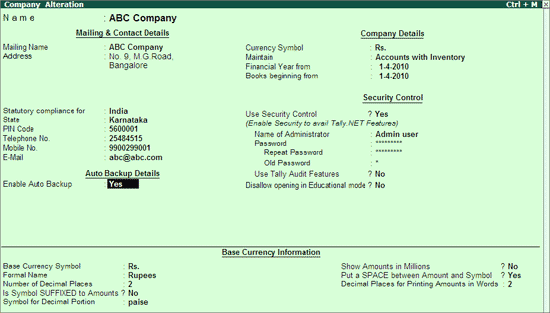
Go to Company Creation/Alteration screen of the required company.

Set Yes to Enable Auto Backup as shown:

  • Save the Company Creation/Alteration screen.

The data backup is stored in the data folder of the respective company.

E.g.: A company titled ABC Company has a folder 10009 located in C:\Tally.ERP9\Data. On enabling Auto Backup feature the backup file ABK.900 is created in C:\Tally.EPR9\Data\10009

Restoring Auto Backup Data

To restore the auto backup taken execute the following steps:

From the Gateway of Tally

  • Press Ctrl + Alt + K.
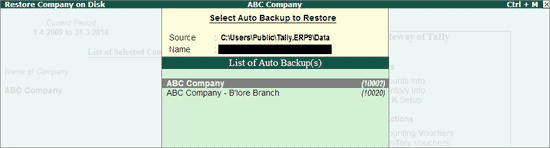
  • Restore Company on Disk screen appears.
  • The Source field displays the data path of the company under Select Auto Backup to Restore screen. Press Enter.
  • The List of Auto Backup(s) will list all the companies enabled for Auto Backup.
  • Select the required company and press Enter.

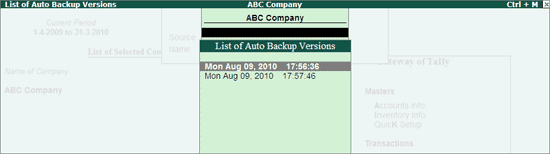
  • The List of Auto Backup Versions screen appears listing the backup versions.

  • Select the required version from the list and press Enter.
  • The selected version of data backup is restored to the respective company folder.
  • The auto backup utility prompts the user to overwrite the existing company.
  • Press Y or click Yes to proceed with restoring the data.
  • Press Alt + F1 to Shut the existing company.
  • Select the restored company.

Tally ERP 9 Auditors Edition Introduction, Features, Characteristics

Tally is an ERP accounting software package that is used to record day to day business data of a company. The latest version of Tally is Tally ERP 9.

It is one of the most financial accounting systems used in India. For small and medium enterprises, it is complete enterprise software. It is a GST software with an ideal combination of function, control, and inbuilt customisability. It is the best accounting software. This software can integrate with other business applications like Inventory, Finance, Sales, Payroll, Purchasing, etc.

Features of Tally

  • Tally is also called multi-lingual tally software because Tally ERP 9 supports multi-languages. In Tally, accounts can be maintained in one language, and reports can be viewed in other languages.
  • Tally is largely considered the best because it is easy to use, has no codes, robust and powerful, executes in real-time, operates at high speed, and has full-proof online help.
  • Using the Tally, you can create and maintain the accounts up to 99,999 companies.
  • Tally has the synchronization feature, so the transaction which is maintained in multiple locations offices can be updated automatically.
  • Tally is used to generate consolidated financial statements as per the requirements of the company.
  • Using the feature of payroll, you can automate the employee records management.
  • Tally can manage single or multiple groups.
  • The feature of Tally customization makes the software suitable for distinctive business functions.
  • Tally software is used to handle financial and inventory management, invoicing, sales and purchase management, reporting, and MIS.

Characteristics:

Separate Tracking:

This software helps to track the trading and non-trading accounts. It helps users to get the receipts, new bills and payments without any hassles.

Interest Calculation:

Tally software has a different transaction method that helps to customize the transaction process. The user can get a detailed report, after the transaction completion. The final report helps to get the balance amount that ought to receive.

Audit, Control and Budgeting:

Tally audit enables the user to have unlimited budgets and periods. With this support, a user can correct mistakes easily. A user can gain robust access control with high security.

Voucher Entry:

Using this software helps to identify the various business transaction details. Tally Classes in Chennai makes you more comfortable in accounting, use this opportunity and get a job in this field.

Billing details:

Tally accounting software enables users to handle billing information. It helps to allocate the payments regarding overdue and invoices. This helps to split the customers easily using billing data.

Interesting in Ledgers:

This software inculcates the multiple ledgers including Purchase Ledger, General Ledger and Sales Ledger. This ledger helps to create records and enter data simultaneously.

Advantages of Tally

Payroll management: Several calculations that need to be made while disbursing salary to employees. Tally is used to maintain the financial record of the company that includes net deduction, net payment, bonuses, and taxes.

Data reliability and security: In Tally, the entered data is reliable and secure. There is no scope of entering the data, after being entered into the software.

Management in the banking sector: Banks use Tally to manage various user accounts, and also calculate interests on deposits. Tally support ensures ease in the calculation and makes banking simpler. Tally Support can make the calculation easy and banking simpler.

Ease of maintaining a budget: Tally is used to maintain the budget. Tally is used to help the companies to work and manage expenses by keeping in mind the total budget which is being allotted.

Regulation of data across geographical locations: Tally software is used to manage the data of an organization globally. Tally can bring together all branches of the company and makes the common calculation for it at large. So no matter which location a company’s employee has access, it will be uniform throughout.

Simple tax returns filing: Tax GST is used to ensure that the company complies with all GST norms. Tax GST takes care of service tax returns, excise tax, VAT filing, TDS return, and profit and loss statement for all small businesses.

Remote Access of Data: In Tally, employees can access the financial data using the unique User ID and password. The logging and access of data can be done by sitting at the comforts of one’s office or house.

Audit tool for compliance: It acts as an audit tool. It is used to carry out regular audits of companies. It does a thorough compliance check towards the financial year beginning and ensures that all the monetary transactions are smoothly being carried out.

Quick Access to Documents: Tally can save all invoices, receipts, bills, vouchers in its archive folder. Using the Tally, we can quickly access any of the previously stored documents. We can immediately retrieve all the billing related files.

Tally.Net: Features, Requirements for remote connectivity Access information via SMS

Tally.NET is a technology within Tally. ERP 9 which powers revolutionary capabilities such as continuous upgrades & updates, central consolidation of branch data, central deployment of Customisation, instant support from within your Tally. ERP 9 and many more that enhances your business performance.

Tally.NET Services

On a broad level, Tally. ERP 9 comprises of:

  • The product itself
  • A set of capabilities (enabled via the Internet) by a service called Tally.NET

This ‘two component’ architecture was chosen as this delivers an unparalleled model of a host of services as below:

(Tally.NET Services Annual Subscription is included in your Tally. ERP 9 for the first one year. Subsequently you are advised to subscribe to avail the following services at a nominal charge of 20% of the then prevailing product price)

(a) Remote Access Services

Your business data stays with you locally, and is never stored on Tally.NET servers or on systems accessing that data via Remote Access.

(b) Integrated Support Services: Support Centre

Integrated within Tally. ERP 9 and Shoper 9, this new feature enables the users to report and track their queries from within the product. You can directly target the query to your regular Tally Service Provider (or any other Tally Service Provider, if you are making your first query) and get responses quickly. These can even be reported and viewed remotely. You can then use the reference number to escalate the issue to Tally’s Customer Centre in case you need to.

Over time, this capability will be extended to cover your Chartered Accountant or other business associates & friends using Tally. ERP 9 to broaden the horizon of your support ecosystem.

You can also access all the conversations centrally. This will simplify the process of having a summary view of the kinds of issues people in your company raise which will help you identify gaps of knowledge or other persistent system issues.

(c) Self-service using Control Centre

The Control Centre enables users to centrally configure and administer Site/ User belonging to an account. Thus, the Control Centre acts like an interface between the user and Tally. ERP 9 installed at different sites.

With the Control Centre you save time, travel and communication costs, manage Tally. ERP 9 installations efficiently and effectively because it enables you to:

  • Manage Licenses
  • Perform Central Configuration
  • Manage Users
  • Manage Company Profile
  • Manage Accounts
  • Change Passwords
  • Maintain Activity History

(d) Self-service using Knowledge Base

Tally has compiled a large selection of articles for users to understand the product and its applications. Users can access the Knowledge Base and search from available topics at their convenience.

(e) Software Assurance Services

Get instant product updates and upgrades as and when they happen

(f) Data Synchronisation Services

Now exchange data with ease between two or more Tally licenses (implemented at different locations)

Requirements for remote connectivity Access information via SMS

You can securely access your Tally. ERP 9 from anywhere to record transactions, or view reports when working from a client’s office, or other remote locations. All you need at the remote location is a Tally. ERP 9 installation, and an internet connection. In your office you need to have a valid Tally. ERP 9 license, an active TSS, an internet connection, and your company connected to Tally.NET services. Server and remote systems must have the same release of Tally ERP 9.

Security and Control: You have complete control on who can access your companies, and which features are available to the user. Further, your data will always be in your computer. Whenever a user connects to your company, based on the access permissions you have provided, the user can access the required features. If your employee is at a client’s place and want to print an invoice or purchase order placed by the client, it can be done. However, the employee will not view your financial reports unless you have given the permission. If you want to check your financial reports when you are away from your office, you can use any computer with a Tally. ERP 9 installation and view the reports.

Anywhere, Any Tally. ERP 9 Installation: You can access your Tally. ERP 9 companies from anywhere using even a Tally. ERP 9 in Educational Mode, and an internet connection. When your employees are at clients’ locations, they can view the stock availability and commit delivery dates to the clients, or check the pending receivables from the clients. This will ensure availability of the latest details at that moment.

Audit Accounts: You can allow your auditor to do verification of your books using remote access. For this, you just need to allow remote access to your company for the auditor’s Tally.NET ID. Like you or your employees logging in to the company, auditor also can log in and do the work.

Print Reports and Vouchers: Users can open a voucher or report, and print it at the remote location. When your employee is at a client’s place to collect receivables, after collection a receipt can be recorded and a voucher can printed for the client.

Record or Alter Vouchers: The user with the required permissions can create or alter vouchers. If you or your employee meets a supplier, and strike a favourable deal, a purchase order can be raised immediately from your Tally. ERP 9 company.

Easy Setups: Connect your company, and allow users to access your company from anywhere. Note that only users with valid Tally.NET IDs are allowed to access your company remotely. Your account ID (e-mail ID used to activate your license) is a valid Tally.NET ID. You can create Tally.NET IDs for users who need to log in to Tally. ERP 9 remotely, allow access to these IDs. Similarly, you can allow your accountants or auditor who have their Tally.NET IDs to log in remotely.

error: Content is protected !!