Methods of Promotion, Seniority vs Meritocracy

Methods of Promotion

Vertical Promotion:

When an employee is shifted from a lower category to higher category with increase in pay, status and responsibility it is called vertical promotion. For example a sales Manager is promoted as General Manager in the company.

Horizontal Promotion:

When an employee is shifted in the same category with increase in pay, responsibilities and change in designation, it is called horizontal promotion. For example Second Division Assistant is promoted as First Division Assistant. This type of promotion may take place within the same department or from one department to another or from one plant to another plant.

Dry Promotion:

When promotion is made without increase in salary or remuneration, it is called “dry promotion”. For example, a college professor promoted as Head of the Department without increase in salary. In dry promotion there will be a change in designation and responsibility without corresponding change in remuneration.

Seniority vs Meritocracy

Promotion by Seniority:

Promotion by seniority is one of the popular methods followed for giving promotion to the employee. Seniority is based on the total length of service and is counted from the date of his appointment in the organisation. This method is followed in Government service. However, merits such as qualifications, knowledge, skills, performance, etc., are not given weightage as promotion is based on seniority.

Advantages of Promotion by Seniority:

  • In business and industrial undertakings, this method is followed for patronising employees and has wide acceptance by trade unions and among employees.
  • It is very simple and objective method of identifying employees for promotion.
  • Creates a sense of security among employees since they can predict in advance when they will get promoted.
  • Leads to congenial industrial relations as decisions on promotions are based on seniority alone.
  • Avoids bias, favouritism and nepotism in identifying employees for promotion.
  • Employees will remain loyal to the organisation even when there are better opportunities elsewhere.

Disadvantages:

  • Seniority very often ignores merit and good performance in the job. The person with long service need not be competent in the job.
  • Overemphasis on seniority and no incentive for high/improved performance the job.
  • Ambitious people who are highly career oriented, may not stick to the job and leave the organisation.
  • It is difficult to attract talented people unless they are placed in special category for promotion.
  • No differentiation between efficient and inefficient employees and promotes mediocrity in the organisation.
  • Management is not generally favourable to promote employees based on seniority. They prefer to combine merits and seniority.

Promotion by Merit:

Promotion by merit is generally followed in private organisations. Promotions are based on merits of the employees, i.e., qualifications, knowledge, skills, honesty, initiative, interpersonal relationship, effective communication and of course performance in the job. Seniority is not given weightage. However, unions demand promotions based on seniority, i.e., length of service of the employee.

The HR department has to keep updated records about each employee and such records should include details, performance in the job, increments, performance awards etc. Performance appraisal records would also provide information on the past performance and strengths and weaknesses of the employee.

Advantages of Promotion by Merit:

  • It appreciates and recognises the knowledge, skills and performance of the employee. Even employees with less experience can expect promotions.
  • It motivates the employees to perform better as promotions are based on merits.
  • The management is able to retain competent employees as they are eligible for promotions based on merits.
  • Leads to increased productivity in the organisation.
  • Management support promotions based on merit.
  • It is a scientific and objective method of promoting employees.

Limitations of Promotion by Merit:

  • Scope for favouritism and bias.
  • The method is not accepted by trade unions.
  • Defining merit is difficult and complicated in the absence of updated and accurate records.
  • No guaranteed promotion even if the person has put in several years’ service in the organisation.

Performance Management System (PMS) Meaning, Definitions, Objectives

Performance Management System is the systematic approach to measure the performance of employees. It is a process through which the organization aligns their mission, goals and objectives with available resources (e.g. Manpower, material etc), systems and set the priorities.

The execution administration framework is a constant procedure of characterizing and conveying the activity parts and duties, execution desires, goals and set their needs between boss (administrator) and subordinates (workers). It incorporates association, office and representative shared objective and targets which are lined up with frameworks and assets. It is the channel of providing clarity about goals and also to improve the business processes through various methods and mechanism.

Performance management can be defined as the development of individuals with competence and commitment, working towards the achievement of shared meaningful objectives within an organization which supports and encourages their achievement.

Michael Armstrong have defined performance management is a strategic and integrated approach to delivering sustained success to organizations by improving the performance of the people who work in them and by developing the capabilities of teams and individual contributors.

Performance assessment has a long history based on comparative judgements of human worth. In the early part of the 19th century, for example, Robert Owen used colored wooden cubes, hung above work stations, to indicate the performance of individual employees at his New Lanark cotton mills in Scotland. Various merit ratings were represented by different colored cubes which were changed to indicate improvement or decline in employee performance.

According to Michael Armstrong and Angela Baron: ‘Performance management is a process which contributes to the effective management of individual and teams in order to achieve high levels of organisational performance.’

According to Dr. T. V. Rao: ‘Performance management involves thinking through various facets of performance, identifying critical dimensions of performance, planning, reviewing and developing and enhancing performance and related competencies.’

According to Manuel Mendonca and R. N. Kanungo: ‘Performance management refers to the process of setting and communicating performance targets, defining evaluative criteria to be employed at different levels of performance, monitoring performance, reviewing performance, providing feedback and taking corrective measures to remove performance snags.’

According to Ronnie Malcom: ‘Performance management may be defined as a planned and systematic approach to managing the performance of individuals ensuring their personal development and contributing towards organisational goals.’

According to John Storey: ‘Performance management includes the whole cycle of agreeing goals and objectives (which may vary in their degree of specificity), providing feedback, offering coaching and advice and motivating staff to perform at a high level.’

Objectives

  • To identify systematically the need and requirements of some learning and training aspects;
  • To promote better and high work culture in the organisation;
  • To focus more on systems approach to perform appraisals rather than to make any formalities;
  • To foster a positive relationship between managers and employees through a two-way communication process;
  • To appreciate, recognise and to give reward and compensate employees for achievement of performance objectives successfully in a more objective, transparent and justified way.
  • To emphasise on career planning and future growth opportunities for employees;
  • It is ensuring to raise the efficiency and productivity of employees;
  • To encourage belongingness, team spirit and devotions among employees with the job;
  • To provide feedback about HR planning and potentialities to implement the planning facts.

Types

Performance Management in Self-Managed Teams:

Performance management in self-managed work team is managed by the team itself. This empowerment varies from organization to organization, or even from department to department, and also depends upon the readiness of the team members to assume those responsibilities.

A fully empowered mature self-managed team would decide their own jobs, set performance standards, give feedback to members about work progress, performance and team skills, appraise their own performance, and identify and support the training and development needs of the members. The organization, particularly the HR department, in this set up will provide guidelines and a framework for that performance management in terms of organizational policies and compliance regulations.

Traditional Performance Management:

Performance management in natural work groups usually operates according to the traditional performance management model in which the focus is on the work performance of an individual and his or her contributions to the mission of the organization, as observed and assessed by the evaluating manager.

While the evaluating manager may solicit the input and involvement of the employee in each step in the process, authority and ultimate responsibility remains with the HR manager or the HR head of the organization.

Performance Management in Cross Functional Teams:

A cross-functional team typically operates without formal supervision, though it may have a team leader. Members usually report to evaluating managers in their concerned departments.

These managers are often not present or be aware of what and when the team members are participating in the work of the team and may only know about the results of the team’s work and the team member’s performance through the reports of others, evidence of the team’s products, or via customer feedback. Hence performance evaluation in this case definitely is a complexes process.

Factors

Business Culture:

At the national level, culture affects performance management through sociopolitical traditions and attitudes which determine whether performance assessment is acceptable, and to what degree. Cultural norms dictate ‘acceptable’ standards of performance and the management methods by which they are assured.

Legislation:

In today’s globalized economy, the employment relationship between workers and employing organizations is seen as a contractual matter. This relationship is expressed in formal or legalistic statements of obligation between the two, such as written employment contracts, job descriptions and performance objectives.

Employers taking HR and administrative decisions on the basis of performance assessment have to be mindful of possible legal action on the following grounds:

  1. Validity or accuracy of assessment ratings as predictors of future performance and promotion potential.
  2. Validity or accuracy of ratings as measures of past behaviour.
  3. Statutory norms laid down by the Government and Government authorities.

General Economic Conditions:

Prevailing attitudes towards employees and, in turn, their response to performance assessment are considerably affected by issues such as unemployment and economic conditions of the nation. Growth and shrinkage in the job market which are influenced by changes in the economic scenario of a nation is conventionally believed to be followed by changes in the behaviour of workers and employers.

At times of high unemployment, workers are thought to be concerned about losing their jobs and hence more conscientious and tolerant of strict management. When suitable employees are scarce, managers must be cautious  unflattering assessments can trigger an employee’s move to another organization leading to high attrition.

Industry Sector:

Methods of performance management vary considerably between different industrial sectors, partly as a matter of the nature of the work involved, tradition and fashion. Sales and service dominated industries, such as retail business and financial services, tend to have clear individual or team objectives which can be translated readily into performance targets.

Performance-related pay (PRP) is common in this sector. In other sectors like manufacturing sector performance objectives are more diffuse and difficult to measure so that PRP is not easily justified.

Technological Change:

Technological change, particularly changes in information technology has a dramatic effect on the nature of supervision, and hence performance assessment. Work can be done at a distance by traveling executives, overseas affiliates or telecommuters working from home. This raises intriguing issues for performance management.

Further, technology has the capability to provide extensive information and statistics regarding an individual’s performance that is being recorded on a real time basis into the information system. This information not only provides a meaningful measure of job performance but also provides a clear cut picture on the areas of performance improvement and skill development.

Flexibility and Diversification:

In the new business environment, the traditional nature of the employment relationship has considerably changed, moving the balance of power firmly in favour of employers. Organizations in today’s highly competitive era have seen job descriptions have disappeared or, at least, have been diluted, so that employees can be asked to do virtually anything required by the organization.

Conversely, performance criteria have been more tightly defined, typically expressed in the form of demanding objectives; forever-moving goalposts. Performance assessment has become the crucial means of monitoring this relationship.

Employee Relations:

Performance management is a means of enhancing managerial control, particularly through individual performance-related pay schemes. Individualization of pay (performance based pay systems) diminishes or neutralizes the role of collective bargaining. The purpose and influence of trade unions is thereby getting day by day diluted, reducing both their effectiveness and attractiveness as an alternative focus for employee involvement.

Workforce Composition:

One important function of performance assessment is the identification of individual strengths and weaknesses of the employees. Strengths may indicate a potential star performer, worthy of a management career route and promotion. Assessment employed to determine development needs ultimately serves to increase a nation’s human capital. This helps the organization to identify and streamline the composition of their workforce with people who are the most competent in terms of their talents and abilities.

Projecting future performance of an employee

Recruitment is a two-sided coin, one side of opportunity and the other of risk. Hiring a new member of your team or finding a trusted freelancer can be like flipping the coin. They may be a perfect fit or they may carry risks. Risks including damage, costs, and loss of time can be hard to recover from.

For a startup, the risks can be fatal, while larger companies face increased expectations to find the best talent. You are searching for a perfect fit, someone to inspire the team, to provide new ideas, to stimulate morale and productivity. But if you hire someone that does not connect with your company, you may need to jump some hurdles along the way. Companies that strategise their recruitment process to predict job performance experience better hiring results.

Cognitive Ability Tests

A cognitive ability test measures different aspect of cognition. This is because the job of a Python Developer requires a different cognitive ability to that of a Sales Manager. Dependant on your company, you will assess new employees using methods that best suit your ethos. The different aspects of cognition are as follows;

Numerical Reasoning: Ranging from mental mathematics to complicated critical reasoning

Verbal Reasoning: Evaluates the understanding of English language (grammar, vocabulary, comprehension)

Abstract Reasoning: Involves incomplete symbols or diagrams with missing items to assess the ability to draw conclusions based on specific information

Logical Reasoning: Aimed to assess critical thinking skills through the understanding of complicated texts.

General Aptitude Test: Most commonly covers verbal reasoning, numerical reasoning, and cognitive ability, this test aims to determine innate ability at a number of levels.

Raven’s Progressive Matrices (RPM) Also used in educational settings, this test aims to measure abstract reasoning through non-verbal means. The test involves multiple choice questions consisting of visual geometric designs with a missing piece.

Criteria Cognitive Aptitude Test (CCAT): Measures problem-solving, skill learning, and critical thinking abilities. This test consists of 50 questions and has a 15-minute time limit.

The Five-Factor Model of Personality

Researchers originally developed this model to understand and explain a person’s personality through five separate traits. Psychological research of this kind has since been used to benefit the criminal justice system, the education system, and more recently the recruitment system. The following model can help to show what traits of a person’s personality are relevant for job performance. Your recruiter will look for certain behaviours or traits that can benefit your team. The Five-Factor Model of Personality includes;

Emotional Stability

(self-esteem, self-efficacy, life satisfaction etc.)

Extraversion

(incentive reward sensitivity, positive emotion, happiness etc.)

Openness

(intelligence, creativity, broad-mindedness etc.)

Agreeableness

(cooperativeness empathy, sympathy etc.)

Conscientiousness

(dutifulness, orderliness, discipline etc.)

When recruiting you can test for each personality measure in different ways. One method involves specific behavioural questions during an interview, while an alternative method is to use a personality assessment. You ideally want to measure all aspects of the personality to create a candidate profile.

Past Behaviour

One of the most common types of interview questions are those related to how a candidate behaved in the past. This is because past performance is one of the most accurate factors to predict job performance. Past behaviour is also important within a variety of public and private sectors, ranging from education to the legal system. You can best predict job performance by focusing on records of past behaviour rather than relying on first impressions and gut feelings (e.g. volunteering for responsibilities, involved in challenging tasks, past rewards/promotions).

Stages and Decision Makers in Event Management

The recent growth in Events as an industry around the world means that the management of events can no longer be ad hoc. The industry now includes events of all sizes from the Olympic down to arranging breakfast meeting for ten business people. Business event management is the practice of incorporating business logic into labeling events, communicating events and handling events. As such, business event management requires a profound interaction and cooperation among business stakeholders as well as the event management in order to meet out the prioritized needs of the stakeholders. Because of the difference between the perspectives of the individuals involved, insignificant events/perspectives can result in significant or serious potentials for business loss, damage to reputation or customer relationships or impacts on productivity and earnings have a profound impact on the bottom-line.

Management of an event encompasses all activities involved in planning, organizing, leading, staffing and evaluation of an event. Thus, it involves groundwork associated with events, i.e.,

  • Venue selection
  • Stage design
  • Infrastructural facilities
  • Liason with artists/performers
  • Logistics plan etc.

Event management is considered as one of the strategic marketing and communication tools by companies of all sizes. From product launches to press conferences, companies create promotional events to help them communicate with clients and potential clients. They might target their audience by using the news media, hoping to generate media coverage which will reach thousands or millions of people. They can also invite their audience to their events and reach out to them at the event.

Unlike planning for public events, after the initial concept or idea for an event has germinated, its feasibility is evaluated and then the activities are substantiated by actions. Event management is the application of the management practice of project management to the creation and development of events. It involves the following:

  • Identifying target audience
  • Feasibility studies
  • Planning
  • Co-ordination
  • Executing the modalities of the proposed event

Event management requires strong organizational, budgeting and creative skills. Those who work as event managers must be comfortable with interacting with all levels of individuals inside and outside of their organization. Event management is the process beyond planning, executing and evaluating corporate, associations, non-profit organizations, government and social events.

Event Planning Staff

Nobody has unlimited time in the day, and a corporate event planner cannot be in two places at the same time. Having support staff available is essential for a successful event. Remember that when assigning the following tasks, it is your responsibility to work with team members to create individual project deadlines so that you can manage the timeline and optimally use your available resources. These team members are responsible for tasks such as:

  • Ensuring presentation technology is functioning
  • Working with venue staff to provide food and other amenities
  • Registering event participants
  • Coordinating lodging and transportation for participants and presenters
  • Preparing information packets and setup/takedown of the event materials

Attendees

You can’t have a successful corporate event without participants. The more engaged they are before, during, and after the event, the higher the chance of success for all involved stakeholders. Bear this in mind as you plan the agenda and schedule learning events. Incorporate a variety of sessions to keep people engaged and consider one or more experiential events. Start engaging attendees in the days and weeks before the event to generate excitement and maintain the momentum you’ve built by investing time into planning a reinforcement and measurement strategy for after the event concludes.

Corporate event planning is no small task. Even a single-day company event can take months of careful planning and a tight-knit team to successfully execute. Form your team early to ensure faster decision-making and greater buy-in from all the key stakeholders throughout the process.

Stages in Event Management

Determine Event Objectives

This stage sets the groundwork for the entire event and is typically directed by senior leadership. If the annual gala goals for this year are vague, work together to create key objectives to ensure your donors and attendees feel engaged as a result of the event.

  • Create/define event objectives
  • Select your audience
  • Determine your budget
  • Assemble your event team

Choose Event Partners

Some events can be created, directed, and executed entirely with your in-house staff. Other events will require venue management, stage directors, catering staff, publicity coordination, and more.

  • Select necessary partners to augment your event team
  • Choose an appropriate venue
  • Set a date
  • Design the overall experience
  • Create a communication plan; invitations, programs, media relations, etc.

Create Event Content

While the logistics of event planning are important for obvious reasons, the content of the event is critical for creating a meaningful experience rather than “just another event.” Revisit your defined event objectives and work with your internal staff and chosen event partners to create truly inspiring content that speaks to the audience while helping meet the event objectives.

  • Confirm key performers; musicians, speakers, VIPs
  • Create video elements to enhance the content, considering what you might want to use for post-event material
  • Implement a communication plan or plans
  • Finalize all event details

Execute the Event

Host an amazing and engaging event that connects, inspires, and energizes donors. With the right partners and with so much work done ahead of time you can relax a bit and ensure your audience is enjoying the event.

  • Greet the guests as they arrive
  • Monitor the venue; room temperature, beverages, any safety concerns
  • Assess the audience; interest, engagement, enjoyment

Develop Post-Event Materials

Many events end as soon as they are over, but it doesn’t have to be that way. Well-designed roadshow tools can help the meaningful experience live beyond the event itself. Determine the most effective way for your team to maximize the resources and materials you’ve created for the event.

  • Excerpt of event video for guests who couldn’t attend
  • Roadshow video for small group presentations
  • Personalized impact stories for website

Decision-Makers

Depending on the scope of the event and the size of the organization, there will most likely be one or more executives involved in laying the groundwork. It is important to understand what their thoughts are on the business goals associated with the event, the budget, the agenda, and so on. Some of the responsibilities that executive decision-makers have during planning are:

  • Determining the overall budget for the event
  • Determining the business objectives, theme, and tone of the event
  • Vetting the speakers and activities
  • Approving major expenditures
  • Participating in development of the agenda
  • Making crucial decisions throughout the planning process
  • Not only participating in and championing the event itself but also the activities pre and post to set the tone

Establishing Policies and Procedures of an Event

Organization’s environment to determine whether important assets are in the state they should be, and knowing when that state changes, is a very important activity that many organizations spend significant portions of their budget doing.

Event management, while useful, can be dangerous if not done appropriately. In the “ITIL Service Operation” book several policies are given to guide an event management process. In this post I will discuss the importance of those policies.

Event Notifications Should be Sent Only to Those Responsible for Action

Events that are sent to people who are unable to, or do not need to take action are somewhat worthless. Event management is a process that helps a service provider understand changes in state throughout their IT environment. The only people who need to be aware of those changes in state are those who are responsible for some kind of action related to that change in state.

Event Management and Support Should be Centralized as Much as Possible

In my experience I have seen that smaller organizations, and organizations up to a certain size, are able to effectively conduct event management in a decentralized way. However, as the organization grows, so does the need for event management. This growth typically drives a growth in monitoring tools, with different groups monitoring things different ways. Ultimately what happens is through monitoring the organization accidentally does a denial of service attack against itself. Additionally, centralized event management means that the organization is more clearly able to define accountability and responsibility for the handling of specific event. Furthermore, decentralized event management, as mentioned earlier, leads to a proliferation of tools, which tends to mean the organization is investing in multiple tools that do the same things, with none of them being fully utilized.

Events Should Utilize a Common Set of Messaging and Logging Standards

An organization doesn’t have to become very large before the body of events becomes overwhelming. When those events all have different formats and structures and say different things (or the same things in different ways), it can be very difficult to effectively filter, correlate and take action on the body of events an organization faces.

Event Handling Should be Automated When Possible

Effective automation tends to speed up the handling of events, whereas if an event management process relies exclusively on humans to respond to events, the wealth of events will quickly overwhelm human processing power, resulting in events being missed or their handling being delayed.

Events Should have Standard Classification Schemes and Escalation Procedures

In other words, a service provider should know what to do with the events that it generates. Not only is it pointless to send an event to someone who is unable to take action on it, it is equally foolish to send an event to an operational team without effective instructions for how to handle that event. This results in events being ignored, which ultimately results in important events being missed.

All Recognized Events Should be Captured and Logged

If something is important enough to consider an event, then the organization must take steps to ensure that that event is predictably and consistently captured and logged. If events are not predictably captured and logged, then it is very difficult to rely on those events as triggers for automated activities within the organization’s IT environment.

Procedures

Organize a Team

No matter the size, a special event takes a concerted team effort to handle all of the details. Where possible, the Trustee(s) involved with the school and/or activity should be invited to participate on the planning committee. Depending on the type and scope of your event, you may consider identifying an Event Manager or Event Chair as well as individual Chairpersons for subcommittees, such as:

  • Venue, logistics & catering management (selection, contracts, permits, insurance, etc.)
  • Guest management (invitations, RSVPs, greeters, registration, seating arrangements, etc.)
  • Speakers/presenters (selecting, confirming, logistics, management, etc.)
  • Activities/entertainment
  • Publicity/promotion (Web presence, events calendars, printed programs, media relations,
  • signage, social media, etc.)
  • Sponsor/partner management
  • Transportation (if providing transport for guests, students, etc.)
  • Volunteer management

Create a Master Plan

Work as a committee to create a master plan and event outline, incorporating all of the potential areas identified above. This plan will be used to manage the work being done and an outline of just the key details can be used to inform stakeholders as needed.

Create a run-of-show document if needed, outlining the expected timing and any requirements for each session or activity, including required setup, starting and ending times, staging directions, presenter/lead, audiovisual and production needs, etc.

Establish a Budget

Identify the available budget for your event, including internal and external sources for each of the potential expenses as part of the master plan. Create a balance sheet listing expenses for all functional areas of your meeting or event, and determine which expenses will be assumed by the host, potential sponsors, and/or by the attendees (fee).

If you are hosting a revenue-generating (fundraising) event, you will want to identify your break-even point (the point at which the revenue generated at the event is sufficient to cover the expenses of hosting the event).

Budget items to consider:

  • Staff time
  • Marketing expenses (design fees, printing, postage, etc.)
  • Transportation
  • Venue
  • Guest accommodations (if applicable)
  • Food and beverage
  • Entertainment and recreation
  • Audiovisual equipment and production costs
  • Security (CCSD School Police, etc.)
  • Special needs (interpreters, etc.)
  • Taxes and gratuities, service charges, etc.
  • Contingency fund for unanticipated, last minute expenses.

Determine Venue/Location

When planning an event it is important to be aware of how to create an event that is open and accessible to everyone. This can include finding a space that is safe and considerate of a wide range of abilities and considering visual, hearing, and physical accessibility to meeting areas and facilities.

No facility will look the same in-person as it does on paper, nor will you be able to get a sense of service without going to the site. If time allows, plan to visit the site and take pictures to help you block out the location of key items (catering, check-in table, seating arrangements, podium location, parking, etc.).

Identify and Establish Partnerships & Sponsors

Consider whether there are organizations that you could partner with or call on for sponsorships to defray the costs and increase potential participation. When you involve other people or groups in your event, they have a stake in helping spread the word and making the event a success.

You may want to consider:

  • Seeking corporate sponsors to fund a portion of the event. This can range from large to small local businesses that might be able to provide goods or services, such as catering, flowers for the tables, raffle prizes, etc.
  • Partnering with community organizations that might be able to offer a venue and/or assistance with organizing or staffing an event.
  • Soliciting donations/sponsorships from key individuals involved with the school, such as the namesake, PTA/PTO committee, etc.

Create a Communications Plan

If you have ample lead time, effective planning, creativity, and willing volunteers or staff, you can promote your event with little or no cost.

Even with the most amazing speaker or entertainment line-up, you will need to promote your event to get people in the door. Event promotion may include:

  • Invitations
  • Web site story and/or banner (School and/or CCSD as appropriate)
  • Newsletter/enewsletter
  • Email announcement(s)
  • Flyers/posters
  • Direct mail
  • Social media (Facebook, Twitter, LinkedIn, Instagram, YouTube, Flickr, etc.)
  • Registering on a variety of online calendars, such as City, Chamber of Commerce, Rotary Club, etc.

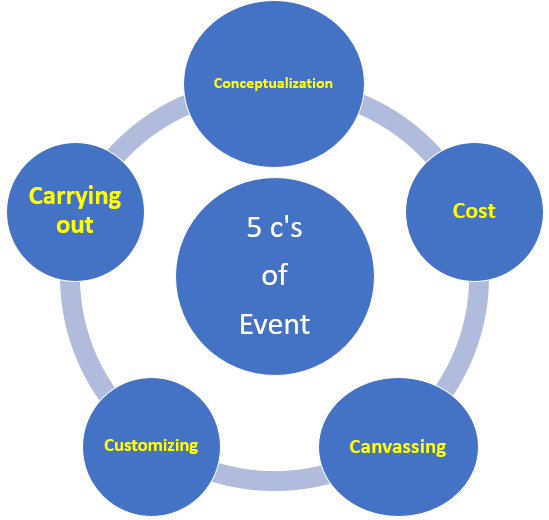
5C’s of event

Event management and event planning requires a few skills for success. Qualities such as attention to detail, creativity, patience and strategic thinking all come in to play at multiple points throughout the process. Therefore, it’s important to approach event management with a solid plan that helps you navigate the (sometimes) rocky road and emerge out of the other side relatively unscathed, bathed in the glory of a successful event.

Conceptualization: It is a first step in vent planning. in this phase, there are five important question one should ask- WHO are the people involved in this event?

    WHEN is the vent taking place?

    WHERE is the event happening?

    WHAT exactly is the event all about?

    WHY is the event taking place?

Cost: to prepare a budget for an event we have to keep in mind the cost limit set by the client. It is very important to know about the funds available and the expenses for the event.

Canvassing: To inform the guest about the event so they can make their schedule free to participate in the event. Canvassing in event management also include sponsorship, raising funds and advertisements.

Customizing: In customizing, the main focus is on the clients request and organised an event which matches their requirement.

Carrying out: In this phase, we have to execute an entire plan. It brings all planning into action. This plan is re-evaluated according to the client requirements, budgets limit and external conditions before the plan is completed.

Role of Event Manager and the people involved in conducting the event

An event manager oversees the design, set-up, and execution of events that bring people together. These events can run from small networking meetings with a few dozen guests to large-scale conferences with thousands of attendees over several days and everything in between.

No matter their scope, managing events is always a people-centric endeavor. Your goal is ensuring people get the most from a given event, and you work closely with people to achieve that goal.

Role

  • Event Coordinator duties and responsibilities
  • Understand requirements and details of each event
  • Understand clients’ needs and wants
  • Plan and organize events with attention to financial and time constraints
  • Book venues and schedule speakers
  • Meet with clients and coordinate with them regularly
  • Look for and compare different vendors (catering, decorators, musicians etc.)
  • Negotiate with vendors to achieve the most favorable terms
  • Hire, train and oversee personnel
  • Evaluate personnel and provide reports
  • Manage all event operations (preparing venue, invitations, food, drinks etc.)
  • Track the overall even expenses regularly
  • Do event budget planning
  • Stay within the budget
  • Carefully oversee event happenings
  • Offer solutions to resolve problems in a timely manner
  • Evaluate event’s success and submit reports

Duties of an Event Manager:

  • Pre-event organisation
  • Planning an event that meets the stated objectives
  • Working out event budget, and logistics (venue, catering, etc)
  • Managing an effective event marketing campaign
  • Managing registrants
  • On-the-day management
  • Ensuring that on the day logistics are running smoothly (catering, venue, equipment)
  • Managing event staff to help mark attendance, run speeches, provide attendee support, collect sign ups etc.
  • Sending SMS communications to attendees when needed (last minute venue changes, parking notices etc)
  • Post-event communication, reporting & analysis
  • Managing post-event marketing/communications (‘thank you for coming’ email, feedback surveys, etc)
  • Reviewing reports
  • Analysing feedback and report data to measure whether event goal was achieved

Different People

1) Infrastructure Manager

They have the following responsibilities:

  1. Procurement management and resource management.
  2. Responsible for setting up and dismantling the infrastructure for the whole event like:
  3. Construction of boundary walls, entrance and exit gates, driveways, walkways and parking lots
  4. Construction of AC/Non AC hangers/ halls, seating arrangement, stage design/ set up.
  5. Construction of green rooms, staff rooms, storage rooms, power rooms, toilets, sewage systems, stalls, counters, booths and kiosks.
  6. Responsible for setting up electricity, water and phone connections.
  7. Responsible for conservancy (i.e. cleanliness).
  8. Formulates, prepares and implements the risk management plan. (risks related to infrastructure management like sudden shortage of workers, materials, power failure etc)

2) Event Manager/Event Planner

They have the following responsibilities:

  1. Responsible for planning and producing the whole event.
  2. Responsible for procurement management and resource management.
  3. Formulates, prepares and implement risk management plan (risks related to event planning and production).

3) Security Manager

  1. Responsible for formulating, preparing and implementing the security plan and strategies. i.e. how to protect delegates, guests, service providers, organizers, sponsors, partners, clients, target audience, goods and merchandise, etc.
  2. Procurement management and resource management.
  3. Formulates, prepares and implements the risk management plan. (risks related to security like stampede, brawl etc)

4) Logistic Manager

  1. Responsible for custom clearances and other clearances.
  2. Responsible for warehousing of cargo
  3. Cargo insurance
  4. Expected to move goods and merchandise from one destination to the other in the most efficient manner.
  5. Responsible for procurement management and resource management.
  6. Formulates, prepares and implements the risk management plan. (risks related to logistic management like cargo theft, etc.)

5) Information Manager

  1. Manages the information acquired through different sources.
  2. Responsible for the documentation of all business operations carried out pre-event, at-event and post-event.
  3. Maintains database of service providers, delegates, guests, organizers, sponsors, partners, clients, target audience, media people and various govt. departments officials.
  4. Formulates, prepares and implements the risk management plan. (risks related to information management like loss of data)

6) Event Coordinator

They are responsible for coordinating with all event professionals and ensures that business operations are efficient and effective.

Event Meaning, Definition, Characteristics, Types, Advantages

The increasing competitive pressures brought on by globalization are forcing business professionals to find new ways to engage customers. There are many definitions of event marketing. It is defined as the marketing discipline focused on face-to-face interaction via live events, trade shows and corporate meetings among other event types. Others define it as designing or developing a ‘live’ themed activity, occasion, display, or exhibit (such as a sporting event, music festival, fair, or concert) to promote a product, cause or organization.

An event is a live multimedia package with a preconceived concept, customized or modified to achieve the clients’ objective of reaching out and suitably influencing the sharply defined, specially gath­ered target audience by providing a complete sensual experience and an avenue for two-way interaction.

Events are attracting worldwide attention and at the same time getting corporatized. Events have proved to be a versatile marketing communication tool, since they can be customized to cater to the needs of the industry.

According to Philip Kotler, Events are defined as “occurrences designed to communicate particular messages to target audience”.

Events can also be defined as something noteworthy that happens according to a set plan involving networking of a multimedia package thereby achieving the client’s objective and justifying their need of associating with events.

Characteristics

  • It can be an observable occurrence.
  • It can be designed to achieve certain goals.
  • It can also be termed as experiential marketing.
  • It is objective-oriented.
  • It provides an avenue for effective interaction.

Types

  1. Wide range of events:

Event marketing encompasses a wide range of event types:

  1. Mega events and local events,
  2. Exhibitions,
  3. Trade shows,
  4. Publicity stunts,
  5. Themed and created events,
  6. Corporate entertainment,
  7. Award ceremonies.

Advantages

  • It helps in brand building, that is, creating awareness about the launch of new products/brands.
  • To highlight the added features of the product/services.
  • It helps in rejuvenating brands during different stages of product life cycle.
  • Helping in communicating the repositioning of brands/products.
  • Associating the brand personality of clients with the personality of target market.
  • Creating and maintaining brand identity.

Types of Customers for Events

Categories of Events

  • Political Events
  • Religious Events
  • Everyday Life”
  • Social Events; Weddings, Anniversaries, Death, Communions, etc.
  • Entertainment Events
  • Awareness Events
  • Crafts and Creativity
  • Sports Events
  • Educative/Academic Events at colleges
  • Corporate Events
  • International Events
  • Promotional Events

The Excitable Client

Everything you say is exciting to this client. They will enthuse, wax lyrical, delight in the details as you share your plans for their event. Feed off their energy and make it your aim to get attendees as excited as they are about the event.

The Demanding Client

They know what they want and they expect to get it. Forthright, blunt to the point of rudeness, the demanding client will make requests and expect you to jump. They tend to have a singular vision and be set upon it. With no respect for processes and protocol, they will interfere with your planning, contact you at all hours and not let up until they are wholly satisfied.

The Bargain Hunter Client

Budget-conscious and with a penchant for bargaining, this client will pinch every penny. Be prepared for them to encourage you to slash costs, cut deals, throw in extras in order to keep them happy. Dealing with a Del Boy can be disheartening: it’s all too easy to feel that they are undervaluing your skills and the effort you put in. However, stick to your guns and believe in your abilities.

The Grumpy Client

Nothing is quite good enough for this client. They are constantly moody and unenthused, even when you pull something spectacular out of the bag. Expect constant grumbles, occasional tuts, and a frown that never turns upside down.  Never fear though, beneath that tough exterior is a big softy.

The Impatient Client

With apparently no concept of how long things take and the pressures you are under, the impatient client wants things done NOW. You will be expected to drop everything to accommodate their requests.

Buyer versus User

Buyer person are focused on prospects looking to solve a problem or meet an objective that your products, solutions or services help them to achieve. Buyer person encompass all of the differing roles or stakeholders involved in the purchase decision and are usually represented by decision maker, influencer, champion, and gatekeeper roles. Distinctions can also be made as to economic buyer and functional buyer.

User person are designed to address the perspectives of those who work with your products, solutions or services on a daily basis. The goal is to help these “end users” achieve more complete use of the product, gain more value than they initially anticipated, as well as to help them become champions for continued use new additions, extensions or feature upgrades. They got what they needed to solve the original problem from your product, now how do they gain more value, or use more features? This persona is often the influencer in an account-based-marketing retention sale.

error: Content is protected !!