Terms of Copyright

Copyright term is the length of time copyright subsists in a work before it passes into the public domain.

The general rule is that copyright lasts for 60 years. In the case of original literary, dramatic, musical and artistic works the 60-year period is counted from the year following the death of the author. In the case of cinematograph films, sound recordings, photographs, posthumous publications, anonymous and pseudonymous publications, works of government and works of international organisations, the 60-year period is counted from the date of publication.

Implications

Copyright term and the public domain

The extension of copyright term imposes tangible restrictions on the public domain. For instance, scholar Neil Netanel argued that Copyright Term Extension Act 1998 prevented the entering of works central to cultural heritage of the US into the public domain. He argued, culturally important dissemination, recasting, or incorporation into new expression is prevented due “to the copyright holder’s veto”. As examples he gave the adaption of the plot from novels such as The Great Gatsby and Peter Pan, the refashion of characters like Mickey Mouse, or the use of Tin Pan Alley songs like “Let’s Do It (Let’s Fall in Love)” for documentaries about the Great Depression.

Copyright term and orphan works

For the millions of older copyrighted works of less enduring popularity, it is difficult, or impossible, to trace the copyright ownership and determine who holds the particular rights that would have to be licensed for the use of the work. The problem of such orphan works stems from the extension of copyright term and the lack of requirement for the copyright owner to renew or register their copyright. In order to tackle this perceived problem some jurisdictions have revised their copyright laws to allow use of orphaned works, after diligent searches.

Length of copyright

Copyright subsists for a variety of lengths in different jurisdictions. The length of the term can depend on several factors, including the type of work (e.g. musical composition or novel), whether the work has been published or not, and whether the work was created by an individual or a corporation. In most of the world, the default length of copyright is the life of the author plus either 50 or 70 years. In the United States, the term for most existing works is a fixed number of years after the date of creation or publication. In most countries (for example, the United States and the United Kingdom) copyright expires at the end of the calendar year in question.

The length and requirements for copyright duration are subject to change by legislation, and since the early 20th century there have been a number of adjustments made in various countries, which can make determining the copyright duration in a given country difficult. For example, the United States used to require copyrights to be renewed after 28 years to stay in force, and formerly required a copyright notice upon first publication to gain coverage. In Italy and France, there were post-wartime extensions that could increase the term by approximately six years in Italy and up to about 14 in France. Many countries have extended the length of their copyright terms (sometimes retroactively). International treaties, like the Berne Convention, establish minimum terms for copyrights, but these only apply to the signatory countries, and individual countries may grant longer terms than those set out in a treaty.
Trade Secrets, Geographical Indications

Trade Secrets

Trade secrets are a type of intellectual property that comprise formulas, practices, processes, designs, instruments, patterns, or compilations of information that have inherent economic value because they are not generally known or readily ascertainable by others, and which the owner takes reasonable measures to keep secret. In some jurisdictions, such secrets are referred to as confidential information.

Trade secrets are the secrets of a business. They are proprietary systems, formulas, strategies, or other information that is confidential and is not meant for unauthorized commercial use by others. This is a critical form of protection that can help businesses to gain a competitive advantage.

Although intellectual property rights protection may seem to provide a minimum amount of protection, when they are utilized wisely, they can maximize the benefit and value of a creation and enable world-changing technology to be developed, protected, and monetized.

A trade secret is information that

  • Is Not Generally Known to The Public
  • Confers Economic Benefit on Its Holder Because the Information Is Not Publicly Known
  • Where the Holder Makes Reasonable Efforts to Maintain Its Secrecy.

Protection of undisclosed information (trade secrets) is dealt with under Article 39 of TRIPS. Companies and individuals can prevent information from being disclosed without their consent if;

  • It is not known or readily accessible to people within the circles that usually deal with the information in question.
  • Has commercial value being secret and has been made subject to steps, by the person lawfully in control of the data, to keep it protected.

Types of trade secrets

  • The ingredients used in the product:

For example, soft drinks manufacturer Coca-Cola keeps its ingredients a closely-guarded secret and the recipe is accessible only to a select few.

  • Way of manufacturing:

A company may get a competitive edge just by finding a new way of making things. These may include types of manufacturing equipment, processes or systems. For example, computer chip maker Intel came up with ‘Copy Exactly!’ to ensure consistent quality of products regardless of where it was manufactured.

  • Way of selling and distribution:

Companies often devise unique methods of selling and distributing products, which may give them an extra edge. A fitting example would be food brand Kellogg’s coming up with a data-sharing strategy with retailers to reduce unsold inventory.

  • Advertising strategies:

The success of any product or service also depends on the way of advertising. Firms will always want to keep their ad strategies protected. Most firms take necessary precautions to prevent inadvertent disclosure of trade secrets. This is because if a trade secret is disclosed, it is no longer possible to protect information, particularly, in the age of social media. This is why most companies, while recruiting an agency to create an advertisement for business, will be required to keep a watch on who has access to the company’s confidential business.

Geographical Indications

A geographical indication (GI) is a name or sign used on products which corresponds to a specific geographical location or origin (e.g., a town, region, or country). The use of a geographical indication, as an indication of the product’s source, acts as a certification that the product possesses certain qualities, is made according to traditional methods, or enjoys a good reputation due to its geographical origin.

Appellation d’origine contrôlée (‘Appellation of origin’) is a sub-type of geographical indication where quality, method, and reputation of a product originate from a strictly defined area specified in its intellectual property right registration.

Legal effect

Geographical Indications protection is granted through the TRIPS Agreement. Protection afforded to geographical indications by law is arguably twofold:

  • On one hand it is granted through sui generis law (public law), for example in the European Union. In other words, GI protection should apply through ex officio protection, where authorities may support and get involved in the making of GI collective dimensions together with their corresponding GI regulatory council, where ongoing discourse with the government is implied for effective inspection and quality control.
  • On the other hand, it is granted through common law (private law). In other words, it is similar to the protection afforded to trademarks, as it can be registered through collective trademarks and also through certification marks, for example in the United States of America.

The geographical origin of a product can create value to producers by:

  • communicating to consumers the product’s characteristics, which derive from the climate, soil and other natural conditions in its particular area
  • promoting the conservation of local traditional production process
  • protecting and adding value to the cultural identity of local communities.

The consumer-benefit purpose of the protection rights granted to the beneficiaries (generally speaking the GI producers), has similarities to but also differences from the trademark rights:

  • While GIs denote a geographical origin of a good, trademarks denote a commercial origin of an enterprise.
  • While comparable goods are registered with GIs, similar goods and services are registered with trademarks.
  • While a GI is a name associated by tradition with a delineated area, a trademark is a badge of origin for goods and services.
  • While a GI is a collective entitlement of public-private partnership, a trademark refers entirely to private rights. With GIs, the beneficiaries are always a community from which usually, regardless of who is indicated in the register as applicant, they have the right to use. Trademarks distinguish goods and services between different undertakings; thus, it is more individual (except collective trademarks which are still more private).
  • While the particular quality denoted by a GI is essentially related to a geographical area, although the human factor may also play a part (collectively), with trademarks, even if there is any link to quality, it is essentially because of the producer and provider (individually).
  • While GIs are an already existing expression and are used by existing producers or traders, a trademark is usually a new word or logo chosen arbitrarily.
  • While GIs are usually only for products, trademarks are for products and services.
  • While GIs cannot become numerous by definition, with trademarks there is no limit to the number that might be registered or used.
  • While GIs may not normally qualify as trademarks because they are either descriptive or misleading and distinguish products from one region from those of another, trademarks normally do not constitute a geographical name as there is no essential link with the geographical origin of goods.
  • While GIs protect names designating the origin of goods, trademarks collective and certification marks where a GI sui generis system exists protect signs or indications.
  • While with GIs there is no conceptual uniform approach of protection (public law and private law / sui generis law and common law), the trademark concepts of protection are practically the same in all countries of the world (i.e., basic global understanding of the Madrid System). In other words, with GIs there is no international global consensus for protection other than TRIPS.
  • While with GIs the administrative action is through public law, the enforcement by the interested parties of trademarks is through private law.
  • While GIs lack a truly global registration system, trademarks global registration system is through the Madrid Agreement and Protocol.
  • While GIs are very attractive for developing countries rich in traditional knowledge, the new world, e.g., Australia, with a different industry development model they are more prone to benefit from trademarks. In the new world, GI names from abroad arrive through immigrants and colonisation, leading to generic names deriving from the GIs from the old world.

Insolvency and Bankruptcy Code 2016

The Insolvency and Bankruptcy Code (IBC), 2016 is a comprehensive law introduced in India to address issues of insolvency and bankruptcy in a time-bound and efficient manner. Prior to the IBC, India lacked a uniform legal framework to address corporate insolvency, leading to delayed and often ineffective resolutions. The IBC aims to provide a structured process for resolving corporate insolvency, improving the ease of doing business, and enhancing the credit culture in India.

Background and Objectives:

The Insolvency and Bankruptcy Code (IBC) was enacted in 2016 to consolidate and amend the existing laws relating to insolvency and bankruptcy. It aims to:

  • Provide a time-bound process for resolving insolvency of individuals and businesses.
  • Improve the overall business environment by addressing issues such as non-performing assets (NPAs) and corporate debt.
  • Promote entrepreneurship by offering a clean slate to viable businesses that face insolvency.
  • Protect the interests of creditors and other stakeholders while providing an opportunity for companies in distress to restructure.

The IBC combines various laws and procedures related to insolvency and bankruptcy into one comprehensive code. It also introduces mechanisms for resolving insolvency both for individuals and corporate entities, ensuring transparency, accountability, and fairness in the process.

Features of the Insolvency and Bankruptcy Code, 2016:

  1. Insolvency Resolution Process: The IBC sets out a clear, standardized process for insolvency resolution. It is divided into three primary parts:
    • Corporate Insolvency Resolution Process (CIRP): A process for resolving insolvency of companies and limited liability partnerships (LLPs). The process is initiated by creditors, who can file a petition with the National Company Law Tribunal (NCLT).
    • Individual Insolvency Resolution Process (IIRP): For individuals and partnership firms, the IBC provides a process to address insolvency situations.
    • Liquidation: In cases where a resolution plan fails, the company may undergo liquidation, where its assets are sold to settle outstanding debts.
  2. Time-Bound Process: The IBC mandates that the insolvency process be completed within 180 days (extendable by another 90 days). This is to ensure that resolution or liquidation occurs without unnecessary delays. The time-bound nature of the process is crucial in preserving the value of distressed assets and ensuring a quicker recovery for creditors.
  3. Resolution Professional: During the insolvency resolution process, an external expert known as a “Resolution Professional” is appointed. The Resolution Professional manages the affairs of the company and works with creditors and other stakeholders to come up with a resolution plan that maximizes the recovery value of the company. The professional is responsible for overseeing the process and ensuring that the interests of all parties are protected.
  4. Committee of Creditors (CoC): The IBC establishes a Committee of Creditors, composed of financial creditors, which has the power to approve or reject resolution plans. The CoC plays a central role in the insolvency process, and their decision is binding on the debtor company. The committee also oversees the role of the Resolution Professional.
  5. Insolvency and Bankruptcy Board of India (IBBI): The IBBI is the regulatory authority responsible for overseeing the functioning of the insolvency and bankruptcy framework. It is tasked with laying down the regulations and ensuring that professionals involved in the process, including Resolution Professionals and Insolvency Professionals, adhere to the standards set by the law.
  6. Creditor’s Hierarchy and Recovery Process: The IBC provides a clear hierarchy of creditors during the resolution process. Secured creditors (such as banks) are given priority, followed by unsecured creditors. Shareholders, however, are the last in line when it comes to recovery. This ensures that creditors’ interests are prioritized in the distribution of proceeds from asset sales.
  7. Adjudicating Authorities: The National Company Law Tribunal (NCLT) and the Debt Recovery Tribunal (DRT) are the primary adjudicating authorities under the IBC. The NCLT resolves disputes related to the corporate insolvency process, while the DRT is responsible for individual insolvency matters. Appeals can be filed with the National Company Law Appellate Tribunal (NCLAT) and the Appellate Tribunal for Debt Recovery.
  8. Cross-Border Insolvency: The IBC allows for cooperation between Indian courts and foreign courts in cases involving cross-border insolvencies. This ensures that assets held by an Indian company abroad or foreign creditors can participate in the insolvency proceedings. This provision helps multinational companies and foreign creditors resolve insolvency issues efficiently.

Advantages of the Insolvency and Bankruptcy Code:

  • Faster Resolution:

IBC ensures quicker resolution of insolvency cases compared to earlier methods. With a fixed timeline, the process helps to minimize delays.

  • Improved Credit Market:

IBC has led to a cleaner and more transparent credit market by providing a legal framework that ensures quicker recovery of debts and reducing defaults.

  • Higher Recovery Rate:

Creditors can expect a higher recovery rate compared to the earlier approach, where a significant portion of their debt went unpaid due to prolonged legal battles.

  • Reduction in Non-Performing Assets (NPAs):

The introduction of IBC has contributed to the reduction of NPAs in the banking sector, improving the financial health of banks and financial institutions.

  • Promotes Entrepreneurship:

By offering a mechanism for revival, the IBC allows businesses to restructure their operations rather than be forced into liquidation. This encourages entrepreneurship and reduces the fear of failure.

Removal of Name of the Company from Registrar of Companies

Removal by the registrar

The Companies Registrar can strike-off or remove a company name if he or she has a reasonable cause to think of:

  • An organization fails to start its business within a year of its incorporation
  • The memorandum subscribers have not reimbursed the subscription within 180-days from the company’s incorporation and a declaration regarding that effect has not been filed
  • An organization has not yet been carrying on any operation or business for a time period of about two years immediately prior to the financial years without making an application for the getting the status of a dormant company

Removal Notice

The notice issued for removal would be officially published in the Gazette for the knowledge of general public. During the expiry of time given in the notice, the Company Registrar will remove the organization name from MCA database followed by publishing a notice in the Official Gazette. Once the notice gets published in the Gazette officially, the company will stand dissolved. Even though the company will be dissolved as above mentioned, the tribunal would still have power for winding up an organization whose name was removed from the companies register.

Restriction on Removal application

An application for striking-off the company’s name would not be made in the preceding three months if the company has:

  • Altered its name or even moved its registered office address from one state to another in India
  • Made a disposal of the value of property or rights being held by it for gain disposal at the time of actual course of trading or even carrying on the business
  • Make an application to tribunal for getting approval of an arrangement or compromise without the matter to be concluded
  • Organization has been wound up under the Chapter XX of Companies Act, 2013 in case voluntarily or even by the Tribunal

Removal of company’s name from MCA database on the suo-moto basis

Removal of company’s name from the register of companies on suo-moto basis is possible where the Registrar has reason to believe that:

(a) the company has failed in commencing its business within the first year of its incorporation; or

(b) the company isn’t carrying on any operation or business for a period of 2 immediately preceding FY (financial years) and has applied within that period for acquiring the dormant company status under section 455,

The registrar shall send a notice to the company and all the directors of the company, of his intention to remove the name of the company from the register of companies and requesting them to send their representations along with copies of the relevant documents, if any, within a period of thirty days from the date of the notice.”

The Registrar may remove the company’s name from the companies register in terms of the Act of Section 248:

Provided that the following categories of the organization should not be striking-off from the company’s register under the rule 4, namely:

  • Listed companies
  • Companies, which have been delisted because of non-compliance of listing agreement or listing regulations or other statutory laws
  • Companies, where investigation or inspection has been ordered and carried out or actions, which were completed yet prosecutions arising out of such investigation or inspection pending in the court
  • Vanishing companies
  • Companies whose compounding application is pending before the competent authority to compound the offenses being committed by the organization or its officers in default
  • Companies against that any prosecution of an offense is found to be pending in any court
  • Companies where notifications under Companies Act 1956, section 234 or section 207 or section 206 of the act is issued by the inspector or registrar. A Pending report under section 208 is submitted or even following the instructions regarding any prosecution emerging out of such scrutiny or inquiry if any.
  • Companies that have accepted deposits from public that are outstanding
  • Companies registered under Section 25 of the Old Companies Act, or Section 8 of the Companies Act 2013.
  • Companies having charges that are pending for the satisfaction

Voluntary application by company for striking off the name from the register of roc

Who can make application : Any company( other than Section 8 company (non-profit organization) may as per section 248(2) of the Act , may voluntarily make an application for striking off the name of the Company from the Register of companies maintained by ROC, after extinguishing all its liabilities , by obtaining approval of 75%  members in terms of paid up share capital or consent by way of special resolution on any of the ground that it has not started or commenced its business or it is not carrying on business or operation for a period of two immediately preceding financial years and not made any application for obtaining the status of the company as a dormant company.

A Company which is regulated under a special Act is required to obtain approval of the regulatory body constituted or established under that Act.

Undertakings by Directors and Discharge of Liabilities

 Before passing an order for dissolution, RoC shall satisfy himself that sufficient provision has been made for the payment or discharge of all its liabilities within a reasonable time and has obtained necessary undertakings from the Managing Director, Director or other person in charge of the management of the Company.

The Liability of every Director, manager or other officer and of every member of the Company shall continue even after the Company is dissolved and it may be enforced.

The assets of the Company shall be made available for the payment or discharge of all its liabilities and obligations even after the order removing the name of the Company from the register of Companies.

Objections or suggestions: ROC shall intimate to the authorities having jurisdiction over the Company for seeking objections within 30 days from the date of issue of the letter of intimation to:

a) Income tax authorities

b) Central exercise authority

c) Service tax authority

If no Objection is received from the aforesaid authorities within 30 days, then it shall be presumed that they have no objections to the striking off.

Dissolution of Company: If ROC has not received any objection, then after the expiry of the period specified in the notice shall strike off the name of the Company and publish a notice in form STK-7 in official Gazette, upon such publication Company shall stand dissolve and same shall also be placed on the official website of MCA.

Application or forms pending before central government: Any application for striking off or Form FTE filed with RoC prior to the commencement of these rules is pending or not disposed of, such application shall be disposed in accordance with the rules made under the Companies Act, 1956.

Publication of Notice: The Notice under sub-section (1) and (2) of section 248 shall be published in Form STK-5 or 5A (Notification dated 12th April, 2017) (in case notice for strike off received from ROC) and Form STK-6 (Voluntary strike off) which shall be:

a) Placed on official website of MCA.

b) Published in official Gazette.

c) Published in English language in a leading English Newspaper and in vernacular language in a leading vernacular language newspaper, having wide circulation in the State where the Registered Office of the Company is situated.

 In case of voluntary winding up an application for striking off shall also be placed on the website of the Company till the Disposal of such application.

Definition and Types of Goods of Sales of Goods Act, 1930

Goods’ is defined as per Section 2(7) of the ‘Act’ as. “Every kind of movable property other than actionable claims and money; and includes stock and shares, growing crops, grass, and things attached to or forming part of the land which are agreed to be severed before sale or under the contract of sale.”

“Every kind of movable property other than actionable claims and money; and includes stock and shares, growing crops, grass, and things attached to or forming part of the land which are agreed to be severed before sale or under the contract of sale will be considered goods”

As you can see, shares and stocks are also defined as goods by the Act. The term actionable claims mean those claims which are eligible to be enforced or initiated by a suit or legal action. This means that those claims where an action such as recovery by auction, suit, refunds etc. could be initiated to recover or realize the claim.

We say that goods are in a deliverable state when their condition is such that the buyer would, under the contract, be bound to take delivery of these goods. Goods may be further understood in the following subtypes:

Existing Goods

The goods that are referred to in the contract of sale are termed as existing goods if they are present (in existence) at the time of the contract. In sec 6 of the Act, the existing goods are those goods which are in the legal possession or are owned by the seller at the time of the formulation of the contract of sale. The existing goods are further of the following types:

A) Specific Goods

According to the sec 2(14) of the Act, these are those goods that are “identified and agreed upon” when the contract of sale is formed. For example, you want to sell your mobile phone online. You put an advertisement with its picture and information. A buyer agrees to the sale and a contract is formed. The mobile, in this case, is specific good.

B) Ascertained Goods:

This is a type not defined by the law but by the judicial interpretation. This term is used for specific goods which have been selected from a larger set of goods.

C) Unascertained Goods:

These are the goods that have not been specifically identified but have rather been left to be selected from a larger group. For example, from your 500 apples, you decide to sell 200 apples but you don’t specify which ones you want to sell. A seller will have the liberty to choose any 200 apples from the lot. These are thus the unascertained goods.

Future Goods

In sec 2(6) of the Act, future goods have been defined as the goods that will either be manufactured or produced or acquired by the seller at the time the contract of sale is made. The contract for the sale of future goods will never have the actual sale in it, it will always be an agreement to sell.

For example, you have an apple orchard with apples in it. You agree to sell 1000 apples to a buyer after the apples ripe. This is a sale that has to occur in the future but the goods have been identified already and the agreement made. Such goods are known as future goods.

Contingent Goods

Contingent goods are actually a subtype of future goods in the sense that in contingent goods the actual sale is to be done in the future. These goods are part of a sale contract that has some contingency clause in it. For example, if you sell your apples from your orchard when the trees are yet to produce apples, the apples are a contingent good. This sale is dependent on the condition that the trees are able to produce apples, which may not happen.

Delivery

The delivery of goods signifies the voluntary transfer of possession from one person to another. The objective or the end result of any such process which results in the goods coming into the possession of the buyer is a delivery process. The delivery could occur even when the goods are transferred to a person other than the buyer but who is authorized to hold the goods on behalf of the buyer.

There are various forms of delivery as follows:

  • Actual Delivery: If the goods are physically given into the possession of the buyer, the delivery is an actual delivery.
  • Constructive delivery: The transfer of goods can be done even when the transfer is affected without a change in the possession or custody of the goods. For example, a case of the delivery by attornment or acknowledgment will be a constructive delivery. If you pick up a parcel on behalf of your friend and agree to hold on to it for him, it is a constructive delivery.
  • Symbolic delivery: This kind of delivery involves the delivery of a thing in token of a transfer of some other thing. For example, the key of the godowns with the goods in it, when handed over to the buyer will constitute a symbolic delivery.

The Document of Title to Goods

From the Sec 2(4) of the act, we can say that this “includes the bill of lading, dock-warrant, warehouse keeper’s certificate, railway receipt, multimodal transport document, warrant or order for the delivery of goods and any other document used in the ordinary course of business as proof of the possession or control of goods or authorizing or purporting to authorize, either by endorsement or by delivery, the possessor of the document to transfer or receive goods thereby represented.”

  • Mercantile Agent [Section 2(9)]

Mercantile agent is someone who has authority in the customary course of business, either to sell or consign goods under the contract on behalf of the one or both of the parties. Examples include auctioneers, brokers, factors etc.

  • Property [Section 2(11)]

In the Act, property means ‘ownership’ or the general property i.e. all ownership right of the goods. A sale constitutes the transfer of ownership of goods by the seller to the buyer or an agreement of the same.

  • Insolvent [Section 2(8)]

The Act defines an insolvent person as someone who ceases to pay his debts in the ordinary course of business or cannot pay his debts as they become due, whether he has committed an act of insolvency or not.

  • Price [Section 2(10)]

In the Act, the price is defined as the money consideration for a sale of goods.

  • Quality of Goods

In Sec 2(12) of the Act, the quality of goods is referred to as their state or condition.

Person, Goods, Service

Person or Consumer

Buys any goods for a consideration which has been paid or promised or partly paid and partly promised, or under any system of deferred payment and includes any user of such goods other than the person who buys such goods for consideration paid or promised or partly paid or partly promised, or under any system of deferred payment when such use is made with the approval of such person, but does not include a person who obtains such goods for resale or for any commercial purpose; or hires or avails of any services for a consideration which has been paid or promised or partly paid and partly promised, or under any system of deferred payment and includes any beneficiary of such services other than the person who ‘hires or avails of the services for consideration paid or promised, or partly paid and partly promised, or under any system of deferred payment, when such services are availed of with the approval of the first mentioned person but does not include a person who avails of such services for any commercial purposes.

(i) One who buys or agrees to buy any goods for a consideration which has been paid or promised or partly paid and partly promised or under any system of deferred payment

(ii) It includes any user of such goods other than the person who actually buys goods and such use is made with the approval of the purchaser.

EXCEPTION: A person is not a consumer if he purchases goods for commercial or resale purposes. However, the word “commercial” does not include use by consumer of goods bought and used by him exclusively for the purpose of earning his livelihood, by means of self-employment.

For the purpose of “services”, a “consumer” means a person belonging to the following categories:

(i) One who hires or avails of any service or services for a consideration which has been paid or promised or partly paid and partly promised or under any system of deferred payment

(ii) It includes any beneficiary of such service other than the one who actually hires or avails of the service for consideration and such services are availed with the approval of such person.

Example of services includes: banking, insurance, transport, processing, housing construction, supply of electrical energy, entertainment, board or lodging etc.

Services as per sec 2(1)(o) of Consumer Protection Act, and MRTP Act means and includes banking, financing, insurance, transport, processing, supply of electric energy, board or lodging or both, entertainment, amusement or purveying of news or other information. Exclusion- those rendered free of charge or personal services.

Goods

For the purpose of “goods”, a consumer means a person belonging to the following categories:

(i) One who buys or agrees to buy any goods for a consideration which has been paid or promised or partly paid and partly promised or under any system of deferred payment

(ii) It includes any user of such goods other than the person who actually buys goods and such use is made with the approval of the purchaser.

Services

“2(l)(o) ‘Service‘ means service of any description which is made available to potential users and includes the provision of facilities in connection with banking, financing, insurance, transport, processing, supply of electrical or other energy, board or loding or both, housing construction, entertainment, amusement or the purveying of news or other information, but does not include the rendering of any service free of charge or under a contract of personal service“.

Characteristics of Services:

(i) Two party process:

there has to be a service provider and service recipient.

(ii) It has to be intangible and invisible, i.e., it cannot be seen or touched.

Types of Contract

The word Contract was derived from a Latin word Contractum. The word contractum means drawn together. The following are definition with regard to Contract.

Definition of Contract

Agreement creating and defining obligations between the parties is called Contract.: Salmond

Any agreement or promise enforceable at law is called Contract. :Pollock

Agreement upon consideration basis to do or not to do a particular thing is called contract. :Black Stone

Agreement enforceable by law is called contract. :Indian Contract Act, 1872 Sec.2 (h)

In connection with contracts, there are four types of classifications. Types of contracts in contract law are as follows;

  • On the basis of Formation
  • On the basis of Nature of Consideration
  • On the basis of Execution
  • On the basis of Validity

Types of Contracts on the basis of Formation

On this base Contracts can be classified into three groups, namely Express, Implied, Quasi Contracts.

Express Contracts: The Contracts where there is expression or conversation are called Express Contracts. For example: A has offered to sell his house and B has given acceptance. It is Express Contract.

Implied ContractThe Contracts where there is no expression are called implied contracts. Sitting in a Bus can be taken as example to implied contract between passenger and owner of the bus.

Quasi Contract: In case of Quasi Contract there will be no offer and acceptance so, actually there will be no Contractual relations between the partners. Such a Contract which is created by Virtue of law is called Quasi Contract. Sections 68 to 72 of Contract Act read about the situations where court can create Quasi Contract.

  • 68: When necessaries are supplied
  • 69: When expenses of one person are paid by another person.
  • 70: When one party is benefited by the activity of another party.
  • 71: In case of finder of lost tools.
  • 72: When payment is made by mistake or goods are delivered by mistake.

Example: A case on this occasion is Chowal Vs Cooper. In this case A`s husband becomes no more. She is very poor and therefore not capable of meeting even cost of cremation. B, one of her relatives, understands her position and spends his own money for cremation. It is done so without A`s request. Afterwards B claims his amount from A where A refuses to pay. Here court applies Sec. 68 and creates a Quasi Contract between them.

Types of Contracts on the basis of Nature of Consideration

On this base, Contracts are of two types. Namely Bilateral Contracts and Unilateral Contracts.

Bilateral Contracts: If considerations in both directions are to be moved after the contract, it is called Bilateral Contract.

Example: A Contract has got formed between X and Y on 1st Jan, according to which X has to deliver goods to Y on 3rd Jan and Y has to pay amount on 3rd Jan. It is bilateral contract.

Unilateral Contract: If considerations is to be moved in one direction only after the Contract, it is called Unilateral Contract.

Types of Contracts on the basis of Execution

On this base Contracts can be classified into two groups. namely, Executed and Executory Contracts. If performance is completed, it is called executed contract. In case where contractual obligations are to be performed in future, it is called executor contract.

Types of Contracts On the basis of Validity

On this base Contracts can be classified into 5 groups. namely Valid, Void, Voidable, Illegal and Unenforceable Contracts.

Valid: The Contracts which are enforceable in a court of law are called Valid Contracts. To attain Validity the Contract should have certain features like consensus ad idem, Certainty, free consent, two directional consideration, fulfillment of legal formalities, legal obligations, lawful object, capacity of parties, possibility of performance, etc.

Void: A Contract which is not enforceable in a court of law is called Void Contract. If a Contract is deficient in any one or more of the above features (Except free consent and legal formalities). It is called Void Contract.

Voidable: A Contract which is deficient in only free consent, is called Voidable Contract. That means it is a Contract which is made under certain pressure either physical or mental. At the option of suffering party, a voidable contract may become either Valid or Void in future. For example: there is a Contract between A and B where B has forcibly made A involved in the Contract. It is voidable at the option of A.

Illegal: If the contract has unlawful object it is called Illegal Contract.

Unenforceable: A contract which has not properly fulfilled legal formalities is called unenforceable contract. That means unenforceable contract suffers from some technical defect like insufficient stamp etc. After rectification of that technical defect, it becomes enforceable or valid contract.

Void Contracts and Illegal Contracts

All illegal Contracts are void, but all void contracts are not illegal: An illegal Contract will not be implemented by court. So, illegal contract is Void. A void contract may not be illegal because its object may be lawful.

The Contracts which are collateral to illegal contract are void, But the contracts which are collateral to Void contract may be Valid: An illegal makes not only itself Void but also the contracts connected to it. But a contract collateral to void contract may attain Validity because object of main contract is lawful.

Void Contracts and Voidable Contracts

Becoming ValidA Voidable Contract may become Valid at the option of suffering party. But a Void Contract can never and never become Valid.

Third Party RightsIn case of Voidable Contracts third party may attain rights on concerned property, If the third party gets the property before the Voidable Contracts gets declared as Void. But in case of Void Contract third party cannot get any right.

Balance Sheet of not-for-profit organization

Even a non-profit organization maintains proper books of accounts. It aims to facilitate simple and convenient calculation of items of income and expenditure and finding the correct position of assets and liabilities of the organization. Let us learn how this balance sheet is made and the accounting treatment of a general fund.

There are several components of the accounting system of non-profit organization. This includes the balance sheet as well.

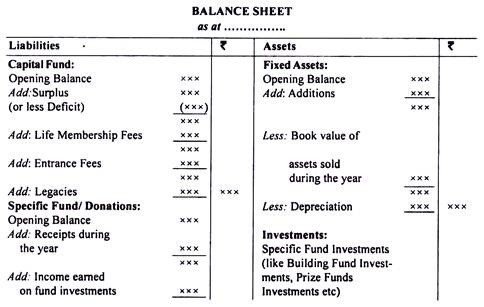
The balance sheet of non-profit organizations is prepared in the same manner as in the case of business enterprises. Assets of the organization are recorded on the ‘Right-hand side’ and Liabilities on the ‘Left-hand side’. Except for some peculiar transactions, the items are also same. The term ‘Capital’ is nowhere found in the case of non-profit organizations; instead Capital Fund, General Fund or Accumulated Fund is appearing in the Balance Sheet.

The amount of this fund is calculated by deducting the amount of liabilities from the value of assets. In this manner we can say that the method of finding out this fund is exactly same that as of calculating the capital of any business enterprise.

Accounting Treatment of General Fund and Preparation of Balance Sheet

  • Preparation of a balance sheet starts with the general fund. You have to add the respective surplus or deficit in the amount.
  • Further, add life membership fees or legacies at this stage.
  • Put all fixed assets on the asset side of the balance sheet.
  • Showcase the amounts paid in advance and amount due on the assets and liabilities side.
  • Post the closing balances of the assets and liabilities on the respective side of the balance sheet.
  • To calculate the amount of the fund, deduct the value of total liabilities from the value of assets.

The surplus or deficit of the year is adjusted to the fund of previous year. It is worth mentioning that the items which have been capitalized during the current year should also be added. Specific funds created for some specific purposes are shown on the liabilities side. For example, Match Fund, Prize Fund etc. are shown on the liabilities side.

The amounts received on account of these funds, if invested separately, are represented by specific assets in the balance sheet on assets side respectively. For example, Match Fund Investments, Prize Fund Investments etc. are shown on the assets side.

A specimen of Balance Sheet is given below:

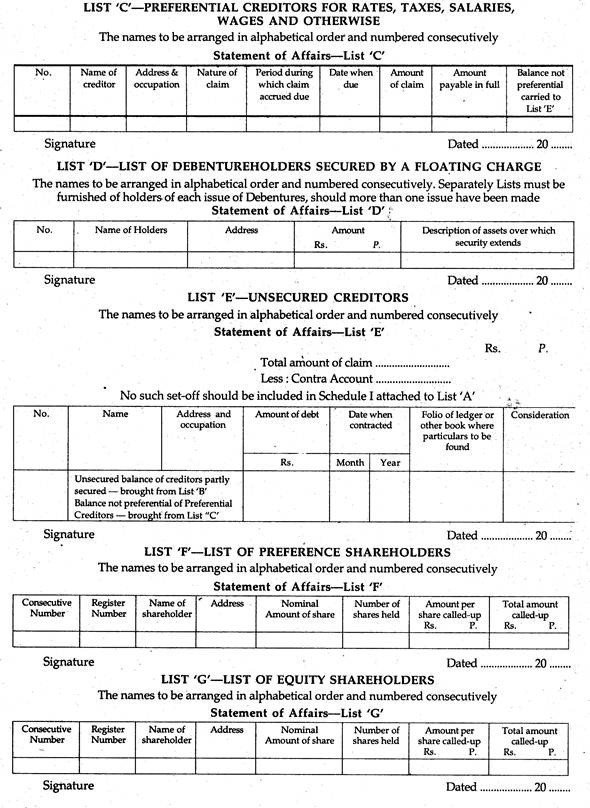
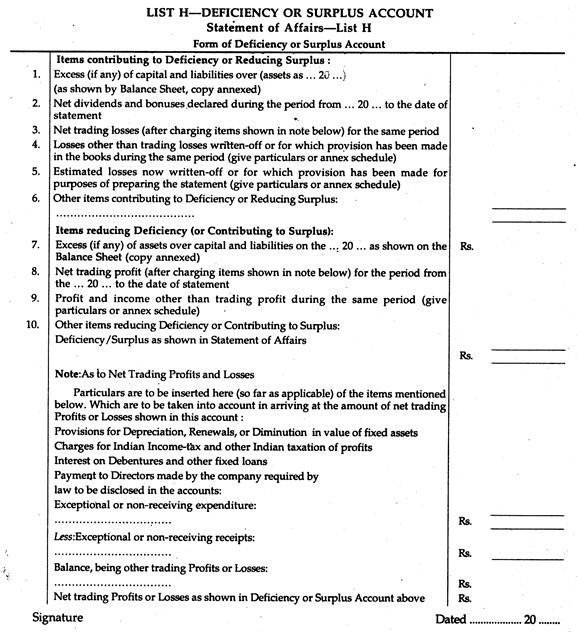
Statement of Affairs

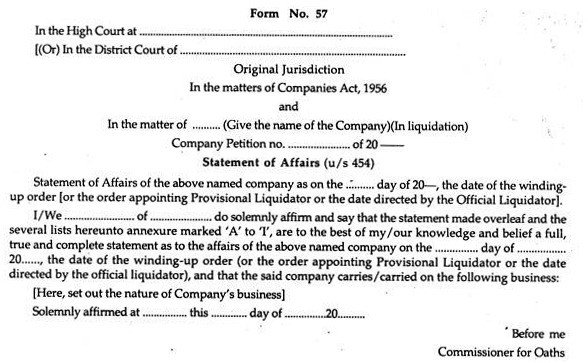
According to Sec. 454, within 21 days of the date of the winding-up order to the appointment of the official liquidator as provisional liquidator, the company has to submit a statement to the official liquidator as to the affairs of the company unless the Court otherwise orders. The statement must be in the prescribed form.

It must be verified by affidavit and must contain the following particulars:

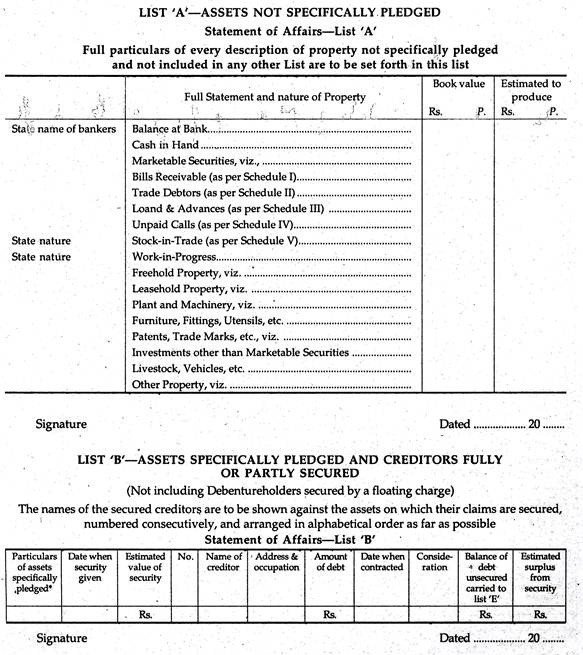
(i) The assets of the company, stating separately the cash in hand and cash at bank and negotiable securities.

(ii) The debts and liabilities of the company;

(iii) Names and addresses of its creditors, stating separately the amount of secured and unsecured debts;

(iv) In the case of secured debts, particularly of the securities held by the creditors, their value and dates on which they were given;

(v) The debts due to the company and names and addresses of the persons from whom they are due and the amount likely to be realized;

(vi) Such further information as may be required by the official liquidator.

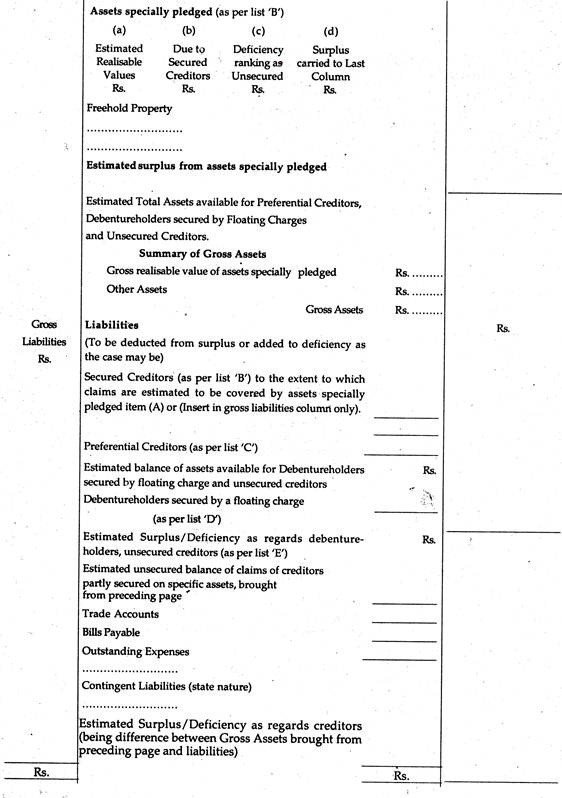
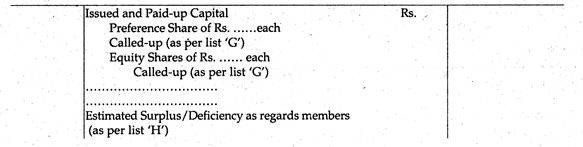
Prescribed Form of Statement of Affairs-[Form 57 of the Companies (Court) Rules, 1959] is given:

Form of Statement of Affairs:

Statement as to the affairs of………… Ltd. on the……… day of 20…; being the date of winding-up order appointing provisional liquidator, or the date directed by the official liquidator as the case may be, showing assets of estimated realisable values and liabilities expected to rank.

Conversion method

Statement of Affairs

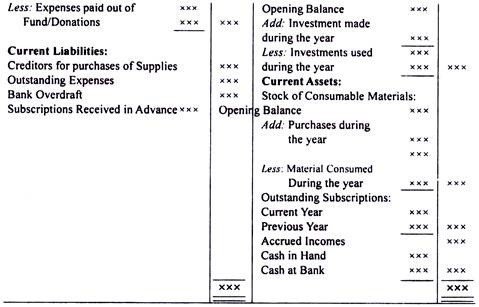
A statement of affairs is a document that shows the overall financial health of a business. It lists the assets, liabilities and capital of a business. A statement of affairs is prepared at the beginning and end of the financial year so business owners can get a sense of their opening or closing capital i.e. the money a business has to fund its day-to-day operation.

There are two sections in a statement of affairs: the left section is for current liabilities and the right section is for current assets. Opening or closing capital (also called “net assets”) is calculated by subtracting total liabilities from total assets.

Statements of affairs are usually prepared by small businesses that use a single-entry system and only use cash and credit accounts. This means they can’t produce a balance sheet, which is similar to a statement of affairs but used in double-entry bookkeeping. Assets and liabilities must balance (match) on a balance sheet for it to be accurate, which is why it’s considered a more reliable document than a statement of affairs.

The conversion method involves converting your accounting from a single-entry system to a double-entry system. Small businesses usually start out by using single-entry bookkeeping. This method is a simpler way to track their income and expenses.

That said, double-entry bookkeeping is a more reliable system that growing small businesses need to adopt. This system allows business owners to produce a document called a trial balance that will let you check if your entries are correct.

The conversion method requires making a statement of affairs, posting transactions in accounting software as both a debit and credit and checking your work via a trial balance and income statement. Two separate bank accounts also need to be opened for expenses and income.

The conversion method is the process of converting a business’s accounting from single-entry to double-entry.

New small businesses often use single-entry bookkeeping as a quick and simple way to record their income and expenses. Single-entry bookkeeping only uses three accounts: bank, cash and personal. Reports like a balance sheet, Trial Balance or Income Statements can’t be produced from single-entry transactions.

Small businesses can use the conversion method to take advantage of the double-entry system’s advanced reporting capabilities.

Double-entry bookkeeping is also considered more reliable. Because double entry bookkeeping records each transaction as both a debit and credit, a Trial Balance can be produced that lets a business owner check if the transactions are correct and make sure total income and expenditure balance (match).

Steps to Convert Single-Entry to Double-Entry Bookkeeping

Using the conversion method to take your accounts from single-entry to double-entry bookkeeping can be performed by a small business owner alone. That said, an accountant should look over your work to make sure it’s accurate and any mistakes won’t be compounded over time.

Prepare an Opening Statement of Affairs

A statement of affairs is a document that shows the assets and liabilities of a business within a certain accounting period (for example, year to date). Subtracting total liabilities from total assets determines working capital i.e., the business’ overall financial health.

Prepare your statement of affairs by making a table with two columns: current liabilities on the left and current assets on the right. Then list each.

Liabilities can include:

  • Accounts payable (your unpaid invoices)
  • Taxes payable
  • Loans payable
  • Credit cards payable

Assets can include:

  • Cash on hand
  • Accounts receivable (outstanding invoices)
  • Equipment value
  • Reimbursable expenses

Post All Transactions in A Double-Entry Journal System

Now it’s time to enter your transactions in a double-entry journal system, so go ahead and download or upgrade your accounting software.

First, enter an opening journal entry of your total assets, liabilities and resulting working capital using information from your statement of affairs.

Then, enter all your expenses and sales in your Cash Account.

We’ll also need to prepare the following accounts:

  • Total Debtors Account
  • Total Creditors Account
  • Bills Receivable Account
  • Bills Payable Account.

Nominal accounts for expenses and revenue need to be created too using information from the Cash Account. Nominal accounts are temporary accounts that are closed at year end and are restarted at the beginning of a new financial year with zero value.

Divide Your Expenses and Income Bank Accounts

Open two new bank accounts: one for expenses and one for income. This will help keep your accounts straight. Each account will have corresponding credit and debit entries in your accounting system both in the ledgers and journal.

Run A Trial Balance

Running a trial balance of your journal and ledger lets you check if your entries are right. A trial balance shows the total of all credits and debits in your business’s accounts. The sum of the credits and debits for each account should match, otherwise you need to go back and check your entries for errors.

error: Content is protected !!