Goodwill, Introductions, Meaning, Definitions, Needs, Origins, Circumstances, Factors, Methods

Goodwill is an intangible asset representing the value of a business’s reputation, brand image, customer loyalty, efficient management, favourable location, and other advantages that enable it to earn higher profits compared to other firms in the same industry.

Unlike tangible assets such as buildings, machinery, or stock, goodwill cannot be physically seen or touched, but it significantly contributes to the earning potential of the business. It reflects the premium value that an acquiring company is willing to pay over and above the fair market value of the net assets of the acquired business.

In accounting terms, goodwill is recognised when a business is purchased for a price higher than the value of its net assets. The difference between the purchase price and the net asset value is recorded as goodwill in the books of the buyer.

Example:

If the net assets of a business are worth ₹50,00,000 and it is purchased for ₹60,00,000, the excess ₹10,00,000 is goodwill.

Goodwill can be:

  • Purchased Goodwill: Arises when paid for during the acquisition.

  • Self-generated Goodwill: Arises due to the firm’s efforts over time but is usually not recorded in the books as per accounting standards.

Need for Valuation of Goodwill

Valuation of goodwill becomes necessary in several business and corporate accounting situations. The major circumstances are explained below, each highlighting why goodwill must be quantified and adjusted.

  • Admission of a Partner

When a new partner is admitted into a partnership, the existing partners may be sacrificing a portion of their future profits. Goodwill is valued to compensate the old partners for this sacrifice. The incoming partner pays his share of goodwill in cash or capital, which is distributed among existing partners in their sacrificing ratio. Valuation ensures fairness, prevents disputes, and reflects the firm’s enhanced earning capacity at the time of admission.

  • Retirement of a Partner

At the time of retirement, a partner is entitled to his share of goodwill because he helped build the firm’s reputation and profit-earning ability. Goodwill valuation is necessary to determine the retiring partner’s due share. The remaining partners compensate him in cash or adjust capital accounts accordingly. Without proper valuation, the retiring partner may be deprived of the benefits arising from the goodwill generated during his association with the firm.

  • Death of a Partner

In case of the death of a partner, goodwill must be valued to calculate the amount payable to the legal representatives of the deceased partner. Since goodwill represents future benefits, the deceased partner’s share up to the date of death must be settled fairly. Valuation helps in arriving at a just settlement, protects the interests of the deceased partner’s family, and ensures continuity of business without financial conflicts.

  • Change in Profit-Sharing Ratio

Whenever partners decide to change their profit-sharing ratio, some partners may gain while others may sacrifice their share of future profits. Goodwill valuation becomes essential to compensate the sacrificing partners by the gaining partners. This adjustment maintains equity among partners and reflects the realignment of future earning rights. Valuation avoids misunderstandings and ensures that changes in ownership rights are supported by proper financial adjustments.

  • Sale of Business

When a business is sold as a going concern, goodwill valuation is necessary to determine the true sale price. The buyer pays not only for tangible assets but also for the established reputation, customer base, and earning potential of the business. Goodwill valuation ensures that the seller receives fair compensation for the intangible advantages transferred to the buyer and helps in accurate determination of purchase consideration.

  • Amalgamation or Absorption of Companies

In cases of amalgamation or absorption, goodwill valuation is required to calculate purchase consideration and to record goodwill or capital reserve in the books of the transferee company. If the purchase price exceeds the fair value of net assets, goodwill arises. Valuation ensures compliance with accounting standards, enables accurate financial reporting, and reflects the true cost of acquiring another company’s business advantages.

  • Conversion of Partnership Firm into a Company

When a partnership firm is converted into a company, goodwill must be valued to determine the purchase consideration payable by the company. The company acquires the firm’s reputation and earning capacity along with its assets. Proper valuation ensures that partners receive shares or consideration proportionate to the goodwill contributed by the firm and that the company’s balance sheet reflects a realistic business value.

  • Determination of True Value of Business

Goodwill valuation is necessary to ascertain the true value of a business beyond its tangible assets. It reflects factors such as market position, brand image, customer loyalty, and managerial efficiency. This valuation is useful for investors, financial institutions, and management while making investment, merger, or expansion decisions. It provides a realistic picture of the firm’s overall worth and future profit potential.

Origins of Goodwill

Goodwill originates from various internal and external factors that enable a business to earn profits in excess of the normal rate. These sources collectively build the reputation and value of the enterprise over time. The main origins of goodwill are explained below.

  • Reputation of the Business

The long-standing reputation of a business is one of the most important sources of goodwill. Firms that have operated successfully for many years build trust among customers, suppliers, and investors. This reputation ensures customer loyalty and repeat sales, even in the presence of competition. A reputed firm can charge premium prices and still retain customers. Such confidence and public image, developed over time, create an intangible advantage that directly contributes to the generation of goodwill.

  • Efficient Management

Efficient, experienced, and visionary management plays a crucial role in the creation of goodwill. Capable managers ensure optimum utilization of resources, cost control, innovation, and strategic decision-making. Sound management policies result in higher productivity, better employee relations, and sustained profitability. When a firm consistently earns above-normal profits due to managerial efficiency, it enhances its market value, thereby giving rise to goodwill at the time of valuation or acquisition.

  • Location Advantage

A favorable business location significantly contributes to goodwill. Firms located in prime areas, such as commercial hubs or places with easy access to raw materials and markets, enjoy operational and competitive advantages. For example, retail stores in busy marketplaces or factories near ports and transport facilities incur lower costs and attract more customers. Such locational benefits enable higher earnings and long-term stability, resulting in the creation of goodwill.

  • Monopoly or Favorable Market Position

Goodwill may arise due to monopoly power or a strong market position. When a firm faces limited or no competition, it can control prices, maintain stable demand, and earn consistent profits. Even without legal monopoly, a dominant market share, brand leadership, or exclusive rights can reduce competitive pressure. These advantages allow the firm to generate excess profits over normal returns, which form the basis for the valuation of goodwill.

  • Quality of Products and Services

Superior quality of products or services is a major source of goodwill. Firms that maintain consistent quality standards gain customer satisfaction and brand loyalty. High-quality goods reduce complaints, returns, and marketing costs while improving brand image. Customers often prefer such products even at higher prices. This ability to attract and retain customers through quality leads to sustained earnings, which ultimately results in the creation of goodwill.

  • Skilled and Loyal Workforce

A skilled, trained, and loyal workforce contributes significantly to goodwill. Experienced employees improve efficiency, reduce wastage, and enhance innovation. Strong employer–employee relationships also reduce labor turnover and industrial disputes. Such stability ensures smooth operations and continuous productivity. Since human resources are not recorded as assets in the balance sheet, their contribution to future profits appears indirectly in the form of goodwill.

  • Favorable Contracts and Legal Rights

Goodwill may also arise from favorable long-term contracts, licenses, patents, trademarks, or exclusive distribution rights. These legal advantages provide income security and competitive protection. For example, patented technology or exclusive supply agreements ensure steady demand and reduced competition. As these benefits enable the firm to earn higher profits over a longer period, they contribute significantly to the valuation of goodwill.

  • Marketing Ability and Brand Image

Strong marketing strategies, effective advertising, and a well-established brand image create goodwill. Firms with popular brand names enjoy customer recognition and loyalty, which increases sales volume and market penetration. Brand equity allows businesses to introduce new products easily and withstand competitive pressure. This marketing strength leads to higher future earnings and forms an important origin of goodwill in corporate accounting.

Circumstances When Goodwill is Valued

Valuation of goodwill becomes necessary under several business situations, particularly when ownership or profit-sharing arrangements change. The key circumstances are:

  • Sale of Business

When a business is sold as a going concern, the purchase price often includes an amount for goodwill. The buyer is willing to pay for the benefits of an established reputation, customer base, and other advantages that will generate profits in the future. In such cases, goodwill is valued to determine the total consideration.

  • Admission of a New Partner

When a new partner joins a partnership firm, they get the right to share in the future profits of the business. Since the existing partners have worked to build the firm’s reputation and profit potential, the incoming partner usually compensates them for their share of the goodwill. The valuation ensures fairness in determining the amount payable.

  • Retirement or Death of a Partner

When a partner retires or dies, they are entitled to receive their share of the goodwill, as they helped build the business’s reputation. Valuation ensures the outgoing partner (or their legal heirs) is fairly compensated for their contribution.

  • Amalgamation of Companies

When two companies merge, the valuation of goodwill helps in deciding the share exchange ratio or purchase consideration. This ensures both sets of shareholders are treated fairly based on the relative worth of their companies, including intangible assets like goodwill.

  • Change in Profit-Sharing Ratio

If partners in a firm decide to change their existing profit-sharing arrangement, the partner gaining a higher share compensates the partner losing a share of profits. Goodwill valuation helps determine this compensation amount.

  • Conversion of a Partnership into a Company

When a partnership is converted into a company, goodwill is valued to determine the consideration payable to the partners, especially when the business is transferred as a going concern.

  • Court Cases or Tax Purposes

In legal disputes, divorce settlements, inheritance cases, or tax assessments, goodwill valuation may be required to determine the fair market value of a business.

  • Liquidation

Even during liquidation, goodwill may have a residual value if the brand name, customer contracts, or other intangible advantages can be sold separately.

Factors Affecting the Valuation of Goodwill:

The value of goodwill is not fixed—it varies depending on several qualitative and quantitative factors. These include:

  • Nature of Business

The type of business has a major influence on goodwill. A business with stable demand, essential products, and a long-term customer base (e.g., FMCG, healthcare) will generally have higher goodwill compared to one operating in a volatile or seasonal market.

  • Location of Business

A business located in a prime area with high footfall (e.g., near markets, busy streets, or transportation hubs) can attract more customers without significant advertising. Such businesses have higher goodwill because their location provides a competitive advantage.

  • Reputation of the Business

A well-established reputation for quality, service, and reliability increases customer trust and loyalty, resulting in repeat business and higher goodwill. Negative publicity or poor customer service can reduce goodwill.

  • Efficiency of Management

A capable and experienced management team improves productivity, reduces costs, and maintains consistent quality—factors that enhance profitability and goodwill. Poor management decisions, on the other hand, can damage goodwill quickly.

  • Quality of Products or Services

High-quality products and services ensure customer satisfaction and retention, leading to strong word-of-mouth promotion and higher goodwill. Businesses known for substandard products may have low or even negative goodwill.

  • Market Conditions

Favourable industry trends, low competition, and economic stability enhance goodwill, while recession, intense competition, or market saturation can reduce it.

  • Access to Resources

Easy access to skilled labour, raw materials, finance, and advanced technology can increase a firm’s efficiency and profitability, thereby boosting goodwill.

  • Risk Involved

Businesses with lower business risk (e.g., stable cash flows, diversified products) command higher goodwill. High-risk ventures (e.g., speculative trading) have lower goodwill valuations.

  • Long-Term Contracts and Relationships

Securing long-term contracts with key customers or suppliers provides revenue stability and increases goodwill.

  • Brand Value and Intellectual Property

Well-known trademarks, patents, and copyrights add to goodwill because they provide a unique competitive advantage.

  • Monopoly or Favourable Agreements

Legal monopolies or government concessions can significantly enhance goodwill since they reduce competition and guarantee revenue streams.

  • Synergy Benefits in Mergers

In the case of amalgamation or acquisition, expected cost savings, market expansion, or combined operational efficiency can increase the goodwill valuation.

Importance of Valuation of Goodwill:

The process of valuing goodwill is essential for:

  • Ensuring fairness in partner compensation.

  • Determining the correct purchase consideration in mergers/acquisitions.

  • Presenting an accurate financial position in legal cases.

  • Facilitating negotiations during business sale.

  • Ensuring compliance with accounting standards (AS 26 in India, IFRS 3 globally).

Methods of Valuation of Goodwill:

The value of goodwill can be determined using various methods, depending on the nature of the business, purpose of valuation, and availability of data. The main methods are:

1. Average Profit Method

Goodwill is valued by multiplying the average maintainable profits by a certain number of years’ purchase.

  • Formula:

Goodwill = Average Profit × Number of Years’ Purchase

  • Steps:

    1. Determine past profits.

    2. Adjust for abnormal items.

    3. Calculate average profit.

    4. Multiply by agreed years’ purchase (e.g., 3, 4, or 5 years).

  • Types:

    • Simple Average Profit Method – Uses arithmetic average.

    • Weighted Average Profit Method – Gives higher weight to recent profits to reflect current earning capacity.

2. Super Profit Method

Goodwill is calculated based on the “super profits” — the excess of average profit over the normal profit (which is based on the normal rate of return).

  • Formula:

Goodwill = Super Profit × Number of Years’ Purchase

Where:

Super Profit = Average Profit − Normal Profit

Normal Profit = Capital Employed × Normal Rate of Return (NRR)

  • Features:

    • Highlights the business’s earning capacity above industry standards.

    • Suitable when profits are higher than normal industry returns.

3. Capitalization Method

This method converts maintainable profits into total capital value, then deducts the actual capital employed to get goodwill.

a) Capitalization of Average Profits

  • Formula:

Goodwill = [Average Profit × 100 / NRR] − Capital Employed

  • Indicates how much more the business is worth compared to its actual capital invested.

b) Capitalization of Super Profits

  • Formula:

Goodwill = [Super Profit × 100] / NRR

  • Focuses purely on capitalizing the extra profit above the normal level.

4. Annuity Method

Super profits are treated as an annuity receivable for a certain period, and goodwill is calculated as the present value of that annuity.

  • Formula:

Goodwill = Super Profit × Present Value of ₹1 for n years at i%

  • Use: Reflects the time value of money, making it suitable when super profits are expected only for a limited period.

5. Market Value Method

Used for companies whose shares are actively traded in the stock market. Goodwill is indirectly reflected in the market value of shares above their book value.

  • Formula:

Goodwill = (Market Value per Share − Net Asset Value per Share) × Number of Shares

  • Use: Common for valuing goodwill in publicly listed companies.

6. Purchase Consideration Method (Residual Method)

Goodwill is the difference between the purchase consideration paid for acquiring a business and the net assets acquired.

  • Formula:

Goodwill = Purchase Consideration − Net Assets Acquired

  • Use: Applicable in mergers, acquisitions, and business takeovers.

7. Rule of Thumb Method

Goodwill is valued as a fixed proportion (e.g., 1 year’s purchase) of turnover, gross profit, or some other financial measure.

  • Use: Quick, but not precise; often used in small business sales (e.g., retail shops).

Average Profit Method of Valuation of Goodwill

Under the Average Profit Method, goodwill is valued on the basis of the average maintainable profits of past years. The assumption is that a business will continue to earn similar profits in the future.

Goodwill = Average Profit × Number of Years’ Purchase

Steps in Valuation

  1. Collection of Past Profits: Collect the profit figures of the past 3 to 5 years (as agreed).

  2. Adjustment of Profits: Adjust for abnormal items:

    • Deduct abnormal gains (e.g., profit from sale of fixed assets).

    • Add back abnormal losses (e.g., loss due to fire, one-time expenses).

    • Adjust for changes in depreciation, salary, or interest not previously recorded.

  3. Calculation of Average Profit: Compute average profits by summing the adjusted profits and dividing by the number of years.

  4. Selection of Years’ Purchase: Decide the number of years’ purchase depending on industry practice, stability of business, and mutual agreement.

  5. Valuation of Goodwill: Multiply average profit by years’ purchase to get goodwill.

Types of Average Profits

Simple Average Profit:

All years’ profits are given equal weight.

Simple Average = Total of adjusted profits / Number of years

Weighted Average Profit:

Profits of recent years are given more importance because they are more relevant for future expectations.

Weighted Average Profit = Total of (Profit × Weight) / Total of Weights

Super Profit Method, Capitalization of Super Profit Method

The Super Profit Method is based on the idea that goodwill arises when a business earns more than the normal expected profit. The difference between the actual (or average) profit and the normal profit is called Super Profit. Goodwill is then valued as a multiple of this super profit.

Goodwill = Super Profit × Years’ Purchase

Steps

  1. Calculate Average Profit of the business (adjust past profits for abnormal items).

  2. Compute Normal Profit:

Normal Profit = Capital Employed × Normal Rate of Return / 100

4. Find Super Profit = Average Profit – Normal Profit.

5. Multiply Super Profit by Years’ Purchase to get goodwill.

Capitalization of Super Profit Method

This method capitalizes the super profit at the normal rate of return to calculate goodwill. Instead of multiplying super profit by years’ purchase, we directly calculate how much capital is required to earn that excess profit at the normal rate of return.

Goodwill = [Super Profit×100] / Normal Rate of Return

Steps:

  1. Calculate Average Profit.

  2. Calculate Normal Profit = Capital Employed × NRR.

  3. Find Super Profit = Average Profit – Normal Profit.

  4. Capitalize the Super Profit at the normal rate of return.

Difference Between the Two Methods

Basis Super Profit Method Capitalization of Super Profit Method
Formula Goodwill = Super Profit × Years’ Purchase Goodwill = (Super Profit × 100) ÷ NRR
Approach Multiplies excess profit by fixed years Converts excess profit into capitalized value
Result Based on years’ purchase decided by agreement Based on industry’s normal return rate
Usefulness Simpler and more common More accurate, used in detailed valuations

Capitalization of Average Profit Method of Valuation of Goodwill

The Capitalization of Average Profit Method is one of the important approaches to valuing goodwill. Unlike the simple Average Profit Method, which multiplies average profit by a certain number of years’ purchase, this method converts average profit into capital employed (or the value of business) and then calculates goodwill as the excess of this capitalized value over the actual capital employed in the business.

It reflects the idea that a business is worth the capital required to generate its maintainable average profit at a normal industry rate of return.

Formula

Goodwill = Capitalized Value of Business − Net Assets (Capital Employed)

Where,

Capitalized Value of Business = [Average Profit / Normal Rate of Return] × 100

Steps in Valuation

  1. Calculate Average Profit: Adjust past profits for abnormal items and calculate the average.

  2. Determine Normal Rate of Return (NRR): Industry standard rate of return is used (e.g., 10%, 12%).

  3. Find Capitalized Value of Business:

Capitalized Value = [Average Profit × 100] / NRR

4. Calculate Capital Employed: Total assets (excluding goodwill and fictitious assets) minus outside liabilities.

5. Compute Goodwill: Deduct capital employed from capitalized value of business.

illustration:

A firm earns an average profit of ₹2,00,000. The normal rate of return in the industry is 10%. The firm’s capital employed is ₹15,00,000. Find goodwill using the Capitalization of Average Profit Method.

Step 1: Capitalized Value of Business

Capitalized Value = 2,00,000 × 10010 = ₹20,00,000

Step 2: Goodwill

Goodwill = 20,00,000 − 15,00,000 = ₹5,00,000

Thus, the goodwill of the firm is ₹5,00,000.

Advantages of Capitalization of Average Profit Method:

  • Considers Normal Industry Returns

This method is more realistic as it compares the firm’s maintainable profits with the normal rate of return (NRR) prevailing in the industry. If a business earns higher profits than the expected industry return, the difference reflects goodwill. Thus, it ensures that the valuation is not arbitrary but benchmarked against the industry, giving a fair and logical estimate of goodwill value.

  • Reflects True Earning Capacity

Unlike methods that merely average past profits, this approach emphasizes the earning capacity of the business in proportion to the capital employed. It highlights how effectively the business is utilizing its capital compared to expected returns. Hence, goodwill is valued based on the excess earnings potential, making the result more reliable, especially for investors, buyers, and sellers considering mergers, acquisitions, or partnership changes.

  • Suitable for Capital-Intensive Businesses

This method is particularly advantageous for firms with heavy investments in assets and infrastructure. Since it directly relates profits to capital employed, it provides an accurate measure of whether the business is generating adequate returns on its invested funds. Such businesses often have goodwill arising from efficiency, scale, or brand reputation, and the method captures these advantages better than simple profit-based methods.

  • Provides Logical Valuation Framework

The Capitalization of Average Profit Method offers a systematic and logical framework for valuing goodwill. By linking profits, capital employed, and normal return rates, it eliminates guesswork and arbitrary multipliers used in other methods. This makes it highly suitable for negotiations, legal disputes, or financial reporting where rational justification is required. The structured process ensures transparency and reduces chances of conflict between interested parties.

Disadvantages of Capitalization of Average Profit Method:

  • Difficulty in Determining Normal Rate of Return (NRR)

One of the biggest limitations of this method is deciding the appropriate normal rate of return. The NRR varies widely depending on industry, economic conditions, competition, and risk factors. A small difference in the assumed rate can lead to a large variation in the calculated goodwill, making the valuation subjective. This uncertainty reduces the reliability of the method unless accurate and up-to-date industry benchmarks are available.

  • Complex Calculation of Capital Employed

Accurate computation of capital employed is often challenging because it requires careful adjustments of assets and liabilities. Non-operating assets, fictitious assets, intangible assets, and contingent liabilities must be excluded, which involves judgment. Any miscalculation may result in misleading goodwill figures. Unlike simpler methods, this one demands detailed analysis of the balance sheet, which may not always be possible due to lack of transparency in financial records.

  • Unsuitable for Firms with Fluctuating Profits

This method assumes that average profit is a fair representation of future maintainable profits. However, in businesses where profits fluctuate significantly due to seasonal demand, market volatility, or irregular performance, the average profit may not reflect the true earning capacity. In such cases, the goodwill valuation may be misleading and either undervalues or overstates the actual potential of the firm, reducing its reliability for decision-making.

  • Time-Consuming and Technical

Compared to the Simple Average Profit Method, the Capitalization of Average Profit Method is more technical and time-consuming. It requires detailed profit adjustments, determination of average profit, accurate calculation of capital employed, and selection of normal rate of return. Small errors at any step can distort results. For small firms or routine transactions, this detailed approach may be impractical, making simpler methods more preferable in such situations.

Annuity Method of Valuation of Goodwill

The Annuity Method is a refined version of the Super Profit Method. Instead of simply multiplying super profits by years’ purchase, this method considers the time value of money. Since future profits will be earned year after year, their present value should be calculated. Under this method, goodwill is the present value of super profits treated as an annuity over a certain number of years, discounted at a normal rate of return.

Formula:

Goodwill = Super Profit × Present Value of Annuity Factor (PVAF)

Where:

  • Super Profit = Average Profit – Normal Profit

  • PVAF = Present value of ₹1 received annually for a given period, discounted at the normal rate of return

Steps

  1. Calculate Average Profit (adjust past profits).

  2. Find Normal Profit = Capital Employed × NRR ÷ 100.

  3. Compute Super Profit = Average Profit – Normal Profit.

  4. Find PVAF (from annuity tables or by formula):

5. Multiply Super Profit by PVAF to get goodwill

Advantages:

  1. Considers the time value of money, making valuation more realistic.

  2. More accurate than simple or super profit methods.

  3. Fair representation of goodwill when profits are expected to be earned over a definite period.

Limitations:

  1. Requires annuity tables or present value calculations, which makes it more complex.

  2. Assumes super profits will remain constant over the period, which may not always be true.

  3. Not widely used in small businesses due to complexity.

Holding Company, Types, Benefits, Functions, Legal Requirements

Holding Company is an entity that has control over one or more companies, known as subsidiaries. Control is typically exercised by owning more than 50% of the subsidiary’s equity share capital or by having the power to appoint or remove a majority of its directors. The holding–subsidiary structure allows the parent entity to influence strategic decisions, manage resources, and oversee operations without being directly involved in day-to-day activities.

Under the Companies Act, 2013, the definition is provided in Section 2(46). A holding company may be incorporated in India or abroad. It must comply with specific legal provisions relating to subsidiary relationships, financial reporting, corporate governance, and restrictions on layers of subsidiaries. This structure is often used for group companies, diversification, risk management, and regulatory benefits, while enabling centralized control over multiple business entities.

Types of Holding Companies

  1. Pure

A holding company is described as pure if it was formed for the sole purpose of owning stock in other companies. Essentially, the company does not participate in any other business other than controlling one or more firms.

  1. Mixed

A mixed holding company not only controls another firm but also engages in its own operations. It’s also known as a holding-operating company.

Holding companies that take part in completely unrelated lines of business from their subsidiaries are referred to as conglomerates.

  1. Immediate

An immediate holding company is one that retains voting stock or control of another company, in spite of the fact that the company itself is already controlled by another entity. Put simply, it’s a type of holding company that is already a subsidiary of another.

  1. Intermediate

An intermediate holding is a firm that is both a holding company of another entity and a subsidiary of a larger corporation. An intermediate holding firm might be exempted from publishing financial records as a holding company of the smaller group.

Benefits of a Holding Company

  1. Greater control for a smaller investment

It gives the holding company owner a controlling interest in another without having to invest much. When the parent company purchases 51% or more of the subsidiary, it automatically gains control of the acquired firm. By not purchasing 100% of each subsidiary, a small business owner gains control of multiple entities using a very small investment.

  1. Independent entities

If a holding company exercises control over several companies, each of the subsidiaries is considered an independent legal entity. It means that if one of the subsidiaries were to face a lawsuit, the plaintiffs have no right to claim the assets of the other subsidiaries. In fact, if the subsidiary being sued acted independently, then it’s highly unlikely that the parent company will be held liable.

  1. Management continuity

Whenever a parent company acquires other subsidiaries, it almost always retains the management. It is an important factor for many owners of subsidiaries-to-be who are deciding whether to agree to the acquisition or not. The holding firm can choose not to be involved in the activities of the subsidiary except when it comes to strategic decisions and monitoring the subsidiary’s performance.

It means that the managers of the subsidiary firm retain their previous roles and continue conducting business as usual. On the other hand, the holding company owner benefits financially without necessarily adding to his management duties.

  1. Tax effects

Holding companies that own 80% or more of every subsidiary can reap tax benefits by filing consolidated tax returns. A consolidated tax return is one that combines the financial records of all the acquired firms together with that of the parent company. In such a case, should one of subsidiary encounter losses, they will be offset by the profits of the other subsidiaries. In addition, the net effect of filing a consolidated return is a reduced tax liability.

Functions of a Holding Company

Successful entrepreneurs with multiple small businesses are typically concerned with limiting liability, streamlining management and retaining ownership control over each entity. Using a holding company can sometimes be the solution to all three concerns. The company works as an umbrella to give you centralized control over your endeavors while maintaining the liability firewall between each business.

  1. Parent Company

A holding company is a corporation or limited liability company that holds a controlling ownership interest in other companies or the assets that those companies use. Typically, a holding company simply holds equity interests or assets, rather than actively engaging in business, such as selling goods or services. Another name for a holding company is a parent, and the companies under it are called operating companies or subsidiaries.

  1. Centralized Control

Entrepreneurs who want to open multiple small businesses can use a holding company to centralize control. The entrepreneur can set up the holding company and designate himself as the sole owner. Each business can be set up separately with the holding company as the owner. In this way, the holding company is the central repository of the equity interests in those companies, and the entrepreneur can select executive management for each company while retaining the ability to direct each entity.

  1. Limiting Investment

Using a holding company also enables you to raise money and create partnerships for each individual entity without losing overarching control of the business conglomerate. An equity investor can invest in one of the companies under the holding company without interfering with any of the others. If you had simply created a single company with multiple divisions or projects, an investor would take an interest in your whole business empire instead of just a single project that is set up as its own business.

  1. Limiting Liability

One of the best uses of a holding company for small-business owners is to further limit liability. Creditors of a corporation or an LLC can go after anything that the entity owns. If you’re in a high-risk business, you can use a holding company to own all of the assets that your business needs to operate, such as real property, vehicles and equipment. The holding company leases those assets to the operating company, so if the operating company gets sued, it owns very little that can be used to satisfy a judgment. The operating company can easily be closed and declared bankrupt, and you can set up another business that leases the exact same assets from the holding company.

  1. Considerations

Creating an interlocking ownership structure for multiple small businesses using a holding company is a sophisticated endeavor with significant tax consequences that are tied to your legal structure choices and tax elections. For example, special personal holding company tax rules apply to corporations but not necessarily LLCs that are used as holding companies. Consult with qualified legal and tax professionals before setting up your businesses.

Holding Companies Legal Requirements under Companies Act, 2013:

The Companies Act, 2013 lays down the following legal requirements:

  1. Definition (Section 2(46)): A holding company includes any body corporate controlling a subsidiary.

  2. Restriction on Layers (Section 2(87) & Rules): A holding company cannot have more than two layers of subsidiaries, except in certain cases (e.g., foreign subsidiaries).

  3. Consolidated Financial Statements (Section 129): Must prepare and present consolidated accounts for itself and all subsidiaries.

  4. Disclosure in Accounts: Details of subsidiaries’ performance must be disclosed in the Board’s Report.

  5. Restriction on Loans & Investments (Section 186): Compliance required for inter-corporate loans, guarantees, and investments.

  6. Related Party Transactions (Section 188): Deals with subsidiaries are treated as related party transactions, requiring approvals.

  7. Annual Return (Section 92): Must include details of subsidiaries, associates, and joint ventures.

  8. Audit Requirements: Subsidiaries’ accounts must be audited and considered in consolidated reports.

Subsidiary Company, Types, Structure, Work, Legal Requirements

Subsidiary Company is an entity that is controlled by another company, known as the holding company. Control is generally established when the holding company owns more than 50% of the subsidiary’s equity share capital or has the power to appoint or remove a majority of its directors. This control can be direct or indirect, including through another subsidiary (step-down subsidiary). The relationship allows the holding company to influence key decisions and policies of the subsidiary without necessarily being involved in its daily operations.

Under the Companies Act, 2013 (Section 2(87)), subsidiaries are subject to specific legal requirements relating to structure, reporting, and compliance. A company cannot have more than two layers of subsidiaries, except in certain permitted cases, such as foreign subsidiaries with overseas holdings. Subsidiaries must prepare their own financial statements, which are then consolidated into the holding company’s accounts. This structure is widely used for business expansion, risk segregation, and managing diverse operations under a single corporate group.

Types of Subsidiary Company

  1. Partly Owned

The parent company owns 50% or more but less than 100% shares in the holding company. Such a subsidiary is partly owned. Here parent company does not get full control over the subsidiary company.

  1. Wholly Owned

The parent company holds 100% shares & controls in the subsidiary company. Though, A wholly-owned subsidiary company is not a merger.

A holding company can have more than one subsidiary company. But a subsidiary company can have one and only one holding company. However, a subsidiary can have a subsidiary or more of its own.

The parent company can be larger or smaller than the subsidiary. It need not be more powerful than the subsidiary. The size of the firm or employees does not decide the relationship. The only control over ownership is the key factor.

Also, the location or type of business of both companies does not matter.  They may or may not be in the same location or same business line.

Structure of Subsidiary Company

  1. Formation

The parent company has to register with the state registrar of the state in which the company operates. The ownership & stake details are to be defined during this process.

  1. Operation

Normally, the parent company just oversees the operations of the subsidiary company. However, in certain cases, the parent company may supervise day to day operations of a subsidiary company.

Subsidiaries are separate legal entities. They have their own concerns regarding the handling of taxation, regulations & liabilities. Subsidiary companies can sue & be sued separate from the parent company. the obligations of a subsidiary may or may not be obligations of the parent company. One of these companies can be undergoing legal proceedings, bankruptcy, tax delinquency or be under investigation without affecting other companies directly. though affecting public image is altogether an intangible thing.

How Does a Subsidiary Work?

Subsidiaries are common in some industries, particularly real estate. A company that owns real estate and has several properties with apartments for rent may form an overall holding company, with each property as a subsidiary. The rationale for doing this is to protect the assets of the various properties from each other’s liabilities. For example, if Company A owns Companies B, C, and D (each a property) and Company D is sued, the other companies can not be held liable for the actions of Company D.

A subsidiary is formed by registering with the state in which the company operates. The ownership of the subsidiary and the type of corporate entity such as a limited liability company (LLC) are spelled out in the registration.

How Are Subsidiaries Accounted For?

From an accounting standpoint, a subsidiary is a separate company, so it keeps its own financial records and bank accounts and track its assets and liabilities. Any transactions between the parent company and the subsidiary must be recorded.

A subsidiary may also be its own separate entity for taxation purposes. Each subsidiary has its own employer identification number and may pay its own taxes, according to its business type.

However, many public companies file consolidated financial statements, including the balance sheet and income statement, showing the parent and all subsidiaries combined. And if a parent company owns 80% or more of shares and voting rights for its subsidiaries, it can submit a consolidated income tax return that can take advantage of offsetting the profits of one subsidiary with losses from another. Each subsidiary must consent to being included in this consolidated tax return by filing IRS Form 1122.

Holding Company vs. Parent Company

Most holding companies’ sole purpose is to hold ownership of subsidiaries. If that’s the case, the company is referred to as a “pure” holding company. If it also conducts business operations of its own, it’s called a “mixed holding company.5 One example of a pure holding company is publicly traded Alphabet Inc., whose purpose is to hold Google and other, lesser-known subsidiaries like Calico and Life Sciences.6 YouTube is, in turn, a subsidiary of Google.

Subsidiary vs. Branch or Division

You may have seen the terms “branch” or “division” used as synonyms for “subsidiary,” but they are not one and the same. A subsidiary is a separate legal entity, while a branch or division is a part of a company that is not considered to be a separate entity.

A branch is usually defined as a separate location within the company, like the Pittsburgh branch of a company whose headquarters is in New York. A division is part of a company that performs a specific activity, such as the wealth management division of a larger financial services company.

Subsidiary Companies Legal Requirements under Companies Act, 2013:

  • Definition (Section 2(87))

A subsidiary company is one in which another company (holding company) controls more than 50% of the total share capital or has the right to control the composition of its board of directors. This control may be direct or through another subsidiary. The definition also includes step-down subsidiaries. The Companies (Restriction on Number of Layers) Rules, 2017 limit the number of subsidiary layers, ensuring transparency. This definition is crucial for determining compliance obligations, reporting requirements, and corporate governance rules applicable to both the holding and subsidiary.

  • Restriction on Layers

Under the Companies (Restriction on Number of Layers) Rules, 2017, a company cannot have more than two layers of subsidiaries. This restriction is aimed at preventing complex corporate structures that could hide ownership and financial transactions. Exceptions are allowed if the subsidiary is a foreign company with subsidiaries outside India. The rule promotes corporate transparency, facilitates regulatory oversight, and ensures that ownership structures remain simple, making it easier for stakeholders and regulators to trace control and financial relationships within the corporate group.

  • Financial Statement Requirements (Section 129)

A subsidiary must prepare its own standalone financial statements as per Schedule III and applicable accounting standards. The holding company is required to consolidate these statements into consolidated financial statements (CFS). This ensures a complete financial picture of the group as a whole. The subsidiary must share its financial data promptly with the holding company for consolidation. The board of the holding company is responsible for ensuring accuracy and compliance with Indian Accounting Standards (Ind AS) or other applicable accounting rules.

  • Disclosure in Board’s Report

A subsidiary’s performance, major decisions, and overall contribution to the group must be disclosed in the holding company’s Board’s Report. This includes financial highlights, operations, and any significant events affecting the subsidiary. Such disclosures enable shareholders and investors to assess the subsidiary’s role and performance within the group structure. The requirement improves transparency, accountability, and trust among stakeholders by giving them access to vital subsidiary-related information as part of the holding company’s annual reporting obligations under the Companies Act, 2013.

  • Audit Requirements

Every subsidiary company must get its financial statements audited annually by a statutory auditor appointed under the provisions of the Companies Act. The audit ensures the accuracy, fairness, and compliance of accounts with legal and accounting standards. The audited financials are then shared with the holding company for consolidation. For certain classes of companies, internal audit may also be mandatory. The audit process enhances stakeholder confidence, ensures regulatory compliance, and safeguards against financial irregularities within the subsidiary company’s operations.

  • Related Party Transactions (Section 188)

Transactions between a holding company and its subsidiary are considered related party transactions. These include the sale or purchase of goods, services, property, or any other arrangements. Such transactions require prior board approval, and in some cases, shareholders’ approval, especially if they exceed prescribed limits. The purpose is to prevent conflict of interest and ensure fairness in dealings between related entities. Proper disclosure of these transactions in financial statements is mandatory to promote transparency and protect minority shareholders’ interests.

Corporate Social Responsibility (CSR), Components, Importance, Stakeholders

Corporate Social Responsibility (CSR) refers to the ethical obligation of companies to contribute positively to society beyond their financial interests. It is a business model in which companies integrate social, environmental, and ethical concerns into their operations, decision-making processes, and interactions with stakeholders, such as employees, customers, investors, and communities. CSR is based on the idea that businesses should not only focus on generating profits but also consider their impact on society and the environment.

The concept of CSR has evolved from a simple philanthropic activity to a comprehensive approach where businesses strive to be responsible corporate citizens. Today, CSR encompasses a wide range of activities aimed at enhancing the well-being of communities, reducing environmental harm, promoting fair labor practices, and ensuring ethical business practices.

Components of CSR

  • Environmental Responsibility:

A significant component of CSR is the responsibility of companies to reduce their environmental footprint. This includes efforts to reduce pollution, conserve natural resources, manage waste, promote sustainable practices, and minimize the ecological impact of their operations. Many companies implement practices such as reducing carbon emissions, using renewable energy, recycling materials, and adopting sustainable sourcing practices to contribute positively to environmental protection.

  • Social Responsibility:

CSR also involves a company’s commitment to society and its people. Social responsibility focuses on improving the quality of life of employees, customers, and communities. This could include providing fair wages, promoting diversity and inclusion, supporting local community projects, and ensuring access to education and healthcare. Social responsibility is about companies engaging in ethical practices that benefit society at large.

  • Economic Responsibility:

CSR extends to ethical business practices, such as ensuring fair trade, avoiding corruption, and providing fair wages to employees. Economic responsibility also involves transparency in financial reporting, paying taxes, and fostering economic development through innovation and job creation. Companies are expected to generate profit in a manner that is ethical, fair, and sustainable for all stakeholders.

  • Ethical Responsibility:

Ethical responsibility in CSR involves conducting business in an honest, transparent, and fair manner. This includes ensuring that products and services are safe, treating employees and customers with respect, and adhering to legal and moral standards. It is also about ensuring that the company’s practices do not harm individuals or communities and that they operate with integrity.

  • Philanthropy:

Many companies engage in philanthropic activities such as charitable donations, volunteering, and sponsoring community development initiatives. While this is just one aspect of CSR, it plays a key role in improving the social and economic well-being of the communities where businesses operate.

  • Stakeholder Engagement:

A key element of CSR is maintaining good relationships with all stakeholders, including employees, customers, suppliers, investors, and local communities. By engaging stakeholders and addressing their concerns, companies can better understand societal expectations and improve their CSR strategies.

Importance of CSR:

  • Building Brand Reputation and Trust:

Companies that actively engage in CSR build a strong reputation as responsible corporate citizens. This enhances their brand image and fosters trust among consumers, investors, and other stakeholders. A positive reputation can lead to increased customer loyalty, improved employee morale, and better relationships with government and regulatory bodies.

  • Attracting and Retaining Talent:

Today’s workforce is increasingly attracted to companies that align with their values. Companies with strong CSR practices are more likely to attract top talent who want to work for organizations that are committed to making a positive impact. Employees who feel that their employer is socially responsible are also more likely to stay with the company long-term, leading to lower turnover rates.

  • Customer Loyalty:

Consumers are becoming more socially conscious and prefer to purchase from companies that share their values and demonstrate a commitment to social and environmental responsibility. CSR initiatives such as ethical sourcing, fair trade, and environmental sustainability can lead to greater customer loyalty and support for a company’s products and services.

  • Financial Performance:

Contrary to the belief that CSR is a financial burden, many studies have shown that companies that invest in CSR programs can achieve better financial performance over time. Engaging in ethical and socially responsible practices can lead to cost savings (e.g., through energy efficiency and waste reduction), enhanced brand value, and increased consumer demand.

  • Risk Management:

CSR can help companies mitigate risks related to their operations. By addressing social and environmental concerns, companies can avoid negative publicity, fines, and legal challenges. Proactively managing CSR helps businesses avoid potential controversies that could damage their reputation and harm their financial stability.

  • Sustainable Development:

CSR plays a crucial role in promoting sustainable development. By taking a long-term view of their impact on society and the environment, companies can contribute to sustainable economic development. CSR initiatives such as promoting renewable energy, reducing waste, and improving labor standards all support the global goal of sustainability.

CSR and Its Stakeholders:

  • Employees:

A company’s commitment to CSR enhances employee morale and job satisfaction. Employees tend to feel proud to work for an organization that is socially responsible and committed to ethical practices. CSR programs can also offer employees opportunities for personal involvement, such as volunteer work or engagement in community initiatives.

  • Customers:

Customers are increasingly seeking products and services that are produced ethically and sustainably. Companies that prioritize CSR are likely to attract socially conscious consumers who care about the origins and environmental impact of the products they purchase. CSR initiatives enhance customer loyalty and retention.

  • Shareholders and Investors:

Investors are placing greater emphasis on companies that adopt CSR practices. Many institutional investors look for businesses that not only promise financial returns but also adhere to environmental, social, and governance (ESG) principles. A strong CSR program can make a company more attractive to investors, leading to increased funding and support.

  • Communities:

CSR helps to improve the social and economic conditions of the communities where a company operates. Whether through donations, community development programs, or local environmental initiatives, businesses can directly contribute to improving the standard of living and well-being in the regions they serve.

  • Government and Regulatory Bodies:

Governments are increasingly requiring businesses to adhere to CSR-related regulations, especially in areas like environmental protection, labor rights, and corporate governance. Companies that proactively adopt CSR policies can reduce their exposure to regulatory risks and improve their relationship with government bodies.

Applicability of CSR as per Section 135 of Companies Act 2013:

Section 135 of the Companies Act, 2013 mandates Corporate Social Responsibility (CSR) for companies meeting specific financial thresholds. The provision applies to every company, including its holding or subsidiary and foreign companies having a branch office or project office in India, that satisfies any one of the following criteria in the immediately preceding financial year:

Applicability Criteria (Any one of the following):

  1. Net worth of ₹500 crore or more,

  2. Turnover of ₹1,000 crore or more, or

  3. Net profit of ₹5 crore or more.

Requirements for Applicable Companies

  1. CSR Committee:
    Companies to whom CSR is applicable must constitute a CSR Committee of the Board with:

    • At least 3 directors (including 1 independent director),

    • (Private companies need only 2 directors; unlisted/public companies with no independent director are exempt from appointing one).

  2. CSR Policy:
    The CSR Committee shall:

    • Formulate and recommend a CSR Policy to the Board,

    • Recommend the amount of expenditure,

    • Monitor the CSR policy implementation.

  3. Minimum CSR Expenditure:
    The Board must ensure that the company spends at least 2% of the average net profits (before tax) made during the three immediately preceding financial years on CSR activities.

  4. Disclosure:

CSR policy and initiatives must be disclosed in the Board’s report and on the company website, if any.

CSR Activities (Schedule VII)

CSR initiatives must fall under activities specified in Schedule VII, such as:

  • Eradicating hunger and poverty,

  • Promoting education and gender equality,

  • Environmental sustainability,

  • Protection of national heritage,

  • Support to armed forces veterans,

  • PM’s National Relief Fund, etc.

Penalty for Non-Compliance (Post Amendment):

As per the Companies (Amendment) Act, 2019:

  • If the required amount is not spent, the company must transfer the unspent amount to a specified fund (like PM CARES) within a stipulated time.

  • Non-compliance attracts penalty:

    • Company: Twice the unspent amount or ₹1 crore (whichever is less),

    • Officers in default: 1/10th of the unspent amount or ₹2 lakh (whichever is less).

Valuation of Preference Shares

Preference Shares are a type of share capital that provides shareholders a preferential right over equity shareholders in two key aspects: (1) Receiving dividends at a fixed rate before equity shareholders, and (2) Repayment of capital during winding up of the company. They usually do not carry voting rights, except in special cases. Preference shares may be cumulative, non-cumulative, redeemable, or convertible. They are considered a hybrid security, combining features of both equity and debt, offering stability to investors and flexible financing to companies.

Valuation of Preference Shares:

Valuation depends on whether preference shares are irredeemable or redeemable.

A. Irredeemable Preference Shares

  • These shares have no maturity date; holders get a fixed dividend forever.

  • Value is calculated as the present value of perpetual dividends.

Formula:

Value of Irredeemable Preference Share = Annual Preference Dividend / Required Rate of Return

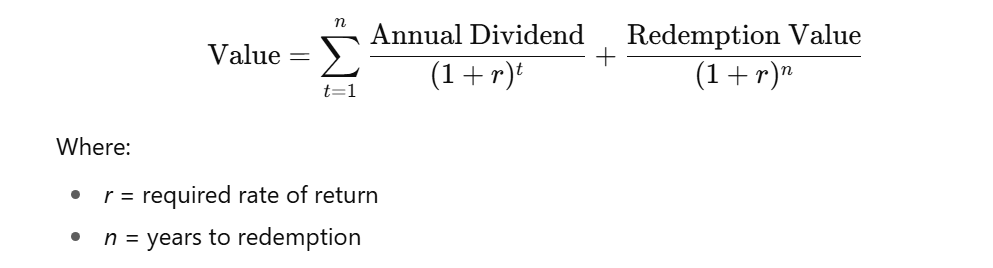
B. Redeemable Preference Shares

  • These shares are repayable after a fixed period (say 5 or 10 years).

  • Value is based on the present value of dividends for n years plus present value of redemption value.

Formula:

Need of  Valuation of Preference Shares:

  • Investment Decision-Making

Valuation of preference shares helps investors decide whether to buy, hold, or sell such securities. Since preference shareholders receive fixed dividends and priority over equity shareholders, knowing the fair value ensures they do not overpay or undervalue their investment. By comparing the intrinsic value with the market price, investors can judge potential returns and risks. This process builds confidence in investment decisions, especially for risk-averse investors who prefer stable returns rather than uncertain equity dividends.

  • Corporate Financing Decisions

Companies issue preference shares as a source of capital, combining features of both debt and equity. Before issuing or redeeming such shares, firms must know their value to ensure cost-effective financing. Valuation helps management compare preference shares with other funding sources like debentures or equity. It also influences dividend payout policies and redemption strategies. Thus, correct valuation ensures balanced capital structure, reduces financing costs, and maintains investor trust, which is essential for smooth business operations and long-term sustainability.

  • Regulatory and Legal Requirements

Valuation of preference shares becomes necessary during mergers, acquisitions, liquidation, or restructuring of a company. Laws and accounting standards often require that shareholders, including preference shareholders, receive fair value for their holdings. Accurate valuation ensures compliance with statutory provisions and prevents disputes among stakeholders. It also helps in calculating compensation payable to preference shareholders when the company decides to redeem or convert their shares. Thus, valuation ensures transparency, fairness, and legal compliance in corporate financial transactions and governance.

  • Redemption and Conversion Decisions

Preference shares are often redeemable after a fixed period or convertible into equity shares. In both cases, valuation plays a vital role. For redemption, it helps determine the repayment amount and its impact on company finances. For conversion, valuation ensures fair exchange ratios between preference and equity shares, avoiding shareholder conflicts. This process safeguards the interests of both the company and investors. Therefore, proper valuation ensures smooth redemption or conversion, maintains fairness, and supports effective long-term financial planning.

error: Content is protected !!