Investment Accounting for Shares

AS 13 Accounting for Investments is widely used and deals with accounting for investments in financial statements prepared by a Company and prescribes various disclosure requirements.

Applicability of AS 13 Accounting for Investments

AS 13 Accounting for Investments doesn’t deal with the following:

  • The base for recognizing dividends, interest, and rentals which are earned on the investments that are covered by AS 9
  • Finance or operating leases which are covered by AS 19
  • Investments in retirement benefit plans and life insurance enterprises which is covered by AS 15
  • The following which is formed under the Central or the State Government Act or declared under Companies Act, 2013
  1. Mutual Funds
  2. Venture Capital Funds and related Asset Management Companies
  3. Banks as well as public financial institutions

Disclosures in the Financial Statements

The below mentioned are the disclosures in the financial statements with respect to AS 13 Accounting for Investments is applicable:

(a) Accounting policies employed for determining carrying amount of investment.

(b) The amounts which are included in the profit and loss statement for:

(i) Dividends, interest, and rentals on the investments presenting the income from such long-term and current investments separately. Gross income must be stated, amount of TDS (tax deducted at source) included under the Advance Taxes Paid.

(ii) Profits and losses on the disposal of current investment and the changes in carrying the amount of the investment.

(iii) Profits and losses on the disposal of long-term investment and the changes in carrying the amount of the investment.

(c) Substantial limitations on the right of ownership, realizability of the investments or remittance of income and proceeds of disposal.

(d) The total amount of both the quoted and unquoted investments, providing the total market value of the quoted investments.

(e) Other disclosures as explicitly as required by the relevant statute governing the.

Treatment

The following points should carefully be remembered:

(a) For Dividend Received:

(i) If we receive dividend from Pre-incorporation profit, the same must be recorded in Nominal Column.

(ii) If we receive dividend from Post-acquisition Profit/Current Profit, such dividend must be recorded in Interest Column.

(b) For Bonus Shares and Right Shares:

If bonus shares are received, entry is made in the debit side of Investment Account in ‘Nominal’ column only and nothing is to be recorded in ‘Principal’ column. In other words, when bonus shares are received, their face value is simply shown in the Investment Account stated above. But in the case of Right shares, the shareholders have the right to avail the ‘Right’ himself or he can refer to third party. The face value of such right shares are recorded in the ‘Nominal’ column and the amount so’ paid in this regard is to be entered in the ‘Principal’ column. But in the case of sale, the amount so received against the sale of ‘Right’ will be entered on the credit side of Investment Account in ‘Principal’ column.

Broker’s Account:

A Broker purchases and sells securities on behalf of his clients. Practically, purchases and sales are made in the name of the client on his information without the receipt of cash or scripts and, consequently, the settlement of payment is made by payment of difference not by actual delivery or by payment.

However, the cost price of the share along with brokerage is debited in client’s account and similarly, the sales minus brokerage is credited in his account against the particular share. It should be remembered in this respect that brokerage should always be calculated on the face/nominal value of shares and not on the cost/selling price of the same (No brokerage is usually charged on sale if the same shares are purchased and sold in the same settlement day).

It has already been stated that the accounts are settled on the settlement or contango day at the end of settlement period. The period may be either 15 days or one month. If, however, the party does not want to settle the account he may carry forward to the next settlement period and the difference after carrying forward is made by Cash. For this carry forward, the broker makes a charge. The charge is called contango when the payment is due and the same is called backwadation when the delivery is due.

The proportionate contango or backwadation in relation to the portion of settlement period which falls in the next year is carried forward at the time of closing the accounts.

Conversion of Convertible Debentures into Equity Shares:

Sometimes Convertible Debentures may be converted into Equity Shares.

Under the circumstances we are to pass the following entry:

  • Convertible Debentures into Equity Shares

  Equity Shares in …………Co. Ltd            Dr.

      To (Convertible) Debentures of….Co. Ltd A/c

It must be remembered that if there is loss on conversion such loss may be adjusted against General Reserve.

Computation and Treatment of exchange rate Differences

In finance, an exchange rate (also known as a foreign-exchange rate, forex rate, or rate) between two currencies is the rate at which one currency will be exchanged for another. It is also regarded as the value of one country’s currency in terms of another currency.

The exchange rate is defined as the rate on the basis of which two countries involved in trade exchange marketable items or commodities. It is basically the cost of exchanging one currency for another currency.

In the retail currency exchange market, a different buying rate and selling rate will be quoted by money dealers. Most trades are to or from the local currency. The buying rate is the rate at which money dealers will buy foreign currency, and the selling rate is the rate at which they will sell the currency. The quoted rates will incorporate an allowance for a dealer’s margin (or profit) in trading, or else the margin may be recovered in the form of a commission or in some other way.

Different rates may also be quoted for different kinds of exchanges, such as for cash (usually notes only), a documentary form (such as traveler’s checks), or electronic transfers (such as a credit card purchase). There is generally a higher exchange rate on documentary transactions (such as for traveler’s checks) due to the additional time and cost of clearing the document, while cash is available for resale immediately.

Therefore, the exchange rate can be calculated as per the below-mentioned relationship:

Exchange Rate = Money in Foreign Currency / Money in Domestic Currency

Additionally, it can also be determined as per the below-mentioned relationship:

Exchange Rate = Money in After Exchange / Money Before Exchange

The equation for the exchange rate can be calculated by using the following steps:

  • First, determine the amount that is to be transferred or exchanged from domestic currency to foreign currency.
  • Next, the individual can access foreign exchange markets through trading platforms or through financial institutions to determine the available exchange rates prevalent between the two nations.
  • Next, multiply the exchange rate with the domestic currency to arrive at the foreign currency.

Model

Purchasing Power Parity

Purchasing power parity is a way of determining the value of a product after adjusting for price differences and the exchange rate. Indeed, it does not make sense to say that a book costs $20 in the US and £15 in England: the comparison is not equivalent. If we know that the exchange rate is £2/$, the book in England is selling for $30, so the book is actually more expensive in England

If goods can be freely traded across borders with no transportation costs, the Law of One Price posits that exchange rates will adjust until the value of the goods are the same in both countries. Of course, not all products can be traded internationally (e.g. haircuts), and there are transportation costs so the law does not always hold.

The concept of purchasing power parity is important for understanding the two models of equilibrium exchange rates below.

Balance of Payments Model

The balance of payments model holds that foreign exchange rates are at an equilibrium level if they produce a stable current account balance. A nation with a trade deficit will experience a reduction in its foreign exchange reserves, which ultimately lowers, or depreciates, the value of its currency. If a currency is undervalued, its nation’s exports become more affordable in the global market while making imports more expensive. After an intermediate period, imports will be forced down and exports will rise, thus stabilizing the trade balance and bringing the currency towards equilibrium.

Asset Market Model

Like purchasing power parity, the balance of payments model focuses largely on tangible goods and services, ignoring the increasing role of global capital flows. In other words, money is not only chasing goods and services, but to a larger extent, financial assets such as stocks and bonds. The flows from transactions involving financial assets go into the capital account item of the balance of payments, thus balancing the deficit in the current account. The increase in capital flows has given rise to the asset market model.

Accounting Treatment of Exchange Difference Approach # 1. Single Transaction Approach:

Single transaction approach is based on the premise that any transaction and its settlement is a single event. So if any exchange difference is there that may be charged to cost of goods purchased or to an export sale.

Accounting Treatment of Exchange Difference Approach # 2. Double Transaction Approach:

In contrast to single transaction approach, Dual transaction approach considers exchange element separately, hence emphasizes on accounting treatment of both separately. In other words, purchase or sale is recorded in the books of accounts at the exchange rate prevailing at the date of transaction and adjustments are not made for any change in exchange rates. These changes in exchange rates on different dates are treated as expenses and charged to loss on foreign exchange account.

Liability of the underwriters in respect of underwriting contract

  1. Fully Underwritten:

When the Entire Issue is Underwritten, i.e., Fully Underwritten:

It is of two types:

(a) When Full Underwriting is done by one person.

(b) When Full Underwriting is done by more than one person.

(a) When Full Underwriting is done by one person:

If the entire issue is underwritten by one person he will be given the full credit. As such, his liability will be just equal to the number of shares underwritten minus the number of shares applied for; and, if the shares are fully or over-subscribed, there will be no liability. He will, in that case, get his agreed commission.

The following illustration will make the principle clear:

(b) When Full Underwriting is done by more than one underwriter:

Sometimes the entire issue may be underwritten by more than one underwriter.

In other words, if the full underwriting is taken by two or more underwriters in an agreed ratio, the following process should carefully be followed:

Step I: Calculate the Gross/Total Liability of each Underwriter as per agreed ratio;

Step II: Deduct Marked Application (excluding firm’s Underwriting) from such total liability;

Step III: Deduct Unmarked Applications as per Gross/Total liability ratio; Deduct Firm Underwriting, if any;

Step IV: If any minus figure appears, transfer the same to others underwriter’s account in the ratio of Gross/Total Liability.

  1. Partial Underwriting:

(a) When a part of the issue of shares or debentures is underwritten by one person only. In such a case, only a part of the whole issue is underwritten only by one underwriter and the balance amount is deemed to have been underwritten by the company itself. In such a situation the unmarked applications are treated as marked application from the point of view of the company.

The liability is determined as follows:

Net Liability = Gross Liability – Marked Applications

  1. Firm Underwriting:

It is an underwriting agreement where the underwriter or underwriters agree to buy a certain number of shares or debentures irrespective of the number of shares or debentures subscribed by the public. It is a case of firm underwriting.

Thus, in firm underwriting, the underwriters agree that a certain number of shares be allotted to them, whether or not the issue is over-subscribed. The liability of the underwriters in such a case will be the unsubscribed shares or debentures plus the shares or debentures under firm underwriting.

Total Liability = (Net liability for unsubscribed on the basis of underwriting agreement) + (Liability under firm Liability)

In the calculation of net liability, the shares under firm underwriting may be treated as marked or unmarked application. The liability of underwriters differs under the two methods. The steps involved under both the methods are given followed by an illustration worked out under both the methods.

Benefits and Challenges of Competency Management

Competency mapping is a way of assessing the strengths and weaknesses of a worker or organization. It is about identifying a person’s job skills and strengths in areas like teamwork, leadership and decision making. Thus, it is about identifying a person’s job skills and strengths in the areas like teamwork, leadership and decision-making.

Many competency mapping models break down strengths in to two major areas- functional and behavioral. Functional skills include practical knowledge that a person needs to perform a job. For e.g. functional requirements for a secretary might include familiarity with computer systems and office machinery as well as bookkeeping knowledge. These skills are generally easy to measure through skill tests and can define whether a worker is capable of carrying out his or her responsibilities.

Competency Mapping is a process of identifying key competencies for a company or institution and the jobs and functions within it. Competency mapping is important and is an essential exercise. Every well managed firm should have well defined roles and list of competencies required to perform each role effectively. Such list should be used for recruitment, performance management, promotions, placement and training needs identification.

Benefits to competency management

Benefits for Staff:

If competency mapping can actually give a picture of the structure of the course as the students experience it, teaching staff will be able to use that picture as the basis for course refinement. The identification of key concepts is the first step towards designing a syllabus. The information gained can also be published to the students, for example by including it in the subject information handout that students usually receive in their first lecture, or by putting it on the courseware web page.

Of course, it is quite possible that the structure revealed by analysis of student results does not match the lecturer’s idea of the conceptual structure of the course. In this case, the revealed structure may suggest ways in which the course can be improved. For example, if two competencies that should be revealed (for example, C pointers and passing by reference) are not clustered together, it could indicate a need to make the connection more explicit to the students.

If the competency map uses all the coursework marks as input, this will not help the students of that year; however, it may well help teaching staff to refine the coursework for the next delivery of the course. It would also be useful to staff who are teaching follow-on courses, as they would gain a better idea of which topics need revision.

A competency map using only the marks for half of the course can be produced if staff wishes to refine the course on the fly, but care must be taken that the data are sufficient; if the only marks on record are the first six practical marks, it is unlikely that any useful conclusions can be drawn. It is not yet certain how many points are needed for competency mapping to be useful, but it is likely to depend on the amount and complexity of the course material.

These uses assume that competency mapping will educate the structure of the course. If, however, the technique does not do this, then there are still potential benefits; logically, we would expect that activities that test strongly related competencies should show correlation’s in their marks; if this is not the case there must be some reason. For example, written exam questions about linked lists might not correlate strongly with practical questions about linked lists if success in practical is more closely related to factors other than subject knowledge.

This could be the case if some students find their work environment operating system, compiler and editor-difficult to use. In this case, practical questions will tend to cluster much more strongly with other practical questions, and much less strongly with theory questions. The competency map can show that there is a problem, it is then up to the teaching staff to investigate that problem. Of course, competency mapping over subsequent years of the course will help the staff to know when they have ameliorated the problem.

In a University setting, competency mapping can be used to compare demographic subsets of students to students’ access to education, for example, if there is concern that students of non-English speaking background are finding a particular activity especially difficult because of the complex language used to explain it, then competency mapping can be applied separately to the results from students belonging to that group and the results compared to a competency map derived from the marks of the rest of the student body.

In this case, a problem with English would result in a distorted cluster arrangement; written-answer questions and questions with complex requirements would tend to cluster together. The technique may also be used to determine whether female students conceptualise the subject differently to male students. Again, if a problem is found, competency mapping over subsequent years will show staff whether the remedies are working.

Benefits for Students:

The primary benefit of competency mapping for students is the increased understanding of the student viewpoint that the teaching staff will have, and resulting in likely course improvements. However, students should also benefit directly from it. A constructivist view of the teaching process suggests that students will assimilate new knowledge and gain new skills more readily if they can be made aware of how those new- competencies interrelate with knowledge and skills that are already mastered.

Of course, Lecturers know this, most new topics begin with an explanation is almost always exclusively verbal. Information about relationships is often best presented in visual form, especially if the relationships are multidimensional, but words are one-dimensional map of the course structure, may help students construct their understanding of the course material.

If it is possible to use competency mapping to break the subject down into components that are close to orthogonal, it should also be possible to design assessment on the basis of that break down. Once the components are known, assessment tasks can be designed that test them individually, or (since it is virtually impossible to test anything in isolation) as close to it as possible. Thus a test can be delivered to students that are quite small, but gives results that are interpretable in terms of the course’s competency map.

Because competency mapping measures correlation between task marks across students, it is obviously impossible to generate a competency map based on a single student’s data, however, numeric results can be presented alongside the group competency map for example, by shading regions that correspond to topics that the student needs to work on. In this way, a student may be able to use her test results to determine her own weaknesses, and then consult the map to see how they relate to the rest of the course; using this map and compass, she may find it easier to navigate through the material.

If she still has trouble understanding the material, she may ask a staff member for help. In this case, if the staff member has access to her test results, it would be easier to pinpoint the misconstruction that is at the heart of the problem. Experience shows that determining the problem is almost always harder and more time-consuming than solving it; figuring out what needs to be explained is more difficult than developing an explanation, especially considering that teachers can develop a set of explanations that work and reuse them.

This means that the student need not worry as much about coming to consultation, and (because consultation time can be used more effectively) the teaching staff are more likely to be free to help her.

To generate a concept map, cluster analysis and multidimensional scaling are applied to proximity data generated from the number of times, concepts were clustered together. Competency maps are generated in a similar way; after student marks, data is collected; cluster analysis and multidimensional scaling are applied to proximity data generated from the matrix of correlations between the marks.

Some other Benefits:

  • This ability to identify which skills are necessary for a job means that HR can better identify the candidates that will succeed in the role.
  • Competency management can identify which skills a person needs to perform well in order to succeed in their specific role.
  • Employee onboarding and training is made easier, as there is a structure in place. Employees who receive clear, defined instructions of their job parameters will do better in their roles.
  • Errors and other issues will be decreased as a result of this improved training.
  • Employee retention is improved, employees who feel that their leadership team is investing in them are more likely to stay in their job, keeping their valuable skills and knowledge within the organization.
  • Productivity is improved by the ability to evaluate skills, identify which ones an employee is lacking, and providing the necessary training.
  • Better understanding of what skills are necessary for the organization to grow and succeed in the future, as well as the ability to select or train for these skills in new and current employees.
  • Leaders can be created from within. Leadership opportunities are important to employees, and building a skilled, loyal leadership team through effective competency management will engage employees and turn them into long-term assets.

Challenges

  • It is generally a time-consuming process even if it has its own rewards.
  • If you implement a general competency plan, then it might not suit the specific requirements of your organization. If you opt for a customized tool, then it will prove expensive, and the additional expenses will affect the bottom line of the financial statement.
  • It is not easy to implement as the organization will need trained employees for its successful and effective implementation. This means additional expenses in terms of money, time and effort for the organization.
  • Most of the competency-based tools are paper-based spreadsheets. Have an automated competency model because, without it, the management will not be able to assess the employee performance effectively, nor is it possible for it to close skill gaps.
  • It is easy to overlook competencies that seem less critical.
  • The process is, in most cases, treated as a process related to the HR department because they align it with improving the performance and skill of employees. It is not considered a business imperative.
  • Many competency models do not include technical competencies in the functional portion. It is then not effective in organizations where technical skills are part of job roles for instance industries like medical, engineering and information and technology.

Competency Development Meaning, Process

Competencies are characteristics of a job, role, or function. An employee’s ability to apply the core competencies of his or her job is a key factor in successful performance and employee engagement.  Many companies include competencies in position descriptions and job postings without a clear explanation of the skills or level of proficiency required, which can ultimately lead to high turnover and poor cultural fit.

From an organizational perspective, competence development serves two main purposes:

  • To improve the alignment between the competencies of employees and the strategic goals of the organization.
  • To stimulate and develop employee involvement in the organization. The result? Content staff and less attrition.

It helps managers at all levels identify core competencies that are critical for success in a particular position.  This effort completed, documented, and accepted by organization leadership can be used to guide a number of related performance management components in a systematic fashion, such as:

  • Pre-Screening: Creating behavioral-based interview questions relative to competencies.
  • Candidate selection: Confirming strengths/potential challenges of candidate in new role.
  • Ongoing talent management.
  • Managing, appraising, and rewarding performance.
  • Identifying HiPo (high-potential) performers and developing leaders.
  • Designing corporate and individual training and development plans.

Process

Data Collection

A list of relative job competencies is developed via a basic questionnaire, along with a thorough review of the job description. Interviews are conducted with key stakeholders to discuss these identified competencies. If possible, interviews are conducted with successful employees in the same role.

Competency Development

A summary report is created and evaluated in a systematic process with primary stakeholders to gain consensus. Typically, 6 to 10 key competencies are developed per position.

Measurement

A measurement process is established to determine the skill level of an individual (employee or candidate) ranked against each of the identified core competencies. This may include psychological assessments, scenario-based exercises, and/or 360° feedback.

Framework for competence development

How does one develop competence development? The exact approach may vary depending on the organization, but there is an effective framework that consists of several fixed steps.

Step 1: Preparation

Putting competence development into practice begins with sound preparation.

  • First and foremost, determine what goal you want to achieve with competence development.
  • What information do you want to collect?
  • How and for what purpose do you want to use that data?
  • And what scope do you apply?

The answers to these questions allow you to determine what individuals within the organization will be working with the framework for competence development.

Step 2: Collecting information

The next step is information gathering. The more data you’ve got, the more precise and detailed you will be able to organize the process of competence development.

In collecting the necessary information, there are several methods (and combinations of methods) at your disposal.

  • Observe how people go about their job. This method is especially useful when it comes to tasks that require manual labor (factory work, construction, etc.).
  • Talk to your staff. Interviews can be conducted individually or in groups.
  • Design a survey or questionnaire and have it distributed to all relevant employees.
  • Analyze work and business processes. Verify whether they are aligned with the strategic goals of the organization and whether they are efficient enough.

Step 3: Building the framework

You have now collected all the relevant information. Good news, because you can now start building a good framework for competence development.

The steps below serve to make the building process easier and more transparent.

  • Group all the collected information into competence categories.
  • Divide competencies and their associated employees into subcategories. Refine these categories further.
  • Identify and name the competencies at the individual level.

Step 4: Implementing the framework

With the final framework ready to go, the time has come to implement your competence development plan into your organization. Communicate with the employees involved. Generating support is an important precondition for successful competence development.

 Below you will find some tips on framework adoption.

  • Ensure a clear connection between individual competencies and business objectives.
  • Reward competencies with a fitting salary and proper growth opportunities.
  • Provide high-quality coaching and training.
  • Keep it simple. A framework for competence development has to be clear and understandable to all. A complex network of rules beats the purpose.
  • Be honest and transparent with your employees when it comes to the how and the why of competence development.

Concept of Competency and Competence, Competence v/s Competency

Competency

Competency is the capability to apply or use the set of related knowledge, skills, and abilities required to successfully perform ‘critical work functions’ or tasks in a defined work setting. Competencies often serve as the basis for skill standards that specify the level of knowledge, skills, and abilities required for success in the workplace as well as potential measurement criteria for assessing competency attainment. Competence is a measure of both proven skills and proven knowledge.

Approaches

  • Assessment is the formal process of collecting evidence of the competencies (skills and knowledge) a worker has developed through:
  • A structured learning environment
  • On-the-job training
  • Off-the-job training
  • Other relevant workplace experience.

Recognition of prior learning (RPL)

RPL is an assessment pathway to confirm the skills and knowledge that a worker has gained previously through informal or non-formal training, or through life or other work experiences. For example, if a worker has been trained and worked on a piece of plant for several years, but for some reason has never been assessed, the RPL assessment process could be used.

The evidence supplied and assessed for RPL must be valid, sufficient, current and authentic. RPL should never bypass or shortcut the assessment process. It is a means to acknowledge that sufficient evidence has been collected to verify competence.

Recognition of current competency (RCC)

RCC is an assessment pathway for workers who have previously completed an assessment, been deemed competent, and are now required to be reassessed to ensure that competence has been maintained. For example, a worker previously been assessed as competent for issuing work permits on a company’s mine site, may be assessed by RCC when they start work on another mine site of the same company using an identical work permit system.

The evidence supplied and assessed for RCC must be valid, sufficient, current and authentic.

Online and electronic training and assessment

The department does not endorse any specific e-learning technologies for training and assessment. In general, best practice should consider the following.

Participants developing an e-learning community

The e-learning environment should facilitate communication among the participants so that they develop as a student community. Students should also be able to interact easily with their instructors.

Establish how the e-learning environment operates

Students should receive an orientation so they understand how the e-learning environment will operate. The instructor should establish the standards expected for submitted work. Submission deadlines for assignments and delivery methods must be clear.

Incorporate different kinds of learning activities

It is important to incorporate activities that are more interactive, as well as research projects. For example, use webinars (live courses or seminars over the internet) as well as offline coursework.

Competence

Competence is the set of demonstrable characteristics and skills that enable and improve the efficiency or performance of a job. The term “Competence” first appeared in an article authored by R.W. White in 1959 as a concept for performance motivation. In 1970, Craig C. Lundberg defined the concept in “Planning the Executive Development Program”. The term gained traction when in 1973, David McClelland wrote a seminal paper entitled, “Testing for Competence Rather Than for Intelligence”. It has since been popularized by Richard Boyatzis and many others, such as T.F. Gilbert (1978) who used the concept in relationship to performance improvement. Its use varies widely, which leads to considerable misunderstanding.

Some scholars see “Competence” as a combination of practical and theoretical knowledge, cognitive skills, behavior and values used to improve performance; or as the state or quality of being adequately or well qualified, having the ability to perform a specific role. For instance, management competency might include systems thinking and emotional intelligence, and skills in influence and negotiation.

Studies on competency indicate that competency covers a very complicated and extensive concept, and different scientists have different definitions of competency. In 1982, Zemek conducted a study on the definition of competence. He interviewed several specialists in the field of training to evaluate carefully what makes competence. After the interviews, he concluded: “There is no clear and unique agreement about what makes competency.”

Here are several definitions of competency by various researchers:

  • Hayes (1979): Competences generally include knowledge, motivation, social characteristic and roles, or skills of one person in accordance with the demands of organizations of their clerks.
  • Boyatzis (1982): Competence lies in the individual’s capacity which superposes the person’s behavior with needed parameters as the results of this adaptation make the organization to hire him.
  • Albanese (1989): Competences are individual’s characteristics which are used to effect on the organization’s management.
  • Woodruff (1991): Competence is a combination of two topics of personal competence and merit at work. Personal merit is a concept which refers to the dimensions of artificial behavior in order to show the competence performance and merit at work depends on the competences of the person in his field.
  • Mansfield (1997): The personal specifications which effect on a better performance are called competence.
  • Standard (2001) ICB (IPMA Competence Baseline): Competence is a group of knowledge, personal attitudes, skills and related experiences which are needed for the person’s success.
  • Rankin (2002): A collection of behaviors and skills which people are expected to show in their organization.
  • Unido (United Nations Industrial Development Organization) (2002): Competence is defined as knowledge, skill and specifications which can cause one person to act better, not considering his special proficiency in that job.
  • Industrial Development Organization of United States (2002): Competences are a collection of personal skills related to knowledge and personal specifications which can make competence in people without having practices and related specialized knowledge.
  • CRNBC (College Of Registered Nurses Of British Columbia) (2009): Competences are a collection of knowledge, skills, behavior and power of judging which can cause competence in people without having enough practice and specialized knowledge.
  • Hay group (2012): Measurable characteristics of a person which are related to efficient actions at work, organization and special culture.
  • Chan and her team (the University of Hong Kong) (2017, 2019): Holistic competency is an umbrella term inclusive of different types of generic skills (e.g. critical thinking, problem-solving skills), positive values, and attitudes (e.g. resilience, appreciation for others) which are essential for students’ life-long learning and whole-person development.
  • The ARZESH Competency Model (2018): Competency is a series of knowledge, abilities, skills, experiences and behaviors, which leads to the effective performance of individual’s activities. Competency is measurable and could be developed through training. It is also breakable into the smaller criteria.

Competency has multiple different meanings, and remains one of the most diffuse terms in the management development sector, and the organizational and occupational literature.

Competencies are also what people need to be successful in their jobs. Job competencies are not the same as job task. Competencies include all the related knowledge, skills, abilities, and attributes that form a person’s job. This set of context-specific qualities is correlated with superior job performance and can be used as a standard against which to measure job performance as well as to develop, recruit, and hire employees.

Competencies and competency models may be applicable to all employees in an organization or they may be position specific. Identifying employee competencies can contribute to improved organizational performance. They are most effective if they meet several critical standards, including linkage to, and leverage within an organization’s human resource system.

Core competencies differentiate an organization from its competition and create a company’s competitive advantage in the marketplace. An organizational core competency is its strategic strength.

Competencies provide organizations with a way to define in behavioral terms what it is that people need to do to produce the results that the organization desires, in a way that is in keep with its culture. By having competencies defined in the organization, it allows employees to know what they need to be productive. When properly defined, competencies, allows organizations to evaluate the extent to which behaviors employees are demonstrating and where they may be lacking. For competencies where employees are lacking, they can learn. This will allow organizations to know potentially what resources they may need to help the employee develop and learn those competencies. Competencies can distinguish and differentiate your organization from your competitors. While two organizations may be alike in financial results, the way in which the results were achieve could be different based on the competencies that fit their particular strategy and organizational culture. Lastly, competencies can provide a structured model that can be used to integrate management practices throughout the organization. Competencies that align their recruiting, performance management, training and development and reward practices to reinforce key behaviors that the organization values.

Competence v/s Competency

Competence

Competency

Definition It refers to the capability of an individual to carry out a particular task. It focuses on the performance that an individual showcases in having completed a particular task.
Basis It is skill-based.  It is behavior-based.
Characteristics Its characteristics include skills like communication, leadership, etc., and knowledge. Its characteristics include a person’s behavioral attributes like confidence, determination, honesty, etc.
Assessment It assesses the standard of performance that a person shows. It assesses the behavior and way in which the standard has been achieved by a person.
Usage Competence can be used in casual as well as formal situations. Competency is mostly used in professional jargon.

Iceberg Model of Competency

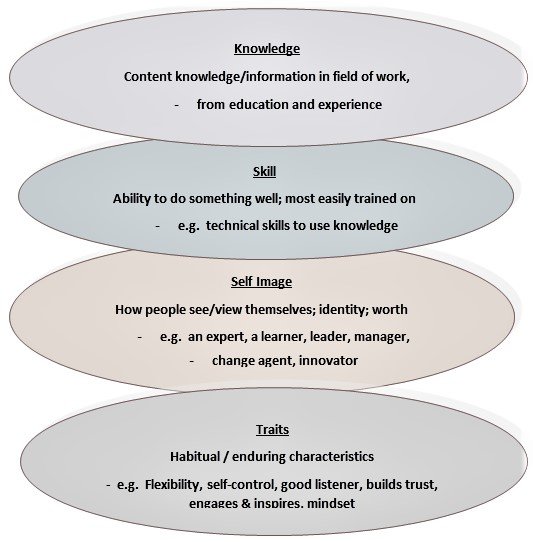
The iceberg model for competencies takes the help of an iceberg to explain the concept of competency. An iceberg which has just one-ninth of its volume above water and the rest remains beneath the surface in the sea. Similarly, a competency has some components which are visible like knowledge and skills but other behavioural components like attitude, traits, thinking styles, self-image, organizational fit etc are hidden or beneath the surface.

Ice-Berg Model

The pictorial representation of the model is as below:

The iceberg model contains six competencies: skill, knowledge, social role, self-image, traits and motives. Skill and knowledge are located on the portion of the iceberg that sits above the water level, which is easily seen. They, are around 20 % of a person’s competencies. So, they are relatively easy to determine. Social role, self-image, traits and motives are positioned on the iceberg below the water level hidden from the human eye. These account for around 80 percent of a person’s competencies, but they’re much more difficult to assess than skill and knowledge.

  • Skills = A learned ability
  • Knowledge = Acquiring information in a particular field
  • Self-Image = Attitudes and values
  • Traits = Why and how we behave a certain way
  • Motives = What drives us, i.e., the need to seek achievement, power/influence, affiliation. etc..

es and traits become more important than the skills and knowledge required to do the job. Think of a soldier at the war front, he knows how to use the weapon he is holding, but thinks that the war is unjust and refuses to fire. In organizations, senior level hiring is therefore a time consuming and elaborate affair as it becomes necessary to establish the alignment between the organizational and individual motivation and aspirations.

Developing the two levels of competencies also takes different routes. The visible competencies like knowledge and skills can be easily developed through training and skill building exercises however the behavioural competencies are rather difficult to assess and develop. It takes more time and effort intensive exercises, like psychotherapy, Counselling, coaching and mentoring, developmental experiences etc.

In the traditional method of hiring, most of the organizations looked at just the visible components of competencies; the knowledge and skills, believing that the behavioural aspects can be developed through proper guidance and good management. However, with major shifts in the conventional methods of people management, the hiring process has also undergone a change therefore a lot of emphasis is being put on the hidden behavioural aspects as well to make a sound decision. Hence, a complete picture regarding the competence of a person consists of both visible and hidden aspects and it becomes necessary to understand both to arrive at identifying the best man for a job.

Methods of Competency Mapping

Competency analysis is concerned with behavioural dimensions of roles while competence analysis considers what people have to do to perform well. In an organisation a tailor-made competency schedule is carried out by specialists or management consultants or both. Line managers may be consulted but the frameworks are issued to them in accordance with procedures laid down for such processes laid down for such processes as performance management. Although the first draft may be developed in-house but when practiced the suggested changes can improve it further.

Approaches

There are 6 approaches to competence analysis:

  1. Expert Opinion
  2. Structured Interviews
  3. Workshops
  4. Critical Incident Techniques
  5. Repertory Grid Analysis
  6. Job Competency Assessment

Approach # 1. Expert Opinion:

This method involves an expert member of the HR dept. possibly discussing with the other experts and referring to the published list to draw up “What counts”. The major drawback of this method is that it lacks detailed analysis and the line managers have not been involved at any step so it may be unacceptable.

Approach # 2. Structured Interviews:

Here we require the list of competences prepared by experts and the job-holders. The key result areas of a particular are identified to analyse the behavioural characteristics, which distinguish performers at different levels of competence.

The positive and negative indicators required for achieving high levels of performance can be analysed as:

  • Personal drive (achievement motivation)
  • Analytical power
  • Creative thinking
  • Team Management
  • Interpersonal skills
  • Communication skills

This approach relies too much on the experts.

Approach # 3. Workshops:

A team of experts (knowledge and experience holders), managers, job-holders along with a facilitator (not from personnel department) or a consultant work together in a workshop. The activities of workshop initiate with defining job related competence area. Then the members of the group develop examples of effective and less effective behaviour recorded on flipcharts. The facilitators’ job is to help the group to analyse its findings and assist generally to set competency dimensions which can be identified by behaviour.

Approach # 4. Critical Incident Technique:

This is a means of eliciting data about effective or less effective behaviour related to actual events- critical incidents.

The technique is used with groups of job holders, their managers and expert in following ways:

  • Explain what the technique is and what are its uses. This helps to gather the real information regarding the behaviours constituting good or poor performance
  • Listing the key areas of responsibilities for a particular job.
  • Each area of job can be discussed and relating to critical incidents
  • Collect information about the critical incidents under the following headings-
  • What were the circumstances?
  • What did an individual do?
  • What was the outcome of the efforts of the individual?
  • Same process is repeated for each area of responsibility and various critical incidents are recorded.
  • On referring to the flipchart, analysing the critical incidents, the recorded behaviour is marked on a scale from one to five.
  • These ratings are discussed and re-discussed for reducing errors.
  • Final analysis; It lists the desired competence, performance indicators for each principal accountability or main task.

Approach # 5. Repertory Grid:

Repertory grid can be used to identify the dimensions that distinguish good from poor standards of performance. This technique is based on Kelly’s personal construct theory. Personal constructs are the ways in which we view the world. They are personal because they are highly individual and they influence the way we behave or view other people’s behaviour. The aspects of the job to which these ‘constructs’ or judgements apply are called ‘elements’.

A group of people concentrate on certain elements (work or task of job holder) and develop constructs for them. This helps to define the qualities which indicate the essential requirements for successful performance.

The procedure being followed by an ‘analyst’ is called ‘triadic’ method of elicitation and involves following steps:

  1. Identify the elements of the job to be analysed.
  2. List the tasks on cards.
  3. Draw three cards randomly from the pack of cards and ask the group members to select the odd one out from the point of view of the qualities and characteristics needed to perform it.
  4. Try to obtain more specific definitions of these qualities in the form of expected behaviour.
  5. Again draw three cards from the pack and repeat step c&d. Repeat the process unless all the cards have been analysed.
  6. List all the constructs and ask the group members to rate each task on every quality using a six or seven point scale.
  7. Collect and analyse the scores in order to assess their relative importance.

The repertory-grid analysis helps people to articulate their views by reference to specific examples. It is easier to identify behavioural competences required in a job by limiting the area through the triadic technique. This method of analysis is quite detailed and time- consuming.

Approach # 6. Job Competency Assessment:

The job competency assessment method as described by Spencer & Spencer (1993) and offered by Hay/McBer, is based on David Mc Clelland’s research on what competency under six clusters-

  • Achievement Cluster
  • Helping/Service
  • Influence
  • Managerial
  • Cognitive
  • Personal Effectiveness

The competency assessment method is used to model the competencies for a generic role i.e. for a position which is similar to many job holders and basic accountabilities are same. The method begins with assembling a panel of expert managers to express their vision of the job, its duties, responsibilities, difficult job components, likely future changes to the role and the criteria against which the job-holders performance is measured. The members do nominate some members to be outstanding or satisfactory.

The next step is to conduct ‘behavioural event interview’ with nominated job-holders to focus upon the distinction between a person’s concept and what a person actually does. This employs a structured probe strategy rather than a standard set of questions. This investigative interview helps to gather most accurate performance data.

Following this analysis, differentiations can be made between superior and average performers in the form of the:

(a) Competencies possessed by superior performers

(b) Activities undertaken by average performers

(c) Competency and average criteria for both superior and average performers.

Tools:

Following these steps, the competency mapping tools are as follows.

  • Interviews
  • Questionnaires
  • Assessment centres
  • Critical incidents Technique
  • Psychometric Tests

Interview

Competency-based interviews may be structured, semi-structured or unstructured depending on the person conducting the competency mapping. Interview should be carefully designed so as to provide information about both the easily observed information and the general disposition and motivation of the employee. Questions prepared should target each competency and give an overview of the tangible skills and knowledge possessed by the employee, how he or she acts under certain conditions, and how they behave with other people. The questions focus on relating past job performance to future on the job performance. Biasness and distortion of flow should be avoided as much as possible. If handled effectively, interviews can prove to be a powerful technique for getting accurate details and obtaining information which may otherwise be unavailable.

Questionnaires

Competency mapping questionnaires consist of a list of questions either standardized or prepared solely for the purpose of competency mapping which the employees are expected to fill. There may be competency mapping questionnaire for employees or for managers depending on the level at which the mapping is being conducted. One form of a questionnaire is the Common Metric Questionnaire (CMQ) that makes use of five domains to examine competencies to improve work performance. These five domains are as follows: background, contact with people, decision making, physical and mechanical activity and work setting. Another form is Functional Job Analysis (FJA) which is a qualitative analysis and breaks the job down to seven parts: things, data, worker instructions, reasoning, people, mathematics and language. The behavior and actions of the employees in the seven areas is a part of FJA.

Assessment Centers

Assessment centers is a process (and not a location) that helps to determine the suitability of employees to specific type of employment or job role. Using validated tests, different elements of the job are simulated. The candidates or employees are expected to complete a number of assessments specifically designed to assess the key competencies required for the job role they are applying. These tests focus on assessing the individual based on their knowledge, skills, attitudes and other behaviors. An essential feature of this process is using situational test to observe job specific behavior.

Critical Incidents Technique

This technique was developed by Flanagan (1954) and involves direct observation of the employee in specific situations. The observations should be recorded as accurately as possible since it would be used to identify behaviors that contribute to success or failure of individual or organization in a specific situation. First step, is to make a list of good and bad on the job behavior. After this, the supervisors should be trained to note down incidents when the employee was successful or not successful in meeting the job requirements. At the end of the year, a balance sheet for each employee is created to find how well the employee has performed.

Psychometric Assessment

These are standardized and scientific tools used to assess the mental capacities and behavioral styles of employees in an organization. The most commonly used psychometric assessment is aptitude, achievement and personality testing. Aptitude tests help to determine the capacity of the individual to acquire with training a particular type of skill or knowledge. Achievement tests help to determine the level of proficiency an individual has achieved in a given area. Personality testing gives a description of the unique traits and characteristics that drive the employee’s behavior. Apart from these, competency mapping rating scale may also be used as a part of assessment.

Types of Competencies, Benefits and Limitations of implementing Competencies

Types of Competencies

Behavioral competencies: Individual performance competencies are more specific than organizational competencies and capabilities. As such, it is important that they be defined in a measurable behavioral context in order to validate applicability and the degree of expertise (e.g. development of talent)

  • Coaching skill
  • Feedback skill
  • Group process skill
  • Negotiation skill
  • Presentation skill
  • Questioning skill
  • Relationship building skill
  • Writing skill.

Core competencies: Capabilities and/or technical expertise unique to an organization, i.e. core competencies differentiate an organization from its competition (e.g. the technologies, methodologies, strategies or processes of the organization that create competitive advantage in the marketplace). An organizational core competency is an organization’s strategic strength.

Functional competencies: Functional competencies are job-specific competencies that drive proven high-performance, quality results for a given position. They are often technical or operational in nature (e.g., “backing up a database” is a functional competency).

Management competencies: Management competencies identify the specific attributes and capabilities that illustrate an individual’s management potential. Unlike leadership characteristics, management characteristics can be learned and developed with the proper training and resources. Competencies in this category should demonstrate pertinent behaviors for management to be effective.

Organizational competencies: The mission, vision, values, culture and core competencies of the organization that sets the tone and/or context in which the work of the organization is carried out (e.g. customer-driven, risk taking and cutting edge). How we treat the patient is part of the patient’s treatment.

Technical competencies: Depending on the position, both technical and performance capabilities should be weighed carefully as employment decisions are made. For example, organizations that tend to hire or promote solely on the basis of technical skills, i.e. to the exclusion of other competencies, may experience an increase in performance-related issues (e.g. systems software designs versus relationship management skills)

  1. Competency identification skill
  2. Computer competencies
  3. Career development theories and techniques understanding
  4. Electronic system skill
  5. Facilities selection skill
  6. Objective’s preparation skill
  7. Performance observation skill
  8. Training and development theories and techniques skill
  9. Research skill.

Business Competencies:

Business competencies include knowledge and skills essentially required for decision-making and to run a business.

Some business competencies are:

  • Business understanding skill
  • Cost benefit analysis skill
  • Delegation skill
  • Organization behaviour understanding
  • Organization understanding
  • Project management skill
  • Marketing skill
  • Concept selling skill
  • Documents and records management skill.

Benefits of competencies

Competency models can help organizations align their initiatives to their overall business strategy. By aligning competencies to business strategies, organizations can better recruit and select employees for their organizations. Competencies have become a precise way for employers to distinguish superior from average or below average performance. The reason for this is because competencies extend beyond measuring baseline characteristics and or skills used to define and assess job performance. In addition to recruitment and selection, a well sound Competency Model will help with performance management, succession planning and career development.

Career paths: Development of stepping stones necessary for promotion and long-term career-growth

  • Clarifies the skills, knowledge, and characteristics required for the job or role in question and for the follow-on jobs.
  • Identifies necessary levels of proficiency for follow-on jobs.
  • Allows for the identification of clear, valid, legally defensible and achievable benchmarks for employees to progress upward.
  • Takes the guesswork out of career progression discussions.

Identifying skill gaps: Knowing whether employees are capable of performing their role in achieving corporate strategy

  • Enables people to perform competency assessments in order to identify skill gaps at an individual and aggregate level.
  • When self-assessments are included, drives intrinsic motivation for individuals to close their own gaps.
  • Identifies re-skilling and upskilling opportunities for individuals, or consideration of other job roles.
  • Ensures organizations can rapidly act, support their people, and remain competitive.

Performance Management: Provides regular measurement of targeted behaviors and performance outcomes linked to job competency profile critical factors.

  • Provides a shared understanding of what will be monitored, measured, and rewarded.
  • Focuses and facilitates the performance appraisal discussion appropriately on performance and development.
  • Provides focus for gaining information about a person’s behavior on the job.
  • Facilitates effectiveness goal-setting around required development efforts and performance outcomes.

Selection: The use of behavioral interviewing and testing where appropriate, to screen job candidates based on whether they possess the key necessary job competency profile:

  • Provides a complete picture of the job requirements.
  • Increases the likelihood of selecting and interviewing only individuals who are likely to succeed on the job.
  • Minimizes the investment (both time and money) in people who may not meet the company’s expectations.
  • Enables a more systematic and valid interview and selection process.
  • Helps distinguish between competencies that are trainable after hiring and those are more difficult to develop.

Succession planning: Careful, methodical preparation focused on retaining and growing the competency portfolios critical for the organization to survive and prosper

  • Provides a method to assess candidates’ readiness for the role
  • Focuses training and development plans to address missing competencies or gaps in competency proficiency levels.
  • Allows an organization to measures its “bench strength” the number of high-potential performers and what they need to acquire to step up to the next level.
  • Provides a competency framework for the transfer of critical knowledge, skills, and experience. prior to succession and for preparing candidates for this transfer via training, coaching and mentoring.
  • Informs curriculum development for leadership development programs, a necessary component for management succession planning.

Training and development: Development of individual learning plans for individual or groups of employees based on the measurable “gaps” between job competencies or competency proficiency levels required for their jobs and the competency portfolio processed by the incumbent.

  • Focuses training and development plans to address missing competencies or raise level of proficiency.
  • Enables people to focus on the skills, knowledge and characteristics that have the most impact on job effectiveness.
  • Ensures that training and development opportunities are aligned with organizational needs.
  • Makes the most effective use of training and development time and dollars.
  • Provides a competency framework for ongoing coaching and feedback, both development and remedial.

Limitations of implementing Competencies

  1. Competency Framework: Can we come out with common competency framework applicable for the organization from different industries/similar industries? No, we can’t have a similar competency framework even if it is similar industry because it differs from organization to organization based on its people, culture, structure, systems and processes, technology, etc. To determine competency framework, its’ essential the HR looks into the vision of the organization, organizations’ future plan, existing employee capability and industry practices and standards.
  2. Identification of competency: The major challenge here is understanding what is competency and how to identify the list of competency. Competency is defined as the knowledge, skills and attitudes that lead to superior performance. Remember competency is not just knowledge, or combination of knowledge and skills or skills and attitude or knowledge and attitude, but it’s the combination of K+S+A. The challenge arises when it is seen either as K/S/A and not as K+S+A.

The next challenge is to list out the competency. It’s a known fact that competency is assessed based on past experience and listed based on the required competency in the future. While we list out the competency, it is essential that we consider the vision of the organization, current roles, expected knowledge, skills to achieve the future goals and how much essential these competencies are to achieve the goals.

3. Developing competency dictionary: Dictionary is the heart of competency based management. If this goes wrong, your assessments, your interpretation and development intervention will take you in a very wrong direction. When you write the dictionary you must look into the following points:

The definition of the competency: This must be broad and comprehensive enough to divide various aspects of the definition into 4 or 5 proficiency levels. Most important it must be relevant to the organizational context.

Behavioural Indicators: When we write the behavioural indicators we have to see the indicators reflects the KSA. In a four point scale we have to see that first two levels indicates the individual need for support and guidance (learning, execution with support) whereas when it comes to third level its’ about ensuring the value adds & results and in the fourth level, more from strategic best practices or from organizational growth perspective

Some of the aspects that needs to be considered in writing a good competency dictionary are:

  • Behavioural indicators are not the JD
  • Behavioural indicators are written in sequence
  • It indicates the individual, team and organizational perspective
  • Language used must be simple and inevitably understood in the same way by all the assessors
  • Able to demonstrate the behavior so that measurement can be done
  1. Assessment development centre: Major challenge comes in probing and getting into details that will aid in correct rating. The rating must not be surprising to the participants and they must not say that they have instances of demonstrated behavior but have either missed or have not been asked. It is important that we give at-least two opportunities to the participant to demonstrate the behavior. Also ensure that your questions are such that it helps the participant to provide relevant information.
  2. Reports: Report writing must be given importance as it can mould an individual behavior in the right direction. It is a tedious process wherein lots of observed facts are analyzed and then arrive at a conclusion. It is often seen that this part of the job is outsourced by giving limited information to whosoever is working on the report. Report is not about the language, it’s not about making the other person feel good or bad on reading the report but it’s about how you place the evidences captured in the right way and how the participants can relate to his development area without a second thought on it.  Reports are the first step for the participant to move towards the development.  Report gives an insight to the participant on what are the competencies that he/she needs to focus on and take up right interventions.  Reports must be essentially be written by the person who has assessed the participant.
  3. IDP: This is an area which is not much explored and highly unorganized approach is adopted. Most of them feel that after feedback the action plans suggested for improvements become only paper records and no actions are taken either by the participant or by the organization.  This happens when the developmental avenues are forced upon on the participant and when the activity is not reviewed periodically.  Based on my experience I feel that organization first must find out what are the various avenues that will aid in developing the competency in the individual.  Once the avenues are listed against the competency, the assessor must facilitate and the participant must take the ownership in the chosen technique for development.  And most important it must be reviewed periodically.  If there are no reviews then most of the participants will be involved in their daily work and not take any initiative for improving.

Creating Business Value through Information Technology

Investing in information technology can play a critical role in your company’s success. In order to create business value with information technology, you need a clear set of goals and mechanisms to track the return on investments.

Create company goals. The goals of your company will define what value means to your business. Gather the major stakeholders of your business including employees, upper level management, major suppliers and company owners. Define a common set of goals for your company that can benefit every stakeholder. Narrow the list to four or five goals in order of importance.

Map out the “Value chain” for each goal. Take each company goal and draw a visual map showing the current state of the process starting from the customer and ending with the product or service delivery. For example, if your goal is to make DVD rentals in your DVD store more accessible to your customers, you would map out how the current customers go about renting a DVD. Information technology usually simplifies repetitive systems. If your customers commonly perform the same actions to rent a DVD, then you could automate the process with technology.

Calculate the benefit of an automated system. This is not always easy to do as financial benefits can be subjective and projections based on faulty assumptions. Take each one of your company goals and place a monetary value to the achievement of each goal. In other words, ask yourself how much money you will make or save if you were to accomplish each one of your company goals. If your company goals are monetary, then you can compare it to the expense of implementing information technology. If the expense of the implementing information technology can help you achieve your company’s financial goals then the technology is creating value. A simple example is being able to accept credit cards. If the cost of buying and setting up the credit card processor helps you close more sales, then the technology is adding value to your business.

Create a trial period for the system. Implement information technology in a small area of your business, and track the results compared with the current system. In some cases this may not be financially feasible since implementing technology for a trial period may be too costly. In this case you should create surveys and focus groups to determine if the customer or employee will embrace the new technology.

Automate repetitive processes. The easiest way to create business value through information technology is to automate or replace old systems with technology. For example, a small business that prints forms to get approval signatures from several departments, can simplify the process by having each department access the document via Google docs, and only print when all the authorizations have been granted. Your company can electronically share databases among many departments where previously only one or two people had access to the files. Minor improvements like these are easy ways to create value through information technology.

The Rise of Innovation

The rise of innovation can be traced to the human race getting smarter. According to the Flynn Effect, general IQ has begun to rise since the 1930s. The average IQ has risen from 80 points to 100 points.

While innovations in travel and multimedia improved collective intelligence, these were mainly passive forms of learning. Today, computer applications and the global brain have switched on active learning and improved how fast people learn new things.

Innovation in Business

Information technology fosters innovation in business. Innovation results in smarter apps, improved data storage, faster processing, and wider information distribution. Innovation makes businesses run more efficiently. And innovation increases value, enhances quality, and boosts productivity.

Innovation through information technology has created the following radical changes in business:

  • Online shopping is more efficient than shopping in a store.
  • Digital marketing is more efficient than high cost newspaper, television, and radio advertising.
  • Social networking is more efficient than going to clubs.
  • VoiP communication is more efficient than legacy telephony.
  • Cloud computing is more efficient than a private computer network.

Businesses that have embraced the innovation paradigm tend to have the following characteristics:

  • They have more accurate business planning
  • They have more effective marketing
  • They have higher global sales
  • They have more systematic management
  • They use real time monitoring
  • They offer instant customer support

In fact, it’s hard to thing of long term business growth without the push of information technology.

5 Reasons for Accelerated Business Growth

The technological revolution has improved businesses this century in the following five primary ways:

  1. Information technology has given business the tools to solve complex problems.

Improved hardware (more memory, faster processors, sharper visual displays, etc) combined with smarter applications (Mindmapping software like X Mind, collaborative software like Kanban boards, organizers like Google calendar, etc) have made it easier to research data, analyze it, and plan scalability. Many tools available to solve complex problems.

  1. Information technology allows businesses to make better decisions.

Good decisions in business are based on solid market research. This can be done through engaging teams through video conferences, reviewing public sentiment on social media and industry forums, and using online surveys to get customer feedback. There are also tools like Microsoft CRM Dynamics and Google Analytics.

  1. Information technology has improved marketing.

Internet marketing using online advertising methods (SEO, PPC, Facebook Ads) are far more accurate ways than traditional marketing of finding target audiences, discovering their needs, and building a marketing campaign to persuade them to buy. It’s difficult to see how many people read a newspaper ad. It’s easy to figure out how many people clicked on an online banner.

  1. Information technology has improved customer support.

Customers can receive support from multiple channels telephone, emails, social media platforms, webinars, and so on. Additionally, customer relationship management systems help businesses understand customer behavior.

  1. Information technology has improved resource management.

Cloud computing allows a company’s employees to use any device anywhere in the world to access their enterprise level software.

error: Content is protected !!