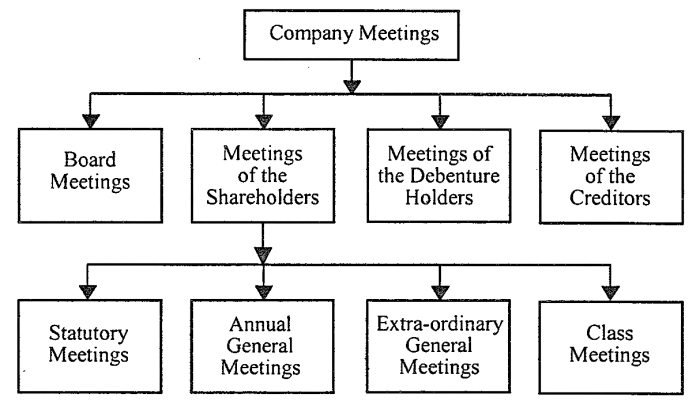
Company Meetings: Statutory, Annual general meeting, Extraordinary Meeting

Statutory Meeting

Statutory Meeting is the first meeting of the shareholders of a public company. It must be held within a period of not less than one month nor more than 6 months from the date at which the company is entitled to commence business. It is held only once in the lifetime of a company. A private company and a company limited by guarantee and not having a share capital need not hold such a meeting.

The purpose of the statutory meeting with its statutory report is to put the shareholders of the company in the possession of all the important facts relating to the new company, what shares have been taken up, what the moneys received etc. This also provides an opportunity to the shareholders of meeting to discuss the whole situation, the management and prospects of the company.

The Board of Directors must, atleast 21 days before the day on which the meeting is to be held, A forward a report, called the ‘statutory report’ to every member of the company. This report contains all the necessary information relating to formational aspects of the company for the information of the shareholders.

Contents of Statutory Report

  1. The total number of shares allotted, distinguishing those allotted as fully or partly paid up otherwise than in cash, the extent to which they are partly paid up, the consideration for which they have been allotted and total amount received in cash;
  2. An abstract of the receipts and payments under distinctive heads upto a date within seven days of the date of report;
  3. An account of estimate of the preliminary expenses of the company.
  4. The names, addresses and occupations of the managing director, director, and also its secretary and auditors of the company;
  5. The particulars of any contract which, and the modification or proposed modification of which, are to be submitted to the meeting for approval;
  6. The extent to which underwriting contracts, if any, have not been carried out and the reason therefor;
  7. The arrears, if any, due on calls from directors, managing director or manager; and
  8. The particulars of any commission or brokerage paid, or to be paid, in connection with the issue or sale of shares to any director, managing director or manager.

Annual General meeting

Annual General Meeting (AGM) is a yearly meeting of stockholders or shareholders, members of company, firm and organizations. Annual General Meeting is held every financial year and it is mandatory for everyone. In AGM functions like reviewing company account, approving audited accounts, elections, fiscal records of the past year are discussed.

As per Companies Act, an annual general meeting must be held by every company once a year without fail. There cannot be a gap of more than 15 months between two AGMs.

However, the first AGM of a company can be held at any date, within a period of 18 months, since the date of incorporation of the company. Annual general meetings help members understand the company’s rate of growth and potential for improvement.

An AGM gives insights into what steps made the company more successful and which steps caused loss. it helps the members and the board to decide the future course of action. An AGM must be held on a working day.

If the Government declares a public holiday on the day of the meeting, it will be considered a working day by the members attending the meeting. The annual general meeting can be held at the registered office of the company.

Legal Requirements for holding an Annual General Meeting

Legally, a notice period of 21 days must be given to all the members before the meeting. However, there is an exception to this rule. If all the voting members consent, the meeting may be held at an earlier date. Further, the following documents are also to be sent with the notice. Articles of Association, company bylaws, and jurisdiction specifies the rules that govern annual general meeting.

  • Copy of annual accounts of the company
  • Director’s report on the company’s position for the given year
  • Report by the Auditor of the annual accounts.

Members are allowed to use proxies in their absence. The proxy does not need to be a member of the company. However, the proxy forms have to be submitted to the company at least 48 hours before the meeting.

Quorum for Annual General Meeting

Unless the articles of the company state otherwise, the quorum for an Annual General Meeting is as follows

  • Public companies: At least 5 members must be present.
  • Other companies:At least 2 members must be present within half an hour of the commencement of the meeting.

Issues Undertaken at Annual General Meeting

The functions of business undertaken at a typical annual general meeting are listed as follows:

  • The declaration of dividend among shareholders
  • Consideration of annual accounts
  • Discussion of the director’s report and the auditor’s report
  • Appointment and fixing of the remuneration of the statutory auditors
  • Appointing replacement directors in place of existing directors retiring

Extraordinary meeting

An Extraordinary General Meeting (an EGM) can be defined as a meeting of shareholders which is not an Annual General Meeting (an AGM). It is held when some urgent issue becomes about the company arises or any situation of crisis and it requires the input of all senior executives and the Board.

As we know, an EGM is held in case of emergency situations and requires the attention of senors execs and the Board. Members, shareholders, and execs must be instructed on the purpose of the meeting so they have time to prepare their valuable input and then, collectively decide further course of action.

Who can Call for an EGM

The members/shareholders of a company can call for an extraordinary general meeting. However, only certain members with a significant stake in the company are allowed to call for an EGM. They are listed in the Companies Act,2013 as follows.

  • In the case of a company having a share capital, members holding not less than one-tenth of such paid-up capital of the company that carry voting rights in regard to that matter as on the date of depositing the requisition;
  • In the case of a company not having a share capital, members holding not less than one-tenth of the total voting power in regard to that matter as at the date of deposit of the requisition.
  • EGM called by Board.  Upon the receival of a valid requisition, the Board has a period of 21 days to call for an EGM. The EGM must be then held with 45 days from the day of the EGM being called.
  • EGM called by the requisitionists: In case the Board fails to call for an EGM, it can be called for by the requisitionists themselves during a period of 3 months from the day the requisition was deposited. If the EGM is held within this specified period of 3 months, it can be adjourned to any day in the future after the 3 months.

Essentials of a Valid Requisition

  1. Specify the issue for which the meeting is called
  2. Signed by requisitionists
  3. Must be deposited at the company’s registered office.

Requirements for holding an EGM

A notice period of 21 days must be given to the members. However, there is an exception to this rule. Where if 95% of the voting members consent, the EGM can be held at a shorter notice.

Quorum Required for EGM

Unless the company’s Articles state otherwise, the following number of members are required for a quorum.

  • In the case of a public company: Five(5) members personally present
  • In the case of any other company: Two (2) members personally present

Meeting of Board of Directors

Director’s meetings, commonly referred to as Board Meetings, are formal gatherings of a company’s board of directors to deliberate and decide upon matters concerning the company’s governance, strategy, policies, financial performance, and regulatory compliance. These meetings are a legal and administrative requirement for companies under the Companies Act, 2013 in India and similar corporate laws globally.

The primary objective of a director’s meeting is to ensure that directors fulfill their fiduciary duties by participating in key decision-making processes. Typical agenda items include approval of financial statements, declaration of dividends, appointment or removal of key managerial personnel, policy formulation, reviewing compliance reports, and evaluating the company’s performance. The board also approves mergers, acquisitions, and major investments.

As per legal requirements, the first board meeting of a company must be held within 30 days of incorporation, and thereafter, at least four board meetings must be conducted every financial year, with not more than 120 days gap between two meetings. A quorum—usually one-third of the total number of directors or two directors, whichever is higher—is necessary for a meeting to be valid.

Proper notice of at least 7 days is to be given to all directors, and minutes of the meeting are recorded for future reference and legal compliance. Decisions made are documented in resolutions, which become binding on the company. These meetings enhance corporate governance by promoting accountability, transparency, and collective decision-making among directors.

Objectives of Director’s Meetings:

  • Strategic Planning and Policy Formulation

One of the key objectives of director’s meetings is to formulate the company’s strategic direction and develop effective policies. The board reviews internal and external business environments to make informed long-term decisions. Directors collaborate to set goals, define performance standards, and ensure the company’s vision aligns with current market conditions. This strategic oversight enables the business to maintain competitiveness and adaptability. By regularly revisiting policies and strategic goals, directors ensure the company moves forward efficiently and sustainably in a dynamic business environment.

  • Monitoring Financial Performance

Director’s meetings are held to evaluate and monitor the company’s financial performance regularly. The board examines financial reports, income statements, balance sheets, and cash flow statements to assess profitability, liquidity, and solvency. Financial review helps in identifying discrepancies, controlling expenditures, and ensuring proper fund allocation. These discussions enable directors to maintain fiscal discipline and make decisions based on accurate data. Ensuring transparency in financial matters also fosters investor confidence and compliance with statutory obligations, thus promoting long-term financial health and sustainability of the organization.

  • Ensuring Legal and Regulatory Compliance

A vital objective of director’s meetings is to ensure that the company operates within the legal and regulatory framework. Directors review and verify compliance with the Companies Act, taxation laws, labor laws, environmental regulations, and other applicable legislation. Non-compliance can lead to penalties and reputational damage. Hence, the board evaluates reports from the compliance officer, legal advisors, and auditors. Regular updates on changes in regulations are discussed to keep the company aligned with legal standards. These meetings act as checkpoints to ensure corporate accountability and ethical governance.

  • Decision-Making on Major Corporate Actions

Director’s meetings facilitate decision-making on significant corporate matters like mergers, acquisitions, capital restructuring, or launching new ventures. These decisions typically involve high risk and long-term implications, requiring thorough deliberation and consensus. The board discusses pros and cons, consults experts if needed, and ensures that such actions align with shareholder interests and the company’s mission. These meetings offer a structured platform for collaborative decision-making, balancing opportunity with responsibility. Final decisions are passed as board resolutions and implemented through appropriate managerial channels, reflecting corporate prudence and planning.

  • Risk Management and Crisis Handling

Another objective is to identify, assess, and mitigate business risks. Directors discuss potential operational, financial, legal, and reputational risks that may affect the company. Risk management strategies such as diversification, insurance, and internal controls are formulated and periodically reviewed. In times of crisis—like economic downturns, cyberattacks, or regulatory issues—the board meets to evaluate the situation and design appropriate response mechanisms. These meetings help in establishing robust contingency plans and resilience frameworks to safeguard the organization’s interests and minimize disruptions to business operations.

  • Reviewing Performance of Top Management

Director’s meetings provide an opportunity to assess the performance of the CEO and other key managerial personnel. The board evaluates leadership effectiveness, goal achievement, and decision-making capabilities. Constructive feedback and necessary course corrections are provided to improve efficiency. In some cases, decisions related to promotions, compensation, or replacements are made based on performance appraisals. This oversight ensures accountability and aligns management’s performance with organizational goals. It also promotes meritocracy and motivates senior executives to perform effectively, thus enhancing overall corporate performance.

  • Enhancing Corporate Governance

A fundamental objective of director’s meetings is to strengthen corporate governance practices. The board ensures transparency, fairness, and accountability in all decisions and actions taken by the company. Ethical conduct, shareholder engagement, and stakeholder welfare are emphasized during discussions. The board formulates governance policies, monitors their implementation, and ensures adherence to ethical standards. These meetings help build a strong governance framework that fosters trust among investors, regulators, and the public. Enhanced governance leads to sustainable growth, risk reduction, and long-term success of the organization.

Board Meetings

Board Meetings are formal gatherings of a company’s Board of Directors, convened to discuss, deliberate, and decide upon key matters affecting the organization. These meetings are fundamental to corporate governance and serve as the primary platform through which directors exercise their powers and fulfill their responsibilities. Board meetings are legally mandated under corporate laws such as the Companies Act, 2013 in India, and must follow a structured process, including issuance of notice, preparation of an agenda, and recording of minutes.

The primary purpose of board meetings is to make collective decisions on strategic, financial, legal, and operational matters. Topics often discussed include approval of budgets, review of financial statements, declaration of dividends, appointment or removal of key personnel, corporate restructuring, compliance updates, and risk management. These meetings help ensure transparency, accountability, and alignment of the company’s actions with its goals and legal obligations.

Board meetings must meet quorum requirements, typically involving at least one-third of the total directors or two directors, whichever is higher. The frequency of board meetings is also regulated; for instance, at least four board meetings must be held every financial year, with no more than 120 days between any two meetings.

Committee Meetings

Committee meetings are formal gatherings of a specific subset of members from a larger governing body, such as the Board of Directors, formed to focus on particular areas of concern or responsibility within an organization. These committees are established to improve efficiency by allowing detailed examination of specific issues like audit, finance, remuneration, risk management, or corporate social responsibility (CSR). Committee meetings enable more specialized, informed, and focused discussions than would be possible in full board meetings.

Each committee is typically composed of directors or officers with relevant expertise or interest, and it operates under a defined charter or terms of reference. Committee meetings are held regularly or as needed to review performance, compliance, or ongoing issues, and they recommend actions to the main board for final approval. For example, an audit committee meeting may examine internal financial controls and auditor reports before advising the board on financial disclosures.

These meetings follow formal procedures, including circulation of agendas, maintaining minutes, and complying with regulatory standards. The outcomes of committee meetings are critical in shaping board decisions, ensuring better governance, transparency, and risk oversight.

Notice of Board Meeting

The notice of Board Meeting refers to a document that is sent to all directors of the company. This document informs the members about the venue, date, time, and agenda of the meeting. All types of companies are required to give notice at least 7 days before the actual day of the meeting.

Quorum for the Board Meeting

The quorum for the Board Meeting refers to the minimum number of members of the Board to conduct a valid Board Meeting. According to Section 174 of Companies Act, 2013, the minimum number of members of the board required for a meeting is 1/3rd of a total number of directors.

At any rate, a minimum of two directors must be present. However, in the case of One Person Company, the rules of Section 174, do not apply.

Participation in Board Meeting

All directors are encouraged to actively attend board meetings and in case that’s not possible at least attend the meetings through a video conference. This is so that all directors can take part in the decision-making process.

Requirements for Conducting a Valid Board Meeting:

  • Right Convening Authority 

The board meeting must be held under the direction of proper authority. Usually, the company secretary (CS) is there to authorize the board meeting. In case the company secretary is unavailable, the predetermined authorized person shall act as the authority to conduct the board meeting.

  • Adequate Quorum 

The proper requirements of the quorum or the minimum number of Directors required to conduct a Board meeting must be present for it to be considered a valid board meeting.

  • Proper Notice 

Proper notice is one of the major requirements to be fulfilled when planning a board meeting. Formal notice has to be served to all members before conducting a board meeting.

  • Proper Presiding Officer 

The meeting must always be conducted in the presence of a chairman of the board.

  • Proper Agenda

Every board meeting has a set agenda that must be followed. The agenda refers to the topic of discussion of the board meeting. No other business, which is not mentioned in the meeting must be considered.

Quorum for Different Meetings

Quorum means the minimum number of persons who being entitled to attend a meeting must be present at the meeting so that the business of the meeting can be transacted validly. Such a number is desirable so that a meeting gets a representative character and no decisions are taken with a very small number of persons being present.

At the same time the quorum shall not be too big so that a meeting falls through on account of small attendance.

Features of Quorum:

(1) What shall be the quorum for different types of meetings of an organisation are usually mentioned in its bye-laws or in the Articles of Association in case of a company. Some statutes also make such provisions. For example Sec. 174 of the Companies Act makes such provisions. The bye-laws or the Articles cannot provide smaller quorum than what are provided in the statutes, if any.

(2) A meeting cannot be started if quorum is not present. The quorum might be continuously present. If any member or members leaves or leave earlier and by that the quorum falls, then any decision taken afterwards will not be binding, if the by-laws or Articles so provide.

(3) It is the duty of the chairman to see that the quorum is present. The secretary helps him in counting the quorum. If at the middle of the meeting quorum falls, any member present may draw the attention of the chairman to this fact by raising a ‘point of order’.

(4) If quorum is not present at the scheduled hour of a meeting already notified, then the members present will wait for half an hour.

After half an hour the following alternative effects can take place:

(A) In Case of an Informal Meeting:

(i) The chairman may allow informal discussions but no binding decisions can be taken. The meeting is adjourned and can be held afterwards after giving fresh notice.

(ii) If the quorum is missing by a small margin, the chairman may allow discussions and decisions may be taken which, however, have to be formally ratified at a next meeting where quorum must be present.

(B) In Case of Any Meeting of a Company:

The Act provides that the meeting shall be adjourned:

(i) In case of a general meeting to the same day in the next week, at the same time and place or to such other day and at such other time and place as the Board may determine.

(ii) In case of a Board meeting, unless the Articles otherwise provide, to the same day in the next week, at the same time and place or if that day is a holiday till the next succeeding day which is not a public holiday, at the same time and place.

(iii) In case of an extraordinary general meeting requisitioned by members the meeting is not adjourned and the meeting just fails.

(5) In case of a members’ meeting of a company where proxy is allowed only members present in person are counted for quorum and not the proxies but representatives are counted

(6) When fraction comes out while calculating quorum (like one-third, one-fourth) the next round number is taken into account.

(7) Conflicting views exist with regard to counting when there are joint holders of shares. Generally it is accepted that joint holders of shares shall be treated as a single member. Some people think that each joint holder is a separate member if his name appears in the Register of Members.

Where Quorum is Strictly not Necessary:

Normally the quorum is necessary for a valid meeting.

But in the following circumstances a less number of persons may make the quorum:

(1) Whenever a meeting is adjourned for want of quorum, any number of members present at the adjourned meeting shall make the quorum.

(2) At a Board meeting when a matter comes up in which one or more than one director is or are interested then, director or directors concerned cannot take part in the discussion. The remaining directors shall make the quorum. If only on- director is left out then of course there cannot be a quorum and the matter shall be referred to a general meeting of members for decision.

(3) In case of class meetings if one person alone holds all the shares of that particular class of shares then he alone shall make the quorum.

(4) In case of an annual general meeting of a company (ailed by the order of the Central Government on the complaint by only one member of the company, or a general meeting called by the Company Law Board on the application of one member of the company then the member alone present in person or by proxy, shall make the quorum when the meeting is held.

The General Patterns of Quorum:

Every company in its Articles of Association or an association in its bye laws or a Com­mittee or Sub-Committee in its own rules and regulations usually provides what shall be the quorum for the different kinds of meetings to be held under it. The quorum for a general meeting is usually one-fourth or one-third of the total number of members or a fixed number like ten, fifteen etc. taking into consideration the total strength of the members.

The Companies Act is very liberal and provides that if nothing is mentioned in the Articles then any two members in case of a private company and any five members in case of a public company, present in person at a general meeting, shall make the quorum.

The quorum for the meeting of an important committee, like the Executive Committee or Managing Committee, is generally fixed at one-third. The Companies Act provides that the quorum for Board meeting, if nothing is provided in the Articles, shall be one-third or two whichever is bigger.

The directors themselves at the first Board meeting may fix the quorum for Board meetings. In some special cases, the quorum is fixed at a big percentage of the total number of members. For example, the quorum for a class meeting in a company is very often fixed by the Articles to be two- thirds or three-fourths or all the shareholders belonging to that class.

Sometimes all the members make the quorum. For example, in a private company having only two directors, both the directors shall make the quorum at a Board meeting. Again, in a private company having only two shareholders, both the members shall make the quorum at a general meeting.

Issue of Debentures

Company debenture is one of the important sources of finance for large companies, in addition to equity stocks, bank loans, and bonds. Companies need to follow certain procedures for issue of debentures to raise money. There are several ways of issuing a debenture viz. at a par, premium or discount and even for consideration other than cash.

Issue of Debentures

The procedure of issuing debentures by a company is similar to the one followed while issuing equity stocks. The company starts by releasing a prospectus declaring the debenture issuance. The interested investors, then, apply for the same. The company may need the entire amount while applying for the debentures or may ask for installments to be paid while submitting the application, on allotment of debentures or on various calls by the company. The company can issue debentures at a par, at a premium or at a discount as explained below.

Different ways for issuing of Debenture

Once the company invites the applications and the investors apply for the debentures, the company can issue debentures in one of the following ways:

Issue of Debenture at par

When the issue price of the debenture is equal to its face value, the debenture is said to be issued at par. When a debenture is issued at par, the long-term borrowings in the liabilities section of the balance sheet equals the cash in the assets side of the balance sheet. Thus, no further adjustment is required to balance the assets and the liabilities of the company. The company can collect the whole amount in one installment i.e on an application or in two installments i.e. on an application and subsequent allotment. However, there might be a scenario in which money is collected in more than two installments i.e. on an application, on an allotment and at various calls by the company.

Issue of debenture at discount

The debenture is said to be issued at a discount when the issue price is below its nominal value. Let us take an example – a Rs. 100 debenture is issued at Rs. 90, then Rs.10 is the discount amount. In such a scenario, the liabilities and the assets sides of the balance sheet do not match. Thus, the discount on debentures’ issuance is noted as a capital loss and is charged to ‘Securities Premium Account’ and is reflected as an asset. The discount can be written off later.

Issue of Debenture At Premium

When the price of the debenture is more than its nominal value, it is said to be issued at a premium. For example, a Rs. 100 debenture is issued for Rs.105 and Rs.5 is the premium amount. Again, assets and liabilities do not match in such situation. Therefore, the premium amount is credited to Securities Premium Account and is reflected under ‘Reserves and Surpluses’ on the liabilities side of the balance sheet.

The Issue of Debenture as Collateral

The debentures can be issued as a collateral security to the lenders. This happens when the lenders insist on additional assets as security in addition to the primary security. The additional assets may be used if the complete amount of loan cannot be realized from the sale of the primary security. Therefore, the companies tend to issue debentures to the lenders in addition to some other physical assets already pledged. The lenders may redeem or sell the debentures on the open market if the primary assets do not pay for the complete loan.

Issue of Debenture for Consideration Other Than Cash

Debentures can also be issued for consideration other than cash. Generally, companies follow this route with their vendors. So, instead of paying the cash for the assets purchased from the vendor, the companies issue debentures for consideration other than cash. In this case, also, the debentures can be issued at a par, premium or discount and are accounted for in the similar fashion.

Over Subscription

The company invites the investors to subscribe to its debenture issue. However, it may happen that the applications received for the debentures may be more than the original number of debentures offered. This scenario is referred to as oversubscription. In the case of over-subscription, a company cannot allocate more debentures than it had originally planned to issue. So, the company refunds the money to the applicants to whom debentures are not allotted. However, the excess money received from applicants who are allocated debentures is not refunded. The same money is used towards allotment adjustment and the subsequent calls to be made.

Winding Up, Introduction, Meaning and Modes of Winding up

Winding up refers to the process of closing a company’s operations, settling its debts, and distributing its remaining assets to shareholders or creditors. It marks the end of a company’s existence. The process involves liquidating the company’s assets, paying off liabilities, and distributing any surplus to the owners. Winding up can be voluntary, initiated by the shareholders or creditors, or compulsory, ordered by the court. The goal is to dissolve the company, ensuring that all financial obligations are met, and any remaining funds are fairly distributed to the stakeholders.

Modes of Winding up of a Company

1. Voluntary Winding Up

  • Shareholders’ Voluntary Winding Up: Initiated by the shareholders when the company is solvent (able to pay its debts). A special resolution is passed, and a liquidator is appointed to wind up the company’s affairs. The company’s assets are sold, and the proceeds are used to settle liabilities. Any surplus is distributed among the shareholders.
  • Creditors’ Voluntary Winding Up: This occurs when the company is insolvent (unable to pay its debts). The shareholders pass a resolution to wind up the company, and a meeting of creditors is called to appoint a liquidator. The liquidator’s responsibility is to pay off the company’s debts with the available assets.

2. Compulsory Winding Up (Court-ordered)

This type of winding up is ordered by a court when a petition is filed, usually by creditors, shareholders, or the company itself. Grounds for compulsory winding up include insolvency, inability to pay debts, or the company being inactive. The court appoints a liquidator to manage the process, and all assets are liquidated to pay creditors.

3. Winding Up Subject to Supervision by Court

Winding up subject to supervision by court is a special mode of liquidation in which a company is first wound up voluntarily, but later the court (now NCLT) places the process under its supervision. In this method, the winding up proceedings continue as a voluntary winding up, yet the Tribunal monitors and controls the activities of the liquidator to protect the interests of creditors and shareholders.

This method is adopted when the Tribunal feels that voluntary winding up alone is not sufficient to safeguard stakeholders, or when disputes, mismanagement, or irregularities arise during voluntary liquidation.

The Tribunal may order supervision when creditors or contributories (shareholders) file a petition stating that their interests are not properly protected in voluntary winding up. It may also intervene when the liquidator is suspected of negligence, fraud, or improper handling of company assets.

Thus, instead of completely cancelling voluntary winding up, the Tribunal allows it to continue but under legal monitoring and authority.

4. Winding Up under the Insolvency and Bankruptcy Code (IBC), 2016

For companies that are facing financial distress and are unable to pay their debts, the IBC provides a framework for insolvency resolution. If the company cannot be rescued through a resolution plan, the company may be wound up. The resolution process under IBC aims to maximize the value of assets and ensure an equitable distribution to creditors.

Procedure for Voluntary Winding Up

The procedure for voluntary winding up of a company involves several steps, depending on whether the company is solvent (Shareholders’ Voluntary Winding Up) or insolvent (Creditors’ Voluntary Winding Up).

1. Board Meeting

The first step involves the board of directors calling a meeting to pass a resolution for the winding up of the company. This decision must be based on the company’s solvency. The board must prepare and sign a declaration stating that the company has no debts or is able to pay its debts in full within a specified period (usually 12 months).

2. Passing a Special Resolution

A general meeting (usually the Annual General Meeting) is called to pass a special resolution for winding up the company. This resolution must be approved by at least 75% of the shareholders present at the meeting.

3. Appointment of Liquidator

The company appoints a liquidator to oversee the winding-up process. The liquidator may be a chartered accountant, a company secretary, or a licensed insolvency professional. The liquidator’s primary responsibilities include liquidating the company’s assets, settling debts, and distributing the remaining assets to the shareholders.

4. Filing with the Registrar of Companies (RoC)

  • Once the special resolution is passed, the company must file a notice of the resolution along with the declaration of solvency with the Registrar of Companies (RoC) within 30 days.
  • The filing should also include the minutes of the meeting and the names of the appointed liquidators.
  • A copy of the resolution must also be sent to the creditors within 14 days.

5. Public Notice

A public notice is published in a widely circulated newspaper and in the Official Gazette to inform the creditors and the public about the winding-up process. This is intended to allow any creditor who may have a claim against the company to come forward.

6. Liquidation Process

The liquidator proceeds with the liquidation of the company’s assets, settles all the company’s liabilities, and distributes any remaining funds among the shareholders. The liquidator must also notify the creditors and shareholders about the status of the liquidation process.

7. Final Meeting of the Company

After the liquidation is completed, a final general meeting is called by the liquidator to present the final accounts of the winding up process. The liquidator submits a final report on the liquidation process, including the distribution of assets, settlements with creditors, and any remaining surplus.

8. Filing of Final Documents with RoC

  • Once the final meeting is held and the final accounts are approved, the liquidator must submit the following documents to the Registrar of Companies (RoC):
    • A copy of the final accounts approved by the shareholders.
    • A declaration that the company has been fully wound up and its affairs are closed.
  • The RoC will then issue a certificate confirming that the company has been officially dissolved.

9. Dissolution

Once the Registrar of Companies is satisfied with the completion of all formalities, it will strike off the company’s name from the register of companies, effectively dissolving the company. The company is considered legally dissolved after the RoC issues the certificate of dissolution.

Quality Circle, Meaning, Concepts, Examples, Objectives, Features, Characteristics, Structure, Process, Techniques & Tools, Advantages and Limitations

Quality Circle is a small group of employees who meet regularly to identify, analyze, and solve work-related problems, aiming to enhance productivity and quality. Typically composed of workers from the same department, these circles encourage participation and collaboration, promoting a culture of continuous improvement. Members share insights and suggestions, which are presented to management for consideration. Quality Circles empower employees, foster teamwork, and enhance communication, leading to improved processes, reduced waste, and greater job satisfaction, ultimately contributing to the organization’s overall performance and competitiveness.

Examples of Successful Quality Circles

  • Toyota: Used quality circles extensively in the 1970s to improve production efficiency and product quality.

  • Sony: Implemented QCs to reduce defects and enhance employee involvement.

  • General Electric: Encouraged quality circles to solve operational issues and improve customer satisfaction.

  • Indian Industries: Many organizations like Tata Steel and BHEL successfully use QCs for process improvement.

Objectives of Quality Circle

  • Enhance Quality of Products and Services

One of the primary objectives of Quality Circles is to improve the quality of products and services offered by the organization. Members work collaboratively to identify quality-related issues, analyze root causes, and propose solutions. By focusing on quality enhancement, organizations can increase customer satisfaction and loyalty.

  • Foster Employee Involvement and Empowerment

Quality Circles aim to empower employees by involving them in the decision-making process. By allowing team members to contribute their ideas and insights, organizations promote a sense of ownership and responsibility among employees. This involvement leads to higher morale and engagement, ultimately creating a more motivated workforce.

  • Encourage Teamwork and Collaboration

Quality Circles are designed to promote teamwork and collaboration among employees. By working together to solve problems, team members develop strong relationships and improve their communication skills. This collaborative environment fosters a culture of cooperation, which can lead to more innovative solutions and improved organizational effectiveness.

  • Identify and Solve Problems Proactively

Quality Circles encourage employees to take a proactive approach to problem-solving. Rather than waiting for issues to arise, team members are trained to identify potential problems before they escalate. This proactive mindset not only helps in addressing current challenges but also mitigates future risks, ensuring smoother operations.

  • Facilitate Continuous Improvement

Continuous improvement is a core objective of Quality Circles. Members are encouraged to constantly assess and refine processes, systems, and workflows. By adopting methodologies such as the Plan-Do-Check-Act (PDCA) cycle, teams can implement incremental changes that lead to significant long-term improvements in efficiency and effectiveness.

  • Improve Communication Across the Organization

Quality Circles facilitate open communication among employees and management. By creating a platform for dialogue, these circles enable members to voice their concerns, share ideas, and provide feedback. Improved communication leads to better understanding and alignment on organizational goals, fostering a collaborative culture.

  • Reduce Costs and Increase Efficiency

By identifying inefficiencies and implementing improvements, Quality Circles aim to reduce operational costs. Members analyze processes to find ways to eliminate waste and streamline operations. The focus on efficiency not only lowers costs but also enhances productivity, allowing organizations to allocate resources more effectively.

Features of Quality Circle

  • Employee Involvement

Quality Circles are formed by employees from the same work area or department, encouraging their active involvement in problem-solving. This feature empowers workers by giving them a voice in the decision-making process. Employees feel valued and engaged when they participate in identifying issues and proposing solutions, leading to a more motivated workforce.

  • Voluntary Participation

Participation in Quality Circles is typically voluntary, allowing employees to choose whether to join. This voluntary nature fosters a genuine interest among members, as they are motivated by a desire to improve their work environment and processes. When employees are passionate about their contributions, they are more likely to be engaged and committed to the circle’s objectives.

  • Focus on Continuous Improvement

Quality Circles aim to foster a culture of continuous improvement within the organization. Members regularly identify problems, analyze processes, and propose innovative solutions to enhance quality and efficiency. This ongoing commitment to improvement helps organizations adapt to changing circumstances and maintain a competitive edge in their industry.

  • Structured Meetings

Quality Circles operate through structured meetings, where members discuss issues, share ideas, and develop action plans. These meetings often follow a systematic approach, such as the Plan-Do-Check-Act (PDCA) cycle, to ensure effective problem-solving. The structured format allows for organized discussions, ensuring that all voices are heard and that action items are clearly defined.

  • Emphasis on Teamwork

Quality Circles promote teamwork and collaboration among employees. Members work together to identify challenges, brainstorm solutions, and implement improvements. This collaborative approach fosters a sense of camaraderie and strengthens relationships among team members. By working together, employees leverage diverse perspectives and skills, leading to more innovative solutions and better outcomes.

  • Management Support

For Quality Circles to be effective, they require support from management. This support includes providing resources, facilitating training, and encouraging a culture of open communication. When management actively participates and shows commitment to the process, it enhances the credibility of Quality Circles and encourages more employees to engage.

  • Results-Oriented Approach

Quality Circles are focused on achieving tangible results. The success of these groups is measured by the improvements they implement, such as increased productivity, reduced waste, and enhanced quality. By concentrating on measurable outcomes, Quality Circles demonstrate their value to the organization and motivate members to continue striving for excellence.

Characteristics of Quality Circles

  • Voluntary Participation

Quality circles are formed on a voluntary basis, meaning employees choose to participate willingly. Participation is not mandatory, and members contribute because they are interested in improving processes and quality. Voluntary involvement ensures commitment, enthusiasm, and proactive problem-solving, as employees feel ownership of the initiatives they undertake. This characteristic fosters a sense of responsibility and encourages active participation without compulsion, enhancing the effectiveness of quality circles.

  • Small Group Size

Typically, a quality circle consists of 6 to 12 members. A small group ensures effective communication, active participation, and better coordination. Smaller teams make it easier to discuss problems in detail, brainstorm solutions, and reach consensus efficiently. This size also allows each member to contribute meaningfully, ensuring that all perspectives are considered in problem-solving, which enhances the quality of solutions proposed.

  • Focus on Work-Related Problems

Quality circles focus exclusively on problems related to work processes, production, or quality. Members analyze issues affecting efficiency, cost, and quality, rather than personal or unrelated matters. This characteristic ensures that efforts are directed toward practical improvements that benefit the organization. By concentrating on work-related challenges, quality circles maintain relevance and generate tangible results in operational performance and process optimization.

  • Regular Meetings

Quality circles meet at scheduled intervals, often weekly or bi-weekly. Regular meetings create a structured environment for discussing problems, analyzing causes, and proposing solutions. Consistent engagement ensures continuity in improvement initiatives, allows follow-up on previous actions, and maintains momentum in problem-solving efforts. This regularity is essential for sustaining motivation and achieving measurable improvements over time.

  • Use of Quality Tools and Techniques

Members of quality circles utilize quality management tools such as cause-and-effect diagrams, Pareto charts, histograms, and control charts. These tools enable systematic problem analysis, root cause identification, and effective solution implementation. The use of such techniques ensures data-driven decision-making, reduces subjectivity, and enhances the precision and reliability of proposed improvements, contributing to better operational outcomes.

  • Employee Empowerment

Quality circles empower employees to take initiative and actively participate in problem-solving. Members are encouraged to identify issues, suggest improvements, and implement solutions with management support. This empowerment increases job satisfaction, enhances motivation, and develops leadership and decision-making skills. Employees feel a sense of ownership over processes, fostering a culture of responsibility and accountability in the workplace.

  • Support from Management

Effective quality circles require active support from supervisors and management. Management provides guidance, allocates resources, and ensures implementation of approved solutions. Without management backing, suggestions from quality circles may remain unexecuted, reducing their effectiveness. Support also signals to employees that their contributions are valued, enhancing participation and trust between employees and management.

  • Training and Skill Development

Members receive training in problem-solving, teamwork, and quality management techniques. This equips employees with the knowledge and skills necessary to analyze issues effectively and develop practical solutions. Training also fosters confidence, ensures consistent application of quality tools, and improves the overall effectiveness of the circle. Continuous skill development is a key characteristic that sustains the long-term success of quality circles.

  • Teamwork and Collaboration

Quality circles emphasize teamwork and collaborative problem-solving. Members work together to identify problems, share ideas, and implement solutions. This collaborative environment promotes mutual respect, knowledge sharing, and effective communication, resulting in better problem-solving outcomes. Teamwork also strengthens interpersonal relationships, creating a positive work culture and collective ownership of quality initiatives.

  • Continuous Improvement Orientation

Quality circles are inherently focused on continuous improvement (Kaizen). They encourage regular evaluation of processes, identification of inefficiencies, and implementation of incremental improvements. This characteristic ensures that organizations continuously evolve, adapt to changing market conditions, and maintain high standards of quality, productivity, and customer satisfaction over time.

Structure of Quality Circles

Quality Circles (QCs) are small, voluntary groups of employees who come together to identify, analyze, and solve work-related problems. To function effectively, a defined structure with clear roles and responsibilities is essential. The structure ensures organized meetings, systematic problem-solving, and successful implementation of solutions.

1. Leader / Facilitator

The leader or facilitator plays a central role in guiding the quality circle.

  • Schedules meetings and ensures participation.

  • Facilitates discussions and keeps the group focused on work-related problems.

  • Trains members in quality tools and problem-solving techniques.

  • Acts as a liaison between the circle and management for approvals and support.

The leader does not make decisions but guides the team toward consensus and actionable solutions.

2. Members

Members are the core of the quality circle and carry out most of the work:

  • Identify and analyze problems within their work area.

  • Suggest possible solutions and improvements.

  • Participate in brainstorming, data collection, and implementation planning.

  • Collaborate with other members to ensure effective teamwork.

Members are usually 6–12 employees, ensuring that all participants can contribute actively.

3. Management Representative / Supervisor

Management representative acts as a link between the circle and higher management:

  • Provides guidance and resources needed to implement solutions.

  • Reviews and approves proposals made by the circle.

  • Ensures that solutions are aligned with organizational objectives.

  • Offers encouragement and recognition to motivate the circle members.

This role ensures that the circle’s suggestions are practical, feasible, and supported by the organization.

4. Trainer / Coordinator

The trainer or coordinator provides technical support and skill development to the circle members:

  • Conducts training in quality tools, techniques, and problem-solving methods.

  • Educates members on data collection, analysis, and process improvement methods.

  • Ensures that members apply systematic approaches to identify root causes and develop solutions.

The trainer’s role is essential for building competence and confidence within the group.

5. Optional Roles

Depending on the organization, additional roles may include:

  • Secretary: Maintains records of meetings, decisions, and follow-ups.

  • Observer: Monitors the progress of implementations and provides feedback.

  • Resource Person: Offers specialized technical knowledge for problem-solving.

These roles enhance organization, documentation, and accountability in the QC process.

Process of Quality Circles

Quality Circle (QC) is a small, voluntary group of employees who work together to identify, analyze, and solve work-related problems. For effective functioning, QCs follow a systematic and structured process. This process ensures that problems are addressed efficiently, solutions are feasible, and improvements are implemented successfully.

1. Selection of Members

The first step in the QC process is the selection of members:

  • Typically, 6–12 employees from a specific work area join the circle voluntarily.

  • Members should have relevant experience, interest in problem-solving, and willingness to participate.

  • Diversity in skills and knowledge enhances the group’s ability to analyze problems comprehensively.

Voluntary participation ensures commitment, motivation, and active contribution to problem-solving.

2. Formation of the Circle

Once members are selected, the circle is formally formed:

  • A leader or facilitator is appointed to coordinate activities and guide discussions.

  • Roles such as secretary, coordinator, or trainer may also be designated.

  • Meeting schedules, objectives, and guidelines for operations are established.

A structured formation ensures clarity, organization, and accountability in the QC process.

3. Identification of Problems

Members identify work-related problems that affect quality, efficiency, or productivity:

  • Problems may include defects, process delays, safety issues, or cost inefficiencies.

  • Employees use their first-hand knowledge of operations to detect issues that may not be visible to management.

  • A priority system is often used to focus on problems with the greatest impact.

Problem identification is crucial for effective problem-solving and ensures that efforts are directed toward meaningful improvements.

4. Analysis of Problems

Once problems are identified, the circle analyzes them systematically:

  • Tools such as cause-and-effect diagrams (Ishikawa), Pareto charts, flowcharts, and check sheets are used.

  • Root causes of the problem are determined rather than just addressing symptoms.

  • The analysis stage often involves data collection, measurement, and evaluation of existing processes.

Effective analysis ensures that solutions are targeted, practical, and sustainable.

5. Development of Solutions

After analyzing the problem, the circle develops potential solutions:

  • Brainstorming sessions encourage all members to contribute ideas freely.

  • Proposed solutions are evaluated based on feasibility, cost-effectiveness, and impact.

  • The best solution(s) are selected for implementation with management approval.

This step emphasizes creativity, collaboration, and practical application in problem-solving.

6. Presentation to Management

Selected solutions are presented to the management representative or supervisor:

  • Presentation includes a problem description, root cause analysis, proposed solution, and expected outcomes.

  • Management reviews the proposal for alignment with organizational objectives, resource availability, and feasibility.

  • Approval is granted, modified, or additional guidance is provided.

This stage ensures management support and facilitates smooth implementation.

7. Implementation of Solutions

Once approved, the solution is implemented in the workplace:

  • Members often participate actively in execution, ensuring correct application.

  • Necessary resources, training, or process adjustments are provided.

  • Implementation should be monitored closely to ensure effectiveness and prevent errors.

Successful implementation is critical to achieving measurable improvements.

8. Follow-Up and Evaluation

After implementation, the circle monitors and evaluates results:

  • Performance is compared with the initial objectives and expected outcomes.

  • Adjustments are made if the solution does not fully resolve the problem.

  • Results are documented for future reference and learning.

This step ensures continuous improvement and knowledge retention.

9. Recognition and Reward

Acknowledging the contributions of the circle members is essential:

  • Recognition can be verbal appreciation, certificates, awards, or promotions.

  • Rewards motivate members to continue participating actively and encourage other employees to join QCs.

Recognition strengthens employee morale, commitment, and the culture of continuous improvement.

10. Standardization

Finally, successful solutions are standardized and incorporated into regular work procedures:

  • Standard Operating Procedures (SOPs) are updated.

  • The improvement becomes part of the organizational process, preventing recurrence of the problem.

  • Standardization ensures sustainability and long-term benefits of the quality circle’s efforts.

Techniques and Tools Used in Quality Circles

Quality Circles (QCs) are small groups of employees who meet voluntarily to identify, analyze, and solve work-related problems. To function effectively, quality circles rely on various techniques and tools that help in problem analysis, decision-making, and continuous improvement. These tools are simple yet powerful, enabling systematic evaluation and practical solutions.

1. Brainstorming

Brainstorming is a key technique used in quality circles:

  • Members generate ideas freely without criticism or evaluation initially.

  • Encourages creativity, participation, and diverse thinking.

  • Helps in identifying potential solutions to a problem quickly.

  • Once ideas are listed, they are evaluated and prioritized for implementation.

Brainstorming is effective for solving complex or recurring problems in processes and operations.

2. Cause-and-Effect Diagram (Fishbone / Ishikawa Diagram)

The cause-and-effect diagram, also known as the Ishikawa or fishbone diagram, is used to identify root causes of problems:

  • Problems are placed at the “head” of the diagram, while major categories of causes (e.g., manpower, methods, machines, materials, environment) form the “bones.”

  • Members analyze each category to determine potential factors contributing to the problem.

  • This technique ensures that solutions address the root cause, not just the symptoms.

3. Pareto Analysis

Pareto Analysis, based on the 80/20 rule, helps identify the most significant problems:

  • 80% of problems are often caused by 20% of the causes.

  • Members rank issues based on frequency or impact to focus efforts on high-priority problems.

  • Enables efficient allocation of resources and maximizes improvement impact.

4. Flowcharts

Flowcharts are visual representations of processes:

  • They map out the steps in a process to identify bottlenecks, redundancies, or inefficiencies.

  • Help members understand process flow and interdependencies.

  • Useful in analyzing production processes, service workflows, or administrative procedures.

5. Check Sheets

Check Sheets are simple tools for collecting and recording data about defects, errors, or process variations:

  • Data is collected systematically over time.

  • Helps identify patterns, frequencies, and trends in problems.

  • Provides quantitative evidence to support analysis and decision-making.

6. Histograms

Histograms are bar graphs representing the distribution of data:

  • Show variations in quality characteristics such as dimensions, defects, or process outputs.

  • Allow members to visualize trends, frequency, and patterns of problems.

  • Useful for monitoring process consistency and identifying areas for improvement.

7. Control Charts

Control Charts, used in Statistical Process Control (SPC), monitor process performance over time:

  • Plot measurements of a process variable with upper and lower control limits.

  • Help detect variations that are beyond acceptable limits.

  • Enable early detection of issues, allowing corrective action before defects occur.

8. Scatter Diagrams

Scatter Diagrams display the relationship between two variables:

  • Used to identify correlations or patterns that may indicate the cause of a problem.

  • Helps in analyzing the effect of one factor on another in the production process.

  • Supports data-driven decision-making in process improvement.

9. 5 Whys Analysis

The 5 Whys Technique involves asking “why” repeatedly to determine the root cause of a problem:

  • Each “why” digs deeper into the cause of a defect or inefficiency.

  • Encourages members to move beyond surface-level symptoms.

  • Simple yet effective for identifying actionable solutions.

10. Histogram and Pie Charts for Data Analysis

  • Histograms: Represent frequency distribution of process variables.

  • Pie Charts: Show proportions of different causes or problem categories.

  • These tools simplify data visualization, making it easier for members to understand and communicate findings.

11. Affinity Diagrams

Affinity Diagrams group a large number of ideas or problems into meaningful categories:

  • Helps organize brainstorming results.

  • Identifies common themes or patterns.

  • Makes complex problems easier to analyze and prioritize.

12. Nominal Group Technique

The Nominal Group Technique (NGT) helps prioritize problems and solutions:

  • Members independently rank issues before discussion.

  • Voting and ranking help identify the most important problems to address.

  • Reduces bias and ensures equitable participation.

Advantages of Quality Circles

  • Improved Product Quality

Quality circles help identify and solve problems affecting product quality. By involving employees in analyzing processes and detecting defects, organizations can ensure consistent output and meet customer expectations. The active participation of workers leads to innovative solutions, fewer errors, and higher reliability, resulting in improved customer satisfaction and enhanced organizational reputation.

  • Increased Productivity

By analyzing workflows and eliminating inefficiencies, quality circles contribute to higher productivity. Streamlined processes, reduced downtime, and optimized resource use ensure that employees work effectively. Continuous improvement initiatives also encourage time-saving practices, which enhance overall operational efficiency and output without necessarily increasing costs or resources.

  • Employee Involvement and Motivation

Quality circles empower employees to participate actively in problem-solving, which increases motivation and job satisfaction. Members feel a sense of ownership over their work and contribute ideas for improvement. This engagement fosters commitment, creativity, and a proactive approach to workplace challenges, creating a more satisfied and motivated workforce.

  • Cost Reduction

By addressing defects, wastage, and inefficiencies, quality circles help reduce operational and production costs. Solutions proposed by employees often optimize resource utilization and prevent rework, leading to significant savings. Cost-effective problem-solving contributes to financial stability and profitability while maintaining high standards of quality.

  • Development of Teamwork

Quality circles encourage collaboration and knowledge sharing among employees. Working together to solve problems fosters a team-oriented culture, strengthens interpersonal relationships, and improves communication. Teamwork within circles also promotes mutual support, collective decision-making, and organizational cohesion.

  • Continuous Improvement Culture

Quality circles promote the principle of Kaizen (continuous improvement). Regular meetings, systematic problem-solving, and evaluation of outcomes ensure that processes are continuously refined. This culture of improvement leads to better quality, higher efficiency, and adaptability to changing market conditions.

  • Skill Development

Participation in quality circles enhances problem-solving, analytical, and communication skills. Employees learn to use quality tools, analyze processes, and develop practical solutions. Training provided as part of the circle fosters professional growth, competence, and confidence, which benefit both the individual and the organization.

  • Improved Employee-Management Relations

Quality circles strengthen relations between employees and management. By giving workers a voice in operational decisions, organizations build trust, transparency, and mutual respect. Improved relations enhance organizational commitment, reduce conflicts, and create a harmonious work environment conducive to productivity and quality improvement.

Limitations of Quality Circles

  • Resistance to Change

Employees or supervisors may resist participating in quality circles due to fear of criticism, extra work, or skepticism about results. Resistance can hinder implementation and reduce the effectiveness of QCs, making it challenging to achieve desired improvements without proper communication and motivation.

  • Dependence on Management Support

Quality circles require active support from management for resources, guidance, and implementation of solutions. Lack of management commitment can result in unexecuted recommendations, low morale, and reduced participation, limiting the potential benefits of the circle.

  • Limited Decision-Making Authority

Members often do not have the authority to implement solutions independently. Proposals must be approved by supervisors or management, which can delay action or lead to rejection, potentially frustrating employees and reducing motivation to participate.

  • Time Constraints

Employees must dedicate time to quality circle activities in addition to their regular duties. Time pressures and workload can limit participation, reduce effectiveness, and make it difficult to maintain regular meetings and follow-up, especially in high-pressure production environments.

  • Skill and Knowledge Gaps

Successful quality circles depend on trained members familiar with problem-solving tools and techniques. A lack of knowledge or analytical skills can hinder problem identification, analysis, and solution development, reducing the overall effectiveness of the circle.

  • Short-Term Focus

Sometimes quality circles focus on immediate, small-scale problems rather than strategic or long-term improvements. While this may yield quick results, it can limit organizational impact and fail to address larger systemic issues affecting quality and efficiency.

  • Limited Scope

Quality circles are generally small groups addressing specific departmental problems, which can restrict their influence on organization-wide processes. Larger systemic issues may require broader management initiatives beyond the circle’s capacity.

  • Dependence on Employee Motivation

The success of quality circles heavily depends on employee enthusiasm and voluntary participation. Lack of interest, engagement, or recognition can lead to poor participation, ineffective problem-solving, and diminished outcomes, making motivation a critical factor in QC effectiveness.

Human Resource Planning, Features, Process, Importance

Human Resource Planning (HRP) is a systematic process of identifying and addressing an organization’s human resource needs to achieve its objectives. It involves forecasting the future demand for and supply of human resources, assessing current workforce capabilities, and developing strategies to bridge the gap between the two. HRP ensures that the right number of people with the right skills are available at the right time to meet organizational goals.

Features of Human Resource Planning:

  • Well Defined Objectives

Enterprise’s objectives and goals in its strategic planning and operating planning may form the objectives of human resource planning. Human resource needs are planned on the basis of company’s goals. Besides, human resource planning has its own objectives like developing human resources, updating technical expertise, career planning of individual executives and people, ensuring better commitment of people and so on.

  • Determining Human Resource Reeds

Human resource plan must incorporate the human resource needs of the enterprise. The thinking will have to be done in advance so that the persons are available at a time when they are required. For this purpose, an enterprise will have to undertake recruiting, selecting and training process also.

  • Keeping Manpower Inventory

It includes the inventory of present manpower in the organization. The executive should know the persons who will be available to him for undertaking higher responsibilities in the near future.

  • Adjusting Demand and Supply

Manpower needs have to be planned well in advance as suitable persons are available in future. If sufficient persons will not be available in future then efforts should be .made to start recruitment process well in advance. The demand and supply of personnel should be planned in advance.

  • Creating Proper Work Environment

Besides estimating and employing personnel, human resource planning also ensures that working conditions are created. Employees should like to work in the organization and they should get proper job satisfaction.

HR Planning Process:

  • Current HR Supply:

Assessment of the current human resource availability in the organization is the foremost step in HR Planning. It includes a comprehensive study of the human resource strength of the organization in terms of numbers, skills, talents, competencies, qualifications, experience, age, tenures, performance ratings, designations, grades, compensations, benefits, etc. At this stage, the consultants may conduct extensive interviews with the managers to understand the critical HR issues they face and workforce capabilities they consider basic or crucial for various business processes.

  • Future HR Demand:

Analysis of the future workforce requirements of the business is the second step in HR Planning. All the known HR variables like attrition, lay-offs, foreseeable vacancies, retirements, promotions, pre-set transfers, etc. are taken into consideration while determining future HR demand. Further, certain unknown workforce variables like competitive factors, resignations, abrupt transfers or dismissals are also included in the scope of analysis.

  • Demand Forecast:

Next step is to match the current supply with the future demand of HR, and create a demand forecast. Here, it is also essential to understand the business strategy and objectives in the long run so that the workforce demand forecast is such that it is aligned to the organizational goals.

  • HR Sourcing Strategy and Implementation:

After reviewing the gaps in the HR supply and demand, the HR Consulting Firm develops plans to meet these gaps as per the demand forecast created by them. This may include conducting communication programs with employees, relocation, talent acquisition, recruitment and outsourcing, talent management, training and coaching, and revision of policies. The plans are, then, implemented taking into confidence the mangers so as to make the process of execution smooth and efficient. Here, it is important to note that all the regulatory and legal compliances are being followed by the consultants to prevent any untoward situation coming from the employees.

Objectives of Human Resource Planning:

  1. Provide Information

The information obtained through HRP is highly important for identifying surplus and unutilized human resources. It also renders a comprehensive skill inventory, which facilitates decision making, like, in promotions. In this way HRP provides information which can be used for other management functions.

  1. Effective Utilization of Human Resource:

Planning for human resources is the main responsibility of management to ensure effective utilization of present and future manpower. Manpower planning is complementary to organization planning.

  1. Economic Development

At the national level, manpower planning is required for economic development. It is particularly helpful in the creating employment in educational reforms and in geographical mobility of talent.

  1. Determine Manpower Gap

Manpower planning examine the gaps in existing manpower so that suitable training programmes may be developed for building specific skills, required in future.

  1. To forecast Human Resource Requirements

HRP to determine the future human resource needed in an organization. In the absence of such a plan, it would be difficult to have the services of the right kind of people at the right time.

  1. Analyze Current Workforce

HRP volunteers to assist in analyzing the competency of present workforce. It determines the current workforce strengths and abilities.

  1. Effective Management of Change

Proper HR planning aims at coping with severed changes in market conditions, technology products and government regulations in an effective way. These changes call for continuous allocation or reallocation of skills evidently in the absence of planning there might be underutilization of human resource.

  1. Realizing Organizational Goals

HRP helps the organization in its effectively meeting the needs of expansion, diversification and other growth strategies.

Importance of Human Resource Planning:

  • It gives the company the right kind of workforce at the right time frame and in right figures.
  • In striking a balance between demand-for and supply-of resources, HRP helps in the optimum usage of resources and also in reducing the labor cost.
  • Cautiously forecasting the future helps to supervise manpower in a better way, thus pitfalls can be avoided.
  • It helps the organization to develop a succession plan for all its employees. In this way, it creates a way for internal promotions.
  • It compels the organization to evaluate the weaknesses and strengths of personnel thereby making the management to take remedial measures.
  • The organization as a whole is benefited when it comes to increase in productivity, profit, skills, etc., thus giving an edge over its competitors.

Systems Approach to Operations Management

An organized enterprise does not, of course, exist in a vacuum. Rather, it is dependent on its external environment; it is a part of larger systems such as the industry to which it belongs, the economic system, and society. Thus, the enterprise receives inputs, transforms them, and exports the outputs to the environment. However, this simple model needs to be expanded and developed into a model of operational management that indicates how the various inputs are transformed through the managerial functions of planning, organizing, staffing, leading, and controlling. Clearly, any business or other organization must be described by an open system model that includes interactions between the enterprise and its external environment.

  1. Inputs and Claimants

The inputs from the external environment may include people, capital, and managerial skills, as well as technical knowledge and skills. In addition, various groups of people will make demands on the enterprise. For example, employees want higher pay, more benefits, and job security. On the other hand, consumers demand safe and reliable products at reasonable prices. Suppliers want assurance that their products will be bought. Stockholders want not only a high return on their investment but also security for their money. Federal, state, and local governments depend on taxes paid by the enterprise, but they also expect the enterprise to comply with their laws. Similarly, the community demands that enterprises become good citizens, and providing the maximum number of jobs with a minimum of pollution. Other claimants to the enterprise may include financial institutions and labor unions; even competitors have legitimate claim for fair play. It is clear that many of these claims are incongruent, and it is manager  job to integrate the legitimate objectives of the claimants.

  1. The Managerial transformation Process

It is the task of managers to transform the inputs, in an effective and efficient manner, into outputs. Of course, the transformation process can be viewed from different perspective. Thus, one can focus on such diverse enterprise functions as finance, production, personnel, and marketing. Writers on management look on the transformation process in terms of their particular approaches to management. Specially, writers belonging to the human behavior school focus on interpersonal relationships, social systems theorist analyze the transformation by concentrating on social interactions, and those advocating decision theory see the transformation as sets of decisions. Perhaps, however, the most comprehensive and useful approach for discussing the job of managers is to use the managerial functions of planning, organizing, staffing, leading, and controlling as a framework for organizing managerial knowledge.

  1. The Communication System

Communication is essential to all phases of the managerial process for two reasons. First, it integrates the managerial functions. For example, the objectives set in planning are communicated so that the appropriate organization structure can be devised. Communication is essential in the selection, appraisal, and training of managers to fill the roles in this structure. Similarly, effective leadership and the creation of an environment conductive to motivation depend on communication. Moreover, it is through communication that one determines whether events and performance conform to plans. Thus, it is communication which makes managing possible.

The second purpose of the communication system is to link the enterprise with its external environment, where many of the claimants are. For example, one should never forget that the customer, who is the reason for the existence of virtually all businesses, is outside a company. It is through the communication system that the needs of customers are identified; this knowledge enables the firm to provide products and services at a profit. Similarly, it is through an effective communication system that the organization becomes aware of competition and other potential threats and constraining factors.

  1. External Variables

Effective managers will regularly scan the external environment. While it is true that managers may have little or no power to change the external environment, they have no alternative but to respond to it.

  1. Outputs

It is the task of managers to secure and utilize inputs to the enterprise, to transform them through the managerial functions with due consideration for external variables and to outputs.

Although the kinds of outputs will vary with the enterprise, they usually include many of the following: products, services, profits, satisfaction, and integration of the goals of various claimants to the enterprise. Most of these outputs require no elaboration, only the last two will be discussed.

It must contribute to the satisfaction not only of basic material needs (for example, employees as needs to earn money for food and shelter or to have job security) but also of needs for affiliation, acceptance, esteem, and perhaps even self-actualization so that one can use his or her potential at the work-place.

error: Content is protected !!