Pictograms, Cartograms

Pictograms

A pictogram, also called a pictogramme, pictograph, or simply picto, and in computer usage an icon, is a graphic symbol that conveys its meaning through its pictorial resemblance to a physical object. Pictographs are often used in writing and graphic systems in which the characters are to a considerable extent pictorial in appearance. A pictogram may also be used in subjects such as leisure, tourism, and geography.

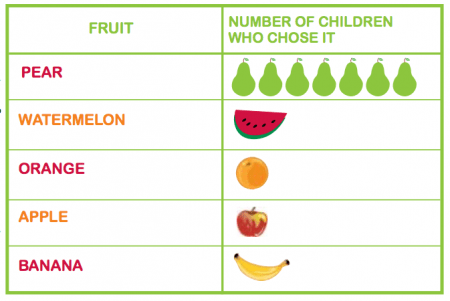
A pictogram is a chart that uses pictures to represent data. Pictograms are set out in the same way as bar charts, but instead of bars they use columns of pictures to show the numbers involved.

Pictography is a form of writing which uses representational, pictorial drawings, similarly to cuneiform and, to some extent, hieroglyphic writing, which also uses drawings as phonetic letters or determinative rhymes. Some pictograms, such as Hazards pictograms, are elements of formal languages.

Pictograph has a rather different meaning in the field of prehistoric art, including recent art by traditional societies and then means art painted on rock surfaces, as opposed to petroglyphs; the latters are carved or incised. Such images may or may not be considered pictograms in the general sense.

Standardization

Pictographs can often transcend languages in that they can communicate to speakers of a number of tongues and language families equally effectively, even if the languages and cultures are completely different. This is why road signs and similar pictographic material are often applied as global standards expected to be understood by nearly all.

A standard set of pictographs was defined in the international standard ISO 7001: Public Information Symbols. Other common sets of pictographs are the laundry symbols used on clothing tags and the chemical hazard symbols as standardized by the GHS system.

Pictograms have been popularized in use on the web and in software, better known as “icons” displayed on a computer screen in order to help user navigate a computer system or mobile device.

Pictograms are most commonly used in Key Stage 1 as a simple and engaging introduction to bar charts. Sometimes teachers will give children cut-out pictures to count out and stick onto a ready-made sheet. This physical activity makes the concept very clear for young children.

When compiling information for a pictogram, a teacher will usually encourage their class to collect data about other children: for example, children might be asked to find out about favourite crisps, cakes, animals or colours of the children in their class or another class. Often, they will record this information on a class list and then put it onto a tally chart (for the younger children, the teacher will probably collate a tally chart on the board for the class). This information is then converted into a pictogram.

Children continue to learn about pictograms in Year 3. More advanced pictograms might be used further up the school, where one image represents more than one of an object, so children need to think about how they are interpreting the number of images.

Cartograms

A cartogram (also called a value-area map or an anamorphic map, the latter common among German-speakers) is a thematic map of a set of features (countries, provinces, etc.), in which their geographic size is altered to be directly proportional to a selected ratio-level variable, such as travel time, population, or GNP. Geographic space itself is thus warped, sometimes extremely, in order to visualize the distribution of the variable. It is one of the most abstract types of map; in fact, some forms may more properly be called diagrams. They are primarily used to display emphasis and for analysis as nomographs.

Cartograms leverage the fact that size is the most intuitive visual variable for representing a total amount. In this, it is a strategy that is similar to proportional symbol maps, which scale point features, and many flow maps, which scale the weight of linear features. However, these two techniques only scale the map symbol, not space itself; a map that stretches the length of linear features is considered a linear cartogram (although additional flow map techniques may be added). Once constructed, cartograms are often used as a base for other thematic mapping techniques to visualize additional variables, such as choropleth mapping.

General principles

Since the early days of the academic study of cartograms, they have been compared to map projections in many ways, in that both methods transform (and thus distort) space itself. The goal of designing a cartogram or a map projection is therefore to represent one or more aspects of geographic phenomena as accurately as possible, while minimizing the collateral damage of distortion in other aspects. In the case of cartograms, by scaling features to have a size proportional to a variable other than their actual size, the danger is that the features will be distorted to the degree that they are no longer recognizable to map readers, making them less useful.

As with map projections, the tradeoffs inherent in cartograms have led to a wide variety of strategies, including manual methods and dozens of computer algorithms that produce very different results from the same source data. The quality of each type of cartogram is typically judged on how accurately it scales each feature, as well as on how (and how well) it attempts to preserve some form of recognizability in the features, usually in two aspects: shape and topological relationship (i.e., retained adjacency of neighboring features). It is likely impossible to preserve both of these, so some cartogram methods attempt to preserve one at the expense of the other, some attempt a compromise solution of balancing the distortion of both, and other methods do not attempt to preserve either one, sacrificing all recognizability to achieve another goal.

Several options are available for the geometric shapes:

  • Circles (Dorling), typically brought together to be touching and arranged to retain some semblance of the overall shape of the original space.[26] These often look like proportional symbol maps, and some consider them to be a hybrid between the two types of thematic map.
  • Squares (Levasseur/Demers), treated in much the same way as the circles, although they do not generally fit together as simply.
  • Rectangles (Raisz), in which the height and width of each rectangular district is adjusted to fit within an overall shape. The result looks much like a treemap diagram, although the latter is generally sorted by size rather than geography. These are often contiguous, although the contiguity may be illusory because many of the districts that are adjacent in the map may not be the same as those that are adjacent in reality.

Statistical errors and approximation

In statistical hypothesis testing, a type I error is the incorrect rejection of a true null hypothesis (also known as a “false positive” finding), while a type II error is incorrectly retaining a false null hypothesis (also known as a “false negative” finding). More simply stated, a type I error is to falsely infer the existence of something that is not there, while a type II error is to falsely infer the absence of something that is.

A type I error (or error of the first kind) is the incorrect rejection of a true null hypothesis. Usually, a type I error leads one to conclude that a supposed effect or relationship exists when in fact it doesn’t. Examples of type I errors include a test that shows a patient to have a disease when in fact the patient does not have the disease, a fire alarm going on indicating a fire when in fact there is no fire, or an experiment indicating that a medical treatment should cure a disease when in fact it does not.

A type II error (or error of the second kind) is the failure to reject a false null hypothesis. Examples of type II errors would be a blood test failing to detect the disease it was designed to detect, in a patient who really has the disease; a fire breaking out and the fire alarm does not ring; or a clinical trial of a medical treatment failing to show that the treatment works when really it does.

When comparing two means, concluding the means were different when in reality they were not different would be a Type I error; concluding the means were not different when in reality they were different would be a Type II error. Various extensions have been suggested as “Type III errors”, though none have wide use.

All statistical hypothesis tests have a probability of making type I and type II errors. For example, all blood tests for a disease will falsely detect the disease in some proportion of people who don’t have it, and will fail to detect the disease in some proportion of people who do have it. A test’s probability of making a type I error is denoted by α. A test’s probability of making a type II error is denoted by β. These error rates are traded off against each other: for any given sample set, the effort to reduce one type of error generally results in increasing the other type of error. For a given test, the only way to reduce both error rates is to increase the sample size, and this may not be feasible.

Type I error

A type I error occurs when the null hypothesis (H0) is true, but is rejected. It is asserting something that is absent, a false hit. A type I error may be likened to a so-called false positive (a result that indicates that a given condition is present when it actually is not present).

In terms of folk tales, an investigator may see the wolf when there is none (“raising a false alarm”). Where the null hypothesis, H0, is: no wolf.

The type I error rate or significance level is the probability of rejecting the null hypothesis given that it is true. It is denoted by the Greek letter α (alpha) and is also called the alpha level. Often, the significance level is set to 0.05 (5%), implying that it is acceptable to have a 5% probability of incorrectly rejecting the null hypothesis.

Type II error

A type II error occurs when the null hypothesis is false, but erroneously fails to be rejected. It is failing to assert what is present, a miss. A type II error may be compared with a so-called false negative (where an actual ‘hit’ was disregarded by the test and seen as a ‘miss’) in a test checking for a single condition with a definitive result of true or false. A Type II error is committed when we fail to believe a true alternative hypothesis.

In terms of folk tales, an investigator may fail to see the wolf when it is present (“failing to raise an alarm”). Again, H0: no wolf.

The rate of the type II error is denoted by the Greek letter β (beta) and related to the power of a test (which equals 1−β).

Table of error types
Null hypothesis (H0) is
True False
Decision
about null
hypothesis (H0)
Don’t
reject
Correct inference
(true negative)

(probability = 1−α)

Type II error
(false negative)
(probability = β
Reject Type I error
(false positive)
(probability = α
Correct inference
(true positive)

(probability = 1−β)

Error Rate

A perfect test would have zero false positives and zero false negatives. However, statistical methods are probabilistic, and it cannot be known for certain whether statistical conclusions are correct. Whenever there is uncertainty, there is the possibility of making an error. Considering this nature of statistics science, all statistical hypothesis tests have a probability of making type I and type II errors.

  • The type I error rate or significance level is the probability of rejecting the null hypothesis given that it is true. It is denoted by the Greek letter α (alpha) and is also called the alpha level. Usually, the significance level is set to 0.05 (5%), implying that it is acceptable to have a 5% probability of incorrectly rejecting the true null hypothesis.
  • The rate of the type II error is denoted by the Greek letter β (beta) and related to the power of a test, which equals 1−β.

These two types of error rates are traded off against each other: for any given sample set, the effort to reduce one type of error generally results in increasing the other type of error.

The quality of hypothesis test

Error2

The same idea can be expressed in terms of the rate of correct results and therefore used to minimize error rates and improve the quality of hypothesis test. To reduce the probability of committing a Type I error, making the alpha (p) value more stringent is quite simple and efficient. To decrease the probability of committing a Type II error, which is closely associated with analyses’ power, either increasing the test’s sample size or relaxing the alpha level could increase the analyses’ power. A test statistic is robust if the Type I error rate is controlled.

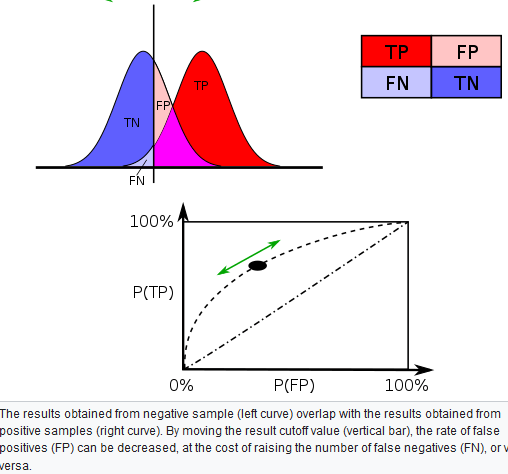
Varying different threshold (cut-off) value could also be used to make the test either more specific or more sensitive, which in turn elevates the test quality. For example, imagine a medical test, in which experimenter might measure the concentration of a certain protein in the blood sample. Experimenter could adjust the threshold (black vertical line in the figure) and people would be diagnosed as having diseases if any number is detected above this certain threshold. According to the image, changing the threshold would result in changes in false positives and false negatives, corresponding to movement on the curve.

Approximation

Too many results are only approximate; meaning they are similar but not equal to the actual result. An approximation can turn a complex calculation into a less complicated one.

For instance, the calculation of a Poisson distribution is more complicated than that of a binomial distribution. If both only differ slightly in their end result, it is permissible to approximate the Poisson distribution by a more simple-to-use binomial distribution. Prerequisite for such approximations is a sufficient sample size. In this example, at least 100 respondents are necessary in order to justify a sufficient proximity of the two distributions. An approximation based on too small a sample can lead to errors, for example, an accidental similarity of the two distributions.

The binomial distribution can be used to solve problems such as, “If a fair coin is flipped 100 times, what is the probability of getting 60 or more heads?” The probability of exactly x heads out of N

Flips is computed using the formula:

P(x)=[N!/(x!(N−x)!)]*πx(1−π)^N−x

where x

is the number of heads (60), N is the number of flips (100), and π

is the probability of a head (0.5). Therefore, to solve this problem, you compute the probability of 60 heads, then the probability of 61 heads, 62 heads, etc, and add up all these probabilities.

Abraham de Moivre, an 18th century statistician and consultant to gamblers, was often called upon to make these lengthy computations. de Moivre noted that when the number of events (coin flips) increased, the shape of the binomial distribution approached a very smooth curve. Therefore, de Moivre reasoned that if he could find a mathematical expression for this curve, he would be able to solve problems such as finding the probability of 60 or more heads out of 100 coin flips much more easily. This is exactly what he did, and the curve he discovered is now called the normal curve. The process of using this curve to estimate the shape of the binomial distribution is known as normal approximation.

The Scope of the Normal Approximation

The scope of the normal approximation is dependent upon our sample size, becoming more accurate as the sample size grows.

The tool of normal approximation allows us to approximate the probabilities of random variables for which we don’t know all of the values, or for a very large range of potential values that would be very difficult and time consuming to calculate. We do this by converting the range of values into standardized units and finding the area under the normal curve. A problem arises when there are a limited number of samples, or draws in the case of data “drawn from a box.” A probability histogram of such a set may not resemble the normal curve, and therefore the normal curve will not accurately represent the expected values of the random variables. In other words, the scope of the normal approximation is dependent upon our sample size, becoming more accurate as the sample size grows. This characteristic follows with the statistical themes of the law of large numbers and central limit theorem.

Sixty two percent of 12th graders attend school in a particular urban school district. If a sample of 500 12th grade children are selected, find the probability that at least 290 are actually enrolled in school.

Part 1: Making the Calculations

Step 1: Find p,q, and n:

  • The probability p is given in the question as 62%, or 0.62
  • To find q, subtract p from 1: 1 – 0.62 = 0.38
  • The sample size n is given in the question as 500

Step 2: Figure out if you can use the normal approximation to the binomial. If n * p and n * q are greater than 5, then you can use the approximation:

n * p = 310 and n * q = 190.

These are both larger than 5, so you can use the normal approximation to the binomial for this question.

Step 3: Find the mean, μ by multiplying n and p:

n * p = 310

(You actually figured that out in Step 2!).

Step 4: Multiply step 3 by q :

310 * 0.38 = 117.8.

Step 5: Take the square root of step 4 to get the standard deviation, σ:

√(117.8)=10.85

Note: The formula for the standard deviation for a binomial is √(n*p*q).

Part 2: Using the Continuity Correction Factor

Step 6: Write the problem using correct notation. The question stated that we need to “find the probability that at least 290 are actually enrolled in school”. So:

P(X ≥ 290)

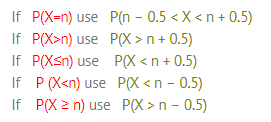
Step 7: Rewrite the problem using the continuity correction factor:

P (X ≥ 290-0.5) = P (X ≥ 289.5)

Step 8: Draw a diagram with the mean in the center. Shade the area that corresponds to the probability you are looking for. We’re looking for X ≥ 289.5, so:

Step 9: Find the z-score.

You can find this by subtracting the mean (μ) from the probability you found in step 7, then dividing by the standard deviation (σ):

(289.5 – 310) / 10.85 = -1.89

Step 10: Look up the z-value in the z-table:

The area for -1.89 is 0.4706.

Step 11: Add .5 to your answer in step 10 to find the total area pictured:

0.4706 + 0.5 = 0.9706.

That’s it! The probability is .9706, or 97.06%.


Equity Market Meaning

An equity market is a platform that allows companies to raise capital via different investors. A company thus issues stock that investors or traders purchase in expectation of earning gains from future sales of said stock.

An equity market is a hub in which shares of companies are issued and traded. The market comes in the form of an exchange which facilitates the trade between buyers and sellers or over-the-counter (OTC) in which buyers and sellers find each other.

An equity market is a market in which shares of companies are issued and traded, either through exchanges or over-the-counter markets. Also known as the stock market, it is one of the most vital areas of a market economy. It gives companies access to capital to grow their business, and investors a piece of ownership in a company with the potential to realize gains in their investment based on the company’s future performance.

Equity Trading in the Stock Market

Trading in the equity market primarily entails the seller fixing a price and a buyer agreeing to pay that price to purchase the security, thus executing a sale. In a general context, the understanding of what is equity in the share market extends to all types of shares and securities traded that are also termed as stock. Equity and stock are thus used interchangeably for the purpose of trading.

Top Equity Exchanges

Some of the most well-known and largest equity markets are:

  • New York Stock Exchange (NYSE) – United States
  • Nasdaq (NASDAQ) – United States
  • Japan Exchange Group (JPX) – Japan
  • London Stock Exchange (LSE) – United Kingdom
  • Shanghai Stock Exchange (SSE) – China
  • Hong Kong Stock Exchange (HKEX) – Hong Kong
  • Euronext – European Union
  • Toronto Stock Exchange – Canada
  • Bombay Stock Exchange – India

Types of Equity Market

Equity markets comprise structured trading and investment and can be defined into two types of platforms, i.e., primary and secondary markets.

Primary market

Each company plans to offer its shares for public trading must start with Initial Public Offering or IPO. In this process, the company offers a part of its total equity to the public for raising capital initially. Once the IPO is complete, the stocks so offered are listed on the stock exchange for further trading.

The entire process of introducing the IPO by a company takes place in the primary market. In other words, this market comprises only the IPO introduction and investment.

Secondary market

Once the shares have already been listed on either of the exchanges, further trading for them is held in the secondary market. Here, the initial investors get an opportunity to exit their investments via stock sale in this live equity market. These stocks can comprise shares, along with other types of securities that can include convertible bonds, corporate bonds, etc.

Recent Developments in Indian Stock Exchanges

Insider Trading:

Insider trading had become an extremely sensitive and controversial subject in the stock market in India.

Any person in power whether an officer or director who had access to information of private matters of the company relating to expansion programs of the company, changes in policies, amalgamations, joint contracts, collaboration or any information about its financial results was making full use of his position to give an advantage to relatives, friends or known persons by leaking out information leading to frauds and rigging of price relating to securities.

SEBI has laid down guidelines by prescribing norms handling information which may be considered sensitive. Price forecasts, changes in investment plans, knowledge of mergers and acquisitions, information about contracts are not to be disclosed. The staff and officers who have such sensitive information are to be identified in each company. Controls are to be made on the handling of sensitive information.

Insider Trading Regulations in 1992 notified by SEBI prohibited insider trading, as it is unfair upon investors. Persons who possess price sensitive information because they have connections with a company take advantage of the situation to ‘peg up’ or ‘down’ prices of securities to their advantage.

Depository or Paperless Trading:

The Depository Act was passed in 1996 allowing dematerializing of securities and transfer of security through electronic book entry to help in reducing settlement risks and infrastructure bottlenecks. The dematerialized securities will not have any identification numbers or distinctive numbers.

The National Securities Depository Ltd., was set up in Nov. 1996. Trading of new Initial (NSDC) public offers was to be in dematerialized form upon listing. An exclusive feature of the Indian Capital Market is that multiple depository system has been encouraged.

Hence, there are two Depository Services. The other depository system is also registered. It is called Central Depository Service Ltd. (CDSL). Debt instruments however, are not transferable by endorsement delivery.

Dematerialization of securities is one of the major steps for improving and modernizing market and enhancing the level of investor protection through elimination of bad deliveries and forgery of shares and expediting the transfer of shares. Long-term benefits were expected to accrue to the market through the removal of physical securities.

Usefulness of a Depository System:

A depository system was required in India to eliminate physical certificates.

A depository system has the following advantages:

  • Paperless:

It eliminates risks, as this system does not have physical certificates. There are no problems regarding bad deliveries or fake certificates.

  • Electronic:

It is an electronic form and provides transfer of securities immediately without any delay.

  • Demat Account:

A depository provides a demat account with a client identification number and a depository identification number. Therefore, there is a special identity of a member. He also has a trading account, which enables him with identity and immediate transfer.

  • Electronic Transfer:

There is no stamp duty on transfer of securities because there is no physical transfer. It is transfer through a pass book similar to a bank.

  • Expenses:

The DP charges a yearly charge for maintaining the member account, hence there is a reduction of paper work and transaction cost of a frequent transfers of securities.

  • Eliminates Problems:

Investors had the problem of selling shares in Odd Lots but with the depository system even one share can be sold.

  • Nomination:

Since a depository allows a nomination facility, hence shares can be easily transferred at the time of death of a participant.

  • Address Changed:

Change in address recorded with DP gets registered with all companies in which investor holds securities electronically, eliminating the need to correspond with each of them separately.

  • Elimination of Correspondence:

Transmission of securities is done by DP eliminating correspondence with companies.

  • Automatic Credit:

There is an automatic credit into demat account of shares, arising out of bonus, split, consolidation, merger etc.

Conversion of Shares into Dematerialized Form:

In order to dematerialize physical securities, an investor has to fill in a Demat Request Form (DRF) which is available with the DP and submit the same along with physical certificates DRF has to be filled for each ISIN no. The investor has to surrender certificates for dematerialization to the DP (depository participant). Depository participant intimates Depository of the request through the system.

He then submits the certificates to the registrar. The Registrar confirms the dematerialization request from depository. After dematerializing certificates, Registrar updates accounts and informs depository of the completion of dematerializations. Depository updates its accounts and informs the depository participant. Depository participant updates the account and informs the investor.

Re-materialization:

If an investor is interested in getting back his securities in the physical form he has to fill in the Remat Request Form (RRF) and request his DP for re-materialization of the balances in his securities account. He has to make a request for re-materialization.

Then the DP intimates the depository of the request through the system. The Depository confirms re-materialization request to the registrar. Registrar updates accounts and prints certificates. Depository updates accounts and downloads details to depository participant. Registrar dispatches certificates to the investor.

Surveillance on Price Manipulation:

SEBI introduced surveillance and enforcement measures against intermediaries’ violation of laws especially in price manipulations. All exchanges have surveillance departments which co-ordinate with SEBI. SEBI has enforced information to be submitted by exchanges on daily settlement and monitoring reports. SEBI has also created a database for trading on National and Bombay Stock Exchanges.

If price manipulation is detected, auction proceeds may be impounded or frozen so that the manipulator cannot use it. SEBI has introduced ‘Stock Watch’ an advances software for surveillance of market activities programmed to show movements from historical patterns through follow ups by analyst and trained investigators to act as a deterrent to trading and price rigging.

Regulation of Stock Brokers:

Stock Broker and Sub-brokers Regulation Act, was passed in 1992. Brokers had to have a dual registration both with SEBI and with Stock Exchange. Penal action would be taken against any broker for violation of laws. Capital adequacy norms were introduced and they were 3% for individual brokers and 6% for corporate brokers.

For investor protection measures, brokers have been disciplined by introducing the system of maintaining accounts for clients and brokers own account and disclosure of transaction price and brokerage separately in contract note.

Audit has been made compulsory of the brokers’ books and filing of auditor’s report with the SEBI has been made mandatory. SEBI has also extended regulations to sub-brokers. Sub-brokers have to be registered by entering into an agreement with the stock brokers from whom he seeks affiliation.

Sub-brokers can transact business only through stock broker with whom he is registered. If he wants to do business through more than one stock broker, he has to be registered separately with each one of them.

Options and Derivatives:

Options can be classified as call options or put options. The National Stock Exchange (NSE) and the Bombay Stock Exchange (BSE) have launched derivatives. They will offer derivatives for three tenures one in the first instance each for subsequent three months.

So, in July, Nifty call and put options can be purchased for July end, August end and September end. The last day of the contract would be the expiration date. In an options contract, a premium has to be paid to enter a contract.

Buyer’s losses are limited to the extent of premium paid but his gains are unlimited. Seller’s profits are limited to premiums received but losses are unlimited.

These derivatives have been started by SEBI to bring about investor confidence to establish the market and to reduce risk. Initially, options trading will be allowed only in 14 stocks. Option will not allow a person to defer settlement of sale/purchase but they will enable placing of bets on Stock Markets.

Regulation of Mutual Funds:

SEBI regulates the Mutual Funds to provide portfolio disclosure and standardization of accounting procedures. It is a requirement of SEBI that Mutual Funds should have a trustee company which is separate from the asset Management Company and the securities of the various schemes should be kept with a custodian independent of the Mutual Fund.

All Mutual Funds should be regulated with the SEBI. All schemes of UTI after 1994 have also been brought under the control of SEBI. SEBI created certain procedures of valuation norms and asset value and pricing for the Mutual Funds. The primary interest of SEBI to control Mutual Fund schemes was to protect investors from fraudulent deals.

To bring transparency in operations, SEBI directed mutual fund investors to mention their permanent account number (PAN) for investments over Rs. 50000. In case where neither the PAN nor the GIR number has been allotted, the fact of non-allotment is to be mentioned in the application form. Mutual fund was prohibited from accepting any application without these details.

All mutual funds were also told to obtain a unique client code from the Bombay Stock Exchange or the National Stock Exchange for each of their existing schemes and plans.

Following the collapse of Global Trust Bank (GTB), SEBI asked all mutual funds to provide details of their investments in fixed deposits of banks. In particular, SEBI called for specifying FD investments exceeding 25% of the total portfolio of a scheme.

To prevent mutual fund schemes from turning into portfolio management schemes, each has directed mutual funds scheme and individual plan under the schemes should have a minimum of 20 investors and no single investor should account for more than 25% of the corpus of such scheme/plan. In case of non-compliance, the schemes/plans will be wound up and investor’s money redeemed at applicable Net Asset Value.

SEBI issued a new format for Mutual Funds to file information details of investment objective of the scheme, asset allocation pattern of the scheme, risk profile of the scheme, plans and options, name of the fund manager, name of the trustee company, performance of the scheme, expenses of the scheme, i.e.,

(i) Load structure

(ii) Recurring expenses, tax treatment for the investors/unit holders and daily net asset value (NAV).

Regulation of Foreign Institutional Investors (FIIs):

FIIs had a large volume of funds. By the nature of their trading volumes, FIIs can retain Control over the stock market. SEBI had to keep these FIIs under its control for protecting the investors. Hence, all FIIs had to be registered with SEBI.

FIIs having a capital of 100 crores could register themselves as depositories and their procedures were to be evaluated by an independent agency. FIIs are also allowed to invest in debt securities but investment in equity and debt securities should be in the ratio of 70:30. The FIIs under SEBI include Pension Funds, Mutual Funds, Asset Management Companies, Investment Trust and Charitable Institutions.

Buy back of Shares:

Buy Back of shares is another development of Indian Corporate practice. It was permitted by SEBI in 1998, following the companies (amendment) ordinance by the Central Government. Buy back of shares is a method whereby a company is allowed to purchase its own shares out of its free reserves, securities premium account, or the proceeds of other specified securities like preference shares.

However, it cannot be made out of earlier issue of equity shares. Buy back of shares may be done from existing shareholders on a proportionate basis, through open market purchases and through company employees where securities are issued under stock option or sweat equity.

It is a strategy used for restructuring a company’s share capital and increasing the value of its shares. It can also have the effect of a greater control of the company by the management and promoters through the use of excess funds available with the company.

Buy back its shares as per SEBI’s regulations only when the following conditions are fulfilled:

  1. The Articles of Association of a company authorize buy back of shares.
  2. A special resolution is passed by the general body to authorize the repurchase of shares. The resolution should have an attached document giving details of all material facts like: need for buy back, amount to be invested, type of securities intended for repurchase and time limit for completion of buy back.
  3. The debt equity ratio after buy back should not be more than 2:1 of secured and unsecured debt except with prior permission of Central Government.
  4. The other specified securities of the company are fully paid up and (both listed and unlisted securities) are in accordance with SEBI regulations.
  5. The buyback of shares is less than 25% of paid up capital and free reserves of the company as shown in the latest balance sheet of the company.
  6. The buyback should be completed within twelve months from the date of passing the special resolution.
  7. The shares/other specified securities would be extinguished within seven days of completion of buy back procedure of the company.
  8. The company will not be permitted to issue the same type of shares/securities which have been bought back for a period of twenty-four months. The exception to such an issue would be the issue of bonus shares of stock-option schemes, conversion of preference shares/debentures into equity issues.
  9. In addition, a company has to file a declaration of solvency verified by an affidavit in a prescribed form with the Registrar of companies within 30 days after completion of buy back. This has been amended in October 2001 to bring in relaxation to companies to buy back shares. The amendments are:
  10. There can be only one buy back in 365 days.
  11. Companies can buy back less than 10% of equity with the approval of the Board of directors meeting.
  12. If a company issues less than 10% equity it does not require shareholders’ approval.

Methods of IPO

The Initial Public Offering IPO Process is where a previously unlisted company sells new or existing securities and offers them to the public for the first time.

Prior to an IPO, a company is considered to be private with a smaller number of shareholders, limited to accredited investors (like angel investors/venture capitalists and high net worth individuals) and/or early investors (for instance, the founder, family, and friends).

After an IPO, the issuing company becomes a publicly listed company on a recognized stock exchange. Thus, an IPO is also commonly known as “going public”.

The steps an investor needs to follow are:

Decision

The primary step for an investor would be to decide the IPO he wants to apply for. Though the existing investors may have the expertise, it could be an intimidating one for the new ones. The investors can form a choice by going through the prospectus of the companies initiating IPO.

The prospectus helps the investors to form an informed idea about the company’s business plan and its purpose for raising stocks in the market. Once the decision has been made, the investor needs to look forward to the next step.

Funding

When an investor has formed the decision regarding the IPO he would like to invest in, the very next step would be to arrange the funds. An investor can use his savings to buy a company’s share.

In case the investor does not have enough savings, he can avail a loan from certain banks and Non-Banking Financial Organisations (NBFCs) at a definite rate of interest.

Opening a Demat-cum-trading account

Any investor without a Demat account cannot apply for an IPO. The function of a Demat account is to provide the investors with the provision to store shares and other financial securities electronically. One can open a Demat account by submitting his Aadhaar card, PAN card, address and identity proofs.

The application process

An investor can apply for an IPO through his bank account or trading account. Some financial organisations will offer you the provision to bunch your Demat, trading and bank accounts.

After an investor has created the demat-cum-trading account, he needs to be familiar with the Application Supported by Blocked Account (ASBA) facility. It is mandatory for every IPO applicant. The ASBA is an application that enables the banks to arrest funds in the applicant’s bank account.

The ASBA application forms are made available to the IPO applicants in both demat and physical form. However, the use of cheques and demand drafts cannot be made to avail the facility. An investor needs to specify his demat account number, PAN, bidding details and bank account number in the application.

Bidding

An investor needs to bid while applying for the shares in an IPO. It is done according to the lot size quoted in the company’s prospectus. Lot size can be referred to as the minimum number of shares that an investor has to apply for in an IPO.

A price range is decided and the investors require to bid within the price range. Though an investor can make a revision in his biddings during an IPO, it should be noted that he needs to block the required funds while bidding. In the meantime, the arrested amount in the banks earns interest until the process of allotment is initiated.

Allotment

In many cases, the demand for the shares can exceed the actual number of stocks released in the secondary market. One can also face situations where he can get a fewer number of shares than what he had demanded. In these cases, the banks unlock the arrested funds either entirely or partially.

But, if an investor is lucky enough to get a full allotment, he would receive a CAN (Confirmatory Allotment Note) within six working days after the IPO process is done. After the shares have been allotted, they are credited to the investor’s demat account.

Once the above-mentioned steps are carried on successfully, the investor will have to wait for the listings of the stocks in the share market. It is generally done within seven days after the shares are finalised.

Instruments and Players in Debt Market: Government Securities, PSU Bonds, Corporate Bonds

Securities are financial instruments that represent a creditor relationship with a corporation or government. Generally, they represent agreements to receive a certain amount depending on the terms contained within the agreement.

Fixed-income securities are investments where the cash flows are according to a predetermined amount of interest, paid on a fixed schedule.

Fixed Income securities offer a predictable stream of payments by way of interest and repayment of principal at the maturity of the instrument. The debt securities are issued by the eligible entities against the moneys borrowed by them from the investors in these instruments. Therefore, most debt securities carry a fixed charge on the assets of the entity and generally enjoy a reasonable degree of safety by way of the security of the fixed and/or movable assets of the company.

The Debt Market is the market where fixed income securities of various types and features are issued and traded. Debt Markets are therefore, markets for fixed income securities issued by Central and State Governments, Municipal Corporations, Govt. bodies and commercial entities like Financial Institutions, Banks, Public Sector Units, Public Ltd. companies and also structured finance instruments.

Debt Markets in India and all around the world are dominated by Government securities, which account for between 50 – 75% of the trading volumes and the market capitalization in all markets. Government securities (G-Secs) account for 70 – 75% of the outstanding value of issued securities and 90-95% of the trading volumes in the Indian Debt Markets.

Government Securities

G-Secs in India currently have a face value of ` 100/- and are issued by the RBI on behalf of the Government of India. All G-Secs are normally coupon (Interest rate) bearing and have semi-annual coupon or interest payments with tenure of between5to30years.This may change according to the structure of the Instrument.

The Zero Default Risk is the greatest attraction for investments in G-secs so that it enjoys the

greatest amount of security possible. The other advantages of investing in G- Secs are:

  • Greater safety and lower volatility as compared to other financial instruments.
  • Variations possible in the structure of instruments like Index linked Bonds, STRIPS
  • Higher leverage available in case of borrowings against G-Secs.
  • No TDS on interest payments.
  • Tax exemption for interest earned on G-Secs. up to Rs.3000/- over and above the limit of Rs.9000/- under Section 80L.
  • Greater diversification opportunities.

PSU Bonds

Public Sector Undertaking Bonds (PSU Bonds): These are Medium or long term debt instruments issued by Public Sector Undertakings (PSUs). The term usually denotes bonds issued by the central PSUs (ie PSUs funded by and under the administrative control of the Government of India). Most of the PSU Bonds are sold on Private Placement Basis to the targeted investors at Market Determined Interest Rates. Often investment bankers are roped in as arrangers to this issue. Most of the PSU Bonds are transferable and endorsement at delivery and are issued in the form of Usance Promissory Note.

Corporate Bonds

Corporate bonds are issued by corporations and usually mature within 1 to 30 years. These bonds usually offer a higher yield than government bonds but carry more risk. Corporate bonds can be categorized into groups, depending on the market sector the company operates in. They can also be differentiated based on the security backing the bond or the lack of security.

A corporate bond is a type of debt security that is issued by a firm and sold to investors. The company gets the capital it needs and in return the investor is paid a pre-established number of interest payments at either a fixed or variable interest rate. When the bond expires, or “reaches maturity,” the payments cease and the original investment is returned.

The backing for the bond is generally the ability of the company to repay, which depends on its prospects for future revenues and profitability. In some cases, the company’s physical assets may be used as collateral.

Corporate bonds sometimes have call provisions to allow for early prepayment if prevailing interest rates change so dramatically that the company deems it can do better by issuing a new bond.

Investors may also opt to sell bonds before they mature. If a bond is sold, the owner gets less than face value. The amount it is worth is determined primarily by the number of payments that still are due before the bond matures.

Investors may also gain access to corporate bonds by investing in any number of bond-focused mutual funds or ETFs.

Benefits of corporate bond funds

  • Components of corporate bonds

Corporate bond funds invest predominantly in debt papers. Companies issue debt papers, which include bonds, debentures, commercial papers, and structured obligations. All of these components carry a unique risk profile, and the maturity date also varies.

  • Price of the bond

Every bond has a price, and it is dynamic. You can buy the same bond at different prices, based on the time you choose to buy. Investors should check how it varies from the par value it will give information about the market movement.

  • Par Value of the bond

This is the amount the company (bond issuer) pays you when the bond matures. It is the loan principal. In India, a corporate bond’s par value is usually Rs 1,000.

  • Coupon (interest)

When you buy a bond, the company will payout interest regularly until you exit the corporate bond or the bond matures. This interest is called the coupon, which is a certain percentage of the par value.

  • Current Yield

The annual returns you make from the bond is called the current yield. For example, if the coupon rate of a bond with Rs 1,000 par value is 20%, then the issuer pays Rs 200 as the interest per year.

  • Yield to Maturity (YTM)

This is the in-house rate of returns of all the cash-flows in the bond, the current bond price, the coupon payments until maturity and the principal. Greater the YTM, higher will be your returns and vice versa.

  • Tax-efficiency

If you are holding your corporate bond fund for less than three years, then you must pay short-term capital gains tax (STCG) based on your tax slab. On the other hand, Section 112 of the Indian Income Tax mandates 20% tax on long-term capital gains. This applies to those who hold the bond for more than three years.

  • Exposure & allocation

Corporate bond funds, sometimes, do take small exposures to government securities as well. But they do so only when no suitable opportunities in the credit space are available. On average, corporate bond funds will have approximately 5.22% allocation to sovereign fixed income.

Types of corporate bonds

Convertible bonds: You can convert these bonds into predefined stocks at your disposal. So, if at any point in time, you feel that stocks are likely to give you better returns than bonds, you can convert them into shares.

Non-convertible: As the name suggests, these bonds cannot be converted into stocks. These will be plain bonds purchased from a corporation for some time.

Types of corporate bond funds.

Type One: Type one corporate bonds invest in high-rated companies; public sector unit (PSU) companies and banks.

Type Two: Type two corporate bonds invest in slightly lower rated companies such as ‘AA- ‘and below.

Bond Ratings

Bond ratings are representations of the creditworthiness of corporate or government bonds. The ratings are published by credit rating agencies and provide evaluations of a bond issuer’s financial strength and capacity to repay the bond’s principal and interest according to the contract.

Investment grade Moody’s Standard & Poor’s Fitch
Strongest Aaa AAA AAA
  Aa1 AA+ AA+
  Aa2 AA AA
  Aa3 AA- AA-
  A1 A+ A+
  A2 A A
  A3 A- A-
  Baa1 BBB+ BBB+
  Baa2 BBB BBB
  Baa3 BBB- BBB-

Non-investment-grade Moody’s Standard & Poor’s Fitch
  Ba1 BB+ BB+
  Ba2 BB BB
  Ba3 BB- BB-
  B1 B+ B+
  B2 B B
  B3 B- B-
  Caa1 CCC+ CCC+ 
  Caa2 CCC CCC
  Caa3 CCC-  CCC-
  Ca CC CC

Weakest Moody’s Standard & Poor’s Fitch
  C C C
    D D

Investment grade and high yield bonds

Investors typically group bond ratings into 2 major categories:

  • Investment-grade refers to bonds rated Baa3/BBB- or better.
  • High-yield (also referred to as “non-investment-grade” or “junk” bonds) pertains to bonds rated Ba1/BB+ and lower.

Primary Dealers in Government Securities

Government securities market in India is narrow and unlike other countries inactive. The general investors do not buy these securities. The Reserve Bank of India and financial institutions are the main investors of government securities.

The government securities market in India supports the capital market and has no negative effect on it. The funds that it collects are mainly for minimizing the cost of servicing and for the planned priorities of the economy.

Government securities have been employed by the Reserve Bank of India in such a way that it is able to maintain some clear pattern of yield and a proper maturity distribution policy. It has also been considered safe by Reserve Bank to purchase securities before maturity in order to maintain stability.

The Reserve Bank of India has used open market operations to provide inexpensive finance for government and has tried to maintain funds with the view of achieving stability in the future.

The Reserve Bank of India has also used the techniques of maintaining the reserve ratio and the statutory liquid ratio and the technique of moral suasion. This it has done for controlling bank liquidity and for achieving the objectives of debt management.

Prices and Yields on Government Securities:

The prices of government securities remain stable, although the bank rate has been increasing. In India usually the bank rate influences the security prices inversely and in opposite direction.

But the Reserve Bank of India has tried to stabilize the prices of government securities. Thus, it has been able to do by refraining from making any change in the purchasing and selling rates of the different loans which are placed on its list.

It has also tried to manipulate the selling rate of Treasury Bills of government. The Reserve Bank of India has many a times mopped up the surplus funds by lowering the rate of sale of Treasury Bills. This is an indication that the Reserve Bank of India was concerned with the rate of term loans and wanted to continue with its stability.

The yields on securities can be studied if the investor holds the security continuously. An investor can then observe year to year changes in the coupon rate, running yield and redemption yield.

It is common practice in India that the government securities are sold far below the face value. This itself shows that the redemption yield is higher than the bond rate because the redemption yield is equal to the face value when the bond is purchased at the face value or par value.

In India, government securities have continuously increased the rate of return. Also, there has been no ceiling rate on government securities.

However, government securities show that even with the continuous increase in interest over the years, coupled with price stability, the rates given by government are far below than what the investor would hope to gain if he invested his funds in industrial securities. The government securities, therefore, are not an attractive form of investment.

In India, government securities have been an important or useful part of the monetary management and fiscal policy. The Reserve Bank of India has executed the interest rate of government selling, borrowing, purchasing and lending and has also influenced the prices and yields. It has also played an important role in maintaining a statutory liquidity ratio with the commercial banks in the country.

This has the effect of reducing or improving the liquidity position of the bank. As has been pointed earlier, government securities have not made a market for themselves. They have generally been issued for the reason of monetary, fiscal and debt management and for using the funds for the planned priorities of the country.

Government securities in India are invested by financial institutions and commercial banks. Although it comprises a larger segment than the industrial securities market in India, very little knowledge is presently available about its operation to the common man.

Dealer

A primary dealer is a firm that buys government securities directly from a government, with the intention of reselling them to others, thus acting as a market maker of government securities. The government may regulate the behaviour and number of its primary dealers and impose conditions of entry. Some governments sell their securities only to primary dealers; some sell them to others as well. Governments that use primary dealers include Australia, Belgium, Brazil, Canada, China, France, Hong Kong, India, Italy, Japan, Singapore, Spain, the United Kingdom, and the United States.

A Primary Dealer will be required to have a standing arrangement with RBI based on the execution of an undertaking and the authorisation letter issued by RBI covering inter-alia the following aspects:

(i) A Primary Dealer will have to commit to aggregative bid for Government of India dated securities on an annual basis of not less than a specified amount and auction Treasury Bills for specified percentage for each auction. The agreed minimum amount/ percentage of bids would be separately indicated for dated securities and Treasury Bills.

(ii) A Primary Dealer would be required to achieve a minimum success ratio of 40 per cent for dated securities and 40 per cent for Treasury Bills.

(iii) Underwriting of Dated Government Securities: Primary Dealers will be collectively offered to underwrite up to 100% of the notified amount in respect of all issues where the amounts are notified.

(iv) Treasury bill issues are not underwritten. Instead, Primary Dealers are required to commit to submit minimum bids at each auction. The commitment of Primary Dealer’s participation in treasury bills subscription works out as follows:

(a) Each Primary Dealer individually commits, at the beginning of the year, to submit minimum bids as a fixed percentage of the notified amount of treasury bills, in each auction.

(b) The minimum percentage of the bids for each Primary Dealer is determined by the Reserve Bank through negotiation with the Primary Dealer so that the entire issue of treasury bills is collectively apportioned among all Primary Dealers.

(c) The percentage of minimum bidding commitment determined by the Reserve Bank remains unchanged for the entire financial year or till furnishing of undertaking on bidding commitments for the next financial year, whichever is later. In determining the minimum bidding commitment, the Reserve Bank takes into account the offer made by the Primary Dealer, its net owned funds and its track record.

(v) A Primary Dealer shall offer firm two-way quotes either through the Negotiated Dealing System or over the counter telephone market or through a recognised Stock Exchange of India and deal in the secondary market for Government securities and take principal positions.

(vi) A Primary Dealer shall maintain the minimum capital standards at all points of time.

(vii) A Primary Dealer shall achieve a sizeable portfolio in government securities before the end of the first year of operations after authorisation.

(viii) The annual turnover of a Primary Dealer in a financial year shall not be less than 5 times of average month end stocks in government dated securities and 10 times of average month end stocks in Treasury Bills.

Of the total, turnover in respect of outright transactions shall not be less than 3 times in respect of government dated securities and 6 times in respect of Treasury Bills. The target should be achieved by the end of the first year of operations after authorisation by RBI.

(ix) A Primary Dealer shall maintain physical infrastructure in terms of office, computing equipment, communication facilities like Telex/Fax, Telephone, etc. and skilled manpower for efficient participation in primary issues, trading in the secondary market, and to advise and educate the investors.

(x) A Primary Dealer shall have an efficient internal control system for fair conduct of business and settlement of trades and maintenance of accounts.

(xi) A Primary Dealer will provide access to RBI to all records, books, information and documents as may be required,

(xii) A Primary Dealer shall subject itself to all prudential and regulatory guidelines issued by RBI.

(xiii) A Primary Dealer shall submit periodic returns as prescribed by RBI.

(xiii) A Primary Dealer’s investment in G-Secs and Treasury Bills on a daily basis should be at least equal to its net call borrowing plus net RBI borrowing plus net owned funds of Rs 50 crore.

Securities Trading Corporation of India

STCI Finance Ltd (formerly Securities Trading Corporation of India Limited), is a Systemically Important Non-Deposit taking NBFC registered with Reserve Bank of India (RBI). Presently STCI Finance Ltd is classified as a loan NBFC.

In May 1994, STCI Finance Limited was promoted by RBI with the main objective of fostering an active secondary market in Government of India Securities and Public Sector bonds. RBI owned a majority stake of 50.18% in the paid-up share capital of the company. In 1996, the Company was accredited as the first Primary Dealer in the India. As one of the leading Primary Dealers in the country, the Company was a market maker in government securities, corporate bonds and money market instruments. Its other lines of activities included trading in interest rate swaps and trading in equity – cash & derivatives segment. The Company enjoyed a successful track record of achieving profits during consecutive years spanning nearly a decade. RBI divested its entire shareholding in STCI in two stages- first in 1997 to bring it down from 50.18% to 14.41% and the balance in 2002 to the existing shareholders. Bank of India became the largest shareholder in the company with 29.96% stake.

In order to diversify into new activities, the Company hived off its Primary Dealership business to its separate 100% subsidiary, STCI Primary Dealer Limited (STCI-PD) in June 2007. Since year 2007, the Company has been undertaking lending and investment activities with its main focus on lending/ financing activities. With growth in the size of the Look Book, the lending activity became the core business of the Company and STCI Finance Limited was classified as a Loan NBFC . With a view to reflecting the lending/ financing business of the Company, the name of the Company was changed from Securities Trading Corporation of India to ‘STCI Finance Limited’ with effect from October 24, 2011.

STCI Finance Limited is a diversified mid-market B2B NBFC offering its product and services across multiple locations in the areas of Capital Markets, Real Estate, Corporate Finance and Structured Finance.

Subsidiaries:

STCI Primary Dealer Limited (STCI PD)

This company is a wholly owned subsidiary of STCI Finance Limited established consequent to the hiving off of the Company’s primary dealership business in line with the Reserve Bank of India guidelines on diversification of business activities by primary dealers. The Company undertakes trading in government securities, corporate bonds, money market instruments, interest rate swaps and trading in equity.

STCI Commodities Limited

This company is a wholly owned subsidiary of STCI Finance Limited. The Company has discontinued its commodity broking operations with effect from September 20, 2011 and has also surrendered its membership with Multi Commodity Exchange (MCX) and National Commodity and Derivative Exchange (NCDEX).

Functions of Money Market

Money market is the market for short-term loanable funds, as distinct from the capital mar­ket which deals in long-term funds.

Money mar­ket is also defined as a mechanism through which short-term funds are loaned and borrowed and through which a large part of the financial transac­tions of a particular country are cleared.

The money market is divided into direct, negotiated, or customers’ money market and the open or impersonal money market. In the former, banks and financial firms supply funds to local customers and also to larger centres such as London for direct lending. In the open money market, idle funds drawn from all-over the country are transferred through intermediaries to the New York City market or the London market.

These intermediaries comprise the Federal Reserve Banks in the USA or the Bank of England in England, commercial banks, insurance companies, business corporations, brokerage houses, finance companies, state and local government securities’ dealers. The money market is a dynamic market in which new money market instruments are evolved and traded and more participants are permitted to deal in the money market.

Use of Surplus Funds:

It provides and opportunity to banks and other institutions to use their surplus funds profitably for a short period. These institutions include not only commercial banks and other financial institutions but also large non-financial business corporations, states and local governments.

Provides Funds:

It provides short-term funds to the public and private institutions needing such financing for their working capital requirements. It is done by discounting trade bills through commercial banks, discount houses, brokers and acceptance houses. Thus the money market helps the development of commerce, industry and trade within and outside the country.

Helps Government:

The money market helps the government in borrowing short-term funds at low interest rates on the basis of treasury bills. On the other hand, if the government were to issue paper money or borrow from the central bank. It would lead to inflationary pressures in the economy.

No Need to Borrow from Banks:

The existence of a developed money market removes the necessity of borrowing by the commercial banks from the central bank. If the former find their reserves short of cash requirements they can call in some of their loans from the money market. The commercial banks prefer to recall their loans rather than borrow from the central banks at a higher rate of interests.

Helps in Financial Mobility:

By facilitating the transfer for funds from one sector to another, the money market helps in financial mobility. Mobility in the flow of funds is essential for the development of commerce and industry in an economy.

Helps in Monetary Policy:

A well-developed money market helps in the successful implementation of the monetary policies of the central bank. It is through the money market that the central banks is in a position to control the banking system and thereby influence commerce and industry.

Equilibrium between Demand and Supply of Funds:

The money market brings equilibrium between the demand and supply of loanable funds. This it does by allocating saving into investment channels. In this way, it also helps in rational allocation of resources.

Promotes Liquidity and Safety:

One of the important functions of the money market is that it promotes liquidity and safety of financial assets. It thus encourages savings and investments.

Economy in Use of Cash:

As the money market deals in near-money assets and not money proper, it helps in economising the use of cash. It thus provides a convenient and safe way of transferring funds from one place to another, thereby immensely helping commerce and industry.

The monetary policy takes care of promotional aspects such as:

(i) Monetary integration of the country,

(ii) Directing credit flow according to policy priorities,

(iii) Assisting in mobilisation of the savings of the community,

(iv) Promotion of capital formation and

(v) Maintain an appropriate structure of relative prices and demand containment.

error: Content is protected !!