What is and What is not Knowledge Management

Primary Components

Now, it’s time to break down the primary components of Knowledge Management and how they work to optimize the storage and sharing of information in your business.

An effective Knowledge Management strategy involves several layers in order to fix the information bottlenecks in your business. From collecting information to using that information to make informed decisions, you need the process to be as streamlined as possible.

Primary components of Knowledge Management:

  • Collecting
  • Organizing
  • Summarizing
  • Analyzing
  • Synthesizing
  • Decision Making

KM is not information management, document management, data warehousing, data mining, imaging, yellow pages, content management, bulletin boards, ERM, CRM, BPM or any other form or application of information technology (IT). Nor is it library management, library science, business intelligence, best practices management, social network analysis, quality management, training, or e-learning.

What KM is is a management discipline aimed at enhancing organizational knowledge processing, and as such it is a social (management) science. Its purpose is to enhance an organization’s capacity to detect problems (i.e., epistemic gaps), solve or dispose of them, share or present the solutions to others, mitigate risks as a result, and adapt. It does this by enhancing organizational learning and innovation processes.

Everything else belongs to some other disciplines. KMCI’s research, training, and consulting programs are oriented accordingly.

People often equate knowledge management with other information systems or processes, such as CRM, document management, content management, or sales force automation. There’s no question that knowledge management works hand in hand with all of these, but it focuses on a different function. Simply put, knowledge management is really about retrieving, acquiring, and adapting corporate knowledge. By retrieving I mean the act of finding an answer to a user’s question, not unlike looking up something in a phone book, just a bit more complex. But what if it’s a question for which no answer exists? That’s where acquiring comes in. True knowledge management allows users not only to define the problem and find an answer as part of the search-and-retrieval process, but also to create a new answer when no answer is available, and make it available for others to use again and again. And finally, there’s adapting knowledge, which respects the vastly different approaches that people and organizations use to answer questions. Knowledge management should be able to adapt and mold to the business requirements of the organization, even as those requirements change. When you put all this together–acquiring, retrieving, adapting it becomes clear that through knowledge management, support organizations can answer questions and resolve problems using, reusing, and adding to, information that exists all over the company, which in turn improves the bottom line.

Process of Management Development Programme

“Management development includes the process by which managers and management acquire not only skills and competency in their present jobs but also capabilities for future managerial tasks of increasing difficulty and scope.”: Flippo

In words of S. B. Budhiraja, former director of Indian Oil Corporation (IOC), “Any activity designed to improve the performance of existing managers and to provide for a planned growth of managers to meet future organisational requirements is called management development.”

Stakeholders are:

(a) The individual

(b) The management team

(c) Environment factors

(d) The organisation

Issues are:

  1. Clarifying what is management development.
  2. Defining business needs and requirements.
  3. What do managers want from developers?
  4. Evolving and changing individual develop­ment needs.
  5. The need for different managerial styles.
  6. Selecting the most appropriate method of development
  7. Measuring and evaluating the benefits. Organising and Implementing Management Development Programmes.

The important assumptions and concerns behind management development are as follows:

  • There always exists a gap between ‘required performance level’ and the ‘capacity’ of an individual. Management must fill in the gap to provide an opportunity for improvement.
  • An executive needs development throughout his work life and his professional career. Thus, management development is an on-going activity.
  • Some personal variables (such as age, habits, level of motivation, state of mind, etc.,) retard the growth of an individual.
  • Involvement and participation are inescapable for growth.
  • In work situation, growth involves stresses and strains. Development can seldom take place in a completely peaceful atmosphere.
  • Shortcomings must be identified. Feedback and counseling to junior colleagues mentioning the shortcomings and applying suitable HRD instruments to overcome the shortcomings are essentially required.
  • In addition to the methodology of achievement, there must be defined objectives and goals required to be achieved.

Process

  • Learning process: Development is a learning process. Through this process executives learn to use their capabilities for organisational goals and they learn to handle future managerial tasks of increasing difficulty.
  • Planned process: Development is a planned process. It does not happen by chance.
  • Behavioural change: Management development is a learning process which is designed to change the behaviour, attitude of executives towards the job and organisation.
  • Conceptual and human skills: There are three kinds of skills conceptual, human and technical. In executive development, conceptual and human skills are emphasised.
  • Continuous process: Development is not a onetime process; it is a continuous process which goes on forever. It is a long-term process.
  • Self-development: Personality of executives improves by development. They become more capable and their value also increases.

Steps in MS Process

Organisational Planning:

This step is concerned with ascertaining development needs that calls for organisational planning and forecast of its needs for present and future growth. This is generally based upon a comprehensive programme of job description, job specification and job analysis.

The management should ascertain well in advance the future course of organisational development, the kind of executives needed and kind of education, experience, training, special knowledge, skill, personal traits, etc., required for each work. Most companies train their own executives except when they experience a critical shortage of specialised high-level talent. In the later case, executives are hired from outside.

Assessment of Present Management Talent:

It is made with a view to determine qualitatively the type of personnel that is available within an organisation itself. The performance of a management individual is compared with the standard expected of him. His personal traits are also analyzed so that a value judgement may be made of his potential for advancement.

Preparation of Management Manpower Inventory:

It is, prepared for the purpose of getting complete information about each management individual’s biodata and educational qualifications, the result of tests and performance appraisal. The information is generally maintained on cards, one for each individual. It may also be maintained on replacement tables or charts. From these, it can be known that several capable executives are available for training for higher positions.

MD Programme Planning:

It is undertaken to meet the needs of different individuals keeping in view the differences in their attitudes and behaviour and in their physical, intellectual and emotional qualities. The weak and strong points of an individual are known from his performance appraisal reports and on the basis of these tailor-made programmes are framed and launched. Such programmes give due attention to the interests and goals of the subordinates as well as the training and development opportunities which exist within an organisation.

Implementation of Development Programme:

This job is done by the personnel department. A comprehensive and well conceived programme is generally prepared containing concentrated brief courses. Such courses may be in the field of human relations, time and motion study, creative thinking, memory training, decision making, leadership courses and courses in profession and the time and the cost involved.

Evaluation of Development Programme:

The evaluation of training has been defined by Hamblin as “Any attempt to obtain information on the effects of training programme and to assess the value of training in the light of that information”. According to him, the objectives of evaluation training are assessing the reactions of trainees, job behaviour, improvement in performance, contribution to organisational objectives, etc. The means of evaluating development programmes may include observation ratings, surveys, interviews, etc.

If these steps are followed meticulously, the objective of MD programme will be accomplished effectively. The managers and organisation both would be benefitted by management development programme.

Counselling Technique with reference to development employees, Society and Organization

According to Keith Davis “Employee counselling involves a discussion of an emotional problem with an employee with the general objective of decreasing it.”

HR counselling has become very important responsibility of HR managers as counselling plays vital role in different aspects of managing human resources like career planning and development, performance management, stress management, and other areas which may affect employees emotionally. Counselling has very wide application both within and without organizational context.

The need of the hour is to remove the problem and help the individual to regain his or her self-confidence and esteem and put his strength in work. Counselling can do the magic and help an individual to overcome his lost confidence and self respect because of the problem. So counselling is the process of helping an individual facing a problem and to regain his lost confidence and self esteem and put his mind in his job.

according to Keith Davis: Employee counselling involves a discussion of an emotional problem with an employee with the general objective of decreasing it.

This definition has three concepts:

(i) Counselling deals with emotional problems.

(ii) Counselling involves discussion i.e., it is an act of communication. Successful counselling depends on communication skills, primarily face- to-face, by which one person’s emotions can be shared with another.

(iii) The general objective of counselling is to understand and/or decrease an employee’s emotional disorder. If two individuals merely discuss an emotional problem of either of them, a social relationship may be established, but hardly a counselling one, because intent is not there. For counselling to exist, an employee must be seeking an understanding or help and/or the other (known as counsellor) must be offering it.

Need

  • The employees need to know as to how much the employer care for the employee.
  • There is a need for the employees to come out from the problems, gives a new way to deal with the problems.
  • There is a need to increase the productivity of employee and the confidence about the work.
  • There is also a need to identify the work related problems and the poor performance.

Objectives

  • Understand his behaviour and reasons for such behaviour.
  • Provide an opportunity for the employee to discuss his frustration, tension, conflicts, concerns and problems.
  • Help the employee to realise his potential.
  • Understanding the work environment.
  • Help him to understand his strengths and areas for development.
  • Improve his personal and interpersonal effectiveness.

Types of Counselling:

Directive Counselling:

Under directive counselling the counsellor issues certain instructions to the counsellee or he is directed to do certain things e.g.: he is asked to behave in a particular manner, asked to abstain from alcohol or drug, asked to respect his colleagues and superiors.

Non-Directive Counselling:

Under non directive counselling counsellor does not issue directions but observe the behaviour and attitude of the counsellee towards his work and his colleagues and superiors and subordinates. If he errs then counsellor comes to his rescue and corrects him realizing him that he was wrong. He will not issue him any instructions or will not direct him.

Cooperative Counselling:

This is a kind of counselling that can be done through extending full cooperation to the counsellee and makes him realize his mistakes relating to his behaviour and attitudes so that he himself will be back on the track and improve himself. It is winning the heart of the counsellee through cooperation. His confidence will be won by the counsellee and he in turn will extend his cooperation and become self disciplined.

Marital and Family Counselling:

Employees need counselling in respect of marriage and family problems. The troubled employees can discuss out their problems with the counsellor who can take them into confidence and prescribe solutions for their ills.

Developing the New Patterns:

Developing new patterns becomes very often necessary when other methods to deal with weak spots remain ineffective. In order to develop new, more satisfying emotional reactions, the individual needs to expose himself to situations where he can experience positive feelings. The manager who deals with such individuals may motivate or instigate them to put themselves into such situations, so that their self-confidence may increase.

Every counsellor must concentrate his/her full attention on two aspects viz., using of assessment tools, and utilizing counselling methods, choice of which differs from person to person, situation to situation, and from case to case.

Participative Counselling:

Both directive and non-directive methods suffer from limitations. While the former is often not accepted by independent employees, the latter needs professionals to operate and hence is costly. Hence, the counselling used in most situations is in between these two. This middle path is known as participative counselling.

Participative is a counsellor-counselee relationship that establishes a cooperative exchange of ideas to help solve an employee’s problems. It is neither wholly counsellor centered nor wholly counselee-centered. Counsellor and counselee mutually apply their different knowledge, perceptions, skills, perspectives and values to problem into the problems and find solutions.

Insight:

Founded by Sigmund Freud, psychoanalysis or insight delves deep into an employee’s past and brings to light past experiences and current unconscious thoughts and behaviours of the employee, that are believed to be the cause of their current problems. Specifically, it targets how inner drives such as the id, superego, and ego conflict with outside pressures such as cultural or religious obligations.

Insight is the ability to acquire a new accurate awareness or comprehension about a thing or person. Insight therapy is a type of therapy that helps the employee to understand how events in the past are negatively influencing the current thoughts, emotions, and behaviours. This type of treatment can be quite empowering for employees, because it is identifying the source of their problems. Identifying the reasons for low self-esteem, insecurity, depression, anxiety, etc., is the first step towards resolving those conflicts and issues.

Desensitization:

According to Desensitization, once an individual is shocked in a particular situation, he/she gives himself/herself no chance for the situation to recur. This method can be used to overcome avoidance reactions, so as to improve the emotional weak spots. If an employee is once shocked by the behavior, approach or action of his superior, he would continue to avoid that superior.

Catharsis:

Discharge of emotional tensions can be called catharsis. A Catharsis is an emotional discharge through which one can achieve a state of moral or spiritual renewal or achieve a state of liberation from anxiety and stress.

Counselling process has three important phases:

(1) Rapport building

(2) Exploration, and

(3) Action planning.

  1. Rapport Building:

Rapport building is essential for any effective counselling outcome. In this phase, a good counsellor attempts to establish a climate of acceptance, warmth, support, openness, and mutuality. He/she does this by listening to the employees’ problems and feeling, by communicating his/her understanding to the employees, and by expressing a genuineness of interest in them.

  1. Exploration:

In the exploration phase, besides accepting the employees, listening to them, and establishing a climate of openness, the counsellor attempts to understand as well as help the employees understand their own situational strengths, weak­nesses, problems, and needs. Counselling skills lie in this.

  1. Action Planning:

In the action planning stage, the counsellor and the employee jointly workout or plan specific action steps for the development of the employee.

Human Performance improvement

Human performance technology (HPT), also known as human performance improvement (HPI), or human performance assessment (HPA), is a field of study related to process improvement methodologies such as lean management, Six Sigma, lean Six Sigma, organization development, motivation, instructional technology, human factors, learning, performance support systems, knowledge management, and training. It is focused on improving performance at the societal, organizational, process, and individual performer levels.

HPT “uses a wide range of interventions that are drawn from many other disciplines, including total quality management, process improvement, behavioral psychology, instructional systems design, organizational development, and human resources management” (ISPI, 2007). It stresses a rigorous analysis of requirements at the societal, organizational process and individual levels as appropriate to identify the causes for performance gaps, provide appropriate interventions to improve and sustain performance, and finally to evaluate the results against the requirements.

Standards of Practice

  • Focus on Results
  • Take a Systems View
  • Add Value
  • Utilize Partnerships
  • Systematic Assessment of Need or Opportunity
  • Systematic Cause Analysis
  • Systematic Design
  • Systematic Development
  • Systematic Implementation
  • Systematic Evaluation

HPI for Business

The HPI process helps you to articulate your business goals, link these goals to human performance, diagnose the current state of performance in the organization, find the root causes for performance deficiencies, implement solutions, and evaluate their results.

Being business focused means having a clear understanding of what your organization’s strategic priorities are and using those priorities to guide your management decisions.

Gap Analysis Aims at Improving Performance

The process of analyzing performance always begins with business analysis, which allows us to identify the gaps in performance. HPI takes into account the influences that affect your business, the tasks that form the daily workload in your business or departments, the processes that are needed to deliver the outcomes desired, and the final goal that your business seeks to satisfy. The difference between the beginning point (current performance level) and the endpoint (desired performance level) is the performance gap.

  • Hobbies: Things you enjoy doing that other people don’t place much monetary value on
  • Time wasters: Things you don’t enjoy that others don’t value
  • Dues: Things you don’t enjoy that others do value
  • Sweet spot: Things you enjoy that others value

HPI Begins with Goals

A business-focused approach to applying HPI to your bottom line begins by identifying what the key business goals are for the client or organization. Your business goals could include goals for:

  • The entire organization
  • Department within your organization
  • A Specific team or unit
  • A function.

    In a large and complex organization, there are usually a variety of business goals at different levels of the organization.

Model for planned Self-Development

Self-confidence is the critical factor in everything you accomplish because, with the appropriate amount, you will try almost anything.

Personal Development is the process of improving oneself through conscious habits and activities. It is the pursuit of personal growth to enhance the quality of life and to achieve one’s dreams and aspirations.

personal development plan helps you know where you’re headed and how to get there, with specifics. First, this will bring clarity to your thinking and you’ll know exactly where you want to be. What’s more, it will give you peace of mind that you’re going in the right direction on a daily basis. Efforts will feel more deliberate and decisions will be easier, as you will have a clear benchmark.

Personal development expert Jim Rohn said: “When you look at successful people, you will almost always discover a plan behind their success. It is the foundation for success.” I couldn’t agree more.

Set Yourself Goals

Search for the things you really want in life, these are your long-term goals. As a twenty-something, you’re in one of the scariest phases of life. Everything feels chaotic, and there are many frustrations. Figuring out what you want is not only the first step in planning, it’s also the hardest. Once you’ve figured out what you want to do, that dream acts an emotional anchor; it provides stability and structure in a time of chaos.

Prioritising Your Goals

Next, you need to consider all the little steps that will help you achieve your big goals. And you’ll need to prioritise these short-term goals. Remember that you can’t do everything at once and trying to will lead to failure.

Set Yourself Deadlines

Knowing when you want to achieve a goal is crucial and picturing your future is an important source of motivation and inspiration.

Day-dreaming is a vital motivation mechanism, and you should harness it to set a deadline on your goals. When you picture yourself buying your first home, how old are you? When you walk up on that graduation stage and get your doctorate, when will that be?

Recognise threats and opportunities

There are going to be certain things they could be external things or an element of yourself that, if you let them, will prevent you from achieving your goals or delay you on your way.

These are your threats.

For example, a lack of motivation could be detrimental to applying for that PhD. But once you’ve identified your tendency to procrastinate or lose focus you can put in place methods that will keep you motivated on your dreams.

But dreams cannot be the only way to set deadlines; you need to make your dreams realistic. Otherwise, you could become discouraged.

Develop yourself

Once you have an idea of what could hinder you and what could help you, this is when you can capitalise on those opportunities you recognised. Make an action plan about how you’ll make that progress.

So, take that course, cut down on unnecessary spending or figure out a way to make sure you stay motivated.

Use your support network

You don’t have to do everything by yourself. And you shouldn’t. The support network around you is a valuable asset, so use it and don’t underestimate it.

Measure progress

Whether it’s big or small, after you’ve achieved some progress take time to reflect on how far you’ve come. Recognising what has gone well is a way to bolster your motivation and remain dedicated.

Build a Support System

It’s much easier to achieve your goals when there are people in your corner. To ensure you make the most of your self-development plan, surround yourself with positive supportive people.

Friends and family members are always more than willing to be your sideline cheerleaders. Your support system should also include an authoritative voice.

Assessment of Training Needs

A training needs assessment lays the necessary groundwork for determining your organization’s true need and how your employees will best receive the required training.

A training needs assessment (TNA) is an assessment process that companies and other organizations use to determine performance requirements and the knowledge, abilities and skills that their employees need to achieve the requirements. There are three key areas that are considered accurate assessors of those needs:

  • Skill proficiency of employees
  • Employees’ frequency of skill usage
  • Level of employees’ skills crucial to job performance

Reasons

  • Why conduct the training: Organizations typically conducts training to tie the performance problem to a working need and make sure that the benefits of carrying out the training are greater than the problems. To answer this question, you have to conduct two types of analysis: feasibility analysis and needs versus wants analysis.
  • Who is involved in the training: A training typically involves appropriate parties to solve the performance problem. To determine the target participants for the training, you have to conduct a target population analysis. This type of analysis allows you to learn as much as possible about the people who are involved in the deficiency and how to tailor a training program to engage them.
  • How to fix the performance problem: Conducting training can help fix the performance problem. But you have to look for another remediation if training is not appropriate. To identify what skill deficiency to address, you must conduct a performance analysis. This type of analysis investigates how your company or department is performing as a whole.
  • What is the best way to perform: There is a preferred or better way to do a task to get the best results. To identify the best way to perform, you must conduct a task analysis. This type of analysis gets down to the fine details of exactly what your employees are doing in their individual roles.
  • When to conduct the training: Because holidays, work cycles, etc. affect the participants’ attendance at the training, you must determine the best timing to deliver training. You may conduct a context analysis to answer logistics questions. Context analysis is a method to examine the environment in which a business operates.

Criteria & Designing, Implementation, An effective training program

Training Program Development

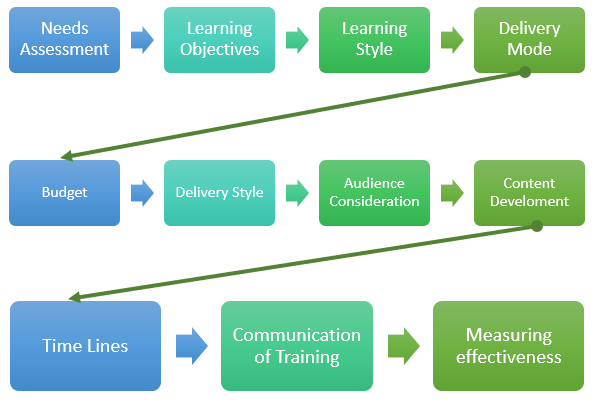
When developing your training plan, there are a number of considerations. Training is something that should be planned and developed in advance.

The considerations for developing a training program are as follows:

  • Needs assessment and learning objectives. This part of the framework development asks you to consider what kind of training is needed in your organization. Once you have determined the training needed, you can set learning objectives to measure at the end of the training.
  • Consideration of learning styles. Making sure to teach to a variety of learning styles is important to development of training programs.
  • Delivery mode. What is the best way to get your message across? Is web-based training more appropriate, or should mentoring be used? Can vestibule training be used for a portion of the training while job shadowing be used for some of the training, too? Most training programs will include a variety of delivery methods.
  • How much money do you have to spend on this training?
  • Delivery style. Will the training be self-paced or instructor led? What kinds of discussions and interactivity can be developed in conjunction with this training?
  • Who will be part of this training? Do you have a mix of roles, such as accounting people and marketing people? What are the job responsibilities of these individuals, and how can you make the training relevant to their individual jobs?
  • What needs to be taught? How will you sequence the information?
  • How long will it take to develop the training? Is there a deadline for training to be completed?
  • How will employees know the training is available to them?
  • Measuring effectiveness of training. How will you know if your training worked? What ways will you use to measure this?

Needs Assessment

The first step in developing a training program is to determine what the organization needs in terms of training. There are three levels of training needs assessment: organizational assessment, occupational (task) assessment, and individual assessment:

  • Organizational assessment. In this type of needs assessment, we can determine the skills, knowledge, and abilities a company needs to meet its strategic objectives. This type of assessment considers things such as changing demographics and technological trends. Overall, this type of assessment looks at how the organization as a whole can handle its weaknesses while promoting strengths.
  • Occupational (task) assessment. This type of assessment looks at the specific tasks, skills knowledge, and abilities required to do jobs within the organization.
  • Individual assessment. An individual assessment looks at the performance of an individual employee and determines what training should be accomplished for that individual.

Types of Training and Delivery

Delivery Method Type of Training Suggested
On-the-job coaching Technical training
Skills training
Managerial training
Safety training
Mentor Technical training
Skills training
Managerial training
Safety training
Brown bag lunch Quality training
Soft skills training
Professional training
Safety training
Web-based Technical training
Quality training
Skills training
Soft skills training
Professional training
Team training
Managerial training
Safety training
Job shadowing Technical training
Quality training
Skills training
Safety training
Job swapping Technical training
Quality training
Skills training
Professional training
Team training
Managerial training
Safety training
Vestibule training Technical training
Quality training
Skills training
Soft skills training
Professional training
Team training
Managerial training
Safety training

Content Development

The content you want to deliver is perhaps one of the most important parts in training and one of the most time consuming to develop. Development of learning objectives or those things you want your learners to know after the training makes for a more focused training. Think of learning objectives as goals what should someone know after completing this training? Here are some sample learning objectives:

  • Be able to define and explain the handling of hazardous materials in the workplace.
  • Be able to utilize the team decision process model.
  • Understand the definition of sexual harassment and be able to recognize sexual harassment in the workplace.
  • Understand and be able to explain the company policies and structure.

Criteria for identifying Training Needs: Personal Analysis, Task Analysis, Organizational Analysis

  1. Organizational analysis

Training Needs Analysis at the organizational level identifies gaps between employees’ actual performance and their maximum potential to attain organizational objectives. This analysis begins with a review of the company’s strategies and operational plans. For this, organizational objectives, efficiency indices, and other factors are analyzed. If a strategic planning process is not in place, you need to conduct a SWOT analysis, i.e. Strengths, Weaknesses, Opportunities and Threats of your organization. Involving employees in key roles will help you to do this better. At this level, you will identify where in the organization training is to be emphasized.

Organizational analysis considers how employee training can help attain organizational goals and where in the organization, training is needed. This analysis finds out the knowledge, skills, and abilities workforce will need for the future, as the organization and the tasks of its personnel evolve and change over time.

For example, let’s take an insurance company organizational analysis identifies the gap between the number of claims actually processed and how those numbers can be maximized to a certain extent or percent.

  1. Task analysis

Task analysis is a process of identifying the purpose of a job and its component parts, and specifying what must be learned in order for there to be effective work performance.

The nature of the tasks to be performed on the job, and the Knowledge, Skills, and Abilities (KSAs) needed to do those tasks are analyzed in this level. This is also known as operations analysis. So, task analysis checks the knowledge and skill needs for each specific job task and correlates these requirements to the workforce’s actual knowledge and skills. The gaps revealed in this analysis will give you the training needs.

Analyzing job descriptions will provide insights on the required competencies to perform the task or job. The gaps between actual performance and required competencies indicate the need for training. Task analysis answers the question of what is the training needed and where it is required.

Insurance Company: Task analysis identifies what should be done to increase the number of claims, such as qualified claims, claims assigned, claims logged in/acknowledged, claim confirmation process, and other jobs.

  1. Individual Analysis

In Individual or person analysis, you can identify who needs to be trained and what training is needed. This helps examine individual performance and training needs.

It analyzes employee performance and compares it with defined standards, to find out the training needs of each individual.

Continuing with the same example: Person analysis verifies what Knowledge, Skills and Abilities (KSAs) each employee must gain, i.e. claim analysis skills, interpreting policies, estimating the extent of loss, calculating the cost of restoration, and other things.

Need Assessment Process

A needs assessment is a process used by organizations to determine priorities, make organizational improvements, or allocate resources. It involves determining the needs, or gaps, between where the organization envisions itself in the future and the organization’s current state. You then develop a plan of action to address the needs (or closing the gaps) to bring the organization closer to its desired future state.

Identification of Job Competencies

Competencies should be identified early in the employee recruitment process. These competencies are drawn from the job description and job specifications, and are then used to develop the employment advertising copy, the interview questions, and the rating and evaluation process that is used to make a hiring decision. By focusing specifically on those critical skills necessary to do the job, the hiring manager and all of those involved in the selection process can increase their chances of success.

  1. Review the job description to identify the knowledge, skills and abilities required to perform the critical functions of the job. The job description should provide an indication of the skills necessary for employees to be successful in a position. In addition to the tasks performed on the job, the background and experience requirements can give an indication of the competencies required. For instance, the job of an editor would require an attention to detail, strong grammar and spelling abilities, and the ability to work well with others, says Lin Grensing-Pophal, author of “Employee Management for Small Business.”
  2. Talk to the job incumbent. The person holding the job can give a real-world perspective on the competencies required for effectiveness. The job holder, if available, should be asked to review the job description to ensure it is accurate and up-to-date, and to provide input on the core competencies required to perform effectively in the job.
  3. Talk to the supervisor or manager for the position. The perspective of the person responsible for managing the position can help to identify key competences. Ask what the current or former employee in the position did exceptionally well that is critical for the job. Then ask what gaps might exist in terms of additional competencies that would improve the value of the position. Make sure that these competencies are included in the job description.
  4. Gather feedback from customers and others in the organization. Cast a wide net for input regarding the important competencies in a position. The more input received from different perspectives, the more likely it is that common competencies will start to emerge and provide an indication of those competencies that are most critical for the position, says Grensing-Pophal.
  5. Check with other companies or online to verify competencies. Many positions are similar across companies and even across industries. Doing some research by contacting other organizations, or searching online can help to identify key core competencies that may have been missed or overlooked.

Using Core Competencies to Guide Interviews

As you begin recruiting, your company may find a focus on core competencies leads to a broader, more diverse candidate pool because the emphasis is on competencies, rather than particular educational or work backgrounds.

Now it’s important to use these competencies to evaluate candidates in the interview process.  Armed with the core competencies for a position, a hiring manager is in a much better position to conduct an interview that evaluates whether a candidate has the skills necessary for the job. Research confirms that structured interviews are much more effective than unstructured interviews. Identifying core competencies provides the basis for structuring effective interviews. Anchor interview questions to the list of competencies for the position. Questions relating to organizational competencies will be relevant for every position, and can form the basis of an interview script for interviews across the company, regardless of the particular position.

Organizational Competencies

While position-specific competencies need to be developed for each role, organizational competencies will be consistent across all roles in a company.

Begin by identifying the norms and behaviors that are expected across the company. Is the management style hierarchical or are decisions taken by consensus? Are employees encouraged to take risks or avoid them? What is the pace of work? Is the work environment traditional or more unconventional? How collegial are employees?

The answers to these questions will tell you which type of people will “fit” in your company. The skills necessary to be successful within the company culture need to be included in your job description to ensure candidates have the organizational competencies required to fit into the company culture.

Many of these organizational competencies will relate to the company’s brand and values. If your organization has codified its brand, values, and culture, refer to these as a starting point to help you identify your organizational competencies.

Position-Specific Competencies

To identify position specific competencies, think about what is required to complete the duties of the job.

Skills. Hard and soft skills such as technical skills, interpersonal skills, accounting skills, writing ability, knowledge of specific statistic, scientific, or project management techniques, etc.

Knowledge/areas of expertise. Often the candidate’s field of study, such as administration, nursing, IT, accounting, history, etc.

Personal qualities and work style. What characteristics does a person need to have in the role? This can include qualities like being organized, analytical, creative, able to meet deadlines, etc.

Need Assessment of Training

Training Needs Analysis (TNA) is the process in which the company identifies training and development needs of its employees so that they can do their job effectively. It involves a complete analysis of training needs required at various levels of the organization.

Technology is changing at a very fast pace and so are the training and development needs of employees. It helps in grooming employees for the next level. It helps the manager to identify key development areas of his/her employees. With proper training and development, the productivity increases manifold.

Various companies have in-house experts who can train employees on various aspects of the business. Normally, a calendar is worked out in advance in which various sessions are listed out and which employees can pick their business requirement to enhance personal development needs.

At times companies also send employees for various training programs outside the organization to train in technical know-how or a course which would be relevant to their job profile. TNA is usually part of the appraisal process and at the end of the year an employee has to complete all the training and development needs identified by the manager.

Training and development, which was at some point in time was not given much weightage, is now a crucial part for any company to meet its broad goals and objectives. There are many aspects when managers are identifying training needs of their team members.

Firstly, the managers need to identify what skill set is required to complete the job or the process. Second, is to assess existing skill levels of the team members, and lastly, determine the training gap.

Training gap is defined as the difference between the skills required to complete the job and existing skill set of any particular team member.

Purpose of TNA

(i) The purpose of Training Need Analysis (TNA) is to help an organization discern the actual needs in training of its employees so that the available resources are directed to training programs that will be most beneficial to the development of the employees and improve the performance of the organization.

(ii) It is always necessary for an organization to carry out Training Need Analysis since it is an avenue of making sure that employees are equipped with the right skills that they need to be effective and competent in their areas of work. When there exists a gap between the expected performance and how the employees are performing presently, the main cause could be lack of the necessary skills or knowledge.

(iii) Training Need Analysis also helps a company to avoid doing training just for the sake of doing it since it is targeted to particular needs. Training is therefore cost effective since the needs are identified and resources channeled to address these needs.

(iv) Training Need Analysis also helps to Increases the chances that the time and money spent on training is spent wisely.

(v) Training Need Analysis also helps to Determines the benchmark for evaluation of training

(vi) Training Need Analysis also helps to Increases the motivation of participants.

(vii) Training Need Analysis also helps to Aligns training activities with the company’s strategic plan.

Methods of TNA

Identifying training needs is a process of information gathering. Data collection is instrumental in understanding how each employee’s knowledge, skills, and abilities can formulate varied performances.

  1. Surveys

You can conduct surveys or polls with a sample pool or all the employees of your organization. Surveys help find out performance deficiencies in specific areas. To conduct a survey, you can prepare a questionnaire and circulate among your employees. The questions in the survey should focus on the specific tasks and needs of the employees and organization. You can use different question formats such as open-ended, closed ended, projective, and priority ranking. Allowing employees to answer anonymously will increase the credibility and you will get genuine answers.

  1. Observations

Training managers watch the work of employees in regular working situations. This observation, in turn, provides enough information on performance gaps. You need to consider technical, functional, and behavioral aspects while observing. This gives qualitative and quantitative feedback on the existing performance.

In a workplace scenario observation is a good way to gather information for the ONA because the employee is able to be observed in their working environment and observing the employee is a good way to gather data.

In observation, it should be done in a manner that should be done in an inconspicuous manner where the person being observed does not see the observer directly observing them for more accurate analysis.

  1. Interviews

Interviews allow you to collect data on performance gaps while talking with each employee or a group of employees. It can be formal or informal. You can conduct interviews in person or by phone, at work locations, or anywhere. Sometimes, you can interview the representative of the work group.

  1. Customer Feedback

You will come to know performance deficiencies with customers’ feedback. They specifically indicate improvement areas. However, you need to formulate each question in the feedback form so that it is directed toward a specific service or performance.

  1. The Delphi Technique

The Delphi technique is a group decision-making technique designed to provide group members with each other’s ideas and feedback, while avoiding some of the problems associated with interacting groups. The members of the group do not have to be face-to-face but are asked to respond to a questionnaire and send their responses to a coordinator. Once all the questionnaires have been received from the members the coordinator then sends them to every member for review. Each member is allowed to comment and analyse the others comments and then participants either vote for the best solution or the coordinator comes up with a consensus of opinion based on all comments received from the participants. This technique is not that easy to administrator and it can be time consuming trying to gather and then resend all the information for review but it is a good qualitative data gathering information which can be used to make relevant decisions with regard to training needed in an organization.

  1. Nominal groups

Nominal groups are a group of individuals who are well versed about a particular subject and with an assistance of a convenor are asked to respond to various questions on a subject. The participants are asked to prioritise the ideas and suggestions by the group in a ranking order. The convenor gathers the information and it allows all answers to represent the group’s preferences and the group is also allowed to vote to rank or rate the responses.

Nominal groups can be asked to give their perspective on problems in an organization, solutions to a given problem, job requirements or tasks, key competencies for a job, or issues facing the target population or organization.

Training Needs Analysis (TNA) examines training needs on three levels, i.e. organizational, tasks, and individual. This analysis provides a way to design training programs that benefit both organizations and employees. Now, let’s come to three levels in Training Needs Analysis.  They are inter-linked and ensure a balanced analysis that takes care of the big picture as well as the specific training needs of individual employees.

The three levels of TNA

  1. Organizational analysis

Training Needs Analysis at the organizational level identifies gaps between employees’ actual performance and their maximum potential to attain organizational objectives. This analysis begins with a review of the company’s strategies and operational plans. For this, organizational objectives, efficiency indices, and other factors are analyzed. If a strategic planning process is not in place, you need to conduct a SWOT analysis, i.e. Strengths, Weaknesses, Opportunities and Threats of your organization. Involving employees in key roles will help you to do this better. At this level, you will identify where in the organization training is to be emphasized.

Organizational analysis considers how employee training can help attain organizational goals and where in the organization, training is needed. This analysis finds out the knowledge, skills, and abilities workforce will need for the future, as the organization and the tasks of its personnel evolve and change over time.

For example, let’s take an insurance company organizational analysis identifies the gap between the number of claims actually processed and how those numbers can be maximized to a certain extent or percent.

  1. Task analysis

Task analysis is a process of identifying the purpose of a job and its component parts, and specifying what must be learned in order for there to be effective work performance.

The nature of the tasks to be performed on the job, and the Knowledge, Skills, and Abilities (KSAs) needed to do those tasks are analyzed in this level. This is also known as operations analysis. So, task analysis checks the knowledge and skill needs for each specific job task and correlates these requirements to the workforce’s actual knowledge and skills. The gaps revealed in this analysis will give you the training needs.

Analyzing job descriptions will provide insights on the required competencies to perform the task or job. The gaps between actual performance and required competencies indicate the need for training. Task analysis answers the question of what is the training needed and where it is required.

Insurance Company: Task analysis identifies what should be done to increase the number of claims, such as qualified claims, claims assigned, claims logged in/acknowledged, claim confirmation process, and other jobs.

  1. Individual Analysis

In Individual or person analysis, you can identify who needs to be trained and what training is needed. This helps examine individual performance and training needs.

It analyzes employee performance and compares it with defined standards, to find out the training needs of each individual.

Continuing with the same example: Person analysis verifies what Knowledge, Skills and Abilities (KSAs) each employee must gain, i.e. claim analysis skills, interpreting policies, estimating the extent of loss, calculating the cost of restoration, and other things.

Need Assessment Process

A needs assessment is a process used by organizations to determine priorities, make organizational improvements, or allocate resources. It involves determining the needs, or gaps, between where the organization envisions itself in the future and the organization’s current state. You then develop a plan of action to address the needs (or closing the gaps) to bring the organization closer to its desired future state.

Importance

At a busy company there are so many things going on, that it is hard to pin down exactly what may be holding it back. Needs assessment is important because it helps an organization determine the gaps that are preventing it from reaching its desired goals. In A Guide to Performing a Needs Assessment and a Gap Analysis, Anthony J. Jannetti says these gaps can exist in either knowledge, practices, or skills. Knowing what is working well and what needs to be changed is crucial to progressing effectively towards those goals and making an organization successful.

Needs assessment addresses these concerns from all levels, starting at the 30,000 foot view and drilling down further and further into the individual organization, to arrive at a plan with specific actions for improvement.

Types of Needs Analyses

Many needs assessments are available for use in different employment contexts. Sources that can help you determine which needs analysis is appropriate for your situation are described below.

  • Organizational Analysis: An analysis of the business needs or other reasons the training is desired. An analysis of the organization’s strategies, goals, and objectives. What is the organization overall trying to accomplish? The important questions being answered by this analysis are who decided that training should be conducted, why a training program is seen as the recommended solution to a business problem, what the history of the organization has been with regard to employee training and other management interventions.
  • Person Analysis: Analysis dealing with potential participants and instructors involved in the process. The important questions being answered by this analysis are who will receive the training and their level of existing knowledge on the subject, what is their learning style, and who will conduct the training. Do the employees have required skills? Are there changes to policies, procedures, software, or equipment that require or necessitate training?
  • Work analysis / Task Analysis: Analysis of the tasks being performed. This is an analysis of the job and the requirements for performing the work. Also known as a task analysis or job analysis, this analysis seeks to specify the main duties and skill level required. This helps ensure that the training which is developed will include relevant links to the content of the job.

Process of Need Assessment

(i) Exploration and identification: During the first phase of the needs assessment, you need to determine what you already know about your organization’s needs, whether it be additional resources, new technologies, or market expansion. It’s about figuring out where you are and where you want to be. You also need to discover other undisclosed needs that may be hindering you from moving from where you are to where you want to be. You will often rank these needs in order of importance. You will then set the scope of your research. In other words, the needs you are going to focus on.

(ii) Data gathering and analysis: At this stage you are collecting the information you need to better understand the gaps (needs) between where you are and where you want to be. Data may be collected from internal company records or externally through market research techniques such as surveys and analysis of secondary data, including statistical data collected by the federal government. After the data is collected, it is organized and analyzed.

(iii) Utilization: This is where the data you analyzed is used to create a plan of action and implement it. You will set priorities, evaluate solutions, apply a cost-benefit analysis to determine which solution is best in light of the relative costs and benefits of each, formulate a plan to implement your solution, and then allocate the resources necessary for implementation. Again, the goal is to develop a plan to close the gaps between the organization’s desired future state and its current state.

(iv) Evaluation: While many organizations will not evaluate the results of their needs assessment, smart organizations do. You will evaluate the results of the action plan against the results: has the action plan placed you closer to where you want to be? Evaluation can help you determine what made an action plan successful or find the errors in your needs assessment.

Output of TNA

Training Needs Analysis (TNA) is used to assess an organization’s training needs. The root of the TNA is the gap analysis. This is an assessment of the gap between the knowledge, skills and attitudes that the people in the organization currently possess and the knowledge, skills and attitudes that they require to meet the organization’s objectives.

The training needs assessment is best conducted up front, before training solutions are budgeted, designed and delivered. The output of the needs analysis will be a document that specifies why, what, who, when, where and how. More specifically, the document will need to answer these questions:

  • Why do people need the training?
  • What skills need imparting?
  • who needs the training?
  • When will they need the new skills?
  • Where the training may be conducted? and
  • How may the new skills be imparted?

There are so many ways for conducting a Training Needs Analysis, depending on your situation. One size does not fit all. Is the purpose of the needs assessment to:

  • Lead in to a design of a specific purpose improvement initiative (e.g., customer complaint reduction)
  • Enable the design of the organization’s training calendar
  • Identify training and development needs of individual staff during the performance appraisal cycle.

In clarifying the purpose of the TNA, consider the scope of the TNA. Is it to determine training needs:

  • At the organization level?
  • At the project level for a specific project? or
  • At the department level for specific employees?

Your answer to these questions will dictate:

  • Who will conduct the TNA
  • How the TNA will be conducted, and
  • What data sources will be used
error: Content is protected !!