Types of Customers for Events

Categories of Events

  • Political Events
  • Religious Events
  • Everyday Life”
  • Social Events; Weddings, Anniversaries, Death, Communions, etc.
  • Entertainment Events
  • Awareness Events
  • Crafts and Creativity
  • Sports Events
  • Educative/Academic Events at colleges
  • Corporate Events
  • International Events
  • Promotional Events

The Excitable Client

Everything you say is exciting to this client. They will enthuse, wax lyrical, delight in the details as you share your plans for their event. Feed off their energy and make it your aim to get attendees as excited as they are about the event.

The Demanding Client

They know what they want and they expect to get it. Forthright, blunt to the point of rudeness, the demanding client will make requests and expect you to jump. They tend to have a singular vision and be set upon it. With no respect for processes and protocol, they will interfere with your planning, contact you at all hours and not let up until they are wholly satisfied.

The Bargain Hunter Client

Budget-conscious and with a penchant for bargaining, this client will pinch every penny. Be prepared for them to encourage you to slash costs, cut deals, throw in extras in order to keep them happy. Dealing with a Del Boy can be disheartening: it’s all too easy to feel that they are undervaluing your skills and the effort you put in. However, stick to your guns and believe in your abilities.

The Grumpy Client

Nothing is quite good enough for this client. They are constantly moody and unenthused, even when you pull something spectacular out of the bag. Expect constant grumbles, occasional tuts, and a frown that never turns upside down.  Never fear though, beneath that tough exterior is a big softy.

The Impatient Client

With apparently no concept of how long things take and the pressures you are under, the impatient client wants things done NOW. You will be expected to drop everything to accommodate their requests.

Buyer versus User

Buyer person are focused on prospects looking to solve a problem or meet an objective that your products, solutions or services help them to achieve. Buyer person encompass all of the differing roles or stakeholders involved in the purchase decision and are usually represented by decision maker, influencer, champion, and gatekeeper roles. Distinctions can also be made as to economic buyer and functional buyer.

User person are designed to address the perspectives of those who work with your products, solutions or services on a daily basis. The goal is to help these “end users” achieve more complete use of the product, gain more value than they initially anticipated, as well as to help them become champions for continued use new additions, extensions or feature upgrades. They got what they needed to solve the original problem from your product, now how do they gain more value, or use more features? This persona is often the influencer in an account-based-marketing retention sale.

Customer versus Consumer

A person who buys the goods or services and pays the price thereof. The word customer is derived from the term ‘custom’ which means ‘practice’, so the word customer means the individual or entity who purchases product or services from a seller at regular intervals. It can also be known as client or buyer. They are divided into two categories:

Trade Customers: The customers who purchase goods in order to add value and resell them. These include Manufacturers, Wholesalers, Distributors, Retailers etc.

Final Customer: They are the customers who purchase it either for their own use or to hand over it to the final user.

The three kinds of customers:

  • Former customers or ex-customers
  • Existing customers
  • Prospective customers

Consumer

a person who is the end user of the product. The word consumer is made from the word ‘consume’ which means ‘to use’. In this way, the word consumer means a person who purchases the product or service for his own use or consumption.

As per the Consumer Protection Act, 1986, it does not include the person who purchases the commodity for the purpose of adding value or resale for any commercial purpose. However, a person can use those goods or services to earn livelihood or self-employment. Any type of user, other than the buyer who purchases goods, consumes the goods by taking permission of the buyer will also come under the category of Consumer. It includes the person who avails the services for any consideration. Moreover, the beneficiary of such services will also be regarded as the consumer. There are three Consumer protection council in India:

  • At national level: Central Protection Council
  • At state level: State Protection Council
  • At district level: District Protection Council
Consumer Customer
Meaning The end user of goods or services is known as a Consumer. The purchaser of goods or services is known as the Customer.
Resell No A customer can be a business entity, who can purchase it for the purpose of resale.
Purchase of goods Not necessary Yes
Purpose Consumption Resale or Consumption
Price of product or service May not be paid by the consumer Paid by the customer
Person Individual, Family or Group of people Individual or Organization

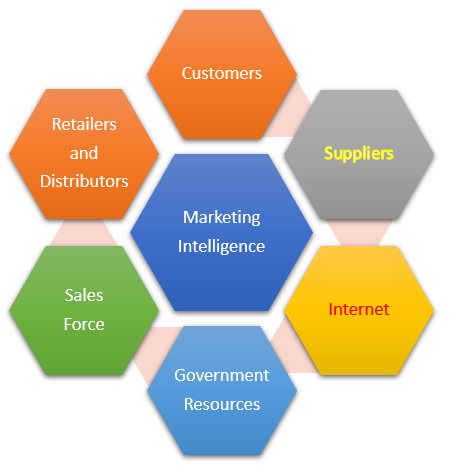
Marketing intelligence

Marketing intelligence (MI) is the everyday information relevant to a company’s markets, gathered and analyzed specifically for the purpose of accurate and confident decision-making in determining market opportunity, market penetration strategy, and market development metrics. Marketing intelligence is necessary when entering a foreign market.

A Market Intelligence system focuses on the systematic collection and processing of information from all the relevant sources to ascertain the changing trends in the marketing environment. In simple words, the marketer gathers data from all the available sources and process these into meaningful information that can be used to make critical business decisions.

Marketing intelligence determines the intelligence needed, collects it by searching the environment and delivers it to marketing managers who need it. Marketing intelligence software can be deployed using an on-premises or software as a service (SaaS, or cloud-based) model. These systems take data from disparate data sources, like web analytics, business intelligence, call center and sales data, which often come separate reports, and put them into a single environment. In order to collect marketing intelligence, marketing managers must be in constant touch with relevant books, newspapers and trade publications. They must talk to various stakeholders like customers, distributors, and suppliers. In addition to this, they must also monitor social media and carry out online discussions. Marketing managers can design reports that correlate and visualize data coming from a variety of departments and sources (even, in some cases, external data). This allows them to see current key performance indicators in real-time (or as quickly as sources provide data) and analyze trends, rather than wait for analysts to deliver periodic reports.

Marketing intelligence systems are designed to be used by marketing managers and often viewed by employees throughout an organization. Notable systems on the market include Contify, Leadtime, Pardot, Marketo, and Hubspot. They may have user interfaces that closely resemble consumer software than the software around individual data sources, which are designed for use by analysts. Business intelligence, for example, can collect highly accurate, timely, granular data, but often requires IT support to build and edit custom reports.

Organizationally, marketing intelligence can be the name of the department that performs both the market intelligence and competitor analysis roles. Business intelligence of any kind may also be their responsibility, in tandem with (or solely performed by) the Finance department, for measuring market share and setting growth targets, the mergers and acquisitions group for exploring acquisition opportunities, the legal department to protect the organization’s assets or research and development for cross-company comparison of innovation trends and the discovery of opportunities through innovative differentiation.

Steps

  • Train and Motivate Sales Force: A company’s sales force can be an excellent source of information about the current trends in the market. They are the “intelligence gatherers” for the company. The acquired facts can be regarding the company’s market offerings, whether any improvements are required or not or is there any opportunity for new products, etc. It can also provide a credible source to know about competitor activities, consumers, distributors, and retailers.
  • Motivate Distributors, retailers, and other intermediaries to pass along important intelligence: Specialists are hired by companies to gather marketing intelligence. In order to measure the quality of production, the way the employees are behaving with customers, quality of facilities being provided; retailers and service providers send mystery shoppers. Firms can also assess the quality of customer experience with the shops with the use of mystery shoppers.
  • Network Externally: Every firm must keep a tab on its competitors. Competitive intelligence describes the broader discipline of researching, analyzing and formulating data and information from the entire competitive environment of any organization. This can be done by purchasing the competitor’s products, checking the advertising campaigns, the press media coverage, reading their published reports, etc. Competitive intelligence must be legal and ethical.
  • Set up a customer advisory panel: Companies can set up panels consisting of customers. They can be the company’s largest customers or representatives of customers or the most outspoken customers. Many business schools set up panels consisting of alumni who provide their knowledge and expertise and help in constituting the course curriculum.
  • Optimal usage of Government data resources: Governments of almost all countries publish reports regarding the population trends, demographic characteristics, agricultural production and a lot of other such data. All this data must be or can be referred to as base data. It can help in planning and formulating policies for the companies.
  • Information bought from external suppliers: Certain agencies sell data that can be useful to other companies. For example, television channels will require information on the number of viewership, ratings of TV programs, etc. An agency that calculates this information and generates this data will provide it to companies that need it.
  • Collect Competitive Intelligence through online customer feedback: The customer’s view of a product is essential for any company. Ultimately it’s the customer who’s buying the product. Hence customer feedback must be taken. Online platforms like chat rooms, blogs, discussion forums, customer review boards can be used to generate customer feedback. This enables the firm to understand customer experiences and impressions. It becomes easier for companies to apply a structured system to do so as it can then scan out the relevant messages without much of a trouble.

Features of Marketer

  1. Sense of responsibility

Good marketers always take responsibility for their actions, no matter what the circumstances. They aren’t afraid of their results being investigated and are ready to justify their work.

  1. Good observational skills

Marketing is all about identifying and satisfying the client’s needs, which is why successful marketers should be able to identify their target audience, their needs and work out how to satisfy them. They must be able to put themselves in the consumer’s shoes in order to understand (empathise). Client feedback is essential for modifying and adapting the product/service accordingly. The ability to identify customer needs is therefore the essence of a successful marketer.

  1. Creativity

Successful marketers know how to stand out from the crowd. They know how to make the product or service they are selling attractive. They don’t want to completely change everything, but rather try to see things from a different angle and help others to do the same. Successful marketers are ready to take risks with creative ideas that others may find completely crazy.

  1. Eternal learners

All successful professionals dedicate a large portion of their personal time to developing their career and successful marketers are no exception. They don’t stop at a typical day’s work, but make a personal and financial investment in order to develop their skills.

  1. Sales ability

Not only should marketers be good at marketing, but also at selling. A talented marketer will be able to sell ice to the eskimos, regardless of the product or service anti-dandruff shampoo or an annual gym membership. Successful marketers know how to communicate their message effectively after all, marketers are the ones managing sales behind the scenes.

  1. Curiosity

Successful marketers know how to observe the behaviour and habits of consumers in order to fully understand their motivations/what will make them fall in love with a product. They are obsessed with market trends, consumer preferences and their curious minds mean they are constantly asking questions.

  1. Innovation

Marketers aren’t afraid to try out new ideas and methods. As mentioned previously, they are curious and always on the lookout for new challenges. There’s nothing more exciting for marketers than testing out a new way of communicating and discovering the results.

  1. Adaptability

The marketing world is constantly evolving, which is why marketers need to be ready to react and adapt quickly to new trends.

  1. Relationship builders

All good marketers know how to build relationships with those around them, one of the most important aspects of working in the marketing world. Having a good network allows marketers to get the best deals along with many other advantages. It is crucial for marketers to get along with both colleagues and clients if they want to build a successful career.

  1. Modesty

Most successful professionals, including good marketers, aren’t glory seekers. The best marketers don’t brag about their achievements, but are more interested by the challenges set by clients and working out how to solve them.

Accrual method

This method is also called, Proportional Capitalization Method, Gradual Capitalization Method or Actual Cash Price Paid Method. As the name itself indicates, this method assumes that the asset accrues to the hirer gradually to the extent of payment made towards the cash price of the asset acquired on hire purchase basis. Therefore, in the books of the hirer or hire purchaser, Asset Account is debited to the extent of only the instalment amount paid towards the cash price of the asset. In other words, Asset Account is debited with the instalment towards cash price of the asset every time instalment is paid. The salient features of this method are as follows.

(1) As both the amount due and the interest due thereon (i.e., on the amount due) are zero at the time of signing the hire purchase agreement (i.e., at the time of delivery of the asset), down payment, if any, made is only towards the cash price of the asset (but not towards interest also). Therefore, the amount of down payment is debited to Asset A/c crediting Cash or Bank A/c.

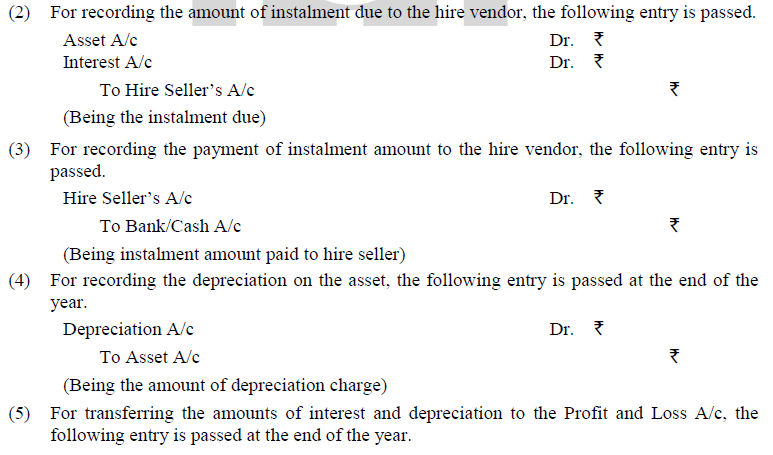
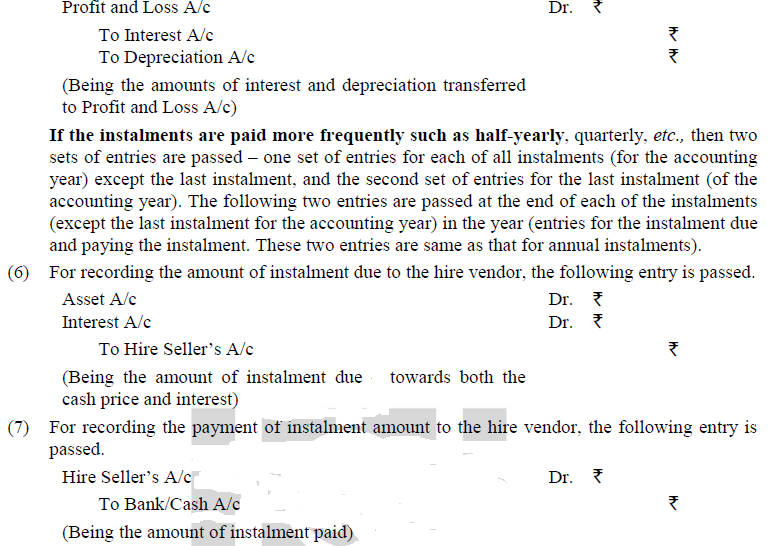
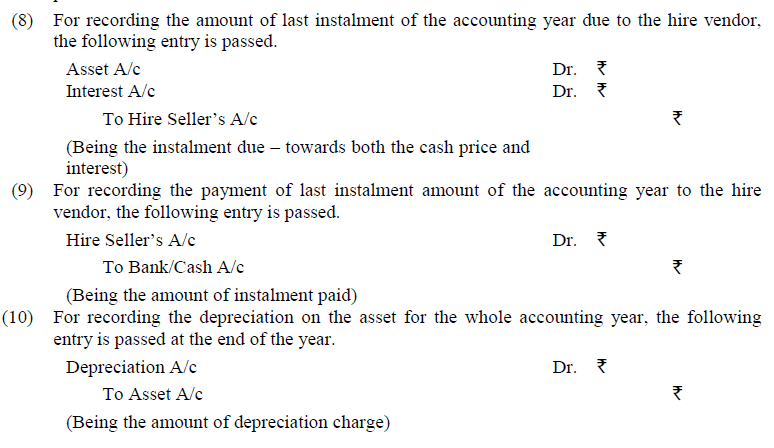
(2) Each instalment payable is towards both the cash price of the asset (called, instalment cash price) and the interest accrued on the amount outstanding (from the date of immediately preceding instalment paid and the date of the current instalment payment). When the instalment is due for payment, a portion of instalment towards cash price is debited to Assets A/c and the remaining portion pertaining to interest is debited to Interest A/c crediting Hire Seller’s A/c. When the payment is made, Hire Seller’s A/c is debited and Cash or Bank A/c is credited.

(3) Since the hire purchaser starts using the asset acquired under hire purchase system, the asset is subject to wear and tear. Hence, depreciation is provided in the books of the hirer, usually, at the end of each accounting year. Therefore, Depreciation A/c is debited and Asset A/c is credited.

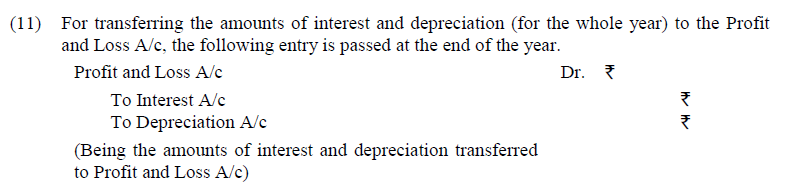
(4) As both the amounts of interest paid (as a part of instalment amount) and depreciation charged constitute the expenses (i.e., items of Nominal Accounts), both are transferred to Profit and Loss A/c at the end of each accounting year by debiting Profit and Loss A/c (for the aggregate of interest and depreciation) crediting Interest A/c (for the amount of interest) and Depreciation A/c (for the amount of depreciation).

With this introduction about the nature of Asset Accrual Method, the journal entries for different hire purchase transactions in the books of hire purchaser are presented below.

Special terminologies in Hire Purchase Accounts Hire Vendor, Hire Purchaser, Down Payment, Principal Component, Interest Component

Hire Vendor

The hire vendor delivers the goods or asset to the hire purchaser at the time of agreement i.e., after singing agreement.

Hire Purchaser

The hire purchaser has the right to use the goods delivered to him by the hire vendor under hire purchase system.

Down Payment

Down Payment is the amount paid by the hirer to the hire vendor at the time of signing the agreement or at the time of taking delivery of the goods by the hirer from hire vendor.

The total sum payable by the hirer under a hire purchase agreement by way of a deposit or initial payment (called, down payment) and subsequent periodical instalments. Usually, the purchase price under hire purchase system (called, hire purchase price) is higher than the purchase price if the same goods had been purchased on cash basis (called, cash price).

That means, Hire Purchase Price > Cash (Purchase) Price. Hire purchase price is also called, net hire purchase price. If the hire purchase price includes the charges for (a) delivery expenses

(b) Registration fee

(c) Insurance premium, etc., they should be subtracted to arrive at the net hire purchase price.

Principal Component, Interest Component

As the hire purchase price comprises both cash price and interest, the amount of each instalment includes a part towards cash price (i.e., principal amount) and another part towards interest for a particular period (on the outstanding balance).

Preparation of Analytical Table including adjustment for Strike period

In the event of strike or lock-out, if the Minimum Rent is not raised, the amount of Minimum Rent depends on the clause of the agreement between the two parties, i.e., Lessor and Lessee.

However, it may be treated in two following ways, viz., the clause may contain like the following:

(1) During strike or lock-out, the actual royalty earned will discharge all rental obligations (if actual royalty is less than Minimum Rent).

(2) During strike or lock-out, the Minimum Rent will be reduced proportionately having regard to the length of stoppage.

(1) Where Actual Royalty earned will discharge all rental obligations:

Under the circumstances, during the period of Strike or Lock-out, there will neither be short-working nor will there be any recoupment. For example, the contract stipulates that the Minimum Rent is Rs. 12,000 per year. But, during the period of strike, actual royalty earned Rs. 8,000. Hence, landlord will get only Rs. 8,000. As such, there will not be any short-working of Rs. 4,000 (Rs. 12,000 – Rs. 8,000) which may be considered in other years.

(2) Where Minimum Rent is reduced proportionately:

Under the circumstances, the amount of Minimum rent will be reduced proportionately having regard to the length of stoppage. For example, the Minimum Rent is. 12,000 per year. Strike period is 3 months, as such, the amount of Minimum Rent will be Rs. 9,000 (i.e., Rs. 12,000 × 9/12).

As such, if actual royalty earned is less than Rs. 9,000 there will be short-working and, similarly, if actual royalties are more than Rs. 9,000, the excess portion may be recouped (of course, if there is any short-working balance).

The following example will help to understand the principle clearly:

Ex1 :

In case of strikes, recoupment of short-working etc.:

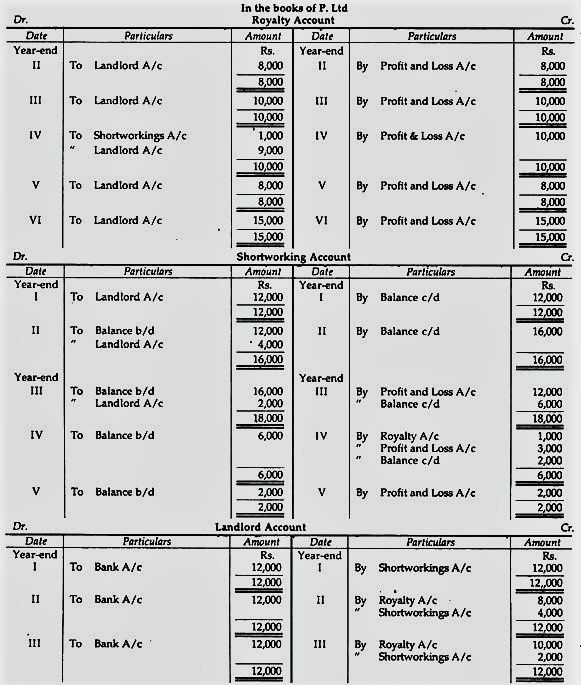
P Ltd. took a mine on lease from Landlord at a given rate of royalty with a Minimum Rent of Rs. 12,000 per year. Each year’s excess of Minimum Rent over royalties is recoverable out of the royalties for the next two years. In the event of Strike, the Minimum Rent was to be reduced proportionately, having regard to the length of the stoppage. But in the case of Lock Out, it was provided that the actual royalties earned for the year would discharge the full rental obligation for that year.

The results of the workings were

Workings:

  1. In case of Strike, the Minimum Rent should be reduced proportionately i.e., Rs. 12,000 x Rs. 9,000.

Minimum Rent for the 4th year will be Rs. 9,000 and, as actual royalty is Rs. 10,000, so Rs. 1,000 is recouped.

  1. In case of lockout the actual royalties will discharge all rental obligation i.e., landlord will get only Rs. 8,000 for the 5th year although the Minimum Rent is Rs. 12,000.
  2. Since in the first year the actual royalty is ‘Nil’ the entire amount is treated as short-working.

Independent Branches and Foreign Branches

Independent Branches

Independent Branches are those which make purchases from outside, get goods from Head Office, supply goods to Head Office and fix the selling price by itself Thus an independent Branch enjoys a good amount of freedom like an American Son.

Characteristics of an Independent Branch:

  1. Independent Branch keeps a complete set of books. Such Branch gets goods from Head Office and from outside parties. It has its own Bank Account. Thus, the Branch keeps frill system of accounting.
  2. It prepares its own Trial Balance, Trading and Profit and Loss Account and Balance Sheet. Copies of these statements are sent to Head Office for incorporating in the Head Office Books.
  3. The books contain an Account called “Head Office Account” or “Head Office Current Account” which is credited with everything received from the Head Office and debited with everything sent to Head Office. That is, all transactions relating to Head Office are recorded in this Account. The Head Office Current Account is thus a Proprietorship Account (i.e. Capital Account).

In-spite of the independent status, the Branch cannot function without resources, and the resources, specially at the initial stage, are provided by the Head Office. Thus, the investments made by the Head Office seen from the Head Office Account are a personal Account in nature.

Similarly, the Head Office in its books opens an Account “Branch Current” Account, which is also a running account between the Branch and the Head Office and incorporates all the transactions between Branch and the Head Office.

A special feature is that the Head Office Current Account in the books of Branch and Branch Current Account in the books of Head Office are maintained on a reciprocal basis.

The balance of these Accounts on any date will be equal to the difference between the assets and liabilities at the Branch on that date. The Branch Current Account in the Head Office books and Head Office Current Account in the Branch books show the same but opposite balance on a particular date.

  1. There may be inter-branch transactions. That is, goods transferred by one Branch to another Branch of the same Head Office. Such entries have been explained later.
  2. On receipt of the accounts and statements by the Head Office, the Head Office reconciles the balances, which is shown in Head Office Account in the Branch books with the Branch Account in Head Office books. Differences are reconciled. This is dealt with separately.
Accounting entries, in the book of Branch, for normal Transactions
1 Purchases made at branch Purchase Account

  To cash/Creditors Account

Dr.
2 Sales affected at Branch Cash/Creditors Account

  To Sales Account

Dr.
3 Payment of expenses at Branch Expanses Account

   To cash Account

Dr.
4 Any income received at Branch Cash/Bank Account

   To concerned income Account

Dr.
  1. For goods supplied by head office to branch:

Branch book:

Goods supplied by head office A/C………Dr.

To Head office A/C

(Being receipt of goods)

Head office book:

Branch A/C…………..Dr.

To goods supplied to branch A/C

(Being goods sent to branch)

  1. For cash remitted by head office to branch:

Branch book:

Cash A/C…………..Dr.

To head office A/C

( Being cash received)

Head office book:

Branch A/C ……………..Dr.

To cash A/C

(Being cash sent to branch)

  1. For goods returned by branch:

Branch book:

Head office A/C…………Dr.

To goods supplied to head office A/C

(Being goods return to head office)

Head office book:

Goods supplied from branch A/C…………Dr.

To Branch A/C

(Being goods returned from branch)

  1. For cash remitted by branch to head office:

Branch book:

Head office A/C………….Dr.

To cash

(Being cash sent to head office)

Head office book:

Cash A/C……………..Dr.

To Branch A/C

(Being cash received from branch)

  1. For assets purchased by branch on behalf of head office:

Branch book:

Head office A/C ………………Dr.

To cash A/C

(Being purchase of assets)

Head office book:

Branch assets A/C………….Dr.

To branch A/C

(Being assets purchased by branch)

  1. For depreciation charged:

Branch book:

Depreciation A/C ……………Dr.

To Head office A/C

(Being depreciation on branch fixed assets)

Head Office book:

Branch A/C……………….Dr.

To branch assets A/C

(Being depreciation of branch fixed assets)

  1. For expenses incurred by head office

Branch book

Expenses A/C…………..Dr.

To head office A/C

(Being expenses incurred by head office)

Head office book:

Branch A/C………………….Dr.

To profit and loss A/C

(Being expenses incurred for branch)

Foreign Branches

Foreign branches are independent branches which are operating in foreign countries.

Accounting in respect of Foreign Branches:

Accounting in respect of foreign branches is done in the books of the branch as well as in the books of the Head Office.

Accounting at Branch:

As the foreign branch is an independent branch, it keeps a complete set of books on the double entry system, prepares all the necessary accounts including the account of the Head Office, prepares its own trial balance, Trading and Profit and Loss Account and Balance Sheet. In short, the accounting procedure adopted at a foreign branch is exactly the same as that adopted at an independent domestic branch.

Accounting at the Head Office:

The trial balance received by the Head Office from the foreign branch is in foreign currency. Therefore, before incorporating the items in the trial balance of the foreign branch, the Head Office is required to convert the various items in the trial balance into the currency of the Head Office. Thereafter, it has to incorporate the items in the Converted Branch Trial Balance in its books, prepare the Branch Trading and Profit and Loss account and Balance Sheet and Branch Account.

Rates at which the items in the trial balance of a foreign branch should be converted:

It is true that the items in the trial balance of a foreign branch should be converted into the currency of the Head Office. But the question is at what rates the various items in the trial balance of a foreign branch should be converted. The following points should be borne in mind while converting the items in the Trial Balance of a foreign branch:

  1. If the rate of exchange is not subject to wide and frequent fluctuations, all the items in the trial balance (other than remittances and Head Office Account) can be converted at a fixed rate of exchange.
  2. If the rate of exchange is subject to wide and frequent fluctuations, then, different rates should be adopted for different items. They are:
  3. Opening stock should be converted at the opening rate of exchange (i.e, the rate of exchange prevailing at the beginning of the accounting year).
  4. Closing stock should be converted at the closing rate of exchange (i.e., the rate of exchange prevailing on the last day of the accounting year).
  5. All the other revenue items (i.e., expenses and incomes, except depreciation on fixed assets and reserve for bad debts, should be converted at the average rate for the year. (In this context, it may be noted that according to the recommendation of the Institute of Chartered Accountants, in the year in which the local currency is devalued, the revenue items should be converted at the closing rate, and not at the average rate.)

Depreciation on fixed assets should be converted at the same rate at which the converted fixed asset is converted

  1. Fixed assets should be taken at the same figure at which they (i.e., branch fixed asset) appear in the books of Head Office.

If that figure is not given, the fixed assets should be converted at the rate of exchange prevailing on the date on which the fixed assets were acquired. If that rate is not given, then, the fixed assets should be converted at the opening rate of exchange.

If additions to fixed assets are made on various dates, average date of exchange for the period should be adopted.

  1. Fixed liabilities should be converted at the rate of exchange prevailing on the date on which they were contracted. If that rate is not given, then, they should be converted at the opening rate of exchange.
  2. All current assets and current liabilities should be converted at the closing rate of exchange.
  3. Remittances appearing in the branch trial balance are converted at the actual rates at which they were effected. If they are not given, they should be converted, i.e., taken, at the same figure at which they appear in the Head Office books.
  4. Head Office account is converted, i.e., taken at the same figure at which Branch Account appears in the Head Office books,
  5. Goods received from Head Office should be converted, i.e., taken, at the same figure at which goods sent to branch appear in the head office books. If that figure is not given, then, the goods received from Head Office should be converted at the average rate of exchange, as it is a revenue item.

However, it should be noted that the converted Trial Balance, generally, does not tally. This is because the different items in the branch trial balance are converted at different rates. The difference in tial balance is taken as Difference in Exchange and is entered in the Profit and Loss Account, either on the debit side or on the credit side.depending upon its nature, if the difference is small. On the other hand, if the difference is fairly large, it is taken as Exchange Fluctuations Account or Exchange Suspense Account and is shown in the Balance Sheet either as an asset or as a liability, depending upon the nature, and is carried forward to be set off against future differences.

After having converted the Branch Trial Balance into head office currency, the Head Office will incorporte the items in the branch trial balance in its books and prepare the Branch Trading and Profit and Loss Account and Balance Sheet and the Combined Trading and Profit and Loss Account and the Balance Sheet, as required.

Meaning of Head Office, Branch

It is the primary aim of all business enterprises to increase their volume of sales. For this purpose, many firms open their shops in different parts of the locality/country. (The parent establishment is known as ‘Head Office’ and its offshoots are termed as ‘Branch’.)

Besides, if branches are opened, particularly in developed regions, both the local consumers and the firms are benefited.

Practically, it is an extension of an existing firm. It should be remembered that a branch has its separate existence but does not possess any separate legal entity. That is why, it is said that it is nearly an extension and a profit centre of an existing firm. Needless to say that all activities of the branches are controlled by the Head Office.

According to Sec. 2 (a) of the Companies Act, 1958, a branch (office) is defined as:

(a) Any establishment described as a branch by the Company, or,

(b) Any establishment carrying on either the same or substantially the same activity as that carried on by the head office of the company, or

(c) Any establishment engaged in any production, processing or manufacture, but does not include any establishment specified in any order made by the Central Govt., u/s-8.

As the foreign branch is an independent branch, it keeps a complete set of books on the double entry system, prepares all the necessary accounts including the account of the Head Office, prepares its own trial balance, Trading and Profit and Loss Account and Balance Sheet. In short, the accounting procedure adopted at a foreign branch is exactly the same as that adopted at an independent domestic branch.

Accounting at the Head Office:

The trial balance received by the Head Office from the foreign branch is in foreign currency. Therefore, before incorporating the items in the trial balance of the foreign branch, the Head Office is required to convert the various items in the trial balance into the currency of the Head Office. Thereafter, it has to incorporate the items in the Converted Branch Trial Balance in its books, prepare the Branch Trading and Profit and Loss account and Balance Sheet and Branch Account.

error: Content is protected !!