Mission of Business

A mission statement defines what an organization is, why it exists, its reason for being. At a minimum, your mission statement should define who your primary customers are, identify the products and services you produce, and describe the geographical location in which you operate.

If you don’t have a mission statement, create one by writing down in one sentence what the purpose of your business is. Ask two or three of the key people in your company to do the same thing. Then discuss the statements and come up with one sentence everyone agrees with. Once you have finalized your mission statement, communicate it to everyone in the company.

It’s more important to communicate the mission statement to employees than to customers. Your mission statement doesn’t have to be clever or catchy just accurate.

If you already have a mission statement, you will need to periodically review and possibly revise it to make sure it accurately reflects your goals as your company and the business and economic climates evolve. To do this, simply ask yourself if the statement still correctly describes what you’re doing.

If your review results in a revision of the statement, be sure everyone in the company is aware of the change. Make a big deal out of it. After all, a change in your mission probably means your company is growing-and that’s a big deal.

Once you have designed a niche for your business, you’re ready to create a mission statement. A key tool that can be as important as your business plan, a mission statement captures, in a few succinct sentences, the essence of your business’s goals and the philosophies underlying them. Equally important, the mission statement signals what your business is all about to your customers, employees, suppliers and the community.

The mission statement reflects every facet of your business: the range and nature of the products you offer, pricing, quality, service, marketplace position, growth potential, use of technology, and your relationships with your customers, employees, suppliers, competitors and the community.

Vision of Business

In the context of management, a vision is an expression of what the organization wants to become, what it wants to be, to be known as or to be known for. It is the long-term objective of the organization.

The vision comes from the leaders it is how they express the future for the organization or its strategic direction. However, it must be practical and feasible while representing a challenge for the organization. The vision must also be shared by the members of the organization so that everyone clearly understands what the organization is striving to become. To create a vision for the organization top management should identify the key potential influences on the organization over the next ten years in terms of the economic, political, social and technological influences.

A vision statement describes what a company desires to achieve in the long-run, generally in a time frame of five to ten years, or sometimes even longer. It depicts a vision of what the company will look like in the future and sets a defined direction for the planning and execution of corporate-level strategies.

Key Elements of a Good Vision Statement

While companies should not be too ambitious in defining their long-term goals, it is critical to set a bigger and further target in a vision statement that communicates its aspiration and motivates the audience. Below are the main elements of an effective vision statement:

  • Forward-looking
  • Motivating and inspirational
  • Reflective of a company’s culture and core values
  • Aimed at bringing benefits and improvements to the organization in the future
  • Defines a company’s reason for existence and where it is heading

Objective Setting

Objectives describe something that has to be accomplished. Objectives or goals define what organizations, functions, departments and individuals are expected to achieve over a period of time. Objective setting those results in an agreement on what the role holder has to achieve is an important part of the performance management processes of defining and managing expectations and forms the point of reference for performance reviews.

Types of Objectives

Let us now understand the different types of objectives and how they are set. The following are the different types of objectives:

Ongoing Role or Work Objectives

All roles have built-in objectives, which may be expressed as key result areas in a role profile. A key result area shows us what the role holder is expected to achieve in this particular aspect of the role.

For example: ‘Identify database requirements for all projects that require data management in order to meet the needs of internal customers’ or ‘Deal quickly with customer queries in order to create and maintain high levels of satisfaction.’

A key result area statement should contain an indication of not only what has to be done but also why it has to be done. The ‘why’ part clarifies the ongoing objective but it may be necessary to expand that by reaching agreement on a performance standard that describes what good performance will look like.

A performance standard definition should take the form of a statement that performance will be up to standard if a desirable, specified and observable result happens. It should preferably be quantified in terms, for example, of level of service or speed of response.

Targets

Targets are objectives that define the quantifiable results to be attained as measured in terms such as output, throughput, income, sales, and levels of service delivery, cost reduction and reduction of reject rates. Thus, a customer service target could be to respond to 90 per cent of queries within two working days.

Tasks/projects

Objectives can be set for the completion of tasks or projects by a specified date or to achieve an interim result. A target for a database administrator could be to develop a new database to meet the need of the HR department by the end of the year.

Behavioral Expectations

Behavioral expectations are often set out generally in competency frameworks but they may also be defined individually under the framework headings. Competency frameworks may deal with areas of behavior associated with core values, for example, teamwork, but they often convert the aspirations contained in value statements into more specific examples of desirable and undesirable behavior, which can help in planning and reviewing performance.

Values

Expectations can be defined for upholding the core values of the organization. The aim would be to ensure that espoused values become values in use.

Performance Improvement

Performance improvement objectives define what needs to be done to achieve better results. They may be expressed in a performance improvement plan, which specifies what actions need to be taken by role holders and their managers.

Developmental/learning

Developmental or learning objectives specify areas for personal development and learning in the shape of enhanced knowledge and skills (abilities and competences).

Integrating the Objectives

A defining characteristic of performance management is the importance attached to the integration or alignment of individual objectives with organizational objectives. The aim is to focus people on doing the right things in order to achieve a shared understanding of performance requirements throughout the organization.

The integration of organizational and individual and team objectives is often referred to as a process of ‘cascading objectives’. However, cascading should not be regarded as just a top-down process.

There will be overarching corporate goals, but people at each level should be given the opportunity to indicate how they believe they can contribute to the attainment of team and departmental objectives. The views of employees towards organization about what they believe they can achieve and they should also take account of them.

There will be times when the overriding challenge has to be accepted, but there will also be many occasions when the opinions of those who have to do the work will be well worth listening to.

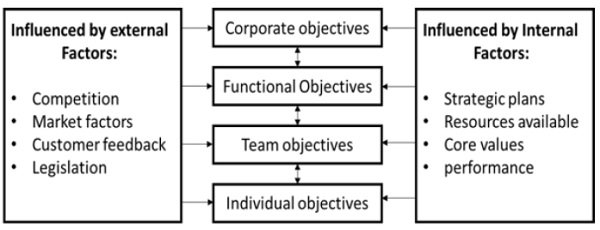
Integration of objectives is achieved by ensuring that everyone is aware of corporate, functional and team goals and that the objectives they agree for themselves are consistent with those goals and will contribute in specified ways to their achievement. This process is illustrated in the following figure.

Business

The main reason to why people want to start up a business is for the money. It is to be said that you will make more money when you are working for yourself rather than for somebody else. Over the LT, you will most likely earn much more money that runs through the business of your own.

Secondly, there are just some people who simply hate working for somebody else a.k.a under them. There may be people who hate the idea of having a boss above them and must obey the rules according to them. Therefore, these people may be best suitable to run their own business and having a job that they exactly know what to do. You will get to work towards something that belongs to you entirely.

A business plan is straight up, a guide for your business that outlines the needed expectations and details on how to achieve them. It helps you allocate resources properly and make the right decisions. A business plan is crucial because it provides specific and organised information about your company, also on “how you will repay borrowed money” because any type of loan package is considered important in a good business plan.

Those who wants to see a business plan may be sales personnel or suppliers as it informs them about your operations and goal. An investor may also search for a good business plan for consideration for investment. They might expect

a) An experienced team

b) Believable exits (whether the money coming out of the company invested will go back into the bank account)

c) Real growth prospects

d) Real planning

Summary statement of strategy

The strategy statement of a firm sets the firm’s long-term strategic direction and broad policy directions. It gives the firm a clear sense of direction and a blueprint for the firm’s activities for the upcoming years. The main constituents of a strategic statement are as follows:

1. Strategic Intent

An organization’s strategic intent is the purpose that it exists and why it will continue to exist, providing it maintains a competitive advantage. Strategic intent gives a picture about what an organization must get into immediately in order to achieve the company’s vision. It motivates the people. It clarifies the vision of the vision of the company.

Strategic intent helps management to emphasize and concentrate on the priorities. Strategic intent is, nothing but, the influencing of an organization’s resource potential and core competencies to achieve what at first may seem to be unachievable goals in the competitive environment. A well expressed strategic intent should guide/steer the development of strategic intent or the setting of goals and objectives that require that all of organization’s competencies be controlled to maximum value.

Strategic intent includes directing organization’s attention on the need of winning; inspiring people by telling them that the targets are valuable; encouraging individual and team participation as well as contribution; and utilizing intent to direct allocation of resources.

Strategic intent differs from strategic fit in a way that while strategic fit deals with harmonizing available resources and potentials to the external environment, strategic intent emphasizes on building new resources and potentials so as to create and exploit future opportunities.

2. Mission Statement

Mission statement is the statement of the role by which an organization intends to serve it’s stakeholders. It describes why an organization is operating and thus provides a framework within which strategies are formulated. It describes what the organization does (i.e., present capabilities), who all it serves (i.e., stakeholders) and what makes an organization unique (i.e., reason for existence).

A mission statement differentiates an organization from others by explaining its broad scope of activities, its products, and technologies it uses to achieve its goals and objectives. It talks about an organization’s present (i.e., “about where we are”). For instance, Microsoft’s mission is to help people and businesses throughout the world to realize their full potential. Wal-Mart’s mission is “To give ordinary folk the chance to buy the same thing as rich people.” Mission statements always exist at top level of an organization, but may also be made for various organizational levels. Chief executive plays a significant role in formulation of mission statement. Once the mission statement is formulated, it serves the organization in long run, but it may become ambiguous with organizational growth and innovations.

In today’s dynamic and competitive environment, mission may need to be redefined. However, care must be taken that the redefined mission statement should have original fundamentals/components. Mission statement has three main components-a statement of mission or vision of the company, a statement of the core values that shape the acts and behaviour of the employees, and a statement of the goals and objectives.

Features of a Mission

  1. Mission must be feasible and attainable. It should be possible to achieve it.
  2. Mission should be clear enough so that any action can be taken.
  3. It should be inspiring for the management, staff and society at large.
  4. It should be precise enough, i.e., it should be neither too broad nor too narrow.
  5. It should be unique and distinctive to leave an impact in everyone’s mind.
  6. It should be analyticale., it should analyze the key components of the strategy.
  7. It should be credible, i.e., all stakeholders should be able to believe it.

3. Vision

A vision statement identifies where the organization wants or intends to be in future or where it should be to best meet the needs of the stakeholders. It describes dreams and aspirations for future. For instance, Microsoft’s vision is “to empower people through great software, any time, any place, or any device.” Wal-Mart’s vision is to become worldwide leader in retailing.

A vision is the potential to view things ahead of themselves. It answers the question “where we want to be”. It gives us a reminder about what we attempt to develop. A vision statement is for the organization and it’s members, unlike the mission statement which is for the customers/clients. It contributes in effective decision making as well as effective business planning. It incorporates a shared understanding about the nature and aim of the organization and utilizes this understanding to direct and guide the organization towards a better purpose. It describes that on achieving the mission, how the organizational future would appear to be.

An effective vision statement must have following features:

  1. It must be unambiguous.
  2. It must be clear.
  3. It must harmonize with organization’s culture and values.
  4. The dreams and aspirations must be rational/realistic.
  5. Vision statements should be shorter so that they are easier to memorize.

In order to realize the vision, it must be deeply instilled in the organization, being owned and shared by everyone involved in the organization.

4. Goals and Objectives

A goal is a desired future state or objective that an organization tries to achieve. Goals specify in particular what must be done if an organization is to attain mission or vision. Goals make mission more prominent and concrete. They co-ordinate and integrate various functional and departmental areas in an organization. Well made goals have following features-

  1. These are precise and measurable.
  2. These look after critical and significant
  3. These are realistic and challenging.
  4. These must be achieved within a specific time
  5. These include both financial as well as non-financial components.

Objectives are defined as goals that organization wants to achieve over a period of time. These are the foundation of planning. Policies are developed in an organization so as to achieve these objectives. Formulation of objectives is the task of top level management. Effective objectives have following features-

  1. These are not single for an organization, but multiple.
  2. Objectives should be both short-term as well as long-term.
  3. Objectives must respond and react to changes in environment, i.e., they must be flexible.
  4. These must be feasible, realistic and operational.

Deducing Strategy from action & endeavours

A learning and development strategy outlines how an organisation develops its workforce’s capabilities, skills and competencies to remain successful. It’s an important part of an organization’s overall business strategy.

Organizational training has seen a significant shift in the past few years. From mere classroom training to new channels like online and mobile, from static training content to more responsive and interactive content like gaming, the changes have been in tune with changing times. Today, training is not a siloed function, but closely linked to HR processes like performance management and also to business outcomes like revenue generation. An effective training strategy is one that delivers on both the fronts–employee learning outcomes and organizational goals. Here is what HR professionals must keep in mind while creating a training strategy.

  1. Employees have time constraints: L&D professionals must understand that training is an activity over and above the regular job, and employees are already stretched to achieve more with less. Hence, aim to add real value to the learner by designing effective training content that meets the specific learning needs. Learning modules, both classroom and online or mobile should be precise and yet reinforce the skills and attitudes they aim to inculcate in the learner. Managers too must respect the time of employees and allocate them training needs that they truly need to propel their careers in the right direction. Hence, training needs identification must be done carefully, considering the time and effort ROI of the employee. Only then will employees be receptive to receiving training and upgrading their skills.
  2. Group size and type matters: This applies especially to classroom programs, where one-on-one interactions and personalized attention can make all the difference between a day wasted and real learning. A smaller group compels participants to actively involve, and gets everyone’s’ voices heard. It is also important to choose the group according to job role. Some trainings like conflict management or leadership skills may benefit by having a diverse group from various functions it helps provide diverse views and a pan-organizational perspective on the topic. Others like specialized subject modules will require a focused group from a function, or even a sub-function. Be sure to design the group size and type to align with the training objectives.
  3. Specialize to add value: Maximise the time spent by employees by making training content relevant to their desired outcome. Specialized content that is curated to the group at hand, especially for people from a niche function, will fuel better learning retention as well as engagement. Work outcomes are becoming more niche, especially in technology domains where a number of emerging technologies are making it big. Decide which skills you must build from within the organization and focus on those specific skills. Specialization is important to work towards goal achievement.
  4. Engage the learner: A learner who is engaged in the learning process is more likely to gain significant takeaways from the process. Engaging the learner means understanding individual learning styles and preferences, and determining the right content and delivery channels to generate a “learning pull”. For example, the younger generation may be more interested in mobile learning than in a traditional classroom approach. A mobile workforce may prefer mobile learning to be able to access learning anytime-anywhere. New joinee induction can be done through online courses to make it location agnostic so that every new joinee gets involved with the organization irrespective of joining location. Putting a thought to what engages the learner goes a long way in making learning stick. Some of the latest in learning engagement are gaming, simulations, e-courses, video courses, and group exercises.
  5. Assess training outcomes: It is not only important to deliver training, but to know whether it meets its objectives. Measuring training effectiveness from time to time is critical to help stay on the organizational track. A popular traditional model to evaluate training effectiveness is the Kirk Patrick model, with its four grades of training measurement reaction, learning, behavior and results. Very few organization are able to link training outcomes with business outcomes in terms of tangible results i.e., how training correlates with revenue, profits, and other financial and business metrics. This is important to ensure a leadership buy-in for training initiatives.

A training strategy is a must to ensure effective implementation at each stage, right from needs identification to training delivery to training assessment. A dedicated Learning and Development team with expertise and experience in the latest organizational training norms and a knack to customize these to the internal needs, is a must.

Formulation of Strategy, Objectives, Steps

Strategy is a long-term plan of action designed to achieve specific goals and objectives by effectively utilizing resources and responding to a dynamic environment. It guides decision-making, aligns organizational efforts, and provides a framework for gaining competitive advantage. Strategy involves analyzing internal strengths and weaknesses, as well as external opportunities and threats, to ensure sustainable success in achieving the mission and vision of an organization.

Objectives of Formulation of Strategy:

  • Define Long-Term Organizational Goals

One of the primary objectives of strategy formulation is to define clear, realistic, and long-term goals for the organization. These goals serve as the foundation for all business activities and guide decision-making at every level. By identifying what the organization wants to achieve over time—such as market leadership, brand recognition, or revenue growth—strategy formulation provides direction and purpose. It ensures that all departments and employees work collectively toward common objectives, resulting in better coordination, focus, and progress toward the organization’s vision and mission.

  • Achieve and Sustain Competitive Advantage

A major objective of strategy formulation is to help the organization develop and maintain a sustainable competitive advantage in the marketplace. This involves identifying what differentiates the business from its competitors—such as superior quality, lower costs, customer service, or innovation—and building strategies around these strengths. Through competitive analysis and strategic positioning, businesses can anticipate rival moves and respond effectively. Achieving competitive advantage allows a company to attract and retain customers, increase profitability, and gain a stronger foothold in the industry.

  • Align Resources with Strategic Objectives

Effective strategy formulation ensures that the organization’s resources—human, financial, technological, and physical—are optimally allocated and aligned with strategic goals. It involves identifying key priorities and determining where and how resources should be deployed to generate the maximum return. This alignment reduces waste, improves operational efficiency, and ensures that all parts of the business are contributing meaningfully to long-term success. By matching internal capabilities with external opportunities, strategy formulation helps the company utilize its full potential in a focused and productive manner.

  • Adapt to Environmental Changes

In today’s dynamic business environment, adapting to external changes is crucial for survival and success. Strategy formulation enables organizations to scan and analyze the external environment—including political, economic, social, technological, environmental, and legal factors (PESTEL)—and respond with informed strategic decisions. Whether facing shifts in consumer behavior, technological disruption, or regulatory changes, strategy helps the organization stay agile and resilient. This proactive approach minimizes surprises, prepares the organization for uncertainty, and ensures continued relevance in a changing marketplace.

  • Minimize Risk and Uncertainty

Another essential objective of strategy formulation is risk identification and mitigation. By analyzing internal weaknesses and external threats through tools like SWOT and risk assessments, strategy helps organizations anticipate potential challenges. It enables the development of contingency plans and preventive measures to deal with crises or setbacks. When risks are identified in advance and addressed within the strategic plan, the organization can maintain stability and confidence, even in volatile conditions. This reduces the likelihood of costly disruptions and supports long-term sustainability.

  • Ensure Organizational Growth and Sustainability

The ultimate aim of strategy formulation is to promote continuous growth and long-term sustainability. This involves entering new markets, launching new products, expanding operations, or adopting innovation to meet evolving customer demands. A well-formulated strategy keeps the organization forward-looking and competitive while maintaining its core values and objectives. It ensures that growth is not just immediate or short-term but is structured in a way that can be sustained over time. This balance between expansion and responsibility is critical for lasting success.

Steps of Formulation of Strategy:

  • Setting Organizational Objectives

The first step in strategy formulation is to clearly define the organization’s mission, vision, and long-term objectives. These objectives serve as a guiding force for the entire strategic planning process. They must be specific, measurable, achievable, relevant, and time-bound (SMART). This step ensures that everyone in the organization understands the desired direction and purpose, and it sets a foundation for aligning resources, activities, and decisions with the overall goals of the enterprise.

  • Environmental Scanning and Analysis

Environmental scanning involves assessing both the internal and external environments of the organization. Internal analysis focuses on strengths and weaknesses (resources, capabilities, processes), while external analysis looks at opportunities and threats (market trends, competitors, regulations, economy). Tools like SWOT, PESTEL, and Porter’s Five Forces are commonly used. This step is essential to understand the strategic position of the company and identify factors that influence its success or failure in the competitive marketplace.

  • Identifying Strategic Alternatives

Based on the analysis, the next step is to identify and generate a range of possible strategic alternatives. These could include market expansion, product development, diversification, cost leadership, or differentiation strategies. Each alternative must be aligned with the organization’s goals and must respond effectively to internal strengths and external opportunities while mitigating weaknesses and threats. The objective is to develop feasible, competitive, and creative options that can address the firm’s strategic challenges and help it achieve sustainable growth.

  • Evaluating Strategic Alternatives

Once alternatives are identified, they must be critically evaluated to determine their suitability, feasibility, and acceptability. This includes assessing the potential benefits, risks, costs, and alignment with organizational capabilities and external conditions. Quantitative tools like cost-benefit analysis or decision matrices may be used, along with qualitative judgment. The evaluation helps in selecting the most effective and realistic strategy that provides the best chance of achieving objectives and maintaining a competitive advantage in the long term.

  • Selecting the Best Strategy

After evaluation, the most suitable strategy is selected. This choice is based on how well it aligns with the company’s vision, mission, goals, and resource capabilities, as well as its ability to respond to external challenges. The chosen strategy must also be acceptable to stakeholders and capable of delivering the desired outcomes with minimal risk. Selection is a critical decision as it forms the basis of future actions and affects every part of the organization’s operations and structure.

  • Implementation Planning

Once the strategy is selected, a detailed implementation plan is created. This involves developing action steps, allocating resources, setting timelines, assigning responsibilities, and establishing performance indicators. Communication of the strategy across all organizational levels is crucial to ensure understanding and commitment. Proper planning bridges the gap between strategy and execution and prepares the organization to convert strategic decisions into concrete results. This step ensures a structured and coordinated effort toward achieving strategic objectives.

  • Monitoring and Evaluation

The final step is to monitor progress and evaluate the effectiveness of the implemented strategy. Key performance indicators (KPIs) and feedback mechanisms are used to track results against the set objectives. Continuous monitoring helps identify deviations or obstacles and allows for timely corrective actions. Evaluation ensures that the strategy remains relevant and adaptive to changing internal and external conditions. Strategic control systems must be flexible enough to support continuous improvement and strategic learning.

Components of environment & Environmental analysis

Environmental Analysis is described as the process which examines all the components, internal or external, that has an influence on the performance of the organization. The internal components indicate the strengths and weakness of the business entity whereas the external components represent the opportunities and threats outside the organization.

To perform environmental analysis, a constant stream of relevant information is required to find out the best course of action. Strategic Planners use the information gathered from the environmental analysis for forecasting trends for future in advance. The information can also be used to assess operating environment and set up organizational goals.

It ascertains whether the goals defined by the organization are achievable or not, with the present strategies. If is not possible to reach those goals with the existing strategies, then new strategies are devised or old ones are modified accordingly.

Some of the features or characteristics of Environmental Analysis are:

  • Holistic View: Environmental Analysis is a holistic exercise in the sense that it must comprise a total view of the environment rather than viewing a trend piecemeal. The corporate must scan the circumference of its environment in order to minimize the chances of surprises and to maximize its utility.
  • Continuous Process: The analysis of environment must be a continuous process rather than being an intermittent scanning system. It must operate continuously in order to keep track of the rapid pace of development. So, Environmental analysis becomes essential due to the dynamic nature of the environment.
  • Exploratory Process: While the Monitoring aspect of the environment is concerned with the present development, a large part of the process seeks to explore the unknown dimensions of possible future. The analysis emphasizes on “What could happen” and not necessarily “What will happen.”

The Importance of Environmental Analysis are:

  • First Mover Advantage: Awareness of environment helps an enterprise to take advantage of early opportunities instead of losing them to competitors. For instance, Maruti Udyog became the leader in the small car market because it was the first to recognize the need for small cars on account of rising Middle class.
  • Early Warning Signal: Environmental awareness serves as an early warning signal. It makes a firm aware of the impending threat or crisis, so that the firm can take timely action to minimize the adverse effects if any. For instance, A MNC entering in to the Indian market would act as a early warning signal for Indian Firms.
  • Focus On Customer: Environmental Understanding makes the management or Business organization sensitive towards the changing needs and expectations of customer. For instance, Several FMCG companies have launched small sachets of shampoo and other products realizing the wishes of customers.
  • Strategy Formulation: Environmental Monitoring provides relevant information about the business environment. such information serves as the basis for strategy formulation. For Instance, ITC realized that there is a vast scope for growth in the travel and tourism industry in India and therefore ITC planned New hotels in India.
  • Change Agent: Business leaders acts as the agents of change. They create a drive for change at the grassroot level. In order to decide the direction and nature of change, the leaders need to understand the aspirations of people and other environmental forces through Environmental Scanning.
  • Public Image: A business firm can improve its image by showing that it is sensitive to its environment and responsive to the aspirations of public. Environmental understanding enables the business to be responsive to their environment.
  • Continuous Learning: Environmental analysis keeps the organization in touch with the changing scenario so that thet are never caught unaware. With the help of Environmental learning, managers can react in an appropriate manner and thereby increase the success of their organization.

The Process of Environmental Analysis/Scanning consists of the following steps:

  • Environmental Scanning: It means the process of analyzing the environment for identifying the factors which may influence the business. Environmental Scanning alerts an organization to potentially significant forces in the external environment, so that suitable strategic initiatives may be taken before the organization reaches to a critical situation.
  • Environmental Monitoring: At this stage, the information from the relevant environment is collected. Once this information is collected, adequate data is gathered so as to find out the patterns and trends of the environment. Further Monitoring is a follow up and deeper analysis of environmental forces. Several techniques such as company records, spying, publication and verbal talks with the customers, employees, dealers and suppliers are the main sources of collecting data.
  • Environmental Forecasting: Environmental Forecasting is the process of estimating the events of future based on the analysis of past records and present behavior. Further it is necessary to analyze or anticipate the future events before any strategic plans are formulated. Forecasts are made for economic, social and political factors. Several techniques such as Time series, Graph method, Delphi method etc. are used for this purpose.
  • Assessment Or Diagnosis: At this stage, Environmental factors are assessed in terms of their impact on the organization. Some factors in the environment may entail an opportunity while others may pose a threat yo the organization. For this purpose, SWOT analysis and ETOP analysis are used.

Advantages of Environmental Analysis

The internal insights provided by the environmental analysis are used to assess employee’s performance, customer satisfaction, maintenance cost, etc. to take corrective action wherever required. Further, the external metrics help in responding to the environment in a positive manner and also aligning the strategies according to the objectives of the organization.

Environmental analysis helps in the detection of threats at an early stage, that assist the organization in developing strategies for its survival. Add to that, it identifies opportunities, such as prospective customers, new product, segment and technology, to occupy a maximum share of the market than its competitors.

Steps Involved in Environmental Analysis

  1. Identifying: First of all, the factors which influence the business entity are to be identified, to improve its position in the market. The identification is performed at various levels, i.e. company level, market level, national level and global level.
  2. Scanning: Scanning implies the process of critically examining the factors that highly influence the business, as all the factors identified in the previous step effects the entity with the same intensity. Once the important factors are identified, strategies can be made for its improvement.
  3. Analysing: In this step, a careful analysis of all the environmental factors is made to determine their effect on different business levels and on the business as a whole. Different tools available for the analysis include benchmarking, Delphi technique and scenario building.
  4. Forecasting: After identification, examination and analysis, lastly the impact of the variables is to be forecasted.

Environmental analysis is an ongoing process and follows a holistic approach, that continuously scans the forces effecting the business environment and covers 360 degrees of the horizon, rather than a specificsegment.

Analysis of internal capabilities using different approaches

To identify and evaluate whether its resources have got any strategic value or not firms generally use various approaches. Possessing valuable resources as indicated previously does not guarantee profits unless they are deployed in an effective and efficient manner. The various approaches that follow now aim at achieving this purpose.

VRIO Analysis is an analytical technique briliant for the evaluation of company’s resources and thus the competitive advantage. VRIO is an acronym from the initials of the names of the evaluation dimensions: Value, Rareness, Imitability, Organization.

The VRIO Analysis was developed by Jay B. Barney as a way of evaluating the resources of an organization (company’s micro-environment) which are as follows:

  • Financial resources
  • Human resources
  • Material resources

Non-material resources (information, knowledge) Question of Value. Resources are valuable if they help organizations to increase the value offered to the customers. This is done by increasing differentiation or/and decreasing the costs of the production. The resources that cannot meet this condition, lead to competitive disadvantage.

Question of Rarity. Resources that can only be acquired by one or few companies are considered rare. When more than few companies have the same resource or capability, it results in competitive parity.

Question of Imitability. A company that has valuable and rare resource can achieve at least temporary competitive advantage. However, the resource must also be costly to imitate or to substitute for a rival, if a company wants to achieve sustained competitive advantage.

Question of Organization. The resources itself do not confer any advantage for a company if it’s not organized to capture the value from them. Only the firm that is capable to exploit the valuable, rare and imitable resources can achieve sustained competitive advantage.

SWOT Analysis:

SWOT is an acronym for the internal strengths and weaknesses of a firm and the external opportunities and threats facing that firm. SWOT analysis helps managers to have a quick overview of the firm’s strategic situation and assess whether there is a sound fit between internal resources, values and external environment (E-V-R Congruence).

A good fit maximizes a firm’s strengths and opportunities and minimizes its weakness and threats. The external analysis provides useful information required to identify opportunities and threats in a firm’s environment. Let’s see how internal analysis helps a firm find its feet in a competitive environment focusing attention on its strengths and weaknesses.

Terminology:

The word Strength implies competitive advantage and other distinct competencies which a firm enjoys in the market place. Having an ability to deliver against the placement of an order within 2 hours is strength to a firm if customers require delivery within a day and its major competitors are not able to fulfill these requirements. A strength is only a strength if it is something that is of value to customers and is also something which a firm does better than its competitors. The term weakness refers to an inherent limitation that creates a strategic disadvantage for a firm. It could come from an inappropriate location, uneconomical operation, outdated plants worn out machinery or militant labor class etc.

Opportunities and threats refer to external issues and are identified after environmental and competitive analysis. Generally speaking opportunities result from external market changes or existing needs which are poorly served. It is often difficult to identify relevant opportunities and threats. Academically speaking a firm is faced with limitless opportunities and myriads of threats. These can range from the opportunities in new markets, new products or the likelihood of increased market share, to the threats of nuclear war, earth quakes and competitive battles. What makes an opportunity or a threat relevant is its importance to the firm and its likelihood of occurring. In order to carry out a good SWOT, the firm should look into certain key issues.

Key Issues in SWOT Analysis:

Strengths

1) A distinctive competence?
2) Adequate financial resources?
3) Well thought of by buyers?
4) An acknowledged market leaders?
5) Well conceived functional area strategies?
6) Access to economies of scale?
7) Insulated (at least somewhat) from strong competitive pressures?
8) Proprietary technology
9) Cost advantages?

Weaknesses

1) No clear strategic direction ?
2) Deteriorating competitive positions?
3) Obsolete facilities?
4) Sub par profitability because …?
5) Lack of managerial depth and talent?
6) Missing any key skills or competencies?
7) Poor track record implementing strategy?
8) Plagued with internal operating problems?
9) Vulnerable to competitive pressures?
10) Falling behind in R&D?

Carrying out SWOT

Corporate success is usually linked to certain critical success factors (CSFs). These relate to the factors which suppliers in a market must meet if they are to compete successfully. While carrying out SWOT, the main CSFs in a market segment need to be identified clearly and each factor should be weighted out of 100 according to its importance to customers. Total weighting should add up to 100. It is the possible to score out each major competitor out of 10 on their performance against each CSF. Multi playing each score by its weights will offer a quantitative assessment of the relative strengths of each competitor within a segment.

Strengths, Weakness, Opportunities, Threats (SWOT Analysis)

SWOT Analysis is a strategic planning tool used to identify an organization’s internal strengths and weaknesses, as well as external opportunities and threats. It involves assessing factors within the organization’s control, such as resources, capabilities, and processes, to determine competitive advantages and areas needing improvement. Additionally, SWOT analysis evaluates external factors like market trends, competitor actions, and regulatory changes to uncover potential avenues for growth and challenges to address. By synthesizing this information, organizations can develop strategies to capitalize on strengths, mitigate weaknesses, exploit opportunities, and defend against threats, ultimately enhancing their competitive position and guiding decision-making processes.

Elements of a SWOT analysis
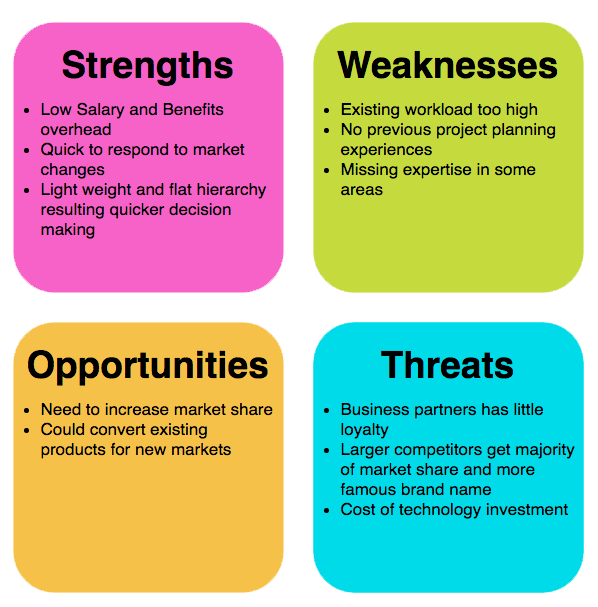
1. Strengths:

Internal attributes and resources that give the organization a competitive advantage. These can include factors such as strong brand reputation, skilled workforce, proprietary technology, efficient processes, and financial stability.

2. Weaknesses:

Internal factors that place the organization at a disadvantage compared to competitors. Weaknesses may include areas such as limited resources, outdated technology, poor brand perception, inefficient processes, and lack of expertise or talent.

3. Opportunities:

External factors or trends in the business environment that the organization could exploit to its advantage. Opportunities may arise from market growth, emerging trends, technological advancements, changes in consumer preferences, or regulatory changes.

4. Threats:

External factors that could negatively impact the organization’s performance or pose risks to its success. Threats may come from factors such as intense competition, economic downturns, changing regulatory landscapes, disruptive technologies, or shifts in consumer behavior.

Factors affecting SWOT Analysis:

  • Scope and Objectives:

Clearly defining the scope and objectives of the analysis ensures that relevant factors are considered and that the analysis remains focused on its intended purpose.

  • Data Quality:

The accuracy and reliability of the data used in the analysis directly impact the validity of the findings. Using up-to-date, accurate, and comprehensive data sources is essential.

  • Perspective and Bias:

Different stakeholders may have varying perspectives and biases that influence their perception of the organization’s strengths, weaknesses, opportunities, and threats. It’s crucial to consider multiple viewpoints to ensure a balanced analysis.

  • Expertise and Knowledge:

The expertise and knowledge of the individuals conducting the analysis can affect the depth and insightfulness of the findings. Involving individuals with diverse backgrounds and expertise can enhance the quality of the analysis.

  • External Environment:

Changes in the external business environment, such as market trends, competitor actions, regulatory changes, economic conditions, and technological advancements, can impact the validity of the analysis. Regularly updating the analysis to reflect changes in the external environment is essential.

  • Internal Dynamics:

Internal factors such as organizational culture, leadership, resource allocation, and decision-making processes can influence the identification of strengths, weaknesses, opportunities, and threats. Understanding internal dynamics is crucial for conducting a realistic SWOT analysis.

  • Interrelationships:

Recognizing the interrelationships between different elements of the SWOT analysis is important for understanding how they interact and influence each other. For example, addressing a weakness may create opportunities, or exploiting an opportunity may mitigate a threat.

  • Time Constraints:

Time constraints can limit the depth and thoroughness of the analysis. It’s essential to allocate sufficient time and resources to conduct a comprehensive SWOT analysis effectively.

Benefits of SWOT Analysis:

  • Strategic Planning:

SWOT analysis provides a structured framework for organizations to assess their internal strengths and weaknesses, as well as external opportunities and threats. This information is invaluable for strategic planning, helping organizations align their resources and capabilities with their goals and objectives.

  • Improved Decision Making:

By identifying key factors influencing the organization’s performance and competitive position, SWOT analysis enables informed decision making. It helps organizations prioritize initiatives, allocate resources effectively, and capitalize on opportunities while mitigating potential risks.

  • Enhanced Competitive Positioning:

Understanding the organization’s strengths and weaknesses relative to competitors, as well as market opportunities and threats, enables organizations to develop strategies to enhance their competitive positioning. SWOT analysis helps organizations identify unique selling points, differentiate themselves in the market, and capitalize on competitive advantages.

  • Risk Management:

By identifying potential threats and weaknesses, SWOT analysis helps organizations anticipate risks and develop strategies to mitigate them. It enables proactive risk management, reducing the likelihood of negative impacts on the organization’s performance and reputation.

  • Facilitates Change Management:

SWOT analysis provides valuable insights into the internal and external factors affecting the organization, making it a useful tool for change management initiatives. It helps organizations anticipate resistance to change, identify areas requiring improvement, and develop strategies to overcome barriers to change.

  • Enhanced Communication and Alignment:

SWOT analysis fosters communication and alignment within the organization by providing a common understanding of the organization’s strengths, weaknesses, opportunities, and threats. It facilitates collaboration among stakeholders, promotes transparency in decision making, and ensures that everyone is working towards common goals and objectives.

error: Content is protected !!