Marketing of Services in Tourism

Tourism marketing is different because the customer purchases a series of services, but is left with very little concrete value at the completion of his trip. As a result, the marketing initiatives have to emphasize the value of the memories, make the collection of services easily accessible and add value through additional programming and other factors. A key challenge is to convince potential customers that the item they are purchasing provides good value for the price, and that the services will be as described and expected. The 8 P’s in marketing tourism summarize the special approach that is required. Many small businesses market tourism products and employ these marketing strategies.

Product: What You Have to Offer

The product is the collection of services that have features and benefits. Standard features and benefits include the normal amenities of a hotel room, for example. Good marketing adds special features, such as free breakfasts or free Internet.

Price: What Customers Will Pay

The price has to match the product, but good marketing makes the price seem more attractive. The operator can either add features to the product and keep the price the same or give a discount for the same features.

Promotion: How You Sell Your Wares

The promotion gives details of the product and the price. The key characteristics of your travel marketing strategy are the method of communicating the information, the content of the promotion and the cost to the operator. The promotion has a target market, and the method and content of the promotion has to appeal to the people who it reaches. The price the members of the target market are willing to pay has to cover the cost of the promotion.

Place: Where You Do Business

Place refers to the location where the customer buys the collection of services. Ideally, the operator who sends out the promotion uses it to encourage the potential customer to visit the operator’s location and complete the purchase. With the convenience of online payments, the operator may find that the best strategy is to direct potential customers to an attractive website where they can complete the purchase.

People: Your Hidden Strength

Since the product is a collection of services, the people who provide the services are a key to the success of the transaction. Operators must have top-level service to initially complete the sale and to encourage repeat customers.

Planning: Look Ahead

The key service component of the tourism experience is planning. The customer expects that the experience will correspond closely to what he purchased. The only way to ensure that kind of correspondence is to execute according to detailed plans, and have contingency planning in place for problems.

Programming: Cater to Your Clients

One way to add value to the standard product and to distinguish a particular offering from competitors is to offer exclusive programming, a practice known as service marketing. Customers will purchase a product that caters to their particular interests. Special programming can address such preferences and draw in additional customers.

Physical Evidence

If possible, the provision of physical evidence that the customer experienced the particular tourism product can help sales. Providing professional photographs of the customers at key events or the supply of branded products are effective strategies for promoting particular tourism products.

Promotion mix strategy for services

Promotion

In marketing, promotion refers to any type of marketing communication used to inform or persuade target audiences of the relative merits of a product, service, brand or issue. The aim of promotion is to increase awareness, create interest, generate sales or create brand loyalty. It is one of the basic elements of the market mix, which includes the four Ps, i.e., product, price, place, and promotion.

Promotion is also one of the elements in the promotional mix or promotional plan. These are personal selling, advertising, sales promotion, direct marketing publicity and may also include event marketing, exhibitions and trade shows. A promotional plan specifies how much attention to pay to each of the elements in the promotional mix, and what proportion of the budget should be allocated to each element.

Promotional Mix

The Promotion Mix refers to the blend of several promotional tools used by the business to create, maintain and increase the demand for goods and services.

The fourth element of the 4 P’s of Marketing Mix is the promotion; that focuses on creating the awareness and persuading the customers to initiate the purchase. The several tools that facilitate the promotion objective of a firm are collectively known as the Promotion Mix.

The Promotion Mix is the integration of Advertising, Personal Selling, Sales Promotion, Public Relations and Direct Marketing. The marketers need to view the following questions in order to have a balanced blend of these promotional tools.

  • What is the most effective way to inform the customers?
  • Which marketing methods to be used?
  • To whom the promotion efforts be directed?
  • What is the marketing budget? How is it to be allocated to the promotional tools?

Tools (Elements) of Promotion Mix

  1. Advertising

The advertising is any paid form of non-personal presentation and promotion of goods and services by the identified sponsor in the exchange of a fee. Through advertising, the marketer tries to build a pull strategy; wherein the customer is instigated to try the product at least once. The complete information along with the attractive graphics of the product or service can be shown to the customers that grab their attention and influences the purchase decision.

  1. Personal Selling

This is one of the traditional forms of promotional tool wherein the salesman interacts with the customer directly by visiting them. It is a face to face interaction between the company representative and the customer with the objective to influence the customer to purchase the product or services.

  1. Sales Promotion

The sales promotion is the short term incentives given to the customers to have an increased sale for a given period. Generally, the sales promotion schemes are floated in the market at the time of festivals or the end of the season. Discounts, Coupons, Payback offers, Freebies, etc. are some of the sales promotion schemes. With the sales promotion, the company focuses on the increased short-term profits, by attracting both the existing and the new customers.

  1. Public Relations

The marketers try to build a favourable image in the market by creating relations with the general public. The companies carry out several public relations campaigns with the objective to have a support of all the people associated with it either directly or indirectly. The public comprises of the customers, employees, suppliers, distributors, shareholders, government and the society as a whole. The publicity is one of the form of public relations that the company may use with the intention to bring newsworthy information to the public.

E.g. Large Corporates such as Dabur, L&T, Tata Consultancy, Bharti Enterprises, Services, Unitech and PSU’s such as Indian Oil, GAIL, and NTPC have joined hands with Government to clean up their surroundings, build toilets and support the swachh Bharat Mission.

  1. Direct Marketing

With the intent of technology, companies reach customers directly without any intermediaries or any paid medium. The e-mails, text messages, Fax, are some of the tools of direct marketing. The companies can send emails and messages to the customers if they need to be informed about the new offerings or the sales promotion schemes.

E.g. The Shopper stop send SMS to its members informing about the season end sales and extra benefits to the golden card holders.

Thus, the companies can use any tool of the promotion mix depending on the nature of a product as well as the overall objective of the firm.

Relationship Marketing, Meaning, Functions, Benefits and Examples

Relationship Marketing is a strategic approach aimed at building long-term connections with customers, based on trust, satisfaction, and loyalty. Unlike traditional marketing, which focuses primarily on individual transactions, relationship marketing emphasizes customer retention, interaction, and ongoing engagement. It fosters stronger customer relationships by delivering personalized experiences and meeting the evolving needs of consumers. The ultimate goal is to transform satisfied customers into loyal advocates of the brand, creating a sustainable and profitable customer base.

In today’s competitive marketplace, businesses that excel at relationship marketing tend to outperform those that focus solely on short-term sales. By developing meaningful relationships with customers, companies can reduce churn, increase customer lifetime value, and generate positive word-of-mouth marketing.

Functions of Relationship Marketing

  • Customer Segmentation

The first step in relationship marketing is identifying and segmenting customers based on shared characteristics, preferences, and behaviors. This allows businesses to create targeted marketing strategies that address the specific needs and interests of each group.

  • Personalized Communication

Relationship marketing thrives on personalized communication. Companies use data to understand customer preferences and tailor their messages accordingly. Whether through email, social media, or direct interactions, personalized communication makes customers feel valued and understood.

  • Loyalty Programs

Loyalty programs are a key function of relationship marketing, designed to reward customers for repeat business. These programs incentivize customers to stay loyal to the brand, often by offering discounts, exclusive offers, or points that can be redeemed for future purchases.

  • Customer Feedback Systems

Gathering and acting on customer feedback is essential in relationship marketing. By understanding customer experiences and satisfaction levels, companies can make improvements and address pain points, ultimately enhancing the relationship with their customers.

  • Customer Support and After-Sales Service

Providing excellent customer support is critical to relationship marketing. Effective customer service helps resolve issues quickly, ensuring that customers remain satisfied and are more likely to continue doing business with the company.

  • Cross-Selling and Upselling

Relationship marketing involves identifying opportunities to offer complementary products or services to customers based on their previous purchases. Cross-selling and upselling increase customer value while meeting more of their needs.

  • Customer Retention Strategies

A major function of relationship marketing is focusing on customer retention. This involves developing strategies to maintain strong relationships, such as regular communication, exclusive offers, and personalized experiences that keep customers engaged.

  • Building Emotional Connections

Relationship marketing aims to create emotional bonds between customers and brands. By understanding customers’ values, aspirations, and emotions, companies can create experiences that resonate on a deeper level, fostering long-term loyalty.

Benefits of Relationship Marketing

  • Increased Customer Loyalty

One of the most significant benefits of relationship marketing is improved customer loyalty. By consistently providing value and personalized experiences, businesses can turn satisfied customers into loyal ones who continue to choose the brand over competitors.

  • Higher Customer Retention Rates

Relationship marketing leads to higher retention rates, as customers who feel valued and supported are more likely to stay with a company over time. This reduces customer churn and the need for constant acquisition efforts.

  • Enhanced Customer Lifetime Value (CLV)

By fostering long-term relationships, businesses can increase the overall value each customer brings over the course of their relationship. Loyal customers tend to spend more, purchase more frequently, and refer others, boosting profitability.

  • Positive Word-of-Mouth

Customers who have positive relationships with a brand are more likely to recommend it to friends, family, and colleagues. Positive word-of-mouth is a powerful marketing tool, often leading to new customer acquisitions at no additional cost to the company.

  • Cost Efficiency

Relationship marketing is more cost-effective than constantly acquiring new customers. Retaining existing customers is generally cheaper than attracting new ones, as loyal customers require less marketing spend and tend to purchase more frequently.

  • Improved Customer Insights

Ongoing engagement with customers provides businesses with valuable insights into their preferences, behaviors, and needs. This data can be used to refine marketing strategies and improve product offerings, resulting in better customer experiences.

  • Stronger Brand Reputation

Relationship marketing contributes to a stronger brand reputation. Satisfied, loyal customers often speak positively about a company, enhancing its credibility and reputation in the marketplace.

  • Resilience Against Competitors

When customers have a strong relationship with a brand, they are less likely to switch to competitors, even if they offer lower prices or similar products. Relationship marketing creates a competitive advantage by solidifying customer trust and loyalty.

Examples of Relationship Marketing

  • Amazon Prime

Amazon’s Prime membership program is an excellent example of relationship marketing. By offering fast shipping, exclusive deals, and streaming services, Amazon builds long-term relationships with customers. The loyalty program encourages repeat purchases and enhances customer retention.

  • Starbucks Rewards

Starbucks has effectively implemented relationship marketing through its rewards program. Customers earn points with every purchase, which can be redeemed for free products. Personalized offers based on buying behavior help deepen the relationship with each customer.

  • NikePlus

NikePlus is a loyalty program designed to engage customers by offering personalized recommendations, exclusive products, and early access to sales. By connecting with customers through their fitness journeys and lifestyle choices, Nike strengthens brand loyalty.

  • Apple’s Customer Service

Apple is known for its exceptional customer service and support. Whether through its Genius Bar in stores or online assistance, Apple focuses on maintaining long-term relationships by ensuring customer satisfaction and providing solutions to any issues that arise.

  • Zappos

Zappos, the online shoe and clothing retailer, is famous for its customer-centric approach. The company goes above and beyond to provide outstanding customer service, often exceeding customer expectations, which helps foster strong, long-lasting relationships.

  • Tesco Clubcard

Tesco’s Clubcard loyalty program provides personalized discounts and offers based on customers’ shopping habits. By rewarding customers for their loyalty and tailoring promotions to individual preferences, Tesco builds strong relationships with its shoppers.

  • Sephora Beauty Insider

Sephora’s Beauty Insider program is another example of relationship marketing. Customers earn points with every purchase, which can be redeemed for exclusive products and services. Sephora also offers personalized beauty tips and recommendations, enhancing the customer experience.

  • Delta SkyMiles

Delta Airlines’ SkyMiles loyalty program rewards frequent flyers with miles that can be redeemed for flights, upgrades, and other perks. By focusing on customer retention and providing exclusive benefits to loyal customers, Delta strengthens its relationship with travelers.

Strategic Management

Strategic Management is a stream of decisions and actions which lead to the development of an effective strategy or strategies to help achieve corporate objectives. The Strategic Management process is the way in which strategists determine objectives and make strategic decisions. Strategic Management can be found in various types of organizations, business, service, cooperative, government, and the like.

Strategic Management can be defined as “the art and science of formulating, implementing and evaluating cross-functional decisions that enable an organization to achieve its objectives”. In fact, Strategic Management focuses on integrating management, marketing, finance/accounting, production/operations, research and development, and computer information systems to achieve organizational success.

The term Strategic Management is used synonymously with the term Strategic Planning. The later term is more often used in the business world, whereas the former is often used in academia.

At time, the term Strategic Management is used to refer to strategy formulation, implementation, and evaluation, with strategic planning referring only to strategy formulation. The purpose of Strategic Management is to exploit and create new and different opportunities for tomorrow long-range planning in contrast, tries to optimize for tomorrow the trends of today.

A Strategic Plan is, in essence, a company’s game plan. Just as a football team needs a good game plan to have a chance for success, a company must have a good strategic plan to be able to complete successfully. A strategic plan results from tough managerial choices among numerous good alternatives, and signals commitment to specific markets, policies, procedures, and operations in line of other, “less desirable” courses of action.

Strategic management is a science of management of strategies. Hence, it deals with different types of strategies, i.e., different types of decisions. Different situations, different challenges, different opportunities, or different problems require different types of strategies to be formed and implemented. So, it is just not sufficient to put all the strategies in one category.

It is highly advantageous to know the classified information on different strategies and their characteristics to make right decisions at right time. Although the practice of decision-making is more of experience-oriented skill; it is significant to have clear knowledge of different types of strategies to understand the situations in which they are useful.

As the strategies are always crucial, every strategy must be formed after careful study of the situations, challenges, opportunities or problems being encountered. Ignorance about types of strategies may lead the managers to wrong conclusions or to wrong choice of strategies. Hence, the following account of types of strategies has practical significance in managing the firm well.

At the heart of strategic management is the question – ‘How and why do some firms outperform others?’ Thus, the challenge to managers is to decide on ‘strategies’ that provide advantages that can be sustained over time. Much of strategic management is about identifying and developing the strategies that managers can pursue to attain superior performance and a competitive advantage for their organisations.

Strategic management is the process of assessing the firm and its environment in order to meet the long-term objectives of the firm. It refers to the series of decisions taken by management to determine the strategies to achieve organisational goals.

Strategic management involves systematic analysis of the internal and external environments, to evaluate a company’s current policies, strategy and goals to build new strategic moves and plans.

Thus, strategic management is the process of planning, directing, organising, and controlling a company’s strategy-related decisions and actions to achieve competitive advantage and the long-run performance goals of a company.

By ‘Strategy’, managers mean:

  1. Large-scale, future-oriented plans for interacting with the competitive environment.
  2. An integrated and coordinated set of commitments and actions designed to exploit core competencies.
  3. A company’s game and action plan of how, when and where it should compete, against whom it should compete; and for what purposes it should compete.

Different phases of development of strategic management are explained below:

Phase 1 Basic Financial Planning:

The first phase of the strategic development is fairly a simple routine of basic financial planning. The main concern during this phase is simply meeting annual budget requirement, operational functions like production, marketing, finance and human resources and emphasizing on the operational control.

Phase 2 Forecast-Based Planning:

During this phase, the primary concern is mainly on effective plans, environmental scanning, plan for the future and allocation of resources.

Phase 3 Externally-Oriented Planning:

There is a remarkable shift during this phase. The notable developments include: increasing response to markets and competition, complete situational analysis and assessment of competitive strength, evaluation of strategic alternatives and allocation of resources based on changing needs from time to time.

Phase 4 Strategic Management:

The focus shifts over time from meeting the budget to planning for the future, to thinking abstractly, to working to create desired future. To create future decision-makers, orchestrate and integrate all their organisation’s resources to gain a competitive advantage. They build flexibility into the organisational planning process, and foster a supportive, participative climate within the organisation.

Thus, developing an effective and efficient strategic management process can be a long and difficult task. It requires sustained effort, enormous patience and sharp political skills. Strategic management requires efficient leadership.

Some important objectives of strategic management are as follows:

  1. To exploit and create new and different opportunities for tomorrow.
  2. To provide the conceptual frameworks that will help a manager understand the key relationships among actions, context, and performance.
  3. To put an organisation into a competitive position.
  4. To sustain and improve that position by the deployment and acquisition of appropriate resources and by monitoring and responding to environmental changes.
  5. To monitor and respond to the demands of key stakeholders.
  6. To find, attract, and keep customers.
  7. To ensure that the company is meeting the needs and wants of its customers, which is a cornerstone in providing the quality product or service that customers really want.
  8. To sustain a competitive position.
  9. To utilize the company’s strengths and take full advantage of its competitor’s weaknesses.
  10. To understand the various concepts involved like strategy, policies, plans and programmes.
  11. To have knowledge about environment—how it affects the functioning of an organisation.
  12. To determine the mission, objectives and strategies of a firm and to visualize how the implementation of strategies can take place.
  13. To find the solutions of problems in real-life business.
  14. To develop analytical ability to identify threats and opportunities present in the environment.
  15. To develop the skills of strategic decision making.
  16. To develop a creative and innovative attitude and to think strategically.

Nature of strategic management specifies its characteristics which are as follows:

  1. Strategic Management as a Process:

Strategic management is basically a process. It has emerged out of management in other fields where the concept of management is taken as a process for achieving certain objectives of the organization. Thus, strategic management involves establishing a framework to perform various processes. The concept of strategic management must embody all general management principles and practices devoted to strategy formulation and implementation in the organization.

  1. Top Management Function:

Strategic management is basically top management function. Thus, in order to ensure effective top management function, it is necessary that a distinction should be made between strategic management and operational management which emphasises day-to-day operations in the organization, so that top management can focus more attention on the strategic aspect rather than emphasising on operational management.

Since the environment of the organization is always changing providing new opportunities and threats, top management must spend more and more time on this aspect. Thus, there is a considerable change on the emphasis of top management functions in the organizations, particularly in large and complex organizations. The change is from operational management to strategic management.

  1. General Management Approach:

Strategic management has general management approach. This approach has three characteristics – (i) This approach uses system frame of reference in dealing with wholeness of an organization. In this dealing, the emphasis is put on identifying tendencies of various phenomena in the organization and relationships among these tendencies, (ii) Decision criteria are based on overall betterment of the organization as a whole, not the criteria used by functional specialists, (iii) Attempt is made to achieve organizational equilibrium and generation of synergy. This may be even suboptimal for some departments or units of the organization.

  1. Relating Organization to Environment:

The focus of strategic management is on relating the organization to its external environment. This emphasises that there is continuous interaction between the organization and its environment taking an open systems approach. Thus, the organization must create adequate channel through which external information will pass to various points in the organization.

  1. Long-Term Issues:

Strategic management deals primarily with long-term issues of the organization that may or may not have an immediate effect. For example, investment in research and development (R&D) may yield no immediate effect in terms of new product development. However, this investment may lead to development of new products and, therefore, enhanced profits.

  1. Flexibility:

Strategic management has flexibility. This flexibility is required because strategic management works in the context of environment which is quite dynamic. As a result, many strategic actions planned maybe either left, postponed, or changed in the light of environmental requirements.

  1. Innovation:

Strategic management puts emphasis on innovation which is the process of introducing new things or new ways of working. Innovation is achieved through new strategic actions which are quite different from the previous actions. Innovation is required to face environmental challenges effectively.

Strategic Management Importance

  1. It helps the organization to be more proactive instead of reactive in shaping its future. Organizations are able to analyze and take action instead of being mere spectators.
  2. It provides framework for all the major business decisions of an enterprise such as – decisions on businesses, products, and markets, manufacturing facilities, investments and organizational structure.
  3. It seeks to prepare the corporation to face the future and acts as a pathfinder to various business opportunities. Organizations are enabled to identify the available opportunities and identify ways and means to reach them.
  4. It helps organizations to avoid costly mistakes in product market choices or investments.
  5. It helps organizations to evolve certain core competencies and competitive advantages that assist in their fight for survival and growth.
  6. Strategic management looks at the threats present in the external environment and thus companies can either work to get rid of them or else neutralizes the threats in such a way that they become an opportunity for their success.

vii. It also adds to the reputation of the organizations because of the consistency that results from organizational success.

Concept of Strategy

The term ‘strategic management’ is used to denote a branch of management that is concerned with the development of strategic vision, setting out objectives, formulating and implementing strategies and introducing corrective measures for the deviations (if any) to reach the organization’s strategic intent. It has two-fold objectives:

  • To gain competitive advantage, with an aim of outperforming the competitors, to achieve dominance over the market.
  • To act as a guide to the organization to help in surviving the changes in the business environment.

Here, changes refer to changes in the internal environment, i.e. within the organization, introduced by the managers such as the change in business policies, procedures etc. and changes in the external environment as in changes in the government rules that can affect business, competitors move, change in customer’s tastes and preferences and so forth.

Strategic Management Process

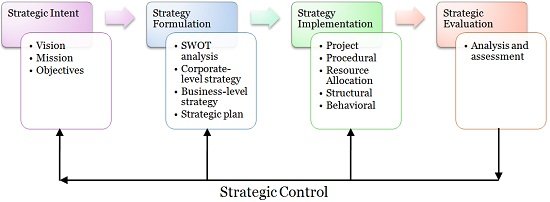
  1. Defining the levels of strategic intent of the business:
    • Establishing vision
    • Designing mission
    • Setting objectives
  2. Formulation of strategy
    • Performing environmental and organizational appraisal
    • Considering strategies
    • Carrying out strategic analysis
    • Making strategies
    • Preparing strategic plan
  3. Implementation of strategy
    • Putting strategies into practice
    • Developing structures and systems
    • Managing behavioural and functional implementation
  4. Strategic Evaluation and Control
    • Performing evaluation
    • Exercising control
    • Recreating strategies

Strategic Management is all about specifying organization’s vision, mission and objectives, environment scanning, crafting strategies, evaluation and control.

Importance of Strategic Management

  • It guides the company to move in a specific direction. It defines organization’s goals and fixes realistic objectives, which are in alignment with the company’s vision.
  • It assists the firm in becoming proactive, rather than reactive, to make it analyse the actions of the competitors and take necessary steps to compete in the market, instead of becoming spectators.
  • It acts as a foundation for all key decisions of the firm.
  • It attempts to prepare the organization for future challenges and play the role of pioneer in exploring opportunities and also helps in identifying ways to reach those opportunities.
  • It ensures the long-term survival of the firm while coping with competition and surviving the dynamic environment.
  • It assists in the development of core competencies and competitive advantage, that helps in the business survival and growth.

The basic purpose of strategic management is to gain sustained-strategic competitiveness of the firm. It is possible by developing and implementing such strategies that create value for the company. It focuses on assessing the opportunities and threats, keeping in mind firm’s strengths and weaknesses and developing strategies for its survival, growth and expansion.

Strategic Management Levels: Corporate, SBU and Functional Strategies

In a multi-business enterprise, having several SBUs, there would be three levels of strategy, viz., – corporate strategy, SBU strategy and functional strategy. In enterprises which do not have SBUs, there will be only two levels of strategy, i.e., corporate strategy and functional strategies.

  1. Corporate Strategy:

Corporate strategy is the long-term strategy encompassing the entire organisation. Corporate strategy addresses fundamental questions such as what is the purpose of the enterprise, what business/businesses it wants to be in (portfolio strategy) and how to expand/get into such business/businesses (for example – by establishing greenfield enterprises or by M&As).

In other words, “corporate-level strategic management is the management of activities which define the overall character and mission of the organisation, the product/service segments it will enter and leave, and the allocation of resources and management of synergy among its SBUs.”

Corporate strategy is formulated by the top level corporate management (board of directors, CEO, and chiefs of functional areas).

  1. SBU Strategy:

SBU-level strategy, sometimes called Business Strategy or Competitive Strategy, is concerned with decisions pertaining to the product mix, market segments and manoeuvring competitive advantages for the SBU.

While corporate strategy decides the business portfolio (i.e., the types of business), the competitive strategy decides the strategy/strategies to succeed in the chosen business/businesses.

SBU strategy has to conform, obviously, to the corporate philosophy and strategy.

In short, “the SBU-level strategic management is the management of an SBU’s effort to compete effectively in a particular line of business and to contribute to overall organisational purposes.”

The responsibility for SBU strategy is with the top executives of the SBU who are normally second-tier executives in the corporate hierarchy. In single-SBU organisations, senior executives have both corporate and SBU-level responsibilities.

  1. Functional Strategies:

Functional-level strategies are strategies for different functional areas like production, finance, personnel, marketing, etc. In other words, “functional-level strategic management is the management of relatively narrow areas of activity, which are of vital, pervasive, or continuing importance to the total organisation.”

Functional-level strategy is the responsibility of functional area heads.

Strategic Management Functions

(a) Determination of basic long-term goals and objectives of the organization.

(b) Adoption of courses of action to achieve organization’s objectives.

(c) Adopting course of action necessary for allocation of resources.

(d) Relates formulation of company’s mission, including broad statements about its purpose, philosophy and goals.

(e) Long-term, future oriented plans for interacting with the competitive environment to achieve company’s objectives.

(f) Developing the company from its present position to the desired future position.

(g) Top management’s decision that directs organization and business towards predetermined goal,

(h) Carefully crafted plan with a stream of decisions and actions over time.

(i) Concerned with efficiency i.e. perceiving opportunities and threats and seizing initiatives to cope with them.

(j) Flows out of goals and objectives of the enterprise and is meant to translate them into realities.

(k) Recognize which competitor’s actions need critical attention.

(l) Identifies strengths and weaknesses compared with those of its competitors.

(m) Plan of action that reveals its objectives, purposes, goals, policies and plans that are required in achieving corporate mission.

(n) Analyze the company’s options by matching its resources with the external environment.

(o) Forward looking and it has orientation towards future.

(p) Provides an integrated and unified framework for managers, for effective decision making affecting all subsystems in an organization.

(q) Creates a fit between the organization and its external environment.

(r) Provides a framework for thinking about the business.

(s) Pattern in a stream of decisions and actions.

(t) Commonality of approach that exists in diverse organizational activities including the products and markets that define the current and planned nature of business.

(u) Way of stating current and desired future position of the company.

Dimension of Strategic decision

Following are the outstanding attributes of strategic decision:

(1) Strategic decision is major one which is fundamental in that it influences the entire or major part of the organisation.

(2) Strategic decision is one that contributes directly in the realisation of organisation. All other decisions are the off-springs of such a decision.

(3) Strategic decision is separating itself from day-to- operational decisions. It is strategic in the sense that it is innovative effective and has different approach in each area be it a production, personnel, finance and marketing.

(4) Strategic decision has in its kit wide range of alternatives to withstand the on sleights of environment which is ever changing. These alternatives provide vital differences in terms of the outcome and inputs needed.

(5) Strategic decision is found on trade-offs between the costs and the risks of innovating and the time vulnerability of competitors. Between the competing alternatives, the best one is chosen.

In a sense, what is strategic or non-strategic is a matter of individual’s independent interpretation. Though the distinction is not very fine, such classification provides management to achieve the benefits of delegation of authority in that routine, repetitive and day to day decisions can be passed on to the lower-level where it is a source of motivation and preparing the aspirants in the art of decision making.

As a result, strategic decisions can be taken with deep thought and logic of applying mental faculty of fertile imagination and sound judgment.

Strategic decision making, or strategic planning, describes the process of creating a company’s mission and objectives and choosing the course of action a company should pursue to achieve those goals. Strategic decisions are different in nature from all other decisions which are taken at various levels of the organization during their day-to-day working.

The major dimensions of strategic decisions are given below:

  1. Strategic issues require top-management decisions.
  2. Strategic issues involve the allocation of large amounts of company resources.
  3. Strategic issues are likely to have a significant impact on the long term prosperity of the firm.
  4. Strategic issues are future-oriented.
  5. Strategic issues usually have major multi-functional or multi-business consequences.
  6. Strategic issues necessitate consideration of factors in the firm’s external environment.

Strategic Management: Tasks

Strategic thinking provides the vision for Strategic Management; by providing an insight into the forces behind the new completion by helping us develop a sustainable competitive advantage based on our organization’s core competencies; creating in infrastructure for the review and redefinition of our strategic direction; and along us to recognize and capitalize on new developments and opportunities in the market. The vision and direction provided by strategic thinking has to be incorporated into the Strategic Management framework.

Strategic Management process can be described by a number of tasks to be undertaken by the organization. In the final analysis, the success of the Strategic Management process boils down to the ability of the organization to carry out these tasks effectively and efficiently.

  1. Evolve business goals, by formulating its future mission and vision in terms of the expectations of the stakeholders.
  2. Set objectives that are achievable in light of changing external factors that include regulation, competition, technology and customers.
  3. Evolve and develop a competitive strategy to achieve the mission.
  4. Create an effective organizational structure and arrange the resources to successfully carry out the strategy.
  5. Finally, evaluate the performance so that necessary corrective measures can be taken to keep it on track to achieve the vision.

Levels of Strategy

Strategic Management Levels: Corporate, SBU and Functional Strategies

In a multi-business enterprise, having several SBUs, there would be three levels of strategy, viz., corporate strategy, SBU strategy and functional strategy. In enterprises which do not have SBUs, there will be only two levels of strategy, i.e., corporate strategy and functional strategies.

  1. Corporate Strategy:

Corporate strategy is the long-term strategy encompassing the entire organisation. Corporate strategy addresses fundamental questions such as what is the purpose of the enterprise, what business/businesses it wants to be in (portfolio strategy) and how to expand/get into such business/businesses (for example – by establishing greenfield enterprises or by M&As).

In other words, “corporate-level strategic management is the management of activities which define the overall character and mission of the organisation, the product/service segments it will enter and leave, and the allocation of resources and management of synergy among its SBUs.”

Corporate strategy is formulated by the top level corporate management (board of directors, CEO, and chiefs of functional areas).

  1. SBU Strategy:

SBU-level strategy, sometimes called Business Strategy or Competitive Strategy, is concerned with decisions pertaining to the product mix, market segments and manoeuvring competitive advantages for the SBU.

While corporate strategy decides the business portfolio (i.e., the types of business), the competitive strategy decides the strategy/strategies to succeed in the chosen business/businesses.

SBU strategy has to conform, obviously, to the corporate philosophy and strategy.

In short, “the SBU-level strategic management is the management of an SBU’s effort to compete effectively in a particular line of business and to contribute to overall organisational purposes.”

The responsibility for SBU strategy is with the top executives of the SBU who are normally second-tier executives in the corporate hierarchy. In single  SBU organisations, senior executives have both corporate and SBU-level responsibilities.

  1. Functional Strategies:

Functional-level strategies are strategies for different functional areas like production, finance, personnel, marketing, etc. In other words, “functional-level strategic management is the management of relatively narrow areas of activity, which are of vital, pervasive, or continuing importance to the total organisation.”

Functional-level strategy is the responsibility of functional area heads.

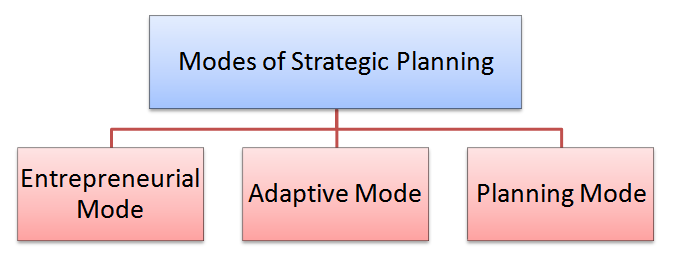
Strategy making Modes

  1. Entrepreneurial Mode

In entrepreneurial mode, strategic planning is done by one person. He takes the full responsibility of planning for the production department. That is, he does production planning on behalf of the production department. He has entrepreneurial skills. That is, he is good in planning, organizing, motivating, etc. He is also a strong and bold leader.

  1. Adaptive Mode

In adaptive mode, the production managers go on changing his plans according to the changes in the environment. He first makes a big plan, then he breaks it into smaller plans. This is done to adjust with the dynamic environment. Then he tries to combine all these plans to make a strategic production plan. In this method, the production manager is not at peace. He works in a disorganized environment. Therefore, his planning is also disorganised.

  1. Planning Mode

In planning mode, the production manager makes the plan after analyzing the objectives and resources of the organization. He carefully considers all the factors before making the plan. In this method, his approach is very rational. He gives prime importance to management science. Therefore, his plan is very logical.

Overview of process of Strategic Planning

Strategic planning means planning for making and implementing strategies to achieve organisational goals. It starts by asking oneself simple questions like: What are we doing, should we continue to do it or change our product line or the way of working, what is the impact of social, political, technological and other environmental factors on our operations, are we prepared to accept these changes etc.

Strategic planning helps in knowing where we are and where we want to go so that environmental threats and opportunities can be exploited, given the strengths and weaknesses of the organisation. Strategic planning is “a thorough self-examination regarding the goals and means of their accomplishment so that the enterprise is given both direction and cohesion.”

It is “a process through which managers formulate and implement strategies geared to optimising strategic goal achievement, given available environmental and internal conditions.” Strategic planning is planning for long periods of time for effective and efficient attainment of organisational goals. Strategic planning is based on extensive environmental scanning. It is a projection into environmental threats and opportunities and an effort to match them with organisational strengths and weaknesses.

Strategic planning is done to comprehend, anticipate and absorb environmental vagaries. It is a continuous process. Every time business organisations want to increase the growth rate or change their operations, desire for better management information system, co-ordinate activities of different departments, remove complacency from organisations; they make strategic plans.

Process

1. Objective Formulation:

Strategies are goal-oriented. The overall purpose or mission of the organisation must be clearly stated. Mission explains the reason why business is in existence. It identifies the scope of products/services. The goals can be economic or social and may relate to size of the organisation, goods or services or simply the technology or the way an organisation operates its business.

Missions justify existence of the organisation in terms of purpose (objectives), markets, products/services, consumers etc.; relationship between organisation’s internal and external environment, its culture, values, ethics and beliefs. Missions formulate objectives and objectives help to formulate strategies.

2. Analyse the Impact of Environment:

Environmental analysis is the “systematic assessment of information about the firm’s external environment during the strategic planning process to identify strategic opportunities for the company as well as major threats, problems, or other possible impediments.” Managers scan the environment, pick relevant information and use it for strategy formulation.

A successful strategy aligns with the environment. Strategies are made to integrate the organisation with its environment. Managers examine both general and specific environmental factors to see what changes are occurring. External factors which indirectly affect strategic planning are technological, social, political, and legal and those which directly influence are competitors, suppliers, government and customers.

Whether these factors promote or restrain business activities is analysed in framing strategies. Complete information collected from various sources like government agencies, banks, customers, journals, bulletins, suppliers, other business associations etc., may not be required for strategy formulation. Information is screened and only relevant information is analysed to formulate strategies.

This information may be related to production (plant location, layout, inventory management repairs and maintenance etc.), marketing (market share, consumer needs, promotion mix, product mix etc.), finance (debt-equity ratio, dividend policy etc.) or human resource (manpower planning, recruitment and selection procedures, training and development etc.).

Environmental analysis helps to:

  1. prepare strategies to convert threats into opportunities
  2. create environmental threat and opportunity profile (ETOP) which analyses the environmental factors and assesses their impact on the organisation.

3. Analyse Resource Position of the Firm:

After analysing the external environment, firms evaluate their internal resource position to identify their strengths and weaknesses in relation to environmental threats and opportunities. Knowing environmental threats and opportunities is not enough unless the organisations know their strengths that can overcome the threats and exploit the opportunities.

Organisational weaknesses, if any, have to be overcome to take benefit of environmental opportunities. Resources being limited, organisational strengths and weaknesses should be analysed to use the resources in areas where they can be optimally utilised.

Matching of strengths and weaknesses (internal environment) with threats and opportunities (external environment) is known as SWOT analysis. It helps in generating strategies and answer the basic question of strategic planning—what we are and what we want to be or where we are and where we want to go?

The following steps are identified by Hofer and Schendel to analyse resource position of the organisation:

(a) Develop a profile of the organisation’s principal resources and skills in three broad areas: financial; physical, organisational and human; and technological.

(b) Determine the key success requirement of the product/market segments in which the organisation competes or might compete.

(c) Compare resource profile with key success requirements to determine the major strengths on which effective strategy can be based and major weaknesses to be overcome.

(d) Compare organisation’s strengths and weaknesses with those of competitors to identify which resources and skills are needed to have competitive advantage in the marketplace.

Analysing the organisation (corporate appraisal) helps in setting priorities over areas where organisations need to pay more attention. These areas could be operations/marketing/hum an resource/finance etc.

4. Establish Alternative Strategies:

Managers carry out gap analysis to develop alternative strategies, i.e., analyse the present strategies and the objectives formulated. “It is the difference between the objectives established in the goal formulation process and the results likely to be achieved if the existing strategy is continued.”

It reveals gap between the present state and future aspirations of the organisation. If existing strategies can help in reaching the desired objectives, new strategies need not be formulated but if there is a gap, managers develop strategies to attain the objectives.

The following strategies can be made:

(a) Strategy to concentrate:

Companies want to specialise in the existing line of products, capture bigger market share and become market specialists in that product line.

(b) Strategy to diversify:

Companies want to enter new markets to increase the share of market.

(c) Strategy to enter international markets:

Besides increasing share in the national markets, firms want to expand their business in other countries.

(d) Strategy to enter into joint ventures:

Firms enjoy the benefits of synergy by collectively exploiting the resources and enlarging their area of operation.

(e) Liquidation strategy:

It means to drop the existing product if it is not profitable.

(f) Retrenchment strategy:

It means dropping some of the resources (human and non-human) to make best use of the remaining ones. Surplus resources are shed off in this strategy. It results in optimum use of resources. The list of strategies is not exhaustive. New strategic options may be considered by the firms depending upon the situation.

5. Evaluate Alternative Strategies:

Different strategic options are evaluated on the basis of their competitive advantages in terms of:

(a) Risk:

Will the strategy be able to achieve the objectives?

(b) Time:

Is it being adopted and implemented at the right time?

(c) Target:

Does it target at matching internal strengths and weaknesses of the organisation with its external environment?

Four criteria for evaluating strategies are identified by Richard R Rumelt:

(a) Is the strategy consistent with broad objectives of the company?

(b) Does the strategy focus organisational resources on critical success factors in the product/market area for which it is intended to be formulated?

(c) Does it maximise company’s internal strengths and minimise its weaknesses?

(d) Is the strategy realistic? Will it be able to produce the desired results? i.e., it is a workable strategy or not?

Various quantitative techniques such as ratio analysis, break-even analysis, linear programming, networking etc. are used to evaluate strategies.

6. Choice of a Strategy:

After evaluating strategies in terms of risks and returns (ability to achieve the goals), they are ranked in order of priority and the strategy best suited to achieve the goals is chosen. The chosen strategy should be directed to maximise long-term goals of the organisation.

7. Implement the Strategy:

After selection, the strategy is put into action and practiced. It becomes a guide for the organisation and members to direct their efforts in a unified direction. Implementation requires designing the suitable organisation structure, developing a sound system of communication, motivation and control, allocating authority responsibility, resources etc.

8. Measurement and Control of Strategy:

Organisational performance is measured at periodic intervals to assess whether strategic objectives are being achieved or not.

A formal strategic control system is designed which answers questions such as:

(a) Is the strategy being implemented as planned?

(b) Are the critical assumptions on the basis of which it was selected still valid?

(c) Is the strategy achieving the intended results?

If the results are similar to objectives, the strategies become the basis for future action. However, if the objectives are not achieved, reasons are found for the same and suitable actions are taken to overcome the problem.

Overview of process of Strategic Management

The strategic management process means defining the organization’s strategy. It is also defined as the process by which managers make a choice of a set of strategies for the organization that will enable it to achieve better performance.

Strategic management is a continuous process that appraises the business and industries in which the organization is involved; appraises it’s competitors; and fixes goals to meet all the present and future competitor’s and then reassesses each strategy.

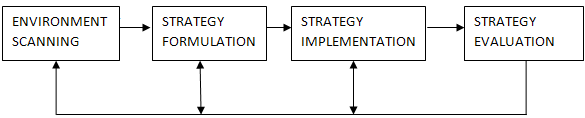
Strategic management process has following four steps:

  1. Environmental Scanning: Environmental scanning refers to a process of collecting, scrutinizing and providing information for strategic purposes. It helps in analyzing the internal and external factors influencing an organization. After executing the environmental analysis process, management should evaluate it on a continuous basis and strive to improve it.
  2. Strategy Formulation: Strategy formulation is the process of deciding best course of action for accomplishing organizational objectives and hence achieving organizational purpose. After conducting environment scanning, managers formulate corporate, business and functional strategies.
  3. Strategy Implementation: Strategy implementation implies making the strategy work as intended or putting the organization’s chosen strategy into action. Strategy implementation includes designing the organization’s structure, distributing resources, developing decision making process, and managing human resources.
  4. Strategy Evaluation: Strategy evaluation is the final step of strategy management process. The key strategy evaluation activities are: appraising internal and external factors that are the root of present strategies, measuring performance, and taking remedial / corrective actions. Evaluation makes sure that the organizational strategy as well as it’s implementation meets the organizational objectives.

These components are steps that are carried, in chronological order, when creating a new strategic management plan. Present businesses that have already created a strategic management plan will revert to these steps as per the situation’s requirement, so as to make essential changes.

Components of Strategic Management Process

Strategic management is an ongoing process. Therefore, it must be realized that each component interacts with the other components and that this interaction often happens in chorus.

error: Content is protected !!