Marketing Mix for Services

The marketing concept dictates that marketing decisions should be based upon customer needs and wants. Buyers purchase goods and services to satisfy their needs and wants. Thus when a buyer engages in a market transaction he perceives a bundle of benefits and satisfactions to be derived from that transaction. However he does not usually divide the market offering into its component parts.

From the sellers’ view point however the market offering can be divided into its component parts. The marketing mix is the convenient means of organizing all the variables controlled by the marketer that influence transactions in the marketplace. It is a ‘checklist approach’ where marketer’s attempt to list and organize the variables under their control which may be important in influencing transactions in the market place.

The formulation process of marketing mixes in services markets is much the same as in other types of markets typically this involves:

(a) Separating the offering into its components or sub mixes;

(b) Coordinating the sub mixes into the marketing mix.

The specific marketing mix adopted by a particular organization will of course vary according to circumstances (e.g. level of demand, range of service being offered). The marketing mix process then is a constant one of fashioning and reshaping the component elements in response to changing market circumstances and needs.

Inevitably there is much overlap and interaction between the various components of a marketing mix. Decisions cannot be made on one component of the mix without considering their impact upon the other components.

Also the precise elements and their importance within any marketing mix at any point in time will vary. The outline that follows therefore indicates some of the key areas to which marketing managers need to devote their attention in formulating their marketing mixes for services markets. It is illustrative not comprehensive. Service organizations will almost certainly need to adapt it in their strategy planning.
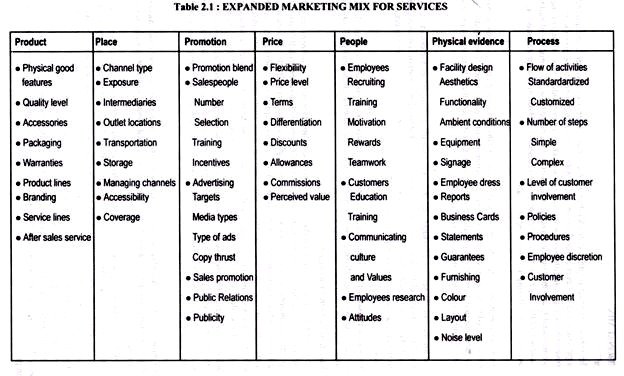
Marketing Mix:

1. Product:

The service product requires consideration of the range of services provided, the quality of services provided and the level of services provided. Attention will also need to be given to matters like the use of branding, warranties and after-sale service. The service product mix of such elements can vary considerably and may be seen in comparisons of service range between a small local building society and one of the largest in the country; or between a small hotel offering a limited menu range and a four star hotel offering a wide range of meals.

2. Price:

Price considerations include levels of prices, discounts allowances and commissions, terms of payment and credit. Price may also pay a part in differentiating one service from another and therefore the customers perceptions of value obtained from a service and the interaction of price and quality are important considerations in many service price sub mixes.

3. Place:

The location of the service providers and their accessibility are important factors in services marketing. Accessibility relates not just to physical accessibility but to other means of communication and contact. Thus the types of distribution channels used (e.g. travel agents) and their coverage is linked to the crucial issue of service accessibility.

4. Promotion:

Promotion includes the various methods of communicating with markets whether through advertising, personal selling activities, sales promotion activities and other direct forms of publicity, and indirect forms of communication like public relations.

Expanded mix for services:

Because services are usually produced and consumed simultaneously, customers are often present in the firm’s factory, interact directly with the firm’s personnel, and are actually part of the service production process. Also, because services are intangible customers will often be looking for any tangible cue to help them understand the nature of the service experience.

These facts have led services marketers to conclude that they can use additional variables to communicate with and satisfy their customers. For example, in the hotel industry the design and decor of the hotel as well as the appearance and attitudes of its employees will influence customer perceptions and experience.

Acknowledgment of the importance of these additional communication variables has led services marketers to adopt the concept of an expanded marketing mix for services shown in the three remaining columns in Table 2.1. In addition to the traditional four Ps, the services marketing mix includes people, physical evidence, and process.

5. People:

All human actors who play a part in service delivery and thus influence the buyer’s perceptions: namely, the firm’s personnel, the customer, and other customers in the service environment. All of the human actors participating in the delivery of a service provide cues to the customer regarding the nature of the service itself. How these people are dressed, their personal appearance their attitudes and behaviors all influence the costumers perceptions of the service.

The service provider or contact person can be very important. In fact, for some services, such as consulting, counselling, teaching, and other professional relationship – based services, the provider is the services. In other cases the contact person may play what appears to be a relatively small part in service delivery, for instance, a telephone installer, an airline baggage handler, or an equipment delivery dispatcher. Yet research suggests that even these providers may be the focal point of service encounters that can prove critical for the organization.

6. Physical Evidence:

The environment in which the service is delivered and where the firm and customer interact, and any tangible components that facilitate performance or communication of the service. The physical evidence of service includes all of the tangible representations of the services – such as brochures, letterhead, business cards, report formats, signage, and equipment. In some cases it includes the physical facility where the service is offered, for example, the retail bank branch facility.

In other cases, such as telecommunication services, the physical facility maybe irrelevant..In this case other tangibles such as billing statements and appearance of the repair truck may be important indicators of quality. Especially when consumers have little on which to judge the actual quality of service they will rely on these cues just as they rely on the cues provided by the people and the service process. Physical evidence cues provide excellent opportunities for the firm to send consistent and strong messages regarding the organization’s purpose, the intended market segments, and the nature of the service.

7. Process:

The actual procedures, mechanism and flow of activities by which, the service is delivered the service delivery and operating systems. The actual delivery steps the customer experiences, or the operational flow of the service, will also provide customers with evidence on which to judge the service.

Some services are very complex, requiring the customer to follow a complicated and extensive series of actions to complete the process. Highly bureaucratized services frequently follow this pattern, and the logic of the steps involved often escapes the customer.

Another distinguishing characteristic of the process that can provide evidence to the customer is whether the service follows a production-line/standardized approach or whether the process is an empowered/customized one. None of these characteristics of the service is inherently better or worse than another.

Rather, the point is that these process characteristics are another form of evidence used by the consumer to judge service. For example, two successful airline companies, Southwest in the United States and Singapore Airlines, follow extremely different process models. Southwest is no-frills (no food, no assigned seats), no exceptions, low-priced airline that offers frequent, relatively short length domestic flights.

All of the evidence it provides is consistent with its vision and market position. Singapore Airlines, on the other hand, focuses on the business traveler and is concerned with meeting individual traveler needs. Thus, its process is highly customized to the individual, and employees are empowered to provide nonstandard service when needed. Both airlines have been very successful.

The three new marketing-mix elements (people, physical evidence, and process) are included in the marketing mix as separate elements because they are within the control of the firm and any or all of them may influence the customer’s initial decision to purchase a service, as well as the customer’s level of satisfaction and repurchase decisions.

Certainly Marketing managers in services markets need to undertake research about the markets and market segments for which their respective marketing mixes are shaped. Wherever possible the services marketing manager will need to research and analyses the characteristics of the markets served. It is these problems of conducting such analysis and research.

  1. Developing a marketing strategy involves two tasks. These are selecting target markets and formulating marketing mixes.
  2. In services marketing adaptations and adjustments may be required, although the processes of devising marketing strategies and formulating marketing mixes are similar irrespective of market type.
  3. In the analytical stage preceding strategy formulation, common questions posed about all products may give rise to different answers for services.
  4. The marketing mix may have to be revised for use in services contexts. In particular people, processes and physical evidence may have to be incorporated into the marketing mix framework.
Classification of Services

In order to be able to make a clear and relevant classification of services, we would first need to understand the concept of the word itself. Services usually refer to processes and not physical products. To understand more, read this article on difference between goods and services. Some services may include people whereas other services (like online services) may including objects which are managed by people.

Examples of services which include people can be a hair salon, education, theater, restaurants, and public transportation. On the other hand services that include objects include repairs and maintenance, dry cleaning, banking, legal services, insurance, etc.

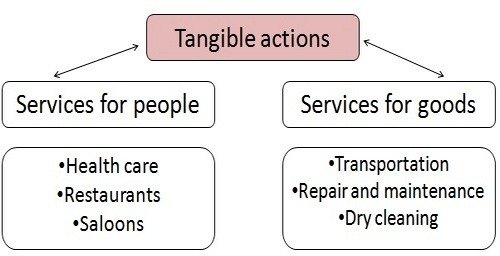
  1. Classification of service based on Tangible Action

Wherever people or products are involved directly, the service classification can be done based on tangibility.

(i) Services for people: Like Health care, restaurants and saloons, where the service is delivered by people to people.

(ii) Services for goods: Like transportation, repair and maintenance and others. Where services are given by people for objects or goods.

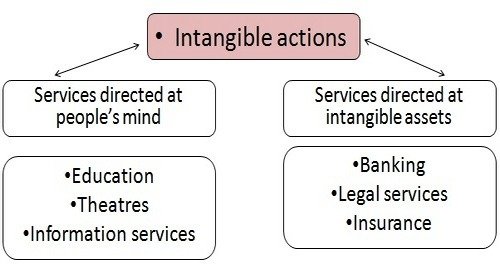
  1. Classification of services based on Intangibility

There are objects in this world which cannot be tangibly quantified. For example  the number of algorithms it takes to execute your banking order correctly, or the value of your life which is forecasted by insurance agents. These services are classified on the basis of intangibility.

(i) Services directed at people’s mind: Services sold through influencing the creativity of humans are classified on the basis of intangibility.

(ii) Services directed at intangible assets: Banking, legal services, and insurance services are some of the services most difficult to price and quantify.

The most intangible form of service output is represented by information processing. The customer’s involvement in this type is service is not required. Generally, customers have a personal desire to meet face to face but there is no actual need in terms of the operational process. Consultancy services can be an example of this type of services where the relationship can be built or sustained on trust or telephone contact. However, it is more indicated to have a face-to-face relationship in order to fully understand the needs of the customer.

A more general classification of services based on the type of function that is provided through them can be as follows:

  • Business services.
  • Communication services.
  • Construction and related engineering services.
  • Distribution services.
  • Educational services.
  • Environmental services.
  • Financial services.
  • Health-related and social services.
  • Tourism and travel-related services.
  • Recreational, cultural, and sporting services.
  • Transport services.
  • Other services not included elsewhere.

7 Important Characteristics of Services

(i) Perish-Ability

Service is highly perishable and time element has great significance in service marketing. Service if not used in time is lost forever. Service cannot stored.

(ii) Fluctuating Demand

Service demand has high degree of fluctuations. The changes in demand can be seasonal or by weeks, days or even hours. Most of the services have peak demand in peak hours, normal demand and low demand on off-period time.

(iii) Intangibility

Unlike product, service cannot be touched or sensed, tested or felt before they are availed. A service is an abstract phenomenon.

(iv) Inseparability

Personal service cannot be separated from the individual and some personalised services are created and consumed simultaneously.

For example hair cut is not possible without the presence of an individual. A doctor can only treat when his patient is present.

(v) Heterogeneity

The features of service by a provider cannot be uniform or standardised. A Doctor can charge much higher fee to a rich client and take much low from a poor patient.

(vi) Pricing of Services

Pricing decision about services are influenced by perish-ability, fluctuation in demand and inseparability. Quality of a service cannot be carefully standardised. Pricing of services is dependent on demand and competition where variable pricing may be used.

(vii) Service quality is not statistically measurable

It is defined in form of reliability, responsiveness, empathy and assurance all of which are in control of employee’s direction interacting with customers. For service, customer’s satisfaction and delight are very important. Employees directly interacting with customers are to be very special and important. People include internal marketing, external marketing and interactive marketing.

Significance of Services Marketing

The following are the characteristics of services:

  1. Intangibility:

Services are intangible and therefore cannot be touched, handled, smelt or tasted (physical senses). This is because service itself is an activity. A service however, can be experienced. A service also gives a certain amount of satisfaction to the consumers. On account of the intangibility, there is no ownership created in case of services. A service can only be generated and used and can never be owned.

  1. Perishability:

A service has to be consumed simultaneously with its production. A service cannot be stored like a tangible commodity. Services are perishable in terms of delivery and time. An empty seat on a plane never can be utilized and charged after departure. Revenue once lost is lost forever.

When the service has been completely rendered to the requesting service consumer, this particular service irreversibly vanishes as it has been consumed by the service consumer. Example – after the passenger has been transported to the destination, he cannot be transported again to the previous location at the previous point of time.

  1. Inseparability:

Commodities once produced can be sold at a later point of time but in case of services it is not possible. Examples – In the cases of services of a doctor to his patient, teacher to his student, the simultaneous presence of both-the producer of the service and the consumer of the service at that point of time is absolutely necessary.

The service provider is indispensable for service delivery as he must promptly generate and render the service to the requesting service consumer. Therefore the service provider, the service itself and the service consumer are inseparable.

  1. Simultaneity:

Services are generated and consumed during the same period of time. As soon as the service consumer has requested the service (delivery), the particular service must be generated from scratch without any delay. The service consumer instantaneously consumes the rendered benefits to satisfy his wants. Therefore the production and consumption of services are always simultaneous.

  1. Variability:

Each service is unique. Services lack homogeneity. Example – a doctor treats two patients with similar ailments on the same day. The level of satisfaction in the minds of these patients after the treatment will never be the same. The difference is caused by factors such as the mood of the doctor, the fatigue level of the doctor, the way the service is perceived by the individual patient etc. There will a difference in the service even if the same doctor treats the same patient on two different occasions.

This is because the moods of the doctor and the patient do not remain the same on both the occasions. No two units of service are identical even if they are generated by the same person. Factors like quality control, standardization etc. which can be very successfully implemented in case of production of tangible goods cannot be applied in case of services. Services always vary with each other.

  1. Ownership:

No ownership is created in case of services. At the time of creating a service or delivering a service, the service provider does not own the service. He only owns the physical infrastructure necessary to create the service. Similarly at the time of consumption or after the consumption, the service consumer does not own the service. He only consumes the service.

After the consumption, the consumer has only the experience but the service itself would have become non-existent. A service cannot be owned by anybody because it is basically an intangible product.

Behaviour of consumer in Services

Accounting procedures may baffle you, and legal statutes may daze you, but if you’re like many small-business owners, the one facet of your business that you can comprehend and that sustains your interest is marketing, perhaps because it involves the relatable yet always surprising realm of human behavior.

Unfortunately, most of what you read focuses on marketing a product, not a service. If your specialty is a service, the question that probably drives you most is What factors affect consumer behavior in the service disciplines? Along with that, you are probably curious about whether consumers follow the same decision-making process while they shop for a service as they do when they shop for a product.

Dive Right In to Consumer Behavior Theory

  • Understanding how consumers shop for financial services, health care, lawyers and home service contractors, all of which provide fascinating insights about consumer behavior in services in general.
  • Revisiting the five steps in the traditional decision-making process.
  • Reviewing suggestions for positioning services in the marketplace.

Contradictions Riddle Consumer Behavior

Brace yourself for some beguiling truisms about the significance of consumer behavior. Given what you already know about marketing, these observations shouldn’t come as much of a surprise:

  • Consumers know exactly what they want.
  • Consumers sometimes know little about what they want.
  • Consumers can make careful, methodical decisions.
  • Consumers can make impulsive decisions.
  • Consumers say they would use online tools to expedite their search for services.
  • Consumers don’t use online tools even when they’re available.

Smart Phone Usage Transformed Marketing

Rather than feel perplexed by these truisms, they should remind you that sometimes you must trust your instincts to guide you. Those same instincts fortified you to start a small business in the first place.

Also as you think about the most effective ways to market your service, it may help to keep certain facts about the factors affecting consumer behavior in mind. This information shouldn’t surprise you, but it should inform your most important marketing decisions.

Most Americans own smart phones, not just cellphones. In fact, 95 percent of people ages 18 to 34 and 67 percent of people ages 50 and up own smart phones.

People rely on their smart phones more than desktop computers or tablets to make searches for services. Since 2016, these digital searches have been one of the most dominant factors affecting consumer behavior, for both products and services. Beyond making purchasing decisions on the go, this insight suggests that consumers aren’t particularly interested in comparison shopping.

Consumer Behavior With Financial Services

If you sell banking, financial or insurance services – or any service, for that matter – you’ll want to bookmark Accenture’s 2019 Global Financial Services Consumer Study for a later read. The company surveyed 47,000 customers across Asia-Pacific, Europe, Latin America, the Middle East, Africa and North America and developed four customer personas that could arguably benefit anyone who wants a crash course in consumer behavior theory.

“The differences between these personas are striking and highlight how traditional demographic segmentation, such as age or wealth, can miss important nuances of how consumers view their financial providers,” the report says.

Four Personas May Sound Familiar

The personas identify:

Pioneers: Pioneers are the risk-takers who are tech-savvy and crave innovation. They are the ones most eager to engage with banking, financial and insurance providers on their smart phones.

Pragmatists: Pragmatists view technology dispassionately. For them, it’s a means to an end rather than an all-consuming passion.

Skeptics: These people are wary of technology and financial providers. Ironically, more than one-third are age 35 and under, which means they can be a tricky target group to engage.

Traditionalists: This older-than-55 group still values personal connections, tends to avoid technology and is losing faith in service providers.

Assess Conclusions About Consumer Behavior in Economics

Despite these differences, the study discerned five findings about consumer behavior in economic matters:

  • Consumers expect providers to provide solutions to their needs.
  • Consumers appreciate personalized service, such as offering a discount for a safe driving record.
  • Consumers expect their online experiences – desktop, tablet and smart phone – to be fully integrated.
  • Consumers trust their financial providers, and this feeling appears to be increasing.
  • Consumers are more likely to share their personal information as long as they get something for it in return, such as a better deal.

The report distills a great deal and says a mouthful about consumer behavior in economics and marketing in general – when it concludes: What brings customers together sets them apart.

Consumer Behavior With Health Care Services

Any small-business owner whose interests even occasionally enter the health care field can benefit from the findings of a survey of 4,530 adults conducted by the Deloitte Center for Health Solutions. Certain factors affecting consumer behavior underscore most of the findings: Consumers are more practical than ever, focusing on issues such as cost and convenience, perhaps because these commodities elude them.

The study found that:

  • Consumers are relying more on quality ratings, though a gap exists between their expressed interest and how often they use this tool.
  • Consumers are amenable to new health care services, especially at-home diagnostic testing.
  • The number of people who wear devices to track their health information has more than doubled since 2013. Moreover, many of these people are willing to share the information with a health care provider – an insight that could present an opportunity for a niche marketing campaign. 

Ailing Consumers Want a Seamless Experience

These findings about consumer behavior in health care services led researchers to suggest that business owners, marketers and other people vested in the patient journey should:

  • Offer online tools when they’re needed most, or when consumers search for a caregiver, look for alternatives, and shop for testing or diagnostic services. 
  • Create a seamless and communicative experience among the patient, caregiver and other members of a care team.

Consumer Behavior With Legal Services

You might conclude that people who shop for legal services tend to fit the traditionalist persona identified in Accenture’s financial services study. This is the commonality that binds many of the findings in the Legal Trend Report, which is billed as “the most comprehensive and the most granular analysis of lawyer activity ever published.”

The findings paint a picture of consumers who know what they want and are determined to find it, even if they rely on traditional means of communication to do so. Nearly 70 percent of the respondents say they prefer a law firm that promptly answers their first phone call or email.

Legal Consumers Are Money Conscious

Once that initial line of communication is open, the factors affecting consumer behavior include:

  • A free, initial consultation. Nearly 65 percent of the respondents referred to this offer as a deal-breaker.
  • Fixed fees was cited by nearly half of the people in the poll.
  • Finances and customer service. In this category, 28 percent of people say they choose a firm if it accepts credit card payments, while 27 percent say that pleasant text message exchanges weighed heavily in their decision-making process, and nearly 20 percent say the firm’s website lured them. 

The significance of this last consumer behavior cannot be overstated. Although consumers are shopping for legal services online and presumably are nudged into filling out and sending online contact me cards, they prefer to pick up the phone or send an email instead.

Consumer Behavior With Home Services

Consumers make more than 5 billion Google searches a day, and many of them are for contractors who specialize in home services such as electrical, plumbing, roofing and carpentry work.

By now, the owners of these companies know that their business must have a website that clearly explains the scope of their services. Research shows that 63 percent of consumers search for a home service company by scanning websites, and 30 percent of consumers won’t consider a business that doesn’t have one.

Consumers Are Impatient With Websites

However, the factors affecting consumer behavior with regard to home services don’t end there. More consumers than ever are conducting searches from their smart phones, and they’re in a big hurry to find what they’re looking for. Consider:

  • Nearly half of consumers expect a webpage to load in 2 seconds or less, and they’ll abandon a website and move onto another if it doesn’t.
  • Google says that for every 1-second delay, conversions – turning a visitor into a potential customer – drop by 12 percent.
  • Nearly 85 percent of consumers will abandon a site where they’re prepared to make a purchase if the connection is not secure.

Word-of-Mouth Still Matters

Despite their dependence on technology, consumers shopping for home services still rely on one of the oldest forms of marketing: word-of-mouth. Small-business owners in this field should know that:

  • Recommendations can increase conversions by up to 5.5 times.
  • Converted customers acquired through word-of-mouth boast a retention rate that is nearly 40 percent higher than customers acquired by other means.
  • Social media reviews and comments can influence the behavior of nearly 70 percent of consumers. 

Word-of-Mouth Affects Consumer Behavior

Word-of-mouth remains one of the most influential factors affecting consumer behavior throughout the entire, five-step decision-making process. It’s a point worth remembering as you market your service and lead potential customers through the process, both online and in person.

A fundamental consumer behavior theory is that most consumers follow this progression for services and products before signing a contract or making a purchase:

  • Recognize a need or problem
  • Gather information about how to fill that need or solve that problem
  • Compare and contrast worthwhile alternatives
  • Make a decision
  • Evaluate the wisdom of the decision

Develop Your Brand, Develop Yourself

It’s a lot of information to digest, although the parallels among consumer behavior in services can be so striking that they should leave an indelible mark on your memory and your marketing decisions. In addition to following your gut instinct, other tips about marketing services should assist your best efforts:

  • Assuming that people do business with people they know, like and trust (and check out via word-of-mouth), go out of your way to develop a rapport with potential customers.
  • Develop a keen understanding of your customer’s needs. If you do this and find a way to address these needs, you have likely found a customer for life.
  • To a certain extent, you are the product,so you must sell yourself too, touting your own features and benefits.

Start thinking of yourself, not only your company, as a brand_._ Everything you do everything you say, how you dress, how you conduct a business meeting – and everything else you embody are part of your brand. It helps if you clearly differentiate your brand from others. If you’re uncomfortable drawing a direct contrast and citing competitors’ names, then be sure to explicitly state who you are, what you stand for and why you’re decidedly different and better.

Perhaps no better definition of personal branding exists than the one offered by Amazon founder Jeff Bezos: “Your brand is what people say about you when you’re not in the room.”

Market Positioning, Features, Strategies, Process, Challenges

Market Positioning is the process of creating a distinct image and identity of a product or brand in the minds of target customers. It involves identifying a unique value proposition that differentiates the product from competitors and aligns with consumer needs and preferences. Effective positioning highlights key benefits, features, or emotional appeals that make the offering more attractive to a specific segment. Positioning strategies are implemented through product design, pricing, promotion, and distribution. The ultimate goal is to occupy a favorable, clear, and distinctive place in the customer’s perception so that the brand is remembered and preferred during the purchase decision-making process.

Features of Market Positioning:

  • Customer Perception Oriented

Market positioning is primarily focused on how customers perceive a product or brand. It involves crafting a clear, distinct image in the consumer’s mind based on features, benefits, quality, or emotional appeal. This perception drives purchase decisions more than just product features alone. A successful positioning strategy ensures that the brand stands out in the customer’s memory, offering value that competitors do not. The goal is to create a mental space where the brand is associated with specific benefits, making it the preferred choice among alternatives in a crowded market.

  • Differentiation-Based

Effective market positioning relies heavily on differentiation—setting the product or brand apart from competitors. This can be achieved through unique features, superior quality, better customer service, innovative technology, or emotional branding. Differentiation ensures that customers recognize a brand for something distinctive, which helps reduce competition and price sensitivity. By clearly communicating what makes the brand different and better, marketers can build strong brand loyalty and encourage repeat purchases. Differentiation must be meaningful, relevant to the target audience, and consistently reinforced across all marketing channels.

  • Competitive Advantage Focused

Positioning helps a company build and sustain a competitive advantage by highlighting what it does better than its rivals. Whether it’s offering lower prices, premium quality, exceptional customer service, or innovation, market positioning ensures that these strengths are communicated effectively to the target audience. By aligning brand attributes with customer expectations and outperforming competitors on key value points, firms can gain market share and customer trust. A well-positioned brand is harder to displace and can command stronger loyalty and higher profit margins in the long run.

  • Strategic and Long-Term Oriented

Market positioning is not a short-term tactic; it is a strategic, long-term commitment that shapes a brand’s future in the market. Once a brand occupies a place in the consumer’s mind, altering that perception can be difficult. Therefore, companies must carefully plan their positioning strategy and ensure consistency across all touchpoints. It influences product development, pricing, distribution, and promotional decisions. A strong and stable positioning helps build brand equity over time, ensuring lasting customer relationships, better recall, and resilience against market fluctuations and competitive threats.

Types of Positioning Strategies:

  • Product-Based Positioning

Product-based positioning emphasizes the unique features, quality, or performance of a product to differentiate it from competitors. This strategy focuses on highlighting tangible aspects such as design, durability, technology, ingredients, or innovation. It appeals to consumers who prioritize functional benefits when making purchase decisions. For example, a smartphone brand may position itself based on superior camera quality or battery life. Successful product-based positioning requires continuous improvement and innovation to maintain relevance and competitive advantage, especially in markets with rapidly changing consumer preferences and technological advancements.

  • Price-Based Positioning

Price-based positioning involves marketing a product based on its cost advantage—either as low-price (value for money) or premium-price (prestige/luxury). A low-price strategy attracts cost-conscious consumers looking for basic functionality at affordable rates, like discount retailers or budget airlines. Conversely, high-price positioning signals exclusivity, quality, and status, appealing to luxury or niche markets. This strategy must align with customer expectations and brand messaging. If the product fails to deliver value or justify its price, it can damage brand reputation. Effective price-based positioning requires clarity, consistency, and market research to sustain customer trust and profitability.

  • Use or Application-Based Positioning

This strategy focuses on positioning a product based on its specific use or application. It highlights how and when the product is best used to solve a particular problem or fulfill a need. This approach appeals to consumers seeking practical, situational solutions. For example, an energy drink may be positioned as a fitness or study aid. Use-based positioning requires a deep understanding of customer habits and lifestyles. Marketers must clearly communicate the context of usage and benefits, helping the product become top-of-mind in those specific scenarios or consumption moments.

  • User-Based Positioning

User-based positioning targets a specific type of customer or lifestyle group, aligning the brand with their values, behaviors, and identities. It personalizes marketing by connecting emotionally with the target audience. For instance, a fashion brand may position itself as youth-oriented and trendsetting, while another may appeal to working professionals. This strategy strengthens brand loyalty by making consumers feel seen and understood. However, it requires a strong understanding of the segment’s needs and must maintain relevance as customer preferences evolve. Consistent messaging and brand alignment are key to effective user-based positioning.

  • Competitor-Based Positioning

Competitor-based positioning involves directly or indirectly comparing the product with competitors to highlight superiority. A brand may position itself as better, more affordable, or more innovative than others in the market. This strategy helps consumers understand where the brand stands relative to others and why they should choose it. For example, a detergent brand claiming to clean better than the “leading brand” uses comparative positioning. While effective in crowded markets, this approach must be backed by facts and handled ethically to avoid misleading claims or legal disputes.

Process of Market Positioning:

  • Identifying Potential Competitive Advantages

The first step in market positioning is to determine what makes the product or brand unique compared to competitors. This involves analyzing customer needs, competitor offerings, and the company’s strengths to identify points of differentiation. These advantages could be based on product features, quality, pricing, service, technology, or brand image. The goal is to find attributes that customers value and that the company can deliver better than competitors. Strong competitive advantages form the foundation for an effective positioning strategy in the target market.

  • Selecting the Right Competitive Advantages

Not all identified advantages are worth pursuing. The next step is to evaluate each advantage based on its importance to customers, distinctiveness, profitability, and sustainability. The selected advantages should be meaningful, hard to imitate, and align with the company’s resources and objectives. By choosing the right differentiators, the brand can establish a strong and credible market position. This selection also helps avoid overcomplication and ensures that the marketing message remains focused, clear, and impactful for the intended target audience.

  • Communicating the Chosen Position

Once the competitive advantages are selected, the final step is to communicate the positioning effectively to the target market. This is done through consistent branding, messaging, product design, pricing, promotions, and customer experiences. The aim is to create a distinct and favorable perception in customers’ minds, making the brand stand out from competitors. Communication should be clear, consistent across all channels, and reinforced through every customer interaction. Successful communication ensures that the positioning becomes a lasting part of the brand’s identity in the marketplace.

Challenges of Market Positioning:

  • Intense Market Competition

In saturated markets, numerous brands offer similar products with comparable features, making it difficult to create a distinct position. Consumers are bombarded with marketing messages, which leads to brand confusion and reduced attention. Standing out requires unique, consistent, and creative strategies. If a brand fails to differentiate effectively, it risks being overlooked. Moreover, competitors may quickly imitate successful positioning strategies, reducing their impact. Companies must continuously innovate and reinforce their unique value proposition to maintain a strong, competitive market position.

  • Changing Consumer Preferences

Consumer tastes, preferences, and behaviors evolve due to trends, technology, social influence, or cultural shifts. A brand that was well-positioned in the past may become irrelevant if it fails to adapt to changing customer expectations. Market positioning strategies must therefore be flexible and based on continuous consumer research. Ignoring these changes can lead to declining sales and brand loyalty. Maintaining relevance requires businesses to consistently monitor customer feedback, market trends, and adjust their messaging, offerings, or positioning accordingly to stay aligned with target audience needs.

  • Brand Perception Gap

Sometimes, the brand’s intended positioning doesn’t match how customers actually perceive it. This perception gap can arise from inconsistent messaging, poor customer experiences, or unclear communication. If customers don’t understand or believe in the brand’s unique value, positioning efforts may fail. Bridging this gap requires companies to align all touchpoints—advertising, product quality, customer service—with their positioning strategy. Regular feedback and brand audits help identify disconnects and adjust the marketing approach to ensure the brand’s image resonates clearly and positively with the target audience.

  • Resource Constraints

Effective market positioning requires significant investment in research, branding, product development, and promotional campaigns. Small or emerging businesses may struggle with budget limitations, making it difficult to compete with established brands. Inadequate resources can lead to inconsistent messaging, low visibility, and an unclear brand image. Without the ability to maintain and reinforce the chosen position, even a well-planned strategy may fail. Businesses must prioritize resource allocation, focus on niche markets, and use cost-effective digital tools to achieve strong positioning within budget constraints.

  • Overpositioning or Underpositioning

Overpositioning occurs when a brand becomes too narrowly defined, limiting its appeal and alienating potential customers. Underpositioning, on the other hand, results from vague or broad messaging that fails to convey a clear identity, making the brand forgettable. Both scenarios reduce the effectiveness of the marketing strategy. Achieving the right balance is crucial—brands must be specific enough to differentiate but broad enough to remain relevant. This challenge requires clear communication, continuous monitoring, and regular adjustments based on customer feedback and market dynamics.

Market Segmentation

Market Segmentation is the process of dividing a broad consumer base into smaller, more manageable groups based on shared characteristics like demographics, behavior, geography, or psychographics. This helps businesses tailor products, messaging, and strategies to meet specific customer needs, improving targeting, efficiency, and customer satisfaction. Effective segmentation enhances marketing ROI and competitive advantage.

Market Segmentation

  • Market segmentation is a marketing concept which divides the complete market set up into smaller subsets comprising of consumers with a similar taste, demand and preference.
  • A market segment is a small unit within a large market comprising of like minded individuals.
  • One market segment is totally distinct from the other segment.
  • A market segment comprises of individuals who think on the same lines and have similar interests.
  • The individuals from the same segment respond in a similar way to the fluctuations in the market.

Basis of Market Segmentation

1. Gender

  • The marketers divide the market into smaller segments based on gender. Both men and women have different interests and preferences, and thus the need for segmentation.
  • Organizations need to have different marketing strategies for men which would obviously not work in case of females.
  • A woman would not purchase a product meant for males and vice a versa.
  • The segmentation of the market as per the gender is important in many industries like cosmetics, footwear, jewellery and apparel industries.

2. Age Group

Division on the basis of age group of the target audience is also one of the ways of market segmentation.

The products and marketing strategies for teenagers would obviously be different than kids.

  • Age group (0 – 10 years) – Toys, Nappies, Baby Food, Prams
  • Age Group (10 – 20 years) – Toys, Apparels, Books, School Bags
  • Age group (20 years and above) – Cosmetics, Anti-Ageing Products, Magazines, apparels and so on

3. Income

Marketers divide the consumers into small segments as per their income. Individuals are classified into segments according to their monthly earnings.

The three categories are:

  • High income Group
  • Mid Income Group
  • Low Income Group

Stores catering to the higher income group would have different range of products and strategies as compared to stores which target the lower income group.

Pantaloon, Carrefour, Shopper’s stop target the high income group as compared to Vishal Retail, Reliance Retail or Big bazaar who cater to the individuals belonging to the lower income segment.

4. Marital Status

Market segmentation can also be as per the marital status of the individuals. Travel agencies would not have similar holiday packages for bachelors and married couples.

5. Occupation

Office goers would have different needs as compared to school / college students.

A beach house shirt or a funky T Shirt would have no takers in a Zodiac Store as it caters specifically to the professionals.

Types of Market Segmentation

  • Psychographic segmentation

The basis of such segmentation is the lifestyle of the individuals. The individual’s attitude, interest, value help the marketers to classify them into small groups.

  • Behaviouralistic Segmentation

The loyalties of the customers towards a particular brand help the marketers to classify them into smaller groups, each group comprising of individuals loyal towards a particular brand.

  • Geographic Segmentation

Geographic segmentation refers to the classification of market into various geographical areas. A marketer can’t have similar strategies for individuals living at different places.

Nestle promotes Nescafe all through the year in cold states of the country as compared to places which have well defined summer and winter season.

McDonald’s in India does not sell beef products as it is strictly against the religious beliefs of the countrymen, whereas McDonald’s in US freely sells and promotes beef products.

Not all individuals have similar needs. A male and a female would have varied interests and liking towards different products. A kid would not require something which an adult needs. A school kid would have a different requirement than an office goer. Market Segmentation helps the marketers to bring together individuals with similar choices and interests on a common platform.

  • Market Segmentation helps the marketers to devise appropriate marketing strategies and promotional schemes according to the tastes of the individuals of a particular market segment. A male model would look out of place in an advertisement promoting female products. The marketers must be able to relate their products to the target segments.
  • Market segmentation helps the marketers to understand the needs of the target audience and adopt specific marketing plans accordingly. Organizations can adopt a more focussed approach as a result of market segmentation.
  • Market segmentation also gives the customers a clear view of what to buy and what not to buy. A Rado or Omega watch would have no takers amongst the lower income group as they cater to the premium segment. College students seldom go to a Zodiac or Van Heusen store as the merchandise offered by these stores are meant mostly for the professionals. Individuals from the lower income group never use a Blackberry. In simpler words, the segmentation process goes a long way in influencing the buying decision of the consumers.

An individual with low income would obviously prefer a Nano or Alto instead of Mercedes or BMW.

  • Market segmentation helps the organizations to target the right product to the right customers at the right time. Geographical segmentation classifies consumers according to their locations. A grocery store in colder states of the country would stock coffee all through the year as compared to places which have defined winter and summer seasons.
  • Segmentation helps the organizations to know and understand their customers better. Organizations can now reach a wider audience and promote their products more effectively. It helps the organizations to concentrate their hard work on the target audience and get suitable results.

Steps in Market Segmentation

1. Identify the target market

The first and foremost step is to identify the target market. The marketers must be very clear about who all should be included in a common segment. Make sure the individuals have something in common. A male and a female can’t be included in one segment as they have different needs and expectations.

Burberry stocks separate merchandise for both men and women. The management is very clear on the target market and has separate strategies for product promotion amongst both the segments.

A Garnier men’s deodorant would obviously not sell if the company uses a female model to create awareness.

Segmentation helps the organizations decide on the marketing strategies and promotional schemes.

Maruti Suzuki has adopted a focused approach and wisely created segments within a large market to promote their cars.

  • Lower Income Group – Maruti 800, Alto.
  • Middle Income Group – Wagon R, Swift, Swift Dzire, Ritz.
  • High Income Group – Maruti Suzuki Kizashi, Suzuki Grand Vitara.

Suzuki Grand Vitara would obviously have no takers amongst the lower income group.

The target market for Rado, Omega or Tag Heuer is the premium segment as compared to Maxima or a Sonata watch.

2. Identify expectations of Target Audience

Once the target market is decided, it is essential to find out the needs of the target audience. The product must meet the expectations of the individuals. The marketer must interact with the target audience to know more about their interests and demands.

Kellogg’s K special was launched specifically for the individuals who wanted to cut down on their calorie intake.

Marketing professionals or individuals exposed to sun rays for a long duration need something which would protect their skin from the harmful effects of sun rays. Keeping this in mind, many organizations came with the concept of sunscreen lotions and creams with a sun protection factor especially for men.

3. Create Subgroups

The organizations should ensure their target market is well defined. Create subgroups within groups for effective results.

Cosmetics for females now come in various categories.

  • Creams and Lotions for girls between 20-25 years would focus more on fairness.
  • Creams and lotions for girls between 25 to 35 years promise to reduce the signs of ageing.

4. Review the needs of the target audience

It is essential for the marketer to review the needs and preferences of individuals belonging to each segment and sub-segment. The consumers of a particular segment must respond to similar fluctuations in the market and similar marketing strategies.

5. Name your market Segment

Give an appropriate name to each segment. It makes implementation of strategies easier.

A kids section can have various segments namely new born, infants, toddlers and so on.

6. Marketing Strategies

Devise relevant strategies to promote brands amongst each segment. Remember you can’t afford to have same strategies for all the segments. Make sure there is a connect between the product and the target audience. Advertisements promoting female toiletries can’t afford to have a male model, else the purpose gets nullified.

A model promoting a sunscreen lotion has to be shown roaming or working in sun for the desired impact.

7. Review the behavior

Review the behavior of the target audience frequently. It is not necessary individuals would have the same requirement (demand) all through the year. Demands vary, perceptions change and interests differ. A detailed study of the target audience is essential.

8. Size of the Target Market

It is essential to know the target market size. Collect necessary data for the same. It helps in sales planning and forecasting.

MIS in Service Marketing

With the increasing use of the computer, companies are becoming more interested in the development of a corporate wide, inte­grated management information system. The purpose of such a sys­tem is to bring all of the flows of recorded information in the entire company into a unified whole. Thereby it is hoped that the manager’s capacity to plan and control the company’s activities will be improved. Such a system is often seen as a marked improvement over current procedures.

As companies have attempted to introduce such a system, how­ever, a consensus seems to be growing, especially among some computer hardware manufacturers, that a more realistic approach is to begin with smaller systems, such as one in marketing, or in production.

As Business Week recently put it, “Skeptics are backing of and asking whether one big system is such a good idea after all.” The reason for this change in view is the growing awareness that these smaller subsystem, such as one for marketing, can per­haps be conceptualized in enough detail to be operational, whereas, in the current state of the art, the larger systems probably cannot.

The human mind simply cannot grasp the whole manage­ment operation with efficient clarity and detail to permit it to be structured and modeled. New concepts will probably have to be developed to aid us in thinking about such a complex phenome­non. In the meantime, management can proceed to develop the smaller systems. In building the smaller systems too, we can ben­efit by learning from the mistakes that were made with global systems.

Marketing information systems are really the frameworks used for managing, processing and accessing data. They can be simply a sharing of information by key departments, but are more likely to be some form of integrated system based around information technol­ogy. The important issue is that the information from such a system is presented in a way that is useful to the marketing decisions.

There are three basic components of a good marketing information system:

  1. Information acquired via market intelligence
  2. Information from operating data
  3. Information library.

Marketing information system is a set of procedures and methods for regular and planned collection, analysis and presentation of information in making marketing decisions. It is an interacting, continuing, future-oriented structure of persons, machines and procedures designed to generate an orderly flow of information collected from internal and external sources of information.

It is an integrated combination of information, information processing and analysis, equipment and tools (i.e., software and hardware) and information specialists who analyse and interpret the collected information and provide it to decision-makers to serve their analysis, planning and control needs.

Marketing information system is a broader and more encompassing term than market research and a variation of the term management information system. Marketing Information System (MIS) is the structure of people, equipment and procedures used to gather, analyses and distribute information required by an organisation.

These are the data to be used as a basis for marketing decisions. Market research reveals that information is collected for a specific reason or project; the major objective is a one-time use.

Marketing information system is a consciously developed plan for information flow (side by side with goods flow) and it is an ongoing or continuous process.

Such marketing information systems are beginning to evolve, as the following two examples illustrate:

  1. MIS to Help Develop Marketing Plans:

To help its managers develop their marketing plans, the Gillette Company uses information gathered from five different types of regularly recurring research projects. The five projects were designed to provide the managers a complete picture of the razor and blade market, including detailed descriptions of consumers, competition, and dis­tribution. The five projects, and the usefulness of the information they gather, are as follows.

These five projects provide Gillette marketing managers with information on market shares, brand loyalty and brand switching, consumer attitudes, brand and advertising awareness, product advantages versus competition, inventory levels, out-of-stock, retail prices and display, local advertising, and more.

As the data are gathered from recurring studies, the managers have a complete picture of current market and competitive conditions from the most recent set of studies, and they know the recent trends that exist in all of these data. All of these items of information provide the Gillette man­agers an excellent historical record on which to base the development of their new marketing plans.

  1. MIS to Evaluate the Marketing Plan’s Effectiveness:

Gross margin, marketing expenditures, and contribution to earnings are recorded for each market area and also totally. This information is also shown for each market (1) as a percentage of the total for all markets and (2) as the dollar amount of change this year compared with last year. Additionally, the total industry sales in dollars, the firm’s market share, the percentage of retail distribution achieved for the product, and television media costs are shown for each market, both for this year and last.

With these data, management can observe changes in demand (as reflected in total industry sales); changes in sales, costs, and earnings, changes in competition (as reflected in market share and retail distribution percentages) and, changes in advertising costs (as reflected in television media costs). This information is available by market and for all markets. With such information management can reappraise a product’s marketing expenditures plan as well as the effectiveness of the advertising-sales promotion mix used and then make changes.

For example- in Area A, advertising and promotion expenses of $100,000 produced $260,000 of contribution to earnings, while in Area E advertising and pro­motion expenses of $400,000 produced only $280,000 of contribution to earnings. This suggests that the company might increase its total contribution to earnings by shifting some advertising and promotion money from Area E to Area A.

Concluding Comments on Marketing Research Usage:

The materials show that marketing research is being used to measure the characteristics of markets, to obtain information needed for forecasting, to evaluate new-product ideas and improve existing products, to assist man­agers in making better advertising and promotion decisions, and for many other purposes. Marketing research is used throughout the four phases of the administrative process, from establishing strategies all the way through to evaluating the effectiveness of the marketing plan used to try to achieve the established strategy.

The role of marketing research appears to be headed for higher levels of sophistication and utilization as more and more companies begin to develop their own Marketing Information Systems (MISs).

Scope

Scope 1. Strategy Implementation:

MIS helps in product launches, authorizes the co-ordination of marketing strategies, and is an integral part of Sales Force Automation (SFA), Customer Relationship Management (CRM), and customer service systems implementations. It permits decision makers to more effectively manage the sales force as well as customer relationships.

Some customer management software companies are extending their CRM applications to include Partner Relationship Management (PRM) capabilities. This has become increasingly important as many marketers are choosing to outsource important marketing functions and form strategic alliances to address new markets.

Scope 2. Strategy Development:

Information needed to develop marketing strategy is also provided by MIS. It supports strategy development for new products, product positioning, marketing communications (advertising, public relations, and sales promotion), pricing, personal selling, distribution, customer service and partnerships and alliances. MIS gives the foundation for the development of information system-dependent e-commerce strategies.

Scope 3. Market Monitoring:

MIS enables the identification of emerging market segments, and the monitoring of the market environment for changes in consumer behaviour, competitor activities, new technologies, economic conditions and governmental policies at the time of using market research and market intelligence.

Scope 4. Wider Applications:

Under modern marketing ideologies, MIS includes operational, sales and marketing process-oriented systems, which serve in daily marketing operational activities such as direct mailing (database marketing), telemarketing and operational sales management. The users are middle management and operative sales and marketing personnel.

Scope 5. Support Management and Decision Making:

Marketing information systems support management decision making. Management has five distinct functions and each of them needs support from MIS. These are planning, organising, co-ordinating, decision-making and controlling.

Scope 6. Functional Integration:

MIS the co-ordination of activities within the marketing department and between marketing and other organisational functions like engineering, production, manufacturing, product management, finance, logistics, and customer service.

Marketing Information System Characteristics

  1. MIS is an ongoing process. It operates continuously.
  2. MIS acts as a data bank and facilitates prompt decision-making by manager.
  3. MIS operates in a rational and systematic manner and provides required information.
  4. MIS is future-oriented. It anticipates and prevents problems as well as it solves marketing problems. It is both a preventive as well as curative process in marketing.
  5. The gathered data is processed with the help of operations research techniques. Modem mathematical and statistical tools are available for problem-solving in the field of marketing.
  6. MIS is a computer-based method of data collection, processing, and storage.
  7. Management gets a steady flow of information on a regular basis — the right information, for the right people, at the right time and cost.
  8. Marketing Information System stands between the marketing environment and marketing decision-makers. Marketing data flows from the environment to the marketing information system. Marketing data is processed by the system and converted into marketing information flow, which goes to the marketers for decision-making.

In the past, most decisions were made on the basis of reports prepared through manual labour. Today, managers, with the help of specialists, can employ sophisticated mathematical and statistical techniques, such as simulation, allocation models, PERT network, inventory models, and similar quantitative models to minimise the risks of doing business in a real-time MIS environment.

They can do this on the basis of up-to-date information recalled or retrieved from the computer’s database. Computer is now regarded as an indispensable ready reckoner for effective managerial decision-making. The introduction of computers has facilitated the setting up of Marketing Decision Support System (MDSS).

The System comprises collection, storage, analysis and reporting of marketing data. MIS is normally centralised, whereas MDSS is decentralised and allows marketing and sales managers to interact directly with the database.

Service Management, Components, Benefits and LImitations

Service Management is a discipline that focuses on the design, delivery, and improvement of services to meet the needs of customers and achieve business objectives. It encompasses various frameworks, methodologies, and best practices to ensure that services are effectively managed and aligned with business goals.

Introduction to Service Management:

Service Management involves the activities, processes, and tools necessary for the effective planning, design, transition, operation, and improvement of services. It recognizes that services are valuable assets that provide benefits to customers and organizations.

Service Strategy:

Service Strategy involves defining the vision, objectives, and policies of an organization regarding its services. It includes understanding customer needs, analyzing market opportunities, and determining the service portfolio. Service Strategy aligns the organization’s resources and capabilities with the demands of the market.

Service Design:

Service Design focuses on designing services that are fit for purpose and fit for use. It includes designing service solutions, processes, technology, and architectures. Service Design ensures that services are aligned with business requirements and can be effectively delivered and supported.

Service Transition:

Service Transition manages the transition of services from development to production environments. It includes activities such as testing, release management, and change management. Service Transition ensures that new or changed services are deployed successfully, minimizing disruption to the business.

Service Operation:

Service Operation is responsible for the ongoing delivery and support of services. It includes activities such as incident management, problem management, and service desk operations. Service Operation aims to ensure that services are delivered with agreed-upon levels of quality and availability.

Continual Service Improvement:

Continual Service Improvement (CSI) is a fundamental aspect of Service Management. It involves identifying and implementing improvements to services, processes, and systems. CSI ensures that services evolve and adapt to changing business needs and technological advancements.

IT Service Management (ITSM):

IT Service Management is a set of practices that focuses on aligning IT services with the needs of the business. It encompasses processes, roles, and tools for delivering, supporting, and managing IT services. ITSM frameworks such as ITIL (Information Technology Infrastructure Library) provide guidance on best practices for IT service delivery.

ITIL (Information Technology Infrastructure Library):

ITIL is a widely adopted framework for IT Service Management. It provides a set of best practices and guidance for the planning, design, transition, operation, and improvement of IT services. ITIL defines processes, roles, and functions that enable organizations to deliver value to their customers through effective service management.

Service Level Agreements (SLAs):

Service Level Agreements are formal agreements between service providers and customers. SLAs define the agreed-upon levels of service quality, performance, and availability. They ensure that both parties have a clear understanding of the expected service levels and provide a basis for measuring and managing service delivery.

Key Performance Indicators (KPIs):

Key Performance Indicators are metrics used to measure the performance and effectiveness of services and processes. KPIs help organizations monitor their performance, identify areas for improvement, and make data-driven decisions. Examples of KPIs include response time, resolution time, and customer satisfaction.

Incident Management:

Incident Management focuses on restoring normal service operations as quickly as possible after an incident. It involves logging, categorizing, prioritizing, and resolving incidents. Incident Management aims to minimize the impact of incidents on the business and ensure that services are restored within agreed-upon service levels.

Problem Management:

Problem Management aims to identify and address the root causes of incidents to prevent them from recurring. It involves investigating the underlying issues, documenting known errors, and implementing corrective actions. Problem Management aims to improve service quality and minimize the impact.

Benefits of Service Management:

  • Improved Customer Satisfaction: Service Management focuses on understanding and meeting customer needs, resulting in improved customer satisfaction. By aligning services with customer requirements, organizations can deliver better experiences and build stronger relationships with their customers.
  • Enhanced Service Quality: Service Management frameworks and methodologies provide guidelines for delivering services with consistent quality. By following best practices, organizations can ensure that services meet or exceed customer expectations, leading to increased customer loyalty and positive word-of-mouth.
  • Increased Efficiency and Productivity: Service Management emphasizes process optimization and automation. By streamlining workflows and eliminating redundant or manual tasks, organizations can improve efficiency and productivity. This allows them to deliver services more quickly and cost-effectively.
  • Effective Change Management: Service Management includes change management processes that help organizations implement changes smoothly and minimize disruption to services. By following structured change management practices, organizations can reduce the risk of errors or service disruptions caused by changes.
  • Better Alignment with Business Goals: Service Management ensures that services are designed and delivered in alignment with the organization’s overall business goals and strategies. This alignment enables organizations to focus resources and efforts on areas that provide the most value and contribute to business success.
  • Continuous Improvement: Service Management promotes a culture of continuous improvement. By regularly evaluating services, processes, and performance, organizations can identify areas for enhancement and implement changes to drive efficiency and effectiveness.

Limitations of Service Management:

  • Implementation Challenges: Implementing Service Management practices and frameworks can be complex and time-consuming. It requires organizational commitment, training, and resource allocation. Some organizations may face resistance or difficulties in fully adopting and integrating Service Management principles.
  • Resource Intensive: Effective Service Management requires dedicated resources, including skilled personnel, technology infrastructure, and financial investments. Small organizations or those with limited resources may struggle to allocate sufficient resources to implement and maintain Service Management practices.
  • Overemphasis on Processes: Service Management frameworks can sometimes lead to an excessive focus on processes and procedures, potentially stifling creativity and flexibility. Organizations must strike a balance between process standardization and the need for agility and innovation.
  • Lack of Flexibility for Unique Situations: Service Management frameworks provide general guidelines, but each organization may have unique requirements or situations that are not fully addressed by these frameworks. Organizations may need to adapt or customize Service Management practices to suit their specific needs, which can be challenging.
  • Limited Scope: Service Management primarily focuses on managing IT services. While it can be applied to other service domains, its concepts and frameworks may not always directly translate to non-IT service industries. Organizations in non-IT sectors may need to modify or adapt Service Management principles to fit their specific context.
  • Dependency on Vendor-Specific Frameworks: Some Service Management frameworks are vendor-specific, which means organizations may become dependent on specific vendors or tools to implement Service Management practices. This dependency can limit flexibility and pose challenges if organizations want to switch vendors or adopt different tools in the future.

Marketing of Services in Bank and Insurance

(1) Product

A product means what we produce. If we produce goods, it means tangible product and when we produce or generate services, it means intangible service product. A product is both what a seller has to sell and a buyer has to buy. Thus, an Insurance company sells services and therefore services are their product. In India, the Life Insurance Corporation of

India (LIC) and the General Insurance Corporation (GIC) are the two leading companies offering insurance services to the users. Apart from offering life Insurance policies, they also offer underwriting and consulting services.

(2) Pricing

With a view of influencing the target market or prospects the formulation of pricing strategy becomes significant. The pricing in insurance is in the form of premium rates. The three main factors used for determining the premium rates under a life insurance plan are mortality, expense and interest. The premium rates are revised if there are any significant changes in any of these factors.

  • Mortality (deaths in a particular area) When deciding upon the pricing strategy the average rate of mortality is one of the main considerations. In a country like South Africa the threat to life is very important as it is played by host of diseases.
  • Expenses: The cost of processing, commission to agents, reinsurance companies as well as registration are all incorporated into the cost of installments and premium sum and forms the integral part of the pricing strategy.
  • Interest: The rate of interest is one of the major factors which determines people’s willingness to invest in insurance. People would not be willing to put their funds to invest in insurance business if the interest rates provided by the banks or other financial instruments are much greater than the perceived returns from the insurance premiums.

(3) Place

This component of the marketing mix is related to two important facets

i) Managing the insurance personnel, and

ii) Locating a branch.

The management of agents and insurance personnel is found significant with the viewpoint of maintaining the norms for offering the services. This is also to process the services to the end user in such a way that a gap between the services- promised and services offered is bridged over. In a majority of the service generating organizations, such a gap is found existent which has been instrumental in making worse the image problem. The transformation of potential policyholders to the actual policyholders is a difficult task that depends upon the professional excellence of the personnel. The agents and the rural career agents acting as a link, lack professionalism.

(4) Promotion:

The insurance services depend on effective promotional measures. In a country like

India, the rate of illiteracy is very high and the rural economy has dominance in the national economy. It is essential to have both personal and impersonal promotion strategies. In promoting insurance business, the agents and the rural career agents play an important role.

Due attention should be given in selecting the promotional tools for agents and rural career agents and even for the branch managers and front line staff. They also have to be given proper training in order to create impulse buying. Advertising and Publicity, organization of conferences and seminars, incentive to policyholders are impersonal communication.

Arranging Kirtans, exhibitions, participation in fairs and festivals, rural wall paintings and publicity drive through the mobile publicity van units would be effective in creating the impulse buying and the rural prospects would be easily transformed into actual policyholders.

(5) People

Understanding the customer better allows to design appropriate products. Being a service industry which involves a high level of people interaction, it is very important to use this resource efficiently in order to satisfy customers. Training, development and strong relationships with intermediaries are the key areas to be kept under consideration. Training the employees, use of IT for efficiency, both at the staff and agent level, is one of the important areas to look into. Human resources can be developed through education, training and by psychological tests. Even incentives can inject efficiency and can motivate people for productive and qualitative work.

(6) Process:

The process should be customer friendly in insurance industry. The speed and accuracy of payment is of great importance. The processing method should be easy and convenient to the customers. Installment schemes should be streamlined to cater to the ever growing demands of the customers. IT & Data Warehousing will smoothen the process flow.

IT will help in servicing large no. of customers efficiently and bring down overheads.

Technology can either complement or supplement the channels of distribution cost effectively. It can also help to improve customer service levels. The use of data warehousing management and mining will help to find out the profitability and potential of various customers product segments.

  1. Flow of activities: all the major activities of banks follow RBI guidelines. There has to be adherence to certain rules and principles in the banking operations. The activities have been segregated into various departments accordingly.
  2. Standardization: banks have got standardized procedures got typical transactions. In fact not only all the branches of a single-bank, but all the banks have some standardization in them. This is because of the rules they are subject to. Besides this, each of the banks has its standard forms, documentations etc. Standardization saves a lot of time behind individual transaction.
  3. Customization: There are specialty counters at each branch to deal with customers of a particular scheme. Besides this the customers can select their deposit period among the available alternatives.
  4. Number of stores: numbers of steps are usually specified and a specific pattern is followed to minimize time taken.
  5. Simplicity: in banks various functions are segregated. Separate counters exist with clear indication. Thus a customer wanting to deposit money goes to ‗deposits ‘counter and does not mingle elsewhere. This makes procedures not only simple but consume less time. Besides instruction boards in national boards in national and regional language help the customers further.

(7) Physical Distribution:

Distribution is a key determinant of success for all insurance companies. Today, the nationalized insurers have a large reach and presence in India. Building a distribution network is very expensive and time consuming. Technology will not replace a distribution network though it will offer advantages like better customer service. Finance companies and banks can emerge as an attractive distribution channel for insurance in India. In Netherlands, financial services firms provide an entire range of products including bank accounts, motor, home and life insurance and pensions. In France, half of the life insurance sales are made through banks. In India also, banks hope to maximize expensive existing networks by selling a range of products.

The physical evidences include signage, reports, punch lines, other tangibles,

employee‘s dress code etc.

  1. Tangibles: banks give pens, writing pads to the internal customers. Even the passbooks, chequebooks, etc. reduce the inherent intangibility of services.
  2. Punch lines: punch lines or the corporate statement depict the philosophy and attitude of the bank. Banks have influential punch lines to attract the customers. Banking marketing consists of identifying the most profitable markets now and in future, assessing the present and future needs of customers, setting business development goals, making plans-all in the context of changing environment.

In India, banks hope to maximize expensive existing networks by selling a range of products. It is anticipated that rather than formal ownership arrangements, a loose network of alliance between insurers and banks will emerge, popularly known as bank assurance. Another innovative distribution channel that could be used are the non-financial organizations. We can‘t deny the fact that if foreign banks are performing fantastically, it is not only due to the sophisticated information technologies they use but the result of a fair synchronization of new information technologies and a team of personally committed employees. The development of human resources makes the ways for the formation of human capital.

Marketing of Services in Hospital

Health marketing is an approach to public health promotion that applies traditional marketing principles and theories alongside science-based strategies to protect and promote the health of diverse populations. It involves creating, communicating, and delivering messages for the public on prevention, health promotion and health protection. Health marketing is one of the ways advancements in medicine and in health-protecting services, such as insurance, are made widely known.

The marketing strategy would follow the traditional “4Ps” of marketing, namely:

  • The “product” in question in this case the surgical procedure.
  • The “place” which refers to the access to this procedure.
  • “Promotion” refers to creating awareness and hence demand.
  • “Price” refers to the cost of the procedure e.g. money, time, reputation etc.

“Health marketing” is a term rarely used in public healthcare and related disciplines. “Social marketing” or “integrated marketing communication” are more commonly used in public health and other disciplines to refer to marketing-based planning frameworks for public health communication.

Medical marketing in the private sector

Health marketing or Medical Marketing is a specialized branch of marketing. Medical marketing was born from the necessity for private health professionals to attract new patients, the characteristics of the health market makes it a unique kind of marketing. Medical marketing is usually a business to consumer (B2C) services. The primary customers for these medical marketing companies are Generation Z. About 85% of Gen Zers said they are open to alternative healthcare options like telemedicine, dispatch services and membership-based services. Marketers and medobal healthcare provides offline/online medical services for healthcare seekers. Healthcare professionals using this type of marketing usually offer beauty related services, such as aesthetic medicine, plastic surgery, dental surgery or dermatology and much more.

Fundamentals

Professional Referral Marketing: A reliable and continuing stream of inbound patient referrals from other medical, dental or other professional sources is the lifeblood of many specialty providers. And whether it’s a primary or secondary channel, professional referral sources can’t be taken for granted. Doctor referrals do not happen by magic or simply because you are a good provider. Success requires a written plan and an unfailing system to preserve and grow the flow of professional referrals.

Internet Marketing: From websites and social media tools, to patient portals and mobile apps, online marketing is a mainstream channel for marketing, advertising and public relations. Exactly how you use the muscle of the digital freeway can be highly effective and profitable, or a huge waste of time and money.

Branding: This is all about standing out from the crowd in a positive way, and it includes virtually everything you do. A powerful, differentiating brand for your healthcare business is part of your reputation. Meaningful and effective branding does not occur without a deliberate effort to shape and express the right message at the right time.

Internal Marketing: This heading includes all the ways and means that you communicate with people who already know you, primarily present and previous patients. Depending on the nature of your practice or situation, this influential audience can be a rich resource for referrals, additional services, testimonials and/or word-of-mouth advertising.

External Marketing: These are the media that reach prospective patients that don’t know you. Advertising in newspapers, radio, television, billboards and the like target an audience that needs to know that you provide an answer for their healthcare need. There’s little margin for error in an external media budget that is expected to produce a measurable return-on-investment.

Public Relations: This heading includes, among other things, planning and generating healthcare publicity and free press exposure, such as newspaper articles or broadcast interviews. The end results look easy, and it can be a positive and powerful influence. But “free press” typically results from careful planning, good timing, a clear message and a deliberate effort.

error: Content is protected !!