Financial Statements of companies including Managerial Remuneration

Overall Maximum and Minimum Remunerations Legal Restrictions:

The Companies Act provides some restrictions on the managerial remuneration provided by a private company (a subsidiary of a public company) or a public company.

These restrictions are enumerated:

(a) Maximum Limit:

According to Sec. 198 of the Companies act, the total managerial remuneration payable by a public company or a private company—which is subsidiary of a public company—to its directors and its managers in respect of a financial year computed in the manner laid down in Sections 349, 350 and 351— except that the remuneration of the directors shall not be deducted from the gross profit.

Explanation:

‘Remuneration’ includes (as per Sections 309, 311, 348 and 387):

(a) Any expenditure incurred by the company in providing any rent-free accommodation or any other benefit or amenity in respect of accommodation free of charge, to any of the persons aforesaid.

(b) Any expenditure incurred by the company in providing any other benefit or amenity free of charge or at a concessional rate to any of the persons aforesaid.

(c) Any expenditure incurred by the company in respect of any obligation or service, which, but for such expenditure by the company, would have been incurred by any of the persons aforesaid;

(d) Any expenditure incurred by the company to effect any insurance on the life of, or to provide any pension, annuity or gratuity for any of the person aforesaid or his spouse or child.

It is to be noted that according to Sec. 200 of the Companies’ Act, 1956, no company can now pay to any of its officer or employees remuneration, fee or any tax or varying with any tax payable by him.

(b) Minimum Limit:

According to Sec. 198 (Subsection 4) of the Companies (Amendment) Act, 1988—subject to the provisions of Sec. 269 (Schedule XIII)—a company shall not pay to its Directors (including any managing or whole time Director or manager) by way of remuneration any sum exclusive of any fees payable to Directors under Sec. 309 (2) except with the previous approval of the Central Government, if the company has inadequate profits or no profits in any financial year. This is subject to the of Sec. 209 (which deals with appointment of managing or whole time Director or manager) read with Schedule XHL

Remuneration to Directors:

The remuneration to Directors is governed by Sec. 309 of the Companies Act, which is to be determined by – the Articles or by the resolution (special resolution if the articles so require).

Fees may be payable by the articles for attendance of the meeting of the board or committee subject to:

(a) A whole-time or managing director may be paid remuneration by way of monthly pay and/or specified percentage of net profit of the company (not exceeding 5% where there is only one such director, and not exceeding 10% in all where there are more than one whole-time director).

(b) A part-time director (i.e., not whole-time or managing director) may be remunerated either by way of monthly, quarterly or annually (with the approval of the Central Government or by way of commission (if the company by special resolution authorizes) not exceeding 1% for all such Directors, Secretaries, Treasurers or Managers and not exceeding 3% for all such Directors in other cases, or at higher percentage with the approval of the Central Government.

(c) Any whole-time or managing director shall not be entitled to receive any commission from any subsidiary of such company.

(d) The special resolution shall remain in force for a maximum period of 5 years. It may, however, be renewed, from time to time, by a special resolution for further periods of 5 years but no renewal can be effected earlier than 1 year from the date on which it is to come into force.

(e) A Director may be paid fees for attending each meeting of the Board or a committee thereof attended by him.

(f) If any Director receives any sum in excess of remuneration due to him, he shall keep the excess amount in trust for the company and shall refund it to the company. The company, however, cannot waive the recovery of any such sum.

(g) The above rules shall not apply to a private company unless it is a subsidiary of a public company.

(h) Prohibition of tax-free payment. A company shall not pay any officer or employee remuneration free of tax (Sec. 200).

(i) The net profit for the purpose of Directors’ remuneration shall be computed as per prescribed manner laid down in Sections 349 and 350 without deducting the Directors’ remuneration from the gross profit.

However, Sec 310 of the Companies Act, 1956, provides that any increase in remuneration of any Director of a public company or a private company which is a subsidiary of a public company, shall not be valid:

(i) In case where Schedule XIII is applicable (unless such increase is as per the conditions specified in that Schedule) and

(ii) In any other case, unless the same is approved by the Central Government.

Sec. 309 does not apply to a private company unless it is a subsidiary of a public company.

It should be noted that the remuneration payable to a director shall include all remuneration payable to him for services rendered in any other capacity unless the services are rendered in professional capacity and the director possesses the requisite qualifications for the practice of the profession in the opinion of the Central Government.

Remuneration to Manager:

According to Sec. 2 (24), ‘Manager’ means an individual who has the management of the whole or substantially the whole of the affairs of a company. He is actually subject to the superintendence, control and directions of the Board of Directors. Thus, ‘Manager’ includes a director or any other person accompanying the position of a manager—by whatever name called.

A company cannot have more than one manager at a time

The remuneration to manager is governed by Sec. 387 of the Companies Act. The manager of a company may receive remuneration by way of a monthly payment and/or by way of a specified percentage on net profit calculate according to Sees. 349, 351 provided that such remuneration shall not exceed in the aggregate of 5% of the net profit without the approval of the Central Government— Sec. 387.

The provisions do not apply to private company unless it a subsidiary of public company.

To Sum Up:

It has already been highlighted above that the Companies Act provides certain restrictions on managerial remuneration (the same is not, however, applicable to a private company which is not a subsidiary of a public company.)

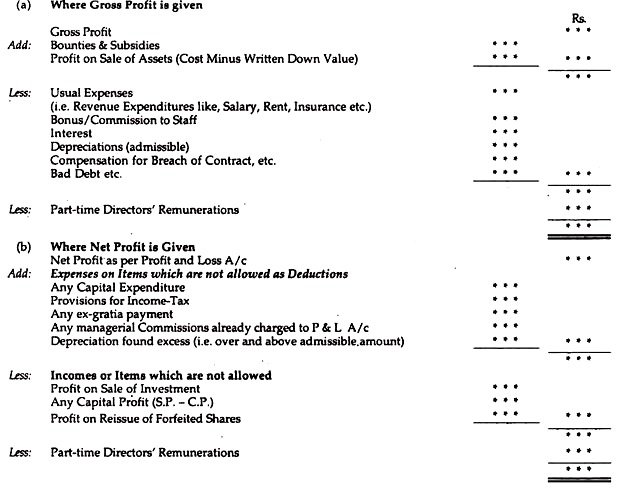
Method of Computation of ‘Profit’ for Calculating Managerial Remuneration:

General Illustrations:

Computation of Managerial Remuneration under Different Conditions:

Illustration 1:

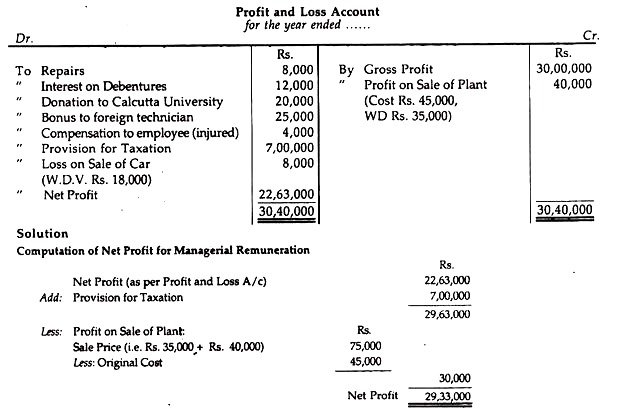
From the following Profit and Loss Account of X Ltd. compute the maximum permissible managerial remunerations under each of the following conditions:

(a) When there is only one whole-time Director

(b) When there are two whole-time directors

(c) When there are two whole-time Directors, a part-time director and a manager

(d) When there is only a part-time Director and no whole-time directors.

Calculation of Maximum Managerial Remuneration:

(a) When there is only one Director:

As per Sec. 349 of the Companies Act, where there is only one Director the maximum limit of managerial remuneration will be @ 5% of the net profit. So, the Managerial Remuneration will be Rs.1, 46,650 (i.e. Rs.29, 33,000 x5/100)

(b) When there are two Whole-time Directors:

The Maximum limit of managerial remuneration will be @ 10% of net profit i.e. Rs.2,93,300 (i.e. Rs. 29,33,000 x 10/100)

(c) When there are two Whole-time Directors, a Part-time Director and a Manager

Under the circumstances, the maximum limit of managerial remuneration will be @ 11% of Net Profit.

So, the Managerial Remuneration will be Rs.3, 22,630. (i.e. Rs.29, 33,000 x11/100).

(d) When there is only a Part-time Director and no Whole-time Director:

The maximum limit of managerial remuneration in this case will be only @ 1% of net profit. So the managerial remuneration will be Rs.29, 330 (i.e. Rs.29, 33,000 x 1/100).

Bonus Shares, Objects, Types, Sources, SEBI Guidelines

Bonus Shares are additional shares issued by a company to its existing shareholders, typically free of charge. They are distributed in proportion to the shares already held, meaning that shareholders receive a certain number of bonus shares for each share they own. Bonus shares are often issued as a way to distribute retained earnings, allowing companies to reward shareholders without depleting cash reserves. This practice can enhance liquidity in the market and may indicate the company’s strong financial position and growth potential.

Objects of Bonus Issue:

  1. Rewarding Shareholders:

One of the primary objectives of a bonus issue is to reward existing shareholders for their loyalty and investment in the company. By providing additional shares, companies acknowledge shareholders’ trust and commitment.

  1. Utilizing Retained Earnings:

Companies often have substantial retained earnings or reserves. Issuing bonus shares is a way to capitalize these profits, converting them into equity without distributing cash. This helps maintain a strong capital base while still providing value to shareholders.

  1. Enhancing Liquidity:

Bonus shares increase the number of shares in circulation, which can enhance the liquidity of the company’s stock. Higher liquidity may make it easier for investors to buy and sell shares, potentially attracting more investors and improving marketability.

  1. Improving Share Price:

Issuing bonus shares can help lower the market price per share by increasing the number of shares outstanding. This may make the shares more affordable for small investors, potentially broadening the shareholder base and increasing demand.

  1. Creating a Positive Market Sentiment:

Bonus issue is often perceived as a positive signal about a company’s financial health and growth prospects. It can boost investor confidence and improve the company’s image in the market, encouraging both current and potential investors.

  1. Encouraging Long-Term Investment:

Bonus shares can serve as an incentive for shareholders to hold onto their shares for the long term. This can help stabilize the share price and reduce market volatility, as more investors may choose to retain their shares to benefit from future growth.

  1. Aligning Interests of Employees and Shareholders:

Companies may issue bonus shares to employees as part of an incentive plan, aligning their interests with those of shareholders. This helps to motivate employees by giving them a stake in the company’s success and fostering a sense of ownership.

  1. Improving Financial Ratios:

Bonus issues can improve certain financial ratios, such as earnings per share (EPS) and return on equity (ROE). While EPS may decrease due to the increase in the number of shares, it can also reflect a more significant total equity, contributing to a more favorable perception of financial health.

Types of Bonus Issue:

  1. Fully Paid Bonus Shares:

These are shares issued to existing shareholders without any additional cost. The company capitalizes its reserves or profits to issue fully paid bonus shares, increasing the number of shares in circulation while maintaining the same overall value of equity.

  1. Partly Paid Bonus Shares:

In this type, bonus shares are issued with a requirement for shareholders to pay a portion of the share price. The company may decide to issue partly paid bonus shares as a way to raise additional capital while rewarding existing shareholders.

  1. Pro-rata Bonus Issue:

A pro-rata bonus issue is where the bonus shares are issued to shareholders in proportion to their existing holdings. For example, if a company issues a bonus share for every four shares held, a shareholder with four shares would receive one additional share.

  1. Bonus Shares from Reserves:

Companies may issue bonus shares by capitalizing reserves or profits. This approach allows companies to convert their retained earnings into equity shares, enhancing liquidity without affecting cash reserves.

  1. Bonus Shares for Employee Stock Options (ESOPs):

Some companies issue bonus shares to employees as part of an employee stock ownership plan or ESOP. These shares serve to motivate and retain key personnel by giving them a stake in the company’s success.

  1. Reverse Bonus Shares:

In contrast to traditional bonus shares, reverse bonus shares involve consolidating shares into fewer units. This type of issuance typically occurs when a company aims to increase its share price or comply with stock exchange listing requirements.

  1. Free Shares:

This category includes shares given as a reward to existing shareholders without requiring any payment. Free shares are often issued as part of an incentive plan to enhance shareholder loyalty and boost investor sentiment.

Source of Bonus Issue:

  1. Retained Earnings:

The most common source for issuing bonus shares is retained earnings. This represents the cumulative profits that a company has retained rather than distributed as dividends. By capitalizing retained earnings, a company can issue bonus shares to its shareholders without affecting its cash flow.

  1. General Reserve:

Companies can also use their general reserves, which are created out of profits not earmarked for any specific purpose. General reserves serve as a cushion for unforeseen expenses or losses, and utilizing them for bonus shares can help improve shareholder value while maintaining financial stability.

  1. Capital Redemption Reserve:

If a company has redeemed its preference shares, it may create a capital redemption reserve. This reserve can be used to issue bonus shares to ordinary shareholders, ensuring that the equity base remains strong after redeeming preference shares.

  1. Securities Premium Account:

When shares are issued at a premium, the amount received over and above the face value is credited to the securities premium account. Companies can utilize this account to issue bonus shares, provided they comply with the relevant legal provisions and regulations.

  1. Profit and Loss Account:

Companies can capitalize amounts from their profit and loss account, which reflects the net earnings after expenses and taxes. Issuing bonus shares from this account indicates that the company has sufficient profits to convert into equity.

  1. Other Reserves:

In addition to the above sources, companies may utilize other reserves, such as the revaluation reserve (created when assets are revalued to reflect current market value) or specific reserves set aside for particular purposes. These reserves can be capitalized to issue bonus shares, subject to regulatory compliance.

SEBI Guidelines for Issue of Bonus Shares:

  1. Eligibility Criteria:

Only companies that have a track record of consistent profits and are compliant with the listing requirements can issue bonus shares.

Companies must ensure that they have adequate reserves or profits to capitalize for issuing bonus shares.

  1. Board Resolution:

The issuance of bonus shares requires the approval of the Board of Directors. A board resolution must be passed detailing the number of shares to be issued, the proportion in which they will be issued, and the source of capitalization.

  1. Shareholder Approval:

Companies are required to obtain approval from shareholders through a special resolution in a general meeting before issuing bonus shares. The resolution must specify the number of shares and the rationale behind the issuance.

  1. Pro-rata Basis:

Bonus shares must be issued on a pro-rata basis to existing shareholders. This means that shareholders receive additional shares in proportion to their existing holdings, ensuring equitable treatment.

  1. Disclosure Requirements:

Companies must disclose the details of the bonus issue in their annual reports, including the rationale, source of capitalization, and any impact on the earnings per share (EPS) and other financial ratios. Additionally, companies should provide adequate information to shareholders and the stock exchanges regarding the bonus issue.

  1. Lock-in Period:

There is no specific lock-in period mandated by SEBI for bonus shares. However, the company may impose a lock-in period as part of its internal policies or based on the terms of the bonus issue.

  1. Credit of Shares:

Upon approval, the bonus shares must be credited to the demat accounts of shareholders within the stipulated timeframe, ensuring prompt delivery and compliance with market regulations.

  1. No Cash Consideration:

Bonus Shares are issued without any cash consideration. This means that shareholders do not have to pay for the additional shares they receive.

  1. Regulatory Compliance:

Companies must comply with all applicable provisions of the Companies Act, 2013, and SEBI regulations while issuing bonus shares. Any non-compliance can lead to penalties or legal consequences.

  1. Impact on Share Capital:

Companies must assess the impact of the bonus issue on their share capital and provide necessary disclosures regarding the revised capital structure post-issuance.

Barriers to Entrepreneurship

1. Finances

We are all bustling with ideas that are unique and can make for an amazing business start-up. But no matter how good your idea is, you will always need stable finances and funding from the investors to begin the process and take the first step towards your journey of entrepreneurship.

And getting a sound financial investment or funding can be one of the biggest Barriers to Entrepreneurship as many of banks, private investors, angel investors, and organizations find it quite difficult to believe in the start-up ideas owing to the risk of failure and losing their money.

2. Fear of not to be a success

We all go through the fear of failure. And if the fear is associated with the risks and stakes taken in the stream of business and entrepreneurship, the level of fear elevates.

There is a fear if we are on the right track, is the idea worthwhile, will there be profit, will I find investors, and various such fears and tensions act as the Barriers to Entrepreneurship.

3. No strategic plan in place

Lack of proper planning and strategy in place is one of the most common Barriers to Entrepreneurship. Many of us think to build a business out of a hobby without having any sort of long term and short term vision and plan in mind.

Running a fully-fledged business or being an entrepreneur requires a huge amount of skill set, passion for excelling, strategic vision, the mission to accomplish the goals, market research, and a lot more.

Right from the target market, finances, human resources, to a proper strategic plan is required to build a successful business or a brand in the market.

4. Human resource issues

Entrepreneurs cannot handle and run a business alone by themselves. We require the support of human resource to carve a niche in the market.

Employees with the required knowledge, expertise, and experience are needed for the efficiency of the business processes and high levels of productivity.

First of all, it is quite difficult to find the employees that share the same vision and wavelength of the business. Plus paying a hefty annual or even a monthly retainer income is a problem of the start up’s as the finances at hand are always limited, and the overheads and expenses are also to be taken care of.

And secondly, it is also difficult to manage human resources as each of us work with a different mindset and perspective. Hence, human resources and employees can be as one of the Barriers to Entrepreneurship.

5. Stringent rules and regulations of the market

It is not very easy for entrepreneurs to enter the new market as there are quite many rules and regulations imposed by the government authorities.

Plus there are various laws and compliances to be adhered to such as taxation, environmental regulations, licenses, property rights, and much more than act as the Barriers to Entrepreneurship.

Some of the countries have many corrupt officials that act as a hindrance for the new entrepreneurs and start-up brands to start or expand their business in the new market. And if the brand is planning to expand its business operations in any of the foreign countries, it gets even more difficult.

6. Fewer opportunities

Even though there is a lot of talent pool in the market with the aspiring entrepreneurs buzzing with the ideas, but the opportunities presented to them are quite less and fewer.

Reasons such as nepotism and corruption act as the Barriers to Entrepreneurship with not many vital and lucrative opportunities.

7. Lack of capacity

Even if there are opportunities presented to the aspiring entrepreneurs, there is a lack of capacity in some them to embrace the opportunities with open arms. The reasons can vary from lack of knowledge, lack of education, lack of willingness, lack of strategic knowledge, and cultural hindrances amongst others; but the factor of motivation and zeal gets missing.

To start a new business venture amidst all the risks and market-related issues, it requires a lot of hard work, passion, and high capacity to handle all of it.

8. Less market experience

The experts always mention that one should never rush in setting up a business. It is quite necessary to gain a relative amount of work experience by working in the industry domain or sector of choice and as per the education levels. It also helps to sharpen the required expertise and find the ground in the career graph.

Once the person is ready to take risks and have a relative amount of market exposure, he is ready to take the entrepreneurial plunge.

9. Lack of risk-taking capacity

It is always said that entrepreneurs never sail in safe waters and are never confined to their comfort zones. Lack of risk-taking capacity is the psychological mindset and perspective towards the business and acts as one of the major Barriers to Entrepreneurship.

The budding entrepreneur has to have a structured and organized approach towards the various business elements and should risks rather than averting them.

10. Corrupt business situations

As mentioned earlier, if the business situations and the environment are not very supportive and corrupt for the young and aspiring entrepreneurs, it acts as one of the top Barriers to Entrepreneurship.

Bribing, rampant corruption, unfriendly ties of government with other nations, inconsistent laws, stringent compliances, and enforcing regulations that are unhealthy and negative in their approach hamper the growth of businesses in the country.

Russia is one of the examples of having an unhealthy and unsupportive business environment.

11. Inadequate training

With no proper education, development, training, entrepreneurial skills, and technical know-how acts as the Barriers to Entrepreneurship.

12. Lack of practical knowledge

Having a strong educational background is just not enough to pursue business as it requires practical knowledge as well to stay relevant amidst the various market cycles. And many entrepreneurs lack practical knowledge.

Entrepreneurial Competencies

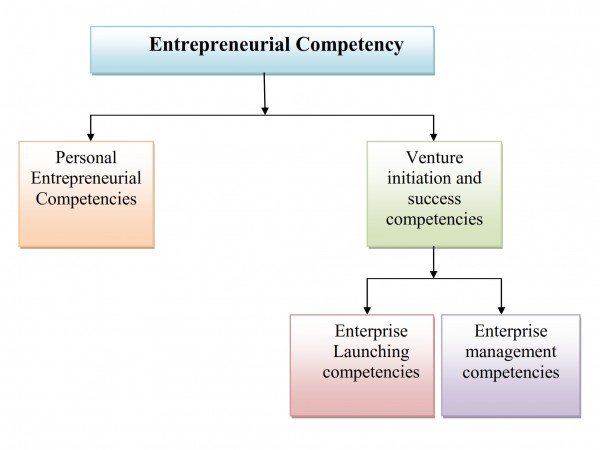
The competencies may be classified into following categories:

  1. Personal entrepreneurial competencies
  2. Venture initiation and success competencies

a) Enterprise launching competencies

b) Enterprise management competencies

  1. Personal Entrepreneurial competencies

It is the personal characteristics of an individual who possess to perform the task effectively and efficiently.Personal entrepreneurial competencies include the following:

a) Initiative

The entrepreneur should be able to take actions that go beyond his job requirements and to act faster. He is always ahead of others and able to become a leader in the field of business.He Does things before being asked or compelled by the situation and acts to extend the business into new areas, products or services.

b) Sees and acts on opportunities

An entrepreneur always looks for and takes action on opportunities. He Sees and acts on new business opportunities and Seizes unusual opportunities to obtain financing, equipment, land, work space or assistance.

c) Persistence

An entrepreneur is able to make repeated efforts or to take different actions to overcome an obstacle that get in the way of reaching goals. An entrepreneur takes repeated or different actions to overcome an obstacle and Takes action in the face of a significant obstacle.

  1. d) Information Seeking

An entrepreneur is able to take action on how to seek information to help achieve business objectives or clarify business problems.They do personal research on how to provide a product or service.They seek information or ask questions to clarify what is wanted or needed.They personally undertake research and use contacts or information networks to obtain useful information.

e) Concern for High Quality of Work

An entrepreneur acts to do things that meet certain standards of excellence that gives him greater satisfaction. An entrepreneur states a desire to produce or sell a top or better quality product or service. They compare own work or own company’s work favourably to that of others.

f) Commitment to Work Contract

An entrepreneur places the highest priority on getting a job completed.They make a personal sacrifice or take extraordinary effort to complete a job.They accept full responsibility for problems in completing a job for others and express concern for satisfying the customer.

g) Efficiency Orientation

A successful entrepreneur always finds ways to do things faster or with fewer resources or at a lower cost.They look for or finds ways to do things faster or at less cost.An entrepreneur uses information or business tools to improve efficiency. He expresses concern about costs vs. benefits of some improvement, change, or course of action.

h) Systematic Planning

An entrepreneur develops and uses logical, step-by-step plans to reach goals.They plan by breaking a large task into subtask and develop plans,then anticipate obstacles and evaluate alternatives.They take a logical and systematic approach to activities.

i) Problem Solving

Entrepreneurs identify new and potentially unique ideas to achieve his goals.They generate new ideas or innovative solutions to solve problems and they take alternative strategies to solve the problems.

j) Self-Confidence

Entrepreneur with this competency will have a strong belief in self and own abilities.They express confidence in their own ability to complete a task or meet a challenge.They stick to their own judgment while taking decision.

k) Assertiveness

An entrepreneur confronts problems and issues with others directly.Entrepreneur with this competency vindicate the claim to asset their own rights on others.They demand recognition and disciplines those failing to perform as expected.They asset own competence,reliability or other personal or company’s qualities.They also assert strong confidence in own company’s or organization’s products or service.

l) Persuasion

Entrepreneurs with this competency successfully pursue others to perform the activities effectively and efficiently.An entrepreneur can persuade or influence others for mobilizing resources, obtaining inputs, organizing productions and selling his products or services.

m) Use of Influence Strategies

An entrepreneur is able to make use of influential people to reach his business goals.Entrepreneurs with this competency influence the environment (Individuals/Institution) for mobilizing resources organizing production and selling goods and services to develop business contacts.

n) Monitoring

Entrepreneurs with this competency normally monitor or surprise all the activities of the concern to ensure that the work is completed by maintaining good quality.

o) Concern for Employee Welfare

Entrepreneurs with this competency take action to improve the welfare of employees and take positive action in response of employee’s personal concerns.

  1. Venture Initiation and success Competencies

In addition to personal competencies Entrepreneur must also possess the competencies required to launch the enterprise and for its growth and survival.

It is further divided into two categories of competencies:

  1. Enterprise launching competencies
  2. Enterprise management competencies

1)  Enterprise launching competencies

  • Competency to understand the nature of business

-To analyse the personal advantage of owning a small business.

-To analyse the personal risks of owning a small business.

-To analyse how to maximize the opportunities and minimize the risks of owning a business.

  • Competency to determine the potential as an entrepreneur

-To consider the personal qualification and abilities needed to manage own business.

-To evaluate the own potentials for decision-making,problem solving and creativity.

-To determine own potential for management,planning,operations,personnel and public relations.

  • Competency to develop a business plan

-To identify how a business plan helps the entrepreneur.

-To recognize how a business plan should be organized.

-To identify and use the mechanisms for developing a business plan.

  • Competency to obtain technical assistance

-To prepare for using technical assistance.

-To select professional consultants.

-To work effectively with consultants.

  • Competency to a choose the type of ownership

-To analyse the type of ownership of business.

-To follow the steps necessary to file for ownership of the business.

-To define politics and procedures for a successful multi-owner.

  • Competency to plan the market strategy

-To use goods classification and life cycle analysis as planning tools for marketing.

-To develop and modify marketing mixes for a business.

-To use decision making tools and aid in evaluating marketing activities.

-To evaluate operations to improve decision making about marketing.

  • Competency to locate the business

-To analyse customer transportation,access,parking and so forth. i.e. relative to alternative site locations.

-To complete a location feasibility study for the business.

-To determine the cost of renovating or improving a site for the business.

-To prepare an occupancy contrast for the business.

  • Competency to finance the business

-To describe the source of information available to help in estimating the financing necessary to start a new business.

-To determine the finance necessary to start a new business.

-To prepare a project profit and loss statement and a projected cash flow statement for the new business.

-To prepare a loan application package.

  • Competency to deal with the business

-To determine the need for legal assistance.

-To select the provisions that is desired in the lease.

-To prepare sales contract(such a s credit sales or long term sales) that may be utilized in the contracts

-To evaluate contracts.

-To determine the need for protection of ideas and intentions.

  • Competency to comply with government regulations

-To appraise the effects of various regulations on the business operations.

-To acquire the information necessary to comply with the various rules and regulations affecting the business.

-To develop policies for the business to comply with the Government rules and regulations.

2) Enterprise Management Competencies

  • Competency to manage the business

-To plan goals and objectives for the business.

-To develop a diagram showing the organizational structure for the business.

-To establish control practices and procedures for the business

  • Competency to manage human resources

-To plan goals and objectives for the business.

-To develop a diagram showing the organizational structure for the business.

-To establish control practices and procedures for the business.

  • Competency to manage human resources

-To write a job description for a position in the business.

-To develop a training programme online for employees.

-To develop a list of personnel for employees in the business.

-To develop an outline for an employee evaluation system.

-To plan a corrective interview with an employee concerning a selected problem.

  • Competency to promote the business

-To create a long-term promotional plan.

-To describe the techniques used to prepare advertising and promotion

-To analyse competitive promotional activities.

-To evaluate promotional effectiveness.

-To plan a community relations programme.

  • Competency to manage sales efforts.

-To develop a sales plan for the business.

-To develop policies and procedures for serving the customers.

-To develop a plan for training and motivating sales people.

  • Competency to keep business records

-To determine who will keep the books for the business and how they will be maintained.

-To describe double-entry bookkeeping.

-Select the types of journals and ledges that you will use in the business.

-To identify the types of records that will be used in the business to record sales,cash receipts,cash disbursements,accounts receivable,accounts payable,payroll,petty cash,inventory,budgets and other items.

-To evaluate the business records.

-To identify how a micro-computer may be used to keep he business records.

  • Competency to manage the finances

-To explain the importance of cash flow management.

-To identify financial control procedures.

-To describe how to find cash flow patterns.

-To analyse trouble spots in financial management.

-To describe how to prepare an owner’s equity financial statement.

-To analyse financial management ratios applicable to a small business.

-To identify the components of break even point problem.

-To review microcomputer application for financial management.

  • Competency to manage customer credit and collection

-To analyse the legal rights and resource of credit guarantors.

-To develop a series of credit collection reminders and the follow up activities.

-To develop various credit and collection policies.

-To prepare a credit promotion plan.

-To discuss information resources and systems that apply to credit and collection procedures.

  • Competency to protect the business

-To prepare policies for the firm that will help minimize losses due to employee theft, vendor theft, bad cheques, shoplifting, robbery, injury or product liability.

Entrepreneurship, Definitions, Characteristics, Functions, Types, Importance, Factors influencing, Core elements and Role of Entrepreneurship in Economic Development

Entrepreneurship is the process of identifying, developing, and managing a business idea into a profitable venture while taking calculated risks. It involves innovation, creativity, leadership, and the ability to recognize opportunities in dynamic environments. Entrepreneurs mobilize resources such as capital, labor, and technology to establish businesses that generate value for society.

The essence of entrepreneurship lies in problem-solving—creating goods or services that fulfill market needs and improve people’s lives. Unlike routine business operations, entrepreneurship emphasizes innovation and adaptability. Entrepreneurs not only contribute to economic development but also stimulate employment, competition, and technological advancement.

In modern economies, entrepreneurship extends beyond profit-making to include social entrepreneurship, which focuses on societal development, and green entrepreneurship, which promotes sustainability. Startups, particularly in technology, agriculture, and services, have redefined entrepreneurship by leveraging digital tools and global networks.

Entrepreneurship is therefore both an economic activity and a mindset—a way of thinking that embraces change, uncertainty, and risk in pursuit of opportunity. Successful entrepreneurs demonstrate resilience, vision, and decision-making skills that help them navigate challenges and create long-term impact. In the era of globalization and innovation, entrepreneurship acts as a key driver of progress, competitiveness, and inclusive growth.

Characteristics/Nature of Entrepreneurship

  • Innovation

Entrepreneurship is driven by innovation, which involves introducing new products, processes, or business models. Entrepreneurs identify gaps in the market and create unique solutions that add value. Innovation not only differentiates a startup but also helps in achieving a competitive edge. By leveraging creativity, entrepreneurs disrupt traditional practices and generate efficiency, affordability, and improved customer experiences. Innovation is thus the cornerstone of entrepreneurship, enabling both economic growth and societal progress.

  • Risk-Taking

A defining characteristic of entrepreneurship is risk-taking. Entrepreneurs often operate in uncertain environments where outcomes are unpredictable. They take financial, social, and psychological risks to establish and grow ventures. While risk does not guarantee success, entrepreneurs manage it strategically through research, planning, and adaptability. Their ability to embrace risk reflects confidence and resilience. Without the courage to step into uncertainty, many groundbreaking businesses and opportunities for economic development would not exist.

  • Visionary Leadership

Entrepreneurs are visionary leaders who see opportunities where others see challenges. They have the ability to predict trends, set long-term goals, and inspire others toward achieving them. Their leadership ensures that resources, teams, and strategies are aligned with the business vision. Visionary leadership not only motivates employees but also attracts investors, partners, and customers. Entrepreneurs with a strong vision create businesses that endure challenges and contribute significantly to industry transformation and innovation.

  • Decision-Making Ability

Effective decision-making is essential in entrepreneurship. Entrepreneurs frequently face complex situations requiring quick, informed choices. They analyze risks, evaluate alternatives, and choose strategies that maximize opportunities while minimizing losses. Good decision-making ensures efficient resource utilization and business continuity. Entrepreneurs must balance intuition with data-driven analysis to succeed. Their ability to make timely decisions in uncertain circumstances determines the survival and growth of the venture, making decision-making a critical entrepreneurial trait.

  • Resilience and Perseverance

Entrepreneurship involves numerous challenges such as financial difficulties, competition, and market failures. Resilience and perseverance are key characteristics that help entrepreneurs navigate setbacks. Rather than giving up, successful entrepreneurs learn from failures and re-strategize. Perseverance builds credibility with stakeholders, while resilience strengthens their ability to recover from crises. These traits ensure that entrepreneurs remain committed to their goals despite obstacles, making resilience and perseverance indispensable qualities for long-term entrepreneurial success.

  • Resource Mobilization

Entrepreneurs excel in mobilizing resources such as capital, technology, and human talent to build businesses. They identify, acquire, and utilize resources efficiently to maximize productivity. Effective resource mobilization includes networking, securing investments, and forming strategic partnerships. Entrepreneurs with this skill ensure their ventures remain financially viable and competitive. By optimizing available resources and identifying new ones, entrepreneurs maintain agility and sustainability, which are crucial for business growth and expansion in dynamic environments.

  • Customer-Centric Approach

A successful entrepreneur understands the importance of customers as the foundation of business success. They focus on identifying customer needs, preferences, and behaviors to create tailored products and services. Customer-centric entrepreneurs actively engage with feedback, ensuring continuous improvement. By prioritizing customer satisfaction and building strong relationships, they develop loyalty and trust, which sustains long-term growth. A customer-first approach distinguishes businesses in competitive markets and fosters lasting relevance in changing economic conditions.

  • Adaptability and Flexibility

Entrepreneurship operates in dynamic environments where markets, technologies, and consumer preferences change rapidly. Entrepreneurs must be adaptable and flexible to survive and thrive. Adaptability means adjusting business models, strategies, and operations in response to shifts, while flexibility ensures openness to new ideas and approaches. Entrepreneurs who embrace change proactively are better equipped to capitalize on opportunities and handle disruptions. This characteristic ensures sustainable growth and resilience in volatile and uncertain markets.

Functions of Entrepreneurship

  • Innovation

Innovation is the primary function of entrepreneurship, involving the creation and introduction of new products, services, technologies, or business models. Entrepreneurs identify gaps in the market and develop unique solutions that add value for consumers. This function drives economic progress by improving efficiency and productivity. Innovation also helps businesses differentiate themselves from competitors and capture new markets. It is a continuous process that requires creativity, experimentation, and risk-taking to convert ideas into practical and profitable outcomes.

  • Risk-Taking

Entrepreneurs take calculated risks by investing time, capital, and effort into uncertain business ventures. This function involves evaluating potential opportunities, analysing possible outcomes, and making decisions despite uncertainties. Risk-taking is essential for business growth because no innovation or opportunity comes without challenges. Entrepreneurs must handle financial risks, market fluctuations, competition, and operational uncertainties. Successful entrepreneurs accept these risks, prepare for setbacks, and implement strategies to minimise losses while maximizing potential rewards, thereby driving economic and industrial development.

  • Organising Resources

Entrepreneurs play an important role in mobilising and organising resources such as capital, labour, technology, and raw materials. They bring together these factors of production and coordinate them to ensure the smooth functioning of business activities. This function requires strong managerial and decision-making skills. The entrepreneur determines what resources are needed, how to acquire them, and how to allocate them efficiently. By effectively organising resources, entrepreneurs ensure productivity, reduce wastage, and maintain operational efficiency necessary for achieving business goals.

  • Decision-Making

Entrepreneurs are responsible for making strategic, financial, and operational decisions that determine the direction of the business. Decision-making involves analysing information, forecasting future conditions, and choosing the best possible alternatives. These decisions include selecting business opportunities, determining pricing strategies, hiring employees, and planning investments. Effective decision-making requires critical thinking, judgement, and foresight. Entrepreneurs must make timely decisions to respond to market changes, competition, and customer needs. Good decisions contribute to business success and long-term sustainability.

  • Business Planning

Business planning involves defining the vision, mission, objectives, strategies, and resources needed for the venture. Entrepreneurs prepare business plans to guide operations, attract investors, and evaluate feasibility. This function also includes setting short-term and long-term goals, analysing market trends, and forecasting financial performance. A well-structured plan helps entrepreneurs stay focused, monitor progress, and adjust strategies based on changing conditions. Business planning reduces uncertainty, enhances coordination, and serves as a roadmap for growth, stability, and competitive advantage.

  • Creating Employment

Entrepreneurs contribute significantly to employment generation by starting and expanding business ventures. When they hire workers for production, sales, marketing, and administration, they create job opportunities for various skill levels. This function supports economic development by reducing unemployment and increasing income levels. As businesses grow, they generate indirect employment as well through supply chains, distribution networks, and service providers. By creating employment, entrepreneurs improve living standards and contribute to the social and economic upliftment of communities.

  • Marketing and Customer Management

Entrepreneurs must identify customer needs, develop suitable products, and design marketing strategies to promote their offerings. This function includes market research, pricing decisions, branding, distribution, and customer service. Understanding customer preferences helps entrepreneurs deliver value and build long-term relationships. Effective marketing ensures business visibility, increases sales, and enhances competitiveness. Entrepreneurs continuously adapt marketing strategies based on market trends and customer feedback. Proper customer management helps in retaining clients, increasing loyalty, and ensuring consistent revenue generation.

  • Economic Development

Entrepreneurs play a vital role in national economic development by promoting innovation, increasing productivity, generating employment, and contributing to GDP. Their ventures stimulate industrial growth, create wealth, and enhance living standards. Entrepreneurship encourages competition, improves product quality, and promotes efficient utilisation of resources. Additionally, entrepreneurs support regional development by establishing industries in backward areas. Their contribution to exports, technology adoption, and infrastructure development strengthens the overall economy and positions the country for sustainable long-term growth.

Types of Entrepreneurship

1. Small Business Entrepreneurship

This involves setting up small-scale businesses such as retail shops, service centers, workshops, and local manufacturing units. These ventures usually cater to local markets and operate with limited resources, family labour, and traditional technologies. The primary goal is to provide livelihood rather than pursue rapid growth. They contribute significantly to employment generation and regional development.

2. Scalable Startup Entrepreneurship

Scalable startups are high-growth ventures designed to expand rapidly, often with the support of venture capital or angel investors. They focus on innovative products, disruptive technologies, or unique business models. Examples include tech startups, app-based companies, and biotechnology firms. Their aim is not only to capture large markets but also to scale globally.

3. Large Company Entrepreneurship (Corporate Entrepreneurship / Intrapreneurship)

Large or established companies also engage in innovative activities to maintain competitiveness. Corporate entrepreneurship involves developing new products, entering new markets, or launching new business lines within the organisation. Employees act as intrapreneurs, using company resources to innovate while reducing personal risk.

4. Social Entrepreneurship

Social entrepreneurship focuses on solving social, cultural, or environmental issues through sustainable business models. Profit is not the primary objective; instead, the aim is to create social value. Examples include ventures addressing poverty, education, healthcare, sanitation, or renewable energy. These entrepreneurs combine compassion with business strategies.

5. Innovative Entrepreneurship

Innovative entrepreneurs introduce new ideas, technologies, products, or methods of production. They thrive on creativity and research. Their ventures often lead to significant changes in industries and markets. Examples include innovators in AI, fintech, biotechnology, clean energy, and product design.

6. Imitative (Adaptive) Entrepreneurship

Imitative entrepreneurs copy or adapt existing business ideas, products, or services and modify them to suit local markets. They do not invest heavily in research and development but rely on proven concepts. This type is common in developing countries where risk-taking ability is low and markets prefer familiar offerings.

7. Trading Entrepreneurship

Trading entrepreneurs focus on buying and selling goods rather than producing them. They bridge the gap between producers and consumers by engaging in wholesale, retail, import, or export activities. Their success depends on market knowledge, negotiation skills, and efficient distribution.

8. Manufacturing Entrepreneurship

Manufacturing entrepreneurs convert raw materials into finished goods by establishing production units. They require technical knowledge, capital investment, and manpower. Examples include textile units, food processing plants, automobile parts manufacturing, and chemical production.

9. Agricultural Entrepreneurship

Agricultural or agri-entrepreneurs engage in farming, dairy, poultry, fisheries, organic farming, food processing, and agribusiness ventures. They introduce modern technologies and innovative practices to improve productivity and sustainability in the agriculture sector.

10. Rural Entrepreneurship

This type focuses on establishing business ventures in rural areas. It includes handloom, handicrafts, agro-processing, village shops, and rural service enterprises. Rural entrepreneurship plays an essential role in reducing migration, promoting local employment, and developing rural economies.

11. Women Entrepreneurship

Women entrepreneurs are those who independently start, manage, and operate business ventures. Their ventures span manufacturing, services, retail, IT, handicrafts, and home-based industries. Encouraging women entrepreneurship enhances gender equality, economic participation, and family welfare.

12. Green / Eco Entrepreneurship

Green entrepreneurs focus on environmentally sustainable products, services, or technologies. Their ventures aim to reduce pollution, conserve resources, and promote eco-friendly business practices. Examples include recycling units, renewable energy ventures, organic products, and waste-management startups.

13. Technopreneurship (Technology Entrepreneurship)

Technopreneurs use technology, innovation, and R&D to develop tech-based businesses. They depend on highly skilled talent and operate in sectors like software, AI, robotics, drones, semiconductors, and biotechnology. Their ventures have high scalability and global potential.

14. Serial Entrepreneurship

Serial entrepreneurs repeatedly start new businesses, sell them, and move on to new ventures. They are highly creative, risk-taking, and opportunity-driven. Their experience helps them build multiple successful companies over time.

Importance of Entrepreneurship

  • Economic Growth

Entrepreneurship plays a vital role in driving economic growth by creating new businesses, industries, and jobs. Entrepreneurs introduce innovations that boost productivity and efficiency across sectors. Their ventures attract investments, stimulate trade, and generate wealth. By fostering competition and new market opportunities, entrepreneurship strengthens economies and reduces dependency on traditional industries. As a result, countries with vibrant entrepreneurial ecosystems experience faster economic development and are better positioned to adapt to global economic shifts.

  • Employment Generation

One of the most significant contributions of entrepreneurship is employment creation. Startups and small businesses absorb a large portion of the workforce, especially in developing economies. Entrepreneurs hire skilled, semi-skilled, and unskilled workers, reducing unemployment and underemployment. Beyond direct jobs, they create indirect opportunities in supply chains, logistics, and support services. By fostering job diversity and providing innovative work models, entrepreneurship contributes to inclusive growth and helps reduce poverty through sustainable employment opportunities.

  • Innovation and Technological Advancement

Entrepreneurs introduce innovative ideas, processes, and technologies that transform industries. They challenge existing norms and create breakthroughs in fields like healthcare, agriculture, and digital services. Entrepreneurship fosters research and development (R&D), leading to cutting-edge solutions that improve efficiency and quality of life. By leveraging new technologies, entrepreneurs promote modernization, disrupt outdated models, and make services more accessible. Such technological advancements not only benefit local communities but also enhance global competitiveness and knowledge sharing.

  • Promoting Regional Development

Entrepreneurship helps reduce economic imbalances by encouraging business growth in rural and semi-urban areas. Agro-based startups, handicraft ventures, and local enterprises create income opportunities and infrastructure development outside metropolitan regions. This decentralization reduces migration to cities and supports balanced regional growth. Entrepreneurs also bring new industries to underdeveloped regions, improving education, healthcare, and living standards. By channeling resources into local economies, entrepreneurship strengthens social equity and bridges the rural-urban development divide effectively.

  • Enhancing Global Competitiveness

In an interconnected world, entrepreneurship enhances a nation’s competitiveness by fostering efficiency, innovation, and productivity. Startups expose local industries to international markets through exports, collaborations, and digital platforms. Entrepreneurs create brands and products that represent national strengths on the global stage. By improving quality, reducing costs, and innovating rapidly, they allow economies to compete with advanced nations. This global competitiveness ensures economic resilience, attracts foreign investments, and positions countries as leaders in international trade.

  • Wealth Creation and Distribution

Entrepreneurship contributes significantly to wealth generation by creating profitable ventures that add value to economies. Entrepreneurs generate income for themselves, employees, investors, and governments through taxes. Unlike wealth concentration in traditional monopolies, entrepreneurship ensures wider distribution of wealth through opportunities for small businesses and startups. This circulation of income fosters purchasing power, supports community development, and sustains growth. By empowering individuals to participate in wealth creation, entrepreneurship enhances financial inclusion and societal progress.

  • Social Development

Entrepreneurship extends beyond profits to address social needs through innovations in education, healthcare, and sustainability. Social entrepreneurs design solutions for issues like poverty, clean energy, and affordable housing. By integrating social responsibility with business, entrepreneurs uplift marginalized communities and foster inclusive development. Startups focusing on sustainable practices reduce environmental harm while improving living standards. Thus, entrepreneurship serves as a tool for both economic and social transformation, ensuring a balance between growth and equity.

  • Encouraging Self-Reliance

Entrepreneurship nurtures self-reliance by promoting business ownership and reducing dependency on government jobs or foreign companies. Entrepreneurs cultivate independence by creating opportunities and solving problems using local resources. This mindset fosters confidence, resilience, and innovation within societies. Nations with strong entrepreneurial ecosystems achieve economic independence by reducing imports, boosting exports, and sustaining local industries. At an individual level, entrepreneurship empowers people to take control of their economic futures, fostering pride and financial security.

Factors influencing Entrepreneurship

  • Economic Factors

Economic conditions strongly influence entrepreneurship. Factors like availability of capital, infrastructure, raw materials, and market demand determine entrepreneurial activity. A stable economy encourages investment and business growth, while inflation, high taxes, or poor credit availability discourage startups. Entrepreneurs thrive in environments with supportive financial institutions, easy access to loans, and favorable trade policies. Economic stability ensures predictability, allowing entrepreneurs to take risks and innovate, making economic factors the most fundamental driver of entrepreneurship.

  • Social and Cultural Factors

Social and cultural values play a crucial role in shaping entrepreneurial behavior. Communities that encourage independence, risk-taking, and innovation create strong entrepreneurial ecosystems. Cultural attitudes toward wealth, success, and social mobility also influence entrepreneurship. Family support, societal recognition, and community networks motivate individuals to start ventures. Conversely, rigid traditions or resistance to change may hinder entrepreneurship. Therefore, supportive social structures and progressive cultural norms foster an environment where entrepreneurial ideas can flourish effectively.

  • Political and Legal Factors

A stable political system and supportive government policies encourage entrepreneurship. Transparent regulations, simplified licensing, tax benefits, and ease of doing business create a conducive business environment. Conversely, excessive bureaucracy, corruption, or unpredictable policies discourage entrepreneurs. Laws related to intellectual property rights, labor, and trade also impact entrepreneurial activity. Countries with strong governance attract more startups and foreign investments. Thus, political stability and favorable legal frameworks are essential for entrepreneurial confidence and long-term sustainability.

  • Technological Factors

Technology drives modern entrepreneurship by enabling innovation, efficiency, and market expansion. Access to advanced tools such as AI, IoT, blockchain, and automation empowers entrepreneurs to create competitive products and services. Digital platforms facilitate global reach and reduce operational costs. However, lack of technological infrastructure can hinder growth, especially in developing regions. Startups thrive in tech-friendly environments where research and development (R&D) is promoted. Technological advancements are therefore both enablers and accelerators of entrepreneurship.

  • Educational and Skill Factors

Education enhances entrepreneurial ability by equipping individuals with knowledge, skills, and confidence. Entrepreneurial education fosters creativity, problem-solving, and risk management. Institutions offering business programs, incubators, and mentorship opportunities build entrepreneurial ecosystems. Skilled labor availability also supports ventures, ensuring productivity and innovation. Lack of education or vocational training, however, limits entrepreneurial growth. Thus, quality education and skills development play a critical role in producing entrepreneurs capable of managing businesses effectively and driving long-term success.

  • Psychological and Personal Factors

Entrepreneurship is greatly influenced by an individual’s mindset, personality, and motivation. Traits like risk-taking, resilience, creativity, leadership, and ambition determine entrepreneurial success. A strong need for achievement and independence motivates individuals to pursue ventures despite challenges. Confidence in decision-making and adaptability to uncertainty are also crucial. Conversely, fear of failure or low self-efficacy discourages entrepreneurship. Ultimately, personal attitudes and psychological strength act as the foundation upon which entrepreneurial ventures are built and sustained.

  • Environmental and Geographical Factors

Geographical conditions, natural resources, and local environments significantly influence entrepreneurship. Regions rich in raw materials, fertile lands, or favorable climates promote agro-based and resource-driven startups. Similarly, industrial clusters or urban centers with good connectivity provide advantages for manufacturing and services. Infrastructure like transport, energy, and communication also shapes entrepreneurial opportunities. Conversely, poor infrastructure or adverse climates can hinder business growth. Thus, environmental and geographical conditions determine the type and scale of entrepreneurial activity.

  • Global and Market Factors

Globalization and market dynamics have a profound impact on entrepreneurship. Open markets, international trade agreements, and access to global customers create vast opportunities for entrepreneurs. Competitive markets push entrepreneurs toward innovation and efficiency. Global trends like sustainability, digitalization, and e-commerce also influence entrepreneurial ventures. However, global economic downturns or supply chain disruptions can pose risks. Entrepreneurs who adapt quickly to international trends and demands remain competitive, making global and market forces vital influencers.

Key Elements of Entrepreneurship:

After having studied the concept of entrepreneurship, now let us look at some key elements that are necessary for entrepreneurship. We will be looking at four of the most important elements.

  • Innovation

An entrepreneur is the key source of innovation and variation in an economy. It is actually one of the most important tools of an entrepreneurs success. They use innovation to exploit opportunities available in the market and overcome any threats.

So this innovation can be a new product, service, technology, production technique, marketing strategy, etc. Or innovation can involve doing something better and more economically. Either way in the concept of entrepreneurship, it is a key factor.

  • Risk-Taking

Entrepreneurship and risk-taking go hand in hand. One of the most important features of entrepreneurship is that the whole business is run and managed by one person. So there is no one to share the risks with.

Not taking any risks can stagnate a business and excessive impulsive risk-taking can cause losses. So a good entrepreneur knows how to take and manage the risks of his business. But the willingness of an entrepreneur to take risks gives them a competitive edge in the economy. It helps them exploit the opportunities the economy provides.

  • Vision

Vision or foresight is one of the main driving forces behind any entrepreneur. It is the energy that drives the business forward by using the foresight of the entrepreneur. It is what gives the business an outline for the future – the tasks to complete, the risks to take, the culture to establish, etc.

All great entrepreneurs of the world that started with an entrepreneurship business are known to have great vision. This helps them set out short term and long term goals for their business and also plan ways to achieve these objectives.

  • Organization

In entrepreneurship, it is essentially a one-man show. The entrepreneur bears all the risks and enjoys all the rewards. And sure he has the help of employees and middle-level management, yet he must be the one in ultimate control. This requires a lot of organization and impeccable organizational skills.

An entrepreneur must be able to manage and organize his finances, his employees, his resources, etc. So his organizational abilities are one of the most important elements of entrepreneurship.

Role of Entrepreneurship in Economic Development

  • Employment Generation

Entrepreneurship significantly reduces unemployment by creating job opportunities across sectors. Startups and small enterprises hire both skilled and unskilled labor, absorbing the workforce that large corporations or governments cannot fully accommodate. They also stimulate indirect employment in allied industries such as logistics, supply chains, and services. By diversifying job opportunities, entrepreneurship enhances income distribution and reduces poverty. This role is crucial in developing nations where rapid population growth increases the demand for sustainable employment.

  • Capital Formation

Entrepreneurs mobilize savings and channel them into productive investments. By attracting funds from personal resources, investors, and financial institutions, they contribute to capital formation, which is vital for economic growth. New enterprises not only increase the pool of investable resources but also generate profits and taxes that further strengthen national wealth. This continuous cycle of investment and reinvestment enhances industrial activity, infrastructure development, and technological progress, forming the backbone of sustainable economic development.

  • Innovation and Technological Advancement

Entrepreneurs drive innovation by introducing new products, services, and technologies that improve efficiency and productivity. They invest in research and development, transforming ideas into practical solutions that address consumer and societal needs. Such innovations create competitive markets, reduce costs, and enhance the quality of goods and services. By pushing technological boundaries, entrepreneurs modernize industries, open up new markets, and ensure that economies remain adaptable and competitive in an ever-evolving global environment.

  • Regional Development

Entrepreneurship supports balanced regional development by encouraging businesses in less developed or rural areas. Agro-based startups, cottage industries, and local enterprises bring economic activity to regions often neglected by large corporations. This reduces migration to urban centers, strengthens rural economies, and improves living standards. Entrepreneurs also contribute to the development of infrastructure such as roads, schools, and healthcare facilities in these areas. Balanced regional development ensures equitable growth and reduces disparities between rural and urban economies.

  • Enhancing Exports and Global Competitiveness

Entrepreneurs strengthen a nation’s position in the global economy by creating products and services that meet international standards. Export-oriented startups generate foreign exchange, contributing to economic stability. By competing in global markets, entrepreneurs push for higher quality and innovation, which enhances national competitiveness. Global exposure also attracts foreign investment, partnerships, and knowledge sharing. This role is critical in integrating local economies with international markets, ensuring resilience and growth in an interconnected world economy.

  • Wealth Creation and Distribution

Entrepreneurship generates wealth by building profitable ventures that benefit entrepreneurs, employees, investors, and governments. Unlike monopolistic structures where wealth is concentrated, entrepreneurship promotes equitable distribution by encouraging small and medium enterprises. Profits circulate through wages, dividends, and taxes, creating broader economic participation. This fosters financial inclusion, improves purchasing power, and uplifts communities. By distributing wealth across various levels of society, entrepreneurship supports sustainable growth and reduces inequality within national and regional economies.

  • Social Development and Sustainability

Beyond economic benefits, entrepreneurs address social challenges by introducing solutions in healthcare, education, energy, and housing. Social and green entrepreneurship promote sustainability by reducing environmental harm while improving living standards. Startups focusing on renewable energy, waste management, and affordable services contribute to inclusive development. By aligning profit with social responsibility, entrepreneurs build resilient societies. This dual contribution ensures that economic growth goes hand-in-hand with social progress and environmental protection, strengthening long-term development goals.

  • Promoting Self-Reliance

Entrepreneurship fosters self-reliance at both individual and national levels. By creating local industries and reducing dependence on imports, entrepreneurs contribute to economic independence. They harness local resources to solve local problems, promoting pride and confidence in communities. For individuals, entrepreneurship provides autonomy, reducing dependency on limited government jobs or external employers. At the national level, self-reliant economies are better equipped to face global uncertainties and crises, making entrepreneurship a foundation of sustainable economic sovereignty.

Identification of Business Opportunities

Identification of business opportunities is the foundation of entrepreneurship and economic growth. It involves recognizing unmet needs, gaps in the market, or innovative ways to deliver existing products and services. Entrepreneurs carefully analyze market trends, customer behavior, technological advancements, and regulatory changes to spot viable opportunities. This process requires creativity, critical thinking, and strong analytical skills. A well-identified opportunity aligns with the entrepreneur’s resources, skills, and goals while offering potential for profitability and scalability. In today’s competitive environment, identifying the right business opportunity is crucial for long-term sustainability and innovation-driven success.

  • Market Research and Analysis

Market research is a vital step in identifying business opportunities as it provides data-driven insights into consumer preferences, market size, and emerging trends. Entrepreneurs analyze primary and secondary data to understand customer needs, competition, and pricing structures. Tools like surveys, interviews, and SWOT analysis help determine market gaps and potential demand. Market research also identifies geographical and demographic segments that are underserved, offering room for innovation. By interpreting data effectively, entrepreneurs can develop products or services that meet existing demands or create new ones. A strong understanding of the market minimizes risks and maximizes the chances of business success.

  • Technological Innovation

Technological innovation plays a major role in identifying new business opportunities by transforming how products and services are created and delivered. Entrepreneurs leverage technologies such as artificial intelligence, machine learning, blockchain, and the Internet of Things to design modern, efficient solutions. Innovation opens new markets, disrupts traditional models, and enhances productivity. By adopting emerging technologies early, businesses can offer unique value propositions and gain a competitive edge. For instance, advancements in renewable energy, fintech, and health-tech have led to entirely new industries. Recognizing and integrating relevant technologies allows entrepreneurs to anticipate market needs and build sustainable, future-ready ventures.

  • Social and Demographic Changes

Social and demographic changes create new opportunities for entrepreneurs by altering consumer lifestyles, preferences, and population structures. Factors such as urbanization, rising middle-class income, aging populations, and changing family dynamics influence market demand. For instance, the growth of working women has increased demand for childcare services, ready-to-eat meals, and e-commerce. Similarly, awareness of health and wellness has encouraged businesses in fitness, organic food, and healthcare sectors. Entrepreneurs who observe and adapt to these trends can develop products and services that meet evolving societal needs. Understanding social and demographic dynamics helps entrepreneurs remain relevant, innovative, and customer-centric in a rapidly changing marketplace.

  • Government Policies and Initiatives

Government policies play a crucial role in creating business opportunities by shaping the economic environment through reforms, incentives, and programs. Initiatives such as Make in India, Startup India, and Digital India have encouraged innovation and entrepreneurship. Policies related to taxation, trade liberalization, subsidies, and infrastructure development directly influence business prospects. Entrepreneurs can capitalize on these initiatives by aligning their ventures with national priorities such as renewable energy, skill development, and digital transformation. Additionally, government-backed funding schemes and incubation support provide a platform for startups to grow. Thus, understanding policy frameworks helps entrepreneurs identify opportunities with strong institutional backing and reduced risk.

  • Globalization and International Markets

Globalization has expanded the scope of business opportunities by enabling entrepreneurs to access global markets and resources. It allows businesses to import technologies, export products, and collaborate with international partners. Entrepreneurs can identify opportunities by analyzing global consumer trends, outsourcing possibilities, and cross-border trade advantages. With advancements in communication and logistics, even small businesses can operate on a global scale. Globalization also encourages cultural exchange, leading to innovative product designs and service delivery models. By tapping into international demand and diversifying markets, entrepreneurs can achieve higher growth potential and competitiveness while contributing to global economic integration.

  • Environmental and Sustainability Trends

Growing environmental awareness and sustainability concerns have opened new avenues for green entrepreneurship. Consumers and governments increasingly demand eco-friendly products, renewable energy, and sustainable practices. Entrepreneurs can identify opportunities in sectors such as waste management, solar energy, biodegradable packaging, and sustainable fashion. By integrating environmental responsibility into business models, startups not only address global challenges but also gain consumer trust and long-term profitability. Regulatory frameworks supporting sustainability, such as carbon credit systems and green subsidies, further enhance these opportunities. Entrepreneurs focusing on eco-innovation are well-positioned to lead the transition toward a circular economy and sustainable development.

  • Changing Consumer Behavior

Consumer behavior evolves constantly due to changes in lifestyle, income, digital influence, and values. The rise of e-commerce, social media, and personalized marketing has transformed how customers discover and purchase products. Entrepreneurs who track these shifts can identify lucrative business opportunities in online retail, subscription models, and digital content creation. Moreover, modern consumers prefer convenience, quality, and social responsibility, driving demand for innovative and ethical brands. Data analytics and consumer feedback allow entrepreneurs to anticipate needs and design tailored offerings. By understanding behavioral trends, businesses can position themselves strategically, enhance customer satisfaction, and secure long-term market success.

  • Digital Transformation

Digital transformation has revolutionized the business landscape, creating vast opportunities for innovation and entrepreneurship. The integration of digital technologies such as cloud computing, artificial intelligence, big data analytics, and blockchain has enabled startups to operate more efficiently and reach global audiences. Entrepreneurs can identify opportunities in sectors like fintech, edtech, healthtech, and e-commerce by leveraging digital tools. Automation and data-driven decision-making enhance productivity and customer experience, opening new business models like on-demand services and digital platforms. Furthermore, the growing digital economy, supported by government initiatives like Digital India, promotes inclusivity and connectivity. Entrepreneurs embracing digital transformation gain agility, competitiveness, and the ability to scale rapidly in today’s technology-driven world.

  • Cultural and Lifestyle Trends

Cultural and lifestyle shifts influence consumer preferences, creating new business opportunities across industries. As people adopt diverse lifestyles influenced by global exposure, social media, and changing values, demand for niche products and experiences grows. Entrepreneurs can tap into trends such as minimalism, wellness tourism, veganism, and sustainable living. For example, brands focusing on organic food, eco-friendly products, and mindful consumption have flourished. Cultural diversity also encourages creative ventures in fashion, entertainment, and digital content. Entrepreneurs who stay attuned to lifestyle trends can design offerings that resonate emotionally with target audiences, fostering brand loyalty and differentiation. Understanding cultural evolution helps businesses remain innovative and aligned with modern consumer identities.

  • Economic and Industrial Shifts

Economic and industrial shifts often open new windows of opportunity for entrepreneurs. Factors like changing interest rates, global supply chain evolution, industrial automation, and emerging sectors reshape the market landscape. For instance, the growth of electric vehicles, renewable energy, and logistics has created vast opportunities for startups. Economic reforms, foreign investments, and privatization encourage innovation and entrepreneurship in both traditional and new-age industries. Entrepreneurs who analyze economic indicators can identify sectors with high growth potential and favorable policy environments. Industrial modernization and technological convergence further enable startups to enter high-value markets. By responding proactively to economic shifts, entrepreneurs can secure long-term growth and stability in competitive environments.

Steps of Business Opportunities:

  • Environmental Scanning

Environmental scanning is the first step in identifying business opportunities. It involves collecting and analyzing information about external factors such as economic trends, technological developments, political changes, and social shifts. Entrepreneurs monitor the environment to recognize emerging needs, gaps, and challenges in the market. This helps them anticipate future demands and adapt their strategies accordingly. Sources like market reports, industry journals, and government publications provide valuable insights. By understanding the external environment, entrepreneurs can make informed decisions, minimize risks, and identify potential opportunities that align with their resources, skills, and long-term business goals.

  • Identifying Consumer Needs and Market Gaps

Recognizing unmet consumer needs and existing market gaps is crucial for discovering viable business opportunities. Entrepreneurs analyze customer behavior, feedback, and purchasing patterns to identify what products or services are missing or could be improved. Techniques such as surveys, interviews, and focus groups help in understanding customer pain points. This process allows entrepreneurs to create innovative solutions that satisfy real demands and enhance customer satisfaction. By offering unique value propositions, they can differentiate themselves from competitors. Identifying and addressing genuine market needs ensures business relevance, sustainability, and long-term success in a competitive environment.

  • SWOT Analysis

SWOT Analysis—an evaluation of Strengths, Weaknesses, Opportunities, and Threats—is an essential step in assessing business opportunities. It helps entrepreneurs understand internal capabilities and external conditions influencing their venture’s success. Strengths and weaknesses provide insights into resources and limitations, while opportunities and threats highlight market potential and risks. This analytical framework enables entrepreneurs to make strategic decisions, focus on their advantages, and mitigate possible challenges. By aligning business ideas with organizational strengths and external opportunities, entrepreneurs can choose ventures that offer maximum profitability and sustainability in a competitive market environment.

  • Feasibility Study

A feasibility study evaluates the practicality and potential success of a business idea. It assesses market demand, technical requirements, financial viability, and legal considerations before launching a venture. Entrepreneurs analyze costs, projected revenue, resources, and operational needs to determine whether the opportunity is achievable and profitable. This step reduces risks by identifying possible challenges early. A well-conducted feasibility study helps investors and stakeholders gain confidence in the idea. It serves as a decision-making tool that ensures only viable and sustainable opportunities are pursued, optimizing the chances of long-term business success.

  • Project Evaluation and Selection

Project evaluation and selection is the final step in identifying and implementing business opportunities. After analyzing multiple ideas, entrepreneurs compare their feasibility, profitability, and risk levels. This process includes assessing resource availability, market potential, and alignment with long-term goals. The most promising idea is then chosen for execution. Evaluation methods like cost-benefit analysis and risk assessment help prioritize opportunities with maximum return and minimal uncertainty. Proper selection ensures efficient use of time, capital, and effort, laying a strong foundation for successful business operations and sustainable entrepreneurial growth.

Process of Entrepreneurship

The Entrepreneur is a change agent that acts as an industrialist and undertakes the risk associated with forming the business for commercial use. An entrepreneur has an unusual foresight to identify the potential demand for the goods and services.

The entrepreneurship is a continuous process that needs to be followed by an entrepreneur to plan and launch the new ventures more efficiently.

Entrepreneurial Process

  1. Discovery: An entrepreneurial process begins with the idea generation, wherein the entrepreneur identifies and evaluates the business opportunities. The identification and the evaluation of opportunities is a difficult task; an entrepreneur seeks inputs from all the persons including employees, consumers, channel partners, technical people, etc. to reach to an optimum business opportunity. Once the opportunity has been decided upon, the next step is to evaluate it.

An entrepreneur can evaluate the efficiency of an opportunity by continuously asking certain questions to himself, such as, whether the opportunity is worth investing in, is it sufficiently attractive, are the proposed solutions feasible, is there any competitive advantage, what are the risk associated with it. Above all, an entrepreneur must analyze his personal skills and hobbies, whether these coincides with the entrepreneurial goals or not.

  1. Developing a Business Plan: Once the opportunity is identified, an entrepreneur needs to create a comprehensive business plan. A business plan is critical to the success of any new venture since it acts as a benchmark and the evaluation criteria to see if the organization is moving towards its set goals.

An entrepreneur must dedicate his sufficient time towards its creation, the major components of a business plan are mission and vision statement, goals and objectives, capital requirement, a description of products and services, etc.

  1. Resourcing: The third step in the entrepreneurial process is resourcing, wherein the entrepreneur identifies the sources from where the finance and the human resource can be arranged. Here, the entrepreneur finds the investors for its new venture and the personnel to carry out the business activities.
  2. Managing the company: Once the funds are raised and the employees are hired, the next step is to initiate the business operations to achieve the set goals. First of all, an entrepreneur must decide the management structure or the hierarchy that is required to solve the operational problems when they arise.
  3. Harvesting: The final step in the entrepreneurial process is harvesting wherein, an entrepreneur decides on the future prospects of the business, i.e. its growth and development. Here, the actual growth is compared against the planned growth and then the decision regarding the stability or the expansion of business operations is undertaken accordingly, by an entrepreneur.

The entrepreneurial process is to be followed, again and again, whenever any new venture is taken up by an entrepreneur, therefore, its an ever ending process.

Establishment of a new Enterprise

Entrepreneurship is a process of turning market gaps into concrete results by putting the following things in place:

Step 1. Idea Generation:

To kick start operations, entrepreneurs must be imbued with rich ideas that can work. In order to generate ideas, entrepreneurs need to have an eye for detail. They should keep a close watch over changing trends in the market place and identify gaps that can be prof­itably exploited.

Step 2. Nature of Business:

The entrepreneur should be clear about the nature of type of business that he wants to be in:

  1. What type of business- Wholesale or retail, independent or fran­chise business or simply a trading business.
  2. What to offer- Products or services or a mix of both; he wants to trade in these or wants to produce and distribute.
  3. In Which sector- Entertainment, construction, software, hardware, fashion, etc.
  4. Is it a profitable business or a risky one -Carefully studying the prospects of chosen business. He needs to calculate the gains, the challenges ahead and the type of risks that exist and the viability of business in the long run.
  5. Whether inputs, resources and requisite manpower available- It is better to carry out a feasibility study of everything beforehand.
  6. Whether the idea will actually work or not- To this end, he has to conduct a feasibility study examining the pros and cons of everything.
  7. Prepare the business plan and move ahead with other steps that follow the decision.

Step 3. Determine the Size and Scale of Operations:

The entrepreneur should be clear about what kind of sales could be generated at different price points. He should plan for a volume that recovers his costs fully and generates enough profits for survival initially. Then he can think of expanding volumes, size and scale of operations. A gradual step by step, trial and error process is what most market experts suggest. Rushing into catch a temporary wave of demand created by artificial mismatch between demand and supply might eventually put a very good business also on the stretcher.

For a budding small business venture, size should not be a fascinating option unless the market is totally ignored, unexplored or underserved (like it happened in the case of iodized salt, vegetarian tooth paste, low priced but reasonable quality detergents; multigrain wheat flour, etc.) The size and scale of operations chosen must be in sync with what the entrepreneur has in terms of available capital and other resources at his command.

Step 4. Select a Place for Business:

The entrepreneur must pick up a location that is closer to all the inputs, resources and materials that the business would require. Availability of manpower and transport links also need to be looked into. Other services like banking, telecommunications, and power supply need closer attention of course, different organisations in the same industry may have different facilities requirements.

For example Benetton uses only one distribution centre for the entire world, whereas Wal-Mart has several distribution centres in the United States alone. In any case, a small business owner of retail business must pay close attention to the convenience factor especially from the customers’ point of view.

Step 5. Choose the Form of Ownership:

The entrepreneur must be clear about the form of ownership that is closer to his heart. He could think of a small business owned by him exclusive or start the venture in partnership with someone or create a company with diversified shareholding. To start with, he can pick up the entity that is easy to form, simple to operate, allows freedom to implement his ideas without any legal or taxation problems and gives him enough room to expand further, whenever the opportunity turns out to be big.

Step 6. Determine Financial Requirements:

Here it is a question of calculating the fixed capital and working capital needs of the firm, keeping the present and future plans of the business in mind. The entrepreneur should be clear about the type of expenses that are going to eat up resources at different points of time. Requisite funds for emergency use need to be put in place. The sources of funds also need to be calculated well in advance. How much through bank financing, how much from the long term lending institutions, how much from the general public—if equity is a preferred option—how much from own sources etc.?

Step 7. Plan for Physical Facilities:

This is a question of giving a concrete shape to the business plan by arranging the physical infrastructure required. It includes decisions regarding machines, equipment, factory and of­fice design, choosing furniture, space planning, providing for repair and maintenance, availability of spare parts, degree of sophistication required in terms of modernizing the plant in every way—keeping the availability of skilled hands in the chosen location etc. An appropriate organisation structure must also be designed keeping the space needs of various departments, divisions and plants in mind.

Step 8. Select an Appropriate Plant Layout:

The choice of physical configuration or the layout of facilities is closed related to other operation decisions. A product layout is appropriate when large quantities of a single product are needed. It makes sense to custom design a straight line flow of work for a product when a specific task is performed at each work station as each unit flows past. Most assembly lines use this format.

For example, Dell’s personal computer factories use a product layout. The type of layout depends on the expected volume of production, space available, type of equipment, etc. The chosen layout, in any case, must be in sync with space available and must permit easy flow of production without posing any danger to human life.

Step 9. Determine Human Resource Requirements:

Here it is a question of finding human resource requirements in terms of physical numbers and also in terms of quality such as technical skill sets, managerial competencies, degree of expertise, necessity for people possessing latest knowledge in a high-tech area etc. The necessity for hiring people with qualities of head and heart must be recognized and the small business owner must keep plans ready for this purpose.

Step 10. Keep an Eye on Legal and Procedural Requirements:

All approvals, sanc­tions must be obtained well in advance. The needed paper work must be entrusted to experienced people hired for this purpose. Help from external consultants could also be obtained to avoid surprises of various kinds hitting the budding venture at a later stage. All taxation matters be carefully looked into at this stage. If required, the owner must carry out a drill looking into each and every detail personally.

Step 11. Launch the Business:

The owner should get ready to launch the business formally after acquiring physical and financial resources, providing for infrastructural facilities and hiring the people needed.

Market Assessment for business establishment

i.Observe the Local Market:

The environment would offer vital clues for starting rewarding ventures. For example, it can be retirement homes for ageing population. It could be a holiday resort to entice people earning good salaries. It could be developing a religious spot -emphasizing peace, tranquility, rejuvenation of mind and soul etc.

ii. Look at the Customer:

The changing tastes and preferences of customers would be ready made source of valuable ideas. The need to look good is making many young boys and girls to spend heavily on hair dressing, personal grooming, beauty salons, fitness, power dressing, perfumes, burgers, pizzas, gourmet coffee, designer pens, etc. One needs to have a critical eye for detail in order to exploit the oppor­tunities that present themselves from time to time.

iii. Observe Markets All Over the Globe:

Global market changes could be pointers to a change in trends in local markets as well. When global markets are crazy about latest cell phones, trendy watches, designer clothes, IPads and I-phones, Tablets etc. you can be sure of customers in local markets getting impacted sooner than later. Many entrepreneurs have picked up these trends and made a huge fortune in recent times— especially by joining hands with producers from markets such as South Korea, Taiwan, Singapore, China etc. (known for cheaper varieties of cell phones, tablets etc.)

iv. Look at Existing Products/Services Closely:

The entrepreneur can look at existing products and services offered by Indian as well as foreign companies to find out the ‘gaps’ that could be exploited profitably. You have the famous examples of Chik shampoo in sachets, use and throw kind of perfumes, cheaper detergents in the form of Ghadi, Nirma etc. Think back 30 years ago.

Did you find anyone in the field of anti-virus software, internet service providers, laptops, domestic fire protection devices etc.? One can think of converting raw wood into finished lumber. It can be fine-tuned to get designer beds and almirahs, dining tables, sofas of various kinds and put them all in a Furniture Mall! An existing service can be improved -such as getting fresh vegetables straight from farmers to city population through a home delivery service.

v. Mass Media:

The mass media is a great source of information, ideas and often opportunity. Newspapers, magazines, television, and nowadays the Internet are all examples of mass media. Take a careful look, for example, at the commercial advertisements in newspaper or magazine and you may well find businesses for sale. Well, one way to become an entrepreneur is to respond to such an offer.

Exhibitions another way to find the ideas for a business is to attend ex­hibitions and trade fairs. These are usually advertised on the radio or in newspapers; by visiting such events regularly, you will not only discover new products and services, but you will also meet sales representatives, manufacturers, wholesalers, distributors and franchisers. These are of­ten excellent sources of business ideas, information and help in getting started. Some of them may also be looking for someone just like you.

vi. Surveys:

Surveys conducted by reputed organisation on changing hab­its, tastes, preferences of customers could prove to be valuable sources of business ideas. Sometimes the age profiles of customers living in a locality might prompt an entrepreneur to start a fast food centre near a College, a designer watch show room in a posh locality, a beauty salon near a school etc.

vii. Complaints:

Complaints and frustrations on the part of customers have led to many a new product or service. Whenever consumers complain bitterly about a product or service, or when you hear someone say ‘I wish there was … “or” If only there were a product/service that could …” you have the potential for a business idea. The idea could be to set up a rival firm offering a better product or service, or it might be a new product or service which could be sold to the firm in question and/or to others.

viii. Brainstorming:

Brainstorming is a technique or creative problem-solving as well as for generating ideas. The object is to come up with as many ideas as possible. It usually starts with a question or problem statement. For example, you may ask “What are the products and services needed in the home today which are not available?” Each idea leads to one or more additional ideas, resulting in a good number.

Organizational and Ownership Structure

An organizational structure is defined as “a system used to define a hierarchy within an organization. It identifies each job, its function and where it reports to within the organization.” A structure is then developed to establish how the organization operates to execute its goals.

There are many types of organizational structures. There’s the more traditional functional structure, the divisional structure, the matrix structure and the flatarchy structure. Each organizational structure comes with different advantages and disadvantages and may only work for companies or organizations in certain situations or at certain points in their life cycles.

Types of Organizational Structures

  1. Functional

The functional structure is based on an organization being divided up into smaller groups with specific tasks or roles. For example, a company could have a group working in information technology, another in marketing and another in finance.

Each department has a manager or director who answers to an executive a level up in the hierarchy who may oversee multiple departments. One such example is a director of marketing who supervises the marketing department and answers to a vice president who is in charge of the marketing, finance and IT divisions.

An advantage of this structure is employees are grouped by skill set and function, allowing them to focus their collective energies on executing their roles as a department.

One of the challenges this structure presents is a lack of inter-departmental communication, with most issues and discussions taking place at the managerial level among individual departments. For example, one department working with another on a project may have different expectations or details for its specific job, which could lead to issues down the road.

  1. Divisional

Larger companies that operate across several horizontal objectives sometimes use a divisional organizational structure.

This structure allows for much more autonomy among groups within the organization. One example of this is a company like General Electric. GE has many different divisions including aviation, transportation, currents, digital and renewable energy, among others.

Under this structure, each division essentially operates as its own company, controlling its own resources and how much money it spends on certain projects or aspects of the division.

  1. Matrix

A hybrid organizational structure, the matrix structure is a blend of the functional organizational structure and the projectized organizational structure.

In the matrix structure, employees may report to two or more bosses depending on the situation or project. For example, under normal functional circumstances, an engineer at a large engineering firm could work for one boss, but a new project may arise where that engineer’s expertise is needed. For the duration of that project, the employee would also report to that project’s manager, as well as his or her boss for all other daily tasks.

The matrix structure is challenging because it can be tough reporting to multiple bosses and knowing what to communicate to them. That’s why it’s very important for the employees to know their roles, responsibilities and work priorities.

Advantages of this structure is that employees can share their knowledge across the different functional divisions, allowing for better communication and understanding of each function’s role. And by working across functions, employees can broaden their skills and knowledge, leading to professional growth within the company.

  1. Flatarchy

While the previous three types of organizational structures may work for some organizations, another hybrid organizational structure may be better for startups or small companies.

Blending a functional structure and a flat structure results in a flatarchy organizational structure, which allows for more decision making among the levels of an organization and, overall, flattens out the vertical appearance of a hierarchy.

The best example of this structure within a company is if the organization has an internal incubator or innovation program. Within this system, the company can operate in an existing structure, but employees at any level are encouraged to suggest ideas and run with them, potentially creating new flat teams. Lockheed Martin, according to Forbes, was famous for its skunkworks project, which helped develop the design of a spy plane.

A benefit of this system is it allows for more innovation company-wide, as well as eliminating red tape that could stall innovation in a functional structure. As for the negatives, the structure could be confusing and inconvenient if everyone involved doesn’t agree on how the structure should be organized.

error: Content is protected !!