Ind AS-10: Events after the Balance Sheet Date

Scope:

This standard shall be applied in the accounting for and disclosure of events after the reporting period. There would always be a gap between the end of the period for which financial statements are presented and the date on which the same will actually be made available to the public.
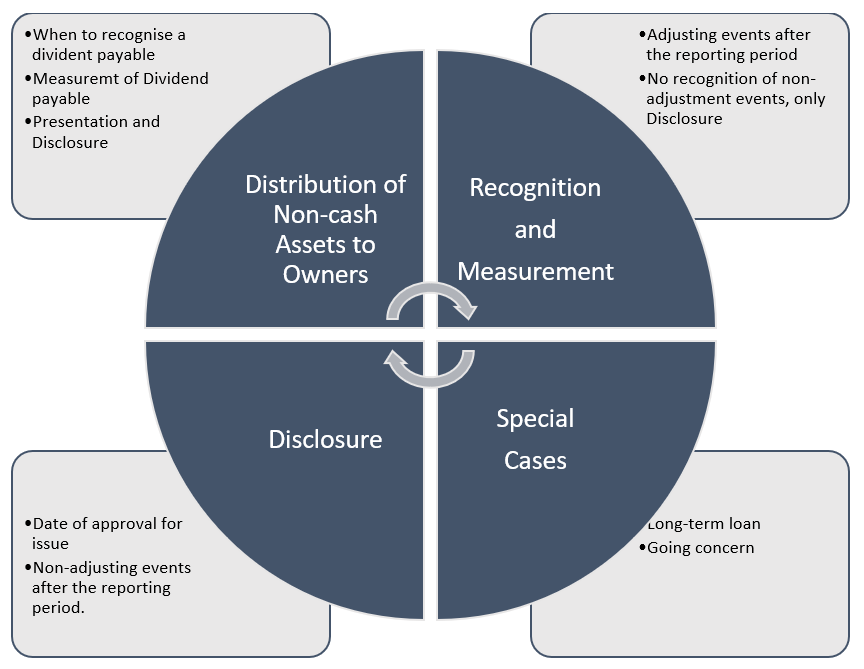
  • Event occurring after the reporting period are defined as ‘events which occur between the end of the reporting date and the date when the financial statements are approved by the Board of Directors in case of a company’ and ‘by the corresponding authority in case of any other entity’.
  • These events may be Adjusting and Un-adjusting.

Adjusting events: Those that provide evidence of conditions that existed at the end of the reporting period.

Non-Adjusting events: Those that are indicative of conditions that arose after the reporting period.

  • Events after the reporting period include all events up to the date when the financial statements are authorized for issue, even if those events occur after the public announcement of profit or of other selected financial information.

The objective of Ind-AS 10 is to prescribe:

  • The disclosures that an entity should give about the date when the financial statements were approved for issue and about events after the reporting.
  • When an entity should adjust its financial statements for events after the reporting period.

Adjusting events:

(a) An entity should adjust its financial statements for events after the reporting date that provide further evidence of conditions that existed at the reporting date.

(b) Notwithstanding anything about adjusting or non-adjusting events, where there is a breach of a material provision of a long-term loan arrangement on or before the end of the reporting period with the effect that the liability becomes payable on demand on the reporting date, the agreement by lender before the approval of the financial statements for issue, to not demand payment as a consequence of such breach, shall be considered as an adjusting event.

An entity shall adjust the amounts recognised in its financial statements to reflect adjusting events after the reporting period.

An entity shall not adjust the amounts recognised in its financial statements to reflect non-adjusting events after the reporting period.

However, if non-adjusting events after the reporting period are material and their non-disclosure could influence the economic decisions that users make on the basis of the financial statements, then it shall disclose the following for each material category of non-adjusting event after the reporting period:

  • The nature of the event.
  • An estimate of its financial effect, or a statement that such an estimate cannot be.

If an entity receives information after the reporting period about conditions that existed at the end of the reporting period, it shall update disclosures that relate to those conditions, in the light of the new information. Appendix A of Ind AS 10 provides guidance with regard to distribution of non–cash assets as dividends to owners. The Appendix prescribes that liability to pay such a dividend should be recognised when it is appropriately authorised and is no longer at the discretion of the entity. This liability should be measured at the fair value of assets to be distributed. Any difference between the carrying amount of the assets distributed and the carrying amount of the dividend payable should be recognised in profit or loss when an entity settles the dividend payable.

Dividends:

(a) If dividend to holders of equity instruments are proposed or declared after the reporting date, an entity should not recognize those dividends as liability. There is no obligation as on the reporting date.

(b) The entity would disclose if any dividend is declared or proposed after the reporting date but before the date of approval of financial statements.

(c) An enterprise may give the disclosure of proposed dividends either on the face of the balance sheet as an appropriation within equity or in the notes in accordance with Ind AS 1 “Presentation of Financial Statements”.

Going concern:

(a) An entity should not prepare its financial statements on a going concern basis if management determines after the reporting date either that it intends to liquidate the entity or to cease trading, or that it has no realistic alternatives but to do so.

(b) However, there should no longer be a requirement to adjust the financial statements where an event after the reporting date indicates that going concern assumption is not appropriate. In that case there is need for fundamental change in the basis of accounting rather than adjustment.

(c) Ind-AS 1 specifies required disclosure if:

  1. The financial statements are not prepared on a going concern basis.
  2. Management is aware of material uncertainties related to events or conditions that may cast significant doubt upon the entity’s ability to continue as a going concern. The events or conditions requiring disclosure may arise after the reporting period.

Events after the Reporting Period

Events after the reporting period are those events, favourable and unfavourable, that occur between the end of the reporting period and the date when the financial statements are approved.

Mandatory exceptions:

(a) An entity’s estimates in accordance with Ind AS at the date of transition to Ind AS shall be consistent with estimates made for the same date in accordance with previous GAAP (after adjustments to reflect any difference in accounting policies), unless there is objective evidence that those estimates were in error.

(b) An entity may need to make estimates in accordance with Ind AS at the date of transition to Ind AS that were not required at that date under previous GAAP. To achieve consistency with Ind AS 10, those estimates in accordance with Ind AS shall reflect conditions that existed at the date of transition to Ind AS. In particular, estimates at the date of transition to Ind AS of market prices, interest rates or foreign exchange rates shall reflect market conditions at that date.

Ind AS-101: First time adoption of Indian Accounting Standards

The objective of Ind AS 101 is to ensure that an entity’s first Ind AS based financial statements, and interim financial reports for part of the period covered by those financial statements, contain high quality information that:

(A) Is transparent for users and comparable over all periods presented

(B) Provides a suitable starting point for accounting in accordance with Indian Accounting Standards.

(C) Can be generated at a cost that does not exceed the benefits.

First time adoption of Ind ASs would require change in various accounting policies. Paragraph 19 of Ind AS 8 Accounting Policies, Changes in Accounting Estimates and Errors requires that any change in accounting policy arising out of initial application of an Ind AS is either given retrospective effect or accounted for in accordance with transitional provisions given in different standards. Presently, Ind ASs do not provide any transitional provisions. Retrospective application means applying a new accounting policy to transactions, other events and conditions as if that policy had always been applied. The change in accounting policy is applied retrospectively except to the extent it is impracticable to determine specific effect or cumulative effect of the change.

Since Ind ASs are a set of converged financial reporting standards (to IFRSs), transitional provisions of corresponding IFRSs are not included therein. In absence of a simplified transitional standard, all changes in accounting policies would have been given effect retrospectively causing hardship in the IFRS convergence and the process would have been very expensive. Ind AS 101 is in effect a standard that provides transitional provisions to the first-time adopter in respect of all Ind ASs.

The objective of this Ind AS is to ensure that an entity’s first Ind AS financial statements, and its interim financial reports for part of the period covered by those financial statements, contain high quality information that:

(a) Is transparent for users and comparable over all periods presented;

(b) Provides a suitable starting point for accounting in accordance with Indian Accounting Standards (Ind ASs)

(c) Can be generated at a cost that does not exceed the benefits.

This standard applies to the first Ind AS financial statements and each interim financial report if any. But this standard does not apply to changes in accounting policies for an organisation that already applies Ind AS, such changes are subject of requirements of Ind AS 8 or specific transitional requirements of other Ind AS.

  • Implementation of Ind AS
  • Selection of Accounting Policies
  • Preparation of Opening Ind AS Balance sheet
  • Presentation and disclosure in an entity’s in Ind AS Financial Statements and Interim Financial Reports.

Preparation of Opening Ind AS Balance Sheet

On the date of transition to Ind AS, an entity shall prepare and present an opening Ind AS Balance Sheet. This is the starting point for it’s accounting according to Ind AS subject to requirements of Ind AS. Except for restrictions spelt out in the AS, an entity must in its Opening Ind AS Balance sheet:

  • Recognise all assets and liabilities for which recognition is required by Ind AS
  • Derecognise items as assets and liabilities if Ind AS does not permit such recognition.
  • If the Ind AS requires a particular asset, liability or component of equity to be recognised differently from its previous recognition under GAAP, then reclassify it.
  • Apply Ind AS in measuring all recognised assets and liabilities.

Meaning of First time Adoption

Ind AS financial statements are the first annual financial statements in which the entity adopts Ind ASs, in accordance with Ind Ass notified under the Companies Act, 2013 and makes an explicit and unreserved statement in those financial statements of compliance with Ind ASs. Refer to Chapter 2 for Ind AS adoption timeline. Therefore, an entity shall include an unreserved statement in the “Basis of Preparation” section of Significant Accounting Policies about adoption of Ind ASs .

Ind AS-24: Related Party Disclosures

The objective of Ind AS 24 is to ensure that an entity’s financial statements contain the disclosures necessary to draw attention to the possibility that its financial position and profit or loss may have been affected by the existence of related parties and by transactions and outstanding balances, including commitments, with such parties.

A related party transaction is a transfer of resources, services or obligations between RE (reported entity) and related party regardless of whether a price is charged or not.

Entity is related to another entity if:

  • Entity and RE are members of same group (i.e., Parent, Subsidiary, fellow subsidiary) A Group is a parent and all its subsidiaries.
  • Associate or JV of the entity covered under (i) (i.e., associate or JV of member of group)
  • Both entities are JV of same third party
  • JV and Associate of the same third party
  • Entity is post-employment benefit plan of either the RE or an entity related to RE. If RE is itself such a plan, the sponsoring employers are also related to RE.
  • Entity is controlled / jointly controlled by Person identified under a)
  • Person identified in a(i) has significant influence over the entity; or Person is a member of KMP of the entity or parent of the entity
  • Entity (or any member of the group of entity is part) provides KMP services to RE or parent of RE.

Related party disclosure requirements as laid down in this Standard do not apply in circumstances where providing such disclosures would conflict with the reporting entity’s duties of confidentiality as specifically required in terms of a statute or by any regulator or similar competent authority.

In case a statute or a regulator or a similar competent authority governing an entity prohibits the entity to disclose certain information which is required to be disclosed as per this Standard, disclosure of such information is not warranted. For example, banks are obliged by law to  maintain confidentiality  in respect of their customers’ transactions and this Standard would not override the obligation to preserve the confidentiality of customers’ dealings.

This standard shall be applied to:

  • Identifying outstanding balance and commitments between the reporting entity and related parties.
  • Identifying related parties and transactions with them.
  • Determine the disclosures to be made.
  • Recognising the circumstances in which disclosures will be required in the above-stated situations.

Related Party Transactions: A transaction of transfer of resources, services or obligations between a reporting entity and a related party regardless of whether a price is charged Government: Government, government agencies and similar bodies whether local, national or international Government-related entity is controlled, jointly controlled or significantly influenced by a government 5. The following are not related parties two entities because they have director or other member of key management personnel in common two joint venturers simply because they share joint control providers of finance trade unions public utilities departments and agencies of government that does not control, jointly control or significantly influence the reportiing entity a customer supplier franchisor distributor general agent 6. Following disclosures are to be made Relationships between a parent and its subsidiaries should be disclosed irrespective of whether there have been transactions between them An entity shall disclose key management personnel compensation in total and for each of the following categories:

  • Post-employment benefits
  • Short-term employee benefits
  • Other long-term benefits
  • Termination benefits and
  • Share based payment.
  • If key management personnel services are obtained from another entity, the above requirements need not be disclosed.
  • If an entity has had related party transactions during the periods covered by financial statements, it shall disclose the nature of the related party relationship as well as information about those transactions (i.e amount, terms and conditions, provisions, expense) and outstanding balances, including commitments.
  • The disclosures required above shall be made separately for each of the parent, entities with joint control or significant influence over the entity, subsidiaries, associates, joint ventures, key management personnel, other related parties
  • Amounts incurred by the entity for the provision of key management personnel services that are provided by a separate management entity.

Some of the examples of transactions to be disclosed if done with related party;

Purchases or sales of goods or assets, rendering or receiving services, leases, transfer of research and development and so on

Disclosures to be made

  • An entity must report the compensation to the key management personnel in total and each of the categories such as short term employee benefits, post-employment benefits, termination benefits, share-based payment, and other long-term benefits.
  • Relationships between parent and subsidiaries should be disclosed irrespective of whether there have been any transactions or not. If the entity’s parent or the ultimate controlling party does not produce consolidated financial statements, then the next senior parent must be named in the consolidated financial statements for public use.
  • If key management services are obtained from another entity, then only the amounts incurred for the provision of such services shall be disclosed.
  • The above disclosures will be made separately in respect of a parent, subsidiaries, associate, entities with joint control or significant influence over the other entity, joint ventures in which the entity is the venturer, and key management personnel of the entity or parent and other related parties.
  • If the entity has transactions with the related party during the financial year, then it shall disclose the nature of such transactions, and also all the details such as amount, outstanding balances including commitments, provision for doubtful debts, and the expense recognised in respect of bad and doubtful debts.

Government related entities Reporting entity is exempt from the disclosures requirements in relation to related party transactions and outstanding balances including commitments with government who has control or joint control or significant influence over the reporting entity and another entity that is related party because the same government has control or joint control of or significant influence over both the reporting and other entity If the above exemption is applied by the reporting entity then it shall disclose the following about the transactions and related outstanding balances.

  • Name of the government and nature of its relationship
  • The nature and amount of each individually significant transaction and for other transactions that are collectively but not individually significant a qualitative or quantitative indication of their extent.

Ind AS-105: Non-current assets held for Sale and Discontinued operations

(A) Non-Current assets held for sale:

i) Are presented separately from other assets in the Balance Sheet.

Ii) As their classification will change.

Iii) The value will be principally recovered through sale transaction rather than through continuous use in operations of the entity.

(B) Results of Discontinuing Operations should be separately presented in the Statement of Profit and loss as it affects the ability of the entity to generate future cash flows.

The Ind AS requires:

  • Assets that meet the criteria to be classified as held for sale to be measured at the lower of carrying amount and fair value less costs to sell, and depreciation on such assets to cease.
  • Assets that meet the criteria to be classified as held for sale to be presented separately in the balance sheet.
  • The results of discontinued operations to be presented separately in the statement of profit.

An entity shall classify a non-current asset (or disposal group) as held for sale if its carrying amount will be recovered principally through a sale transaction rather than through continuing use.

For this to be the case, the asset (or disposal group) must be available for immediate sale in its present condition subject only to terms that are usual and customary for sales of such assets (or disposal groups) and its sale must be highly probable. Thus, an asset (or disposal group) cannot be classified as a non-current asset (or disposal group) held for sale, if the entity intends to sell it in a distant future.

For the sale to be highly probable, the appropriate level of management must be committed to a plan to sell the asset (or disposal group), and an active programme to locate a buyer and complete the plan must have been initiated. Further, the asset (or disposal group) must be actively marketed for sale at a price that   is reasonable in   relation to   its current fair value.

In addition, the sale should be expected to qualify for recognition as a completed sale within one year from the date of classification, except as permitted by paragraph 9 of the Standard, and actions required to  complete the plan should indicate that it is unlikely that significant changes to the plan will be made or that the plan will be withdrawn.

A discontinued operation is a component of an entity that either has been disposed of or is classified as held for sale and:

  • Is part of a single co-ordinated plan to dispose of a separate major line of business or geographical area of operations.
  • Represents a separate major line of business or geographical area of operations.
  • Is a subsidiary acquired exclusively with a view to

A component of an entity comprises operations and cash flows that can be clearly distinguished, operationally and for financial reporting purposes, from the rest of the entity.  In other words, a component of an entity will have been   a cash-generating unit or a group of cash-generating units while being held for use.

An entity shall not classify as held for sale a non-current asset (or disposal group) that is to be abandoned.

Exception to the period of one year

  • There must be sufficient evidences that the entity is still committed to it selling plan.
  • The delay must have been caused by the events or circumstances which are beyond the control of the entity.

Measurement:

  • Depreciation and amortization shall be immediately stopped from the moment the asset has been classified as held for sale.
  • An entity should measure a non-current asset (or disposal group) classified as held for sale at the lower of it carrying amount and fair value less costs to sell.
  • Interest and other expenses attributable to the liabilities of a disposal group classified as held for sale shall continue to be recognised.
  • Non-current asset (or disposal group) classified as held for distribution are also measured on same line as non-current asset (or disposal group) classified as held for sale.
  • When the sale is expected to occur beyond one year, the entity should measure the costs to sell at their present value. Any increase in the present value of the costs to sell that arises from the passage of time shall be presented in profit or loss as a financing cost.

Recognition Of Impairment Losses and Reversals:

  • An entity should recognise a gain for any subsequent increase in fair value less costs to sell of an asset, but not in excess of the cumulative impairment loss that has been recognised either in accordance with this Ind AS or previously in accordance with Ind AS 36, Impairment of Assets.
  • An entity should recognise an impairment loss for any initial or subsequent write-down of the asset (or disposal group) to fair value less costs to sell, to the extent that it has not been recognised in accordance with above.

Changes to Plan of Sale

  1. If an entity has classified an asset (or disposal group) as held for sale, but the held for sale criteria no longer met, the entity should cease to classify the asset (or disposal group) as held for sale.
  2. The entity shall measure a non-current asset that ceases to be classified as held for sale (or ceases to be included in a disposal group classified as held for sale) at the lower of: (a) its carrying amount before the asset (or disposal group) was classified as held for sale, adjusted for any depreciation, amortization or revaluations that would have been recognised had the asset (or disposal group) not been classified as held for sale; and (b) its recoverable amount at the date of the subsequent decision not to sell.

Classification of Accounting Theory

At present, a single universally accepted accounting theory does not exist in accounting. Instead, different theories have been proposed and continue to be proposed in the accounting literature.

(a) “Accounting Structure” Theory:

‘Accounting structure’ theory, known by different names such as classical theory, descriptive theory, traditional theory, attempt to explain current accounting practices and predict how accountants would react to certain situations or how they would report specific events.

This theory relates to the structure of the data collection process (accounting) and financial reporting. Thus, this theory is directly connected with accounting practices, i.e., what does exist or what accountants do.

The principal contributors to the accounting structure theory are identified chronologically as follows:

  • William A. Paton, Accounting Theory with Special Reference to Corporate Enterprise (1922).
  • Henry Rand Hatfield, Accounting; Its Principles and Problems (1927).
  • Henry W. Sweeney, Stabilized Accounting (1936).
  • Stephen Gilman, Accounting Concepts of Profit (1939).
  • A. Paton and A. C. Littleton, An Introduction to Corporate Accounting Standards (1940).
  • C. Littleton, Structure of Accounting Theory (1953).
  • Maurice Moonitz, the Basic Postulates of Accounting (1961).
  • Robert R. Sterling and Richard E. Flaherty, “The Role of Liquidity in Exchange Valuation,”
  • Accounting Review (July 1971).
  • Robert R. Sterling, John O. Tollefson, and Richard E. Flaherty,
  • “Exchange Valuation: An Empirical Test,” Accounting Review (Oct. 1972).
  • Yuji Ijiri, Theory of Accounting Measurement (1973).

This theory, basically concerned with observing the mechanical tasks which accountants traditionally perform, is based on the assumption that the objective of financial statement is associated with the stewardship concept of the management role, and the necessity of providing the owners of businesses with information relating to the manner in which their assets (resources) have been managed.

In this view, company directors occupy a position of responsibility and trust in regard to shareholders, and the discharge of these obligations requires the publication of annual financial reports to shareholders. Ijiri explains traditional accounting practice; however, he does place emphasis on the historical cost system.

Sterling advises “to observe accountants’ actions and rationalise these actions by subsuming them under generalized principles.” Theories explaining traditional accounting practice are desirable to obtain greater insight into current accounting practices, permit a more precise evaluation of traditional theory and an evaluation of existing practices that do not correspond to traditional theory.

Such theories relating to the structure of accounting can be tested for internal logical consistency, or they can be tested to see whether or not they actually can predict what accountants do.

Limitations:

(1) The ‘accounting structure’ theory concentrates on accounting practices and the behaviour of practising accountants. The accounting practice begins with observable occurrences (transactions), translates them into symbolic form (money values) and makes them inputs (e.g., sales, costs) into the formal accounting system where they are manipulated into outputs (financial statements).

Accounting practices followed in this way may not reflect the real business situation and real world phenomena. The traditional theory is not concerned with judging the usefulness of the output of accounting practice, but concentrates upon judging the means of manipulation of input into output.

(2) Inconsistencies in traditional theory have given rise to alternative accepted principles and procedures which give significantly divergent reported results. Accrual accounting results in allocations which provide a variety of alternative accounting methods for each major event e.g., LIFO and FIFO valuations of stock and different accountants may prefer different methods depending upon how they are affected. Moreover, the traditional approach is inconsistent with theories developed in related disciplines. For example, the historical cost concept of valuation is externally inconsistent with current value concepts.

Finally, good theory should provide for research to assist advances in knowledge. The conventional approach tends to inhibit change, and by concentrating upon generally accepted accounting principles makes the relationship between theory and practice a circular one.

(b) “Interpretational” Theory:

Truly speaking, ‘accounting structure’ and ‘interpretational’ theories are part of the classical accounting theory (model). The principal writers under ‘accounting structure’ such as Hatfield, Littleton, Paton and Littleton, Sterling and Ijiri are mainly positivist, inductive writers, concerned with traditional accounting practice in terms of historical cost system, with some deviations such as the lower of cost or market.

Accounting practices under accounting structure theory are the result of recording business events as they take place. Such practices lack application of judgement and consequences. Interpretational theory attempts to give some meaning to accounting practice.

The theory based on “accounting structure” only, although logically formulated, does not require meaningful interpretation of accounting practices and analysis of accounting activities.

Interpretational theory emphasises on giving interpretations and meaning as accounting practices are followed. This theory provides a suitable basis for evaluating accounting practices, resolving accounting issues and making accounting propositions.

The principle writers in interpretational theory are the following:

  • John B. Canning, The Economics of Accountancy (1929).
  • Sidney S. Alexander, Income Measurement in a Dynamic Economy (1950).
  • Edgar O. Edwards and Philip W. Bell, The Theory and Measurement of Business Income (1961).
  • Robert T. Sprouse and Maurice Moonitz, A Tentative Set of Board Accounting Principles for Business Enterprises (1962).

The above writers in interpretational theory are more analysts and explicators than advocates and preachers. They analyse and assess what accountants do and seek to do, they undertake to explain a phenomenon to accountants, and help in understanding the implications of using accounting concepts in the real business situation. For example, Sprouse and Moonitz suggest that the assets valuations should be made in terms of their future services.

In “accounting structure” theory, accounting concepts are un-interpreted and do not reflect any meaning except actual data resulting from following specific accounting procedures. Asset valuations, for example, are the result of following a specific method of inventory valuation and depreciation.

Similarly, specific rules are followed for the measurement of these revenues and expenses. Interpretational theory gives meaningful interpretations to these concepts and rules and evaluate alternative accounting procedures in terms of these interpretations and meanings. For example, it can be said that FIFO is the most appropriate if objective is to measure current value of inventories.

In this case, selection of FIFO in interpretational theory is made with a view to suggest specific result and interpretation. It is argued that empirical enquiry should be made to determine whether information users attach the same interpretations and meanings which are intended by producers of information.

Items of information vary as to degree of interpretation; some items by nature reflect higher degree of interpretation and some items are subject to many interpretations. For example, the item cash in balance sheet is fairly well understood by users to mean what prepares intend it to mean.

On the contrary, the items like deferred expenses and goodwill may not reflect any specific interpretation. The role of interpretational theories is to build a correspondence between the interpretations of producers and users as to accounting information.

This theory attempts to find ways to improve the meaning and interpretations of accounting information in terms of experiences about human behaviour and information processing capacity.

‘Accounting structure’ and interpretational theories both are known as classical accounting models. The writers (mentioned above) under both the theories are, in every sense, reformers. Interpretational theorists differ from ‘accounting structure’ theorists more in degree than in kind; the former are motivated less by missionary zeal than by a desire to analyse, criticize, and suggest, and are primarily deductivists.

Many of the prominent interpretational theorists advocate current cost or values. It is said that interpretational theorists may have observed the behaviour of investors and other economic decision makers and concluded with a validated hypothesis that such decisions-makers seek current value, not historical cost, information.

In spite of the difference in emphasis of ‘traditional’ and ‘interpretational’ theorists, broadly, both are concerned with designing financial reports that communicate relevant information to users of accounting information.

(c) “Decision-Usefulness” Theory:

The decision-usefulness theory emphasises the relevance of the information communicated to decision making and on the individual and group behaviour caused by the communication of information.

Accounting is assumed to be action-oriented its purpose is to influence action, that is, behaviour; directly through the informational content of the message conveyed and indirectly through the behaviour of preparers of accounting reports.

The focus is on the relevance of information being communicated to decision-makers and the behaviour of different individuals or groups as a result of the presentation of accounting information. The most important users of accounting reports presented to those outside the firm are generally considered to include investors, creditors, customers, and government authorities.

However, decision usefulness can also take into consideration the effect of external reports on the decisions of management and the feedback effect on the actions of accountants and auditors. Since accounting is considered to be a behavioural process, this theory applies behavioural science to accounting.

Due to this, decision-usefulness theory is sometimes referred to as behavioural theory also. In the broader perspective, decision-usefulness studies analyses behaviour of users of information. A behavioural theory attempts to measure, and evaluate the economic, psychological and sociological effects of alternative accounting procedures and modes of financial reporting.

In adopting the decision usefulness theory or approach, two major aspects or questions must be addressed.

First, who are the users of financial statements? Obviously, there are many users. It is helpful to categorize them into broad groups, such as investors, lenders, managers, employees, customers, governments, regulatory authorities, suppliers etc. These groups are called constituencies of accounting.

Second, what are the decision models or problems of financial statement users? By understanding these decision models preparers will be in a better position to meet the information needs of the various constituencies. Financial statements can then be prepared with these information needs in mind and in this way financial statements will lead to improved decision making and are made more useful.

Role of Accounting theory

Accounting theory may also be used to explain existing practices to obtain a better understanding of them. But the most important goal of accounting theory should be to provide a coherent set of logical principles that form the general frame of reference for the evaluation and development of sound accounting practices.

Accounting theory is that branch of accounting which consists of the systematic statement of principles and methodology. However, theory cannot be divorced from practice. The theory underlies practices, explains and attempts to predict them. There is not and cannot be any basic contradiction between theory and facts.

A theory is an explanation. However, every explanation is not a theory in the scientific meaning of the word. The objective of accounting theory is to explain and predict accounting practice. Explanation provides reasons for observed practice. For example, an accounting theory should explain why certain firms use LIFO method of inventory rather than the FIFO method.

Prediction of accounting practices means that the theory can also predict unobserved accounting phenomena. Unobserved phenomena are not necessarily future phenomena; they include phenomena that have occurred but on which systematic evidence has not been collected.

It is significant to observe that accounting theory may be based on empirical evidence and practices as well as accounting theory may be formulated using hypothetical and speculative interpretations.

(1) Accounting theory has a great amount of influence on accounting and reporting practices and thus serves the informational requirements of the external users.

In fact, accounting theory provides a framework for:

(i) Evaluating current financial accounting practice and

(ii) Developing new practice.

(2) Secondly, accounting theory literature is useful to accounting policy makers who are interested in making the accounting information useful. The researches, empirical evidence and investigation can be used and incorporated by the policy makers in formulating accounting policies. Theories are helpful as they apprise policy makers of the underlying issues and clarify the trade-offs implicit in various theory approaches.

Deductive and inductive approach in theory formulation

Induction is a reasoning method by which a law or a general principle would be inferred via observing specific cases. The inductive approach emphasizes on observation and deriving conclusions through observation. It generally moves from specific to general, since the researcher generalizes his limited observations of specific circumstances to general conditions. In accounting, the inductive approach begins by observing the financial information of the companies and progresses towards constructing accounting generalizations and principles out of those observations and reoccurring relations.

In deductive approach, in order to achieve a consensus, the structure of logical reasoning needs to be quite formal. However, in inductive approach, the accounting practice can turn into accounting principles. Accounting standard setters, extracted the conceptual framework via the best practices which in turn have been identified based on the assumed objectives of financial reporting. At the same time, attention was paid to the conceptual integrity, because the framework has been developed descriptively, although the objective was to make an imperative framework for providing guidelines to set and interpret accounting standards.

Deductive Approach

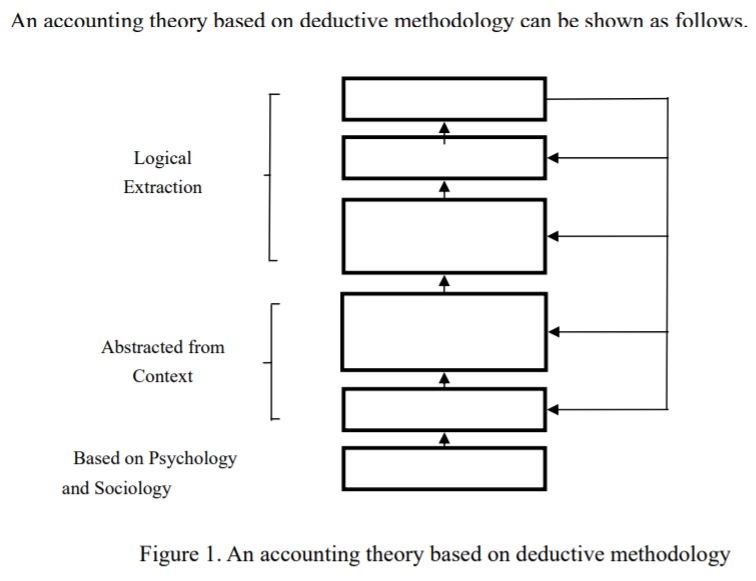
This approach involves developing a theory from elementary proposals, premises and assumptions which results in accounting principles that are reasonable conclusions about the subject. The theory is verified by determining whether its results are acceptable in practice. Edwards and Bell are deductive theorists and historical cost accounting was also derived from a deductive approach.

The deductive approach constitutes developing of an assumption based on the existing theories and forming a research plan to test the assumption (Wilson, 2010). The deductive approach can be explained using the assumption driven from theory. In other words, the deductive approach includes deducing the results from the premises. When a deductive method is applied for a research project, the author formulates a set of hypotheses that need to be tested and next, using a relevant methodology, tests the hypothesis. Deductive reasoning has specific characteristics that needs be understood. If the premises of deductive reasoning are accepted, then, the conclusion must necessarily be accepted. In a deductive reasoning, the contents of the result are implicitly stated in the premises, making such argument a non-ampliative one. If new premises are added to the argument, then the conclusion must still follow. A deductive argument is either valid or invalid and there is no degree of validity. There is no choice or decision in applying such argument and no judgment is necessary for getting the result and conclusion.

Inductive Approach

For this approach we start with observed phenomena and move towards generalized conclusions. The approach requires experimental testing, i.e. the theory must be supported by sufficient illustrations/observations that support the derived conclusions. Fairly often the logical and inductive approaches are mixed as researchers use their knowledge of accounting practices. As Riahi-Belkaoui states: General propositions are formulated through an inductive process, but the principles and techniques are derived by a deductive approach. He also observes that when an inductive theorist, collaborates with a deductive theorist, a hybrid results showing compromise between the two approaches.

Inductive approach begins with specific observations and the conclusions are generalized. In inductive approach, after selecting a number of observations correctly, one can generalize the conclusion to all or groups of similar conditions and situations. These generalizations need to be tested, some of which might be verified and some rejected. Accordingly, all of the principles which are derived based on inductive reasoning are theoretically falsifiable. In the induction process, the researcher as an observer, should honestly, without any prejudgments and biases, and with an impartial mind, register what they observe. Then these observations form a basis on which theories and laws are constructed which make up the scientific knowledge. Inductive researchers also believe that one can logically generalize the observations into general and inclusive rules and the scientific assumptions get verified and ratified.

According to the inductive approach, at the end of research and as a result of observations, theories are constructed. The inductive approach includes looking for a pattern based on the observations and developing a theory for those patterns through hypotheses. In inductive research, no theory is applied at the beginning of the research and the researcher enjoys complete freedom in terms of determining the course of research. Particularly, there is no assumption at the early stages of research and the researcher is not sure about the kind and the nature of findings as research is not finished yet. In inductive reasoning the researcher uses the observations in order to construct an abstract or to describe the circumstances being.

The main advantage of the inductive method is that there is no necessity for any pre-fabricated framework or model. Obviously, while principles are generalized they should be verified through a logical method (deductive approach). The inductive approach towards science has been criticized concerning some aspects. The main issue of the inductive method can be the researchers’ being influenced by their limited knowledge of the relations and the data of the research. Some claim that induction as a principle is falsifiable because it is based on human observations.

External audit requirements

An external auditor performs an audit, in accordance with specific laws or rules, of the financial statements of a company, government entity, other legal entity, or organization, and is independent of the entity being audited. Users of these entities’ financial information, such as investors, government agencies, and the general public, rely on the external auditor to present an unbiased and independent audit report.

The manner of appointment, the qualifications, and the format of reporting by an external auditor are defined by statute, which varies according to jurisdiction. External auditors must be members of one of the recognised professional accountancy bodies. External auditors normally address their reports to the shareholders of a corporation. In the United States, certified public accountants are the only authorized non-governmental external auditors who may perform audits and attestations on an entity’s financial statements and provide reports on such audits for public review. In the UK, Canada and other Commonwealth nations Chartered Accountants and Certified General Accountants have served in that role.

For public companies listed on stock exchanges in the United States, the Sarbanes-Oxley Act (SOX) has imposed stringent requirements on external auditors in their evaluation of internal controls and financial reporting. In many countries external auditors of nationalized commercial entities are appointed by an independent government body such as the Comptroller and Auditor General. Securities and Exchange Commissions may also impose specific requirements and roles on external auditors, including strict rules to establish independence.

The objectives of an external audit are to determine:

  • Whether the client’s accounting records have been prepared in accordance with the applicable accounting framework.
  • The accuracy and completeness of the client’s accounting records.
  • Whether the client’s financial statements present fairly its results and financial position.

Difference from internal auditor

Internal auditors who are members of a professional organization would be subject to the same code of ethics and professional code of conduct as applicable to external auditors. They differ, however, primarily in their relationship to the entities they audit. Internal auditors, though generally independent of the activities they audit, are part of the organization they audit, and report to management. Typically, internal auditors are employees of the entity, though in some cases the function may be outsourced. The internal auditor’s primary responsibility is appraising an entity’s risk management strategy and practices, management (including IT) control frameworks and governance processes. They are also responsible for the internal control procedures of an organization and the prevention of fraud.

If an external auditor detects fraud, it is their responsibility to bring it to the management’s attention and consider withdrawing from the engagement if management does not take appropriate actions. Normally, external auditors review the entity’s information technology control procedures when assessing its overall internal controls. They must also investigate any material issues raised by inquiries from professional or regulatory authorities, such as the local taxing authority.

General Accounting System controls

Accounting controls consists of the methods and procedures that are implemented by a firm to help ensure the validity and accuracy of its financial statements. The accounting controls do not ensure compliance with laws and regulations, but rather are designed to help a company operate in the best possible manner for all stakeholders.

Accounting Controls are the measures and controls adopted by an organization that leads to increased efficiency and compliance across the organization and ensures that financial statements are accurate when presented to auditors, bankers, investors, and other stakeholders.

The purpose of implementing accounting controls in a firm is to ensure that all areas in an organization avoid fraud and other issues, improve efficiency, accuracy, and compliance. Every firm will have different accounting controls in place, depending on their type of business, however, there are three traditional areas that are the most common when it comes to accounting controls: detective controls, preventive controls, and corrective controls.

Corrective Controls

As the name suggests, corrective controls are put in place to fix any issues found through detective controls. These can also include remedying any issues made on accounting books after the audit process has been completed by an accountant.

Preventive Controls

Preventive controls are simply the controls that have been put in place by an organization to avoid any inaccuracies or incorrect practices. These are the policies and procedures that all employees must follow.

An example of a preventive control would be limiting management’s involvement in the preparation of financial statements. Sometimes it’s helpful for management to be involved since they generally know the company better than anyone. But final say on numbers should be in the hands of an accountant, because management may have the incentive to distort numbers to inflate the company’s performance.

Detective Controls

The controls in this category are meant to seek out any current practices that don’t align with the policies and procedures in place. The goal here is to find any areas that are not functioning as they ought to, if employees are accidentally or purposefully practicing incorrect or illegal actions, or detecting any errors in systems or accounting practices. Examples of detective controls would include inventory checks and internal audits.

Advantages of Accounting Internal Controls

  • Accuracy of financial statements and funds application.
  • The action log identifies the person responsible for any error.
  • Efficient use of the resources for the intended purpose.
  • A strong foundation for a more significant growth.
  • Helpful in audit facilitation.
  • Saving of cost and resources.
  • Identification and rectification of any discrepancy identified.

Disadvantages:

  • The high cost of maintaining controls and standards.
  • Sometimes irritating and time-consuming for employees.
  • Duplication of work.
  • Overdependent for financial statements and audit.

Procedures:

Approval Authority Requirements

Requiring specific managers to authorize certain types of transactions can add a layer of responsibility to accounting records by proving that transactions have been seen, analyzed and approved by appropriate authorities. Requiring approval for large payments and expenses can prevent unscrupulous employees from making large fraudulent transactions with company funds, for example.

Daily or Weekly Trial Balances

Using a double-entry accounting system adds reliability by ensuring that the books are always balanced. Even so, it is still possible for errors to bring a double-entry system out of balance at any given time. Calculating daily or weekly trial balances can provide regular insight into the state of the system, allowing you to discover and investigate discrepancies as early as possible.

Physical Audits of Assets

Physical audits include hand-counting cash and any physical assets tracked in the accounting system, such as inventory, materials and tools. Physical counting can reveal well-hidden discrepancies in account balances by bypassing electronic records altogether. Counting cash in sales outlets can be done daily or even several times per day. Larger projects, such as hand counting inventory, should be performed less frequently, perhaps on an annual or quarterly basis.

Separation of Duties

Separation of duties involves splitting responsibility for bookkeeping, deposits, reporting and auditing. The further duties are separated, the less chance any single employee has of committing fraudulent acts. For small businesses with only a few accounting employees, sharing responsibilities between two or more people or requiring critical tasks to be reviewed by co-workers can serve the same purpose.

Periodic Reconciliations in Accounting Systems

Occasional accounting reconciliations can ensure that balances in your accounting system match up with balances in accounts held by other entities, including banks, suppliers and credit customers. For example, a bank reconciliation involves comparing cash balances and records of deposits and receipts between your accounting system and bank statements. Differences between these types of complementary accounts can reveal errors or discrepancies in your own accounts, or the errors may originate with the other entities.

Standardized Financial Documentation

Standardizing documents used for financial transactions, such as invoices, internal materials requests, inventory receipts and travel expense reports, can help to maintain consistency in record keeping over time. Using standard document formats can make it easier to review past records when searching for the source of a discrepancy in the system. A lack of standardization can cause items to be overlooked or misinterpreted in such a review.

Accounting System Access Controls

Controlling access to different parts of an accounting system via passwords, lockouts and electronic access logs can keep unauthorized users out of the system while providing a way to audit the usage of the system to identify the source of errors or discrepancies. Robust access tracking can also serve to deter attempts at fraudulent access in the first place.

Application and Transaction controls

Application control includes completeness and validity checks, identification, authentication, authorization, input controls, and forensic controls, among others.

Application controls are a form of security that is designed to improve the quality of the data that is input into a database. An example of an application control is the validity check, which reviews the data entered into a data entry screen to ensure that it meets a set of predetermined range criteria. Or, a completeness check will examine a data entry screen to see if all fields have an entry. An authorization control ensures that only authorized users are gaining access to the database.

  • Validity checks: Controls ensure only valid data is input or processed.
  • Completeness checks: Controls ensure records processing from initiation to completion.
  • Identification: Controls ensure unique, irrefutable identification of all users.
  • Authorization: Controls ensure access to the application system by approved business users only.
  • Authentication: Controls provide an application system authentication mechanism.
  • Forensic controls: Controls ensure scientifically and mathematically correct data, based on inputs and outputs.
  • Input controls: Controls ensure data integrity feeds into the application system from upstream sources.

Benefits of Application Control:

  • Automatically identify trusted software that has authorization to run.
  • Identify and control which applications are in your IT environment and which to add to the IT environment.
  • Protect against exploits of unpatched OS and third-party application vulnerabilities.
  • Prevent all other, unauthorized applications from executing; they may be malicious, untrusted, or simply unwanted.
  • Reduce the risks and costs associated with malware.
  • Improve your overall network stability.
  • Eliminate unknown and unwanted applications in your network to reduce IT complexity and application risk.
  • Identify all applications running within the endpoint environment.

Transaction controls

error: Content is protected !!