Principles of effective Presentation

Perception: Stop trying to be a great “public” speaker.

People want to listen to someone who is interesting, relaxed, and comfortable. In the routine conversations we have every day, we have no problem being ourselves. Yet too often, when we stand up to give a speech, something changes. We focus on the “public” at the expense of the “speaking.” To become effective at public speaking, you must do just the opposite: focus on the speaking and let go of the “public.”

Think of it as a conversation between you and the audience. If you can carry on a relaxed conversation with one or two people, you can give a great speech. Whether your audience consists of two people or two thousand and whether you’re talking about the latest medical breakthrough or what you did today at work, be yourself; talk directly to people and make a connection with them.

Discipline: Practice makes perfectly good.

Your goal is not to be a perfect public speaker. There is no such thing. Your goal is to be an effective public speaker. Like anything else in life, it takes practice to improve those public speaking skills. We too often take communication for granted because we speak to people everyday. But when your prosperity is directly linked to how well you perform in front a group, you need to give the task the same attention as if you were a professional athlete. Remember, even world champion athletes practice every day.

Description: Make it personal.

Whatever the topic, audiences respond best when the presenter can personalize their message. It’s a terrific way to get intimate with large audiences. Take the opportunity to put a face on the facts of your presentation. People like to hear about other people’s experiences—the triumphs, tragedies, and everyday humorous anecdotes that make up their lives. Telling stories will give you credibility, and help your listeners engage more often. Whenever possible, insert a personal-interest element in your public speaking. This technique will make your listeners warm up to you, but it will also do wonders at putting you at ease by helping you overcome any lingering nervousness.

  • The presentation ideas should be well adapted to your audience. Relate your presentation message/idea to the interests of the audience. A detailed audience analysis must be made before the presentation, i.e., an analysis of the needs, age, educational background, language, and culture of the target audience. Their body language instantly gives the speaker the required feedback.
  • A good presentation should be concise and should be focused on the topic. It should not move off-track.
  • A good presentation should have the potential to convey the required information.
  • The fear should be transformed into positive energy during the presentation. Be calm and relaxed while giving a presentation. Before beginning, wait and develop an eye contact with the audience. Focus on conveying your message well and use a positive body language.
  • To communicate the desired information, the speaker should use more of visual aids such as transparencies, diagrams, pictures, charts, etc. Each transparency/slide should contain limited and essential information only. No slide should be kept on for a longer time. Try facing the audience, rather than the screen. The speaker should not block the view. Turn on the room lights else the audience might fall asleep and loose interest. Organize all the visuals for making a logical and sound presentation.
  • A good presentation must be planned. The speaker must plan how to begin the presentation, what to speak in the middle of presentation and how to end the presentation without losing audience interests at any point of time.
  • Rehearse and practice the presentation. This will help the speaker to be more confident and self-assured. The more the speaker rehearses the better the presentation turns to be.
  • The speaker should encourage more questions from the audience. He should be honest enough to answer those questions. If any biased question is put forth by the audience, rearticulate it before answering.
  • Summarize the presentation at the end. Give final comments. Leave a positive impact upon the audience.
  • The speaker must have a presentable appearance while giving a presentation. The speaker should stand with feet far apart maintaining a good balance. He must use confident gestures. He must use short and simple words.
  • Try to gain and maintain audience interest by using positive quotes, humour, or remarkable fact.
  • The speaker must be affirmative and optimistic before giving presentation. He should ensure all tools and equipments to be used in presentation are working well.
  • The speaker must state the objectives of the presentation at beginning of the presentation.

Departmentation Meaning, Basis and Significance

Departmentation is the process of dividing an organization into distinct units or departments based on specific functions, products, geographical areas, customer segments, or processes. This division allows for better specialization, coordination, and management of activities within each department. By grouping related tasks, departmentation enables organizations to allocate resources more efficiently, enhance accountability, and improve overall performance. Common types of departmentation include functional (based on activities like marketing, finance), product (based on product lines), geographical (by region), and customer (targeting different customer groups). Effective departmentation enhances operational efficiency and supports organizational growth.

Importance of Departmentation:

  1. Specialization and Expertise

Departmentation enables specialization by grouping employees with similar skills and expertise into departments. This fosters a deeper focus on particular tasks, enhancing the quality and efficiency of work. For example, a finance department can focus solely on financial matters, ensuring better financial management.

  1. Improved Coordination

By organizing activities into separate departments, organizations can improve coordination among tasks and processes. Departments can operate independently but still work towards common organizational goals. Department heads communicate with each other to ensure smooth functioning across the organization.

  1. Accountability and Responsibility

Departmentation assigns clear responsibilities to each department and its managers. This makes it easier to hold specific units accountable for their performance. When roles and responsibilities are well-defined, it is easier to track progress and address issues within each department.

  1. Effective Resource Allocation

With departmentation, resources such as human capital, finances, and materials can be allocated more efficiently. Since each department has specific functions or goals, managers can allocate resources based on the unique needs of that department, ensuring optimal utilization.

  1. Facilitates Growth and Expansion

As organizations grow, departmentation helps manage the increasing complexity by dividing tasks into manageable units. This makes it easier to scale operations. For instance, as a company expands geographically, it can create regional departments to handle specific markets effectively.

  1. Focus on Customer Needs

Customer-based departmentation allows organizations to cater to different customer segments more effectively. Each department focuses on a particular group of customers, improving service delivery and customer satisfaction by addressing specific needs and preferences.

  1. Increased Flexibility

Departmentation allows for more flexible operations. If a new product or service is introduced, the organization can create a dedicated department to focus solely on its development and management, without disrupting other areas of the business.

  1. Improved Communication

Departments promote better communication within specific units. By grouping related activities, employees and managers within a department can communicate more effectively, reducing confusion and ensuring that everyone is aligned with departmental goals.

Basis of Departmentation:

  1. Functional Departmentation:

Functional departmentation is one of the most common methods of structuring organizations. It involves grouping activities based on functions such as marketing, finance, human resources, operations, and research and development. Each department is responsible for a specific function, with employees who specialize in that area.

  • Advantages: It promotes specialization, as employees focus on one functional area. It also enhances efficiency, as similar tasks are grouped together.
  • Disadvantages: Communication between departments may be limited, leading to silos. Also, functional departments may lack a holistic view of the organization.
  1. Product Departmentation:

Product departmentation involves dividing the organization based on its product lines or services. Each department focuses on a specific product or group of products, with functional activities like marketing and production tailored to each product line.

  • Advantages: This structure allows for better focus on specific products, faster decision-making, and greater accountability for product performance. It also encourages product innovation and competitiveness.
  • Disadvantages: It may lead to duplication of resources, as each product department may have its own set of functional activities.
  1. Geographical Departmentation:

Geographical departmentation is used when an organization operates across various regions or countries. It divides operations based on geographic locations, allowing each department to cater to the specific needs and conditions of the region.

  • Advantages: Geographical departmentation helps in managing regional differences, such as cultural, economic, or legal factors. It allows for better customer service and quicker response to local market changes.
  • Disadvantages: There can be coordination challenges between different regional departments, and the organization may face issues of duplicating roles and resources across regions.
  1. Customer Departmentation:

Customer departmentation groups activities based on specific customer segments, such as retail customers, wholesale buyers, or government clients. This approach is often used in organizations with diverse customer needs.

  • Advantages: It allows for a better focus on customer needs, improves customer satisfaction, and enhances the ability to cater to different types of clients.
  • Disadvantages: Similar to product departmentation, it may lead to resource duplication and increased costs due to maintaining separate units for each customer group.
  1. Process Departmentation:

Process departmentation is based on the different stages of a production or operational process. For example, in manufacturing, departments could be organized around fabrication, assembly, and quality control.

  • Advantages: It ensures better coordination and efficiency within each stage of the production process, leading to smoother operations and specialization.
  • Disadvantages: It may result in challenges in coordination between departments handling different stages of the process.
  1. Time-Based Departmentation:

In organizations that operate around the clock, such as hospitals or factories, departmentation may be based on time. Different shifts or work periods are used to structure activities.

  • Advantages: This helps in ensuring continuous operations, and it allows for better management of workforce and resources over extended time periods.
  • Disadvantages: Coordination between different shifts or time-based departments may be challenging.
  1. Matrix Departmentation:

Matrix departmentation combines two or more types of departmentation, such as functional and product-based structures. It creates a more flexible organizational design, particularly useful in project-based environments.

  • Advantages: It promotes collaboration across functions and products, allowing for better resource utilization and flexibility.
  • Disadvantages: The complexity of reporting relationships can lead to confusion and conflicts, especially when employees report to multiple managers.

Graicunas Theory of Span of Management

V.A. Graicunas a French management Consultant, made a study on superior-subordinate relationship, however, not based on empirical observations. He developed a mathematical formula to analyse this relationship. He suggested that the number of possible relationships increases with the number in the number of subordinates.

Graicemas has identified three specific kinds of superior-subordinate relationships in every organisation and leading to the question as to the number of subordinates which a superior can effectively manage.

  1. Direct Single Relationship:

This refers to relationships that are easily and clearly recognized by the individuals who are his immediate subordi­nates. They are equal to the number of subordinates supervised. For example, if A has three subordinates, there would be three direct single relationships. This has been identified as Number of direct relationships = n.

  1. Direct Group Relationships:

This means the group relationships between the superior and each possible combination of subordinates. A manager has occasions to consult, confer, advise, inform or discuss with every subordinate or any number of them or all of them in attendance. This type of relationship arises between the superior and his group of subordinates in all possible combinations.

Example: A manager having three subordinates would have three direct group relationships.

Formula = n (2n-1 -1) where n represents the number of subordinates.

  1. Cross Relationship:

Cross relationships are mutual relationships among subordinates necessary for working under the same superior. This result from the need of the subordinates of a common superior to consult with one another.

Resulting from the above analysis of the three kinds of relationships, Graicunas developed the following formula to give the total number of all the three kinds of relationships where n = number of subordinates.

n(2n/2 + n + 1)

The significance of Graicunas contribution is that he initiated the principle of restriction of the span of delegated authority on account of maximum limit to the potential burdens set up simply by innate limitations of the capacity of human mind. From this analysis he deduced a ‘reasonable span’ restricted to five or six subordinates. Thus he stimulated thinking on this aspect of organisation structure which, later on, became the subject of much discussion in management literature.

Criticism:s

(a) Mathematical precision of the formula is debatable. Relationships increase with the increase hi the number of subordinates but not in a precise formula.

(b) Graicunas has ignored the frequency of relationships and the strain they generate.

(c) He has left out certain possible relationships.

(d) He has failed to identify the factors which govern or determine the span of management.

Span of control refers to the number of subordinates an executive can supervise. The concept is the central theme of the classical theory. Proper span of control is considered necessary for effective co-ordination. The classical theory has advocated a narrow span than a large one because an executive must have intimate and direct contact with his subordinates. The ideal ratio may be 15 to 25 subordinates for the first level supervision and 5 to 8 subordinates in executive spans.

Organizing Advantages and Limitations

Advantages of Organisation Structure:

  1. The activities of the individuals and the groups will become more rational, stable and predictable.
  2. An orderly hierarchy in which people are related in a meaningful sequence will result. Individual responsibility will be known clearly and the authority to act would be defined.
  3. Individuals will be selected on the basis of ability to perform expected tasks. Simplification and specialisation of job assignment is possible in more effective way.
  4. Directional and operational goals and procedures will be determined clearly and energies devoted to their achievement.
  5. Available resources will be utilised in the most effective way.
  6. Such an organisation may make the treatment of the individual workers more democratic because patronage and favouritism are reduced.
  7. Workers will benefit from planned superior subordinate- relationships in which each work receives essential support and direction.

Demerits of Organisation Structure:

  • Individual creativity and originality may be stifled by the rather rigid determination of duties and responsibilities.

Workers may become:

  • Individual creativity and originality may be stifled by the rather rigid determination of duties and responsibilities.
  • Workers may become less willing to assume duties that are not formally a part of their original assignment.
  • Very often the fixed relationships and lines of authority seem inflexible and difficult to adjust to meet changing needs.
  • They produce anxiety in individual workers by pressing too heavily for routine and conformity.
  • They become too costly in terms of time and human dignity in order to implement organisational rules and regulations.
  • Inter-personal communication may be slowed or stopped as a result of strict adherence to formal lines of communication.
  • Organisations tend to fail to account for important differences in workers as human beings.

These drawbacks can be reduced through careful planning and efforts by supervisors to be responsive to human problems created by formal organisational structures. 

Matrix Organization, Meaning, Characteristics, Importance, Limitations

Matrix Organization is a hybrid structure that combines elements of functional and project-based organizational structures. In this system, an employee reports to two superiors—typically a functional manager (e.g., head of marketing, finance, HR) and a project or product manager. This dual-reporting framework allows for better use of resources, more flexibility, and a collaborative working environment.

Matrix organizations are commonly used in large, complex, and dynamic industries such as aerospace, construction, IT, consulting, and defense, where multiple projects run simultaneously. This structure allows for specialization within functions while ensuring cross-functional collaboration for project success.

For example, in an IT firm, a software developer might report to the Head of Engineering for technical tasks and simultaneously report to a Project Manager for project-specific activities. While this system helps integrate expertise from various departments into each project, it also creates challenges like authority conflicts, workload imbalances, and the need for strong communication skills.

Characteristics of Matrix Organization:

  • Dual Authority Structure

One of the most defining characteristics of a matrix organization is the dual authority or dual reporting structure. Employees report to both a functional manager and a project/product manager. This allows organizations to effectively use functional expertise while simultaneously focusing on project goals. However, this dual chain of command can also lead to confusion, conflicting priorities, and stress unless managed with clear communication and boundaries.

  • Shared Resources and Expertise

In matrix organizations, human and material resources are shared across different projects and departments. This sharing optimizes the use of specialized skills across the organization. For instance, a skilled designer may contribute to multiple projects under different project managers while still reporting to the head of the design department. Such a system ensures efficient utilization of talent and infrastructure while also encouraging interdepartmental collaboration.

  • Emphasis on Teamwork and Collaboration

Matrix structures encourage cross-functional teamwork, fostering a culture of collaboration and shared responsibility. Project teams typically consist of members from various functions (e.g., marketing, finance, IT), which brings diverse perspectives and enhances innovation. Employees must develop strong interpersonal and communication skills to work effectively in such a collaborative environment. This setup encourages learning from peers in other functions and builds organizational agility.

  • Complexity in Coordination

While matrix organizations promote flexibility, they are also inherently complex to manage. The dual reporting system, varied work roles, and overlapping responsibilities make coordination a significant challenge. There needs to be clarity in communication, task allocation, and performance appraisal. Managers must have excellent planning and negotiation skills to ensure projects progress smoothly without stepping on functional priorities.

Importance of Matrix Organization

  • Optimal Utilization of Resources

Matrix organizations help in better allocation of human and material resources across various projects. Employees can contribute their expertise where needed most, avoiding redundancy and maximizing efficiency. Since resources are not locked into a single department or project, organizations can remain agile and responsive to shifting demands. This flexibility enhances cost-efficiency and adaptability, which is crucial in dynamic industries.

  • Promotes Skill Development

Working in a matrix structure exposes employees to multiple roles, managers, and functional areas, encouraging a broader skill set. For example, a finance professional working on a product launch will also gain marketing and project management insights. This exposure helps in career growth, increases adaptability, and prepares employees for leadership roles. It also nurtures a learning culture and reduces employee monotony.

  • Encourages Innovation and Creativity

Matrix structures facilitate the merging of ideas from different departments, fostering innovation. Project teams consist of people with diverse functional backgrounds, leading to rich brainstorming, varied viewpoints, and problem-solving approaches. The interaction of multiple experts brings creativity to the fore, often resulting in more effective and innovative solutions. This cross-pollination of ideas enhances the organization’s ability to stay competitive and respond to market trends.

  • Enhances Organizational Flexibility

Matrix organizations are well-suited to volatile business environments because they can quickly reassign resources based on project needs. When priorities change, teams can be restructured without a full organizational overhaul. This structure balances stability and change, enabling both long-term functional development and short-term project success. It also allows the organization to adapt to new technologies, customer demands, and market shifts without compromising operational efficiency.

Limitations of Matrix Organization:

  • Confusion in Reporting Relationships

Dual reporting can cause conflict and confusion. Employees may receive conflicting instructions from functional and project managers, leading to delays and stress. Decision-making may be slowed if there’s no clear resolution mechanism, and power struggles between managers can demoralize staff. Strong leadership and defined responsibilities are essential to avoid such issues.

  • High Administrative Overhead

The matrix structure often requires complex planning, coordination, and communication, resulting in higher administrative costs. Maintaining balance between functional and project goals involves regular meetings, documentation, and conflict resolution strategies. This additional workload can strain managers and reduce organizational efficiency if not managed carefully.

  • Potential for Power Struggles

Functional managers may prioritize departmental goals, while project managers may focus solely on project deadlines. This clash of interests can lead to turf wars and deteriorate teamwork. Without proper conflict management, such tensions can disrupt workflow and affect overall productivity.

  • Increased Employee Stress

Matrix organizations place high demands on employees, who must juggle multiple roles and report to two bosses. The lack of role clarity and performance expectations can cause stress and burnout. Employees must possess strong time management and interpersonal skills to thrive in such environments.

Concept of PODSCORB

POSDCORB is an acronym widely used in the field of management and public administration that reflects the classic view of organizational theory. It appeared most prominently in a 1937 paper by Luther Gulick (in a set edited by himself and Lyndall Urwick). However, he first presented the concept in 1935. Initially, POSDCORB was envisioned in an effort to develop public service professionals. In Gulick’s own words, the elements are as follows: Planning, Organizing, Staffing, Directing, Co-Ordinating, Reporting and Budgeting.

Gulick’s “Notes on the Theory of Organization” further defines the patterns of POSDCORB. That document explains how portions of an executive’s workload may be delegated, and that some of the elements can be organized as subdivisions of the executive depending on the size and complexity of the enterprise.

Under Organizing, Gulick emphasized the division and specialization of labor in a manner that would increase efficiency. Yet Gulick observed that there were limitations. Based on his practical experience, he carefully articulated the many factors.

Gulick described how the organization of workers could be done in four ways. According to him, these are related and may be multi-level. Specifically, they are:

By the purpose the workers are serving, such as furnishing water, providing education, or controlling crime. Gulick lists these in his organizational tables as vertical organizations.

  • By the process the workers are using, such as engineering, doctoring, lawyering, or statistics. Gulick lists these in his organizational tables as horizontal organizations.
  • By the clientele or material: the persons or things being dealt with, such as immigrants, veterans, forests, mines, or parks in government; or such as a department store’s furniture department, clothing department, hardware department, or shoe department in the private sector.
  • By the place where the workers do their work.

Gulick stresses how these modes of organization often cross, forming interrelated structures. Organizations like schools may include workers and professionals not in the field of education such as nurses. How they are combined or carefully aggregated into a school or a school system is of concern. But the early work of Gulick was not limited to small organizations. He started off his professional career at New York City’s Bureau of Municipal Research and advanced to President Franklin D. Roosevelt’s Committee on Administrative Management.

Under Coordination, Gulick notes that two methods can be used to achieve coordination of divided labor. The first is by organization, or placing workers under managers who coordinate their efforts. The second is by dominance of an idea, where a clear idea of what needs to be done is developed in each worker, and each worker fits their work to the needs of the whole. Gulick notes that these two ideas are not mutually exclusive, and that most enterprises function best when both are utilized.

Gulick notes that any manager will have a finite amount of time and energy, and discusses span of control under coordination. Drawing from the work of Henri Fayol, Gulick notes that the number of subordinates that can be handled under any single manager will depend on factors such as organizational stability and the specialization of the subordinates. Gulick stops short of giving a definite number of subordinates that any one manager can control, but authors such as Sir Ian Hamilton and Lyndall Urwick have settled on numbers between three and six. Span of control was later expanded upon and defended in depth by Lyndall Urwick in his 1956 piece The Manager’s Span of Control.

Under coordination, as well as organization, Gulick emphasizes the theory of unity of command: that each worker should only have one direct superior so as to avoid confusion and inefficiency.

Gulick discusses the concept of a holding company which may perform limited coordinating, planning, or budgeting functions. Subsidiary entities may carry out their work with autonomy, but as the holding company allows, based upon their authority and direction.

Steps of POSDCORB

This essentially refers to the various steps or stages involved in a typical administrative process. POSDCORB can be explained in detail below:

  1. Planning: This essentially refers to establishing a broad sketch of the work to be completed and the procedures incorporated to implement them.
  2. Organizing: Organizing involves formally classifying, defining and synchronizing the various sub-processes or subdivisions of the work to be done.
  3. Staffing: This involves recruiting and selecting the right candidates for the job and facilitating their orientation and training while maintaining a favorable work environment.
  4. Directing: This entails decision making and delegating structured instructions and orders to execute them.
  5. Coordinating: This basically refers to orchestrating and interlinking the various components of the work.
  6. Reporting: Reporting involves regularly updating the superior about the progress or the work related activities. The information dissemination can be through records or inspection.
  7. Budgeting: Budgeting involves all the activities that under Auditing, Accounting, Fiscal Planning and Control.

Importance of POSDCORB

Every business needs to have systematic framework in ensuring there is maximum output, minimum wastage and higher margins. POSDCORB is one such method in management where workforce and employees can be managed in a way which would be beneficial for a company. This concept helps organizations to break down the work into multiple processes and help in getting maximum value out to each employee. These steps and stages of POSDCORB help the HR team to deliver to the needs of a company.

Assumptions

POSDCORD focuses on two assumptions which are central to its administrative management framework, POSDCORB focuses especially in the area of Organisation and Coordination:

  1. Span of Control

The span of control is how many employees a single manager can effectively oversee. According to POSDCORB, the span of control for effective organization of duties and supervision of the same should be ideally three to six employees per manager.

  1. Unity of Command

For smooth functioning of the organization, POSDCORB prescribes that there has to be a unity of command down the hierarchical levels amongst the employees. This means a single employee must receive his commands from one and only one manager. Different reporting authorities sometimes may confuse the employee.

  1. The distinction between line and staff functions

POSDCORB recommends delineation between the ‘Line’ and ‘Staff’ functions in an organization. This means that there can be a holding company for carrying out higher order tasks such as planning, organizing, and budgeting; and the subsidiaries will execute these plans according to the mandate from the holding companies.

Criticisms:

POSDCORB has been a very effective and concrete theory in administration and management elucidating very clearly the roles and duties of any chief manager. However, POSDCORB has also been facing some criticising remarks on the following grounds:

Too simple a concept:

A major criticism against POSDCORB is that it is too simple a theory a mere list  of some of the duties of the higher managing authorities. Many of the functions listed in POSDCORB have already been delegated to various departmental managements under modern management practices.

Unity of command: A debatable principle:

The assumption of Unity of Command also seems out of context as it is a common occurrence to have more than one reporting authorities in today’s complex organizational systems. Many times, the critical insight received from more than one line managers enhances the performance of the employee.

Ignores the role of Leadership:

POSDCORB as a theory is overly fixated on a routine set of duties that are administrative and mechanical in nature. POSDCORB ignores the vital area where any chief manager can actually make the significant contribution to the organization. This area is Leadership skills. Being a visionary, the leader has the capability to think something different than routine managerial functions and led the organization towards uncharted territories successfully. POSDCORB doesn’t focus on leadership skills at all.

Managerial Grid Theory, Dimensions, Styles, Advantages, Challenges

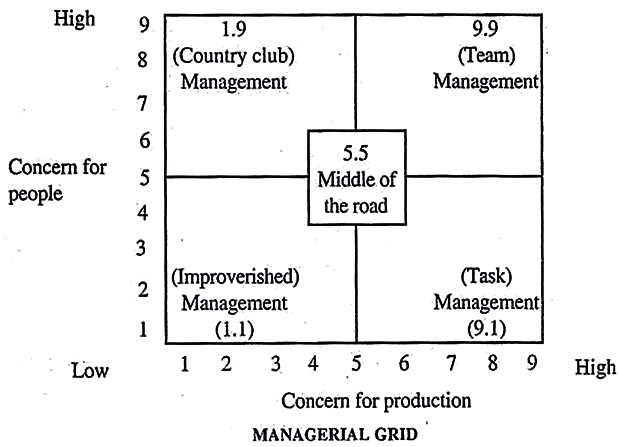
Managerial Grid Theory was developed by Robert Blake and Jane Mouton in the early 1960s to analyze leadership styles based on two key dimensions: Concern for People and Concern for Production. This theory is also known as the Leadership Grid. The primary objective of the theory is to help managers understand their inherent style of leadership and provide a framework for improving it.

Blake and Mouton’s grid identifies five distinct leadership styles, placing them on a grid with concern for production on the X-axis and concern for people on the Y-axis. The concern for production refers to task orientation or the focus on achieving organizational goals, while concern for people refers to relationship orientation or how leaders interact with subordinates.

Key Dimensions of the Managerial Grid:

  • Concern for People (Y-axis):

This dimension reflects the degree to which a leader considers the well-being, personal needs, interests, and development of subordinates when making decisions. A high concern for people indicates a leader who prioritizes employee satisfaction and morale.

  • Concern for Production (X-axis):

This dimension indicates the extent to which a leader emphasizes productivity, efficiency, and goal attainment. A high concern for production signifies a results-oriented leader who focuses on achieving organizational objectives.

In 1999, the grid managerial seminar began using a new text, The Power to Change.

Five Leadership Styles:

Blake and Mouton proposed five key leadership styles based on different combinations of concern for people and concern for production:

  • Impoverished Management (1,1): Low Concern for People, Low Concern for Production

This style represents minimal effort by the manager, both in terms of task accomplishment and people management. Leaders who exhibit this style tend to avoid responsibility and have little commitment to achieving results or ensuring employee well-being. The result is low productivity and low morale.

Example: A manager who only performs the bare minimum and avoids engaging with employees or improving processes.

  • Task Management (9,1): Low Concern for People, High Concern for Production

Also known as Authoritarian or Dictatorial Style, this approach emphasizes high productivity with little regard for employees’ needs or morale. Leaders using this style focus solely on achieving goals, often at the expense of employee satisfaction. While short-term results may be high, long-term morale and engagement suffer.

Example: A factory manager who prioritizes output without considering employee fatigue or motivation.

  • Country Club Management (1,9): High Concern for People, Low Concern for Production

This style focuses on creating a friendly and comfortable work environment, with little emphasis on task achievement. While employees may feel valued and satisfied, this approach often results in low productivity due to a lack of direction and control.

Example: A manager who emphasizes social gatherings and employee comfort but neglects deadlines and performance metrics.

  • Middle-of-the-Road Management (5,5): Moderate Concern for People, Moderate Concern for Production

This style represents a balance between concern for people and concern for production. Leaders using this style try to achieve acceptable performance levels while maintaining reasonable employee satisfaction. However, this compromise often leads to mediocre results in both areas.

Example: A manager who tries to please everyone and achieves moderate results without excelling in either productivity or employee engagement.

  • Team Management (9,9): High Concern for People, High Concern for Production

Considered the ideal leadership style, Team Management emphasizes both high productivity and high employee morale. Leaders adopting this style foster a collaborative environment, encourage participation, and focus on achieving high performance while ensuring employee well-being. This approach often results in high job satisfaction, innovation, and sustained productivity.

Example: A project manager who involves the team in decision-making, provides clear direction, and supports employee growth while meeting deadlines effectively.

Advantages of the Managerial Grid Theory:

  • Simple and Practical Framework:

The theory provides a straightforward way to analyze leadership styles by focusing on two key dimensions, making it easy for managers to understand and apply.

  • Diagnostic Tool for Self-Assessment:

Managers can use the grid to assess their current leadership style and identify areas for improvement.

  • Emphasizes Balance:

By highlighting the importance of balancing concern for people and production, the theory encourages a holistic approach to leadership.

  • Promotes Team-Oriented Leadership:

The Team Management style (9,9) is presented as the ideal, encouraging leaders to strive for both high productivity and employee satisfaction.

Criticism of the Managerial Grid Theory:

  • Over-Simplification of Leadership:

Critics argue that reducing leadership to two dimensions may oversimplify the complexities of real-world leadership, where multiple factors such as situational dynamics and organizational culture play crucial roles.

  • Ignores Situational Factors:

The theory assumes that the same leadership style is effective in all situations. However, contingency theories suggest that the best leadership style depends on specific situational variables.

  • Limited Emphasis on External Influences:

The theory focuses mainly on internal leadership behavior, without considering external factors such as market conditions, technological changes, and competitive pressures.

  • Ideal Style Not Always Practical:

While the Team Management style (9,9) is presented as ideal, it may not always be feasible in every organization due to resource constraints or other limitations.

Practical Implications for Managers:

Managers can use the Managerial Grid as a tool to reflect on their leadership style and make necessary adjustments. For example, a manager who realizes they have a high concern for production but a low concern for people (9,1) may work on developing better interpersonal relationships with their team. Similarly, those who prioritize people over production (1,9) can focus on improving task management skills.

Training programs based on the Managerial Grid can help managers develop a balanced approach to leadership, fostering both employee satisfaction and high performance. Additionally, organizations can use the grid to assess leadership effectiveness and implement targeted development initiatives.

Green Management – Meaning, Importance, Nature, Types, Green Management actions

Green Management refers to the incorporation of environmentally sustainable practices into business operations. It aims to minimize environmental impact while promoting ecological conservation. Organizations adopting green management contribute to sustainable development, ensuring resource availability for future generations.

Evolution:

  • Green Movement and Green Policies began in the late 1970’s when the first Green party was formed in Germany. The Term ‘Green’ is the English translation of the German word ‘Grun‘. Green politics advocated issues pertaining to Ecology, Environment, Feminism, Conservation and Peace.
  • It is believed that Green politics draws its inspirations from Mahatma Gandhi, Spinoza and Uexkull who advocated and urged personal responsibility to make the right moral choices is the pillar of the green politics ideology.

Importance of Green Business Management:

  • Cost Saving

Companies that focus on reducing energy consumption not only help the environment but also reduce their costs in the form of lower energy bills. Smaller businesses can also benefit from reduced energy costs by taking simple steps like switching off lights and fans when they are not required for usage.

  • Reduced Energy Use

Green Management often include measures to reduce energy use. To increase the efficiency of the building envelope it may use high efficiency windows and insulation in walls, ceilings and floors.

  • Healthier Workplace

Companies that promote a healthier workplace have a decrease in the number of sick days used by employees. This benefits the companies through increased productivity and less money paid out through medical benefits.

  • Reduced Waste

Green Management also seeks to reduce waste of energy, water and materials. During the construction phase, one goal should be to reduce the number of materials going to landfills. By collecting human waste at the source and running it to a semi-centralized bio-gas with other biological waste, liquid fertilizer can be produced.

  • Tax Credits

Tax Credits are available to companies that utilize environmentally friendly business practices such as switching to renewable energy source like solar power and using electric or hybrid automobiles and trucks as fleet vehicles.

  • Decreased Productivity

It is easier for the staff to toss paper plastic and other items into one trash can, then it is to sort the trash. If a company adds recycling to the office, company can see a slight decrease in worker productivity

  • Improved Public Image

Anytime companies can add a green initiative to the workplace. Companies can use the event to generate positive public relations. They can also include green initiatives on product packaging, advertisements and marketing materials to appeal to consumers who prefer green products.

  • Increased Capital Outflows

Some green conversions require an initial cash outflow that decreases the bottom-line performance while the investment is paying for itself. This can increase the company’s quarterly earnings on annual profits.

  • Increased Business Opportunities

Some Government agencies, Commercial businesses and non-profit institutions mandate that only businesses that meet specific green standards can bid on their contracts. Not all standards are government mandated with the office of the management and budget directing federal agencies to look for companies that meet voluntarily rather than Government standards when possible.

Nature of Green Management:

  • Nature-Based Knowledge and Technology

It involves emulating one’s own self in terms of growing their own food, harnessing their energy, constructing things, conducting business, healing themselves, processing information and designing their communities.

  • Products of Service to Products of Consumption

Products of Service are durable goods unlike products of consumption which have shorter life span. Products of Service are made of technical materials unlike products of Consumption which are made only of biodegradable materials.

  • Solar, Wind, Geothermal and Ocean Energy

These are used extensively without any negative effect on the earth.

  • Local-Based Organizations and Economies

This characteristic includes durable, beautify and health communities with locally owned and operated business and locally managed non-profit organizations, along with regional corporations and shareholders working together in partnerships and other collaborations.

  • Value Production

The triple value production establishes three simultaneous requirements of sustainable business activities as financial benefits for the company, natural world betterment, social advantages for the employees and members of the local community.

  • Continuous Improvement Process

The continuous process of monitoring, analysing, redesigning and implementing is used to intensify value production as conditions change and new opportunities emerge.

Types of Green Management:

1. Green Supply Chain Management (GSCM)

It includes repurchasing, recycling, reuse and substitute of material. This concept gains popularity because the customers are concerned with environment improvement which encourages the supplier to make environment friendly product.

Companies which adopted Green Supply Chain Management are British Telecom, Nike, Toyota and so on.

2. Green Marketing

It is the marketing of products that are presumed to be environmentally safe. Green Marketing incorporates a broad range of activities including product modification, changes to the production process, packaging changes.

Eg., Bank of America reduced Paper usage by 32%

3. Green Production

With this type of production, we could reduce all the harmful pollution to the environment and also reduce the cost from their starting step to finished product. Companies that follow Green Production are: Ikea – Using Solar & Wind Energy,

Nike Using recycled aluminum frames and underground energy storage

4. Green Research and Development

With only proper Research and Development the customer can provide a suitable product. Eg., Volkswagen Creating cars which are following environmental and safety standards to reduce carbon emissions.

5. Green Criminology

Criminology is referred to the study of Crime and Criminals whereas Green is related to environment issues. Some of the Green Crimes are Deforestation, Animal Trafficking, Cutting of Shark fins for trading.

6. Green Human Resource Management

It is based on Green Environment related to protection of environment. The term Human Resource refers to the contribution of Human resource policies and practices towards the broader corporate environmental agendas of protection, prevention and conservation of natural resources.

Green Management actions:

  • Sustainable Resource Use

Organizations should adopt strategies to reduce the consumption of natural resources such as water, energy, and raw materials. Implementing energy-efficient technologies, using renewable energy sources, and optimizing resource usage are critical to reducing the ecological footprint.

  • Waste Management

Proper waste management is a cornerstone of green management. Companies should emphasize the 3Rs: Reduce, Reuse, and Recycle. Efficient waste segregation, recycling materials, and minimizing production waste help lower landfill contributions and environmental harm.

  • Eco-Friendly Product Design

Green management encourages the design of eco-friendly products that use sustainable materials, require less energy during production, and generate minimal waste. Adopting green packaging solutions, such as biodegradable or recyclable materials, further reduces environmental impact.

  • Pollution Reduction

Organizations should implement measures to minimize air, water, and soil pollution. This includes treating industrial effluents, reducing greenhouse gas emissions, and adopting cleaner production technologies. Pollution reduction contributes to healthier ecosystems and communities.

  • Green Supply Chain Management

Businesses should encourage their supply chains to adopt sustainable practices. This includes sourcing materials ethically, working with environmentally conscious suppliers, and ensuring that transportation and logistics minimize emissions.

  • Employee Training and Engagement

Training employees in eco-friendly practices fosters a green culture within the organization. Encouraging employees to conserve energy, reduce paper use, and participate in sustainability programs creates a shared responsibility toward environmental conservation.

  • Corporate Social Responsibility (CSR) Initiatives

Green management actions often align with CSR programs focused on environmental protection. Activities such as tree plantation drives, biodiversity conservation projects, and community awareness campaigns demonstrate a company’s commitment to sustainability.

  • Compliance with Environmental Regulations

Adhering to environmental laws and standards is essential for green management. Organizations should ensure compliance with local and international environmental regulations, avoiding penalties and enhancing their reputation as responsible entities.

Employee Provident Fund

The Employee Provident Funds, 1952 is a beneficial legislation enacted for the betterment of the future of industrial worker:

  1. On his retirement.
  2. For his dependents in case of death of employment.

This Act is enacted as a social security measure which falls under the ground of “retirement benefit”, the object of this Act is to inculcate, non-withdrawable financial benefit, the sum is payable normally on retirement or on the death of the employee. Administration of the scheme given under this act is done by the central board, state board, and regional committee, a chief executive committee appointed and constituted by the central government.

  • Central board -Section 5A
  • Executive committee – Section 5AA
  • State board – Section 5B
  • Regional committee

Boards under the Act

Constitution and position

Central board: Section 5

Central board: Central board is created by official gazette notification given by the Central government.

Functions

  1. Section 6 and Section 6C discussions how the central board should use their fund vested on them.
  2. Duty of the central board is to send an annual report to the Central government, of its work and activities.
  3. The central government will submit a report to the comptroller and Auditor General of India. Comments of Central board is laid down before parliament.

Constitution of the following a person as a member:

  • Chairman and a vice-chairman appointed by the central government
  • The central Provident fund commissioner, ex-official
  • Among Central government officials (not more than five-person)
  • A representative of states (not more than 50)
  • Representing the employer of the establishment (10 people)
  • Representing the employee of the establishment (10 people)

Executive committee: Section 5AA

State Board: section 5 B 

The central government, after consulting with any of the states constitute the state board in the following state, as provided for in the scheme. Constitution of the state board is done by the notification in the official gazette. Central government from time to time prescribes the duties to be performed by the state board and the powers exercised by the state government. The following scheme will provide the terms condition subject to which a member of state board is appointed, time place and procedure for conducting meetings etc. Every board of trustee constituted under this section is a Body Corporate, being a body corporate, it has perpetual succession, a common seal and right to sue or get sued in its name.

Regional committee 

Until state board is constituted, the Central Government may set up Regional Committee, which is under the control of Central Government, it works under the advice of the following person:

  1. Central board, when matters referred to it from time to time.
  2. All the matter regarding “administration of the Scheme”, such as the progress of recovery of PF, contribution and other charges, speedy disposal of prosecution, settlement of claims and sanctions of advances.

Appointment of central fund commissioner

  • The central government shall appoint Central provident fund commissioner, deputy provident commissioner and regional provident fund commissioner by discharging his duty they will assist central provident fund commissioner. 
  • Chief executive officer is appointed by the central provident fund commissioner. 
  • Central Board will appoint other officers, employees for the efficient administration of various schemes.

EPF Features

The employer is under a statutory obligation to deduct a specified percentage of the contribution from the employee’s salary for provident fund. The employer should also contribute such percentage for provident fund. An employee who gets more than 15,000 is eligible for getting the provident fund.

This Act contains nearly 20 sections and four schedules. Section 7E, F, G, H, M, N is omitted, section 20 is repealed.

Applicability of the Act – section 1 of this Act deals with the application of the Act. This is applicable to “every factory engaged in any industry specified in schedule I”. 

  1. Every establishment in which 20 or more are employed. 
  2. Any establishment notified by the central government. 
  3. Any class of such establishment employing 20 or more. This Act is applicable to home workers held in the case Mangalore Gandhi Beedi workers V. U.O.I and P.M.Patel V. U.O.I. 
  4. This Act is applied when the establishment satisfies the two tests, namely:
  • Whether there is an establishment is a ‘factory’?
  • Whether 20 or more person is employed which is held in the case Andhra University V. Regional Provident Fund Commissioner.

Some workers will not come under this Act. They are Casual, or temporary workers can’t be considered as employee held in the case Bikar cold storage co. Ltd. V. Regional PF Commissioner.

Non-applicability of the Act

The Act does not apply to the following things. Any establishment registered under the co-operative society Act, 1912. Any state-related co-operative society employed less than 50 people and working without the aid of power. From the date on which the establishment is set up, where the establishment as:

  • Only 50 or more persons, after the expiry of 3 years.
  • Only 20 or more, but less than 50 people before the expiry of 5 years, which is held in the case V.K. Bhatt V. A.C.B & T. Mfg. Co.

Central Government also has the power to exempt any class of establishment, on such condition mentioned in the notification:

  • On the ground of financial position.
  • Other circumstances of the case which is held in the case Mohammed Ali V. U.O.I.

Eligibility For getting EPF- Any person is eligible, who is employed:

  • For work of the establishment.
  • Through contractor.
  • Connection with work of establishment is eligible for the benefit of the Act.

This Act was constitutionally challenged on the ground that it is:

  • Discriminative in nature.
  • Article 14 is violated because it is applied only to a particular class of industry, but the Supreme Court said that it doesn’t violate article 14, it is certain, classification of a certain class of industry falls in reasonable classification which is valid.

Schemes under EPF

Employees provident fund scheme 1952

Section 5 gives wholly unrestricted unguided direction to the central government to frame a scheme, and it appears on the other hand that the Act is full of carefully laid down principles to guide the central government which is held in the case R.P.F. Commr. V. L.R.F Works, A.I.R 1962 Punj. 507

When they say that this scheme has retrospective effect, the employer cannot be asked to pay the employees contribution for the period antecedent to the notification applying the scheme because he has no right to deduct the same for the future wages payable to the employee. The payment of employee contribution by the employer with the corresponding right to deduct the same from the wages of the employees could be only for the current period during which the employer also has to pay his contribution, which is held in the case District exhibitors Assn.,Muzaffarnagar & others V. Union of India (1991) II LLJ 115 (SC).

They were re-employment by the petitioner on a temporary basis. It was held that the employer cannot be asked to pay a contribution in respect of re-employed employees on a temporary basis which is held in the case Bombay printers LTD. & Others V. Union of India and others (1992)I LLJ 816 (BOM).

The fund shall be administered by the central board constituted under section 5A of the Act. The scheme shall take effect either prospectively or retrospectively.

Employees deposit linked insurance scheme, 1976

The scheme Established the purpose of providing life insurance benefits to the employees. The benefit under the scheme is to provide the incentive to the members to save more in the Provident fund account. The benefit under this scheme is linked to the amount of accumulation in the Provident fund account of the member. All the members of the employee’s Provident Fund Scheme are covered as members of the employee’s deposit linked insurance scheme also.

Employee’s family pension scheme, 1995

For the benefit of providing family pension and life insurance benefit. Following benefit package is:

  • Pension for life to the member, on retirement and invalidation
  • To the member of the family upon the death of the members.
  • Facility for capital return ( corpus accretion) on an option formula basis
  • Commutation if pension up to 1/3 Rd of pension amount.
  • Retention of membership of the scheme till attaining the age of 68 

Retirement pension under the new scheme will be payable on fulfilling minimum 10 years eligible service and on attaining the age of 58 years.

UAN- Universal Account Number

Universal account number (UAN) is number given to an employee by the Ministry of Employment and Labour under the government of India, who is maintaining PF account. It used to know information or track information done by his employer regarding his provided fund (PF). When an employee joined in the new organisation, he was assigned with new PF account, after UAN came into existence, the member of the assemble (employee) all his PF account associated with multiple Ids of difference organization at one place. So through UAN, difficulties faced by the employee when he/she joins the new organization is overcome, with UAN they can track the activities if there are any payment issues.

Uses of UAN 

  • It is a unique number given to an employee, which is independent of employers.
  • UAN is used to link all the PF account when the employee is switching his company.
  • An employer can authenticate his employee by verifying this number and KYC documents.
  • EPF passbook can be verified by sending SMS EPFOHO UAN ENG TO 7738299899 from the mobile number which is registered under employee provident fund organization.
  • An employee can check his deposit done by his employer through online using UAN number, and you can also get a monthly update regarding your deposit done by the employer.

Transparency Through UAN

  • Through UAN employee can check the employer is depositing his PF amount periodically, by registering on EPF member Portal using his UAN.
  • The employee would be able to find out whether his employer is deducted or hold back his PF.

EPF Calculation and Example

Contribution for EPF is two parts, one is by the employee, and the other is by the employer.

Contribution by the employee is, including basic wage and dearness allowance is -12%.

Contribution on the part of the employer is-

  • 8.33% (for Employees Pension Scheme Account of Employee)
  • 3.67 % (for Employee Provident Fund Account of Employee)
  • 0.50% ( for Employees Deposit Linked Insurance Account of Employee) 
  • 0.50% ( is Employer has to pay an additional charge for an administrative account- minimum 500 rupees and if there is no contribution by the employer that month, an employer must pay rupees 75)
error: Content is protected !!