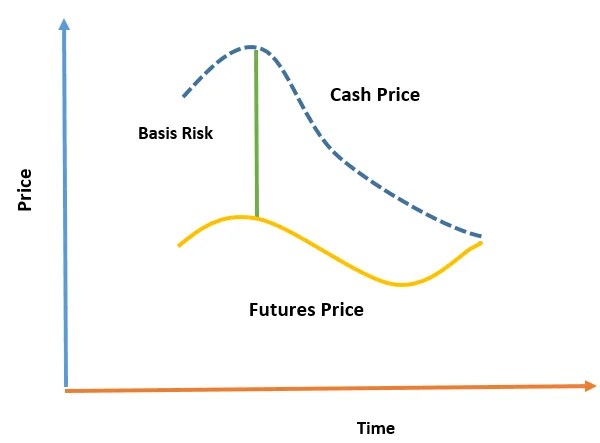
Basis & Basis Risk

Basis risk in finance is the risk associated with imperfect hedging due to the variables or characteristics that affect the difference between the futures contract and the underlying “cash” position.

Basis risk is the financial risk that offsetting investments in a hedging strategy will not experience price changes in entirely opposite directions from each other. This imperfect correlation between the two investments creates the potential for excess gains or losses in a hedging strategy, thus adding risk to the position.

It arises because of the difference between the price of the asset to be hedged and the price of the asset serving as the hedge namely b = S – F, before expiration, any difference at expiration will be offset by arbitrage. Other examples of aspects that may cause basis risk to arise:

a) Quality: the hedge in place may have a different grade (which may not be perfectly correlated with the basis)

b) Timing: A mismatch between the expiration date of the hedge asset and the actual selling date of the asset

c) Location/Transportation Costs: Due to the difference in the location of the asset to be hedged and the asset serving as the hedge, an unforeseen rise in transportation costs may cost the producer who hedges more money.

  • Basis risk is the potential risk that arises from mismatches in a hedged position.
  • Basis risk occurs when a hedge is imperfect, so that losses in an investment are not exactly offset by the hedge.
  • Certain investments do not have good hedging instruments, making basis risk more of a concern than with others assets.

Under these conditions, the spot price of the asset, and the futures price, do not converge on the expiration date of the future. The amount by which the two quantities differ measures the value of the basis risk. That is,

Basis = Futures price of contract − Spot price of hedged asset.

Basis risk is not to be confused with another type of risk known as price risk.

Some examples of basis risks are:

  • Treasury bill future being hedged by two year Bond, there lies the risk of not fluctuating as desired.
  • Foreign currency exchange rate (FX) hedge using a non-deliverable forward contract (NDF): the NDF fixing might vary substantially from the actual available spot rate on the market on fixing date.
  • Over-the-counter (OTC) derivatives can help minimize basis risk by creating a perfect hedge. This is because OTC derivatives can be tailored to fit the exact risk needs of a hedger.

Components of Basis Risk

Risk can never be altogether eliminated in investments. However, risk can be at least somewhat mitigated. Thus, when a trader enters into a futures contract to hedge against possible price fluctuations, they are at least partly changing the inherent “price risk” into another form of risk, known as “basis risk”. Basis risk is considered a systematic, or market, risk. Systematic risk is the risk arising from the inherent uncertainty of the markets. Unsystematic, or non-systematic, risk, which is the risk associated with a specific investment. The risk of a general economic turndown, or depression, is an example of systematic risk. The risk that Apple may lose market share to a competitor is unsystematic risk.

Between the time a futures position is initiated and closed out, the spread between the futures price and the spot price may widen or narrow. As the visual representation below shows, the normal tendency is for the basis spread to narrow. As the futures contract nears expiration, the futures price usually converges toward the spot price. This logically happens as the futures contract becomes less and less “future” in nature. However, this common narrowing of the basis spread is not guaranteed to occur.

Different Types of Basis Risk

  • Price basis risk: The risk that occurs when the prices of the asset and its futures contract do not move in tandem with each other.
  • Location basis risk: The risk that arises when the underlying asset is in a different location from the where the futures contract is traded. For example, the basis between actual crude oil sold in Mumbai and crude oil futures traded on a Dubai futures exchange may differ from the basis between Mumbai crude oil and Mumbai-traded crude oil futures.
  • Calendar basis risk: The selling date of the spot market position may be different from the expiry date of a futures market contract.
  • Product quality basis risk: When the properties or qualities of the asset are different from that of the asset as represented by the futures contract.

Perfect & Imperfect Hedge

A perfect hedge is a position undertaken by an investor that would eliminate the risk of an existing position, or a position that eliminates all market risk from a portfolio. In order to be a perfect hedge, a position would need to have a 100% inverse correlation to the initial position. As such, the perfect hedge is rarely found.

A common example of a near-perfect hedge would be an investor using a combination of held stock and opposing options positions to self-insure against any loss in the stock position. The downside of this strategy is that it also limits the upside potential of the stock position. Moreover, there is a cost to maintaining a hedge that grows over time. So even when a perfect hedge can be constructed using options, futures and other derivatives, investors use them for defined periods of time rather than as ongoing protection.

When the term perfect hedge is thrown about in the world of finance, it usually means an ideal hedge as judged by the speaker’s own risk tolerance. There is really no reason to completely remove all the risk out of an investment, as neutering risk has a similar impact on rewards. Instead, investors and traders look to establish a range of probability where the worst and best outcomes are both acceptable.

Traders do this by establishing a trading band for the underlying they are trading. The band can be fixed or can move up and down with the underlying. However, the more complex the hedging strategy, the more likely it is that hedging costs themselves can impact overall profit.

The same is true of investors in traditional securities. There are many strategies to hedge owned stocks involving futures, call and put options, convertible bonds and so on, but they all incur some cost to implement. Investors also try to create “perfect” hedges through diversification. By finding assets with low correlation or inverse correlation, investors can ensure smoother overall portfolio returns. Here again, the cost of hedging comes into play in that an investor ties up capital and pays transaction fees throughout the process of diversification.

Perfect hedges do exist in theory, but they are rarely worth the costs for any period of time except in the most volatile markets. There are several types of assets, however, that are often referred to as the perfect hedge. In this context, the perfect hedge is referring to a safe haven for capital in volatile markets. This list includes liquid assets like cash and short-term notes and less liquid investments like gold and real estate. It takes very little research to find issues with all of these perfect hedges, but the idea is that they are less correlated with financial markets than other places you can park your money.

Imperfect Hedge

The hedger’s gain and loss in the spot and futures market are not fully offset and the hedger will end up with some gain or loss. This is called imperfect hedge. Note that the gain or loss of hedging will be much less than not utilizing hedge.

Seller’s hedge or short hedge

Following the example from the previous page, assume the price has gone down between the time of selling the futures contract and November 1st and the basis has changed a bit (imperfect hedge). Let’s explore two cases:

  • On November 1st, the spot market prices are $59.5/bbl and the December futures contract would be $60.60/bbl.
  • On November 1st, the spot market prices are $59.60/bbl and the December futures contract would be $60.40/bbl.

Buyer’s hedge or long hedge

Following the example from the previous page, assume prices have gone down from the time the refinery buys the future contracts until November 1st. Let’s consider the above cases:

  • On November 1st, the spot market prices are $59.50/bbl and the December futures contract would be $60.60/bbl.
  • On November 1st, the spot market prices are $59.60/bbl and the December futures contract would be $60.40/bbl.

Reasons for Investing in Commodities

Inflation hedging

Commodity returns have tended to pick up when inflation has been rising and decline when inflation has been falling, in contrast to both equities and bonds.

Other asset classes which are typically considered inflation hedges, such as real estate and inflation-linked bonds, currently trade on historically very expensive valuations, unlike commodities.

While deflationary pressures exist, there are signs that inflation is building.

Labour markets are tight and the 12-month core inflation rate, which excludes commodity prices, has been running above 2% since last November. It would be complacent to ignore the dangers of inflation.

All the more so given the sums that have been pumped into the financial system and the policy bias towards generating inflation.

Commodities diversify equity risk

Commodities diversify equity risk but, given their intrinsic link with economic growth, it would be unrealistic to expect them to hedge so-called tail risks such as the economic downturn resulting from the financial crisis of 2008-09.

In reality, the relationship between commodities and equities varies considerably. At times there is a negative correlation, but on average they show a low but positive correlation.

Nonetheless, so long as commodities are not perfectly correlated with equities, even a small allocation to an equity-heavy portfolio can result in a reduction in overall volatility.

Assuming a 0.2 correlation between equities and commodities, reasonable given historic experience, we estimate that commodities only have to generate returns of around 2% a year to improve portfolio risk-adjusted returns.

Potential for more attractive risk-adjusted returns

So far we have argued that there is a case for a strategic allocation to commodities even if returns are relatively muted. In fact, however, current conditions suggest that they could actually be much better than that.

Certainly, commodities look cheap compared with their history, particularly against equities.

Furthermore, many commodities are trading below their costs of production, a key valuation anchor. They are one of the few global asset classes that can lay a claim to being cheap.

So, we would argue, there has rarely been a better time to buy commodities. However, effective implementation is key.

Passive investors tracking well known benchmarks are exposed to a host of undesirable costs and consequences which active managers can avoid or even profit from.

With prices low and many commodities poorly-researched, this should be an excellent environment in which active managers could add value.

Trading in Commodities in India (Cash & Derivative Segment)

A tradable commodity can be bought and sold, just like you trade in equity/shares. You buy a commodity, expecting future Price appreciation. When the future price hits the target, you sell it. This is the modus operandi. On the other side, sellers of a commodity sell it when they think there is no room for appreciation for future price. Open a demat account today.

Even today in villages, farmers exchange commodities among themselves. In the organized commodity trading world, things are a little different. Commodity trading is regaining its importance among investors. This trading happens on a commodities exchange, where various commodities and their derivatives products are bought/sold. The most commonly traded items are agricultural products and contracts based on them. But, increasing non-agro commodities are also being traded like diamonds, steel, energy items etc.

There are two sides to the same coin. Commodity trading has its own advantages and disadvantages.

The advantages include commodity futures are highly leveraged investments, which means with a relatively small amount of money you can take a bigger bet. Commodity future markets generally are very liquid, which means entry and exit are easy. Commodity futures can potentially give huge profits, if traded carefully and smartly

The disadvantages of commodity futures trading are that markets are volatile, which means risk is higher. Direct investment in the commodity markets is of high-risk, especially for new investors. So, be careful. Gains and losses are magnified by leverage, which means you win big or lose big.

Cash commodities or “actuals” refer to the physical goods, e.g., wheat, corn, soybeans, crude oil, gold, silver that someone is buying/selling/trading as distinguished from derivatives.

Cash Market

Derivative Market

Purchase even one share In case of futures and options, the minimum lots are fixed
Tangible assets are traded In derivatives contracts based on tangible and intangible assets are traded
Cash markets are used for investment Derivatives are used for hedging, arbitrage or speculation
Customer must open for trading account For futures, a customer must open a future trading account with a derivative broker
Entire amount is put upfront In case of futures, only the margin money needs to be put up
The owner of shares is entitled to the dividends The derivative holder is not entitled to dividends

Participants in Commodities Market

Players of commodities market have been classified into three broad categories. They are Hedgers, Speculators and Arbitrageurs.

Hedgers: Hedging is an investment strategy used for minimising a risk and hedgers are the practitioners of this strategy. Generally, hedgers are producers or consumers who want to transfer the price-risk on to the market. Commodities derivatives market provide them an effective hedging mechanism against adverse price movements. They protect themselves from risk associated with the price of commodity by using derivatives.

For example, an airline company faces the risk is price rise of fuel. So they will go for a long position (buy an oil futures contract) to hedge, just to cover the amount of fuel they expect to buy.

Similarly, gold is the best hedge against inflation.

Speculators: Speculators are sophisticated leading players in commodities futures market. They are basically risk takers and are never associated with any commodity. They generally bet against the price movement in the hope of making gains.

They undertake speculative position with respect to anticipating future price movements with a small margin and square-off anytime during trading hours. They do either by going long or going short positions.

Buying a futures contract in anticipation of price increase is known as ‘going long”. Selling a futures contract in anticipation of a price decrease is known as ‘going short”.

Arbitrageurs: Arbitrageurs are investors who earn from discrepancy in prices between the two exchanges or between different maturities of the same commodity.

A simple example of arbitraging is simultaneously buying a gold at lower price from one exchange and selling it on another exchange for higher price. So they make profit from price difference.

Margin Traders: In the finance industry, the margin is the collateral deposited by an investor investing in a financial instrument to the counterparty to cover the credit risk associated with the investment.

Structure of Commodities Market in India

The commodities market exists in two distinct forms:

  • Over-the-counter (OTC) market
  • Exchange based market

Similar to equities, there exists the spot and the derivatives segments. Spot markets are essentially OTC markets and participation is restricted to people who are involved with that commodity, such as the farmer, processor, wholesaler, etc.

A majority of the derivatives trading takes place through the exchange-based markets with standardized contracts, settlements, etc. The exchange-based markets are essentially derivative markets and are similar to equity derivatives in their working, that is, everything is standardized and a person can purchase a contract by paying only a percentage of the contract value.

A person can also go short on these exchanges. Moreover, even though there is a provision for delivery, most contracts are squared-off before expiry and are settled in cash. As a result, one can see an active participation by people who are not associated with the commodity. The typical structure of commodity futures markets in India is as follows.

Structure of commodity market in india

Ministry of Consumer Affairs, Food and Public Distribution

The Department pertaining to consumer affairs is responsible for the formulation of policies for:

  • Monitoring Prices
  • Consumer Movement in the country
  • Controlling of statutory bodies (Bureau of Indian Standards (BIS) and Weights and Measures)
  • Internal Trade
  • Inter-State Trade- The Spirituous Preparations (Inter-State Trade and Commerce) Control Act, 1955 (39 of 1955).
  • Control of Futures Trading- the Forward Contracts (Regulations) Act, 1952 (74 of 1952)

The Department for food and public distribution is responsible for the formulation of policies for:

  • Ensuring food security for the country through timely and efficient procurement and distribution of food grains.
  • Building up and maintenance of food stocks, their storage, movement and delivery to the distributing agencies and monitoring of production, stock and price levels of food grains.
  • Incentivizing farmers through fair value of their produce by way of Minimum Support Price mechanism, distribution of food grains to Below Poverty Line (BPL) families.
  • Covering poor households at the risk of hunger under Antyodaya Anna Yojna (AAY).
  • Establishing grain banks in food scarce areas and involvement of Panchayati Raj Institutions in Public Distribution System (PDS).
  • Concerns for the sugar sector such as fixing of Fair and Remunerative Price (FRP) of sugarcane payable by Sugar factories, development and  regulation of sugar industry (including training in sugar technology), fixation of levy price of sugar and its supply for PDS and regulation of supply of free sale sugar.
  • Export and import of food grains, sugar and edible oils.

Forward Market Commission

The Commission functions under the control of the Ministry of Consumer Affairs, Food & Public Distribution, Department of Consumer Affairs, Government of India. The functions of the Forward Markets Commission are:

  • To advise the Central Government in respect of the recognition or the withdrawal of recognition from any association or in respect of any other matter arising out of the administration of the Forward Contracts (Regulation) Act 1952.
  • To keep forward markets under observation and to take such action in relation to them, as it may consider necessary, in exercise of the powers assigned to it by or under the Act.
  • To collect and whenever the Commission thinks it necessary, to publish information regarding the trading conditions in respect of goods to which any of the provisions of the Act is made applicable, including information regarding supply, demand and prices, and to submit to the Central Government, periodical reports on the working of forward markets relating to such goods.
  • To make recommendations generally with a view to improving the organization and working of forward markets.
  • To undertake the inspection of the accounts and other documents of any recognized association or registered association or any member of such association whenever it considers it necessary.

Types of Commodities Traded

A commodity is a group of assets or goods that are important in everyday life, such as food, energy or metals. A commodity is alternate and exchangeable by nature. It can be categorized as every kind of movable good that can be bought and sold, except for actionable claims and money.

Hard and soft commodities are traded on the exchanges. Metals, crude oil, etc. fall under the category of hard commodities whereas agricultural commodities like corn, wheat, cotton, soybean, and guar are soft commodities as they have a limited shelf life. Let us concentrate on the types of commodity market in India and list of commodities traded on commodity market.

Commodity trading in India started way back in time, even before it did in many other countries. But, foreign invasions and ruling, natural calamities, and many government policies and their amendments were significant reasons for the diminishing of commodity trading. Today, even though there are various other forms of stock market and share market traders, commodity trading has regained its importance.

Commodity trading is where various commodities and their derivatives products are bought and sold. A commodity is any raw material or primary agricultural product that can be bought or sold, whether wheat, gold, or crude oil, among many others. When you engage in commodity trading, such commodities can diversify your asset portfolio.

Types of Commodities Traded

Commodities that are traded are typically sorted into four categories broad categories: metal, energy, livestock and meat, and agricultural.

  1. Metals

Metals commodities include gold, silver, platinum, and copper. During periods of market volatility or bear markets, some investors may decide to invest in precious metals–particularly gold–because of its status as a reliable, dependable metal with real, conveyable value. Investors may also decide to invest in precious metals as a hedge against periods of high inflation or currency devaluation.

  1. Energy

Energy commodities include crude oil, heating oil, natural gas, and gasoline. Global economic developments and reduced oil outputs from established oil wells around the world have historically led to rising oil prices, as demand for energy-related products has gone up at the same time that oil supplies have dwindled.

Investors who are interested in entering the commodities market in the energy sector should also be aware of how economic downturns, any shifts in production enforced by the Organization of the Petroleum Exporting Countries (OPEC), and new technological advances in alternative energy sources (wind power, solar energy, biofuel, etc.) that aim to replace crude oil as a primary source of energy, can all have a huge impact on the market prices for commodities in the energy sector.

  1. Livestock and Meat

Livestock and meat commodities include lean hogs, pork bellies, live cattle, and feeder cattle.

  1. Agriculture

Agricultural commodities include corn, soybeans, wheat, rice, cocoa, coffee, cotton, and sugar. In the agricultural sector, grains can be very volatile during the summer months or during any period of weather-related transitions. For investors interested in the agricultural sector, population growth–combined with limited agricultural supply–can provide opportunities for profiting from rising agricultural commodity prices.

Commodities Market, Meaning, History and Origin, Features, Classification

Commodities market in India refers to the trading of raw materials and primary agricultural products like gold, silver, crude oil, metals, and agricultural commodities. It plays a crucial role in price discovery, risk management, and ensuring liquidity. The Multi Commodity Exchange (MCX) and National Commodity and Derivatives Exchange (NCDEX) are the two major exchanges facilitating commodities trading in India. These markets allow hedging against price fluctuations and provide opportunities for investors to diversify their portfolios. The commodity derivatives market includes futures and options contracts, which help participants manage risks related to price volatility. The commodities market contributes to India’s economic development by improving market efficiency and supporting both producers and consumers.

History and Origin of Commodities Market:

The origin of the commodities market can be traced back to ancient civilizations, where the exchange of goods, primarily agricultural products, and raw materials was a fundamental part of trade. The commodities market, as we know it today, has evolved significantly over centuries, driven by the need for structured trading, price discovery, and risk management.

  • Ancient Civilizations and Early Trading

The concept of commodities trading can be traced back to Mesopotamia around 3000 BCE, where grain was traded. The ancient Sumerians used clay tablets to record transactions, which are considered the earliest forms of futures contracts. These early forms of trade were often linked to agricultural products such as grains, livestock, and metals. In Egypt and Greece, similar trade practices evolved, with local markets developing around major cities to facilitate the exchange of agricultural goods and resources.

  • Emergence of Futures Contracts

The formalization of futures contracts began in Japan in the 17th century. The Dojima Rice Exchange was established in 1697 in Osaka, Japan, marking the world’s first futures market. Farmers and merchants used this exchange to enter into contracts that allowed them to lock in future prices for rice. This practice was crucial for both producers, who wanted to secure income, and merchants, who sought to ensure consistent supply. The Dojima Exchange set the foundation for futures trading, which is now a cornerstone of modern commodities markets.

  • Commodities Market in the United States

In the United States, the history of commodities markets began in the early 19th century. The Chicago Board of Trade (CBOT) was established in 1848, and it became one of the most influential commodity exchanges globally. Initially, the exchange focused on agricultural products such as corn, wheat, and oats, vital to the U.S. economy at the time. The CBOT introduced standardized contracts for the trading of these commodities, which helped promote transparency, liquidity, and price discovery.

The futures contracts introduced by the CBOT allowed producers to hedge against price fluctuations, providing a financial safety net. Over time, this concept expanded to include a broader range of commodities, including energy products like oil and natural gas, as well as precious metals such as gold and silver.

Evolution of the Modern Commodities Market

The growth of the global economy and advances in technology contributed significantly to the expansion of commodities markets. The creation of electronic trading platforms and online exchanges allowed for quicker execution of trades and greater market participation. In India, the modern commodities market began to take shape in the late 20th century.

National Commodity and Derivatives Exchange (NCDEX) and Multi Commodity Exchange (MCX) were established in India in 2003 and 2004, respectively, to provide structured platforms for trading a variety of commodities, including metals, energy, and agricultural goods. These exchanges were designed to help manage price risks, ensure liquidity, and contribute to the overall development of India’s commodity market.

Features of Commodities Market:

  • Variety of Commodities:

The commodities market in India deals with a wide range of raw materials and primary products. These include agricultural commodities like wheat, rice, and cotton, and non-agricultural commodities such as gold, silver, crude oil, and industrial metals like copper, aluminum, and steel. The diversity of commodities allows traders and investors to participate in various sectors and manage their exposure to different risks.

  • Physical and Derivatives Market:

The commodities market consists of two segments: the physical market and the derivatives market. The physical market involves the direct buying and selling of the commodities, while the derivatives market includes contracts such as futures and options, which allow traders to hedge against price fluctuations. The derivatives market enables participants to lock in prices for future delivery, thus offering protection against price volatility.

  • Price Discovery and Transparency:

One of the main functions of the commodities market is price discovery. Through active trading and supply-demand dynamics, the market establishes transparent and fair prices for commodities. The prices in the market reflect real-time economic conditions, geopolitical factors, and other relevant influences, providing both producers and consumers with valuable insights into market trends and price movements.

  • Hedging Opportunities:

Commodities markets offer participants a chance to hedge against price volatility and uncertainties. For instance, producers like farmers or mining companies can use futures contracts to lock in a specific price for their products, protecting themselves from adverse price movements. Similarly, importers and exporters can hedge against exchange rate fluctuations or price changes in global markets.

  • Regulation and Oversight:

The commodities market in India is regulated by organizations like the Securities and Exchange Board of India (SEBI) and the Forward Markets Commission (FMC). These regulatory bodies ensure that the market operates with transparency, fairness, and integrity, protecting the interests of all participants. Exchanges such as MCX and NCDEX play a central role in maintaining order and enforcing rules for smooth market operations.

  • Liquidity:

The commodities market provides liquidity, enabling traders to buy or sell commodities quickly and efficiently. Liquidity is essential for price discovery and helps investors enter or exit positions without significant price distortion. With high liquidity, participants are assured that they can execute their trades at prevailing market prices, making the market more attractive for both institutional and retail investors.

Classification of Commodities Market:

  • Physical (Spot) Market

The physical or spot market is where commodities are bought and sold for immediate delivery and payment. Transactions occur on the spot, meaning buyers pay and take possession of the goods right away. This market deals with tangible commodities such as agricultural produce, metals, and energy products. Prices are determined based on current supply and demand conditions. Spot markets are typically used by manufacturers, traders, and consumers who need physical delivery of goods. These markets operate through auction systems, trading floors, or over-the-counter (OTC) channels, and they form the foundation for futures and derivatives pricing.

  • Futures Market

The futures market involves contracts to buy or sell commodities at a future date at a predetermined price. It allows buyers and sellers to hedge against price fluctuations by locking in prices in advance. No physical exchange of goods occurs at the time of the agreement. This market is essential for risk management, price discovery, and speculation. Standardized contracts are traded on exchanges like MCX or NCDEX. The futures market is regulated to ensure transparency, and it attracts investors, producers, exporters, and large buyers looking to mitigate risks related to price volatility in commodity markets.

  • Over-the-Counter (OTC) Market

The OTC commodities market allows for direct trading between two parties without exchange involvement. These contracts are customized in terms of volume, delivery date, and settlement terms, catering to specific needs of large players like corporates or institutional buyers. Since OTC markets are not standardized, they offer flexibility, but also carry higher counterparty risk. Commonly traded OTC commodities include crude oil, metals, and grains. Though not as regulated as exchange-traded markets, OTC trading plays a significant role in global commodities pricing and is often used for complex financial strategies or hedging requirements.

  • Exchange-Traded Market

This market refers to commodity transactions that occur through regulated exchanges such as MCX (Multi Commodity Exchange) or NCDEX (National Commodity & Derivatives Exchange) in India. These markets offer transparency, standardization, and reduced counterparty risk due to regulatory oversight. Commodities are traded in standardized contract sizes and delivery specifications. Prices are determined through market dynamics and published in real-time. Traders, investors, and hedgers participate actively in this platform, making it a key part of the financial system. Exchange-traded commodity markets promote efficient price discovery, liquidity, and facilitate fair and transparent commodity trading.

Factors Favouring Transactional Strategy

A firm using a global strategy sacrifices responsiveness to local requirements within each of its markets in favor of emphasizing efficiency. This strategy is the complete opposite of a multidomestic strategy. Some minor modifications to products and services may be made in various markets, but a global strategy stresses the need to gain economies of scale by offering essentially the same products or services in each market.

Microsoft, for example, offers the same software programs around the world but adjusts the programs to match local languages. Similarly, consumer goods maker Procter & Gamble attempts to gain efficiency by creating global brands whenever possible. Global strategies also can be very effective for firms whose product or service is largely hidden from the customer’s view, such as silicon chip maker Intel. For such firms, variance in local preferences is not very important.

A firm using a transnational strategy seeks a middle ground between a multidomestic strategy and a global strategy. Such a firm tries to balance the desire for efficiency with the need to adjust to local preferences within various countries. For example, large fast-food chains such as McDonald’s and KFC rely on the same brand names and the same core menu items around the world. These firms make some concessions to local tastes too. In France, for example, wine can be purchased at McDonald’s. This approach makes sense for McDonald’s because wine is a central element of French diets.

Technological change

Rapid and sustained technological change has reduced the cost of transmitting and communicating information sometimes known as “the death of distance” – a key factor behind trade in knowledge products using web technology.

Containerisation

The costs of ocean shipping have come down, due to containerization, bulk shipping, and other efficiencies. The lower unit cost of shipping products around the global economy helps to bring prices in the country of manufacture closer to those in export markets, and it makes markets more contestable globally

Differences in tax systems

The desire of businesses to benefit from lower unit Labour costs and other favorable production factors abroad has encouraged countries to adjust their tax systems to attract foreign direct investment (FDI). Many countries have become engaged in tax competition between each other in a bid to win lucrative foreign investment projects.

Economies of scale

Many economists believe that there has been an increase in the minimum efficient scale (MES) associated with some industries. If the MES is rising, a domestic market may be regarded as too small to satisfy the selling needs of these industries. Many emerging countries have their own transnational corporations

Growth Strategies of Transnational and Multinational Companies

In their pursuit of revenue and profit growth, increasingly global businesses and brands have invested significantly in expanding internationally. This is particularly the case for businesses owning brands that have proved they have the potential to be successfully globally, particularly in faster-growing economies fuelled by growing numbers of middle class consumers.

Less protectionism

Old forms of non-tariff protection such as import licensing and foreign exchange controls have gradually been dismantled. Borders have opened and average import tariff levels have fallen.

That said, it is worth knowing that, in the last few years, there has been a rise in non-tariff barriers such as import quotas as countries have struggled to achieve real economic growth and as a response to persistent trade and current account deficits.

International Strategies in Service Marketing

Global marketing is defined as the process of adjusting the marketing strategies of your company to adapt to the conditions of other countries. Of course, global marketing is more than selling your product or service globally. It is the full process of planning, creating, positioning, and promoting your products in a global market.

Big businesses usually have offices abroad for countries they market to. Currently, with the proliferation of the internet, even small businesses can reach consumers anywhere in the world. If a business chooses not to extend internationally, it can face domestic competition from international companies that are extending their international presence. The presence of this competition almost makes it a requirement for many businesses to have an international presence.

There are many benfits of global marketing, when it is done right.

  • First, it can improve the effectiveness of your product or service. This is because the more you grow, the more you learn, and the faster you learn, you become more effective at producing new product or service offerings.
  • Second, you are able to have a strong competitive advantage. It is easy enough for companies to be competing in the local market. But there are very few companies who can do so on the worldwide arena. Hence, if you can compete in the worldwide market and your competitors cannot, you have become a strong force in your industry!
  • Third, you increase consumer awareness of your brand and product or service. Through the internet, consumers can keep track of your progress in the world.
  • Finally, global marketing can reduce your costs and increase your savings. In focusing on other markets, you can attain economies of scale and range by standardizing your processes not to mention the savings that you get when you leverage the internet.
  • Companies evolving towards global marketing are actually quite gradual. The first stage has the company concentrating on the domestic side, with its activities focused on their home market. Stage two has the company still focusing domestically but has exports. By stage three, the company has realized that they need to adapt their marketing geared towards overseas. The concentration moves from multinational. Thus, adaption has become crucial. The fourth and last stage has the company creating value when it extends its programs and products to serve worldwide markets. Definitely, there are no definite time periods to this evolution process.

A global marketing strategy almost always consists of several things:

(1) Uniform brand names

(2) Identical packaging

(3) Similar products

(4) Standardized advertising messages

(5) synchronized pricing

(6) Coordinated product launches

(7) Harmonious sales campaigns.

  • As a whole, these two are the most well-known global marketing strategies used by companies expanding internationally:
  • Create a consistent and strong brand culture. Creating a strong and consistent brand that always seems familiar to customers is a priority for companies growing internationally. With the ever-more rising and expanding internet, brand structure has become more of a brand culture. To be more specific, it has become more prevalent nowadays that the brand you support reflects your culture. It can be damaging if you compromise your brand culture. For example, Google found out the hard way when it launched a self-censored search engine in China, even though China subjects its new media to government blocks. Google’s brand has been known to make the world access information at anytime. How can Google set up something in China against its own culture? As a result, customer backlash versus Google was substantial.
  • Market as if there were no borders. Due to the proliferation of digital platforms, brands cannot always adopt different strategies per country. In a way, due to the internet, companies have to adopt a marketing approach that is more or less unified.

Global marketing issues and mistakes

Companies, especially their marketing teams, often face the following issues and mistakes when expanding worldwide. These can become hurdles in achieving international success.

Non-Specification of Countries

Many businesspersons usually think of foreign markets vaguely, like they want to shift to Asia or they want to increase their growth by offering their products to Europe. It is problematic to take things too simply. Europe can mean the European Union, Western Europe, Eastern Europe, and so on and so forth. Consumers always identify themselves at the local level and marketing teams have to remember that each country has its own norms, laws, payment types, and particular business practices.

By being specific in the start, companies can prioritize the markets they want to get into, generate a staffing plan, and allocate the budget. These are all important for a business to attain its global objectives.

No Focus on Internal Information

You have to conduct specialized and complicated market research when you are going to create a global market entry strategy. You would need to consider the potential opportunity in the market, how easy or hard it would be for your business to work in that market, and how successful you already are in the market.

There are a lot of companies that concentrated on outside data to help their decision-making, as described above. Nonetheless, you can simply use your own internal information to get the data, on whether there is a strong fit between your product or service and the market. Remember that data from third parties do not understand your company or even know your consumer. Only you have the best input on this.

Lack of Adaptation of Sales and Marketing Channels

Most Western companies think that they can go into new markets by doing the same things that brought them success domestically.

As previously mentioned, it is important to have brand consistency, but differing markets would like particular marketing approaches. Moreover, marketers have to consider at which channels it would be best to market, based on market behavior.

Case in point, for Brazil, marketing campaigns are more successful through Facebook because of its popularity there. However, in Latin America, you can draw in a bigger audience through Twitter. Hence, you may need to check which channels give you the best results through market research.

No Adaptation of Product Offerings

Business can only attain a fit between their product and the market one at a time. However, more often than not, businesses attempt to launch the same products in varying markets. In essence, they are ignoring that they are interacting with a different set of consumers.

Case in point, if a tech company sells a similar product abroad that it sells domestically and if the new customers do not know the advanced features of the product, the company could be in trouble. Alternatively, the company should begin with the basic version.

On the same note, a market that is more advanced might need additional features than what the product already has.

Non-Usage of Local Team Leads

Perhaps one of the usual mistakes companies make in global marketing is failing to consider the input of strong and competent employees in their foreign markets, especially when establishing strategic decisions.

These individuals are significant because they know their country and your company. Since one of the biggest issues businesses face when including local input is communication, the marketing team must have a system that guarantees that local perspectives are gathered and distributed often.

Lack of Knowledge on Global Logistics

Marketers often make use of software that allows them to publish website content, send email, publish updates on social media, and accomplish other marketing-related activities. However, these tools do not always support each market. For example, you have payment solutions only for a couple of countries, but your customer relationship management system has many contacts coming from a hundred countries.

Marketers have to guarantee that they could market to customers in the countries they are entering. They should consider how to display the local currency, how to email consumers in particular time zones, and how to support the languages of the consumers.

error: Content is protected !!