Client Agency relationship, Guidelines, Need, Components

The client-agency relationship refers to the dynamic and collaborative partnership between a company (the client) and its chosen advertising or marketing agency. This relationship is foundational to the development, execution, and success of marketing strategies and campaigns. Central to this relationship is a mutual understanding of the company’s goals, values, and objectives, which the agency uses as a guide to create and implement effective advertising strategies tailored to the client’s needs.

Effective communication is the lifeblood of a healthy client-agency relationship, allowing for clear articulation of expectations, timely feedback, and ongoing dialogue about campaign performance and adjustments. Trust and transparency are also crucial, as they foster a conducive environment for creativity, risk-taking, and innovation. The agency becomes an extension of the client’s team, offering specialized expertise, resources, and an outside perspective that enrich the client’s marketing efforts.

The best client-agency relationships are characterized by a partnership approach rather than a transactional interaction, where both parties are invested in achieving shared success. These relationships are built on a foundation of mutual respect, where the agency’s strategic and creative contributions are valued, and the client’s industry insights and feedback are welcomed and integrated into the marketing approach.

Guidelines for maintaining good Client Agency relationship:

Maintaining a strong and healthy client-agency relationship is essential for the success of marketing efforts. Here are some guidelines to help foster and sustain a positive partnership:

  1. Clear Communication:
  • Establish open lines of communication from the outset and maintain regular contact.
  • Encourage honest and transparent dialogue to address concerns and provide feedback constructively.
  1. Set Expectations:

  • Define clear goals, objectives, and deliverables for each project or campaign.
  • Ensure both parties understand their roles, responsibilities, and timelines.
  1. Mutual Respect and Trust:
  • Cultivate a relationship built on trust, respect, and professionalism.
  • Acknowledge and appreciate each other’s expertise, contributions, and perspectives.
  1. Collaborative Approach:
  • Foster a spirit of collaboration and partnership rather than a client-vendor dynamic.
  • Involve the agency in strategic discussions and decision-making processes.
  1. Regular Review Meetings:
  • Schedule periodic review meetings to evaluate campaign performance, discuss insights, and brainstorm ideas for improvement.
  • Use these meetings as opportunities to align strategies and address any challenges proactively.
  1. Transparency:
  • Be transparent about budget constraints, changes in objectives, and any other relevant information.
  • Provide access to necessary data and resources to facilitate the agency’s work.
  1. Feedback Mechanism:
  • Establish a structured feedback mechanism for both parties to share input and insights.
  • Encourage constructive criticism and be receptive to suggestions for improvement.
  1. Celebrate Successes:
  • Recognize and celebrate successes, milestones, and achievements together.
  • This fosters a positive atmosphere and reinforces the value of the partnership.
  1. Resolve Conflicts Amicably:
  • Address conflicts or disagreements promptly and professionally.
  • Focus on finding mutually acceptable solutions rather than assigning blame.
  1. Continuous Improvement:
  • Commit to continuous improvement and learning from past experiences.
  • Encourage innovation, experimentation, and a willingness to adapt to changing market dynamics.

Client Agency relationship Need:

  1. Strategic Alignment:

Ensures both client and agency are working towards common goals with a shared understanding of objectives, leading to more effective and targeted marketing strategies.

  1. Effective Communication:

A close relationship facilitates open and honest communication, allowing for the timely exchange of information, feedback, and adjustments to strategies as needed.

  1. Maximized Creativity:

Trust and understanding within the relationship encourage the agency to think creatively and propose innovative solutions without fear of rejection, thereby pushing boundaries and achieving standout results.

  1. Resource Optimization:

A good client-agency relationship helps in efficiently leveraging both parties’ resources, expertise, and strengths, leading to cost-effective and impactful marketing campaigns.

  1. Flexibility and Responsiveness:

In an ever-changing market environment, a strong partnership enables both client and agency to quickly adapt strategies and tactics to meet new challenges and opportunities.

  1. Improved ROI:

Through a collaborative approach, the agency can deeply understand the client’s business and target audience, leading to more effective campaigns and a better return on investment.

  1. Long-term Planning:

A stable and enduring relationship allows for long-term strategic planning and the development of campaigns that build on past successes, ensuring sustained brand growth and market presence.

  1. Mutual Growth:

Successful partnerships not only drive the client’s business forward but also contribute to the agency’s growth and reputation, creating a mutually beneficial dynamic.

  1. Risk Management:

Trust in the relationship means the client can rely on the agency to navigate and manage risks associated with marketing campaigns, using their expertise to mitigate potential negative impacts.

Client Agency relationship Components:

  • Trust:

Trust is the cornerstone of any strong relationship, including the client-agency partnership. It’s built over time through consistent, reliable actions and honesty. Trust enables open communication and the willingness to take creative risks.

  • Communication:

Effective communication is vital. This includes not only regular updates and check-ins but also clear, honest discussions about expectations, feedback, and campaign adjustments. Both parties should feel comfortable expressing concerns and ideas.

  • Transparency:

Transparency in processes, billing, successes, and failures helps build trust and aids in effective problem-solving. It ensures that both parties are on the same page regarding the project’s scope, budget, and objectives.

  • Understanding:

A deep understanding of the client’s business, including its brand, goals, challenges, and market environment, is crucial for the agency. Similarly, the client should understand the agency’s creative process and respect their expertise.

  • Collaboration:

A partnership approach, where both client and agency work closely together, sharing ideas and solving problems collaboratively, leads to more innovative and effective marketing strategies.

  • Respect:

Mutual respect for each party’s expertise, time, and challenges is essential. Recognizing and valuing each other’s contributions fosters a positive working environment.

  • Flexibility:

The ability to adapt to changes, whether they’re market-driven, budget-related, or strategic shifts, is important. Flexibility helps the partnership stay dynamic and responsive to external pressures.

  • Commitment:

Both parties must be committed to the relationship and to achieving the set objectives. This includes being willing to invest time, resources, and effort into making the partnership work.

  • Shared Goals and Values:

Aligning on goals and values ensures that both the client and agency are moving in the same direction. This alignment helps in making decisions that are in the best interest of the campaign and the brand.

  • Performance Measurement:

Establishing clear metrics for success and regularly reviewing performance against these metrics enables both parties to see where they stand and where improvements are needed.
Advertising Importance

Importance of Advertising: For Manufacturers, Middlemen, Consumer and Society

Advertising is an integral part of our economic and social life. As a power­ful technique of promoting sales, it has been doing wonders in the area of distri­bution. The role of advertising can be analyzed from five different angles namely, manufacturers; middleman; sales force; customer and society.

  1. Importance of Advertising to Manufacturers:

Every manufacturer and producer, who wants to make available his goods to people at profit, do take full advantage of advertising to popularize their products and services.

The major benefits that are available to manufacturer are:

(a) Increasing Sales: Even the best product cannot be sold on its own, unless people know about the product. In today’s highly sensitive and competitive market, a firm cannot maximize its profit, unless it multiplies its sales turnover. A regular and frequent advertising helps the producer to obtain this objective.

(b) Helps in maintain existing market and explore new market: Every forward looking company eyes on future prospects without losing its current position. A company’s success is reflected by how it maintains its current position and future expansion. Advertising helps the manufacturer, in this regard, to face competition effectively.

(c) Helps to control price of product: Through advertising, it is possible to control price of the product especially in retail market. Very often greedy retailer charge higher price from the customer. The manufacturer can help them by printing the price on the packages.

  1. Importance of Advertising for Middlemen:

Middlemen are essential link between producer and consumer.

The benefits which advertising offers to middlemen are:

(a) Quick Sale: Every retailer holds stock of different producer. Advertising, by making the range of products known to customer, helps the retailer to quickly sell its stock.

(b) Act as Salesmen: Advertising has been rightly described as salesmanship in print. Advertising perform task of travelling salesmen at least cost. That is why; most of the retail organizations do not employ large number of travelling salesman. Instead, they spend on advertising, which attracts customers to the shops, where counter salesmen cater to their need.

  1. Importance of Advertising for Consumer:

Ultimate aim of all marketing efforts is to satisfy the needs of the customer by providing the goods and services.

Advertising is essential for consumer due to following reasons:

(a) Quick decision making and saves time: In today’s competitive world market is full of different types of product which satisfy needs and want. Every producer claims his product to be superior one. In such situation, advertising helps the consumer in comparing features; price; utility; quality etc. of the product, and select the best.

(b) Better Quality Product at Reasonable Price: Advertising promotes good quality product by printing their image in the minds of consumer. Due to this, bad product goes out of the market. Moreover, it increases competition in the market, which helps consumer in getting the product at reasonable price.

  1. Importance of Advertising for Society:

Advertising is not only beneficial for manufacturer; retailer and customer but also for the society.

Various benefits offered by advertising to the society are:

(a) Uplift Standard of Living: Advertising has made it possible for general public to use those products which were luxuries of yesterday. Advertising increases the consumption pattern, it results in more production at least cost, which in turn increases earning of the society and thus, standard of living of the society.

(b) Generates Employment: Advertising generates gainful employment opportunities both directly and indirectly. It directly generates employment painters; artist; photographers; technician etc. Indirectly, it gives employment by supporting all those industries like paper; colour; electronic etc. which supply inputs for the advertising activities.

Importance of Advertising as a Promotional, Marketing and Business Activity

For an organization, advertising is important both as a promotional and as a marketing activity. As a business activity it holds its importance for an economy.

  1. As a Promotional Activity:

Advertising could have following effects:

  1. To generate awareness for the product.
  2. To impart knowledge about product to the customer.
  3. To cause the change in attitude.
  4. To induce trial behaviour for the product.
  5. To have direct purchase action.

Advertising effects differ in different market situations. For a ‘less expensive frequently purchased product’ the use of repetitive advertising may cause trial purchase. In case the trial experience is satisfactory, it is expected to result into final purchase of a product. For routine or habitual kind of purchases like purchase of glucose biscuits, the mere exposure to an advertisement is likely to trigger a direct purchase action.

On the other hand, for the purchase of a product like automobile advertising is primarily used to generate awareness and impart knowledge about the product. Since such decision-making situation requires more of buyer’s deliberations, it is less likely that attitude change occurs due to advertising only. The use of repetitive advertising, however, provides reassurance like in the case of Surf Excel ads and helps in reinforcing the product choice.

  1. As a Marketing Activity:

Advertising holds its significance for decisions concerning other promotion tools as well as other marketing decisions concerning product, price, and place. The nature and scope of advertising for a product in turn depends upon the mix of various marketing tools in a given situation.

Product is at the very heart of an advertising programme. A, successful advertising programme requires knowledge about product attributes and a clear notion about its positioning. Packaging, trade mark and various other attributes of product as its taste, colour, texture, aroma, style and design are other essential elements of effective advertising.

The potential of these attributes in affecting product sale is analyzed before incorporating them in the advertising message. Though advertising does not add any intrinsic value to the product, it makes possible selling the product by informing the consumers. Advertising is one of the major parts of brand building exercise.

In case advertising carries a price tag, it helps in comparison between various brands also. Otherwise the media choice, the message content, and its execution for an advertising activity do convey a certain notion about the product price to the consumer. There is a perception about positive relationship between the product price and the level of advertising activity for a product.

Brands with relatively high advertising budget are presumed as charging premium prices and brands that spend less than their competitors on advertising charge lesser price. At each product life cycle stage, the level and the kind of advertising is related to its price strategy. The positive relationship between high relative advertising and price level is supposed to be stronger for products in the later stages of PLC. This is especially found true for market leaders and for low cost products.

The level of advertising exposure is related to distribution objectives and strategies. Product distribution can be intensive or selective or exclusive. Advertising as a mass communication mode facilitates an intensive distribution of product. It works as a pull factor in the market and creates demand for the product. In case of selective or exclusive distribution strategy adopted for the product, advertising is mainly used to provide information about the product availability.

Advertising is often regarded as ‘salesmanship in print which pre-sells the product verbally and makes it comfortable for sales personnel to approach the target audience. Advertising facilitates the implementation of various sales promotion techniques in the market. Quite often, marketers make use of sales promotion tools like gifts, coupons, discounts, etc. to give immediate boost to the declining product sales or to counter the competitive strategy.

Advertising creates awareness about these tools and makes the environment conducive to bring success in terms of increase in product sales. Similarly, for public relation and publicity to be effective in their goals, advertising provides a viable platform to make people aware of such promotional initiatives.

In a nutshell, advertising appears to be one among many marketing activities being taken up to communicate with the customers. An insight into the interdependencies between advertising decisions and those on product design, pricing and dealer’s choice. Thus, the ability of advertising decisions to contribute to the goals of an organization depends on other decisions and also the coordination with these decisions.

The productivity of advertising decisions increases when the quality of decisions in other areas of marketing mix improves. There is some kind of communication which occurs at every phase of marketing and at the end product itself performs the principal and decisive act of communication.

But when advertising is used it generally assumes a dominant position in the overall marketing and promotional strategy of an organization. The actual aim of advertising is therefore not to ‘sell’ but to induce people to try the product or service offered and to prepare them for satisfaction in its use by ‘pre-sampling’ it verbally.

Over the years, advertising industry has witnessed the annual growth of over 15 per cent and it reflects the buoyancy and optimism in Indian economy. The booming stock market, price rationalisation across categories, exploding real estate and entertainment industry has opened up new markets for the advertisers.

Along with Telecom and Auto sectors the growth of advertising industry is driven mainly by advertising for new product categories including Mutual Funds, IPO’s, Aviation and also the increased ad spend for rural markets and the markets with low price points. There is reported an increase of 45.5 per cent in inbound traffic and additional earnings of Rs 8,274 crores in the year 2005 over that in the year 2003.

Advertising Scope

Advertising is often regarded as the most important means of marketing a company’s services and tools. The scope of advertising is to communicate a message to current customers or potentially target new customers. It helps a company get a message or a piece of information across to their customer base regarding a new product or special deal.

  1. Scope of advertising by budget

There is always a budget allocated for advertising and promotion within the marketing budget. The budget allocated should be in coordination with the type of advertisement the organization wants. The resources and other requirements are to be kept in mind for the budget allocation.

  1. Scope of advertising by deliverables

Once the budget is decided, the marketing plan can be projected further. A detailed scope of work that deliverables require can be outlined. Agencies can now develop a proposed resource plan.

  1. Scope of advertising by allocating deliverables

For creative work, allocating the type of deliverables (TV, online, mobile, press, magazine,​etc.) based on the previous campaign requirements can be more insightful after the previous plan.

  1. Scope of advertising by strategy

Once the deliverables are allocated, advertising agencies can define the strategic requirements by brand or category and develop a scope of work based on past requirements and remuneration for similar strategic deliverables.

Advertising Features, Benefits

important features of advertising are listed below:

  1. Paid Form:

Only that attempt of the seller on which he/she has spent some money to communicate information to the consumer is called advertising. If without incurring any expenditure some information relating to some product or service is published, it will not be called advertising.

For example, if an editor of some magazine, on his own, publishes news about a particular product, it will convey to the consumers necessary information regarding that product but no expenditure has been incurred by the seller for this publication.

As such, it cannot be called advertising. It may be called propaganda or publicity. Thus, any information about a product communicated free of cost cannot be termed as advertising.

  1. Impersonal Presentation:

Advertising is non-personal presentation of information. In other words, the advertiser and the consumer do not come into personal contact. Advertising is a monologue and not a dialogue.

  1. Speedy and Mass Communication:

Advertising is a speedy medium of communication. Besides being speedy, its operational area is very vast. In other words, it reaches millions of people simultaneously.

  1. Identified Sponsor:

Another feature of advertising is that its sponsor can be identified. Whenever we come across an advertisement, its sponsor is easily recognized. Obviously, its sponsor can be either the seller or the producer of that product or service. If due to some reason it is difficult to identify the sponsor, then that information cannot be called advertising. It will be called propaganda or publicity.

Important benefits of advertising are listed below:

(1) Introduces a New Product in the Market:

Advertising plays significant role in the introduction of a new product in the market. It stimulates the people to purchase the product.

(2) Expansion of the Market:

It enables the manufacturer to expand his market. It helps in exploring new markets for the product and retaining the existing markets. It plays a sheet anchor role in widening the marketing for the manufacturer’s products even by conveying the customers living at the far flung and remote areas.

(3) Increased Sales:

Advertisement facilitates mass production to goods and increases the volume of sales. In other words, sales can be increased with additional expenditure on advertising with every increase in sale, selling expenses will decrease.

(4) Fights Competition:

Advertising is greatly helpful in meeting the forces of competition prevalent in the market. Continuous advertising is very essential in order to save the product from the clutches of the competitors.

(5) Enhances Good-Will:

Advertising is instrumental in increasing goodwill of the concern. It introduces the manufacturer and his product to the people. Repeated advertising and better quality of products brings more reputation for the manufacturer and enhances goodwill for the concern.

(6) Educates The Consumers:

Advertising is educational and dynamic in nature. It familiarizes the customers with the new products and their diverse uses and also educates them about the new uses of existing products.

(7) Elimination of Middlemen:

It aims at establishing a direct link between the manufacturer and the consumer, thereby eliminating the marketing intermediaries. This increases the profits of the manufacturer and the consumer gets the products at lower prices.

(8) Better Quality Products:

Different goods are advertised under different brand names. A branded product assures a standard quality to the consumers. The manufacturer provides quality goods to the consumers and tries to win their confidence in his product.

(9) Supports The Salesmanship:

Advertising greatly facilitates the work of a salesman. The customers are already familiar with the product which the salesman sells. The selling efforts of a salesman are greatly supplemented by advertising. It has been rightly pointed out that “selling and advertising are cup and saucer, hook and eye, or key and lock wards.”

(10) More Employment Opportunities:

Advertising provides and creates more employment opportunities for many talented people like painters, photographers, singers, cartoonists, musicians, models and people working in different advertising agencies.

(11) Reduction in the Prices of Newspapers and Magazines Etc:

Advertising is immensely helpful in reducing the cost of the newspapers and magazines etc. The cost of bringing out a newspaper is largely met by the advertisements published therein.

(12) Higher Standard of Living:

The experience of the advanced nations shows that advertising is greatly responsible for raising the living standards of the people. In the words of Winston Churchil “advertising nourishes the consuming power of men and creates wants for better standard of living.” By bringing to the knowledge of the consumers different variety and better quality products, it has helped a lot in increasing the standard of living in a developing economy like India.

5 M’s of Advertising

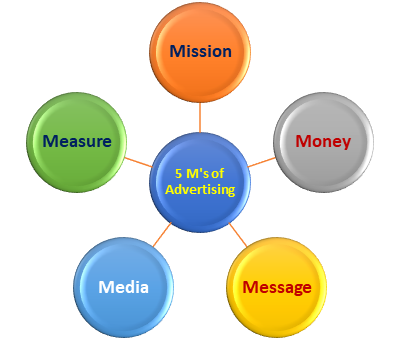
The 5 M’s of advertising are as follows:

  1. Mission
  2. Money
  3. Message
  4. Media
  5. Measurement

  1. Mission:

Advertising Objectives can be classified as to whether their aim is:

  • To inform: This aim of Advertising is generally true during the pioneering stage of a product category, where the objective is building a primary demand.
  • To persuade: Most advertisements are made with the aim of persuasion. Such advertisements aim at building selective brand.
  • To remind: Such advertisements are highly effective in the maturity stage of the product. The aim is to keep the consumer thinking about the product.
  1. Money:

This M deals with deciding on the Advertising Budget

The advertising budget can be allocated based on:

  • Departments or product groups
  • The calendar
  • Media used
  • Specific geographic market areas

There are five specific factors to be considered when setting the Advertising budget.

  1. Stage in PLC: New products typically receive large advertising budgets to build awareness and to gain consumer trial.  Established brands are usually supported with lower advertising budgets as a ratio to sales.
  2. Market Share and Consumer base: high-market-share brands usually require less advertising expenditure as a percentage of sales to maintain their share. To build share by increasing market size requires larger advertising expenditures. Additionally, on a cost-per-impressions basis, it is less expensive to reach consumers of a widely used brand them to reach consumers of low-share brands.
  3. Competition and clutter: In a market with a large number of competitors and high advertising spending, a brand must advertise more heavily to be heard above the noise in the market. Even simple clutter from advertisements not directly competitive to the brand creates the need for heavier advertising.
  4. Advertising frequency: the number of repetitions needed to put across the brands message to consumers has an important impact on the advertising budget.

Product substitutability: brands in the commodity class (example cigarettes, beer, soft drinks) require heavy advertising to establish a different image. Advertising is also important when a brand can offer unique physical benefits or features.

  1. Message:

Message generation can be done in the following ways:

  1. Inductive: By talking to consumers, dealers, experts and competitors. Consumers are the major source of good ideas. Their feeling about the product, its strengths, and weaknesses gives enough information that could aid the Message generation process.
  2. Deductive: John C. Meloney proposed a framework for generating Advertising Messages.

According to him, a buyer expects four types of rewards from a product:

  • Rational
  • Sensory
  • Social
  • Ego Satisfaction.

Buyers might visualize these rewards from:

  • Results-of-use Experience
  • Product-in-use Experience
  • Incidental-to-use Experience
  1. Media:

The next M to be considered while making an Advertisement Program is the Media through which to communicate the Message generated during the previous stage. The steps to be considered are:

  1. Measurement:

Evaluating the effectiveness of the Advertisement Program is very important as it helps prevent further wastage of money and helps make corrections that are important for further advertisement campaigns. Researching the effectiveness of the advertisement is the most used method of evaluating the effectiveness of the Advertisement Program. Research can be in the form of:

  1. Communication-Effect Research
  2. Sales-Effect Research

Consumer Advertising

Consumer advertising is messages paid for by companies and delivered through mass media. The objective is to inform or persuade consumers of the merits of your brand and products. Consumers are a large and common target of ads presented through several traditional types of media. Consumer advertising is distinct from trade market or business-to-business ads presented to business buyers.

Television

Television is the most heavily expended advertising medium used to target household consumers. Companies pay TV networks to place 30- to 60-second spots during a certain part of the day or during particular programs watched by people in the target audience. TV ads typically offer an advertiser the largest possible audience reach if that is the objective. You can also present creative messages and show off products or services to effectively persuade customers. Negative attitudes toward commercials and the high cost are challenges of delivering TV ads to consumers.

Radio

Radio ads also target consumers. They are commonly used by retailers in local markets because of their affordability and targeted geographic reach. Because of their affordability, you can often influence consumers over time with radio ads through repetition, making radio a good advertising medium for a small business. Audience attitudes and disinterest in radio ads are detractors. People are commonly driving and often turn the channel when ads come on. Radio messages are also fleeting and creating a memorable impact is a difficult.

Print

Several print media are used to reach consumers, with newspapers and magazines being the most common. Direct-mail pieces are also sent to consumers. Businesses are also targeted through business newspapers and industry-specific magazines. However, consumers purchase lots of daily or weekly newspapers and any of the hundreds of weekly consumer magazine publications. High perceived credibility, geographic targeting in newspapers, visual appeal in magazines and high audience interest in print media are among advantages in reaching consumers through these formats. Newspapers don’t allow you to reach niche audiences, though, and magazines have a high cost per contact. However, advertising your small business in your local newspaper can allow you to reach a large audience for a moderate cost.

Support

A number of support media are used to reach consumer audiences. Billboards are placed on highways and in metro areas to hit local consumers or those in the midst of travel. Directories target consumers in select markets. Transit ads are placed on public transportation vehicles to target urban consumers in cities. Aerial ads are often used to reach consumers in cities or attending outdoor sporting events.

Digital/Interactive

Digital and interactive ads have picked up since the emergence of the Internet in homes in the mid-1990s. Companies use online ads, mobile messaging and other digital formats to reach tech-savvy and “on the go” consumers. Affordability, ease in tracking and audience selectivity are among the appeals of digital ads. Plus, as people continue to do more with their mobile devices, companies are attempting to reach consumers through them. Digital advertising is often a good choice for small businesses because it is inexpensive and allows targeting of niche audiences.

Sales Promotion

Whereas other traditional consumer ads are intended to build and maintain long-term brand image, sales promotions are used to induce consumers to make immediate purchases. Discounts, rebates and coupons are among the promotions used to lure in customers. This short-term-oriented ad approach is used to convey value to the consumer by offering a quality product a reduced price. Overuse can detract from other consumer advertising,

Industrial Advertising

The most popular terminology used for industrial advertising is Business to Business advertising. This type of advertising generally includes a company advertising its products or services for the companies which actually uses same or similar products or services or we can say that the advertising company should produce the products which the other company needs for its productions or functions. For e.g. some mineral water companies which work on a smaller scale outsource the packaging bottles, the caps for bottles, the cover with name printed on it, etc. so for this, the advertisements of the manufacturers of bottles, caps and outer packaging paper can work.

A smaller to smaller and largest of all, every company has to do industrial advertising. For e.g. if a company is making coffee powder, it will sell its powder to the distributors who in turn will sale it to the retailers and wholesalers and also to the big companies who has a coffee machine for their employees. Thus companies manufacturing any products can be advertised to the other companies, like raw materials, the machineries used by other companies, spare parts of the machines which makes it work, anything.

Role of Industrial Advertising

  • It minimizes the hunt for buyers.
  • It helps in increasing sales of the company.
  • It helps in making more and more distribution channels.
  • It makes company work more efficiently to produce the desired product or service.
  • It creates awareness among the customers or other companies about the products and services.

Process of Industrial Advertising

The strategies used in industrial advertising differ from company to company, as different companies have different products to be advertised. So, a single rule cannot work for all the companies’ advertisements. But the basic process which can lead to a successful advertisement is: knowing the objective for advertising – identifying the target companies researching about the market conditions and the competitors creating the ad to be delivered selecting media to be used what should be the budget allotted execution of the advertisement getting the feedbacks from the customers.

Media types in Industrial Advertising

The media generally used in the industrial advertising is print media and direct marketing.

Print Media includes business magazines, trade publications, newspapers, technical journals, etc. To make print media work efficiently, there are some do’s and don’ts to be kept in mind:

  • Visual image of the ad should be very sharp and prominent
  • The ad should be so impressive that readers get attracted towards reading it
  • The highlight should be on the service or product offered and not the source by which it is being offered
  • Let the ad be simple to be read (with no difficult fonts)
  • The picture shown should not be irrelevant with the product.
  • The ad should reflect the company’s image.
  • The ad should to be in logical sequence if it is of two or more pages.
  • Headlines should be catchy and suiting the product image.
  • And lastly, at the bottom of the page, the company name, address and phone number of the respected office should be mentioned clearly without fail.

Direct Marketing includes:

  1. Direct Mail: Here, the newsletters, data sheets, and the brochures of the company are directly mailed to the customers’ postal address.
  2. Telephonic Advertising: The advertising is done by calling up the customers on their telephones, giving messages on mobile phones, etc.
  3. Online Advertising: Includes companies sending e-mails to the customers or other companies enclosing information about their products and services, putting online banners, providing e-shopping options, etc.

The advertisers also use other ways for promoting their products like participating in trade shows, trade expos, and fairs.

Thus, the companies can use any or every type of advertising, the important motto being increase in sales, producing best quality products, maintaining good relations with the customers, and achieving the desired goal.

Institutional Advertising

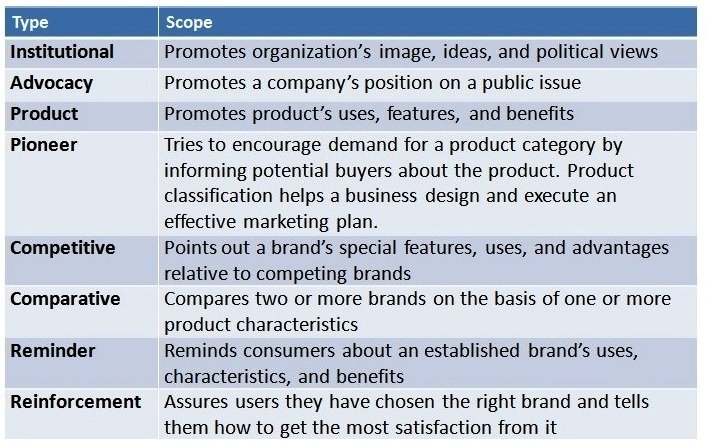
Institutional advertising consists of promotional activities that aim to improve reputation, create a positive image or encourage support of an organization. The term applies to actions oriented to promote the firm itself.

Institutional advertising differs from the most common advertising because the latter has the purpose of selling a particular product or service. When promoting the organization, the activities are designed to create certain mindset about it like trustworthiness or respectability. The ultimate objective is to make people more willing to think positively about the organization. In some cases, these actions might result in higher consumer preference when deciding about a purchase.

Like any other type of advertising, the company must define a target group, a message, means or methods to communicate it and expected results. Many times, institutional advertising is reactive after an event or situation has damaged the company image. However, other firms carry out proactive, planned institutional advertising as a complement of institutional relations. Public Relations are an important part of institutional advertising.

Objectives of Institutional Advertising

  1. The first and foremost objective of Institutional Advertising is to promote the image of a business as a whole rather than of a single product or service.
  2. The business also tries to promote its mission, vision as well as its philosophies and principles.
  3. Institutional advertising is also an effective way to create and maintain goodwill about the organization in the market.
  4. Organizations also use this kind of advertising to promote good qualities such as reliability, low prices or good customer care, that distinguish it from its competitors.

Types of Institutional advertising

  1. The first kind of Institutional advertising is in Print and digital media. This includes brand promotion through advertisements placed in Newspapers, magazines, emails, text messages and others.
  2. The second kind of institutional advertising is on Television and Radio and consists of specially created infomercials and commercials.

Advantages of Institutional Advertising

1. Increase awareness of the organization

Building the Organization’s image through institutional advertising helps the organization build brand awareness. For example, if an organization dealing with luxury household goods wants to target customers with high income, it will craft an advertisement that has several symbols of luxury, like the fine wine or fancy homes, and thus entice its target consumers who will end up splurging on their high-end goods.

2. Building brand identity

If institutional advertising is aimed to follow a single theme, a cohesive brand identity is built. An example here would be a brand targeting its demographic consumer the modern working. If its advertisements also include symbols of men or children, it would send a mixed signal to the demographic consumer and thus decrease the effect of its advertisement.

3. Countering Negative attitude

Institutional advertising is one of the most effective ways to counter negative perception of consumers. A large majority of firms use this kind of advertising to counter a negative image of their company. ITC is one of the best examples here. In the example mentioned above, it used institutional advertising to counter customer perception about its tobacco products.

4. Develop a subtle sales pitch

Institutional advertising also helps develop a subtle sales pitch. The target consumers, who are subjected to this kind of advertising, do not realize that they are being indirectly being attracted to the products of the company.

Disadvantages of Institutional advertising

  1. Since institutional advertising only aims to promote the organization as a whole and not any specific product, some experts are of the opinion that they simply add to the advertising cost of the organization without substantial returns on investment in the short run.
  2. Institutional advertising and product advertising are similar in the characteristic that they tend to mislead consumers. Hence, consumers might feel cheated by the organization.
  3. Institutional advertising might sometimes lead to Monopoly in the market. When an organization of a single industry starts to aggressively pursue institutional advertising, it might lead to a situation where it starts ruling over its competitors and thus creates the monopoly. This might become dangerous for the market.

Classified Advertising

Classified advertisement is a small message or advertisement that is placed in newspapers, magazines or periodicals. These messages are generally grouped under specific headings, also called classifications, in a separate section. Classified advertisements are comparatively low-cost ads. Recent times have also seen classified advertisements on websites, social media networks such as Facebook as well as on Smartphones and Tablets.

Types of Classified advertisement

Let us now discuss different kinds of classified advertisements that consumers come across. These are:

1. Regular Classified advertisement

They are normal text advertisements and are charged per letter or line or column. They are typically a column wide, have no graphics, and are typeset by the publisher of the print media.

2. Classified Display Advertisement

These types of advertisement also include a logo or a visual image and have a border surrounding the text advertisement. They are typically priced more than the regular classifieds and are charged on per column centimeter or per square centimeter basis.

3. Display classified advertisement

This is the costliest kind of classified advertisement as it has the maximum impact. The minimum size of the advertisements is 3 centimeters and it can be of any size in height and width. Advertisers can also choose to have their display classified ads in color too.

All the above kinds of classified advertisements can further be divided into the following categories:

Types of Classified Advertising

1. Recruitment

Though recruitment advertisements are extremely popular in display advertising, it is equally popular in classified advertisement too. Advertisements under ‘Situations Vacant” heading are an apt medium for small and medium-sized businesses to attract job applicants. A spin-off of Situations Vacant is “Situations Wanted” classified ads, where job applicants describe their skills and qualifications.

2. Property

Classified advertisements are one of the most effective advertisement methods for sale, purchase or rent of houses or other properties by individual property owners, landlords or even property brokers. However, we must remember here that advertisements for Real Estate projects do not come under classified advertisements.

3. Obituary

Obituary messages are another common kind of classified advertisements, which allow advertisers to add images of the departed along with a message. Advertisers also used classified advertisements to place condolence messages, funeral invitations, and Remembrances.

4. Matrimonial

This is one of the most common kinds of classified advertisements found in India. Here, parents or a close family member places a text advertisement or a classified display that consisting of an image of the prospective bride or groom and seeks for a prospective match.

5. Business

A lot of small and medium-sized businesses choose classified advertisements to advertise. Statistics say that 80% of business promotional campaigns choose newspaper advertising as the their first choice. Common kinds of business classified advertisements are Business Proposals and offer, Sales promotions and ads seeking Business partners.

6. Announcements

Though Matrimonial advertisements are the leading type of classified advertisement, announcement classified advertisements are a close second. They include personal announcements like Name or Address Change, legal notifications, Lost & Found and marriage notices. Placed by individual advertisers, these are primarily intended for personal or government references.

7. Education

A lot of educational advertisements can also be found under the classified ad section. It is mostly used by coaching centers, who have a small budget, and thus prefer to introduce or promote their coaching classes.

8. Personal

This is the last kind of classified advertisement and includes personal messages such as Birthday wishes, messages about personal achievements, season’s greetings and others similar messages. These are placed by individuals in a personal capacity.

Advantages of Classified Advertisements

  1. One of the first advantages of this kind of advertisement is its low cost when compared to other forms of advertising. This low cost might allow small and medium businesses to effectively advertise their products or service while not burning a hole in their pockets.
  2. This kind of advertisement has a wide reach. Classified ads placed in newspapers or magazines can be seen by everyone reading them while classified ads placed on online websites will be seen by every website visitor.
  3. Since the advertisements are short and simple, they are easy to create and need no rocket science. No need for copywriters to write these!
  4. Some Online classified advertisement allows interested consumers to directly contact the advertisers, either by clicking on a link or sending a text or e-mail.

Disadvantages of Classified advertisement

Like any other forms of advertisements, Classified advertisements have their own set disadvantages too. Some of these disadvantages are listed below:

  1. Since a particular newspaper or magazine is not read by everyone, businesses can miss out on potential target clients by placing their classified advertisements in a select few newspapers or magazines. Same is the case for websites which might not be visited by all target consumers. Hence, advertisers might have to place their ads on all possible newspapers/magazines or websites in order to reach a wide base of consumers and thus increase their advertisement costs.
  2. The ads have to compete against their competitors – who might place their advertisements next to yours!
  3. Classified advertisements have a short life as they are read only once. Hence, advertisers need to consistently keep on advertising their product or service.
  4. Advertisers might be paying for advertising to people who may never be their target consumers.

National Advertising

The term national advertising has a special connotation that it is not confined to any geographic area within the nation. This type of advertising is undertaken mostly by the marketer of a branded product or service sold through different outlets in the distribution channel, wherever they may be located. Apparently, the term national advertising conveys mass marketing effort. In reality this does not necessarily mean that the product is sold nationwide.

The objective of national advertising is to inform or remind consumers about a company or brand. The ad may intend to communicate brand features, benefits, advantages or uses and to create or reinforce its image so that the consumers will be predisposed to buy it. This type of advertising is done by a manufacturer and is in contrast to that done by a retailer whose objectives are totally different.

National advertising often identifies a specific target audience and attempts to create an image for the product. For example, the ad for Mercedes-E class is targeting a specific segment in the Indian market. When a new manufacturer with lesser money muscle, limited production capacity and limited distribution know-how, etc., appears on the business scene, he does not usually decide for national distribution. Instead, he tries to sell his output in limited markets and then gradually with improved conditions, gradually spreads in the remaining markets. Even well-established companies often introduce new products in some selected markets only.

National advertisers realize that, under some conditions, it is better to advertise in regional or local media rather than mass media. As more and more national advertisers are able to identify and reach narrowly defined market segments there would appear more regional or local advertising. For example, they may select regional/local newspapers, television stations, radio, or outdoor media because of differences in the regional language. The advertiser would still be classified as national advertiser as the purpose of the ads is to encourage purchase of the advertised product at any outlet carrying the item. In the short-term, however, national advertising will continue to introduce new brands and emphasize brand loyalty to established ones. In effect, the message in national advertising says, “buy our brand.”

National Advertising

  • Advertising done by a company on a nationwide basis or in most regions of the country and targeted to the ultimate consumer market is known as national advertising.
  • The companies that sponsor these ads are generally referred to as national advertisers.
  • Most of the advertisements for well-known brands that we see on TV or in other major media are examples of national advertising.
  • It informs or reminds consumers of the brand and its features, benefits, advantages and uses or reinforces its images.
  • However, in Indian context due to cultural and linguistic variation, different versions of advertisements are released by the advertisers.
  • Example of National Advertiser are: Hyundai, Nestle, HUL etc.
error: Content is protected !!