Brand image

Brand image is the current view of the customers about a brand. It can be defined as a unique bundle of associations within the minds of target customers. It signifies what the brand presently stands for. It is a set of beliefs held about a specific brand. In short, it is nothing but the consumers’ perception about the product. It is the manner in which a specific brand is positioned in the market. Brand image conveys emotional value and not just a mental image. Brand image is nothing but an organization’s character. It is an accumulation of contact and observation by people external to an organization. It should highlight an organization’s mission and vision to all. The main elements of positive brand image are- unique logo reflecting organization’s image, slogan describing organization’s business in brief and brand identifier supporting the key values.

Brand image is the overall impression in consumers’ mind that is formed from all sources. Consumers develop various associations with the brand. Based on these associations, they form brand image. An image is formed about the brand on the basis of subjective perceptions of associations bundle that the consumers have about the brand. Volvo is associated with safety. Toyota is associated with reliability.

The idea behind brand image is that the consumer is not purchasing just the product/service but also the image associated with that product/service. Brand images should be positive, unique and instant. Brand images can be strengthened using brand communications like advertising, packaging, word of mouth publicity, other promotional tools, etc.

Brand image develops and conveys the product’s character in a unique manner different from its competitor’s image. The brand image consists of various associations in consumers’ mind attributes, benefits and attributes. Brand attributes are the functional and mental connections with the brand that the customers have. They can be specific or conceptual. Benefits are the rationale for the purchase decision. There are three types of benefits: Functional benefits what do you do better (than others ),emotional benefits how do you make me feel better (than others), and rational benefits/support why do I believe you(more than others). Brand attributes are consumers overall assessment of a brand.

Brand image has not to be created, but is automatically formed. The brand image includes products’ appeal, ease of use, functionality, fame, and overall value. Brand image is actually brand content. When the consumers purchase the product, they are also purchasing it’s image. Brand image is the objective and mental feedback of the consumers when they purchase a product. Positive brand image is exceeding the customers expectations. Positive brand image enhances the goodwill and brand value of an organization.

“Brand image” is the customer’s net extract from the brand.

Brand image Dimension

Brand identity is composed of various shares that trigger particular responses in consumers in addition to filling the afore-mentioned functions. These shares build on one another; the more shares a brand has, the stronger and more positive the relationship with consumers.

Mind

At the very lowest level, mind share must be created in the consumer consciousness (cognitive level). This means that, as a complex perceptual and conceptual construct, the brand evokes an internal neural representation in the minds of consumers, leaving behind certain brand impressions.

Heart

This refers to the emotional relationship a consumer should develop with a brand. Heart share is less a matter of a product’s functional utility and more a matter of its symbolic attributes. The buyer of a Ferrari, for instance, will not develop an affection for the car based purely on functional attributes, but rather as a result of the values associated with the brand and the brand environment it operates in.

Buying intentions

Brand identity must trigger a buying intention share in consumers. After all, despite the importance of a brand’s mind and heart share, it only makes sense for a supplier to invest in brand identity if consumers will also want to buy the brand.

Self

Brand identity contributes to self share, which means that the brand functions as a manifestation of the self, a tangible expression of self-image within the social environment. In this context, brands serve self-expression and self-design purposes, differentiating the individual within the social group. Brands can easily serve similar ends in the realm of business-to-business, where they bolster self-image in terms of a company and its functions.

Legend

Here, the brand shares in the existential search for meaning conducted by a consumer in a world enlightened to the point of meaning-lessness and takes on a virtually religious character. This aspect sheds light on the cultural-sociological proposition that brand management is worshiping the customer. Brands allow consumers to achieve social position or status, to partake of cultural expression, to create mythology and shape meaning, and as a result, to weave themselves into the social and metaphysical fabric of the world. In this context, a loyal customer is a member of a community and an individual loyal to that community not just a customer who makes repeat purchases. A brand is a tool for building a sense of community and belonging, for building the community itself.

Brand Creative strategy, Message Strategy, Media Strategy

It is important to examine the concept of creativity, how it applies to marketing communication, and the challenge firms face in developing creative and effective marketing communication.

Creativity is one of the most commonly used terms in marketing communication as those who develop marketing communication messages are often referred to as “creative types” and agencies develop reputations for their creativity. So much attention is focused on the concept of creativity because the major challenge given to those who develop marketing communication messages is to be creative. Creativity has been defined as “a quality possessed by persons that enables them to generate novel approaches in situations, generally reflected in new and improved solutions to problems.”

Perspectives of Marketing Communication Creativity

Perspectives of what constitutes creativity in marketing communication vary. At one extreme are those who argue that marketing communication is creative only if it sells the product. At the other end of the continuum are those who judge creativity in terms of its artistic or aesthetic value and argue that creative marketing communication must be novel, original and unique. The answer as to what constitutes creative in marketing communication is probably somewhere between these two extreme positions.

We are concerned with marketing communication creativity which refers to “the ability to generate fresh, unique and appropriate ideas that can be used as solutions to communications problems.” This perspective recognises that creative marketing communication ideas are those that are novel, original and appropriate. To be appropriate a creative idea must be relevant or have some importance to the target audience.

Planning Creative Strategy

Those who work on the creative side of marketing communication often face a real challenge. They must take all the research, creative briefs, strategy statements, communication objectives and other inputs and transform them into a marketing communication message. Their job is to write copy, design layouts and illustrations and produce commercials that communicate effectively. Marketers usually hire marketing communication agencies to develop and implement their marketing communication campaigns because they are specialists in the creative function of marketing communication. However, it is important to point out that the development of creative strategy also involves representatives from the client side and other people in the agency as well as the creative staff.

The Creative Challenge

Those who work on the creative side of marketing communication have the responsibility of developing an effective way of communicating the marketer’s message to their customers. The creative person or team is often provided with a great deal of input and background information on the target audience, such as their lifestyles, needs and motives, and communication objectives. However, every marketing situation is different and requires a unique approach.

Taking Creative Risks

Many creative people in agencies argue that they often follow proven approaches or formulas when creating ads because they are safe and less likely to fail. They note that their clients are very often risk averse and feel uncomfortable with marketing communication that is too different. It is important to note that companies who have very creative marketing communication are more willing to assume some risk. However, many managers are more comfortable with marketing communication that is straight forward in communicating with customers and gives them a reason to buy.

Creative Personnel

It is a fairly common perception that those individuals who work on the creative side of marketing communication tend to be somewhat unique and different from those working on the managerial or business side. It is worthwhile to discuss some of the characteristics of creative personnel in marketing communication and the need to create an environment that fosters, and is conducive to, the development of creative marketing communication.

The Creative Process

A number of marketing communication people have argued that creativity in marketing communication is best viewed as a process and that creative success is most likely when some organized approach is followed. While most marketing communication people reject and/or resist attempts to standardise creativity or develop rules or guidelines to follow, most creative people do follow some type of process when approaching the task of developing an advertisement.

The creative process contains five steps:

  1. Immersion
  2. Digestion
  3. Incubation
  4. Illumination
  5. Reality or verification

Another model:

Inputs to the Creative Process: Preparation/Incubation/Illumination —

These models of the creative process offer an organized way of approaching an marketing communication problem. Both models stress the need for preparation or gathering of background information that is relevant to the problem as the first step in the creative process. Various types of research and information can provide input to the creative process of marketing communication at each stage. There are numerous ways the creative specialist can acquire background information that is relevant to the marketing communication problem. These include:

Background research: informal fact-finding techniques and general preplanning input. Various ways of gathering background information might be discussed. ti

Product specific research: this involves different types of studies such as attitude, market structure and positioning, perceptual mapping and psychographic studies.

Qualitative research input: techniques such as in-depth interview or focus groups with customers or ethnographic studies.

Verification/Revision: The purpose of the verification/revision stage of the creative process is to evaluate ideas that come from the illumination stage, reject any that may be inappropriate, and refine those that remain and help give them final expression.

Some of the techniques used at this stage include:

Focus groups

Message studies

Portfolio tests

Pretesting of ads in storyboard or aniamatic form

Creative Strategy Development

The creative process of marketing communication is guided by specific goals and objectives and requires the development of a creative strategy or plan of action for achieving the goal. Creative strategy development actually begins with a thorough assessment of the marketing and promotional situation and a determination of what needs to be communicated to the marketer’s target audience. Creative strategy should, however, also be based on a number of other factors that are stated in the creative or copy platform.

Copy Platform: A copy platform provides a plan or checklist that is useful in guiding the development of an marketing communication message or campaign. This document is prepared by the agency team or group assigned to the account and may include creative personnel as well as the account coordinator and representatives from media and research. The marketing communication manager and/or the marketing and product manager from the client side will also be involved in the process and must approve the copy platform.

Marketing Communication Campaigns

Most advertisements are part of a series of messages that make up an marketing communication campaign which consists of multiple messages, often in a variety of media that center on a single theme or idea. The determination of the central theme, idea, position, or image is a critical part of the creative process as it sets the tone or direction for the development of the individual ads that make up the campaign.

The Search for the Major Selling Idea

An important part of creative strategy development is determining the central theme that will become the major selling idea or big idea for the ad campaign. There are several different approaches that can be used for developing major selling ideas and as the basis of creative strategy. Some of the best known and most discussed approaches include:

The unique selling proposition

This concept, which was mentioned in the opening vignette, is described in Rosser Reeve’s Reality in Marketing communication. It’s three characteristics include:

  • Each advertisement must make a proposition to the consumer
  • The proposition must be one that the competition either cannot or does not offer
  • The proposition must be strong enough to pull over new customers to your brand

Creating a brand image

Some competing brands are so similar it is difficult to find or create a unique attribute or benefit so the creative strategy is based on the development of a strong, memorable identity for the brand through image marketing communication.

Finding the inherent drama

Leo Burnett believed marketing communication should be based on a foundation of consumer benefits with an emphasis on the dramatic element in expressing these benefits.

Positioning

The basic idea is that marketing communication is used to establish or “position” the product or service in a particular place in the consumer’s mind.

These approaches to determining the major selling ideas discussed above are very popular and are often used as the basis of the creative strategy for marketing communication campaigns. These creative approaches represent specific “creative styles” that have become associated with some of the most successful marketing communication creative minds and their agencies. However, it should be pointed out that many other creative approaches and styles are available and are often used in marketing communication. The challenge to the creative team is to find a major selling idea and use it as a guide to the development of an effective creative strategy.

Message design and positioning

Message is the idea or other information that the marketer wishes to convey to the consumer, emphasising the importance of message design.

Ogilvy said, “my original magic lantern started with the assertion that positioning and promise were more than half the battle.” True, but spotting the uniqueness or association of the product that will help the advertiser and win a place in the consumer’s mind isn’t easy. An excellent example of brand positioning is Maggi instant noodles. In his book Brand Positioning, Subrato Sengupta describes this success:

“Through consumer research, the company (Food Specialities Limited) felt that the most profitable position (for Maggi) would be as a tasty, instant snack, made at home and initially aimed at children. The target market was the in-home segment of the very substantial snack category. This positioning decision automatically determined the competition which included all snack products in general. These would range from ready to eat snacks biscuits, wafers and peanuts to ready prepared snacks such as samosas. All were bought out items.”

“Traditional pasta products (Chinese noodles and macroni) were considered to be near. Competitors forming a rapidly growing product group. But they were invariably used for meals, requiring a fair amount of cooking time and garnishing was essential.”

“Maggi Noodles was launched in Delhi in January 1983 and it became an overnight success.” The reasons? Maggi Noodles, as market results show, found a vacant strong position and sat on it as “the good to eat, fast to cook anytime snack.”

Message Design and Marketing Objectives

A message is the thought, ideas, attitude, image or other information that the sender wishes to convey to the intended audience. The marketer’s objectives tend to vary with audience. Objectives in communicating with consumers, for example, may be one or all of the following:

  1. Informing them what is for sale
  2. Creating brand awareness,
  3. Getting them to buy the product
  4. Reducing their uneasiness after the purchase is made.

The marketer’s objective with intermediary customers is to get them to stock the product; with other manufacturers, to get them to buy the product and use it to make their own. In tourism, the message may have more objectives like promoting a destination, building an image for the whole country, conveying the distinctive features of the product or service, etc.

Senders must also know their audiences’ characteristics in terms of education, interests needs, and realms of experience. They must then, endeavour to encode or phrase their message in such away that they will fall within the consumers’ zones of understanding and familiarity.

For example, AB group of Hotels has mainly targeted the business class in the advertisements which features that all the requirements of the guests are met unobtrusively. The message conveyed is that AB hotels understand the needs of business traveller better than any other hotel.

Media Strategy

Media strategy can be defined as the usage of an appropriate media mix in order to achieve desired and optimum outcomes from the advertising campaign. It plays a key role in advertising campaigns. The objective of Media Strategy is not just about procuring customers for their product or services but also focusses on placing a right message towards the right people at the right time and ensuring that the message is relevant and persuasive. Media Strategy is designed to achieve the above mentioned target but the budget is always kept in mind.

Every work to be done needs a plan of action so that the work is done in a desired and correct manner. Media Strategy plays a very important role in Advertising. The role of Media Strategy is to find out the right path to transfer or say deliver the message to the targeted customers.

How many people see or hear or read all the advertisements or promotional offers and buy the product or service? The basic intention of media strategy is not only procuring customers for their product but also placing a right message to the right people on the right time and of course that message should be persuasive and relevant. So, here the planners of the organization decide the Media Strategy to be used but keeping the budget always in mind.

There are three “W”s to be decided. They are:-

Where to advertise?

The question is to find out where the advertisement should be displayed to the current and prospective customers. The common available options are – TV, radio, newspapers, blogs, hoardings on roads, sponsorships, ads during breaks in theatres, etc. It can be done at international/national/state/city level as per the requirement of the brand.

When to advertise?

The timing of advertisement is very critical especially with respect to the seasonal products. There is no point in airing advertisement for room heaters in summer season. It should be aired right at the end of monsoon and beginning of winter season.

Which type of media to use?

It is very important to use a correct media type for delivering the message. There are two basic media approaches which can be adopted:

(i) Media Concentration approach

In this approach, firms concentrate their campaigns only on a few media types (generally two or three) in order to reach their target consumers instead of using a wide variety of media types.

(ii) Media Dispersion Approach

In media dispersion approach a wide variety of different media categories is employed to reach the target customers. It is employed when the entire target market can’t be reached by a few media types.

Integration of advertising with other communication tools

Integrated Marketing Communication tools refer to integrating various marketing tools such as advertising, online marketing, public relation activities, direct marketing, sales campaigns to promote brands so that similar message reaches a wider audience. Products and services are promoted by effectively integrating various brand communication tools.

To implement integrated marketing communication, it is essential for the organizations to communicate effectively with the clients. You need to know how your products or services would benefit your end-users. The more effectively you promote your brand, the more demand would it have in the market. Identify your target audience. Remember, not everyone would need your product. Understand why would an individual invest in your brand unless and until you have something unique and interesting to offer? The benefits of the brand need to be communicated effectively.

Let us go through various integrated marketing communication tools: Integrated marketing communication effectively integrates all modes of brand communication and uses them simultaneously to promote various products and services among customers effectively and eventually yield higher revenues for the organization.

Advertising

Advertising is one of the most effective ways of brand promotion. Advertising helps organizations reach a wider audience within the shortest possible time frame. Advertisements in newspaper, television, Radio, billboards help end-users to believe in your brand and also motivate them to buy the same and remain loyal towards the brand. Advertisements not only increase the consumption of a particular product/service but also create brand awareness among customers. Marketers need to ensure that the right message reaches the right customers at the right time. Be careful about the content of the advertisement, after all you are paying for every second.

Sales Promotion

Brands (Products and services) can also be promoted through discount coupons, loyalty clubs, membership coupons, incentives, lucrative schemes, attractive packages for loyal customers, specially designed deals and so on. Brands can also be promoted effectively through newspaper inserts, danglers, banners at the right place, glorifiers, wobblers etc.

Direct Marketing

Direct marketing enables organizations to communicate directly with the end-users. Various tools for direct marketing are emails, text messages, catalogues, brochures, promotional letters and so on. Through direct marketing, messages reach end-users directly.

Personal Selling

Personal selling is also one of the most effective tools for integrated marketing communication. Personal selling takes place when marketer or sales representative sells products or services to clients. Personal selling goes a long way in strengthening the relationship between the organization and the end-users.

Personal selling involves the following steps:

  1. Prospecting: Prospecting helps you find the right and potential contact.
  2. Making first contact: Marketers need to establish first contact with their prospective clients through emails, telephone calls etc.An appointment is essential and make sure you reach on time for the meeting.
  3. The sales call: Never ever lie to your customers. Share what all unique your brand has to offer to customers. As a marketer, you yourself should be convinced with your products and services if you expect your customers to invest in your brand.
  4. Objection handling: Be ready to answer any of the client’s queries.
  5. Closing the sale: Do not leave unless and until you successfully close the deal. There is no harm in giving customers some time to think and decide accordingly. Do not be after their life.

Public Relation Activities

Public relation activities help promote a brand through press releases, news, events, public appearances etc.The role of public relations officer is to present the organization in the best light.

Product planning

Product planning and development is the critical journey a product takes from conception through to sales. While product planning and development is an integral part of any successful product’s launch and lifespan, there are no guarantees on the road to success. And yet, this phase can’t be rushed, or consequences can be severe.

Steps in Product Planning and Development

  1. Generation of New Product Ideas

The first step in product planning and development is generation of ideas for the development of new/innovative products.

Ideas may come from internal sources like company’s own Research and Development (R&D) department, managers, sales-force personnel etc.; or from external sources like, customers, dealers, competitors, consultants, scientists etc.

At this stage, the intention of management is to generate more and more new and better product ideas; so that the most practical and profitable ideas may be screened subsequently.

  1. Screening of Ideas

Screening of ideas means a close and detailed examination of ideas, to determine which of the ideas have potential and are capable of making significant contribution to marketing objectives. In fact, generation of ideas is not that significant as the system for screening the generated ideas.

The ideas should be screened properly; as any idea passing this stage would cost the firm in terms of time, money and efforts, at subsequent stages in product planning and development.

  1. Product Concept Development

Those product ideas which clear the screening stage must be developed into a product concept  identifying physical features, benefits, price etc. of the product. At this stage product idea is transformed into a product concept i.e. a product which target market will accept.

  1. Commercial Feasibility

At this stage, the purpose is to determine whether the proposed product idea is commercially feasible, in terms of demand potential and the costs of production and marketing. Management must also ensure that product concept is compatible with the resources of the organization technological, human and financial.

  1. Product Development

Product development encompasses the technical activities of engineering and design. At this stage, the engineering department converts the product concept into a concert form of product in view of the required size, shape, design, weight, colour etc. of the product concept.

A model or prototype of the product is manufactured on a limited scale. Decisions are also made with regard to packaging, brand name, label etc. of the product.

  1. Test Marketing

A sample of the product is tested in a well-chosen and authentic sales environment; to find out consumers’ reaction. In view of consumers’ reactions, the product may be improved further.

  1. Commercialization

After the management is satisfied with the results of test marketing, steps are taken to launch a full-fledged programme for the production, promotion and marketing of the product. It is the stage where the new product is born; and it enters it life cycle process.

Brand equity

The Brand Equity refers to the additional value that a consumer attaches with the brand that is unique from all the other brands available in the market. In other words, Brand Equity means the awareness, perception, loyalty of a customer towards the brand.

E.g., The additional value a customer is willing to pay for Uncle Chips against any local chips brand available with the shopkeeper.

Brand Equity is the goodwill that a brand has gained over time.

Brand Equity can be seen in the way the customer thinks, feels, perceives the product along with its price and market position and also the way brand commands profit and market share for the organization as a whole.

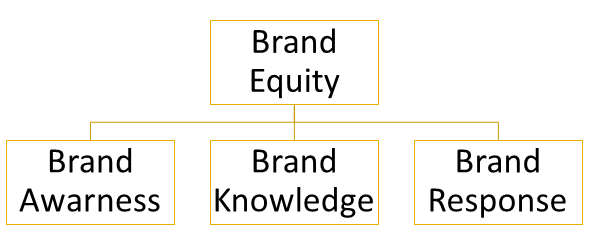
Customer Brand Equity can be studied in 3 different ways:

  1. The Different Responses of a customer towards the product or service helps in determining the brand equity. The way customer thinks about the brand and considers it to be different from the other brands will generate a positive response for that brand and will contribute to its goodwill.
    g., Customer, have a positive response towards Mac laptops because of its anti- virus software.
  2. The responses can be generated only if customers have sufficient knowledge about the brand; thus, Brand Knowledge is essential to determine the brand equity. The Brand knowledge includes the thoughts, feelings, information, experiences, etc. that establish an association with the brand.
    g., Brand Association reflects the knowledge about the product such as woodland is recognized for its rough and tough styling.
  3. The different customer’s response that adds to the brand value depends solely on the Marketing of a Brand. The strong brand results in substantial revenues for the organization and better understanding about the product among the customers.

Thus, the marketers basically study the Customer-Based Approach wherein they study the response of a customer towards the brand that can be reflected in their frequency of purchase. It focuses on customer’s perception i.e. what they have read, felt, thought, seen about the brand and how it has helped them to satisfy their urge of need.

Brand Positioning

Brand positioning refers to “target consumer’s” reason to buy your brand in preference to others. It is ensures that all brand activity has a common aim; is guided, directed and delivered by the brand’s benefits/reasons to buy; and it focusses at all points of contact with the consumer.

Positioning creates a bond between the customer and the business. It’s that friend of the customer who’ll always stay in their subconscious mind and will make them recall about the company whenever they hear about the any of its product or a particular feature which makes it stand out.

Examples of Brand Positioning

  • Colgate is positioned as protective.
  • Patanjali can be trusted as it is fully organic.
  • Woodland is tough and perfect for outdoors.
  • Coca-Cola brings happiness.
  • Axe deodorants have a sexual appeal.

Characteristics of a Good Brand Positioning Strategy

  • Relevant: The positioning strategy you decide should be relevant according to the customer. If he finds the positioning irrelevant while making the purchase decision, you’re at loss.
  • Clear: Your message should be clear and easy to communicate. E.g. Rich taste and aroma you won’t forget for a coffee product gives out a clear image and can position your coffee brand differently from competitors.
  • Unique: A strong brand positioning means you have a unique credible and sustainable position in the customers’ mind. It should be unique or it’s of no use.
  • Desirable: The unique feature should be desirable and should be able to become a factor which the customer evaluate before buying a product.
  • Deliverable: The promise should have the ability to be delivered. False promises lead to negative brand equity.
  • Points of difference: The customer should be able to tell the difference between your and your competitor’s brand.
  • Recognizable Feature: The unique feature should be recognizable by the customer. This includes keeping your positioning simple, and in a language which is understood by the customer.
  • Validated by the Customer: Your positioning strategy isn’t successful until the time it is validated by the customer. He is the one to decide whether you stand out or not. Hence, try to be in his shoes while deciding your strategy.

How to create a strong brand positioning strategy?

Before you decide your brand positioning, ask yourself these three questions.

  • What does my customer want?
  • Can I promise him to deliver it better and/or differently than my competitors?
  • Why will they buy my promise?

What does my customer want?

Not everyone in the market is your customer. You need to divide the market into ‘my customer’ and ‘not my customer’. This way, it’ll be easier for you to know what exactly is your customers’ wants are.

The division should be followed by you trying to be in your customers’ shoes. A good businessman speaks in the voice of the consumer.

Your research should not be based on secondary data. You should go out and look for what the customer actually wants, make the product fit those wants, and they’ll buy it.

Be Better and/or Different

If it’s not just you who is in the market, you’ve got to find a way to deliver your promise better and/or differently than your competitors. Make a brand which has a recall, which comes to the customer’s minds when they hear about the particular product category or the feature you’re offering. Every time I hear about girls being attracted by a deodorant, I get an image of Axe deodorants in my mind.

Give them a reason to buy your promise.

Your promise should be one of the factors they consider while buying the product. Use this trick

  • Decide your product
  • List its various characteristics
  • Do a research, and
  • Divide the characteristics into essential and add-ons.
  • Select only those categories, be it essential or add-ons, which customers consider while making a purchase. (E.g. aesthetics, fragrance, taste, shape, cost, etc.)
  • Find out what among these categories can you provide better than the competitors.
  • Whatever you decide, don’t lose your focus from the essential characteristics. (E.g. Taste will always be most important characteristic which a customer consider while buying a food product)
  • Provide your unique feature along with the essential characteristics.

Product brand policy

One of the prime objectives of branding in marketing is to generate or increase recognition of a product or of information pertaining to its various aspects. Branding has, therefore, become an important element in the overall marketing strategy of a firm. It goes without saying that the brands that are most widely recognized have a large market share than the less important ones. A definite brand policy is called for if the market potency of a firm is not to be blunted.

Types of Branding Policies

  1. Family Brand name policy:

A family brand is used by firms that offer all their merchandise under one name. A product line containing closely-related products are quite often sold under one brand name. The IBM in the USA, Tatas, Modis and Mafatlal in India follow the family brand name policy.

Family brand name such as Lakme or Ponds for cosmetics, Dipys for fruit squashes and syrups, Bakeman’s for confectionery, Dabar for Ayurvedic medicines are quite popular. When a family brand is successfully advertised, a favorable reaction to one item often leads to an increase in the sale of the product line. Contrary to this, an unfavorable experience may set the consumer against the entire product line. Due care must, therefore, be taken to ensure that all items of a family brand must meet the consumer’s expectations.

Products lacking common marketing attributes are usually sold under individual brands, for nothing can be gained from their joint association with one single brand. At times, there may be an adverse reaction to sales resulting from the family branding. For example, there is no point in putting vegetable ghee, detergent or soap under a family brand. This is obvious from the branding policy of Hindustan Unilever, where every item is sold under an individual brand name. Here, vegetable ghee is sold under the brand name of Dalda, washing powder under the brand name of Surf, detergent soap under the brand-name of Rin.

2. Single Brand and Multiple Brand

In order to strike a greater market penetration some manufacturers employ a multiple brand strategy. Under this strategy, they market two or more products that are labelled under different brands but are designed to appeal basically to the same category of customers.

For example,

  • Hindustan Unilever is selling various toilet soaps under different brand names.
  • Malhotras market shaving blades under different brand names.

In such cases, each of these brands competes with the other brand. The decision to have separate brands or to stick to one single brand depends on whether different brands have developed dissimilar images that appeal to different market segments.

3. Mixed Branding

Manufacturers may adopt a strategy of marketing a part of their output under the brands of one or more middlemen. By following this policy, the manufacturer can grab a larger market share, besides strengthening his financial status. Where the policy of private branding is adopted, both the manufacturer and the middlemen are expected to take a policy decision.

The middlemen must give due consideration to the fact that they would be able to sell and compete with the manufacturers’ brand. Manufacturers, too, must be able to evaluate whether they would be able to compete with the middleman’s brands which sell at a lower price. Such a policy is usually adopted for the sale of hosiery, woolen and sports goods, etc.

4. National or Manufacturer’s Brand

The policy of having a national brand is followed by producers who enjoy wide geographical distribution. The national or manufacturer’s brand is a brand used by the producer who enjoy a wide geographical distribution. “This they are able to achieve because they have a high annual sales value, extensive warehousing and physical distribution facilities; the capacity and experience in conducting marketing operations, which include maintaining a large sales force and conducting comparative and national advertising programmes; continued consumer and marketing research programmes and maintaining extensive warranty and service programmes.”

Because of these facilities, companies using national brands can easily compete with others. National brands, once acceptable to the consumer, bring large profits to the distributors and the product. Secondly, such brands help merchandise a product, because promotional campaigns can be developed around the brand.”

7 Types of Branding Strategies

A well-received product will result in strong growth, and these types of marketing strategies will get you there.

  1. Name Brand Recognition

A well-established company will often use the weight of its own name brand to extend to its products. Most often, a company with large name brand recognition can be recognized by its logo, slogan, or colors. Companies such as Coca-Cola, Starbucks, Apple, and Mercedez-Benz are all iconic while featuring multiple subsidiary products featured under the company name.

  1. Individual Branding

Sometimes a larger company may produce products that carry their own weight independent of the parent company. This strategy involves establishing the brand as a unique identity that is easily recognizable. General Mills, for example, distributes Cheerios, Chex, Cinnamon Toast Crunch, Kix, Total, Trix, and more and that’s just the cereal division. The company also distributes other major brands from every food group.

  1. Attitude Branding

Ambiguous marketing can often go above the actual product itself in the case of attitude branding. These brands all use strategies that bring to life personality and a customized experience with products and services. NCAA, Nike, and the New York Yankees made Forbes list of “The World’s Most Valuable Sports Brands 2015,” and are automatically associated with a certain style. Other brands, such as Apple and Ed Hardy, also reflect a customer’s self-expression.

  1. “No-brand” Branding

A minimalist approach can speak volumes. No-brand products are often simple and generic in design. The most successful company to establish this marketing method is the Japanese company, Muji, which simply translates to “no label.”

  1. Brand Extension

Brand extension occurs when one of your flagship brands ventures into a new market. Say you have a shoe company that is now making jackets, athletic wear, and fragrances. The brand name carries its own identity to your product mix.

  1. Private Labels

Store brands or private labels have become popular at supermarkets. Retail chains such as Kroger, Food Lion, and Wal-Mart can produce cost-effective brands to compete with larger retailers.

  1. Crowdsourcing

These brands are outsourced to the public for brand creation, which allows customers the chance to be involved in the naming process, and effectively drives up personal interest in a product.

Product Distribution

Distribution means to spread the product throughout the marketplace such that a large number of people can buy it.

Distribution can make or break a company. A good distribution system quite simply means the company has greater chance of selling its products more than its competitors. The company that spreads its products wider and faster into the market place at lower costs than its competitors will make greater margins absorb raw material price rise better and last longer in tough market conditions. Distribution is critical for any type of industry or service. The best price product, promotion and people come to nothing if the product is not available for sale at the points at which consumers can buy.

In the FMCG industry in India, specially, companies distribute their low-value, high volume products to over 1 million retail outlets, or points of sale. The most successful FMCG companies have the biggest networks, made of factories, stock points, distributors or C&F (Carrying and forwarding agents), wholesalers, retailers and consumers. Nowadays, even direct marketing is considered a feasible distribution channel.

Distribution involves doing the following things:

  1. A good transport system to take the goods into different geographical areas.
  2. A good tracking system so that the right goods reach at the right time in the right quantity.
  3. A good packaging, which takes the wear and tear of transport.
  4. Tracking the places where the product can be placed such that there is a maximum opportunity to buy it.
  5. It also involves a system to take back goods from the trade.

Importance of Distribution

Distribution is one of the important mix among marketing mixes. Delivery of satisfaction, standard of living, value addition, communication, employment, efficiency and finance are the major role and importance of distribution.

The role and importance of distribution in marketing and in the whole economy can be discussed as follows:-

  1. Delivery of satisfaction

Marketing concept emphasizes on earning profit through satisfaction of the customers. Besides market research for the development and sales of goods according to need and wants of consumers, the participants of distribution channel also help producers in production of new goods.

  1. Standard of living

Distribution function helps to improve living standard of the consumers in the society. Proper distribution of necessary goods and services to the consumers easily at right time does not only satisfy them but also brings change in their living standard. Distribution brings improvement in living standard of consumers through generation of employment, increase in income and transfer of ownership. Hence, it brings positive effect in the society.

  1. Value addition

The functions of distribution such as transportation, warehousing, inventory management etc. increase the importance of products by creating place utility, time utility and quantity utility. Distribution mix plays an important role to increase the value of the products through delivery of goods in right quantity, at right place and right time.

  1. Communication

Distribution serves as link between producers and consumers. Producers can make flow of information and messages to consumers about their products, price, promotion etc. through channel members. Similarly, they receive information about customers, competitors and environmental changes from channel members.

  1. Employment

The function of distribution creates employment opportunities in society. Market intermediaries work as direct and indirect sources of employment. Different producers need to supply their innumerable products to consumers. Thousands of distributors, agents, wholesalers, retailers, brokers etc. involve in supplying the products to the consumers. Similarly, many persons of the society can get job in the transport and warehouses sectors, etc.

  1. Efficiency

Producers produce limited types of goods in mass quantity. but the consumers demand different types of goods in small quantity. When goods are produced in a mass quantity, they can be obtained at lower price. Distribution helps to satisfy the needs of consumers by supplying assortment of different products of different producers. From this, efficiency can be achieved in both production and distribution.

  1. Financing

Intermediaries themselves make arrangement to keep reserve and stock of goods. The producers need not make arrangement and management of distribution centers and warehouse. The producers need not do anything except remaining busy in production, the timely payment by intermediaries and financial helps become more important for smooth operation of production. Similarly, the role of finance is also decisive in mobilizing other means of production.

Different types of channel of distribution are as follows:

Manufacturers and consumers are two major components of the market. Intermediaries perform the duty of eliminating the distance between the two. There is no standardised level which proves that the distance between the two is eliminated.

Based on necessity the help of one or more intermediaries could be taken and even this is possible that there happens to be no intermediary. Their description is as follows:

(A) Direct Channel or Zero Level Channels

When the manufacturer instead of selling the goods to the intermediary sells it directly to the consumer then this is known as Zero Level Channel. Retail outlets, mail order selling, internet selling and selling

(B) Indirect Channels

When a manufacturer gets the help of one or more middlemen to move goods from the production place to the place of consumption, the distribution channel is called indirect channel. Following are the main types of it:

  1. One Level Channel

In this method an intermediary is used. Here a manufacturer sells the goods directly to the retailer instead of selling it to agents or wholesalers. This method is used for expensive watches and other like products. This method is also useful for selling FMCG (Fast Moving Consumer Goods).

  1. Two Level Channel

In this method a manufacturer sells the material to a wholesaler, the wholesaler to the retailer and then the retailer to the consumer. Here, the wholesaler after purchasing the material in large quantity from the manufacturer sells it in small quantity to the retailer.

Then the retailers make the products available to the consumers. This medium is mainly used to sell soap, tea, salt, cigarette, sugar, ghee etc.

  1. Three Level Channel

Under this one more level is added to Two Level Channel in the form of agent. An agent facilitates to reduce the distance between the manufacturer and the wholesaler. Some big companies who cannot directly contact the wholesaler, they take the help of agents. Such companies appoint their agents in every region and sell the material to them.

Then the agents sell the material to the wholesalers, the wholesaler to the retailer and in the end the retailer sells the material to the consumers.

Role of advertising in PLC

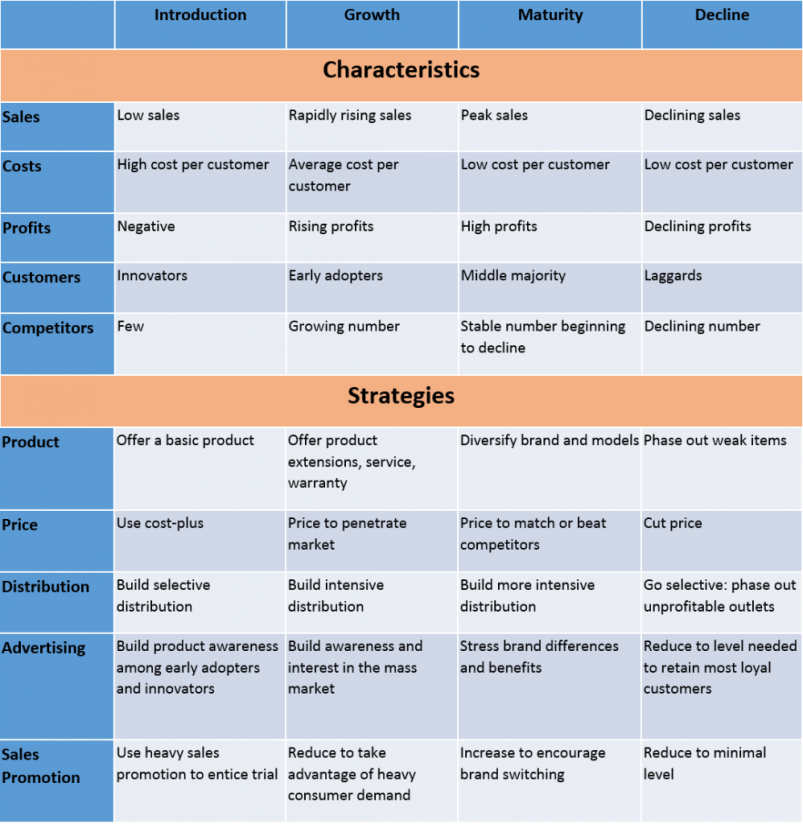
Therefore, proper product life cycle strategies are critical. The company needs to pay more attention to its aging products to identify products in the decline stage early. Then, the firm must take a decision: maintain, harvest or drop the declining product.

The main objective in the decline stage should be to reduce expenditure and “milk” the brand. General strategies for the decline stage include cutting prices, choosing a selective distribution by phasing out unprofitable outlets and reduce advertising as well as sales promotion to the level needed to retain only the most loyal customers.

If management decides to maintain the product or brand, repositioning or reinvigorating it may be an option. The purpose behind these options is to move the product back into the growth stage of the PLC. If management decides to harvest the product, costs need to be reduced and only the last sales need to be harvested. However, this can only increase the company’s profits in the short-term. Dropping the product from the product line may involve selling it to another firm or simply liquidate it at salvage value.

In the following, all characteristics of the four product life cycle stages discussed are listed. For each, product life cycle strategies with regard to product, price, and distribution, advertising and sales promotion are identified. Choosing the right product life cycle strategies is crucial for the company’s success in the long-term.

Advertising agencies Structure & Types

The Organizational Structure of an Advertising Agency

The organizational structure of an advertising agency consists of the same basic elements, regardless of the firm’s size. An account services team manages client relationships, the creative team develops the advertisements and media specialists select the media outlets that will run the ads. A senior management team takes responsibility for the agency’s business and financial operations.

(i) Agency Management

The senior management team may consist of a chief executive and finance director in a small agency. A larger agency may have a management team, including a chief executive and finance director, together with directors responsible for each of the firm’s departments. If an agency belongs to a large group of companies, a member of the management team takes responsibility for relationships with the board of the holding company.

(ii) Account Services

The account services team deals with clients and coordinates the work of the agency’s creative and media teams. A large agency might have three levels of account management: account director, account executive and assistant account executive. Account directors, who report to the agency’s management team, supervise the work of account executives and take responsibility for a group of accounts. They may also maintain a close relationship with the agency’s most important clients. Account executives and assistant account executives report to account directors and manage the day-to-day operations on their accounts.

(iii) Account Planning

Account planners research the needs and preferences of the target market for a product or service. They use their findings to develop an advertising strategy and prepare a brief for the creative team that’s working on an advertising campaign. In smaller agencies, account planning may be part of the responsibility of an account executive. Larger agencies may appoint a specialist as a member of the account management team.

(iv) Media

The media department is responsible for planning where and when advertisements will appear and buying space or time in newspapers, magazines, radio, television, digital media and outdoor media, such as poster sites and billboards. In small agencies, one person may combine the planning and buying roles. Larger agencies have a media department headed by a media director who supervises the work of a team of planners and buyers. The media team may include specialists in print, broadcast or digital media.

(v) Creative Services

The creative services team consists of copywriters and designers, known as art directors, who work together to develop concepts for advertisements. In larger agencies, a creative director manages teams working on different accounts. Smaller agencies may only appoint a creative director who works with freelance writers.

(vi) Production

Larger agencies have a production department responsible for managing advertising campaigns. They set schedules and manage campaign budgets, coordinating the work of the creative and media departments. The production team also interacts with external suppliers working on advertising campaigns, such as printers, photographers and video production companies. In smaller agencies, account executives or creative directors take responsibility for project management.

5 types of advertising agencies.

  1. Full-service Agencies

    • Large size agencies.
    • Deals with all stages of advertisement.
    • Different expert people for different departments.
    • Starts work from gathering data and analyzing and ends on payment of bills to the media people.
  2. Interactive Agencies

    • Modernized modes of communication are used.
    • Uses online advertisements, sending personal messages on mobile phones, etc.
    • The ads produced are very interactive, having very new concepts, and very innovative.
  3. Creative Boutiques

    • Very creative and innovative ads.
    • No other function is performed other than creating actual ads.
    • Small sized agencies with their own copywriters, directors, and creative people.
  4. Media Buying Agencies

    • Buys place for advertise and sells it to the advertisers.
    • Sells time in which advertisement will be placed.
    • Schedules slots at different television channels and radio stations.
    • Finally supervises or checks whether the ad has been telecasted at opted time and place or not.
  5. In-House Agencies

    • As good as the full service agencies.
    • Big organization prefers these type of agencies which are in built and work only for them.
    • These agencies work as per the requirements of the organizations.

There are some specialized agencies which work for some special advertisements. These types of agencies need people of special knowledge in that field. For example, advertisements showing social messages, finance advertisements, medicine related ads, etc.

error: Content is protected !!