Forms of International Organizations

  1. Expo-documents against acceptance Department

Exports are often looked after by a company’s marketing or sales department in the initial stages when the volume of exports sales is low. However, with increase in exports turnover, an independent exports department is often setup and separated from domestic marketing, as shown in Fig.1

Exports activities are controlled by a company’s home-based office through a designated head of export department, i.e. Vice President, Director, or Manager (Exports). The role of the HR department is primarily confined to planning and recruiting staff for exports, training and development, and compensation.

Sometimes, some HR activities, such as recruiting foreign sales or agency personnel are carried out by the exports or marketing department with or without consultation with the HR department.

  1. International division structure

As the foreign operations of a company grow, businesses often realize the overseas growth opportunities and an independent international division is created which handles all of a company’s international operations (Fig. 2). The head of international division, who directly reports to the chief executive officer, coordinates and monitors all foreign activities.
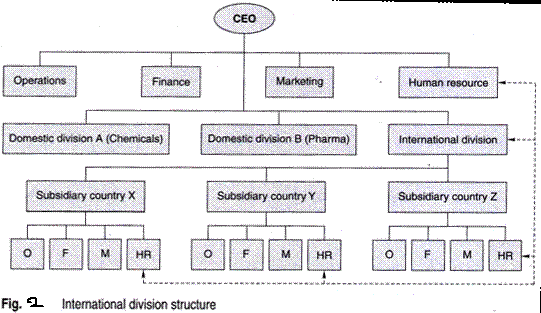
The in-charge of subsidiaries reports to the head of the international division. Some parallel but less formal reporting also takes place directly to various functional heads at the corporate headquarters.

The corporate human resource department coordinates and implements staffing, expatriate management, and training and development at the corporate level for international assignments. Further, it also interacts with the HR divisions of individual subsidiaries.

The international structure ensures the attention of the top management towards developing a holistic and unified approach to international operations. Such a structure facilitates cross-product and cross-geographic co-ordination, and reduces resource duplication.

Although an international structure provides much greater autonomy in decision-making, it is often used during the early stages of internationalization with relatively low ratio of foreign to domestic sales, and limited foreign product and geographic diversity.

  1. Global Organizational Structures

Rise in a company’s overseas operations necessitates integration of its activities across the world and building up a worldwide organizational structure.

While conceptualizing organizational structure, the internationalizing firm often has to resolve the following conflicting issues:

  • Extent or type of control exerted by the parent company headquarters over subsidiaries.
  • Extent of autonomy in making key decisions to be provided by the parent company headquarters to subsidiaries (centralization vs. decentralization)

It leads to re-organization and amalgamation of hitherto fragmented organizational interests into a globally integrated organizational structure which may either be based on functional, geographic, or product divisions. Depending upon the firm strategy and demands of the external business environment, it may further be graduated to a global matrix or trans-national network structure.

(a) Global functional division structure

It aims to focus the attention of key functions of a firm, as shown in Fig. 3, wherein each functional department or division is responsible for its activities around the world. For instance, the operations department controls and monitors all production and operational activities; similarly, marketing, finance, and human resource divisions co-ordinate and control their respective activities across the world.
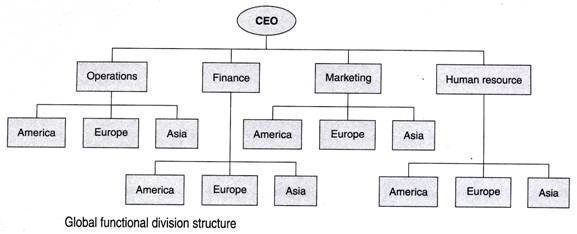
Such an organiza­tional structure takes advantage of the expertise of each functional division and facili­tates centralized control. MNEs with narrow and integrated product lines, such as Caterpillar, usually adopt the functional organizational structure.

Such organizational structures were also adopted by automobile MNEs but have now been replaced by geographic and product structures during recent years due to their global expansion.

The major advantages of global functional division structure include:

  • Greater emphasis on functional expertise
  • Relatively lean managerial staff
  • High level of centralized control
  • Higher international orientation of all functional managers

The disadvantages of such divisional structure include:

  • Difficulty in cross-functional coordination
  • Challenge in managing multiple product lines due to separation of operations and marketing in different departments
  • Since only the chief executive officer is responsible for profits, such a structure is favoured only when centralized coordination and control of various activities is required.

(b) Global product structure

Under global product structure, the corporate product division, as depicted in Fig. , is given worldwide responsibility for the product growth.

The heads of product divisions do receive internal functional support associated with the product from all other divisions, such as operations, finance, marketing, and human resources. They also enjoy considerable autonomy with authority to take important decisions and operate as profit centres.

The global product structure is effective in managing diversified product lines.

Such a structure is extremely effective in carrying out product modifications so as to meet rapidly changing customer needs in diverse markets. It enables close coordination between the technological and marketing aspects of various markets in view of the differences in product life cycles in these markets, for instance, in case of consumer electronics, such as TV, music players, etc.

However, creating exclusive product divisions tends to replicate various functional activities and multiplicity of staff. Besides, little attention is paid to worldwide market demand and strategy. Lack of cooperation among various product lines may also result into sales loss. Product managers often pursue currently attractive markets neglecting those with better long-term potential.

(c) Global geographic structure

Under the global geographic structure, a firm’s global operations are organized on the basis of geographic regions, as depicted in Fig. It is generally used by companies with mature businesses and narrow product lines. It allows the independent heads of various geographical subsidiaries to focus on the local market requirements, monitor environmental changes, and respond quickly and effectively.
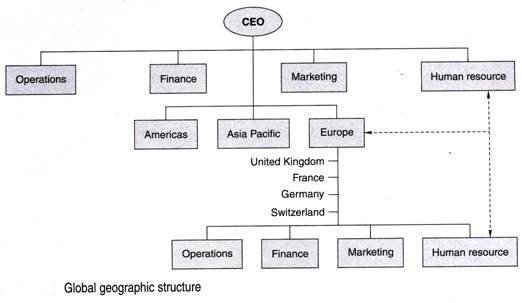
The corporate headquarter is responsible for transferring excess resources from one country to another, as and when required. The corporate human resource division also coordinates and provides synergy to achieve company’s overall strategic goals between various subsidiaries based in different countries.

Such structure is effective when the product lines are not too diverse and resources can be shared. Under such organizational structure, subsidiaries in each country are deeply embedded with nationalistic biases that prohibit them from cooperating among each other.

(d) Global matrix structure

It is an integrated organizational structure, which super-imposes on each other more than one dimension. The global matrix structure might consist of product divisions intersecting with various geographical areas or functional divisions. Unlike functional, geographical, or product division structures, the matrix structure shares joint control over firm’s various functional activities.
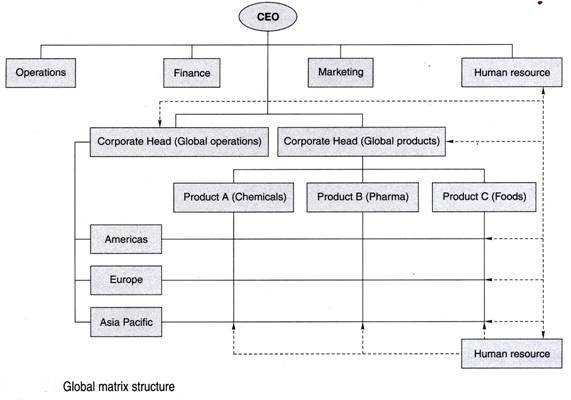
Such an integrated organizational structure facilitates greater interaction and flow of information throughout the organization. Since the matrix structure has an in-built concept of interaction between intersecting perspectives, it tends to balance the MNE’s prospective, taking cross-functional aspects into consideration.

It facilitates ease of technology transfer to foreign operations and of new products to different markets leading to higher economies of scale and better foreign sales performance. Matrix structure is used successfully by a large number of MNEs, such as Royal Dutch/Shell, Dow Chemical, etc.

In an effort to bring together divergent perspectives within the organization, the matrix structure may also lead to conflicting situations. It inhibits a firm’s ability to respond quickly to environmental changes in case an effective conflict resolution mechanism is not in place.

Since the structure requires most managers to report to two or multiple bosses, Fayol’s basic principle of unity of command is violated and conflicting directives from multiple authorities may compel employees to compromise with sub-optimal alternatives so as to avoid conflict which may not be the most appropriate strategy for an organization as a whole.

(e) Transnational network structure

Such a globally integrated structure represents the ultimate form of an earth-spanning organization, which eliminates the meaning of two or three matrix dimensions. It encompasses elements of function, product, and geographic designs while relying upon a network arrangement to link worldwide subsidiaries.
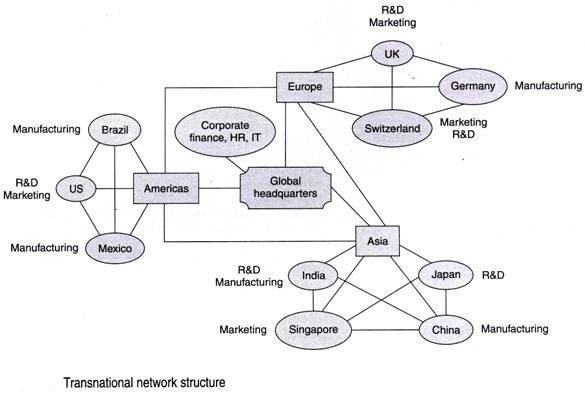
This form of organization is not defined by its formal structure but by how its processes are linked with each other, which may be characterized by an overall integrated system of various inter-related sub-systems.

The trans-national network structure is designed around ‘nodes’, which are the units responsible for coordinating with product, functional and geographic aspects of an MNE. Thus, trans-national network structures build-up multi­dimensional organizations which are fully networked.

  1. Evolution of Global Organizational Structures

Organizational structures often exhibit evolutionary patterns, as shown in Fig., depending upon their strategic globalization. The historical evolution of organizational patterns indicates that in the early phase of internationalization, most firms separate their exports departments from domestic marketing or have separate international divisions.
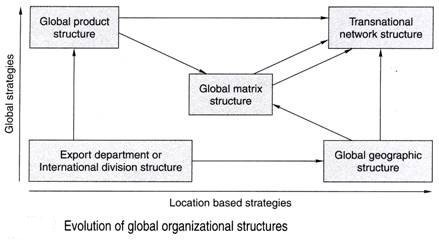
Companies with emphasis on global business strategies move towards global product structures whereas those with emphasis on location base strategies move towards global geographic structures.

Subsequently, a large number of companies graduate to a matrix or trans-national network structure due to dual demands of local adaptations pressures and globalization. In practice, most companies hardly adopt either pure matrix or trans-national structures; rather they opt for hybrid structures incorporating both.
International Business Organizations

International Business conducts business transactions all over the world. These transactions include the transfer of goods, services, technology, managerial knowledge, and capital to other countries. International business involves exports and imports.

International Business is also known, called or referred as a Global Business or an International Marketing.

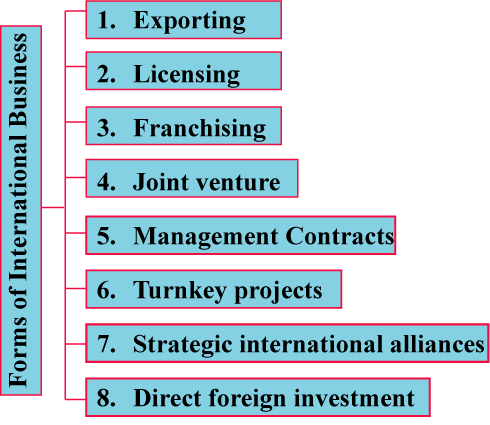
An international business has many options for doing business, it includes,

  • Exporting goods and services.
  • Giving license to produce goods in the host country.
  • Starting a joint venture with a company.
  • Opening a branch for producing & distributing goods in the host country.
  • Providing managerial services to companies in the host country.

International Business Organizations

The exciting world of international business beckons the brightest minds and sharpest business performers to excel in relationships, governance, and financial acuity in order to create a better future for all people. World changers need spaces in which to gather to share ideas, spur one another on, create relational opportunism, mingle with industry and governmental leaders, and dream of advanced systems to enhance our daily lives. Many such venues exist but it’s not always easy to know which ones with which to associate. This article discusses key places for the entrepreneur to consider.

A plethora of international business organizations exist to promote education and facilitate business transactions around the world. The following organizations are among the most active and well known. Whether you are a business person transacting international business or a student looking to learn and eventually get in on the action, these organizations will open the door to your forward-looking international worldview.

  1. World Trade Organization

The World Trade Organization (WTO) is the premier worldwide group geared toward the politics of international trade. Government officials meet together within the WTO context to negotiate trade agreements and negotiate the politics of international business. The WTO receives significant media attention while also proactively publishing data related to accessing international markets. Check out their annual World Trade Report for research, analysis, and featured member nation stories.

The WTO’s student-friendly approach contributes internships, a youth ambassador program, and essay awards for young economists in the hope of promoting business and friendship for young international professionals. The newly created Youth Ambassador Programme gives young leaders a voice at the international trade table to offer their unique opinions and perspectives. The internship program for post-graduate university students develops knowledge, understanding, and experience in global trade policy and compliance. Internships can last up to 24 weeks and take place exclusively in beautiful Geneva, Switzerland. Interns also receive a stipend.

  1. International Chamber of Commerce

The International Chamber of Commerce (ICC) promotes world business by providing forums, leadership development, and advocacy for nations who desire for their citizens to enjoy a higher global standard of living while living in a world of peace. The ICC conducts training events, arbitration conferences, financial summits and numerous other programs to promote their agenda of building peace and prosperity on earth.

ICC online training modules expose students and business professionals to certification level expertise developed as ICC constituents intermingle on the world stage at G20 Summits and United Nations forums. The ICC maintains policy commissions in the areas of the digital economy, competition, the environment and energy policy, intellectual property, and taxation, among other topics. Dispute resolution, antitrust compliance, international sales contracts, arbitration provision and anti-crime initiatives are just a sampling of the services proffered by the International Chamber of Commerce.

Students can benefit specifically with the Young Arbitrators Forum (YAF). YAF is a place for young professionals to learn from seasoned international practitioners about issues related to arbitration and arbitration career development. Events are held regularly all around the world.

  1. International Association of Business Communicators

The International Association of Business Communicators (IABC) is a networking association for communication professionals. The IABC promotes professional development and communication standards worldwide. They tout a membership of 15,000 professionals in over 80 countries.

  1. International Business Organization

The International Business Organization (IBO) is a group that serves the international community who wants to do business in or immigrate to the United States of America with a special purview related to the state of Florida. The IBO can assist with real estate information, immigration services, health insurance, and unique networking contacts.

  1. The Federation of International Trade Associations

The Federation of International Trade Associations (FITA) is an online clearinghouse of 8,000 international trade Web sites. FITA is comprised of 450 association members and 450,000 linked company members. FITA brings together trade agents, distributors, and service providers that contribute toward import and export activities. Their market research tools and leads increase the capacity of members to conduct international trade ethically and legally.

Check out their Web site tools of the trade including customs and tariffs, intellectual property rights, trade barriers, logistics, and more. This fully-orbed research driven site will help you to determine, among other things, how to import horses into China, how to franchise overseas, how to fight against fraudulent individuals in Nigeria, and how to invest in Afghanistan.

The IBO Web site provides country profiles for more than half of the nations of the world. Profiles contain demographics, country overview, currency and communications information, and basic economic data.

  1. The World Technology Network

The World Technology Network (WTN) brings innovative individuals together from the science and technology communities to share ideas, discover synergies, and create momentum within the realm of emerging technologies. Add in financiers and futurists and the organization builds capacity for creating roadmaps into the rest of the 21st Century. The community also includes marketers, writers, entrepreneurs, government officials, and policy analysts – people who are bent on creating dynamic systems to enhance world productivity and efficiencies.

WTN’s headline event, The World Technology Summit & Awards ceremony, has taken place annually for twelve years. Awards are presented in the following categories: arts, biotechnology, communication technology, design, education, energy, entertainment, environment, ethics, finance, health and medicine, IT hardware, IT software, law, marketing communications, materials, media and journalism, policy, social entrepreneurship, and space. Awards are presented in these categories to both individuals and corporations who best represent WTN goals and ideologies.

  1. International Assembly for Collegiate Business Education

The International Assembly for Collegiate Business Education (IACBE) is a professional accrediting organization related to business education. They promote business educational standards and opportunities for students and the professional educational community. Members include colleges and universities who are committed to strengthening business educational capacities worldwide.

IACBE member services range from mentoring and consulting platforms to the Journal for Excellence in Business Education. The International Business Education Consortium enables members to share curriculum ideas, provide fresh experiences for business students, create international teaching opportunities for faculty, and establish new revenue tuition streams for member institutions.

  1. International Executives Association

The International Executives Association is an elite type networking group for companies and their respective top level employees. Their focus on inspiration and camaraderie refreshes business executives enabling them to prosper as they share business leads and referrals with one another. Most local chapters are located in Canada and the United States.

  1. Business Council for International Understanding

Started in 1955 as an initiative by President Dwight Eisenhower, the Business Council for International Understanding (BCIU) exists to foster dialogue among world business and political leaders. The BCIU organizes trade mission tours for cross-fertilization of business opportunities both internationally and domestically-hosted, roundtables for senior executives and politicians, and private meetings for high level officials of influence. A commercial training program geared toward embassy personnel and diplomats-in-training shows the diplomatic community how to promote business interests wherever they serve in the world by understanding the local business conditions and applying international standards for success. BCIU meets annually in New York for an awards gala.

BCIU provides fascinating internship opportunities for college juniors and seniors to obtain experience in both private sector and governmental contexts. Responsibilities include database management, research, writing, and communications. A key benefit is networking with interns from different cultural backgrounds.

  1. Coalition of Services Industries

The Coalition of Services Industries (CSI) represents the needs for the service industries in the United States, industries such as banking, hospitality, logistics, telecommunications, and insurance. They also promote international policies that will benefit these industries seeking to develop business worldwide. Special working groups have developed around the themes of financial services, insurance, telecommunications, media, and information technology. In addition, groups focus on the emerging economies of China and India.

Take the time to explore these organizations and you’ll see a world that contains unlimited possibilities. Determine what it is that you are looking for and then narrow down your search based upon geography, association fees, personal and professional goals, membership opportunities and requirements, and the capacity for association members to influence you to influence your sphere of the world.

International Business Environment: Political Environment, Economic Environment, Technological Environment, Cultural Environment, Competitive Environment, Legal and Financial Environment

Political Environment

The political environment refers to the type of the government, the government relationship with a business, & the political risk in the country. Doing business internationally, therefore, implies dealing with a different type of government, relationships, & levels of risk.

There are many different types of political systems, for example, multi-party democracies, one-party states, constitutional monarchies, dictatorships (military & non-military). Therefore, in analyzing the political-legal environment, an organization may broadly consider the following aspects:

  • The Political system of the business
  • Approaches to the Government towards business i.e. Restrictive or facilitating
  • Facilities & incentives offered by the Government
  • Legal restrictions for instance licensing requirement, reservation to a specific sector like the public sector, private or small-scale sector
  • The Restrictions on importing technical know-how, capital goods & raw materials
  • The Restrictions on exporting products & services
  • Restrictions on pricing & distribution of goods
  • Procedural formalities required in setting the business

Economic Environment

The economic environment relates to all the factors that contribute to a country’s attractiveness for foreign businesses. The economic environment can be very different from one nation to another. Countries are often divided into three main categories: the more developed or industrialized, the less developed or third world, & the newly industrializing or emerging economies.

Within each category, there are major variations, but overall the more developed countries are the rich countries, the less developed the poor ones, & the newly industrializing (those moving from poorer to richer). These distinctions are generally made on the basis of the gross domestic product per capita (GDP/capita). Better education, infrastructure, & technology, healthcare, & so on are also often associated with higher levels of economic development.

Clearly, the level of economic activity combined with education, infrastructure, & so on, as well as the degree of government control of the economy, affect virtually all facets of doing business, & a firm needs to recognize this environment if it is to operate successfully internationally. While analyzing the economic environment, the organization intending to enter a particular business sector may consider the following aspects:

  • An Economic system to enter the business sector.
  • Stage of economic growth & the pace of growth.
  • Level of national & per capita income.
  • Incidents of taxes, both direct & indirect tax.
  • Infrastructure facilities available & the difficulties thereof.
  • Availability of raw materials & components & the cost thereof.
  • Sources of financial resources & their costs.
  • Availability of manpower-managerial, technical & workers available & their salary & wage structures.

Technological Environment

The technological environment comprises factors related to the materials & machines used in manufacturing goods & services. Receptivity of organizations to new technology & adoption of new technology by consumers influence decisions made in an organization.

As firms do not have any control over the external environment, their success depends on how well they adapt to the external environment. An important aspect of the international business environment is the level, & acceptance, of technological innovation in different countries.

The last decades of the twentieth century saw major advances in technology, & this is continuing in the twenty-first century. Technology often is seen as giving firms a competitive advantage; hence, firms compete for access to the newest in technology, & international firms transfer technology to be globally competitive.

It is easier than ever for even small business plan to have a global presence thanks to the internet, which greatly grows their exposure, their market, & their potential customer base. For the economic, political, & cultural reasons, some countries are more accepting of technological innovations, others less accepting. In analyzing the technological environment, the organization may consider the following aspects:

  • Level of technological development in the country as a whole & specific business sector.
  • The pace of technological changes & technological obsolescence.
  • Sources of technology.
  • Restrictions & facilities for technology transfer & time taken for the absorption of technology.

Cultural Environment

The cultural environment is one of the critical components of the international business environment & one of the most difficult to understand. This is because the cultural environment is essentially unseen; it has been described as a shared, commonly held body of general beliefs & values that determine what is right for one group, according to Kluckhohn & Strodtbeck.

National culture is described as the body of general beliefs & the values that are shared by the nation. Beliefs & the values are generally seen as formed by factors such as the history, language, religion, geographic location, government, & education; thus firms begin a cultural analysis by seeking to understand these factors. The most well-known is that developed by Hofstede in1980.

His model proposes four dimensions of cultural values including individualism, uncertainty avoidance, power distance & masculinity.

Individualism is the degree to which a nation values & encourages individual action & decision making.

Uncertainty avoidance is the degree to which a nation is willing to accept & deal with uncertainty.

Power distance is the degree to which a national accepts & sanctions differences in power.

This model of cultural values has been used extensively because it provides data for a wide array of countries. Many academics & the managers found that this model helpful in exploring management approaches that would be appropriate in different cultures.

For example, in a nation that is high on individualism one expects individual goals, individual tasks, & individual reward systems to be effective, whereas the reverse would be the case in a nation that is low on individualism.

  • While analyzing social & cultural factors, the organization may consider the following aspects:
  • Approaches to society towards business in general & in specific areas;
  • Influence of social, cultural & religious factors on the acceptability of the product;
  • The lifestyle of people & the products used for them;
  • Level of acceptance of, or resistance to change;
  • Values attached to a particular product i.e. the possessive value or the functional value of the product;
  • Demand for the specific products for specific occasions;
  • The propensity to consume & to save.

Competitive Environment

The competitive environment also changes from country to country. This is partly because of the economic, political, & cultural environments; these environmental factors help determine the type & degree of competition that exists in a given country. Competition can come from a variety of sources. It can be a public or a private sector, come from the large or the small organizations, be domestic or global, & stem from traditional or new competitors, GST registration. For a domestic firm, the most likely sources of competition might be well understood. The same isn’t the case when a person moves to compete in the new environment.

International Legal Environment

Firms operating internationally face major challenges in conforming to different laws, regulations, and legal systems in different countries. The legal framework to protect small and medium enterprises (SMEs), mainly to achieve social objectives, adversely influences the expansion of manufacturing capacities and achieving economies of scale in certain countries.

International managers need to develop basic understanding of the types of legal systems followed in the countries of their operations before entering into legal contracts.

Major Participants of International Business

Four Major Participants of International Business

  1. Exporting

Exporting is often the first choice when manufacturers decide to expand abroad. Simply stating, exporting means selling abroad, either directly to target customers or indirectly by retaining foreign sales agents or/and distributors. Either case, going abroad through exporting has minimal impact on the firm’s human resource management because only a few, if at all, of its employees are expected to be posted abroad.

  1. Licensing

Licensing is another way to expand one’s operations internationally. In case of international licensing, there is an agreement whereby a firm, called licensor, grants a foreign firm the right to use intangible (intellectual) property for a specific period of time, usually in return for a royalty. Licensing of intellectual property such as patents, copyrights, manufacturing processes, or trade names abound across the nations. The Indian basmati (rice) is one such example.

  1. Franchising

Closely related to licensing is franchising. Franchising is an option in which a parent company grants another company/firm the right to do business in a prescribed manner. Franchising differs from licensing in the sense that it usually requires the franchisee to follow much stricter guidelines in running the business than does licensing. Further, licensing tends to be confined to manufacturers, whereas franchising is more popular with service firms such as restaurants, hotels, and rental services.

One does not have to look very far to see how important franchising business is to companies here and abroad. At present, the prominent examples of the franchise agreements in India are Pepsi Food Ltd., Coca-Cola, Wimpy’s Damino, McDonald, and Nirula. In USA, one in 12 business establishments is a franchise.

However, exporting, licensing and franchising make companies get them only so far in international business. Companies aspiring to take full advantage of opportunities offered by foreign markets decide to make a substantial direct investment of their own funds in another country. This is popularly known as Foreign Direct Investment (FDI). Here, by international business means foreign direct investment mainly. Let us discuss some more about foreign direct investment.

  1. Foreign Direct Investment (FDI)

Foreign direct investment refers to operations in one country that ire controlled by entities in a foreign country. In a sense, this FDI means building new facilities in other country. In India, a foreign direct investment means acquiring control by more than 74% of the operation. This limit was 50% till the financial year 2001-2002.

There are two forms of direct foreign investment: joint ventures and wholly-owned subsidiaries. A joint venture is defined as “the participation of two or more companies jointly in an enterprise in which each party contributes assets, owns the entity to some degree, and shares risk”. In contrast, a wholly-owned subsidiary is owned 100% by the foreign firm.

An international business is any firm that engages in international trade or investment. International trade refers to export or import of goods or services to customers/consumers in another country. On the other hand, international investment refers to the investment of resources in business activities outside a firm’s home country.

Importance of International Business

  1. Insufficiency of Domestic Demand

If the domestic demand for the product is not sufficient to consume the production, the firm may take a decision to enter the foreign market. In this way he can equalize the production and demand.

  1. To Utilize Installed Capacity

If the installed capacity of the firm is much more than the level of demand of the product in the domestic market, it can enter the international market and utilize its un-utilized installed capacity. In this way it can export the surplus production.

  1. Legal Restrictions

Sometimes the Government of a country imposes certain restrictions on the growth and expansion of certain firms or on the production and distribution of certain commodities in the domestic market in order to achieve certain social objectives.

  1. Relative Profitability

The export business is more attractive for its higher rate of profitability. The higher profitability rate also gives extra strength to the firm.

  1. Less Business Risk

A diversified export business helps the exporting firm in mitigating the risk of sharp fluctuations in the business activity of the firm.

  1. Increased Productivity

Due to certain social and technological developments the industrial production has increased to a great extent. The production will be higher at cheaper rate. The surplus production can be exported.

  1. Social Responsibility

In order to meet the social responsibility some business firms take the decision to contribute to the National Exchequer by exporting their products.

  1. Technological Improvements

Technological improvements also attract the business firm to enter foreign markets. It introduces new products with latest technological improvements and faces the competition successfully in the international markets.

  1. Product Obsolescence

If a product becomes obsolete in domestic market it may be in demand in International markets. The firm has to make a survey for introducing the product in those markets.

  1. International Collaboration

Developed countries fix their import quotas for different countries and for different commodities. A county can export various commodities to these developed countries to the extent of its quota.

  1. International Business Brings Various Countries Closer

Better business relations are established among the countries. Government and non-government business commissions or business representatives visit other countries from time to time. The local representatives and other related persons came into contact with foreign representatives and come to know their habits and customs.

  1. Helps in Maintaining Good Political Relations

The economic relations between two countries help each other to improve their political relations. Various countries having different political ideologies import or export their products. To conclude it is now undisputable that export business contributes to the national economy, national exchequer, individual exporting firms and maintains international, economic cultural and political relations among various countries. Countries have come closer on account of international business.

Importance of International Business: On the view of National Economy

  1. It is important to meet imports of industrial needs.
  2. Debt Servicing: This means to grant loan for and for their industrial development.
  3. For rapid economic growth.
  4. For profitable use of natural resources.
  5. To face competition successfully-better quality goods production having lower or moderate prices. To improve the image of the producer as well as of the country in the minds of foreign customers.
  6. Increase in employment opportunities.
  7. To increase national income.
  8. Increase in standard of living of the people.

Domestic Business v/s International Business

Trade refers to the exchange of goods and services for money, which can be undertaken within the geographical limits of the countries or beyond the boundaries. The trade which takes place within the geographical boundaries of the country is called domestic business, whereas trade which occurs between two countries internationally, is called international business.

Entities engaged in international business often face more difficulties than the entities which conduct domestic business. Although international business enjoys large customer base as they operate in multiple countries. Here is an article which compiles the important differences between domestic and international business.

Domestic Business

The business transaction that occurs within the geographical limits of the country is known as domestic business. It is a business entity whose commercial activities are performed within a nation. Alternately known as internal business or sometimes as home trade. The producer and customers of the firm both reside in the country. In a domestic trade, the buyer and seller belong to the same country and so the trade agreement is based on the practices, laws and customs that are followed in the country.

There are many privileges which a domestic business enjoys like low transaction cost, less period between production and sale of goods, low transportation cost, encourages small-scale enterprises, etc.

International Business

International Business is one whose manufacturing and trade occur beyond the borders of the home country. All the economic activities indulged in cross-border transactions comes under international or external business. It includes all the commercial activities like sales, investment, logistics, etc., in which two or more countries are involved.

The company conducting international business is known as a multinational or transnational company. These companies enjoy a large customer base from different countries, and it does not have to depend on a single country for resources. Further, the international business expands the trade and investment amongst countries.

However, there are several drawbacks which act as a barrier to entry in the international market like tariffs and quota, political, socio-cultural, economic and other factors that affect the international business.

Comparison

DOMESTIC BUSINESS INTERNATIONAL BUSINESS
Meaning      

A business is said to be domestic, when its economic transactions are conducted within the geographical boundaries of the country.

International business is one which is engaged in economic transaction with several countries in the world.

Area of operation Within the country Whole world
Quality standards Quite low Very high
Deals in                     Single currency Multiple currencies
Capital investment            Less Huge
Restrictions  Few    Many
Nature of customers Homogeneous Heterogeneous
Business research It can be conducted easily. It is difficult to conduct research.
Mobility of factors of production            Free Restricted

Differences between Domestic and International Business

The most important differences between domestic and international business are classified as under:

  1. Domestic Business is defined as the business whose economic transaction is conducted within the geographical limits of the country. International Business refers to a business which is not restricted to a single country, i.e. a business which is engaged in the economic transaction with several countries in the world.
  2. The area of operation of the domestic business is limited, which is the home country. On the other hand, the area of operation of an international business is vast, i.e. it serves many countries at the same time.
  3. The quality standards of products and services provided by a domestic business is relatively low. Conversely, the quality standards of international business are very high which are set according to global standards.
  4. Domestic business deals in the currency of the country in which it operates. On the contrary, the international business deals in the multiple currencies.
  5. Domestic Business requires comparatively less capital investment as compared to international business.
  6. Domestic Business has few restrictions, as it is subject to rules, law taxation of a single country. As against this, international business is subject to rules, law taxation, tariff and quotas of many countries and therefore, it has to face many restrictions which are barriers in the international business.
  7. The nature of customers of a domestic business is more or less same. Unlike, international business wherein the nature of customers of every country it serves is different.
  8. Business Research can be conducted easily, in domestic business. As against this, in the case of international research, it is difficult to conduct business research as it is expensive and research reliability varies from country to country.
  9. In domestic business, factors of production are mobile whereas, in international business, the mobility of factors of production are restricted.

Carrying out the activities of international business and its management is far more difficult than conducting a domestic business. Due to changes in political, economic, socio-cultural environment across the nations, most business entities find it difficult to expand their business globally. To become a successful player in the international market firms need to plan their business strategies as per the requirement of the foreign market.

International business Meaning and Types

Business activities done across national borders is International Business. The International business is the purchasing and selling of the goods, commodities and services outside its national borders. Such trade modes might be owned by the state or privately owned organization.

In which, the organization explores trade opportunities outside its domestic national borders to extend their own particular business activities, for example, manufacturing, mining, construction, agriculture, banking, insurance, health, education, transportation, communication and so on.

Basically international business is a cross border transaction between individuals, businesses, or government entities. The transaction can be of anything that has value, examples include:

  • Physical Goods
  • Services such as banking, insurance, construction, etc.
  • Technology such as software, arms, and ammunition, satellite technology, etc.
  • Capital and
  • Knowledge

For ease of understanding, in this article, the word “goods” will include all of the above-mentioned items. For regular commodities, we will be using the word “physical goods”.

Types of International Businesses

All the major international business conducted in the world can come under seven main types. These can also be termed as modes of business.

  1. Imports and Exports

Simplest and most commonly used method, imports and exports can be seen as the foundation of international business. Imports are an inflow of goods into the markets of home country for consumption, in contrast, export means selling of goods to foreign countries. In short, imports means inflow whereas export means outflow of goods in any form.

  1. Licensing

Licencing is one of the easiest ways to expand a business internationally. When a company has a standardized product with ownership rights, it can use licensing to distribute and sell the products in the international market. Licenses come in many forms, some of which are patent, copyright, trademark, etc. Products such as books and movies are usually distributed internationally through licensing agreements.

  1. Franchising

A very effective method to expand a business nationally as well as internationally, franchising is similar to licensing. In this, a parent company gives the right to another company to conduct business using the parent company’s name/ brand and products. The parent company becomes the franchiser and the receiving company becomes the franchisee. Many of the biggest restaurant chains in the world have used the franchisee model to expand internationally. Some examples include – McDonald, Pizza Hut, Starbucks, Domino’s Pizza and many more

  1. Outsourcing and Offshoring

Outsourcing means giving out contracts to international firms for certain business processes. For example, giving out accounting function to an international firm. This is usually effective when the cost of conducting these processes are comparatively much cheaper in some other country than in the home country. For example, many developed countries such as the USA, Australia, the UK, etc. outsource its functions to companies in India, China, etc. because it is cheaper.

Offshoring is similar to outsourcing in the sense that a function is moved away from the home country. However, it is different in the sense that the facility is physically moved to another country but the management stays with the company itself. For example, Apple Inc. is conducting its manufacturing function in China, however, it is completely controlled by Apple Inc.

  1. Joint Ventures and Strategic Partnerships

A joint venture is a contract between two parties, one is an international company while another company is local to where the business has to be conducted. Both parties contribute to the equity and management of the company. As a result, both share the profit as well. These parties can mutually decide the percentage of equity and profit sharing.

These types of ventures and partnerships come into existence when both the party has something to offer. For example, the local company may have the brand name and network within the country while the international company may have advanced technology. A classic example of a joint venture is Tata Jaguar collaboration in India. Sometimes there are government restrictions to international companies against holding 100% equity in certain areas such as defense. In such cases, international companies can take the benefit of the new market by a joint venture.

  1. Multinational Companies

Multinational companies, as the name suggests, are companies that are conducting business in multiple countries. They actually set up the whole business in multiple countries. Some such examples are Amazon, Citigroup, Coca-Cola, etc.

These companies have independent operations in each country, and each country has its own set of offices, employees, etc. In fact, even the products and marketing campaigns are customized as per local needs. For example, Nestle introduced a Matcha flavor Kit Kat in Japan as the flavor is very popular in that country, however, they don’t offer the same flavor in India. This customization is one of the many benefits of being a multinational company.

  1. Foreign Direct Investment

Foreign direct investment is an investment made by an individual or a company located in one country to the business interest located in another foreign country. In this the investing company usually commits more than capital, they share management, technology, processes, etc, with the company that they have invested in. The foreign direct investments can take many forms such as a subsidiary company, associate company, joint venture, merger, etc.

These are the major types through which people, companies, and government conduct international business. However, means of business is just one minor speck of the international business environment.

One must consider many factors when setting up any business internationally. These factors include –

Factors to Consider Before Starting International Business Operations

  1. Geographical Factors

Simple challenges that come with the change in geography have to be studied when considering international business. There are differences in storage requirement, supply chain requirements, connectivity issues, etc. from country to country. Colgate-Palmolive will face a thousand challenges even before its soaps and shampoos can reach rural areas of India where there is a lack of basic necessities such as water, electricity, transportation, etc.

  1. Social Factors

Social factors are very important in international business. It is very difficult to set up shops in countries that are politically disturbed or are going through some tensions. For example, most companies don’t want to expand its business in Afghanistan, as there is so much disturbance.

  1. Legal Policies

Every country has different laws and governing policies. A company should check all the legal requirements in the country in which it wants to conduct business. The basic laws that need attention are organization laws, securities laws, consumer protection laws, employees protection laws, and many more. The process can be lengthy but it is necessary.

  1. Behavioral Factors

Every country has different cultures and beliefs, and people can be very sensitive to these beliefs. An international company, if not careful, can land a lot of issues if they don’t take care of the country’s behavioral factors. For example, McDonald cannot sell its beef burgers in India, else it will have to face the brunt of the Indian population that is majority Hindu.

  1. Economic Forces

These factors include the county’s currency values, market size, cost, inflation, etc. These are important because it directly affects the profitability of operations. Every company should consider these factors before expanding internationally if they want to manage its bottom line.

All these above-mentioned factors play an important role in how successful or unsuccessful an entity will be in its international business adventures. All these factors should be considered in the research and planning stage to get maximum benefit out of it.

Concept of Organizational Development

Organizational Development or simply O.D. is a technique of planned change. It seeks to change beliefs, attitudes, values and structures-in fact the entire culture of the organization so that the organization may better adapt to technology and live with the pace of change.

O.D. is a comprehensive strategy for organization improvement. O.D. is a long range effort to improve an organization’s problem solving and renewal processes, particularly through a more effective and collaborative management culture.

Objectives of Organizational Development

(a) Improvement in the performance of the organization.

(b) Improvement in the ability of the organization to adapt to its environment, and

(c) Improvement in inter-personal and inter-group behaviour to secure team work.

Characteristics of Organizational Development

  1. Organizational development is an educational strategy for bringing a planned change.
  2. It is related to real problems of the organization.
  3. Laboratory training methods based on experienced behaviour are primarily used to bring change.
  4. O.D. uses change agent (or consultant) to guide and affect the change. The role of change agent is to guide groups towards more effective group processes rather than telling them what to do. Change agents simply assist the group in problem solving processes and the groups solve the problems themselves.
  5. There is a close working relationship between change agents and the people who are being changed.
  6. O.D. seeks to build problem-solving capacity by improving group dynamics and problem confrontation.
  7. O.D. reaches into all aspects of the organization culture in order to make it more humanly responsive.
  8. O.D. is a long term approach (of 3 to 5 years period) and is meant to elevate the organization to a higher level of functioning by improving the performance and satisfaction of organization members.
  9. O.D. is broad-based and describes a variety of change programmes. It is concerned not only with changes in organizational design but also with changes in organizational philosophies, skills of individuals and groups.
  10. O.D. is a dynamic process. It recognises that the goals of the organization change and hence the methods of attaining them should also change.
  11. O.D. utilizes systems thinking. It is based on open, adaptive systems concept. The organization is treated as an interrelated whole and no part of the organization can be changed without affecting other parts.
  12. O.D. is research based. Change agents conduct surveys, collect data, evaluate and then decisions are taken.
  13. O.D. uses group processes rather than individual process. It makes efforts to improve group performance.
  14. O.D. is situational and contingency oriented.
  15. Organization Development and Management Development are complementary rather then conflicting.

Steps in Organizational Development (O.D)

Lawrence and Lorsch have provided the following steps in organizational development:-

  1. Problem identification—Diagnosis

O.D. program starts with the identification of the problem in the organization. Correct diagnosis of the problem will provide its causes and determine the future action needed.

  1. Planning Strategy for Change

O.D. consultant attempts to transform diagnosis of the problem into a proper action plan involving the overall goals for change, determination of basic approach for attaining these goals and the sequence of detailed scheme for implementing the approach.

  1. Implementing the Change

O.D. consultants play an important role in implementing change.

  1. Evaluation

D. is a long-term process. So there is a great need for careful monitoring to get process feedback whether the O.D. programme is going on well after its implementation or not. This will help in making suitable modifications, if necessary. For evaluation of O.D. programme, the use of critic sessions, appraisal of change efforts and comparison of pre and post training behavioural patterns are quite effective.

Change Agent

Change agent is an individual or group, who carry out the task of instigating and managing change in the organization. He/She is someone, who directly or indirectly influences change, i.e. the change agents are appointed by the organizations to transform the ways, the organization is managed, or the business is conducted.

Types of Change Agent

The change agent can be internal or external to the organization who plays the role of a catalyst to implement change in the organization.

  1. Internal Change Agent

When the change agent, is internal to the organization then he/she is usually the employee such as a manager, senior executive, leader, HR professional or any other person from the staff who has mastered in behavioural sciences and intervention technology of organization development. They are appointed by the organization to look after the change process.

  1. External Change Agent

The external change agent is the one who is brought to the organization from outside such as consultants. The company’s rules regulations and policies are not imposed on them, and so they can deeply analyze and bring different viewpoints to a situation and challenge the existing state of affairs.

However, this can also be seen as a disadvantage, as the external change agent is not aware of the company’s history, work processes, and personnel.

Roles of a Change Agent

Change agents aim at making changes in the existing processes or culture of the organization that sticks. And to do so, they focus on the matters relating to organizational effectiveness, innovation, and advancement.

He/She is someone who always seeks an opportunity for change, determines the best approach and bring about change. They are the one who possesses skills and competencies to initiate, facilitate and coordinate organizational change.

Change Agents help the organization in understanding the requirement and relevance for change and takes all necessary steps required to manage change and also anticipates the problem; that might take place during or after the change is implemented in the organization. He/She is responsible to transform vision into a realistic plan and execute it.

Skills of a Change Agent

(i) Cognitive Skills: The skills which require some level of pro-action from the side of the change agent for the purpose of self-understanding, conceptualization, and evaluation.

(ii) Action Skills: Change Agent works as a consultant, researcher, trainer, counsellor, etc. in an organization, so, he/she should possess the required skills and competencies.

(iii) Communication Skills: He/She is responsible for spreading change information, and making the organization realize the need for change, for which he/she must possess excellent communication and pervasive skills.

Many multinational corporations have their own in-house change specialist, who works with the management team of the organization to recognize the need for change and facilitate change efforts.

Characteristics of a Change Agent

  1. Clear Vision

As mentioned above, a “change agent” does not have to be the person in authority, but they do however have to have a clear vision and be able to communicate that clearly with others.  Where people can be frustrated is if they feel that someone is all over the place on what they see as important and tend to change their vision often.  This will scare away others as they are not sure when they are on a sinking ship and start to looking for ways out.  It is essential to note that a clear vision does not mean that there is one way to do things; in fact, it is essential to tap into the strengths of the people you work with and help them see that there are many ways to work toward a common purpose.

  1. Patient yet persistent

Change does not happen overnight and most people know that.  To have sustainable change that is meaningful to people, it is something that they will have to embrace and see importance.  Most people need to experience something before they really understand that, and that is especially true in schools.  With that being said, many can get frustrated that change does not happen fast enough and they tend to push people further away from the vision, then closer.  The persistence comes in that you will take opportunities to help people get a step closer often when they are ready, not just giving up on them after the first try.  I have said continuously that schools have to move people from their point ‘A’ to their point ‘B’, not have everyone move at the same pace. Every step forward is a step closer to a goal; change agents just help to make sure that people are moving ahead.

  1. Asks tough questions

It would be easy for someone to come in and tell you how things should be, but again that is someone else’s solution.  When that solution is someone else’s, there is no accountability to see it through.  It is when people feel an emotional connection to something is when they will truly move ahead.  Asking questions focusing on, “What is best for kids?”, and helping people come to their own conclusions based on their experience is when you will see people have ownership in what they are doing.  Keep asking questions to help people think, don’t alleviate that by telling them what to do.

  1. Knowledgeable and leads by example

Stephen Covey talked about the notion that leaders have “character and credibility”; they are not just seen as good people but that they are also knowledgeable in what they are speaking about.  Too many times, educators feel like their administrators have “lost touch” with what is happening in the classroom, and many times they are right.  Someone who stays active in not necessarily teaching, but active in learning and working with learners and can show by example what learning can look like now will have much more credibility with others.  If you want to create “change”, you have to not only be able to articulate what that looks like, but show it to others. I have sat frustrated often listening to many talk about “how kids learn today” but upon closer look, the same speakers do not put themselves in the situation where they are actually immersing themselves in that type of learning.  How can you really know how “kids learn” or if something works if you have never experienced it?

  1. Strong relationships built on trust

All of the above, means nothing if you do not have solid relationships with the people that you serve.  People will not want to grow if they do not trust the person that is pushing the change.  The change agents I have seen are extremely approachable and reliable.  You should never be afraid to approach that individual based on their “authority” and usually  they will go out of their way to connect with you.

Decision making under Certainty, Uncertainty, Risk

Decision theory, in statistics, a set of quantitative methods for reaching optimal decisions. A solvable decision problem must be capable of being tightly formulated in terms of initial conditions and choices or courses of action, with their consequences. In general, such consequences are not known with certainty but are expressed as a set of probabilistic outcomes. Each outcome is assigned a “utility” value based on the preferences of the decision maker. An optimal decision, following the logic of the theory, is one that maximizes the expected utility. Thus, the ideal of decision theory is to make choices rational by reducing them to a kind of routine calculation.

Decision-making under Certainty

A condition of certainty exists when the decision-maker knows with reasonable certainty what the alternatives are, what conditions are associated with each alternative, and the outcome of each alternative. Under conditions of certainty, accurate, measurable, and reliable information on which to base decisions is available.

The cause and effect relationships are known and the future is highly predictable under conditions of certainty. Such conditions exist in case of routine and repetitive decisions concerning the day-to-day operations of the business.

Decision-making under Risk:

When a manager lacks perfect information or whenever an information asymmetry exists, risk arises. Under a state of risk, the decision maker has incomplete information about available alternatives but has a good idea of the probability of outcomes for each alternative.

While making decisions under a state of risk, managers must determine the probability associated with each alternative on the basis of the available information and his experience.

Decision-making under Uncertainty:

Most significant decisions made in today’s complex environment are formulated under a state of uncertainty. Conditions of uncertainty exist when the future environment is unpredictable and everything is in a state of flux. The decision-maker is not aware of all available alternatives, the risks associated with each, and the consequences of each alternative or their probabilities.

The manager does not possess complete information about the alternatives and whatever information is available, may not be completely reliable. In the face of such uncertainty, managers need to make certain assumptions about the situation in order to provide a reasonable framework for decision-making. They have to depend upon their judgment and experience for making decisions.

Modern Approaches to Decision-making under Uncertainty:

There are several modern techniques to improve the quality of decision-making under conditions of uncertainty.

The most important among these are:

(1) Risk analysis,

(2) Decision trees and

(3) Preference theory.

Risk Analysis:

Managers who follow this approach analyze the size and nature of the risk involved in choosing a particular course of action.

For instance, while launching a new product, a manager has to carefully analyze each of the following variables the cost of launching the product, its production cost, the capital investment required, the price that can be set for the product, the potential market size and what percent of the total market it will represent.

Risk analysis involves quantitative and qualitative risk assessment, risk management and risk communication and provides managers with a better understanding of the risk and the benefits associated with a proposed course of action. The decision represents a trade-off between the risks and the benefits associated with a particular course of action under conditions of uncertainty.

Decision Trees:

These are considered to be one of the best ways to analyze a decision. A decision-tree approach involves a graphic representation of alternative courses of action and the possible outcomes and risks associated with each action.

By means of a “tree” diagram depicting the decision points, chance events and probabilities involved in various courses of action, this technique of decision-making allows the decision-maker to trace the optimum path or course of action.

Preference or Utility Theory:

This is another approach to decision-making under conditions of uncertainty. This approach is based on the notion that individual attitudes towards risk vary. Some individuals are willing to take only smaller risks (“risk averters”), while others are willing to take greater risks (“gamblers”). Statistical probabilities associated with the various courses of action are based on the assumption that decision-makers will follow them.

3For instance, if there were a 60 percent chance of a decision being right, it might seem reasonable that a person would take the risk. This may not be necessarily true as the individual might not wish to take the risk, since the chances of the decision being wrong are 40 percent. The attitudes towards risk vary with events, with people and positions.

Top-level managers usually take the largest amount of risk. However, the same managers who make a decision that risks millions of rupees of the company in a given program with a 75 percent chance of success are not likely to do the same with their own money.

Moreover, a manager willing to take a 75 percent risk in one situation may not be willing to do so in another. Similarly, a top executive might launch an advertising campaign having a 70 percent chance of success but might decide against investing in plant and machinery unless it involves a higher probability of success.

Though personal attitudes towards risk vary, two things are certain.

Firstly, attitudes towards risk vary with situations, i.e. some people are risk averters in some situations and gamblers in others.

Secondly, some people have a high aversion to risk, while others have a low aversion.

Most managers prefer to be risk averters to a certain extent, and may thus also forego opportunities. When the stakes are high, most managers tend to be risk averters; when the stakes are small, they tend to be gambler.

error: Content is protected !!