Elements of Promotion Mix.

The Promotion Mix refers to the blend of several promotional tools used by the business to create, maintain and increase the demand for goods and services.

The fourth element of the 4 P’s of Marketing Mix is the promotion; that focuses on creating the awareness and persuading the customers to initiate the purchase. The several tools that facilitate the promotion objective of a firm are collectively known as the Promotion Mix.

Gary Armstrong defines promotion mix as, “A company’s promotional mix includes advertising, personal selling, sales promotion, public relations, direct marketing. It also includes product design, shape, package, colour, label etc., as all these communicate something to buyer.”

Philip Kotler opines, “A company’s total marketing communication mix also called promotion mix consists of specific blends of advertising, personal selling, sales promotion, public relations and direct marketing tools that the company use to pursue its advertising and marketing objectives.”

Promotion is a process of communication involving information, persuasion, and influence. It includes all types of personal or impersonal communication by a producer with prospective customers as well as middlemen in the distribution network.

The purpose of promotion is to inform, persuade and influence the prospective customers. Personal selling, advertising, public relations, sales promotion and direct marketing are widely used to inform the people about the availability of products and create among them the desire to buy the products.

Promotion is a form of corporate communication that uses various methods to reach a targeted audience with a certain message in order to achieve specific organizational objectives. Nearly all organizations, whether for-profit or not-for-profit, in all types of industries, must engage in some form of promotion.

Such efforts may range from multinational firms spending large sums on securing high-profile celebrities to serve as corporate spokespersons to the owner of a one-person enterprise passing out business cards at a meeting of local business persons.

Promotion is communication from a marketers to the prospective buyers in the market. It tries to instil into buyer’s minds images (through advertising, personal selling, sales promotion and publicity) that make them buy the product.

The Promotion Mix is the integration of Advertising, Personal Selling, Sales Promotion, Public Relations and Direct Marketing. The marketers need to view the following questions in order to have a balanced blend of these promotional tools.

  • What is the most effective way to inform the customers?
  • Which marketing methods to be used?
  • To whom the promotion efforts be directed?

Objectives of Promotion Mix

Promotion can be used for number of reasons for ex: Promotional activity can increase sales, raise awareness or concerns about particular issues develop a brand image or alter public opinion.

The possible objectives for promotion mix may include the following:

  1. Build Awareness

New products and new companies are often unknown to a market, which means initial promotional efforts must focus on establishing an identity. In this situation the marketer must focus promotion to effectively reach customer and tell the market who they are and what they have to offer.

  1. Create Interest

Moving a customer from awareness of a product to making a purchase can present a significant challenge. Consumer buying behaviour depends on the type of customer so the customer must first recognize they have a need before they actively start to consider a purchase.

The focus on creating messages that convince customers that a need exists has been the hallmark of marketing for a long time with promotional appeals targeted at basic human characteristics such as emotions, fears, humor, sex etc.

  1. Provide Information

Some promotions are designed to assist customers in the search stage of the purchasing process. In some cases, such as when a product is so novel it creates a new category of product and has few competitors the information is simply intended to explain what the product is and may not mention any competitors.

In other situations where the product competes in an existing market, informational promotion may be used to help with a product positing strategy.

  1. Stimulate Demand

The right promotion can drive customers to make a purchase. In the case of products that a customer has not previously purchased or has not purchased in a long time, the promotional efforts may be directed at getting the customer to try the product.

This is often seen on the internet where software companies allow for free demonstrations or even free downloadable trials of their products. For customer base products, promotion can encourage customers to increase their purchasing by providing a reason to purchase products sooner or purchase in greater quantities than they normally do.

  1. Reinforce the Brand

Once a purchase is made a marketer can use promotion to build a strong relationship that can lead to the purchaser becoming a loyal customer. For instance, many retail stores now ask for a customer’s email address so that follow-up emails containing additional product information or even an incentive to purchase other products from the retailer can be sent in order to strengthen the customer marketer relationship.

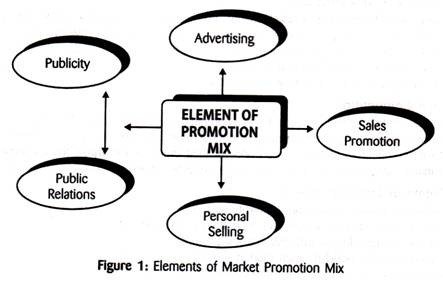
Elements of promotional mix are also called as tools, means, or components. Basically, there are five elements involved in promotional mix. Some authors have considered more elements, too. However, we will consider five elements as shown in Figure 1.
  1. Advertising

Advertising is defined as any paid form of non-personal presentation and promotion of ideas, goods, and services by an identified sponsor. It is a way of mass communication. It is the most popular and widely practiced tool of market promotion. Major part of promotional budget is consumed for advertising alone. Various advertising media – television, radio, newspapers, magazines, outdoor means and so forth – are used for advertising the product.

Characteristics of advertising are as follow:

(i) Adverting is non-personal or mass communication. Personal contact is not possible.

(ii) It is a paid form of communication.

(iii) It is a one-way communication.

(iv) Identifiable entity/sponsor-company or person gives advertising.

(v) It is costly option to promote the sales.

(vi) It can be reproduced frequently as per need.

(vii) Per contact cost is the lowest.

(viii) Various audio-visual, print, and outdoor media can be used for advertising purpose.

(ix) It is a widely used and highly popular tool of market promotion.

  1. Sales Promotion

Sales promotion covers those marketing activities other than advertising, publicity, and personal selling that stimulate consumer purchasing and dealer effectiveness. Sales promotion mainly involves short-term and non-routine incentives, offered to dealers as well consumers. The popular methods used for sales promotion are demonstration, trade show, exhibition, exchange offer, seasonal discount, free service, gifts, contests, etc.

Characteristics of sales promotion are as follows:

(i) The primary purpose of sales promotion is to induce customers for immediate buying or dealer effectiveness or both.

(ii) Excessive use of sale promotion may affect sales and reputation of a company adversely.

(iii) It is taken as supplementary to advertising and personal selling efforts.

(iv) It involves all the promotional efforts other than advertising, personal selling, and publicity.

(v) It consists of short-term incentives, schemes, or plans offered to buyers, salesmen, and/ or dealers.

(vi) It involves non-routine selling efforts.

  1. Personal Selling

Personal selling includes face-to-face personal communication and presentation with prospects (potential and actual customers) for the purpose of selling the products. It involves personal conversation and presentation of products with customers. It is considered as a highly effective and costly tool of market promotion.

Characteristics of personal have been listed below:

(i) Personal selling is an oral, face-to-face, and personal presentation with consumers.

(ii) Basic purpose is to promote products or increase sales.

(iii) It involves two-way communication.

(iv) Immediate feedback can be measured.

(v) It is an ability of salesmen to persuade or influence buyers.

(vi) It is more flexible way of market communication.

(vii) Per contact cost is higher than advertising.

(viii) It involves teaching, educating, and assisting people to buy.

  1. Publicity

Publicity is also a way of mass communication. It is not a paid form of mass communication that involves getting favourable response of buyers by placing commercially significant news in mass media. William J. Stanton defines: “Publicity is any promotional communication regarding an organization and/or its products where the message is not paid for by the organization benefiting from it.”

It is the traditional form of public relations. Publicity is not paid for by the organization. Publicity comes from reporters, columnists, and journalists. It can be considered as a part of public relations. Publicity involves giving public speeches, giving interviews, conducting seminars, charitable donations, inauguration by film actor, cricketer, politician or popular personalities, stage show, etc., that attract mass media to publish the news about them.

Main characteristic of publicity include

(i) Publicity involves obtaining favourable presentation about company or company’s offers upon radio, television, or stage that is not paid for by the sponsor.

(ii) It is a non-paid form of market promotion. However, several indirect costs are involved in publicity.

(iii) It may include promotion of new product, pollution control efforts, special achievements of employees, publicizing new policies, etc., for increasing sales. It is primarily concerns with publishing or highlighting company’s activities and products. It is targeted to build company’s image.

(iv) Mostly, publicity can be carried via newspapers, magazines, radio or television.

(v) Company has no control over publicity in terms of message, time, frequency, information, and medium.

(vi) It has a high degree of credibility. Publicity message is more likely to be read and reacted by audience.

(vii) Publicity can be done at a much lower cost than advertising. Company needs to spend a little amount to get the event or activity publicized.

(viii) Frequency or repetition of publicity in mass media depends upon its social significance or the values for news. Mostly, it appears only once.

  1. Public Relations

The public relations is comprehensive term that includes maintaining constructive relations not only with customers, suppliers, and middlemen, but also with a large set of interested publics. Note that public relations include publicity, i.e., publicity is the part of public relations.

William Stanton defines:

“Public relations activities typically are designed to build or maintain a favourable image for an organisation and a favourable relationship with the organization’s various publics. These publics may be customers, stockholders, employees, unions, environmentalists, the government, and people in local community, or some other groups in society.” Thus, public relations include organization’s broad and overall communication efforts intended to influence various groups’ attitudes toward the organization. Some experts have stated that the public relations are an extension of publicity.

Main characteristic of publicity are as under:

(i) Public relations is a paid form of market promotion. Company has to incur expenses.

(ii) Public relations activities are designed to build and maintain a favourable image for an organization and a favourable relationship with the organization’s various publics.

(iii) It is an integral part of managerial function. Many companies operate a special department for the purpose, known as the public relations department.

(iv) It involves a number of interactions, such as contacting, inviting, informing, clarifying, responding, interpreting, dealing, transacting, and so forth.

(v) Public relations covers a number of publics – formal and informal groups. These publics may be customers, stockholders, employees, unions, environmentalists, the government, people of local community, or some other groups in society.

(vi) Public relations activities are undertaken continuously. It is a part of routine activities.

(vii) All the officials, from top level to supervisory level, perform public relations activities.

(viii) In relation to modern management practices, the public relations is treated as the profession.

Thus, there are five major elements or promotion mix. Each tool/element has its advantages, limitations, and applicability. Depending upon company’s internal and external situations, one or more tools are used. Mostly, company’s promotional programme involves more elements, each element supplements others.

Promotion

Promotion is a type of communication between the buyer and the seller. The seller tries to persuade the buyer to purchase their goods or services through promotions. It helps in making the people aware of a product, service or a company. It also helps to improve the public image of a company. This method of marketing may also create interest in the minds of buyers and can also generate loyal customers.

Promotions in marketing are generally the fourth and final P of the marketing mix. This is because before promotions, the product, price and place (distribution) should be ready. Promotions in marketing generally use integrated marketing communication. Integrated marketing communication is the use of different media vehicles to get the message of the brand from the company to the consumer.

So, if you are a jewelry brand, you will use TV commercials and other ATL media to promote your own products. Whereas if you are a small time brand, you will use print media or Internet and Out of home media to promote your brand. Thus, depending on the segmentation, targeting and positioning you are planning, your promotions can be planned.

Methods of Promotion

  1. Advertising

Advertising means to advertise a product, service or a company with the help of television, radio or social media. It helps in spreading awareness about the company, product or service. Advertising is communicated through various mass media, including traditional media such as newspapers, magazines, television, radio, outdoor advertising or direct mail; and new media such as search results, blogs, social media, websites or text messages.

  1. Direct Marketing

Direct marketing is a form of advertising where organizations communicate directly to customers through a variety of media including cell phone text messaging, email, websites, online adverts, database marketing, fliers, catalog distribution, promotional letters and targeted television, newspaper and magazine advertisements as well as outdoor advertising. Among practitioners, it is also known as a direct response.

  1. Sales Promotion

Sales promotion uses both media and non-media marketing communications for a pre-determined, limited time to increase consumer demand, stimulate market demand or improve product availability.

  1. Personal Selling

The sale of a product depends on the selling of a product. Personal Selling is a method where companies send their agents to the consumer to sell the products personally. Here, the feedback is immediate and they also build a trust with the customer which is very important.

  1. Public Relation

Public relation or PR is the practice of managing the spread of information between an individual or an organization (such as a business, government agency, or a nonprofit organization) and the public. A successful PR campaign can be really beneficial to the brand of the organization.

The effect of promotions in marketing is:

(a) Awareness

The first and foremost role of promotions in marketing is to create Awareness. Whenever a new product is launched, or a company introduces a new scheme, awareness needs to be created. Thus, companies use promotions in the marketing mix which are ATL and BTL to promote the product.

(b) Brand building

The idiom “A brand is a promise” is one of the most commonly used ones in the world of marketing. However, a brand comprises both – The product as well as the marketing communications from the company to the customer. Thus brands like Apple and Coca cola are at the top of the brand equity table, because of their promotions and marketing communication efforts throughout the last few decades.

(c) Positioning

When you talk about premium cars, which is the product that comes in mind? Is it BMW, AUDI, FERRARI or any other? All these companies are trying to get the top positioning in your mind and similarly in other customers mind. The type of promotions from a company directly contribute to the positioning of the brand in the mind of the customer.

(d) Acceptance

A customer is more likely to accept a product, if he has heard the brand or the companies name. Thus, along with awareness, promotions also increase the acceptance of the product in the market. But, in some cases, how much ever promotions you do, if the product is not proper, the market will never accept the same. Thus, promotions in marketing has its own limitations.

(e) Targeting of customers

The promotions of a company help the company target their desired customer. For example – pepsi targets youngsters, Adidas targets healthy and sport loving people, so on and so forth. Thus, segmentation targeting and positioning can all be achieved with the right promotions.

(f) Brand recall

There are many objectives of promotions, one of the most common one being brand recall. Many brands over a time become so common in the market, that they might not need brand recall ads. On the other hand, sectors like pharmaceuticals, which have high competition and a line of generic products, regularly need to release promotions which promote the brand recall in the market. Thus, promotions in marketing can help the recall of your brand in the customers market, thereby promoting the sales and the brand equity of the product.

(g) Acquire new customers

The ultimate aim of promotions, or of any activity in marketing for that matter, is to attract new customers, convert them towards the company and gain better profit margins for the company. With ATL and BTL activities working simultaneously, and a proper marketing communication plan in place, it becomes easier for the company to acquire more customers.

Thus, there are many roles which are played by promotions in marketing. It is therefore no surprise, that many people are involved in promotions for the organization. In house marketing managers, executives, branding department, outsourced agencies are all involved in media buying and selling activities. These activities, on a whole, contribute to achieve the right promotions mix for the organization.

Types of Intermediaries

Unless customers are buying a product directly from the company that makes it, sales are always facilitated by one or more marketing intermediaries, also known as middlemen. Marketing intermediaries do much more than simply take a slice of the pie with each transaction. Not only do they give customers easier access to products, they can also streamline a manufacturer’s processes. Four types of traditional intermediaries include agents and brokers, wholesalers, distributors and retailers.

Types of Intermediaries:

  • Wholesalers

Wholesalers typically are independently owned businesses that buy from manufacturers and take title to the goods. These intermediaries then resell the products to retailers or organizations. If they’re full-service wholesalers, they provide services such as storage, order processing and delivery, and they participate in promotional support. They generally handle products from several producers but specialize in particular products. Limited-service wholesalers offer few services and often serve as drop shippers where the retailer passes the customer’s order information to the wholesaler, who then packages the product and ships it directly to the customer.

  • Retailers

Retailers work directly with the customer. These intermediaries work with wholesalers and distributors and often provide many different products manufactured by different producers all in one location. Customers can compare different brands and pick up items that are related but aren’t manufactured by the same producer, such as bread and butter. Purchasing bread or medications directly from a manufacturer or pharmaceutical company would be time-consuming and expensive for a customer. But buying these products from a local retail “middleman” is simple, quick and convenient.

  • Distributors

Distributors are generally privately owned and operated companies, selected by manufacturers, that buy product for resale to retailers, similar to wholesalers. These intermediaries typically work with many businesses and cover a specific geographic area or market sector, performing several functions, including selling, delivery, extending credit and maintaining inventory. Although main roles of distributors include immediate access to goods and after-sales service, they typically specialize in a narrower product range to ensure better product knowledge and customer service.

  • Agents and Brokers

Agents and brokers sell products or product services for a commission, or a percentage of the sales price or product revenue. These intermediaries have legal authority to act on behalf of the manufacturer or producer. Agents and brokers never take title to the products they handle and perform fewer services than wholesalers and distributors. Their primary function is to bring buyers and sellers together. For example, real estate agents and insurance agents don’t own the items that are sold, but they receive a commission for putting buyers and sellers together. Manufacturers’ representatives that sell several non-competing products and arrange for their delivery to customers in a certain geographic region also are agent intermediaries.

Role of Intermediaries

  • Purchasing

Wholesalers purchase very large quantities of goods directly from producers or from other wholesalers. By purchasing large quantities or volumes, wholesalers are able to secure significantly lower prices.

Imagine a situation in which a farmer grows a very large crop of potatoes. If he sells all of the potatoes to a single wholesaler, he will negotiate one price and make one sale. Because this is an efficient process that allows him to focus on farming (rather than searching for additional buyers), he will likely be willing to negotiate a lower price. Even more important, because the wholesaler has such strong buying power, the wholesaler is able to force a lower price on every farmer who is selling potatoes.

The same is true for almost all mass-produced goods. When a producer creates a large quantity of goods, it is most efficient to sell all of them to one wholesaler, rather than negotiating prices and making sales with many retailers or an even larger number of consumers. Also, the bigger the wholesaler is, the more likely it will have significant power to set attractive prices.

  • Warehousing and Transportation

Once the wholesaler has purchased a mass quantity of goods, it needs to get them to a place where they can be purchased by consumers. This is a complex and expensive process. McLane Company operates eighty distribution centers around the country. Its distribution center in Northfield, Missouri, is 560,000 square feet big and is outfitted with a state-of-the art inventory tracking system that allows it to manage the diverse products that move through the center. It relies on its own vast trucking fleet to handle the transportation.

  • Grading and Packaging

Wholesalers buy a very large quantity of goods and then break that quantity down into smaller lots. The process of breaking large quantities into smaller lots that will be resold is called bulk breaking. Often this includes physically sorting, grading, and assembling the goods. Returning to our potato example, the wholesaler would determine which potatoes are of a size and quality to sell individually and which are to be packaged for sale in five-pound bags.

  • Risk Bearing

Wholesalers either take title to the goods they purchase, or they own the goods they purchase. There are two primary consequences of this, both of which are both very important to the distribution channel. First, it means that the wholesaler finances the purchase of the goods and carries the cost of the goods in inventory until they are sold. Because this is a tremendous expense, it drives wholesalers to be accurate and efficient in their purchasing, warehousing, and transportation processes.

Second, wholesalers also bear the risk for the products until they are delivered. If goods are damaged in transport and cannot be sold, then the wholesaler is left with the goods and the cost. If there is a significant change in the value of the products between the time of the purchase from the producer and the sale to the retailer, the wholesaler will absorb that profit or loss.

  • Marketing

Often, the wholesaler will fill a role in the promotion of the products that it distributes. This might include creating displays for the wholesaler’s products and providing the display to retailers to increase sales. The wholesaler may advertise its products that are carried by many retailers.

Wholesalers also influence which products the retailer offers. For example, McLane Company was a winner of the 2016 Convenience Store News Category Captains, in recognition for its innovations in providing the right products to its customers. McLane created unique packaging and products featuring movie themes, college football themes, and other special occasion branding that were designed to appeal to impulse buyers. They also shifted the transportation and delivery strategy to get the right products in front of consumers at the time they were most likely to buy. Its convenience store customers are seeing sales growth, as is the wholesaler.

  • Distribution

As distribution channels have evolved, some retailers, such as Walmart and Target, have grown so large that they have taken over aspects of the wholesale function. Still, it is unlikely that wholesalers will ever go away. Most retailers rely on wholesalers to fulfill the functions that we have discussed, and they simply do not have the capability or expertise to manage the full distribution process. Plus, many of the functions that wholesalers fill are performed most efficiently at scale. Wholesalers are able to focus on creating efficiencies for their retail channel partners that are very difficult to replicate on a small scale.

error: Content is protected !!