Characteristics of Effective Organizational Communication

Organizational Communication refers to the structured exchange of information, ideas, and messages within an organization to achieve its goals. It encompasses formal and informal communication across all levels—upward, downward, and lateral. Effective organizational communication ensures clarity, collaboration, and alignment among employees, management, and external stakeholders, fostering productivity, decision-making, and a positive work environment.

Effective organizational communication ensures smooth operations, fosters collaboration, and drives success.

1. Clarity

The message must be clear, concise, and free from ambiguity to ensure that the recipient understands it accurately. Avoiding jargon and using simple language ensures that the communication achieves its intended purpose.

2. Conciseness

Effective communication eliminates unnecessary details, focusing only on relevant information. This saves time and ensures the recipient remains engaged and can easily comprehend the core message.

3. Completeness

The communication should provide all the necessary information to avoid confusion and ensure that the recipient can take appropriate action. For example, including deadlines, expectations, and required resources in instructions ensures completeness.

4. Consistency

Messages should align with organizational goals, values, and past communications. Consistent communication builds trust and prevents contradictions that might confuse employees or stakeholders.

5. Appropriateness

Effective communication considers the audience’s needs, level of understanding, and cultural context. For example, technical details might be simplified when addressing non-specialist audiences.

6. Feedback Mechanism

Communication should be a two-way process, allowing recipients to provide feedback or ask questions. This ensures that the message has been understood correctly and provides opportunities for clarification or improvement.

7. Timeliness

Timing is critical for effective communication. Messages should be delivered promptly to ensure relevance. For instance, informing employees about a policy change well in advance allows them to adapt.

8. Empathy

Effective communication demonstrates understanding and respect for the recipient’s perspective. Empathy fosters positive relationships and reduces resistance to the message, especially during conflict resolution or organizational change.

9. Medium Selection

Choosing the right medium enhances the effectiveness of communication. For example, urgent messages might be best conveyed through direct verbal communication, while detailed reports are better suited for written formats.

10. Engagement

Effective communication engages the audience, making them active participants in the process. This involves using storytelling, visuals, or interactive elements to make the message more impactful and memorable.

Importance of Effective Communication in Organizations

  • It improves decision-making by providing accurate and timely information.
  • It fosters teamwork and collaboration by ensuring that all members are aligned with organizational goals.
  • It enhances employee morale and productivity through clear expectations and recognition of achievements.
  • It strengthens relationships with external stakeholders by ensuring transparency and trust.

Basic Forms of Communication

Forms of Communication refer to the various ways in which information, ideas, and messages are exchanged between individuals or groups. The primary forms include verbal communication, which uses spoken or written words; non-verbal communication, expressed through body language, gestures, and facial expressions; and visual communication, which employs images, charts, and graphs. These forms can occur in person, over digital platforms, or via traditional media. Effective use of these forms enhances understanding, collaboration, and relationship-building in personal and professional settings.

Forms of Communication on the Basic of Expression

The method or way of conveying and exchanging one’s ideas, opinions and emotions is known as communication medium. Keeping in view the objects and utility of the message, different modes are used in conveying the message.

  1. Verbal Communication

Communication through spoken and written words is known as verbal communication. In other words, When message is transmitted by sender to receiver with the help of words spoken or written, it is called as verbal communication. The process of communication involves the use of common set of symbols between the sender and the recipient. Words are most accurate and powerful set of symbols, Therefore most of the communication take place through words. Verbal communica5ion can be to of two types.

(i)  Oral Communication: When communication is done by words spoken, it is called oral communication. In this type of communication, exchange of opinions is done through face to face communication or through some mechanical device. Oral communication takes place in different ways such as personal talks, speeches, interviews, seminars, telephone talks etc. In the oral communication , receiver also comes to know the body language of the sender. If the receiver cannot understand the messages, he can also get clarified at once form the sender. Oral communication is speedy, saves time , provide immediate feedback and provides better under- standing by removing doubts and fears.

(ii) Written Communication:  Exchange of messages in written or printed form is known as written communication . This type of communication takes place in different ways such us letters, memos, reports, notices, circulars, magazines etc. It need utmost care while preparing the written message. The choice of words should be done carefully in written communication and the words should be such so as to convey a specific meaning. In the modern age, need and importance of written communication is increasing day by day.

  1. Non Verbal Communication

Any communications without the use of words is known as non-verbal communication. It is a process of communication in which transmission of messages is done through facial expressions, body posture, eye contact, appearance, silence it. Studies reveal that more than 65% of human communication is done through non-verbal clues. It makes verbal communication complete and more effective. By using non-verbal form of communication, a person can express his feelings to other quickly and economically. Raising eyebrows, lines on the forehead, raising hands, shaking the head, smiling, clapping etc. communicate much more than words. While communicating it should be remembered that the way of speaking is as important as what you speak. Infact one expert contends that only 7% of as impact of our face to face  communication comes from the words we spoke, the other 93% comes form our vocal intonation, facial expressions, posture and appearance.

(i) Body language or kinesics: The study of message conveyed by body movements is known as body language. Just as language uses symbols to convey message, our body movements convey messages such as rubbing the nose for feeling tense, putting the hand on forehead for distress, raising hand by a traffic policeman to stop the traffic etc. are the examples of body language. Body language helps to complete the verbal communication. Man may play with words but his body movements speak the truth.

(ii)  Sing Language: It is a method in which different signs, pictures, signals, colours are used to convey the message. Signs can be of two types- audio signs and visual signs.

Audio sign include buzzers, electric bells, sirens, hooters etc. which produce different sounds to convey the messages. For example hooting of siren in a factory immediately makes the workers active. Visual signs such as posters, cartoons, pictures, colours etc. are used to convey message for general information and education. People all over the worlds recognize what the traffic lights red, yellow and green. The symbols of two crossed bones below a skull means danger and a crossed cigarette means no smoking.

(iii)  Para language:  In the Para language tone of voice, pitch, rhythm, volume, break in sentences etc. are used to convey the message. In Para language, we examine the sound of someone speech. Voice tells us so much about the speaker sex, background, education and temperament. Clearer the voice is more effective will be the communication. In the same way, stress on different words changes the meaning of message every time. For example, in a sentence ‘you may go’ if stress is laid on the word go then it shows anger. With the help of para language mental situation of a person can be studied easily.

On the Basic of Direction

On the basic of direction of flow of communication, is can be classified as under:

  1. Vertical communication

Every organization has a hierarchical line of authority along which runs a communication channel used for transmitting all written and oral messages. When message flow from higher authorities to subordinates or from subordinates to higher authorities along with different levels of organization structure is known as vertical communication. In this type of communication, messages and direction passes along the scalar chain for example, board of director( highest authority of the organization ) passes his orders and direction to the managing director and managing director passes on necessary and relevant information to departmental managers, who in turn, issue instructions to supervisors. Vertical communication can be of two forms :

(i) Downward communication: When message is transmitted from higher authorities to subordinates and lover class of employees, it is known as downward communication. Through this managers provide information to his subordinates regarding the policies, plans and programmers of the enterprise. Orders, bulletin, job-sheets, manuals, guidelines are its main examples. It can be shown as follows:

(ii) Upward Communication:  When message is transmitted from subordinates to higher authorities then it is known as upward communication. This communication system is usually used to communicate the problems grievances, suggestions and reactions of workers to managers. For the success of this system, it is necessary to have open door policy, management workers meetings, participation attitude in the business etc. This system increases the morale and productivity of workers.

  1. Lateral or Horizontal Communication

When communication takes place between two or more persons who are linked to each other by equal status or equality of relationship. The meeting of general managers of various units of the company, communication between territorial sales managers are the examples of horizontal communication. The main objective of this communication is to establish co-ordination in the business so that works and decisions are fulfilled quickly and efficiently.

  1. Diagonal Communication

The transfer of information among people who are neither in the same department nor on the same level of organizational hierarchy is called diagonal communication. In other words it refers to the interchange of messages among the persons located at different levels of hierarchy and outside the direct chain of command. When the assistant Finance manager communicates with the accounts clerk directly is an example of diagonal communication. Diagonal flow of communication short- circuits the rigid chain of command. Informal meeting. Lunch hour meeting, conference project organization meeting etc. is the main media of this type of communication.

On the Basic of Organizational Structure

Communication on the basic of organizational structure may be classified into two categories formal and informal.

  1. Formal Communication

Formal communication is closely associated with a formal organizational structure. Under this system, the message flows according to a fixed and prescribed way. It follows the pre- decided procedures, rules and regulation for the transmission of messages. Formal channel of communication recognizes superior and subordinate positions and relationship. This system ensures flow of information in a planned route smoothly, accurately and timely. Infact, this communication takes place between two positions and not between persons.

  1. Informal Communication

It is not a planned or deliberately created channel of communication. It is free from all formalities. No formal organization chart is followed to convey the messages. It is based on the informal relations of the two persons. Body language is also used in informal communication like to show anger, to smile, remain silent etc. it is most flexible and speedy channel of communication. But his type of communication is difficult to control and often misunderstanding .

Process of Communication

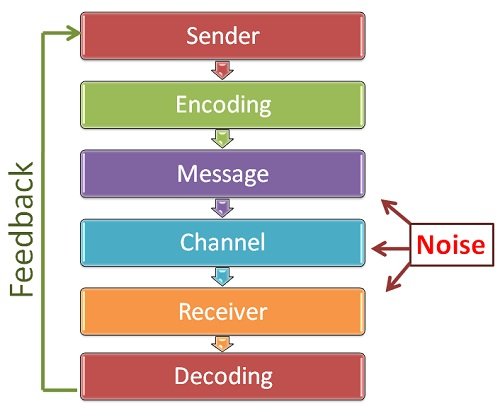
The process of communication involves the systematic exchange of information between a sender and a receiver. It begins with the sender encoding a message and transmitting it through a chosen medium (e.g., verbal, written, or digital). The receiver decodes the message, interprets its meaning, and provides feedback to complete the process. Effective communication relies on clarity, the right medium, and mutual understanding while minimizing barriers like noise, misinterpretation, or distractions that can disrupt the flow of information.

Communication Process:

The communication is a dynamic process that begins with the conceptualizing of ideas by the sender who then transmits the message through a channel to the receiver, who in turn gives the feedback in the form of some message or signal within the given time frame.

  1. Sender

The sender is the source of the message that initiates the communication. The sender has a message or purpose of communicating to one or more people. A manager in an organization has to communicate information about the tasks to be achieved or a production deadline to be met by his subordinate employees. Without a reason, purpose, or desire, the sender has no information/message to send.

  1. Encoding

In the next stage, encoding takes place when the sender translates the information or message into some words, signs or symbols. Without encoding the information cannot be transferred from one person to another. In encoding the message, the sender has to choose those words, symbols or gestures that he believes to have the same meaning for the receiver. While doing so, the sender has to keep the level of the receiver in mind and accordingly communicate with him in the way the receiver understands it.

The message may be in any form that can be understood by the receiver. Speech is heard; words are read; gestures are seen or felt and symbols are interpreted. For example, there are several communications we make with a wave of the hand or with a nod of the head, a pat on the back, blinking of eyes.

  1. Message

Once the encoding is finished, the sender gets the message that he intends to convey. The message can be written, oral, symbolic or non-verbal such as body gestures, silence, sighs, sounds, etc. or any other signal that triggers the response of a receiver.

Message is the idea or information that the sender wants to convey. He may convey it verbally (by writing or speaking) or non-verbally (through gestures or body language). Whatever the form, the message should be clearly formed so that the objective is accomplished.

  1. Channel

The channel is the medium used for transmission of information or message from sender to receiver. There are various media like telephone, mail through post, internet, radio, TV, press etc. For communication to be effective and efficient, the channel must be appropriate for the message. A phone conversation is not a suitable channel for transmitting a complex engineering diagram.

An express mail may be more appropriate. The needs and requirements of the receiver must also be considered in selecting a channel. If the receiver is illiterate, sending the message through postal mail is not relevant. Similarly, you cannot select the medium of telephone, if the receiver does not have a telephone with him. Therefore, in choosing the appropriate channel, the manager must decide whether feedback is important or not.

  1. Receiver

The receiver is the person who senses or perceives or receives the sender’s message. There may be just one receiver or a large number of receivers. The message must be prepared with the receiver’s background in mind. An engineer in a software organization should avoid using technical terms in communicating with his family members. It should be recognized that if the message does not reach a receiver, no communication takes place. Even, when the message reaches the receiver, if he cannot understand it, again there is no communication.

  1. Decoding

Decoding is the process through which the receiver interprets the message and translates it into meaningful information. It may be remembered that decoding is affected by the receiver’s past experience, personal assessments of the symbols and gestures, expectations, and mutuality of meaning with the sender.

  1. Noise

It represents the disturbing factor in the process of communication. It interferes with effective communication and reduces clarity of the message. The message may be interpreted differently than intended by the sender. Conversing near a machine making sounds, disturbance in telephone line, physical ailment or mental distress of sender or receiver are the common causes of noise that obstruct the quality of message transmitted from sender to the receiver.

  1. Feedback

Feedback is receiver’s response to the sender’s message. The receiver communicates reaction to the sender through words, symbols or gestures. It is the reversal of communication process where receiver becomes the sender and sender becomes the receiver. Unless the receiver responds to the message, communication process is incomplete. Feedback helps the sender transform his message, if needed. It also allows the receiver to clear doubts on the message, ask questions to build his confidence and enables the sender to know efficiency of the message. Feedback of information makes the communication process complete.

In face-to-face communication, sender can immediately receive the feedback. Written communication, on the other hand, takes longer for the sender to receive feedback on the message.

Feedback plays important role in two-way communication. In one-way communication, sender communicates with the receiver without getting any feedback but in two-way communication, the receiver provides feedback to the sender. Though one-way communication takes less time and is more orderly (it avoids noise and chaos), feedback in two-way communication makes it more accurate and precise.

Principles of Effective Business Communication

Effective Business Communication is critical to ensuring that information is conveyed clearly, accurately, and efficiently, fostering collaboration and productivity. Following certain principles can help individuals and organizations communicate more effectively, reducing misunderstandings and improving decision-making.

1. Clarity

Clarity is the foundation of effective communication. The message should be clear and straightforward, with no ambiguity. Using simple, precise language ensures that the audience fully understands the message without confusion. For example, when giving instructions or providing updates, be specific and avoid vague terms. Clear communication helps prevent errors and misunderstandings in business processes.

2. Conciseness

Conciseness means delivering the message in as few words as necessary, without sacrificing essential information. It eliminates redundancy and unnecessary details, saving time for both the sender and the receiver. Concise communication is particularly important in busy environments where individuals may be pressed for time. For instance, an email that conveys the key points without excessive elaboration increases the likelihood of a timely response and action.

3. Completeness

A message must be complete, containing all the information required by the receiver to understand and act upon it. It should answer the “5 Ws” (Who, What, Where, When, and Why), providing context, facts, and instructions. Incomplete communication can lead to confusion, delays, and mistakes. For example, a project update should include not only the status but also any potential risks, timelines, and resources needed.

4. Consideration

Effective business communication requires consideration of the receiver’s perspective. The sender should anticipate how the audience will interpret the message and ensure it aligns with their expectations, background, and needs. This principle emphasizes empathy—being aware of the receiver’s emotions, experiences, and knowledge level. For instance, when delivering bad news, it’s important to be sensitive and respectful to the recipient’s potential concerns.

5. Concreteness

Concreteness involves using specific facts, figures, and examples to support your message. Concrete communication is more impactful and leaves less room for misinterpretation. Rather than saying, “Sales have increased a lot,” a more concrete statement would be, “Sales have increased by 25% over the past quarter.” Specificity strengthens credibility and helps the receiver make informed decisions.

6. Correctness

Correctness in business communication refers to using proper grammar, punctuation, and spelling, as well as ensuring that the message is factually accurate. Incorrect information can damage credibility, lead to confusion, and harm professional relationships. Whether sending an email or giving a presentation, attention to detail in terms of language and facts is essential for maintaining professionalism.

7. Courtesy

Courtesy means communicating in a polite, respectful, and considerate manner. In business, maintaining a courteous tone fosters positive relationships and creates a collaborative environment. This principle involves being mindful of the receiver’s feelings, using appropriate language, and being diplomatic, especially when discussing sensitive topics. For example, a “thank you” at the end of a meeting or email strengthens interpersonal relationships.

8. Emphasis on Feedback

Effective communication is a two-way process, which includes providing and receiving feedback. Regular feedback helps clarify misunderstandings, reinforces key points, and allows for continuous improvement. In a business context, feedback can come in the form of performance reviews, surveys, or informal check-ins. An open feedback loop also ensures that communication remains dynamic and adaptable to changing needs.

9. Consistency

Consistency in communication ensures that the messages being communicated do not contradict each other and that they align with the organization’s values, goals, and objectives. Discrepancies in messages can lead to confusion, lack of trust, and decreased morale. For example, if a company communicates a commitment to innovation, this should be reflected in its actions, policies, and public statements.

10. Appropriateness

The principle of appropriateness refers to adapting the message to the audience and the context. The tone, medium, and level of detail should vary depending on the audience. For instance, a formal business letter would be appropriate for communicating with investors, while an informal email might be better for communicating with colleagues. Knowing the audience and situation ensures that communication is effective and well-received.

7 C’s of Communication

7 C’s of Communication offer a comprehensive framework for effective communication in any context. Developed by Scott M. Cutlip and Allen H. Center in their book “Effective Public Relations,” these principles serve as guiding pillars to enhance clarity, coherence, and impact in conveying messages.

  1. Clarity:

Clarity ensures that the message is understandable to the recipient. Ambiguity can lead to misinterpretation and confusion. Communicators must strive for simplicity and precision in their expression, avoiding jargon or complex language that may hinder comprehension. Clear communication involves organizing thoughts logically and presenting them in a straightforward manner.

For instance, instead of saying, “We might possibly need to revisit the budget,” say, “We need to review the budget.”

  1. Conciseness:

Conciseness involves conveying information succinctly without sacrificing clarity. In today’s fast-paced world, attention spans are limited, making brevity a valuable asset. Communicators should aim to deliver their message efficiently, avoiding unnecessary details or verbosity. Concise communication respects the recipient’s time and enhances the likelihood of engagement.

For example, instead of saying, “In light of the current circumstances, it is my opinion that we should consider alternative options,” say, “Given the situation, we should explore other options.”

  1. Concreteness:

Concreteness entails using specific facts, figures, and examples to substantiate the message. Abstract or vague statements can weaken the impact of communication, whereas tangible evidence adds credibility and relevance. By grounding their message in concrete details, communicators provide clarity and ensure that their points resonate with the audience.

For instance, instead of saying, “Sales were good last quarter,” say, “Sales increased by 15% compared to the previous quarter.”

  1. Correctness:

Correctness pertains to the accuracy and precision of the message. Errors in grammar, spelling, or factual information can undermine credibility and diminish trust. Communicators must meticulously review their content to eliminate mistakes and maintain professionalism. Additionally, adhering to industry-specific terminology and standards reinforces the accuracy of the message.

For example, instead of saying, “The meeting is at 3:00 PM on Monday, May 17th, at the conference room,” say, “The meeting will be held at 3:00 PM on Monday, May 17th, in the conference room.”

  1. Coherence:

Coherence refers to the logical consistency and flow of the message. Information should be presented in a sequential and organized manner, allowing recipients to follow the progression of ideas effortlessly. Transitional phrases and logical connectors facilitate coherence, guiding the audience through the communication process. A coherent message fosters understanding and retention.

For instance, instead of saying, “You need to improve your performance,” say, “Let’s discuss ways to enhance your performance.”

  1. Completeness:

Completeness ensures that the message contains all necessary information for the recipient to grasp its significance fully. Omissions or gaps in communication can lead to misunderstandings or incomplete decision-making. Communicators should address the key aspects of the topic at hand, providing sufficient context and details to support comprehension. Anticipating the audience’s informational needs enhances the completeness of the message.

“Please send me the report,” say, “Please send me the quarterly sales report by Friday, including the analysis section.”

  1. Courtesy:

Courtesy emphasizes the importance of respect and consideration in communication. Politeness, empathy, and sensitivity to the recipient’s feelings contribute to a positive interaction. Courteous communication fosters goodwill and strengthens relationships, even in challenging or contentious situations. Acknowledging the audience’s perspective and demonstrating empathy cultivates a supportive communication environment.

Instead of: “Your presentation was mediocre and lacked enthusiasm.” You could say: “I appreciate the effort you put into your presentation.

Developing 7C’s of Effective Communication through exercises:

1. Clarity

Clarity ensures that the message is clear and easily understood.

  • Exercise: Rewrite the Message
    • Provide participants with a complex or ambiguous message.
    • Ask them to rewrite it in simpler terms while retaining the core meaning.
    • Example: “The utilization of alternative strategies might enhance the output.” Simplify to: “Using different methods may improve results.”
  • Focus: Highlight the importance of plain language, avoiding jargon and ambiguity.

2. Conciseness

Conciseness eliminates unnecessary words, ensuring the message is direct and to the point.

  • Exercise: Trim the Fat
    • Give a paragraph with redundant phrases or unnecessary words.
    • Challenge participants to reduce its length by 50% without losing the message’s meaning.
    • Example: “In today’s modern world, technology has become an essential part of daily life.” Reduce to: “Today, technology is essential.”
  • Focus: Teach participants to avoid over-explaining or repeating ideas.

3. Concreteness

Concreteness ensures that the message is specific and supported by facts or examples.

  • Exercise: Make It Concrete
    • Provide a vague statement, such as “Our product is better than others.”
    • Ask participants to make it concrete by adding specific details, e.g., “Our product reduces energy consumption by 20%, saving $100 annually.”
  • Focus: Emphasize the use of data, facts, and examples for better understanding.

4. Correctness

Correctness ensures the message is free from errors and uses appropriate language.

  • Exercise: Proofreading Challenge
    • Share a passage with intentional grammatical, spelling, and factual errors.
    • Ask participants to identify and correct the mistakes.
    • Example Error: “Their going to the meeting at 3pm.” Correction: “They’re going to the meeting at 3 PM.”
  • Focus: Stress the importance of proofreading and accurate information.

5. Consideration

Consideration involves understanding the audience’s perspective and tailoring the message accordingly.

  • Exercise: Audience Adaptation
    • Provide a scenario and multiple audiences (e.g., professionals, students, or seniors).
    • Ask participants to craft a message for each audience type.
    • Example: Explaining a new app to tech-savvy users vs. older, non-technical users.
  • Focus: Highlight empathy and audience awareness in communication.

6. Courtesy

Courtesy means being respectful and polite, even in disagreement.

  • Exercise: Transform the Tone
    • Provide a rude or impolite email or message.
    • Ask participants to rewrite it in a polite and respectful tone.
    • Example: “You failed to meet the deadline again!” Revised: “I noticed the deadline was missed. Let’s discuss how we can prevent this in the future.”
  • Focus: Foster a positive and professional tone in all communications.

7. Completeness

Completeness ensures the message provides all necessary information.

  • Exercise: Fill in the Gaps
    • Provide an incomplete message or set of instructions.
    • Challenge participants to identify and add missing details.
    • Example: “The meeting is at 3.” Completed: “The meeting is at 3 PM in the conference room. Please bring the sales report.”
  • Focus: Train participants to anticipate the audience’s need for details and clarity.

Barriers to Communication, Steps to overcome Communication barriers

Barriers to Communication are obstacles that hinder the effective exchange of information between individuals or groups. These barriers can arise from various sources, leading to misunderstandings, delays, or breakdowns in the communication process. Understanding these barriers is essential for improving communication in personal and professional settings.

1. Physical Barriers

Physical barriers refer to tangible obstacles that prevent effective communication. These are:

  • Geographical Distance: Remote teams may face challenges due to time zones or lack of face-to-face interaction.
  • Noise: Environmental noise, such as machinery or background conversations, can disrupt communication.
  • Technical Issues: Problems with communication tools like video conferencing or email can delay messages.

2. Language Barriers

Differences in language, dialects, or vocabulary can create confusion. For example, using jargon, acronyms, or technical terms that the audience doesn’t understand may lead to misinterpretation. Language barriers are particularly prominent in multicultural workplaces or global business environments.

3. Emotional Barriers

Emotions like fear, anger, or frustration can impede communication. For instance, an employee who feels intimidated may hesitate to share their concerns, or a manager experiencing stress may convey instructions harshly, affecting clarity.

4. Cultural Barriers

Cultural differences in communication styles, values, and norms can cause misunderstandings. For example:

  • In some cultures, direct communication is preferred, while others rely on indirect cues.
  • Non-verbal cues, such as eye contact or gestures, may have different meanings across cultures.

5. Perceptual Barriers

Perception is how individuals interpret messages based on their experiences, biases, and assumptions. For example, a person with preconceived notions about the sender may dismiss their message without fully understanding it.

6. Organizational Barriers

These barriers arise from hierarchical structures, unclear roles, or inefficient communication channels within an organization. Examples include:

  • Overloaded Channels: Excessive information shared at once can overwhelm recipients.
  • Rigid Hierarchies: Information may get distorted as it passes through multiple levels of management.

7. Psychological Barriers

Psychological factors like stress, anxiety, or lack of confidence can hinder effective communication. For example, a nervous presenter may struggle to articulate their message clearly.

8. Attitudinal Barriers

Negative attitudes, such as arrogance, apathy, or prejudice, can create resistance to communication. For example, a manager who dismisses employee suggestions without listening fosters a lack of trust and openness.

9. Technological Barriers

Dependence on technology can lead to issues like misinterpretation in text-based communication or glitches during virtual meetings. Over-reliance on technology may also reduce personal interaction, affecting relationship-building.

Steps to Overcome Communication Barriers:

  • Active Listening

Active listening involves giving full attention to the speaker, understanding their message, and responding thoughtfully. By focusing on what is being said and avoiding distractions, listeners can avoid misinterpretations. Active listening also allows for the clarification of unclear points and fosters mutual understanding.

  • Clarify and Simplify Language

Using clear and simple language helps to avoid confusion and misunderstanding, particularly when communicating with people from different backgrounds or with varying levels of expertise. Avoiding jargon, technical terms, or overly complex vocabulary ensures the message is accessible to all audiences.

  • Provide Feedback

Feedback is essential in confirming that the message has been understood correctly. Encouraging feedback allows the sender to assess the receiver’s understanding and correct any misunderstandings. This two-way communication process ensures that the exchange of ideas is clear and effective.

  • Non-Verbal Communication Awareness

Non-verbal cues, such as body language, facial expressions, and tone of voice, play a significant role in communication. Being mindful of these signals can help avoid misinterpretation. For example, maintaining eye contact or using open body language can signal attentiveness, while crossed arms or avoiding eye contact may imply disinterest or defensiveness.

  • Overcome Cultural Barriers

Cultural differences can lead to communication breakdowns, as customs, values, and communication styles vary across cultures. It is important to be culturally sensitive and aware of different norms, values, and expectations. Understanding and respecting cultural differences promotes inclusivity and prevents misunderstandings.

  • Use the Right Medium

Choosing the appropriate communication medium is essential. Some messages are better conveyed through face-to-face meetings, while others may be more suitable for emails or phone calls. For sensitive issues, direct and personal communication is more effective than digital methods. The medium should match the nature and urgency of the message.

  • Minimize Distractions (Noise)

Physical or environmental distractions, such as background noise, can interfere with effective communication. Creating an environment conducive to communication, such as choosing a quiet meeting space or minimizing interruptions, can help ensure the message is received clearly.

  • Develop Emotional Intelligence

Emotional intelligence involves understanding and managing your emotions and recognizing the emotions of others. Being emotionally intelligent helps in handling sensitive conversations, reducing misunderstandings, and promoting empathy. It encourages more thoughtful, considerate interactions.

Effective Listening, Steps, Principles

Effective Listening is the active process of receiving, understanding, and responding to spoken messages. It goes beyond merely hearing the words; it involves paying full attention, processing the information, and retaining it. Effective listening requires focus, open-mindedness, and an ability to interpret both verbal and non-verbal cues, such as tone and body language. It also involves providing feedback and asking clarifying questions when needed. This skill is essential in both personal and professional communication, fostering better understanding, stronger relationships, and more productive interactions by ensuring that all parties are actively engaged in the conversation.

Steps to effective Listening:

Effective listening is a skill that requires focus and practice. To ensure that you understand and engage with the message being communicated, you can follow these key steps:

1. Prepare to Listen

Before engaging in any conversation, clear your mind of distractions and mentally prepare yourself to listen. This involves focusing on the speaker and the topic at hand. Eliminate any external distractions, such as turning off your phone or stepping away from other tasks, so you can be fully present in the conversation.

2. Pay Attention

Give the speaker your full attention. This means making eye contact, nodding occasionally, and facing the speaker to show interest. Pay close attention to both verbal and non-verbal cues, such as tone, body language, and facial expressions, as they help convey the full message.

3. Avoid Interruptions

Resist the urge to interrupt the speaker. Let them finish their thoughts before responding. Interrupting can create misunderstandings and disrupt the flow of conversation. If you have a question or want to clarify something, wait until the speaker pauses or finishes their message.

4. Listen for Understanding

As the speaker talks, try to understand the message behind the words. This means considering the speaker’s perspective, emotions, and intent. Focus not only on the content but also on the context of the message. It’s important to process both the explicit information and the underlying meanings.

5. Clarify and Ask Questions

If something is unclear, ask the speaker for clarification. Use questions like “Could you elaborate on that?” or “What did you mean by…?” Asking questions ensures you fully understand the message and prevents any misunderstandings. Avoid making assumptions or jumping to conclusions.

6. Provide Feedback

Offer appropriate feedback to show that you have understood the message. This can be verbal, such as summarizing the key points (“So, what you’re saying is…”), or non-verbal, such as nodding or making affirmative sounds. Feedback shows the speaker that you are engaged and interested in what they are saying.

7. Retain Information

After listening, try to retain and remember key points from the conversation. This may involve mentally summarizing important facts or writing down notes for later use. Retaining information helps you respond thoughtfully and allows you to follow up on key points when needed.

8. Respond Appropriately

Finally, provide a response that reflects your understanding of the message. This can include agreeing, asking follow-up questions, or sharing your own thoughts or feelings. A well-considered response demonstrates that you have actively engaged with the speaker and fosters productive dialogue.

Principles of Effective Listening:

Effective listening is a critical skill in communication, enabling individuals to understand, interpret, and respond appropriately to messages. It involves more than just hearing words; it requires focus, active engagement, and thoughtful processing.

1. Be Attentive

Attentive listening is the foundation of effective listening. It involves giving your full attention to the speaker without distractions. This means putting aside other tasks, turning off distractions (such as electronic devices), and maintaining eye contact. When you focus on the speaker, you not only hear the words but also pick up on non-verbal cues such as body language and tone, which provide additional meaning.

2. Avoid Interrupting

Interrupting the speaker can disrupt the flow of communication and show a lack of respect for their message. Effective listeners wait for the speaker to finish their thoughts before responding. This shows patience and allows the speaker to fully express their ideas, preventing misunderstandings and fostering a more meaningful exchange.

3. Be Open-Minded

Effective listening requires an open mind. It’s essential to avoid making judgments or forming opinions about the message before hearing it in full. Being open-minded helps you absorb information objectively and prevents biases from influencing your understanding. When you approach listening without preconceived notions, you’re more likely to appreciate diverse perspectives and ideas.

4. Show Empathy

Empathy is a crucial element of effective listening. It involves understanding and sharing the feelings of the speaker. By showing empathy, you create an environment where the speaker feels valued and understood. This can be expressed through verbal cues (e.g., “I see how that might feel”) and non-verbal cues like nodding or maintaining an understanding expression. Empathetic listening helps build trust and rapport.

5. Ask Clarifying Questions

Clarifying questions help ensure that you fully understand the message. If something is unclear, it’s important to ask for more information or an explanation. Asking open-ended questions such as “Can you explain that further?” or “What do you mean by that?” promotes deeper engagement and ensures you grasp the intended meaning of the communication.

6. Provide Feedback

Feedback is an essential part of effective listening. After the speaker has communicated their message, respond in a way that shows you have understood their points. This can include summarizing key ideas, offering comments, or asking follow-up questions. Constructive feedback reinforces the idea that you are engaged and helps refine the message.

7. Retain Information

Effective listeners retain and recall information. Listening is not just about understanding the immediate message but also about remembering important details for later use. Good listening practices, such as taking notes or mentally summarizing key points, can help retain critical information for decision-making or future conversations.

Business Etiquettes, Principles

Business etiquettes refer to the set of professional behaviors, manners, and standards that govern interactions in the workplace and business environments. These include respectful communication, punctuality, proper dress code, and adherence to cultural norms and organizational policies. Business etiquettes ensure smooth interpersonal relationships, foster a positive impression, and enhance collaboration among colleagues, clients, and stakeholders. They encompass various contexts such as meetings, emails, networking events, and business lunches. Practicing proper etiquettes demonstrates professionalism, builds trust, and contributes to a respectful and productive work atmosphere. Mastery of business etiquettes is essential for career growth and effective relationship management.

Principles of Business Etiquettes:

(i) Arrive on Time

In the business world, it is best to observe the old rule, “Five minutes early is late.” Allow yourself enough time to arrive promptly, take off your coat, and settle in a bit. Arriving at a meeting exactly at the appointed time can make you feel rushed, and you will look it. Time is a commodity; by being punctual, you show you respect others.

(ii) Dress Appropriately for Work

While appropriate dress certainly varies from field to field and climate to climate, some things remain the same. Clean, pressed clothing without any loose threads or tags and relatively polished, closed-toe shoes are a must. Look at the people around you for ideas on what sort of clothing is standard.

The adage, “Dress for the job you want, not the job you have,” is a good rule to follow. When in doubt, ask human resources personnel when you get the job or discreetly ask someone you work with.

(iii) Speak Kindly of Others

Taking care to greet your co-workers and remembering to say “please” and “thank you” make a tremendous difference in the way they perceive you. Your good manners show that you acknowledge those around you and are considerate of their presence. Avoid discussing political or religious matters.

Keep the conversation focused on noncontroversial topics, so your co-workers find you easy to talk to. That sort of diplomacy is the basic idea of business etiquette.

(iv) Avoid Gossip or Eavesdropping

Gossip and eavesdropping are childish behaviors that have no place in the workplace. If you hear a rumor about someone in the workplace, do not pass it on. People don’t always know or remember who starts a rumor, but they always remember who spreads it. If you walk into an area, and it seems your co-workers don’t know you are there, make sure to greet them politely to remove any chance that you accidentally eavesdrop on their conversation.

(v) Show Interest in Others

Showing interest goes beyond business etiquette into general politeness, but it bears repeating: When speaking with someone, show you are truly engaged. Do not play on your phone or computer, and if you have to answer a communication say, “Excuse me one moment; I’m so sorry.”

Maintain friendly eye contact. Listen. People will remember how you make them feel, and nobody wants to feel as if they are ignored.

(vi) Watch Your Body Language

In the Western world, a handshake is still the typical greeting. Say hello with a firm but quick handshake. This handshake is the extent of how much you should ever touch a co-worker – when it doubt, just don’t touch. Hugs or other types of affection that you share with friends and family are out of place in the workplace.

(vii) Introduce Yourself and Others

Sometimes you can tell people do not remember your name or position. Introduce or reintroduce yourself quickly if that seems to be the case. If you are with a co-worker who is new, take the time to introduce him to others. It helps to have a friendly person make you feel comfortable in the office.

(viii) Don’t Interrupt Others

When you have a great idea or suddenly remember something important, it can be tempting to blurt it out. Do not do this. Interrupting the person who is speaking sends the message that what she is saying isn’t as important as what you have to say. Demonstrating you are an attentive listener is the backbone of diplomacy.

(ix) Mind Your Mouth

Using vulgar language is a surefire way to become unpopular in your workplace. Vulgar language includes swear words and judgmental language. Business etiquette requires being constantly mindful that you are in a diverse environment with people you do not know on a personal level. Speak as though someone from human resources is always listening.

(x) Consume Food and Drink Correctly

If you attend an after-hours work event, do not drink too much alcohol. When at work, take care not to bring particularly malodorous foods that everyone in the office can’t help but smell. Don’t make noises during or after you eat; no one wants to hear that.

At the heart of these 10 basics of business etiquette is diplomacy. Taking care to treat everyone as the valuable people they are says a lot about who you are as a person. That is the kind of care people notice and want to be around. Embrace the basics of business etiquette to become a lasting employee or to advance through the corporate ranks.

Written Communication, Purpose, Advantages and Disadvantage

Written Communication involves the transmission of information, ideas, or messages through written symbols such as letters, emails, reports, memos, and texts. It is a formal and structured method of communication often used in professional, academic, and legal contexts. Written communication ensures clarity and permanence, allowing for documentation and future reference. Unlike oral communication, it provides time for the sender to organize thoughts and for the receiver to review and understand the message. It is essential for record-keeping, official correspondence, and detailed instructions. Effective written communication requires precision, clarity, and appropriate tone to ensure the message is understood as intended.

Purpose of Written communication:

  • Documentation and Record-Keeping

One of the primary purposes of written communication is to create a permanent record of information. Contracts, policies, agreements, meeting minutes, and reports are documented in writing for future reference and legal purposes. This ensures transparency, accountability, and consistency in organizational operations. Written records also help in tracking progress and maintaining a historical record of events or decisions.

  • Clarity and Precision

Written communication is often used to convey complex ideas or detailed instructions with clarity and precision. Unlike oral communication, written messages can be carefully crafted to avoid ambiguity and ensure that the recipient fully understands the content. For example, user manuals, legal documents, and financial reports require exact wording to prevent misinterpretation.

  • Facilitating Formal Communication

Written communication is a preferred mode for formal and professional interactions. It is used in situations that demand a structured and official approach, such as drafting business proposals, issuing notices, or sending official correspondence. Written communication ensures professionalism and helps maintain a record of formal exchanges for organizational integrity.

  • Providing Detailed Information

When a message requires depth and elaboration, written communication is ideal. Reports, research papers, project plans, and business presentations provide extensive details that cannot be effectively communicated through speech alone. Written communication allows readers to review and process the information at their own pace, making it an effective tool for complex data presentation.

  • Ensuring Consistency

Written communication ensures consistency in messaging, especially in large organizations. For instance, company policies, employee handbooks, and guidelines remain uniform and accessible to all employees. This reduces the risk of miscommunication and ensures that everyone receives the same information in the same format.

  • Fostering Accountability

By documenting information, written communication holds individuals and organizations accountable. Agreements, memos, and official communications clearly outline responsibilities, deadlines, and expectations, creating a binding reference that can be revisited if needed.

  • Overcoming Geographic Barriers

Written communication, especially in the digital era, facilitates instant and asynchronous communication across the globe. Emails, reports, and instant messages enable effective interaction between individuals or teams, regardless of location, fostering collaboration in a globalized world.

Merits of Written communication

  • Precise and accurate

Written communication is generally prepared with great care and precision. The very prospect of writing makes a person conscious. You have to be very serious and organised while communicating in the written form, because written communication is open to verification.

  • Easily verified

Since written communication is on paper etc., it can be read and re-read. It also offers itself to verification. There is also, thus, less ‘chance of someone twisting the message to his or her own advantage.

  • Permanent record

Written communication constitutes a permanent record. It also acts like evidence. It proves very useful for future reference as it can be preserved for years. For example, old orders and decisions can serve as the basis for new ones.

  • Suitable for lengthy and complicated messages

Lengthy and complicated messages can be understood better when they are in the written form rather than in the oral. There is less chance of misinterpretation and misunderstanding. Also, the language used is less subject to change.

  • Responsibility can be easily fixed

In written communication, responsibilities of sender and receiver can be fixed easily. People have the tendency of shifting responsibilities for mistakes, but this is difficult if the onus is obvious in black and white.

  • Has legal validity

Written communication is acceptable as a legal document. Written communication has been used as evidence since time immemorial.

Demerits of Written communication

  • Slower method of communication

Written communication can be time-consuming since it may take even two or even three days to reach the receiver (by letters, for instance). By contrast, oral communication is immediate.

  • Further delay if clarifications are required

Written communication hampers quick clarifications. The receiver may write back for clarifications and wait for a reply, making the process tedious. Even if clarifications are not needed, there is still a delay between the time the sender writes a message and the receiver receives it.

  • Leads to too much of paperwork

Since written communication is basically done on paper, one may tend to use it as escape mechanism Paper-free offices remain a dream.

  • Always a possibility of ambiguity or lack of comprehensibility

It is quite possible that the receiver is not able to comprehend the exact meaning of a written message that he has received. The clarity of a written message also depends upon the skill, or the lack of it, in the sender. If the message has not been written properly, it will not be understood, either.

  • Costly in terms of money and man-hours

Writing letters is a costly process not only because you need to spend money on postage, but also because several persons are involved in the process of sending out a letter from an organization. Their time costs organization money. While oral communication can be short and quick, written communication, because of its very nature, tends to be lengthy.

  • No flexibility

The written word is not subject to instant change after communication. Therefore, conveying an afterthought may prove very lengthy, and, at times, even impossible.

  • Literacy essential

It goes without saying that in written communication, the sender as well as the receiver should be literate. In fact, we may wrongly presume that they are so. In many Asian Countries, where literacy is low, a written message will be meaningless for large masses of illiterate persons.

Literacy also means literacy in the language of the message. The receiver should know the language in which a message has been written. It is no use receiving a message in English if you are not conversant with that language.

Factors in Written Communication:

(i) The writer

(ii) The content

(iii) The language used

(iv) The purpose of the communication

(v) The style adopted – formal or friendly

(vi) The receiver

Pre-requisites of Written Communication:

(i) How much to put in writing

(ii) What to leave out

(iii) When to stop

(iv) When to convey

(v) By what means to convey

Oral Communication, Purpose, Advantages and Disadvantage

Oral Communication refers to the process of conveying information, ideas, or messages through spoken words. It is a direct, face-to-face exchange or may occur over telephone, video calls, or public speaking engagements. This form of communication is essential for collaboration, decision-making, and relationship-building in both personal and professional settings. Oral communication allows for immediate feedback, clarification, and emotional expression, making it highly effective in fostering understanding. Active listening, clarity, tone, and articulation are key components for ensuring effective oral communication. It is commonly used in meetings, presentations, negotiations, and informal conversations.

Purpose of Oral Communication:

  • Facilitating Immediate Feedback

One of the primary purposes of oral communication is to enable immediate feedback. During face-to-face conversations or phone calls, both the sender and receiver can engage in real-time dialogue, asking questions, clarifying doubts, and adjusting their message. This instant exchange helps ensure the message is understood correctly and allows for quick resolution of any confusion or misunderstanding.

  • Promoting Effective Collaboration

Oral communication is essential for collaboration within teams and organizations. Meetings, brainstorming sessions, and group discussions foster the exchange of ideas and solutions, ensuring that all members contribute to decision-making. Clear verbal interaction helps build a collaborative environment where team members can share thoughts, offer suggestions, and work together effectively towards a common goal.

  • Building Relationships

Effective oral communication helps establish and maintain relationships, both personal and professional. Through conversations, individuals can connect on an emotional level, express feelings, and show empathy. In business contexts, it strengthens relationships with colleagues, clients, and customers by allowing for deeper connections, understanding, and trust. Personal relationships also thrive through verbal communication, with individuals expressing affection, gratitude, or concerns.

  • Enhancing Persuasion and Influence

Oral communication is an effective tool for persuasion and influencing others. Through clear articulation, tone, and body language, speakers can persuade their audience to accept ideas, adopt new perspectives, or take action. Leaders, marketers, and negotiators often rely on oral communication to present compelling arguments, inspire others, and influence decisions. Persuasive oral communication is essential in sales pitches, advertising, and leadership presentations.

  • Disseminating Information

Oral communication is widely used to disseminate information quickly and efficiently. In organizations, announcements, briefings, and training sessions are conducted orally to ensure everyone is informed. It is particularly useful in emergency situations where quick communication is needed. Verbal communication is also used in educational settings to deliver lectures, explain concepts, or provide instructions.

  • Problem-Solving and Decision-Making

In business and personal contexts, oral communication is used for problem-solving and decision-making. Through discussions and debates, people can explore different perspectives, identify potential solutions, and make decisions collaboratively. It allows for brainstorming, evaluating options, and achieving consensus, especially when facing complex challenges that require input from multiple parties.

  • Clarifying and Explaining Complex Ideas

Oral communication is crucial for clarifying complex topics or technical information. A speaker can provide explanations, examples, and illustrations to ensure the audience comprehends difficult concepts. This form of communication is effective in educational settings, presentations, or customer support, where information may need to be simplified and conveyed in an understandable way.

  • Expressing Emotions and Feelings

Oral communication provides a platform for expressing emotions and feelings. Whether it is through casual conversations, counseling sessions, or therapy, verbal expression helps individuals convey their thoughts, frustrations, and joys. It is particularly important in personal relationships, where feelings of love, support, or concern are often communicated through speech. In organizational settings, managers use oral communication to motivate and inspire employees.

Advantages of Oral Communication:

  • Immediate Feedback

One of the most significant advantages of oral communication is the ability to receive immediate feedback. Oral communication allows for real-time interaction. This instant exchange ensures that any misunderstandings or clarifications are addressed immediately, which improves the overall efficiency of communication. For example, in a meeting, participants can ask questions and get direct answers, reducing the chances of confusion or misinterpretation.

  • Personalized Interaction

Oral communication allows for a more personal, direct interaction between individuals. The speaker’s tone, pitch, and body language can convey emotions, intentions, and attitudes, which adds depth and understanding to the message. This personal touch fosters stronger connections and trust between the sender and receiver, making it particularly effective in building relationships, whether in business negotiations or casual conversations.

  • Quick Decision-Making

Oral communication facilitates fast decision-making, especially in time-sensitive situations. In business, teams can quickly discuss options, reach a consensus, and make decisions during meetings, conference calls, or discussions. This immediacy can be crucial in dynamic environments where quick actions are necessary, such as responding to customer inquiries or addressing urgent issues in a project.

  • Flexibility and Adaptability

Oral communication offers flexibility as it allows the speaker to adjust their message based on the audience’s reactions. For instance, if the audience looks confused or disengaged, the speaker can clarify points, provide examples, or alter the tone to maintain interest. This adaptability makes oral communication more dynamic and responsive to the needs of the audience, which is often not possible with written communication.

  • Effective in Building Relationships

Oral communication plays a crucial role in building and nurturing relationships. By conveying messages directly and personally, it fosters trust, understanding, and empathy. In the workplace, managers can motivate employees and resolve conflicts more effectively through face-to-face conversations or phone calls. Personal relationships also benefit from verbal interactions, as it helps individuals express emotions, connect on a deeper level, and build rapport.

  • Clearer Expression of Ideas

Complex ideas or concepts can be communicated more clearly through oral communication. The speaker has the opportunity to explain, elaborate, and clarify points immediately. If the receiver doesn’t understand something, they can ask for clarification right away. This makes oral communication especially useful when dealing with intricate or technical subjects that require immediate explanation.

  • Encourages Open Dialogue

Oral communication fosters open dialogue, encouraging discussion and exchange of ideas. It creates an interactive environment where both the sender and receiver actively participate in the conversation. This interaction can lead to better problem-solving and innovation. For example, in brainstorming sessions, group discussions, or team meetings, oral communication allows participants to freely express ideas and contribute to solutions.

Disadvantage of Oral Communication:

  • Lack of Permanent Record

One of the major drawbacks of oral communication is the absence of a permanent record. Oral communication does not leave a tangible, lasting document. This can lead to misunderstandings, misinterpretations, or forgotten details. In business, important discussions or agreements may need to be documented later, leading to the risk of missing critical information.

  • Potential for Misunderstanding

Oral communication is prone to misunderstanding, especially when the message is unclear or when there are language barriers, differing accents, or varied interpretations. The lack of visual aids or written references can make it difficult for the receiver to fully comprehend the message, leading to errors or miscommunication. Additionally, emotions, tone, and body language can sometimes be misinterpreted, further complicating communication.

  • Limited Reach

Oral communication is often limited in its reach. Oral communication is typically one-to-one or in small groups. This can be time-consuming and inefficient, especially when there is a need to communicate the same information to a larger audience, such as in an organization or public setting.

  • Dependence on Speaker’s Communication Skills

The effectiveness of oral communication heavily relies on the speaker’s ability to articulate thoughts clearly, use the right tone, and adjust the message according to the audience. If the speaker lacks effective communication skills, the message may be confusing, leading to poor comprehension or disengagement from the audience. Poor public speaking or ineffective delivery can hinder the intended purpose of the communication.

  • Interruption and Distraction

In oral communication, interruptions and distractions are common, especially in informal settings. Conversations can be disrupted by external factors such as noise, other people, or competing priorities. Even in formal settings like meetings, participants may become distracted or may not fully pay attention, which can result in the loss of key details or points in the conversation.

  • Emotional Influence

Oral communication can sometimes be influenced by emotions, both from the speaker and the listener. The speaker’s tone, body language, or voice may convey unintended emotions, leading to misinterpretations. For instance, an angry or frustrated tone may cause the listener to misjudge the message, or an overly emotional conversation may distract from the actual point being discussed.

  • Time Consuming in Complex Information

For conveying complex or detailed information, oral communication can be time-consuming. Explaining intricate concepts or technical data orally may require lengthy discussions, which could be less efficient compared to providing written documentation that the recipient can read and review at their own pace. This can be especially problematic in fast-paced environments where time is limited.

error: Content is protected !!