Role of Technology in Career Planning and Development

People tend to restrict the impact of technology on career planning to only those candidates searching for jobs on the internet. While that is a crucial change in career planning, it is by no means the only change that technology has brought in an employee’s life. Thanks to the advances in technology, employees can now undertake a self-assessment of their skill-sets through various online platforms and portals.

Technology can help facilitate career development conversations between managers and employees in a number of ways, including support for regular discussions between staff and supervisors across the career management process. A career development planning section on the regular performance review form can ensure that managers and employees discuss and document employee career goals and that managers assign the appropriate career development opportunities. Employees can also document their broader skills and abilities as well as their career plans in their digital talent profiles. These profiles should be configurable so you can include all the sections you need.

The employees can now get a clearer idea of the areas they need to focus on to get a wellrounded profile. It reduces their dependence on employers and immediate supervisors to get a feedback on their performance in the form of performance reviews. These employees also don’t need to rely upon counsellors or on the human resources department to get their suggestions and to get their questions answered.

Connectivity also helps people from different departments to be connected, which increases overall efficiency and time utilization. The employees can now easily get the response to their queries over mails and instant messengers, as opposed to the earlier method of walking to the desk and getting questions asked. Instead of just one mentor, now there are several ones who can help you out when you are in a fix.

All the credit for providing these facilities goes to the Internet. Internet or technology facilitates the employees to learn new courses and enhance their skills and add weightage to their resume. Even the organizations are making use of the online modules for providing training to their employees.

Mails and instant messaging systems facilitate the employees to communicate easily and the answers to their queries can be fast received. The number of mentors who guide the employees in the due course of their learning also increases.

Concept of High-Performance Teams

High-performance teams (HPTs) is a concept within organization development referring to teams, organizations, or virtual groups that are highly focused on their goals and that achieve superior business results. High-performance teams outperform all other similar teams and they outperform expectations given their composition.

A high-performance team can be defined as a group of people with specific roles and complementary talents and skills, aligned with and committed to a common purpose, who consistently show high levels of collaboration and innovation, produce superior results, and extinguish radical or extreme opinions that could be damaging. The high-performance team is regarded as tight-knit, focused on their goal and have supportive processes that will enable any team member to surmount any barriers in achieving the team’s goals.

Within the high-performance team, people are highly skilled and are able to interchange their roles. Also, leadership within the team is not vested in a single individual. Instead the leadership role is taken up by various team members, according to the need at that moment in time. High-performance teams have robust methods of resolving conflict efficiently, so that conflict does not become a roadblock to achieving the team’s goals. There is a sense of clear focus and intense energy within a high-performance team. Collectively, the team has its own consciousness, indicating shared norms and values within the team. The team feels a strong sense of accountability for achieving their goals. Team members display high levels of mutual trust towards each other.

What distinguishes high-performance teams from other groups is that a team is more than a collection of people simply following orders. To function effectively, a high-performance team also needs:

  • A deep sense of purpose and commitment to the team’s members and to the mission.
  • Relatively more ambitious performance goals than average teams.
  • Mutual accountability and a clear understanding of members’ responsibilities to the team and individual obligations.
  • A diverse range of expertise that complements other team members’ abilities.
  • Interdependence and trust between members.

There are four key reasons why teams work:

  • A group of individuals brings complementary skills and experience that exceed the abilities of a single individual.
  • Teams support real-time problem-solving and are more flexible and responsive to changing demands.
  • Teams provide a unique social dimension that enhances the economic and administrative aspects of work.
  • High-performance teams generally have more fun at work than low-achieving teams or individuals.

Characteristics

Different characteristics have been used to describe high-performance teams. Despite varying approaches to describing high-performance teams there is a set of common characteristics that are recognised to lead to success

Participative leadership: Using a democratic leadership style that involves and engages team members.

Talent, skills and work ethic: High-performance teams begin by recruiting and retaining their best talent while quickly helping low-performing members find other places to work. Morale typically increases as performance increases. After selecting for talent, it is critical to ensure that the team members possess complementary skills (e.g., technical, problem-solving, decision-making and interpersonal skills). Team members must exhibit a sustained commitment to performance excellence, exercise candor and mutual respect, and hold themselves and their organizations accountable at both the individual and team levels.

Effective decision-making: Using a blend of rational and intuitive decision making methods, depending on that nature of the decision task

Open and clear communication: Ensuring that the team mutually constructs shared meaning, using effective communication methods and channels

Valued diversity: Valuing a diversity of experience and background in team, contributing to a diversity of viewpoints, leading to better decision making and solutions

Mutual trust: Trusting in other team members and trusting in the team as an entity.

Incentives, motivation and efficacy: Both monetary and nonmonetary systems that encourage high performance have a positive impact on tactical implementation of the team’s goals. Over the long term, intrinsic motivators such as personal satisfaction at work and working on interesting projects provide the greatest impact on performance. In addition, a belief in one’s self and abilities encourages people to take more strategic risks to achieve team goals.

Managing conflict: Dealing with conflict openly and transparently and not allowing grudges to build up and destroy team morale

Clear goals: Goals that are developed using SMART criteria; also each goal must have personal meaning and resonance for each team member, building commitment and engagement

Defined roles and responsibilities: Each team member understands what they must do (and what they must not do) to demonstrate their commitment to the team and to support team success

Coordinative relationship: The bonds between the team members allow them to seamlessly coordinate their work to achieve both efficiency and effectiveness

Positive atmosphere: An overall team culture that is open, transparent, positive, future-focused and able to deliver success

Linking Performance Management to Compensation

Write results-oriented job descriptions

Many companies find it beneficial to rewrite their job descriptions to include more results-oriented and measurable information. Instead of simply including the specific tasks or duties of the job description, consider adding why the duty is performed, or which results it aims to achieve, and how the performance will be measured.

For example, for the marketing director role in an assisted living facility, the roles and responsibilities might look like this:

  • Facilitate the move-in process to build relationships with new residents. Metric: New resident satisfaction.
  • Ensure respite apartments are ready to show to ensure marketability. Metric: Apartment turnover.
  • Develop and maintain a detailed marketing plan to great market share. Metric: Competitive market data.

The overarching goal of the compensation strategy is to ensure an organization has allocated the money necessary to motivate the performance needed to achieve the business strategy. To that end, compensation should also tie into the overall performance management strategy.

Practices must therefore be understood by employees and based on hard, objective data. It is essential to maintain an approach in which equal pay is given for equal work. These critical objectives can be achieved by:

  • Standardizing pays practices and basing the compensation system on benchmarks
  • Achieving internal parity
  • Providing competitive hiring scales
  • Reformatting or rewriting job descriptions
  • Creating a meaningful performance management tool

The four types of direct compensation for employees you’ll see most often are:

  • Hourly Pay/Wage: The most common and direct form of compensation. Typically used with unskilled, semi-skilled, and part-time positions.
  • Salary: Customarily a yearly amount that is split evenly into pay periods so that workers receive the same amount every paycheck throughout the year. Positions that require more education or specific skills generally pay a salary.
  • Commission: Commission-based compensation is designed to incentivize employees to produce at a high level and may be used in certain industries where the employer cannot guarantee a consistent workload.
  • Bonuses: Bonuses give businesses a flexible option to reward employees additionally for great performance.

Steps

Build a Pay-for-Performance Compensation Strategy

By linking performance and compensation management efforts, employers not only provide clear compensation guidelines for themselves, but they can help employees understand their value and work to increase it.

HR professionals should lead these strategic planning efforts by first working with senior leadership to create these strategies (and subsequent tactics). Second, you’ll want to make sure these strategies are tied to applicable data because your people will want proofs. Data from your performance management efforts can help in this process.

Improve Pay Communication

But don’t run too fast. There is some aligning that needs to take place before you discuss your pay-for-performance strategies with your people.

According to the survey mentioned above, two-thirds of the employees who felt they were underpaid were at least paid at market value, and 35 percent were actually paid above market value.

Compensation is an exchange of value, and as we’ve already discussed, value is about perception. So, even if you come up with a perfect strategy to compensate your people according to their real value, it’ll be for nothing if they don’t understand it.

Performance Management Implementation & Strategies

Performance management is a strategic process and an integrated approach. The process involves an ongoing dialogue between the supervisor and the employee for setting goals which are achievable and contribute in the direction of fulfilment of the organizational goal. The main objective of performance management approach is to proactively manage employee’s performance for accomplishing organizational goals by attaining a desired level of performance. It believes in linking the performance plans of an organization with the strategic vision and identifying the major performance indicators and KRA’s for enabling the employees to achieve the expected outcomes for their organization.

Any performance management process broadly involves three stages and these are:

  • Goal Setting and Motivation which is normally done in the beginning of the session.
  • Encouraging Stage which is normally undertaken when the employees get involved in the process of pursuit of the assigned task.
  • The final stage is the Stage of Rewards and Consequences which is applied after the completion of a task.

Performance management is always a forward planning process which is developmental and facilitative in nature as it involves the team leaders and the employees in a joint process of decision making for fixing smart targets. It aims at breeding performance orientation in the employees for developing high performance organizations. The entire process involves identification, evaluation and development of the work performance of the employees through effective management practices like continuous coaching, feedback and regular communication. The process includes the following stages:

  • Work Planning and defining expectations
  • Monitoring performance
  • Developing the weak performance areas
  • Performance rating
  • Rewarding good performance

Step 1: Set expectations

Performance management starts with meeting with each employee to discuss which results and behaviors are expected of them. Don’t list off what you want and expect your team members to quietly obey. Instead, ask your employee to participate in deciding what is realistic for them to achieve. Be as specific as possible to ensure everyone is on the same page. This avoids an “I didn’t know I was supposed to do that” situation a few months down the line.

Step 2: Observe

Laid out expectations, and team participated in setting their objectives. Now take a step back and observe how the plan takes shape, helping out as necessary and maintaining regular communication.

  • Give ongoing feedback: Rather than waiting until the review period is over, be sure to give feedback and coaching on a regular basis. This ensures the employee develops and helps them reach their objectives. Give advice or constructive criticism as needed.
  • Reinforce: Likewise, make sure he maintains good performance by making it clear it is being noticed. If good performance is not praised, employees will lose motivation. This is especially crucial when an employee exceeds their performance standards or expectations. If you don’t acknowledge it, they might wonder why they’re working so hard.
  • Give updates and resources: As your project goals change, so might the employee’s objectives. Be sure to update them on any such changes immediately. Provide them with all the resources they need to facilitate goal-setting or to maintain their performance during the shift. Whether it’s training, tools, or readings, make sure they have what they need to do the job.
  • Observe and collect performance info: Keep track of examples of good and bad performance on a daily basis. These examples will be used during the performance review process to highlight what improvements are needed, and what they’re already knocking out of the park.

Step 3: Assessment

It may be appropriate to evaluate results, for others behaviors, and for some, both. To help you figure out what to assess for what employee, consider this:

Assess results if: Effort will always lead to results; results show consistent improvement over time; or if there are several different ways to do the job right and get good results. 

Assess behaviors if: Effort and results aren’t connected in an obvious, very direct way; results take months to develop; or if bad results can come from factors outside of the employee’s control.

Self-appraisals:

Let the employee do a self-appraisal as well, or give them a chance to explain how they think they did. Self-ratings pinpoint discrepancies between how a team member views themselves, versus how others view them. These discrepancies provide teaching moments, and highlight areas needing development. Self-evaluations also minimize defensiveness, help team members learn, and ensure they feel the performance management process is fair.

Appraisal forms:

A valuable way to assess performance is to fill out a template or complete an appraisal form. You can also invite an employee’s peers to complete one, as this can be a great way to assess teamwork or how the person acts when you aren’t around. However peer evaluations can be subject to bias and context, so don’t rely on them as your sole source of information.

Step 4: Review

The final step of performance management is to sit down with the employee and discuss their performance during the review period. Share your observations, assessments, and feedback, and ask the employee for their opinion on what they did well and what they need to improve on. Then brainstorm ways to improve performance during the next term. You should also discuss their development and plans for the future.

Performance Monitoring Meaning, Objectives and Process

Performance monitoring may be defined as the process of appraising an environment of continuous learning and development. It will be done by maintaining the employee’s performance, enhancing individual competencies to make them more productive for the organization.

Performance monitoring and performance benchmarking are measures that are used to stimulate good performance outcomes. They are considered important in industries where there is an absence of competitive market processes. Performance monitoring involves the measurement of performance over time against indicators of performance or key performance indicators (KPIs)

Objectives of Performance Monitoring

Performance monitoring explicitly promotes the value that a manager and their managee accept as joint responsibility for monitoring progress on the tasks and goals agreed upon during the initial performance planningor expectation setting meeting and subsequent review meetings. The managers use instruments like written reports, review discussions and on-the-spot inspections to track:

  • Setting and defining goals to fulfill company objectives
  • Timely and quality fulfillment of managing tasks and goals.
  • Help and support legitimately needed by the managee’s tasks, including those agreed upon during planning and review meetings.
  • To improve employee’s job performance as well as methods and techniques of measuring.
  • Setting the right expectations for managers and employees
  • Introducing the continuous learning and development process.
  • Periodic reviews help the performance manager.
  • It helps in correct planning assumptions and errors mid-course before it is too late.
  • It monitors and encourages progress, and keep the work on track.
  • It strengthens a dyadic relationship between the manager and the employee.

Process of Performance Monitoring:

  • Scheduled meetings.
  • Periodic written reports.
  • On-the-spot inspections, or field or site visits in case of managees whose location is different from that of the manager.
  • Relevant and reliable information from other available sources.

Performance Planning Meaning, Objectives, Barriers

Performance planning is the first step of performance management. Performance planning is the process of determining what and how a job is to be done in such a manner that both the employee and his superior understand what is expected from the employee and how success is defined and measured.

Performance planning for an employee flows from organizational or unit objectives and is undertaken jointly by the employee and his superior.

Need for Performance Planning

Performance planning is the first step of performance management. Performance planning is the process of determining what and how a job is to be done in such a manner that both the employee and his superior understand what is expected from the employee and how success is defined and measured. Performance planning for an employee flows from organizational or unit objectives and is undertaken jointly by the employee and his superior.

Performance planning is a simple way of ensuring that the employee gives quality inputs that will ensure the output expected from him. Planning gives a sense of direction and ensures good economics for the company. In addition, it ramps up the contribution of the individual and enhances his self-worth.

Objectives

For success of any performance management system, the development of an employee performance management plan is of paramount importance. The plan establishes the development researcher’s essential job tasks, responsibilities, and critical performance objectives that need to be achieved or performed during the performance period.

  • It is mutually developed during the planning conference and reflects the individual aspects and nature of the employee’s job.
  • It solves major problems in the organization by providing ongoing on-the-job feedback
  • After planning, the next task is to communicate those goals and objectives to the organization’s constituents.
  • We have to ensure the most effective use of the organization’s resources by focusing the resources on the key priorities.
  • Then to provide a base from which progress can be measured and establish a mechanism for informed change when needed.
  • Performance planning clearly defines the purpose of the organization. The purpose is to establish realistic goals and objectives consistent with that mission in a defined time frame within the organization’s capacity for implementation.
  • To listen to everyone’s opinions in order to build consensus about where the organization is going and where to want to reach.
  • It is used to clearly identify the performance metrics used to measure employee’s success in meeting predetermined targets.
  • It produces great satisfaction and meaning among planners, especially around a common vision which increases productivity from increased efficiency and effectiveness.
  • It provides a clearer focus for the organization, thereby producing more efficiency and effectiveness.

Barriers

Individual Barriers: The lack of commitment in the organization’s employees or management is another important barrier to performance planning. Sometimes managers or employees or both show less commitment towards the achievement of organizational goals and the reasons could be personal, organizational, competitive or any other HR factor.

Organizational Barriers: Most of the traditional organizations are not in favour of performance planning. According to this concept, the organizations spending time on performance planning is just the wastage of time. These organizations believe that they have a strong implementation strategy and due to this only, it becomes the barrier.

Steps for Setting Performance Criteria

Performance evaluations which provide employers with an opportunity to assess their employees’ contributions to the organization, are essential to developing a powerful work team. Yet in some practices, physicians and practice managers put performance evaluations on the back burner, often because of the time involved and the difficulties of critiquing employees with whom they work closely. The benefits of performance evaluations outweigh these challenges, though. When done as part of a performance evaluation system that includes a standard evaluation form, standard performance measures, guidelines for delivering feedback, and disciplinary procedures, performance evaluations can enforce the acceptable boundaries of performance, promote staff recognition and effective communication and motivate individuals to do their best for themselves and the practice.

Performance evaluation is the process of evaluating how effectively employees are fulfilling their job responsibilities and contributing to the accomplishment of organizational goals

Performance evaluation:

  • Is the systematic evaluation of the performance of employees and to understand the abilities of a person for further growth and development,
  • Is a process of evaluating an employee’s performance of a job in terms of its requirements,
  • Is the process of evaluating the performance of employees, sharing that information with them and searching for ways to improve their performance,
  • Provides the basis for assessment of employee contributions, coaching for improved performance and distribution of economic rewards,
  • Refers to the outcome of the behavior of employees.

Criteria

  • Explain the appraisal process.
  • Clarify job expectations.
  • Review and update job skills.
  • Review accomplishments and goals.
  • Final steps and rewards.

Explain the appraisal process

In the appraisal meeting between a manager and employee, the manager should first explain the purpose and the process of the Performance evaluation.

Generally, a Performance evaluation is conducted to clarify job expectations, set goals for improvement of weaknesses and reward for accomplishments and overall performance.

The manager’s job is to explain the steps involved during and after the Performance evaluation.

Clarify job expectations

A mutual understanding of job expectations is essential to an effective Performance evaluation. Absence of mutual understanding, the appraisal meeting could spiral downward because the manager and employee might be working from completely different viewpoints.

A review of the job description, and employee skills, qualifications and responsibilities should precede the actual Performance evaluation.

Review and update job skills

It is important to review the skills of employees and update accordingly. Manager discusses any improvements necessary, and praise the employee for acquiring the new skill.

The manager determines what additional skills the employee can learn during the next evaluation period by setting reasonable goals for professional development. The employee should feel free to provide input throughout the Performance evaluation.

Employees should be provided with a self-appraisal form. If this is the case, the employee will come to the Performance evaluation meeting with the completed self­appraisal.

Review accomplishments and goals

Accomplishments throughout the evaluation year will be enumerated. If there are quantifiable goals established for the review period, the manager and the employee determine if the goals have been met.

Often, a “management by objective” technique is used to track specific, goals, progress and completion of each quarter. Using this technique simplifies the Performance evaluation because there are intermediate assessments made during the evaluation period.

Final steps and rewards

An overall appraisal score may be discussed during the meeting or it may be calculated after the manager has had an opportunity to consider the employee input.

Best Practices in Performance Management

Delivers greater employee autonomy

Once your employees are aware of the wider business’ objectives and their contribution to those; they are relatively free to make their own choices about how they go about their responsibilities. As a result, employees are happier, more committed, more productive and more loyal than those whose every action is dictated.

Line managers will have the reassurance of regular feedback sessions and discussion to review an employee’s progress against their agreed objectives. This fosters a culture of trust and initiative amongst your employees. A culture where ideas and creativity flow freely. Such a culture will only stand to benefit your business in the long-term.

Supports workforce planning

Frequent reviews with employees as part of a wider performance management strategy can also help with workforce planning. Discussing current and future workloads with employees can help to identify any requirements for future staff.

Boosts morale

Everyone likes being told they’re doing a good job. Performance reviews provide the perfect setting to formalise and document praise. But reviews shouldn’t just be about setting objectives for the coming quarter. It should also provide an environment for a line manager to recognise individuals on their team.

Happy employees are productive employees. A staggering 69% of employees say they would work harder if they felt their efforts were being recognised. No longer is a pay check enough recognition but regular feedback and reviews are key to maintaining employee morale.

Highlights training needs

Introducing more frequent reviews, whether formal or informal, can help to better understand the skillset of employees. Providing an open forum for employees to share and discuss their roles regularly can help to identify training needs before they have an impact on productivity.

Helps with identifying the right employees for promotion

Regular reviews are a great way to better understand the performance of your employees and their suitability for promotion.

All employees will be going through the same performance review process. As such managers can better evaluate them for promotion, salary increases or transfer in the same, consistent manner. Not only will this help to ensure the right employee is chosen for promotion; but will allow for more transparency and fairness in your selection process.

Increases employee retention

Companies who implement regular employee feedback have turnover rates that are 14.9% lower than for employees who receive no feedback. High staff turnover could have a major impact on your company. Not to mention the impact on staff morale and simply getting things done.

The nature of performance management ensures that the expectations of your employees and their objectives are clear and regularly reviewed. What’s more, the introduction of regular feedback sessions and reviews allows an employee to raise and resolve any issues.

Effective Form Structure

A good performance management form should have at least four sections to provide adequate structure and guidance:

  • A section for listing business goals for the appraisal period. This is what the employee will ideally accomplish.
  • A section devoted to behavior rating factors, standards, or competencies. This is how the employee will go about achieving goals.
  • A development planning section specifying behavior improvement goals and development actions.
  • An administrative section requiring some sign-offs, showing that the employee received the appraisal and the boss acknowledged it.

Provide Clear Rating Scales

Use a simple three-part response scale for rating quantifiable goals: Did not meet goal, Meet goal, Exceeded goal. Motivate high achievers with a fourth response, known as a “stretch goal.” The stretch goal rating accommodates exceptional levels of quality, quantity, cost, or timelines, and is stated as Met or exceeded stretch level of performance.

Prepare Clear Goals

Well-written goals enhance the impact of performance appraisal. Increase clarity and reliability by following this simple formula for writing goals: Action + Object + Measurement Method. Use as many measurement methods (quality, quantity, cost, and timelines) as possible. For example: Increase (Action) production (Object of the Action) this year (Time Line) by 10% over last year (Quantity) while keeping reject rate to 1:1000 (Quality) and incurring no overtime (Cost).

Gain Commitment, Using Self-Discovery Questions

Review the process in-depth, citing feature, function (how it works), and benefits (what’s in it for people to participate). Conclude these briefings with a round of self-discovery questions. “What do you see as the positives of this process? How might you benefit? What’s the downside of not doing performance reviews?”

Appraiser Skills

A good manager helps employees understand:

  • What’s expected and how their performance will be appraised
  • How they are performing
  • How they can improve

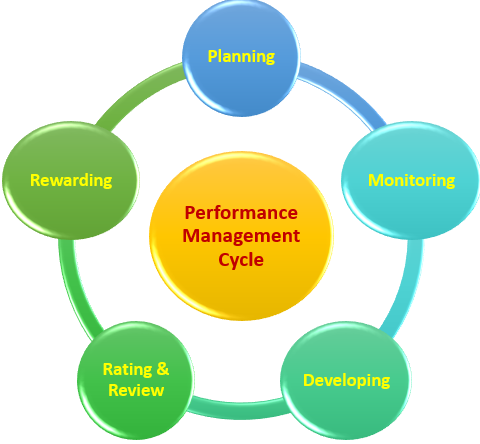
Performance Management Cycle

The performance management cycle is a part of the performance management process or strategy, it is shorter and utilizes a continuous four-step procedure of planning, monitoring, reviewing and rewarding.

Benefits of utilizing this method include increased competitiveness, more structural flexibility, and higher employee motivation.

Performance management involves much more than just assigning ratings. It is a continuous cycle that involves:

  • Planning work in advance so that expectations and goals can be set
  • Monitoring progress and performance continually
  • Developing the employee’s ability to perform through training and work assignments
  • Rating periodically to summarize performance
  • Rewarding good performance.

Planning

“Planning” means setting performance expectations and goals for groups and individuals to channel their efforts toward achieving organizational objectives. It also includes the measures that will be used to determine whether expectations and goals are being met. Involving employees in the planning process helps them understand the goals of the organization, what needs to be done, why it needs to be done, and how well it should be done.

This involves the overall strategy for the business, but also the personal objectives for all employees and teams, including development goals, specific tasks, targets, actions and behaviors.

SMART goals are:

  • Specific: The goal is clearly outlined, with detailed information such as what is to be achieved, how well it must be done, and why it is important.
  • Measurable: The goal must have a definite and measurable indicator to tell if it has been achieved.
  • Achievable: While the goal should stretch the employee, it should not be so lofty as to not be realistically achievable at all.
  • Relevant: The goal is in line with both the employee’s job and the overall goals of the organization.
  • Time-bound: There should be a definite timeline as to when this goal should be completed.

Monitoring

Monitoring” means consistently measuring performance and providing ongoing feedback to employees and work groups on their progress toward reaching their goals. Ongoing monitoring provides the opportunity to check how employees are doing and to identify and resolve any problems early.

The monitoring will not be as effective, however, if it is only done once or twice during the year. It is advised that management meets with employees on a monthly or quarterly basis to check in on progress, offer help if needed, assist in solving any problems that might have arisen, and adjust goals, if necessary.

Developing

Developing” means increasing the capacity to perform through training, giving assignments that introduce new skills or higher level of responsibility, improving work processes, or other methods. Development efforts can encourage and strengthen good performance and help employees keep up with changes in the workplace.

Rating & Review

Rating” means evaluating employee or group performance against the elements and standards in an employee’s performance plan, summarizing that performance, and assigning a rating of record.

This is another opportunity to build a collaboration with the employee. The more involved they are in the other stages of the performance management cycle, the more motivation they will have to continue working diligently to achieve their goals and those of the organization.

If proper monitoring was done, the management will have already have a good idea of how well the employee did during the year. The review is a chance for management and employees to evaluate both the final result and the process itself.

Rewarding

Rewarding” means providing incentives to and recognition of employees, individually and as members of groups, for their performance and acknowledging their contributions to the agency’s mission. There are many ways to acknowledge good performance, from a sincere “Thank You!” for a specific job well done to granting the highest level, agency-specific honours and establishing formal cash incentive and recognition award programs.

The final stage of the performance management cycle plan is the reward. This is a stage that cannot be overlooked, as it is the one that is the most important for employee motivation.

Employees who do not receive a proper reward after a year of striving to meet organizational goals, and succeeding in doing so, will lose motivation for the next year. They might lose faith in their organization, feel that their talents are not appreciated, and begin searching for another job.

Future of Performance Management

Big companies are making changes. Soon smaller companies will follow suit. Patterns are beginning to emerge:

  • The nature of some companies is such that their objectives can change quite rapidly. Such companies cannot measure their employees’ performance against annual objectives.
  • Big companies are testing new ideas that give employees constant feedback and coaching.
  • Companies are collecting more objective performance data through systems that automate real-time analyses.
  • Better data is bringing about a shift in emphasis from reflective evaluations to fact-based performance and development discussions, which are becoming frequent and as-needed rather than annual events.

Research and surveys show that there’s no need to reinvent the wheel when it comes to new performance management systems. The key is to conduct performance reviews in such a way that they improve individual and team performance in alignment with organizational objectives and priorities, and the employee experience and business outcomes.

Coaching Employees, and Managers too

Giving feedback is a crucial part of the performance appraisal process. However, this feedback is of no use if employees don’t know what to do with the feedback, what to do with the feedback to improve. Managers need development to show their team how to get work done well. While this is beneficial to the employees, it’s also beneficial for managers who are evaluated on their ability to engage their teams.

Integrate technology in the performance appraisal process

Organizations that integrate performance tools into the real workflow are much more likely to see positive results from the process.

Clearly defined criteria for compensation

It can be very demotivating when an employee feels that their pay is unfair and does not match with their contribution or achievement. Therefore, it’s very important to have a compensation plan in place that is transparent, clearly-defined, and easy to understand. This plan must be clearly established with everyone in the organization so that there is no ambiguity in what to expect.

Set flexible goals

Instead of having a top-down approach in setting SMART goals set annually, set flexible goals that allow format and timing to be tailored to the work.

Team performance vs. Individual performance

Organizations are not about individual performance anymore. As human beings, it’s hard for us to function alone. How an employee performs within a team and within an organization is what defines success. Organizations that focus on team or project objectives perform far better than those that focus on individuals.

Different criteria for different decisions

Use different criteria for different decisions to ensure ratings are fair, instead of using performance ratings as the basis of all talent decisions, compensation and promotion. Calibration sessions can be conducted to ensure ratings are fair.

error: Content is protected !!