Joint Arrangements (Ind AS 111) Scope, Assessment, Types of Joint Arrangements

Ind AS 111, “Joint Arrangements,” establishes principles for the financial reporting by entities that have an interest in arrangements that are controlled jointly (i.e., joint control) with one or more other entities. It identifies two types of joint arrangements: joint ventures and joint operations. The classification depends on the parties’ rights and obligations arising from the arrangement. In a joint operation, parties have rights to the assets and obligations for the liabilities relating to the arrangement and recognize their share of assets, liabilities, revenues, and expenses. In a joint venture, parties have rights to the net assets of the arrangement and account for their interest using the equity method in accordance with Ind AS 28, “Investments in Associates and Joint Ventures.”

Ind AS 111 requires entities to assess the structure, legal form, contractual terms, and other facts and circumstances of the arrangement to classify it accurately. This Standard emphasizes substance over form, requiring detailed judgment to determine the type of joint arrangement and the appropriate accounting treatment. The aim is to provide financial statement users with relevant information about an entity’s involvement in joint arrangements, including the nature, risks, and financial effects.

Joint Arrangements (Ind AS 111) Scope:

Ind AS 111, “Joint Arrangements,” applies to entities that are parties to joint arrangements. The scope of this standard is to provide financial reporting guidance for entities that engage in joint arrangements with other parties, focusing on the rights and obligations that arise from such arrangements. Joint arrangements are defined based on the contractual arrangement and the existence of joint control.

Scope Inclusions:

  1. Joint Operations:

Entities participating in a joint operation recognize their direct rights to the assets, and obligations for the liabilities, associated with the arrangement. They account for their share of assets, liabilities, revenues, and expenses in accordance with the terms of the joint arrangement.

  1. Joint Ventures:

Entities participating in joint ventures recognize their investment using the equity method according to Ind AS 28, “Investments in Associates and Joint Ventures.” A joint venture is a joint arrangement whereby the parties have rights to the net assets of the arrangement.

Scope Exclusions:

  • Business combinations accounted for under Ind AS 103, “Business Combinations,” are excluded from the scope of Ind AS 111. However, joint arrangements may be relevant in identifying whether control exists in various investment scenarios.
  • Ind AS 111 does not apply to the accounting for investments in associates, which are covered by Ind AS 28, nor does it apply to investments in subsidiaries accounted for under Ind AS 110, “Consolidated Financial Statements.”
  • Financial instruments, including those that may give rise to joint control, are excluded from the scope of Ind AS 111 and are instead covered by Ind AS 109, “Financial Instruments.”

Joint Arrangements (Ind AS 111) Assessment:

The assessment of whether an arrangement constitutes a joint arrangement under Ind AS 111 involves evaluating whether there is joint control, and if so, determining the type of joint arrangement it is (joint operation or joint venture). This assessment is critical as it affects the accounting treatment in the financial statements of the parties involved.

  1. Identifying a Joint Arrangement

A joint arrangement is an arrangement of which two or more parties have joint control. The initial step is to identify if the arrangement is structured through a separate vehicle and if the contractual arrangement gives the parties joint control over the arrangement.

  1. Assessing Joint Control

Joint control exists only when decisions about the relevant activities (those that significantly affect the returns of the arrangement) require the unanimous consent of the parties sharing control. The assessment includes considering:

  • Contractual Arrangement: Review the contractual agreement to determine if there is a sharing of control. The agreement should specify how strategic financial and operating decisions are made, requiring unanimous consent.
  • Existence of Joint Control: There must be evidence that the parties are required to act together to control the arrangement. This involves shared power to govern the financial and operating policies so as to obtain benefits from the activities.
  1. Determining the Type of Joint Arrangement

Once joint control is established, the next step is to classify the joint arrangement as either a joint operation or a joint venture based on the rights and obligations of the parties:

  • Joint Operations: Parties to the joint operation have rights to the assets, and obligations for the liabilities, relating to the arrangement. Look for evidence that the parties have direct rights and obligations for the assets and liabilities.
  • Joint Ventures: Parties have rights to the net assets of the arrangement. This typically involves setting up a separate vehicle (e.g., a company, partnership, or other entity) that is jointly controlled, where the parties do not have direct rights to the assets or direct obligations for the liabilities but have rights to the net assets.
  1. Evaluating the Structure, Legal Form, Terms, and Facts and Circumstances

The classification is not solely based on the legal form of the arrangement. Instead, it involves a deeper analysis of:

  • The Structure of the Joint Arrangement: Whether the arrangement is structured through a separate vehicle.
  • Legal Form of the Separate Vehicle: Legal form and its implications on the rights and obligations of the parties.
  • Terms of the Contractual Arrangement: Specific rights and obligations outlined in the agreement regarding the assets and liabilities.
  • Facts and Circumstances: Other relevant facts and circumstances that could impact the classification, such as regulatory or financial requirements.
  1. Continuous Assessment

The classification of a joint arrangement as a joint operation or a joint venture is not static and should be reassessed if the facts and circumstances underlying the arrangement change.

Types of Joint Arrangements:

  1. Joint Operations

In a joint operation, the parties that have joint control of the arrangement (joint operators) have rights to the assets, and obligations for the liabilities, relating to the arrangement. Each party to the joint operation:

  • Recognizes its share of the assets co-controlled, including its share of any assets held jointly.
  • Recognizes its share of the liabilities for which it is jointly responsible.
  • Recognizes its share of the revenue from the sale of the output by the joint operation, and its share of the expenses incurred by the joint operation.

Joint operations are characterized by the fact that the activities are conducted through the joint arrangement itself, and the parties have direct rights and obligations for the assets and liabilities. The accounting for a joint operation involves recognizing each of these elements in the participants’ own financial statements.

  1. Joint Ventures

In a joint venture, the parties that have joint control of the arrangement have rights to the net assets of the arrangement. Joint ventures are typically structured through a separate legal entity, in which each venturer has an equity interest.

  • The joint venture operates autonomously, with a distinct legal and financial structure.
  • The parties (joint venturers) recognize their investment in the joint venture and account for it using the equity method as prescribed by Ind AS 28, “Investments in Associates and Joint Ventures.” Under the equity method, the investment is initially recognized at cost, and the carrying amount is increased or decreased to recognize the investor’s share of the profit or loss of the joint venture.

Ind AS-11: Construction contracts

The Standard shall be applied in accounting for construction contracts in the financial statements of contractors. A construction contract is a contract specifically negotiated for the construction of an asset or a combination of assets that are closely interrelated or interdependent in terms of their design, technology and function or their ultimate purpose or use.

The requirements of this Standard are usually applied separately to each construction contract. However, in certain circumstances, it is necessary to apply the Standard to the

separately identifiable components of a single contract or to a group of contracts together in order to reflect the substance of a contract or a group of contracts.

Contract revenue shall comprise:

(a) The initial amount of revenue agreed in the contract.

(b) variations in contract work, claims and incentive

Payments:

(i) To the extent that it is probable that they will result in revenue.

(ii) They are capable of being reliably measured. Contract revenue is measured at the fair value of the consideration received or receivable.

Contract costs shall comprise:

(a) Costs that relate directly to the specific contract

(b) Costs that are attributable to contract activity in general and can be allocated to the contract

(c) Such other costs as are specifically chargeable to the customer under the terms of the contract.

The Indian Accounting Standard 11 prescribes the accounting treatment of the revenues and costs associated with construction contracts. One of the primary assumptions of accounting is the matching concept. Under this concept, the revenues are matched with the costs in the period in which they are incurred. However, construction contracts are long-term in nature and hence, the revenue and costs are carried over from one accounting period to another. Hence, the need for this standard arose. This standard clearly explains the recognition of contract revenue and its expenses.

The standard defines the following:

Contract Revenue: Contract revenue comprises the initial amount of revenue agreed in the contract; and variations in contract work, claims, and incentive payments, to the extent that they may result in revenue. These need to be capable of being reliably measured.

Construction contract: A construction contract is a contract specifically negotiated for the construction of an asset or a combination of assets that are closely interrelated or interdependent in terms of their design, technology, and function or their ultimate purpose or use. It also includes agreements of real estate development to provide services together with construction material in order to perform the contractual obligation to deliver the real estate to the buyer. Construction of a specific asset as stated in the definition can be the building of a bridge, dam, pipeline, and much more. Construction of closely interrelated assets can be the construction of refineries.

Contract costs Contract costs shall consist of:

  • Costs that are attributable to contract activity in general and can be allocated to the contract.
  • Costs that relate directly to the specific contract.
  • Such other costs as are specifically chargeable to the customer under the terms of the contract.

The outcome of a fixed price contract can be estimated reliably when:

  • It is probable that the economic benefits associated with the contract will flow to the entity.
  • Total contract revenue can be measured reliably.
  • The contract costs attributable to the contract can be clearly identified and measured reliably so that actual contract costs incurred can be compared with prior estimates.
  • The contract costs to complete the contract and the stage of contract completion at the end of the reporting period can be measured reliably.

Once the outcome of the contract can be estimated reliably the contract costs and revenue will be recognised as revenue and expenses by reference to the stage of completion of the contracting activity at the end of the reporting period. This method is called the percentage of completion method. The stage of completion can be determined by either of the following:

  • By the completion of a physical proportion of the contract work.
  • The proportion of the contract costs incurred till date to the estimated total contract costs Surveys.

When the outcome of a construction contract cannot be estimated reliably:

  • Contract costs shall be recognised as an expense in the period in which they are incurred.
  • Revenue shall be recognised only to the extent of contract costs incurred, which are probable and recoverable.

Recognition of expected losses

When it is probable that total contract costs will exceed total contract revenue, the expected loss shall be recognised as an expense immediately.

An entity shall disclose the amount recognised as contract revenue in the period, the method used to determine the contract revenue recognised and stage of completion of contracts in progress.

For the contracts in progress at the end of the period, an entity shall disclose the aggregate costs incurred and recognised profits to date, the amounts of retentions and advances received.

Appendix A of Ind AS 11 gives guidance on accounting by operators for public-to-private service concession arrangements. It sets out principles for recognition and measurement of the obligations and related rights in service concession arrangements. The Appendix prescribes that an operator shall not recognise the public service infrastructure (within the scope of this appendix) as its Property, Plant and Equipment because the contractual service arrangement does not convey the right to control the use of the infrastructure. It only gives operator the access to operate the infrastructure to provide public service on behalf of the grantor.

Recognition of contract revenue and expenses

When the outcome of a construction contract can be estimated reliably, contract revenue and contract costs associated with the construction contract shall be recognised as revenue and expenses respectively by reference to the stage of completion of the contract activity at the end of the reporting period.

When the outcome of a construction contract cannot be estimated reliably:

(a) Revenue shall be recognised only to the extent of contract costs incurred that it is probable will be recoverable.

(b) Contract costs shall be recognised as an expense in the period in which they are incurred.

Ind AS-18: Revenue

IAS 18 Revenue outlines the accounting requirements for when to recognise revenue from the sale of goods, rendering of services, and for interest, royalties and dividends. Revenue is measured at the fair value of the consideration received or receivable and recognised when prescribed conditions are met, which depend on the nature of the revenue.

The primary issue in accounting for revenue is determining when to recognise revenue. Revenue is recognised when it is probable that future economic benefits will flow to the entity and these benefits can be measured reliably. This Standard identifies the circumstances in which these criteria will be met and, therefore, revenue will be recognised. It also provides practical guidance on the application of these criteria.

Revenue is the gross inflow of economic benefits during the period arising in the course of the ordinary activities of an entity when those inflows result in increases in equity, other than increases relating to contributions from equity participants.

Recognition of revenue

Recognition, as defined in the IASB Framework, means incorporating an item that meets the definition of revenue (above) in the income statement when it meets the following criteria:

  • The amount of revenue can be measured with reliability.
  • It is probable that any future economic benefit associated with the item of revenue will flow to the entity.

Measurement of revenue

Revenue should be measured at the fair value of the consideration received or receivable. [IAS 18.9] An exchange for goods or services of a similar nature and value is not regarded as a transaction that generates revenue. However, exchanges for dissimilar items are regarded as generating revenue. [IAS 18.12]

If the inflow of cash or cash equivalents is deferred, the fair value of the consideration receivable is less than the nominal amount of cash and cash equivalents to be received, and discounting is appropriate. This would occur, for instance, if the seller is providing interest-free credit to the buyer or is charging a below-market rate of interest. Interest must be imputed based on market rates. [IAS 18.11]

Sale of goods

Revenue arising from the sale of goods should be recognised when all of the following criteria have been satisfied: [IAS 18.14]

  • The seller retains neither continuing managerial involvement to the degree usually associated with ownership nor effective control over the goods sold.
  • The seller has transferred to the buyer the significant risks and rewards of ownership.
  • It is probable that the economic benefits associated with the transaction will flow to the seller.
  • The costs incurred or to be incurred in respect of the transaction can be measured reliably.
  • The amount of revenue can be measured reliably.

Rendering of services

For revenue arising from the rendering of services, provided that all of the following criteria are met, revenue should be recognised by reference to the stage of completion of the transaction at the balance sheet data (the percentage-of-completion method): [IAS 18.20]

When the outcome of a transaction involving the rendering of services can be estimated reliably, revenue associated with the transaction shall be recognised by reference to the stage of completion of the transaction at the end of the reporting period. The outcome of a transaction can be estimated reliably when all the following conditions are satisfied:

(a) The amount of revenue can be measured reliably.

(b) It is probable that the economic benefits associated with the transaction will flow to the entity.

(c) The stage of completion of the transaction at the end of the reporting period can be measured reliably; and (d) the costs incurred for the transaction and the costs to complete the transaction can be measured reliably.

  • It is probable that the economic benefits will flow to the seller.
  • The amount of revenue can be measured reliably.
  • The costs incurred, or to be incurred, in respect of the transaction can be measured reliably.
  • The stage of completion at the balance sheet date can be measured reliably.

Interest, Royalties, and Dividends

Revenue arising from the use by others of entity assets yielding interest and royalties shall be recognised when:

(a) The amount of the revenue can be measured reliably.

(b) It is probable that the economic benefits associated with the transaction will flow to the entity.

For interest, royalties and dividends, provided that it is probable that the economic benefits will flow to the enterprise and the amount of revenue can be measured reliably, revenue should be recognised as follows: [IAS 18.29-30]

  • Royalties: on an accrual’s basis in accordance with the substance of the relevant agreement.
  • Interest: using the effective interest method as set out in ias 39
  • Dividends: when the shareholder’s right to receive payment is established.

Disclosure [IAS 18.35]

Accounting policy for recognising revenue amount of each of the following types of revenue:

  • Sale of goods
  • Rendering of services
  • Interest
  • Royalties
  • Dividends
  • Within each of the above categories, the amount of revenue from exchanges of goods or services

Ind AS-20: Accounting for Government Grants and Disclosure of Government Assistance

Government grants are assistance by government in the form of transfers of resources to an entity in return for past or future compliance with certain conditions relating to the operating activities of the entity. They exclude those forms of government assistance which cannot reasonably have a value placed upon them and transactions with government which cannot be distinguished from the normal trading transactions of the entity.

Government assistance is action by government designed to provide an economic benefit specific to an entity or range of entities qualifying under certain criteria. Government assistance for the purpose of this Standard does not include benefits provided only indirectly through action affecting general trading conditions, such as the provision of infrastructure in development areas or the imposition of trading constraints on competitors.

Objective of IAS 20

The objective of IAS 20 is to prescribe the accounting for, and disclosure of, government grants and other forms of government assistance.

Scope

IAS 20 applies to all government grants and other forms of government assistance. [IAS 20.1] However, it does not cover government assistance that is provided in the form of benefits in determining taxable income. It does not cover government grants covered by IAS 41 Agriculture, either. [IAS 20.2] The benefit of a government loan at a below-market rate of interest is treated as a government grant. [IAS 20.10A]

Accounting for grants

A government grant is recognised only when there is reasonable assurance that (a) the entity will comply with any conditions attached to the grant and (b) the grant will be received. [IAS 20.7]

The grant is recognised as income over the period necessary to match them with the related costs, for which they are intended to compensate, on a systematic basis. [IAS 20.12]

Non-monetary grants, such as land or other resources, are usually accounted for at fair value, although recording both the asset and the grant at a nominal amount is also permitted. [IAS 20.23]

Even if there are no conditions attached to the assistance specifically relating to the operating activities of the entity (other than the requirement to operate in certain regions or industry sectors), such grants should not be credited to equity. [SIC-10]

A grant receivable as compensation for costs already incurred or for immediate financial support, with no future related costs, should be recognised as income in the period in which it is receivable. [IAS 20.20]

A grant relating to assets may be presented in one of two ways: [IAS 20.24]

  • As deferred income
  • By deducting the grant from the asset’s carrying amount.

A government grant that becomes receivable as compensation for expenses or losses already incurred or for the purpose of giving immediate financial support to the entity  with no future related costs shall  be recognised in profit  or loss of the period in which it becomes receivable.

Grants related to assets are government grants whose primary condition is that an entity qualifying for them should purchase, construct or otherwise acquire long-term assets. Subsidiary conditions may also be attached restricting the type or location of the assets or the periods during which they  are to be acquired or held.

Government grants related to assets, including non-monetary grants at fair value, shall be presented in the balance sheet by setting up the grant as deferred income.

Grants related to income are government grants other than those related to assets. Grants related to income are presented as part of profit or loss, either separately or under a general heading such as ‘Other income’; alternatively, they are deducted in reporting the related expenses.

A government grant that becomes repayable shall be accounted for as a change in accounting estimate (Ind AS 8 Accounting Policies, Changes in Accounting Estimates and Errors). Repayment of a grant related to income shall be applied first against any unamortised deferred credi t recognised in respect of the grant. To the extent that the repayment exceeds any such deferred credit, or when no deferred credit exists, the repayment shall be recognised immediately in profit or loss. Repayment of a grant related to an asset shall be recognised by reducing the deferred income balance by the amount repayable.

The following matters shall be disclosed:

  • The nature and extent of government grants recognised in the financial statements and an indication of other forms of government assistance from which the entity has directly benefited.
  • The accounting policy adopted for government grants, including the methods of presentation adopted in the financial statements.
  • Unfulfilled conditions and other contingencies attaching to government assistance that has been

Ind AS-23: Borrowing Costs

The treatment of such borrowing cost is prescribed under Ind AS 23, AS 16 under IGAAP, and IAS 23 under IFRS. The objective of this article is to prescribe the treatment of borrowing cost as prescribed under Ind AS 23 along with highlighting the differences between AS 16 and IAS 23.

Core Principle

  • Borrowing costs that are directly attributable to the acquisition, construction or production of a qualifying asset form part of the cost of that asset.
  • Other borrowing costs are recognised as an expense

Borrowing costs that are directly attributable to the acquisition, construction or production of a qualifying asset form part of the cost of that asset.

Other borrowing costs are recognised as an expense.

Borrowing Cost

Borrowing costs are defined as interest and other costs that an entity incurs in connection with the borrowing of funds.

Borrowing costs may include:

  • Finance charges in respect of finance leases recognised in accordance with Ind AS 17 Leases.
  • Interest expense calculated using the effective interest method as described in Ind AS 39 Financial Instruments.
  • Exchange differences arising from foreign currency borrowings to the extent that they are regarded as an adjustment to interest costs.

Need and Objective

Entities has to borrow funds in order to acquire, build and install PPE and these assets take time to make them usable or saleable, therefore the entity incur the interest (cost on borrowings) to acquire and build these assets .The objective of this standard is to prescribe the treatment of borrowing cost (interest +other cost) in accounting, whether the cost of borrowing should be included in the cost of assets or not. Borrowing costs that are directly attributable to the acquisition, construction or production of a qualifying asset form part of the cost of that asset. Other borrowing costs are recognized as an expense.

Scope

  • This standard is applied in accounting for borrowing cost.
  • It does not deal with the actual or imputed cost of equity, including preferred capital not classified as a liability. For example: Dividend paid on equity shares, cost of issuance of equity, cost on Irredeemable preference share capital will not be included as borrowing cost within the purview of this standard.
  • This standard is not required to apply on borrowing cost directly attributable to the acquisition, construction or production of:
  • Qualifying asset measured at fair value {For example: A biological asset Ind AS 41}.
  • Inventories that are manufactured, or otherwise produced, in large quantities on a repetitive basis.

Borrowing costs are interest and other costs that an entity incurs in connection with the borrowing of funds. It may include:

  • Interest expense calculated using the effective interest method as described in Ind AS 109, Financial Instruments.
  • Interest in respect of lease liabilities recognised in accordance with Ind AS 116, Leases.
  • Exchange differences arising from foreign currency borrowings to the extent that they are regarded as an adjustment to interest costs.

Borrowing costs

Borrowing costs are interest and other costs that an entity incurs in connection with the borrowing of funds

Qualifying asset

It is an asset that necessarily takes a substantial period of time to get ready for its intended use or sale, Examples:

  • Manufacturing plants
  • Inventories
  • Power generation facilities
  • Investment properties
  • Intangible assets

Treatment of Borrowing Cost

1) If the borrowing cost incurred is directly attributable to the acquisition, construction or production of qualifying asset, then it should be capitalised as part of the cost of the asset.

2) Otherwise, it should be expensed in the profit or loss.

3) Note: In case of hyperinflationary economy, part of borrowing cost which compensates for the inflation during the same period should be expensed in profit of loss.

Substantial Period of Time

It is based on facts and circumstances of each case. Ordinarily Substantial period =A Period of 12 months.

Borrowing cost eligible for capitalisation

Borrowing cost which is directly attributable to the acquisition, construction or production of a qualifying asset is capitalised. A borrowing cost is said to be directly attributable if it can be avoided when the expenditure on qualifying asset is not made.

Specific borrowing

When an entity borrows funds specifically for the purpose of obtaining a particular qualifying asset, the borrowing costs that directly relate to that qualifying asset can be readily identified.

The amount of borrowing costs eligible for capitalization is the actual borrowing costs incurred on those funds during the period reduced by any investment income earned on the temporary investment of idle funds.

General borrowing

In case of general borrowings, it may be difficult to identify a direct relationship between particular borrowings and a qualifying asset and to determine the borrowings that could otherwise have been avoided.

Rate of Capitalisation

Total general borrowing cost for the period / Weighted average total general borrowings

Expenditure to which the capitalisation rate is applied:

Particular Amount
Opening balance of Qualifying Asset
(Including borrowing cost previously capitalised)
XXX
Add: Cash expenditure incurred XXX
Add: Transfer or consumption of other assets and material XXX
Add: Assumption of Interest-bearing liabilities XXX
Less: Progress payments received XXX
Less: Pre-Sale Deposit XXX

Cessation of capitalisation

  • Borrowing cost is not being incurred.
  • Substantially all the activities necessary to prepare the qualifying asset for its intended use or sale are complete.

Measurement

It depends on the following

  1. Funds Borrowed Specifically
  2. Funds Borrowed Generally.

Funds Borrowed Specifically

Amount of Borrowing Cost eligible for Capitalization =Actual interest plus related expenses Incurred less Investment Income from Excess idle Borrowings.

Funds Borrowed Generally

  • Amount of Borrowing cost eligible for Capitalization =Amount of Qualifying Asset × Weighted Average Capitalization Rate
  • Weighted Average Capitalization Rate=Total borrowing Cost/Total average outstanding ×100.
  • Amount of Borrowing cost capitalized cannot exceed the amount of borrowing cost incurred during that period.

Ind AS-7: Cash Flow Statements

Cash on hand, demand deposits, investment only when it has a short maturity of, say, three months or less from the date of acquisition.

Bank borrowings are generally considered to be financing activities. However, where bank overdrafts which are repayable on demand are included in cash and cash equivalents. (Under AS – 3, the same is not treated as part of cash and cash equivalents).

Investing activities:

Cash flows from investing activities represent expenditures have been made for resources intended to generate future income and cash flows. Only expenditures that result in a recognized asset in the balance sheet are eligible for classification as investing activities. (AS 3 does not prescribe any such requirement.)

Operating activities:

Cash flows from operating activities -> indicator -> sufficient cash flows to repay loans, pay dividends and make new investments without external sources of financing.

Financing activities:

The separate disclosure of cash flows arising from financing activities is important because it is useful in predicting claims on future cash flows by providers of capital to the entity.

Reporting cash flows from operating activities:

An entity shall report cash flows from operating activities using either:

(a) the direct method: Major classes of gross cash receipts and gross cash payments are disclosed.

(b) the indirect method: Profit or loss from statement of profit of loss is adjusted for the effects:

  • Transactions of a non-cash nature (e.g., undistributed profit of associates in consolidated financial statements)
  • Any deferrals or accruals of past or future operating cash receipts or payments
  • Items of income or expense associated with investing or financing cash flows.

Foreign currency cash flows:

  • Cash flows of a foreign subsidiary shall be translated at the exchange rates between functional currency and foreign currency.
  • Record cash flows (those cash flows which arise from transactions in foreign currency) in functional currency.
  • Exchange rate at the date of cash flows shall be applied. Ind AS 21 permits the use of exchange rate that approximates the actual rate.
  • Unrealised gains and losses arising from changes in foreign currency exchange rates are not cash flows. However, the effect of exchange rate changes on cash and cash equivalents is reported in the statement of cash flows in order to reconcile cash and cash equivalents at the beginning and the end of the period. This amount is presented separately from cash flows from operating, investing and financing activities.

Change in ownership (no such concept under AS 3):

Cash flows from obtaining / losing control in businesses (including subsidiary) shall be presented separately and classified as Investing activity and disclose the following:

  • Total amount of consideration
  • Portion of consideration consisting of cash and cash equivalents
  • Amount of cash and cash equivalent over which control is obtained / lost
  • Assets and liabilities (other than cash and cash equivalent) over which control is obtained / lost summarised in each major category.
  • Cash paid / received as consideration is reported net of cash and cash equivalents acquired / disposed on account of such transaction.
  • Cash flow effects of losing control are not deducted from those of obtaining control.
  • Cash flows arising from changes in ownership in subsidiary that do not result in a loss of control shall be classified as cash flows from financing activities, unless subsidiary is held by investment entity.

Non-cash Transactions:

Many investing and financing activities do not impact cash flows although they do affect the capital and asset structure of an entity. These shall be excluded from the statement of cash flows. Examples:

  • Acquisition of assets by means of a finance lease;
  • Conversion of debt to equity.
  • Issue of bonus shares
  • Conversion of term loan into equity shares.

Changes in liabilities arising from financing activities (It was an amendment in Ind AS 7 and this provision was not there in AS 3):

An entity shall provide the following disclosures to evaluate changes in liabilities arising from financing activities including both changes arising from cash flows and non-cash changes:

  • Changes from financing cash flows.
  • Changes arising from obtaining or losing control of subsidiaries or other businesses.
  • The effect of changes in foreign exchange rates.
  • Changes in fair values.
  • Other changes.

Ind AS- 108: Operating Segments

An entity shall disclose information to enable users of its financial statements to evaluate the nature and financial effects of the business activities in which it engages and the economic environments in which it operates.

Applicability

  • Companies to which Ind AS are not applicable but voluntarily opts to disclose Segment information, in that case entity has two options: either comply with all the requirements of this Ind AS or provide selective disclosures without using the term Segment Information.
  • Applicable to all companies to which Ind ASs notified under Companies Act apply.
  • If a financial report contains both Parent’s consolidated financial statement and Parent’s standalone financial statement, Segment Information is required only in Parent’s consolidated financial statement.

The Standard requires an entity to report financial and descriptive information about its reportable segments. Reportable segments are operating segments or aggregations of operating segments that meet specified criteria. Operating segments are components of an entity about which separate financial information is available that is evaluated regularly by the chief operating decision maker in deciding how to allocate resources and in assessing performance. Generally, financial information is required to be reported on the same basis as is used internally for evaluating operating segment performance and deciding how to allocate resources to operating segments.

The Standard requires an entity to report a measure of operating segment profit or loss and of segment assets. It also requires an entity to report a measure of segment liabilities and particular income and expense items if such measures are regularly provided to the chief operating decision maker. It requires reconciliations of total reportable segment revenues, total profit or loss, total assets, liabilities and other amounts disclosed for reportable segments to corresponding amounts in the entity’s financial statements

The Standard requires an entity to report information about the revenues derived from its products or services (or groups of similar products and services), about the countries in which it earns revenues and holds assets, and about major customers, regardless of whether that information is used by management in making operating decisions. However, the Standard does not require an entity to report information that is not prepared for internal use if the necessary information is not available and the cost to develop it would be excessive.

The Standard also requires an entity to give descriptive information about the way the operating segments were determined, the products and services provided by the segments, differences between the measurements used in reporting segment information and those used in the entity’s financial statements, and changes in the measurement of segment amounts from period to period.

Operating Segments (Para 5)

An Operating Segment is a component of an entity that satisfies all of the following conditions:

  • Whose operating results are regularly reviewed by entity’s chief operating decision maker to make decisions about resources allocation to the segment and assess its performance.
  • That engages in business activities from which it may earn revenues and incur expenses (including revenues and expenses relating to transactions with other components of the same entity).
  • For which discrete financial information is available.

Reportable Segments

Aggregation Criteria

Two or more Operating Segments may be aggregated into a single operating segment if the segments have similar economic characteristics and segments are similar in each of the following respects:

  • The nature of the products and services;
  • The nature of the production processes;
  • The type or class of customer for their products and services;
  • The methods used to distribute their products or provide their services; and
  • If applicable, the nature of the regulatory environment, for e.g., banking, insurance or public utilities.

Quantitative Thresholds

Operating Segment’s Reported revenue (External customers sale + Intersegment sale) >=10% of combined revenue (internal + external) of all operating segments

OR

Operating Segment’s Reported profit/loss >=Greater of A) or B)

A) Combined reported PROFIT of all PROFITABLE operating segments

B) Combined reported LOSS of all operating segments reported LOSS

OR

Operating Segment’s Assets >=10% of combined assets of all operating assets

Operating Segments that do not meet any of the quantitative thresholds may be considered reportable, if management believes that segment information would be useful to users of the financial statement.

Para 14: Operating Segments that do not meet quantitative thresholds

Ind AS-8: Accounting Policies, Changes in Accounting Estimates and Errors

Indian Accounting standard 8 is intended to enhance the reliability and relevance of an organization’s financial statements. It also aims to make them more comparable over time within the entity and also with financial statements of other entities.

Accounting policies, estimates and correction of errors play a major role in the presentation of financial statements. That is why Ind AS 1 state that an entity cannot rectify inappropriate accounting policies either by disclosure of the accounting policies used or by notes or explanatory material. If there is any change in accounting policies, that needs to be dealt with due diligence and not just by mere note or explanation.

Accounting Policies

Accounting policies are the specific principles, bases, conventions, rules and practices applied in preparing and presenting financial statements.

Bases are the methods in which accounting principles may be applied to financial transactions. Eg. Method used to depreciate assets.

Principles are the guidelines which must be followed when reporting financial transactions.

Conventions consists of practices that arise from the practical application of accounting principles and is designed to help accountants vercome practical problems that arise while reporting financial transactions.

Practices are the ways by which its accounting policies are implemented and adhered to on a routine basis.

Rules are the golden rules of debit and credit of accounting.

This standard prescribes the guidelines for selecting and modifying accounting policies, together with the accounting treatment and disclosure of changes in accounting policies, changes in accounting estimates and corrections of error. To understand the standard, we must first understand the following terms:

  • Accounting principles are the specific principles, rules, bases, conventions and practices followed by an organization in preparing and presenting financial statements.

Example of accounting principle is the accrual and matching concept which requires the entity to record the expenses and income in the period in which it is incurred. Accounting principles form the very basis of accounting for transactions and presenting them.

  • A change in accounting estimate is a modification of the carrying amount of a liability or an asset or the life of the asset, that results from the evaluation of the current status of, and expected future advantages and obligations linked with, assets and liabilities. Changes in accounting estimates arise due to new findings or new developments and, hence, are not corrections of errors.

Changes in Accounting Estimates

Accounting estimates are the estimations used by management to recognize amounts in the financial statements where precise values cannot be determined.

A change in accounting estimate is an adjustment of the carrying amount of an asset or a liability, or the amount of the periodic consumption of an asset (depreciation), that results from the assessment of the present status of, and expected future benefits and obligations associated with, assets and liabilities.

  • Changes in accounting estimates result from new information or new developments and accordingly are not corrections of errors.

Example of a change in accounting estimate is the change in depreciation owing to change in the estimation of the useful life of the asset.

  • Prior period errors are omissions from, and misstatements in, the entity’s financial statements for one or more prior period refers to such errors that have occurred due to failure to use or misuse relevant information that was available when the statements were approved for the issue and could have been taken into account then.

Such errors include the outcomes of mathematical mistakes, errors in applying accounting policies, oversights or misinterpretations of facts, and fraud.

Ind AS specifically applies to a transaction, other event or condition if it applies then, the accounting policy or policies to be applied shall be determined by applying Ind AS If the Ind AS does not apply then the management shall use its judgement in formulating and applying an accounting policy that results in information that is relevant to the economic decision-making needs of users; and reliable, in that the financial statements:

  • Reflect the economic substance of transactions, other events and conditions, and not merely the legal form.
  • Represent accurately the financial position, financial performance and cash flows of the entity.
  • Are neutral, ie free from bias.
  • Are complete in all material respects.
  • Are prudent.

Error Treatment

Errors can arise in respect of the identification, measurement, presentation or disclosure of elements of financial statements. An entity shall rectify material prior period errors retrospectively unless impracticable, after the finding of errors in the first set of financial statements:

(a) for the prior periods presented in which the error occurred by restating the comparative amounts; or

(b) if the error occurred before the earliest prior period presented, restating the opening balances of assets, liabilities and equity for the earliest prior period presented. The standard also prescribes disclosure requirements in the case of changes in accounting policy, estimates and prior period errors.

Prior Period Errors

Prior period errors are omissions from, and misstatements in, the entity’s financial statements for one or more prior periods arising from a failure to use, or misuse of, reliable information that:

a) Was available when financial statement for those periods were approved for issue, and

b) Could reasonably be expected to have been obtained and taken into account in the preparation and presentation of those financial statement.

Such errors include:

a) The effects of mathematical mistakes,

b) Mistakes in applying accounting policies,

c) Oversights or misinterpretations of facts, and

d) Fraud.

Change in Accounting estimates Versus prior period errors

Particulars Change in Accounting estimates Prior Period Errors
When there is Result from new information or new developments. Result from failure to use or misuse of available information.
Examples: Change in the useful life of depreciable asset. Forget to include borrowing cost in the cost of machiney.
Accounting treatment when there is Prospectively Retrospectively

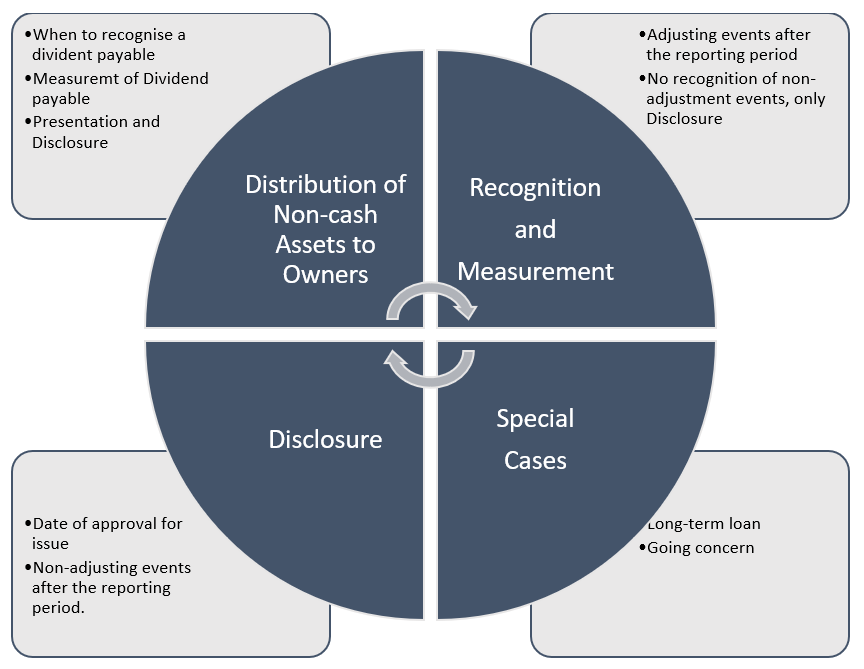
Ind AS-10: Events after the Balance Sheet Date

Scope:

This standard shall be applied in the accounting for and disclosure of events after the reporting period. There would always be a gap between the end of the period for which financial statements are presented and the date on which the same will actually be made available to the public.

  • Event occurring after the reporting period are defined as ‘events which occur between the end of the reporting date and the date when the financial statements are approved by the Board of Directors in case of a company’ and ‘by the corresponding authority in case of any other entity’.
  • These events may be Adjusting and Un-adjusting.

Adjusting events: Those that provide evidence of conditions that existed at the end of the reporting period.

Non-Adjusting events: Those that are indicative of conditions that arose after the reporting period.

  • Events after the reporting period include all events up to the date when the financial statements are authorized for issue, even if those events occur after the public announcement of profit or of other selected financial information.

The objective of Ind-AS 10 is to prescribe:

  • The disclosures that an entity should give about the date when the financial statements were approved for issue and about events after the reporting.
  • When an entity should adjust its financial statements for events after the reporting period.

Adjusting events:

(a) An entity should adjust its financial statements for events after the reporting date that provide further evidence of conditions that existed at the reporting date.

(b) Notwithstanding anything about adjusting or non-adjusting events, where there is a breach of a material provision of a long-term loan arrangement on or before the end of the reporting period with the effect that the liability becomes payable on demand on the reporting date, the agreement by lender before the approval of the financial statements for issue, to not demand payment as a consequence of such breach, shall be considered as an adjusting event.

An entity shall adjust the amounts recognised in its financial statements to reflect adjusting events after the reporting period.

An entity shall not adjust the amounts recognised in its financial statements to reflect non-adjusting events after the reporting period.

However, if non-adjusting events after the reporting period are material and their non-disclosure could influence the economic decisions that users make on the basis of the financial statements, then it shall disclose the following for each material category of non-adjusting event after the reporting period:

  • The nature of the event.
  • An estimate of its financial effect, or a statement that such an estimate cannot be.

If an entity receives information after the reporting period about conditions that existed at the end of the reporting period, it shall update disclosures that relate to those conditions, in the light of the new information. Appendix A of Ind AS 10 provides guidance with regard to distribution of non–cash assets as dividends to owners. The Appendix prescribes that liability to pay such a dividend should be recognised when it is appropriately authorised and is no longer at the discretion of the entity. This liability should be measured at the fair value of assets to be distributed. Any difference between the carrying amount of the assets distributed and the carrying amount of the dividend payable should be recognised in profit or loss when an entity settles the dividend payable.

Dividends:

(a) If dividend to holders of equity instruments are proposed or declared after the reporting date, an entity should not recognize those dividends as liability. There is no obligation as on the reporting date.

(b) The entity would disclose if any dividend is declared or proposed after the reporting date but before the date of approval of financial statements.

(c) An enterprise may give the disclosure of proposed dividends either on the face of the balance sheet as an appropriation within equity or in the notes in accordance with Ind AS 1 “Presentation of Financial Statements”.

Going concern:

(a) An entity should not prepare its financial statements on a going concern basis if management determines after the reporting date either that it intends to liquidate the entity or to cease trading, or that it has no realistic alternatives but to do so.

(b) However, there should no longer be a requirement to adjust the financial statements where an event after the reporting date indicates that going concern assumption is not appropriate. In that case there is need for fundamental change in the basis of accounting rather than adjustment.

(c) Ind-AS 1 specifies required disclosure if:

  1. The financial statements are not prepared on a going concern basis.
  2. Management is aware of material uncertainties related to events or conditions that may cast significant doubt upon the entity’s ability to continue as a going concern. The events or conditions requiring disclosure may arise after the reporting period.

Events after the Reporting Period

Events after the reporting period are those events, favourable and unfavourable, that occur between the end of the reporting period and the date when the financial statements are approved.

Mandatory exceptions:

(a) An entity’s estimates in accordance with Ind AS at the date of transition to Ind AS shall be consistent with estimates made for the same date in accordance with previous GAAP (after adjustments to reflect any difference in accounting policies), unless there is objective evidence that those estimates were in error.

(b) An entity may need to make estimates in accordance with Ind AS at the date of transition to Ind AS that were not required at that date under previous GAAP. To achieve consistency with Ind AS 10, those estimates in accordance with Ind AS shall reflect conditions that existed at the date of transition to Ind AS. In particular, estimates at the date of transition to Ind AS of market prices, interest rates or foreign exchange rates shall reflect market conditions at that date.

Ind AS-101: First time adoption of Indian Accounting Standards

The objective of Ind AS 101 is to ensure that an entity’s first Ind AS based financial statements, and interim financial reports for part of the period covered by those financial statements, contain high quality information that:

(A) Is transparent for users and comparable over all periods presented

(B) Provides a suitable starting point for accounting in accordance with Indian Accounting Standards.

(C) Can be generated at a cost that does not exceed the benefits.

First time adoption of Ind ASs would require change in various accounting policies. Paragraph 19 of Ind AS 8 Accounting Policies, Changes in Accounting Estimates and Errors requires that any change in accounting policy arising out of initial application of an Ind AS is either given retrospective effect or accounted for in accordance with transitional provisions given in different standards. Presently, Ind ASs do not provide any transitional provisions. Retrospective application means applying a new accounting policy to transactions, other events and conditions as if that policy had always been applied. The change in accounting policy is applied retrospectively except to the extent it is impracticable to determine specific effect or cumulative effect of the change.

Since Ind ASs are a set of converged financial reporting standards (to IFRSs), transitional provisions of corresponding IFRSs are not included therein. In absence of a simplified transitional standard, all changes in accounting policies would have been given effect retrospectively causing hardship in the IFRS convergence and the process would have been very expensive. Ind AS 101 is in effect a standard that provides transitional provisions to the first-time adopter in respect of all Ind ASs.

The objective of this Ind AS is to ensure that an entity’s first Ind AS financial statements, and its interim financial reports for part of the period covered by those financial statements, contain high quality information that:

(a) Is transparent for users and comparable over all periods presented;

(b) Provides a suitable starting point for accounting in accordance with Indian Accounting Standards (Ind ASs)

(c) Can be generated at a cost that does not exceed the benefits.

This standard applies to the first Ind AS financial statements and each interim financial report if any. But this standard does not apply to changes in accounting policies for an organisation that already applies Ind AS, such changes are subject of requirements of Ind AS 8 or specific transitional requirements of other Ind AS.

  • Implementation of Ind AS
  • Selection of Accounting Policies
  • Preparation of Opening Ind AS Balance sheet
  • Presentation and disclosure in an entity’s in Ind AS Financial Statements and Interim Financial Reports.

Preparation of Opening Ind AS Balance Sheet

On the date of transition to Ind AS, an entity shall prepare and present an opening Ind AS Balance Sheet. This is the starting point for it’s accounting according to Ind AS subject to requirements of Ind AS. Except for restrictions spelt out in the AS, an entity must in its Opening Ind AS Balance sheet:

  • Recognise all assets and liabilities for which recognition is required by Ind AS
  • Derecognise items as assets and liabilities if Ind AS does not permit such recognition.
  • If the Ind AS requires a particular asset, liability or component of equity to be recognised differently from its previous recognition under GAAP, then reclassify it.
  • Apply Ind AS in measuring all recognised assets and liabilities.

Meaning of First time Adoption

Ind AS financial statements are the first annual financial statements in which the entity adopts Ind ASs, in accordance with Ind Ass notified under the Companies Act, 2013 and makes an explicit and unreserved statement in those financial statements of compliance with Ind ASs. Refer to Chapter 2 for Ind AS adoption timeline. Therefore, an entity shall include an unreserved statement in the “Basis of Preparation” section of Significant Accounting Policies about adoption of Ind ASs .

error: Content is protected !!