Emerging Trends in OD

Organizational growth and productivity depend to a high degree on a company’s capability to keep up with and implement learning best practices. Learning best practices drive talent development and improve performance. One day or another, this will mean leaving traditional models of learning behind and adopting more impactful solutions many of which involve technological innovations.

Collective Sense-making

The world is changing so rapidly that we need everyone to participate in making sense of it. That’s why in the future, the ability to quickly adapt and apply new information will become more important than any number of hard skills.

Sense-making can be seen as an enduring capability. Deloitte defines enduring capabilities as “observable human attributes that are demonstrated independent of context. These human capabilities can be thought of as universally applicable and timeless.” Other examples of enduring capabilities include team-building, coaching, and learning. Compared with skills, they’re more transferable to different roles and situations.

Collective sense-making helps you create meaning from shared experiences. In the context of organizational change, it takes all perspectives into account to figure out what is changing and what actions are needed next.

No one person can possibly have the collective intelligence of a large organization. But by listening to different perspectives, you should be able to harness the skills, knowledge, and opinions of everyone in the organization, and that way reach your combined potential.

Going Mobile:

Mobile has transformed the way companies work, interact, and collaborate. With global penetration rates skyrocketing, organizations that are not considering mobile in all areas of HCM will have a difficult time competing for talent. Despite this reality, companies are still slow to embrace mobile learning solutions. Only 10 percent of companies are using mobile Web-based learning solutions. Some 8 percent are using mobile learning apps, 5 percent mobile performance Web-based sites, and 4 percent are using mobile performance apps Most companies recognize that mobile learning solutions can improve adoption, expand global reach, and engage users better, but do not understand how to execute a mobile strategy. Additionally, some organizations find it challenging to determine what options are available and which providers to consider. Regardless of the barriers they are facing, organizations looking to improve their learning functions will need to make mobile part of the equation and determine what requirements they have in order to select a technology partner.

Understanding Social:

Companies are quickly embracing social media tools, as well as investing in social collaboration tools to better engage employees and foster a learning culture. Although social has become mainstream, companies still lack the knowledge and insight around how to use these tools for learning and development. Of the 59 percent of companies using social for their learning strategies, only 24 percent say they are effective. One reason is that companies are limited in the social tools they are using. Companies are using document sharing, discussion forms, and blogs, but they aren’t generally using video or micro-blogs which our research shows are more effective to improve their learning functions. Companies must educate themselves on the value of social learning and invest in providers that offer solutions that drive business outcomes.

From one-off change processes to continuous development:

Particularly in the United States, organizational change is seen as a process with a beginning, a midpoint, and an end when the goals have been achieved. But this approach is being replaced by transformation that is, continuous organizational development.

Instead of having the perfect ready-made plan for change, companies want genuine changes where the general direction is known, but the workplace community finds its way to the final destination together.

Transformation is not about having a set goal; rather, the result is created and shaped through learning.

Considering Adaptive Learning:

Adaptive learning is a methodology that breaks traditional models and allows employees to learn at their own pace. It has gained popularity with educational institutions, referred to as “adaptive teaching,” where a teacher will gather information on individual students to learn what they need to do to improve their learning. In the workforce, adaptive learning is conducted similarly. Employees can be monitored individually and in real time to determine what learning approach will best suit their needs. It has advantages for younger generations entering the workforce that have expectations around flexibility and interaction. Adaptive learning can be effective at improving efficiency, as well as employee engagement and retention since it allows employees to build confidence and overall expertise. Companies may want to consider breaking traditional learning methods by introducing aspects of adaptive learning.

Digitalization is transforming even the late-blooming organizations:

Digitalization can hardly be seen as a trend anymore. But the harsh reality is that we’re in the stages where organizations unable to transform and develop are actually going out of business.

In the best of cases, digital ways of working give people real opportunities to participate, and decisions are made collectively. It enables transparent, real-time processes. Digitalization is progressing more rapidly in countries with an existing analogue foundation, such as the Nordics.

Change is digitally driven in countries where traditional hierarchies endure. This was the case when developing countries transferred directly to mobile networks and took the leap onto the Internet, for example. The same will happen with corporate cultures. Communities will be built on real-time technologies and new types of communication practices.

Measuring Effectiveness:

To determine if the learning strategy in place is driving business outcomes, companies must find a way to consistently measure its effectiveness. Companies should determine metrics in advance and include both business metrics and learning/HR metrics. Currently, most companies are considering team encouragement, employee engagement, and employee satisfaction over more concrete business metrics such as retention, turnover, and revenue per full-time employee.

OD in Global Setting

OD is the practice of planned, systemic change in the beliefs, attitudes and values of employees for individual and company growth. The purpose of OD is to enable an organization to better respond and adapt to industry/market changes and technological advances. In today’s post we will focus on five benefits of OD from continuous improvement to increased profits.

Continuous improvement:

Companies that engage in organizational development commit to continually improving their business and offerings. The OD process creates a continuous cycle of improvement whereby strategies are planned, implemented, evaluated, improved and monitored. Organizational development is a proactive approach that embraces change (internal and external) and leverages it for renewal.

Increased communication:

One of the key advantages to OD is increased communication, feedback and interaction within the organization. The goal of improving communication is to align all employees to shared company goals and values. Candid communication also leads to increased understanding of the need for change within the organization. Communication is open across all levels of the organization and relevant feedback is recurrently shared for improvement.

Employee development:

Organizational development focuses on increased communication to influence employees to bring about desired changes. The need for employee development stems from constant industry and market changes. This causes an organization to regularly enhance employee skills to meet evolving market requirements. This is achieved through a program of learning, training, skills/competency enhancement and work process improvements.

Product & service enhancement:

A major benefit of OD is innovation, which leads to product and service enhancement. Innovation is achieved through employee development, which focuses on rewarding successes and boosting motivation and morale. In this scenario, employee engagement is high leading to increased creativity and innovation. Organizational development also increases product innovation by using competitive analysis, market research and consumer expectations and preferences.

Increased profit:

Organizational development affects the bottom line in a variety of ways. Through raised innovation and productivity, efficiency and profits are increased. Costs are also reduced by minimizing employee turnover and absenteeism. As OD aligns objectives and focuses on development, product/service quality and employee satisfaction are increased. The culture shift to one of continuous improvement gives the company a distinct advantage in the competitive marketplace.

The key dimensions of culture are:

Power distance: Power Distance and OD It is the extent to which individuals who are less powerful members of institutions and organizations within a country expect and accept that power is distributed unequally.

Uncertainty avoidance: Uncertainty avoidance and OD It is the extent to which organizational members do not tolerate unpredictability and ambiguity. Fagenson, et al. (2004) found that countries high in Uncertainty Avoidance such as Russia, France and Japan there is less likelihood that OD efforts that require long periods of ambiguity, such as culture change efforts, will be implemented. While, high Uncertainty Avoidance countries, as in high Power Distance countries, hierarchy is respected and decision-making is expected to be top-down. Risk-taking behaviour is discouraged and having clear and stable rules is important.

Individualism/collectivism: Individualism/collectivism and OD It is the extent to which people believe they should be primarily responsible for themselves as opposed to the collective. Countries with high Individualism cultures such as the U.S. and Britain, look to OD for interventions that will promote personal initiative such as executive coaching and the development of performance appraisal and reward systems to promote individual productivity. There has been an explosion of executive coaching services in these countries in recent years and this trend is likely to continue.

Masculinity/femininity: Masculinity/femininity and OD This was the only one of the four original dimensions where Hofstede (1991) found a systematic difference in the answers between women and men. He explains that, “a society is called masculine when emotional gender roles are clearly distinct. Men are supposed to be tough and women are supposed to be tender. A society is called feminine when emotional gender roles overlap: both men and women are supposed to be modest, tender, and concerned with quality of life”

Long-term/Short-term orientation: Long-term/short-term orientation and OD Long-Term Orientation (LTO), “stands for the fostering of virtues oriented toward future rewards; in particular, perseverance and thrift” Example: China, Hong Kong, Taiwan, Japan, Vietnam and South Korea. The Short-Term Orientation (STO) is defined by Hofstede and Hofstede (2005) as, “the fostering of virtues related to the past and present” Example: European countries fall in the mid range, and the U.S., Britain, and other Anglo countries score on the short-term side.

  • People in high power distance cultures expect leaders to know what’s best and do not expect openness or transparency, and people in high Uncertainty Avoidance cultures do not feel comfortable with confrontation and tension.
  • Collectivist cultures focus on the needs of families and groups, not on the needs or rights of individuals. Cultural values need to be respected and acknowledged if OD is to add value in these cultures.
  • Practitioners must be sensitive to the cultural context, as they are working in while grounding our work in values that can guide us to make

OD Practitioner Meaning, Role of OD Practitioner, Competencies of an OD Practitioner

An OD practitioner is a person who provides professional services i.e. diagnosing systems, developing interventions, and helping to implement them. They refer to at least three sets of people, first those who specialize in OD as professionals and traditionally focus on humanistic values but now include organizational effectiveness and competitiveness.

Second are those who specialize in the field related to OD such as reward system, organizational design, work design, information technology, and business strategy. Third are those people who are managers and administration and gained OD competencies. OD is becoming a general management skill over time.

Organizational Development Practitioners are people who are entrusted with the job to carry out the planned change process in the organization. These are the people with the ultimate responsibility to development and create organizational wide effectiveness through challenging and changing its current practices.

Role Demand of OD Practitioner

The primary goal of OD is to improve organisation effectiveness; therefore the primary role of an OD consultant is to establish helping relationships within the organisation, with and between individuals and groups, to achieve that objective. The way that goal is acted out depends on the nature of the task in hand.

Organizational Development Practitioners are people who are entrusted with the job to carry out the planned change process in the organization. These are the people with the ultimate responsibility to development and create organizational wide effectiveness through challenging and changing its current practices. OD Practitioner normally refers to people who do Organizational Development.

Organizational Development Practitioners are people who are entrusted with the job to carry out the planned change process in the organization. These are the people with the ultimate responsibility to development and create organizational wide effectiveness through challenging and changing its current practices. OD Practitioner normally refers to people who do Organizational Development. These are the people who support in favor of the change initiative and assist others to implement Organizational Development interventions. Normally the Organizational Development Practitioners are either the OD Specialist or Leaders and Managers who bring change in their work domain.

Competencies of an OD Practitioner

Marketing

An effective organization development (OD) practitioner has to be aware of systems wanting to change and be known and available to those needing them. They must know how to match skills with potential client profile and convey qualifications in a credible manner. Their skills are much needed in quickly grasping the nature of the system, determining appropriate decision and processes as needed according to situation and circumstances.

Leadership

Leaders keep members focused on key company values and on opportunities and need for improvement. A leader’s job is to recognize when a company is headed in the wrong direction and to get it back on the right track. The role of OD practitioner is not just being that leader but also training the managers to be the leaders.

Enrolling

An effective organization development (OD) practitioner must build trusting relationships, present the theoretical foundations of change, deal effectively with resistance, help the client trust the process, and help the client manage emotionally charged feelings and collaboratively design the change process.

Problem-Solving

The real challenge is to implement a solution to an organizational problem. OD practitioner must not forget about today’s problems yet focus constantly on the next set of problems. He must not just propose solutions but ensure the correct implementation of these solutions.

Emotional Intelligence

OD practitioner role is emotionally demanding, he must have the capability which influences personal abilities to succeed in coping with environmental demand and pressure. Self-awareness, self-management, empathy, social skills and self-motivation are all needed requirements of OD practitioner role.

Use of Knowledge and Experience

The role of an OD practitioner can be defined on a continuum ranging from client centered to consultant centered. He must not only direct the managers of the organization but also successfully transfer his/her knowledge and experience to the learners. He must attend to all phases of the business and focus on how the organization works with clients.

With the development of new and varied intervention approaches, the OD professional’s role needs to be seen as falling along the entire continuum from client-centred to consultant-centred. At times, the consultant will rely mainly on organization members’ knowledge and experiences to identify and solve problems. At other times, it will be more appropriate to take on the role of expert, withdrawing from that role as managers gain more knowledge and experience. This is no doubt a very crucial role and needs a lot of practice, expertise and a good command over all tools and techniques to attain complete success.

Types of Organizational Development Practitioners

  1. External OD Practitioners

Advantages

  • Brought in from outside so not associated with the system, which makes them less dependent on the system and makes them work independently.
  • They are more formal in their approach and since they are Specialist they are more Involved in the process, as this is what they to for living.
  • Sees from Different point of view, with Objectivity.
  • Greater freedom of operation.
  • Viewed by top managers to have more positive influence, as they cannot be influenced with ease, and are not really a part of the organizational structure.
  • Less Influenced by power politics of the organization.
  • More Independent and Risk Takers.

Disadvantages

  • Outsiders are unfamiliar with the organizational culture, Norms, Practices.
  • May have difficulty in Obtaining the information due to lack of information on data repository and informal channels of communication.
  1. Internal Practitioners

Advantages

  • They know the Structure of the Organization.
  • Familiar with Organizational culture and norms.
  • They know the people.
  • Have personal interest in making organization succeed.

Disadvantages

  • Lack of Objectivity as they may be influenced by the Management
  • Lack of Specialized Skills
  • May not have necessary power and authority

Organisational Development Principles, Process, Importance

Principles

  1. Values-Based: Values-based key variables include.
  • Collaboration: Builds collaborative relationships between the practitioners and the client while encouraging collaboration throughout the client system.
  • Self-awareness: OD (Organization Development) practitioners engage in personal and professional development through lifeline learning.
  1. Systems focused: Approaches communities and organizations as open systems: that is, acts with the knowledge that change in one area of a system always results in tin changes in one area of a system always results in changes in other areas, and change in one area cannot be sustained without supporting changes in other areas of the system.
  2. Action Research: Continuously reexamines, reflects, and integrates discoveries throughout the process of change in order to achieve desired outcomes. In this way, the client members are Involved both in doing their work and in dialogue about their reflection and learning in order to apply them to achieve a shared result.
  3. Informed by data: Involves proactive inquiry and assessment of the internal environment in order to discover and create a compelling need for change and the achievement of a desired future state of the organization or community.

Process

(1) Initial Diagnosis:

If executives recognise that there are inadequacies within organisation which can be corrected by OD activities, it is necessary to find out the professional and competent people within the organisation to plan and execute OD activities.

If competent people are not available within the organisation the services of the outside consultants to help in diagnosing the problem and developing OD activities are to be taken. The consultants adopt various methods including interviews, questionnaires, direct observation, analysis of documents and reports for diagnosing the problem.

(2) Data Collection:

Survey method is used to collect the data and information for determining organisational climate and identifying the behavioural problems.

(3) Data Feedback and Confrontation:

Data collected are analysed and reviewed by various work groups formed from this purpose in order to mediate in the areas of disagreement or confrontation of ideas or opinions and to establish priorities.

(4) Selection and Design of Interventions:

The interventions are the planned activities that are introduced into the system to accomplish desired changes and improvements. At this stage the suitable interventions are to be selected and designed.

(5) Implementation of Intervention:

The selected intervention should be implemented. Intervention may take the form of workshops, feedback of data to the participants, group discussions, written exercises, on-the-job activities, redesign of control system, etc. Interventions are to be implemented steadily as the process is not a “one-shot, quick cure” for organisational malady. But it achieves real and lasting change in the attitudes and behaviour of employees.

(6) Action Planning and Problem Solving:

Groups prepare recommendations and specific action planning to solve the specific and identified problems by using data collected.

(7) Team Building:

The consultants encourage the employees throughout the process to form into groups and teams by explaining the advantages of the teams in the OD process, by arranging joint meetings with the managers, subordinates, etc.

(8) Intergroup Development:

The consultants encourage the intergroup meetings, interaction etc., after the formation of groups/teams.

(9) Evaluation and Follow-Up:

The organisation evaluates the OD programmes, find out their utility, and develop the programmes further for correcting the deviations and/or improved results. The consultants help the organisation in this respect.

All the steps in the OD processes should be followed by the organisation in order to derive full range of OD benefits.

Importance

A change agent: Very important aspect of organization development is change. Agents of behavioral scientists encourage people of the organization to solve problems. His main strength is comprehensive knowledge of human behavior.

Contractual relationship: For the establishment of the contractual relationship between the concerned parties in the organization, organization development can play a significant role. Contractual relationships help to ensure the successful implantation of plans.

Sponsoring organization: The imitative for organization development programs come from an organization that has a problem. This means that to management’s awareness that the problem exists and has decided to seek help in solving it.

Implement performances: Through the OD process improved relations, effective commutation, and enhanced ability to copy of all kinds, more effective decisions, etc. are possible. It indicates an improvement in the performance of all sides.

Applied behavioral science: OD process states its activities by applying behavioral science principles without applying so that people cannot be made fit for implementing the program.

Organization self-renewal: OD program helps self-renewals also. People become conscious of their responsibilities in the future for the organization and society. It minimizes suspension and control steps.

High morale and satisfaction: If reasonable OD programs are undertaken, morale and satisfaction of employees may be increased, which can result in a good performance.

Increased motivation: OD programs increase the motivation of employees. The motivation of employees can ensure high productivity and sensibility. On the other hand, demotivated employees destroy good deeds even.

Increased competitive ability: Developed organization cans again competitive ability. This position can be gained by producing high-quality goods. Rendering better services, expanding the market, sending goods at the doorsteps of customers, and so on.

Quality goods & services: Whether OD has taken part properly or not, it is proved through the quality of goods and services. If quality does not improve, OD does not carry and y value.

Research & Development: Research and development are the successful weapons of any organization. It helps innovate, improve the quality of goods and services, and increase competitive strengths.

Participation of Top Management in OD

Ensuring Management Involvement

The top management of a company leads by example and affects the motivation felt by the employees. A management team that takes a sincere interest and connects with the staff is more likely to inspire the employees to achieve. Transparency from the management team about the company’s future aids in motivating the staff because it gives them a better idea of the reasons for their work duties.

Top management needs to also make sure the line of communication and transparency continues throughout the company as well. Make it a company policy that managers meet regularly with each of their employees-weekly, for example-to discuss their progress. Weekly staff meetings are good for keeping everyone informed of coming activities, but they’re not a substitute for meeting one-on-one, where each employee has the opportunity to express problems, issues and concerns.

Providing Support for Asset Management

A company’s financial decisions typically come from the top level of management. This includes each department’s budget for the fiscal year. In many cases, the purchase of equipment and other assets must be approved by top management. It’s important that top management has confidence in mid-level managers to know what their employees need, and to procure it while keeping within their departments’ budgets.

If the employees don’t have access to the equipment and resources necessary to complete their jobs, the company’s achievement suffers. A management team that supports the staff and has a sense of what they need is better equipped to lead the company to success. Don’t let the lack of essential tools for the job hinder the company’s success.

Communicating Company Goals

The goals and vision of the company guide the work that is completed by the employees. To reach higher achievements for the company, top management first needs to make sure everyone in the company knows what the company’s overall goals and strategy are. It’s not enough to know their own goals. They need to understand the direction the company is headed and what management wants to achieve so they can see where their efforts fit into the overall strategy.

Next, top management needs to direct front line managers to establish goals for each employee. These should be achievable but challenging so they push each employee to grow. The goals must take into consideration the company’s current situation and its overall strategy and direction. Above all, each employee’s goals should be measurable so it’s clear when they have been achieved.

Goals

  • Inviting employees in the decision-making process: A decision cannot be appropriate without participation. Management should involve employees from every department to make a perfect decision.
  • Making decisions for the organization: Management will make appropriate decisions for the organization’s development. They will study every aspect and resource of the organization. After this study management will take decisions and they will look after it.
  • Allocations of funds for implementing decisions: After decision making, this is the responsibility of management to implement that decision on its employees, So, management will allocate funds for decision implementing and make it smooth.
  • Making action steps for individual improvement: A organization run by its employee, but every individual is not the same skillful. An organization should take action for individual improvement. And this action will be taken by the management of that organization.
  • Ensuring accountability of implementation activities: Ensuring the accountability of the organization is another major role of management.
  • Taking corrective or preventive measures in case of any deviation: If there is any situation which is not good for organization management will take corrective or preventive measure. In one word management play the most vital role in organizational development.

Relevance of Organisational Development for Managers, OD-HRD Interface

The Organizational Development Manager plans, develops, implements and administers development and training programs for company employees. The manager also acts as liaison and advisor to the organization’s leadership and facilitates initiatives across the organization.

Duties/Responsibilities:

  • Directs the needs assessment for training and staff development to enhance the effectiveness of employee performance in achieving the goals and objectives of the company.
  • Identifies and incorporates best practices and lessons learned into program plans.
  • Designs and develops HR training programs for management and employees.
  • Develops learning activities, audio-visual materials, instructor guides and lesson plans.
  • Reviews evaluations of training courses, objectives and accomplishments.
  • Makes assessments of effectiveness of training in terms of employee accomplishments and performance.
  • Trains employees on HR issues and practices. Presents course materials.
  • Consults with management on performance, organizational and leadership matters. Conducts needs assessments to determine measures required to enhance employee job performance and overall company performance.

Organisational development process is very comprehensive and it involves jobs, work design, structure, individuals, groups, strategy, processes, procedures, technology and culture of the organisation. It takes a long time to get the desired results. For improving the effectiveness of the organisation through OD the involvement of all concerned persons is needed.

Right from top level to bottom levels all are attached with organisational development. Change manager, change agent, managers, workers and unions play their role in their own capacity. It is expected that everyone must give the desired contribution for organisational development.

  1. Role of Change Manager:

Change manager is the person responsible for bringing development in various areas of the organisation. He starts his role from identification of needs for change, situation analysis, deciding intervention for development, implementation and review of the intervention. In some of the organisation the organisational development responsibility is assigned to one person independently, whereas in other organisations the role is played by the manager along with routine functions.

The change manager may find difficulty in planning and implementation of strategy because of resistance from functional managers. When additional job of OD is given to the functional manager then he may not give proper attention to the development activities. The task of OD should be given to the person at higher level so that he can create the situation suitable for organisational development.

The change manager should be an expert of his field and must have knowledge regarding manpower, processes, procedures, technology, structure and strategy for effective working. The training should be given to the executives to play role of change manager. The role of change manager is very important in organisational development because he provides proper planning and guidance for bringing desired changes in the organisation.

  1. Role of Change Agent:

Change agent is a person outside of organisation and be may called as consultant. When the company is not involved in much development activities, it may take service of the experts from the markets. In case of regular development jobs the company employs a full-time change manager or jobs may be-assigned to one internal manager who is expert in that job.

The change agent is having knowledge of the particular field. Right from study of internal and external environment, industry and company analysis, designing, developing, selection and implementation of intervention he is involved and provides support to the managers. He works for his consultation fees or commission as per the requirements he provides his services.

For selection of the change agent the management should take proper care. On the basis of his proven track record the consultant should be finalized. The feedback should be taken from the companies where he has already worked as a change agent successfully or from markets. The available information should be verified properly otherwise the decision may be wrong.

The change agent explains the changes, their types of changes and benefits expected from such changes to the employees. He convinces all concerned persons to get them into confidence and get their support. If it is done so successfully, the resistance from employees would not be there.

The role of above mentioned activities is very important. The expertise and involvement of change agent in OD activities would affect the success of OD. He may leads to the OD programme successfully if level of commitment on his part is high definitely.

  1. Role of HRD Manager:

Organisational development and human resource development are having the common objectives of development. Human resource is one the areas of OD. For achieving objectives an HRD manager plays an important role. Designing, planning and implementation of intervention for OD and HRD are the main functions of HRD manager. Through development of human resource the organisational development is possible.

The main purpose of concerned department is to create the favourable climate for learning and development. In the favourable environment the employees learn from the learning facilities provided in an organisation and from their own experience also. The employees should be motivated by the department to utilize their potential.

Due to continuous learning the employees will acquire new competencies (skills, knowledge, capability and attitude). The main objective of HRD department is to develop the competencies of the employees to meet the changing needs of the organisation.

To achieve this objective the concerned department should perform the following major functions in HRM intervention for OD:

(i) Formulate the human resource policy in the organisation and open support of top management.

(ii) Create a constant desire to learn and develop by inspiring employees by line managers.

(iii) Canalize all HRD efforts in one direction to achieve the goals of the organisation.

(iv) For creating and developing suitable climate, planning and designing of new systems and methods.

(v) Monitoring of implementation and performance of various human resource development mechanisms.

(vi) Close contact with associations and unions and their inspiration.

(vii) Conducting research periodically relating to various human aspects.

(viii) Supply relevant information to the top management.

(ix) Influencing formulation of personnel policies due to staff expertise.

To perform the above-mentioned functions, it is required that HRD manager staff of the concerned department, must be well qualified and experienced. Otherwise these activities cannot be performed effectively. Keeping in view the functions performed by HRD manager for development of human resource and organisation, it is concluded that the role played is very important and essential for successful effort for achieving high level of effectiveness of organisation as a whole.

  1. Role of Trade Union:

Management are not having positive attitude towards trade unions. Trade unions are considered opponent to the management. These are mainly confined to issues like wages, bonus and working conditions. But they had paid no attention towards the development of workers in past. In the recent past initiatives have been taken by the management for development of human resource and organisation.

Trade unions have not supported the initiative taken by the management due to various reasons. Now it is time for management to deal with the fears and doubts of trade union. Management should have continuous interaction with the trade unions regarding OD activities. Trade unions must be taken into confidence and they must be involved.

Working climate of trust and understanding must be developed. These efforts will develop involvement of unions in developmental programmes. Trade unions should play the positive roles in development of employees.

The role of trade union for development of organisation is important.

The trade union can play the following roles:

(i) When the initiative for development of organisation comes from management trade unions must cooperate. If no initiative from management side then trade unions must initiate for development of workers. The improved communication between management union and employees can strengthen the role of trade unions.

(ii) Trade unions should provide counselling service to workers regarding excessive drinking, smoking, drug addiction, gambling, etc. In absence of counselling the employees get involved in evils.

(iii) Trade union must help the employees to acquire knowledge and skills regarding work and human processes like team-spirit empathy, helping attitude.

(iv) Trade union must put continuous efforts to improve employees’ welfare programme for overall development.

(v) Trade unions should sponsor appropriate research projects to collect relevant data regarding various dimensions of worker’s needs, aspirations, development needs, etc. They can seek involvement of experts, academicians by participating in research problems relevant to the trade unions.

For better and effective role in HRD and OD, trade union should be professional. This means HRD within union. Trade unions had ignored development of union leadership. Trade unions must develop union leadership. The new developmental role will acquire new skills in the union leadership and the unions will play their roles more effectively.

Amendment, Cancellation and Revocation of Registration (Sec 28,29,30)

Amendment Sec 28

(1) Every registered person and a person to whom a Unique Identity Number has been assigned shall inform the proper officer of any changes in the information furnished at the time of registration or subsequent thereto, in such form and manner and within such period as may be prescribed.

(2) The proper officer may, on the basis of information furnished under sub-section (1) or as ascertained by him, approve or reject amendments in the registration particulars in such manner and within such period as may be prescribed: Provided that approval of the proper officer shall not be required in respect of amendment of such particulars as may be prescribed: Provided further that the proper officer shall not reject the application for amendment in the registration particulars without giving the person an opportunity of being heard.

(3) Any rejection or approval of amendments under the State Goods and Services Tax Act or the Union Territory Goods and Services Tax Act, as the case may be, shall be deemed to be a rejection or approval under this Act.

Cancellation Sec 29

(1) The proper officer may, either on his own motion or on an application filed by the registered person or by his legal heirs, in case of death of such person, cancel the registration, in such manner and within such period as may be prescribed, having regard to the circumstances where,

(a) The business has been discontinued, transferred fully for any reason including death of the proprietor, amalgamated with other legal entity, demerged or otherwise disposed of; or

(b) There is any change in the constitution of the business; or

“(c) the taxable person is no longer liable to be registered under section 22 or section 24 or intends to optout of the registration voluntarily made under sub-section (3) of section 25:”

(2) The proper officer may cancel the registration of a person from such date, including any retrospective date, as he may deem fit, where,

(a) A registered person has contravened such provisions of the Act or the rules made thereunder as may be prescribed; or

(b) A person paying tax under section 10 has not furnished returns for three consecutive tax periods; or

(c) Any registered person, other than a person specified in clause (b), has not furnished returns for a continuous period of six months; or

(d) Any person who has taken voluntary registration under sub-section (3) of section 25 has not commenced business within six months from the date of registration; or

(e) Registration has been obtained by means of fraud, wilful misstatement or suppression of facts: Provided that the proper officer shall not cancel the registration without giving the person an opportunity of being heard.

(3) The cancellation of registration under this section shall not affect the liability of the person to pay tax and other dues under this Act or to discharge any obligation under this Act or the rules made thereunder for any period prior to the date of cancellation whether or not such tax and other dues are determined before or after the date of cancellation.

(4) The cancellation of registration under the State Goods and Services Tax Act or the Union Territory Goods and Services Tax Act, as the case may be, shall be deemed to be a cancellation of registration under this Act.

(5) Every registered person whose registration is cancelled shall pay an amount, by way of debit in the electronic credit ledger or electronic cash ledger, equivalent to the credit of input tax in respect of inputs held in stock and inputs contained in semi-finished or finished goods held in stock or capital goods or plant and machinery on the day immediately preceding the date of such cancellation or the output tax payable on such goods, whichever is higher, calculated in such manner as may be prescribed:

Provided that in case of capital goods or plant and machinery, the taxable person shall pay an amount equal to the input tax credit taken on the said capital goods or plant and machinery, reduced by such percentage points as may be prescribed or the tax on the transaction value of such capital goods or plant and machinery under section 15, whichever is higher.

(6) The amount payable under sub-section (5) shall be calculated in such manner as may be prescribed.

Revocation of Registration Sec 30

Revocation of cancellation means revalidation of cancelled registration. Section 30 of the CGST Act 2017 read with Rule 23 of CGST Rules provide for revocation of cancelled registrations.

Section 30(1) A registered person, whose registration is cancelled by the proper officer on his own motion, may apply to such officer for revocation of cancellation of the registration within thirty days from the date of service of the cancellation order.

Thus, a registered person can submit an application for revocation if proper officer cancelled the registration (Suo Motu) due to the following reasons:

(a) Contravened provisions of the Act or the rules made there under.

(b) Composition dealer has not furnished returns for three consecutive tax periods

(c) Any taxable person not furnished returns (other than composition) for a continuous period of six months.

(d) The voluntarily registered person has not commenced business within six months from the date of registration.

(e) Registration has been obtained by means of fraud, willful misstatement, or suppression of facts.

First Proviso to Section 30(1) Additional Commissioner or the Joint Commissioner may, on sufficient cause being shown, and for reasons to be recorded in writing extend such period (submission of application for revocation) for a period not exceeding thirty days.
Second Proviso to Section 30(1) Commissioner may, on sufficient cause being shown, and for reasons to be recorded in writing may extend such period for further period not exceeding thirty days.
Rule 23 A registered person may submit an application for revocation of cancellation of registration, in FORM GST REG -21 to such proper officer, within a period of thirty days from the date of the service of the order of cancellation of registration at the common portal

Prerequisite for filing revocation application

First proviso to Rule 23 Application for revocation cannot be filed if the registration has been cancelled for the failure of the taxable person to furnish returns, unless such returns are filed and any amount due as a tax, in terms of such returns has been paid along with any amount payable towards interest, penalties and late fee payable in respect of the said returns.

Computation of GST: Computation of GST under Inter State and Intra State Supplies

1.1. A supply can be categorized as Intra- State Supply if the following conditions are satisfied:

1.1.1.  The Location of Supplier and Place of Supply are in the same State or Union Territory;

1.2. A supply can be categorized as Inter-State Supply in the following situations:

1.2.1. The Location of Supplier and Place of Supply are in different State or Union Territory;

1.2.2.  The imported goods till they cross the customs frontiers of India (CFI);

1.2.3. The import of services;

1.2.4. The export of goods;

1.2.5. The export of services;

1.2.6. The location of supplier in India and Place of supply outside India;

1.2.7. Supply to or by SEZ Developer/ unit;

 “Location of the supplier of services” means:

(a) Where a supply is made from a place of business for which the registration has been obtained, the location of such place of business;

(b) Where a supply is made from a place other than the place of business for which registration has been obtained (a fixed establishment elsewhere), the location of such fixed establishment;

(c) where a supply is made from more than one establishment, whether the place of business or fixed establishment, the location of the establishment most directly concerned with the provision of the supply; and

(d) in absence of such places, the location of the usual place of residence of the supplier;

The place of supply for goods is defined as per section 10 & 11 and for services is defined as per section 12 & 13 of IGST Act, 2017;

1.3. The GST law does not define the location of supplier for goods. Considering that the location of supplier will be location of goods, in this type of transaction there will not be any inter- State supply since the location of the supplier and the place of supply will be in the same State.

However, the most crucial thing is to determine the Place of Supply of services or goods. The IGST law shall be referred for section 10, 11, 12 & 13 to determine the place of supply.

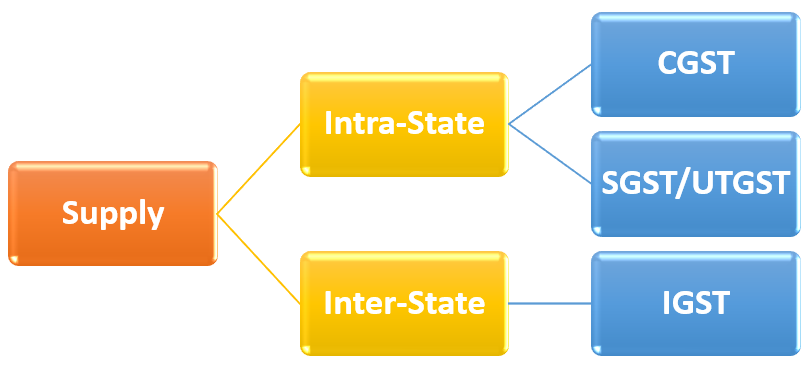
2.1. Under GST regime, 4 types of taxes i.e. CGST, SGST, UTGST and IGST. If a transaction/supply is determined as Intra- State Supply then CGST and SGST/UTGST shall be chargeable and payable whereas in case of Inter-State Supply then IGST shall be chargeable and payable.

2.2. Therefore, it is well established that different taxes is to be paid on respective supplies and it becomes more important to determine the Supply to be Intra- State and Inter-State supply.

S.No. Nature of business Category of Supply Applicable tax
1 Hotel, Inns, etc. Intra- State Supply CGST & SGST/ UTGST
2 Restaurants Intra- State Supply CGST & SGST/ UTGST
3 Import/Export of goods Inter-State Supply IGST
4 Import/ Export of services Inter-State Supply IGST
5 Renting of immovable property Intra- State Supply (If landlord and property is located in same State) CGST & SGST/ UTGST
6 Renting of immovable property Inter-State Supply (If landlord and property is located in different State) IGST

Deemed Registration (Sec 26), Special Provision (Sec 27)

Section 26: Deemed Registration:

(1) The grant of registration or the Unique Identity Number under the State Goods and Services Tax Act or the Union Territory Goods and Services Tax Act shall be deemed to be a grant of registration or the Unique Identity Number under this Act subject to the condition that the application for registration or the Unique Identity Number has not been rejected under this Act within the time specified in sub-section (10) of section 25.

(2) Notwithstanding anything contained in sub-section (10) of section 25, any rejection of application for registration or the Unique Identity Number under the State Goods and Services Tax Act or the Union Territory Goods and Services Tax Act shall be deemed to be a rejection of application for registration under this Act.

Special Provision (Sec 27)

(1) The certificate of registration issued to a casual taxable person or a non-resident taxable person shall be valid for the period specified in the application for registration or ninety days from the effective date of registration, whichever is earlier and such person shall make taxable supplies only after the issuance of the certificate of registration: Provided that the proper officer may, on sufficient cause being shown by the said taxable person, extend the said period of ninety days by a further period not exceeding ninety days.

(2) A casual taxable person or a non-resident taxable person shall, at the time of submission of application for registration under sub-section (1) of section 25, make an advance deposit of tax in an amount equivalent to the estimated tax liability of such person for the period for which the registration is sought: Provided that where any extension of time is sought under sub-section (1), such taxable person shall deposit an additional amount of tax equivalent to the estimated tax liability of such person for the period for which the extension is sought.

(3) The amount deposited under sub-section (2) shall be credited to the electronic cash ledger of such person and shall be utilised in the manner provided under section 49.

Interest on Delayed Payment (Sec 50)

Every person who is liable to pay tax in accordance with the provisions of this Act or the rules made thereunder, but fails to pay the tax or any part thereof to the Government within the period prescribed, shall for the period for which the tax or any part thereof remains unpaid, pay, on his own, interest at such rate, not exceeding eighteen per cent., as may be notified by the Government on the recommendations of the Council.

Provided that the interest on tax payable in respect of supplies made during a tax period and declared in the return for the said period furnished after the due date in accordance with the provisions of section 39, except where such return is furnished after commencement of any proceedings under section 73 or section 74 in respect of the said period, shall be levied on that portion of the tax that is paid by debiting the electronic cash ledger.

The interest under sub-section (1) shall be calculated, in such manner as may be prescribed, from the day succeeding the day on which such tax was due to be paid.

A taxable person who makes an undue or excess claim of input tax credit under sub-section (10) of section 42 or undue or excess reduction in output tax liability under sub-section (10) of section 43, shall pay interest on such undue or excess claim or on such undue or excess reduction, as the case may be, at such rate not exceeding twenty-four per cent., as may be notified by the Government on the recommendations of the Council.

Amendment by Finance Bill, 2021

The Union Budget for financial year 2021-22 has been laid in Parliament on 1st February, 2021.

It proposes to amend section 50(1) by way of clause 103. Accordingly,

  • Finance Bill, 2021 has proposed to substitute proviso to section 50(1) so as to charge interest on net cash liability.
  • Section 50 of CGST Act, 2017 provides for interest on delayed payment of tax.
  • Thus, interest shall be payable on that portion of the tax which is paid by debiting the electronic cash ledger.
  • This will be effective retrospectively w.e.f. 01.07.2017 implying that Department will have to forego such demands raised till now and interest will only be payable on tax liability payable in cash.

Other Considerations:

The Act with respect to the filing of the returns as contained u/s 39 of the CGST Act, 2017 merely link the due date for payment of tax with the due date for the filing of the return but does not provide that the return can be filed only after paying the entire tax. Attention is also draw to the definition of “valid return” u/s 2(117) of the CGST Act, 2017 which considers a return on which entire tax has been paid as a valid return (which would have been considered for matching if the GSTR – 2/3 would not have been suspended). Therefore a return filed on the due date reflecting the tax paid by way of utilizing the input tax credit and showing the balance tax as payable, although not a valid return for matching, would still remain a return filed u/s 39.

Appendix

It has been proposed to substitute the proviso to Section 50(1) of the CGST Act, so as to charge interest on delayed payment of GST on net tax liability only and that too retrospectively with effect from the July 1, 2017.

error: Content is protected !!