Performance of contract of sale

The performance of a contract of sale involves various obligations and duties that both the seller and the buyer must fulfill for the transaction to be completed satisfactorily. The Sale of Goods Act, 1930, in India, outlines these responsibilities in detail, ensuring that there is clarity and fairness in commercial transactions involving the sale of goods.

Duties of the Seller

  • Delivery of Goods:

The seller is required to deliver the goods to the buyer as per the terms of the contract. This involves making the goods available to the buyer at the designated location and time, in the correct quantity and quality, and in a deliverable state.

  • Transfer of Property:

The seller must ensure that the property in the goods is transferred to the buyer, giving the buyer the right to own, use, and dispose of the goods as they see fit, subject to the terms of the contract.

  • Transfer of Title Free from Encumbrances:

The seller should ensure that the title transferred to the buyer is free from any charges or encumbrances, unless explicitly agreed upon.

Duties of the Buyer

  • Acceptance of Delivery:

The buyer is obligated to accept the goods when they are delivered in accordance with the contract. This involves taking physical possession of the goods and acknowledging that the delivery fulfills the contract terms.

  • Payment:

The buyer must pay the price for the goods as stipulated in the contract. The payment should be made at the time and place agreed upon in the contract, and in the absence of such agreement, payment is to be made at the time and place of delivery.

Delivery of Goods

  • Place of Delivery:

The place for the delivery of goods is determined by the contract. In the absence of such a stipulation, the goods are to be delivered at the place where they are at the time of the sale.

  • Time of Delivery:

If the contract specifies a time for delivery, the goods must be delivered accordingly. In contracts where time is not specified, the delivery should be made within a reasonable time.

  • Delivery in Installments:

Unless otherwise agreed, the goods must be delivered in a single delivery, and payment is to be made accordingly. Delivery by installments may be allowed if the contract so specifies or if it is customary in the trade.

  • Expenses of Delivery:

The cost of putting the goods into a deliverable state is generally borne by the seller unless there is an agreement to the contrary.

Acceptance of Goods

  • Examination of Goods:

The buyer has the right to examine the goods on delivery to ensure they conform to the contract. The examination should be done within a reasonable time after delivery.

  • Acceptance:

Acceptance of the goods by the buyer occurs when the buyer intimates to the seller that the goods are accepted, does something in relation to the goods that is inconsistent with the ownership of the seller, or retains the goods without intimation of rejection within a reasonable time.

Payment

  • Manner of Payment:

The payment is to be made in the manner prescribed in the contract. If not specified, it should be made in cash.

  • Time of Payment:

Unless agreed otherwise, the payment is due on the delivery of the goods. If the goods are to be delivered at a different time from that of payment, payment is to be made at the time agreed upon.

Remedies for Breach

Both the seller and the buyer have specific remedies available to them in case of a breach of the contract by the other party. These include the right to sue for damages, the right to repudiate the contract, and specific performance, among others.

Market Positioning, Features, Strategies, Process, Challenges

Market Positioning is the process of creating a distinct image and identity of a product or brand in the minds of target customers. It involves identifying a unique value proposition that differentiates the product from competitors and aligns with consumer needs and preferences. Effective positioning highlights key benefits, features, or emotional appeals that make the offering more attractive to a specific segment. Positioning strategies are implemented through product design, pricing, promotion, and distribution. The ultimate goal is to occupy a favorable, clear, and distinctive place in the customer’s perception so that the brand is remembered and preferred during the purchase decision-making process.

Features of Market Positioning:

  • Customer Perception Oriented

Market positioning is primarily focused on how customers perceive a product or brand. It involves crafting a clear, distinct image in the consumer’s mind based on features, benefits, quality, or emotional appeal. This perception drives purchase decisions more than just product features alone. A successful positioning strategy ensures that the brand stands out in the customer’s memory, offering value that competitors do not. The goal is to create a mental space where the brand is associated with specific benefits, making it the preferred choice among alternatives in a crowded market.

  • Differentiation-Based

Effective market positioning relies heavily on differentiation—setting the product or brand apart from competitors. This can be achieved through unique features, superior quality, better customer service, innovative technology, or emotional branding. Differentiation ensures that customers recognize a brand for something distinctive, which helps reduce competition and price sensitivity. By clearly communicating what makes the brand different and better, marketers can build strong brand loyalty and encourage repeat purchases. Differentiation must be meaningful, relevant to the target audience, and consistently reinforced across all marketing channels.

  • Competitive Advantage Focused

Positioning helps a company build and sustain a competitive advantage by highlighting what it does better than its rivals. Whether it’s offering lower prices, premium quality, exceptional customer service, or innovation, market positioning ensures that these strengths are communicated effectively to the target audience. By aligning brand attributes with customer expectations and outperforming competitors on key value points, firms can gain market share and customer trust. A well-positioned brand is harder to displace and can command stronger loyalty and higher profit margins in the long run.

  • Strategic and Long-Term Oriented

Market positioning is not a short-term tactic; it is a strategic, long-term commitment that shapes a brand’s future in the market. Once a brand occupies a place in the consumer’s mind, altering that perception can be difficult. Therefore, companies must carefully plan their positioning strategy and ensure consistency across all touchpoints. It influences product development, pricing, distribution, and promotional decisions. A strong and stable positioning helps build brand equity over time, ensuring lasting customer relationships, better recall, and resilience against market fluctuations and competitive threats.

Types of Positioning Strategies:

  • Product-Based Positioning

Product-based positioning emphasizes the unique features, quality, or performance of a product to differentiate it from competitors. This strategy focuses on highlighting tangible aspects such as design, durability, technology, ingredients, or innovation. It appeals to consumers who prioritize functional benefits when making purchase decisions. For example, a smartphone brand may position itself based on superior camera quality or battery life. Successful product-based positioning requires continuous improvement and innovation to maintain relevance and competitive advantage, especially in markets with rapidly changing consumer preferences and technological advancements.

  • Price-Based Positioning

Price-based positioning involves marketing a product based on its cost advantage—either as low-price (value for money) or premium-price (prestige/luxury). A low-price strategy attracts cost-conscious consumers looking for basic functionality at affordable rates, like discount retailers or budget airlines. Conversely, high-price positioning signals exclusivity, quality, and status, appealing to luxury or niche markets. This strategy must align with customer expectations and brand messaging. If the product fails to deliver value or justify its price, it can damage brand reputation. Effective price-based positioning requires clarity, consistency, and market research to sustain customer trust and profitability.

  • Use or Application-Based Positioning

This strategy focuses on positioning a product based on its specific use or application. It highlights how and when the product is best used to solve a particular problem or fulfill a need. This approach appeals to consumers seeking practical, situational solutions. For example, an energy drink may be positioned as a fitness or study aid. Use-based positioning requires a deep understanding of customer habits and lifestyles. Marketers must clearly communicate the context of usage and benefits, helping the product become top-of-mind in those specific scenarios or consumption moments.

  • User-Based Positioning

User-based positioning targets a specific type of customer or lifestyle group, aligning the brand with their values, behaviors, and identities. It personalizes marketing by connecting emotionally with the target audience. For instance, a fashion brand may position itself as youth-oriented and trendsetting, while another may appeal to working professionals. This strategy strengthens brand loyalty by making consumers feel seen and understood. However, it requires a strong understanding of the segment’s needs and must maintain relevance as customer preferences evolve. Consistent messaging and brand alignment are key to effective user-based positioning.

  • Competitor-Based Positioning

Competitor-based positioning involves directly or indirectly comparing the product with competitors to highlight superiority. A brand may position itself as better, more affordable, or more innovative than others in the market. This strategy helps consumers understand where the brand stands relative to others and why they should choose it. For example, a detergent brand claiming to clean better than the “leading brand” uses comparative positioning. While effective in crowded markets, this approach must be backed by facts and handled ethically to avoid misleading claims or legal disputes.

Process of Market Positioning:

  • Identifying Potential Competitive Advantages

The first step in market positioning is to determine what makes the product or brand unique compared to competitors. This involves analyzing customer needs, competitor offerings, and the company’s strengths to identify points of differentiation. These advantages could be based on product features, quality, pricing, service, technology, or brand image. The goal is to find attributes that customers value and that the company can deliver better than competitors. Strong competitive advantages form the foundation for an effective positioning strategy in the target market.

  • Selecting the Right Competitive Advantages

Not all identified advantages are worth pursuing. The next step is to evaluate each advantage based on its importance to customers, distinctiveness, profitability, and sustainability. The selected advantages should be meaningful, hard to imitate, and align with the company’s resources and objectives. By choosing the right differentiators, the brand can establish a strong and credible market position. This selection also helps avoid overcomplication and ensures that the marketing message remains focused, clear, and impactful for the intended target audience.

  • Communicating the Chosen Position

Once the competitive advantages are selected, the final step is to communicate the positioning effectively to the target market. This is done through consistent branding, messaging, product design, pricing, promotions, and customer experiences. The aim is to create a distinct and favorable perception in customers’ minds, making the brand stand out from competitors. Communication should be clear, consistent across all channels, and reinforced through every customer interaction. Successful communication ensures that the positioning becomes a lasting part of the brand’s identity in the marketplace.

Challenges of Market Positioning:

  • Intense Market Competition

In saturated markets, numerous brands offer similar products with comparable features, making it difficult to create a distinct position. Consumers are bombarded with marketing messages, which leads to brand confusion and reduced attention. Standing out requires unique, consistent, and creative strategies. If a brand fails to differentiate effectively, it risks being overlooked. Moreover, competitors may quickly imitate successful positioning strategies, reducing their impact. Companies must continuously innovate and reinforce their unique value proposition to maintain a strong, competitive market position.

  • Changing Consumer Preferences

Consumer tastes, preferences, and behaviors evolve due to trends, technology, social influence, or cultural shifts. A brand that was well-positioned in the past may become irrelevant if it fails to adapt to changing customer expectations. Market positioning strategies must therefore be flexible and based on continuous consumer research. Ignoring these changes can lead to declining sales and brand loyalty. Maintaining relevance requires businesses to consistently monitor customer feedback, market trends, and adjust their messaging, offerings, or positioning accordingly to stay aligned with target audience needs.

  • Brand Perception Gap

Sometimes, the brand’s intended positioning doesn’t match how customers actually perceive it. This perception gap can arise from inconsistent messaging, poor customer experiences, or unclear communication. If customers don’t understand or believe in the brand’s unique value, positioning efforts may fail. Bridging this gap requires companies to align all touchpoints—advertising, product quality, customer service—with their positioning strategy. Regular feedback and brand audits help identify disconnects and adjust the marketing approach to ensure the brand’s image resonates clearly and positively with the target audience.

  • Resource Constraints

Effective market positioning requires significant investment in research, branding, product development, and promotional campaigns. Small or emerging businesses may struggle with budget limitations, making it difficult to compete with established brands. Inadequate resources can lead to inconsistent messaging, low visibility, and an unclear brand image. Without the ability to maintain and reinforce the chosen position, even a well-planned strategy may fail. Businesses must prioritize resource allocation, focus on niche markets, and use cost-effective digital tools to achieve strong positioning within budget constraints.

  • Overpositioning or Underpositioning

Overpositioning occurs when a brand becomes too narrowly defined, limiting its appeal and alienating potential customers. Underpositioning, on the other hand, results from vague or broad messaging that fails to convey a clear identity, making the brand forgettable. Both scenarios reduce the effectiveness of the marketing strategy. Achieving the right balance is crucial—brands must be specific enough to differentiate but broad enough to remain relevant. This challenge requires clear communication, continuous monitoring, and regular adjustments based on customer feedback and market dynamics.

Relationship Marketing, Meaning, Functions, Benefits and Examples

Relationship Marketing is a strategic approach aimed at building long-term connections with customers, based on trust, satisfaction, and loyalty. Unlike traditional marketing, which focuses primarily on individual transactions, relationship marketing emphasizes customer retention, interaction, and ongoing engagement. It fosters stronger customer relationships by delivering personalized experiences and meeting the evolving needs of consumers. The ultimate goal is to transform satisfied customers into loyal advocates of the brand, creating a sustainable and profitable customer base.

In today’s competitive marketplace, businesses that excel at relationship marketing tend to outperform those that focus solely on short-term sales. By developing meaningful relationships with customers, companies can reduce churn, increase customer lifetime value, and generate positive word-of-mouth marketing.

Functions of Relationship Marketing

  • Customer Segmentation

The first step in relationship marketing is identifying and segmenting customers based on shared characteristics, preferences, and behaviors. This allows businesses to create targeted marketing strategies that address the specific needs and interests of each group.

  • Personalized Communication

Relationship marketing thrives on personalized communication. Companies use data to understand customer preferences and tailor their messages accordingly. Whether through email, social media, or direct interactions, personalized communication makes customers feel valued and understood.

  • Loyalty Programs

Loyalty programs are a key function of relationship marketing, designed to reward customers for repeat business. These programs incentivize customers to stay loyal to the brand, often by offering discounts, exclusive offers, or points that can be redeemed for future purchases.

  • Customer Feedback Systems

Gathering and acting on customer feedback is essential in relationship marketing. By understanding customer experiences and satisfaction levels, companies can make improvements and address pain points, ultimately enhancing the relationship with their customers.

  • Customer Support and After-Sales Service

Providing excellent customer support is critical to relationship marketing. Effective customer service helps resolve issues quickly, ensuring that customers remain satisfied and are more likely to continue doing business with the company.

  • Cross-Selling and Upselling

Relationship marketing involves identifying opportunities to offer complementary products or services to customers based on their previous purchases. Cross-selling and upselling increase customer value while meeting more of their needs.

  • Customer Retention Strategies

A major function of relationship marketing is focusing on customer retention. This involves developing strategies to maintain strong relationships, such as regular communication, exclusive offers, and personalized experiences that keep customers engaged.

  • Building Emotional Connections

Relationship marketing aims to create emotional bonds between customers and brands. By understanding customers’ values, aspirations, and emotions, companies can create experiences that resonate on a deeper level, fostering long-term loyalty.

Benefits of Relationship Marketing

  • Increased Customer Loyalty

One of the most significant benefits of relationship marketing is improved customer loyalty. By consistently providing value and personalized experiences, businesses can turn satisfied customers into loyal ones who continue to choose the brand over competitors.

  • Higher Customer Retention Rates

Relationship marketing leads to higher retention rates, as customers who feel valued and supported are more likely to stay with a company over time. This reduces customer churn and the need for constant acquisition efforts.

  • Enhanced Customer Lifetime Value (CLV)

By fostering long-term relationships, businesses can increase the overall value each customer brings over the course of their relationship. Loyal customers tend to spend more, purchase more frequently, and refer others, boosting profitability.

  • Positive Word-of-Mouth

Customers who have positive relationships with a brand are more likely to recommend it to friends, family, and colleagues. Positive word-of-mouth is a powerful marketing tool, often leading to new customer acquisitions at no additional cost to the company.

  • Cost Efficiency

Relationship marketing is more cost-effective than constantly acquiring new customers. Retaining existing customers is generally cheaper than attracting new ones, as loyal customers require less marketing spend and tend to purchase more frequently.

  • Improved Customer Insights

Ongoing engagement with customers provides businesses with valuable insights into their preferences, behaviors, and needs. This data can be used to refine marketing strategies and improve product offerings, resulting in better customer experiences.

  • Stronger Brand Reputation

Relationship marketing contributes to a stronger brand reputation. Satisfied, loyal customers often speak positively about a company, enhancing its credibility and reputation in the marketplace.

  • Resilience Against Competitors

When customers have a strong relationship with a brand, they are less likely to switch to competitors, even if they offer lower prices or similar products. Relationship marketing creates a competitive advantage by solidifying customer trust and loyalty.

Examples of Relationship Marketing

  • Amazon Prime

Amazon’s Prime membership program is an excellent example of relationship marketing. By offering fast shipping, exclusive deals, and streaming services, Amazon builds long-term relationships with customers. The loyalty program encourages repeat purchases and enhances customer retention.

  • Starbucks Rewards

Starbucks has effectively implemented relationship marketing through its rewards program. Customers earn points with every purchase, which can be redeemed for free products. Personalized offers based on buying behavior help deepen the relationship with each customer.

  • NikePlus

NikePlus is a loyalty program designed to engage customers by offering personalized recommendations, exclusive products, and early access to sales. By connecting with customers through their fitness journeys and lifestyle choices, Nike strengthens brand loyalty.

  • Apple’s Customer Service

Apple is known for its exceptional customer service and support. Whether through its Genius Bar in stores or online assistance, Apple focuses on maintaining long-term relationships by ensuring customer satisfaction and providing solutions to any issues that arise.

  • Zappos

Zappos, the online shoe and clothing retailer, is famous for its customer-centric approach. The company goes above and beyond to provide outstanding customer service, often exceeding customer expectations, which helps foster strong, long-lasting relationships.

  • Tesco Clubcard

Tesco’s Clubcard loyalty program provides personalized discounts and offers based on customers’ shopping habits. By rewarding customers for their loyalty and tailoring promotions to individual preferences, Tesco builds strong relationships with its shoppers.

  • Sephora Beauty Insider

Sephora’s Beauty Insider program is another example of relationship marketing. Customers earn points with every purchase, which can be redeemed for exclusive products and services. Sephora also offers personalized beauty tips and recommendations, enhancing the customer experience.

  • Delta SkyMiles

Delta Airlines’ SkyMiles loyalty program rewards frequent flyers with miles that can be redeemed for flights, upgrades, and other perks. By focusing on customer retention and providing exclusive benefits to loyal customers, Delta strengthens its relationship with travelers.

Methods of Pricing

Pricing is the process of determining the monetary value of a product or service. It involves assessing various factors, including production costs, market demand, competition, and customer perception of value. Effective pricing strategies aim to maximize profitability, attract customers, and maintain a competitive edge, balancing the need for revenue generation with the desire to provide perceived value to consumers.

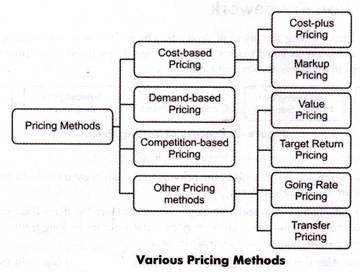
An organization has various options for selecting a pricing method. Prices are based on three dimensions that are cost, demand, and competition. The organization can use any of the dimensions or combination of dimensions to set the price of a product.

  1. Cost based Pricing:

Cost-based pricing refers to a pricing method in which some percentage of desired profit margins is added to the cost of the product to obtain the final price. In other words, cost-based pricing can be defined as a pricing method in which a certain percentage of the total cost of production is added to the cost of the product to determine its selling price. Cost-based pricing can be of two types, namely, cost-plus pricing and markup pricing.

These two types of cost-based pricing are as follows:

(i) Cost Plus Pricing

Refers to the simplest method of determining the price of a product. In cost-plus pricing method, a fixed percentage, also called mark-up percentage, of the total cost (as a profit) is added to the total cost to set the price. For example, XYZ organization bears the total cost of Rs. 100 per unit for producing a product. It adds Rs. 50 per unit to the price of product as’ profit. In such a case, the final price of a product of the organization would be Rs. 150.

Cost-plus pricing is also known as average cost pricing. This is the most commonly used method in manufacturing organizations.

In economics, the general formula given for setting price in case of cost-plus pricing is as follows:

P = AVC + AVC (M)

AVC = Average Variable Cost

M = Mark-up percentage

AVC (m) = Gross profit margin

Mark-up percentage (M) is fixed in which AFC and net profit margin (NPM) are covered.

AVC (m) = AFC + NPM

For determining average variable cost, the first step is to fix prices. This is done by estimating the volume of the output for a given period of time. The planned output or normal level of production is taken into account to estimate the output.

The second step is to calculate Total Variable Cost (TVC) of the output. TVC includes direct costs, such as cost incurred in labor, electricity, and transportation. Once TVC is calculated, AVC is obtained by dividing TVC by output, Q. [AVC = TVC / Q]. The price is then fixed by adding the mark-up of some percentage of AVC to the profit [P = AVC + AVC (m)].

Advantages of cost-plus pricing method are as follows:

  • Requires minimum information
  • Involves simplicity of calculation
  • Insures sellers against the unexpected changes in costs

Disadvantages of cost-plus pricing method are as follows:

  • Ignores price strategies of competitors
  • Ignores the role of customers

(ii) Markup Pricing

Refers to a pricing method in which the fixed amount or the percentage of cost of the product is added to product’s price to get the selling price of the product. Markup pricing is more common in retailing in which a retailer sells the product to earn profit. For example, if a retailer has taken a product from the wholesaler for Rs. 100, then he/she might add up a markup of Rs. 20 to gain profit.

It is mostly expressed by the following formula:

  • Markup as the percentage of cost= (Markup/Cost) *100
  • Markup as the percentage of selling price= (Markup/ Selling Price)*100
  • For example, the product is sold for Rs. 500 whose cost was Rs. 400. The mark up as a percentage to cost is equal to (100/400)*100 =25. The mark up as a percentage of the selling price equals (100/500)*100= 20.
  1. Demand Based Pricing:

Demand-based pricing refers to a pricing method in which the price of a product is finalized according to its demand. If the demand of a product is more, an organization prefers to set high prices for products to gain profit; whereas, if the demand of a product is less, the low prices are charged to attract the customers.

The success of demand-based pricing depends on the ability of marketers to analyze the demand. This type of pricing can be seen in the hospitality and travel industries. For instance, airlines during the period of low demand charge less rates as compared to the period of high demand. Demand-based pricing helps the organization to earn more profit if the customers accept the product at the price more than its cost.

  1. Competition Based Pricing

Competition-based pricing refers to a method in which an organization considers the prices of competitors’ products to set the prices of its own products. The organization may charge higher, lower, or equal prices as compared to the prices of its competitors.

The aviation industry is the best example of competition-based pricing where airlines charge the same or fewer prices for same routes as charged by their competitors. In addition, the introductory prices charged by publishing organizations for textbooks are determined according to the competitors’ prices.

  1. Other Pricing Methods

In addition to the pricing methods, there are other methods that are discussed as follows:

(i) Value Pricing

Implies a method in which an organization tries to win loyal customers by charging low prices for their high- quality products. The organization aims to become a low cost producer without sacrificing the quality. It can deliver high- quality products at low prices by improving its research and development process. Value pricing is also called value-optimized pricing.

(ii) Target Return Pricing

Helps in achieving the required rate of return on investment done for a product. In other words, the price of a product is fixed on the basis of expected profit.

(iii) Going Rate Pricing

Implies a method in which an organization sets the price of a product according to the prevailing price trends in the market. Thus, the pricing strategy adopted by the organization can be same or similar to other organizations. However, in this type of pricing, the prices set by the market leaders are followed by all the organizations in the industry.

(iv) Transfer Pricing

Involves selling of goods and services within the departments of the organization. It is done to manage the profit and loss ratios of different departments within the organization. One department of an organization can sell its products to other departments at low prices. Sometimes, transfer pricing is used to show higher profits in the organization by showing fake sales of products within departments.

Pricing, Meaning, Objectives, Strategies, Nature, Scope, Challenges and Factors Influencing Pricing

Pricing refers to the process of determining the value of a product or service in monetary terms. It is a critical aspect of marketing and business strategy, influencing demand, profitability, and market positioning. Effective pricing considers various factors, including production costs, competition, market demand, and perceived value. Businesses can adopt different pricing strategies, such as cost-plus pricing, value-based pricing, or penetration pricing, to achieve their objectives.

Objectives of Pricing:

  • Revenue Generation

One of the primary objectives of pricing is to generate revenue for the business. By setting prices that reflect the value of the product or service, companies can ensure that they are covering costs and making a profit. Pricing strategies should align with revenue goals, whether for short-term gains or long-term sustainability.

  • Market Penetration

Businesses often aim for market penetration through competitive pricing strategies. Lower prices can attract customers and increase market share, especially for new products entering a competitive landscape. This approach helps establish a foothold in the market, encouraging customer loyalty and fostering brand recognition.

  • Profit Maximization

Pricing is a critical lever for maximizing profits. By strategically adjusting prices based on demand, cost structure, and competitive landscape, businesses can enhance their profit margins. This may involve premium pricing for high-value products or competitive pricing to drive volume and reduce costs.

  • Competitive Positioning

Effective pricing can differentiate a product from competitors, positioning it as either a premium offering or a budget-friendly alternative. Understanding competitors’ pricing strategies allows businesses to craft their pricing in a way that highlights unique features or benefits, enhancing their market position.

  • Customer Perception

The price of a product often influences customer perception and brand image. A well-calibrated pricing strategy can convey quality, exclusivity, or affordability. For instance, luxury brands may adopt high pricing to reinforce their premium image, while discount retailers focus on value to attract cost-conscious consumers.

  • Cost Recovery

Another objective of pricing is to ensure that all costs associated with a product or service are recovered. This includes fixed costs (like overhead and salaries) and variable costs (like raw materials and production). Businesses must carefully analyze their cost structure to set prices that adequately cover expenses and support financial health.

  • Market Stabilization

Pricing strategies can also be used to stabilize markets and reduce price wars. By establishing a consistent pricing approach, companies can help prevent excessive competition that may lead to eroded profits. Collaborative pricing strategies or price signaling can help maintain market stability.

  • Demand Management

Pricing can be used as a tool to manage demand for a product or service. By implementing dynamic pricing strategies, companies can adjust prices based on real-time demand fluctuations. For example, airline ticket prices often vary based on seasonality and occupancy rates, helping to optimize revenue.

  • Promotion and Sales Strategy

Pricing objectives are often tied to promotional activities and sales strategies. Temporary discounts, bundled pricing, or special offers can be employed to stimulate sales during slow periods or to clear inventory. These strategies enhance customer engagement and drive purchases.

  • Market Segmentation

Differentiated pricing strategies can be employed to cater to various market segments. Businesses can use price discrimination, charging different prices for the same product based on customer characteristics or buying behavior. This approach allows companies to maximize revenue from each segment by capturing consumer surplus.

Strategies of Pricing:

1. Cost-Based Pricing

Cost-based pricing involves setting prices based on the costs of producing a product or service, with a markup added for profit. This strategy ensures that a business covers its expenses and achieves a desired level of profitability. It’s straightforward and easy to calculate but may not always consider market conditions or customer demand.

  • Example: A manufacturer calculates the production cost of a product and adds a 20% markup to set the retail price.

2. Penetration Pricing

Penetration pricing is used when a company aims to enter a new market or increase its market share quickly. This strategy involves setting low prices initially to attract customers, generate interest, and build brand recognition. After gaining a sufficient market share, the company may gradually raise prices.

  • Example: A new streaming service offering a low subscription fee to attract users, with plans to raise the price once customer loyalty is established.

3. Price Skimming

Price skimming is a strategy where businesses set high prices for a new or innovative product, targeting customers willing to pay a premium. Over time, prices are gradually lowered to attract more price-sensitive customers. This approach allows businesses to maximize profit from early adopters before reducing prices to capture a broader market.

  • Example: Technology companies like Apple often use skimming pricing for new smartphone launches.

4. Psychological Pricing

Psychological pricing takes advantage of consumer psychology to influence purchasing decisions. This strategy often uses pricing techniques like “charm pricing” (e.g., $9.99 instead of $10) to create the perception of a better deal. It can also involve premium pricing to position a product as high-quality or exclusive.

  • Example: A retailer prices items at $19.99 instead of $20 to make the price appear more attractive.

5. Dynamic Pricing

Dynamic pricing involves adjusting prices in real time based on factors like demand, competition, or seasonality. This strategy is commonly used in industries like airlines, hospitality, and ride-sharing services, where prices fluctuate depending on market conditions.

  • Example: Uber uses dynamic pricing (surge pricing) to increase fares during peak times or in areas with high demand.

6. Bundle Pricing

Bundle pricing is the strategy of offering multiple products or services together at a lower price than if they were purchased individually. This encourages customers to buy more items while perceiving a better value. It is often used in both consumer goods and services industries.

  • Example: Fast food chains offer meal combos, such as a burger, fries, and drink, at a discounted rate when bought together.

7. Value-Based Pricing

Value-based pricing is centered around setting prices based on the perceived value to the customer rather than the cost of production. This strategy requires businesses to understand their customers’ needs and how much they are willing to pay for the product’s benefits, features, or unique qualities.

  • Example: High-end cosmetics companies use value-based pricing by positioning their products as luxury items with added benefits like superior ingredients or packaging.

8. Competitive Pricing

Competitive pricing involves setting prices in line with competitors in the market. This strategy can either match, beat, or slightly exceed the competition’s prices based on a company’s positioning. It works best in markets with many similar products where price competition is high.

  • Example: Retailers often price similar products at competitive rates to ensure they remain attractive to consumers and avoid losing business to cheaper alternatives.

Nature of Pricing:

1. Strategic Tool

Pricing is a strategic tool that plays a pivotal role in a company’s market positioning and overall marketing mix. The price of a product or service affects how customers perceive the quality, value, and brand identity. By adjusting pricing, businesses can influence demand, increase market share, and attract specific customer segments.

  • Example: Premium pricing strategies can create a perception of high quality, while competitive pricing might be used to attract price-sensitive customers.

2. Dynamic

Pricing is not static; it is subject to change based on various internal and external factors, including demand, competition, economic conditions, and costs. Businesses often adjust their prices to respond to market fluctuations, consumer behavior, and competitor pricing strategies. Dynamic pricing helps companies remain competitive and optimize profits in a changing environment.

  • Example: Airlines often adjust ticket prices based on demand, time of booking, and availability.

3. Reflects Costs and Profit Margins

The price of a product or service is often based on the costs involved in its production, distribution, and marketing. Pricing must not only cover these costs but also ensure a profit margin for the company. Understanding fixed and variable costs is essential for setting an appropriate price that ensures profitability.

  • Example: A retailer pricing a product will factor in the cost of manufacturing, shipping, and overheads while adding a profit margin.

4. Customer-Oriented

The price must align with the perceived value of the product or service from the customer’s perspective. A customer-oriented pricing strategy considers factors such as the target market’s buying behavior, their willingness to pay, and the product’s perceived benefits. This approach helps in setting a price that customers find fair and reasonable.

  • Example: Apple’s pricing of its smartphones is based on consumer perception of innovation and quality.

5. Competitive

Pricing is heavily influenced by competition. Companies need to analyze competitors’ pricing strategies to set a price that is competitive in the market. Pricing too high may drive customers to competitors, while pricing too low could lead to a loss of perceived value. Competitive pricing ensures that businesses maintain market relevance and profitability.

  • Example: Supermarkets often adjust their prices based on competitor promotions.

6. Legal and Ethical Considerations

Pricing must adhere to legal regulations and ethical standards. In many countries, laws prevent unfair pricing practices such as price-fixing, price discrimination, and deceptive pricing. Businesses must ensure that their pricing strategies do not exploit consumers or violate antitrust laws.

  • Example: The Indian government regulates the maximum retail price (MRP) of essential goods to protect consumers.

Scope of  Pricing

1. Cost-Based Pricing

The scope of pricing starts with understanding the costs involved in producing and delivering a product or service. Pricing must cover both fixed and variable costs, while ensuring a reasonable profit margin. Cost-based pricing is often the starting point for setting prices. This approach involves determining the total cost of production and adding a desired profit margin.

  • Example: A manufacturer of a gadget may calculate its production cost and add a 20% markup to set the retail price.

2. Market-Based Pricing

Market-based pricing involves setting prices according to market demand, competition, and customer expectations. Businesses must consider external factors, including competitor pricing, market trends, and consumer demand, when setting their prices. By analyzing the market and understanding customer perceptions of value, companies can adjust their pricing strategies accordingly.

  • Example: A clothing retailer might adjust prices based on seasonal demand or competitive pricing in the market.

3. Psychological Pricing

The scope of pricing also includes psychological pricing, which uses pricing tactics to influence customer behavior. It involves setting prices that create an emotional impact, such as $9.99 instead of $10, or using prestige pricing to indicate luxury and exclusivity. These strategies are designed to appeal to the customer’s emotions and perception of value.

  • Example: A luxury brand may set prices at higher levels to create a perception of quality and exclusivity.

4. Penetration Pricing

In markets where companies aim to gain market share quickly, penetration pricing is used. This strategy involves setting a low price initially to attract customers and build brand awareness. Once the market share increases, the business may gradually raise prices. This approach is especially useful in new market entries or highly competitive industries.

  • Example: A new streaming service may offer low subscription prices to attract customers before increasing the rates.

5. Skimming Pricing

Skimming pricing strategy is often used for new, innovative products. Here, businesses set high initial prices, targeting customers who are willing to pay a premium for the latest product or service. Over time, as demand decreases or competition increases, the price is gradually reduced. This helps businesses maximize profits in the early stages of a product’s lifecycle.

  • Example: Technology companies often launch new smartphones at a high price before reducing them after a few months.

6. Discount and Promotional Pricing

Discounts and promotions are an integral part of the scope of pricing, especially in retail and e-commerce. Offering discounts, seasonal sales, or limited-time promotions can stimulate demand, clear out inventory, and attract new customers. This strategy helps businesses manage inventory and improve sales volumes during specific periods.

  • Example: A retailer offering 30% off during a holiday sale to boost sales.

7. Dynamic Pricing

Dynamic pricing is an advanced pricing strategy that involves adjusting prices in real-time based on demand, supply, or other external factors. This type of pricing is particularly common in industries like airlines, hospitality, and ride-sharing services, where prices fluctuate according to demand and availability.

  • Example: Airlines adjust ticket prices based on factors such as the time of booking and available seats.

Challenges of Pricing:

  • Market Dynamics

Market conditions, including competition, consumer demand, and economic fluctuations, can change rapidly. Businesses must continually assess these dynamics to set appropriate prices, making it challenging to maintain consistent pricing strategies. Unexpected shifts, such as economic downturns or new entrants in the market, can disrupt established pricing models.

  • Cost Fluctuations

Prices must reflect the costs associated with producing and delivering a product or service. However, fluctuating costs of raw materials, labor, and logistics can complicate pricing strategies. Businesses must frequently adjust their pricing to maintain profitability without alienating customers who may be sensitive to price increases.

  • Consumer Perception

Understanding how consumers perceive value is crucial for effective pricing. If prices are set too high, customers may perceive the product as overpriced; if too low, it may be viewed as low-quality. Striking the right balance between perceived value and price is a persistent challenge.

  • Competition

Competitive pricing is essential to attract and retain customers, but it can lead to price wars, eroding profit margins. Businesses must carefully analyze competitors’ pricing strategies and find ways to differentiate their offerings without engaging in destructive price competition.

  • Price Sensitivity

Different market segments exhibit varying levels of price sensitivity. Determining how sensitive customers are to price changes can be complex, especially in diverse markets. Businesses need to use segmentation strategies to tailor pricing to different consumer groups effectively.

  • Regulatory Constraints

Pricing can be influenced by government regulations and industry standards, especially in highly regulated sectors like pharmaceuticals, utilities, and telecommunications. Businesses must navigate these constraints while ensuring compliance and maintaining competitive pricing.

  • Psychological Pricing

Consumer psychology plays a significant role in pricing. Strategies like charm pricing (e.g., setting prices at $9.99 instead of $10) can influence purchasing decisions, but businesses must understand the psychological impact of pricing and how it relates to brand positioning.

  • Global Pricing Strategies

For companies operating in multiple countries, establishing a global pricing strategy can be particularly challenging. Factors like currency fluctuations, local market conditions, and cultural differences affect pricing decisions and require a nuanced approach.

  • Technology and Data Analytics

While technology provides tools for data-driven pricing strategies, it also introduces complexity. Businesses must effectively leverage analytics to monitor pricing performance and make informed decisions, requiring investment in technology and expertise.

Factors Influencing Pricing

  • Cost of Production

The fundamental factor influencing pricing is the cost incurred in producing goods or services. This includes direct costs (materials, labor) and indirect costs (overheads). Businesses typically set prices to cover these costs while ensuring a profit margin. Understanding the total cost structure helps in determining the minimum price point necessary for sustainability.

  • Market Demand

The level of consumer demand for a product or service significantly influences pricing. When demand is high, businesses may set higher prices due to increased willingness to pay. Conversely, when demand is low, prices may need to be reduced to stimulate sales. Market research helps identify demand elasticity and assists in forecasting how changes in price can affect sales volume.

  • Competitive Landscape

The pricing strategies of competitors play a critical role in determining a company’s pricing. Businesses must analyze competitor pricing to ensure their offerings are competitively positioned. This may involve setting prices lower to attract price-sensitive customers or higher if offering superior value or differentiation.

  • Customer Perception and Value

Customer perception of value is pivotal in pricing decisions. Pricing should reflect the perceived value of the product or service in the eyes of consumers. Factors influencing this perception include brand reputation, product quality, and the benefits offered. Effective communication of value can justify higher prices and enhance consumer willingness to pay.

  • Economic Conditions

Broader economic factors, such as inflation, interest rates, and economic growth, impact pricing decisions. In an inflationary environment, businesses may need to raise prices to maintain profit margins. Economic downturns may necessitate price reductions to retain customers facing tighter budgets.

  • Regulatory and Legal Factors

Government regulations, industry standards, and legal considerations can influence pricing. Certain industries may have pricing regulations to protect consumers, prevent price gouging, or maintain fair competition. Companies must stay compliant with these regulations while formulating their pricing strategies.

  • Distribution Channels

The choice of distribution channels affects pricing due to varying costs associated with each channel. Direct sales may allow for lower prices, while intermediaries (wholesalers, retailers) can add markup to prices. Understanding the entire distribution strategy helps in setting appropriate end-user prices.

  • Marketing Objectives

The overall marketing strategy and objectives of a business also influence pricing. For example, a company aiming to penetrate the market may adopt penetration pricing, setting low prices to attract customers quickly. Alternatively, a company focusing on premium positioning may implement skimming pricing to maximize revenue from early adopters.

Product Lifecycle, Meaning and Stages in PLC

Product Life Cycle (PLC) is an important concept in Principles of Marketing that explains the stages through which a product passes from its introduction in the market to its final decline. Every product has a limited life span, and during this life span, its sales, profits, competition, and marketing strategies change. Understanding the product life cycle helps marketers plan product development, pricing, promotion, and distribution strategies effectively. The concept of PLC provides a systematic framework for managing products in a dynamic and competitive market environment.

Meaning of Product Life Cycle

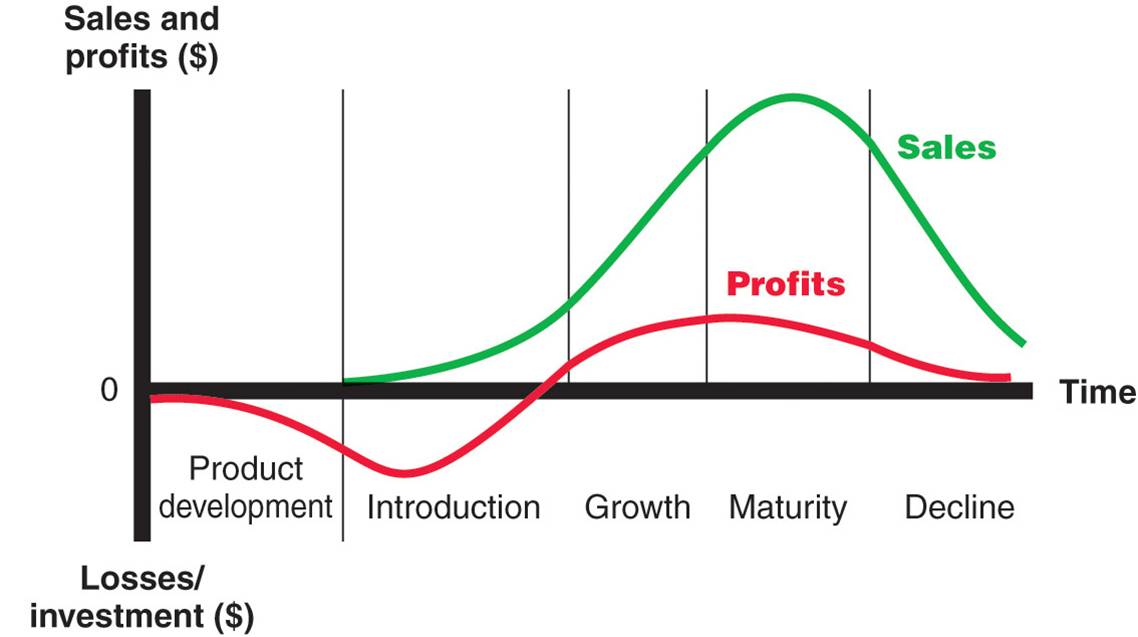
Product Life Cycle refers to the pattern of sales and profits experienced by a product over time. It represents the journey of a product from its launch to its withdrawal from the market. Just like human beings, products are born, grow, mature, and eventually decline. Although the length of each stage may vary from product to product, most products generally pass through five stages: Introduction, Growth, Maturity, and Decline. Each stage has distinct characteristics and requires different marketing strategies.

Product-Life-Cycle-Stages

Stages of Product Life Cycle

1. Introduction Stage

The introduction stage is the first stage of the product life cycle, where a new product is launched in the market. During this stage, sales growth is slow because the product is new and customers are not fully aware of its existence. Heavy expenditure is incurred on advertising, promotion, product development, and distribution. Profits are usually low or negative due to high initial costs and low sales volume.

The main objective should be to create product awareness and trial.

In this stage, competition is limited or absent as the product is unique. Pricing strategies may vary—firms may adopt skimming pricing to recover high costs or penetration pricing to gain quick market acceptance. Promotion focuses on creating awareness, educating consumers, and encouraging trial purchases. Distribution channels are limited, and the product is available only in selected markets. The success of the introduction stage depends largely on effective promotion and product acceptance.

2. Growth Stage

The growth stage is characterized by a rapid increase in sales as the product gains acceptance among consumers. Customer awareness increases, repeat purchases occur, and new customers are attracted. Profits rise significantly due to higher sales volume and reduced cost per unit. During this stage, competitors enter the market with similar or improved versions of the product.

The main objective in the growth stage is to maximise the market share.

Marketing strategies in the growth stage focus on improving product quality, adding new features, expanding distribution channels, and strengthening brand image. Prices may be reduced slightly to attract price-sensitive customers and face competition. Promotional activities shift from creating awareness to building brand preference and differentiation. The growth stage is crucial for establishing a strong market position and maximizing long-term profitability.

3. Maturity Stage

The maturity stage is the longest stage of the product life cycle. During this stage, sales growth slows down as the product reaches maximum market penetration. The market becomes saturated, and competition becomes intense. Many competitors offer similar products, leading to price competition and reduced profit margins.

The company’s main objective should be to maximise profit while defending the market share.

Firms adopt various strategies to extend the maturity stage, such as product modification, market modification, and marketing mix modification. Product modification includes improving quality, design, packaging, or adding new features. Market modification involves finding new uses, new markets, or new customer segments. Promotional strategies focus on brand loyalty, reminders, and sales promotion schemes. Although profits start declining, effective strategies can help sustain sales and profitability.

4. Decline Stage

The decline stage is the final stage of the product life cycle. During this stage, sales and profits decline sharply due to technological advancements, changing consumer preferences, availability of substitutes, or market saturation. Some competitors exit the market, while others continue with limited offerings.

Marketing strategies during the decline stage include harvesting, divesting, or discontinuing the product. Firms may reduce promotional expenditure, cut costs, and focus on niche markets. Alternatively, companies may rejuvenate the product through innovation or repositioning. The decline stage requires careful decision-making to minimize losses and allocate resources efficiently.

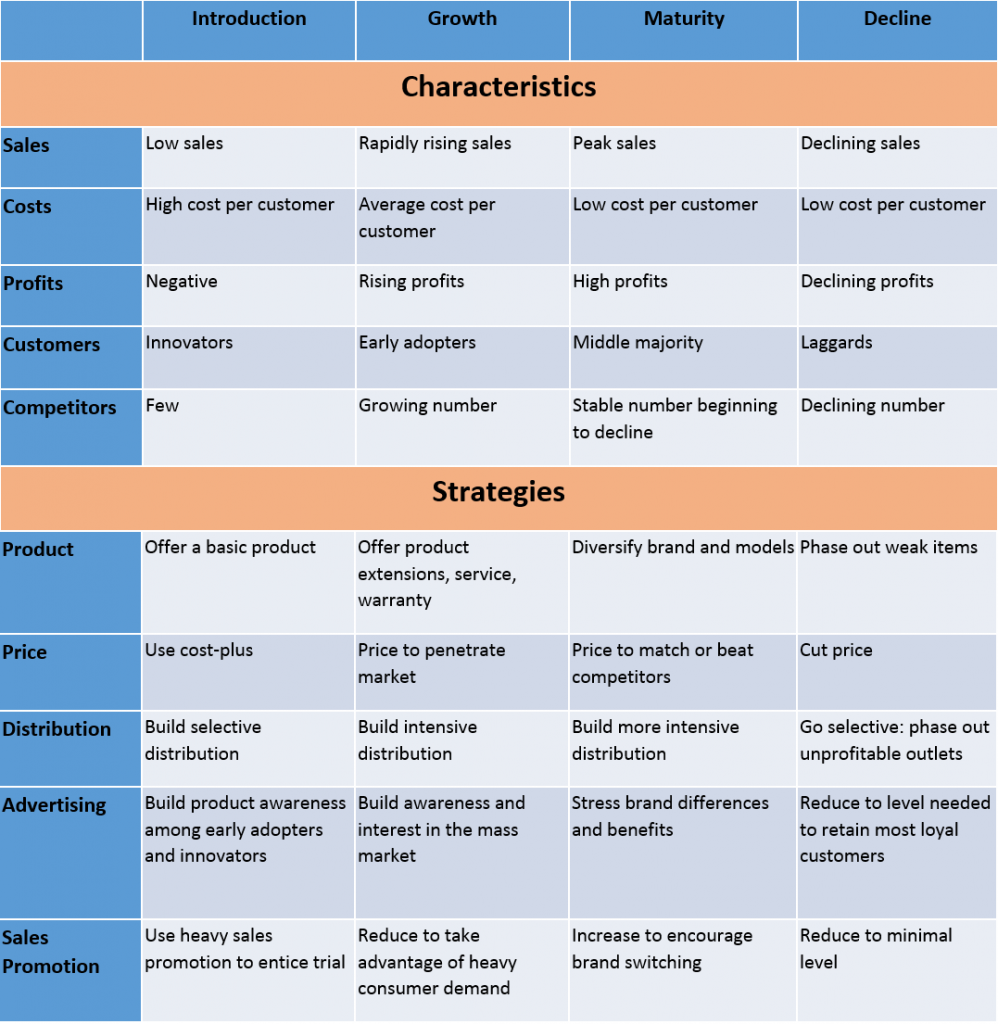
Product-Life-Cycle-Strategies-and-Characteristics-998x1024

Marketing Strategies at Different Product Life Cycle (PLC) Stages

Marketing strategies vary at each stage of the Product Life Cycle because market conditions, competition, sales volume, and consumer behavior change over time. To achieve maximum effectiveness, firms must align their product, price, place, and promotion strategies with the specific stage of the PLC. The major marketing strategies at different PLC stages are explained below.

1. Introduction Stage

At the introduction stage, the product is new to the market and consumer awareness is low. The main objective of marketing is to create awareness and encourage trial purchases.

  • Product Strategy

The product is introduced in its basic form with limited varieties. Emphasis is placed on quality and uniqueness.

  • Price Strategy

Firms may adopt skimming pricing to recover high development costs or penetration pricing to attract more customers quickly.

  • Place Strategy

Distribution is limited and selective. The product is available in selected markets and outlets.

  • Promotion Strategy

Promotion is informative in nature. Heavy advertising, product demonstrations, free samples, and personal selling are used to educate consumers.

2. Growth Stage

In the growth stage, sales increase rapidly due to rising consumer acceptance and increasing competition. The objective is to build brand preference and expand market share.

  • Product Strategy

Product improvements, new features, and additional models are introduced to differentiate from competitors.

  • Price Strategy

Prices may be reduced slightly to attract price-sensitive customers and meet competition.

  • Place Strategy

Distribution channels are expanded to reach a wider market. Product availability increases.

  • Promotion Strategy

Promotion becomes persuasive. Advertising focuses on brand image, superiority, and customer benefits.

3. Maturity Stage

The maturity stage is marked by intense competition, market saturation, and slowing sales growth. The objective is to maintain market share and extend product life.

  • Product Strategy

Product modification, quality improvement, new packaging, and value-added features are introduced.

  • Price Strategy

Competitive pricing, discounts, and allowances are used to retain customers.

  • Place Strategy

Distribution becomes intensive. Firms strengthen relationships with intermediaries.

  • Promotion Strategy

Promotion focuses on reminder advertising, sales promotion schemes, and brand loyalty programs.

4. Decline Stage

In the decline stage, sales and profits decline due to technological changes, substitutes, or changing consumer preferences. The objective is to minimize losses.

  • Product Strategy

Firms may discontinue weak products or focus on profitable variants.

  • Price Strategy

Prices may be reduced to clear stock or maintained for niche markets.

  • Place Strategy

Distribution is reduced and unprofitable outlets are eliminated.

  • Promotion Strategy

Promotional expenditure is minimized. Only selective promotion is undertaken.

Marketing Strategies at Different PLC Stages

PLC Stage Sales & Profits Product Strategy Price Strategy Place (Distribution) Promotion Strategy
Introduction Low sales, low/negative profits Basic product, limited variants Skimming / Penetration Selective, limited outlets Informative advertising, awareness creation
Growth Rapidly increasing sales, rising profits Improved quality, new features, variants Competitive pricing Expanded channels, wider market reach Persuasive advertising, brand building
Maturity Peak sales, declining profits Product modification, better packaging Competitive pricing, discounts Intensive distribution Reminder advertising, sales promotion
Decline Falling sales and profits Product elimination or niche focus Reduced or stable niche pricing Reduced channels Minimal promotion, cost control

Advantages of Product Life Cycle (PLC)

  • Helps in Effective Product Planning

The Product Life Cycle concept helps marketers plan products effectively at different stages. By identifying whether a product is in the introduction, growth, maturity, or decline stage, firms can decide necessary changes in product features, quality, packaging, and branding. Proper product planning reduces chances of failure and ensures that products meet changing customer needs throughout their life span.

  • Supports Better Marketing Strategy Formulation

PLC assists marketers in designing suitable marketing strategies for each stage of a product’s life. Pricing, promotion, and distribution strategies differ at every stage. For example, informative promotion is used in the introduction stage, while persuasive promotion is used in the growth stage. Thus, PLC ensures the right marketing mix is applied at the right time.

  • Helps in Sales and Demand Forecasting

The product life cycle helps firms forecast future sales and demand patterns. By studying past and present sales trends, marketers can predict future performance. Accurate forecasting helps in production planning, inventory control, and resource allocation. This reduces uncertainty and enables firms to prepare for market changes in advance.

  • Assists in Cost Control and Profit Planning

PLC helps organizations control costs and plan profits effectively. During the introduction stage, firms accept low or negative profits, while in the growth and maturity stages, they aim to maximize profits. In the decline stage, cost-cutting strategies are adopted. Thus, PLC enables better financial planning and efficient use of resources.

  • Aids in Product Modification and Innovation

The PLC concept encourages continuous product improvement and innovation. When a product enters the maturity stage, firms modify features, design, or packaging to extend its life. Innovation helps in meeting changing consumer preferences and facing competition. PLC ensures that firms do not rely on outdated products for long periods.

  • Helps in Managing Competition

PLC helps firms understand the level of competition at different stages. Competition is low in the introduction stage but increases in the growth and maturity stages. By knowing the intensity of competition, firms can adopt defensive or aggressive strategies. This improves competitive strength and market position.

  • Supports Product Portfolio Management

The product life cycle helps firms manage a balanced product portfolio. Companies usually have products at different PLC stages. Profits from mature products can be used to support new products in the introduction stage. This balance ensures steady income, reduces risk, and supports long-term business stability.

  • Guides Product Withdrawal Decisions

PLC helps firms decide the right time to discontinue or withdraw a product. When a product enters the decline stage and becomes unprofitable, firms can drop it and divert resources to new opportunities. This prevents unnecessary losses and improves overall efficiency and performance of the organization.

Limitations of Product Life Cycle (PLC)

  • Difficulty in Identifying Exact Stage

One major limitation of the Product Life Cycle concept is the difficulty in identifying the exact stage of a product. Sales patterns are not always clear, and stages may overlap. Managers may misjudge whether a product is in growth or maturity, leading to incorrect marketing decisions and ineffective strategies.

  • Not Applicable to All Products

The PLC concept does not apply uniformly to all products. Some products may not follow a clear life cycle pattern, while others may remain in one stage for a long time. Fashion products, fads, and seasonal goods often have unpredictable life cycles, limiting the usefulness of the PLC model.

  • Uncertainty in Duration of Stages

The length of each stage of the product life cycle cannot be predicted accurately. Some products may experience rapid growth and quick decline, while others may remain in the maturity stage for many years. This uncertainty makes long-term planning difficult for marketers.

  • External Factors Affect the Life Cycle

External factors such as technological changes, government policies, economic conditions, and competition can alter the product life cycle. Sudden innovations or regulatory changes may shorten or extend a product’s life unexpectedly. The PLC concept does not fully consider these uncontrollable environmental factors.

  • Overemphasis on Sales and Profits

The PLC concept mainly focuses on sales and profit trends and ignores other important factors such as customer satisfaction, brand equity, and market relationships. A product with low sales may still be strategically important for brand image or customer retention, which PLC may overlook.

  • Reactive Rather Than Predictive

PLC is more descriptive than predictive in nature. It explains what has happened to a product rather than accurately predicting future performance. Managers often use PLC after changes occur, which may result in delayed responses to market challenges.

  • Ignores Marketing Efforts Impact

The PLC model assumes that products naturally move through stages, but it does not fully recognize the impact of marketing efforts. Aggressive promotion, repositioning, or innovation can significantly change a product’s life cycle. Thus, PLC may underestimate the role of managerial decisions.

  • Difficult to Use in Strategic Decisions

Due to its generalized nature, PLC may not provide clear guidance for strategic decision-making. Different products within the same category may be at different stages. Relying solely on PLC can lead to oversimplified strategies and poor decision-making.

Product Mix, Meaning, Elements and Strategy

Product Mix refers to the complete range of products that a company offers for sale to its customers. It includes all product lines and individual products that a company markets, showcasing variety in terms of size, design, functionality, or price. The product mix is characterized by four key dimensions: width (the number of product lines), length (the total number of products), depth (the variety within each product line), and consistency (how closely related the product lines are). A well-balanced product mix allows companies to meet diverse customer needs and expand market reach.

Elements of Product Mix

Elements of the Product mix. refer to the various components that make up a company’s range of products. These elements help a business manage its products and create a comprehensive strategy for satisfying customer needs and driving profitability. The main elements of the product mix are Product line, Product width, Product length, Product depth, and Product consistency.

1. Product Line

Product line is a group of related products that a company offers under a single brand. These products usually share similar characteristics, cater to the same target market, or serve similar purposes. For example, a company that produces personal care items may have separate product lines for hair care, skincare, and hygiene products.

  • Example: Apple’s product lines include iPhones, iPads, MacBooks, and Apple Watches

2. Product Width

Product width refers to the number of different product lines that a company offers. A wider product mix means a company has a diverse range of product lines, while a narrower mix indicates fewer product lines. A broad product width allows companies to cater to various customer segments, reduce market risk, and create cross-selling opportunities.

  • Example: Procter & Gamble has a wide product mix, offering a variety of product lines including beauty, grooming, health care, and household cleaning.

3. Product Length

Product length is the total number of individual products or items offered across all product lines. This includes all variants within each product line. The length helps companies assess the variety of products they offer within each product line.

  • Example: In the beverage category, Coca-Cola offers a long product line, with products such as Coke, Diet Coke, Coke Zero, Sprite, and Fanta.

4. Product Depth

Product depth refers to the number of variations offered within a single product line. Variations can include different sizes, flavors, colors, designs, or any other features that differentiate products within a line. Greater product depth allows companies to meet diverse customer preferences and capture niche markets.

  • Example: Colgate offers various toothpaste options in terms of flavors, packaging sizes, and specific benefits (e.g., whitening, cavity protection, sensitivity relief).

5. Product Consistency

Product consistency refers to how closely related the product lines are in terms of use, production requirements, distribution channels, or branding. High consistency means the products are closely related, while low consistency indicates a mix of unrelated products.

  • Example: A company like PepsiCo has a relatively consistent product mix focused on beverages and snacks, while a conglomerate like General Electric has a low consistency with products ranging from jet engines to medical devices.

Example of Product Mix.: in Table

Here’s a table that illustrates an example of a Product Mix. for a hypothetical company, including various product lines and their respective products:

Element Description Example
Product Line A group of related products offered by a company under one brand, sharing similar characteristics. Apple’s product lines include iPhones, iPads, MacBooks, and Apple Watches.
Product Width The number of different product lines a company offers. Procter & Gamble offers product lines in beauty, grooming, health care, and household cleaning.
Product Length The total number of individual products or items offered across all product lines. Coca-Cola’s beverage category includes Coke, Diet Coke, Coke Zero, Sprite, and Fanta.
Product Depth The number of variations offered within a single product line (e.g., sizes, flavors, colors). Colgate offers toothpaste in various sizes, flavors, and specific benefits like whitening or sensitivity relief.
Product Consistency How closely related product lines are in terms of use, production, distribution, or branding. PepsiCo focuses on beverages and snacks (high consistency), while General Electric offers diverse products like jet engines and medical devices (low consistency).

Product Mix Strategies

Product Mix Strategies are techniques companies use to manage and optimize their range of products to better meet customer needs and improve market performance. These strategies help in deciding what products to introduce, modify, or discontinue.

  • Expansion

A company adds new product lines or variants to its product mix. This strategy is used when a company wants to diversify its offerings, target new market segments, or increase sales volume.

  • Contraction

Also known as product line pruning, this strategy involves reducing the number of products or product lines. Companies use this when certain products become unprofitable or when they want to focus on their core products.

  • Product Modification

Company makes improvements or changes to existing products, such as adding new features, improving quality, or updating design. This strategy helps keep products competitive and relevant in the market.

  • Diversification

Company enters new markets or introduces entirely new product categories. It can be related or unrelated diversification, depending on whether the new products are similar or different from the existing lines.

  • Product Differentiation

This strategy focuses on making a product stand out from competitors’ offerings by highlighting its unique features, branding, or design. It aims to create a competitive advantage and attract specific customer segments.

  • Trading Up (Upward Stretching)

Company adds higher-end, more premium products to its product line to target more affluent customers. This strategy helps elevate the brand and capture a more profitable segment of the market.

  • Trading Down (Downward Stretching)

Company introduces lower-priced products to appeal to a broader audience or to compete with lower-cost competitors. This can help companies gain market share in a more price-sensitive segment.

  • Line Filling

Company adds new products within its existing range to fill gaps in the product line. This prevents competitors from exploiting these gaps and helps the company meet customer demands more effectively.

  • Product Line Extension

This involves expanding a particular product line by adding more variants, such as different sizes, flavors, or features. It helps attract different customer preferences within the same product line.

  • Cannibalization Management

This strategy ensures that new products introduced do not negatively affect the sales of the company’s existing products. Companies need to carefully manage product mix to avoid overlap and sales losses.

Product Line, Meaning, Working, Product Line Extension, Features, Types, Benefits, and Challenges

Product Line refers to a group of related products offered by a company that share similar characteristics, target the same market, or serve a similar purpose. These products typically fall under a single brand and are marketed together, allowing companies to leverage their branding and promotional strategies effectively. For example, a beverage company might have a product line that includes various types of soft drinks, juices, and bottled water. By managing product lines strategically, businesses can meet diverse customer needs while optimizing their overall product mix.

How Product Lines Work?

Product lines play a crucial role in a company’s overall marketing strategy by grouping related products to meet specific customer needs.

  • Definition and Structure

Product line is a collection of products that are related in terms of their functions, target market, or marketing strategy. Companies organize their offerings into product lines to streamline management and marketing efforts.

  • Target Market Identification

Each product line is designed to cater to a specific segment of the market. By understanding the needs and preferences of target customers, businesses can develop products within the line that appeal directly to that audience.

  • Branding and Positioning

Products within a line often share a common brand name and identity. This creates brand recognition and loyalty, making it easier for customers to associate new products with established ones. Positioning the entire line effectively can enhance overall brand perception.

  • Product Variations

Companies can offer variations within a product line to address different consumer preferences. These variations may include differences in size, flavor, features, or packaging. For example, a snack brand might offer different flavors or health-focused options within its chip product line.

  • Cross-Promotion

Having a well-defined product line allows for cross-promotion of products. For example, if a company launches a new flavor of chips, it can promote it alongside other products in the same line, encouraging customers to try multiple offerings.

  • Economies of Scale

By producing a range of products within the same line, companies can benefit from economies of scale in production, distribution, and marketing. Shared resources can lead to cost savings and improved efficiency.

  • Flexibility and Adaptation

Product lines provide flexibility for companies to adapt to changing market trends and consumer preferences. Businesses can introduce new products, retire underperforming ones, or make adjustments based on feedback from the target market.

  • Performance Evaluation

Companies can evaluate the performance of a product line as a whole, assessing sales, market share, and profitability. This analysis helps in making strategic decisions about resource allocation, marketing efforts, and future product development.

  • Market Expansion

Successful product lines can serve as a foundation for market expansion. Companies can introduce entirely new lines based on the success of existing products, leveraging brand equity and consumer loyalty.

  • Lifecycle Management

Each product line goes through a lifecycle, from introduction to growth, maturity, and decline. Companies must actively manage their product lines by innovating, repositioning, or phasing out products to maximize profitability.

Product Line Extension

Product Line Extension refers to the strategy of adding new products to an existing product line to attract a larger customer base or to meet the evolving needs of consumers. This approach allows companies to leverage their established brand equity and customer loyalty while expanding their offerings.

Key Features of Product Line Extension

  • Broadened Range of Products

Product line extension involves introducing variations or new items that are related to the existing products in the line. For instance, a yogurt brand might add new flavors, low-fat options, or plant-based varieties to its product line.

  • Utilization of Brand Equity

By extending a well-known product line, companies can capitalize on the recognition and trust established with their existing products. This can lead to quicker acceptance of new products by consumers.

  • Meeting Diverse Customer Needs

Product line extensions can address different consumer preferences, demographics, and market segments. For example, a beverage company may introduce a new energy drink variant to cater to health-conscious consumers.

  • Increased Market Share

By offering a wider variety of products, companies can capture a larger share of the market and reduce competition. This is particularly effective in crowded markets where differentiation is crucial.

  • Reduced Risk of New Product Failure

Launching a product extension under an established brand is generally less risky than introducing an entirely new brand. Consumers are more likely to try a new product from a brand they already trust.

Types of Product Line Extensions

1. New Flavors or Varieties: Adding different flavors or styles to an existing product. For example, a snack brand may introduce sweet and spicy versions of its chips.

2. Size Variations: Offering products in different sizes, such as single-serving or family-size packages, to meet varying consumption needs.

3. Healthier Options: Introducing low-calorie, organic, or gluten-free versions of existing products to cater to health-conscious consumers.

4. Targeting New Demographics: Developing products aimed at different age groups, lifestyles, or interests, such as a kids’ version of a popular cereal.

5. Seasonal or Limited Editions: Launching special edition products tied to seasons, holidays, or events to stimulate interest and drive sales.

Benefits of Product Line Extension:

1. Increased Sales Potential: A broader product range can lead to higher overall sales, as customers may purchase multiple items from the same line.

2. Enhanced Brand Loyalty: By continuously offering new options, companies can maintain customer interest and encourage repeat purchases.

3. Efficient Use of Resources: Companies can utilize existing marketing strategies, distribution channels, and production processes to launch new products, reducing costs.

4. Competitive Advantage: A diverse product line can help a company stand out in a competitive marketplace by offering more choices to consumers.

Challenges of Product Line Extension

  • Brand Dilution

If not managed properly, extending a product line can dilute brand identity. Consumers may become confused about what the brand stands for if there are too many unrelated products.

  • Cannibalization

New products may compete with existing ones, potentially leading to a decline in sales of the original products.

  • Quality Control

Maintaining consistent quality across an extended product line can be challenging, especially when introducing new variants.

  • Market Research Needs

Thorough market research is necessary to ensure that the new products meet consumer needs and preferences. Failure to do so can result in unsuccessful product launches.

Examples of Product Line Extension

  • Coca-Cola

The introduction of Diet Coke and Coca-Cola Zero Sugar expanded the original Coca-Cola product line to cater to health-conscious consumers.

  • Lay’s

Lay’s offers a variety of flavors and limited-edition chips, including spicy, exotic, and local flavors to appeal to different tastes.

  • Oreo

Oreo cookies have been extended to include various flavors (like birthday cake and red velvet) and formats (such as Oreo Thins and Mega Stuf).

  • Nike

Nike has expanded its line of athletic shoes to include specialized versions for different sports, lifestyles, and even collaborations with celebrities.

  • Procter & Gamble

P&G has extended its Tide brand to include Tide Pods, Tide Free & Gentle, and other variants, addressing various laundry needs.

Market Segmentation, Basis of Market Segmentation

Market Segmentation is a critical marketing strategy that involves dividing a broad target market into smaller, more manageable segments based on shared characteristics. This process enables businesses to tailor their marketing efforts to meet the specific needs of different consumer groups. The basis of market segmentation can be categorized into several key criteria, including demographic, geographic, psychographic, and behavioral factors.

Demographic Segmentation:

Demographic segmentation is one of the most common bases for segmenting a market. It divides consumers based on demographic factors such as:

  • Age:

Different age groups have distinct needs and preferences. For instance, products aimed at teenagers, such as trendy clothing, will differ significantly from those aimed at older adults, like retirement planning services.

  • Gender:

Men and women often have different buying behaviors and preferences. Marketers can tailor their messages and products accordingly. For example, beauty and grooming products are often marketed differently to men and women.

  • Income:

Consumer purchasing power varies significantly across different income levels. Luxury brands typically target higher-income segments, while budget-friendly products are designed for lower-income consumers.

  • Education Level:

Education can influence consumer preferences and behavior. For instance, products requiring technical knowledge might be marketed to more educated consumers.

  • Family Size and Lifecycle:

Family structures influence purchasing decisions. Marketers can create products that cater to single individuals, couples, or families with children.

Geographic Segmentation:

Geographic segmentation divides the market based on geographic boundaries. Factors influencing this type of segmentation include:

  • Region:

Different regions may have distinct cultural, economic, and climatic conditions that affect consumer behavior. For example, winter clothing is more relevant in colder regions compared to warmer ones.

  • Urban vs. Rural:

Consumer needs and behaviors can vary significantly between urban and rural areas. Urban consumers might prefer convenience products, while rural consumers might favor traditional, locally sourced goods.

  • Climate:

Climate can influence product usage and preferences. For instance, summer clothing and outdoor equipment may be marketed differently in tropical regions than in colder climates.

Psychographic Segmentation:

Psychographic segmentation focuses on the psychological aspects of consumer behavior, including values, interests, lifestyles, and personality traits. Key factors:

  • Lifestyle:

Consumers’ lifestyles influence their purchasing decisions. For instance, health-conscious consumers might be targeted with organic food products and fitness-related services.

  • Personality:

Different personality traits can affect consumer preferences. Brands often position themselves to resonate with certain personality types. For example, adventurous brands may appeal to thrill-seekers.

  • Values and Beliefs:

Consumers’ values and beliefs significantly impact their buying behavior. Brands that align with specific values, such as sustainability or social responsibility, can attract consumers who prioritize these attributes.

Behavioral Segmentation:

Behavioral segmentation divides the market based on consumer behaviors and interactions with a product or brand. Factors influencing behavioral segmentation:

  • Purchase Occasion:

Consumers may buy products based on specific occasions, such as holidays, birthdays, or back-to-school season. Marketers can create campaigns that align with these occasions to boost sales.

  • Benefits Sought:

Different consumers seek different benefits from the same product. For example, in the toothpaste market, some consumers may prioritize whitening, while others may focus on cavity protection.

  • Usage Rate:

Consumers can be segmented based on their usage patterns. Heavy users, moderate users, and light users may all have different needs and responses to marketing efforts.

  • Loyalty Status:

Consumers exhibit varying degrees of brand loyalty. Marketers can target brand advocates with loyalty programs while trying to convert occasional buyers into loyal customers.

Technological Segmentation:

With the rise of digital marketing, technological segmentation has emerged as an important basis. This involves categorizing consumers based on their technology usage and preferences:

  • Device Usage:

Consumers may prefer different devices (smartphones, tablets, laptops) for accessing information and making purchases. Marketers can optimize their content for specific devices.

  • Digital Behavior:

Online consumer behavior, such as browsing habits and social media engagement, can provide insights into segmentation. Marketers can tailor their strategies based on how consumers interact with digital platforms.

Firmographic Segmentation (for B2B Markets):

In B2B (business-to-business) marketing, firms can be segmented based on organizational characteristics:

  • Industry:

Businesses in different industries have unique needs and challenges. For instance, software solutions for healthcare providers will differ from those designed for retail businesses.

  • Company Size:

The size of a business influences purchasing decisions. Large enterprises may require more complex solutions compared to small businesses.

  • Location:

Geographical factors also play a role in B2B segmentation, with regional market dynamics impacting business decisions.

  • Business Model:

Companies can be categorized based on their operational models (B2B, B2C, C2C), influencing how products or services are marketed.

Multi-Dimensional Segmentation:

Increasingly, businesses are adopting multi-dimensional segmentation approaches that combine various bases to create more refined segments. This method acknowledges that consumers may belong to multiple segments simultaneously. For example, a company may target health-conscious, urban consumers with high incomes who prioritize convenience. By utilizing a multi-dimensional approach, marketers can create highly tailored campaigns that resonate with specific audience segments.

Marketing Mix, Meaning, Characteristics and Elements of Marketing mix

Marketing Mix. refers to the combination of key elements that businesses use to promote and sell their products or services effectively. Traditionally known as the 4 Ps—Product, Price, Place, and Promotion—the marketing mix helps companies develop a strategic plan to meet consumer needs, maximize profitability, and differentiate their offerings in the market. The mix has evolved to include additional Ps such as People, Process, and Physical Evidence, especially in service industries, addressing both tangible and intangible aspects of marketing to ensure a comprehensive approach to customer satisfaction and business success.

Determining the Marketing-Mix

The purpose of determining the marketing mix is to meet the needs and wants of customers in the most efficient and cost-effective way. Since customer preferences and external factors evolve over time, the marketing mix must also change and remain flexible. As a dynamic concept, the marketing mix cannot be static. According to Philip Kotler, “Marketing mix represents the setting of the firm’s marketing decision variables at a particular point in time.”

The process of determining the marketing mix, or making marketing decisions, involves the following steps:

  • Identification

The first step is to identify the target customers to whom the company intends to sell its products or services. This involves pinpointing the market segment most likely to purchase and benefit from the offering.

  • Analysis

Once the target market is identified, the next step is to analyze the needs, desires, and behaviors of these customers. Market research is employed to gather information on the size, location, buying power, and motivations of the target audience. Additionally, an understanding of competitive forces, dealer behavior, and relevant government regulations is essential for shaping the marketing mix.

  • Design

Based on the insights gained through identification and analysis, the next step is to design an appropriate mix of the 4 Ps: Product, Price, Promotion, and Place (distribution). This step involves not only determining each element of the marketing mix but also ensuring proper integration and alignment of all components to create a cohesive strategy that reinforces one another.

  • Testing

Before full implementation, it is beneficial to test the designed marketing mix on a small scale with a select group of customers. By gauging their reactions, the company can determine whether adjustments are needed to improve the effectiveness of the mix.

  • Adoption

Once any necessary modifications are made, the marketing mix is officially adopted and implemented. The company must continuously monitor and evaluate its effectiveness, adapting to any changes in the business environment or customer preferences over time. Regular updates ensure the marketing mix remains relevant and effective.

Characteristics/Features/Nature of Marketing Mix

  • Customer-Centric

The marketing mix revolves around understanding and meeting the needs of the target customer. Each element is designed to appeal to customer preferences, ensuring satisfaction and fostering loyalty. A deep understanding of customer behavior, preferences, and expectations is essential.

  • Interdependent Elements

The components of the marketing mix are not isolated; they are interdependent and work together to create a cohesive strategy. For example, pricing decisions can impact promotion strategies, and distribution choices can influence product development.

  • Dynamic and Flexible

The marketing mix is dynamic, meaning it must evolve as market conditions, customer preferences, competition, and technology change. Companies must regularly review and adjust their marketing mix to stay competitive and relevant.

  • Adaptable to Market Conditions

The marketing mix needs to adapt to different market environments, such as economic fluctuations, political changes, and cultural shifts. For example, a company may need to modify its pricing strategy during a recession or alter its promotion methods for different cultural markets.

  • Blends Traditional and Modern Approaches

Today’s marketing mix blends traditional (product, price, place, promotion) and modern components, such as digital marketing, customer experiences, and sustainability practices. This allows businesses to reach broader and more diverse audiences through multiple channels.

  • Focus on Differentiation

One of the key characteristics of the marketing mix is the focus on differentiating the product or service from competitors. This could be through product features, pricing strategies, promotional tactics, or unique distribution methods, allowing the company to create a competitive advantage.

  • Balance Between Customer Needs and Business Objectives

While the marketing mix is centered around customer satisfaction, it also considers the company’s business goals, such as profitability, market share, and brand positioning. The marketing mix aims to find the balance between these two priorities.

  • Product-Specific

The marketing mix is tailored to specific products or services. Each product or service may require a unique combination of the marketing mix elements, depending on factors like the target market, competition, and industry trends.

  • Helps in Decision-Making

The marketing mix provides a structured framework for businesses to make marketing decisions. By breaking down the 4 Ps, managers can make informed choices about how to allocate resources, what strategies to pursue, and how to engage with customers.

  • Supports Competitive Positioning

An effective marketing mix helps a company position itself against competitors. By optimizing elements such as product features, pricing strategies, and distribution channels, businesses can position their brand and offerings in a way that distinguishes them from competitors.

  • Affects All Aspects of Marketing

The marketing mix touches every aspect of marketing—from product development to customer engagement. It influences decisions related to market research, advertising campaigns, pricing models, and distribution channels, ensuring a consistent and integrated marketing effort.

  • Emphasizes Customer Experience

Beyond the traditional focus on product and price, today’s marketing mix increasingly emphasizes the overall customer experience. This includes not just the quality of the product, but also the process of purchasing, customer service, and post-purchase support.

Elements of Marketing Mix:

  • Product

The product element refers to the tangible goods or intangible services that a business offers to meet the needs or desires of its target market. It includes decisions regarding the design, features, quality, variety, and functionality of the product or service. Effective product strategies focus on ensuring that the product provides value, meets customer expectations, and differentiates itself from competitors. Products must be continuously improved and adapted to evolving customer needs and preferences.

  • Price

Price is the amount of money customers must pay to obtain the product or service. It plays a crucial role in determining the perceived value of the product. Pricing strategies include competitive pricing, discount pricing, psychological pricing, and value-based pricing, among others. The goal is to set a price that aligns with the target market’s willingness to pay while maintaining profitability for the business. Factors such as production costs, competitor prices, and market demand influence pricing decisions.

  • Place

Place refers to the distribution channels through which the product reaches the customer. This includes the locations, intermediaries, and logistics involved in making the product available. Companies must ensure that their products are accessible to the target audience through physical stores, online platforms, or a combination of both. Effective placement strategies also consider factors such as market reach, geographic location, and convenience for customers.

  • Promotion

Promotion encompasses all the activities that communicate the product’s benefits and persuade customers to make a purchase. This element involves advertising, sales promotions, public relations, direct marketing, and digital marketing tactics. The purpose of promotion is to increase brand awareness, drive consumer interest, and encourage sales. Companies use various promotional tools, including social media, email campaigns, TV ads, and discounts, to engage customers and keep the product top of mind.

  • People

People refer to the employees, customers, and other stakeholders who interact with the product or service. In service industries, the customer experience is heavily influenced by the behavior and attitudes of employees, as they are often the face of the brand. Companies focus on training employees, maintaining strong customer relationships, and creating a positive experience for both employees and customers.

  • Process

The process element refers to the procedures, mechanisms, and flow of activities by which services are consumed. It includes the steps involved in service delivery, such as customer service interactions, payment methods, and after-sales support. Businesses must streamline processes to ensure efficiency, consistency, and customer satisfaction. A smooth process can greatly enhance customer loyalty and contribute to the overall success of the business.

  • Physical Evidence

Physical evidence is particularly important for service-based industries where the product cannot be physically touched or seen. It includes the physical environment, branding, and any tangible components that help customers evaluate the service experience. Examples include the layout of a retail store, the website interface, packaging, and brochures. Providing strong physical evidence helps customers feel more confident about the service and strengthens the brand’s credibility.

error: Content is protected !!