Social Issues in Retailing in India

Retailing in India, like in many other countries, is influenced by a variety of social issues that impact both the industry and consumers. These issues often reflect the broader social and cultural context of the country.

Addressing these social issues requires a holistic approach from retailers, encompassing ethical business practices, cultural sensitivity, and responsiveness to changing consumer dynamics. By aligning their strategies with the social fabric of India, retailers can build stronger connections with their customer base and contribute positively to society. This involves not only understanding the diverse needs of consumers but also actively participating in social initiatives that align with the values of the community.

  • Diversity and Cultural Sensitivity:

India is a diverse country with multiple languages, cultures, and traditions. Retailers need to be sensitive to this diversity in their marketing strategies, product offerings, and customer interactions. Cultural insensitivity can lead to backlash and negatively impact a brand’s image.

  • Consumer Behavior and Preferences:

Consumer preferences in India can vary significantly across regions and demographic segments. Retailers must stay attuned to evolving consumer trends, preferences, and purchasing behaviors to tailor their offerings and marketing strategies effectively.

  • Gender Sensitivity:

Gender plays a significant role in shaping consumer behavior. Retailers need to be aware of gender-related social issues and promote inclusivity in their marketing and advertising. Creating gender-neutral spaces and products can be essential for attracting a diverse customer base.

  • Economic Disparities:

India faces economic disparities, with a significant portion of the population belonging to lower-income segments. Retailers need to balance their product offerings to cater to diverse economic groups. Strategies like affordable pricing, value for money, and inclusive marketing are crucial.

  • Ethical Sourcing and Fair Trade:

There is an increasing awareness among Indian consumers about the ethical sourcing of products and fair trade practices. Retailers are under scrutiny to ensure that their supply chains adhere to ethical standards, and they are expected to be transparent about their sourcing practices.

  • Digital Divide:

While there is a growing trend of digitalization in urban areas, rural parts of India may still face challenges related to digital access and literacy. Retailers need to adopt strategies that cater to diverse digital maturity levels among consumers.

  • Changing Lifestyle and Aspirations:

India is experiencing a significant shift in lifestyle and aspirations, especially among the younger population. Retailers must keep pace with changing consumer expectations, including a demand for international brands, experiential shopping, and lifestyle products.

  • Health and Wellness Trends:

There is an increasing awareness of health and wellness in India, leading to a growing demand for organic, sustainable, and health-conscious products. Retailers need to adapt to these trends by offering healthier options and providing transparent information about product ingredients.

  • Social Media Influence:

Social media plays a substantial role in shaping consumer opinions and trends. Retailers need to have a robust social media strategy to engage with consumers, manage brand perception, and stay connected with the younger demographic.

  • Sustainability and Environmental Concerns:

Environmental consciousness is on the rise, and consumers are increasingly looking for sustainable and eco-friendly products. Retailers need to incorporate sustainable practices in their operations, such as reducing packaging waste and promoting environmentally friendly products.

  • Inclusivity and Accessibility:

Retail spaces and services need to be inclusive and accessible to people with disabilities. Ensuring that stores are wheelchair-friendly, providing assistance for visually impaired individuals, and offering inclusive product ranges are important considerations.

  • Rural-Urban Dynamics:

Retailers need to recognize the unique dynamics between rural and urban consumers. While urban consumers may seek convenience and a wide range of products, rural consumers may have different preferences and purchasing patterns.

Ethical Issues in Retailing in India

Ethical issues in retailing are critical considerations that impact the relationships between businesses, consumers, and the broader society. Maintaining ethical standards is not only a legal requirement but also essential for building trust, ensuring fair practices, and sustaining a positive reputation.

Ethics in business have become an essential topic of discussion. In retailing, retailers want to earn maximum profit by providing satisfaction to their customers with ethical means. Some certain laws and regulations govern the retail sector.

Following these laws are important and beneficial for the organizations. In this article, you will learn about ethical behavior in the retail sector and its importance.

Ethics can be defined as the moral principles for the behavior of a person or an organization to conduct activities. Business ethics tell the difference between right and wrong activities. However, ethical conduct in business is not as simple as it seems. There are various complexities when It comes to ethical conduct.

Ethical order ensures a sense of order and justice in an organization. The concepts like Corporate Social Responsibility is introduced in the retailing sector. The CSR is related to the ethical expression to conduct business. Retailing is the end unit of the Supply chain.

Customers directly interact with retailers. Therefore, it is important that retailers act ethically as they impact the lives of many people. Ethical practices are not only moral responsibility of a retailer, but it has great importance for the retail business. Let us learn about them one by one.

Adopting an ethical approach in retailing is not only a legal obligation but also a strategic imperative. Ethical behavior builds trust with consumers, fosters a positive workplace culture, and contributes to the long-term sustainability and success of a retail business. By addressing these ethical issues, retailers can demonstrate a commitment to integrity, responsibility, and the well-being of both consumers and the broader community.

Fair Pricing and Transparency:

Deceptive pricing practices, hidden fees, and misleading discounts can erode consumer trust.

  • Ethical Approach: Retailers should ensure transparency in pricing, avoid misleading promotions, and provide clear information about product costs.

Product Quality and Safety:

Selling substandard or unsafe products can harm consumers and damage a retailer’s reputation.

  • Ethical Approach: Retailers must adhere to quality standards, conduct product testing, and promptly recall defective items.

Supply Chain Ethics:

Unethical practices within the supply chain, such as exploitation of labor, child labor, or environmental violations, can tarnish a retailer’s reputation.

  • Ethical Approach: Retailers should implement ethical sourcing policies, ensure fair labor practices, and promote sustainable and responsible supply chain management.

Employee Treatment and Fair Labor Practices:

Unfair wages, poor working conditions, and lack of employee benefits can lead to ethical concerns.

  • Ethical Approach: Retailers should prioritize fair wages, provide a safe and healthy work environment, and offer employee benefits to promote overall well-being.

Customer Privacy and Data Security:

Mishandling customer data, privacy breaches, and unauthorized use of personal information can lead to ethical violations.

  • Ethical Approach: Retailers must prioritize customer privacy, implement robust data security measures, and adhere to data protection laws.

Truth in Advertising:

False or misleading advertising can deceive consumers and harm a retailer’s credibility.

  • Ethical Approach: Retailers should ensure that advertising is truthful, accurate, and does not exaggerate product capabilities.

Inclusivity and Diversity:

Discrimination or lack of inclusivity in hiring practices or product representation can be ethically problematic.

  • Ethical Approach: Retailers should foster diversity and inclusion, both in their workforce and in the representation of various demographics in marketing and product offerings.

Environmental Sustainability:

Irresponsible environmental practices, such as excessive packaging or contributing to pollution, raise ethical concerns.

  • Ethical Approach: Retailers should adopt sustainable practices, reduce environmental impact, and promote eco-friendly products.

Social Responsibility:

Neglecting social responsibility, such as community engagement or charitable initiatives, can be viewed as ethically irresponsible.

  • Ethical Approach: Retailers should actively engage in socially responsible activities, supporting community initiatives and contributing to social causes.

Ethical Marketing:

Manipulative marketing tactics, such as false scarcity or exploiting emotional triggers, can be ethically questionable.

  • Ethical Approach: Retailers should prioritize honesty, integrity, and authenticity in marketing, avoiding manipulative practices.

Fair Competition:

Unfair business practices, such as price fixing or collusion, can harm competition and violate ethical standards.

  • Ethical Approach: Retailers should compete fairly, adhere to antitrust laws, and avoid engaging in anti-competitive behavior.

Product Endorsements and Reviews:

Deceptive product endorsements or fake reviews can mislead consumers.

  • Ethical Approach: Retailers should encourage genuine customer reviews, avoid deceptive endorsements, and maintain the integrity of product recommendations.

Importance of Ethics in Retail

  • Build a Positive Image in society

People who have not much knowledge about the business ethics and rules of business conduct usually prefer to associate with those organizations which have a positive image in society.

Take the example of an IT company Infosys. Infosys is known for its charitable work, good corporate governance, and social responsibility initiatives such as providing scholarship to deserving children and providing medical help to poor elderly people.

People, when learning all about this they built a positive perception about the company.

  1. Ethics helps in satisfying human needs

People, whether they are employee or customers, want to associate with an organization which works with honesty and in a fair manner.

Therefore, the following ethical practices are important if you want to retain customers as well as employees for a long period of time.

  1. Ethics plays an important role in decision making

In everyday life, retailers need to take important decisions for the well-being of the organization. If an organization believe in ethical practices, it tends to make decisions which are in favor of the organization, its employees as well as customers.

A retailer can take fierce decisions in the absence of ethical practices. For example, an organization which does not follow ethical practice can take fierce decisions to tackle competition.

  1. Bringing People together

Employees love and respect organization whose actions are influenced by ethical practices. The organization which practices ethics will never only think about its own but also think about its employees and customers. In this way, a healthy relationship establishes between employees and the owner.

A healthy relationship is important for the well-being of the organization. A happy employee will never betray his organization and consistently take actions to make his organization successful.

  1. Makes society a better place to live

Society will become a better place to live if everyone follows ethical practices. A society where everyone thinks about themselves and take selfish decisions is not a suitable place for people to live. There will always be contradictions between the people.

However, we know very well that no two people can be the same. There will always be people who will indulge in unethical practices. At that time, ethical laws come into action and restrict unethical practices.

  1. Long-term profits

Organizations which practices malice activities might get profit for short period of time, but can’t retain that success for longer period of time and, on the other hand, Organizations which are driven by values and ethics are expected to be profitable for a long time though they might lose money in a short time.

For example, the Tata group faced a great loss of business in the initial 1990s,’ but soon it turns into one of the most profitable organization by not indulging into unethical practices. The company is one of the most successful companies in India and also known for its ethical conduct in business.

In simple words, it can be said that ethics shows the path of right doing to the organization and let it make decisions which are both in favor of its employees as well as customers.

Individual Factors Affecting Consumer Behaviour

The Personal Factors are the individual factors to the consumers that strongly influences their buying behaviors. These factors vary from person to person that results in a different set of perceptions, attitudes and behavior towards certain goods and services.

Some of the important personal factors are:

  1. Age

The consumer buying behavior is greatly influenced by his age, i.e. the life cycle stage in which he falls. The people buy different products in different stages of the life cycle. Such as the purchase of confectionaries, chocolates is more when an individual is a child and as he grows his preferences for the products also changes.

Age and human lifecycle also influence the buying behaviour of consumers. Teenagers would be more interested in buying bright and loud colours as compared to a middle aged or elderly individual who would prefer decent and subtle designs.

A bachelor would prefer spending lavishly on items like beer, bikes, music, clothes, parties, clubs and so on. A young single would hardly be interested in buying a house, property, insurance policies, gold etc. An individual who has a family, on the other hand would be more interested in buying something which would benefit his family and make their future secure.

  1. Income

The income of the person influences his buying patterns. The income decides the purchasing power of an individual and thus, the more the personal income, the more will be the expenditure on other items and vice-versa.

  1. Occupation

The occupation of the individual also influences his buying behavior. The people tend to buy those products and services that advocate their profession and role in the society. For example, the buying patterns of the lawyer will be different from the other groups of people such as doctor, teacher, businessman, etc.

  1. Lifestyle

The consumer buying behavior is influenced by his lifestyle. The lifestyle means individual’s interest, values, opinions and activities that reflect the manner in which he lives in the society. Such as, if the person has a healthy lifestyle then he will avoid the junk food and consume more of organic products.

Lifestyle, a term proposed by Austrian psychologist Alfred Adler in 1929, refers to the way an individual stays in the society. It is really important for some people to wear branded clothes whereas some individuals are really not brand conscious. An individual staying in a posh locality needs to maintain his status and image. An individual’s lifestyle is something to do with his style, attitude, perception, his social relations and immediate surroundings.

  1. Personality

An individual’s personality also affects his buying behaviour. Every individual has his/her own characteristic personality traits which reflect in his/her buying behaviour.A fitness freak would always look for fitness equipments whereas a music lover would happily spend on musical instruments, CDs, concerts, musical shows etc.

  1. Economic Condition

The buying tendency of an individual is directly proportional to his income/earnings per month. How much an individual brings home decides how much he spends and on which products?

Individuals with high income would buy expensive and premium products as compared to individuals from middle and lower income group who would spend mostly on necessary items. You would hardly find an individual from a low income group spending money on designer clothes and watches. He would be more interested in buying grocery items or products necessary for his survival.

These are some of the personal factors that influence the individual’s buying behavior, and the marketer is required to study all these carefully before designing the marketing campaign.

International Perspective in Retail Business

Retail internationalization is the transfer of retail operations outside the home market. It involves the international transfer of retail concepts, management skills, technology and even the buying function.

International trade and commerce has existed for centuries and played a very important part in the World History. However International Retailing has been in existence and has gained ground in the past two to three decades. The economic boom in several countries, coupled with globalization have given way to Organizations looking at setting up retailing across borders. The advent of internet and multimedia has further changed the dimensions as far as International Retailing is concerned.

The international perspective in retail business involves understanding and navigating the complexities of operating in diverse global markets. Retailers expanding internationally must consider cultural nuances, regulatory environments, consumer behaviors, and economic conditions unique to each country.

The international perspective in retail business involves a nuanced understanding of diverse markets and the ability to adapt strategies to local conditions. Successful global retailers prioritize cultural sensitivity, comply with local regulations, and leverage technology to navigate the complexities of operating on a global scale. By combining a deep understanding of local markets with a strategic and flexible approach, retailers can establish a strong international presence and capitalize on global opportunities.

Factors involved in International Retailing

A careful examination of the definition for international retailing reveals certain concepts which are key to the process of international retailing. These include operations, concepts, management expertise, technology and buying.

  1. Operations

Retail internationalization is the expansion of a retailer’s operations into a foreign market. The store format may or may not be similar to that in the home market. Identical operations may well trade under a different brand than that operated in the domestic market. This decision is largely dependent upon the method of market entry. On the acquisition of a foreign retail operation, the new owner may retain the original brand if it is a respected brand.

For example, in 1999 Wal-Mart (the retail giant) bought UK grocery chain ASDA and retained the original ASDA brand. When a retailer enters a new market by franchise, it may transfer an established domestic brand. Sometimes, a new foreign brand is perceived as more fashionable than its competitors.

  1. Concepts

Retail concepts lay emphasis on innovations in the industry. The self service concept first emerged in California in 1912. Later, the concept was followed in a number of international markets in the next two decades. Similarly, the convenience store format which originated in USA in 1920s was taken up in Europe in the 1970s. Now, the focus in on globalization. The retail concept currently by operated by retailers may also become successful in a foreign market.

The internationalization of “the body shops” popularized the idea of environmentally sensitive products. The success of such concepts have been adopted by competitors spawning of similar retail offers in natural toiletries and cosmetics.

  1. Management expertise

The transfer of concepts is linked with the internationalization of management expertise. This encompassed the internationalization of skills and techniques used in the management of the business. Formation of alliances is an important means of transferring management functions. Retail alliances are prompted by operational synergies, buying economies of scale, increased retailer power over manufacturer, the development of retailer own labels and joint defense building against the market entry of foreign competitors.

International retail alliances are the direct outcome of growing globalization. Successful alliance management rests on close cooperation, communication, synergistic performance measures and an agreement to common objectives.

  1. Technology

Retailers who operate internationally require the use of technology advances. Use IT in central management of retail operations has improved its decision making in areas such as finance, personnel and logistics. Technologies such as EPOS (Electronic Point of Sale) are also used at operational levels of retail stores.

Generally, internationalization will employ relatively advanced technology. It is preferable for retailers to move into a market where they have a technological advantage. Technological advantage in turn, would confer a competitive advantage over indigenous retailers.

  1. Buying

The proportion of consumer expenditure on retail is considerably important. As the population becomes more wealthy a greater proportion of income is spent on non-essentials. Only a small percentage of total spend goes on food and clothing. A higher share of spending power is directed towards non-essentials such as holidays and leisure activities. In retail operations the function of buying is indeed sourcing. Sourcing has had the greatest impact in terms of internationalization.

Alliances are formed to attain efficiency and leverage in sourcing. International retailers use their collective influence with suppliers to reduce prices and improve quality. For example, the European alliance EMD has stated exerting the combined purchasing power of its members as its primary objective.

Reason for Internationalization of retailing

  1. Inadvertent internationalization

Inadvertent internationalization is due to political instability. Sometimes, changes in the demarcation of national borders take place. This may mean a retail company is operating in a different market although its stores have not physically moved. Changes in Eastern Europe are the examples of this kind. The US retailer KMart entered Czechoslovakia. Within a year it found itself operating in two district markets, the Czech and Slovak republics.

  1. Non-commercial reasons

Non-commercial reasons of political, personal, ethical or social responsibility have motivated retailers to move into foreign markets. For example, retailers foray into markets for reasons of social and environmental responsibility. Notably, the Body Shop’s “trade not aid” sourcing policy helped develop infrastructures in order to stabilize economics.

  1. Commercial objectives

It include entering the market which gives retailers competitive edge. Gaining important market knowledge before moving in on a larger scale learning about innovations may be other commercial objectives of retail internationalization.

  1. Government regulations

Government regulations influence the choice of market by retailers. It is not a prerequisite to internationalization. Retailers prefer the markets with fewer restrictions on their growth. Severe regulations at home push retailers into the international arena. Loi Royer in France severely restricted the development of large out of town stores. As a result the French hypermarkets turned to less restrictive markets to continue their expansion.

  1. Growth potential

Retailers seek the best growth potential possible. If they perceive profitable opportunities in overseas markets, they are likely to capitalize on them.

International Perspective in Retail Business

  1. Globalization and Market Expansion:

  • Market Entry Strategies:

Retailers may choose from various entry strategies, including franchising, joint ventures, acquisitions, or establishing wholly-owned subsidiaries, depending on the level of control desired and the nature of the market.

  • Global Supply Chains:

Managing global supply chains is crucial, involving coordination of sourcing, production, and distribution across different countries. Retailers often optimize supply chain efficiency to reduce costs and enhance flexibility.

  1. Cultural Sensitivity and Localization:

  • Understanding Cultural Differences:

Cultural factors significantly impact consumer preferences, shopping habits, and communication styles. Successful retailers adapt their strategies to align with local cultural norms and values.

  • Localization of Products and Services:

Retailers often tailor their product offerings and services to meet local tastes and preferences. This may involve adapting packaging, marketing messages, and even the assortment of products.

  1. Regulatory and Legal Considerations:

  • Compliance with Local Regulations:

International retailers must navigate diverse regulatory landscapes, including tax laws, employment regulations, and trade restrictions. Understanding and complying with local laws are critical for sustained success.

  • Trade Barriers and Tariffs:

Retailers need to be aware of trade barriers, tariffs, and import/export regulations that may impact the cost and availability of goods.

  1. Economic Conditions:

  • Currency Fluctuations:

Global retailers face exposure to currency fluctuations, which can impact pricing, profitability, and financial performance. Hedging strategies may be employed to manage currency risk.

  • Economic Stability:

Economic conditions in different countries influence consumer purchasing power and spending behavior. Retailers must be adaptable to economic fluctuations and tailor strategies accordingly.

  1. Technology and E-commerce:

  • E-commerce and Digital Platforms:

The growth of e-commerce enables retailers to reach international consumers without significant physical infrastructure. Online platforms provide opportunities for market entry and global reach.

  • Technology Adoption:

The adoption of technology varies globally. Retailers need to assess the digital maturity of each market and adapt their technology strategies accordingly.

  1. Competitive Landscape:

  • Local and Global Competition:

Retailers face competition from both local players and other international brands. Understanding the competitive landscape is crucial for market positioning and differentiation.

  • Partnerships and Collaborations:

Forming strategic partnerships with local businesses or entering collaborations with established players can facilitate market entry and enhance competitiveness.

  1. Consumer Behavior and Trends:

  • Diverse Consumer Behaviors:

Consumer preferences and behaviors differ across countries. Retailers must conduct thorough market research to understand local trends, shopping habits, and preferences.

  • Global Trend Impact:

Some consumer trends, such as sustainability and ethical consumption, have global resonance. Retailers can leverage such trends for consistent messaging across international markets.

  1. Social and Environmental Responsibility:

  • CSR and Sustainability:

Social and environmental responsibility are increasingly important globally. Retailers are expected to demonstrate commitment to sustainable and ethical practices, aligning with global expectations.

  1. Logistics and Distribution:

  • Efficient Distribution Networks:

Establishing efficient logistics and distribution networks is critical for timely and cost-effective delivery of products. Retailers often optimize distribution strategies based on the geography and infrastructure of each market.

  • Last-Mile Challenges:

Last-mile delivery challenges can vary significantly, and retailers must address them to provide a seamless customer experience.

  1. Adaptability and Agility:

  • Agile Business Models:

International retailers need to adopt agile business models to respond to changing market conditions, consumer preferences, and competitive landscapes.

  • Crisis Management:

Effective crisis management is essential for navigating unexpected challenges, such as geopolitical events, economic downturns, or public health crises.

Retail Theories

Retail theories encompass a wide range of concepts and models that help explain the dynamics, strategies, and challenges within the retail industry. These theories are developed to provide insights into consumer behavior, market trends, and effective retail management.

Retail theories provide valuable frameworks for understanding and navigating the complex dynamics of the retail industry. From consumer behavior and store location to marketing strategies and the impact of technology, these theories guide retailers in making informed decisions and staying competitive in an ever-evolving marketplace. The retail landscape continues to transform, and the application of these theories allows retailers to adapt, innovate, and meet the evolving needs of consumers.

This session deals with the following theories namely:

  • Wheel of Retailing
  • Retail Accordian Theory
  • Theory of Natural Selection
  • Retail life cycle
  1. Wheel of Retailing

This theory talks about the structural changes in retailing. The theory was proposed by Malcomb McNair and according to this theory it describes how retail institutions change during their life cycle. In the first stage when new retail institutions start business they enter as low status, low price and low margin operations. As the retail firms achieve success they look in for increasing their customer base.

They begin to upgrade their stores, add merchandise and new services are introduced. Prices are increased and margins are raised to support the higher costs. New retailers enter the market place to fill the vacuum, while this continues to move ahead as a result of the success. A new format emerges when the store reaches the final stage of the life cycle. When the retail store started it started low but when markets grew their margins and price changed. The theory has been criticized because they do not advocate all the changes that happen in the retail sector and in the present scenario not all firms start low to enter the market

  1. Retail Accordian Theory

This theory describes how general stores move to specialized stores and then again become more of a general store. Hollander borrowed the analogy ‘accordian’ from the orchestra. He suggested that players either have open accordion representing the general stores or closed accordions representing narrow range of products focusing on specialized products. This theory was also known as the general-specific-general theory. The wheel of retailing and the accordion theory are known as the cyclical theories of retail revolution

  1. Theory of Natural selection

According to this theory retail stores evolve to meet change in the microenvironment. The retailers that successfully adapt to the technological, economic, demographic and political and legal changes are the ones who are more likely to grow and prosper. This theory is considered as a better one to wheel of retailing because it talks about the macro environmental variables as well, but the drawback of this theory is that if fails to address the issues of customer taste, expectations and desires

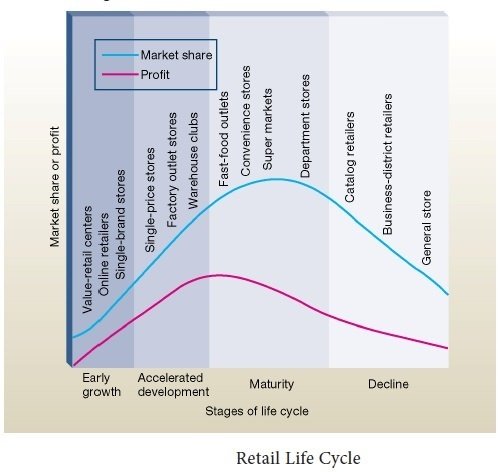
  1. Retail Life cycle

Like products, brands retail organizations pass through identifiable stages of innovation, accelerated development, maturity and decline. This is commonly known as the retail life cycle. Any organization when in the innovation stage is nascent and has few competitors. They try to create a distinctive advantage to the final customers. Since the concepts are new at this stage organizations try to grow rapidly and the management tries to experiment. Profits will be moderate and the stage may last for a couple of years. When we talk about our country e-buying or online shopping is in the innovation stage.

In the accelerated growth phase the organizations face rapid increase in sales, competitors begin to emerge and the organizations begin to use leadership and their presence as a tool in stabilizing their position. The investment level will be high as there are others who will be creating a lot of competition. This level may go up to eight years. Hypermarkets, Dollar stores are in this stage. In the maturity stage as competition intensifies newer forms of retailing begin to emerge, the growth rate starts to decline. At this stage firms should start work on strategies and reposition techniques to be in the market place. Supermarkets, cooperative stores are in this stage. In the final stage of the retail life cycle is the declining phase where firms begin to loose their competitive advantage. Profitability starts to decline further and the overheads starts to rise. Thus we see that organizations needs to adopt different strategies at each level in order to sustain in the marketplace.

  1. Consumer Behavior Theories:

  • Wheel of Retailing:

The Wheel of Retailing theory, proposed by Malcolm P. McNair in the 1950s, suggests that retail firms evolve through predictable stages. Retailers initially enter the market with low-status, low-margin operations and gradually add services and amenities as they succeed. Over time, this process may lead to higher prices and increased competition, eventually prompting the entry of new low-status retailers. The cycle continues.

  • Retail Life Cycle:

Building on the Wheel of Retailing, the Retail Life Cycle theory posits that retail formats go through distinct life stages, including introduction, growth, maturity, and decline. Each stage is associated with specific challenges and opportunities. Understanding the life cycle helps retailers adapt strategies based on their position in the market.

  • Customer Decision-Making Process:

The Consumer Decision-Making Process theory outlines the steps consumers go through when making purchasing decisions. These steps include problem recognition, information search, evaluation of alternatives, purchase decision, and post-purchase evaluation. Retailers use this theory to tailor marketing strategies to influence consumers at each stage.

  1. Store Location Theories:

  • Central Place Theory:

The Central Place Theory, developed by Walter Christaller, explores the optimal spatial arrangement of retail centers within a geographic area. It posits that consumers will travel to the nearest central place (retail center) to fulfill their shopping needs. Larger retail centers offering a broader range of goods and services are located less frequently but serve a larger population.

  • Huff’s Gravity Model:

The Huff’s Gravity Model predicts the probability of a consumer choosing a particular store based on its attractiveness (size, offerings) and distance. This model is valuable for retailers in understanding consumer behavior related to store choice and optimizing their location strategies.

  1. Retail Marketing Theories:

  • Retail Mix:

The Retail Mix theory, also known as the 6 Ps of retailing (Product, Price, Place, Promotion, Presentation, and Personnel), emphasizes the interconnected elements that retailers must consider when creating a marketing strategy. Balancing these elements is essential for a cohesive and effective retail marketing approach.

  • STP Marketing:

STP stands for Segmentation, Targeting, and Positioning. In retail, this theory involves identifying market segments, selecting target segments that align with the retailer’s strengths, and positioning the store to meet the specific needs and preferences of those target customers.

  • Retail Atmospherics:

Retail Atmospherics theory explores how the physical environment of a store, including lighting, colors, scents, and layout, affects consumer perceptions and behavior. Creating a pleasant and engaging atmosphere enhances the overall shopping experience and influences purchasing decisions.

  1. Retail Evolution Theories:

  • Wheel of Retailing Evolution:

The Wheel of Retailing Evolution theory builds on the Wheel of Retailing, proposing that retailers evolve through stages of innovation, growth, maturity, and decline. New retailers often introduce innovative formats, challenging existing structures and leading to a continuous cycle of evolution in the retail industry.

  • Retail Life Cycle Evolution:

Similar to the Retail Life Cycle, this theory suggests that retail formats evolve through stages of introduction, growth, maturity, and decline. The evolution may involve changes in format, strategies, and consumer offerings to adapt to market conditions and competition.

  1. Technology and Omnichannel Retailing Theories:

  • Technology Adoption Curve:

The Technology Adoption Curve, developed by Everett Rogers, categorizes consumers into innovators, early adopters, early majority, late majority, and laggards based on their readiness to adopt new technologies. Retailers use this theory to guide their adoption of technology and innovation strategies.

  • Omnichannel Retailing:

Omnichannel Retailing theory emphasizes the integration of various channels (online, offline, mobile, etc.) to provide a seamless and unified shopping experience for consumers. It recognizes that consumers may engage with retailers through multiple channels and aims to create a cohesive brand experience across all touchpoints.

  1. Retail Strategy Theories:

  • Porter’s Generic Strategies:

Developed by Michael Porter, this theory outlines three generic strategies for competitive advantage: cost leadership, differentiation, and focus. Retailers can pursue one of these strategies to position themselves in the market and gain a competitive edge.

  • Wheel of Retailing Strategy:

The Wheel of Retailing Strategy theory suggests that retailers should strategically choose their positioning within the Wheel’s evolution stages. For example, a retailer may opt for a low-cost strategy as a low-status entrant or differentiate through innovation as a higher-status player.

  1. Sustainability in Retailing:

  • Green Retailing:

With a growing emphasis on sustainability, Green Retailing theory focuses on environmentally friendly retail practices. This includes sustainable sourcing, energy-efficient operations, waste reduction, and efforts to appeal to environmentally conscious consumers.

  • Circular Economy in Retailing:

The Circular Economy theory promotes a regenerative approach where products, materials, and resources are kept in use for as long as possible. Retailers adopting circular economy principles aim to reduce waste, recycle materials, and create more sustainable product life cycles.

Types of Marketing Channels

Marketing Channels, also known as distribution channels, are pathways through which a product or service travels from the manufacturer to the end consumer. The effectiveness of these channels is critical for reaching target markets, enhancing customer satisfaction, and driving sales. There are several types of marketing channels, each serving a distinct function in the distribution process.

1. Direct Marketing Channels

A direct marketing channel involves the manufacturer or producer selling products directly to the end consumer without intermediaries. This channel is commonly used in industries where companies want to maintain full control over their products, customer interaction, and pricing. It offers the advantage of higher margins, as there are no intermediaries to take a commission.

Examples:

  • Retail Stores: Companies like Apple and Nike sell directly to customers through their branded retail outlets or online stores.
  • E-Commerce Websites: Brands can also sell directly through their own websites, cutting out the middleman and engaging customers directly.
  • Direct Mail: Companies send promotional material or product catalogs directly to potential customers via mail.

Advantages:

  • Direct control over the customer experience.
  • Higher profit margins.
  • Direct customer feedback, which can improve product and service offerings.

Disadvantages:

  • High initial setup costs.
  • Requires substantial investment in logistics and infrastructure.

2. Indirect Marketing Channels

An indirect marketing channel involves one or more intermediaries between the manufacturer and the end consumer. These intermediaries could be wholesalers, distributors, retailers, or agents who assist in moving the product to market. Indirect channels are more common when a company does not want to deal with the complexities of direct selling and prefers to outsource distribution to specialized intermediaries.

Examples:

  • Retail Distribution: Products are sold through retail outlets like supermarkets, department stores, or specialty stores.
  • Wholesale Distribution: Manufacturers sell products to wholesalers, who then distribute the products to retailers or other resellers.
  • Agent-Based Channels: A company uses agents or brokers who manage sales and product distribution on behalf of the manufacturer, often seen in industries like real estate or insurance.

Advantages:

  • Broad market reach with minimal investment.
  • The expertise of intermediaries in distribution and logistics.
  • Less burden on the manufacturer to handle customer service and retail operations.

Disadvantages:

  • Lower profit margins due to intermediaries taking a commission.
  • Less control over branding, marketing, and customer experience.

3. Dual or Hybrid Marketing Channels

A hybrid or dual marketing channel combines both direct and indirect marketing channels. This model allows businesses to sell their products through multiple channels, offering more flexibility and market coverage. Hybrid channels are increasingly popular as they enable businesses to maximize their reach and cater to diverse customer preferences.

Examples:

  • Nike: Sells directly to consumers through its online store and physical retail outlets, but also distributes through third-party retailers.
  • Dell: Initially adopted a direct selling model but later expanded to sell through retailers like Walmart and Best Buy in addition to their website.

Advantages:

  • Flexibility to reach different customer segments.
  • Increased market penetration by leveraging multiple distribution methods.
  • Ability to adapt to changing market conditions.

Disadvantages:

  • Complexity in managing multiple channels.
  • Potential conflicts between direct and indirect channels (e.g., price competition).

4. Franchise Marketing Channels

Franchising is a form of distribution where a company (the franchisor) grants the right to another party (the franchisee) to sell its products or services. This arrangement involves a partnership between the franchisor and franchisee, where the franchisee benefits from using the franchisor’s established brand and business model, while the franchisor receives royalties and fees.

Examples:

  • McDonald’s: One of the most iconic examples of a franchise system.
  • Subway: Operates a global network of franchisees, each owning and operating an individual store under the Subway brand.

Advantages:

  • Rapid expansion with minimal capital investment.
  • Franchisees bring local market knowledge.
  • Established brand recognition attracts customers.

Disadvantages:

  • Less control over franchisee operations.
  • Dependence on franchisee performance.

5. Vertical Marketing Channels

Vertical marketing channel is a distribution channel where all the participants (manufacturer, wholesaler, retailer) work together within a single, integrated system to achieve efficiency and control. These channels are organized in a way that all the channel members have a common interest, often with one member having control over the others. This collaboration leads to improved coordination and smoother operations.

Examples:

  • Corporate Vertical Marketing: A company owns and controls all the stages of the supply chain, from manufacturing to retail. An example is Zara, which manages its own supply chain and stores.
  • Contractual Vertical Marketing: Franchises or contractual agreements where businesses work under common objectives, such as McDonald’s or 7-Eleven.

Advantages:

  • Enhanced coordination between channel members.
  • Better control over pricing, marketing, and customer experience.
  • Potential for economies of scale.

Disadvantages:

  • High investment in control and ownership of the entire channel.
  • Risk of conflict between channel members.

6. Horizontal Marketing Channels

In a horizontal marketing channel, businesses at the same level in the distribution chain collaborate to reach a larger market. These partnerships are typically formed between companies that offer complementary products or services. Horizontal marketing channels allow companies to share resources and increase their reach.

Examples:

  • Co-Branding: Two companies collaborate to create a product that benefits both. An example is the partnership between Nike and Apple for a wearable fitness tracker.
  • Retail Partnerships: A department store might partner with an online retailer like Amazon to sell its products.

Advantages:

  • Access to new markets.
  • Shared resources reduce costs.
  • Increased brand exposure through collaboration.

Disadvantages:

  • Potential for brand dilution if partnerships are not well aligned.
  • Coordination challenges between businesses.

7. Direct Mail or Catalog Marketing Channels

In direct mail or catalog marketing, businesses send physical product catalogs, brochures, or promotional offers to potential customers via postal services. This traditional marketing channel allows businesses to target specific customer segments directly.

Examples:

  • IKEA: Sends catalogs to homes worldwide showcasing their latest furniture and home accessories.
  • LL Bean: Famous for using direct mail catalogs to drive sales.

Advantages:

  • Ability to target specific customer groups based on demographics and past purchasing behavior.
  • Tangible materials can leave a lasting impression.

Disadvantages:

  • High costs associated with printing and mailing.
  • Limited interactivity and engagement compared to digital channels.

Green Marketing, Definition, Features, Golden Laws, Importance, 4P’s, and Challenges

Green marketing refers to the practice of developing and promoting products or services based on their environmental benefits. It involves the process of marketing products that are presumed to be environmentally safe, produced sustainably, and often made using eco-friendly methods. The concept emerged in response to growing consumer awareness about environmental issues and the desire for sustainable development.

Green marketing not only helps companies position themselves as socially responsible but also meets the demand of a growing segment of environmentally conscious consumers. It includes activities such as using recyclable packaging, minimizing carbon footprints, adopting energy-efficient production processes, and reducing waste.

Features of Green Marketing

  • Eco-Friendly Products

Green marketing focuses on promoting products that are non-toxic, made from natural ingredients, and cause minimal harm to the environment. These products are designed to be biodegradable or recyclable.

  • Sustainable Practices

Companies engaging in green marketing adopt sustainable practices in their operations, such as using renewable energy, reducing water consumption, and minimizing waste generation.

  • Consumer-Centric Approach

Green marketing emphasizes educating consumers about the environmental impact of products and how their choices can contribute to sustainability. This approach builds trust and long-term customer loyalty.

  • Compliance with Environmental Standards

Green marketing often involves adhering to national and international environmental regulations, such as ISO 14000 standards, which ensure that products and processes meet environmental criteria.

  • Innovation and Continuous Improvement

To maintain a competitive edge, companies invest in R&D to develop innovative eco-friendly products and processes. This involves adopting new technologies and improving existing methods.

  • Cost Implications

Green products often have higher production costs due to the use of sustainable materials and eco-friendly processes. However, these costs can be offset by premium pricing and increased customer loyalty.

  • Long-Term Orientation

Green marketing focuses on long-term environmental and economic benefits rather than short-term profitability. This approach ensures sustainable business growth.

Golden Laws of Green Marketing

  • Transparency

Companies must be honest about their green practices and claims. Greenwashing, or making false claims about environmental benefits, can damage brand reputation and lead to legal consequences.

  • Consumer Value

Green products should provide real value to consumers, both in terms of functionality and environmental impact. Consumers are willing to pay a premium only if they perceive genuine benefits.

  • Differentiation

To stand out in the market, companies must differentiate their products by highlighting unique eco-friendly features, such as reduced carbon emissions or biodegradable packaging.

  • Sustainability

Green marketing strategies should be aligned with long-term sustainability goals. This includes using renewable resources, reducing waste, and minimizing environmental impact throughout the product lifecycle.

  • Affordability

While green products may be priced higher than conventional ones, companies should strive to make them affordable for a broader consumer base through economies of scale and process optimization.

  • Consistency

Companies must ensure consistency in their green marketing practices. It is essential that all aspects of the business—from production to distribution—reflect the brand’s commitment to sustainability.

  • Partnerships and Collaboration

Companies should collaborate with stakeholders, including suppliers, NGOs, and governments, to promote sustainable practices and enhance the impact of their green marketing efforts.

Importance of Green Marketing

  • Environmental Protection

Green marketing promotes the use of eco-friendly products and sustainable practices, contributing to environmental conservation and reducing pollution.

  • Meeting Consumer Demand

As awareness of environmental issues increases, more consumers prefer brands that demonstrate a commitment to sustainability. Green marketing helps companies meet this growing demand.

  • Regulatory Compliance

Governments across the world are enforcing stricter environmental regulations. By adopting green marketing practices, companies can ensure compliance and avoid legal penalties.

  • Brand Differentiation

Green marketing allows companies to differentiate themselves in a crowded marketplace. A strong commitment to sustainability can enhance brand image and attract a loyal customer base.

  • Cost Savings

While initial investments in green practices may be high, companies can achieve long-term cost savings through energy efficiency, waste reduction, and improved resource management.

  • Enhanced Investor Appeal

Companies with strong green credentials often attract socially responsible investors. Green marketing can help businesses secure funding from investors who prioritize sustainability.

  • Long-Term Profitability

Green marketing ensures long-term profitability by building a sustainable business model. Companies that adopt eco-friendly practices are better positioned to adapt to future market and regulatory changes.

4P’s of Green Marketing

  • Product

Green products are designed to minimize environmental impact. This involves using sustainable materials, eco-friendly packaging, and ensuring that the product is recyclable or biodegradable. Examples include energy-efficient appliances, organic food products, and electric vehicles.

  • Price

Green products are often priced higher due to the cost of sustainable materials and production processes. However, consumers who value environmental responsibility are often willing to pay a premium for such products. Companies should also consider offering discounts or incentives for eco-friendly purchases.

  • Place

The distribution of green products should be efficient to minimize the carbon footprint. Companies can adopt green logistics, such as using electric delivery vehicles and optimizing delivery routes. Additionally, businesses should partner with retailers that support sustainable practices.

  • Promotion

Green marketing involves promoting products in a way that highlights their environmental benefits. Companies can use eco-labels, certifications, and transparent communication to build trust. Digital marketing, social media campaigns, and educational content can also be used to spread awareness about the brand’s green initiatives.

Challenges of Green Marketing

  • High Costs

Developing and promoting eco-friendly products often involves high costs due to the use of sustainable materials, advanced technology, and adherence to environmental regulations. These costs may deter companies, especially small businesses, from adopting green marketing.

  • Consumer Skepticism

Many consumers are skeptical of green claims due to instances of greenwashing, where companies falsely promote products as environmentally friendly. Building consumer trust requires consistent and transparent communication.

  • Limited Market

Although the demand for green products is growing, it still represents a niche market. Many consumers prioritize cost and convenience over environmental concerns, making it challenging for companies to scale green products.

  • Complex Regulations

Green marketing involves complying with various environmental regulations, which can be complex and vary across regions. Navigating this regulatory landscape requires significant effort and expertise.

  • Supply Chain issues

Ensuring a green supply chain is a major challenge. Companies must source eco-friendly materials, work with sustainable suppliers, and adopt green logistics, which can be difficult to manage and costly.

  • Competition from Non-Green Products

Green products often face stiff competition from conventional products that are cheaper and more readily available. Convincing consumers to switch to eco-friendly alternatives requires strong marketing efforts and value propositions.

  • Measurement of Impact

Measuring the actual environmental impact of green products and practices is challenging. Companies need reliable metrics and tools to assess and report their sustainability efforts, which requires expertise and resources.

Firewall, Components, Working, Types, Challenges

Firewall is a network security system that monitors, filters, and controls incoming and outgoing network traffic based on predetermined security rules. It acts as a barrier between trusted internal networks and untrusted external networks, such as the internet, to prevent unauthorized access and potential cyberattacks. Firewalls can be hardware-based, software-based, or a combination of both. They examine data packets, allowing only legitimate traffic while blocking malicious or suspicious activity. By enforcing access policies, firewalls protect systems from hackers, malware, and unauthorized users, ensuring data confidentiality, integrity, and availability within networks and computer systems.

Components of Firewall:

  • Packet Filtering

Packet filtering is a fundamental firewall component that examines data packets entering or leaving the network. It analyzes packet headers, such as IP addresses, port numbers, and protocols, to determine whether to allow or block the traffic based on predefined rules. This method is fast and efficient, but it cannot inspect the actual data content, making it vulnerable to advanced threats. Packet filtering works as the first line of defense, ensuring only traffic matching the organization’s security policies is permitted. While simple, it provides essential control over basic network traffic flow.

  • Proxy Service

A proxy service acts as an intermediary between users and the internet. Instead of direct communication, the firewall’s proxy server fetches requests on behalf of the user, providing an additional security layer. It hides the internal network structure, preventing attackers from identifying devices within the system. Proxies can also perform deep packet inspection, cache frequently accessed content, and filter requests based on content or user behavior. By breaking direct connections, proxies reduce exposure to threats, enhance privacy, and enforce security policies, making them essential for controlling application-level communication.

  • Stateful Inspection

Stateful inspection, also called dynamic packet filtering, monitors the state and context of active network connections. Unlike basic packet filtering, which checks packets in isolation, stateful inspection analyzes the entire traffic session, ensuring packets are part of a legitimate, established connection. It maintains a state table to track sessions and validates whether incoming packets match expected patterns. This prevents unauthorized attempts like spoofing or session hijacking. Stateful inspection provides a balance of strong security and performance, offering a more robust solution for modern networks compared to simple filtering techniques.

  • Network Address Translation (NAT)

NAT is a firewall component that conceals internal IP addresses by translating them into a single public IP address for external communication. This masking improves security by hiding the network’s internal structure from outsiders. NAT also helps conserve limited IPv4 addresses by allowing multiple devices to share one public IP. In addition to protecting devices from direct external exposure, NAT ensures efficient traffic management. Combined with firewall rules, NAT minimizes the risk of attacks on internal systems, making it a critical function in safeguarding organizational networks from potential cyber intrusions.

  • Virtual Private Network (VPN) Support

Many firewalls include VPN support to establish secure, encrypted tunnels for remote access. VPN-enabled firewalls allow employees or authorized users to connect to the organization’s internal network safely over the internet. By encrypting traffic, VPNs ensure confidentiality, integrity, and authentication, protecting sensitive data from interception. They also enforce access control by verifying user credentials before granting entry. VPN integration in firewalls is especially important for organizations with remote workers, branch offices, or cloud-based operations, as it ensures safe communication and resource sharing while maintaining the network’s security perimeter.

  • Intrusion Detection and Prevention (IDPS)

Intrusion Detection and Prevention Systems (IDPS) in firewalls monitor network traffic for suspicious activity or policy violations. They use signature-based, anomaly-based, or behavioral techniques to identify threats like malware, denial-of-service attacks, or unauthorized access attempts. An IDS alerts administrators about suspicious events, while an IPS actively blocks or mitigates malicious traffic in real-time. Integrating IDPS with firewalls provides layered defense against both known and emerging cyber threats. This proactive security feature ensures threats are detected early, reducing damage and maintaining network integrity.

  • Logging and Monitoring

Logging and monitoring are essential firewall components that record details of all traffic and activities passing through the firewall. Logs include information such as source and destination IPs, ports, protocols, and timestamps of network events. These records help administrators analyze traffic patterns, detect anomalies, and investigate security incidents. Real-time monitoring enables quick response to attacks, while historical logs support audits and compliance requirements. By offering visibility into network behavior, logging and monitoring strengthen overall security posture, enabling organizations to improve firewall policies and anticipate potential threats more effectively.

  • Content Filtering

Content filtering in firewalls controls access to inappropriate, harmful, or non-business-related websites and online resources. By inspecting web traffic, the firewall blocks access to sites containing malware, phishing, or offensive content, ensuring employee productivity and organizational safety. Content filtering can also restrict access based on categories like social media, streaming platforms, or gaming. It often integrates with URL filtering databases or keyword-based restrictions. Beyond security, content filtering helps organizations comply with regulations, maintain bandwidth efficiency, and protect users from harmful online material.

How does a Firewall Work?

  • Traffic Monitoring and Filtering

A firewall works by continuously monitoring all incoming and outgoing network traffic. It acts as a security guard, examining data packets that travel between a private network and external sources like the internet. Each packet is inspected based on pre-set rules such as IP addresses, port numbers, and protocols. If a packet meets the allowed criteria, it is permitted to pass; otherwise, it is blocked. This packet-filtering process ensures that only safe and authorized communication enters or leaves the network, providing a first line of defense against unauthorized access.

  • Access Control

Firewalls enforce access control by defining which users, devices, or applications can interact with the network. Administrators configure policies that specify permitted services, such as web browsing or email, while restricting unwanted ones. By applying these rules, the firewall creates barriers between trusted and untrusted zones, ensuring critical systems are shielded. Access control may be based on IP addresses, domain names, or authentication credentials. This mechanism helps prevent attackers, malware, or unauthorized users from exploiting the network. Essentially, firewalls limit exposure by ensuring that only approved communication is allowed, maintaining both privacy and system integrity.

  • Stateful Inspection

Modern firewalls use stateful inspection, a method that not only checks packet headers but also tracks the state of active connections. Instead of treating each packet independently, the firewall records session details in a state table. It verifies whether a packet belongs to an established, legitimate connection or is suspicious. For example, if a packet claims to be a response to a request but no such request was sent, the firewall will block it. This deeper inspection provides more accuracy and security than simple packet filtering, helping to detect and stop sophisticated cyberattacks effectively.

  • Protection Against Threats

A firewall acts as a defense mechanism by blocking malicious traffic, viruses, worms, and hacking attempts before they reach the network. Many firewalls integrate intrusion detection, intrusion prevention, and content filtering to strengthen security. They can identify unusual patterns, such as port scanning or denial-of-service (DoS) attempts, and take immediate action. By controlling both inbound and outbound traffic, firewalls prevent sensitive data from being leaked or stolen. This multi-layered protection reduces vulnerabilities and ensures the confidentiality, integrity, and availability of network resources, making firewalls a critical safeguard in cybersecurity.

Types of Firewalls:

  • Packet-Filtering Firewall

A packet-filtering firewall is the most basic type, which examines data packets moving across a network. It checks source and destination IP addresses, port numbers, and protocols against predefined rules. If the packet matches the rules, it is allowed; otherwise, it is blocked. This firewall works at the network layer and is efficient but limited because it does not inspect the content of packets. While it provides quick filtering, it is vulnerable to sophisticated attacks that disguise malicious data. It is best suited for small networks requiring simple, cost-effective protection without complex monitoring.

  • Stateful Inspection Firewall

A stateful inspection firewall, also known as a dynamic packet filter, goes beyond simple packet filtering. It monitors active connections and keeps track of the state of network sessions using a state table. Instead of only checking packet headers, it verifies whether the packet belongs to an existing, legitimate session. This makes it more secure than basic firewalls, as it prevents malicious or unsolicited traffic. Stateful firewalls are commonly used in modern networks because they balance performance and security. They are effective in protecting against unauthorized access and attacks while still maintaining efficient traffic flow.

  • Proxy Firewall (Application-Level Gateway)

A proxy firewall acts as an intermediary between users and the internet by filtering requests at the application layer. Instead of allowing direct communication, it processes requests and forwards them to the destination on behalf of the user. This hides the internal network, offering strong anonymity and protection. Proxy firewalls can inspect data deeply, block harmful content, and prevent direct exposure to threats. However, they may slow down network performance due to heavy traffic inspection. They are useful in organizations needing strict security and monitoring, especially for web browsing, email filtering, and application-level access control.

  • Next-Generation Firewall (NGFW)

Next-Generation Firewalls combine traditional firewall features with advanced capabilities like intrusion prevention systems (IPS), deep packet inspection, and application awareness. Unlike standard firewalls, NGFWs can identify and control applications regardless of port, protocol, or encryption. They also integrate features like malware protection, URL filtering, and threat intelligence. This makes them highly effective against sophisticated cyber threats. NGFWs provide greater visibility into network traffic, enabling organizations to enforce more granular security policies. Although costlier, they are widely adopted by enterprises that require robust, multi-layered security to protect against modern attacks and evolving cyber risks.

Challenges of Firewalls:

  • Limited Protection Scope

Firewalls are effective at blocking unauthorized access, but they cannot detect or prevent all types of cyber threats. They mainly monitor incoming and outgoing traffic, which means attacks like phishing, malware hidden in encrypted traffic, or insider threats may bypass them. Additionally, firewalls do not provide full protection against social engineering or sophisticated zero-day attacks. Relying solely on a firewall without other security measures creates vulnerabilities. To overcome this limitation, organizations must use firewalls in combination with intrusion detection systems, antivirus software, and strong user awareness programs to ensure a multi-layered defense strategy.

  • Performance and Latency Issues

Firewalls, especially advanced ones like next-generation firewalls (NGFWs), can introduce latency by analyzing packets, inspecting content, and filtering applications. High traffic volumes may slow down network performance, causing delays for users and critical business applications. In environments with heavy data flow, this can impact productivity. To address this, organizations need robust hardware, proper configuration, and network optimization strategies. However, upgrading infrastructure increases costs. Balancing strong security with optimal performance remains a challenge, as overloading the firewall or misconfiguring rules may lead to bottlenecks, service disruptions, or even security gaps if traffic inspection is reduced to improve speed.

  • Complex Configuration and Management

Setting up and maintaining a firewall requires skilled administrators to configure rules, policies, and filters correctly. Misconfigured firewalls may either block legitimate traffic, causing disruptions, or allow malicious traffic, creating security holes. Large organizations with complex networks face challenges in managing multiple firewalls across different locations. Regular updates and monitoring are necessary to keep policies aligned with evolving security threats. Inadequate documentation or improper rule prioritization may result in conflicts and vulnerabilities. To overcome this, organizations must invest in trained professionals, automation tools, and consistent auditing practices to ensure firewalls function effectively without compromising usability or security.

  • Cost and Resource Requirements

While basic firewalls are affordable, advanced solutions like next-generation firewalls (NGFWs) come with high costs for acquisition, deployment, and maintenance. Additionally, they require powerful hardware, constant updates, and skilled IT staff for monitoring. Smaller organizations often struggle with these expenses, making them more vulnerable to cyberattacks. Furthermore, as threats evolve, firewalls need regular upgrades, which add to long-term costs. Cloud-based firewalls may reduce infrastructure expenses but still involve subscription fees. Balancing cost-effectiveness and strong security remains a major challenge, especially for businesses with limited budgets that cannot afford enterprise-grade firewall solutions with advanced threat protection.

Domain Name Registration

Domain Name is a unique web address that identifies a website on the internet. It serves as an online identity for businesses, organizations, or individuals looking to establish a digital presence. Registering a domain name is the first step in creating a website, and it requires careful planning to ensure it aligns with the brand, purpose, and target audience.

Steps to Register a Domain Name

1. Choose a Suitable Domain Name

Selecting the right domain name is crucial because it represents a business or personal brand online. Consider the following factors while choosing a domain name:

  • Simplicity: Keep it short, easy to spell, and memorable.
  • Relevance: The name should reflect the website’s purpose or business.
  • Keyword Usage: Including relevant keywords can improve search engine ranking.
  • Avoid Numbers & Hyphens: These can make the domain name harder to remember.

2. Select a Domain Extension

The domain extension, or Top-Level Domain (TLD), follows the domain name (e.g., .com, .org, .net). Some common extensions include:

  • .com – Most popular and widely used for businesses and general websites.
  • .org – Used mainly by non-profits and organizations.
  • .net – Suitable for technology and networking websites.
  • .edu – Reserved for educational institutions.
  • .gov – Used by government entities.

Newer extensions like .tech, .store, .blog, and .online offer more specific branding opportunities.

3. Check Domain Availability

Once a suitable name is chosen, check its availability using a domain registrar. Websites like GoDaddy, Namecheap, Google Domains, and Bluehost provide domain search tools. If the desired name is unavailable, alternative suggestions or different TLDs may be considered.

4. Choose a Domain Registrar

A domain registrar is a company accredited to sell domain names. Some popular domain registrars include:

  • GoDaddy
  • Namecheap
  • Google Domains
  • Bluehost
  • HostGator

Compare pricing, renewal costs, and additional features like domain privacy protection before selecting a registrar.

5. Purchase and Register the Domain

After selecting a domain name and registrar, proceed with the registration:

  • Add the Domain to Cart: Confirm availability and proceed to checkout.
  • Choose Registration Duration: Domains can be registered for one year or more (up to 10 years in most cases).
  • Provide Contact Information: Registrars require details like name, email, phone number, and address.

6. Enable Domain Privacy Protection (Optional)

When a domain is registered, the owner’s details become publicly available in the WHOIS database. Domain privacy protection hides this information to prevent spam and identity theft.

7. Configure Domain Settings

After registration, configure domain settings:

  • Point the Domain to a Website: If building a website, connect the domain to a hosting provider.
  • Set Up Email Accounts: Many registrars offer custom email services (e.g., yourname@yourdomain.com).
  • Renewal & Auto-Renewal: Enable auto-renewal to prevent domain expiration and loss of ownership.

E-commerce: Business Models and Concepts

E-commerce (electronic commerce) refers to the buying and selling of goods and services over the internet. With the rapid growth of technology and internet connectivity, e-commerce has transformed business operations, customer behavior, and market dynamics. There are various business models and concepts that define the structure and functioning of e-commerce.

E-commerce Business Models:

  • Business to Consumer (B2C):

B2C model is one of the most commonly known e-commerce models. It refers to transactions between businesses and individual consumers. Online retailing is the most popular form of B2C commerce. Companies such as Amazon, Alibaba, and Walmart operate in this space, where consumers purchase products or services from businesses directly via websites or mobile apps. In B2C, the transaction process involves browsing, ordering, payment, and delivery, with a focus on providing a user-friendly shopping experience.

  • Business to Business (B2B):

B2B e-commerce involves transactions between two or more businesses. These transactions often include wholesale trade, raw materials, or bulk product purchases. The buyers are typically other companies, rather than individual consumers. Platforms such as Alibaba, ThomasNet, and Indiamart serve as intermediaries for B2B transactions. This model is more complex compared to B2C due to the larger scale of transactions, longer sales cycles, and the need for more robust systems to manage relationships, orders, and logistics.

  • Consumer to Consumer (C2C):

C2C e-commerce refers to transactions between consumers, often facilitated by a third-party platform. Online marketplaces such as eBay, Craigslist, and Poshmark serve as intermediaries, allowing individuals to buy and sell goods or services to one another. The C2C model benefits from low overhead costs as it typically involves no large inventory or physical stores. It’s highly popular for second-hand goods, auctioned items, and peer-to-peer services.

  • Consumer to Business (C2B):

C2B is a less common but growing model where individual consumers offer products or services to businesses. This model has evolved with the rise of freelance work, crowdsourcing, and influencers. Websites like Fiverr, Upwork, and Shutterstock facilitate these transactions by allowing individuals to sell their skills, content, or products to businesses. This model highlights how consumers can generate value for businesses, especially in the context of creative services or product feedback.

  • Business to Government (B2G):

In this model, businesses provide goods and services to governments or government agencies. B2G transactions typically involve government contracts for procurement, consulting, and other services. E-commerce platforms that facilitate B2G exchanges often require complex bidding processes and compliance with governmental regulations. Examples of B2G platforms include government procurement websites and e-tendering portals.

  • Subscription-Based E-commerce:

The subscription model has gained immense popularity, especially in digital content and software services. Under this model, consumers pay a recurring fee for access to products or services over a specified period. Netflix, Spotify, and Amazon Prime are some of the most recognized subscription-based services. Subscription e-commerce also extends to physical goods, such as beauty boxes (e.g., Ipsy), meal kits (e.g., Blue Apron), and even pet supplies (e.g., BarkBox).

  • Marketplace Model:

In a marketplace business model, the platform owner (like Amazon, Etsy, or eBay) acts as an intermediary between sellers and buyers, facilitating transactions without directly selling products. The platform typically charges a fee or commission on each sale. The marketplace model offers businesses the opportunity to reach a larger audience while consumers benefit from a variety of choices and competitive pricing. This model emphasizes scalability, where the platform owner earns revenue without needing to maintain inventory.

Concepts in E-commerce:

  • Digital Payment Systems:

A core aspect of e-commerce is the ability to conduct secure online transactions. Payment gateways such as PayPal, Stripe, and credit card processors facilitate online payments by providing a secure method for transferring money. Digital wallets like Apple Pay and Google Pay have simplified the payment process for consumers, enabling faster transactions with minimal friction.

  • Online Security and Privacy:

With the increasing prevalence of e-commerce, ensuring the safety of consumer data is crucial. Security protocols like Secure Sockets Layer (SSL) and encryption technologies protect sensitive data during online transactions. Additionally, privacy concerns have led to stricter regulations such as the General Data Protection Regulation (GDPR) in Europe, ensuring businesses handle customer data responsibly.

  • Logistics and Supply Chain Management:

Efficient logistics and supply chain management are essential for e-commerce businesses to ensure timely delivery of products. Companies must invest in warehousing, inventory management, and shipping systems to meet consumer expectations. Technologies like dropshipping and fulfillment by Amazon (FBA) have simplified supply chain processes, allowing businesses to focus on sales and customer experience.

  • Customer Relationship Management (CRM):

Successful e-commerce businesses emphasize customer engagement and retention. CRM tools and software help companies track customer interactions, personalize marketing efforts, and improve customer service. Through customer data, businesses can better understand preferences and behavior, enabling tailored marketing campaigns and more efficient sales strategies.

  • Digital Marketing:

E-commerce businesses rely heavily on digital marketing strategies to attract and retain customers. Search Engine Optimization (SEO), Pay-Per-Click (PPC) advertising, email marketing, and social media engagement are some of the common tactics used. Social proof, such as customer reviews and influencer endorsements, plays a critical role in influencing purchasing decisions in the online marketplace.

  • Mobile Commerce (M-commerce):

Mobile commerce, or m-commerce, is another important concept in e-commerce. With the rise of smartphones and mobile apps, many consumers now shop on-the-go. Optimizing websites for mobile devices and creating user-friendly mobile apps are critical strategies for businesses to cater to mobile shoppers. Features like push notifications and location-based promotions also contribute to enhancing the mobile shopping experience.

error: Content is protected !!