Human Resource Management, Meaning, Nature, Scope, Objectives

Human Resource Management (HRM) refers to the strategic approach of managing people within an organization to enhance their performance and achieve business objectives. It involves recruiting, training, compensating, and retaining employees while fostering a positive work environment. HRM ensures compliance with labor laws, promotes employee well-being, and aligns workforce capabilities with organizational goals. Key functions include workforce planning, performance management, employee relations, and talent development. By effectively managing human capital, HRM helps organizations maintain a competitive edge, improve productivity, and create a culture of continuous learning and engagement. It plays a crucial role in building a skilled and motivated workforce.

Nature of Human Resource Management:

  • People-Oriented

HRM focuses on individuals and groups within an organization. Since human capital is essential for achieving organizational goals, HRM aims to recruit, develop, and retain talent, ensuring that employees are motivated and productive.

  • Strategic in Nature

HRM aligns human resource policies and practices with the strategic objectives of the organization. This involves workforce planning, talent acquisition, and employee development to meet both current and future business needs.

  • Continuous Process

HRM is a dynamic and continuous process that involves regular monitoring, evaluating, and improving human resource practices. It begins with hiring and continues through performance management, training, compensation, and retention.

  • Development-Oriented

One of the core aspects of HRM is employee development. It focuses on enhancing the skills, knowledge, and abilities of employees through training, workshops, and career development programs, which ultimately benefits both individuals and the organization.

  • Comprehensive Function

HRM is comprehensive as it covers a wide range of activities including recruitment, selection, training, performance appraisal, compensation, and employee relations. It ensures that all human resource needs of the organization are addressed effectively.

  • Mutual Benefit

HRM emphasizes a mutually beneficial relationship between employees and the organization. By addressing employee needs such as job satisfaction, fair compensation, and career growth, HRM ensures higher employee engagement and loyalty, which, in turn, boosts organizational performance.

  • Interdisciplinary Approach

HRM draws from various disciplines such as psychology, sociology, economics, and law to manage employees effectively. Understanding human behavior, motivation, and organizational dynamics is crucial for designing effective HR policies.

Scope of Human Resource Management:

  • Human Resource Planning (HRP)

HRM involves forecasting and planning the future manpower requirements of the organization. It ensures that the right number of people with the right skills are available at the right time. HRP includes workforce analysis, succession planning, and staffing strategies to meet business needs.

  • Recruitment and Selection

One of the primary functions of HRM is to attract and select the most suitable candidates for various positions. The recruitment process involves job analysis, advertising vacancies, screening applicants, conducting interviews, and selecting the best candidates.

  • Training and Development

HRM focuses on enhancing the skills, knowledge, and capabilities of employees through continuous training and development programs. This not only improves individual performance but also helps employees prepare for future roles within the organization.

  • Performance Management

HRM involves establishing performance standards, evaluating employee performance, and providing feedback. Performance management systems, such as appraisals and key performance indicators (KPIs), ensure that employees contribute effectively to organizational goals and are rewarded accordingly.

  • Compensation and Benefits

HRM ensures that employees are fairly compensated for their efforts. This includes designing salary structures, incentives, bonuses, and benefits such as health insurance, retirement plans, and leave policies. A competitive compensation strategy helps attract and retain top talent.

  • Employee Relations

Maintaining healthy employee relations is a critical part of HRM. It involves addressing employee grievances, fostering a positive work environment, and ensuring effective communication between employees and management. Good employee relations lead to higher job satisfaction and morale.

  • Compliance with Labor Laws

HRM ensures that the organization complies with various labor laws and regulations, such as minimum wage laws, occupational health and safety standards, and anti-discrimination laws. Compliance reduces legal risks and promotes ethical practices.

Objectives of Human Resource Management:

  • Ensuring Effective Utilization of Human Resources

HRM aims to utilize human resources efficiently by placing the right people in the right jobs. This ensures that employee skills and abilities are effectively leveraged to meet organizational needs, thereby increasing productivity and reducing costs.

  • Employee Development

One of the core objectives of HRM is to develop employees through continuous learning and skill enhancement. Training, development programs, career planning, and succession planning help employees grow personally and professionally, making them valuable assets to the organization.

  • Building a Positive Work Environment

HRM focuses on creating a healthy and positive work culture where employees feel motivated, satisfied, and committed. This involves ensuring proper communication, providing fair treatment, and fostering teamwork and collaboration.

  • Ensuring Job Satisfaction and Employee Well-Being

HRM strives to enhance job satisfaction by offering fair compensation, work-life balance, and career growth opportunities. Employee well-being is promoted through welfare measures, workplace safety, and health programs.

  • Compliance with Legal and Ethical Standards

HRM ensures that the organization adheres to labor laws, industrial regulations, and ethical practices. This reduces legal risks, promotes ethical behavior, and enhances the organization’s reputation.

  • Maintaining Workforce Stability

HRM aims to reduce employee turnover by improving employee retention through engagement programs, effective grievance handling, and creating a supportive work environment. Stability in the workforce leads to consistent performance and long-term success.

  • Supporting Organizational Goals

HRM aligns its policies and practices with the overall goals and strategies of the organization. By effectively managing talent and improving employee performance, HRM directly contributes to achieving organizational objectives, such as increased profitability, innovation, and market competitiveness.
Personnel Management, Nature, Functions, Personnel Management to Strategic HR

Personnel Management refers to the traditional approach of managing employees within an organization. It focuses on administrative tasks related to hiring, training, compensating, and maintaining workforce discipline. The concept primarily emphasizes employee welfare and labor relations, ensuring compliance with legal regulations and fostering harmonious workplace relations. Personnel management is more reactive and operational, dealing with employee issues as they arise, rather than proactively planning for workforce development. Its core objective is to maintain workforce efficiency by meeting employee needs and ensuring that organizational rules and procedures are followed.

Nature of Personnel Management:

  • Employee-Centered

The primary focus of Personnel Management is the employees. It deals with various aspects of their employment, such as recruitment, training, motivation, and welfare. Personnel management seeks to ensure that employees are comfortable and satisfied with their jobs, leading to better productivity and morale.

  • Administrative in Nature

Personnel Management involves administrative functions such as record-keeping, ensuring compliance with labor laws, and maintaining employee files. It focuses on implementing policies and procedures that govern employment relationships, making it more operational in approach.

  • Maintains Workforce Discipline

One of the key responsibilities of Personnel Management is to maintain workforce discipline. This involves ensuring that employees adhere to organizational rules and regulations, handling grievances, and taking corrective action when necessary. A disciplined workforce ensures smooth operations and minimizes conflicts.

  • Concerned with Employee Welfare

Personnel Management emphasizes employee welfare by implementing various welfare schemes and facilities such as health care, safety measures, recreational facilities, and employee benefits. This aspect helps in enhancing job satisfaction and reducing absenteeism and turnover.

  • Operates in a Reactive Mode

Personnel Management is generally reactive in nature. It responds to workforce-related issues as they arise, such as addressing employee grievances or filling job vacancies when they occur. Unlike HRM, it does not proactively focus on strategic planning or talent development.

  • Labor Relations-Oriented

Managing labor relations is a significant part of Personnel Management. It involves negotiating with labor unions, ensuring industrial harmony, and resolving disputes. This aspect ensures that the organization maintains a cooperative relationship with its employees, minimizing conflicts and disruptions.

  • Focuses on Short-Term Goals

Personnel Management tends to focus on short-term goals, such as filling current vacancies, addressing immediate workforce issues, and maintaining daily operations. It lacks the strategic, long-term perspective found in Human Resource Management (HRM).

Functions of Personnel Management:

  • Manpower Planning

Personnel management begins with manpower planning, which involves assessing current and future workforce requirements. It ensures that the right number of employees with appropriate skills is available to meet organizational needs. This function also includes forecasting future vacancies and planning recruitment accordingly.

  • Recruitment and Selection

Recruitment involves attracting suitable candidates for job vacancies, while selection refers to choosing the best candidates from the pool of applicants. This function ensures that qualified individuals are hired to fill organizational roles. The process involves screening resumes, conducting interviews, and performing background checks.

  • Training and Development

Personnel management is responsible for training employees to improve their job performance. Training programs are designed to enhance specific skills, while development programs prepare employees for future roles and responsibilities. This function ensures that the workforce remains competent and capable of handling evolving job requirements.

  • Compensation and Benefits

Ensuring fair and competitive compensation is a key function of personnel management. It involves determining wages, salaries, incentives, and benefits, such as health insurance and retirement plans. Proper compensation motivates employees and enhances job satisfaction, leading to better performance and retention.

  • Employee Welfare

Personnel management focuses on employee welfare by providing various facilities, such as safe working conditions, health services, recreational facilities, and employee assistance programs. This function ensures that employees feel cared for, which improves morale and productivity.

  • Maintaining Discipline

Maintaining discipline is crucial for organizational stability. Personnel management establishes policies and procedures to ensure that employees adhere to rules and regulations. This function also includes addressing misconduct, handling grievances, and taking disciplinary actions when necessary.

  • Industrial Relations

Managing industrial relations involves maintaining a harmonious relationship between management and employees. This function includes negotiating with trade unions, resolving disputes, and ensuring compliance with labor laws. Effective industrial relations help prevent conflicts and promote cooperation within the organization.

Role of Personnel Manager:

  • Planning Role

The Personnel Manager is responsible for workforce planning, which includes forecasting future manpower needs, determining job requirements, and developing strategies to recruit and retain skilled employees. By planning for future workforce demands, the manager ensures that the organization is never understaffed or overstaffed.

  • Recruitment and Selection

One of the primary roles of a Personnel Manager is to oversee the recruitment and selection process. They design job advertisements, screen applicants, conduct interviews, and select suitable candidates for various positions. The objective is to ensure that the organization hires qualified and competent employees who fit well with its culture and values.

  • Training and Development Facilitator

The Personnel Manager identifies training needs, designs training programs, and arranges development initiatives to enhance employee skills. They ensure that employees are well-equipped to meet job requirements and contribute effectively to organizational goals. This role also involves creating career development paths for employees.

  • Policy Maker and Implementer

The Personnel Manager plays a key role in formulating HR policies related to employment, compensation, welfare, discipline, and industrial relations. They ensure that these policies are effectively communicated and implemented across the organization to maintain consistency and fairness.

  • Welfare Officer

Ensuring employee welfare is a vital part of the Personnel Manager’s role. They are responsible for creating a safe and healthy work environment, addressing employee concerns, and offering welfare schemes such as medical insurance, recreational activities, and workplace safety programs.

  • Mediator and Conflict Resolver

Conflicts and grievances are inevitable in any organization. The Personnel Manager acts as a mediator between employees and management to resolve conflicts, address grievances, and maintain a harmonious work environment. Their conflict resolution skills are crucial for maintaining industrial peace.

  • Liaison with Government Authorities

Personnel Managers ensure that the organization complies with labor laws and government regulations. They maintain relationships with government agencies and represent the organization in legal matters related to employment, such as labor disputes and regulatory compliance.

  • Performance Evaluator

The Personnel Manager oversees the performance management process by setting performance standards, conducting appraisals, and providing feedback to employees. They play a critical role in motivating employees and enhancing productivity through fair and transparent evaluation practices.

Personnel Management to Strategic HR:

The transformation from Personnel Management (PM) to Strategic Human Resource Management (SHRM) reflects a major shift in the approach to managing people. Initially, PM focused on administrative and operational aspects like hiring, payroll, and compliance. It treated employees as tools and prioritized rules, discipline, and procedures. The role of personnel officers was limited and reactive, mainly concerned with maintaining workforce stability.

However, with globalization, technological advancement, and increased competition, businesses recognized that employees are not just inputs, but key strategic resources. This led to the evolution of Human Resource Management (HRM), which broadened the scope of people management. HRM emphasized employee motivation, development, and organizational alignment.

Strategic HRM (SHRM) is the latest phase in this evolution. It integrates HR practices with long-term business goals and treats HR as a strategic partner in decision-making. SHRM is proactive, data-driven, and performance-oriented. It focuses on acquiring the right talent, fostering leadership, enhancing organizational culture, and aligning human capital with corporate strategy.

SHRM is embedded in all organizational levels. It involves strategic workforce planning, performance-linked rewards, talent analytics, learning and development, and succession planning. SHRM creates a competitive advantage by managing people as assets and investing in their capabilities.

For example, companies like Google or Infosys have used SHRM to build learning cultures and foster innovation, thus achieving high productivity and employee satisfaction. The shift from PM to SHRM has helped organizations become more agile, adaptive, and people-centric in their management approach.

Human Resource Planning, Features, Process, Importance

Human Resource Planning (HRP) is a systematic process of identifying and addressing an organization’s human resource needs to achieve its objectives. It involves forecasting the future demand for and supply of human resources, assessing current workforce capabilities, and developing strategies to bridge the gap between the two. HRP ensures that the right number of people with the right skills are available at the right time to meet organizational goals.

Features of Human Resource Planning:

  • Well Defined Objectives

Enterprise’s objectives and goals in its strategic planning and operating planning may form the objectives of human resource planning. Human resource needs are planned on the basis of company’s goals. Besides, human resource planning has its own objectives like developing human resources, updating technical expertise, career planning of individual executives and people, ensuring better commitment of people and so on.

  • Determining Human Resource Reeds

Human resource plan must incorporate the human resource needs of the enterprise. The thinking will have to be done in advance so that the persons are available at a time when they are required. For this purpose, an enterprise will have to undertake recruiting, selecting and training process also.

  • Keeping Manpower Inventory

It includes the inventory of present manpower in the organization. The executive should know the persons who will be available to him for undertaking higher responsibilities in the near future.

  • Adjusting Demand and Supply

Manpower needs have to be planned well in advance as suitable persons are available in future. If sufficient persons will not be available in future then efforts should be .made to start recruitment process well in advance. The demand and supply of personnel should be planned in advance.

  • Creating Proper Work Environment

Besides estimating and employing personnel, human resource planning also ensures that working conditions are created. Employees should like to work in the organization and they should get proper job satisfaction.

HR Planning Process:

  • Current HR Supply:

Assessment of the current human resource availability in the organization is the foremost step in HR Planning. It includes a comprehensive study of the human resource strength of the organization in terms of numbers, skills, talents, competencies, qualifications, experience, age, tenures, performance ratings, designations, grades, compensations, benefits, etc. At this stage, the consultants may conduct extensive interviews with the managers to understand the critical HR issues they face and workforce capabilities they consider basic or crucial for various business processes.

  • Future HR Demand:

Analysis of the future workforce requirements of the business is the second step in HR Planning. All the known HR variables like attrition, lay-offs, foreseeable vacancies, retirements, promotions, pre-set transfers, etc. are taken into consideration while determining future HR demand. Further, certain unknown workforce variables like competitive factors, resignations, abrupt transfers or dismissals are also included in the scope of analysis.

  • Demand Forecast:

Next step is to match the current supply with the future demand of HR, and create a demand forecast. Here, it is also essential to understand the business strategy and objectives in the long run so that the workforce demand forecast is such that it is aligned to the organizational goals.

  • HR Sourcing Strategy and Implementation:

After reviewing the gaps in the HR supply and demand, the HR Consulting Firm develops plans to meet these gaps as per the demand forecast created by them. This may include conducting communication programs with employees, relocation, talent acquisition, recruitment and outsourcing, talent management, training and coaching, and revision of policies. The plans are, then, implemented taking into confidence the mangers so as to make the process of execution smooth and efficient. Here, it is important to note that all the regulatory and legal compliances are being followed by the consultants to prevent any untoward situation coming from the employees.

Objectives of Human Resource Planning:

  1. Provide Information

The information obtained through HRP is highly important for identifying surplus and unutilized human resources. It also renders a comprehensive skill inventory, which facilitates decision making, like, in promotions. In this way HRP provides information which can be used for other management functions.

  1. Effective Utilization of Human Resource:

Planning for human resources is the main responsibility of management to ensure effective utilization of present and future manpower. Manpower planning is complementary to organization planning.

  1. Economic Development

At the national level, manpower planning is required for economic development. It is particularly helpful in the creating employment in educational reforms and in geographical mobility of talent.

  1. Determine Manpower Gap

Manpower planning examine the gaps in existing manpower so that suitable training programmes may be developed for building specific skills, required in future.

  1. To forecast Human Resource Requirements

HRP to determine the future human resource needed in an organization. In the absence of such a plan, it would be difficult to have the services of the right kind of people at the right time.

  1. Analyze Current Workforce

HRP volunteers to assist in analyzing the competency of present workforce. It determines the current workforce strengths and abilities.

  1. Effective Management of Change

Proper HR planning aims at coping with severed changes in market conditions, technology products and government regulations in an effective way. These changes call for continuous allocation or reallocation of skills evidently in the absence of planning there might be underutilization of human resource.

  1. Realizing Organizational Goals

HRP helps the organization in its effectively meeting the needs of expansion, diversification and other growth strategies.

Importance of Human Resource Planning:

  • It gives the company the right kind of workforce at the right time frame and in right figures.
  • In striking a balance between demand-for and supply-of resources, HRP helps in the optimum usage of resources and also in reducing the labor cost.
  • Cautiously forecasting the future helps to supervise manpower in a better way, thus pitfalls can be avoided.
  • It helps the organization to develop a succession plan for all its employees. In this way, it creates a way for internal promotions.
  • It compels the organization to evaluate the weaknesses and strengths of personnel thereby making the management to take remedial measures.
  • The organization as a whole is benefited when it comes to increase in productivity, profit, skills, etc., thus giving an edge over its competitors.

Systems Approach to Operations Management

An organized enterprise does not, of course, exist in a vacuum. Rather, it is dependent on its external environment; it is a part of larger systems such as the industry to which it belongs, the economic system, and society. Thus, the enterprise receives inputs, transforms them, and exports the outputs to the environment. However, this simple model needs to be expanded and developed into a model of operational management that indicates how the various inputs are transformed through the managerial functions of planning, organizing, staffing, leading, and controlling. Clearly, any business or other organization must be described by an open system model that includes interactions between the enterprise and its external environment.

  1. Inputs and Claimants

The inputs from the external environment may include people, capital, and managerial skills, as well as technical knowledge and skills. In addition, various groups of people will make demands on the enterprise. For example, employees want higher pay, more benefits, and job security. On the other hand, consumers demand safe and reliable products at reasonable prices. Suppliers want assurance that their products will be bought. Stockholders want not only a high return on their investment but also security for their money. Federal, state, and local governments depend on taxes paid by the enterprise, but they also expect the enterprise to comply with their laws. Similarly, the community demands that enterprises become good citizens, and providing the maximum number of jobs with a minimum of pollution. Other claimants to the enterprise may include financial institutions and labor unions; even competitors have legitimate claim for fair play. It is clear that many of these claims are incongruent, and it is manager  job to integrate the legitimate objectives of the claimants.

  1. The Managerial transformation Process

It is the task of managers to transform the inputs, in an effective and efficient manner, into outputs. Of course, the transformation process can be viewed from different perspective. Thus, one can focus on such diverse enterprise functions as finance, production, personnel, and marketing. Writers on management look on the transformation process in terms of their particular approaches to management. Specially, writers belonging to the human behavior school focus on interpersonal relationships, social systems theorist analyze the transformation by concentrating on social interactions, and those advocating decision theory see the transformation as sets of decisions. Perhaps, however, the most comprehensive and useful approach for discussing the job of managers is to use the managerial functions of planning, organizing, staffing, leading, and controlling as a framework for organizing managerial knowledge.

  1. The Communication System

Communication is essential to all phases of the managerial process for two reasons. First, it integrates the managerial functions. For example, the objectives set in planning are communicated so that the appropriate organization structure can be devised. Communication is essential in the selection, appraisal, and training of managers to fill the roles in this structure. Similarly, effective leadership and the creation of an environment conductive to motivation depend on communication. Moreover, it is through communication that one determines whether events and performance conform to plans. Thus, it is communication which makes managing possible.

The second purpose of the communication system is to link the enterprise with its external environment, where many of the claimants are. For example, one should never forget that the customer, who is the reason for the existence of virtually all businesses, is outside a company. It is through the communication system that the needs of customers are identified; this knowledge enables the firm to provide products and services at a profit. Similarly, it is through an effective communication system that the organization becomes aware of competition and other potential threats and constraining factors.

  1. External Variables

Effective managers will regularly scan the external environment. While it is true that managers may have little or no power to change the external environment, they have no alternative but to respond to it.

  1. Outputs

It is the task of managers to secure and utilize inputs to the enterprise, to transform them through the managerial functions with due consideration for external variables and to outputs.

Although the kinds of outputs will vary with the enterprise, they usually include many of the following: products, services, profits, satisfaction, and integration of the goals of various claimants to the enterprise. Most of these outputs require no elaboration, only the last two will be discussed.

It must contribute to the satisfaction not only of basic material needs (for example, employees as needs to earn money for food and shelter or to have job security) but also of needs for affiliation, acceptance, esteem, and perhaps even self-actualization so that one can use his or her potential at the work-place.

Indian Traditions for Decision Making and Management of Stress

There are four stages in rational and logical decision making.

  1. Identify and Define Decision Stimulus and Identify Decision Objectives

A decision stimulus can be a problem (a situation that causes difficulties) or an opportunity (a chance to do something). Problem solving is a type of decision making in which the decision stimulus is a problem.

After identifying the problem, sufficient information should be obtained to clearly define the problem, classify the problem (urgent or nonurgent; routine or nonroutine) and understand its causes.

Ineffective reactions to a problem include complacency (not seeing or ignoring the problem), defensive avoidance (denying the importance of the problem or denying any responsibility for taking action) and panic reaction (becoming very upset and frantically seeking a solution). The effective reaction to a problem is deciding to decide. The bias of giving too much weight to readily available infor­mation precludes the search for additional information and prevents clear definition of the problem.

After defining the problem, the desired end-results, the expected outcomes or decision objectives of problem solving should be identified.

  1. Develop Decision Alternatives

Alternative courses of action that are appropriate to the problem should be identified. The more important the problem, the more time and effort should be devoted to the development of decision alternatives. Brainstorming is a technique for creative generation of as many decision alternatives as possible without evaluating them.

Bounded rationality means that the rationality of decision makers is limited by their beliefs, values, attitudes, education, habits and unconscious reflexes and incomplete information. Hence, decision makers usually satisfice or accept the first satisfactory alternative they uncover, rather than maximize or search until they find the best alternative.

  1. Evaluate the Decision Alternatives and Select the Best Alternative

Each decision alternative should be evaluated for its fea­sibility, effectiveness and efficiency (cost-effectiveness analysis). The alternative which has the highest levels of these qualities should be selected.

Decision makers use heuristics, rules of thumb or judg­mental shortcuts in decision making to reduce informa­tion processing demands. These shortcuts can lead to biased decisions. Availability heuristic is the tendency for people to base judgment on information that is readily available to them. Recent, vivid and emotional events are more easily recalled. Representative heuristic is the ten­dency to assess the likelihood of an occurrence by trying to match it with a pre-existing category. Anchoring and adjustment heuristic is the tendency to be influenced by an initial figure even when the information is largely irrelevant. Framing is the tendency to make different decisions de­pending on how a problem is presented. Prospect theory means that decision makers find the prospect of an actual loss more painful than giving up the possibility of a gain.

Intuition is an innate belief about something without conscious consideration. Escalation of commitment is staying of a decision maker with a decision even when i appears to be wrong.  Risk propensity is the extent to which a decision maker is willing to take risk in making a decision.  

  1. Implement the Decision and Evaluate Outcomes

The best decision alternative is implemented and its ef­fectiveness is evaluated. If the people who implement the decision are involved in decision making they understand and accept it and are motivated to implement it.

Management of Stress

Stress management is a wide spectrum of techniques and psychotherapies aimed at controlling a person’s level of stress, especially chronic stress, usually for the purpose of and for the motive of improving everyday functioning. In this context, the term ‘stress’ refers only to a stress with significant negative consequences, or distress in the terminology advocated by Hans Selye, rather than what he calls eustress, a stress whose consequences are helpful or otherwise.

Stress produces numerous physical and mental symptoms which vary according to each individual’s situational factors. These can include physical health decline as well as depression. The process of stress management is named as one of the keys to a happy and successful life in modern society. Although life provides numerous demands that can prove difficult to handle, stress management provides a number of ways to manage anxiety and maintain overall well-being.

Despite stress often being thought of as a subjective experience, levels of stress are readily measurable, using various physiological tests, similar to those used in polygraphs.

Many practical stress management techniques are available, some for use by health professionals and others, for self-help, which may help an individual reduce their levels of stress, provide positive feelings of control over one’s life and promote general well-being. Other stress reducing techniques involve adding a daily exercise routine, spending quality time with family and pets, meditation, finding a hobby, writing your thoughts, feelings, and moods down and also speaking with a trusted one about what is bothering you. It is very important to keep in mind that not all techniques are going to work the same for everyone, that is why trying different stress managing techniques is crucial in order to find what techniques work best for you. An example of this would be, two people on a roller coaster one can be screaming grabbing on to the bar while the other could be laughing while their hands are up in the air (Nisson). This is a perfect example of how stress effects everyone differently that is why they might need a different treatment. These techniques do not require doctors approval but seeing if a doctors technique works better for you is also very important.

Evaluating the effectiveness of various stress management techniques can be difficult, as limited research currently exists. Consequently, the amount and quality of evidence for the various techniques varies widely. Some are accepted as effective treatments for use in psychotherapy, while others with less evidence favoring them are considered alternative therapies. Many professional organizations exist to promote and provide training in conventional or alternative therapies.

There are several models of stress management, each with distinctive explanations of mechanisms for controlling stress. Much more research is necessary to provide a better understanding of which mechanisms actually operate and are effective in practice.

Introduction to Business Communication, Types, Purpose

Business Communication refers to the exchange of information, ideas, and messages within and outside an organization to achieve its objectives. It involves verbal, non-verbal, and written forms of communication to convey messages effectively among employees, management, and external stakeholders like customers, suppliers, and investors. Clear and efficient business communication enhances collaboration, decision-making, and operational efficiency. It includes tools such as reports, emails, presentations, and meetings. Effective communication skills are essential for building relationships, resolving conflicts, and ensuring organizational success. In a globalized business environment, understanding cultural nuances and leveraging technology are critical to improving communication processes.

Types of Business Communication:

Business communication can be classified into various types based on its purpose, direction, and methods.

1. Internal Communication

Internal communication occurs within the organization and is crucial for ensuring that employees and management are on the same page. It can be further divided into:

  • Upward Communication: Information flows from employees to managers or higher authorities. For example, feedback, reports, and suggestions.
  • Downward Communication: Information flows from management to employees, such as instructions, policies, and announcements.
  • Lateral Communication: Communication among employees or departments at the same organizational level. For instance, team discussions or inter-departmental collaboration.

2. External Communication

External communication involves interactions with individuals or entities outside the organization, such as customers, suppliers, investors, or regulators. It aims to build relationships, share information, or market products and services. Examples include press releases, advertisements, and client negotiations.

3. Verbal Communication

Verbal communication uses spoken words for the exchange of information. It is quick and allows for immediate feedback. Examples are:

  • Face-to-Face Communication: Meetings, interviews, or presentations.
  • Telephonic Communication: Calls or virtual meetings using tools like Zoom or Teams.

4. Non-Verbal Communication

Non-verbal communication includes gestures, facial expressions, posture, and tone of voice that complement or reinforce the message. For example, a firm handshake during a business meeting conveys confidence, while positive body language enhances understanding.

5. Written Communication

Written communication involves the use of written or printed words. It is used for record-keeping, formal communication, or when accuracy is essential. Examples include emails, reports, memos, proposals, and business letters. Written communication is reliable and provides a reference for future use.

6. Formal Communication

Formal communication follows predefined channels and structures, such as official memos, policies, and reports. It ensures clarity, professionalism, and adherence to organizational protocols.

7. Informal Communication

Informal communication, or the “grapevine,” occurs without formal structures. It includes casual conversations among colleagues, which can help build relationships but might also lead to misinformation if unchecked.

8. Digital Communication

In the digital era, communication increasingly relies on technology. Tools like emails, instant messaging (e.g., Slack), social media, and video conferencing are integral to modern business operations.

Purpose of Communication in Business:

  • Information Sharing

Communication serves as the foundation for sharing essential information within a business. Employees, managers, and stakeholders exchange data, updates, and reports to ensure that everyone is aligned with organizational goals. For instance, a manager communicates a project timeline to a team to keep them informed about deadlines and deliverables.

  • Decision-Making

Effective communication facilitates sound decision-making by providing relevant information and insights. Managers rely on clear communication to gather feedback, analyze options, and make informed choices. For example, data-driven reports and collaborative discussions help leaders decide on resource allocation, market strategies, or product launches.

  • Building Relationships

Strong communication fosters relationships within the organization and with external stakeholders. It helps establish trust, collaboration, and goodwill. Internal communication among employees enhances teamwork, while communication with customers, suppliers, and investors builds long-term partnerships. For example, personalized customer interactions strengthen brand loyalty.

  • Motivating Employees

Communication is crucial for motivating employees by providing clear objectives, recognition, and constructive feedback. Leaders use communication to inspire and align employees with the company’s vision. For instance, regular meetings, praise for achievements, and transparent discussions about career growth boost morale and engagement.

  • Conflict Resolution

Misunderstandings and disagreements are inevitable in business, but effective communication helps address and resolve conflicts. By fostering open dialogue and encouraging empathy, businesses can find mutually acceptable solutions. For instance, a mediated discussion between two departments can resolve resource allocation issues.

  • Promoting Innovation

Clear and open communication channels encourage employees to share ideas and suggestions. By fostering a culture of innovation, businesses can develop creative solutions and stay competitive. For example, brainstorming sessions and feedback platforms enable teams to propose and refine new product concepts.

  • Enhancing Customer Satisfaction

Businesses rely on communication to understand and meet customer needs. Effective customer service involves listening to feedback, resolving complaints, and providing timely information about products or services. For instance, a well-trained support team that communicates clearly can enhance the overall customer experience.

  • Facilitating Organizational Change

In times of change, such as mergers, restructuring, or technological upgrades, communication helps manage transitions effectively. Clear messaging reduces resistance, provides clarity, and aligns employees with new processes or goals. For example, regular updates and training sessions ensure that staff understand and adapt to changes.

Characteristics of Effective Organizational Communication

Organizational Communication refers to the structured exchange of information, ideas, and messages within an organization to achieve its goals. It encompasses formal and informal communication across all levels—upward, downward, and lateral. Effective organizational communication ensures clarity, collaboration, and alignment among employees, management, and external stakeholders, fostering productivity, decision-making, and a positive work environment.

Effective organizational communication ensures smooth operations, fosters collaboration, and drives success.

1. Clarity

The message must be clear, concise, and free from ambiguity to ensure that the recipient understands it accurately. Avoiding jargon and using simple language ensures that the communication achieves its intended purpose.

2. Conciseness

Effective communication eliminates unnecessary details, focusing only on relevant information. This saves time and ensures the recipient remains engaged and can easily comprehend the core message.

3. Completeness

The communication should provide all the necessary information to avoid confusion and ensure that the recipient can take appropriate action. For example, including deadlines, expectations, and required resources in instructions ensures completeness.

4. Consistency

Messages should align with organizational goals, values, and past communications. Consistent communication builds trust and prevents contradictions that might confuse employees or stakeholders.

5. Appropriateness

Effective communication considers the audience’s needs, level of understanding, and cultural context. For example, technical details might be simplified when addressing non-specialist audiences.

6. Feedback Mechanism

Communication should be a two-way process, allowing recipients to provide feedback or ask questions. This ensures that the message has been understood correctly and provides opportunities for clarification or improvement.

7. Timeliness

Timing is critical for effective communication. Messages should be delivered promptly to ensure relevance. For instance, informing employees about a policy change well in advance allows them to adapt.

8. Empathy

Effective communication demonstrates understanding and respect for the recipient’s perspective. Empathy fosters positive relationships and reduces resistance to the message, especially during conflict resolution or organizational change.

9. Medium Selection

Choosing the right medium enhances the effectiveness of communication. For example, urgent messages might be best conveyed through direct verbal communication, while detailed reports are better suited for written formats.

10. Engagement

Effective communication engages the audience, making them active participants in the process. This involves using storytelling, visuals, or interactive elements to make the message more impactful and memorable.

Importance of Effective Communication in Organizations

  • It improves decision-making by providing accurate and timely information.
  • It fosters teamwork and collaboration by ensuring that all members are aligned with organizational goals.
  • It enhances employee morale and productivity through clear expectations and recognition of achievements.
  • It strengthens relationships with external stakeholders by ensuring transparency and trust.

Basic Forms of Communication

Forms of Communication refer to the various ways in which information, ideas, and messages are exchanged between individuals or groups. The primary forms include verbal communication, which uses spoken or written words; non-verbal communication, expressed through body language, gestures, and facial expressions; and visual communication, which employs images, charts, and graphs. These forms can occur in person, over digital platforms, or via traditional media. Effective use of these forms enhances understanding, collaboration, and relationship-building in personal and professional settings.

Forms of Communication on the Basic of Expression

The method or way of conveying and exchanging one’s ideas, opinions and emotions is known as communication medium. Keeping in view the objects and utility of the message, different modes are used in conveying the message.

  1. Verbal Communication

Communication through spoken and written words is known as verbal communication. In other words, When message is transmitted by sender to receiver with the help of words spoken or written, it is called as verbal communication. The process of communication involves the use of common set of symbols between the sender and the recipient. Words are most accurate and powerful set of symbols, Therefore most of the communication take place through words. Verbal communica5ion can be to of two types.

(i)  Oral Communication: When communication is done by words spoken, it is called oral communication. In this type of communication, exchange of opinions is done through face to face communication or through some mechanical device. Oral communication takes place in different ways such as personal talks, speeches, interviews, seminars, telephone talks etc. In the oral communication , receiver also comes to know the body language of the sender. If the receiver cannot understand the messages, he can also get clarified at once form the sender. Oral communication is speedy, saves time , provide immediate feedback and provides better under- standing by removing doubts and fears.

(ii) Written Communication:  Exchange of messages in written or printed form is known as written communication . This type of communication takes place in different ways such us letters, memos, reports, notices, circulars, magazines etc. It need utmost care while preparing the written message. The choice of words should be done carefully in written communication and the words should be such so as to convey a specific meaning. In the modern age, need and importance of written communication is increasing day by day.

  1. Non Verbal Communication

Any communications without the use of words is known as non-verbal communication. It is a process of communication in which transmission of messages is done through facial expressions, body posture, eye contact, appearance, silence it. Studies reveal that more than 65% of human communication is done through non-verbal clues. It makes verbal communication complete and more effective. By using non-verbal form of communication, a person can express his feelings to other quickly and economically. Raising eyebrows, lines on the forehead, raising hands, shaking the head, smiling, clapping etc. communicate much more than words. While communicating it should be remembered that the way of speaking is as important as what you speak. Infact one expert contends that only 7% of as impact of our face to face  communication comes from the words we spoke, the other 93% comes form our vocal intonation, facial expressions, posture and appearance.

(i) Body language or kinesics: The study of message conveyed by body movements is known as body language. Just as language uses symbols to convey message, our body movements convey messages such as rubbing the nose for feeling tense, putting the hand on forehead for distress, raising hand by a traffic policeman to stop the traffic etc. are the examples of body language. Body language helps to complete the verbal communication. Man may play with words but his body movements speak the truth.

(ii)  Sing Language: It is a method in which different signs, pictures, signals, colours are used to convey the message. Signs can be of two types- audio signs and visual signs.

Audio sign include buzzers, electric bells, sirens, hooters etc. which produce different sounds to convey the messages. For example hooting of siren in a factory immediately makes the workers active. Visual signs such as posters, cartoons, pictures, colours etc. are used to convey message for general information and education. People all over the worlds recognize what the traffic lights red, yellow and green. The symbols of two crossed bones below a skull means danger and a crossed cigarette means no smoking.

(iii)  Para language:  In the Para language tone of voice, pitch, rhythm, volume, break in sentences etc. are used to convey the message. In Para language, we examine the sound of someone speech. Voice tells us so much about the speaker sex, background, education and temperament. Clearer the voice is more effective will be the communication. In the same way, stress on different words changes the meaning of message every time. For example, in a sentence ‘you may go’ if stress is laid on the word go then it shows anger. With the help of para language mental situation of a person can be studied easily.

On the Basic of Direction

On the basic of direction of flow of communication, is can be classified as under:

  1. Vertical communication

Every organization has a hierarchical line of authority along which runs a communication channel used for transmitting all written and oral messages. When message flow from higher authorities to subordinates or from subordinates to higher authorities along with different levels of organization structure is known as vertical communication. In this type of communication, messages and direction passes along the scalar chain for example, board of director( highest authority of the organization ) passes his orders and direction to the managing director and managing director passes on necessary and relevant information to departmental managers, who in turn, issue instructions to supervisors. Vertical communication can be of two forms :

(i) Downward communication: When message is transmitted from higher authorities to subordinates and lover class of employees, it is known as downward communication. Through this managers provide information to his subordinates regarding the policies, plans and programmers of the enterprise. Orders, bulletin, job-sheets, manuals, guidelines are its main examples. It can be shown as follows:

(ii) Upward Communication:  When message is transmitted from subordinates to higher authorities then it is known as upward communication. This communication system is usually used to communicate the problems grievances, suggestions and reactions of workers to managers. For the success of this system, it is necessary to have open door policy, management workers meetings, participation attitude in the business etc. This system increases the morale and productivity of workers.

  1. Lateral or Horizontal Communication

When communication takes place between two or more persons who are linked to each other by equal status or equality of relationship. The meeting of general managers of various units of the company, communication between territorial sales managers are the examples of horizontal communication. The main objective of this communication is to establish co-ordination in the business so that works and decisions are fulfilled quickly and efficiently.

  1. Diagonal Communication

The transfer of information among people who are neither in the same department nor on the same level of organizational hierarchy is called diagonal communication. In other words it refers to the interchange of messages among the persons located at different levels of hierarchy and outside the direct chain of command. When the assistant Finance manager communicates with the accounts clerk directly is an example of diagonal communication. Diagonal flow of communication short- circuits the rigid chain of command. Informal meeting. Lunch hour meeting, conference project organization meeting etc. is the main media of this type of communication.

On the Basic of Organizational Structure

Communication on the basic of organizational structure may be classified into two categories formal and informal.

  1. Formal Communication

Formal communication is closely associated with a formal organizational structure. Under this system, the message flows according to a fixed and prescribed way. It follows the pre- decided procedures, rules and regulation for the transmission of messages. Formal channel of communication recognizes superior and subordinate positions and relationship. This system ensures flow of information in a planned route smoothly, accurately and timely. Infact, this communication takes place between two positions and not between persons.

  1. Informal Communication

It is not a planned or deliberately created channel of communication. It is free from all formalities. No formal organization chart is followed to convey the messages. It is based on the informal relations of the two persons. Body language is also used in informal communication like to show anger, to smile, remain silent etc. it is most flexible and speedy channel of communication. But his type of communication is difficult to control and often misunderstanding .

Process of Communication

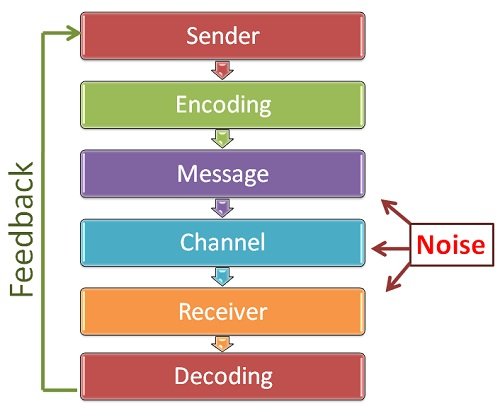
The process of communication involves the systematic exchange of information between a sender and a receiver. It begins with the sender encoding a message and transmitting it through a chosen medium (e.g., verbal, written, or digital). The receiver decodes the message, interprets its meaning, and provides feedback to complete the process. Effective communication relies on clarity, the right medium, and mutual understanding while minimizing barriers like noise, misinterpretation, or distractions that can disrupt the flow of information.

Communication Process:

The communication is a dynamic process that begins with the conceptualizing of ideas by the sender who then transmits the message through a channel to the receiver, who in turn gives the feedback in the form of some message or signal within the given time frame.

  1. Sender

The sender is the source of the message that initiates the communication. The sender has a message or purpose of communicating to one or more people. A manager in an organization has to communicate information about the tasks to be achieved or a production deadline to be met by his subordinate employees. Without a reason, purpose, or desire, the sender has no information/message to send.

  1. Encoding

In the next stage, encoding takes place when the sender translates the information or message into some words, signs or symbols. Without encoding the information cannot be transferred from one person to another. In encoding the message, the sender has to choose those words, symbols or gestures that he believes to have the same meaning for the receiver. While doing so, the sender has to keep the level of the receiver in mind and accordingly communicate with him in the way the receiver understands it.

The message may be in any form that can be understood by the receiver. Speech is heard; words are read; gestures are seen or felt and symbols are interpreted. For example, there are several communications we make with a wave of the hand or with a nod of the head, a pat on the back, blinking of eyes.

  1. Message

Once the encoding is finished, the sender gets the message that he intends to convey. The message can be written, oral, symbolic or non-verbal such as body gestures, silence, sighs, sounds, etc. or any other signal that triggers the response of a receiver.

Message is the idea or information that the sender wants to convey. He may convey it verbally (by writing or speaking) or non-verbally (through gestures or body language). Whatever the form, the message should be clearly formed so that the objective is accomplished.

  1. Channel

The channel is the medium used for transmission of information or message from sender to receiver. There are various media like telephone, mail through post, internet, radio, TV, press etc. For communication to be effective and efficient, the channel must be appropriate for the message. A phone conversation is not a suitable channel for transmitting a complex engineering diagram.

An express mail may be more appropriate. The needs and requirements of the receiver must also be considered in selecting a channel. If the receiver is illiterate, sending the message through postal mail is not relevant. Similarly, you cannot select the medium of telephone, if the receiver does not have a telephone with him. Therefore, in choosing the appropriate channel, the manager must decide whether feedback is important or not.

  1. Receiver

The receiver is the person who senses or perceives or receives the sender’s message. There may be just one receiver or a large number of receivers. The message must be prepared with the receiver’s background in mind. An engineer in a software organization should avoid using technical terms in communicating with his family members. It should be recognized that if the message does not reach a receiver, no communication takes place. Even, when the message reaches the receiver, if he cannot understand it, again there is no communication.

  1. Decoding

Decoding is the process through which the receiver interprets the message and translates it into meaningful information. It may be remembered that decoding is affected by the receiver’s past experience, personal assessments of the symbols and gestures, expectations, and mutuality of meaning with the sender.

  1. Noise

It represents the disturbing factor in the process of communication. It interferes with effective communication and reduces clarity of the message. The message may be interpreted differently than intended by the sender. Conversing near a machine making sounds, disturbance in telephone line, physical ailment or mental distress of sender or receiver are the common causes of noise that obstruct the quality of message transmitted from sender to the receiver.

  1. Feedback

Feedback is receiver’s response to the sender’s message. The receiver communicates reaction to the sender through words, symbols or gestures. It is the reversal of communication process where receiver becomes the sender and sender becomes the receiver. Unless the receiver responds to the message, communication process is incomplete. Feedback helps the sender transform his message, if needed. It also allows the receiver to clear doubts on the message, ask questions to build his confidence and enables the sender to know efficiency of the message. Feedback of information makes the communication process complete.

In face-to-face communication, sender can immediately receive the feedback. Written communication, on the other hand, takes longer for the sender to receive feedback on the message.

Feedback plays important role in two-way communication. In one-way communication, sender communicates with the receiver without getting any feedback but in two-way communication, the receiver provides feedback to the sender. Though one-way communication takes less time and is more orderly (it avoids noise and chaos), feedback in two-way communication makes it more accurate and precise.

Principles of Effective Business Communication

Effective Business Communication is critical to ensuring that information is conveyed clearly, accurately, and efficiently, fostering collaboration and productivity. Following certain principles can help individuals and organizations communicate more effectively, reducing misunderstandings and improving decision-making.

1. Clarity

Clarity is the foundation of effective communication. The message should be clear and straightforward, with no ambiguity. Using simple, precise language ensures that the audience fully understands the message without confusion. For example, when giving instructions or providing updates, be specific and avoid vague terms. Clear communication helps prevent errors and misunderstandings in business processes.

2. Conciseness

Conciseness means delivering the message in as few words as necessary, without sacrificing essential information. It eliminates redundancy and unnecessary details, saving time for both the sender and the receiver. Concise communication is particularly important in busy environments where individuals may be pressed for time. For instance, an email that conveys the key points without excessive elaboration increases the likelihood of a timely response and action.

3. Completeness

A message must be complete, containing all the information required by the receiver to understand and act upon it. It should answer the “5 Ws” (Who, What, Where, When, and Why), providing context, facts, and instructions. Incomplete communication can lead to confusion, delays, and mistakes. For example, a project update should include not only the status but also any potential risks, timelines, and resources needed.

4. Consideration

Effective business communication requires consideration of the receiver’s perspective. The sender should anticipate how the audience will interpret the message and ensure it aligns with their expectations, background, and needs. This principle emphasizes empathy—being aware of the receiver’s emotions, experiences, and knowledge level. For instance, when delivering bad news, it’s important to be sensitive and respectful to the recipient’s potential concerns.

5. Concreteness

Concreteness involves using specific facts, figures, and examples to support your message. Concrete communication is more impactful and leaves less room for misinterpretation. Rather than saying, “Sales have increased a lot,” a more concrete statement would be, “Sales have increased by 25% over the past quarter.” Specificity strengthens credibility and helps the receiver make informed decisions.

6. Correctness

Correctness in business communication refers to using proper grammar, punctuation, and spelling, as well as ensuring that the message is factually accurate. Incorrect information can damage credibility, lead to confusion, and harm professional relationships. Whether sending an email or giving a presentation, attention to detail in terms of language and facts is essential for maintaining professionalism.

7. Courtesy

Courtesy means communicating in a polite, respectful, and considerate manner. In business, maintaining a courteous tone fosters positive relationships and creates a collaborative environment. This principle involves being mindful of the receiver’s feelings, using appropriate language, and being diplomatic, especially when discussing sensitive topics. For example, a “thank you” at the end of a meeting or email strengthens interpersonal relationships.

8. Emphasis on Feedback

Effective communication is a two-way process, which includes providing and receiving feedback. Regular feedback helps clarify misunderstandings, reinforces key points, and allows for continuous improvement. In a business context, feedback can come in the form of performance reviews, surveys, or informal check-ins. An open feedback loop also ensures that communication remains dynamic and adaptable to changing needs.

9. Consistency

Consistency in communication ensures that the messages being communicated do not contradict each other and that they align with the organization’s values, goals, and objectives. Discrepancies in messages can lead to confusion, lack of trust, and decreased morale. For example, if a company communicates a commitment to innovation, this should be reflected in its actions, policies, and public statements.

10. Appropriateness

The principle of appropriateness refers to adapting the message to the audience and the context. The tone, medium, and level of detail should vary depending on the audience. For instance, a formal business letter would be appropriate for communicating with investors, while an informal email might be better for communicating with colleagues. Knowing the audience and situation ensures that communication is effective and well-received.

error: Content is protected !!