 by
by Product Life Cycle (PLC) is an important concept in Principles of Marketing that explains the stages through which a product passes from its introduction in the market to its final decline. Every product has a limited life span, and during this life span, its sales, profits, competition, and marketing strategies change. Understanding the product life cycle helps marketers plan product development, pricing, promotion, and distribution strategies effectively. The concept of PLC provides a systematic framework for managing products in a dynamic and competitive market environment.
Meaning of Product Life Cycle
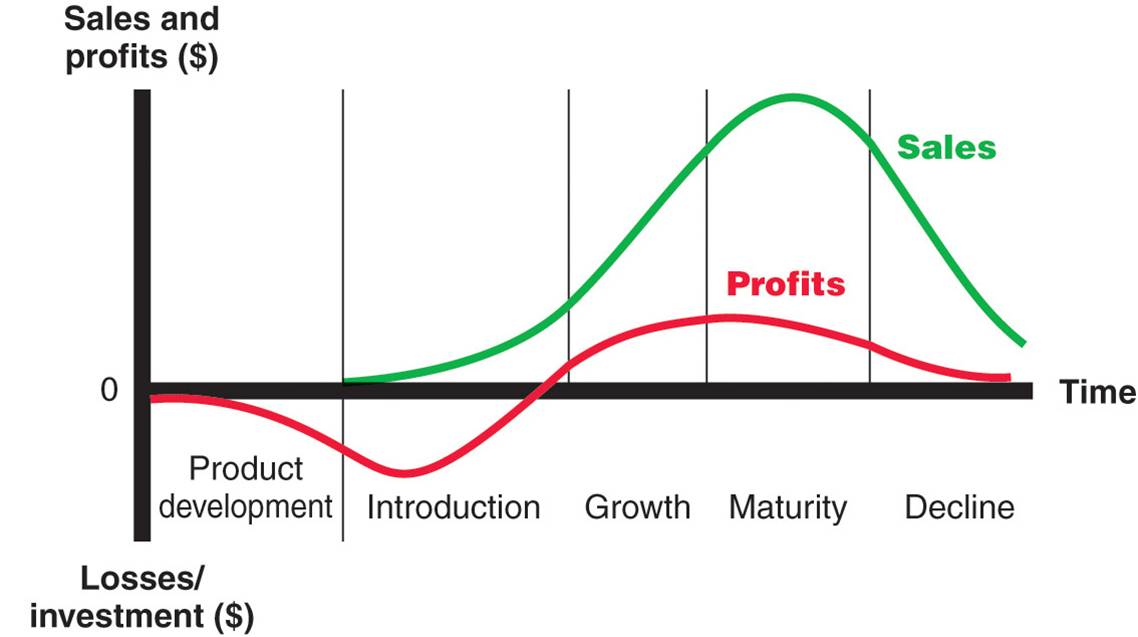
Product Life Cycle refers to the pattern of sales and profits experienced by a product over time. It represents the journey of a product from its launch to its withdrawal from the market. Just like human beings, products are born, grow, mature, and eventually decline. Although the length of each stage may vary from product to product, most products generally pass through five stages: Introduction, Growth, Maturity, and Decline. Each stage has distinct characteristics and requires different marketing strategies.
Stages of Product Life Cycle
1. Introduction Stage
The introduction stage is the first stage of the product life cycle, where a new product is launched in the market. During this stage, sales growth is slow because the product is new and customers are not fully aware of its existence. Heavy expenditure is incurred on advertising, promotion, product development, and distribution. Profits are usually low or negative due to high initial costs and low sales volume.
The main objective should be to create product awareness and trial.
In this stage, competition is limited or absent as the product is unique. Pricing strategies may vary—firms may adopt skimming pricing to recover high costs or penetration pricing to gain quick market acceptance. Promotion focuses on creating awareness, educating consumers, and encouraging trial purchases. Distribution channels are limited, and the product is available only in selected markets. The success of the introduction stage depends largely on effective promotion and product acceptance.
2. Growth Stage
The growth stage is characterized by a rapid increase in sales as the product gains acceptance among consumers. Customer awareness increases, repeat purchases occur, and new customers are attracted. Profits rise significantly due to higher sales volume and reduced cost per unit. During this stage, competitors enter the market with similar or improved versions of the product.
The main objective in the growth stage is to maximise the market share.
Marketing strategies in the growth stage focus on improving product quality, adding new features, expanding distribution channels, and strengthening brand image. Prices may be reduced slightly to attract price-sensitive customers and face competition. Promotional activities shift from creating awareness to building brand preference and differentiation. The growth stage is crucial for establishing a strong market position and maximizing long-term profitability.
3. Maturity Stage
The maturity stage is the longest stage of the product life cycle. During this stage, sales growth slows down as the product reaches maximum market penetration. The market becomes saturated, and competition becomes intense. Many competitors offer similar products, leading to price competition and reduced profit margins.
The company’s main objective should be to maximise profit while defending the market share.
Firms adopt various strategies to extend the maturity stage, such as product modification, market modification, and marketing mix modification. Product modification includes improving quality, design, packaging, or adding new features. Market modification involves finding new uses, new markets, or new customer segments. Promotional strategies focus on brand loyalty, reminders, and sales promotion schemes. Although profits start declining, effective strategies can help sustain sales and profitability.
4. Decline Stage
The decline stage is the final stage of the product life cycle. During this stage, sales and profits decline sharply due to technological advancements, changing consumer preferences, availability of substitutes, or market saturation. Some competitors exit the market, while others continue with limited offerings.
Marketing strategies during the decline stage include harvesting, divesting, or discontinuing the product. Firms may reduce promotional expenditure, cut costs, and focus on niche markets. Alternatively, companies may rejuvenate the product through innovation or repositioning. The decline stage requires careful decision-making to minimize losses and allocate resources efficiently.
Marketing Strategies at Different Product Life Cycle (PLC) Stages
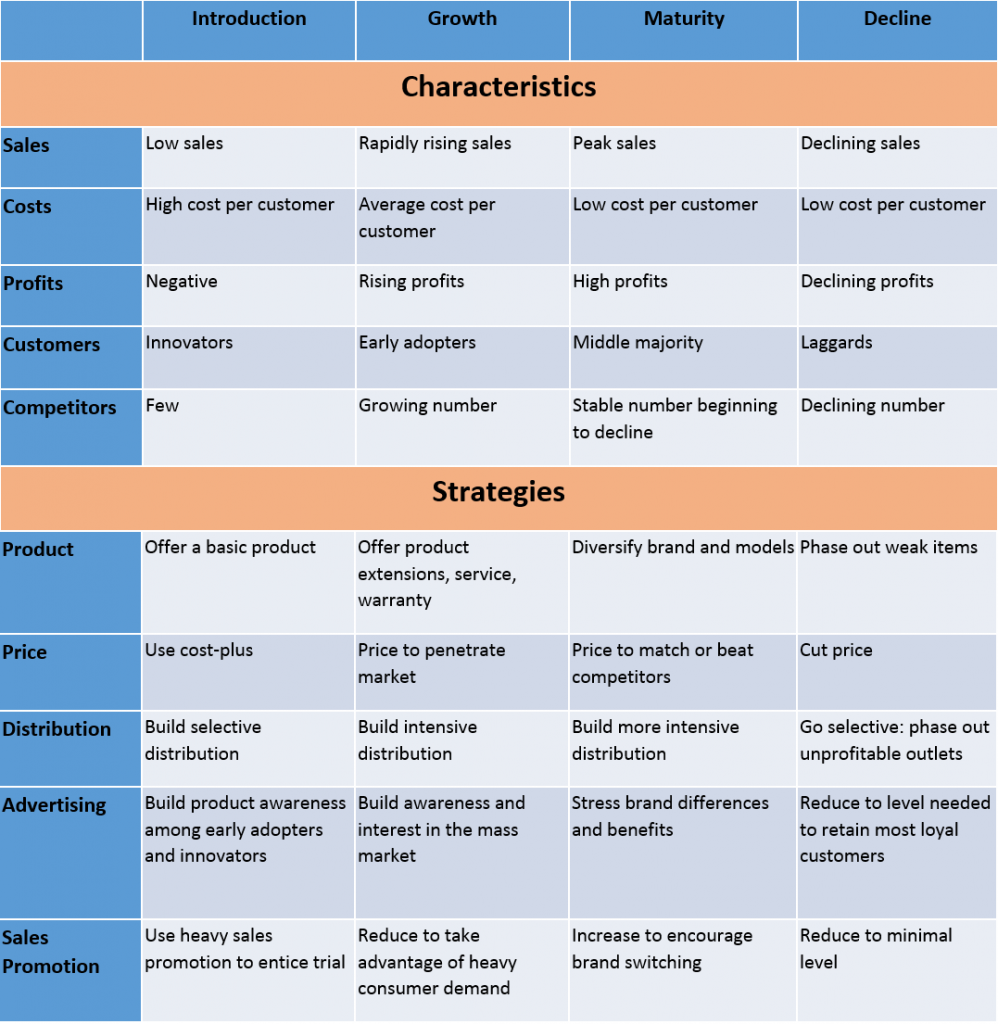
Marketing strategies vary at each stage of the Product Life Cycle because market conditions, competition, sales volume, and consumer behavior change over time. To achieve maximum effectiveness, firms must align their product, price, place, and promotion strategies with the specific stage of the PLC. The major marketing strategies at different PLC stages are explained below.
1. Introduction Stage
At the introduction stage, the product is new to the market and consumer awareness is low. The main objective of marketing is to create awareness and encourage trial purchases.
- Product Strategy
The product is introduced in its basic form with limited varieties. Emphasis is placed on quality and uniqueness.
- Price Strategy
Firms may adopt skimming pricing to recover high development costs or penetration pricing to attract more customers quickly.
- Place Strategy
Distribution is limited and selective. The product is available in selected markets and outlets.
- Promotion Strategy
Promotion is informative in nature. Heavy advertising, product demonstrations, free samples, and personal selling are used to educate consumers.
2. Growth Stage
In the growth stage, sales increase rapidly due to rising consumer acceptance and increasing competition. The objective is to build brand preference and expand market share.
- Product Strategy
Product improvements, new features, and additional models are introduced to differentiate from competitors.
- Price Strategy
Prices may be reduced slightly to attract price-sensitive customers and meet competition.
- Place Strategy
Distribution channels are expanded to reach a wider market. Product availability increases.
- Promotion Strategy
Promotion becomes persuasive. Advertising focuses on brand image, superiority, and customer benefits.
3. Maturity Stage
The maturity stage is marked by intense competition, market saturation, and slowing sales growth. The objective is to maintain market share and extend product life.
- Product Strategy
Product modification, quality improvement, new packaging, and value-added features are introduced.
- Price Strategy
Competitive pricing, discounts, and allowances are used to retain customers.
- Place Strategy
Distribution becomes intensive. Firms strengthen relationships with intermediaries.
- Promotion Strategy
Promotion focuses on reminder advertising, sales promotion schemes, and brand loyalty programs.
4. Decline Stage
In the decline stage, sales and profits decline due to technological changes, substitutes, or changing consumer preferences. The objective is to minimize losses.
- Product Strategy
Firms may discontinue weak products or focus on profitable variants.
- Price Strategy
Prices may be reduced to clear stock or maintained for niche markets.
- Place Strategy
Distribution is reduced and unprofitable outlets are eliminated.
- Promotion Strategy
Promotional expenditure is minimized. Only selective promotion is undertaken.
Marketing Strategies at Different PLC Stages
| PLC Stage | Sales & Profits | Product Strategy | Price Strategy | Place (Distribution) | Promotion Strategy |
|---|---|---|---|---|---|
| Introduction | Low sales, low/negative profits | Basic product, limited variants | Skimming / Penetration | Selective, limited outlets | Informative advertising, awareness creation |
| Growth | Rapidly increasing sales, rising profits | Improved quality, new features, variants | Competitive pricing | Expanded channels, wider market reach | Persuasive advertising, brand building |
| Maturity | Peak sales, declining profits | Product modification, better packaging | Competitive pricing, discounts | Intensive distribution | Reminder advertising, sales promotion |
| Decline | Falling sales and profits | Product elimination or niche focus | Reduced or stable niche pricing | Reduced channels | Minimal promotion, cost control |
Advantages of Product Life Cycle (PLC)
- Helps in Effective Product Planning
The Product Life Cycle concept helps marketers plan products effectively at different stages. By identifying whether a product is in the introduction, growth, maturity, or decline stage, firms can decide necessary changes in product features, quality, packaging, and branding. Proper product planning reduces chances of failure and ensures that products meet changing customer needs throughout their life span.
- Supports Better Marketing Strategy Formulation
PLC assists marketers in designing suitable marketing strategies for each stage of a product’s life. Pricing, promotion, and distribution strategies differ at every stage. For example, informative promotion is used in the introduction stage, while persuasive promotion is used in the growth stage. Thus, PLC ensures the right marketing mix is applied at the right time.
- Helps in Sales and Demand Forecasting
The product life cycle helps firms forecast future sales and demand patterns. By studying past and present sales trends, marketers can predict future performance. Accurate forecasting helps in production planning, inventory control, and resource allocation. This reduces uncertainty and enables firms to prepare for market changes in advance.
- Assists in Cost Control and Profit Planning
PLC helps organizations control costs and plan profits effectively. During the introduction stage, firms accept low or negative profits, while in the growth and maturity stages, they aim to maximize profits. In the decline stage, cost-cutting strategies are adopted. Thus, PLC enables better financial planning and efficient use of resources.
- Aids in Product Modification and Innovation
The PLC concept encourages continuous product improvement and innovation. When a product enters the maturity stage, firms modify features, design, or packaging to extend its life. Innovation helps in meeting changing consumer preferences and facing competition. PLC ensures that firms do not rely on outdated products for long periods.
- Helps in Managing Competition
PLC helps firms understand the level of competition at different stages. Competition is low in the introduction stage but increases in the growth and maturity stages. By knowing the intensity of competition, firms can adopt defensive or aggressive strategies. This improves competitive strength and market position.
- Supports Product Portfolio Management
The product life cycle helps firms manage a balanced product portfolio. Companies usually have products at different PLC stages. Profits from mature products can be used to support new products in the introduction stage. This balance ensures steady income, reduces risk, and supports long-term business stability.
- Guides Product Withdrawal Decisions
PLC helps firms decide the right time to discontinue or withdraw a product. When a product enters the decline stage and becomes unprofitable, firms can drop it and divert resources to new opportunities. This prevents unnecessary losses and improves overall efficiency and performance of the organization.
Limitations of Product Life Cycle (PLC)
- Difficulty in Identifying Exact Stage
One major limitation of the Product Life Cycle concept is the difficulty in identifying the exact stage of a product. Sales patterns are not always clear, and stages may overlap. Managers may misjudge whether a product is in growth or maturity, leading to incorrect marketing decisions and ineffective strategies.
- Not Applicable to All Products
The PLC concept does not apply uniformly to all products. Some products may not follow a clear life cycle pattern, while others may remain in one stage for a long time. Fashion products, fads, and seasonal goods often have unpredictable life cycles, limiting the usefulness of the PLC model.
- Uncertainty in Duration of Stages
The length of each stage of the product life cycle cannot be predicted accurately. Some products may experience rapid growth and quick decline, while others may remain in the maturity stage for many years. This uncertainty makes long-term planning difficult for marketers.
- External Factors Affect the Life Cycle
External factors such as technological changes, government policies, economic conditions, and competition can alter the product life cycle. Sudden innovations or regulatory changes may shorten or extend a product’s life unexpectedly. The PLC concept does not fully consider these uncontrollable environmental factors.
- Overemphasis on Sales and Profits
The PLC concept mainly focuses on sales and profit trends and ignores other important factors such as customer satisfaction, brand equity, and market relationships. A product with low sales may still be strategically important for brand image or customer retention, which PLC may overlook.
- Reactive Rather Than Predictive
PLC is more descriptive than predictive in nature. It explains what has happened to a product rather than accurately predicting future performance. Managers often use PLC after changes occur, which may result in delayed responses to market challenges.
- Ignores Marketing Efforts Impact
The PLC model assumes that products naturally move through stages, but it does not fully recognize the impact of marketing efforts. Aggressive promotion, repositioning, or innovation can significantly change a product’s life cycle. Thus, PLC may underestimate the role of managerial decisions.
- Difficult to Use in Strategic Decisions
Due to its generalized nature, PLC may not provide clear guidance for strategic decision-making. Different products within the same category may be at different stages. Relying solely on PLC can lead to oversimplified strategies and poor decision-making.
