Liabilities and Bills Payable

A liability is a financial obligation of a company that results in the company’s future sacrifices of economic benefits to other entities or businesses. A liability can be an alternative to equity as a source of a company’s financing. Moreover, some liabilities, such as accounts payable or income taxes payable, are essential parts of day-to-day business operations.

Liabilities can help companies organize successful business operations and accelerate value creation. However, poor management of liabilities may result in significant negative consequences, such as a decline in financial performance or, worse, bankruptcy.

Current Liabilities vs. Long-term Liabilities

The primary classification of liabilities is according to their due date. The classification is critical to the company’s management of its financial obligations.

Current liabilities are those that are due within a year. These primarily occur as part of regular business operations. Due to the short-term nature of these financial obligations, they should be managed with consideration of the company’s liquidity. Liquidity is frequently determined as a ratio between current assets and current liabilities. The most common current liabilities are:

  • Accounts payable: These are the unpaid bills to the company’s vendors. Generally, accounts payable are the largest current liability for most businesses.
  • Interest payable: Interest expenses that have already occurred but have not been paid. Interest payable should not be confused with the interest expenses. Unlike interest payable, interest expenses are expenses that have already been incurred and paid. Therefore, interest expenses are reported on the income statement, while interest payable is recorded on the balance sheet.
  • Income taxes payable: The income tax amount owed by a company to the government. The tax amount owed must be payable within one year. Otherwise, the tax owed must be classified as a long-term liability.
  • Bank account overdrafts: A type of short-term loan provided by a bank when the payment is processed with insufficient funds available in the bank account.
  • Accrued expenses: Expenses that have incurred but no supporting documentation (e.g., invoice) has been received or issued.
  • Short-term loans: Loans with a maturity of one year or less.

Bill Payable

A bill payable is a document which shows the amount owed for goods or services received on credit (meaning not paid at the time that the goods or services were received). The provider of the goods or services is referred to as the supplier or vendor. Hence, a bill payable is also known as an unpaid vendor invoice.

Examples of Bills Payable

Examples of a bill payable include a monthly telephone bill, the monthly bill for the electricity used, a bill for repairs that were completed, the bill for merchandise purchased by a retailer on credit, etc.

In the context of personal finance and small business accounting, bills payable are liabilities such as utility bills. They are recorded as accounts payable and listed as current liabilities on a balance sheet.

The term “bills payable” is often used interchangeably with the term “accounts payable.” As such, a company will treat bills payable in the same manner as it treats accounts payable obligations that will become due within one year. The account for bills payable includes purchases a company makes on credit and money a company borrows that must be repaid within one year.

Significance

The bills payable account appears on a company’s balance sheet, which indicates the financial position of the business at a specific point in time. Bills payable reduces the amount of equity owners have invested in the business because owners’ equity equals the remaining portion after liabilities are subtracted from assets. Increased liabilities means the company has less equity. A credit in the bills payable account increases the amount of the obligation the company must pay, while a debit to bills payable reduces the amount of the liability.

Interest

If a company takes out a loan, it may be classified as a bill payable if the loan must be repaid within one year. Typically, a loan due in over one year is classified under notes payable, while short-term loans are classified as accounts or bills payable. The company makes interest payments as a result of the short-term borrowing, and the interest due is classified as interest payable until the company makes a cash payment for the amount of interest due. Interest payable is another short-term liability that indicates the company has an obligation to make an interest payment.
Goodwill – Investments

Goodwill is an intangible asset that is associated with the purchase of one company by another. Specifically, goodwill is the portion of the purchase price that is higher than the sum of the net fair value of all of the assets purchased in the acquisition and the liabilities assumed in the process. The value of a company’s brand name, solid customer base, good customer relations, good employee relations, and proprietary technology represent some reasons why goodwill exists.

Goodwill in accounting is an intangible asset that arises when a buyer acquires an existing business. Goodwill represents assets that are not separately identifiable. Goodwill does not include identifiable assets that are capable of being separated or divided from the entity and sold, transferred, licensed, rented, or exchanged, either individually or together with a related contract, identifiable asset, or liability regardless of whether the entity intends to do so. Goodwill also does not include contractual or other legal rights regardless of whether those are transferable or separable from the entity or other rights and obligations. Goodwill is also only acquired through an acquisition; it cannot be self-created. Examples of identifiable assets that are goodwill include a company’s brand name, customer relationships, artistic intangible assets, and any patents or proprietary technology. The goodwill amounts to the excess of the “purchase consideration” (the money paid to purchase the asset or business) over the net value of the assets minus liabilities. It is classified as an intangible asset on the balance sheet, since it can neither be seen nor touched. Under US GAAP and IFRS, goodwill is never amortized, because it is considered to have an indefinite useful life. Instead, management is responsible for valuing goodwill every year and to determine if an impairment is required. If the fair market value goes below historical cost (what goodwill was purchased for), an impairment must be recorded to bring it down to its fair market value. However, an increase in the fair market value would not be accounted for in the financial statements. Private companies in the United States, however, may elect to amortize goodwill over a period of ten years or less under an accounting alternative from the Private Company Council of the FASB.

The process for calculating goodwill is fairly straightforward in principle but can be quite complex in practice. To determine goodwill in a simplistic formula, take the purchase price of a company and subtract the net fair market value of identifiable assets and liabilities.

Goodwill = P-(A-L)

where: P = Purchase price of the target company, A = Fair market value of assets, L = Fair market value of liabilities.

What Goodwill Tells You?

The value of goodwill typically arises in an acquisition—when an acquirer purchases a target company. The amount the acquiring company pays for the target company over the target’s net assets at fair value usually accounts for the value of the target’s goodwill If the acquiring company pays less than the target’s book value, it gains negative goodwill, meaning that it purchased the company at a bargain in a distress sale.

Goodwill is recorded as an intangible asset on the acquiring company’s balance sheet under the long-term assets account. Under generally accepted accounting principles (GAAP) and International Financial Reporting Standards (IFRS), companies are required to evaluate the value of goodwill on their financial statements at least once a year and record any impairments. Goodwill is considered an intangible (or non-current) asset because it is not a physical asset like buildings or equipment.

Goodwill Calculation Controversies

There are competing approaches among accountants as to how to calculate goodwill. One reason for this is that goodwill represents a sort of workaround for accountants. This tends to be necessary because acquisitions typically factor in estimates of future cash flows and other considerations that are not known at the time of the acquisition. While this is perhaps not a significant issue, it becomes one when accountants look for ways of comparing reported assets or net income between different companies; some that have previously acquired other firms and some that have not.

Goodwill Impairments

Impairment of an asset occurs when the market value of the asset drops below historical cost. This can occur as the result of an adverse event such as declining cash flows, increased competitive environment, or economic depression, among many others. Companies assess whether an impairment is needed by performing an impairment test on the intangible asset.

The two commonly used methods for testing impairments are the income approach and the market approach. Using the income approach, estimated future cash flows are discounted to the present value. With the market approach, the assets and liabilities of similar companies operating in the same industry are analyzed.

If a company’s acquired net assets fall below the book value or if the company overstated the amount of goodwill, then it must impair or do a write-down on the value of the asset on the balance sheet after it has assessed that the goodwill is impaired. The impairment expense is calculated as the difference between the current market value and the purchase price of the intangible asset.

The impairment results in a decrease in the goodwill account on the balance sheet. The expense is also recognized as a loss on the income statement, which directly reduces net income for the year. In turn, earnings per share (EPS) and the company’s stock price are also negatively affected.

The Financial Accounting Standards Board (FASB), which sets standards for GAAP rules, is considering a change to how goodwill impairment is calculated.1 Because of the subjectivity of goodwill impairment and the cost of testing impairment, FASB is considering reverting to an older method called “goodwill amortization” in which the value of goodwill is slowly reduced annually over a number of years.

Goodwill vs. Other Intangibles

Goodwill is not the same as other intangible assets. Goodwill is a premium paid over fair value during a transaction and cannot be bought or sold independently. Meanwhile, other intangible assets include the likes of licenses and can be bought or sold independently. Goodwill has an indefinite life, while other intangibles have a definite useful life.

Limitations of Using Goodwill

Goodwill is difficult to price, and negative goodwill can occur when an acquirer purchases a company for less than its fair market value. This usually occurs when the target company cannot or will not negotiate a fair price for its acquisition. Negative goodwill is usually seen in distressed sales and is recorded as income on the acquirer’s income statement.

There is also the risk that a previously successful company could face insolvency. When this happens, investors deduct goodwill from their determinations of residual equity. The reason for this is that, at the point of insolvency, the goodwill the company previously enjoyed has no resale value.

Example of Goodwill

If the fair value of Company ABC’s assets minus liabilities is $12 billion, and a company purchases Company ABC for $15 billion, the premium value following the acquisition is $3 billion. This $3 billion will be included on the acquirer’s balance sheet as goodwill.

As a real-life example, consider the T-Mobile and Sprint merger announced in early 2018. The deal was valued at $35.85 billion as of March 31, 2018, per an S-4 filing. The fair value of the assets was $78.34 billion and the fair value of the liabilities was $45.56 billion. The difference between the assets and liabilities is $32.78 billion. Thus, goodwill for the deal would be recognized as $3.07 billion ($35.85 – $32.78), the amount over the difference between the fair value of the assets and liabilities.

Verification and Valuation of different Items

Fixed assets of are a permanent nature with which the business is carried on and which are held for earning income and not for re-sale in the ordinary course of the business. It is a long-term tangible property that a firm owns and uses in its operations to generate income. Fixed assets are not converted into cash or consumed within a year. They are also called as Capital Assets. Example: land and buildings, plant and machinery, furniture etc. These assets are to be valued at cost price less total depreciation in their value by constant use. Additions by way of purchase and deletions by way of sales should be taken into account. The mode of valuation of different types of assets differs depending upon the nature of the business and the purpose for which the assets are held.

  1. Land and Buildings

Land means a long -term asset that refers to the cost of real property exclusive of the cost of any constructed assets on the property. The value of land has an appreciated value and is not subject to depreciation. A building is a noncurrent or long-term asset which shows the cost of a building (excluding the cost of the land) Buildings will be depreciated over their useful life of the asset.

Classified into two types

Land and Buildings can further be classified as:

  • Freehold property
  • Leasehold property

(i)  Freehold Property

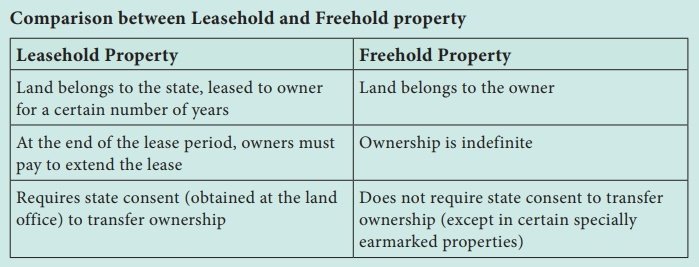
A property which is free from hold (Possession/Rights) is called as freehold property. This means that the property is free from the hold of anybody besides the owner who enjoys complete ownership.

Auditor’s Duty

  • Where Freehold property has been purchased, the auditor should examine the title deeds e.g., purchase deed, certificate of registration, the broker’s note and auctioneer’s account etc., to verify the correct position.
  • When the property has been mortgaged, the auditor should obtain a certificate from the mortgagee regarding the possession of title deed and outstanding amount of loan.
  • When the property has been acquired in the current year, then the cost may be verified with the help of the bank passbook. He should vouch all the payments made in this connection.
  • He should see that the property account should be shown in the Balance Sheet at cost price including the legal and registration charges less depreciation up-to-date.
  • He should also see that a separate account for building and land on which it is constructed is maintained. It is necessary because depreciation is provided for building and not for the land.

(ii)  Leasehold Property

Leasehold is an accounting term for an asset being leased. The asset is typically property such as a building or space in a building.

  • The property which is on lease (rent).
  • The property (plot/flat/villa/mall/ factories) which is leased by the landlord for a certain period of time to the lessee (tenant /leaseholder/renter/ occupant/dweller).
  • The (tenants) have been given the right to use during that specified time by the landlord.
  • The ownership of the property returns to the landlord when the lease comes to an end.

Auditor’s Duty

  • The auditor should verify this by inspecting the lease agreement or contract to find out value and duration. He should see that the terms and conditions of lease are properly complied with.
  • In case property has been mortgaged, the auditor should obtain a certificate from the mortgagee regarding the possession of title deed.
  • Where the leasehold property has been sub-let, the counter part of the tenant’s agreement should also be examined.
  • The auditor should physically inspect the properties.
  • The auditor should also note that proper provision has been made for depreciation of lease problem and for any possible claims arising there under.
  1. Plant and Machinery

A plant is an asset with a useful life of more than one year that is used in producing revenues in a business’s operations. Plant is recorded at cost and depreciation is reported during their useful life.

Auditor’s Duty

  • When the machines are purchased in the current accounting period, the invoices and the agreement with the vendors should be verified.
  • The auditor should ` examine the plant register in which particulars about the cost, records about sales, provision for depreciation, etc., are available.
  • He should prepare a list of each machine from the plant register and should get the list certified by the works manager as he is not a technical person and therefore he has to depend upon the advice of the works manager regarding their valuation, etc.
  • He should see that plant and machinery account is shown in the Balance Sheet at cost less depreciation after making proper adjustment for purchases and sales during the year under audit.
  • In case any plant and machinery has been scrapped, destroyed or sold, he should ascertain that the profit or loss arising thereon has been correctly determined.

Valuation of Fixed Assets

  1. Valuation of Land: Land which does not have depreciated value, is valued at cost price.
  2. Valuation of Other Fixed Assets: Other fixed assets like Buildings, Plant, machinery, office equipment, furniture and fixtures should be valued at going concern value.
  3. Depreciation: Auditor should ensure that adequate amount of depreciation has been provided, taking into account the working life and usage of the asset.
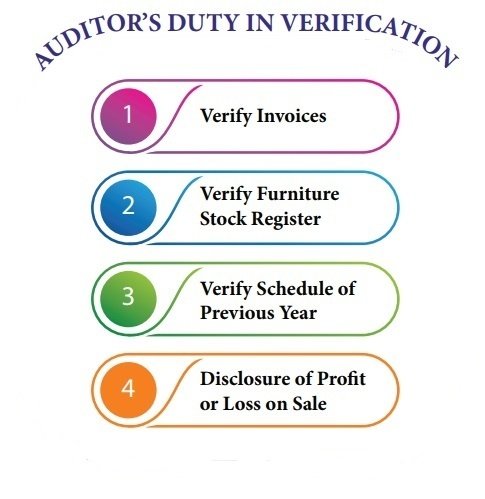
  4. Disclosure in Balance Sheet: He should verify that furniture, fittings and fixtures are disclosed in Balance Sheet at cost less depreciation.

Meaning and Objectives of Verification and Valuation

Concept and Meaning of Verification

Verification means proving the correctness. One of the main work’s of auditor is verification of assets and liabilities. Verification is the act of assuring the correctness of value of assets and liabilities, title and their existence in the organization. An auditor should be satisfied himself about the actual existence of assets and liabilities appearing in the balance sheet is correct. If balance sheet incorporates the incorrect assets, both profit and loss account and balance sheet do not present true and fair views.

Thus, verification means to confirm the truth or accuracy and to substantiate. It is a process by which the auditor satisfies himself not only about the actual existence, possession, ownership and the basis of valuation but also ensures that the assets are free from any charge. While verifying the assets, an auditor should consider the following points:

  • Ensuring the existence of assets.
  • Acquiring the assets for business.
  • Ensuring the proper valuation of assets.
  • Ensuring that the assets are free from any charge.

Objective of Verification

The objectives of verification are as follows:

  • To show the correct value of assets and liabilities.
  • To know whether the Balance Sheet exhibits a true and fair view of the state of affairs of the business.
  • To find out the ownership, possession and title of the assets appearing in the Balance Sheet.
  • To find out whether assets are in existence.
  • To detect frauds and errors, if any while recording assets in the books of the concern.
  • To find out whether there is an adequate internal control regarding acquisition, utilization and disposal of assets.
  • To verify the arithmetic accuracy of the accounts.
  • To ensure that the assets have been properly recorded.

Auditor’s Duty Regarding Verification

The auditor of a business is required to report in concrete terms that the Balance Sheet exhibits a true and fair view of the state of its affairs. In other words, he has to examine and ascertain the correctness of the money value of assets and liabilities appearing in the Balance Sheet and this examination is known as verification of assets and liabilities. Therefore, an auditor has to keep in mind the following points while verifying the assets:

  • Ensuring the existence of assets.
  • Acquiring the assets for business.
  • Legal ownership and possession of the assets.
  • Ensuring the proper valuation of assets.
  • Ensuring that the assets are free from any charge.

Concept and Meaning of Valuation

Valuation is the act of determining the value of assets and critical examination of these values on the basis of normally accepted accounting standard. Valuation of assets is to be made by the authorized officer and the duty of auditor is to see whether they have been properly valued or not. For ensuring the proper valuation, auditor should obtain the certificates of professionals, approved values and other competent persons. Auditor can rely upon the valuation of concerned officer but it must be clearly stated in the report because an auditor is not a technical person.

An auditor should consider the following points regarding the assets while making valuation off assets:

  • Original cost
  • Expected working life
  • Wear and tear
  • Scrap value

Objectives of Valuation

  • To assess the correct financial position of the concern.
  • To enquire about the mode of investment of the capital of the concern.
  • To assess the goodwill of the concern.
  • To evaluate the differences in the value of the asset as on the date of purchase and on the date of Balance Sheet.

Methods of Valuation

Valuation of various assets can be made by using different methods of valuation of fixed assets. Some of the major methods are as follows:

  1. Cost Price Method

In this method, valuation of assets is made on the basis of purchase price of the assets. This price refers to the price at which an asset is acquired plus expenses incurred in connection with the acquisition of an asset. It is a very simple method of valuing assets.

  1. Market Value Method

Valuation of assets can be made on the basis of market price of such assets. But if same nature of assets is not available in the market, it is very difficult to determine the value of such assets. So, there are two methods related to it. They are:

  • Replacement Value Method: It represents the value at which a given asset can be replaced. This method of valuation of assets can be done only in the case of replacement of the same asset.
  • Net Realizable Value: It refers to the price in which such asset can be sold in the market. But expenditure incurred at the sale of such asset should be deducted.
  1. Standard Cost Method

Some of the business organizations fix the standard cost on the basis of their past experience. On the basis of standard cost, they make valuation of assets and present in the Balance Sheet.

  1. Book Value

This is the value at which an asset appears in the books of accounts. It is usually the cost less depreciation written off so far.

  1. Going concern or Historical Value or Conventional Value or Token Value

It is equivalent to the cost less a reasonable amount of depreciation written off. No notice is taken of any fluctuation in the price of the assets. Reason for this is that these assets are acquired for use in the business and not for resale.

  1. Scrap Value

This method shows the value realized from sale of an asset as scrap. In other words, it refers to the value, which may be obtained from the assets if it is sold as scrap.

Auditor’s Duty as Regards Valuation

In a legal case against Kingston Cotton Mills Co: It was held that “although it is no part of an Auditor’s’ duty to value the assets and liabilities, yet he must exercise reasonable skill and care in scrutinizing the basis of valuation. He should test the accuracy of the values put by the officers of the business. In any case, the auditor cannot guarantee the accuracy of the valuation”.

It is not an auditor’s duty to determine the values of various assets. It has been judicially held that he is not a valuer or a technical man to estimate the value of an asset. But he is definitely concerned with values set against the assets. He has to certify that the profit and loss account shows true profit or loss for the year and Balance Sheet shows a true and fair view of the state of affairs of the company at the close of the year. Therefore he should exercise reasonable care and skill, analyse all the figures critically, inquire into the basis of valuation from the technical experts and satisfy himself that the different classes of assets have been valued in accordance with the generally accepted assumptions and accounting principles. If the market value of the assets are available i.e., in the case of share investment then he should verify the market value with the stock exchange quotations. If there is any change in the mode of the valuation of an asset, he should seek proper explanation for it. If he is satisfied with the method of valuation of the assets he is free from his liability.

Vouching of Receipts: Cash Sales, Receipts from Debtors

Vouching of Receipts from Debtors

There should be an effective system of Internal Check. Important parts of such systems should be (a)Persons maintaining the debtor’s ledger should not be allowed to collect the money from the customers, and (b) The customers should be asked to remit cash/cheques through the post.

The auditor should ensure that the unused receipt books are kept in the custody and control of some responsible officer. The original copies of all the spoilt receipt forms are attached with the duplicate copies in the receipt book. Proper scrutiny should be made about the discounts allowed to the customers. Special attention should be paid to amounts written off as bad debts. Tally the dates and amounts on the counterfoils with those in the cash book. Teeming and Lading should be avoided.

Vouching of Sale of Investment

Sale of Investment should give rise to capital receipts, except in the case of sale by brokers or investment firms for whom the proceeds will constitute revenue receipts. Vouching of sale of investment should be done with the broker’s advice and comparison with the stock market quotations in the fin racial journal. It should also be checked with related to investments accounts. The securities on hand and the payments received thereon from time-to-tithe should be checked.

Routine Checking and Vouching

Routine Checking

The term ‘routine checking’ means

(a) The checking of casts, sub-casts, carry forwards, extensions and other calculations in the books of original entry;

(b) The checking of postings into ledgers, and

(c) The checking of ledger accounts, as regards their casts, balancing the carrying forward of balances and the transfer of balances and the transfer of balances to the Trial Balance.

For this purpose, Auditors usually employ ticks of different kinds. Very often coloured pencils are used to distinguish one type of ticks from other.

Objectives of Routine Checking

  1. Verification of the arithmetical accuracy of the original books;
  2. Ascertainment of postings from books of original entry to the correct accounts in the ledgers;
  3. Ensuring, by special ticks, that no figures are altered after they have been checked.

Contrary to this the objects of vouching are much wider in their scope. In addition to the objects of routine checking discussed above, auditor undertakes the work of vouching with the object of going behind the books and to completely satisfy himself that the transactions recorded in the books are (i) properly authorised and (ii) correctly entered into. His attempt would be in the direction of finding out facts behind the figures. Careful and intelligent vouching would help an auditor to a very great extent in detecting frauds. The extent of vouching to be performed by an auditor would depend upon the systems of book-keeping and internal check in operation in the business.

Advantages of Routine Checking

Following benefits can be obtained from the routine checking:

  1. All the original entries will be checked; so all the errors and frauds can be detected easily.
  2. All the entries and posting will be tested.
  3. Routine checking helps to conduct final audit because all the balancing and totals have already been checked.
  4. Separate and specific staffs are not needed because it is a regular process.

Disadvantages of Routine Checking

Followings are the limitations of routine checking:

  1. Routine checking is a mechanical test, so the staff who performs this work does not have inspiration. So, there are chances of leaving errors and frauds.
  2. Routine checking can only detect small errors and frauds but not the planned frauds.
  3. Routine checking is not needed where self balancing system is applied.
  4. Routine checking cannot detect principle and compensating errors.

The following points, show the relationship/difference between routine checking and vouching:

  1. The auditor verifies the arithmetical accuracy of the entries through routine checking. In vouching entries are checked with the help of related documentary evidence.
  2. Vouching also includes examination of documentary evidence in support of recorded transactions besides routine checking. Thus, routine checking is a part of vouching.
  3. The work of routine checking is generally done by junior audit clerks, whereas vouching is done by senior audit clerks.
  4. Vouching traces the sources of information beyond the books of accounts whereas routine checking is limited to recorded entries.

The auditor verifies the arithmetical accuracy of the entries through routine checking. In vouching entries are checked with the help of related documentary evidence.

Vouching also includes examination of documentary evidence in support of recorded transactions besides routine checking. Thus, routine checking is a part of vouching.

The work of routine checking is generally done by junior audit clerks, whereas vouching is done by senior audit clerks.

Vouching traces the sources of information beyond the books of accounts whereas routine checking is limited to recorded entries.

Vouching: Meaning, Definition, Importance, Objective, Characteristics and Source

Vouching, widely recognized as “the backbone of auditing,” is a component of an audit seeking to authenticate the transactions recorded in a firm’s book of accounts. When an accounting transaction is vouched, it is tested and verified by presenting relevant documentary evidence.

Vouching is a Technical term, which refers to the inspection of documentary evidence supporting and substantiating a transaction, by an auditor. It is the essence of Auditing.

It is the practice followed in an audit, with the objective of establishing the authenticity of the transactions recorded in the primary books of account. It essentially consists of verifying a transaction recorded in the books of account with the relevant documentary evidence and the authority on the basis of which the entry has been made; also confirming that the amount mentioned in the voucher has been posted to an appropriate account which would disclose the nature of the transaction on its inclusion in the final statements of account. Vouching does not include valuation.

Vouching can be described as the essence or backbone of auditing. The success of an audit depends on the thoroughness with which vouching is done. After entering in all vouchers, only then can auditing start. Vouching is defined as the “verification of entries in the books of account by examination of documentary evidence or vouchers, such as invoices, debit and credit notes, statements, receipts, etc. The object of vouching is to establish that the transactions recorded in the books of accounts are:

(1) in order and have been properly authorized.

(2) are correctly recorded.

“Simple routine checking cannot establish the same accuracy that vouching can. In routine checking, entries recorded in the books only show what information the bookkeeper chooses to disclose; however, these entries can be fictitious without any vouching or vouchers. By using a vouching or a voucher system a company will have concrete and solid documentation and evidence of expenses, capital, and written proof in audits.

Vouching is the essence or backbone of auditing because when performing an audit, an auditor must have proof of all transactions. Without the proof provided by vouching, the claims provided by the auditor are just that, only claims. In most cases, hard to detect frauds can only be discovered through the use of vouching. This means that the auditor must conduct vouching with great importance, if not, he can be charged with negligence. The importance of vouching was realized. In this case, the auditors were found to be guilty on negligence, because the auditors did not display enough reasonable care and skill in vouching the wage sheets and ended up failing to detect fraud in manipulation of these wage records and cash vouchers. When delivering the decision, the Judge stated that “It was clear that a good many documents were suspicious on either face and called for Inquiry”. It was declared that it was essential that due care and attention are to be given to vouching in auditing.

Importance

Essence of Auditing:

Auditing not only checks the accuracy of books of accounts but also checks whether the transactions are related to business or not. All the transactions are performed after the prior approval of concerned authority or not, transactions are real or not because an accountant may include fictitious transactions to commit frauds. All these facts can be found with the help of vouching. So, vouching is essential for auditing.

Verification:

Once vouching of the transactions recorded is over, verification of assets and liabilities is done. Therefore, vouching acts as a basis for verifying the assets and liabilities.

Backbone of Auditing:

Main aim of auditing is to detect errors and frauds for proving the true and fairness of results presented by income statement and balance sheet. Vouching is only the way of detecting all sorts of errors and planned frauds. So, it is the backbone of auditing.

Objectives

  • To check whether proper documentary evidence is there in support of the entries made in the books of accounts.
  • All transactions are to be supported by evidence. Each document should be proved by authorized authority. With the help of vouching we can detect errors and frauds by verifying each transaction. Planned fraud can be detected through vouching.
  • To make sure that all the transactions that have been occurred, are entered in the books of accounts.
  • To Find the Unrecorded Transactions: Each and every transaction is checked and ratified on the basis of document. Vouching helps to find out the unrecorded or missing transactions. If any voucher is found unrecorded, auditor can suggest to record such transactions.
  • To examine the transaction for which money paid or received relates to the business.
  • To check whether the transaction belongs to the entity.
  • To Know That Only the Business Transactions Are Recorded: Sometimes, transactions are performed for individual purpose but payment is made out of business. Such transactions should not be recorded in account of business. If such transactions are recorded, we can find it with the help of vouching. To know the real profit or loss of business, such transactions are to be separated.

Characteristics

  • Imperative Aspect of Auditing
  • Basis of Auditing
  • Drafted Evidence
  • Disclosure of Extortion
  • Report on Business Activities Only
  • No Secret Transactions
  • Course of Voucher

Source

Internal Voucher: The Voucher prepared by company and its entities (Different Branches), also called micro environment of Business use for own purpose. Eg. Sale Invoice, Transfer of goods invoice etc..

External Voucher: The Voucher prepared by macro environment of the Business Organization (Outsider) of the Business, received from outside Party. Eg. Electricity Bill, Rent Paid, Bank Statement etc..

Differences between Internal Check and Internal Audit

  1. Meaning

  • Internal Check is an arrangement of duties allocated in such a way that the work of one person is automatically checked by another.
  • Internal Audit is an independent appraisal of the operations and records of the company.
  1. Object

  • The purpose of Internal Audit is to detect the errors and frauds which have already been committed.
  • The purpose of Internal Check is to prevent or minimize he possibilities of errors, frauds or irregularities.
  1. Need for separate staff

  • For carrying out Internal Audit, a separate staff of employees is engaged for the purpose.
  • For internal check, no new appointment is made. It, in fact represents only the arrangement of duties of the staff in a particular way.
  1. Nature of work

  • The work involved in the Internal Audit is just like that of a watch man. Internal auditor has to report, from time to time, to the management about the various in efficiencies and suggest improvements. It is also his duty to see that the internal check system does not become static.
  • Internal Check, on the other hand, represents a process under which the work goes on uninterruptedly and the checking too is more or less automatic.
  1. Timing of work

  • Internal Audit starts when the accounting process of different transactions is finished.
  • Internal Check is an operation during the course of transaction.
  1. Internal audit

  • It is a device for checking the work, whereas
  • Internal check is a device for doing the work.
  1. In Internal Audit Errors and Frauds are detected after the completion of work, whereas in Internal Check the Errors and Frauds are discovered during the course of work.
  2. Scope of work

  • The scope of Internal Check is very limited.
  • The scope of Internal Audit is comparatively board.
  1. Involvement

  • A large number of employees are needed for the implementation of Internal Check System.
  • Whereas, a much smaller number of persons are needed for implementing Internal Audit implementation.

Differences between Internal Check and Internal Audit

If you want to successfully manage risk, it helps to use the correct risk terms and expressions. Many people use risk terms without realizing that they may not be using the right terminology. It’s easy to become confused because sometimes the field of risk management uses similar terms for different purposes. For example, “Operational Risk Management” has a different meaning in the banking and insurance industry, compared to other industries (oil & gas, mining, manufacturing, chemicals, etc.).

Similarly, the term “audit” can refer either to an internal audit conducted by an organization itself, or an external audit performed by an auditing firm hired by the organization. Some people confuse the two when using the term “audit”. This is important because an internal audit and external audit may assess different things, and have different frameworks and workflows.

Internal Audit is a Function Performed at Specific Times

Many people in risk management use this simple formula to explain the difference between Internal Audit and Internal Control: Internal Audit is a function, while Internal Control is a system. Internal audits are performed at specific times to assess:

  • If the company has a good understanding of the risks that it faces
  • If the controls put in place to mitigate risks are effective.

There is one very important distinction to be made: it is not the job of internal auditors to identify risks, nor to specify the controls that are needed. Internal Audit evaluates whether the process leading to the identification of risks is working well, checks whether controls already in place are working according to the way they are intended to, and evaluates an organization’s governance system and process.

Internal Control is an Ongoing System

Internal Control is made up of procedures, policies and measures designed to make sure that an organization meets its objectives, and that risks that can prevent an organization from meeting its objectives are mitigated. While the Internal Audit function is performed by internal auditors, Internal Control is the responsibility of operational management functions. Another point of contrast is frequency. An internal audit is a check that is conducted at specific times, whereas Internal Control is responsible for checks that are on-going to make sure operational efficiency and effectiveness are achieved through the control of risks. Some risk experts even say that Internal Control is a part of a company’s day-to-day management and administration.

Internal Audit: Meaning, Advantages and Disadvantages of Internal Audit

The words “internal audit” often conjure a sense of fear, frustration, and time consumption. Even in the best circumstances, most would find having someone review their activities unsettling or intimidating. Having an understanding of the role of an internal audit, knowing what to expect during an internal audit, and knowing potential pitfalls to avoid will help put you at ease and make a much more pleasant and valuable experience.

Meaning

Internal Audit is a department or an organization of people within a company that is tasked with providing unbiased, independent reviews of systems, business organizations, and processes. The role of Internal Audit is to provide senior leaders and governing bodies of an organization an objective source of information regarding the organization’s risks, control environment, operational effectiveness, and compliance with applicable laws and regulations.

As Internal Audit reports to senior leadership, it is only appropriate that its activities are directed by CEO or Board of Directors through its Audit Committee. Members of Internal Audit must be independent of internal politics and unbiased to provide leadership with objective source of information. Under the direction of Audit Committee, Internal Audit works with management to systematically review control activities over critical systems and processes.

The reviews performed by Internal Audit are often called internal audits. An internal audit may be used to assess an organization’s performance or the execution of a process against a number of standards, policies, metrics, or regulations. These audits may include examining a business’s internal controls around corporate governance, accounting, financial reporting, and IT general controls. Internal audits may also entail evaluating the effectiveness/efficiency of critical business operations such as supply chain management. Those individuals working in Internal Audit are called internal auditors. Internal auditors may cover all areas of an organization or specialize based on their skill-sets.

The aim of internal audits is to identify weaknesses within the organization’s processes and control environment internally so that they can be fixed as quickly as possible to prevent harm to the organization or its stakeholders. Accordingly, the internal audit plan for an organization should be driven by risk basis or, in other words, be designed to examine those areas that present the greatest risk to the company. The internal audit plan should also include a component of the strategic needs of an organization.

Advantages of Internal Audit

  1. To Discover Errors and Frauds

Internal audit helps to discover accounting errors and frauds so that they can be rectified before the final audit.

  1. To Maintain Proper Accounting

It helps to maintain proper accounting system in the organization. It ensures accuracy and authenticity of accounting records.

  1. Provides Base for Final Audit

Internal audit examines and verifies entire books of accounts and locate mistakes and frauds. So, conduction of final audit becomes easier.

  1. Increase Employees Efficiency

Internal audit alerts the staffs by checking their performance regularly. It helps to increase their efficiency and also helps to minimize errors.

  1. Proper Utilization of Resources

Internal audit ensures proper utilization of resources by detecting their misuse. It helps to increase operational efficiency and productivity.

  1. Valuable Suggestions

It gives suggestions and instructions regarding the financial and operational activities of the organization. So it helps to maintain better management, proper supervision and effective control.

Disadvantages/Demerits of Internal Audit

  1. Not Suitable for Small Firms

Internal audit is not suitable for small business organizations with less financial and operational activities.

  1. Not Acceptable

It is conducted for internal purpose only. It is not accepted by shareholders and other external users.

  1. Chance of Errors

There may be a chance of errors because of the poor knowledge of the audit staff.

  1. Time Consuming

It takes a long time to perform internal auditing. It may disturb regular office work.

Types of Internal Audits

While a significant portion of internal audit covers internal controls over financial reporting within the organization as they pertain to generally accepted accounting procedures (GAAP) impacting their financial statements. Many organizations also recognize the need for other types of assessments or audits outside of accounting or finance. Some of these key areas include compliance (i.e., regulatory), environmental, information technology, operational and performance audits.

  1. Compliance Audits

Compliance Audits evaluate compliance with applicable laws, regulations, policies and procedures. Some of these regulations may have a significant impact on the company’s financial well-being. Failure to comply with some laws, such as the Foreign Corrupt Practices Act (FCPA) or General Data Protection Regulation (GDPR), may result in millions of dollars in fines or preclude a company from doing business in certain jurisdictions.  Here is a link to a beginners guide to GDPR.

  1. Environmental Audits

Environmental Audits assess the impact of a company’s operations on the environment. They may also assess the company’s compliance with environmental laws and regulations.

  1. Information Technology

Audits may evaluate information systems and the underlying infrastructure to ensure the accuracy of their processing, the security and confidential customer information or intellectual property. They will typically include the assessment of general IT controls related logical access, change management, system operations, and backup and recovery.

  1. Audits assess

Audits assess the organization’s control mechanisms for their overall efficiency and reliability.

  1. Performance Audits

Performance Audits evaluate whether the organization is meeting the metrics set by management in order to achieve the goals and objectives set forth by the Board of Directors.

Internal Audit Procedure / Process

An internal audit should have four general phases of activities—Planning, Fieldwork, Reporting, and Follow-up. The following provides a brief synopsis of each phase.

  1. Planning

During the planning process, the internal audit team will define the scope and objectives, review guidance relevant to audit (e.g., laws, regulations, industry standards, company policies and procedures, etc.), review the results from previous audits, set a timeline and budget for the audit, create an audit plan to be executed, identify the process owners to involve, and schedule a kick-off meeting to commence the audit.

  1. Fieldwork

Fieldwork is the actual act of auditing. Throughout this phase, the audit team will execute the audit plan. This usually includes interviewing key personnel to confirm an understanding of the process and controls, reviewing relevant documents and artifacts for an example execution of the controls, testing the controls for a sample over a period of time, documenting the work performed, and identifying exceptions and recommendations.

  1. Reporting

As you might guess, internal audit will draft the audit report during the reporting phase. The report should be written clearly and succinctly to avoid misinterpretation and to encourage the intended audience to actually read and understand the report. Findings should be accompanied by recommendations that are actionable and lead directly to process improvements. The process of issuing an internal audit report should include drafting the report, review the draft with management to ensure the accuracy of findings, and issuance and distribution of the final report.

  1. Follow-up

The final stage is an important one that is often overlooked and neglected. Following up is critical to ensure that the recommendations have been implemented to address the findings identified. This process should include appropriate follow-up with process owners needing to implement the recommendations as well as Board oversight of the company’s overall status in addressing findings identified by internal audit. If an organization fails to follow-up on the implementation of recommendations, it is unlikely that the changes will be made.

Cash purchases

Cash purchases are happened when entity make a purchase of goods or renders the services and then make the payments by cash immediately.

Most of the business prefer to make the payments by banks transactions so that the fraud case might be minimize. And sometime, entity’s management want to manage its cash flow by keeping delay to pay later or obtain long credit term.

For cash purchase, entity mostly use petty cash to make payments and for small items only. For larges purchase, they normally purchase on credit and make payments by banks transactions.

If the purchase are paid by cash, accounting transactions will be like this:

Debit Expenses or Assets based on products/material purchased ($ XXXX)

Credit Cash ($XXXX)

For cash taken from a customer, you can create an invoice in Wave and mark it as paid in cash by going into that invoice and selecting “Record A Payment”, and selecting cash as the payment method.

For cash spent you can upload a receipt for an expense, either in Wave ( look under Sales in the left navigation bar), or through our Receipts by Wave mobile application.

Both of these options will automatically create a log of that transaction for you.

If neither of these fit with what you’re looking for, you also always have the option of clicking Add Income or Add Expense in your Transactions page, and creating a log of those transactions manually in there.

How are cash purchases recorded on a company’s income statement?

Cash purchases are recorded more directly in the cash flow statement than in the income statement. In fact, specific cash outflow events do not appear on the income statement at all. Rather, different items on the operating section of a company’s income statement are affected by the balance of cash purchases, credit purchases and other previously recorded transactions. One of the limiting features of the income statement is it does not show when revenue is collected or when expenses are paid.

Any investor who wants to look at cash purchases should instead look at the cash flow statement. The cash flow statement further differentiates between cash purchases for financing activities, investing activities and operating activities. For really detailed entries, cash payments are listed in the general ledger by crediting the cash account and debiting the corresponding payable.

Role of the Income Statement

In financial accounting, the income statement is designed to show summaries of financial activity on a quarterly or annual basis. These summaries are drawn from the general ledger. There may be footnotes in an income statement that describe specific cash purchases, but this is not a reliable source for specific line item details.

Operating Section of the Income Statement

With larger, exchange-listed companies, cash flows are most likely built into the revenue and expenses portion of the operating section. Any cash purchases made in the course of normal operations increases the recorded expenses of the company.

Depending on the company in question, the expenses portion may be broken down into more specific sub-categories. Even in these cases, specific cash purchases are not recorded. The aggregate of all cash purchases and other cash outflows is instead built into the figures listed in the expenses portion.

error: Content is protected !!