Statement of Funds from Operations

Funds from operations is the cash flows generated by the operations of a business, usually a real estate investment trust (REIT). This measure is commonly used to judge the operational performance of REITs, especially in regard to investing in them. Funds from operations does not include any financing-related cash flows, such as interest income or interest expense. It also does not include any gains or losses from the disposition of assets, or any depreciation or amortization of fixed assets. Thus, the calculation of funds from operations is:

Funds from operations = Net income – Interest income + Interest expense + Depreciation – Gains on asset sales + Losses on asset sales

After preparing the schedule of changes in net working capital, the second step is to determine the amount of funds (loss) from business operations. It refers to the funds or loss, which is generated or suffered in the business as a result of its regular operations during the period. The funds from operation is an important source of fund, while loss from operation is one of the important applications of funds. The funds or loss from operation is determined by adjusting the firm’s net income in a statement called the statement of funds from operations. In this statement, the items such as non-operating incomes and non-cash expenses are adjusted while determining the amount of funds (loss) from operations.

Non-cash expenses such as depreciation and amortization of intangible assets do not result in actual cash outflow. Non-operating expenses are those which are not treated as regular expenses of the business. These expenses matter while ascertaining the business income, but are irrelevant in determining the funds (loss) from operations. Therefore non-operating incomes should be deducted from and non-operating and non-cash expenses should be added back to the business income shown by the income statement.

Non-operating and non-cash expenses

  • Depreciation for the year
  • Amortization of Goodwill, Copyright, Patent, Trademark, Preliminary expenses
  • Discount on issue of share and debenture written off
  • Loss on sale of fixed assets or investment
  • Loss of revaluation of fixed assets
  • Premium on redemption of debentures and preference share

Incomes and gains which are not earned from the normal business operations are called non-operating incomes. These incomes are included while ascertaining the business income, but are excluded while determining the funds (loss)from operations. The following are the examples of non-operating incomes.

  • Gain on sale of fixed assets or investment
  • gain on revaluation of fixed assets
  • Discount on redemption of debentures and preference share
  • Compensation received
  • Interest received
  • Refund of tax
  • Transfer fees received
  • Appreciation on fixed assets

Preparation of Statement Of Funds From Operation

Funds from operations can be determined by using one of the two following methods.

  1. Add Back Method

Under this method,net profit is taken as the base. All the non-operating and non-cash expenses are added to net profit and non-operating incomes are deducted.

Funds from operations = Net profit+Non-operating and non-cash expenses-Non operating Incomes.

  1. Profit And Loss Adjustment Account Method

Funds from operations can also be determined by preparing an account called profit and loss adjustment account begins with opening balance of profit on its credit side and closing balance on the debit side. Instead of opening and closing balance of profit and loss account, only the amount of net profit for the year can also be brought down to the debit side of this account. Then the items of non-operating expenses and non-cash expenses are adjusted to the debit side and the items of non-operating incomes are adjusted to the credit side to determine the amount of funds (loss) from operations.

Statement of Sources and Applications of Funds

Generally, the statement consists of two sections: the source (where the money has come from) and the application (where the money has gone).

The sources of funds originate from:

  • A decrease in liabilities or an increase in assets
  • Net income after tax
  • The disposal or revaluation of fixed assets
  • Proceeds of loans obtained
  • Proceeds of shares that were issued
  • Repayments received on loans previously granted by the company
  • Any increase in net working capital

The application of funds includes:

  • Losses to be met by the company
  • The purchase of fixed assets/investments
  • The full or partial payment of loans
  • Granting of loans
  • Liability for taxes
  • Dividends paid or proposed
  • Any decrease in net working capital

Sources of Funds

Items to be shown under the head Sources of Funds are as follows:

  • Issue of Shares and Debentures for Cash: The total amount received from the Issue of Shares or Debentures is to shown under this head. But, the Issue of bonus Shares or Conversion of Debentures into Equity Shares or Shares issued to vendors shall not be shown here as there is no inflow of Cash
  • Long Term Loans: The Amount received on raising Long Term Loans is shown under this head. Short Term Loans are not to be shown here as their treatment has already been done while preparing the Statement of Changes in Working Capital.
  • Sale of Investments and other Fixed Assets: The Total Amount received on the sale of Investments and other Fixed Assets is to be shown under this head.
  • Funds from Operations: The Funds generated from Operations as computed in Step II are also required to be shown here.
  • Decrease in Working Capital: This would be the Balancing Figure of the Statement and will come from change in Working Capital Statement

Application of Funds

Items to be shown under Application of Funds are as follows:

  • Purchase of Fixed Assets and Investments: The Cash Payment made for purchase of Fixed Assets and Investments is an application of Funds. But if the purchase if made by issue of shares or debentures, such a transaction will not constitute application of funds. Similarly, if the purchases are on credit, these will not constitute fund applications.
  • Redemption of Debentures, Preference Shares and Repayment of Loan: Payment made including Premium (less: Discount) is to be taken as fund application
  • Payment of Dividend & Tax: Payment of Dividend and Tax are to be taken as applications of fund if the provisions are excluded from Current Liabilities and Current Provisions are added back to profit to determine the “Funds from Operations
  • Increase in Working Capital: This would be the Balancing Figure of the Statement and will come from change in Working Capital Statement

Procedure for preparation of Fund Flow Statement

Steps for Preparing Funds Flow Statement:

The steps involved in preparing the statement are as follows:

  1. Determine the change (increase or decrease) in working capital.
  2. Determine the adjustments account to be made to net income.
  3. For each non-current account on the balance sheet, establish the increase or decrease in that account. Analyze the change to decide whether it is a source (increase) or use (decrease) of working capital.
  4. Be sure the total of all sources including those from operations minus the total of all uses equals the change found in working capital in Step 1.

General Rules for Preparing Funds Flow Statement:

The following general rules should be observed while preparing funds flow statement:

  1. Increase in a current asset means increase (plus) in working capital.
  2. Decrease in a current asset means decrease (minus) in working capital.
  3. Increase in a current liability means decrease (minus) in working capital.
  4. Decrease in a current liability means increase (plus) in working capital.
  5. Increase in current asset and increase in current liability does not affect working capital.
  6. Decrease in current asset and decrease in current liability does not affect working capital.
  7. Changes in fixed (non-current) assets and fixed (non-current) liabilities affects working capital.

Format of Funds Flow Statement:

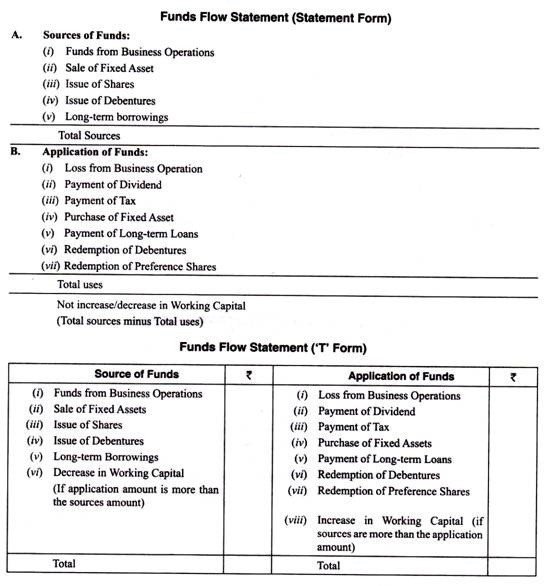
A funds flow statement can be prepared in statement form or ‘T’ form.

Both the formats are given below:

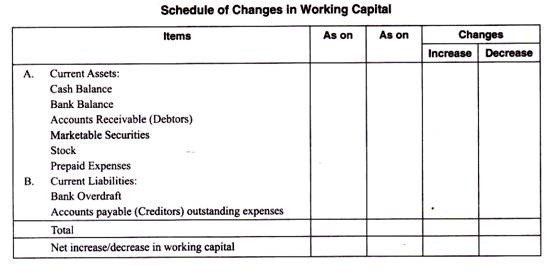
Schedule of Changes in Working Capital:

Many business enterprises prefer to prepare another statement, known as schedule of changes in working capital, while preparing a funds flow statement, on a working capital basis. This schedule of changes in working capital provides information concerning the changes in each individual current assets and current liabilities accounts (items).

This schedule is a part of the funds flow statement and increase (decrease) in working capital indicated by the schedule of changes in working capital will be equal to the amount of changes in working capital as found by funds flow statement. The schedule of changes in working capital can be prepared by comparing the current assets and current liabilities at two periods.

The format of schedule of changes in working capital is as follows:

Statement of changes in Working Capital

In the preparation of funds flow statement, the first step is to find out the net amount of increase or decrease of working capital, as increase in net working capital is a use of funds and decrease in net working capital is a source. Since net working capital is excess of current assets over current liabilities, the increase or decrease in the net working capital can be found out by comparing the current assets and current liabilities contained in the balance sheets of two following dates. For this purpose, a statement is prepared which is called statement or schedule of changes in net working capital. This statement helps to identify the change in position of the working capital. While preparing the statement of changes in working capital, the following points are considered.

* Increase in current assets , increase in net working capital
* Decrease in current assets , decrease in net working capital
* Increase in current liabilities , decrease in net working capital
* Decrease in current liabilities, increase in net working capital

The statement or schedule of changes in net working capital can be prepared by using one of the following forms.

  1. Using only current account

The statement or schedule of changes in net working capital can be prepared by using only current account, viz. account of current assets and current liabilities. While preparing the statement, the current assets and current liabilities of the previous year are compared with those of the current year and changes (increase or decrease) therein are determined. If the total of increase is more than that of decrease, there is an increase in net working capital, or vice versa.

  1. Using both current and non-current accounts

The statement or schedule of changes in net working capital can also be prepared by using both current as well as non-current accounts. Current account is the account of current assets and current liabilities and non-current account of non-current assets and non-current liabilities and owner’s equity. Increase in an item of current assets or decrease in an item of current liabilities from previous year to this year is debited, while increase in an item of current liabilities or decrease in an item of current assets is credited to current account. On other hand, increase in an item of non-current assets or decrease in an item of non-current liabilities from the previous year to this year is debited, while increase in an item of non-current liabilities and owner’s equity and decrease in an item of non-current assets is credited to non-current account.

The preparation of statement of changes in networking capital under this method is advantageous as compared to the previous method as it is easy to prepare funds flow statement there from.

Changes in Net Working Capital = Working Capital (Current Year) – Working Capital (Previous Year)

Or

Change in a Net Working Capital = Change in Current Assets – Change in Current Liabilities

  • Step 1: Find the Current Assets for the current year and previous year

From the point of the current asset of view, we consider the below:

      • Inventory
      • Accounts Receivable
      • Prepaid Expenses
  • Step 2: Find the Current Liability for the Current Year and Previous Year

From the current liabilities, we consider the below:

      • Accounts Payable & Accrued Expenses
      • Interest Payable
      • Deferred Revenue
  • Step 3: Find Working Capital for the Current Year and Previous Year
      • Working Capital (Current Year) = Current Assets (current year) – Current Liabilities (current year)
      • Working Capital (Current Year) = Current Assets (current year) – Current Liabilities (current year)
  • Step 4: Calculate Changes in Net Working Capital using the formula below –
      • Changes in Net Working Capital Formula = Working Capital (Current Year) – Working Capital (Previous Year).

Uses and Limitations of Fund Flow Statement

Uses of Funds Flow Statement:

By highlighting the changes in the distribution of the resources of an undertaking, the funds flow statement enables the financial manager to have a clear perspective of the organization’s financial strengths and weaknesses. It provides answers to a number of difficult questions.

(a) It explains the financial consequences of business operations. For example, a business may be earning huge profits, but its liquidity position would be highly unsatisfactory.

The funds statement will explain the causes for such situation by showing what has become of the profits earned. Further, the statement would explain the direction of flow of funds into productive or non-productive activities.

When a balance sheet presents a distorted picture of an undertaking because of a number of non-fund transactions, the funds statement would be an illuminating document.

(b) Debt capital is very essential for increased profitability of any enterprise. But the creditors may like to ascertain the credit worthiness and the funds generating capacity of the organization.

They may like to know in what way the management has utilized the funds in the past and how the funds would be utilized in future. The funds flow statement would enable the finance manager to answer such questions in a befitting manner.

(c) It acts as an instrument for allocation of the company’s scarce resources. A proposed funds statement will help to find out how the management is going to allocate the resources for meeting future productive programmes of the business.

When the projected funds statement is tied to the capital budget, it will help management to maintain the financial health of the organization.

(d) It is a test for evaluating the effective use of working capital by the management. Information on the adequacy or inadequacy of working capital will enable the management to decide what possible steps it should take for effective use of surplus working capital, or in the case of inadequate working capital to make suitable arrangements to make up the deficiency.

Limitations of Funds Flow Statement:

Despite its multiple managerial uses, the funds flow statements suffer from certain limitations.

  1. As this statement ignores non-fund items, it becomes a crude device compared to the income statement and balance sheet.
  2. The statement does not reveal shifts among the items making up the current assets and current liabilities. It does not tell whether any loss of working capital has unduly weakened the financial position.

Only an examination of the balance sheet at the end of the period will show the end of these changes. Therefore, funds flow statement cannot supplant but only supplement the conventional financial statements, either in whole or in part.

  1. The information used for the preparation of funds flow statement is essentially historical in nature, though attempts are made to project the funds statement for the future period.

Despite these limitations, the information supplied by the funds flow statement is really an invaluable aid to management in planning capital expenditure, devising dividend and other financial policies.

Differences between Cash Flow Statement and Fund Flow Statement

A cash flow statement shows the inflows and outflows of cash and cash equivalents. Cash includes cash in hand and demand deposits with the banks while cash equivalents are highly liquid investments i.e., they can be readily converted into cash like marketable securities, commercial papers, and short-term government bonds. It explains the changes in the cash in hand and cash at bank at the beginning and the end of the accounting period.

Accounting standard 3 deals with the cash flow statement. It has been classified into three broad categories:

  • Operating Activities: Representing movements of money due to regular business operations like the purchase, sale, production, etc. of goods.
  • Investing Activities: Representing the movement of cash due to the purchase or sale of assets or any other investment activities of the business.
  • Financing Activities: Accounts for the funds raised through the issue of shares or debentures, long term loans, etc. and utilised for the redemption of shares or debentures and payment of dividend, etc.

There are two methods of preparation of a Cash Flow Statement, they are:

  • Direct Method
  • Indirect Method

Fund Flow Statement

Funds refer to the working capital of the company, so fund flow statement is a statement that studies the changes in the working capital of the business between two accounting years. It shows the additions in the working capital through various sources like issuing shares, debentures or raising loans, etc. and reduction in it through different applications like the redemption of shares or debentures, repayment of loans, purchase of fixed assets, etc.

Fund Flow Statement explain the reasons for the change in the working capital of the business between two Balance Sheet dates through various Non-Current Assets and Non-Current Liabilities, which are responsible for the increase or decrease in the working capital. A fund flow statement displays the financial status of an organisation, which ensures easy comparison and analysis between two accounting periods. It clarifies the variability in the assets, liabilities and equity of the company.

It is prepared based on cash and cash equivalents. It is prepared based on fund as working capital.
Cash from operation is calculated. Funds from operation is calculated.
Statement of changes in working capital is not prepared. Statement of changes in working capital is prepared.
It is started with cash flows from operating activities. It is started with funds from operation or funds lost in operation.
It is ended with closing cash in hand and cash equivalents. It is ended with either increase in working capital or decrease in working capital.
The reasons for the change in cash are known through cash flow statement. The reasons for the change in working capital are known through fund flow statement.
Short term financial pIanning is done through cash flow statement. Medium term and long term financial planning is done through funds flow statement.
Cash flow analysis is based on cash concept. Funds flow analysis is based on accrual concept.
It is used for preparing cash budgeting. It is used for preparing capital budgeting.
It shows only changes in cash position. It is concerned with the changes in working capital between two balance sheet dates.
It is worked as an indicator of improved working capital. It is not necessary that an improved fund position will be an indicator of improved and sound cash position.
Increase in current liability or decrease in current assets brings decrease in working capital and vice versa. Increase in current liability or decrease in current asset brings increase in cash and vice versa.

Meaning and Definition of Ratio analysis, Uses & Limitations

Ratio analysis is a technique of analysis and interpretation of financial statements. It is the process of establishing and interpreting various ratios for helping in making certain decisions. However, ratio analysis is not an end. It is only a means of better understanding of financial strengths and weaknesses of a firm.

Calculation of mere ratios does not serve any purpose unless several appropriate ratios are analyzed and interpreted. There are a number of ratios which can be calculated from the information given in the financial statements, but the analyst has to select the appropriate data and calculate only a few appropriate ratios from the same keeping in mind the objective of analysis. The ratios may be used as a symptom like blood pressure, the pulse rate or the body temperature and their interpretation depends upon the calibre and competence of the analyst.

The following are the four steps involved in the ratio analysis:

(i) Selection of relevant data from the financial statements depending upon the objective of the analysis.

(ii) Calculation of appropriate ratios from the above data.

(iii) Comparison of the calculated ratios with the ratios of the same firm in the past, or the ratios developed from projected financial statements or the ratios of some other firms or the comparison with ratios of the industry to which the firm belongs.

(iv) Interpretation of the ratios.

Uses of Ratio Analysis:

The ratio analysis is one of the most powerful tools of financial analysis. It is used as a device to analyze and interpret the financial health of enterprise. Just like a doctor examines his patient by recording his body temperature, blood pressure, etc. before making his conclusion regarding the illness and before giving his treatment, a financial analyst analyses the financial statements with various tools of analysis before commenting upon the financial health or weaknesses of an enterprise.

‘A ratio is known as a symptom like blood pressure, the pulse rate or the temperature of an individual.’ It is with help of ratios that the financial statements can be analyzed more clearly and decisions made from such analysis. The use of ratios is not confined to financial managers only. There are different parties interested in the ratio analysis for knowing the financial position of a firm for different purposes.

The supplier of goods on credit, banks, financial institutions, investors, shareholders and management all make use of ratio analysis as a tool in evaluating the financial position and performance of a firm for granting credit, providing loans or making investments in the firm. With the use of ratio analysis one can measure the financial condition of a firm and can point out whether the condition is strong, good, questionable or poor. The conclusions can also be drawn as to whether the performance of the firm is improving or deteriorating.

Thus, ratios have wide applications and are of immense use today:

(a) Managerial Uses of Ratio Analysis:

  1. Helps in decision-making:

Financial statements are prepared primarily for decision-making. But the information provided in financial statements is not an end in itself and no meaningful conclusion can be drawn from these statements alone. Ratio analysis helps in making decisions from the information provided in these financial statements.

  1. Helps in financial forecasting and planning:

Ratio Analysis is of much help in financial forecasting and planning. Planning is looking ahead and the ratios calculated for a number of years work as a guide for the future. Meaningful conclusions can be drawn for future from these ratios. Thus, ratio analysis helps in forecasting and planning.

  1. Helps in communicating:

The financial strength and weakness of a firm are communicated in a more easy and understandable manner by the use of ratios. The information contained in the financial statements is conveyed in a meaningful manner to the one for whom it is meant. Thus, ratios help in communication and enhance the value of the financial statements.

  1. Helps in co-ordination:

Ratios even help in co-ordination which is of utmost importance in effective business management. Better communication of efficiency and weakness of an enterprise results in better co­ordination in the enterprise.

  1. Helps in Control:

Ratio analysis even helps in making effective control of the business. Standard ratios can be based upon proforma financial statements and variances or deviations, if any, can be found by comparing the actual with the standards so as to take a corrective action at the right time. The weaknesses or otherwise, if any, come to the knowledge of the management which helps in effective control of the business.

  1. Other Uses:

These are so many other uses of the ratio analysis. It is an essential part of the budgetary control and standard costing. Ratios are of immense importance in the analysis and interpretation of financial statements as they bring the strength or weakness of a firm.

(b) Utility to Shareholders/Investors:

An investor in the company will like to assess the financial position of the concern where he is going to invest. His first interest will be the security of his investment and then a return in the form of dividend or interest. For the first purpose he will try to asses the value of fixed assets and the loans raised against them. The investor will feel satisfied only if the concern has sufficient amount of assets.

Long-term solvency ratios will help him in assessing financial position of the concern. Profitability ratios, on the other hand, will be useful to determine profitability position. Ratio analysis will be useful to the investor in making up his mind whether present financial position of the concern warrants further investment or not.

(c) Utility to Creditors:

The creditors or suppliers extend short-term credit to the concern. They are interested to know whether financial position of the concern warrants their payments at a specified time or not. The concern pays short- term creditor, out of its current assets. If the current assets are quite sufficient to meet current liabilities then the creditor will not hesitate in extending credit facilities. Current and acid-test ratios will give an idea about the current financial position of the concern.

(d) Utility to Employees:

The employees are also interested in the financial position of the concern especially profitability. Their wage increases and amount of fringe benefits are related to the volume of profits earned by the concern. The employees make use of information available in financial statements. Various profitability ratios relating to gross profit, operating profit, net profit, etc. enable employees to put forward their viewpoint for the increase of wages and other benefits.

(e) Utility to Government:

Government is interested to know the overall strength of the industry. Various financial statements published by industrial units are used to calculate ratios for determining short-term, long-term and overall financial position of the concerns. Profitability indexes can also be prepared with the help of ratios. Government may base its future policies on the basis of industrial information available from various units. The ratios may be used as indicators of overall financial strength of public as well as private sector, in the absence of the reliable economic information, governmental plans and policies may not prove successful.

(f) Tax Audit Requirements:

Section 44 AB was inserted in the Income Tax Act by the Finance Act, 1984. Under this section every assesse engaged in any business and having turnover or gross receipts exceeding Rs. 40 lakh is required to get the accounts audited by a chartered accountant and submit the tax audit report before the due date for filing the return of income under Section 139 (1). In case of a professional, a similar report is required if the gross receipts exceed Rs 10 lakh.

Clause 32 of the Income Tax Act requires that the following accounting ratios should be given:

(i) Gross Profit/Turnover

(ii) Net Profit/Turnover

(iii) Stock-in-trade/Turnover

(iv) Material Consumed/Finished Goods Produced.

Further, it is advisable to compare the accounting ratios for the year under consideration with the accounting ratios for the earlier two years so that the auditor can make necessary enquiries, if there is any major variation in the accounting ratios.

Limitations of Ratio Analysis:

The ratio analysis is one of the most powerful tools of financial management.

Though ratios are simple to calculate and easy to understand, they suffer from some serious limitations:

  1. Limited Use of a Single Ratio:

A single ratio, usually, does not convey much of a sense. To make a better interpretation a number of ratios have to be calculated which is likely to confuse the analyst than help him in making any meaningful conclusion.

  1. Lack of Adequate Standards:

There are no well accepted standards or rules of thumb for all ratios which can be accepted as norms. It renders interpretation of the ratios difficult.

  1. Inherent Limitations of Accounting:

Like financial statements, ratios also suffer from the inherent weakness of accounting records such as their historical nature. Ratios of the past are not necessarily true indicators of the future.

  1. Change of Accounting Procedure:

Change in accounting procedure by a firm often makes ratio analysis misleading, e.g., a change in the valuation of methods of inventories, from FIFO to LIFO increases the cost of sales and reduces considerably the value of closing stocks which makes stock turnover ratio to be lucrative and an unfavorable gross profit ratio.

  1. Window Dressing:

Financial statements can easily be window dressed to present a better picture of its financial and profitability position to outsiders. Hence, one has to be very careful in making a decision from ratios calculated from such financial statements. But it may be very difficult for an outsider to know about the window dressing made by a firm.

  1. Personal Bias:

Ratios are only means of financial analysis and not an end in itself. Ratios have to be interpreted and different people may interpret the same ratio in different ways.

  1. Un-comparable:

Not only industries differ in their nature but also the firms of the similar business widely differ in their size and accounting procedures, etc. It makes comparison of ratios difficult and misleading. Moreover, comparisons are made difficult due to differences in definitions of various financial terms used in the ratio analysis.

  1. Absolute Figures Distortive:

Ratios devoid of absolute figures may prove distortive as ratio analysis is primarily a quantitative analysis and not a qualitative analysis.

  1. Price Level Changes:

While making ratio analysis, no consideration is made to the changes in price levels and this makes the interpretation of ratios invalid.

  1. Ratios no Substitutes:

Ratio analysis is merely a tool of financial statements. Hence, ratios become useless if separated from the statements from which they are computed.

  1. Clues not Conclusions:

Ratios provide only clues to analysts and not final conclusions. These ratios have to be interpreted by these experts and there are no standard rules for interpretation.

Classification of Ratios

Based on function or test, the ratios are classified as liquidity ratios, profitability ratios, activity ratios and solvency ratios.

Liquidity Ratios:

Liquidity ratios measure the adequacy of current and liquid assets and help evaluate the ability of the business to pay its short-term debts. The ability of a business to pay its short-term debts is frequently referred to as short-term solvency position or liquidity position of the business.

Generally a business with sufficient current and liquid assets to pay its current liabilities as and when they become due is considered to have a strong liquidity position and a businesses with insufficient current and liquid assets is considered to have weak liquidity position.

Short-term creditors like suppliers of goods and commercial banks use liquidity ratios to know whether the business has adequate current and liquid assets to meet its current obligations. Financial institutions hesitate to offer short-term loans to businesses with weak short-term solvency position.

Four commonly used liquidity ratios are given below:

  • Current ratio or working capital ratio
  • Quick ratio or acid test ratio
  • Absolute liquid ratio
  • Current cash debt coverage ratio

Unfortunately, liquidity ratios are not true measure of liquidity because they tell about the quantity but nothing about the quality of the current assets and, therefore, should be used carefully. For a useful analysis of liquidity, these ratios are used in conjunction with activity ratios (also known as current assets movement ratios). Examples of activity ratios are receivables turnover ratio, accounts payable turnover ratio and inventory turnover ratio etc.

Profitability Ratios:

Profit is the primary objective of all businesses. All businesses need a consistent improvement in profit to survive and prosper. A business that continually suffers losses cannot survive for a long period.

Profitability ratios measure the efficiency of management in the employment of business resources to earn profits. These ratios indicate the success or failure of a business enterprise for a particular period of time.

Profitability ratios are used by almost all the parties connected with the business.

A strong profitability position ensures common stockholders a higher dividend income and appreciation in the value of the common stock in future.

Creditors, financial institutions and preferred stockholders expect a prompt payment of interest and fixed dividend income if the business has good profitability position.

Management needs higher profits to pay dividends and reinvest a portion in the business to increase the production capacity and strengthen the overall financial position of the company.

Some important profitability ratios are given below:

  • Net profit (NP) ratio
  • Gross profit (GP) ratio
  • Price earnings ratio (P/E ratio)
  • Operating ratio
  • Expense ratio
  • Dividend yield ratio
  • Dividend payout ratio
  • Return on capital employed ratio
  • Earnings per share (EPS) ratio
  • Return on shareholder’s investment/Return on equity
  • Return on common stockholders’ equity ratio

Activity Ratios:

Activity ratios (also known as turnover ratios) measure the efficiency of a firm or company in generating revenues by converting its production into cash or sales. Generally a fast conversion increases revenues and profits.

Activity ratios show how frequently the assets are converted into cash or sales and, therefore, are frequently used in conjunction with liquidity ratios for a deep analysis of liquidity.

Some important activity ratios are:

  • Inventory turnover ratio
  • Receivables turnover ratio
  • Average collection period
  • Accounts payable turnover ratio
  • Average payment period
  • Asset turnover ratio
  • Working capital turnover ratio
  • Fixed assets turnover ratio

Solvency Ratios:

Solvency ratios (also known as long-term solvency ratios) measure the ability of a business to survive for a long period of time. These ratios are very important for stockholders and creditors.

Solvency ratios are normally used to:

  • Analyze the capital structure of the company
  • Evaluate the ability of the company to pay interest on long term borrowings
  • Evaluate the ability of the the company to repay principal amount of the long term loans (debentures, bonds, medium and long term loans etc.).
  • Evaluate whether the internal equities (stockholders’ funds) and external equities (creditors’ funds) are in right proportion.

Some frequently used long-term solvency ratios are given below:

  • Debt to equity ratio
  • Times interest earned (TIE) ratio
  • Proprietary ratio
  • Fixed assets to equity ratio
  • Current assets to equity ratio
  • Capital gearing ratio

Classification on the basis of financial statements:

Income statement/profit and loss ratios:

Income statement/profit and loss account ratios are those ratios that are calculated by using the items of income statement/profit and loss account of a particular period only. Examples of income statement/profit and loss account ratios are net profit ratio, gross profit ratio, operating ratio, and times interest earned ratio etc.

Balance sheet ratios:

Balance sheet ratios are those ratios that are calculated by using figures from the balance sheet only. The figures must be used from the balance sheet of the same period. Examples of balance sheet ratios are current ratio, liquid ratio, and debt to equity ratio etc.

Composite ratios:

These ratios are calculated by using the items of both income statement and balance sheet for the same period. Composite ratios are, therefore, also known as mixed ratios and inter-statement ratios. Numerous composite ratios are computed depending on the need of analyst. Some examples are inventory turnover ratio, receivables turnover ratio, accounts payable turnover ratio, and working capital turnover ratio etc.

Classification on the basis of importance:

On the basis of importance or significance, the ratios are classified as primary ratios and secondary ratios.  The most important ratios are called primary ratios and less important ratios are called secondary ratios. Secondary ratios are usually used to explain the primary ratios.

Examples of primary ratios for a commercial undertaking are return on capital employed ratio and net profit ratio because the basic purpose of these undertakings is to earn profit.

Importance of ratios significantly varies among industries therefore each industry has its own primary and secondary ratios. A ratio that is of primary importance in one industry may be of secondary importance in another industry.

Profitability Ratios

The management of a company cannot wait for the year to end to analyze their financial performance and their profits. This must be done year-round. These profitability ratios help the management determine an entity’s ability to use its assets and create earnings. The most useful comparisons for these ratios is to the performance of the previous years.

Profitability ratios are both revenue statement ratios and balance sheet ratios. They compare the revenue of a firm to different types of expense accounts within the Profit and Loss Statement. And then some profitability ratios also compare revenue to aspects of the balance sheet such as assets and equity.

There are a variety of profitability ratios calculated with the help of the Income Statement and the Balance Sheet.

Gross Profit Ratio

This ratio simply compares the gross profit of a company to its net sales. Both of these figures are obtained from the Income Statement. The ratio is also known as Margin ratio or the Rate of Gross Profit. The ratio is represented as a percentage of sales.

This ratio basically signifies the basic profitability of the firm. This is why it is one of the most important profitability ratios. It shows the margin in the selling price before the company will incur losses from operations. The formula is

Gross Profit Ratio = (Gross Profits / Net Revenue from Operations) × 100

Net Revenue from Operations = Net Sales = Sales Sale Returns

Gross Profit = Sales Cost of Sales

Operating Ratio

The second one of the profitability ratios is the operating ratio. This ratio measures the equation between the cost of operating activities and the net sales, or revenue from operations. This ratio expresses the cost of goods sold as a percentage of the net sales.

Operating ratio also takes into account operating expenses such as administration and office expenses, selling and distribution costs, salaries paid, depreciation expenses etc. Also, it ignores the non-operating incomes such as interests, commisions, dividends etc.

Operating Ratio = (COGS + Operating Expenses / Net Revenue from Operations) × 100

This ratio can actually help ascertain the efficiency of the organization along with its profitability. There is no standard ratio, but a trend analysis must be done on year on year basis to check the progress of the firm.

Net Profit Ratio

Unlike the operating ratio, the net profit ratio includes the total revenue of the firm. It takes into account both the operating income as well as the non-operating income. Then it compares net profit to these incomes. This ratio too is represented as a percentage. The formula for Net Profit ratio is,

Net Profit Ratio = (Net Profit / Net Revenue) × 100

Net Profit = Net Profit after Tax (NPAT)

This ratio helps measure the overall profitability of the firm. It indicates the portion of the net revenue that is available to the proprietors. It also reflects on the efficiency of the business and is a very important ratio for investors and financiers.

Return on Capital Employed

This ratio is one of the important ones of the profitability ratios. It measures the overall efficiency of the utilization of the firm’s funds. The ratio explores the relationship between the total income/profit earned by a firm and the total capital employed by the firm, or the total investment made.  The formula is as follows,

Return on Capital Employed = (PBIT / Capital Employed) × 100

PBIT = Profit Before Income and Tax

This ratio measures the efficiency with which the capital is being utilized and it indicates the productivity of the capital employed. It is a good tool to measure the overall profitability of the firm as well.

Earnings Per Share

This ratio represents the profit or the earnings of a company in the context of one share. It represents the earnings of a firm whether or not dividends were actually declared on such shares. The formula for this ratio is

Earnings Per Share (EPS) = (Profit available to Equity Shareholders / Number of equity Shareholders) × 100

Profit available to Equity Shareholders = NPAT Preference Dividend

This is an important ratio for the shareholders, it helps them decide whether to hold onto the shares or sell them. It also is a good indicator of the dividends to be declared and/or bonus issues.

Solvency Ratios

Solvency Ratios also known as leverage ratios determine an entity’s ability to service its debt. So, these ratios calculate if the company can meet its long-term debt. It is important since the investors would like to know about the solvency of the firm to meet their interest payments and to ensure that their investments are safe. Hence solvency ratios compare the levels of debt with equity, fixed assets, earnings of the company etc.

One thing to make note of is the difference between solvency ratios and liquidity ratios. These two are often confused for the other. Liquidity ratios compare current assets with current liabilities, i.e. short-term debt. Whereas solvency ratios analyze the ability to pay long-term debt.

1) Debt to Equity Ratio

The debt to equity ratio measures the relationship between long-term debt of a firm and its total equity. Since both these figures are obtained from the balance sheet itself, this is a balance sheet ratio. Let us look at the formula:

Debt to Equity Ratio = Long-Term Debt / Shareholders Funds

Long Term Debt = Debentures + Long Term Loans

Shareholders Funds = Equity Share Capital + Preference Share Capital + Reserves – Fictitious Assets

The debt-equity ratio holds a lot of significance. Firstly, it is a great way for the company to measure its leverage or indebtedness. A low ratio means the firm is more financially secure, but it also means that the equity is diluted.

In contrast, a high ratio indicates a risky business where there are more creditors of the firm than there are investors. In fact, a high debt to equity ratio may deter more investors from investing in the firm, and even deter creditors from lending money.

While there is no industry standard as such it is best to keep this ratio as low as possible. The maximum a company should maintain is the ratio of 2:1, i.e. twice the amount of debt to equity.

2) Debt Ratio

Next, we learn about debt ratio. This ratio measures the long-term debt of a firm in comparison to its total capital employed. Alternatively, instead of capital employed, we can use net fixed assets. So the debt ratio will measure the liabilities (long-term) of a firm as a percent of its long-term assets. The formula is as follows:

Debt Ratio = Long-Term Debt / Capital Employed OR Long-Term Debt / Net Assets

Capital Employed = Long Term Debt + Shareholders Funds

Net Assets = Non-Fictitious Assets – Current Liabilities

This is one of the more important solvency ratios. It indicates the financial leverage of the firm. A low ratio points to a more financially stable business, better for the creditors. A higher ratio points to doubts about the firms long-term financial stability.  But a higher ratio helps the management with trading on equity, i.e. earn more income for the shareholders. Again there is no industry standard for this ratio.

3) Proprietary Ratio 

The third of the solvency ratios is the proprietary ratio or equity ratio. It expresses the relationship between the proprietor’s funds, i.e. the funds of all the shareholders and the capital employed or the net assets. Like the debt ratio shows us the comparison between debt and capital, this ratio shows the comparison between owner’s funds and total capital or net assets. The ratio is as follows:

Proprietary Ratio = Shareholders Funds / Capital Employed OR Shareholders Funds / Net Assets

A high ratio is a good indication of the financial health of the firm. It means that a larger portion of the total capital comes from equity. Or that a larger portion of net assets is financed by equity rather than debt. One point to note, that when both ratios are calculated with the same denominator, the sum of debt ratio and the proprietary ratio will be 1.

4) Interest Coverage Ratio

All debt has a cost, which we normally term as an interest. Debentures, loans, deposits etc all have an interest cost. This ratio will measure the security of this interest payable on long-term debt. It is the ratio between the profits of a firm available and the interest payable on debt instruments. The formula is:

Interest Coverage Ratio = Net Profit before Interest and Tax / Interest on Long-Term Debt

error: Content is protected !!