Levy and Collection of duties not covered under GST

There are certain activities which are items not covered under GST. They are beyond the scope of GST, i.e., GST will not apply on them. These are classified under Schedule III of the GST Act as “Neither goods nor services”.

1.Services by an employee to the employer in relation to his employment

Related parties include employer-employee which raised many concerns whether employment now attracted GST.  This clarification has been brought in to clarify whether GST is not applicable on employment. An employee will still pay income tax on salary earned .

  1. Court/Tribunal Services including District Court, High Court and Supreme Court

Courts will not charge GST to pass judgement.

  1. Duties performed by:

  • The Members of Parliament, State Legislature, Panchayats, Municipalities and other local authorities
  • Any person who holds a post under the provisions of the Constitution
  • Chairperson/Member/Director in a body established by the government or a local body and who is not an employee of the same
  1. Services of a funeral, burial, crematorium or mortuary including transportation of the deceased

There are no taxes on funeral services for any religion.

  1. Sale of land and sale of building

Construction of a new building is subject to GST (being works contract).

  1. Actionable claims (other than lottery, betting and gambling)

Actionable Claims’ means claims which can be enforced only by a legal action or a suit, example a book debt, bill of exchange, promissory note. A book debt (debtor) is not goods because it can be transferred as per Transfer of Property Act but cannot be sold. Bill of exchange, promissory note can be transferred under Negotiable Instruments Act by delivery or endorsement but cannot be sold. 

Actionable claims are neither products nor services. They can be considered as something in lieu of money. So GST will not apply on these.

Lottery, betting, and gambling attract 28% GST.

  1. Supply of goods from a place in the non-taxable territory to another place in the non-taxable territory without such goods entering into India*.
  2. Supply in Customs port before Home consumption*:
    (a) Supply of warehoused goods to any person before clearance for home consumption;
    (b) Supply of goods by the consignee to any other person, by an endorsement of documents of title to the goods, after the goods have been dispatched from the port of origin located outside India but before clearance for home consumption.
  3. Petroleum Product, Alcohol

One of the biggest burdens for home buyers is that they will have to bear both GST and Stamp Duty. This is because Stamp Duty was not subsumed under the GST. As a result, they are paying both the taxes which is a burden.

Since GST does not cover road tax, Vehicle Tax was not subsumed under GST. So, vehicle buyers still need to pay road tax as per the Motor Vehicle Act.

In order to bring alcohol under the purview of GST, a constitutional amendment is needed. Hence, Excise on Liquor was not covered under GST.

The Tax on sale and consumption of Electricity is not covered by GST. So, states still charge VAT and centre charges Central Excise on electricity bills.

Toll Tax, environment tax and all other taxes that are directly paid by the users are still levied by the states as they do not come under GST.

Entertainment tax collected by the Local Bodies is not covered under GST. As a result, users will have to pay extra tax in addition to GST which leads to an increase in the price of things like movie tickets.

All the above taxes are a burden on the users or consumers, hence they want the government to levy a single tax to avoid double taxation.

Sales Tax / Central Sales Tax Meaning and Definition, Features

A sales tax is a tax paid to a governing body for the sales of certain goods and services. Usually laws allow the seller to collect funds for the tax from the consumer at the point of purchase. When a tax on goods or services is paid to a governing body directly by a consumer, it is usually called a use tax. Often laws provide for the exemption of certain goods or services from sales and use tax. A value-added tax (VAT) collected on goods and services is like a sales tax.

The indirect tax imposed on selling and purchasing of goods within India is referred to as Sales Tax. It is an additional amount paid over and above the base value of the product being purchased. This tax, usually imposed on the seller by the government, enables the seller to recover the tax from the purchaser. It is usually charged from buyers at the point of purchase or the exchange of some specific goods and is chargeable at a certain percentage of the product value.

Sales Tax is levied by the Central Government as well as State Governments. It is decided by the Central Government basis its tax policies. State Sales Tax laws vary between states.

Central Sales Tax

The following are some of the key features of the Central Sales Tax Act.

  • Lays down principles regarding the time of sale and purchase of goods
  • Enlists goods that have special importance for trade and commerce
  • Lays down regulations regarding charging, collection and distribution of taxes generated from interstate trade
  • Holds the final authority for settling interstate trade disputes

State Government Taxes

State Governments in India have the power to decide on Sales Tax policies as per their unique financial requirements. This explains the reason as to why sales taxes vary from state to state. States classify businesses dealing in the sale of goods under three heads – manufacturers, dealers and sellers. Each of them require certificates to operate legally.

Exemptions from Sales Tax

The following categories are exempted from State Sales Tax and are offered to overcome double taxation, or on humanitarian grounds.

  • Certain specific goods as per the list of goods that have been exempted by the state government
  • Products from sellers with valid state resale certificates
  • Products sold for the purpose of charities or educational institutions like schools

Sales Tax Calculation

Sales Tax rate applicable on a particular product can be calculated through a simple formula:

Total Sales Tax = Cost of item x Sales tax rate

While the formula is a simple one, sellers and manufactures need to consider the following while calculating Sales Tax on their goods:

  • It is calculated as a percentage
  • Be updated on the Sales Tax rate of the state and city that the manufacturer or seller belongs to, as it varies from state to state

Types of Sales Tax

Though countries across geographies have their unique Sales Tax policies, there are certain standard types of sales taxes that are applicable to most countries. They are:

Wholesale Sales Tax: Tax levied on individuals dealing with wholesale distribution of goods is referred to as Wholesale Sales Tax.

Manufacturers’ Sales Tax: Tax charged on manufacturers of some specific goods is known as Manufacturers’ Sales Tax.

Retail Sales Tax: Tax levied on sale of retail goods and directly payable by the final consumer is called Retail Sales Tax.

Use Tax: This is a tax levied on the consumer for goods bought without paying sales tax. This usually holds true when goods are bought from vendors who are not a part of the tax jurisdiction.

Value Added Tax: An additional tax levied by some central governments on all purchases is called the Value Added Tax.

Tax Administration

Composition of Central Board of Direct Taxes

The Central Board of Direct Taxes is the administrative authority for levying and collection of sale taxes in India. It is a part of the Department of Revenue that is integral to the Ministry of Finance, and functions as per the Central Board Revenue Act, 1963.

The Central Board of Direct Taxes is composed of members who are assigned responsibilities across different departments like Income Tax, Revenue, Investigation, Legislation and Computerisation, Personnel and Vigilance, and Audit. The governing body is headed by the Chairman.

The Central Board of Direct Taxes is responsible for the following:

  • Formulate policies related to direct taxes.
  • Oversee administration of direct tax laws along with the Income Tax Department.
  • Investigates complaints and disputes related to evasion of taxes.

According to the federal structure of Goods and Services Tax in India, the taxation system has been divided into two parts Central GST (CGST) and State GST (SGST). In this case Centre and States will simultaneously levy Goods and Services Tax across the value chain. The Goods and Services Tax will be levied on every supply of goods and services. Centre would levy and collect Central Goods and Services Tax (CGST), and States would levy and collect the State Goods and Services Tax (SGST) on all transactions within a State.

This topic concentrates on defining the concepts of GSTN. GSTN Act Commencement, Powers of Officer, Tax exemption and Levy, Time value of money and Input tax credit. Let us now start defining the concept of GSTN.

GSTN abbreviated as Goods and Services Tax Network, is a not-for-profit, non-Government Company to provide shared IT infrastructure and services to Central and State Governments, tax payers and other stakeholders. The key objectives of GSTN are to provide a standard and uniform interface to the taxpayers, and shared infrastructure and services to Central and State/UT governments. Goods and Services Tax Network (GSTN) is a Section 8 (under new companies Act, not for profit companies are governed under section 8), non-Government, private limited company. It was incorporated on March 28, 2013.

GST Act Commencement

The Goods and Services Tax Act Commencement covers Section 1 – Short title, extent and commencement

  • This Act may be called the Central / State Goods and Services Tax Act, 2016.
  • It extends to the whole of India / State’s name.
  • It shall come into force on such date as the Central or a State Government may, by notification in the Official Gazette, appoint in this behalf:

Only if different dates may be appointed for different provisions of this Act and any reference in any such provision to the commencement of this Act shall be construed as a reference to the coming into force of that provision.

Taxable value of Goods and Services not covered under GST

GST exemptions for goods

There is a list of goods which do not attract GST as recommended by the GST Council. The reasons for granting exemption on goods might include any of the following:

  • In the interest of the public
  • The exemption is as per the GST Council’s recommendation
  • The exemption is granted by the Government through a special order
  • The exemption is allowed on specific goods through an official notification

Moreover, there are two types of GST exemptions on goods. These are as follows:

  • Absolute exemption: Under this type of exemption, the supply of specific types of goods would be exempted from GST without considering the details of the supplier or receiver and whether the good is supplied within or outside the State.
  • Conditional exemption: Under this type of exemption, supply of specific types of goods would be GST exempt subject to certain terms and conditions which have been specified under the GST Act or any amendment or notification.

Here is a list of some of the most common goods which are GST exempt:

Types of goods Examples
Live animals Asses, cows, sheep, goat, poultry, etc.
Meat  Fresh and frozen meat of sheep, cows, goats, pigs, horses, etc.
Fish  Fresh or frozen fish
Natural products Honey, fresh and pasteurized milk, cheese, eggs, etc.
Live trees and plants Bulbs, roots, flowers, foliage, etc.
Vegetables  Tomatoes, potatoes, onions, etc.
Fruits Bananas, grapes, apples, etc.
Dry fruits Cashew nuts, walnuts, etc.
Tea, coffee and spices Coffee beans, tea leaves, turmeric, ginger, etc.
Grains  Wheat, rice, oats, barley, etc.
Products of the milling industry  Flours of different types
Seeds  Flower seeds, oil seeds, cereal husks, etc.
Sugar  Sugar, jaggery, etc.
Water  Mineral water, tender coconut water, etc.
Baked goods Bread, pizza base, puffed rice, etc.
Fossil fuels Electrical energy
Drugs and pharmaceuticals Human blood, contraceptives, etc.
Fertilizers  Goods and organic manure
Beauty products Bindi, kajal, kumkum, etc.
Waste  Sewage sludge, municipal waste, etc.
Ornaments Plastic and glass bangles bangles, etc.
Newsprint  Judicial stamp paper, envelopes, rupee notes, etc.
Printed items Printed books, newspapers, maps, etc.
Fabrics  Raw silk, silkworm cocoon, khadi, etc.
Hand tools Spade, hammer, etc.
Pottery  Earthen pots, clay lamps, etc.

GST Exemption on services

Just like specific goods, specific services are also GST exempt. There are three types of supply of services which would qualify for GST exemption. These include the following:

  • Supplies which have a 0% tax rate
  • Supplies which do not attract CGST or IGST due to the provisions stated in a notification which amends either Section 11 of CGST Act or Section 6 of IGST Act
  • Supplies which are defined under Section 2(78) of the GST Act which are not taxable.

Since these types of supplies are GST exempt, any Input Tax Credit which is applicable on these supplies would not be available to utilise or set off the GST liability.

Moreover, even under supply of services, there can be two types of GST exemptions which are as follows –

  • Absolute exemption wherein the service would be exempted from GST without any conditions
  • Conditional exemption or partial exemption wherein exemption is granted based on a condition. This condition states that if the service is supplied intra-State or if the service is supplied by a registered person to an unregistered one, GST would be exempted if the total value of such supplies received by a registered person is not more than INR 5000/day.

Here is a list of some of the services which enjoy GST exemption:

Types of services  Examples 
Agricultural services Cultivation, supplying farm labour, harvesting, warehouse related activities, renting or leading agricultural machinery, services provided by a commission agent or the Agricultural Produce Marketing Committee or Board for buying or selling agriculture produce, etc.
Government services Postal service, transportation of people or goods, services by a foreign diplomat in India, services offered by the Reserve Bank of India, services offered to diplomats, etc.
Transportation services  Transportation of goods by road, rail, water, etc., payment of toll, transportation of passengers by air, transportation of goods where the cost of transport is less than INR 1500, etc.
Judicial services Services offered by arbitral tribunal, partnership firm of advocates, senior advocates to an individual or business entity whose aggregate turnover is up to INR 40 lakhs
Educational services Transportation of faculty or students, mid-day meal scheme, examination services, services offered by IIMs, etc.
Medical services  Services offered by ambulance, charities, veterinary doctors, medical professionals, etc. 
Organizational services  Services offered by exhibition organisers for international business exhibitions, tour operators for foreign tourists, etc.
Other services  Services offered by GSTN to the Central or State Government or Union Territories, admission fee payable to theatres, circuses, sports events, etc. which charge a fee up to INR 250

Though GST is applicable for all businesses and on the supply of goods and services, the above-mentioned exemptions are available. These exemptions reduce the GST burden and help in the socio-economic development of the country.

New Scheme of Taxation of Firms

Rate of Income tax applicable to Partnership Firm / LLP

Flat rate of 30% on the total income after deduction of interest and remuneration to partners/Designated Partners at the specified rates + Surcharge of 12% if Total Income exceeds 1 Crore and will be further increased by education cess secondary and higher education cess @ 3% on Income-tax (wef A.Y. 2019-20 health and education cess @ 4% shall be levied in lieu of education cess secondary and higher education cess @ 3% )

Income Tax Slabs for Partnership Firm / LLP

F.Y. 2017-18 F.Y. 2018-19
Tax Rate 30% 30%
Surcharge If income is greater than Rs.1,00,00,00 12% of income tax amount. Subject to marginal relief. If income is greater than Rs.1,00,00,00 12% of income tax amount. Subject to marginal relief.
Education Cess 2% extra – charged on the amount of income tax + surcharge being paid.


N.A.
Secondary and Higher Education Cess  1% extra – charged on the amount of income tax + surcharge being paid.


N.A.
Health and Education cess N.A. 4% extra – charged on the amount of income tax + surcharge being paid.

Remuneration to Partners/Designated Partners

  • Payment of Remuneration to a non-working partner will not be allowed as a deduction
  • A ‘working partner’ is an individual who is actively engaged in conducting the affairs of the business or profession of the firm.
  • Quantum of allowance is to be determined with reference to ‘book profit’ which is defined to mean an amount computed in accordance with the provisions of sections 28 to 44D of the Income-tax Act, as increased by the amount of remuneration to partners if deducted in determining book profit.

As per section 40(b)(v) any payment of remuneration to any partner who is a working partner, which is authorised by, and is in accordance with, the terms of the partnership deed and relates to any period falling after the date of such partnership deed in so far as the amount of such payment to all the partners during the previous year exceeds the aggregate amount computed as hereunder will be disallowed:

Slab of Remuneration to Partners/Designated Partners

Particulars Salary Allowed
a. On the first 3,00,000 of book profits or in case of a loss Rs. 1,50,000 or at the rate of 90% of the book profit (whichever is higher)


b. On the balance of book profits at the rate of 60%


Explanation 3 to section 40(b) defines “book-profit” as to mean the net profit, as shown in the profit and loss account for the relevant previous year, computed in the manner laid down in Chapter IV-D as increased by the aggregate amount of the remuneration paid or payable to all the partners of the firm if such amount has been deducted while computing the net profit.

Conditions for allowance of remuneration and interest to partners

  1. Remuneration should be to a working partner.
  2. Payment of remuneration and interest should be authorised by and should be in accordance with the terms of the partnership deed and should relate to any period falling after the date of such partnership deed.
  3. No deduction u/s. 40(b)(v) will be admissible unless the partnership deed either specifies the amount of remuneration payable to each individual working partner or lays down the manner of quantifying such remuneration: Circular No. 739 dt. 25-3-1996.
  4. Conditions for assessment as a firm
  • The partnership should be evidenced by an instrument in writing specifying individual shares of the partners.
  • A certified copy of the instrument signed by all the partners (not being minors) shall accompany the return of the firm for the first assessment as a ‘firm’.

Assessment of Companies Meaning

Every taxpayer must furnish the details of his income to the Income-tax Department. These details are to be furnished by filing up his return of income. Once the return of income is filed up by the taxpayer, the next step is the processing of the return of income by the Income Tax Department. The Income Tax Department examines the return of income for its correctness. The process of examining the return of income by the Income-Tax department is called as “Assessment”. Assessment also includes re-assessment and best judgment assessment under section 144.

Under the Income-tax Law, there are four major assessments given below:

  • Assessment under section 143(1), i.e., Summary assessment without calling the assessee.
  • Assessment under section 143(3), i.e., Scrutiny assessment.
  • Assessment under section 144, i.e., Best judgment assessment.
  • Assessment under section 147, i.e., Income escaping assessment.

Assessment under section 143(1)

This is a preliminary assessment and is referred to as summary assessment without calling the assessee (i.e., taxpayer).

Scope of assessment under section 143(1)

Assessment under section 143(1) is like preliminary checking of the return of income. At this stage no detailed scrutiny of the return of income is carried out. At this stage, the total income or loss is computed after making the following adjustments (if any), namely:

(i) any arithmetical error in the return; or

(ii) an incorrect claim (*), if such incorrect claim is apparent from any information in the return.

(iii) disallowance of loss claimed, if return of the previous year for which set-off of loss is claimed was furnished beyond the due date specified under section 139(1); or

(iv) disallowance of expenditure indicated in the audit report but not taken into account in computing the total income in the return; or

(v) disallowance of deduction claimed u/s 10AA, 80IA to 80-IE, if the return is furnished beyond the due date specified under section 139(1); or

(vi) addition of income appearing in Form 26AS or Form 16A or Form 16 which has not been included in computing the total income in the return. However, no such adjustment shall be made in relation to a return furnished for the assessment year 2018-19 and thereafter.

However, no such adjustment shall be made unless an intimation is given to the assessee of such adjustment either in writing or in electronic mode. Further, the response received from the assessee, if any, shall be considered before making any adjustment, and in case where no response is received within 30 days of the issue of such intimation, such adjustments shall be made.

For the above purpose “an incorrect claim apparent from any information in the return” means a claim on the basis of an entry in the return :-

(i) of an item which is inconsistent with another entry of the same or some other item in such return;

(ii) in respect of which the information is required to be furnished under the Act to substantiate such entry and has not been so furnished; or

(iii) in respect of a deduction, where such deduction exceeds specified statutory limit which may have been expressed as monetary amount or percentage or ratio or fraction;

Procedure of assessment under section 143(1)

  • After correcting arithmetical error or incorrect claim (if any) as discussed above, the tax and interest and fee*, if any, shall be computed based on the adjusted income.
  • Any sum payable by or refund due to the taxpayer shall be intimated to him.
  • An intimation shall be prepared or generated and sent to the taxpayer specifying the sum determined to be payable by, or the amount of refund due to the taxpayer. An intimation shall also be sent to the taxpayer in a case where the loss declared in the return of income by the taxpayer is adjusted but no tax or interest is payable by or no refund is due to him.
  • The acknowledgement of the return of income shall be deemed to be the intimation in a case where no sum is payable by or refundable to the assessee or where no adjustment is made to the returned income.

*As per section 234F (as inserted by Finance Act, 2017 with effect from Assessment Year 2018-19), a fee shall be levied where the return of income is not filed within the due dates prescribed under section 139(1). The amount of fee is as follows:-

(a) Rs. 5,000, if the return is furnished on or before the 31st day of December of the assessment year;

(b) Rs. 10,000 in any other case:

Provided that if the total income of the person does not exceed Rs. 5,00,000, the amount of fee shall not exceed Rs. 1000.

Time-limit

Assessment under section 143(1) can be made within a period of one year from the end of the financial year in which the return of income is filed.

Assessment under section 143(3)

This is a detailed assessment and is referred to as scrutiny assessment. At this stage a detailed scrutiny of the return of income will be carried out is to confirm the correctness and genuineness of various claims, deductions, etc., made by the taxpayer in the return of income.

Scope of assessment under section 143(3)

The objective of scrutiny assessment is to confirm that the taxpayer has not understated the income or has not computed excessive loss or has not underpaid the tax in any manner.

To confirm the above, the Assessing Officer carries out a detailed scrutiny of the return of income and will satisfy himself regarding various claims, deductions, etc., made by the taxpayer in the return of income.

Procedure of assessment under section 143(3)

  • If the Assessing Officer considers it necessary or expedient to ensure that the taxpayer has not understated the income or has not computed excessive loss or has not underpaid the tax in any manner, then he will serve on the taxpayer a notice requiring him to attend his office or to produce or cause to be produced any evidence on which the taxpayer may rely, in support of the return.
  • To carry out assessment under section 143(3), the Assessing Officer shall serve such notice in accordance with provisions of section 143(2).
  • Notice under section 143(2) should be served within a period of six months from the end of the financial year in which the return is filed.
  • The taxpayer or his representative (as the case may be) will appear before the Assessing Officer and will place his arguments, supporting evidences, etc., on various matters/issues as required by the Assessing Officer.
  • After hearing/verifying such evidence and taking into account such particulars as the taxpayer may produce and such other evidence as the Assessing Officer may require on specified points and after taking into account all relevant materials which he has gathered, the Assessing Officer shall, by an order in writing, make an assessment of the total income or loss of the taxpayer and determine the sum payable by him or refund of any amount due to him on the basis of such assessment.

Assessment under section 144

This is an assessment carried out as per the best judgment of the Assessing Officer on the basis of all relevant material he has gathered. This assessment is carried out in cases where the taxpayer fails to comply with the requirements specified in section 144.

Scope of assessment under section 144

As per section 144, the Assessing Officer is under an obligation to make an assessment to the best of his judgment in the following cases:

  • If the taxpayer fails to file the return required within the due date prescribed under section 139(1) or a belated return under section 139(4) or a revised return under section 139(5).
  • If the taxpayer fails to comply with all the terms of a notice issued under section 142(1).

Assessment under section 147

This assessment is carried out if the Assessing Officer has reason to believe that any income chargeable to tax has escaped assessment for any assessment year

Scope of assessment under section 147

  • The objective of carrying out assessment under section 147 is to bring under the tax net any income which has escaped assessment in original assessment.
  • Original assessment here means an assessment under sections 143(1), 143(3), 144 and 147 (as the case may be).
  • In other words, if any income has escaped (*) from being taxed in the original assessment made under section 143(1) or section 143(3) or section 144 or section 147, then the same can be brought under tax net by resorting to assessment under section 147.

* In the following cases, it will be considered as income having escaped assessment:

  • Where no return of income has been furnished by the taxpayer, although his total income or the total income of any other person in respect of which he is assessable during the previous year exceeded the maximum amount which is not chargeable to income-tax.
  • Where a return of income has been furnished by the taxpayer but no assessment has been made and it is noticed by the Assessing Officer that the taxpayer has understated the income or has claimed excessive loss, deduction, allowance or relief in the return.
  • Where the taxpayer has failed to furnish a report in respect of any international transaction which he was required to do under section 92E.
  • Where an assessment has been made, but:
  1. income chargeable to tax has been under assessed; or
  2. income has been assessed at low rate; or
  3. income has been made the subject of excessive relief; or
  1. excessive loss or depreciation allowance or any other allowance has been computed;
  • Where a person is found to have any asset (including financial interest in any entity) located outside India.
  • Where a return of income has not been furnished by the assessee and on the basis of information or document received from the prescribed income-tax authority under section 1 33C(2), it is noticed by the Assessing Officer that the income of the assessee exceeds the maximum amount not chargeable to tax.
  • Where a return of income has been furnished by the assessee and on the basis of information or document received from the prescribed income-tax authority under section 133C(2), it is noticed by the Assessing Officer that the assessee has understated the income or has claimed excessive loss, deduction, allowance or relief in the return.

Procedure of assessment under section 147

  • For making an assessment under section 147, the Assessing Officer has to issue notice under section 148 to the taxpayer and has to give him an opportunity of being heard. The time-limit for issuance of notice under section 148 is discussed in later part.
  • If the Assessing Officer has reason to believe that any income chargeable to tax has escaped assessment for any assessment year, then he may assess or reassess such income and also any other income chargeable to tax which has escaped assessment and which comes to his notice subsequently in the course of the proceedings under this section. He is also empowered to re-compute the loss or the depreciation allowance or any other allowance, as the case may be, for the assessment year concerned.
  • Items which are the subject matters of any appeal, reference or revision cannot be covered by the Assessing Officer under section 147.

Time-limit for completion of assessment under section 147

As per Section 153, the time limit for making assessment under section 147 is:

1) Within 9 months from the end of the financial year in which the notice under section 148 was served (if notice is served before 01-04-2019).

2) 12 months from the end of the financial year in which notice under section 148 is served (if notice is served on or after 01-04-2019).

Note: If reference is made to TPO, the period available for assessment shall be extended by 12 months.

Time-limit for issuance of notice under section 148

Notice under section 148 can be issued within a period of 4 (*) years from the end of the relevant assessment year. If the escaped income is Rs. 1,00,000 or more and certain other conditions are satisfied, then notice can be issued upto 6 years from the end of the relevant assessment year.

 In case the escaped income relates to any asset (including financial interest in any entity) located outside India, notice can be issued upto 16 years from the end of the relevant assessment year.

Computation of Depreciation under section of 32 of Income Tax Act

Depreciation under the Income Tax Act is a deduction allowed for the reduction in the real value of a tangible or intangible asset used by a taxpayer. The concept of depreciation is used for the purpose of writing off the cost of an asset over its useful life.

Depreciation is a mandatory deduction in the profit and loss statements of an entity and the Act allows deduction either in Straight-Line method or Written Down Value (WDV) method. The calculation for depreciation under the WDV method is widely used except for undertaking engaged in generation or generation and distribution of power. The Act also allows a deduction for additional depreciation in the year of purchase in certain circumstances. To read about additional depreciation visit Additional Depreciation Under the Income Tax Act.

Block of Assets: Concept

Depreciation is calculated on the WDV of a Block of assets. Block of assets is a group of assets falling within a class of assets comprising of:

  • Tangible assets, being building, machinery, plant, or furniture,
  • Intangible assets, being know how, patents, copyrights, trademarks, licenses, franchises or any other business or commercial rights of similar nature

The block of assets is classified further depending on the similar use, life of the asset and nature of the asset.

Conditions for Claiming Depreciation

You can avail deduction for depreciation, only if it satisfies the following conditions.

  1. The assets must be owned, wholly or partly, by the assessee.
  2. The assets must be in use for the business or profession of the taxpayer. If the assets are not used exclusively for the business, but for other purposes as well, depreciation allowable would be proportionate to the use of business purpose. The Income Tax Officer also has the right to determine the proportionate part of the depreciation under Section 38 of the Act.
  3. Co-owners can claim depreciation to the extent of the value of the assets owned by each co-owner.
  4. You cannot claim depreciation on the cost of land.
  5. Depreciation is mandatory from A.Y. 2002-03 and shall be allowed or deemed to have been allowed as a deduction irrespective of a claim made by a taxpayer in the profit & loss account.

Written Down Value

As per Section 32(1) of the IT Act depreciation should be computed at the prescribed percentage on the WDV of the asset, which in turn is calculated with reference to the actual cost of the assets. In the context of computing depreciation, it is important to understand the meaning of the term ‘WDV’ & ‘Actual Cost’.

WDV under the Income Tax Act means:

  1. Where the asset is acquired in the previous year, the actual cost of the asset shall be treated as WDV.
  2. Where the asset is acquired in an earlier year, the WDV shall be equal to the actual cost incurred less depreciation actually allowed under the Act.

Depreciation Allowed

  • The allowance for depreciation is calculated under the WDV method except for undertaking engaged in generation or generation and distribution of power. The depreciation rates are given in Appendix 1. In the case of undertakings engaged in generation or generation and distribution of power, such undertaking has an option to claim depreciation on WDV method at the rates provided in New Appendix I – if such option is exercised before the due date of filing the return.

In the case of amalgamation or demerger, the aggregate depreciation allowance shall be apportioned between the amalgamating and the amalgamated company, or the demerged and the resulting company. The aggregate depreciation would be computed as if the amalgamation or demerger had not taken place. It shall be apportioned based on the number of days the assets were used by such companies.

In case of a finance lease transaction, the lessee has to capitalise the assets in its books under AS-19 – the Accounting standard on leases. In such cases, the lessee can exercise the rights of the owner in his own right and hence the allowance for depreciation is available to the lessee.

Sl.No Asset

Class

Asset Type Rate of Depreciation
1 Building Residential buildings not including boarding houses and hotels 5%
2 Building Boarding houses and hotels 10%
3 Building Purely temporary constructions like wooden structures 100%
4 Furniture Any fittings / furniture including electrical fittings 10%
5 Plant and machinery Motor cars excluding those used in a business of running them on hire 15%
6 Plant and machinery Lorries/taxis/motor buses used in a business of running them on hire 30%
7 Plant and machinery Computers and computer software 60%
8 Plant and machinery Books owned by assessee carrying on a profession being annual publications 100%
9 Plant and machinery Books owned by assessee carrying on profession not being annual publications 60%
10 Plant and machinery Books owned by assessee carrying on business in running lending libraries 100%
11 Intangible assets Franchise, trademark, patents, license, copyright, know-how or other commercial or business rights of similar nature 25%

Depreciation Rates as per the Income Tax Act

Part A Tangible Assets:

Asset Class Sl.No Asset Type Rate of Depreciation
Building 1 Buildings used primarily for residential reasons (excluding boarding houses and hotels) 5%
  2 Buildings apart from those used primarily for residential reasons and not covered by subitems 1 (above) and 3 (below) 100%
  3 Buildings procured on or after September 1, 2002, for installing plant and machinery forming part of water treatment system or water supply project and which is used for the purpose of business of providing infrastructure facilities under clause (i) of subsection (4) of section 80-IA 100%
  4 Purely temporary erections like wooden structures 100%
Furniture and fittings   Furniture and fittings including electrical fittings 10%
Plant and machinery 1 Plant and machinery excluding those covered by sub-items (2), (3) and (8) below 15%
  2 Motor cars, excluding those used in a business of running them on hire, procured or put to use on or after April 1, 1990 15%
  3(i) Aeroplanes, Aero Engines 40%
  3(ii) Motor taxis, motor buses and motor lorries used in a business of running them on hire 30%
  3(iii) Commercial vehicle which is procured by the assessee on or after October 1, 1998, but before April 1, 1999, and is used for any period of time prior to April 1, 1999, for the purpose of profession or business in agreement with the third proviso to clause (ii) of sub-section (1) of section 32 40%
  3(iv) New commercial vehicle procured on or after October 1, 1998, but prior to April 1, 1999, in replacement of condemned vehicle of more than 15 years of age and is used for any period of time prior to April 1, 1999, for the purpose of profession or business in agreement with the third proviso to clause (ii) of sub-section (1) of section 32 60%
  3(v) New commercial vehicle procured on or after April 1, 1999, but before April 1, 2000, in replacement of condemned vehicle of more than 15 years of age and is put to use prior to April 1, 2000, for the purposes of profession or business in agreement with the second proviso to clause (ii) of sub-section (1) of section 32 60%
  3(vi) New commercial vehicle procured on or after April 1, 2001, but before April 1, 2002, and is put to use before April 1, 2002, for the purpose of profession or business 50%
  3(vii) Moulds used in plastic and rubber goods factories 30%
  3(viii) Air pollution control equipment

  • Felt
  • filter system
  • Electrostatic precipitation systems
  • Scrubber
  • Counter current / packed bed / venture / cyclonic scrubbers
  • Dust collector systems
  • Evacuation system and ash handling system
100%
  3(ix) Water pollution control equipment

  • Aerated detritus chambers (including air compressor)
  • Mechanical screen systems
  • Mechanically skimmed grease and oil removal systems
  • Flash mixing equipment and chemical feed systems
  • Mechanical reactors and mechanical flocculators
  • Mechanically aerated activated sludge / diffused air systems
  • Biofilters
  • Aerated lagoon systems
  • Air floatation systems
  • Methane
  • recovery anaerobic digester systems
  • Steam/air stripping systems
  • Marine outfall systems
  • Urea Hydrolysis systems
  • Activated carbon column
  • Bio
  • Disc or rotating biological contractor
  • Marine outfall systems
  • Ion exchange resin column
  • Centrifuge for dewatering sludge
30%
  3(x) (a) Solid waste, control equipment Cryolite / mineral / lime / caustic / chrome recovery system (b) Resource recovery and solid waste recycling systems 100%
  3(xi) Plant and machinery used in semiconductor industry covering all integrated circuits (ICs) (not including hybrid integrated circuits) ranging from small scale integration (SSI) to large scale integration / very large scale integration (LSI/VLSI) as also discrete semiconductor devices like diodes, triacs, thyristors, transistors, etc., except those covered by entries (viii), (ix), (x) of this sub-item and sub-item (8) below 30%
  3(xi)a Life Saving medical equipment

  • D.C Defibrillators for pacemakers and internal use
  • Colour Doppler
  • Haemodialysis
  • Cobalt therapy unit
  • Vascular Angiography System including Digital subtraction Angiography
  • Heart lung machine
  • Spect Gamma Camera
  • Magnetic Resonance Imaging System
  • Ventilator used with anaesthesia apparatus
  • Ventilator except those used with anaesthesia
  • Surgical laser
  • Gamma knife
  • Fibreoptic endoscopes including audit resectoscope/paediatric resectoscope, arthoscope, peritoneoscopes, fibreoptic flexible nasal pharyngo, microaryngoscope, video laryngo, fiberoptic flexible laryngo bronchoscope.
  • Bronchoscope, video oescophago gastroscope, video oescopghago bronchoscope, fibreoptic flexible oesophago gastroscope
40%
  4 Containers made of plastic or glass used as refills 50%
  5 Computers including computer software 60%
  6 Plant and machinery, used in processing, weaving and garment sector of textile industry, which is bought under TUFS on or after April 1, 2001, but prior to April 1, 2004, and is put to use prior to April 1, 2004 50%
  7 Plant and machinery procured and installed on or after September 1, 2002, in a water treatment system or a water supply project and put to use for the purpose of business of providing infrastructure facility under clause (i) of sub-section (4) of section 80-IA 100%
  8 1. Wooden parts used in artificial silk manufacturing machinery 100%
    2. Match factories, wooden match frames  
    3. Cinematograph films, bulbs of studio lights 100%
    4. Salt works, condensers, reservoirs, salt pans, etc., made of clayey, sandy or earthy material or any other similar material 100%
    5. Quarries and mines 100%
    Sand stowing pipes, winding ropes, tubs and haulage ropes  
    Safety lamps  
    6. Flour mills, rollers  
    7. Sugar works, rollers 80%
    8. Steel and iron industry, rolling mill rolls 80%
    9. Energy saving devices 80%
    (A) Furnaces and specialised boilers  
    (i) Fluidized bed boilers / ignifluid 80%
    (ii) Continuous pusher type furnaces and flameless furnaces  
    (iii) High efficiency boilers  
    (iv) Fluidized bed type heat treatment  
    (B) Instrumentation and monitoring system for monitoring energy flows 80%
    (i) Digital heat loss meters  
    (ii) Automatic electrical load monitoring systems  
    (iii) Infrared thermography  
    (iv) Microprocessor based control systems  
    (v) Meters for measuring heat losses, steam flow, furnace oil flow, power factor and electric energy meters  
    (vi) Exhaust gas analysers  
    (vii) Maximum demand indicator and clamp on power meters  
    (viii) Fuel oil pump test bench  
    (C) Waste heat recovery equipment 80%
    (i) Air pre-heaters and recuperators  
    (ii) Feed water heaters and economisers  
    (iii) Thermal energy wheel for low and high temperature heat recovery  
    (iv) Heat pumps  
    (D) Co-generation systems 80%
    (i) Controlled extraction, back pressure pass out, extraction cum condensing turbines for cogeneration along with pressure boilers  
    (ii) Organic rankine cycle power systems  
    (iii) Vapour absorption refrigeration systems  
    (iv) Low inlet pressure small steam turbines  
    (E) Electrical equipment 80%
    (i) Synchronous condenser systems and shunt capacitors  
    (ii) Relays (automatic power cut off devices)  
    (iii) Power factor controller for AC motors  
    (iv) Automatic voltage controller  
    (v) Solid state devices for controlling motor speeds  
    (vi) FACT (Flexible AC Transmission) devices, Thyristor controlled series compensation equipment  
    (vii) Thermally energy-efficient stenters  
    (viii) Series compensation equipment  
    (ix) TOD (Time of Day) energy meters  
    (x) Intelligent electronic devices/remote terminal units, computer software/hardware, bridges/router, other required equipment and associated communication systems for data acquisition systems and supervisory control, distribution management systems and energy management systems for power transmission systems  
    (xi) Special energy meters for ABT (Availability Based Tariff)  
    (F) Burners 80%
    (i) Zero to ten per cent excess air burners  
    (ii) Burners using air with high preheat temperature (above 300 degrees Celsius)  
    (iii) Emulsion burners  
    (G) Other equipment 80%
    (i) Mechanical vapour recompressors  
    (ii) Wet air oxidation equipment for recovery of heat and chemicals  
    (iii) Automatic microprocessor based load demand controllers  
    (iv) Thin film evaporators  
    (v) Fluid couplings and fluid drives  
    (vi) Coal based producer gas plants  
    (vii) Super-charges/turbo charges  
    (viii) Sealed radiation sources for radiation processing plants  
    10. Gas cylinders including regulators and valves 60%
    11. Glass manufacturing concerns, Direct fire glass melting furnaces 60%
    12. Mineral oil concerns 60%
    (i) Plant used in field operations (above ground) distribution, returnable packages  
    (ii) Plant used in field operations (below ground), but not including kerbside pumps including fittings and tanks used in field operations (distribution) by mineral oil concerns  
    13. Renewable energy devices 60%
    (i) Pipe type and concentrating solar collectors  
    (ii) Flat plate solar collectors  
    (iii) Solar cookers  
    (iv) Air/fluid/gas heating systems  
    (v) Solar water heaters and systems  
    (vi) Solar crop drivers and systems  
    (vii) Solar steels and desalination systems  
    (viii) Solar refrigeration, air conditioning systems and cold storages  
    (ix) Solar pumps based on solar-photovoltaic and solar-thermal conversion  
    (x) Solar power generating systems  
    (xi) Solar-photovoltaic panels and modules for water pumping and other applications  
    14. Wind mills and any other specially designed devices that operate on wind mills (installed on or after April 1, 2014) 80%
    15. Any special devices including electric pumps and generators operating on wind energy (installed on or after April 1, 2014) 80%
    16. Books owned by assessees carrying on a profession  
    (i) Books, being annual publications 100%
    (ii) Books, excluding those covered by entry (i) above 60%
    (iii) Books owned by assessees carrying on business in running lending libraries 100%
Ships 4(i) Ocean-going ships including tugs, survey launches, dredgers, barges and other similar ships used primarily for dredging purposes and sighing vessels with wooden hull  
  4(ii) Vessels ordinarily operating on inland waters, not covered by sub-item (iii) below 20%
  4 (iii) Vessels ordinarily operating on inland waters being speed boats 20%

Part B Intangible Assets:
Patents, know-how, trademarks,franchises,copyrights, licenses or any other commercial or business right of similar nature – 25% is the Depreciation Rate.

Deductions under section 80G, 80GGB, 80IA, 80IB

Section 80GG: House Rent Paid

Deduction for House Rent Paid Where HRA is not Received

  1. Section 80GG deduction is available for rent paid when HRA is not received. The taxpayer, spouse or minor child should not own residential accommodation at the place of employment
  2. The taxpayer should not have self-occupied residential property in any other place
  3. The taxpayer must be living on rent and paying rent
  4. The deduction is available to all individuals

Section 80GGB: Company Contribution

Deduction on contributions given by companies to Political Parties

Section 80GGB deduction can an Indian company for the amount contributed by it to any political party or an electoral trust. Deduction is allowed for contribution done by any way other than cash.  

the deductions U/s 80IA which is coming to end for certain categories of enterprises in respect of certain incomes.

(a) Developing Roads etc.:  The eligible enterprise should commence business between 01.04.1995 and 31.03.2017.  100% of profit for any 10 consecutive assessment years in a block of 20 years commencing from the previous year in which the enterprise starts business. Accordingly, for those enterprises who commenced business & started claiming deduction between 01.04.1995 and 01.04.2009, the deduction came to end for them w.e.f. A.Y. 2020-21.

(b) Developing Ports etc.: The eligible enterprise should commence business between 01.04.1995 and 31.03.2017.  100% of profit for any 10 consecutive assessment years in a block of 15 years starting from the previous year in which the enterprise starts business. Accordingly, for those enterprises who commenced business & started claiming between 01.04.1995 and 01.04.2009, the deduction came to end for them w.e.f. A.Y. 2020-21.

(c) Telecommunication Services: The eligible enterprise should commence business between 01.04.1995 and 31.03.2005.  100% of profit for first 5 assessment years and 30% for next five assessment years for any 10 consecutive years in a block of 15 years commencing from the previous year in which the enterprise starts business. Accordingly, for those enterprises who commenced business & started claiming deduction between 01.04.1995 and 01.04.2009, the deduction came to end for them w.e.f. A.Y. 2020-21.  Further, A.Y. 2020-21 is the last year of the block of 15 years after which the deduction will never be available.

(d) Industrial Parks: The industrial park should be notified by the Central Govt. in accordance with the scheme framed between 01.04.1997 and 31.03.2011. 100% of profit for any 10 consecutive assessment years in a block of 15 years starting from the previous year in which the enterprise starts business. Accordingly, for those enterprises who commenced business & started claiming deduction between 01.04.1997 and 01.04.2009, the deduction came to end for them w.e.f. A.Y. 2020-21.

(e) Special Economic Zones: The SEZs should be notified by the Central Govt. in accordance with the scheme framed between 01.04.1997 and 31.03.2005. 100% of profit for any 10 consecutive assessment years in a block of 15 years starting from the previous year in which the enterprise starts business. Accordingly, for those enterprises who commenced business & started claiming deduction between 01.04.1997 and 01.04.2009, the deduction came to end for them w.e.f. A.Y. 2020-21. Further, A.Y. 2020-21 is the last year of the block of 15 years after which the deduction will never be available.

(f) Generation or generation and distribution of Power: The business should commence between 01.04.1993 and 31.03.2017. 100% of profit for any 10 consecutive assessment years in a block of 15 years starting from the previous year in which the enterprise starts business. Accordingly, for those enterprises who commenced business & started claiming deduction between 01.04.1993 and 01.04.2009, the deduction came to end for them w.e.f. A.Y. 2020-21.

(g) Laying a Network: The business should commence between 01.04.1999 and 31.03.2017. 100% of profit for any 10 consecutive assessment years in a block of 15 years starting from the previous year in which the enterprise starts business. Accordingly, for those enterprises who commenced business & started claiming deduction between 01.04.1999 and 01.04.2009, the deduction came to end for them w.e.f. A.Y. 2020-21.

(h) Substantial Renovation and Modernisation: The business should commence between 01.04.2004 and 31.03.2017. 100% of profit for any 10 consecutive assessment years in a block of 15 years starting from the previous year in which the enterprise starts business. Accordingly, for those enterprises who commenced business & started claiming deduction between 01.04.2004 and 01.04.2009, the deduction came to end for them w.e.f. A.Y. 2020-21.

(i) Reconstruction or revival of a power generating plant: The company must be notified before 31.12.2005 by the Central Government. Such undertaking begins to generate or transmit or distribute power before 31.03.2011.  100% of profit for any 10 consecutive assessment years in a block of 15 years starting from the previous year in which the company starts business.  Accordingly, for those companies who commenced business & started claiming deduction between 01.04.2006 and 01.04.2009, the deduction came to end for them w.e.f. A.Y. 2020-21.

Sec – 80-Ib: Deduction In Respect Of Profit And Gains From Industrial Undertakings Other Than Infrastructure Development Undertakings

  1. The deduction in case of an assessee whose gross total income includes any profits and gains from any business of an industrial undertaking, shall be of the following amount:

i. In case of an industrial undertaking located in an industrial Backward State:

  1. For the initial 5 assessment years: 100% of the profit and gains derived from such undertaking and
  2. Thereafter, for the next 5 assessment years: 25% of the profits and gains derived from such industrial undertaking. (30% in case of a company) (25% for 7 assessment years in case of co-operative society)

ii. In case of an industrial undertaking located in an industrial Backward district:

  1. For the initial 5 assessment years: 100% of the profit and gains derived from such undertaking and
  2. Thereafter, for the next 5 assessment years: 25% of the profits and gains derived from such industrial undertaking. (30% in case of a company) (25% for 7 assessment years in case of co-operative society)

Note: The deduction is available to an Industrial Undertaking, which fulfills all the following conditions:

  1. It is not formed by splitting up, or the reconstruction of a business in existence.

Exception: If re-construction takes place in the circumstances and period given in section 33B, then deduction is available.

  1. It is not formed by the transfer to a new business of machinery or plant previously used for any purpose. [Note: The deduction under section 80IB shall be available if the new undertaking is started in an old building or if old furniture and fittings are used]

Exception:

  1. Imported old Plant & Machinery
  2. 20% of total Plant & Machinery can be old.
  3. It begins to manufacture or produce articles or things at any time up to 31-03-2004. For Jammu & Kashmir sunset date is 31-03-2012.
  4. The undertaking employs ten or more workers in a manufacturing process carried on with the aid of power or employs twenty or more workers in a manufacturing process carried on without the aid of power.
  5. The deduction is available to any undertaking which begins commercial production or refining of mineral oil in any part of India. The deduction is 100% of the profits from such business for the 7 consecutive assessment years including the initial assessment year. Initial assessment year means the assessment year relevant to the previous year in which the undertaking commences the commercial production or refining of mineral oil.
  6. The deduction under section 80-IB shall be:
  • 100% of the profits for a period of 7 consecutive Assessment Years
  • Derived from an undertaking which is engaged in commercial production of natural gas in blocks licensed under the New Exploration Licensing Policy (NELP)
  • And which begins commercial production of natural gas
  • The deduction shall commence from the AY relevant to the previous year in which the undertaking commences commercial production of natural gas.

Explanation: For the purpose of claiming deduction under this section, all blocks licensed under a single contract, which has been awarded under the NELP, shall be treated as a single undertaking. (This explanation is relevant for both mineral oil and natural gas)

Business Sunset Date
Refining of Mineral Oil Refining to start by 31st March, 2012 9 (but not later than 31.03.2017)
Production of Mineral Oil No deduction in respect of blocks licensed after 31.03.2011 (but not later than 31.03.2017)
Production of Natural Gas Commercial production to start by 01.04.2009 (but not later than 31.03.2017)
  1. The amount of deduction in the  case of an undertaking developing and building housing projects approved by a local authority shall be 100% of the profits derived in any previous year from such housing project if:
  • such undertaking commences development and construction of the housing project and completes such construction within 5 years, from the end of the financial year in which the housing project is approved by the local authority.
  • the project is on the size of a plot of land which has a minimum area of an acre
  • the residential unit has a maximum built-up area of 1000 square feet where such residential unit is situated within the city of Delhi or Mumbai or within 25 kilometers from the municipal limits of these cities and 1500 square feet at any other place and
  • the built up area of the shops and other commercial establishments included in the housing project does not exceed 3% of the aggregate built-up area of the housing project or five thousand square feet, whichever is higher.
  • Not more than one residential unit in the housing project is allotted to any person not being an individual and
  • in a case  where a residential unit in the housing project is allotted to a person being an individual, no other residential unit in such housing project is allotted to any of the following persons, namely:

i. The individual or the spouse or the minor children of such individual

ii. The HUF in which such individual is the Karta

iii. The person representing such Individual, the spouse or the minor children of such individual or the HUF in which such individual is the Karta.

The deduction is 100% of the profits derived from the housing project in any previous year. It is possible that the residential units are sold say over a period of 6 years, then the deduction shall be profits derived during these 6 years from the housing project.

Note: Deduction can be claimed on a year to year basis where assessee is showing profit from partial completion of project. If later any of the condition is violated, then deduction allowed in earlier years shall be withdrawn.

  1. The amount of deduction in the case of an undertaking deriving profits from the business of operating and maintaining a hospital located anywhere in India, other than the excluded area, shall be 100% of the profits and gains derived from such business for a period of 5 consecutive assessment years, beginning with  the initial assessment year, if:
  2. The hospital has at least 100 beds for patients
  3. The construction of the hospital is in accordance with the regulations or bye-laws of the local authority.

80IC

Tax subsidy for enterprises in Himachal Pradesh, Sikkim, Uttaranchal and North – Eastern states

For the purpose to set up more industries for overall development of some less developed states in India, this section came into the picture. The major objective of providing tax holiday to specified states is to promote and encourage industrial development in those states.

Deduction under this section is available to undertakings established in specified states. Under this section, eligible assessee will get tax deduction on profits under business head for specified period of time.In this blog, we will discuss the list of states covered who are eligible to claim deduction, conditions and amount of deduction etc. This section was inserted from the assessment year 2004-05.

States covered under section 80-IC

S.No. Name of state
1. Sikkim
2. Himachal Pradesh
3. Uttranchal
4. North Estern States ( Arunachal Pradesh, Assam, Manipur, Meghalaya, Mizoram, Nagaland and Tripura )

Fundamental Concepts of VAR Approach

Value at risk (VAR or sometimes VaR) has been called the “new science of risk management,” but you don’t need to be a scientist to use VAR.

Here, in part 1 of this short series on the topic, we look at the idea behind VAR and the three basic methods of calculating it.

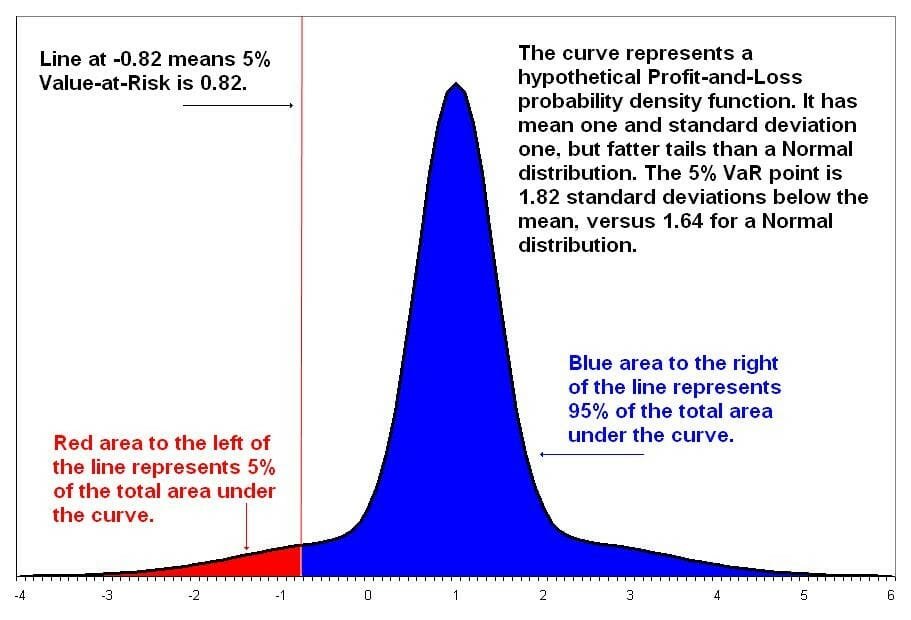
alue at risk (VaR) is a measure of the risk of loss for investments. It estimates how much a set of investments might lose (with a given probability), given normal market conditions, in a set time period such as a day. VaR is typically used by firms and regulators in the financial industry to gauge the amount of assets needed to cover possible losses.

For a given portfolio, time horizon, and probability p, the p VaR can be defined informally as the maximum possible loss during that time after we exclude all worse outcomes whose combined probability is at most p. This assumes mark-to-market pricing, and no trading in the portfolio.

For example, if a portfolio of stocks has a one-day 5% VaR of $1 million, that means that there is a 0.05 probability that the portfolio will fall in value by more than $1 million over a one-day period if there is no trading. Informally, a loss of $1 million or more on this portfolio is expected on 1 day out of 20 days (because of 5% probability).

More formally, p VaR is defined such that the probability of a loss greater than VaR is (at most) p while the probability of a loss less than VaR is (at least) 1−p. A loss which exceeds the VaR threshold is termed a “VaR breach”.

The Idea Behind VAR

The most popular and traditional measure of risk is volatility. The main problem with volatility, however, is that it does not care about the direction of an investment’s movement: stock can be volatile because it suddenly jumps higher. Of course, investors aren’t distressed by gains.

For investors, the risk is about the odds of losing money, and VAR is based on that common-sense fact. By assuming investors care about the odds of a really big loss, VAR answers the question, “What is my worst-case scenario?” or “How much could I lose in a really bad month?”

Now let’s get specific. A VAR statistic has three components: a time period, a confidence level and a loss amount (or loss percentage). Keep these three parts in mind as we give some examples of variations of the question that VAR answers:

  • What is the most I can – with a 95% or 99% level of confidence – expect to lose in dollars over the next month?
  • What is the maximum percentage I can – with 95% or 99% confidence – expect to lose over the next year?

You can see how the “VAR question” has three elements: a relatively high level of confidence (typically either 95% or 99%), a time period (a day, a month or a year) and an estimate of investment loss (expressed either in dollar or percentage terms).

Methods of Calculating VAR

Institutional investors use VAR to evaluate portfolio risk, but in this introduction, we will use it to evaluate the risk of a single index that trades like a stock: the Nasdaq 100 Index, which is traded through the Invesco QQQ Trust. The QQQ is a very popular index of the largest non-financial stocks that trade on the Nasdaq exchange.

There are three methods of calculating VAR: the historical method, the variance-covariance method, and the Monte Carlo simulation.

1. Historical Method

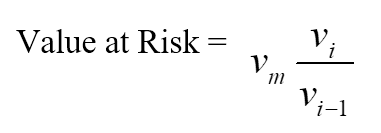
The historical method is the simplest method for calculating Value at Risk. Market data for the last 250 days is taken to calculate the percentage change for each risk factor on each day. Each percentage change is then calculated with current market values to present 250 scenarios for future value. For each of the scenarios, the portfolio is valued using full, non-linear pricing models. The third worst day selected is assumed to be 99% VaR.

Where:

  • vi is number of variables on day i
  • is the number of days from which historical data is taken

2. Parametric Method

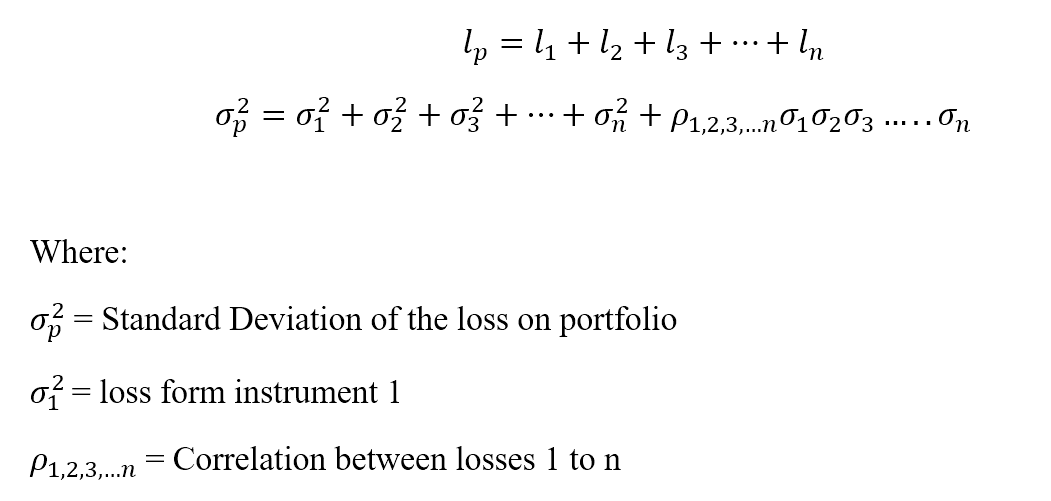
The parametric method is also known as the variance-covariance method. This method assumes a normal distribution in returns. Two factors are to be estimated – an expected return and a standard deviation. This method is best suited to risk measurement problems where the distributions are known and reliably estimated. The method is unreliable when the sample size is very small.

Let loss be ‘l’ for a portfolio ‘p’ with ‘n’ number of instruments.

  1. Monte Carlo Method

Under the Monte Carlo method, Value at Risk is calculated by randomly creating a number of scenarios for future rates using non-linear pricing models to estimate the change in value for each scenario, and then calculating the VaR according to the worst losses. This method is suitable for a great range of risk measurement problems, especially when dealing with complicated factors. It assumes that there is a known probability distribution for risk factors.

Advantages of Value at Risk (VaR)

  1. Easy to understand

Value at Risk is a single number that indicates the extent of risk in a given portfolio. Value at Risk is measured in either price units or as a percentage. This makes the interpretation and understanding of VaR relatively simple.

  1. Applicability

Value at Risk is applicable to all types of assets bonds, shares, derivatives, currencies, etc. Thus, VaR can be easily used by different banks and financial institutions to assess the profitability and risk of different investments, and allocate risk based on VaR.

  1. Universal

The Value at Risk figure is widely used, so it is an accepted standard in buying, selling, or recommending assets.

Limitations of Value at Risk

  1. Large portfolios

Calculation of Value at Risk for a portfolio not only requires one to calculate the risk and return of each asset but also the correlations between them. Thus, the greater the number or diversity of assets in a portfolio, the more difficult it is to calculate VaR.

  1. Difference in methods

Different approaches to calculating VaR can lead to different results for the same portfolio. 3. Assumptions

Calculation of VaR requires one to make some assumptions and use them as inputs. If the assumptions are not valid, then neither is the VaR figure.

Key Elements of Value at Risk

  • Specified amount of loss in value or percentage
  • Time period over which the risk is assessed
  • Confidence interval

Risk Management with Swaps

Swaps are used to manage risk in a couple ways. First, you can use swaps to ensure favorable cash flows, either through timing (as with the coupons on bonds) or through the types of assets being exchanged (as with foreign exchange swaps that ensure a corporation has the right type of currency). The exact nature of the risk being managed depends on the type of swap being used.

Four types of swaps are interest rate, currency, equity, and commodity swaps.

  • Interest rate swaps typically involve one side paying at a floating interest rate and the other paying at a fixed interest rate. In some cases both sides pay at a floating rate, but the floating rates are different.
  • Currency swaps are essentially interest rate swaps in which one set of payments is in one currency and the other is in another currency. The payments are in the form of interest payments; either set of payments can be fixed or floating, or both can be fixed or floating. With currency swaps, a source of uncertainty is the exchange rate so the payments can be fixed and still have uncertain value.
  • In equity swaps, at least one set of payments is determined by the course of a stock price or stock index.
  • In commodity swaps at least one set of payments is determined by the course of a commodity price, such as the price of oil or gold.

The easiest way to see how companies can use swaps to manage risks is to follow a simple example using interest-rate swaps, the most common form of swaps.

  1. Company A owns $1,000,000 in fixed rate bonds earning 5 percent annually, which is $50,000 in cash flows each year.
  2. Company A thinks interest rates will rise to 10 percent, which will yield $100,000 in annual cash flows ($50,000 more per year than their current bond holdings), but exchanging all $1,000,000 for bonds that will yield the higher rate would be too costly.
  3. Company A goes to a swap broker and exchanges not the bonds themselves but the company’s right to the future cash flows.

Company A agrees to give the swap broker the $50,000 in fixed rate annual cash flows, and in return, the swap broker gives the company the cash flows from variable rate bonds worth $1,000,000.

  1. Company A and the swap broker continue to exchange these cash flows over the life of the swap, which ends on a date determined at the time the contract is signed.

Revenue generation and swap derivatives

When pursuing opportunities to generate revenue through swaps, the process is no different, but the motivation behind the swap is to take advantage of differentials in the spot and anticipated future values related to the swap. To see how revenue generation works with swaps, consider the following example, which involves foreign exchange swaps, a simpler but less common form of swap (in the example, USD = U.S. dollar):

  1. Company A has USD 1,000 and believes that the Chinese Yuan (CNY) is set to increase in value compared to the USD.
  2. Company A gets in touch with Company B in China, which just happens to need USD for a short time to fund a capital investment in computers coming from the U.S.
  3. The two companies agree to swap currency at the current market exchange rate, which for this example, is USD 1 = CNY 1.

They swap USD 1,000 for CNY 1,000. The swap agreement states that they’ll exchange currencies back in one year at the forward rate (also USD 1 = CNY 1; it’s a very stable market in Example-World).

In the example, Company B needs the currency but doesn’t want to pay the transaction fees, while Company A is speculating on the change in exchange rate. If the CNY were to increase by 1 percent compared to the USD, then Company A would make a profit on the swap.

If the CNY were to decrease in value by 1 percent, then Company A would lose money on the swap. This potential for loss is why using derivatives to generate income is called speculating. (Did you know the term speculate means “to come by way of very loose interpretation” or “to guess”?)

Valuation of swap derivatives

The value of a swap isn’t very difficult to measure. Simply put, you start with the value of what you’re receiving plus any added value that results from changes in rates or returns and then subtract the value of what you’re giving away plus any increases in value associated with interest earned or changes in rates.

Of course, as with all known valuations, this is a hindsight calculation. When you’re estimating future value, the calculations involve the time value of money and the probabilities of event occurrences, both of which should be treated in the same manner as estimating the value of futures. Remember that a swap is nothing more than a combination of a spot rate exchange and a futures exchange in a single contract.

error: Content is protected !!