Theories of Industrial Relations

According to Encyclopaedia Britannica, “The concept of industrial relations has been extended to denote the relations of the state with employers, workers and their organisations. The subject, therefore, includes individual relations and joint consultation between employers and work people at their work place; collective relations between employers and their organisations and trade unions and the part played by the state in regulating these relations.”

Before the evolution of the concept of “industrial relations”, two concepts, namely “personnel administration” or “personnel management” and “labour relations”, were widely prevalent in industrial organisations. The term “personnel administration” laid emphasis on management’s relationships with a focus on individual employees.

The main areas of its operation comprised the following – recruitment and selection, remuneration, working conditions, promotions and transfers, termination of service and welfare amenities at the place of work. The relationships between the management and organised “labour relations” represented by unions came under the arena of “labour relations”.

The main areas covered under “labour relations” comprised the following – union recognition, collective bargaining, labour contract, industrial disputes, work-stoppages, day- to-day relationships with union representatives and governmental intervention regulating such relationships. In many organisations, “industrial relations” combined the activities and coverage of both “personnel administration” and “labour relations.”

Whatever might have been the differences in organisational arrangements, all the terms have come into usage even to date. At present, “industrial relations” is considered synonymous to “labour relations”, implying the relationships of the management with the organised labour or unions combined with governmental measures in regard to the regulation of such relationships.

Thus, “industrial relations” may be conceived of as “employees/union(s)-employers(s)/management-government relationships in industrial employment.” Some of major areas under its coverage include the following – union recognition, day-to-day dealing with union representatives, collective bargaining and collective agreements, industrial disputes and strikes, grievance settlement and union’s participation in joint bodies.

Growth of Some Other Related Concepts:

In recent years, certain new concepts have emerged in regard to the relationships of management with employees, whether as individuals or with their organisations, and also in the approaches related to managing manpower; these are employee relations, employment relations and human resource management.

One of the main reasons behind the adoption of the term “employee relations” or “employment relations” has been increasing the importance of non-industrial employment relationships in many areas of economic activities.

As management-employees relationships have come to exist in several non-industrial employments such as business, trade and commerce, insurance and other service sectors, the use of the term “human resource management” combining in itself, the functions of “personnel administration” and “labour or industrial relations” appears to be more appropriate and comprehensive.

The term “employee relations”, which also comes within the arena of human resource management as in practice now, refers to the relationships of the management with individual employees.

The ILO has used the term “employment relationship” in a wider perspective, stating that it exists “when a person performs work or services under certain conditions in return for remuneration.” The ILO also adopted Employment Relationship Recommendation No. 198 in 2006, which inter alia provides guidelines pertaining to formulation and application of a national policy on the subject, determination of such a relationship and the establishment of an appropriate mechanism.

Whatever the differences in the pattern of organisational arrangements for managing work-­people, whether present or prospective, there is common acceptance of the assertion that “industrial relations” involve relationships between management and organised workforce along with the government agencies influencing such relationships.

Some of the important features pertaining to industrial relations may be listed thus:

  1. Employment Relationship Essential:

Industrial relations do not emerge in vacuum; they are born out of “employment relationship” in an industrial setting. Without the existence of two parties, i.e., labour and management, this relationship cannot exist. It is the industry which provides the environment for industrial relations.

  1. Conflict and Cooperation Characterise Industrial Relations:

Industrial relations are characterised by both conflict and cooperation. This is the basis of adverse relationship. So the focus of industrial relations is on the study of the attitudes, relationships, practices and procedures developed by the contending parties to resolve or at least minimise conflicts.

  1. The Scope of ‘Industrial Relations’ Fairly Large and Covers Lot of Ground:

As the labour and management do not operate in isolation but are part of a larger system, so the study of industrial relations also includes vital environmental issues like technology of the workplace, country’s socio-economic and political environment, nation’s labour policy, attitude of trade unions, workers and employers and impact of the new wave of global markets, global supply demand and economy.

  1. Measures for Healthy Labour Management Cooperation Put to Close Examination:

Industrial relations also involve the study of conditions conducive to the labour, management cooperation as well as the practices and procedures required to elicit the desired cooperation from both the parties.

  1. The Legalistic Part of Industrial Relations Need to be Examined Closely:

Industrial relations also study the laws, rules, regulations, agreements, awards of court, customs and traditions, as well as policy framework laid down by the government for eliciting cooperation between labour and management and defining rights obligation of both the parties. Besides this, it makes an in-depth analysis of the interference patterns of the executive and judiciary in the regulation of labour-management relations.

  1. All Encompassing Examination of Multifarious Issues Affecting Labour- Management Relations:

The concept of industrial relations is very broad-based, drawing heavily from a variety of disciplines like social sciences, humanities, behavioural sciences, laws etc.

  1. The National Commission on Labour:

According to NCL, industrial relations affect not merely the interests of the two participants— labour and management, but also the economic and social goals to which the State addresses itself. To regulate these relations in socially desirable channels is a function, which the State is in the best position to perform. In fact, industrial relation encompasses all such factors that influence behaviour of people at work.

A few such important factors are below:

(i) Institutions:

They include government, employers, trade unions, union federations, employers’ federations or associations, government bodies, labour courts, tribunals and other organisations which have direct or indirect impact on the industrial relations system.

(ii) Characters:

It aims to study the role of workers, unions and employers’ federation officials, shop stewards, industrial relations officers / manager, mediator / conciliators / arbitrator, judges of labour court, tribunal, etc.

(iii) Methods:

Here, the focus is on collective bargaining, workers’ participation in the industrial relation schemes, discipline, procedure, grievance redressal machinery, dispute settlement machinery, working of closed shops, union recognition, organisation of protests through methods like strikes, gheraos, bandhs and lockouts, formulation and revision of existing rules, regulations, policies, procedures, decisions of labour courts, tribunals, etc. in defining the rights and obligations of the parties.

(iv) Contents:

They include matter pertaining to employment conditions like pay and other monetary non-monetary demands of the workers hours of work, leave with wages, health, and safety disciplinary actions, lay-off, dismissals, retirement etc., laws relating to such activities, legislation governing labour welfare, social security, industrial relations, issues concerned with workers’ participation in management, collective bargaining, sharing gains of productivity profits.

3 Important Approaches: Unitary Approach, Pluralistic Approach Marxist Approach

Industrial relations has become one of the most delicate and complex problems of modern industrial society. Industrial progress is impossible without labour management. So that, it is the interest of all to create and maintain good relations between employers and employees. Generally, industrial relations means the relationships between employers and employees in industrial organisations.

But, in the broad sense, the term industrial relations includes the relations between the various unions between the state and the unions as well as those between the employers and the government. Relations of all these associated in industry may be called industrial relations. It also involve the study of how people get on together at their work, what difficulties arise between them, how relations among them are regulated and what organisations are set up to protect different interest.

According to Encyclopaedia Britannica, “The concept of industrial relations has been extended to denote the relations of the state with employers, workers and their organizations. The subject, therefore, includes individual relations and joint consultations between employers and work people at their workplace, collective relations between employers and their organizations and trade unions and the part played by the state in regulating these relations.”

There are three approaches:

(i) Unitary Approach

(ii) Pluralistic approach

(iii) Marxist Approach.

1. Unitary:

Under this approach, mutual cooperation, team spirit and shared goals play a significant role. Any conflict is seen as a result of a temporary aberration resulting from poor management. Direct negotiation with workers is encouraged. This approach is criticised as a tool for seducing workers away from unionism/socialism. It is also criticised as manipulation and exploitation.

2. Pluralistic:

This approach perceives organisation as a coalition of competing interest between management and different groups, trade unions as legitimate representative of employee’s interests and stability in Industrial Relation as the product of concessions and compromises between management and workers. Unions, therefore balance the power between management and employees. Therefore, strong unions are desirable and necessary.

3. Marxist:

This approach also regards conflict between employers and employees inevitable. Marxists consider conflict as a product of the capitalistic society – the gap between “Haves and Have Not’s”. Trade Unions focus on improving the position of workers but workers’ participation in management, cooperative work culture etc., are not acceptable to the Marxists.
Theories underlying Motivation and Remuneration

Remuneration Meaning: The compensation an employee receives in return of his or her contribution to the organization.

Remuneration is the reward for employment in the form of pay, salary, or wage, including allowances, benefits (such as company car, medical plan, pension plan), bonuses, cash incentives, and monetary value of the non cash incentives.

Components of Remuneration- An average employee in the organized sector is entitled to several benefits such as salary and wages, incentives, fringe benefits etc. following are the major components of remuneration:

Wages and Salary: Wages represent the hourly rates of pay whereas salary represents the monthly rates of pay regardless number of hours put in by an employee.

Incentives: incentives are basically “payment by results”. Incentives depend on productivity, sales, profits or cost reduction efforts. There are two types of incentives schemes:

Individual Incentive Scheme: Applicable to specific employee performance.

Group Incentive Scheme: It is applicable where a given task demands group efforts for completion.

Fringe Benefits: It includes PF, gratuity, medical care, hospitalization, accident relief, health & group insurance, canteen, uniform and recreation etc.

Prerequisites: These are allowed to executives and include company car, club membership, paid holidays, furnished house, stock option schemes etc.

Non Monetary Benefits: These include challenging job responsibilities, growth prospect, competent supervision, comfortable working conditions etc.

Theories of Remuneration: In order to understand which components of remuneration are more effective, we can look at theories of remuneration-

Reinforcement & Expectancy Theory

Reinforce theory suggests that behavior which has a rewarding experience is likely to be repeated. Implication of remuneration in this theory is that high employee performance followed by a will make future employee performance more likely.

Expectancy theory is link between rewards and behavior.  According to this theory, motivation is product of valance, instrumentality and expectancy. Remuneration system differs according to their impact on these motivation components.  Pay system differ most in their impact on instrumentality-the perceived link between behavior and pay. Valance of pay outcomes remains the same under different pay system. Expectancy perceptions often have more to do with job design and training than pay system.

Equity Theory: Equity theory emphasis in pay structure of employee remuneration. It suggests that an employee who perceives inequity in his or her rewards seeks to restore equity. When employee perceives inequity it can result in lower productivity, higher absenteeism or increase in turnover.

Remuneration system needs to meet three types of equity which directly impact motivation, commitment and performance-

Internal Equity: Perceived fairness of pay differentials among different jobs with organization.

External Equity: Employees’ perception of fairness of remuneration relative to those outside organization.

Individual Equity: Employees’ perception of pay differentials among individuals who hold identical job in the same organization.

Agency Theory: Focuses on the divergent interests and goals of the organization’s stakeholders and the way that employee remuneration can be used to align these interests and goals. This theory talks about two important stakeholder i.e. employer and employee. Employer plays a role of principal whereas employee plays a role of agent. Remuneration paid to employee (agent) is called agency cost. Agent wants high agency cost whereas principals want to minimize it.

Agency theory says that principal must choose a contracting schemes that helps align the interest of agent with the principal’s own interest.

Workers Participation in Management, Characteristics, Objectives, Levels

Workers’ Participation in Management refers to the involvement of employees in decision-making processes, policies, and practices that affect their work and workplace. It encompasses mechanisms and structures that enable workers to contribute their perspectives, ideas, and feedback to management, fostering a sense of ownership, empowerment, and collaboration. Workers’ participation can take various forms, including representation on decision-making bodies, consultation mechanisms, joint committees, and employee involvement programs. By promoting dialogue, transparency, and shared responsibility between management and workers, workers’ participation in management aims to enhance productivity, job satisfaction, and organizational performance while fostering a culture of mutual respect and cooperation in the workplace.

Characteristics of Workers Participation in Management:

  • Voluntary Involvement:

Workers’ participation in management is based on voluntary involvement, where employees willingly engage in decision-making processes and activities that affect their work and workplace. It is not coerced or mandated by management but arises from a genuine desire to contribute to organizational goals and improve working conditions.

  • Joint Decision-Making:

Workers’ participation in management involves joint decision-making processes where both management and workers have a voice and influence in decisions that affect the organization. It fosters collaboration, dialogue, and consensus-building between management and employees, leading to more informed and inclusive decision-making.

  • Information Sharing:

Workers’ participation in management entails open and transparent communication between management and employees, with the sharing of relevant information, data, and insights. It ensures that employees are well-informed about organizational goals, strategies, performance, and challenges, enabling them to make meaningful contributions and informed decisions.

  • Consultation and Dialogue:

Workers’ participation in management involves regular consultation and dialogue between management and workers on matters of mutual interest, such as workplace policies, procedures, and practices. It provides opportunities for employees to express their views, concerns, and suggestions, while management listens, considers feedback, and responds constructively.

  • Representation:

Workers’ participation in management often involves the representation of employees on decision-making bodies, committees, or forums where they can articulate the interests and perspectives of their colleagues. Employee representatives serve as advocates for their peers, ensuring that their voices are heard and considered in management decisions.

  • Training and Development:

Workers’ participation in management may require training and development initiatives to enhance employees’ skills, knowledge, and capabilities in areas such as communication, negotiation, problem-solving, and leadership. Training programs equip employees with the tools and competencies needed to engage effectively in decision-making processes and contribute to organizational success.

  • Continuous Improvement:

Workers’ participation in management is characterized by a commitment to continuous improvement and learning, where both management and employees work together to identify areas for enhancement, innovation, and optimization. It fosters a culture of continuous feedback, experimentation, and adaptation, driving organizational agility and resilience in a dynamic business environment.

Objectives of Workers Participation in Management:

  • Enhanced Decision-Making:

One objective of workers’ participation in management is to improve the quality of decision-making by incorporating the knowledge, insights, and perspectives of employees. By involving workers in decision-making processes, organizations can tap into their frontline expertise, innovative ideas, and problem-solving abilities, leading to more informed and effective decisions.

  • Increased Productivity:

Workers’ participation in management aims to enhance productivity by engaging employees in the improvement of work processes, efficiency measures, and productivity initiatives. By involving workers in identifying and implementing productivity enhancements, organizations can boost performance, optimize resource utilization, and achieve better outcomes.

  • Improved Quality of Work Life:

Workers’ participation in management seeks to enhance the quality of work life for employees by providing opportunities for meaningful involvement, autonomy, and recognition. By empowering employees to contribute to decision-making and problem-solving, organizations can create a positive work environment characterized by job satisfaction, motivation, and fulfillment.

  • Promotion of Industrial Democracy:

Workers’ participation in management promotes the principles of industrial democracy by fostering a culture of shared responsibility, accountability, and mutual respect between management and employees. By giving employees a voice and stake in organizational decisions, organizations can build trust, transparency, and cooperation, strengthening labor-management relations.

  • Conflict Resolution:

Workers’ participation in management aims to prevent and resolve conflicts by providing mechanisms for dialogue, negotiation, and consensus-building between management and employees. By fostering open communication and collaboration, organizations can address grievances, resolve disputes, and build consensus on issues of mutual concern, reducing tension and promoting harmony in the workplace.

  • Employee Development:

Workers’ participation in management contributes to the development of employees by providing opportunities for learning, skill development, and career advancement. By involving employees in decision-making and problem-solving, organizations can empower them to take ownership of their work, build leadership capabilities, and enhance their professional growth and development.

  • Organizational Effectiveness:

Ultimately, workers’ participation in management aims to improve organizational effectiveness and performance by leveraging the collective intelligence, creativity, and commitment of employees. By engaging employees as partners in the pursuit of organizational goals, organizations can enhance agility, innovation, and adaptability, driving sustainable growth and success.

Levels of Workers Participation in Management:

  1. Shop Floor or Operational Level:

At the shop floor or operational level, workers participate in decision-making processes that directly affect their work tasks, processes, and immediate work environment. This level of participation may include involvement in problem-solving, process improvement initiatives, safety protocols, and quality control measures.

  1. Departmental or Team Level:

Workers may participate in decision-making at the departmental or team level, where they collaborate with colleagues and supervisors to address department-specific issues, allocate resources, and coordinate activities. This level of participation fosters teamwork, communication, and collective responsibility within departments or work teams.

  1. Plant or Facility Level:

At the plant or facility level, workers may participate in broader decision-making processes related to overall plant operations, production schedules, resource allocation, and performance management. This level of participation involves engagement with plant management, department heads, and other stakeholders to address systemic challenges and opportunities.

  1. Company-wide or Organizational Level:

Workers may participate in decision-making at the company-wide or organizational level, where they contribute to strategic planning, policy development, and corporate governance. This level of participation may involve representation on company boards, advisory committees, or task forces responsible for shaping organizational direction and priorities.

  1. Industry or Sector Level:

Workers may participate in decision-making at the industry or sector level through participation in industry associations, trade unions, or sector-specific forums. This level of participation enables workers to advocate for their collective interests, influence industry policies and practices, and address common challenges facing workers in the sector.

  1. National or International Level:

Workers may participate in decision-making at the national or international level through engagement with government agencies, international organizations, and multi-stakeholder initiatives. This level of participation involves advocacy for labor rights, social justice, and policy reforms on issues of global concern, such as labor standards, trade policies, and sustainable development.

Possible Errors in Appraisal Process

Rating errors are factors that mislead or blind us in the appraisal process. Armstrong warned that “appraisers must be on guard against anything that distorts reality, either favorably or unfavorably.” These are the 10 rating errors seen most often. They’re where managers and other raters are most likely to go offtrack.

  1. Central tendencyClustering everyone in the middle performance categories to avoid extremes of good or bad performance; it’s easy, but it’s wrong. This isn’t fair to employees who are really making an effort, and it can be demoralizing.
  2. Overlooking the flaws of favored or “nice” employees, especially those whom everyone likes.
  3. Excusing below standard performance because it is widespread; “Everyone does it.”
  4. Guilt by association. Rating someone on the basis of the company they keep, rather than on the work they do.
  5. The halo effect. Letting one positive work factor you like affect your overall assessment of performance.
  6. Holding a grudge. A dangerous luxury that may result in your ending up in court. Never try to make employees pay for past behavior.
  7. The horns effect. The opposite of the halo effect letting one negative work factor or behavior you dislike color your opinion of other factors.
  8. Allowing your bias to influence the rating. Bias can come from attitudes and opinions about race, national origin, sex, religion, age, veterans’ status, disability, hair color, weight, height, intelligence, etc.
  9. Rating only recent performance, good or bad. Data should be representative of the entire review period. If you’re not keeping good notes, you may not remember the whole period. Armstrong noted that “you want to make sure, again, that you’re keeping records so that you can adequately describe performance over an entire performance period.”
  • The sunflower effect. Rating everyone high, regardless of performance, to make yourself look good or to be able to give more compensation.

Performance Appraisal of Managers, Objectives, Purpose, Advantages, Limitations, Process, Uses

Performance Appraisal of managers is a systematic evaluation of a manager’s effectiveness in achieving organizational goals, leading teams, and fulfilling their responsibilities. It assesses various dimensions such as leadership, decision-making, communication skills, goal achievement, and team management. The process involves setting performance standards, measuring actual performance, providing feedback, and identifying areas for improvement. Appraisals are crucial for recognizing contributions, aligning individual performance with organizational objectives, and fostering professional development. They also aid in making informed decisions about promotions, rewards, and training needs, ensuring that managers remain motivated and equipped to handle evolving business challenges effectively.

Objectives of Performance Appraisal:

  • Assessing Performance

The primary objective is to evaluate an employee’s performance against predefined standards. This assessment identifies strengths, weaknesses, and areas needing improvement, enabling managers to make informed decisions about an employee’s future roles and responsibilities.

  • Providing Feedback

Performance appraisals aim to provide constructive feedback to employees about their work. Regular and transparent feedback fosters a culture of openness and continuous improvement, helping employees understand how their efforts contribute to organizational success.

  • Facilitating Career Development

Through performance appraisals, organizations can identify employees’ training and development needs. This helps in designing customized learning programs and career advancement opportunities, ensuring employees grow in their roles and contribute effectively to the organization.

  • Supporting Decision-Making

Performance appraisals provide a solid basis for making various HR decisions such as promotions, transfers, terminations, and compensation adjustments. They ensure that such decisions are fair, objective, and aligned with organizational goals.

  • Setting Future Goals

Appraisals help managers and employees collaboratively set realistic and measurable goals for the future. These goals guide employees in prioritizing tasks and focusing on key performance areas that align with organizational objectives.

  • Enhancing Motivation and Productivity

Recognizing and rewarding employees for their performance boosts morale and motivates them to perform better. It also creates a healthy competitive environment, encouraging all employees to strive for excellence.

  • Identifying Leadership Potential

Performance appraisals help in identifying employees with leadership capabilities and managerial skills. This is essential for succession planning, ensuring the organization is prepared for future leadership needs.

  • Aligning Individual and Organizational Goals

By assessing and aligning individual performance with organizational objectives, appraisals ensure that employees’ efforts contribute to the larger vision and mission of the company. This alignment fosters a sense of purpose and commitment among employees.

Purpose of Performance Appraisal:

  • Employee Development

One of the primary purposes of performance appraisal is to help identify an employee’s strengths and weaknesses. It provides valuable feedback to employees, which aids in their professional development. By addressing areas where improvement is needed, employees can focus on skill development, enhancing their capabilities, and becoming more effective in their roles.

  • Performance Feedback

Performance appraisals offer an opportunity for managers to provide employees with constructive feedback regarding their work performance. This feedback highlights what employees are doing well and areas where they can improve. Regular feedback fosters transparency, helping employees understand their contributions and adjust behaviors accordingly.

  • Goal Setting and Alignment

Performance appraisals are often linked with goal-setting processes. During the appraisal, employees can discuss their past goals and set new targets for the future. These goals help align individual performance with the broader objectives of the organization, ensuring that everyone works toward common goals and enhances overall performance.

  • Reward and Recognition

Performance appraisals play a vital role in determining rewards, promotions, and salary increments. By evaluating employees based on their performance, organizations can ensure that high-performing individuals are appropriately recognized and rewarded. This motivates employees to perform better and fosters a culture of meritocracy within the workplace.

  • Career Development

Performance appraisals help identify potential future leaders within an organization. They provide insights into employees’ readiness for higher roles and responsibilities. By understanding an employee’s strengths and career aspirations, HR managers can offer tailored career development opportunities, including training, mentorship, or job rotations, to prepare employees for future roles.

  • Organizational Planning

By assessing the performance of employees across various departments, performance appraisals help organizations make informed decisions about staffing needs, resource allocation, and succession planning. They provide a comprehensive view of workforce capabilities, helping organizations plan for the future and address any gaps in skills or talent.

  • Enhancing Motivation and Morale

A well-conducted performance appraisal system boosts employee morale by recognizing hard work and achievement. When employees see that their efforts are acknowledged, they feel valued and are more motivated to perform at higher levels. Positive feedback during appraisals also strengthens employee engagement and loyalty to the organization.

Advantages of Performance Appraisal:

  • Improves Employee Performance

Performance appraisals help employees understand their strengths and weaknesses through constructive feedback. By identifying specific areas for improvement, employees can focus on enhancing their skills and productivity, ultimately contributing to the organization’s success.

  • Identifies Training and Development Needs

Through appraisals, organizations can pinpoint skill gaps and training requirements among employees. This enables the design of targeted training programs to address these gaps, ensuring employees are better equipped to meet job demands and adapt to evolving organizational needs.

  • Facilitates Promotion and Career Growth

Appraisals provide a clear and objective basis for making decisions regarding promotions and career advancements. They help identify high-performing employees who deserve recognition, rewards, or leadership opportunities, fostering a meritocratic work environment.

  • Boosts Employee Motivation

Recognizing and rewarding employees for their hard work during appraisals boosts morale and motivation. Positive reinforcement encourages employees to maintain or improve their performance, creating a culture of continuous excellence within the organization.

  • Enhances Communication

Performance appraisals foster open communication between employees and management. Regular discussions during appraisals provide a platform for employees to share concerns, seek guidance, and align expectations, leading to better understanding and collaboration.

  • Supports Strategic Decision-Making

Performance appraisals provide valuable data for strategic HR decisions, such as workforce planning, promotions, transfers, and terminations. This ensures that organizational decisions are fair, data-driven, and aligned with long-term goals.

  • Aligns Individual and Organizational Objectives

Appraisals align employee efforts with organizational goals by setting clear expectations and performance standards. This alignment ensures that individual contributions support the larger mission and vision of the company, driving overall success.

Limitations of Performance Appraisal:

  • Subjectivity and Bias

Performance appraisals are often influenced by the evaluator’s personal biases or preferences. Subjective judgments can result in inaccurate assessments, where personal relationships, favoritism, or preconceived notions overshadow objective performance evaluation.

  • Halo and Horn Effect

The “halo effect” occurs when a single positive trait influences the overall appraisal, while the “horn effect” occurs when a single negative trait dominates the evaluation. These biases can distort the true performance picture and lead to unfair appraisals.

  • Lack of Standardization

Inconsistent appraisal methods and criteria across departments or evaluators can lead to discrepancies in evaluations. Without a standardized process, comparisons between employees become unreliable, and fairness in assessments is compromised.

  • Employee Demotivation

Poorly conducted appraisals can lead to dissatisfaction and demotivation among employees. If feedback is overly critical, vague, or fails to recognize genuine contributions, employees may feel undervalued and lose motivation to perform.

  • Resistance to Feedback

Employees may resist or react negatively to critical feedback, viewing it as an attack rather than an opportunity for improvement. This resistance can hinder constructive dialogue and reduce the effectiveness of the appraisal process.

  • Time-Consuming and Costly

Performance appraisals require significant time and resources for planning, implementation, and follow-up. For large organizations, conducting regular and detailed appraisals for all employees can be a complex and expensive process, leading to inefficiencies.

  • Focus on Past Performance

Appraisals often emphasize past performance rather than future potential. This retrospective approach may overlook an employee’s ability to grow, adapt, or contribute in new roles, limiting the organization’s ability to identify and nurture potential talent.

Process of Performance Appraisal:

  • Establishing Performance Standards

The first step is to define clear, measurable, and achievable performance standards based on organizational objectives. These standards serve as benchmarks for evaluating employee performance and should be communicated clearly to employees to avoid ambiguity.

  • Communicating Expectations

It is essential to ensure that employees understand the performance standards and expectations. This step involves regular communication between managers and employees to clarify roles, responsibilities, and key performance indicators (KPIs).

  • Measuring Actual Performance

In this step, employee performance is tracked and documented over a specific period using various tools such as reports, observation, and self-assessments. This data collection should be objective and based on facts rather than subjective opinions.

  • Comparing Performance Against Standards

Once the data is collected, the actual performance is compared to the predefined standards. This comparison identifies gaps, strengths, and areas for improvement, providing a comprehensive view of an employee’s performance.

  • Providing Feedback

Feedback is a critical step in the appraisal process. Managers share their observations and evaluations with employees through one-on-one discussions. Constructive feedback highlights both achievements and areas for improvement, fostering a culture of learning and development.

  • Identifying Training and Development Needs

Based on the appraisal results, managers identify specific training and development requirements for employees. Addressing these needs helps improve skills and prepares employees for future responsibilities and roles.

  • Decision-Making

Appraisals provide the foundation for making key HR decisions such as promotions, rewards, salary adjustments, transfers, or terminations. The appraisal outcomes ensure that these decisions are fair, transparent, and aligned with organizational goals.

  • Monitoring and Follow-Up

The final step involves monitoring progress and ensuring that employees work on the feedback provided. Regular follow-ups help maintain accountability and track improvements, fostering continuous growth and alignment with organizational standards.

Uses of Performance Appraisal:

  • Employee Development

Performance appraisal helps in identifying an employee’s strengths and areas for improvement. Based on feedback, employees can work on enhancing their skills and competencies through training or mentoring. It also encourages self-reflection and goal setting, helping individuals align their efforts with organizational expectations. Appraisals act as a developmental tool by enabling employees to track their progress over time and stay motivated to improve. When conducted properly, they foster a learning culture that boosts both personal and professional growth, ensuring long-term development and better performance outcomes.

  • Compensation Decisions

Organizations use performance appraisals to make informed decisions regarding salary increases, bonuses, and other financial rewards. High-performing employees are often recognized and rewarded accordingly, which helps in maintaining motivation and performance levels. It ensures that compensation is distributed fairly based on merit and contribution rather than favoritism. Linking pay to performance reinforces the idea that efforts and achievements are valued. This also supports the organization’s compensation strategy by aligning rewards with employee productivity and organizational goals, promoting a culture of accountability and excellence.

  • Promotion and Career Planning

Appraisals provide valuable insights into an employee’s readiness for advancement or role changes. Managers assess competencies such as leadership, problem-solving, and teamwork to determine suitability for higher positions. Performance data helps in succession planning and internal talent identification. Employees who consistently perform well may be fast-tracked for promotions, while those needing improvement are guided through development plans. This ensures that promotions are fair, strategic, and based on evidence. Career planning becomes more effective when based on documented achievements and progress, helping both individuals and organizations prepare for future challenges.

  • Training and Development Needs

Appraisals highlight specific skill gaps or knowledge deficiencies among employees, which organizations can address through targeted training programs. For instance, if a team shows weak customer service skills, a training module can be introduced to improve communication. This focused approach ensures that resources are used effectively and training is relevant to current needs. Managers and HR professionals can use appraisal data to tailor development plans that support employee growth. Addressing these gaps enhances overall productivity, minimizes errors, and strengthens organizational capability, thereby fostering a more competent and confident workforce.

  • Feedback and Communication

Performance appraisals create structured opportunities for open dialogue between employees and supervisors. Through feedback, employees understand how their work aligns with expectations, what they’re doing well, and where they need improvement. This communication fosters trust, reduces ambiguity, and ensures alignment of individual efforts with team and organizational goals. Constructive feedback motivates employees and strengthens the manager-employee relationship. It also allows managers to express appreciation or concerns in a professional manner. Regular, honest feedback ensures that employees remain engaged, responsible, and continuously improve their work performance.

  • Disciplinary and Termination Decisions

Appraisal records serve as formal documentation of employee performance, which can be critical when making disciplinary or termination decisions. If an employee is consistently underperforming, appraisal results can support managerial actions such as issuing warnings, restructuring roles, or initiating exit processes. This ensures objectivity and legal compliance, as decisions are based on documented evidence rather than subjective judgment. It also protects the organization from potential disputes. Thus, appraisals act as a safeguard to maintain workforce quality and reinforce accountability across all levels of employment.

  • Organizational Planning

Performance appraisal data supports workforce planning by providing insights into overall employee productivity, skill levels, and future potential. Organizations can use this information to anticipate talent shortages, redesign roles, and manage succession. It also helps in aligning individual capabilities with future organizational needs. Appraisal data allows leadership to make strategic decisions regarding restructuring, manpower allocation, or expansion. This macro-level use of performance evaluations ensures that the organization has the right people in the right roles at the right time, ultimately leading to improved effectiveness and sustainable growth.

Methods of Performance Appraisal

Each method of performance appraisal has its strengths and weaknesses may be suitable for one organization and non-suitable for another one. As such, there is no single appraisal method accepted and used by all organizations to measure their employees’ perfor­mance.

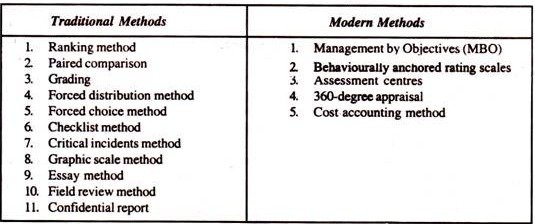
  1. Traditional Methods

(i) Ranking Method

It is the oldest and simplest formal systematic method of performance appraisal in which employee is compared with all others for the purpose of placing order of worth. The employees are ranked from the highest to the lowest or from the best to the worst.

In doing this the employee who is the highest on the characteristic being measured and also the one who is L lowest, are indicated. Then, the next highest and the next lowest between next highest and lowest until all the employees to be rated have been ranked. Thus, if there are ten employees to be appraised, there will be ten ranks from 1 to 10.

(ii) Paired Comparison

In this method, each employee is compared with other employees on one- on one basis, usually based on one trait only. The rater is provided with a bunch of slips each coining pair of names, the rater puts a tick mark against the employee whom he insiders the better of the two. The number of times this employee is compared as better with others determines his or her final ranking.

N (N-1)/2

Where N = the total number of employees to be evaluated.

(iii) Grading Method

In this method, certain categories of worth are established in advance and carefully defined. There can be three categories established for employees: outstanding, satisfactory and unsatisfactory. There can be more than three grades. Employee performance is compared with grade definitions. The employee is, then, allocated to the grade that best describes his or her perfor­mance.

Such type of grading is done is Semester pattern of examinations and in the selection of a candidate in the public service sector. One of the major drawbacks of this method is that the rater may rate most of the employees on the higher side of their performance.

(iv) Forced Distribution Method

This method was evolved by Tiffen to eliminate the central tendency of rating most of the employees at a higher end of the scale. The method assumes that employees’ performance level confirms to a normal statistical distribution i.e., 10,20,40,20 and 10 per cent. This is useful for rating a large number of employees’ job performance and promo ability. It tends to eliminate or reduce bias.

It is also highly simple to understand and easy to apply in appraising the performance of employees in organizations. It suffer from the drawback that improve similarly, no single grade would rise in a ratings.

(v) Forced-Choice Method

The forced-choice method is developed by J. P. Guilford. It contains a series of groups of statements, and rater rates how effectively a statement describes each individual being evaluated. Common method of forced-choice method contains two statements, both positive and negative.

(vi) Check-List Method

The basic purpose of utilizing check-list method is to ease the evaluation burden upon the rater. In this method, a series of statements, i.e., questions with their answers in ‘yes’ or ‘no’ are prepared by the HR department. The check-list is, then, presented to the rater to tick appropriate answers relevant to the appraisee. Each question carries a weight-age in relationship to their importance.

(vii) Critical Incidents Method

In this method, the rater focuses his or her attention on those key or critical behaviours that make the difference between performing a job in a noteworthy manner (effectively or ineffectively). There are three steps involved in appraising employees using this method.

First, a list of noteworthy (good or bad) on-the-job behaviour of specific incidents is prepared. Second, a group of experts then assigns weightage or score to these incidents, depending upon their degree of desirability to perform a job. Third, finally a check-list indicating incidents that describe workers as “good” or “bad” is constructed. Then, the check-list is given to the rater for evaluating the workers.

(viii) Graphic Rating Scale Method

The graphic rating scale is one of the most popular and simplest techniques for appraising performance. It is also known as linear rating scale. In this method, the printed appraisal form is used to appraise each employee.

The form lists traits (such as quality and reliability) and a range of job performance characteristics (from unsatisfactory to outstanding) for each trait. The rating is done on the basis of points on the continuum. The common practice is to follow five points scale.

(ix) Essay Method

Essay method is the simplest one among various appraisal methods available. In this method, the rater writes a narrative description on an employee’s strengths, weaknesses, past performance, potential and suggestions for improvement. Its positive point is that it is simple in use. It does not require complex formats and extensive/specific training to complete it.

(x) Field Review Method

When there is a reason to suspect rater’s biasedness or his or her rating appears to be quite higher than others, these are neutralised with the help of a review process. The review process is usually conducted by the personnel officer in the HR department.

(xi) Confidential Report

It is the traditional way of appraising employees mainly in the Government Departments. Evaluation is made by the immediate boss or supervisor for giving effect to promotion and transfer. Usually a structured format is devised to collect information on employee’s strength weakness, intelligence, attitude, character, attendance, discipline, etc. report.

  1. Modern Methods

(i) Management by Objectives (MBO)

Most of the traditional methods of performance appraisal are subject to the antagonistic judgments of the raters. It was to overcome this problem; Peter F. Drucker propounded a new concept, namely, management by objectives (MBO) way back in 1954 in his book.

The Practice of management. The concept of MBO as was conceived by Drucker, can be described as a “process whereby the superior and subordinate managers of an organization jointly identify its common goals, define each individual’s major areas of responsibility in terms of results expected of him and use these measures as guides for operating the unit and assessing the contribution of each its members”.

An MBO programme consists of four main steps: goal setting, performance standard, compari­son, and periodic review. In goal-setting, goals are set which each individual, s to attain. The superior and subordinate jointly establish these goals. The goals refer to the desired outcome to be achieved by each individual employee.

In performance standards, the standards are set for the employees as per the previously arranged time period. When the employees start performing their jobs, they come to know what is to be done, what has been done, and what remains to be done.

In the third step the actual level of goals attained are compared with the goals agreed upon. This enables the evaluator to find out the reasons variation between the actual and standard performance of the employees. Such a comparison helps devise training needs for increasing employees’ performance it can also explore the conditions having their bearings on employees’ performance but over which the employees have no control.

Finally, in the periodic review step, corrective measure is initiated when actual performance deviates from the slandered established in the first step-goal-setting stage. Consistent with the MBO philosophy periodic progress reviews are conducted in a constructive rather than punitive manner.

(ii)  Behaviourally Anchored Rating Scales (BARS)

The problem of judgmental performance evalu­ation inherent in the traditional methods of performance evaluation led to some organizations to go for objective evaluation by developing a technique known as “Behaviourally Anchored Rating Scales (BARS)” around 1960s. BARS are descriptions of various degrees of behaviour with regard to a specific performance dimension.

It combines the benefits of narratives, critical incidents, and quan­tified ratings by anchoring a quantified scale with specific behavioural examples of good or poor performance. The proponents of BARS claim that it offers better and more equitable appraisals than do the other techniques of performance appraisal we discussed so far.

(iii) Assessment Centres

The introduction of the concept of assessment centres as a method of performance method is traced back in 1930s in the Germany used to appraise its army officers. The concept gradually spread to the US and the UK in 1940s and to the Britain in 1960s.

The concept, then, traversed from the army to business arena during 1960s. The concept of assessment centre is, of course, of a recent origin in India. In India, Crompton Greaves, Eicher, Hindustan Lever and Modi Xerox have adopted this technique of performance evaluation.

In business field, assessment centres are mainly used for evaluating executive or supervisory potential. By definition, an assessment centre is a central location where managers come together to participate in well-designed simulated exercises. They are assessed by senior managers supple­mented by the psychologists and the HR specialists for 2-3 days.

Assessee is asked to participate in in-basket exercises, work groups, simulations, and role playing which are essential for successful performance of actual job. Having recorded the assessee’s behaviour the raters meet to discuss their pooled information and observations and, based on it, they give their assessment about the assesee. At the end of the process, feedback in terms of strengths and weaknesses is also provided to the assesees.

(iv) 360 Degree Appraisal

Yet another method used to appraise the employee’s performance is 360 – degree appraisal. This method was first developed and formally used by General Electric Company of USA in 1992. Then, it travelled to other countries including India. In India, companies like Reliance Industries, Wipro Corporation, Infosys Technologies, Thermax, Thomas Cook etc., have been using this method for appraising the performance of their employees. This feedback based method is generally used for ascertaining training and development requirements, rather than for pay increases.

Under 360–degree appraisal, performance information such as employee’s skills, abilities and behaviours, is collected “all around” an employee, i.e., from his/her supervisors, subordinates, peers and even customers and clients.

In other worlds, in 360-degree feedback appraisal system, an employee is appraised by his supervisor, subordinates, peers, and customers with whom he interacts in the course of his job performance. All these appraisers provide information or feedback on an employee by completing survey questionnaires designed for this purpose.

(v) Cost Accounting Method

This method evaluates an employee’s performance from the monetary benefits the employee yields to his/her organization. This is ascertained by establishing a relationship between the costs involved in retaining the employee, and the benefits an organization derives from Him/her.

HRM Training Methods

Many methods of training are available each has certain advantages and disadvantages. Here we list the different methods of training…you can comment on the pros and cons and make the examples concrete by imagining how they could be applied in training truck drivers.

  1. Technology Based Learning

Common methods of learning via technology include:

  • Basic PC-based programs
  • Interactive multimedia: using a PC-based CD-ROM
  • Interactive video: using a computer in conjunction with a VCR
  • Web-based training programs

The forms of training with technology are almost unlimited. A trainer also gets more of the learner’s involvement than in any other environment and trainees have the benefit of learning at their own pace.

Example: In the trucking industry one can imagine interactive multimedia training on tractor-trailers followed by a proficiency test to see how well the employee knows the truck.

  1. Simulators

Simulators are used to imitate real work experiences.

Most simulators are very expensive but for certain jobs, like learning to fly a 747, they are indispensable. Astronauts also train extensively using simulators to imitate the challenges and micro-gravity experienced on a space mission. The military also uses video games (similar to the “shoot-em-up” ones your 14-year old plays) to train soldiers.

Example: Truck drivers could use simulators to practice responding to dangerous driving situations.

  1. On-The-Job Training

Jumping right into work from day one can sometimes be the most effective type of training.

Here are a few examples of on-the-job training:

  • Read the manual a rather boring, but thorough way of gaining knowledge of about a task.
  • A combination of observation, explanation and practice.
  • Trainers go through the job description to explain duties and answer questions.
  • Use the intranet so trainees can post questions concerning their jobs and experts within the company can answer them.

On-the-job training gives employees motivation to start the job. Some reports indicate that people learn more efficiently if they learn hands-on, rather than listening to an instructor. However, this method might not be for everyone, as it could be very stressful.

Example: New trucking employees could ride with experienced drivers. They could ask questions about truck weigh stations, proper highway speeds, picking up hitchhikers, or any other issues that may arise.

  1. Coaching/Mentoring

Coaching/mentoring gives employees a chance to receive training one-on-one from an experienced professional. This usually takes place after another more formal process has taken place to expand on what trainees have already learned.

Here are three examples of coaching/mentoring:

  • Hire professional coaches for managers.
  • Set up a formal mentoring program between senior and junior managers
  • Implement less formal coaching/mentoring to encourage the more experienced employees to coach the less experienced.

Coaching/mentoring gives trainees the chance to ask questions and receive thorough and honest answers; something they might not receive in a classroom with a group of people.

Example: Again, truck drivers could gain valuable knowledge from more experienced drivers using this method.

  1. Lectures

Lectures usually take place in a classroom-format.

It seems the only advantage to a lecture is the ability to get a huge amount of information to a lot of people in a short amount of time. It has been said to be the least effective of all training methods. In many cases, lectures contain no form of interaction from the trainer to the trainee and can be quite boring. Studies show that people only retain 20 percent of what they are taught in a lecture.

Example: Truck drivers could receive lectures on issues such as company policies and safety.

  1. Group Discussions & Tutorials

These most likely take place in a classroom where a group of people discuss issues.

For example, if an unfamiliar program is to be implemented, a group discussion on the new program would allow employees to ask questions and provide ideas on how the program would work best.

A better form of training than lectures, it allows all trainees to discuss issues concerning the new program. It also enables every attendee to voice different ideas and bounce them off one another.

Example: Truck drivers could have group discussions and tutorials on safety issues they face on the road. This is a good way to gain feedback and suggestions from other drivers.

  1. Role Playing

Role playing allows employees to act out issues that could occur in the workplace. Key skills often touched upon are negotiating and teamwork.

A role play could take place between two people simulating an issue that could arise in the workplace. This could occur with a group of people split into pairs, or whereby two people role play in front of the classroom.

Role playing can be effective in connecting theory and practice, but may not be popular with people who don´t feel comfortable performing in front of a group of people.

Example: Truck drivers could role play an issue such as a large line-up of trucks is found at the weighing station and one driver tells another that he might as well go ahead and skip the whole thing. Or role play a driver who gets pulled over by a police officer and doesn’t agree with the speeding charge.

  1. Management Games

Management games simulate real-life issues faced in the workplace. They attract all types of trainees including active, practical and reflective employees.

Some examples of management games could include:

  • Computer simulations of business situations that managers ´play´.
  • Board games that simulate a business situation.
  • Games surrounding thought and creativity to help managers find creative ways to solve problems in the workplace, or to implement innovative ideas.

Example: In a trucking business, managers could create games that teach truckers the impact of late deliveries, poor customer service or unsafe driving.

  1. Outdoor Training

A nice break from regular classroom or computer-based training, the usual purpose of outdoor training is to develop teamwork skills.

Some examples include:

  • Wilderness or adventure training: participants live outdoors and engage in activities like whitewater rafting, sailing, and mountain climbing.
  • Low-impact programming: equipment can include simple props or a permanently installed “low ropes” course.
  • High-impact programming: Could include navigating a 40-foot “high ropes” course, rock climbing, or rappelling.

Outgoing and active participants may get the most out of this form of training. One risk trainers might encounter is distraction, or people who don´t like outdoor activities.

Example: As truck drivers are often on the road alone, they could participate in a nature-training course along with depot personnel to build esprit de corps.

  1. Films & Videos

Films and videos can be used on their own or in conjunction with other training methods.

To be truly effective, training films and videos should be geared towards a specific objective. Only if they are produced effectively, will they keep the trainees attention. They are also effective in stimulating discussion on specific issues after the film or video is finished.

Films and videos are good training tools, but have some of the same disadvantages as a lecture i.e., no interaction from the trainees.

A few risks to think about showing a film or video from an outside source may not touch on issues directly affecting a specific company. Trainees may find the information very interesting but irrelevant to their position in the company.

Some trainers like to show videos as a break from another training method, i.e. as a break from a lecture instead of a coffee break.

This is not a good idea for two reasons. One: after a long lecture, trainees will usually want a break from any training material, so a training film wouldn´t be too popular. Two: using films and videos solely for the purpose of a break could get expensive.

Example: Videos for truckers could show the proper way to interact with customers or illustrate preventive maintenance techniques.

  1. Case Studies

Case studies provide trainees with a chance to analyze and discuss real workplace issues. They develop analytical and problem-solving skills, and provide practical illustrations of principle or theory. They can also build a strong sense of teamwork as teams struggle together to make sense of a case.

All types of issues could be covered i.e. how to handle a new product launch.

Example: Truck drivers could use case studies to learn what issues have been faced in the trucking industry in the past and what they could do if a similar situation were to occur.

  1. Planned Reading

Basically planned reading is pre-stage preparation to more formal methods of training. Some trainees need to grasp specific issues before heading into the classroom or the team-building session.

Planned reading will provide employees with a better idea of what the issues are, giving them a chance to think of any questions beforehand.

Example: Here we may be stretching if we think that truckers are going to read through a lot of material the training department sends them.

Executive Development

Developing the executives and managers is the most important positive feature of the human resources development. Executives and managers play an imperative role in organizations so their development is very precious to organization. It has been well standard now that well skilled executives and managers considered necessary in the industry. Good organizations always select the talented employees and trained them to have sufficient catalog of management skill for use so that the desire objectives of an organization might be achieved. The process by which the executives attain not only the skills and experience in their current job position but also capability for the future decision making tasks of increasing difficulty and scope is known as the executive development. We can say that this development is the premeditated attempt to get better the current performs as well as the future managerial performance of employees. Executive development includes the actions by which executives learn to develop their behavior and the level of working. Development means not to provide the basic knowledge to the employees of the work but to provide the necessary conditions and environment for their improvement. Development is the basic design to pick up the success of the managers in their existing jobs and to develop them for the difficult and advanced jobs in future.

Importance of Executive development

The importance of the executive development can be analyzed by the following points.

(i) Technological changes: Now a days the technology is getting change very rapidly. Many advanced and automatic machines have been bringing in present organization. So the managers should have high-quality working knowledge of the use of modern technological machines and equipment. It can be possible by developing the managers for the use of new opened machines

(ii) Increase in size of organizations: The size of the organizations is increasing day by day. With the increase in size the complexity is also increasing. So the executives or managers need to be developed to deal with the troubles of the bulky and complex organizations.

(iii) Lack of trained managers: There is scarcity of the trained managers and it is quite difficult to recruit the experienced and qualified managers. As a result it is very important to develop the brilliant employees by a disciplined development process.

(iv) Social and cultural changes: The social and cultural environment is getting changed rapidly. The managers must have brought up to date the knowledge of the sociology-cultural background to understand the people intentions and actions towards you.

Features of Executive development

The features of the executive development are:

  • Executive development is the well designed and systematic process of learning. In this process the executives not only gain the knowledge about the working skills of the work related to them but also get training for future work and upcoming technological machines etc.
  • Development is infinite process because knowledge is the endless and very vast so it continues throughout the executives whole specialized carrier.
  • This process is a long term course because no one can develop the managerial skills over a night. It takes time to become a professional. Experience is required to develop the executive nature or behavior in a person and it increases with the work.
  • Executive development is that process in which the executives or managers has to accomplish themselves. But the executive can do this more sufficiently under the guidance and when the occasion comes to him by the company.
  • To get ready the managers to the better presentation and serving them to give their full potentials, the development is very imperative process.

Techniques

On-The-Job Techniques of Executive Development

1. Coaching:

Coaching is an activity of guiding a manager by a senior one. A senior manager must play an active role in guiding and teaching skills. He tells him how to do a job and corrects the errors. A senior manager is referred to as a coach. So coach makes an analysis of trainee’s work performance and tries to improve it with suitable guidance. He renders advice, criticizes, makes necessary suggestions and gives directions to the trainee executive for his growth and development. This is a method of learning by doing.

A feedback is also taken by the coach. The coach must be a good teacher. The coach may divert the trainee executive from routine work and assign him to handle some complex problem and observe his performance. This technique suffers from limitations that there is heavy dependence on the coach and there developed a tendency to make present executive styles as central. This will not give way to new and developed managerial styles and practices in the organisation. The trainee executive acquires the skills and knowledge to perform a job and also acquire the teaching or coaching ability.

2. Job Rotation:

The job rotation is a very good method of transforming a functional specialist into a generalist executive. The job rotation refers to transfer of managers from one job to another or from one department to another or from one section to another in a planned mariner. The transferred executive to new job has to assume the full responsibility and duty. The object is to broaden the outlook and acquire the diverse skills and knowledge needed to perform the various jobs in the organisation. The manager will learn new ideas and gain new information underlying various jobs.

It will motivate him and help him acquire comprehensive knowledge and skills. He will understand others difficulties and realize the circumstances under which his colleagues are working. It will free him from the monotony of working in the same position. Job rotation may be horizontal or vertical. The horizontal job rotation is a lateral transfer while vertical is a promotion. Many organisations in India use job rotation technique to impart multiple skills to their executives.

The job rotation imparts multiple skills and broadens the outlook of trainee executive. It increases the knowledge and skills of performing various jobs in the organisation and aids executive to gain in experience. This technique is not cost effective. On the new assignment the manager may commit mistakes which add to costs.

3. Understudy:

It is a development technique to prepare a manager for taking over the charge of his senior after his retirement, transfer, promotion or death. This technique provides an equally competent successor to a senior manager who is currently holding the post. The executive who is understudy acts as assistant to the superior executive whom he will succeed.

The senior executive teaches him all the skills and imparts complete knowledge for the performance of the job and gives him a feel of what his job is. The understudy is developed in all respects such as decision making, leading, problem solving etc.

The senior managers realize that unless they develop their subordinates, they would not get promotion. Under these circumstances they prepare their subordinates for taking over their charge. The understudy is given an opportunity to see the job in toto in absence of senior manager who is on leave. Only a care is taken by the under study that the decision making in critical matter is delayed and is left to the manager currently holding the post.

4. Multiple Management:

Multiple management is also known as committee management, under this technique a committee consisting of some managers is formed and given an assignment to study the company problems and to make advice or give recommendations to the top management.

These committees are usually formed with the junior executives. They study the problem and find out alternate solutions, discuss them and arrive at a final decision. The appointment of managers to the committees facilitates their exposure to the organisation and widens their outlook and provides them with an excellent opportunity to develop them by acquiring knowledge of different aspects relating to business and industry and to interact with the group. This method is cost effective and develops a junior executive within a short period of time.

Off-the-Job Techniques of Executive Development

1. Sensitivity Training:

This is the technique of bringing about a change in behaviour of the executives through group processes. According to Edwin B. Flippo the objective of this technique is the “development of awareness of and sensitivity to behavioural patterns of one self and others.”

This technique is also referred to as laboratory training. The trainee executives participate and influence each other through unstructured group interaction. The participants here are provided open environment where they discuss freely among themselves.

The environment is created by a professional behaviour list. They openly express their ideas, concepts, attitudes and get opportunity to know about themselves and the impact of their behaviour on their fellow participants. This technique helps in creating mutual trust and respect.

It thus develops managerial sensitivity. It develops team spirit. This technique is regularly used by some of the Indian companies. This method helps in creating a sense of respect for others and their thoughts, tolerance, improve listening skills, remove prejudices create understanding, increase awareness of their own behaviour.

2. Case Study:

Under this technique the cases based on actual business situations are prepared and given to the trainee managers for discussion and arriving at a proper decision. Managers are given opportunity to find out the latent problems and suggest alternatives to tackle them. The selection of the best-alternative solution trainees have to suggest. This technique helps in improving the decision-making skills by making analytical judgment. Case study was made popular at the Harvard Business School.

3. Simulation Exercises:

Simulations are popular techniques of management development. In this technique a duplicate work situation similar to the actual job situation is created and the trainee is given a particular role to find out solutions to the problem and take decision. He gets a feedback of his performance. It sharpens the decision making quality of the trainee. It is a costly method of management development.

4. Management Games:

Under these techniques the trainee executives are divided into rival groups assuming the management of simulated companies. Each rival group has to discuss a given subject relating to production, marketing, pricing etc. and arrive at a decision. The groups react to the decision of each other. They get immediate feedback on their performance. This technique helps in building team spirit among executives. This is followed in many Indian companies.

5. Managerial Grid:

It is a multi-phased programme ranging from three to five years. It improves managerial skills, intergroup relations and develops leadership styles.

6. Role Playing:

It is also a simulated exercise. The participants have to assume a role of a person in the simulated situation. They have to react to one another in the similar manner as they would be doing a job as manager in real situation. Participants are given a list of learning points which they have to use during executive subordinate encounter. They can take the help of videos for improvement in management skills. Through this technique the human relations skills, marketing and sales management, interviewing skills are acquired.

7. Incident Method:

Under this technique the incidents based on real situations are prepared. Each participant is asked to study the incident and make decisions. Afterward, the group of participants makes discussion and arrives at a decision. This method develops the intellectual level, judgment of the participant. This technique was developed by Paul Pigors.

8. In Basket Method:

Under this method a basket containing various kinds of correspondences such as reports, letters, replies, applications each involving some problems is given to the trainee and within a specified time limit he has to sort out all the correspondence by passing orders, recommendations, delegating authority to his subordinates and distributing work etc. This resembles to real life situation. Through this method trainee learns the decision-making abilities. This is less expensive method.

9. Conference:

Under this technique a group of executives meet as per plan and discuss a problem of common interest. The members of the group learn through others viewpoint and develop their knowledge by comparing their opinion with others. It is the most effective method when a problem is to be analyzed and tested through different angles or viewpoints.

The conference has a leader who leads the discussion and takes due care that the participating members are not moving away from the main problem under discussion. The executives learn how to motivate people through discussion. Every participant is given an opportunity to express his opinion freely. This is a very common method of developing executives.

10. Lectures:

It is very popular and simple method. The concepts, ideas, theories, principles are explained through lectures. The speaker is an expert who collects the material and delivers a lecture to the trainee executives. It is a direct, time saving, low in cost method of explaining and presenting a viewpoint on any problem or subject to the trainees.

11. Programmes by Academic Institution:

Some academic institutions and universities run management courses. They include degree as well as short term diploma courses. These institutions also hold conferences, seminars, workshops, lecture series and other related programmes which help in management development. The effectiveness of these programmes depends upon their quality, response from the companies and implementation.

Organisations can sponsor their executives to join these courses. Besides these academic institutions, All India Management Association also conducts some management courses for company executives, hold seminars and conferences regularly.

12. Transactional Analysis:

The transactional analysis (TA) is an attempt to understand and analyze the trainee’s personality through the communicative interaction. The interaction between individual human being is viewed as transactions, for instance, “I will do this for you and you do that for me.”

TA holds the view that the human personality is constituted by three ego states i.e., parent, child and adult. All these three ego states are reflected in his personality when he communicates with others. Parent state is reflected when he behaves and interacts like a parent and offers “do’s” and “don’ts” e.g. Do this, Don’t delegate authority to him etc.

Parent state reflects dominance. An individual reflects a child state when his interaction is characterized by an impulse that is natural. An individual reflects his adult mode or state when his interactions are rational.

The transactional analysis aims at liberating the adult from the parent and child state. The adult state is rational and deals with reality. It collects information and see reasons and takes decisions. Adult behaviour and interactions are expected from executives and managers who are decision makers. Transactional analysis is an important psychiatric technique for executive development of recent origin used by many organisations.

Difference between Training and Development

Training

Training is a systematic process aimed at enhancing the skills, knowledge, and competencies of employees to improve their performance and productivity in their current roles. It involves structured programs, workshops, or hands-on learning experiences designed to teach specific job-related tasks, technical abilities, or soft skills. Training ensures that employees are equipped with the necessary tools and understanding to perform their duties effectively and adapt to new technologies, processes, or changes within the organization. By investing in training, organizations foster a culture of continuous learning and development, leading to increased job satisfaction, higher employee retention, and overall organizational success. Training can be delivered through various methods, including on-the-job training, e-learning, seminars, and classroom instruction.

Characteristics of Training:

  • Structured Approach:

Training programs are typically organized and structured, with clear objectives, content, and timelines. They follow a systematic process to ensure that learning outcomes are achieved efficiently.

  • Goal-Oriented:

Training programs are designed to achieve specific learning objectives related to improving job performance, acquiring new skills, or enhancing knowledge in a particular area.

  • Practical and Hands-On:

Training often involves practical, hands-on learning experiences that allow participants to apply new knowledge and skills in real-world situations. This experiential learning approach enhances retention and skill transfer.

  • Targeted Audience:

Training programs are tailored to meet the needs of a specific audience, such as employees in a particular department, role, or skill level. They are designed to address the unique learning needs and objectives of the target audience.

  • Instructor-Led or Facilitated:

Training programs may be delivered by instructors, trainers, or facilitators who guide participants through the learning process. They provide instruction, feedback, and support to help participants achieve their learning goals.

  • Interactive and Engaging:

Effective training programs incorporate interactive elements, such as group discussions, case studies, simulations, and role-playing exercises, to engage participants and promote active learning.

  • Feedback and Assessment:

Training programs include mechanisms for providing feedback and assessing participants’ progress and performance. This may involve quizzes, tests, evaluations, or feedback from instructors or peers to gauge learning effectiveness.

  • Continuous Improvement:

Training programs are subject to continuous evaluation and improvement to ensure their relevance, effectiveness, and alignment with organizational goals and learner needs. Feedback from participants and stakeholders is used to refine and enhance future training initiatives.

  • Flexible Delivery Methods:

Training programs may be delivered through various delivery methods, including in-person sessions, online courses, webinars, workshops, and self-paced modules. This flexibility allows organizations to accommodate diverse learning preferences and logistical constraints.

  • Measureable Outcomes:

Training programs are designed with measurable learning outcomes or performance indicators that allow organizations to assess the effectiveness of the training and its impact on employee performance, productivity, and organizational goals.

Development

Development refers to the ongoing process of enhancing an employee’s skills, knowledge, and abilities to prepare them for future roles and responsibilities within an organization. Unlike training, which focuses on immediate job-related skills, development aims at long-term growth and career progression. It includes activities such as mentoring, coaching, leadership development programs, and continuing education. Development helps employees broaden their competencies, adapt to changing job requirements, and achieve their professional goals. By investing in development, organizations foster a motivated and capable workforce, ensure a pipeline of future leaders, and enhance overall organizational performance and innovation. This commitment to employee growth ultimately contributes to higher job satisfaction and retention.

Characteristics of Development:

  • Long-Term Focus:

Development initiatives have a long-term perspective, focusing on enhancing employees’ skills, knowledge, and capabilities over time to prepare them for future roles and responsibilities within the organization.

  • Career Growth and Advancement:

Development initiatives are aimed at supporting employees’ career growth and advancement within the organization by providing opportunities for skill enhancement, career planning, and professional development.

  • Individualized Approach:

Development initiatives are often tailored to meet the unique needs and aspirations of individual employees. They take into account employees’ strengths, weaknesses, interests, and career goals to create personalized development plans.

  • Holistic Development:

Development initiatives encompass a broad range of learning experiences and activities beyond job-specific skills, including leadership development, interpersonal skills, strategic thinking, and emotional intelligence.

  • Self-Directed Learning:

Development encourages employees to take ownership of their learning and development by actively seeking out opportunities for growth, acquiring new skills, and pursuing professional development activities outside of formal training programs.

  • Mentoring and Coaching:

Development initiatives often include mentoring and coaching relationships, where more experienced employees or leaders provide guidance, support, and feedback to less experienced individuals to help them grow and develop professionally.

  • Experiential Learning:

Development emphasizes experiential learning opportunities that allow employees to learn and grow through hands-on experiences, challenging assignments, stretch projects, and cross-functional collaborations.

  • Feedback and Reflection:

Development encourages employees to seek feedback from others, reflect on their experiences, and learn from both successes and failures. Feedback and reflection are integral to the learning process and contribute to continuous improvement.

  • Organizational Support:

Development initiatives receive support and endorsement from organizational leaders and stakeholders, who recognize the importance of investing in employee development to build a skilled and capable workforce.

  • Continuous Learning Culture:

Development initiatives foster a culture of continuous learning and growth within the organization, where employees are encouraged to continually expand their knowledge, skills, and capabilities to adapt to changing business needs and stay competitive.

Key difference between Training and Development

Aspect Training Development
Focus Short-term Long-term
Purpose Improve job skills Foster career growth
Timeframe Immediate Ongoing
Scope Specific skills/tasks Broad skill enhancement
Audience Group-oriented Individualized
Method Structured instruction Self-directed learning
Feedback Performance evaluation Personal reflection
Outcome Enhanced performance Career advancement
Mentorship Limited Commonly involved
Experiential Less emphasis Emphasized
Organizational Skill acquisition focus Talent development focus
Leadership focus Less prominent Emphasized

Training & Development

Training and development is vital part of the human resource development. It is assuming ever important role in wake of the advancement of technology which has resulted in ever increasing competition, rise in customer’s expectation of quality and service and a subsequent need to lower costs. It is also become more important globally in order to prepare workers for new jobs. In the current write up, we will focus more on the emerging need of training and development, its implications upon individuals and the employers.

Noted management author Peter Drucker said that the fastest growing industry would be training and development as a result of replacement of industrial workers with knowledge workers. In United States, for example, according to one estimate technology is de-skilling 75 % of the population. This is true for the developing nations and for those who are on the threshold of development. In Japan for example, with increasing number of women joining traditionally male jobs, training is required not only to impart necessary job skills but also for preparing them for the physically demanding jobs. They are trained in everything from sexual harassment policies to the necessary job skills.

Need for Training and Development

Before we say that technology is responsible for increased need of training inputs to employees, it is important to understand that there are other factors too that contribute to the latter. Training is also necessary for the individual development and progress of the employee, which motivates him to work for a certain organisation apart from just money. We also require training update employees of the market trends, the change in the employment policies and other things.

The following are the two biggest factors that contribute to the increased need to training and development in organisations:

Change: The word change encapsulates almost everything. It is one of the biggest factors that contribute to the need of training and development. There is in fact a direct relationship between the two. Change leads to the need for training and development and training and development leads to individual and organisational change, and the cycle goes on and on. More specifically it is the technology that is driving the need; changing the way how businesses function, compete and deliver.

Development: It is again one the strong reasons for training and development becoming all the more important. Money is not the sole motivator at work and this is especially very true for the 21st century. People who work with organisations seek more than just employment out of their work; they look at holistic development of self. Spirituality and self awareness for example are gaining momentum world over. People seek happiness at jobs which may not be possible unless an individual is aware of the self. At ford, for example, an individual can enrol himself / herself in a course on ‘self awareness’, which apparently seems inconsequential to ones performance at work but contributes to the spiritual well being of an individual which is all the more important.

The critical question however remains the implications and the contribution of training and development to the bottom line of organisations performance. To assume a leadership position in the market space, an organisation will need to emphasise on the kind of programs they use to improvise performance and productivity and not just how much they simply spend on learning.

Nature of Training

  1. Training is a must in every organization. The alternative to systematic training is training through ‘trial and error’, which is more costly, time-consuming and nerve-raking.
  2. Expenditure on training is not an expense but an investment in human resource development. It yields attractive returns in the form of higher productivity and employee satisfaction.
  3. Training has become more important these days because of rapid changes in technologies, environment, working ways, and employees’ aspirations from their jobs, and management styles. Further, effective training can result in increased competitiveness of the organization, and greater employee satisfaction and career development.
  4. Training matches individual’s abilities with job and organizational requirements. It turns new employees into productive insiders, contributing their best efforts towards higher productivity and profitability, quicker organizational growth and change.
  5. Training involves learning and learning follows a learning curve. It takes place in bursts and plateaus. In the beginning trainees take time to pick up, then pick up learning with zeal and then plateau (relax) for sometime, and then sees a sudden spurt and again a plateau and sudden spurt.

Scope of training:

The scope of training depends upon the categories of employees to be trained. As we all know that training is a continuous process and not only needed for the newly selected personnel but also for the existing personnel at all levels of the organisation.

Prof. Yoder listed the following five groups of employees who need continuous training:

  1. Rank And File: employees who have no administrative or supervising work.
  2. Supervisory Employees:, the first line foreman, supervisor and their immediate supervisors.
  3. Staff: specialised personnel such as technical and professional persons attached to the line organisation as advisors.
  4. Middle Management: all the managerial personnel holding positions between line supervisors and the top management.
  5. Top Executives: all executives who hold major responsibility for the overall planning and control.
error: Content is protected !!