Overview of Implementation Aspects

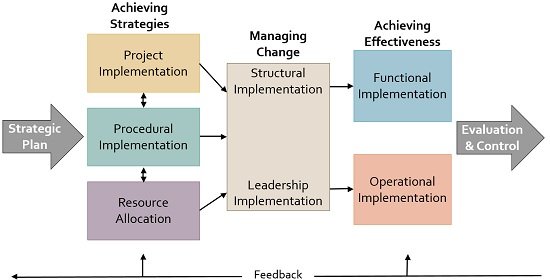
Strategy Implementation refers to the execution of the plans and strategies, so as to accomplish the long-term goals of the organization. It converts the opted strategy into the moves and actions of the organisation to achieve the objectives.

Simply put, strategy implementation is the technique through which the firm develops, utilises and integrates its structure, culture, resources, people and control system to follow the strategies to have the edge over other competitors in the market.

Strategy Implementation is the fourth stage of the Strategic Management process, the other three being a determination of strategic mission, vision and objectives, environmental and organisational analysis, and formulating the strategy. It is followed by Strategic Evaluation and Control.

Process of Strategy Implementation

  1. Building an organization, that possess the capability to put the strategies into action successfully.
  2. Supplying resources, in sufficient quantity, to strategy-essential activities.
  3. Developing policies which encourage strategy.
  4. Such policies and programs are employed which helps in continuous improvement.
  5. Combining the reward structure, for achieving the results.
  6. Using strategic leadership.

The process of strategy implementation has an important role to play in the company’s success. The process takes places after environmental scanning, SWOT analyses and ascertaining the strategic issues.

Prerequisites of Strategy Implementation

  • Institutionalization of Strategy: First of all the strategy is to be institutionalized, in the sense that the one who framed it should promote or defend it in front of the members, because it may be undermined.
  • Developing proper organizational climate: Organizational climate implies the components of the internal environment, that includes the cooperation, development of personnel, the degree of commitment and determination, efficiency, etc., which converts the purpose into results.
  • Formulation of operating plans: Operating plans refers to the action plans, decisions and the programs, that take place regularly, in different parts of the company. If they are framed to indicate the proposed strategic results, they assist in attaining the objectives of the organization by concentrating on the factors which are significant.
  • Developing proper organisational structure: Organization structure implies the way in which different parts of the organisation are linked together. It highlights the relationships between various designations, positions and roles. To implement a strategy, the structure is to be designed as per the requirements of the strategy.
  • Periodic Review of Strategy: Review of the strategy is to be taken at regular intervals so as to identify whether the strategy so implemented is relevant to the purpose of the organisation. As the organization operates in a dynamic environment, which may change anytime, so it is essential to take a review, to know if it can fulfil the needs of the organization.

Even the best-formulated strategies fail if they are not implemented in an appropriate manner. Further, it should be kept in mind that, if there is an alignment between strategy and other elements like resource allocation, organizational structure, work climate, culture, process and reward structure, then only the effective implementation is possible.

Aspects of Strategy Implementation

  • Creating budgets which provide sufficient resources to those activities which are relevant to the strategic success of the business.
  • Supplying the organization with skilled and experienced staff.
  • Conforming that the policies and procedures of the organisation assist in the successful execution of the strategies.
  • Leading practices are to be employed for carrying out key business functions.
  • Setting up an information and communication system, that facilitate the workforce of the organisation, to perform their roles effectively.
  • Developing a favourable work climate and culture, for proper implementation of the strategy.

Strategy implementation is the time-taking part of the overall process, as it puts the formulated plans into actions and desired results.

Portfolio Analysis

Portfolio analysis is an examination of the components included in a mix of products with the purpose of making decisions that are expected to improve overall return. The term applies to the process that allows a manager to recognize better ways to allocate resources with the goal of increasing profits. It might also refer to an investment portfolio composed by securities.

When a company markets a range of different product or services it is required to conduct portfolio analysis periodically. This means to analyze each product separately in terms of profitability, contribution to the company’s income and growth potential. This analysis facilitates the identification of products that are not profitable at all or play poorly within the group.

The products are categorized by pre-defined criteria such as sales value, market share, gross profitability, contribution margin and life cycle. The results could clearly point to products that should be taken out of the market or simply receive fewer resources. It might also indicate that the company must increase its investments and efforts to some star products that have a higher potential. The analysis is made to improve the global portfolio’s performance since the ultimate objective is maximizing profit for shareholders.

Importance of Portfolio Analyze

  1. The analysis is done in large multinationals with multiple product portfolios. A company should be aware of the financial health of the portfolios and their wellbeing. To know the top performers and strategies to maintain them the profit makers is the primary objective of Portfolio analysis.
  2. No company will have all products in profit. There will be few products or product lines which may be loss makers. These are the cash consuming portfolios and the company should be aware of them so that they can either be discontinued or revamped. The idea is to make them less costly and more profit making.
  3. Portfolio analysis helps the company to stay in sync with the vision, mission, and objectives. At times it may happen that a certain portfolio may be loss-making and the company may have been unknowingly being financing the dead weight for a long time. In these cases, the analysis will give a clear picture of the scenarios.

Portfolio Analysis Tools:

There are several tools for portfolio analysis but here are two which are majorly used:

BCG Matrix for Portfolio Analyze

Also known as Product-Portfolio Matrix, Boston Box, Boston Consulting-Group Analysis, Portfolio Diagram. It was crafted in the 70s for the analysis of the business lines or product units. The chart is plotted as Market Share on the X-axis vs the growth on the Y-axis. Before one understands the tool, one must know the terms associated with it such as:

  1. Relative Market Share: The market shares relative to the market leader or the product which is considered as a benchmark is called relative market share.
  2. Market Growth Rate: The rate of growth of the specific product or portfolio is called Market Growth rate. Higher growth rate means higher profits.

The BCG Matrix is a graph which has four quadrants plotted on Market Share vs the Market growth or Relative Market Share vs Relative Market Growth. There are four components of BCG Graph as follows:

Cash Cows

Cash cows are the ones which generate the excess cash necessary for the survival of other portfolios as well along with itself. Cash cows are generally mature with relatively low market growth but higher market share. Cash cows have low market share compared to competitors but yield much higher returns as cash hence the term Cash Cow. A company will always try to push Cash cows to Star in terms of market growth. Cash cows require low investment and are usually do not cost much. The cash returns generated by cash cows are much higher than their expenses.

Stars

Like their names, Star is the portfolio which has a higher market share and highest growth compared to all other product portfolios. They are fast growing products with the highest market share close to monopoly but they also require high funding compared to others since they have to maintain their market share and growth, which can be generated from cash cows. If a star declines in market share, it becomes a Cash Cow and if it declines in growth, it becomes a question mark. Star products are very tricky to maintain their position and company has to invest a lot to keep that position. A company’s brand image and brand recognition is enhanced because of the Star products.

Question Mark:

These are also known as Problem Child or Wildcat. They operate with a lower market share compared to others in a high growth market. They have the potential to become Star as their market share increases and they already have a high growth rate as much as Star. When they increase their market share, they become Star and if they lose their share, they turn into Dog.

Dogs

Dog is a category which has a low market share and low market growth. They take a long time simply to break even and generate a nominal business barely necessary for survival in the market. They have a low return on investments and they are usually sold off or traded or closed down since eventually they become cash eating centers only. In very few cases it may be possible to increase their market share and convert them into cash cows or increase their growth rate and push them to Question Mark which eventually is converted to Star.

An example of Portfolio analysis by BCG Matrix would be of Google. Gmail, YouTube and Google Search Engine is the Cash Cow for the company while AdWords and Google Cloud are Star. The newly launched Google’s flagship phones Pixel 3 XL, Pixel 3 and other Pixel series is a Question, Mark, while Google Pay is a Dog. Shareholders use this matrix as one of the tools for Portfolio Analysis of the company to determine the financial stability and predict the future for the company.

Product Life Cycle Analysis for Portfolio Analyze:

It is also known as the Product Life Cycle Analysis, determines the various stages at which the product is and will eventually go through. It imitates the biological life cycle and starts with Introduction, proceeds to growth, maturity and ends with decline.

Introduction: Introduction is the initial inception of the product in the market or the introduction. The market share is low and the growth rate is also low since the product is in its early stages. Here profit is not an objective but promotion is.

Growth: This is the prime phase of the product wherein the growth rate is higher and the market share goes on increasing equally faster. Companies earn maximum profit in this phase of the product and investors invest a lot. The promotion levels are kept down and the product earns an excellent profit for the company.

Maturity: In this phase, the market growth rate stops and the share continues to remain the same or increases marginally. The promotion levels have no effect on the growth or share. This is where the competition enters the picture and price wars start. The margins over the product are severely affected and this causes a lot of resellers to leave the market.

Decline: Here there is a decline in market share and the consumer’s change or divert from the product making the producers divest in the product by introducing new variants of the same product. Many products may be discontinued from the market in this phase since there is little or no profit. The company, in order to increase the profit levels, may undergo cost cutting or cut down on the marketing budget.

Advantages of Portfolio Analyze:

  1. Determines the financial stability of the company along with product performance
  2. Acts as trend analysis for the product to predict they are possible future in the market
  3. Guide for investors and shareholders for financial assessment of the portfolios
  4. The tool in decision making for the company to take product-related decisions whether to continue, change or discontinue products.

Disadvantages of Portfolio Analyze:

  1. Doesn’t consider market influencers and political factors in the analysis which may cause sudden changes in the nature of the portfolio
  2. It is difficult to perform Portfolio Analysis for a startup company or small-scale industries with limited product lines
  3. Any of the major portfolio analysis tools do not consider internal factors of the company like a sudden change in management which may affect sales of the product.

Generic Business Strategies

Every business must find a strategy that enables it to achieve a competitive advantage in the marketplace. That choice of strategy is based on the strengths and weaknesses of the company’s products and the position it wants to have in the minds of its customers. The best strategy is the one that leverages the company’s strengths for the greatest profits and the highest return on investment.

Porter’s generic strategies are as follows:

  • Cost Leadership Strategy.
  • Differentiation Strategy.
  • Cost Focus.
  • Differentiation Focus.

Cost Leadership

A cost leadership strategy works if the company can produce its products at the lowest cost in the industry. This strategy is commonly used in markets with products that are not distinctly different from each other. They are “standard” products in a broad market, frequently purchased and universally accepted by most consumers.

To become a cost leader, a company strives to reach the lowest cost of production with the least distribution cost so that it can offer the cheapest price in the market. With the lowest price, the company hopes to attract the most buyers and dominate the market by driving competitors out.

A successful cost leadership strategy requires the optimization of all aspects of a company’s operations. To becomes the lowest-cost producer, a business might pursue the following:

  • Productivity: Study any process that uses labor and find ways to improve productivity and increase efficiency.
  • Bargaining power: One way to lower the cost of production is to exploit the economies of scale. Higher volumes enable the business to negotiate lower prices from material suppliers and reduced costs for transportation.
  • Technology: Improvements in technology happen rapidly, and a company must invest in the latest innovations to remain competitive.
  • Distribution: As with technology, the methods of distribution are constantly evolving. Businesses must continuously analyze changes in distribution costs to find the lowest cost to transport their goods.
  • Production methods: Lowering the cost of production is a continuous process. For example, implementing just-in-time inventory controls for raw materials is a way to reduce financing costs of assets.

Firms that are successful with a cost leadership strategy usually have the following advantages:

  • They have access to the capital needed to large investments in manufacturing facilities that lower the cost of production. Weaker competitors may not have the financial strength to borrow large sums of money.
  • More efficient producers will have highly-skilled engineering and production staff that work constantly to improve the manufacturing processes.
  • Aggressive companies are always looking for ways to vertically integrate their processes by acquiring raw material suppliers, component manufacturers and distribution companies. Of course, this also requires having the financial strength to finance the purchases of these companies.

Walmart is one of the most well-known companies that has an effective cost leadership strategy. Their approach is to market to the largest number of customers with the lowest prices on all of its products.

The company has been able to dominate the low-cost market by negotiating price-volume discounts with suppliers and building an incredibly cost-efficient distribution system. Walmart works with all of its internal processes to operate at the lowest cost.

Differentiation Strategy

A differentiation strategy requires the company to offer products with unique characteristics that consumers believe have value and are willing to pay more for them. If consumers perceive that these unique properties are worthwhile, the company can charge premium prices for its products.

Ideally, the premium prices will be more than enough to offset the higher costs of production and allow the company to make a reasonable profit.

Companies that succeed with a differentiation generic marketing strategy need to have a talented and creative product development staff. These people must have the ability to survey the market and get into the minds of the potential buyers to identify the features that will attract consumers and make them willing to pay more for the products.

Having a unique product is not the end of the story. The implementation of a differentiation strategy requires a sales team that has the skills to effectively communicate the unique properties of the products and convince consumers that they are receiving more value for their money. At the same time, marketing campaigns should promote and establish the company as a reputable firm known for high-quality and innovative products.

A differentiation strategy has several risks. Competitors will not remain idle when losing market share; they will find ways to imitate products and begin their own differentiation campaigns.

Another risk is changing consumer tastes. Unique product characteristics that capture the minds of consumers at one time can fade away as competitors introduce other features that catch the eyes of buyers.

Cost Focus

A cost focus strategy centers on a limited market segment or a particular niche. It requires the company to understand the idiosyncrasies of that market and the unique needs of those specific customers.

Companies that pursue a cost focus strategy are taking a risk by abandoning the mass market. While concentrating on a specific demographic may develop a loyal pool of customers, the company is basing its fortunes on a small group of buyers. The features that are attractive to this niche market may not appeal to the broader market.

Differentiation Focus

Like a cost focus strategy, the differentiation focus approach aims for a narrow niche market. In this case, the company finds unique features of its products that appeal to a particular group of customers.

However, the company is depending on the spending habits of a small group of consumers for its profits. If this group changes its tastes, the company will have difficulty switching direction to start selling to the mass market.

A successful differentiation focus strategy depends on developing a strong brand loyalty from its customers and constantly finding unique features to stay ahead of the competition.

Choosing a Strategy

The first step in selecting a strategy for your company is to conduct a SWOT analysis of the business. This analysis will identify the strengths and weaknesses of the company in addition to highlighting market opportunities and threats.

To thoroughly understand the market, Porter developed another model known as the Five Forces Analysis. This analysis looks at the competitive position of the business and the factors that will adversely affect its profitability. Those factors are the

  • Power of suppliers.
  • Power of customers.
  • Availability of similar products.
  • Threat of new competitors.
  • Internal competition.

The SWOT and Five Forces analyses will help to identify which one of these generic business strategies will work best for your company.

Choice of Strategy, Importance, Process

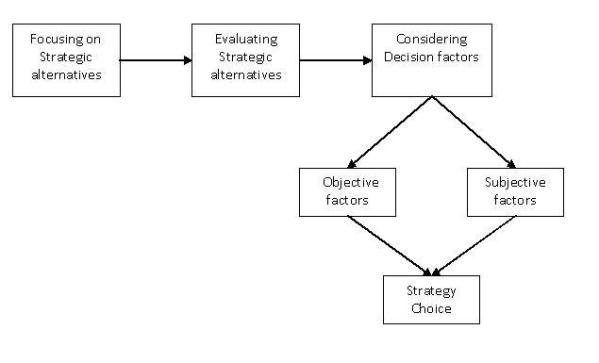
Choice of Strategy refers to the process of selecting the most appropriate strategic option that aligns with an organization’s goals, internal capabilities, and external environment. It involves evaluating various alternatives based on their feasibility, acceptability, and suitability. The chosen strategy should provide a clear path to competitive advantage, sustainability, and value creation. This decision is influenced by factors such as market trends, resource availability, stakeholder expectations, and risk assessment. Strategic choice acts as a bridge between strategic analysis and implementation, ensuring that the organization commits to a coherent direction that supports long-term growth and performance.

Importance of Strategic Choices:

  • Provides Direction and Focus

Strategic choices give an organization a clear direction by defining where it is headed and how it plans to get there. By selecting a particular path from various alternatives, companies can set specific goals and objectives, enabling focused efforts and resource alignment. This clarity ensures that every department and employee understands their role in achieving the overall strategy. Without a well-defined strategic choice, organizations may drift, waste resources, or pursue conflicting priorities. Thus, it brings unity and clarity in the decision-making process, helping avoid confusion and inefficiency.

  • Enhances Competitive Advantage

Choosing the right strategy allows an organization to position itself effectively in the market. Whether it’s through cost leadership, differentiation, or niche focus, strategic choices help build and sustain a competitive advantage. These choices enable the company to serve customers better than its rivals by offering greater value or lower prices. A strong strategic position can create brand loyalty, reduce threats from competitors, and increase profitability. Strategic choices also guide how an organization responds to market forces and competitor actions, keeping it one step ahead in a dynamic environment.

  • Facilitates Optimal Resource Allocation

Every organization operates with limited resources. Strategic choices help allocate financial, human, and technological resources to areas with the highest strategic impact. By identifying and focusing on priority activities, businesses avoid spreading resources too thin or investing in less impactful areas. This ensures better returns on investment and improves operational efficiency. Strategic choices also assist in budget planning, manpower distribution, and capacity building, ensuring that resources are aligned with long-term goals and not wasted on short-term or uncoordinated efforts.

  • Aids in Risk Management

Strategic choices involve evaluating and selecting options based on their risks and potential returns. This helps organizations anticipate possible threats and prepare mitigation strategies in advance. By understanding the risks associated with different strategic paths—such as entering a new market or launching a new product—companies can make informed decisions that minimize uncertainty. Strategic planning also builds organizational resilience by ensuring that backup plans and flexible responses are in place in case of unexpected disruptions or changes in the external environment.

  • Encourages Long-Term Thinking

The process of making strategic choices moves an organization beyond day-to-day operations and encourages long-term planning. It forces leadership to think about where the organization wants to be in five, ten, or twenty years, and how to get there. This mindset is essential for sustainability, innovation, and growth. Without long-term thinking, organizations may make reactive decisions that bring short-term gains but compromise future success. Strategic choices ensure that present actions are connected to future outcomes, supporting continuous progress and adaptability.

  • Improves Stakeholder Confidence

When organizations make sound strategic choices and communicate them effectively, it boosts the confidence of stakeholders—such as investors, employees, customers, and business partners. A clear strategy signals that the company is well-managed, goal-oriented, and prepared to deal with challenges. It helps attract investment, retain talent, and build trust among partners and customers. Stakeholders are more likely to support a company that has a clear vision and a roadmap to achieve it, making strategic choice a foundation for strong relationships and organizational reputation.

Strategic Choice Process:

  • Identifying Strategic Options

The strategic choice process begins with identifying all viable options available to the organization. These options may include market entry strategies, diversification, cost leadership, differentiation, mergers, or strategic alliances. They are generated through strategic analysis of internal strengths and weaknesses and external opportunities and threats. This stage encourages creativity and comprehensive brainstorming without premature judgment. The objective is to create a list of alternatives that align with the organization’s goals, mission, and vision while responding to the current and emerging business environment.

  • Evaluating Strategic Options

Once strategic alternatives are identified, the next step is to evaluate them critically. This involves assessing each option’s suitability (alignment with goals and environment), feasibility (resource availability), and acceptability (stakeholder expectations and risk tolerance). Tools like SWOT analysis, risk analysis, cost-benefit analysis, and decision matrices are used here. The evaluation helps in identifying options that offer the best balance between risk and return. This step is crucial in filtering out weak or impractical strategies, ensuring that the remaining alternatives are aligned with the company’s capabilities and external conditions.

  • Selecting the Best Strategy

After evaluation, the most appropriate strategy is selected based on its potential to provide competitive advantage and long-term sustainability. This choice is often influenced by factors such as market position, organizational strengths, customer needs, competitor behavior, and financial projections. The chosen strategy should be robust, adaptable, and capable of addressing future uncertainties. In many cases, a combination of strategies may be chosen to achieve multiple objectives. This selection is usually made by top management with inputs from various departments to ensure alignment and consensus across the organization.

  • Communicating the Strategic Choice

Once a strategy is selected, effective communication is essential to ensure successful implementation. This includes sharing the strategic direction with all relevant stakeholders—employees, investors, suppliers, and customers—using clear, motivating, and transparent messaging. Communication should highlight the rationale behind the choice, expected outcomes, and the role each stakeholder will play. This fosters ownership, alignment, and commitment throughout the organization. Without effective communication, even a well-chosen strategy may fail due to misunderstanding, resistance, or lack of engagement from key players in the implementation process.

  • Aligning Resources and Capabilities

Strategic choice must be followed by aligning organizational resources—financial, technological, human, and operational—to support the chosen direction. This involves setting budgets, restructuring where necessary, enhancing capabilities, and acquiring the right talent or technologies. This step ensures that the organization is strategically and operationally prepared to implement the chosen strategy effectively. It also includes aligning systems, policies, and performance metrics with strategic goals. Resource alignment is critical for turning strategic intent into practical action and achieving measurable results.

  • Monitoring and Revising the Strategy

Strategic choice is not a one-time event. It must be continuously monitored to ensure that it remains relevant and effective. Regular review mechanisms, performance tracking, and feedback systems should be established to assess progress. If there are significant changes in the internal or external environment—such as technological shifts, competitor actions, or economic downturns—the strategy may need to be revised or adjusted. Flexibility and responsiveness are key components of successful strategy execution. Monitoring ensures strategic alignment with evolving business realities and maintains organizational competitiveness.

Strategic Alternatives for Growth, Stable, Combinations & international strategies

1. Stability Strategy:

When an enterprise is satisfied by its present position, it will not like to change from here and it will be a stability strategy. Stability strategy will be successful when the environment is stable. This strategy is exercised most often and is less risky as a course of action. A stability strategy of a concern for example will be followed when the organization is satisfied with the same product, serving the same consumer groups and maintaining the same market share.

The organization may not be adventurous to try new strategies to change the status quo. This strategy may be possible in a mature industry with static technology. Stability strategy may create complacency among managers. The managers of such an organization may find it difficult to cope with the changes when they come.

Stability strategies can be of the following types:

(i) No-Change Strategy:

Stability strategy is a conscious decision to do nothing new, that is to continue with the present work. It does not mean an absence of strategy, rather taking no decision in itself is a strategy. When external environment is predictable and organizational environment is stable then a businessman may like to continue with the present situation. There may be major opportunities or threats operating in the environment.

There may be no new threat from competitors or no new competing product may be coming into the market, under these circumstances it will be prudent to continue the present strategies. The small and medium firms generally operate in a limited market and supply products and services with the use of time tested technology, such firms will prefer to continue with their present work. Unless otherwise there is a major threat in the environment or occurrence of some major upset in the market, the present strategy will serve the firms well.

(ii) Profit Strategy:

Sometimes things change in such a way that the firm has to adopt changes in its working. There may be unfavorable external factors such as increase in competition, recession in the industry, government attitude, industry down turn etc. Under these situations it becomes difficult to sustain profitability.

A supposition is that the changed situation will be a temporary phase and old situation will again return. The firm will try to sustain profitability by controlling expenses, reducing investments, raise prices, cut costs, increase productivity etc. These measures will help the firm in sustaining current profitability in the short run.

With the opening of markets, Indian industry is facing lot of problems with the presence of multinationals and reduction in tariff on imports. The firms will have to adjust their policies to the changing environment otherwise they will find it difficult to stay in the market.

Profit strategy will be successful for a short period only. In case things do not improve to the advantage of the firms then this strategy will only deteriorate their position. This strategy can work only if problems are temporary.

(iii) Proceed-With Caution Strategy:

Proceed with caution strategy is employed by firms that wish to test the ground before moving ahead with full-fledged grand strategy or by those firms which had a rapid pace of expansion and now wish to rest for a while before moving ahead. The pause is sometimes essential because intervening period will allow consolidation before embracing on further expansion strategies. The main object is to let the strategic changes seep down the organizational levels, allow structural changes to take place and let the system adopt to new strategies.

2. Growth Strategy:

Growth may mean expansion and diversification of operations of the enterprise. The management is not satisfied with their present status, the environment is changing, favourable opportunities are available, in such cases growth strategy will be helpful in expansion as well as diversification. The growth strategy may be implemented through product development, market development, diversification, vertical integration or merger. In product development, new products are added to the existing ones or new products replace the old ones when they are obsolete.

In market development strategy, new customers are approached or those markets are explored which were not covered earlier. In diversification both new products and new markets are added. The enterprise may also enter entirely new lines. In vertificial integration, the backward or forward lines may also be taken up.

A company may start producing its own raw materials or it may start processing its own output before marketing. For example, a weaving unit may start making thread and ginning of cotton (backward integration) or it may start producing readymade garments (forward integration).

In merger, two or more concerns may join their resources to take advantage of financial or marketing factors. Growth should be properly planned and controlled otherwise it may bring adverse results. Since growth is an indication of effective management it is not only essential but desirable too.

Growth strategies may be described as follows:

(i) Growth through Concentration:

Growth involves converging resources in one or more of enterprise’s businesses in terms of their respective customer needs, customer functions or alternative technologies in such a way that it results in growth. This strategy involves the investment of resources in a product line for an identified market with the help of proven technology. It may be done in a number of ways.

The enterprise may focus on existing markets with present products by using market penetration or it may attract new users for existing products or it may introduce newer products in existing markets by concentrating on product development. The concentration strategy will apply when industry possesses high growth potential and the firm should be strong enough to sustain the growth.

(ii) Growth through Integration:

Under integration strategy the firm continues serving the same customers but increases the scope of its business definition. Integration involves taking up more activities than taken up earlier. There can be backward integration as well as forward integration.

There are activities ranging from procurement of raw materials to marketing of finished products. The firm may move up or down of the value chain for increasing its scope of work. Several process based industries such as petrochemicals, steel, textiles etc. have integrated firms. These firms deal with products with a value chain extending from the basic raw materials to ultimate consumer. The firms operating at one end of the value chain attempt to move up or down in the process while integrating activities adjacent to their present activities.

While adopting integration strategy the firm must take into account the alternative cost of make or buy. If the cost of manufacturing one’s product is less than the cost of procuring it from the market only then this activity should be integrated. Similarly, if the cost of selling the finished product is lesser than the price paid to the sellers to do the same thing then it will be profitable to move down on the value chain.

(iii) Growth through Diversification:

Diversification strategy involves a substantial change in the business definition, singly or jointly, in terms of customer functions, customer groups or alternative technologies of one or more of a firm’s business. When an organization takes up an activity in such a manner that it is related to the existing business it is called concentric diversification.

The firm may market more products to the same customers, a new product or service may be offered to the same customers, these are the cases of diversification of business activities. Growth may also be undertaken by taking up those activities which are unrelated to the existing business, a cigarette company may diversify into hotel industry, it will be a case of conglomerate diversification. Diversification strategies are helpful in spreading risk over several businesses. If environmental and regulatory factors block growth then diversification may be a proper way.

(iv) Growth through co-operation:

There is a view that firms operate in a competing market. When one firm gains in its market share then one or more firms lose this share. It is a win-lose situation where if one wins then one or several others have to lose. But thinkers like James Moore, Ray Noorda, Barry J. Nalebuff are of the view that competition could co-exist with co-operation.

The strategies could take into account the possibility of mutual co-operation with competitors while competing with them at the same time so that market potential could expand. The co-operative strategies can take the form of mergers, acquisitions, joint ventures and strategic alliances. All these strategies taken separately or jointly can help the growth of a firm.

(v) Growth through Internationalization:

International strategies are a type of growth strategies that require firms to market their products or services beyond the national or domestic market. A firm would have to assess the international environment and evaluate its own capabilities and to form strategies to enter foreign markets. The firm may start exporting products or services to foreign countries or it may set up a subsidiary in other countries for producing and marketing the products or services there. In such situations the firm would have to implement the strategies and monitor and control its foreign operations. International strategies require a different strategic perspective than the strategies implemented in national context.

3. Retrenchment or Retreat Strategy:

An enterprise may retreat or retrench from its present position in order to survive or improve its performance. Such a strategy may be adopted during a period of recession, tough competition, scarcity of resources and re-organization of company in order to reduce waste. This strategy, though reflecting failure of the company to some degree becomes highly necessary for the survival of the company.

When an organization chooses to focus on ways and means to reverse the process of decline, it adopts a turnaround strategy. If it cuts off the loss-making units, divisions, curtails product line or reduces the functions performed, it adopts a disinvestment strategy. If these actions do not work then the activities may be totally abandoned and the unit may be liquidated.

(i) Turnaround Strategies:

Retrenchment may be done either internally or externally. Internal retrenchment is done to improve internal working. This usually takes the form of an operating turnaround strategy. In contrast, a strategic turn­around is a more serious form of external retrenchment and leads to disinvestment or liquidation.

Turnaround strategies may be adopted in different ways. One way may be that the existing chief executive and management team handles the turnaround strategy with the help of specialist or external consultant. The success of this approach will depend upon the type of credibility the chief executive has with banks and other financing institutions.

In another situation, the present chief executive withdraws from the scene temporarily and the work is done by the outside specialist employed for this job. The third approach to execute the turnaround strategy involves the replacement of the existing team or merging the sick organization with a healthy one.

(ii) Disinvestment Strategies:

It involves the sale or liquidation of a portion of business or major division or profit center etc. Disinvestment is usually a part of rehabilitation or restructuring plan. This strategy is adopted when turnaround strategy has failed. A firm may disinvest in two ways. A part of the company is divested by spinning it off as a financially and managerially independent company, with the parent company retaining or not retaining partial ownership. Alternatively, the firm may sell a unit outright.

(iii) Liquidation Strategies:

It involves the closing down of a firm and selling its assets. It is considered to be the last resort because it leads to serious consequences such as loss of employment for workers and other employees, termination of opportunities where the firm could pursue any future activities and also the stigma of failure which will be attached with this action.

4. Combination Strategy:

A large firm, active in a number of industries may adopt a combined strategy. It represents mix of the three strategies mentioned above. A large concern may adopt growth strategy’ on one side and retreat strategy in the other area. In order to make this strategy effective there should be right people who can take objective and intelligent decisions by considering various factors.

There may not be a concern which has adopted only one strategy throughout. The complexity of doing business demands that different strategies be adopted to suit the situational demands made upon the organization. A company which has adopted a stability strategy for long may like to use expansion strategy later. Similarly a firm which has seen expansion for quite some time may like to consolidate its working. Multi-business companies have to follow multiple strategies.

Definition & Nature of Company

The word company is derived from a Latin word `companies` it means a group of persons who took their need together. In India law relating to companies are contained in The companies Act 1956.

A company is a voluntary association of persons formed for some common purpose with capital divisible into parts known as shares.

Justice Lindlay defines company “as an association of many persons who contribute money or money’s worth to a common stock and employ it in some trade or business and who share the profits arising there from”

According to companies act a company means a company formed and registered under companies act.

Features of a Registered company

  1. Voluntary Association

A company is voluntary association of persons who have come together for a common object which generally is to earn profit.

The activities of this association are governed by the law and are limited by its memorandum of association

  1. Incorporated association

A company comes into existence on incorporation or registration under the companies act. Minimum number of persons required for the purpose of incorporation is seven in case of a public company and two in case of a private company.

  1. Separate legal entity

 On incorporation company gets personality which is separate and distinct from those of its members. Company is an artificial person created by law. 

  1. Separate property

The company can own , enjoy  and dispose off its property in its own name.

  1. Legal restrictions

The formation, working and winding up of a company are strictly governed by laws, rules and regulations

  1. Perpetual succession

 unlike a person a company never dies. Its existence is not affected in any way by the death or insolvency of any shareholder. Members may come and members may go , but the company continues its operations until it is wound up.

  1. Common seal

As a company is an artificial person it cannot sign its name on a contract. So it function with the help of seal. All contract entered into by the members will be under the common seal of the company.

  1. Share capital

A company mobilizes its capital by selling its shares. Those persons who buy these shares become its share holders and thereby become members in it

  1. Limited Liability

In case of limited companies liability of members will be limited to the amount unpaid on the shares.

10. Transferability of shares

Members can freely transfer and sell their shares .The right to transfer share is a statutory right of members.

  1. Ownership and management

The owners of a company are its share holders.

The affairs of the company are managed by their representatives known as Directors

Steps in Formation of a Company

The formation of a company in India is a meticulous process governed by the Companies Act, 2013, which outlines the rules, regulations, and procedures. This law provides the legal framework for the establishment of different types of companies such as private, public, one-person companies, etc. The formation process can be divided into several stages, each of which requires compliance with specific legal formalities.

Stage 1. Promotion Stage

Promotion is the first stage in the formation of a company, where the idea of starting a company takes shape, and the necessary actions are initiated by the promoters.

Who is a Promoter?

Promoter is a person or a group of persons who conceive the idea of forming a company and take the necessary steps to incorporate it. They are responsible for:

  • Identifying Business Opportunities: Promoters identify the potential opportunities for starting a new business and devise strategies for utilizing those opportunities.
  • Feasibility Study: This involves the evaluation of the commercial, financial, and technical viability of the proposed company. The promoter assesses whether the business idea will succeed.
  • Business Plan Preparation: The promoter prepares a detailed business plan, outlining the company’s objectives, strategies, resources, and funding needs.
  • Arrangement of Capital: The promoter identifies the potential sources of capital, whether through personal savings, loans, or investor funding.
  • Appointment of Directors: The promoter nominates the directors who will oversee the company’s operations after incorporation.
  • Legal Compliances: The promoter is responsible for ensuring that all necessary legal formalities, such as obtaining licenses, are completed.

Stage 2. Selection of Company Name

The next significant step in company formation is selecting an appropriate name for the company. This is governed by the guidelines of the Ministry of Corporate Affairs (MCA).

  • Reserve Unique Name (RUN):

The promoter must submit an application for reserving the company’s name through the MCA’s online service, known as the Reserve Unique Name (RUN) facility. The proposed name should not be identical or similar to any existing company name or trademark.

  • Name Approval:

Once the application is submitted, the Registrar of Companies (RoC) will either approve or reject the name within a few working days. If approved, the name is reserved for 20 days during which time the company must proceed with the next steps.

Stage 3. Preparation of Documents

Once the company’s name is approved, the next step involves preparing and submitting the following key documents:

Memorandum of Association (MoA)

Memorandum of Association outlines the company’s constitution and defines its relationship with the outside world. It contains essential clauses such as:

  • Name Clause: States the company’s registered name.
  • Registered Office Clause: Specifies the location of the company’s registered office.
  • Object Clause: Defines the objectives for which the company is being formed.
  • Liability Clause: Indicates the extent of the liability of the members.
  • Capital Clause: Mentions the authorized capital of the company.

Articles of Association (AoA)

Articles of Association detail the internal management of the company, including rules related to the conduct of business, rights and responsibilities of directors, and procedures for meetings and resolutions.

Stage 4. Application for Incorporation

Once the MoA and AoA are prepared, the promoter must file the Incorporation Application (Form SPICe+). This is the most crucial stage in the formation process, as it involves the actual registration of the company with the Registrar of Companies (RoC).

Required Documents for Incorporation:

  • MoA and AoA: Duly signed by the promoters and subscribers.
  • Declaration of Compliance: A declaration signed by the promoters, affirming that all legal requirements of company formation have been complied with.
  • Identity Proofs of Directors and Subscribers: PAN, passport, Aadhar card, or other acceptable ID proofs.
  • Address Proof: Utility bills or other documents for the company’s registered office.
  • Digital Signature Certificate (DSC): The directors must obtain DSCs, which are used to sign documents electronically.
  • Director Identification Number (DIN): Every proposed director must have a DIN, which can be applied for during the incorporation process.

Filing SPICe+ (Simplified Proforma for Incorporating Company Electronically):

SPICe+ is a comprehensive online form provided by the MCA for the incorporation of companies. The form integrates multiple services including PAN, TAN, EPFO, ESIC, and bank account opening.

Stage 5. Payment of Fees

At the time of filing the incorporation documents, the promoter must pay the necessary government fees. These fees vary depending on the authorized capital of the company and the type of company being registered. For instance:

  • For a Private Limited Company, the fees are based on the share capital.
  • For a One Person Company (OPC), the fees are typically lower.

Stage 6. Certificate of Incorporation (COI)

Once all the documents and forms are submitted, and the prescribed fees are paid, the RoC reviews the application. If the RoC finds the documents in order, it issues the Certificate of Incorporation (COI). The COI is conclusive evidence that the company has been legally registered and is a recognized entity under Indian law.

The Certificate of Incorporation contains:

  • The company’s name.
  • The CIN (Company Identification Number).
  • The date of incorporation.
  • The name of the RoC who issued the certificate.

Stage 7. Post-Incorporation Formalities

Even after the company is registered, several formalities must be completed to ensure the smooth operation of the company:

  • Opening a Bank Account: The company needs to open a bank account in its name, which will be used for all financial transactions.

  • Registered Office Address: The company must ensure that it has a registered office within 30 days of incorporation and submit the address to the RoC.
  • Issuance of Share Certificates: The company must issue share certificates to the subscribers within two months of incorporation.
  • Statutory Books: The company must maintain statutory books such as a register of members, a register of directors, minutes of meetings, and other records required by law.
  • Compliance with Tax and Regulatory Requirements: The company needs to register for GST, Professional Tax, and any other applicable taxes. It must also file its annual returns and financial statements with the RoC.

Stage 8. Commencement of Business

Once the above formalities are completed, the company can start its business operations. However, for companies incorporated with share capital, a Declaration for Commencement of Business must be filed within 180 days of incorporation. This declaration affirms that the subscribers have paid for the shares they agreed to take and is mandatory for the company to begin its business activities.

Incorporation of Companies

The Incorporation of a company is the legal process of forming a company or corporate entity recognized under the law. In India, this process is governed by the Companies Act, 2013, and regulated by the Ministry of Corporate Affairs (MCA) through the Registrar of Companies (ROC). Incorporation is essential for granting a company its separate legal identity, allowing it to function independently of its shareholders, raise capital, sue and be sued, and engage in lawful business activities.

Meaning of Incorporation:

Incorporation refers to the registration of a company with the Registrar of Companies (ROC) to bring it into existence as a legal entity. Once incorporated, the company becomes a juristic person — it can own property, enter into contracts, and is liable for its debts. The process ensures that the company follows all the statutory compliances and operates within the framework of the law.

Types of Companies That Can Be Incorporated:

Under the Companies Act, 2013, companies can be incorporated in various forms depending on the objectives, size, liability structure, and capital. The major types are:

  1. Private Limited Company (Pvt Ltd)

    • Minimum 2 members and 2 directors

    • Maximum 200 members

    • Restricts transfer of shares

    • Cannot invite the public to subscribe to securities

  2. Public Limited Company (Ltd)

    • Minimum 7 members and 3 directors

    • No maximum limit on members

    • Can offer shares to the public

    • Requires more regulatory compliance

  3. One Person Company (OPC)

    • Single person acts as both shareholder and director

    • Suitable for small entrepreneurs

    • Limited liability protection

  4. Section 8 Company (Not-for-Profit)

    • Formed for charitable, social, educational, or religious purposes

    • Profits cannot be distributed as dividends

    • Requires prior approval from the Central Government

  5. Producer Company

    • Special type of company for farmers or agricultural producers

    • Governed by special provisions under the Companies Act

Advantages of Incorporation:

  • Separate legal identity

  • Limited liability of shareholders

  • Perpetual succession

  • Transferability of shares (in case of public companies)

  • Access to capital through equity or debt

  • Increased credibility and trust

Procedure for Incorporation of a Company in India:

The incorporation process involves several steps which must be completed online through the MCA21 portal (https://www.mca.gov.in/). The general steps are:

1. Obtain Digital Signature Certificate (DSC)

  • A Digital Signature Certificate (DSC) is mandatory for signing electronic documents filed with the ROC.

  • DSC is required for all proposed directors and subscribers.

  • It can be obtained from government-recognized certifying agencies such as eMudhra or Sify.

2. Obtain Director Identification Number (DIN)

  • DIN is a unique identification number for directors.

  • It can be obtained through the SPICe+ form during incorporation.

  • Proof of identity, proof of address, and photographs of the proposed directors are required.

3. Name Reservation (RUN or SPICe+ Part A)

  • Choose a unique name for the company.

  • Use the SPICe+ Part A form to apply for name reservation.

  • The proposed name must comply with Companies (Incorporation) Rules, 2014, and must not be identical or similar to existing company or trademark names.

4. Preparation of Incorporation Documents

The following documents need to be prepared and submitted:

  • Memorandum of Association (MOA): Outlines the objectives and scope of the company.

  • Articles of Association (AOA): Contains the rules and regulations for internal management.

  • Declaration by the directors (Form INC-9)

  • Consent to act as director (Form DIR-2)

  • Proof of office address

  • Identity and address proof of subscribers/directors

5. Filing of SPICe+ (Part B)

  • The SPICe+ form is an integrated form for incorporation.

  • It includes applications for incorporation, PAN, TAN, GST (optional), ESIC, EPFO, and bank account.

  • The documents prepared above are attached to this form.

  • Payment of prescribed government fees and stamp duty is made online.

6. Issue of Certificate of Incorporation (COI)

  • After verification, the Registrar of Companies issues a Certificate of Incorporation with the Corporate Identification Number (CIN).

  • The COI is conclusive proof of the company’s legal existence.

Documents Required for Incorporation:

For Directors and Subscribers:

  • PAN card

  • Aadhaar card or Voter ID/Passport/Driving License

  • Passport-size photograph

  • Proof of current address (utility bill, bank statement)

For Registered Office:

  • Electricity bill or property tax receipt

  • Rent agreement (if rented)

  • No Objection Certificate (NOC) from the property owner

Post-Incorporation Formalities:

After incorporation, the following activities are to be completed:

  1. Open a Current Bank Account in the name of the company using the Certificate of Incorporation, PAN, and board resolution.

  2. Commencement of Business (Form INC-20A)

    • Required for companies with share capital.

    • Must be filed within 180 days of incorporation.

  3. Maintain Statutory Registers

    • Register of members, directors, share certificates, etc.

  4. Appointment of Auditor

    • First auditor must be appointed within 30 days of incorporation.

  5. Apply for Other Registrations (if applicable)

    • GST registration if turnover exceeds threshold or for inter-state trade

    • Professional Tax, Shops & Establishments license, etc.

Time Frame for Incorporation:

Typically, incorporation may take 7–15 working days, provided all documents are in order. Online processing has made the procedure faster under the MCA’s simplified system.

Key Legal Provisions Under Companies Act, 2013L

  • Section 3: Defines the formation of a company

  • Section 4: Naming requirements and restrictions

  • Section 7: Procedure for incorporation and required documents

  • Section 12: Registered office and related compliances

  • Section 10A: Declaration for commencement of business

Role of Professionals:

While some businesses may choose to file forms themselves, it is advisable to seek assistance from Company Secretaries (CS), Chartered Accountants (CA), or legal professionals for accurate documentation, compliance, and legal structuring, especially for public companies or startups seeking investor funding.

Recent Reforms and Ease of Doing Business:

To improve India’s global ranking and encourage entrepreneurship, the government has introduced several reforms:

  • SPICe+ form combines multiple registrations in one go

  • AGILE-PRO form allows for GST, EPFO, ESIC, and bank account registration

  • Online PAN and TAN allotment at the time of incorporation

  • Zero MCA fees for companies with authorized capital up to ₹15 lakhs

These steps have simplified the process and made it more transparent, efficient, and cost-effective.

Liability of Promoters

A promoter stands in a fiduciary position with the company which he promotes. But he is neither an agent nor a trustee to the future com­pany. The reason is obvious, there cannot be an agent of a person not in existence, nor there can be a trustee for a non-existent beneficiary.

Even then, the principles of agency and trusteeship are returned to the care of a promoter. A promoter, even though he may act only as agent or trustee, is personally liable where the contract is made on behalf of an intended company.

Duties of Promoters:

Promoters have some duties, the violation of which makes them li­able for punishment.

The duties are:

(i) To prepare and submit documents Memorandum, Articles and Prospectus.

(ii) To see that all property and assets are taken over by the proposed company at reasonable prices and on justifiable terms.

(iii) To disclose to the company or to the independent Board of Direc­tors after the company has been formed secret profits, if any, en­joyed by them as vendors.

Liabilities of Promoters:

A promoter may be made liable in a suit by an aggrieved share­holder or debenture holder for damages for deceit, besides, being liable for compensation. A promoter, even though he may only act as agent or trustee, is personally liable for the contract on behalf of the com­pany.

A promoter is liable to pay compensation for misstatements in prospectus, for non-disclosure of any matter in the prospectus and for non-compliance of the provisions under Sec. 56. There is a liability of the promoter under the general law enforceable by suit for recovery of damages on the ground of fraud etc. For untrue statements in the pro­spectus, a promoter has criminal liability.

Rights of Promoters:

Since promoters have duties, it implies that they have rights too.

Rights are:

(i) They are entitled to take assistance of the experts in preparing the documents.

(ii) They can enter into preliminary or pre-incorporation contracts on behalf of the proposed company.

(iii) They may claim reasonable remuneration for their services.

Company Promotion in India:

The industrial history of India is the history of company promotion by managing agents during the British regime. Directors and partners of old firms did also promote business enterprises. In India, we do not have generally any professional or specialized agencies for promotion of companies.

The National Industrial Development Corporation was started in 1954 as a specialist promoting institution. It prepared project reports for a number of industrial units.

In company promotion in India, promoters usually follow the stan­dard stages. But, if necessary, they also undertake the task of incorpo­ration and formation, underwriting of shares, substantial share contri­bution and, above all, direct charge of routine management of busi­ness.

Promoters in India, therefore, perform various functions in the formational stage of a company. They act as manager and controller of new companies. A controlling interest in the affairs of the company is generally retained by the Indian promoters. Promoters are generally the first directors of a company.

Types of Companies

Companies can be classified on the basis of:

  1. Incorporation
  2. Liability of members
  3. Number of members
  4. Ownership

1. Incorporation

  • Chartered company
  • Statutory company
  • Registered company


  1. Chartered company

 The company which have formed and incorporated under a special charter granted by the king or queen.

Eg East India company. Bank of England.

  1. Statutory company

These are companies which are created by means of a special Act of Parliament or any state legislature. Eg RBI, Railway

  1. Registered company

Company formed and registered under companies Act 1956 is called Registered companies.

2. Liability of members

  1. Limited company
  2. Company limited by guarantee
  3. Unlimited company

1. Limited company or company limited by share

Majority of registered companies will be company limited by shares. In case of limited companies liability of members will be limited to the amount unpaid on the shares.

  1. Company limited by guarantee

Here liability of each member is limited by the memorandum to such amount as he may guarantee by the memorandum to contribute to the assets of the company in the event of its winding up.

Such  companies are formed for the promotion of art science, culture, sports etc.

  1. Unlimited company

A company not having any limit on the liability of its members is termed as unlimited company.

The members are liable for the debts of the company at the time of winding up.

3. Number of members

  1. Private company
  2. Public company
  3. Private company

1. A private company is a company

  • Which restricts the right to transfer its shares.
  • Limits the number of its members to 50.
  • Prohibits any invitation to public to subscribe its shares.
  1. Public company

A public company means a company which is not a private company

4. Ownership

  1. Government Company
  2. Foreign company
  3. Holding and subsidiary company

1. Government company

A company is said to be Government Company when 51% of the paid up capital is held by the central government or by any state government or partly by central govt or partly by one or more state govt.

  1. Foreign company

A foreign company is a company incorporated outside India and having a place of business in India.

  1. Holding and subsidiary company

A Company which controls another company is known as the holding company and the so controlled company is known as subsidiary company.

One Man Company

This is a company in which one man holds practically the whole of the share capital of the company, and in order to meet the statutory requirement of minimum number of members some dummy members like his wife and son holds one or two shares each.

Distinction between public company & private company.

Private Company

Public Company

1. Minimum no of members is 2 Minimum no of members is 7
2. Maximum no members is 50 No maximum limit
3. Minimum paid up capital is Rs 1 lakh Minimum paid up capital is 5 lakh
4. Name must end with the word ‘Pvt Ltd’ Name must end with the word ‘Ltd’
5. Can commence business immediately after incorporation It shall have to wait until it receive the certificate for commencement of business.
6. It cannot invite public to subscribe its shares and debentures It can invite public to subscribe its shares and debentures
7. Minimum subscription is not required for allotment of shares. Minimum subscription is required for allotment of shares.
8. Need not hold statutory meeting of the members. It has to hold a statutory meeting and file a stat: report.
9. Quorum required for a meeting is 2. Quorum required for a meeting is 5
10. There is restriction of transfer of shares  Shares can be freely transferred.
11. Not required to issue prospectus. Must issue prospectus.
13. Two directors Three directors


error: Content is protected !!