Financial Planning Factors, Limitations

Financial planning has been defined as “the advance programming of all plans of financial management and the integration and coordination of these plans with the operating plans of the enterprise.” There is hardly any aspect of a business which does not have both financial requirements and financial consequences. Financial planning deals with both sources and uses of funds.

Factors affecting Financial Planning

Financial planning of a business is determined by the following factors:

(i) Objectives. Objectives of financial planning should be consistent with the overall objectives of the business. The main objectives of financial planning are to raise funds at reasonable cost and utilize them in the best possible manner.

(ii) Requirements of the Enterprise. A good financial plan should take care of the present and future requirements of the business. Provision of or various contingencies, replacement of assets, and growth and diversification of business enterprise must be made.

(iii) Economy. Case of raising capital should be reasonable. Capital structure should be such as to create an appropriate balance between the cost of funds and the company’s ability to pay.

(iv) Solvency and Liquidity. The funds should be invested in those ventures which are likely to give sufficient return on investment. Moreover, adequate cash should always to available to meet the requirements of the enterprise. The enterprise should be solvent and liquid not only in the short-term but also in the long-term.

(v) Flexibility. Financial planning should ensure flexibility allow the diversion of funds into more profitable channels. It should also make provision for raising of additional funds at a short notice.

(vi) Optimum Capital Structure. There should be proper capitallsation of the company. An optimum mix of equity shares, preference shares and debentures should be kept in mid while raising funds from different resources.

Limitations of Financial Planning

Rapid Changes:

The growing mechanisation of industry is bringing rapid changes in industrial process. The methods of production, marketing devices, consumer preferences create new demands every time. The incorporation of new changes requires a change in financial plan every time.

Once investments are made in fixed assets then these decisions cannot be reversed. It becomes very difficult to adjust a financial plan for incorporating fast changing situations. Unless a financial plan helps the adoption of new techniques, its utility becomes limited.

Difficulty in Change:

Once a financial plan is prepared then it becomes difficult to change it. A changed situation may demand change in financial plan but managerial personnel may not like it. Even otherwise, assets might have been purchased and raw material and labour costs might have been incurred. It becomes very difficult to change financial plan under such situations.

Problem of Co-ordination:

Financial function is the most important of all the functions. Other functions influence a decision about financial plan. While estimating financial needs, production policy, personnel requirements, marketing possibilities are all taken into account.

Unless there is a proper-co­ordination among all the functions, the preparation of a financial plan becomes difficult. Often there is a lack of co-ordination among different functions. Even indecision among personnel disturbs the process of financial planning.

Difficulty in Forecasting:

Financial plans are prepared by taking into account the expected situations in the future. Since, the future is always uncertain and things may not happen as these are expected, so the utility of financial planning is limited. The reliability of financial planning is uncertain and very much doubted.

Financial Planning, Sources of Finance

Financial Planning is the process of estimating the capital required and determining their competition. It is the process of framing financial policies in relation to procurement, investment and administration of funds of an enterprise.

Objectives of Financial Planning

  • Determining capital structure: The capital structure is the composition of capital, i.e., the relative kind and proportion of capital required in the business. This includes decisions of debt- equity ratio- both short-term and long- term.
  • Determining capital requirements: This will depend upon factors like cost of current and fixed assets, promotional expenses and long- range planning. Capital requirements have to be looked with both aspects: short- term and long- term requirements.
  • A finance manager ensures that the scarce financial resources are maximally utilized in the best possible mannerat least cost in order to get maximum returns on investment.
  • Framing financial policies with regards to cash control, lending, borrowings, etc.

Importance of Financial Planning

Financial Planning is process of framing objectives, policies, procedures, programmes and budgets regarding the financial activities of a concern. This ensures effective and adequate financial and investment policies. The importance can be outlined as:

  • Financial Planning helps in ensuring a reasonable balance between outflow and inflow of funds so that stability is maintained.
  • Adequate funds have to be ensured.
  • Financial Planning ensures that the suppliers of funds are easily investing in companies which exercise financial planning.
  • Financial Planning reduces uncertainties with regards to changing market trends which can be faced easily through enough funds.
  • Financial Planning helps in making growth and expansion programmes which helps in long-run survival of the company.
  • Financial Planning helps in reducing the uncertainties which can be a hindrance to growth of the company. This helps in ensuring stability an d profitability in concern.

Sources of finances:

Sources of finance for business are equity, debt, debentures, retained earnings, term loans, working capital loans, letter of credit, euro issue, venture funding etc. These sources of funds are used in different situations. They are classified based on time period, ownership and control, and their source of generation. It is ideal to evaluate each source of capital before opting for it.

They are classified based on time period, ownership and control, and their source of generation.

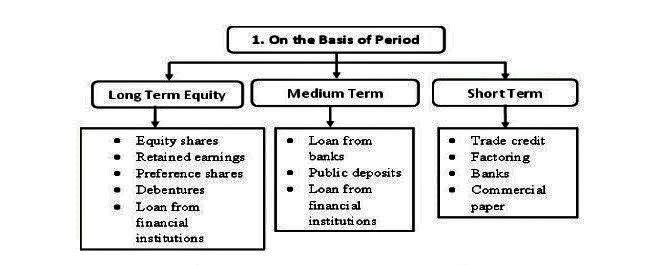
On the basis of the period, the different sources of funds can be classified into three parts. Which are:

(i) Long Term Equity

Long-term sources fulfill the financial requirements of a business for a period more than 5 years. It includes various other sources such as shares and debentures, long-term borrowings and loans from financial institutions. Such financing is generally required for the procurement of fixed assets such as plant, equipment, machinery etc.

(ii) Medium Term

Medium-term sources are the sources where the funds are required for a period of more than one year but less than five years. The sources of the medium term include borrowings from commercial banks, public deposits, lease financing and loans from financial institutions.

(iii) Short Term

Short-term sources Funds which are required for a period not exceeding one year are called short-term sources. Trade credit, loans from commercial banks and commercial papers are the examples of the sources that provide funds for short duration.

Short-term financing is very common for the financing of present assets such as inventories and account receivables. Seasonal businesses that must build inventories in terms of future prospects of selling requirements often need short-term financing for the interim period between seasons. Wholesalers and manufacturers with a major portion of their assets used in inventories or receivables also require a large number of funds for a short period.

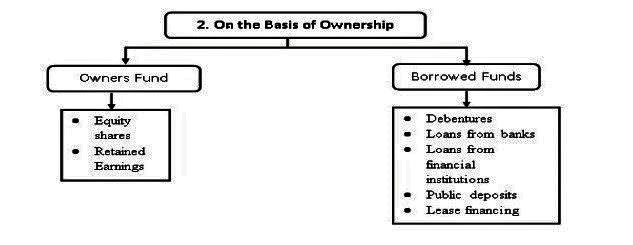
On the basis of ownership, the sources can be classified into Owner’s funds and Borrowed funds.

(i) Owners Fund

Owner’s funds mean funds which are procured by the owners of a business, which may be a sole entrepreneur or partners or shareholders of a business. It also includes profits which are reinvested in the business. The owner’s capital remains invested in the business for a longer duration and is not required to be refunded during the life period of the business.

This capital forms the base on which owners gain their right of control of management in the business. Some entrepreneurs may not like to dilute their ownership rights in the business and others may believe in sharing the risk. Equity shares and retained earnings are the two important sources from where owner’s funds can be obtained.

(ii) Borrowed Funds

Borrowed funds refer to the funds raised with the help of loans or borrowings. This is the most common type of source of funds and is used the majority of the time. The sources for raising borrowed funds include loans from commercial banks, loans from financial institutions, issue of debentures, public deposits and trade credit.

These sources provide funds for a specific period, on certain terms and conditions and have to repay the loan after the expiry of that period with interest. A fixed rate of interest is paid by the borrowers on such loans. Often it does put a lot of burden on the business as payment of interest is to be made even when the earnings are low or when the loss is incurred. These institutions don’t take into consideration the activities of business after the loan is given. Generally, borrowed funds are provided on the security of some assets of the borrower.

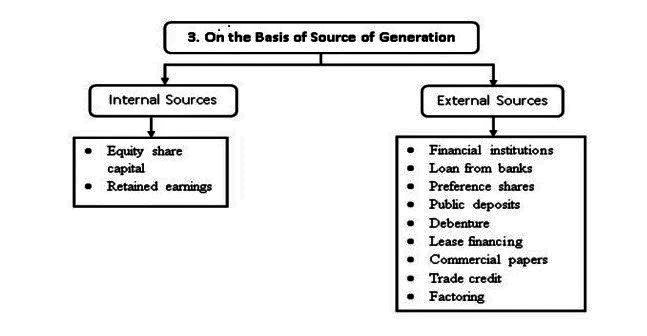
The way of classifying the sources of funds is whether the funds are generated from within the organization or from external sources of the organization.

(i) Internal sources

Internal sources of funds are those that are generated inside the business. A business, for example, can generate funds internally by speeding collection of receivables, disposing of surplus inventories and increasing its profit. The internal sources of funds can fulfill only limited needs of the business.

(ii) External sources

External sources of funds are the sources that lie outside an organization, such as suppliers, lenders, and investors. When a large amount of money is needed to be raised, it is generally done through the external sources. External funds may be costly as compared to those raised through internal sources.

In some cases, business is required to mortgage its assets as security while obtaining funds from external sources. The issue of debentures, borrowing from commercial banks and financial institutions and accepting public deposits are some of the examples of external sources of funds commonly used by business organizations.

Accounting for Price Level Changes Introduction, History, Limitations

Conventional or historical cost accounting assumes that money has stable value. But in reality, value of money varies from time to time as a result of changes in the general level of prices. Prices of goods and services change over the time. The change in price as a result of various economic and social forces brings about a change in the purchasing power of money.

Accounting is known as the language of business. The basic objective if accounting is to prepare financial statements in such a way that they give a true and fair view of business. Income statement should disclose the true profit or loss made by the business during a particular period where as balance sheet must show a true and fair view of the financial position of the business on a particular date. The recording of business transactions under the assumption that monetary unit is stable is called historical cost accounting (HCA). Under HCA, assets are recorded by the business at the price at which they are acquired and there will be no change in their values even if the market values of such assets change. Likewise, liabilities are recorded at the amounts contracted for and such amounts are not revised to compensate for changes in the price level. Costs are recorded on historical basis where are revenues are recorded on current value basis. Under HCA, it is assumed that money has stable value. But in reality, the value of money varies from time to time. The historical accounting system does not consider the impact of price level change on financial statements. Therefore, accounting for price level changes has been emerged as new accounting system.

Accounting for Price Level Changes

The general tendency in changes of prices of goods and services over a time is called price level. The rise in general price level is called inflation. During the period of inflation, purchasing power of money declines. The fall in the general price level is called deflation. During the period of deflation, purchasing power of money increases. Price level change means increase or decrease in the purchasing power of money over a period of time. The accounting which considers price level changes is called accounting for price level changes.

Accounting for price level changes is a system of maintaining accounts in which all items in financial statements are recorded at current values. This system of accounting ascertains profit or loss and presents financial position of the business on the basis of current prices. Accounting for price level changes is also called inflation accounting.

Objectives Of Price Level Accounting

  • Gives strength to the decision making.
  • Fair and truth of the financial position and operational results.
  • Shows real worth of the company.
  • Ensures that business has adequate funds to replace assets.
  • Maintains efficiency in operational business.

Advantages Of Inflation Accounting

The company reports very high profits during high inflation but on the other way faced financial difficulties. This happens because the taxes and dividends have been paid from the capital as a result of overstated profits arisen out of adopting the historical cost concept. Therefore, to alter this historical cost concept, price level accounting is recommended.

Investment Market

The price level accounting establishes a realistic price for the shares which also affects the investment market of the company.

Misled

Employees, the public and the investors are not misled using inflation accounting which shows realistic profits. Without adjusting the price changes, higher profits create resentment and urge for higher wages among the workers. Moreover, new entrepreneurs get attracted by excessive profits to enter the business.

Balance Sheet Reveals A Fair And True View

The balance sheet also reveals a fair and true view of the financial position of the company since assets are valued at the current position and not in distorted historical values.

Depreciation

Depreciation is charged on the current value of assets in price level accounting. As a result, this enables the company to show their accounting profit closer to economic profits. Moreover, the replacement of assets can be done when required.

Social Image

The social image of the company that prepares the financial statements adjusted to the price level changes gets improved.

Realistic View

The price level accounting presents a more realistic view of the company’s profitability. This happens because the current expenses/costs are matched with the current revenues only.

Comparison

Comparing becomes possible when price level accounting is adopted. This states that when financial statements are denoted according to the price changes, the profitability can be compared for two concerns developed at different times.

Maintain Real Capital

Helps the company to maintain real capital to avoid payment of taxes and dividends out of the capital due to inflated profits in accounting historically.

Limitations

Deflation Period

Lastly, in the deflation period, when the prices fall, adjustments means overstatement of profits and charging lesser depreciation.

Window Dressing

Price level accounting appears to have theoretical importance rather than practical due to which the adjustment in the accounts may lead to window dressing because of the element of subjectivity in it. People can alter the accounts according to the amounts most suited making the financial statements inaccurate.

Alterations

Altering accounts according to the price changes becomes a never-ending process. The process includes constant changes and adjustments in the financial statements.

Depreciation

Depreciation charged on the assets on current values is not acceptable by the Income Tax Act, 1961. As a result, adjusting depreciation to price changes will not serve any practical purpose.

Complications

Inflation accounting does involve a bunch of calculations and makes the financial statements complicated. Therefore, it becomes difficult for the common man to understand, analyse and then interpret.

Current Cost Accounting (CCA)

The British Government appointed Sandilands Committee with a chairman named Mr Francis C.P. Sandilands to recommend and consider the price level accounting. By recommending the adoption of the current cost accounting technique as the price level accounting in the reports of the committee (in 1975), it replaced the replacement cost accounting technique.

Therefore, the current cost accounting technique focused on the current values of individual items in the formation of financial statements and not on the original cost/historical cost.

Characteristics:

  • Stocks are valued at current replacement costs at the end of the year or the market price whichever is lower.
  • Depreciation charged on fixed assets is on current value.
  • COGS is not calculated on its original cost but the replacement costs of the business.
  • In addition to the financial statements (balance sheet & profit and loss a/c), a statement of changes and appropriation account is prepared.
  • The surplus that arose from revaluation is not distributed rather transferred to the revaluation account.

 Adjustments under the CCA technique:

  • Backlog Depreciation
  • Current Cost of Sales Adjustment (COSA)
  • Monetary Working Capital Adjustment (MWCA)
  • Gearing Adjustment
  • Current Cost Operating Profit

Features of CCA System:

(a) Fixed Assets are to be shown in the Balance Sheet at their value to the business and not at historical cost as reduced by depreciation. That is assets are shown in terms of what such assets would currently cost.

(b) Similarly, inventories are shown in the Balance Sheet at their value prevailing on the date of the Balance Sheet. These are not shown at cost or market price whichever is lower, as in case of historical accounting.

(c) Depreciation is to be computed on the current value of fixed assets.

(d) The cost of goods sold during the year has to be ascertained on the basis of prices prevailing at the date of consumption and not at the date of purchase.

(e) The difference between the current values and the depreciated original cost of fixed assets and of stocks, the increased requirements for monetary working capital and the under provision of depreciation in the past years may be adjusted through Revaluation Reserve Account.

(f) The fixed assets are shown at their “value to the business”. The “value to the business” can be defined in one of the following three ways:

(i) Replacement cost is the estimated cost of acquiring new asset of the same productive capacity at current prices adjusted for estimated depreciation since acquisition.

(ii) Net Realisable value is the estimated selling price in the ordinary course of business less reasonably predictable costs of completion and disposal.

(iii) Economic Value is the sum of the discounted future cash flows expected from the use of an asset during its useful life.

Current Cost Operating Profit:

Three main adjustments to trading account, calculated on the historical cost basis before interest, are required to arrive at current cost operating profit. These are called the Depreciation Adjustment, Cost of Sales Adjustment and Monetary Working Capital Adjustments.

Depreciation Adjustment:

The depreciation adjustment allows for the impact of price changes when determining the charge against revenue for the part of fixed assets consumed in the period. It is the difference between the value to the business of part of fixed assets consumed during the accounting period and the amount of depreciation charged on historical cost basis. The resulting total depreciation charge thus represents the value to the business of the part of fixed assets consumed in earning the revenue of the period.

Cost of Sales Adjustment:

The important principle to be remembered is that current costs must be matched with current revenues. As far as sales are concerned, it needs no adjustment as it is a current revenue. One of the features of current cost accounting is to show inventories in the Balance Sheet on the basis of their value to the business, and not at cost or market price, whichever is lower. If there are stocks, certain adjustments are to be made to cost of sales. If there are no stocks, then cost of sales will comprise only current purchases and cost of sales adjustment is not necessary.

Monetary Working Capital Adjustment:

Most businesses have other working capital besides stock involved in their day-to-day operating activities. For example, when sales are made on credit the business has funds tied up in debtors. Conversely, if the suppliers of goods and services allow a period of credit, the amount of funds needed to support working capital is reduced. This monetary working capital is an integral part of the net operating assets of the business.

Thus, the standard provides for an adjustment in respect of monetary working capital when determining current cost operating profit. This adjustment should represent the amount of additional (or reduced) finance needed for monetary working capital as a result of changes in the input prices of goods and services used and financed by the business.

In a business which holds stocks, the monetary working capital adjustment (MWCA) complements the COSA and together they allow for the impact of price changes on the total amount of working capital used by the business in its day-to-day operations.

Gearing Adjustment:

The net operating assets shown in the Balance Sheet have usually been financed partly by borrowing and the effect of this is reflected by means of a gearing adjustment in arriving at current cost profit attributable to shareholders. No gearing adjustment arises where a company is wholly financed by shareholders’ capital.

While repayment rights on borrowing are normally fixed in monetary amount, the proportion of net operating assets so financed increases or decreases in value to the business. Thus, when these assets have been realized, either by sale or use in the business, repayment of borrowing could be made so long as the proceeds are not less than the historical cost of those assets.

Current Purchasing Power (CPP)

Institute of Chartered Accountants in England and Wales recommended that changes in the price level should be reflected in the financial statements through the current purchasing power method (CPP). For measuring changes in the price level and incorporating the changes in the financial statements we use index numbers, which may be considered to be a barometer meant for the purpose.

Under this method any established and approved general price index is used to convert the values of various items in the Balance Sheet and Profit and Loss Account. This method takes into consideration the changes in the value of items as a result of the general price level, but it does not account for changes in the value of individual items.

For example, a particular machine may have become cheaper over the last few years, whereas the general price level may have risen; the value of the machine will also be raised in accordance with general price index. Thus general price level adjustment restates financial data by bringing past rupee amounts in line to current rupee purchasing power by general index multiplier.

Mechanisms Under the CPP Method:

  1. Conversion technique
  2. Mid- period conversion
  3. Non- monetary and monetary accounts
  4. Adjustment of cost of inventory and sales
  • LIFO method
  • FIFO method
  1. Ascertainment of profits
  • Net change method
  • Conversion of income method

The preparation of the financial statements according to CPP method, needs understanding of the following steps:

(i) Conversion technique

CPP method involves the restatement of historical figures at current purchasing power.

(ii) Mid-Period Conversion:

In case of transactions occurring throughout a period, it will be advisable to convert them according to the average index of the period. Such transactions generally include revenue items such as sales and purchases of goods, payment of expenses etc. In case the information regarding average index is not available, it may be calculated by taking the average of the index numbers at the beginning and at the end of the period.

(iii) Monetary and Non-Monetary Items:

Monetary items are those assets and liabilities the amount of which are fixed by contract or otherwise, and expressed in units of money, regardless of changes in general price level. These cover cash, bank, bills receivable, bills payable, debtors, creditors, outstanding expenses, pre-paid expenses etc., represent specific monetary claim which is receivable or payable in specified number of rupees regardless of price level changes.

(iv) Cost of Sales and Inventories:

Cost of sales and inventory value vary according to cost flow assumptions, i.e., FIFO or LIFO. Under FIFO method cost of sales comprise the entire opening stock and current purchases less closing stock. And closing stock is entirely from current purchases.

Under LIFO method cost of sale comprise current purchases only. However, if the current purchases are less than cost of sales, a part of the opening inventory may also become a part of cost of sales. And closing stock comprises purchases made in the previous year.

The following indices are used Under CPP method for restating the historical figures:

(i) For current purchases: Average index of the year.

(ii) For opening stock: Index at the beginning of the year.

(iii) For purchases of the previous year: Average indices for the year.

Methods of Accounting for Price Level Changes

Current Value Accounting

In this method of price level accounting, all the liabilities and assets are represented in the balance sheet at the current values. The difference in the net assets calculated at the beginning and end of the accounting period is ascertained which is known as the profit or loss

Similar to the RCA technique, this method also includes an element of subjectivity. Moreover, it becomes difficult to determine with a relevant price index.

Replacement Cost Accounting Technique

Replacement Cost Accounting Technique is referred to as an improved version of CPP (current purchasing power technique). The major drawback of CPP is that it does not consider the price index individually related to the assets of the company.

In the RCA technique, the index used is directly related to the company’s assets and not to the general price index. However, using the RCA technique means adopting different price indices for the conversion of items in the financial statements. Therefore, it makes the calculation of the relative price index difficult in a particular case. Furthermore, this method gets criticized by thinkers due to the element of subjectivity in it.

Depreciation and Replacement of Fixed Assets:

Another problem posed by the price level changes (and more so by inflation) is that how much depreciation should be charged on fixed assets.

The purpose of charging depreciation is twofold:

(i) To show the true and fair view of the financial statements and the profitability of the concern.

(ii) To provide sufficient funds to replace the assets after the expiry of the life of the asset. Depreciation charged on historical or original cost does not serve any of the two purposes.

Suppose a machine was purchased in 2000 for Rs 1, 00,000 having a life of 10 years. In case depreciation is charged on original cost, after 10 years we shall have Rs 1, 00,000 from the total depreciation provided. But due to inflation the cost of the machine might well have gone up to Rs 2, 00,000 or even more in 2011 when the machine is to be replaced and we may find it difficult to replace the asset.

It proves that we have been charging less depreciation which resulted in overstatement of profits and higher payment of dividends and taxes in the past and insufficient funds now to enable the replacement of the asset. Hence, to rectify this, it is necessary that fixed assets are valued at replacement cost values and depreciated on such replacement cost values. But adopting replacement cost method is also not free from difficulties.

The main difficulties are as follows:

(1) It is not possible to find accurately the replacement cost till the replacement is actually made.

(2) The replaced new assets are not of the same type and quality as old assets because of new developments and improved qualities.

(3) Income Tax Act. 1961 does not provide for any other method than the actual cost method.

(4) The fixed assets should not be written-up in the balance sheet when the prices are not stable.

Hence, it may not be possible to charge depreciation on replacement cost basis. However, it is still advisable to retain profits ad restrict dividends so as to enable funds for replacement of fixed assets. For this purpose. ‘Specific Capital Reserves’ or ‘Replacement Reserves’ should be provided in addition to the normal depreciation provided on actual cost of the asset.

Profit measurement under different systems of accounting

Under Current Purchasing Power Method, the profit can be determined in two ways:

(i) Net Change Method:

This method is based on the normal accounting principle that profit is the change in equity during an accounting period.

In order to determine this change the following steps are taken:

(a) Opening Balance Sheet prepared under historical cost accounting method is converted into CPP terms as at the end of the year. This is done by application of proper conversion factors to both monetary as well as non-monetary items. Equity share capital is also converted. The difference in the balance sheet is taken as reserves. Alternatively, the equity share capital may not be converted and the difference in balance sheet be taken as equity.

(b) Closing Balance Sheet prepared under historical cost accounting is also converted. The difference between the two sides of the balance sheet is put as reserves after converting the equity capital. Alternatively, the equity capital may not be restated in CPP terms and the balance be taken as equity.

(c) Profit is equivalent to net change in reserves (where equity capital has also been converted) or net change in equity (where equity capital has not been restated).

(ii) Conversion or Restatement of Income Statement Method:

In case of this method, the income statement prepared on historical cost basis is restated in CPP terms, generally on the basis:

(a) Sales and operating expenses are converted at the average rate applicable for the year.

(b) Cost of sales is converted as per cost flow assumption (FIFO or LIFO) as explained in the preceding pages.

(c) Fixed assets are converted on the basis of the indices prevailing on the dates they were purchased. The same applies to depreciation.

(d) Taxes and dividends paid are converted on the basis of indices that were prevalent on the dates they were paid.

(e) Gain or loss on account of monetary items should be calculated and stated separately in Restated Income Statement to arrive at the overall figure of profit or loss.

Human resource accounting in India

Indian companies act 1956, does not provide any scope for showing any information about human resources in financial statement. Due to the development of business and industries, some of the Indian companies, both public and private, value their human resources and report this information in their annual report. The companies, who are presently reporting human assets valuation, includes

  • Steel Authority of India Ltd (SAIL).
  • Bharat heavy Electrical Ltd (BHEL).
  • Oil and Natural Gas Commissioning (ONGC).
  • Project and Equipment corporation of India. (PEC).
  • Oil India Ltd
  • Engineers India limited
  • Electrical India Ltd.
  • Mineral and Metal trading Corporation of India. (MMTC).
  • Hindustan Shipyard Ltd.
  • Infosys Technologies Ltd.
  • Cement corporation of India. (CCI).
  • Tata Engineering and Locomotive Works
  • Associated Cement Company Ltd ACC).
  • Southern Petrochemicals Industries Corporation Ltd SPIC).
  • National Thermal Power Corporation Ltd (NTPC).

Benefits

Calculate Return on Investment (ROI):

The return on investment can realistically be calculated only when the investment on human resources also is taken into account. The ROI is may be good because there is an investment on human beings.

Improving employee efficiency:

It helps in improving the efficiency of employees. The employees come to know of the cost incurred on them and the return given by them in the form of output, and so on, which will motivate them to increase their worth.

Proper investment:

It can be seen whether the business has made proper investment in human resources in terms of money or not. If the investment is in excess, efforts should be made to control it.

Cost of developing human resources:

HRA will give the cost of developing human resources in the business. This will enable the management to ascertain the cost of labor turnover also.

Planning and executing personal policies:

It will help the management in planning and executing personal policies. The management also makes use of its help in taking decisions regarding transfers, promotions, training, retirement and retrenchment of human resources.

Calculation of Reasonable Return, Disposal of Surplus and Replacement of an Asset

Calculation of Reasonable Return

Control Reserve fall short of reasonable return, the appropriations to this reserve can be reduced by the amount of shortfall. The amount of such reserve is to be invested in the same electricity undertaking and is to be handed over to purchaser of the business in case the business is sold away.

The Electricity (Supply) Act, 1948, imposes restrictions on electricity undertakings on earning too high a profit, by means of the concept of reasonable return, which stipulates the following:

  1. A yield at the standard rate which is the Bank Rate stipulated by the Reserve Bank of India from time to time, plus 2% on the Capital Base.
  2. Income derived from investments excluding investments made against the Contingencies Reserve.
  3. An amount equal to ½% on any loans advanced by the Board.
  4. An amount equal to ½% on the amounts borrowed from organisations or institutions approved by the State Government.
  5. An amount equal to ½% on the amounts realised by the issue of debentures.
  6. An amount equal to ½% on the accumulations in the Development Reserve.
  7. Any other amount as may be allowed by the Central Government, having regard to the prevailing tax structure in the country.

An electricity company must adjust the rates so that the clear profit in any year does not exceed the reasonable return by more than 20 per cent of the reasonable return. In case it exceeds, it should be credited to Customers Rebate (or Benefit) Reserve.

Moreover, even the surplus within 20 per cent of the reasonable return has to be disposed of as follows:

(i) 1/3 of the surplus not exceeding 5 per cent of the reasonable return will be at the disposal of the undertaking.

(ii) Of the balance, 1/2 will be transferred to the Tariffs and Dividend Control Reserve.

(iii) The balance left will be distributed among consumers by way of reduction of rates or by way of special rebate.

Calculation of Disposal of Surplus

Should the clear profit exceed the reasonable return, the surplus has to be disposed of as under:

(a) One-third of the surplus not exceeding 5% of the reasonable return will be at the disposal of the undertaking;

(b) Of the balance, one-half will be transferred to “Tariffs and Dividends Control Reserve”; and

(c) The balance will be distributed among consumers by way of reduction of rates or by way of special rebate.

An electricity undertaking must so adjust rates that the amount of clear profit in any year does not exceed the reasonable return by more than 20% of the reasonable return.

Replacement of an Asset

In an Electricity company an asset once appeared in a Capital account cannot be reduced even after its replacement or disposal. So, when no extension or improvement is involved the entire replacement cost is charged to revenue and if some extension is involved, the difference is to be capitalised. i.e. the difference between the actual amount spent and the amount that would have been spent had the old asset been constructed now. For this the following calculations and journal are necessary.

Three procedures for replacement of an asset.

(i) The original cost of the asset will remain intact.

(ii) The estimated cost of replacement of the old asset is ascertained. At the same time, the estimated cost is reduced by the sale proceeds of old materials, if any, or by the value of materials re-used in the new construction. The balance is charged to Revenue Account.

(iii) The difference between the total cost of the entire work and the estimated replacement cost of the old asset in original manner is charged to Capital Account, i.e., capitalized.

In addition to above, the additions and improvements are capitalized. Moreover, the auxiliary mains, subsidiary, subsidiary permanent ways, etc. are also to be capitalized. Improvement is the excess amount spent over the cost of replacement with asset of equal efficiency.

It may be mentioned, however, in this respect that current cost of the old assets may be determined either from the market or from the price index. That is, price index which is applicable to the type of asset with same efficiency after 20-30 years may be practically obsolete now.

It may be applied simply to get the estimated current cost. If the asset is in the nature of Construction Works, separate indices have to be applied to different elements of cost. But if the estimate differs (between engineering data and price indices) the lesser amount may be capitalized just on the basis of conservatism.

Final Accounts of Electricity Companies

Revenue Account

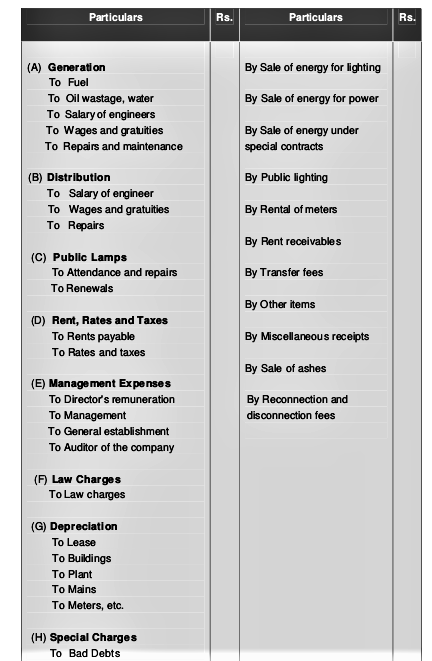
This account is similar to the Profit and Loss Account of a trading or manufacturing concern. It is debited with various items of expenses and credited with various items of incomes. Depreciation on fixed assets is charged by debiting the Revenue Account and crediting the Depreciation Fund Account. Generally, expenses are shown under the following broad headings:

(A) Generation;

(B) Distribution;

(C) Public Lamps;

(D) Rent, Rates and Taxes;

(E) Management Expenses;

(F) Law Charges;

(G) Depreciation;

(H) Special Charges.

Similarly, incomes are grouped as:

(1) Sale of energy for lighting;

(2) Sale of energy for power;

(3) Sale of energy under special contracts;

(4) Public lightings;

(5) Rental of meters;

(6) Rent receivable; and

(7) Transfer fees, etc.Statutory Form of Revenue Account under Indian Electricity Act, 1910 is given below :

Revenue Account for the year ended ………………
Net Revenue Account

This is similar to the Profit and Loss Appropriation Account of a trading or manufacturing concern except the treatment of interest on debentures and loans.

In the Net Revenue Account, it is treated as appropriation of profits. However, In ordinary cases, such interest is treated as a charge against profits and shown in the Profit and Loss Account. The balance of the Net Revenue Account is shown in the General Balance Sheet.

The Statutory form of Net Revenue Account under the Indian Electricity Act,1910 is given below:

Net Revenue Account for the year ended ……………….

Capital Account (Receipts and Expenditure on Capital Account)

The main purpose of this account is to show total amount of capital raised and its application for acquisition of fixed assets for carrying on the business.As per the statutory forms (prescribed by the Indian Electricity Act, 1910) there are three columns on each side:

(i) one showing balance at the end of the previous year;

(ii) disclosing the amount received/spent during the year; and

(iii) balance at the end of the year. Statutory form of Capital Account under The Indian Electricity Act, 1910 is given below:

Receipts and Expenditure on Capital Account for the year ended………….

General Balance Sheet

In the General Balance Sheet, all the remaining assets and liabilities, like current assets, current liabilities, reserves, etc., are shown along with the total of receipts (on the liability side) and the total expenditure (on the asset side).

The Statutory Form of General Balance Sheet under Indian Electricity Act, 1910 is given below:

General Balance Sheet as on ………………………..

Treatment of Replacement of an Asset

Under the Single Account System when an asset is replaced, the Cash Account is debited and the Asset Account is credited, and the difference is transferred to the Profit and Loss Account (being profit or loss on sale of asset). The Asset Account is reduced by its written down value. Similarly, when an asset is purchased, the Asset Account is debited and the Cash or Bank Account is

credited and the Asset Account is increased by that amount. However, under the Double Account System when an asset is replaced, the original cost of the asset is not disturbed, instead it continues to appear in the Capital Account at the old figure. Under this system, the cost of replacement is treated in the books of accounts as under:

(i) When no Extension or Improvement is involved:

In this case, the entire amount of cost of replacement is treated as revenue expenditure and is debited to Revenue Account.

(ii) When Extension or Improvement is Involved:

In this case, an amount equal to the present cost of replacement of the old asset is treated as revenue expenditure and is charged to the Revenue Account. However, this chargeable amount is reduced by

(a) sale proceeds of scrap of the old asset

(b) value of materials of old asset used in rebuilding the new asset.

The total cost of replacement plus the value of materials of old asset used in rebuilding the new asset minus the present cost of replacement of the old asset is capitalised. Some Important Provisions

The students should note the following important matters which will affect the accounts of electricity companies as provided in the Sixth Schedule to The Electricity (Supply) Act. 1948.

These are as follows:

(a) Depreciation on fixed assets

(b) Fixed assets and their prescribed life

(c) Contingency reserve

(d) Development reserve

(e) General reserve

(f) Appropriation of profits

Depreciation on Fixed Assets

As per the provision of Sec. of The Electricity (Supply) Act, 1948, every fixed asset must be depreciation and for calculating depreciation, the life of each asset is to be taken as stated in the Seventh Schedule. Schedule VI provides for two methods of depreciation, viz:

(a) Compound Interest Method

(b) Strait Line Method.

Compound Interest Method

Under this method, such an amount should be set aside annually as depreciation throughout the prescribed life of the asset concerned, as would,with 4% p.a. compound interest, produced by the end of the prescribed period an amount equal to 90% of the original cost of the asset.

Straight Line Method

Under this method, the depreciation is calculated by dividing 90% of the original cost of the asset by the prescribed period in respect of such an asset.All sums credited to the Depreciation Reserve may be invested either in the  business or may be utilised for repayments of loans not guaranteed under Section or for repayment of sums paid by the State Government under Guarantee  Assets Written Down to 10% of Cost and No depreciation is allowed in respect of an asset which has been written-down to 10% (or less) of its original cost.

When a fixed asset is discarded or becomes obsolete it cannot be depreciated any more. In this case, the written-down value of such an asset is transferred to a special account. Any profit on sale of such assets is transferred to the Contingency Reserve Account.

Contingencies Reserve

Every electricity supply company is required to maintain a Contingencies Reserve. A sum equal to not less than 1/4% or not more than 1/2% of the original cost of fixed assets must be transferred from the Revenue Account to the Contingencies Reserve. The maximum amount in this account must not exceed 5% of the original cost of the fixed assets. The amount of Contingencies Reserve must be invested in trust securities. With the prior approval of the State Government, the Contingencies Reserve can be utilised for the following purposes :

( i ) For meeting expenses or loss of profit due to accident, strikes or circumstances beyond the control of the management;

(ii) For meeting expenses on replacement or removal of plant or works other than expenses required for normal maintenance or renewals;

(iii) For paying compensation under any law for the time being in force and for which no other provision has been made.

Development Reserve

An amount equal to income tax and super tax saved on account of Development Rebate allowed under Income Tax Act, 1961 has to be transferred to the Development Reserve Account. If, in any accounting year, the clear profit without considering special appropriations plus balance in the credit of Tariffs and Dividend Control Reserve is less than the required amount of Development Reserve, the shortfall may not be made good. In case of sale of the undertaking, this reserve should be handed over to the buyer.

General Reserve

Section of the Electricity Act, 1948 provides for the creation of the General Reserve by making appropriation from the Revenue Account after charging interest and depreciation. The amount of contribution shall be calculated @ 1/2% of the original cost of the fixed assets until the total of such reserve comes to 8% of the original cost of the fixed assets. Tariffs and Dividend Control Reserve

It is created out of the disposable surplus of the electricity company (explained below). This reserve can be utilised whenever the clear profit is less than reasonable return. At the time of sale of the undertaking, this reserve should be handed over to the buyer.

Appropriation of Profits

The Electricity (Supply) Act, 1948 provides that an electricity company cannot charge any rate as they like. They are entitled to charge such rates which give them a reasonable return. They must so adjust the rate that the amount of clear profit in any year does not exceed the reasonable return by more than 20%.

Disposal of Surplus

The excess of clear profit over reasonable return to the extent of 20% of reasonable return has to be disposed of as under: (Any excess over 20% of reasonable return must be refunded to customers).

(i) 1/3 of the surplus (not exceeding 5% of reasonable return) at the disposal of the undertaking.

(ii) Of the balance, 1/2 is to be transferred to the Tariffs and Dividend Control Reserve.

(iii) The balance is to be transferred to the Consumer’s Rebate Reserve for reduction of rates or for special rebate.

Calculation of Clear Profit

The Clear profit is the difference between the total income and total expenditure plus specific appropriations. The Clear profit is calculated as follows:

(A) Income from

(i) Gross receipts from sale of energy, less discount

(ii) Rental of meters and other apparatus hired to customers

(iii) Sale and repair of lamps and apparatus

(iv) Rent, less outgoings not otherwise provided for

(v) Transfer fees

(vi) Interest on investments, fixed and calls deposits and bank balances

(viii) Other taxable general receipts

Total Income

(B)Expenditure

(i) Cost of generation and purchases of energy

(ii) Cost of distribution and safe of energy

(iii) Rent, rates and taxes (other than taxes on income profits)

(iv) Interest on load advanced by Board

(v) Interest on loan taken from organization or institutions approved by the State Government

(vi) Interest on debentures issued by the licencee

(vii) Interest on security deposits

(viii) Legal charges

(ix) Bed debts

(x) Auditor’s fees

(xi) Management expenses

(xii) Depreciation (as per Schedule Seventh)

(xiii) Other admissible expenses

(xiv) Contribution to Provident Fund; gratuity, staff pension and apprentice and other training schemes

(xv) Bonus paid to the employees of the Undertaking. In case of dispute, in accordance with the decision of the tribunal.

In any other case, with the approval of the State Government Total Expenditure

Balance (A – B)

Less : Specific Appropriations

(i) Past losses (i.e., excess of expenditure over income)

(ii) All taxes on income and profits

(iii) Amount written-off in respect of fictitious and intangible assets

(iv) Contribution to Contingency Reserve

(v) Contribution towards arrears depreciation (if any)

(vi) Contribution to Development Reserve

(vii) Other appropriation (special) permitted by the State Government Clear Profit

Reasonable Return: It means the sum of the following items:

(i) An amount calculated at (bank rate + 2%) on Capital Base as defined below.

(ii) Income from investments (except income from Contingency Reserve Investment).

(iii) An amount equal to 1/2% on loans advanced by the State Electricity Board.

(iv) An amount equal to 1/2% on the amounts borrowed from organisations or institutions approved by the State Government.

(v) An amount equal to 1/2% on the amount raised through issue of debentures.

(vi) An amount equal to 1/2% on the balance of Development Reserve.

(vii) Any other amount as may be permitted by the Central Government.

Capital Base : Capital Base means :

(i) Original cost of fixed assets available for use Less : Contribution, if any, made by the customers for construction of service lines

(ii) the cost of intangible assets

(iii) the amount of investments made compulsorily on account of contingencies reserve

(iv) the original cost of work-in-progress

(v) working capital which is equal to the sum of:

(a) 1/2 of the sum of stores, materials and supplies including fuel on hand at the end of each month of the accounting year;

(b) 1/ 2 of the sum of cash and bank balance and call and short term deposit at the end of each month of accounting year but does not exceed in aggregate an amount equal to 1/4 of the expenditure (already listed in previous page).

(i) Deduct

Accumulated deprecation on tangible assets and amounts written-off tangible assets Loan advanced by Electricity Board

(ii) Security deposits of customers held in cash.

(iii) Debentures issued by the undertaking

(iv) Amount standing to the credit of Tariffs and dividend control revenue.

(v) Loan borrowed from organisations or institutions approved by the State Government.

(vi) Balance of Development reserve.

(vii) Amount carried forward for distribution to consumers.

Capital Base

error: Content is protected !!