Conflict

Conflict can be defined in many ways and can be considered as an expression of hostility, negative attitudes, antagonism, aggression, rivalry and misunderstanding. It is also associated with situations that involve contradictory or irreconcilable interests between two opposing groups.

A few definitions of conflict are as given below:

“A simple definition of conflict is that it is any tension which is experienced when one person perceives that one’s needs or desires are or are likely to be thwarted or frustrated.” Follett simply defines conflict as, “the appearance of difference, difference of opinions, of interests.”

Chung and Megginson define conflict as, “the struggle between incompatible or struggling needs, wishes, ideas, interests or people. Conflict arises when individuals or groups encounter goals that both parties cannot obtain satisfactorily.”

According to David L. Austin, “It can be defined as a disagreement between two or more individuals or groups, with each individual or group trying to gain acceptance of its view or objectives over others.”

Louis R. Pondy has given a very comprehensive definition of conflict.

According to him the term conflict is used in four ways in the literature to describe:

(i) Antecedent conditions of conflictual behaviour such as scarcity of resources or policy differences;

(ii) Affective states of individuals involved such as stress, tension, hostility, anxiety etc.;

(iii) Cognitive state of individuals, that is their perception or awareness of conflictual situation; and

(iv) conflictual behaviour ranging from passive resistance to over aggression.

Thus, we can say that fighting, hostility and controversy, all of which can be called conflict, are nearly every day fare for individuals and groups, although they are not always evident. It is an absolutely predictable social phenomenon and it should be channeled to useful purposes.

Features of Conflict

From the organizational point of view following are the broad features of conflict:

  1. Conflict occurs when individuals are not able to choose among the available alternative courses of action.
  2. Conflict between two individuals implies that they have conflicting perceptions, values and goals.
  3. Conflict is a dynamic process as it indicates a series of events. Each conflict is made up of a series of interlocking conflict episodes.
  4. Conflict must be perceived by the parties to it. If no one is aware of a conflict, then it is generally agreed that no conflict exists.

Transitions in Conflict Thought

There have been conflicting views over the role of conflict in groups and organizations. There are three different schools of thought emphasizing different roles conflict in organizations.

These three schools of thought are:

(i) The Traditional View

(ii) The Human Relations View

(iii) The Inter-actionist View.

The views of all these schools of thought are explained as:

  1. The Traditional View

According to the traditional view, conflict, by definition, was harmful and was to be avoided. This view was consistent with the attitudes that prevailed about human behaviour in the 1930s and 1940s. Traditionally, conflict was viewed negatively, and it was used synonymously with such terms as violence, destruction and irrationality.

Conflict was seen as a dysfunctional outcome resulting from poor communication, a lack of openness and trust between people and the failures of the managers to be responsive to the needs and aspirations of the employee. Conflict could cause losses in productivity because groups would not cooperate in getting jobs finished and would not share important information. Too much conflict could also distract managers from their work and reduce their concentration on the job.

Thus, traditional writers had a very conservative view about conflict as they considered it totally bad and advocated that conflicts must be avoided, with the result that sometimes; there is a tendency to suppress conflict and push it under the rug. By ignoring the presence of conflict, we somehow try to wish it away.

Both the scientific management approach and the administrative school of management relied heavily on developing such organizational structures that would specify task, rules, regulations procedures and authority relationships so that if a conflict develops, then these inbuilt rules will identify and correct problems of such conflict. Thus, through proper management techniques and attention to the causes of conflict, it could be eliminated and organizational performance improved.

  1. The Human Relations View

The human relations view dominated the conflict theory from the late 1940s through the mid 1970s. The human relations view argued that conflict was a natural occurrence in all groups and organizations. Since conflict was inevitable, management should accept the conflict. This theory says that conflict is avoidable by creating an environment of goodwill and trust.

But still conflicts are bound to happen due to differences in opinions, faulty policies and procedures, lack of cooperation, allocation of resources which will lead to distortion and blockage in communication. Accordingly, management should always be concerned with avoiding conflict if possible and resolving it soon if possible, in the interests of the organization and the individuals.

  1. The Inter-Actionist View

Modern View Point, while the human relations view accepted conflict, the inter-actionist approach encourages conflict. This view is based on the belief that conflict is not only a positive force in a group but is also necessary for a group to perform effectively. This approach encourages conflict. According to it if the group is harmonious, peaceful and cooperative, it is prone to become static and non responsive to the needs for change and innovation. Therefore, the group leader must allow some conflicts to happen in the group, so that the group may remain viable, self critical and creative.

However, conflicts must be kept under control to avoid their dysfunctional consequences. The major contribution of the inter-actionist approach is encouraging group leaders to maintain an ongoing minimum level of conflict, enough to keep the group viable, self critical and creative.

Thus, it becomes evident that to say conflict is all good or bad is in appropriate and naive. Whether a conflict is good or bad depends on the type of conflict. Specifically, it is necessary to differentiate between functional and dysfunctional aspects of conflict.

Functional and Dysfunctional Conflict

The inter-actionist view does not propose that all conflicts are good. There are both positive and negative aspects of conflicts. Boulding recognizes that some optimum level of conflict and associated personal stress and tension are necessary for progress and productivity, but he portrays conflict primarily as a potential and social cost.

Similarly, Kahn views that “one might as well make a case for interpreting some conflict as essential for the continued development of mature and competent human beings, but they feel that conflict has a social cost.”

Thus, we can say that the conflicts which support the goals of the group and improve its performance are known as functional conflicts. On the other hand, there are conflicts that hinder group performance; these are dysfunctional or destructive forms of conflict.

The demarcation between functional and dysfunctional is neither clear nor precise.

Functional Conflicts

If we look at conflict from functional point of view, conflicts are supposed to serve the following functions:

  1. Release of Tension

Conflict when expressed can clear the air and reduce the tension which might otherwise remain suppressed. Suppression of tension can lead to imaginative distortion of truth, sense of frustration and tension, high mental exaggerations and biased opinions resulting in fear and distrust. When members express themselves, they get some psychological satisfaction. This also leads to reduction of stress among the involved members.

  1. Analytical Thinking

When a group is faced with a conflict, the members display analytical thinking in identifying various alternatives. In absence of conflict, they might not have been creative or even might have been lethargic. The conflicts may induce challenge to such views, opinions, rules, policies, goals and plans which would require a critical analysis in order to justify these as they are or make such changes that may be required.

  1. Group Cohesiveness

Inter group conflict brings about closeness and solidarity among the group members. It develops group loyalty and greater sense of group identity in order to compete with the outsiders. This increases the degree of group cohesiveness which can be utilized by the management for the attainment of organisational goals in an effective manner. As cohesiveness increases, differences are forgotten.

  1. Competition

Conflicts promote competition and hence it results in increased efforts. Some persons are highly motivated by conflict and severe competition. Such conflict and competition, thus, lead to high level of effort and output.

  1. Challenge

Conflicts test the abilities and capacities of the individuals and groups. It creates challenges for them for which they have to be dynamic and creative. If they are able to overcome the challenge, it will lead to search for alternatives to existing patterns which leads to organizational change and development.

  1. Stimulation for Change

Sometimes, conflict stimulates change among the people. When they are faced with a conflict, they might change their attitudes and be ready to change themselves to meet the requirements of the situation.

  1. Identification of Weaknesses

When a conflict arises, it may help in identifying the weaknesses in the system. Once the management comes to know about the weaknesses, if can always take the steps to remove them.

  1. Awareness

Conflict creates awareness of what problems exist, who is involved and how to solve the problem. Taking cue from this, management can take the necessary action.

  1. High Quality Decisions

When conflicting, persons express their opposing views and perspectives, high quality decisions result. The people share their information and check each other reasoning to develop new decisions.

  1. Enjoyment

Conflict adds to the fun of working with others when not taken seriously. Many people find conflict enjoyable to competitive sports, games, movies, plays and books.

Dysfunctional Conflicts

The dysfunctional aspects of the conflicts can be visualized in the following ways:

  1. High Employee Turnover

In case of intra-individual and inter-individual conflicts particularly, some dynamic personnel may leave the organization, if they fail to resolve the conflict in their favour. In this case, organization will be the sufferer in the long run due to the loss of key people.

  1. Tensions

Sometimes, conflict can cause high level of tensions among the individuals and groups and a stage may come when it becomes difficult for the management to resolve the conflicts. This will result in anxiety, frustration, uncertainty and hostility among the members.

  1. Dissatisfaction

Conflict will result in discontentment to the losing party, who will wait for an opportunity to settle the score with the winning party. All this tussle will result in less concentration on the job and as a result, the productivity will suffer.

  1. Climate of Distrust

Conflict often creates a climate of distrust and suspicion among the members of the group as well the organization. The degree of cohesiveness will be less as the discords will be more. The concerned people will have negative feelings towards each other and try to avoid interaction with each other.

  1. Personal Vs. Organizational Goals

Conflicts may distract the attention of the members of the organization from organizational goals. They may waste their time and energy in finding ways and tactics to come out as winners in the conflict. Personal victory becomes more important than the organizational goals.

  1. Conflict as a Cost

Conflict is not necessarily a cost for the individuals. But the conflicts may weaken the organization as a whole, if the management is not able to handle them properly. If the management tries to suppress conflicts, they may acquire gigantic proportions in the later stages. And if the management does not interfere in the earlier stages, unnecessary troubles may be invited at the later stages. It is a cost to the organization, because resignations of personnel weaken the organisation, feeling of distrust among members have negative impact on productivity and so on.

Conflicts contained within reasonable limits, thus, serve, several useful purposes and can be functional for individuals, groups and to the institution. However, if conflict is allowed to develop beyond control, it could tend to become destructive, resulting in such adverse situations as strikes, sabotage and other dysfunctional behaviour. There should be an optimum level of conflict that is very useful for the development of that is very useful for the development of creativity, high problem solving behaviours and productivity.

This optimum level is depicted in the following figure:

Optimum Level

Too little conflict creates conditions of inertia, and boredom in the system and excessive conflict results in destructive and dysfunctional tendencies, thus, conflict has to be managed. Managers have to motivate the level of conflict in the system. If there is too little or no conflict at all, he may even have to induce some level of conflict to energies the system. As the level of conflict tends to go beyond the optimum level, the manager must act to resolve the conflict in a manner that will beneficial to the organization.
Interpersonal Behavior, Features, Types, Challenges

Interpersonal Behavior refers to the way individuals interact and communicate with each other within social settings. It encompasses verbal and nonverbal communication, as well as the exchange of emotions, thoughts, and ideas between people. This behavior is influenced by various factors including cultural norms, personal experiences, and social roles. Effective interpersonal behavior involves skills such as active listening, empathy, assertiveness, and conflict resolution. It plays a crucial role in forming and maintaining relationships, whether in personal, professional, or social contexts. Understanding and practicing positive interpersonal behavior can lead to improved communication, stronger connections, and healthier interactions with others, contributing to overall well-being and success in various aspects of life.

Features of Interpersonal Behavior:

  • Verbal Communication:

Verbal communication involves the use of words to convey messages. It includes speaking, listening, and understanding language. Effective verbal communication requires clarity, coherence, and relevance. It also involves the ability to adapt language and tone based on the context and the audience.

  • Non-verbal Communication:

Nonverbal communication encompasses all forms of communication other than words, such as body language, facial expressions, gestures, and tone of voice. Nonverbal cues often convey more meaning than verbal messages and can significantly impact interpersonal interactions.

  • Active Listening:

Active listening is a fundamental aspect of effective interpersonal communication. It involves fully concentrating on what the other person is saying, understanding their message, and responding appropriately. Active listening requires not only hearing the words but also paying attention to nonverbal cues and empathizing with the speaker.

  • Empathy:

Empathy is the ability to understand and share the feelings of another person. It involves putting oneself in someone else’s shoes and seeing the world from their perspective. Empathetic communication fosters connection and trust in relationships by validating others’ emotions and experiences.

  • Assertiveness:

Assertiveness is the ability to express one’s thoughts, feelings, and needs openly and honestly while respecting the rights and opinions of others. It involves standing up for oneself without being aggressive or passive. Assertive communication promotes self-confidence, boundary-setting, and healthy conflict resolution.

  • Conflict Resolution:

Conflict is inevitable in any interpersonal relationship. Effective conflict resolution involves addressing differences and disagreements constructively to reach a mutually satisfactory outcome. This may include active listening, expressing feelings and concerns, seeking common ground, and negotiating solutions.

  • Respect:

Respect is the foundation of positive interpersonal relationships. It involves valuing others’ opinions, beliefs, and boundaries, even if they differ from our own. Respectful communication entails treating others with dignity, courtesy, and consideration, fostering mutual trust and cooperation.

  • Trust:

Trust is essential for building and maintaining meaningful connections with others. It develops over time through consistent communication, reliability, honesty, and integrity. Trusting relationships enable individuals to feel safe, supported, and understood, enhancing collaboration and intimacy.

  • Cultural Sensitivity:

Cultural sensitivity involves recognizing and respecting cultural differences in communication styles, values, and norms. It requires openness, curiosity, and willingness to learn about other cultures’ perspectives and practices. Culturally sensitive communication promotes inclusivity, diversity, and mutual understanding.

  • Adaptability:

Interpersonal behavior should be adaptable to different social contexts and situations. This involves adjusting communication strategies, language, and behavior based on the specific cultural, relational, and environmental factors at play. Adaptability enhances communication effectiveness and reduces misunderstandings.

  • Feedback:

Feedback is essential for improving interpersonal communication skills and strengthening relationships. It involves providing constructive input, observations, and reflections to help others understand the impact of their behavior and make adjustments as needed. Receiving feedback with openness and humility is equally important for personal growth and development.

  • Boundaries:

Establishing and respecting personal boundaries is crucial for healthy interpersonal relationships. Boundaries define the limits of acceptable behavior and protect individuals from emotional or physical harm. Clear communication of boundaries promotes mutual respect, autonomy, and self-care.

  • Emotional Intelligence:

Emotional intelligence refers to the ability to recognize, understand, and manage one’s own emotions as well as the emotions of others. It includes skills such as self-awareness, self-regulation, empathy, and social awareness. High emotional intelligence enables individuals to navigate complex social dynamics with empathy, resilience, and authenticity.

  • Body Language:

Body language plays a significant role in interpersonal communication, often conveying emotions, attitudes, and intentions more powerfully than words. Awareness of body language cues such as posture, gestures, facial expressions, and eye contact can enhance understanding and rapport in interactions.

  • Feedback:

Providing and receiving feedback is essential for improving interpersonal communication skills. Constructive feedback helps individuals understand the impact of their communication style and behavior on others, enabling them to make adjustments and grow.

Types of Interpersonal Behavior:

  • Aggressive Behavior:

Aggressive behavior involves assertiveness taken to an extreme, where individuals may display hostility, dominance, or intimidation towards others. This behavior can include yelling, insults, threats, and physical violence, and it often damages relationships and creates conflict.

  • Passive Behavior:

Passive behavior involves avoiding confrontation and expressing one’s needs or opinions inadequately or indirectly. Passive individuals may have difficulty asserting themselves and may prioritize others’ needs over their own, often leading to feelings of resentment and unmet needs.

  • Assertive Behavior:

Assertive behavior strikes a balance between aggression and passivity. Assertive individuals express their thoughts, feelings, and needs openly and honestly while respecting the rights and opinions of others. They communicate assertively without being overly passive or aggressive, fostering mutual respect and healthy relationships.

  • Passive-Aggressive Behavior:

Passive-aggressive behavior involves indirectly expressing hostility or resentment towards others while avoiding direct confrontation. Examples include sarcasm, backhanded compliments, and subtle forms of sabotage. Passive-aggressive behavior can undermine trust and communication in relationships.

  • Manipulative Behavior:

Manipulative behavior involves attempting to influence or control others’ thoughts, feelings, or actions for personal gain. This behavior can be subtle or overt and may include deception, guilt-tripping, or emotional manipulation. Manipulative behavior damages trust and undermines the authenticity of relationships.

  • Empathetic Behavior:

Empathetic behavior involves understanding and sharing others’ feelings and experiences. Empathetic individuals listen actively, validate others’ emotions, and offer support and understanding without judgment. Empathetic behavior fosters connection, trust, and emotional intimacy in relationships.

  • Co-operative Behavior:

Cooperative behavior involves working collaboratively with others towards common goals or outcomes. Cooperative individuals are willing to compromise, communicate openly, and contribute to mutual success. Cooperative behavior promotes teamwork, synergy, and positive outcomes in relationships and group settings.

  • Conflict Resolution Behavior:

Conflict resolution behavior involves addressing disagreements or conflicts constructively to find mutually satisfactory solutions. Effective conflict resolution behaviors include active listening, perspective-taking, negotiation, and problem-solving skills. Conflict resolution behavior strengthens relationships and promotes understanding and compromise.

  • Supportive Behavior:

Supportive behavior involves providing emotional, practical, or social support to others in times of need. Supportive individuals offer empathy, encouragement, and assistance, helping others cope with challenges and build resilience. Supportive behavior fosters trust, reciprocity, and closeness in relationships.

  • Boundary-Setting Behavior:

Boundary-setting behavior involves establishing and communicating personal boundaries to protect one’s physical, emotional, and psychological well-being. Individuals who set healthy boundaries assert their needs, values, and limits, promoting self-respect and mutual respect in relationships.

Challenges of Interpersonal Behavior:

  • Communication Barriers:

Communication barriers such as language differences, misunderstandings, and poor listening skills can hinder effective communication between individuals. These barriers may lead to misinterpretations, conflicts, and breakdowns in relationships.

  • Conflict and Disagreement:

Interpersonal conflicts and disagreements are inevitable in relationships, stemming from differences in opinions, values, and preferences. Managing conflicts constructively requires effective communication, empathy, and conflict resolution skills to find mutually acceptable solutions.

  • Lack of Empathy:

Empathy deficit can hinder genuine understanding and connection between individuals. Failing to empathize with others’ feelings and perspectives may lead to misunderstandings, emotional distance, and strained relationships.

  • Assertiveness issues:

Difficulty in expressing one’s thoughts, feelings, and needs assertively can result in passive or aggressive communication styles. Assertiveness challenges may stem from low self-esteem, fear of rejection, or lack of assertiveness skills, impacting interpersonal interactions and self-confidence.

  • Trust issues:

Trust issues can arise from past betrayals, dishonesty, or lack of reliability in relationships. Building and maintaining trust require consistent communication, honesty, and reliability, but trust can be fragile and easily compromised, leading to relationship strain.

  • Cultural Misunderstandings:

Cultural differences in communication styles, values, and norms can lead to misunderstandings and conflicts in multicultural interactions. Cultural sensitivity and awareness are essential for navigating diverse social contexts and fostering inclusivity.

  • Boundary Violations:

Boundary violations occur when individuals disregard or overstep others’ personal boundaries, leading to feelings of discomfort, resentment, or mistrust. Respecting and communicating personal boundaries are essential for maintaining healthy and respectful relationships.

  • Emotional Intelligence Deficits:

Emotional intelligence deficits, such as low self-awareness, difficulty managing emotions, or lack of empathy, can hinder effective interpersonal behavior. Developing emotional intelligence skills, such as self-regulation, empathy, and social awareness, is crucial for navigating social interactions successfully.

Group Dynamics: Meaning and Role

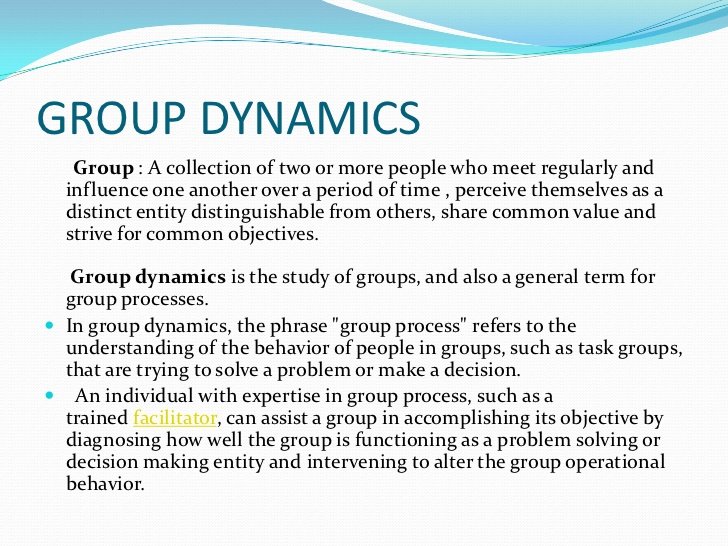
The term ‘group dynamics’ means the study of forces within a group. Since human beings have an innate desire for belonging to a group, group dynamism is bound to occur. In an organization or in a society, we can see groups, small or large, working for the well-being.

The social process by which people interact with one another in small groups can be called group dynamism. A group has certain common objectives & goals. Because of which members are bound together with certain values and culture.

Group dynamics deals with the attitudes and behavioral patterns of a group. Group dynamics concern how groups are formed, what is their structure and which processes are followed in their functioning. Thus, it is concerned with the interactions and forces operating between groups.

Importance/Role of Group Dynamics

  • Firstly, a group can influence the way the members think. The members are always influenced by the interactions of other members in the group. A group with a good leader performs better as compared to a group with a weak leader.
  • The group can give the effect of synergy, that is, if the group consists of positive thinkers then its output is more than double every time.
  • Group dynamism can furthermore give job satisfaction to the members.
  • The group can also infuse the team spirit among the members.
  • Even the attitude, insights & ideas of members depend on group dynamism. For example, negative thinkers convert to positive thinkers with the help of the facilitator.
  • Also, if the group works as a cohesive group, the cooperation and convergence can result in maximiza­tion of productivity
  • Furthermore, group dynamism can reduce labor unrest. Lastly, it reduces labor turnover due to emotional attach­ment among the group members.

Process/Stages of Group Dynamics

Group Development is a dynamic process. How do groups evolve? There is a process of five stages through which groups pass through. The process includes the five stages: forming, storming, forming, performing, and adjourning.

  1. Forming

The first stage in the life of a group is concerned with forming a group. This stage is characterized by members seeking either a work assignment (in a formal group) or other benefit, like status, affiliation, power, etc. (in an informal group). Members at this stage either engage in busy type of activity or show apathy.

  1. Storming

The next stage in this group is marked by the formation of dyads and triads. Members seek out familiar or similar individuals and begin a deeper sharing of self. Continued attention to the subgroup creates a differentiation in the group and tensions across the dyads / triads may appear. Pairing is a common phenomenon. There will be conflict about controlling the group.

  1. Norming

The third stage of group development is marked by a more serious concern about task performance. The dyads/triads begin to open up and seek out other members in the group. Efforts are made to establish various norms for task performance.

Members begin to take greater responsibility for their own group and relationship while the authority figure becomes relaxed. Once this stage is complete, a clear picture will emerge about hierarchy of leadership. The norming stage is over with the solidification of the group structure and a sense of group identity and camaraderie.

  1. Performing

This is a stage of a fully functional group where members see themselves as a group and get involved in the task. Each person makes a contribution and the authority figure is also seen as a part of the group. Group norms are followed and collective pressure is exerted to ensure the Process of Group effectiveness of the group.

The group may redefine its goals Development in the light of information from the outside environment and show an autonomous will to pursue those goals. The long-term viability of the group is established and nurtured.clip_image002

  1. Adjourning

In the case of temporary groups, like project team, task force, or any other such group, which have a limited task at hand, also have a fifth stage, This is known as adjourning.

The group decides to disband. Some members may feel happy over the performance, and some may be unhappy over the stoppage of meeting with group members. Adjourning may also be referred to as mourning, i.e. mourning the adjournment of the group.

The readers must note that the four stages of group development mentioned above for permanent groups are merely suggestive. In reality, several stages may go on simultaneously.

Types of Groups

One way to classify the groups is by way of formality, formal and informal. While formal groups are established by an organization to achieve its goals, informal groups merge spontaneously. Formal groups may take the form of command groups, task groups, and functional groups.

  1. Command Groups

Command groups are specified by the organizational chart and often consist of a supervisor and the subordinates that report to that supervisor. An example of a command group is a market research firm CEO and the research associates under him.

  1. Task Groups

Task groups consist of people who work together to achieve a common task. Members are brought together to accomplish a narrow range of goals within a specified time period. Task groups are also commonly referred to as task forces. The organization appoints members and assigns the goals and tasks to be accomplished.

Examples of assigned tasks are the development of a new product, the improvement of a production process, or designing the syllabus under semester system.

Other common task groups are ad hoc committees, project groups, and standing committees. Ad hoc committees are temporary groups created to resolve a specific complaint or develop a process are normally disbanded after the group completes the assigned task.

  1. Functional Groups

A functional group is created by the organization to accomplish specific goals within an unspecified time frame. Functional groups remain in existence after achievement of current goals and objectives. Examples of functional groups would be a marketing department, a customer service department, or an accounting department.

Group Norms

Group norms are the informal guidelines of behavior and a code of conduct that provides some order and conformity to group activities and operations. These rules are expected to be followed by all the group members. These norms and rules usually develop gradually and informally as group members learn as to what behaviors are necessary for the group to function effectively. These norms may include a code of dress for meetings or being on time for the meetings and behaving in a predictable manner both within and outside the group meetings.

This predictability of behavior also causes higher degree of cohesiveness within the group. Predictability reduces chaos, ambiguity and conflict. Discomfort would be high in a committee or a task group, if the group members are not sure as to how each member would behave. Norms also identify the values and ethics of the group members. They are established on the basis of what is right and decent and expected of professionals. For example, some companies have very rigorous dress standards, tolerating no deviation, such as the Federal Bureau of Investigation (FBI).

Types of Group Norms

  1. Behavior Norms

Theses are rules and guidelines defining the day-to-day behavior of people at work. This behavior pattern may include punctuality as a habit, completing any given assignments within the required time framework, not losing temper, showing respect for other member’s opinions, not monopolizing the conversation and so on. Certain professionalism is expected from all members and this professionalism is predictable form of behavior.

  1. Work Norms

Work norms regulate the performance and productivity of individual members. An overly ambitious worker who produces more is considered as much a deviate from the norms as a worker who is an under producer. Work norms usually put an acceptable level of productivity, within reasonable tolerances so that comparatively poor performers can also be accommodated and that they do not become a burden on their peers.

Workers performing below the lower acceptable level are generally Informally reprimanded and encouraged to produce more. On the other hand, rate-busters who perform above the upper acceptable limit set by the group are also ostracized for encouraging the management to raise its expectations.

In addition to productivity, work norms may also define the extent of time spent on the job. For example, if coffee breaks are allowed for 15 minutes in the morning, then those members who do not take coffee breaks at all as well as those members who take longer coffee breaks are considered as disobeying the group norms. Thus, groups will often want to regulate not only how much workers produce, but also how many hours they put in on the job. Some work norms are strengthened when management tends to exploit some of the members of the groups. Thus norms might also define the limits placed upon worker interaction and cooperation with superiors.

Other work norms might involve loyalty or confidentiality on the part of members. Workers are not expected to report about fellow workers to supervisors. Similarly confidentiality is a powerful group norm so that no matter how much tension there may be between workers and management, the workers will not divulge company secrets to competing organizations.

Group norms are generally reinforced if all members agree to abide by them and the members will agree if they firmly believe that adherence to such norms will facilitate group goals achievement or ensure group survival and additionally, such norms do not conflict with individual values and principles. Also, the norms are reinforced if the members value their membership in the group and do not like the outcomes of violating them. The outcome of violating the group norms must be sufficiently consequential in order to discourage members to deviate from them.

The groups enforce compliance with norms in many ways. They can reward people who comply with group norms by appreciating them, by listening to them in a respectful manner and by making them leaders of the group. Also, they can take negative actions against those persons who deviate from group norms in the form of ridicule or ‘silent treatment’ or by withdrawing privileges or by ultimate action of expelling them from the membership of the group.

Theories of Group

  1. Propinquity Theory

The most basic theory explaining affiliation is propinquity. This interesting word simply means that individuals affiliate with one another because of spatial or geographical proximity. In an organization employees who work in the same area of the plant or office or managers with offices close to one another would more probably form into groups than would those who are not physically located together. There is some research evidence to support the propinquity theory and on the surface, it has a great deal of merit for explaining group formation. The drawback of this theory is that it is not analytical and does not begin to explain some of the complexities of group formation. Some more theoretical and practical reasons need to be explored.

  1. Homan’s Theory

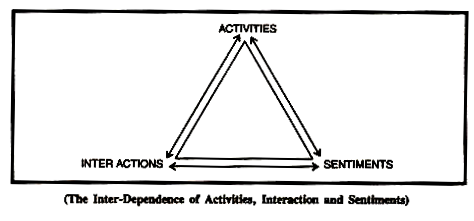
According to George C. Homans, “The more activities persons share, the more numerous will be there interactions and the stronger will be their shared activities and sentiments, and the more sentiments people have for one another, the more will be their shared activities and interactions.”

It is a very comprehensive theory and based on activities, interactions and Homan’s theory is based on sentiments. These three elements are directly related to each other. The members’ activities interactions and of a group share activities and interact with one another not just because of physical proximity but also to accomplish group goals.

The key element is interaction because of which they develop common sentiments for one another. These sentiments gradually get expressed through the formation of informal groups. If any disturbance is caused to any of the three-activities, interactions and sentiments, it is likely to disturb all the others.

Their relationships are shown in the following figure:

The Inter-Dependence of Activities, Interaction and Sentiments

  1. Balance Theory

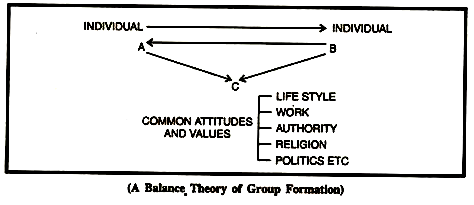
Another very comprehensive theory is a Balance Theory of group formation. This theory as proposed by Theodore Newcomb states that “Persons are attracted to one another on the basis of similar attitudes towards commonly relevant objects and goals. Once a relationship is formed, it strives to maintain a symmetrical balance between the attraction and the common attitudes. If an imbalance occurs, attempts are made to restore the balance. If the balance cannot be restored, the relationship dissolves.”

Thus, the balance theory is additive in nature in the sense, that it introduces the factor of balance to the propinquity and interaction factors. There must be a balance in the relationship between the group members for the group to be formed and for its survival. The following -figure shows the balance theory.

Individual (A) will interact and form a relationship/group with individual (B) because of common attitudes and values (C). Once this relationship is formed, the participants strive to maintain a symmetrical balance between the attraction and the common attitudes. If an imbalance occurs, an attempt is made to restore the balance. If the balance cannot be restored, the relationship dissolves.

  1. Exchange Theory

This theory is based on reward-cost outcomes of interactions. To be attracted towards a group, a person thinks in terms of what he will get in exchange of interaction with group members. A minimum positive level (rewards greater than costs) of an outcome must exist in order for attraction or affiliation to take place. Rewards from interactions gratify needs while costs incur anxiety, frustrations, embarrassment or fatigue. Propinquity, interaction and common attitudes all have roles in the exchange theory.

Group Cohesiveness

Group cohesiveness (also called group cohesion and social cohesion) arises when bonds link members of a social group to one another and to the group as a whole. Although cohesion is a multi-faceted process, it can be broken down into four main components: social relations, task relations, perceived unity, and emotions. Members of strongly cohesive groups are more inclined to participate readily and to stay with the group.

Factors Contributing to Group Cohesiveness

There are many factors that foster the cohesion of the group. Some of the more important factors are illustrated below:

  1. Time Together

It is quite natural that the more time people spend together, the more they will get to know each other and more tendency there will be to get closer to each other, thus strengthening the degree of cohesiveness. This is based upon the assumption that you will spend more time with only those whom you like personally and want to continue interacting with them.

These interactions typically lead to common interests and increased attraction. The idea of long courtships or the idea that couples live together before marriage is primarily to ensure that there will be a high degree of cohesiveness in the marriage if the couple gets to know each other well by spending more time together and in close proximity to each other.

In an organizational setting, people who work near each other are more likely to spend more time together. For example, among clerical workers in one organization, it was found that distance between their desks was the single most important determinant of the rate of interaction among them.

  1. Group Size

Since continuous and close interaction among members is a fundamental necessity for cohesiveness, it would be natural to assume that large groups restrict the extent of communication and interaction with each other, thus resulting in the reduction of degree of cohesiveness.

Another problem with large size groups is that there is a likelihood of forming small groups within the large groups. This would result in the dilution of the common group goal thus increasing the extent of power politics play. This tends to decrease the overall cohesiveness.

Another interesting aspect about group cohesion depends upon whether the group is all male, all female or mixed. Studies showed that if all members were of the same sex then smell groups had better cohesion than large ones. But when the groups were made up of both males and females, then larger groups had better cohesion. It seems that people like to join mixed groups than single sex groups and an opportunity to interact with a larger set of both sexes increases cohesiveness.

  1. Difficult in Entry

Some groups are not easy to join. The members are very carefully selected and the selected member feels a sense of pride and accomplishment. The more difficult it is to get into a group, the more cohesive that group becomes. The reason being that in exclusive and elite groups the members are selected on the basis of certain characteristics and these characteristics being common to all add to the degree of liking and attraction towards each other.

The more exclusive the group, the more is the closeness among members. Accordingly, individuals like to join such exclusive groups. That is one reason, for example, why many bright students want to study at Harvard and Princeton universities. Similarly, exclusive yacht clubs and golf clubs have applicants on their waiting lists for many years before they are accepted.

  1. Threat and Competition

Whenever the common group goal is threatened, cohesiveness increases. Also, such cohesiveness increases the importance of the goals. When we fight for a goal then the goal gets the highest priority. For example, when a hostile group wants to take over a corporation, the Board of Directors of the corporation suddenly becomes a united front against the threats and their cohesiveness reaches its peak. Similarly, management threats frequently bring together an otherwise disarrayed union. Thus the threatening party will have less chance of success when faced with a unified force.

  1. Previous Successes

When a group achieves a meaningful goal, the cohesiveness of the group increases because the success is shared by all the members and each one feels responsible for the achievement. For example, when a sports team wins an important game, every one in the team congratulates every other member of the team for this success.

Specially, if a group has a series of successes, it builds a united team spirit. For this reason, successful companies find it easier to hire new talented employees. Similarly, prestigious universities are never short of applicants for admission. This proves that every one loves a winner.

Similarity of Attitudes and Values: One of the strongest sources of group cohesiveness is the similarity in values, morals, beliefs and code of conduct. We enjoy the company of others who hold similar opinions and characteristics as ourselves. That is one reason why interfaith marriages are discouraged. Similarity of interests is specially important when the group’s primary goal is that of creating a friendly interpersonal climate.

This increases group cohesiveness. This factor may not be so important if the goal is task oriented. For example, if an army unit has to win a strategic battle, then the successful task accomplishment becomes the cohesive factor rather than the similarity of interests because the unit may consist of black soldiers and white soldiers who may not have much in common.

Dynamics of Informal Group

Groups serve a counter organizational function, attempting to counteract the coercive tendencies in an organization. If management prescribes production norms that the group considers unfair, for instance, the group’s recourse is to adopt less demanding norms and to use its ingenuity to discover ways in which it can sabotage management’s imposed standards.

Informal groups have a powerful influence on the effectiveness of an organization, and can even subvert its formal goals. But the informal group’s role is not limited to resistance. The impact of the informal group upon the larger formal group depends on the norms that the informal group sets. So the informal group can make the formal organization more effective, too.

A norm is an implied agreement among the group’s membership regarding how members in the group should behave. From the perspective of the formal group, norms generally fall into three categories-positive, negative, and neutral. In other words, norms either support, obstruct, or have no effect on the aims of the larger organization.

For example, it the informal group in Jeff’s shop set a norm supporting high output, that norm would have been more potent than any attempt by Jeff to coerce compliance with the standard. The reason is simple, yet profound. The norm is of the group members own making, and is not one imposed upon them. There is a big motivational difference between being told what to do and being anxious to do it.

If Jeff had been aware of group dynamics, he might have realized that informal groups can be either his best friend or his worst enemy. He should have been sensitive to the informal groups within his area and he should have cultivated their goodwill and cooperation and made use of the informal group leadership.

That is, he should have wooed the leadership of the informal group and enlisted the support of its membership to achieve the formal organization’s aims. The final effect of his actions might have been positive or negative, depending upon the agreement or lack of it between the informal group and himself.

Harnessing the power of informal groups is no easy task. The requirements include: an understanding of group dynamics and, an ability to bring about changes in informal group norms that positively reinforce the formal organization’s goals.

As a starting point, managers and supervisors should at least be aware of the reasons behind informal group formation and the properties and characteristics of these groups.

Formation of informal work groups

Individuals are employed by an organization to perform specific functions. Although the whole person joins an organization, attention is usually focused on the partial person, the part of the individual doing the job. Because people have needs that extend beyond the work itself, informal groups develop to fill certain emotional, social, and psychological needs.

The degree to which a group satisfies its members needs determines the limits within which individual members of the group will allow their behavior to be controlled by the group.

Sense of belonging

Several major functions are served by informal groups. For example, the group serves as a means of satisfying the affiliation needs of its members for friendship and support. People need to belong, to be liked, to feel a part of something. Because the informal group can withhold this attractive reward, it has a tool of its own to coerce compliance with its norms.

Identity and self esteem

Groups also provide a means of developing, enhancing, and confirming a person’s sense of identity and self-esteem. Although many organizations attempt to recognize these higher needs, the nature of some jobs-their technology and environment-precludes this from happening. The long assembly line or endless rows of desks reinforce a feeling of depersonalization.

Stress reduction

Another function of groups is to serve as an agent for establishing and testing social reality. For instance, several individuals may share the feeling that their supervisor is a slave driver or that their working conditions are inadequate. By developing a consensus about these feelings, group members are able to reduce the anxiety associated with their jobs.

All for one, one for all

Finally, the informal group serves as a defense mechanism against forces that group members could not resist on their own. Joining forces in a small group makes the members feel stronger, less anxious, and less insecure in the face of a perceived threat.

As long as needs exist that are not served by the formal organization, informal groups will form to fill the gap. Since the group fills many important needs for its members, it influences member behavior.

Leadership of informal work groups

Informal groups possess certain characteristics that, if understood, can be used to advantage. While many of these characteristics are similar to those of formal organizations, others are unique. One attribute of informal groups is rotational leadership.

The informal leader emerges as the individual possessing qualities that the other members perceive as critical to the satisfaction of their specific needs at the moment; as the needs change so does the leader. Only rarely does a single individual possess all of the leadership characteristics needed to fill the various needs of the group.

Unlike the formally appointed leader who has a defined position from which to influence others, the informal leader does not possess formal power. If the informal leader fails to meet the group’s expectations, he or she is deposed and replaced by another. The informal group’s judgment of its leaders tends to be quicker and more cold-blooded than that of most formal groups.

Supervisory strategies

The supervisor can use several strategies to affect the leadership and harness the power of informal groups. One quick and sure method of changing a group is to cause the leader to change one or more of his or her characteristics. Another is to replace the leader with another person.

One common ploy is to systematically rotate out of the group its leaders and its key members. Considering the rotational nature of leadership, a leader may emerge who has aims similar to the formal goals of the organization. There are problems with this approach, however. Besides the practical difficulties of this, this strategy is blunted by the fact that group norms often persist long after the leader has left the group.

A less Machiavellian approach is for the supervisor to be alert to leaders sympathetic to the supervisor’s objectives and to use them toward the betterment of the formal group’s effectiveness. Still another method is to attempt to ‘co-opt’ informal leaders by absorbing them into the leadership or the decision-making structure of the formal group. Co-opting the informal leader often serves as a means of averting threats to the stability of the formal organization.

Remember, though, a leader may lose favor with the group because of this association with management, and group members will most likely select another leader.

Informal Work Group Communication

Another characteristic of the informal group is its communications network. The informal group has communications processes that are smoother and less cumbersome than those of the formal organization.

Thus its procedures are easily changed to meet the communication needs of the group. In the informal group, a person who possesses information vital to the group’s functioning or well-being is frequently afforded leadership status by its members. Also, the centrally located person in the group is in the best position to facilitate the smooth flow of information among group members.

Knowing about informal group communication the supervisor can provide a strategically placed individual with information needed by the group. This not only enhances the stature of this individual perhaps elevating him or her to a leadership position but also provides an efficient means of distributing information. Providing relevant information to the group will also help foster harmony between the supervisor and the informal group.

By winning the cooperation of informal group leaders the supervisor will most likely experience fewer grievances and better relationships.

Informal group cohesiveness

A third characteristic of informal groups is group cohesiveness-the force that holds a group together. Group cohesiveness varies widely based on numerous factors-including the size of the group dependence of members upon the group achievement of goals status of the group and management demands and pressures.

For example group cohesiveness increases strongly whenever the membership perceives a threat from the outside. This threat produces the high anxiety that strong group cohesiveness can help reduce.

If the supervisor presses the group to conform to a new organizational norm that Is viewed as a threat to the security needs of group members The group will become more unified in order to withstand the perceived threat. Thus management can limit its own effectiveness by helping to increase the group’s cohesiveness. With the passing of the threat the group tends to lose its cohesiveness.

Perhaps paradoxically the most dangerous time for group cohesion is when things are going well. Supervisors can use the factors that affect group cohesiveness to increase their own effectiveness.

Decision making process involvement

For instance a supervisor can involve the informal group members in the decision-making process. Input from group members will not only reduce their feeling of alienation but also improve communication between the supervisor and subordinates thereby reducing potential conflict.

Where group participation in decision making is not practical the supervisor should carefully explain the reasons to play down what might be seen as a threat to the group. In some cases the supervisor may want to increase the groups cohesiveness deliberately devising situations that put one group into competition with another. If this gambit is carefully controlled the solidarity that results may bring a higher level of performance.

The danger of this strategy is that the supervisor may be unable to control the reaction of the group. The ploy could backfire bringing competition and dissension within the group.

Team and Team Building

When individuals with similar interest, attitude, and taste come together to work for a common objective, a team is formed. Every individual contributes equally and performs his level best to meet the team targets and achieve the organization’s goal. Team members strive hard to live up to the expectations of others and successfully accomplish the assigned task. A team cannot do well unless and until each and every member is focused and serious about his responsibilities. For every team member, his team should come first and everything else later. Personal interests must take a backseat.

Every individual must feel motivated to perform his level best. Never impose things on anyone; instead, the individuals must take the initiative on their own. They should come forward and accept the challenge.

Let us go through the below example:

Mike and Jordan were reporting to Steve their team leader. Steve had a tremendous faith on Mike and Jordan, always appreciated them in front of others and even went out for dinners with his team. His team was way ahead of the other teams and never fell short of their targets. Steve was the most admired team leader.

Steve never had to convince Mike and Jordan to take up any new responsibility; they were always on their toes and accepted new assignments willingly.

Why do you think Mike and Jordan were always eager to work ? The answers to this question are the various efforts which their team leader took to motivate and extract the best out of them. This explains team building.

Team Building

Team building refers to the various activities undertaken to motivate the team members and increase the overall performance of the team. You just can’t expect your team to perform on their own. A motivating factor is a must. Team Building activities consist of various tasks undertaken to groom a team member, motivate him and make him perform his best.

We all are human beings and love appreciation. Any individual performing exceptionally well must be appreciated well in public. He feels happy and motivated to perform even better the next time. If any team member has come out with a unique idea; treat him with any thing that makes him happy. Never criticize any team member or demotivate him if he has failed to perform. Ask him to “Buck up”.

Team Building Exercises

  • Encourage many trust building exercises in your team. Team members must trust each other for the maximum output. Blindfold half of your team members and ask them to jump over bricks with the help of members who can see. Repeat this exercise and now blindfold those who could see earlier. This exercise goes a long way in building the trust among the team members. An individual might be a little hesitant initially, but the moment he jumps over the brick with his fellow team member without getting hurt, he starts trusting him. The trust factor increases with time and relations among the team members improve.
  • One must know his fellow team member well. You can’t work with someone you don’t know. Include a lot of exercises which help the team members know each other well. Make pairs and ask them to write whatever they know about their partner and vice a versa. You can ask anyone to write his partner’s favourite colour, favourite outfit, preferred hangout zone and so on. Ask his partner to correct him if he is wrong in his answers. People know a lot about each other this way and also find out some unknown facts about their partner. Ask the team members to give their introduction one by one once the team is formed.
  • The team members must be compatible with each other. Include icebreaking activities in the team. Take them out for picnics; get togethers where they can interact with each other freely on any topic. Allow the individuals to bring their families as well. People come a lot closer this way. Relationships improve. Remember your team member’s birthday, anniversary or any other important date and do not forget to wish him that day. Ask for a treat! This way, individuals are no longer strangers to each other and the bonding increases.
  • Encourage activities where individuals come together as a single unit and work for a common task. Collect some even sized sticks, rope, nails, hammer, and glue stick. Ask your team members to construct a bridge out of the sticks using the rope, hammer, gluestick and nails. You will be surprised to see that everyone will be involved in the activity and help each other in making the bridge. The concentration and will power to do something increases and individuals learn to work as a single unit. They all work together, each one contributing something or the other to construct the bridge i.e. accomplish the task assigned to their team.

Team Building activities are of utmost importance as they help in the overall development of the team members and in turn improving the team’s performance. It also strengthens the bond among the employees and they feel motivated to work and achieve the targets. Some kind of team building activities must be undertaken from time to time to encourage the team members to work hard and realize their dreams.

Perception, Nature, Importance, Role in Individual Decision Making

Perception refers to the process by which individuals interpret and make sense of sensory information from their environment. It involves selecting, organizing, and interpreting sensory stimuli such as sight, sound, touch, taste, and smell to form a meaningful understanding of the world. Perception is influenced by various factors, including past experiences, cultural background, expectations, and cognitive biases. These factors shape individuals’ perceptions, leading to differences in how they perceive and interpret the same stimuli. Perception plays a crucial role in guiding behavior, decision-making, and interpersonal interactions, as individuals’ perceptions shape their beliefs, attitudes, and responses to the world around them.

Nature of Perception:

  • Subjectivity:

Perception is inherently subjective, as it involves the interpretation of sensory information based on individual experiences, beliefs, expectations, and cognitive biases. Two people exposed to the same stimulus may perceive it differently due to their unique perceptual filters and cognitive frameworks.

  • Selective Attention:

Perception involves selective attention, whereby individuals focus on certain aspects of sensory input while ignoring others. This process allows individuals to prioritize relevant information and filter out irrelevant or distracting stimuli, enhancing cognitive efficiency and adaptive functioning.

  • Organization and Interpretation:

Perception involves organizing and interpreting sensory information to construct a coherent and meaningful understanding of the environment. This process is influenced by perceptual principles such as Gestalt principles of grouping (e.g., proximity, similarity, closure) and perceptual constancies (e.g., size constancy, shape constancy), which help individuals organize sensory input into meaningful patterns and objects.

  • Contextual Influence:

Perception is influenced by the context in which stimuli are presented, including situational factors, social cues, and cultural norms. Contextual cues provide valuable information that shapes individuals’ interpretations and attributions of sensory input, leading to context-dependent perceptual experiences.

  • Perceptual Adaptation:

Perception is adaptable and malleable, as individuals can adjust their perceptual processes in response to changing environmental conditions and sensory input. Perceptual adaptation allows individuals to accommodate to novel or unfamiliar stimuli over time, leading to changes in perceptual sensitivity and acuity.

  • Top-Down and Bottom-Up Processing:

Perception involves both top-down processing, where prior knowledge, expectations, and cognitive factors influence perceptual interpretation, and bottom-up processing, where sensory input is analyzed and synthesized into higher-level perceptual representations. The interaction between top-down and bottom-up processing influences the efficiency and accuracy of perceptual judgments and decision-making.

  • Perceptual illusions and Biases:

Perception is susceptible to illusions and biases, where perceptual experiences deviate from objective reality due to cognitive distortions or misinterpretations of sensory input. Perceptual illusions, such as the Müller-Lyer illusion or the Ponzo illusion, highlight discrepancies between perception and reality, revealing the limitations of perceptual processing.

  • Perceptual Plasticity:

Perception exhibits plasticity, as it can be shaped by learning, experience, and sensory deprivation. Sensory experiences and environmental exposure influence the development and refinement of perceptual skills, leading to changes in perceptual sensitivity, discrimination, and resolution.

  • Multisensory Integration:

Perception involves integrating information from multiple sensory modalities, such as vision, audition, touch, taste, and smell, to construct a coherent and unified perceptual experience. Multisensory integration enhances perceptual accuracy and richness by combining complementary sensory inputs and resolving conflicting information across modalities.

  • Individual Differences:

Perception varies across individuals due to factors such as age, gender, culture, and sensory abilities. Individual differences in perceptual processing influence how individuals perceive and interact with their environment, leading to variations in perceptual preferences, strategies, and biases.

Importance of Perception:

  • Understanding Reality:

Perception serves as the lens through which we interpret and make sense of the external world. By organizing and interpreting sensory input, perception allows us to navigate our surroundings, identify objects and events, and understand the relationships between them. Our perception of reality influences our beliefs, attitudes, and behaviors, shaping our interactions with the world and guiding our decision-making processes.

  • Adaptive Functioning:

Perception facilitates adaptive functioning by allowing us to prioritize relevant information and respond effectively to environmental demands. Through selective attention and perceptual categorization, we can filter out irrelevant stimuli and focus on salient cues that are essential for survival and goal attainment. Adaptive perception enables us to detect potential threats, locate resources, and engage in adaptive behaviors that enhance our chances of survival and success.

  • Social Interaction:

Perception plays a vital role in social interaction by influencing how we perceive and interpret the thoughts, feelings, and intentions of others. Social perception allows us to make inferences about people’s personalities, emotions, and behaviors based on subtle cues such as facial expressions, body language, and vocal tone. Accurate social perception is essential for forming interpersonal relationships, establishing rapport, and navigating social dynamics effectively.

  • Decision Making:

Perception informs decision-making processes by providing the sensory input and cognitive representations necessary for evaluating options and selecting appropriate courses of action. Our perceptions of risks, benefits, and consequences shape our decision-making preferences and strategies, influencing the choices we make in various domains such as health, finance, and relationships. By accurately perceiving the outcomes of our decisions, we can make informed choices that align with our goals and values.

  • Cognitive Processing:

Perception is closely linked to cognitive processing, as it provides the raw sensory data that serve as inputs for higher-level cognitive functions such as attention, memory, and problem-solving. Perceptual processing influences how we allocate cognitive resources, encode and retrieve information from memory, and generate mental representations of our experiences. By optimizing perceptual processing, we can enhance cognitive efficiency, learning, and intellectual performance.

  • Emotional Regulation:

Perception plays a crucial role in emotional regulation by influencing how we perceive and interpret emotional stimuli in our environment. Perceptual processes such as emotional appraisal and attribution shape our emotional responses to events and situations, determining whether we perceive them as threatening, rewarding, or neutral. By accurately perceiving and interpreting emotional cues, we can regulate our emotions more effectively, manage stress, and maintain psychological well-being.

  • Problem Solving:

Perception is essential for problem-solving and creative thinking, as it enables us to identify problems, generate alternative solutions, and evaluate their effectiveness. Perceptual processes such as pattern recognition, analogical reasoning, and insight play a key role in problem-solving by facilitating the discovery of novel solutions and overcoming cognitive barriers. By enhancing perceptual flexibility and creativity, we can improve our problem-solving skills and adapt to changing circumstances more effectively.

  • Self-Concept and Identity:

Perception shapes our self-concept and identity by influencing how we perceive ourselves and others in relation to social and cultural norms. Perceptual processes such as self-perception and social comparison inform our beliefs, values, and self-evaluations, shaping our sense of identity and self-esteem. By cultivating accurate and positive perceptions of ourselves and others, we can enhance our self-confidence, resilience, and overall psychological well-being.

Perception Role in individual decision making:

  • Information Processing:

Perception serves as the initial stage of information processing in decision making, as sensory inputs are translated into perceptual representations that are then evaluated and acted upon. The way individuals perceive and interpret information shapes their understanding of the decision context, influencing subsequent cognitive processes such as attention, memory, and reasoning.

  • Selective Attention:

Perception influences selective attention, determining which aspects of the decision environment individuals focus on and prioritize. Individuals tend to pay attention to stimuli that are perceived as relevant or salient, filtering out irrelevant or distracting information. This selective attention process affects what information is considered in the decision-making process and can impact the quality of decisions made.

  • Interpretation and Evaluation:

Perception influences how individuals interpret and evaluate the significance of decision-relevant information. Perceptual biases and heuristics, such as confirmation bias (favoring information that confirms existing beliefs) or anchoring bias (relying too heavily on initial information), can distort individuals’ perceptions and lead to suboptimal decision outcomes. The way information is perceived and interpreted can shape individuals’ judgments, preferences, and choices.

  • Risk Perception:

Perception plays a crucial role in how individuals perceive and evaluate risks associated with decision options. Perceptions of risk are influenced by factors such as the framing of decision outcomes, the context in which decisions are made, and individuals’ subjective interpretations of uncertainty and probability. Perceptual biases, such as optimism bias (underestimating personal risk) or loss aversion (preferring to avoid losses over acquiring equivalent gains), can impact risk perception and influence decision-making behavior.

  • Emotional Influences:

Perception is intertwined with emotional processes in decision making, as emotional responses to decision-relevant information can influence perceptions of risk, value, and desirability. Emotionally charged stimuli may elicit strong affective reactions that influence individuals’ judgments and decisions, sometimes overriding rational considerations. Emotional biases, such as the affect heuristic (using emotional responses as a shortcut for decision-making), can shape individuals’ perceptions of decision options and lead to impulsive or irrational choices.

  • Perceptual Framing:

The way decision options are framed or presented can influence individuals’ perceptions and preferences, leading to different decision outcomes. Perceptual framing effects, such as the framing effect (preferring options presented in a positive frame) or the reference dependence effect (evaluating outcomes relative to a reference point), can shape individuals’ perceptions of decision alternatives and influence their choices.

  • Cognitive Biases:

Perceptual biases and cognitive heuristics can lead to systematic errors in decision making. For example, availability heuristic (judging the likelihood of events based on how easily they come to mind) can lead to overestimation of the frequency or importance of rare events, while representativeness heuristic (making judgments based on perceived similarities to prototypes) can lead to inaccurate assessments of probability and risk.

  • Feedback and Learning:

Perception plays a role in feedback processing and learning from decision outcomes. Individuals’ perceptions of the feedback received following a decision influence their subsequent decisions and behaviors. Perceptual biases, such as attribution bias (attributing success to internal factors and failure to external factors), can affect how individuals interpret and learn from feedback, potentially leading to persistent patterns of decision-making errors.

Difference between Sensation and Perception

We have five different sensory organs: eyes, nose, ears, tongue, and skin. These five sensory organs are responsible for receiving different stimulations around us through seeing, smelling, hearing, tasting, and, finally, feeling through the skin. The signals which are received through our sensory organs from the environment around us are called sensations. Simply put, sensations are what our sense organs receive and transmit to the brain. Once the brain receives the stimulus, it converts the whole signal into feelings, taste, sound, sight, and smell. On the other hand, perception is almost like a sixth sense. It is what we perceive or form an opinion on of anything and everything happening around us.

The perception of a person is an absolutely personal experience. It is what a person thinks about his or her environment, and it is how the person looks at the world around him. It is more of a psychological concept than anything physical like sensations. Two different people can have different perceptions about the same thing. For example, in body image, a healthy person has a different perception about his or her body. Healthy people, even if they are a little overweight, react and see themselves differently and accept who they are or work towards achieving what they want. Once they achieve it, they stop. While an anorexic person, no matter how slim, no matter how underweight, has a perception that they are still overweight and stops eating food altogether to achieve, what they perceive, to be the right body for them.

Perception is what a person wants to believe, their personal opinion. People of different generations or people of different religions or people from different backgrounds have a difference of opinion only because they perceive everything differently. Wise people try to understand the perceptions of other people whereas unwise people believe that what they perceive about a situation or about a person is the only correct perception.

Perception and sensation are different mostly because sensation is more physical. Sensations arise only because the body receives a stimulus, and the body reacts to it converting the stimulus into one of the things that one of the sensory organs of the body can identify. However, perception is absolutely psychological. Perceptions are individual thoughts of individual people.

Sensation is objective. It normally just refers to the stimuli and the objective and universal affect of that stimuli. Everyone that has a functional eye and optic nerve have this, basically everyone that has vision.

Perception on the other hand is subjective. It is not necessarily universal and the same among everyone. This doesn’t have to be directly linked to the signal sent from the eye, various factors can make that interpretation of the brain make the image look different, both normal(physiological) and abnormal(pathological) factors. You don’t observe the sensing, but your perception of the picture the brain makes.

Processing of the sensation by the brain isn’t happening only for vision, but all inputs to the brain(tactile, smell, taste, and sound) and can be affected by various and there are many more factors that are involved.

In some way: Sensation is the raw material, while perception is the product after having been handled, manipulated and changed by the brain.

Summary

Sensation is the process of hearing, smelling, feeling, tasting, and seeing as a result of external stimulations received by the five sensory organs of the body; ears, eyes, nose, tongue, and skin. Perception, however, is the mental image of something or somebody made due to the different actions exhibited by the environment around us.

error: Content is protected !!