Organizational Development Interventions

Business leaders must continually look at the changing market to develop and implement strategies within their organizations. Failure to do so results in becoming less relevant to consumers and losing revenues. Organizational development intervention techniques are designed to assess information, process new strategies, and effectively integrate new approaches. Following the eight steps for organizational development process interventions helps leaders remain focused on specifics as they proceed through organizational change.

Eight Steps for Organizational Development Interventions

  1. Entry Signals

Entry signals refer to the flags a business leaders sees outside the business that alert him to start thinking about change. An entry signal could be external, such as a new competitor with innovative solutions, or internal, such as a sudden influx of negative feedback on products and services.

  1. Purpose

The purpose step defines the core issues that are at play with newly discovered issues. This may be the step where a third-party change agent is brought in to take over the organizational development (OD) intervention. For example, an influx of complaints may have started at the onset of moving to fulfillment centers with inexperienced employees. The change agent goes to the site and gathers all pertinent information. The purpose is to develop a strategy that will resolve the issues with the fulfillment center.

  1. Assessment

Assessment takes the information gathered in the previous step and summarizes the feedback. This is presented to other stakeholders and management so the group can then review the issues, the overall company goals and budget.

  1. Action Plan

Stakeholders and leaders develop a plan to solve the problem. In the case of the new fulfillment center, the assessment may demonstrate a lack of training on company processes for fulfillment. The action plan becomes to implement a new training program to resolve it.

  1. Intervention

With intervention, leadership takes the action plan steps and begins the implementation process. Leadership explains to teams the series of changes that will happen and rolls out the change plan. In the case of the new fulfillment center, this means organizing the training in a way to least disrupt operations and running training programs.

  1. Evaluation

Once the intervention is complete, leadership evaluates the results. This is where metrics are collected and measured compared to the control defined in the purpose and assessment phase and the goals set forth in the action plan.

  1. Adoption

After evaluating the success metrics of the action plan, the stakeholders and leadership determine if the changes will become a new part of the organization policy. In the case of the training program, it might become a mandatory onboarding process for all employees to complete.

  1. Separation

Separation is the closure of the organizational development process most prominent when the change was implemented by a third-party change agent. This person begins the process of stepping away from the organization and project, providing duties to others within the organizations. If leadership was helming the intervention, a systematic delegation of duties is implemented to allow leaders to get to other tasks and projects.

Types of OD Interventions

We can classify the OD interventions into three categories:

  1. Behavioural Techniques: These techniques are designed to affect the behaviour of individuals and the group. These include:

(i) Sensitivity Training

The purpose of sensitivity training sessions or T-groups (T for training) is to change the behaviour of people through unstructured group interaction. Members (ten to fifteen individuals) are brought together in a free and open environment, away from work places, in which participants discuss themselves freely, aided by a facilitator. No formal agenda is provided.

The objectives of the T-groups are

  • To provide the participants with increased awareness of their own behaviour
  • How others perceive the, greater sensitivity to the behaviour of others
  • Increased understanding of group processes.

(ii) Role Playing

Role playing may be described as a technique of creating a life situation, usually one involving conflict between people, and then having persons in group play the parts or roles of specific personalities. In industry, it is used primarily as a technique of or modifying attitudes and interpersonal skills.

For instance, two trainees may play the roles of a superior and a subordinate to discuss the latter’s grievances.

The purpose of role playing is to aid trainees to understand certain business problems and to enable observers to evaluate reactions to them.

Role-playing is generally used for human relations and sales training. This technique makes trainees self-conscious and imaginative and analytical of their own behaviour.

(iii) Management by Objectives (MBO)

Managing by objectives is a dynamic system which integrated the company’s need to achieve its goals for profit and growth with the manager’s need to contribute and develop himself.

Management by objectives (MBO) is a technique designed to

  • increase the precision of the planing process at the organizational level.
  • reduce the gap between employee and organisational goals.
  • MBO encourages performance appraisal through a process of shared goal setting and evaluation.

(iv) Grid development

Grid organizational development is based on Blake and Moution’s model of leadership called the managerial Grid. Their model depicts two prevailing concerns found in all organizations-concern for productivity and concern for people.

Some managers are high in concern for productivity but low in concern for people; others are high in concern for people but low in concern for productivity.

Besides helping managers evaluate their concern for proper and productivity, the Managerial Grid stresses the importance of developing a team-management leadership style.

In grid OD, change agents use a questionnaire to determine the existing styles of managers, help them to re-examine their own styles and work towards maximum effectiveness.

  1. Non-Behavioural Techniques

These techniques are much more structured than behavioural techniques. These include:

(i) Organizational Redesign

The organization’s structure may be changed to make it more efficient by redefining the flow of authority. There are call also be changes in functional responsibility, such as a move from product to matrix organizational structure.

Organizational structure often reflects the personal desires, needs, and values of the chief executive. Changing structure, therefore, may create resistance and concern because people are worried about their power or status, or how the change will affect their work groups.

(ii) Job Enrichment

Job enrichment implies increasing the cents of a job or the deliberate upgrading of the responsibility, scope and challenge in work.

Job enrichment is a motivational technique which emphasises the need for challenging and interesting work. It suggests that jobs be redesigned, so that intrinsic satisfaction is derived from doing the job.

In its best application, it leads to a vertically enhanced job by adding functions from other organizational levels, making it contain more variety and challenge and offer autonomy and pride to employee.

The job holder is given a measure of discretion in making operational decisions concerning his job. In this sense, he gains a feeling of higher status influence and power.

(iii) Work Design

Work design is a broad term meaning the process of defining tasks and jobs to achieve both organizational and employee goals, it must, therefore, take into account the nature of the business (organizational interest), the organizational structure, the information flow and decision process, the differences among employees, and the reward system.

Within the board scope of work, design is the design of individual jobs, that is, job design.

  • Job analysis is the process of obtaining information about jobs.
  • Job redesign makes use of job analysis to redefine a job in terms of tasks, behaviours, education, skills, relationships, and responsibilities required.
  1. Miscellaneous Techniques

In addition to the above techniques, there are certain other techniques which are used in organization development, such as:

(i) Survey Feedback

Survey feedback is one of the most popular and widely used intervention techniques, in the field of OD.

It involves two basic activities:

  • Collecting data about the organization through the use of surveys of questionnaires, and
  • Conducting feedback meetings and workshops in which the data are presented to organizational members.

Survey feedback is useful in as much as it helps bring about changes in attitudes and perceptions of participants. Used along with team building the impact of the survey feedback is much more positive.

(ii) Process Consultation

Process consultation includes “a set of activities on the part of a consultant which help the client to perceive, understand, and act upon process events which occur in the client’s environment”.

Process consultation assumes that an organization’s effectiveness depends on how well its people relate to one another. An organization’s problems, therefore, often can be traced to the breakdown of critical human processes at key places.

Consultation concentrates on certain specific areas as communication, functional roles of members, group problem-solving and decision-making; group norms and growth, leadership and authority, and intergroup cooperation and competition.

(iii) Team Building

Team building is a process of diagnosing and improving the effectiveness of a work group with particular attention to work procedures and inter-personal relationship smith in it, especially the role of the leader in relation to other group members.

Both the group’s task procedures and its human interactions are the subjects of study in team building.

The basic assumption of team building is that increasing the effectiveness of teams will improve the organization’s overall effectiveness.

Importance

(a) It is need to bridge the gap between the existing and required abilities.

(b) It improves the processes, systems, people and management capabilities.

(c) Performance of the organisation as a whole improves.

(d) The quality and quantity of products improves as per demand of the customers.

(e) The sales and revenue of its products and services go high.

(f) The profitability of the company goes high.

(g) The financial position of the company improves.

(h) The market share of the company improves.

(i) The company gets competitive advantage over their arch rivals in markets.

(j) The reputation of the company as a whole improves.

Concept of Organizational Development

Organizational Development or simply O.D. is a technique of planned change. It seeks to change beliefs, attitudes, values and structures-in fact the entire culture of the organization so that the organization may better adapt to technology and live with the pace of change.

O.D. is a comprehensive strategy for organization improvement. O.D. is a long range effort to improve an organization’s problem solving and renewal processes, particularly through a more effective and collaborative management culture.

Objectives of Organizational Development

(a) Improvement in the performance of the organization.

(b) Improvement in the ability of the organization to adapt to its environment, and

(c) Improvement in inter-personal and inter-group behaviour to secure team work.

Characteristics of Organizational Development

  1. Organizational development is an educational strategy for bringing a planned change.
  2. It is related to real problems of the organization.
  3. Laboratory training methods based on experienced behaviour are primarily used to bring change.
  4. O.D. uses change agent (or consultant) to guide and affect the change. The role of change agent is to guide groups towards more effective group processes rather than telling them what to do. Change agents simply assist the group in problem solving processes and the groups solve the problems themselves.
  5. There is a close working relationship between change agents and the people who are being changed.
  6. O.D. seeks to build problem-solving capacity by improving group dynamics and problem confrontation.
  7. O.D. reaches into all aspects of the organization culture in order to make it more humanly responsive.
  8. O.D. is a long term approach (of 3 to 5 years period) and is meant to elevate the organization to a higher level of functioning by improving the performance and satisfaction of organization members.
  9. O.D. is broad-based and describes a variety of change programmes. It is concerned not only with changes in organizational design but also with changes in organizational philosophies, skills of individuals and groups.
  10. O.D. is a dynamic process. It recognises that the goals of the organization change and hence the methods of attaining them should also change.
  11. O.D. utilizes systems thinking. It is based on open, adaptive systems concept. The organization is treated as an interrelated whole and no part of the organization can be changed without affecting other parts.
  12. O.D. is research based. Change agents conduct surveys, collect data, evaluate and then decisions are taken.
  13. O.D. uses group processes rather than individual process. It makes efforts to improve group performance.
  14. O.D. is situational and contingency oriented.
  15. Organization Development and Management Development are complementary rather then conflicting.

Steps in Organizational Development (O.D)

Lawrence and Lorsch have provided the following steps in organizational development:-

  1. Problem identification—Diagnosis

O.D. program starts with the identification of the problem in the organization. Correct diagnosis of the problem will provide its causes and determine the future action needed.

  1. Planning Strategy for Change

O.D. consultant attempts to transform diagnosis of the problem into a proper action plan involving the overall goals for change, determination of basic approach for attaining these goals and the sequence of detailed scheme for implementing the approach.

  1. Implementing the Change

O.D. consultants play an important role in implementing change.

  1. Evaluation

D. is a long-term process. So there is a great need for careful monitoring to get process feedback whether the O.D. programme is going on well after its implementation or not. This will help in making suitable modifications, if necessary. For evaluation of O.D. programme, the use of critic sessions, appraisal of change efforts and comparison of pre and post training behavioural patterns are quite effective.

Change Agent

Change agent is an individual or group, who carry out the task of instigating and managing change in the organization. He/She is someone, who directly or indirectly influences change, i.e. the change agents are appointed by the organizations to transform the ways, the organization is managed, or the business is conducted.

Types of Change Agent

The change agent can be internal or external to the organization who plays the role of a catalyst to implement change in the organization.

  1. Internal Change Agent

When the change agent, is internal to the organization then he/she is usually the employee such as a manager, senior executive, leader, HR professional or any other person from the staff who has mastered in behavioural sciences and intervention technology of organization development. They are appointed by the organization to look after the change process.

  1. External Change Agent

The external change agent is the one who is brought to the organization from outside such as consultants. The company’s rules regulations and policies are not imposed on them, and so they can deeply analyze and bring different viewpoints to a situation and challenge the existing state of affairs.

However, this can also be seen as a disadvantage, as the external change agent is not aware of the company’s history, work processes, and personnel.

Roles of a Change Agent

Change agents aim at making changes in the existing processes or culture of the organization that sticks. And to do so, they focus on the matters relating to organizational effectiveness, innovation, and advancement.

He/She is someone who always seeks an opportunity for change, determines the best approach and bring about change. They are the one who possesses skills and competencies to initiate, facilitate and coordinate organizational change.

Change Agents help the organization in understanding the requirement and relevance for change and takes all necessary steps required to manage change and also anticipates the problem; that might take place during or after the change is implemented in the organization. He/She is responsible to transform vision into a realistic plan and execute it.

Skills of a Change Agent

(i) Cognitive Skills: The skills which require some level of pro-action from the side of the change agent for the purpose of self-understanding, conceptualization, and evaluation.

(ii) Action Skills: Change Agent works as a consultant, researcher, trainer, counsellor, etc. in an organization, so, he/she should possess the required skills and competencies.

(iii) Communication Skills: He/She is responsible for spreading change information, and making the organization realize the need for change, for which he/she must possess excellent communication and pervasive skills.

Many multinational corporations have their own in-house change specialist, who works with the management team of the organization to recognize the need for change and facilitate change efforts.

Characteristics of a Change Agent

  1. Clear Vision

As mentioned above, a “change agent” does not have to be the person in authority, but they do however have to have a clear vision and be able to communicate that clearly with others.  Where people can be frustrated is if they feel that someone is all over the place on what they see as important and tend to change their vision often.  This will scare away others as they are not sure when they are on a sinking ship and start to looking for ways out.  It is essential to note that a clear vision does not mean that there is one way to do things; in fact, it is essential to tap into the strengths of the people you work with and help them see that there are many ways to work toward a common purpose.

  1. Patient yet persistent

Change does not happen overnight and most people know that.  To have sustainable change that is meaningful to people, it is something that they will have to embrace and see importance.  Most people need to experience something before they really understand that, and that is especially true in schools.  With that being said, many can get frustrated that change does not happen fast enough and they tend to push people further away from the vision, then closer.  The persistence comes in that you will take opportunities to help people get a step closer often when they are ready, not just giving up on them after the first try.  I have said continuously that schools have to move people from their point ‘A’ to their point ‘B’, not have everyone move at the same pace. Every step forward is a step closer to a goal; change agents just help to make sure that people are moving ahead.

  1. Asks tough questions

It would be easy for someone to come in and tell you how things should be, but again that is someone else’s solution.  When that solution is someone else’s, there is no accountability to see it through.  It is when people feel an emotional connection to something is when they will truly move ahead.  Asking questions focusing on, “What is best for kids?”, and helping people come to their own conclusions based on their experience is when you will see people have ownership in what they are doing.  Keep asking questions to help people think, don’t alleviate that by telling them what to do.

  1. Knowledgeable and leads by example

Stephen Covey talked about the notion that leaders have “character and credibility”; they are not just seen as good people but that they are also knowledgeable in what they are speaking about.  Too many times, educators feel like their administrators have “lost touch” with what is happening in the classroom, and many times they are right.  Someone who stays active in not necessarily teaching, but active in learning and working with learners and can show by example what learning can look like now will have much more credibility with others.  If you want to create “change”, you have to not only be able to articulate what that looks like, but show it to others. I have sat frustrated often listening to many talk about “how kids learn today” but upon closer look, the same speakers do not put themselves in the situation where they are actually immersing themselves in that type of learning.  How can you really know how “kids learn” or if something works if you have never experienced it?

  1. Strong relationships built on trust

All of the above, means nothing if you do not have solid relationships with the people that you serve.  People will not want to grow if they do not trust the person that is pushing the change.  The change agents I have seen are extremely approachable and reliable.  You should never be afraid to approach that individual based on their “authority” and usually  they will go out of their way to connect with you.

Resistance to Change, Reasons, Types, Overcoming

Organizational Resistance to change refers to the collective reluctance or opposition within an organization to adopt new processes, technologies, or strategies. It stems from various factors, including fear of the unknown, perceived threats to job security, and discomfort with unfamiliar ways of working. Resistance may manifest through passive resistance, such as apathy or skepticism, or active resistance, such as sabotage or defiance. Addressing organizational resistance requires proactive communication, stakeholder engagement, and change management strategies to build trust, manage expectations, and mitigate concerns. By understanding and addressing resistance, organizations can foster a culture of openness, collaboration, and adaptability essential for successful change implementation.

Reasons for Resistance to Change:

  • Fear of the Unknown:

Change often brings uncertainty about the future, including potential impacts on job security, roles, and responsibilities. Employees may resist change due to fear of the unknown and concerns about how it will affect their livelihoods.

  • Loss of Control:

Change can disrupt established routines and processes, leading to a loss of perceived control over one’s work environment. Employees may resist change because they feel threatened by the loss of autonomy or influence over decision-making processes.

  • Comfort with the Status Quo:

Humans are creatures of habit, and familiarity breeds comfort. Employees may resist change simply because they are accustomed to existing ways of working and are hesitant to step out of their comfort zones.

  • Perceived Lack of Benefits:

If employees do not see the benefits of the proposed changes or perceive them as minimal compared to the perceived costs or risks, they may resist change. Clear communication about the rationale and expected benefits of the change is essential to address this resistance.

  • Past Experiences with Change:

Negative experiences with past change initiatives, such as poorly managed transitions or failed implementations, can breed skepticism and resistance to future changes. Trust must be rebuilt through transparent communication and demonstrable commitment to addressing past mistakes.

  • Cultural Inertia:

Organizational culture plays a significant role in shaping attitudes and behaviors toward change. Cultures resistant to change, characterized by rigid hierarchies, risk aversion, or resistance to new ideas, can perpetuate resistance even in the face of compelling reasons for change.

  • Lack of Involvement or Consultation:

Employees are more likely to resist changes imposed upon them without their input or involvement in the decision-making process. Inadequate consultation or participation in the planning and implementation of change initiatives can breed resentment and resistance.

  • Perceived Threats to Relationships or Identity:

Change can disrupt social dynamics and interpersonal relationships within the organization. Employees may resist change if they perceive it as a threat to their relationships with colleagues or their identity within the organization.

Types of Resistance to Change:

  • Active Resistance:

This type of resistance involves overt actions or behaviors aimed at obstructing or undermining change initiatives. Examples include open defiance, sabotage of systems or processes, or spreading rumors and misinformation to discredit the change effort.

  • Passive Resistance:

Passive resistance is characterized by a lack of engagement or enthusiasm towards change without overtly opposing it. Employees may exhibit apathy, disengagement, or a reluctance to participate in change-related activities, impeding progress through inaction.

  • Denial:

Some individuals or groups may deny the need for change altogether, refusing to acknowledge the existence of problems or the necessity of adapting to new circumstances. Denial can manifest as minimizing the significance of change, dismissing evidence of its benefits, or clinging to outdated beliefs and practices.

  • Foot-Dragging:

Foot-dragging involves delaying or procrastinating in implementing change-related tasks or decisions. Employees may intentionally slow down progress, make excuses for missed deadlines, or resist allocating resources to change initiatives, impeding momentum and hindering progress.

  • Skepticism:

Skepticism towards change arises from doubts or reservations about its feasibility, effectiveness, or long-term sustainability. Skeptical individuals may question the rationale behind proposed changes, express skepticism about their potential benefits, or seek evidence to support their concerns.

  • Fear-Based Resistance:

Fear is a common driver of resistance to change, stemming from concerns about the unknown, potential loss of job security, or negative consequences for performance or well-being. Fear-based resistance may manifest as anxiety, stress, or apprehension about the implications of change.

  • Cultural Resistance:

Organizational culture can act as a barrier to change, particularly in cultures that value stability, conformity, or tradition. Cultural resistance may stem from entrenched norms, beliefs, or practices that perpetuate resistance to new ideas, processes, or ways of working.

  • Personal Resistance:

Personal factors, such as ego, pride, or self-interest, can also contribute to resistance to change. Individuals may resist change if they perceive it as a threat to their status, authority, or expertise, or if they feel their personal goals or interests are at odds with the proposed changes.

Overcoming Resistance:

  • Communicate Openly and Transparently:

Provide clear, honest, and timely communication about the reasons for change, its expected impact, and the benefits it will bring to individuals and the organization as a whole. Address concerns, dispel rumors, and provide opportunities for feedback and dialogue to build trust and credibility.

  • Engage Stakeholders:

Involve stakeholders at all levels of the organization in the change process to build ownership, foster alignment, and generate buy-in. Solicit input, address concerns, and incorporate diverse perspectives to ensure that change initiatives reflect the needs and priorities of those affected by them.

  • Provide Support and Resources:

Offer the necessary support, training, and resources to help employees adapt to change and acquire the skills and knowledge needed to succeed in new roles or processes. Investing in training programs, coaching, and mentorship can build confidence and competence and reduce resistance to change.

  • Address Concerns and Resistance:

Proactively identify and address concerns and resistance to change by listening to employees’ feedback, acknowledging their fears and apprehensions, and addressing them empathetically. Tailor communication and interventions to address specific barriers and build confidence in the change process.

  • Empower Change Agents:

Identify and empower change champions within the organization to advocate for change, inspire others, and drive momentum. Change agents can play a crucial role in mobilizing support, addressing resistance, and modeling desired behaviors, enhancing the likelihood of successful change adoption.

  • Lead by Example:

Leaders must demonstrate commitment to change through their words, actions, and behaviors. By modeling openness, adaptability, and resilience, leaders can inspire confidence, build trust, and create a supportive environment conducive to change.

  • Celebrate Successes and Milestones:

Recognize and celebrate achievements along the change journey to boost morale, reinforce progress, and sustain momentum. Celebrations provide an opportunity to acknowledge the efforts of individuals and teams, foster a sense of accomplishment, and build confidence in the change process.

  • Monitor Progress and Adjust Course:

Continuously monitor progress, solicit feedback, and evaluate outcomes to identify barriers, address challenges, and make necessary adjustments to change initiatives. Flexibility and adaptability are key to navigating unforeseen obstacles and ensuring that change efforts remain on track.

Planned Change

One of Newton’s laws is that “bodies in motion tend to stay in motion; bodies at rest tend to stay at rest”. There is an organizational version of this truth. Those who believe in growth and forward movement tend to be exemplars of change, while those who believe in this is how we do things around here” lead to doom. Therefore, bringing change in a planned manner is the prime responsibility of all managers who are forward looking. Planned change aims to prepare the total organization, or a major portion of it, to adapt to significant changes in the organization’s goals and direction. Thomas and Bennis have defined planned change as follows:

“Planned change is the deliberate design and implementation of a structural innovation, a new policy or goal, or a change in operating philosophy, climate or style.”

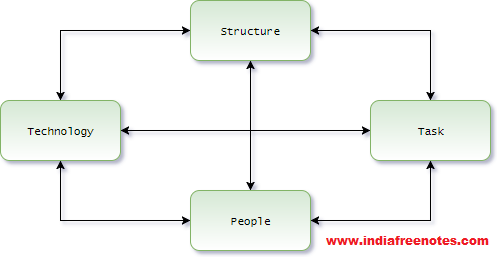
Planned change attempts at all aspects of the organization which are closely interrelated: technology, task, structure, people as shown in fig:

  1. Technology related Changes

Technology refers to the sum total of knowledge providing ways to do things. It may include inventions and techniques which affect the way of doing things, that is designing, producing, and distributing products. Technology-related changes may include:

  • Changing problem-solving and decision-making procedures.
  • Introduction of automated data processing devices like computers to facilitate managerial planning and control.
  • Change in methods of production like conversation of unit production to mass production.
  1. Task related Canges

Technology-related changes determine the types of task that may be required to complete an operation. However, what alternatives are chosen must consider the core job characteristics- skill variety, task identity, task significance, autonomy, and feedback from the job. Task-related changes must focus on:

  • High internal work motivation
  • High quality work performance
  1. Structure related Changes

Structural changes redefine nature of relationships among various organizational positions and may include:

  • Changing the number of Hierarchical levels.
  • Changing one form of organization to another form
  • Changing span of management
  • Changing line-staff and functional authority

When structural changes are effected, these may affect the formal reporting relationships, formal interaction pattern, and consequently informal relations.

  1. People related Changes

Changes of any type as pointed out above require changes in people in an organization. These changes may be of two types- skills and behavior. The magnitude of these changes depends on the type of change. For example, if there is a change in technology, say from manual to automated, it requires different type of skills in the operators as compared to the previously used skills. Similarly, changes in behavior and the socio-psychological factors determine behavior are required.

Nature and Factors of Organizational Change

Organizational change refers to any alteration that occurs in total work environment. Organizational change is an important characteristic of most organizations. An organization must develop adaptability to change otherwise it will either be left behind or be swept away by the forces of change. Organizational change is inevitable in a progressive culture. Modern organizations are highly dynamic, versatile and adaptive to the multiplicity of changes.

Organizational change refers to the alteration of structural relationships and roles of people in the organization. It is largely structural in nature. An enterprise can be changed in several ways. Its technology can be changed, its structure, its people and other elements can be changed. Organizational change calls for a change in the individual behaviour of the employees.

Organizations survive, grow or decay depending upon the changing behaviour of the employees. Most changes disturb the equilibrium of situation and environment in which the individuals or groups exist. If a change is detrimental to the interests of individuals or groups, they will resist the change.

Nature of Organizational Change

The term change refers to an alteration in a system whether physical, biological, or social. Thus organizational change is the alteration of work environment in organization. It implies a new equilibrium between different components of the organization- technology, structural, arrangement, job design, and people. Thus organizational change may have following features:

  • When change occurs in any part of the organization, it disturbs the old equilibrium necessitating the development of the a new equilibrium. The type of new equilibrium depends on the degree of change and its impact on the organization.
  • Any change may affect the whole organization; some parts of the organization may be affected more, others less; some parts are affected directly, others indirectly.
  • Organizational change is a continuous process. However, some changes which are of minor type, may be absorbed by the existing equilibrium; others, which are major ones may require special change efforts.

Factors of Organizational Change

Organizational change as we have read is a strategic initiative impacting almost every aspect of its operations and functions. The factors that induce changes almost always require immediate attention. The major forces that drive this change in business are:

  • Internal environment
  • External environment
  1. The Internal Environment

The internal environment of an organization consists of factors within the organization over which it can exercise a fair amount of control. Some of the internal factors are:

(i) Employees: Employees are the human capital of the organization. An organization without a motivated and dedicated workforce will not be able to perform in spite of having the best products and capital. Employees must take the initiative to change their workplace, or changes in work tasks for more efficient and effective performance.

(ii) The Organizational Structure: The organizational structure is what governs and guides the effective operations of the company. It defines and scopes the authority and hierarchy in the company. However, over time the organizational structure needs reorganization to answer to the needs of an evolving entity and becomes an internal source of organizational change.
(iii) Organization Processes: The processes in organization are collections of activities that need to be undertaken in order to produce an output, and that will have a value for consumers. There are various processes in the organization that need to be constantly updated to keep serving the market like – manufacturing, distribution, logistics, information technology, etc.

Apart from the above factors like the company’s mission and objectives, organizational culture and style of leadership are factors typically associated with the internal environment of an organization and can have a considerable impact on the organization.

  1. The External Environment

The external environment of an organization are those set of factors which the organization cannot exercise control on. Though these factors are external to the organization, they have a significant influence over its operations, growth and sustainability.

(i) Economic Factors: The macroeconomic factors like the political and legal environment, the rate of inflation and unemployment, monetary and fiscal policies of the government, etc. are causes that have a high influence on companies and prompt for changes in the organization. Managers need to carefully track these indicators in order to make the right decisions for change.

(ii) Socio-cultural Factors: The local and regional conditions greatly influence people’s values, habits, norms, attitudes and demographic characteristics in the society. All of these factors highly influence the business operations or will do so in the future.

(iii) Global Environment: The increasing globalization of markets has made organizations sensitive to changes. Any change or crisis in the global market affects every business, and corrective measures are not often easy and immediately taken.

(iv) Technology: Technology has become an intrinsic part of business operations. It regulates processes in all aspects like manufacturing, distribution, logistics, finance, etc. Organizations have to be up-to-date with the ever-changing technological advancements in order to improve efficiencies and remain competitive.

Stress and Conflict Management

Stress management is the need of the hour. There are very many proven methods of coping with stress. The most significant or sensible way out is a change in lifestyle. These help us to remain calm and effective in high pressure situations, and help us avoid the problems of long term stress The most sensible way out is a change in lifestyle.

Relaxation techniques such as meditation, physical exercises, listening to soothing music, deep breathing, various natural and alternative methods, personal growth techniques, visualization and massage are some of the most effective of the known non-invasive stress busters.

  1. Physical relaxation techniques are as effective as mental techniques in reducing stress. In fact, the best relaxation is achieved by using physical and mental techniques together. Physical relaxation techniques help to reduce muscle tension and manage the effects of the fight-or-flight response on the body. Participate in activities that you don’t find stressful, such as sports, social events or hobbies
  2. Exercise on a regular basis, eat well-balanced meals and get enough sleep.
  3. Don’t worry about things you can’t control, such as the weather, meditate and try to look at change as a positive challenge, not as a threat.
  4. Resolve conflicts with other people by talking with a trusted friend, family member or counselor and settle grievances through a mediator.

Most large companies in the United States provide some type of stress management training for their workforce. Some have employee assistance programs (EAPs) to provide individual counseling for employees with both work and personal problems

Stress management training is inexpensive, easy to implement, and may rapidly reduce stress symptoms such as anxiety and sleep disturbances. However, the beneficial effects on stress symptoms are often short lived. Such programs often ignore important root causes of stress because they focus on the worker and not the environment.

Organizations cutting across industries are gearing up to provide employees with a stress-free healthy environment. According to the Experts, though stress at the workplace is a global phenomenon, professionals in some industries are more susceptible to stress than others.

For instance, surveys conducted in 2006 and 2007 in the UK and the US respectively, found that employees in Information Technology (IT) industry (including the ITeS outsourcing industry) were the most stressed. Therefore, these organizations started implementing various unconventional methods to decrease stress at the workplace.

Even in India, organizations have woken up to this menace and are resorting to novel methods including teaching the employees dancing and music, trekking. etc, to reduce stress at the workplace. For instance, Tata Consultancy Services Ltd. has started different clubs like Theatre Club, Bibliophile Club, Adventure & Trekking Club, Fitness Club, Sanctuary Club, Music Club and Community Services Club, etc.

Infosys Technologies Ltd. focuses on increasing self-awareness and provides the employees with guidance on how to cope with stress through a series of workshops by experts. In addition to conducting stress management workshops, organizations are also conducting off-site picnics, games, and inter-departmental competitions. Some companies promote open communication to improve interactions and camaraderie at the workplace.

Conflict Management

‘Conflict management is the principle that all conflicts cannot necessarily be resolved, but learning how to manage conflicts can decrease the odds of non-productive escalation. Conflict management involves acquiring skills related to conflict resolution, self-awareness about conflict modes, conflict communication skills, and establishing a structure for management of conflict in your environment.’ All members of every organization need to have ways of keeping conflict to a minimum – and of solving problems caused by conflict, before conflict becomes a major obstacle to your work.

Conflict

Conflicts are natural in all walks of daily life – both at workplace and home. Thus, conflict is ever present and both charming and maddening. But conflict is a complex and big subject. There are many sources of conflict. Conflict occurs when individuals or groups are not obtaining what they need or want and are seeking their own self-interest.

Sometimes the individual is not aware of the need and unconsciously starts to act out. Other times, the individual is very aware of what he or she wants and actively works at achieving the goal. It would be better to identify conflict at an early stage and come to an understanding.

The concept of conflict is controversial. Psychologists and sociologists have given different meanings. It is being defined as a process by few, an obstructive behavior, and goal incompatibility by others. Conflict can be expressed as:

Conflict is a process, where perception (real or otherwise) leads to disruption of desirable state of harmony and stability in an interdependent world.

Characteristics of Conflict

  1. Conflict is a Process

Conflict occurs in ‘layers’. First layer is always misunderstanding. The other layers are differences of values, differences of viewpoint, differences of interest, and interpersonal differences. It is also called a process because it begins with one party perceiving the other to oppose or negatively affect its interests and ends with competing, collaborating, compromising or avoiding.

  1. Conflict is Inevitable

Conflict exists everywhere. No two persons are the same. Hence they may have individual differences. And the differences may be because of values or otherwise, lead to conflict. Although inevitable, conflict can be minimized, diverted and/or resolved. Conflict develops because we are dealing with people’s lives, jobs, children, pride, self-concept, ego and sense of mission. Conflict is inevitable and often good, for example, good teams always go through a “form, storm, norm and perform” period.

  1. Conflict is a Normal Part of Life

Individuals, groups, and organizations have unlimited needs and different values but limited resources. Thus, this incompatibility is bound to lead to conflicts. The conflict is not a problem, but if it is poorly managed then it becomes a problem.

  1. Perception

It must be perceived by the parties to it, otherwise it does not exist. In interpersonal interaction, perception is more important than reality. What we perceive and think affects our behaviour, attitudes, and communication.

  1. Opposition

One party to the conflict must be perceiving or doing something the other party does not like or want.

  1. Interdependence and Interaction

There must be some kind of real or perceived interdependence. Without interdependence there can be no interaction. Conflict occurs only when some kind of interaction takes place.

  1. Everyone is inflicted with Conflict

Conflict may occur within an individual, between two or more individuals, groups or between organizations.

  1. Conflict is not Unidimensional

It comes into different ways in accordance with degree of seriousness and capacity. At times, it may improve even a difficult situation.

Stages of Conflict

A manager must know various stages of conflict to handle it. The solution to conflict becomes easy before it becomes serious, if he knows of the real issue behind the conflict and how the conflict developed. Normally a conflict passes through the following stages:

(a) People recognize lack of resources, diversity of language or culture. Sensitiveness may possibly result in conflict.

(b) If there are serious differences between two or among more than two groups, the latent conflict in a competitive situation may turn out into conflict.

(c) An incident may trigger a latent conflict into an open conflict

(d) Once a problem has been solved, the potential for conflict still remains in the aftermath. In fact the potential is bigger than before, if one party perceives that the resolution has resulted into win-lose situation.

Types of Conflict

Conflicts can be of different types as described below:

  1. On the basis of involvement

Conflicts may be intrapersonal (conflict with self), interpersonal (between two persons) and organizational. Organizational conflict, whether real or perceived, is of two types –intra-organizational and inter-organizational. Inter-organizational conflict occurs between two or more organizations.

Different businesses competing against each other are a good example of inter-organizational conflict. Intra-organizational conflict is the conflict within an organization, and can be examined based upon level (e.g. department, work team, individual), and can be classified as interpersonal, intragroup and intergroup.

Interpersonal conflict-once again-whether it is substantive or affective, refers to conflict between two or more individuals (not representing the group of which they are a part of) of the same or different group at the same or different level, in an organization.

Interpersonal conflict can be divided into intergroup and intergroup conflict. While the former— intragroup-occurs between members of a group (or between subgroups within a group), intergroup-occurs between groups or units in an organization.

  1. On the basis of Scope

Conflicts may be substantive and Affective. A substantive conflict is associated with the job, not individuals, while an affective conflict is drawn from emotions. Substantive conflicts may be over the facts of a situation, the method or means of achieving a solution to the problem, ends or goals, and values. Thus it includes task conflict and process conflict in its scope.

Procedural conflicts can include disagreements about factors such as meeting dates and times, individual task assignments, group organization and leadership, and methods of resolving disagreements. Unresolved procedural conflicts can prevent work on collaborative projects. Substantive conflict can enhance collaborative decision-making. Substantive conflict is also called performance, task, issue, or active conflict.

On the other hand, an affective conflict (also called as relationship or opposite of agreeable conflict) deals with interpersonal relationships or incompatibilities and centres on emotions and frustration between parties.

Affective conflicts can be very destructive to the organization, if remains unresolved. Relationship conflict comes under the scope of affective conflicts. An affective conflict is nearly always disruptive to collaborative decision-making. The conflict causes members to be negative, irritable, suspicious, and resentful.

For example, when collaborators disagree on the recognition and solution to a task problem because of personal prejudices (e.g. prejudices stemming from strong social, political, economic, racial, religious, ethnic, philosophical, or interpersonal biases) they are seldom able to focus on the task.

The two concepts are related to each other. If one could make a distinction between good and bad conflict, substantive would be good and affective conflict would be bad. Substantive conflict deals with disagreements among group members about the content of the tasks being performed or the performance itself.

  1. On the basis of Results

Conflict can be Constructive or Destructive, creative or restricting, and positive or negative. Destructive conflicts are also known as dysfunctional conflicts, because such conflicts prevent a group from attaining its goals.

Conflict is destructive when it takes attention away from other important activities, undermines morale or self-concept, polarises people and groups, reduces cooperation, increases or sharpens difference, and leads to irresponsible and harmful behaviour, such as fighting, name-calling.

On the other hand, constructive conflicts are also known as functional conflicts, because they support the group goals and help in improving performance. Conflict is constructive when it results in clarification of important problems and issues, results in solutions to problems, involves people in resolving issues important to them, causes authentic communication, helps release emotion, anxiety, and stress, builds cooperation among people through learning more about each other; joining in resolving the conflict, and helps individuals develop understanding and skills.

  1. On the basis of Sharing by Groups

Conflicts may be Distributive and Integrative. Distributive conflict is approached as a distribution of a fixed amount of positive outcomes or resources, where one side will end up winning and the other losing, even if they do win some concessions.

On the other hand, integrative – Groups utilizing the integrative model see conflict as a chance to integrate the needs and concerns of both groups and make the best outcome possible. This type of conflict has a greater emphasis on compromise than the distributive conflict. It has been found that the integrative conflict results in consistently better task related outcomes than the distributive conflict.

  1. On the basis of Strategy

Conflicts may be competitive and cooperative. Competitive conflict is accumulative. The original issue that began the conflict becomes irrelevant. The original issue is more of a pretext than a cause of the conflict. Competitive conflict is marked by the desire to win the fight or argument, even if winning costs more and causes more pain than not fighting at all.

Costs do not matter in competitive conflict, and therefore, irrationality remains its main mark. Competitive conflict is characterized by fear, which is one of the important ingredients in a conflict becoming irrational. If one is personally invested in the outcome, this too leads to irrational conclusions, especially if issues of self-esteem, whether personal or national, are involved.

Competitive conflict can either begin by, or be rationalized by, conflicts of ideology or principle. Even more, when the desire to win overtakes any specific reason for the conflict, irrationally develops.

Importantly in history, when powers are roughly equal, such as the World War I alliances were, conflict that becomes competitive and irrational nearly always develops. In economic competition customers are the winners and the firms may be at risk. But in sports competition is encouraged.

In a cooperative situation the goals are so linked that everybody ‘sinks or swims’ together, while in the competitive situation if one swims, the other must sink. A cooperative approach aligns with the process of interest-based or integrative bargaining, which leads parties to seek win-win solutions. Disputants that work cooperatively to negotiate a solution are more likely to develop a relationship of trust and come up with mutually beneficial options for settlement.

  1. On the basis of Rights and Interests

Conflict of rights means where people are granted certain rights by law or by contract or by previous agreement or by established practice. If such a right is denied, it will lead to conflict. Such a conflict is settled by legal decision or arbitration, not negotiation

On the other hand conflict of interests means where a person or group demands certain privileges, but there is no law or right in existence. Such a dispute can be settled only through negotiation or collective bargaining.

Causes of Stress and its effects

The causes of stress are found within the environment, the individual, and the interaction between the two. The stress experienced by a given individual is seldom traceable to a single source. Stress has become increasingly common in organizations, largely because individuals experience increased job complexity and increased economic pressures. In exploring the causes of stress it is important that a clear distinction be made between stress and the stressor (the source of the stress). It is confusing and technically incorrect to speak of a “stressful situation” as though anyone placed in that situation would experience stress. For purposes of analysis and understanding, stressors are divided into two classes:

  • Those that lie within the individual, and
  • Those that are a part of the external environment.

Causes of Stress

Stressors the word coined for causes of stress. Any situation, any event can be a potential cause of stress. The causes of stress vary from person to person and situation to situation. So to say, the causes of stress are relative to person time and situation.

The following are the causes of stress or stressors:

  1. Organizational Causes

The organizational causes include the organizational structure, managerial leaderships, rules and regulations, extent of centralization and decentralization, type of communication, delegation of powers, number of employees in a room or hall working together etc. are the potential causes of stress at the organization level. Organization structure defines authority responsibility relationship, and decision making process. Excessive nature of centralized decisions and allowing participation of employees in decision making process cause stress.

Style of leadership adopted by the managers and executives of the organization also affect the mental balance of the employees and they fall a prey to stress. Some managers create fear in the minds of the employees that become a cause of stress. While democratic style eases the tension.

Rules and regulations also become the cause of stress. Bad and coercive rules and regulations and strict adherence to them by managers are the immediate cause of stress. More centralization of authority in one or few hands may also cause stress. Decentralization of authority relieves the employees from stress.

Type of communication adopted by the organization also causes stress. Effective communication is must for smooth working. Policies rules and regulations must be communicated to the employees. Lack of communication creates problems.

Delegation of authority is effected to get the work completed early and relieve the managers of their managerial burden. Some managers do not delegate their authority and want to work themselves. This increases their burden of work and they come under stress. The large number of employees working in a room also is a cause of stress. They can’t concentrate on their work in a crowd and come under tension.

The nature of job is another potential cause of stress. Certain jobs are associated with stress. These jobs pose threat for timely performance. A pressure is created for their performance on time. Timely decisions are to be taken.

Some of the high strain jobs include those of telephone operators, assembly job workers, personal assistant and secretaries, busy executives etc. These jobs require higher level of performance within a short period of time such job performers work under strain. There are certain jobs need work for long hours and have to acquire new skills.

Long working hours put them under strain. There are certain jobs where high tone noise and terrible heat is involved and working environment is not that good. Such jobs put the workers under tension. Certain employees are overloaded with work and their superiors want early disposal of the work. This naturally puts the employee under stress.

In the organization various types and kinds of people are working. They have to achieve organizational goals unitedly. Hence cooperation of all is essential. But because of lack of interpersonal relationship among employees some do not receive social support from their partners. This attitude on the part of other employees put them under stress.

  1. Group Level Causes

At workplace human beings are working. Human beings are social animals they live in groups. This group ideology holds good at workplace also. Employees have to work in groups. Certain jobs demand teamwork. Employees’ behaviour is influenced by group. The group is also a potential cause of stress where there is lack of cohesiveness and social support. Working together in groups is essential at lower level of the organization.

Lack of this is a cause of stress. Workers when they work together and in groups they develop social relationships at the workplace. They get support from each other. Lack of social support becomes a cause of stress. The conflicts between groups also are a cause of stress because inter-department or intergroup conflicts increase the burden of work and cause strain.

  1. Individual Level Causes

There are many reasons for causing stress to an individual. At the workplace when two superiors have assigned the work to the same individual simultaneously put him under stress. He will be under tension as to whose work is to be finished first. This is because of role conflict.

Another reason for stress for an individual is when the job responsibilities are not clearly defined. The types of personality also are the causes of stress to an individual. “Type A personality” individuals are workaholics; works speedily and exactly, don’t rest, and don’t enjoy life.

If they fail to achieve task, they come under stress. They suffer from high blood pressure and prone to heart attack. As against them, the individuals with “Type B personality” remain stress free comparatively. These individuals do not bother if work suffers, they take their own time to complete the task, and they enjoy life and take full rest. The change in job and job responsibilities because of promotion or transfer also put an individual under stress. Dual career is also a reason for stress.

  1. Domestic Level Causes

Several changes are taking place nowadays. Joint family system has now broken. Modern approach to life has changed the life style of individuals. Everyone wants complete freedom. To run the family according to modern life style is becoming increasingly difficult.

Majority middle class people face the identity crisis. They want to lead sophisticated life style which the rich can afford. They suffer from financial crisis which becomes a major cause of worry and tension for them. Children’s education, death of a spouse, purchase of new house, soaring prices, etc. are the causes of stress to an individual on domestic front.

  1. Other Causes

Among other include economic, political and technological changes that are going on continuously. These are extra organizational but sometimes have negative effect on jobs. E.g. in India computerization in banks and government organization was opposed by the employees unions because they took it as a threat to their jobs.

In the similar manner the Narsinhan Committee’s report on banking was also opposed. The changes in economic, political and technological front sometimes have potential threat to the jobs. These reasons put the employees under stress.

Age, health and education are also the factors causing stress. The employees above the age of 35 having less chances of promotion because of pyramidal structure of organizations put them under stress. Increasing age contributes to stress.

Health is another factor that gives strength to cope with stress. Unhealthy and sick employees cannot cope with stress. Education is yet another factor for stress. Highly educated, not getting promotion lives under tension. A well educated and understandable and matured person has more ability to cope up with stress.

Internal Stimuli for Stress

The internal sources of stress are complex and difficult to isolate. There are three internal sources of stress. Each of these internal influences on stress is considered separately, although they function in continual interaction.

(i) Inner Conflicts

For many people stress is a constant companion regardless of how favourable or unfavourable external conditions may be. Non-specific fears, anxiety and guilt feelings maintain the body in a state of readiness for emergency action on a continuing basis.

(ii) Perceptual Influences

Perception is influenced by a number of internal factors. Certainly people with inner conflicts sufficient to cause stress are more likely than self-confident people to perceive environmental conditions as threatening. Because the environment is presumed to be full of danger, evidences of danger are perceived everywhere. They are selectively perceived in exaggerated form.

(iii) Thresholds of Stress

The threshold of stress is not independent of the two factors just discussed. People who have few internal conflicts and a minimum of perceptual distortion can withstand external conflict and pressure that weaken personalities would find intolerable. People who have high thresholds for stress have high levels of resistance to it.

(iv) Motivational Level

People who are ambitious and highly motivated to achieve are more likely to experience stress than are those who are content with their career status. Persons whose self-expectations exceed their abilities and opportunities are especially stress prone.

Environmental Stressors

Environmental and internal conditions that lie beyond an individual’s control are called environmental stressors. Such stressors can have a considerable impact on work performance and adjustment. We can organize environmental stressors into the following categories:

(i) Task Demands

Task demands are factors related to a person’s job. They include the design of the individual’s job, working conditions, and the physical work layout. Changes and lack of control are two of the most stressful demands people face at work. Change leads to uncertainty, a lack of predictability in a person’s daily tasks and activities and may be caused by job insecurity related to difficult economic times.

Technology and technological innovation also create change and uncertainty for many employees, requiring adjustments in training, education and skill development.

Lack of control is a second major source of stress, especially in work environments that are difficult and psychologically demanding. The lack of control may be caused by inability to influence the timing of tasks and activities, to select tools or methods for accomplishing the work, to make decisions that influence work outcomes, or to exercise direct action to affect the work outcomes.

(ii) Role Demands

The social-psychological demands of the work environment may be every bit as stressful as task demands at work. Role demands relate to pressures placed on a person as a function of the particular role he or she plays in the organization. Role conflicts create expectations that may be hard to reconcile or satisfy. Role conflict results from inconsistent or incompatible expectations communicated to a person. The conflict may be an inter-role, intra-role or person-role conflict.

  • Inter-role Conflict: is caused by conflicting expectations related to two separate roles, such as employee and parent. For example, the employee with a major sales presentation on Monday and a sick child at home is likely to experience inter-role conflict.
  • Intra-role Conflict: is caused by conflicting expectations related to a single role, such as employee. For example, the manager who presses employees for both vary fast work and high-quality work may be viewed at some point as creating a conflict for employees.
  • Person-role Conflict: Ethics violations are likely to cause person-role conflicts.

Employees expected to behave in ways that violate personal values, beliefs or principles experience conflict. The second major cause of role stress is role ambiguity. Role ambiguity is created when role expectations are not clearly understood and the employee is not sure what he or she is to do. Role ambiguity is the confusion a person experiences related to the expectations of others. Role ambiguity may be caused by not understanding what is expected, not knowing how to do it, or not knowing the result of failure to do it.

(iii) Inter-personal Demands

These are pressures created by other employees. Lack Stress of social support from colleagues and poor interpersonal relationships can cause considerable stress, especially among employees with a high social need. Abrasive personalities, sexual harassment and the leadership style in the organization are interpersonal demands for people at work.

  • The Abrasive Person: May be an able and talented employee, but one who creates emotional waves that others at work must accommodate.
  • Sexual Harassment: The vast majority of sexual harassment is directed at women in the workplace, creating a stressful working environment for the person being harassed, as well as for others.
  • Leadership Styles: Whether authoritarian or participative, create stress for different personality types. Employees who feel secure with firm, directive leadership may be anxious with an open, participative style. Those comfortable with participative leadership may feel restrained by a directive style.

(iv) Physical Demands

Non-work demands create stress for people, which carry over into the work environment or vice versa. Workers subject to family demands related to marriage, child rearing and parental care may create role conflicts or overloads that are difficult to manage. In addition to family demands, people have personal demands related to non-work organizational commitments such as churches and public service organizations. These demands become more or less stressful, depending on their compatibility with the person’s work and family life and their capacity to provide alternative satisfactions for the person.

Individual Differences in Negotiation Effectiveness

It’s natural to believe that individual differences matter in negotiation. At home and on the job, most of us have encountered shrewd negotiators who always seem to get what they want, as well as those who constantly get taken for a ride.

Much of what we’ve learned so far about how negotiation styles vary has to do with gender and cultural differences. We know, for example, that men tend to negotiate more often than women for career opportunities in certain environments, a gender difference that contributes to inequities over time. Similarly, personality traits such as agreeableness and extroversion could harm you or help you depending on what country you’re negotiating in.

  1. Positive beliefs about negotiation, such as comfort with negotiation skills and the belief that you can improve.
  2. Conflict style, such as the inclination to collaborate rather than compete, and ethical tendencies, including willingness to make false promises.
  3. Intelligence and creativity, as measured by diagnostic tests.
  4. Personality traits, including conscientiousness, openness and self-esteem.
  5. Observable characteristics, such as gender, age and physical attractiveness.

Do such differences predict negotiation outcomes, and if so, to what degree? To answer these questions, theintactone subjected a group of nearly 150 MBA students to a battery of surveys that measured these differences. Next, the students were divided into groups of four or five. Group members then negotiated in pairs until each group member had engaged in a different simulation (including a merger and a car purchase) with every other member, and each person’s ability to claim and create value was scored. This round-robin method allowed the researchers to assess how consistently individuals behaved across several negotiations.

The results? A whopping 46 percent of scoring variations could be tied to consistent individual performance differences across interactions. In other words, differences among negotiators were responsible for almost half of their outcomes. These differences influenced both their own behavior and their counterparts’ reactions and mattered a great deal.

Although theintactone did find that negotiators performed at a similar level from one negotiation to the next, to their surprise, these scores were only minimally related to specific personality traits. And traits that are basically unchangeable, such as gender, ethnic background and physical attractiveness, were not closely connected to people’s scores.

A small number of traits did affect negotiators’ performance, however.

  1. Beliefs about negotiation

Do you view negotiation as an innate skill or one that can be learned? Some of us think that we can improve our negotiating ability, and others believe there’s little hope of improving our skills. If you think people can improve their negotiation skills, you’re likely to outperform those who believe negotiation prowess is innate.

  1. Selfishness and selflessness

Perhaps unsurprisingly, negotiators in the theintactone study who were most concerned about their own outcomes achieved higher performance scores than other negotiators.

  1. Intelligence and creativity

In the theintactone study, highly intelligent negotiators created more value than others, but they also claimed slightly less value for themselves. As a result, intelligence didn’t significantly affect negotiators’ performance. Similarly, negotiators who scored high on creativity measures were adept at uncovering innovative trade-offs on issues, but their overall scores did not rise above average.

  1. Sensitivity to slights

When you criticize a negotiator’s arguments or question her motives, you risk threatening her “face,” or social image. Such direct threats to self-esteem can trigger embarrassment, anger and competitive behavior in your counterpart

We’ve just begun to understand how our individual differences affect our talks, but these early findings suggest several pieces of advice for negotiators:

  1. Take stock of yourself

To identify traits and tendencies that could be holding you back at the bargaining table, consider taking aptitude and personality tests. You might also ask trusted colleagues and friends to help you identify your strengths and weaknesses.

  1. Cultivate a positive attitude

The individual differences that had the greatest impact in the theintactone study were people’s beliefs and attitudes about negotiation. Unlike more ingrained personality and demographic differences, these are easy to change. Just thinking that you can improve your skills given the right training can become a self-fulfilling prophecy.

Thus, it’s important that you approach your negotiations with a positive attitude. Setting high but realistic goals also should help you improve.

  1. Assess other negotiators

Knowledge of how specific individual differences affect negotiation enables you to view your counterparts with greater clarity. You’re less likely to be intimidated by a “brainiac” lawyer if you look at her as someone who may have a knack for finding ways to satisfy you both, for example. Similarly, if your manager has a hard time taking advice from others, she may have a strong need to save face. Be careful to use polite language when communicating with sensitive individuals, advise White and colleagues; rather than saying “I disagree,” say “I see your point, and at the same time, I want to share some of my thoughts.”

Finally, if you are responsible for negotiators in your workplace, an understanding of their differences can help you guide them toward improvement and fit the right people to the right roles.

Negotiation Meaning and Process

Negotiation is a strategic discussion that resolves an issue in a way that both parties find acceptable. In a negotiation, each party tries to persuade the other to agree with his or her point of view. By negotiating, all involved parties try to avoid arguing but agree to reach some form of compromise.

Negotiations involve some give and take, which means one party will always come out on top of the negotiation. The other, though, must concede—even if that concession is nominal.

Parties involved in negotiations can vary. They can include talks between buyers and sellers, an employer and prospective employee, or between the governments of two or more countries.

Key Factors in Negotiations

When it comes to negotiation, there are some key elements or factors that come into play if you’re going to be successful:

(i) The Parties Involved

Who are the parties in the negotiation, and what are their interests? What is the background of all involved, and how does that affect their position in the discussion?

(ii) Relationships

What is the relationship between the parties and their intermediaries in the negotiation? How are the parties connected and what role does that play in the terms of the negotiation process?

(iii) Communication

How will the needs of the parties involved be best communicated in order to secure their agreements through negotiation? What is the most effective way to convey the desired outcomes and needs? How can the parties be certain they are being heard?

(iv) Alternatives

Are there any alternatives to what either party initially wants? If a direct agreement is not possible, will the parties need to seek substitute outcomes?

(v) Realistic Options

What options may be possible to achieve an outcome? Have the parties expressed where there may be flexibility in their demands?

(vi) Legitimate Claims

Are what each party requests and promises legitimate? What evidence do the parties offer to substantiate their claims and show their demands are valid? How will they guarantee they will follow through on the results of the negotiation?

(vii) Level of Commitment

What is the amount of commitment required to deliver the outcome of the negotiations? What is at stake for each party, and do the negotiations consider the effort that will need to be made to achieve the negotiated results?

Important factors in Negotiating

Not everyone has the skills needed to negotiate successfully. But there are a few things you can do to better help you make your position known:

(i) Justify your Position

Don’t just walk into negotiations without being able to back up your position. Come armed with information to show that you’ve done your research and you’re committed to the deal.

(ii) Put Yourself in Their Shoes

There’s nothing wrong with sticking to your ground. But while you shouldn’t go over your limitations—such as spending more money if you’re buying a home or car—remember that the other party has its own restrictions as well. There’s nothing wrong with trying to see things from the other person’s perspective and why they may not accept your offer.

(iii) Remove the Emotion

It’s easy to get caught up and be swayed by your personal feelings, especially if you’re really vested in the outcome. The best thing to do is to keep your emotions in check before you start.

(iv) Know When to Stop

Before you begin the negotiating process, it’s a good idea to know when you’ll walk away. There is no use trying to get the other party to see where you stand if the talks aren’t moving forward.

Negotiation Process

Negotiation process permeates the interactions of almost everyone in groups and organizations.

In today’s loosely structured organizations, in which members work with colleagues over whom they have no direct authority and with whom they may not even share a common boss, negotiation skills become critical.

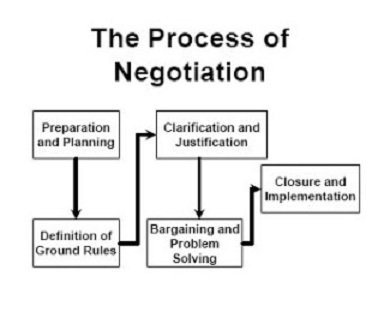
The 5 steps of the negotiation process are:

  1. Preparation and Planning

Before the start of negations, one must be aware of the conflict, the history leading to the negotiation of the people involved and their perception of the conflict expectations from the negotiations etc.

Before starting the negotiation, it needs to do homework.

What’s the nature of the conflict? What’s the history leading up to this negotiation?

Who’s involved and what are their perceptions of the conflict? Moreover before any negotiation takes place; a decision needs to be taken as to when and where a meeting will take place to discuss the problem and who will attend.

Setting a limited time-scale can also be helpful to prevent disagreement from continuing. This stage involves ensuring all the pertinent facts of the situation are known in order to clarify own position.

It also needs to prepare an assessment of what the other parties’ negotiation’s goals are. What are they likely to ask for?

  1. Definition of Ground Rules

Once the planning and strategy are developed, one has to begin defining the ground rules and procedures with the other party over the negotiation itself that will do the negotiation. Where will it take place?

What time constraints, if any will apply? To what issues will negotiations be limited? Will, there be a specific procedure to follow in an impasse is reached? During this phase, the parties will also exchange their initial proposals or demands.

  1. Clarification and Justification

When initial positions have been exchanged both the parties will explain amplify, clarify, bolster and justify their original demands. This need not be confrontational.

Rather it is an opportunity for educating and informing each other on the issues why they are important and how each arrived at their initial demands.

This is the point where one party might want to provide the other party with any documentation that helps support its position.

  1. Bargaining and Problem Solving

The essence of the negotiation process is the actual give and take in trying to hash out an agreement, a proper bargain. It is here where concessions will undoubtedly need to be made by both parties.

  1. Closure and Implementation

The final step in the negotiation process is formalization the agreement that has been worked out and developing and procedures that are necessary for implementation and monitoring.

For major negotiations this will require hammering out the specifics in a formal contract.

Negotiation Process has five stages. In all steps of a negotiation process, the involved parties bargain at a systematic way to decide how to allocate scarce resources and maintain each other’s interest.

error: Content is protected !!