Research Scope, Significance

Research without a pre-drawn plan is like an ocean voyage without Mariner’s compass. The preparation of a research plan for a study aid in establishing direction to the study and in knowing exactly what has to be done and how and when it has to be done at every stage.

Marketing Level

  • Price
  • Product
  • Place
  • Promotion
  • Sales
  • Customer

Organizational Level

  • Finance
  • HRM
  • Production
  • Organizational Effectiveness and Success.

Environmental Level

  • Competitors Analysis
  • Technological innovations
  • Industry fears
  • New Market entry
  • New product development

  • It is the process of giving clear and precise meaning and accepted definitions to various concepts and variables used in the area of research undertaken. All terms and concepts should be defined clearly. Vague ideas will lead to inadequate and un-interpretable research findings. A not “too broad or too narrow” definition is to be given to understand the full meaning of the terms and concepts used. It should also specify the depth and magnitude of empirical reality that needs to be explored for investigating the problem.
  • The social researcher guided either by a desire to gain knowledge or by an urgency to solve a problem scientifically works out a plan of study. In the beginning, this scope is generally vague and tentative. It undergoes many modifications and changes, as the study progresses and insights into it deepen. The considerations which enter into making the decisions regarding the what, where, when, how, constitute a scope of the study or a study design.
  • A research plan prescribes the boundaries of research activities and enables the researcher to channel his energies in the right work. With clear research objectives in view, the researcher can proceed systematically toward their achievement. The design also enables the researcher to anticipate potential problems of data gathering operationalization of concepts, measurement, etc.

Significance

Research design is significant simply because it allows for the smooth sailing of the various research operations, thus making research as efficient as possible producing maximum information with nominal expenses of effort, time and money.

Research has its special significance in solving various operational and planning problems of business and industry. Operations research and market research, along with motivational research, are considered crucial and their results assist, in more than one way, in taking business decisions.

Market research is the investigation of the structure and development of a market for the purpose of formulating efficient policies for purchasing, production and sales. Operations research refers to the application of mathematical, logical and analytical techniques to the solution of business problems of cost minimization or of profit maximization or what can be termed as optimization problems. Motivational research of determining why people behave as they do is mainly concerned with market characteristics. In other words, it is concerned with the determination of motivations underlying the consumer or market behaviour.

All these are of great help to people in business and industry who are responsible for taking business decisions. Research with regard to demand and market factors has great utility in business. Given knowledge of future demand, it is generally not difficult for a firm, or for an industry to adjust its supply schedule within the limits of its projected capacity. Market analysis has become an integral tool of business policy these days. Business budgeting, which ultimately results in projected profit and loss account, is based mainly on sales estimates which in turn depends on business research.

Once sales forecasting is done, efficient production and investment programmes can be set up around which are grouped the purchasing and financing plans. Research, thus, replaces intuitive business decisions by more logical and scientific decisions. Research is equally important for social scientists in studying social relationships and in seeking answers to various social problems. It provides the intellectual satisfaction of knowing a few things just for the sake of knowledge and also has practical utility for the social scientist to know for the sake of being able to do something better or in a more efficient manner.

The design assists the researcher to organize his ideas in a form whereby it will be possible for him to watch out for flaws and inadequacies. This type of design can also be given to others for their comments and critical evaluation. In the absence of such a strategy, it will likely be challenging for the critic to supply a comprehensive review of the offered study.

Descriptive research design provides accurate description of variables relevant to the problem under consideration and generally used for preliminary and exploratory studies. The descriptive study is more formal and less flexible as it involves both qualitative and quantitative information and can be used for both positivist test and non-positivist test research. The commonly used techniques under this category are panel research design or longitudinal research. The panel design involves the continual or periodic information collection from a fixed panel or sample of respondents. The longitudinal analysis involves repeated measurement of the same variables to facilitate a variety of inferences to be drawn about the behaviour of the elements of the panel. Participant observation and field studies use such methods.

Cross sectional design is aimed are taking a one-time stock of the situation or the phenomena in which the decision maker is interested. Cross sectional designs give the picture of situation at a given point of time. Opinion polls and market service use such kind of methods.

Experimental Research Design is where the researcher actively tries to change inputs like the situation, circumstances or experience of participants which may lead to a change in behaviour or outcome for the participants of the study. It establishes the causality between dependent and independent variable and test hypothesis. The participants are ideally randomly assigned to different conditions and variable of interest for measured. This is done to eliminate all extraneous variables. Hawthorne studies of Elton Mayo are class examples of such experimental design. This is a method which is most often associated with natural sciences in which we change variables in a controlled environment. This method is mostly used for positivity is to research or quantitative research as it aims to keep prejudices and biases away while doing the research. Experimental research attempts to determine how and why something happens. Experimental research tests the way in which independent variable affect the dependent variable. Due to high objectivity data obtained through such methodology are more reliable.

Comparative method is used to compare the social phenomena to arrive at generalized conclusions. It is a method which is suggested as an alternative to the experimental research in sociology but is based on the similar sets of principles. According to Haralambos and Holborn in the Sociology: Themes and Perspectives, 2013, the comparative method is based on what has happened or is happening in society rather than upon situation artificially created by the researcher. It was more popular with the early sociologist. Durkheim was the first sociologist to discuss this method at length in the rules of Sociological Method, 1895. He regarded it as a method of sociology to identify dependent and independent variables. The crime study of suicide is a classic example of use of this methodology. Ginsberg use this method in the study of primitive societies. If a particular social phenomenon is studied in different social contexts and the causes are found out then a cause and effect relationship can be established.
Income measurement analysis

Value Added Approach:

Under this approach, the income is measured with the help of the value added by the firm during a particular period and the same is determined by the differences between the value of the product/output over the cost of raw materials including stores and necessary components which are purchased from outside and are used in this production process of the concern. In this respect, it must be remembered that the prices so paid for the purchase of materials, stores etc. are to be deducted from that value of the product.

The value added is to be a distributed among:

(i) The worker to whom wages are paid

(ii) The supplier of non-manual services to whom expenses are paid

(iii) Supplies of capital to whom interest is paid

(iv) Maintenance of capital by way of depreciation etc.

(v) To the owner to whom profits are to be paid.

To sum up, value added of the firm amounts to:

Wages + Expenses + Interest on Capital + Depreciation + Profit.

The Balance Sheet Approach:

This approach is also known as capital maintenance approach. Increase in assets is the result of income. As such, measurement of income requires the measurement of net increase in assets (of a specific accounting period) which are made for the period after maintaining the capital intact.

Under this approach, the opening assets of a business constantly bring a change. As soon as a transaction occurs, there is a change in assets, either in their shape or in their nature. It is also known to us that a flow comes out of stock and, similarly, an income comes out of capital. Therefore, the income after mixing up with capital is circulated again and again for generating further income which usually increases the volume of total assets although a major portion of fixed assets do not bring any change.

It is to be noted that measurement of net asset needs valuation of both fixed and current assets. There is difference of opinion among accountants as to the valuation of assets. In case of current assets, of course the difference is not so important. But, in case of fixed assets, there is a wide difference of opinion among accountants as to their valuation.

The decrease in value of fixed asset, as a result of use, deterioration in the form of depreciation or any other factor should also be considered, i.e., market value should be taken into consideration in order to maintain the capital intact.

The Activities Approach to Income Measurement:

This approach differs from the previous approach, viz. the transaction approach, in the sense that it expresses a description of the activities of a firm rather than on the reporting of transactions alone. In other words, income is believed to arise when certain events or activities take place and not as a result of certain transactions.

For example, activity incomes are recorded at the time of planning, purchasing, production and sales including collection process (i.e., it is an expansion of the transaction approach). Therefore, the fundamental difference between the two approaches is that the former is based on the reporting process which measures an external event, i.e., transaction, whereas the latter is based on the real-world concept of event or activity.

The Transaction or the Operation Approach to Income Measurement:

This is the more conventional approach used by accountants and most of the business enterprises adopt this method.

This approach indicates that the changes between asset and liability valuations arise as a result of transactions.

Revenues and expenses are recorded as soon as they arise from the external transactions. The problems arise of timing and valuation for recording each transaction. But the fundamental principal problem is to make a proper matching against the related revenues during a particular period.

The different concepts of incomes can be incorporated into the transactions approach by making proper adjustments to revenues and expenses at the time of recording each transaction and by making adjustments to asset valuations. Therefore, the current accounting practice is a combination of maintenance of capital concepts; operational concept and transaction approach.

Advantages:

  • The incomes from operations and from external causes can be reported separately.
  • Under this method, profit earned from each product can be determined separately. As such, it provides more useful information to the management.
  • Recording and analysing the external transactions are essential for efficient managerial work.
  • It supplies a basis for the determination of the types and quantities of assets and liabilities which exist at the end of the period and, consequently, other valuation methods can easily be applied.

Expense analysis

An expense in accounting is the money spent, or costs incurred, by a business in their effort to generate revenues. Essentially, accounts expenses represent the cost of doing business; they are the sum of all the activities that hopefully generate a profit.

A cost-benefit analysis is a systematic process that businesses use to analyze which decisions to make and which to forgo. The cost benefit analyst sums the potential rewards expected from a situation or action and then subtracts the total costs associated with taking that action. Some consultants or analysts also build models to assign a dollar value on intangible items, such as the benefits and costs associated with living in a certain town.

An expense is defined in the following ways:

  • Depreciation expense, which is a charge to reduce the book value of capital equipment (e.g., a machine or a building) to reflect its usage over a period.
  • A prepaid expense, such as prepaid rent, is an asset that turns into a cash expense as the rent is used up each month.
  • Office supplies use up the cash (asset).

Before building a new plant or taking on a new project, prudent managers conduct a cost-benefit analysis to evaluate all the potential costs and revenues that a company might generate from the project. The outcome of the analysis will determine whether the project is financially feasible or if the company should pursue another project.

In many models, a cost-benefit analysis will also factor the opportunity cost into the decision-making process. Opportunity costs are alternative benefits that could have been realized when choosing one alternative over another. In other words, the opportunity cost is the forgone or missed opportunity as a result of a choice or decision. Factoring in opportunity costs allows project managers to weigh the benefits from alternative courses of action and not merely the current path or choice being considered in the cost-benefit analysis.

A cost-benefit analysis (CBA) should begin with compiling a comprehensive list of all the costs and benefits associated with the project or decision.

The costs involved in a CBA might include the following:

  • Indirect costs might include electricity, overhead costs from management, rent, utilities.
  • Direct costs would be direct labor involved in manufacturing, inventory, raw materials, manufacturing expenses.
  • Intangible costs of a decision, such as the impact on customers, employees, or delivery times.
  • Cost of potential risks such as regulatory risks, competition, and environmental impacts.
  • Opportunity costs such as alternative investments, or buying a plant versus building one.

Earnings quality

Earnings quality, also known as quality of earnings (QoE), in accounting, refers to the ability of reported earnings (income) to predict a company’s future earnings. It is an assessment criterion for how “repeatable, controllable and bankable“A firm’s earnings are, amongst other factors, and has variously been defined as the degree to which earnings reflect underlying economic effects, are better estimates of cash flows, are conservative, or are predictable.

A company’s quality of earnings is revealed by dismissing any anomalies, accounting tricks, or one-time events that may skew the real bottom-line numbers on performance. Once these are removed, the earnings that are derived from higher sales or lower costs can be seen clearly.

Even factors external to the company can affect an evaluation of the quality of earnings. For example, during periods of high inflation, quality of earnings is considered poor for many or most companies. Their sales figures are inflated, too.

In general, earnings that are calculated conservatively are considered more reliable than those calculated by aggressive accounting policies. Quality of earnings can be eroded by accounting practices that hide poor sales or increased business risk.

Conversely, an organization can have low-quality earnings if changes in its earnings relate to other issues, such as:

  • Elimination of LIFO inventory layers
  • Aggressive use of accounting rules
  • Inflation
  • Increases in business risk
  • Sale of assets for a gain

Factors

An assessment of earnings quality would therefore be based on other factors, such as:

  • A correlation between reported earnings and underlying economic activity.
  • The permanence and sustainability of reported earnings.
  • The relationship between reported earnings and market valuation.
  • The extent and impact of discretionary accruals.
  • The transparency and completeness of disclosures.
  • The impact of low reported earnings on corporate image.
  • The company’s handling of “bad news,”
  • The degree to which earnings are good estimates of cash flows.

Accruals

Accruals are a major consideration when evaluating earnings quality because they contribute to the difference between economic performance and reported earnings. Because accruals are non-cash, estimated journal entries, they may not always properly represent a company’s economic performance. For example, a company should record an estimate for sales returns and allowances. Accounting for future sales returns and allowances is appropriate and relevant because sales will be overstated if future returns are not considered. However, the subjective nature of this accrual, which is made before any return actually happens, makes it less reliable to investors. This trade-off between reliability and relevance is why earnings quality is such an important consideration.

Total Accrual to Assets Ratio

During a valuation, investors can use the following ratio to evaluate the prevalence of accruals in a company’s financial statements:

Total accruals to assets = (Net Income – Operating Cash Flow) / Beginning Total Assets

Net Income Vs. Cash Flow Ratio

Another way that investors analyze the effect of accruals on earnings quality is by comparing net income to operating cash flow. Analysts use these two measures to calculate the quality of earnings ratio as follows:

Quality of earnings ratio = Net cash from operating activities / Net income

Earnings Management

Public companies are under intense investor scrutiny, and the pressure to increase earnings every quarter can lead companies to engage in earnings management. Earnings management refers to the use of subjective estimates, changes in business practices, and accounting techniques to intentionally manipulate a company’s earnings. Because earnings management improves reported earnings without improving economic performance, increased earnings management leads to a decrease in earnings quality. Engaging in earnings management could damage investors’ perception of the reliability of your company’s financial statements. Private equity firms, hedge funds, and other investors will likely be hesitant to invest in a company that they believe is trying to artificially inflate earnings.

Market Profitability analysis

Profitability analysis is especially useful and essential for growing companies. Profitability analysis help businesses identify growth opportunities; since things aren’t as stable yet as compared to a more established business, profitability analysis can spell the difference between shutting down and keeping afloat. In the long run, profitability analysis can help propel that business into the future, and allow that business to grow the potential that allowed it to exist in the first place.

Profitable Customer or Market

A profitable customer is a person, organisation, business or a company that over time yields revenue that exceeds, by an acceptable amount, the cost of attracting, selling and servicing that customer.

A profitable market is a market for the business that over time yields revenue that exceeds, by an acceptable amount, the cost of attracting, selling and servicing the group of customers with which they trade within that market.

Cost Allocation

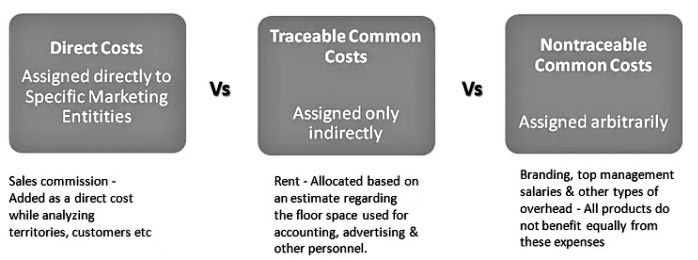
Direct costs are those costs incurred to generate revenue, such as the purchase or production cost of units sold or services delivered

Indirect costs or overheads are those costs that cannot be directly attributed to generating revenue, such as the cost of finance, marketing, communications and administration.

The challenge of any profitability analysis is to find a way of allocating the indirect costs to the significant customers or markets. To allocate indirect costs fairly, the key drivers for those costs need to be identified. Examples of drivers for indirect cost are:

  • Labour cost or time
  • Revenue
  • Production cost or time
  • Time spent servicing the customers or markets
  • The number of transactions, such as purchase orders or sales orders.

Profitability control

This is simply because profit is like money in the bank. For a bootstrapped company, profit may be the corporation’s only capital. For an invested company, financing can be used to sustain a company for a certain period of time but ultimately it is a liability, not an asset. Therefore, businesses need to analyse the profitability of their various products, regions, customer groups and channels.

Past research over the years has shown that:

  • 20-40 percent of a company’s products are unprofitable and up to 60 percent of their accounts generate losses
  • More than half of customer relationships are not profitable. Also, 30-40 percent are only marginally profitable. More often than not, a mere 10-15 percent of company’s relationships generate most of its profits.

Identifying the functional expenses

The company needs to determine the expenses being incurred for the marketing activities such as selling, advertising, distribution, packing, billing, and collection, et al. Next task is to break each expense and allocate it to different marketing functions. For example, if most salary went to sales representatives and rest went to advertising manager, packing, office accountant, then the total salary will be allocated according to these activities. Finally, all the natural expenses of salary, rent, etc are mapped onto each functional expense of say, selling, advertising, billing, etc.

Assigning the functional expenses to the marketing entities

The next step in the Marketing-Profitability Analysis is to measure how much functional expense is associated with each type of channel. For example, based on the number of orders placed through each channel, the company can allocate accounting expenses. Also, based on the number of ads placed for each channel, the advertising expense can be allocated. This way an average cost can be calculated based on the total number of ads. Based on the amount of sales efforts required for each channel, the cost for the sales calls can be allocated to the specific channel.

Preparing a profit-and-loss statement for each marketing entity

The last step is to prepare a profit and loss statement for each type of channel. The cost of goods is assigned according to the number of sales for each channel, e.g. if one channel achieved half of the total sales then the cost of goods allocated to that channel will be half of the total cost of goods sold.

From this gross margin, one can deduct the proportion of each of the functional expenses including selling, advertising, billing, packing, etc. This overall calculation will give the net profit for each of the channels. The key inference from this calculation is that the gross sales from a specific channel does not equate to a higher profit from that same channel.

While determining the correcting action based on the profit and loss statement, the company also needs to consider factors related to buyers, market trends, marketing strategies, etc. before concluding which channels are the best to continue investing in and which channels need to be dropped. Marketing management can evaluate alternative actions more specific to the channels that are not doing so well.

Off-balance sheet financing

Off-balance sheet (OBS), or incognito leverage, usually means an asset or debt or financing activity not on the company’s balance sheet. Total return swaps are an example of an off-balance sheet item.

Some companies may have significant amounts of off-balance sheet assets and liabilities. For example, financial institutions often offer asset management or brokerage services to their clients. The assets managed or brokered as part of these offered services (often securities) usually belong to the individual clients directly or in trust, although the company provides management, depository or other services to the client. The company itself has no direct claim to the assets, so it does not record them on its balance sheet (they are off-balance sheet assets), while it usually has some basic fiduciary duties with respect to the client. Financial institutions may report off-balance sheet items in their accounting statements formally, and may also refer to “assets under management”, a figure that may include on and off-balance sheet items.

Differences between on- and off-balance sheets

Traditionally, banks lend to borrowers under tight lending standards, keep loans on their balance sheets and retain credit risk the risk that borrowers will default (be unable to repay interest and principal as specified in the loan contract). In contrast, securitization enables banks to remove loans from balance sheets and transfer the credit risk associated with those loans. Therefore, two types of items are of interest: on-balance sheet and off-balance sheet. The former is represented by traditional loans, since banks indicate loans on the asset side of their balance sheets. However, securitized loans are represented off the balance sheet, because securitization involves selling the loans to a third party (the loan originator and the borrower being the first two parties). Banks disclose details of securitized assets only in notes to their financial statements.

Leasing:

It is the oldest form of off-balance-sheet financing. Leasing an asset, allows the company to avoid showing financing of the asset from its liabilities and lease or rent is directly shown as an expense in the Profit & Loss statement.

Special Purpose Vehicle (SPV)

Special purpose vehicles or subsidiary companies are one of the routine ways of creating off the balance sheet financing exposures. It was used by Enron, which is known for one of the high profile off-balance-sheet financing exposure controversies.

Hire Purchase Agreements

If a company cannot afford to purchase assets outright or obtain finance for the same, it can enter into a hire purchase agreement for a certain period with financiers. A financier will purchase the asset for the company, which in turn will pay a fixed amount monthly until all the terms in the contract are fulfilled. The hirer has the option of owning the asset at the end of the hire purchase agreement.

Factoring

It is a type of credit service offered by Banks and other financial institutions to their existing clients. Under factoring, finance is obtained by selling account receivables to Banks. Banks offer immediate cash to the company after taking some cut from account receivables  for offering the service.

Purpose:

  • Better solvency ratios ensure maintaining a good credit rating, which in term allows the company to access cheaper finance.
  • To maintain solvency ratio like Debt-to-equity ratio below a certain level and obtain funding which company would not have been able to obtain otherwise.
  • It makes balance sheet finance appear leaner, which prima facie may attract investors.

Key Features

  • There is a change in the Capital structure of the company.
  • It results in the reduction in existing assets or exclusion of assets going to be created from the balance sheet.
  • It involves the use of creative accounting and financial instruments to achieve off-balance sheet finance.
  • Assets and liabilities are both understated, and it gives a leaner impression of the balance sheet finance.

Term structure of interest rates

The term structure of interest rate can be defined as the graphical representation that depicts the relationship between interest rates (or yields on a bond) and a range of different maturities. The graph itself is called a “yield curve.” The term structure of interest rates plays an important part in any economy by predicting the future trajectory of rates and facilitating quick comparison of yields based on time.

The term structure of interest rates, commonly known as the yield curve, depicts the interest rates of similar quality bonds at different maturities.

Essentially, term structure of interest rates is the relationship between interest rates or bond yields and different terms or maturities. When graphed, the term structure of interest rates is known as a yield curve, and it plays a crucial role in identifying the current state of an economy. The term structure of interest rates reflects the expectations of market participants about future changes in interest rates and their assessment of monetary policy conditions.

The term of the structure of interest rates has three primary shapes.

Downward sloping: Short-term yields are higher than long-term yields. Dubbed as an “inverted” yield curve and signifies that the economy is in, or about to enter, a recessive period.

Flat: Very little variation between short and long-term yields. This signals that the market is unsure about the future direction of the economy.

Upward sloping: Long-term yields are higher than short-term yields. This is considered to be the “normal” slope of the yield curve and signals that the economy is in an expansionary mode.

Interest rates are both a barometer of the economy and an instrument for its control. The term structure of interest rates market interest rates at various maturities is a vital input into the valuation of many financial products. The goal of this reading is to explain the term structure and interest rate dynamics that is, the process by which the yields and prices of bonds evolve over time.

A spot interest rate (in this reading, “spot rate”) is a rate of interest on a security that makes a single payment at a future point in time. The forward rate is the rate of interest set today for a single-payment security to be issued at a future date. Section 2 explains the relationship between these two types of interest rates and why forward rates matter to active bond portfolio managers. Section 2 also briefly covers other important return concepts.

The swap rate curve is the name given to the swap market’s equivalent of the yield curve. Section 3 describes in more detail the swap rate curve and a related concept, the swap spread, and explains their use in valuation.

Sections 4 and 5 describe traditional and modern theories of the term structure of interest rates, respectively. Traditional theories present various largely qualitative perspectives on economic forces that may affect the shape of the term structure. Modern theories model the term structure with greater rigor.

Section 6 describes yield curve factor models. The focus is a popular three-factor term structure model in which the yield curve changes are described in terms of three independent movements: level, steepness, and curvature. These factors can be extracted from the variance covariance matrix of historical interest rate movements.

Types:

Normal/Positive Yield

The normal yield curve has a positive slope. This stands true for securities with longer maturities that have greater risk exposure as opposed to short term securities. So rationally, an investor would expect higher compensation (yield), thus giving rise to a normal positively sloped yield curve.

Steep

The steep yield curve is just another variation of the normal yield curve just that a rise in interest rates occurs at a faster for long-maturity securities than the ones with a short maturity.

Inverted/Negative Yield

An inverted curve forms when there is a high expectation of long-maturity yields falling below short maturity yields in the future. An inverted yield curve  is an important indicator of the imminent economic slowdown.

Humped/Bell-Shaped

This type of curve is atypical and very infrequent. It indicated that yields for medium-term maturity are higher than both long and short terms, eventually suggesting a slowdown.

Flat

A Flat curve indicates similar returns for long-term, medium-term, and short-term maturities.

Term Structure Theories

Any study of the term structure is incomplete without its background theories. They are pertinent in understanding why and how are the yield curves so shaped.

Liquidity Preference Theory

This theory perfects the more commonly accepted understanding of liquidity preferences of investors. Investors have a general bias towards short-term securities, which have higher liquidity as compared to the long-term securities, which get one’s money tied up for a long. Key points of this theory are:

  • Liquidity restrictions on long term bonds prevent the investor from selling it whenever he wants.
  • The price change for long term debt security is more than that for a short term debt security.
  • Less liquidity leads to an increase in yields, while more liquidity leads to falling yields, thus defining the shape of upward and downward slope curves.
  • The investor requires an incentive to compensate for the various risks he is exposed to, primarily price risk and liquidity risk.

The Expectations Theory/Pure Expectations Theory

Expectations, theory states that current long-term rates can be used to predict short term rates of future. It simplifies the return of one bond as a combination of the return of other bonds. For e.g., a 3-year bond would yield approximately the same return as three 1-year bonds.

Preferred Habitat Theory

This theory states that investor preferences can be flexible, depending on their risk tolerance level. They can choose to invest in bonds outside their general preference also if they are appropriately compensated for their risk exposure.

These were some of the main theories dictating the shape of a yield curve, but this list is not exhaustive. Theories like Keynesian economic theory and substitutability theory have also been proposed.

Market Segmentation Theory/Segmentation Theory

This theory is related to the supply-demand dynamics of a market. The yield curve shape is governed by the following aspects:

  • An investor tries to match the maturities of his’ assets and liabilities. Any mismatch can lead to capital loss or income loss.
  • Preferences of investors for short term and long-term securities.
  • Low supply and high demand lead to an increase in interest rates.
  • Securities with varying maturities form a number of different supply and demand curves, which then eventually inspire the final yield curve.

Advantages

  • Knowing how interest rates might change in the future, investors are able to make informed decisions.
  • Indicator of the overall health of the economy an upward sloping and steep curve indicates good economic health while inverted, flat, and humped curves indicated a slowdown.
  • Financial organizations have a heavy dependency on the term structure of interest rates since it helps in determining rates of lending and savings.
  • It also serves as an indicator of inflation.
  • Yield curves give an idea of how overpriced or under-priced the debt securities may be.

Valuation of financial instruments

Financial Instruments Valuation includes determining the Fair Value of equity instruments, debt instruments, derivatives (option and future contracts) and embedded derivatives (convertible bonds / preference shares). Financial Instruments may require valuation for commercial, financial reporting or regulatory purposes.

  • Non-convertible Bonds
  • Equity Instruments
  • Options, Warrants, Grants and Rights and other derivatives
  • Hybrid Instruments
  • Futures & Options and Forward Contracts
  • Financial Liabilities

Selection of Valuation Method:

Valuation Standard 303 “Financial Instruments” prescribes followings are the indicative factors that need to be consider for determining appropriate method or combination of methods for the purpose of valuation of financial instruments:

The purpose of valuation:

The purpose for which valuation is being used is also a determining factor. Generally, in the case of business combination transaction the valuation methodology which consider more observable inputs is given priority over other approaches.

The valuation base and terms and conditions of the instrument being valued:

In selection appropriate valuation method, due consideration must be given to the nature of instrument and the terms conditions embodying with instrument. While determining the market comparable the terms and conditions of the instrument plays and important role.

The control framework of the entity and input data sets:

In selection of the appropriate valuation method, a valuer shall also give importance to the control environment under which the entity and the instrument operates. The control environment consists the entity’s internal governance and control objectives, procedures and their operating effectiveness with the objective of enhancing the reliance on the valuation process and outcome thereof. A valuer, if relying on valuation inputs provided by the entity, shall form independent opinion on the valuation control environment and factor outcome on the valuation method, approach, outcome and reporting thereof.

Methods of Valuation of Financial Instruments:

Market Approach Valuation:

  • In market approach, the value of the financial instrument is determined by considering traded prices of such instrument in an active market; or prices and other relevant information generated by market transactions involving identical or comparable (similar) assets.
  • This method uses prices and other relevant information generated by market transactions involving identical or comparable assets, liabilities or a group of assets and liabilities.
  • In absence of an active market benchmark price, comparable pricing or private transaction pricing may also be considered.

Cost Approach Valuation:

  • From the perspective of a market participant seller, the price that would be received for the asset is based on the cost to a market participant buyer to acquire or construct a substitute asset of comparable utility.
  • Cost approach is a valuation approach that reflects the amount that would be required currently to replace the service capacity of an asset.
  • The usage of cost method is of more predominance in valuation of non-financial assets.

Income Approach Valuation:

  • In this approach value of a financial instrument is determined based on the expected economic benefits by way of income, cash flows or cost savings generated by such financial instrument and level of risk associated with such financial instrument. It generally involves discounting future amounts to a single present value after adjusting inherent risks.
  • Income approach is the valuation approach that converts maintainable or future amounts (e.g., cash flows or income and expenses) to a single current i.e., discounted amount.
  • Black-Scholes-Merton formula or a binomial model and similar other pricing models are examples of income approach, that incorporate present value techniques and reflect both the time value and the intrinsic value of an option.

Long-term Financial Management

The funds which are not paid back within a period of less than a year are referred to as long term finance. Certain long term finance options directly form a part of the permanent capital of the firm. In such cases, the repayment obligation does not even arise. A 20 year mortgage or 10 year treasury bills are examples of long term finance. The primary purpose of obtaining long-term funds is to finance capital projects and carrying out operations on an expansionary scale. Such funds are normally invested into avenues from which greater economic benefits are expected to arise in future.

Long-term financial planning combines financial forecasting with strategizing. It is a highly collaborative process that considers future scenarios and helps governments navigate challenges. Long-term financial planning works best as part of an overall strategic plan.

Financial forecasting is the process of projecting revenues and expenditures over a long-term period, using assumptions about economic conditions, future spending scenarios, and other salient variables.

Long-term financial planning is the process of aligning financial capacity with long-term service objectives.

Financial planning uses forecasts to provide insight into future financial capacity so that strategies can be developed to achieve long-term sustainability in light of the government’s service objectives and financial challenges.

Sources:

Bonds

Bonds are debt instruments involving two parties- the borrower and the lender. The borrower can be the government, a local body or a corporation. They provide fixed interest payments at periodic intervals and are redeemable at a predetermined date in future. Bonds are normally issued against collateral and are therefore a highly secured form of long-term finance. Bonds may prove to be a very cost-effective source of funds in a bullish market.

Internal Accruals

Internal accruals are nothing but the reserve of profits or retention of earnings that the firm has created over the years. They represent one of the most essential sources of long term finance since they are not injected into the business from external sources. Rather it is self-generated and highlights the sustainability and profitability of the entity Also internal accruals are owner’s funds and therefore create no charge on the assets of the company.

Venture Capital

This form of financing has emerged with the growing popularity of start-up culture worldwide. VC firms invest into companies at their inception or seed stage. They are constantly on a watch out for firms demonstrating high growth potential. Their investment takes the form of ownership funds and forms a part of the permanent capital of the firm. Venture capitalists also have a predetermined exit strategy before they invest. This results in the target company being listed or a secondary sale to another VC firm.

Equity

Equity is the foremost requirement at the time of floatation of any company. They represent the ownership funds of the company and are permanent to the capital structure of the firm. The equity can be private or public. Private equity is raised from institutional or high net worth individuals. Public equity is raised by issuing shares to the public at large which are subscribed to by retail investors, mutual funds, banks and a pool of other investors. On the flipside, equity is an expensive variant of long term finance. The investors expect a high return due to the extent of risk involved.

Market efficiency

Market efficiency refers to the degree to which market prices reflect all available, relevant information. If markets are efficient, then all information is already incorporated into prices, and so there is no way to “beat” the market because there are no undervalued or overvalued securities available.

The term was taken from a paper written in 1970 by economist Eugene Fama, however Fama himself acknowledges that the term is a bit misleading because no one has a clear definition of how to perfectly define or precisely measure this thing called market efficiency. Despite such limitations, the term is used in referring to what Fama is best known for, the efficient market hypothesis (The efficient-market hypothesis (EMH) is a hypothesis in financial economics that states that asset prices reflect all available information. A direct implication is that it is impossible to “beat the market” consistently on a risk-adjusted basis since market prices should only react to new information.

Because the EMH is formulated in terms of risk adjustment, it only makes testable predictions when coupled with a particular model of risk. As a result, research in financial economics since at least the 1990s has focused on market anomalies, that is, deviations from specific models of risk. EMH).

Features of an Efficient Market

  • An efficient market allows investors an opportunity to outperform.
  • In a truly efficient market, the prices of securities reflect all relevant information about the asset, including historical data such as price, volume and more.
  • With the disclosure of new information, the efficiency of the market increases, diminishing the opportunities for excess returns and arbitrage.
  • It’s important to note that market efficiency does not suggest that the price of security is its true intrinsic value. It only states that market participants cannot predict the future price of an asset on a consistent basis.

Types of Market Efficiency

Strong form

This form of market efficiency theory states that market prices of securities reflect public and private information both. Consequently, investors will not be able to beat the market by trading on any private information since all such information will already be factored into the market prices of the securities.

Semi-strong form

In a semi-strong variation of an efficient market, the current prices of securities represent all information that is publicly available. It includes historical information like price, volume and more. This form of theory assumes that securities make quick adjustments in response to any newly available information. Thus, traders won’t be able to outperform the market by trading on such information.

It dismisses both technical and fundamental analysis since any information gathered by using these techniques will already be available to other investors. Only private information that is unavailable in the market would be useful for an investor to have the edge over others.

Weak form

This form of market efficiency theory suggests that current market prices of securities reflect their previous or historical prices. Thus, it means that market participants who are buying and selling securities by analysing their historical data should earn normal returns. Hence, any new price changes in future can only take place if new information becomes publicly available.

Differing Beliefs of an Efficient Market

Investors and academics have a wide range of viewpoints on the actual efficiency of the market, as reflected in the strong, semi-strong, and weak versions of the EMH. Believers in strong form efficiency agree with Fama and often consist of passive index investors. Practitioners of the weak version of the EMH believe active trading can generate abnormal profits through arbitrage, while semi-strong believers fall somewhere in the middle.

For example, at the other end of the spectrum from Fama and his followers are the value investors, who believe stocks can become undervalued, or priced below what they are worth. Successful value investors make their money by purchasing stocks when they are undervalued and selling them when their price rises to meet or exceed their intrinsic worth.

People who do not believe in an efficient market point to the fact that active traders exist. If there are no opportunities to earn profits that beat the market, then there should be no incentive to become an active trader. Further, the fees charged by active managers are seen as proof the EMH is not correct because it stipulates that an efficient market has low transaction costs.

error: Content is protected !!