Managerial interpersonal Styles

Autocratic

Autocratic management is the most controlling of the management styles. Variations of this style are authoritative, persuasive, and paternalistic. Autocratic managers make all of the decisions in the workplace. Communication with this type of management is one way, top-down to the employees. Employee ideas and contributions are not encouraged or considered necessary. Roles and tasks are clearly defined, and workers are expected to follow these directions without question while being consistently checked and supervised.

This type of style is particularly useful in organizations with hierarchical structures where management makes all of the decisions based on positioning in the hierarchy. Employees that benefit from this style of management include those who are new, unskilled, or unmotivated, as they need the supervision and clear direction. Managers can benefit greatly from using this style in times of crises or serious time constraints.

The advantages of the autocratic management style are little uncertainty, clearly defined roles and expectations for employees, and the speed of decision-making. All decisions are made by the manager and employees are expected to be compliant leaving little room for variation or confusion. Decision-making speed is ideal and is not slowed by conflicting thought or agendas.

Disadvantages include lack of staff input with ideas that are not encouraged or shared. This can lead to job dissatisfaction, absenteeism, and employee turnover. Because managers make all of the decisions, the employees are not inclined to act autonomously and may become too dependent on the manager. Not all employees want or need supervision, and as a result can become resentful and unhappy. Too many dissatisfied employees and the separation of power with an autocratic management style can lead to an ‘us vs them’ mentality.

Authoritative style

With this management style, there is little trust or confidence in employees. This manager dictates orders to employees and expects that they do exactly as required. These employees are unskilled. This requires constant teaching and coaching of the staff as well as consistent supervision.

Persuasive style

Using this management style, the manager still makes all decisions for employees but then convinces employees that these decisions were made in the best interest of the team. The only real difference here is that it can establish a higher level of trust between management and staff.

Paternalistic or Exploitative/Authoritative style

The manager still makes all of the decisions in this style of management and treats the employees in a condescending or paternalistic way. The decisions are made in the best interest of the employees and the manager explains these decisions and the importance of them to the employees. These employees may feel well taken care of and looked after by the paternalistic manager but may become resentful of not being taken seriously. This style breeds highly dependent employees.

  • In paternalistic style of working, the leaders decide what is best for the employees as well as the organization.
  • Policies are devised to benefit the employees and the organization.
  • The suggestions and feedback of the subordinates are taken into consideration before deciding something.
  • In such a style of working, employees feel attached and loyal towards their organization.
  • Employees stay motivated and enjoy their work rather than treating it as a burden.

Democratic

The democratic management style involves managers reaching decisions with the input of the employees but being responsible for making the final decision. There are many variations of this style of management including consultative, participative, and collaborative styles. Employee ideas and contributions are encouraged, but not necessary. Communication is both top-down and bottom-up and makes for a cohesive team.

This type of style is versatile with the advantages of having more diverse perspectives involved in decision making. As employees are being taken into account before the manager makes decisions, the employees feel valued which increases motivation and productivity.

Disadvantages of the democratic management style are the time it takes to make a decision due to the gathering of ideas and opinions. There is also the potential conflict of different viewpoints playing a role in the decision making and as a result, employees can feel less valued if their input is not taken, leading to decreased morale and productivity.

Consultative style

With this management style, trust and confidence is placed in the employees and management actively seeks out their opinions.

Participative style

Similar to consultative, management trusts the employees, but trusts them completely and not only seeks out their opinions and ideas, but they act on them. They work together to make decisions as a group and the staff is highly involved. As a result, employees feel valued and show increased motivation and productivity. However, a drawback to this style is that some employees do not want to be involved in decision making and can come to resent a manager with this style.

Collaborative style

Managers with the collaborative style communicated extensively with employees and make decisions by the majority. The manager believes that involving everyone and making the team take ownership will result in the best decisions made. The main disadvantage of this style is that it is time-consuming, and sometimes the majority decision is not the best decision for the business entity, in which case, the manager should take control of the final choice.

Laissez-faire

The laissez-faire management style involves little or no interference from management. The staff do not need supervision and are highly skilled which allows management to take the hand’s off approach and leave the problem solving, and decision making to the staff. Variations of this style include the delegative style and what is referred to as bossless environments or self-managed teams.

This type of style works best in organizations with flatter decentralized management. Typically, the staff is highly skilled, more so than the management, and is trusted with setting the bar for innovation and setting the objectives.

The advantages of the Laissez faire are increased innovation and creativity through the autonomy of expert staff. Some examples of this type of employee are teachers, creatives, and designers.

Disadvantages include the risk of low productivity by unsupervised staff, loss of direction due to the hands-off style of management.

  • In such a style of working, managers are employed just for the sake of it and do not contribute much to the organization.
  • The employees take decisions and manage work on their own.
  • Individuals who have the dream of making it big in the organization and desire to do something innovative every time outshine others who attend office for fun.
  • Employees are not dependent on the managers and know what is right or wrong for them.

Delegative Style

A delegative management style allows employees to take full responsibility of their work areas. The manager assigns tasks with little or no direction and expects the staff to achieve results of their own accord. The manager retains responsibility for meeting objectives. The major drawbacks of this style are lack of uniformity among team members and uncoordinated efforts toward productivity. Also, because little direction and guidance is given the team can lack direction and focus.
Types of transactions Analysis

The interactions between people give rise to the Social Transactions, i.e. how people respond and interact with each other depends on their ego states. The transactions routed through ego states of persons can be classified as complementary, crossed and ulterior.

Complementary Transactions: A transaction is said to be complementary when the person sending the message gets the predicted response from the other person. Thus, the stimulus and response patterns from one ego state to another are parallel. These are:

Child-Child Transaction: The manager acting with child-child ego is inefficient to lead his employees successfully and hence turn out to be the liability to the firm.

Child-Parent Transaction: The manager in the child ego might not contribute efficiently towards the effectiveness of management. Although the child ego is characterized by creativity, it does not suffice the role of a manager. Here, the employee controls the manager.

Parent-Adult Transaction: Here, both manager and employee might be frustrated. The manager may feel devastated if the employee does not perform as directed while, the employee may feel irritated because the manager is not acting with the adult ego.

Adult-Child Transaction: Here the employee possesses the child ego state, and this can be effective only if the manager knows about it and let his employees to be in this state to be creative.

Adult-Adult Transaction: The manager acts with the adult ego state, who tries to clarify and inform employees about the issues and has a concern for the human needs and facts and figures. I am O.K. you are O.K is his life position. This is an ideal transaction.

Child-Adult Transaction: There is a lack of rationality when a manager acts with a child ego. Here, the employee in the adult ego gets discouraged as he wants to make logical and realistic decisions, but the manager may land up to the unrealistic decisions made on the basis of whims, fancies and emotions.

Parent-Child Transaction: This is the ideal situation if the manager acts with adult ego while the employee is in child ego. The employee may find this transaction advantageous as it eliminates the responsibility and pressure on them.

Parent-Parent Transaction: Here the manager is in the parent ego, and his life position is I am O.K. you are not O.K. Reprimand, reward, criticism, rules, praise, etc. will be the sources used by him. This transaction is effective only if the employee supports him and join forces with him.

Adult-Parent Transaction: Here, the manager tries to implement the information being processed by him, but rather the employees with the parent ego stick to the clichés and the rules of the past. The employee tries to control the manager with his parent ego but is temporary.

Non-Complementary Transactions: A transaction is said to be non-complimentary or crossed when the person sending the message does not get the predicted response, or the stimulus and response lines are not parallel.

Ulterior Transaction: This is the most complex transaction because the communication has the double meaning. Such as, on the surface level the communication may have a clear adult message, but it may carry some hidden message on the psychological level and gets misinterpreted.

Individual behaviour

Individual behaviour refers to the way in which an individual reacts or behaves at his place of work. It can be defined as a combination of reactions to internal and external stimuli. Individual behaviour defines how a person will respond under distinct conditions and will express different emotions such as happiness, rudeness, love, anger etc. It refers to some concrete action by an individual. Study of individual behaviour reveals the behaviour of human at the working environment. Behaviour of an individual have a great influence on the performance of organization. Positive behaviour will lead to enhance the productivity. Whereas on another hand, negative behaviour will cause damages and bring heavy losses for company.

Individual behavior means some concrete actions by a person. For instance, how a teacher behaves in the class reflects his behavior. Organizational behavior has a great challenge as well as responsibility to deal with the difference in individual behavior in the context of organizations.

Psychology, a discipline contributing to organizational behavior, helps to examine how people are similar, and how they differ in their thinking, feeling, and behaviors. The behavior of an individual is influenced by various factors. Some of the factors lie within himself e.g. his instincts, personality traits, internal feelings etc. while some lie outside him comprising the external environment of which he is a part, e.g. weather conditions, events conveying some information, and other people’s behavior that directly influences his behavior.

Personal Factors

Personal factors are of 2 types: Biographic and Learned Characteristics

Biographic Characteristics: Biographic characteristics are genetic nature and are inherited by individual by their parents or forefathers. These are gifted features that an individual possesses by birth.

Psychical Characteristics: Personal characteristics relates to skin, complexion, vision, height, weight, size of nose etc. which influence the performance of individual. A person with good physical characteristics have an attractive personality, they dress well and behave gently in an organization.

Age: Age is an individual inherited characteristic that is determined by date of birth. Young people are expected to be more efficient, energetic, risk-taking, innovative and ambitious.

Gender: Gender is an inherited characteristic as being a men or women is genetic in nature. Woman are expected to be more emotional than men and generates high turnover rates. It is due to more likeness of woman quitting their job citing personal reasons.

Religion: Religious values of individual influence distinct aspects of his/her behaviour in organization. Highly religious person is stricter towards following moral values, ethics and code of conduct while performing their roles.

Marital Status: Researcher indicated that with marital status, responsibilities of individual get inclined and for them having steady proper job becomes more important. Such employees have less absences, low turnovers and more job satisfaction.

Organizational Factors

Individual behavior is influenced by a wide variety of organizational system and resources. Systems such as the organizational structure and hierarchy strongly influence and constrain both what individuals do and how they do. Some of the main organizational factors are organizational culture and climate, tenure, reward system, leadership style etc.

i) Organizational Culture and Climate

Organizational culture and climate also affect an individual’s behavior at work. The various dimensions of organizational culture are values, ethics, beliefs, climate and culture. Organizational climate can be divided into following four categories.

ii) Tenure

Tenure refers to the length of time an employee spends with an organization. It has a direct impact on productivity, job performance, turnover and absenteeism. There is a positive relationship between seniority and job productivity and a negative relationship with seniority and absenteeism. Tenure is another important factor that has an impact on an organization’s turnover. The longer a person continues in a job, the less likely he/she is to quit. It is also true that there is positive relationship between tenure and satisfaction. People who work longer with an organization are not only satisfied with their work, but are also loyal to the organization.

iii) Reward System

Reward system is another influencing factor to the individual behavior. There is positive relationship between rewards, and individual’s work performance. It means when people perform well, they are positively reward through awards, encouragement and appreciation. The aim of rewards should be to develop among employees pride in belonging to the organization and a feeling that people are valued.

iv) Leadership Style

Leadership style is another factor that helps in determining individual’s behavior at work. Leadership styles can be divided as autocratic, democratic, participative and consultative.

  • Autocratic Leaders: Autocratic leaders take decision on their own, without consulting other and use threats and other coercive ways to make people comply with their decisions. Autocratic leaders can only be effective when there is no need for any contribution from the others in the decision making and where the motivation of people to implement the decision will not be affected by the fact that they were not involved in the decision making.
  • Democratic Leaders: Democratic leaders involve their people in decision making. Democratic decision making may be difficult when the options differ widely and it is difficult to arrive at an equitable final decision. With this kind of leadership style, labour turnover and absenteeism rate is low and productivity is high.
  • Participative Leaders: Participative leaders involve people at all levels in the decision-making process. Participative leaders attend to people’s problems and use rewards to encourage appropriate performance. Individual performance is high with this kind of leadership style, and people have a spirit of collaboration.
  • Consultative Leaders: In consultative leadership style, the focus of control for day-to-day decision making and problem-solving shifts from the leader to the group members. Individuals display a fair amount of responsibility and ownership of the decisions made. Since a lot of responsibility is with the subordinates, turnover and absenteeism rate is low.

Environmental Factors

The external environment has an effective role in influencing the individual behaviour.

Wages Rate: Monetary compensation is a major factor that every employee considers before joining any organization. Therefore, a decision whether to stay in a particular company or shift anywhere else is taken on the basis of wages he/she is getting.

Employment level: Employment opportunities available within the country act as a major determinant of individual behaviour. In case of less employment opportunities, he/she will remain stick to same job level irrespective of how much satisfaction is attained. However, if there are more employment opportunities available then employees will shift to other jobs.

Political Factors: Political factors indirectly influences the behaviour of an individual. In a politically stable environment, there will be large opportunities of steady job positions. It will provide better freedom to individual which will influence their career choice, performance and job design.

General Economic Environment: Economic cycle in a country greatly influences the behaviour of individual in an organization. They are subject to retrenchment and layoffs. Job security and a stable income are the most relevant factors of motivation for these types of employees. Whereas, employees of public sector undertakings are not affected by economic position within the country as they receive their fixed salaries irrespective of economic conditions.

Managing emotions

Emotions in the workplace play a large role in how an entire organization communicates within itself and to the outside world. “Events at work have real emotional impact on participants. The consequences of emotional states in the workplace, both behaviors and attitudes, have substantial significance for individuals, groups, and society”. “Positive emotions in the workplace help employees obtain favorable outcomes including achievement, job enrichment and higher quality social context”. “Negative emotions, such as fear, anger, stress, hostility, sadness, and guilt, however increase the predictability of workplace deviance,”, and how the outside world views the organization.

Emotions normally are associated with specific events or occurrences and are intense enough to disrupt thought processes.”. Moods on the other hand, are more “generalized feelings or states that are not typically identified with a particular stimulus and not sufficiently intense to interrupt ongoing thought processes“. There can be many consequences for allowing negative emotions to affect your general attitude or mood at work. “Emotions and emotion management are a prominent feature of organizational life. It is crucial “to create a publicly observable and desirable emotional display as a part of a job role.”

“The starting point for modern research on emotion in organizations seems to have been sociologist Arlie Russell Hochschild’s (1983) seminal book on emotional labor: The Managed Heart”. Ever since then the study of emotions in the workplace has been seen as a near science, with seminars being held on it and books being writing about it every year to help us understand the role it plays, especially via the Emonet website and Listserv, founded by Neal M. Ashkanasy in 1997.

Three different types of feelings:

  • Discrete, short-lived emotions, such as joy, anger, fear and disgust.
  • Moods, which are longer-lasting feelings and not necessarily tied to a particular cause. A person is in a cheerful mood, for instance, or feeling down.
  • Dispositional, or personality, traits, which define a person’s overall approach to life. “She’s always so cheerful,” or “He’s always looking at the negative.”

Positive

Positive emotions at work such as high achievement and excitement have “desirable effect independent of a person’s relationships with others, including greater task activity, persistence, and enhanced cognitive function.” “Strong positive emotions of emotionally intelligent people optimism, positive mood, self-efficacy, and emotional resilience to persevere under adverse circumstances. “. “Optimism rests on the premise that failure is not inherent in the individual; it may be attributed to circumstances that may be changed with a refocusing of effort. “Those who express positive emotions in the workplace are better equipped to influence their co-workers favorably. “They are also more likable, and a halo effect may occur when warm or satisfied employees are rated favorably on other desirable attributes.” It is likely that these people will inspire cooperation in others to carry out a task. It is said that “employees experience fewer positive emotions when interacting with their supervisors as compared with interactions with coworkers and customers.” Specific workers such as “service providers are expected to react to aggressive behaviors directed toward them with non-aggressive and even courteous behavior…also to engage in what has been termed emotional labor by demonstrating polite and pleasant manners regardless of the customer’s behavior.” Being aware of whether or not you are showing positive emotions will cause ripple effects in the workplace. A manager or co-worker who displays positive emotions consistently is more likely to motivate those around him/her and have more opportunities within the company. Being able to bring out positive emotions and aware of how to do this can be an incredibly useful tool in the workplace. “Positive mood also elicits more exploration and enjoyment of new ideas and can enhance creativity”. A manager who is able to reward and speak to his employees in a way that brings out their positive emotions will be much more successful than one who lacks these skills.

Negative

Negative emotions at work can be formed by “work overload, lack of rewards, and social relations which appear to be the most stressful work-related factors”. “Cynicism is a negative effective reaction to the organization. Cynics feel contempt, distress, shame, and even disgust when they reflect upon their organizations”. Negative emotions are caused by “a range of workplace issues, including aggression, verbal abuse, sexual harassment, computer flaming, blogging, assertiveness training, grapevines, and nonverbal behavior”. “Stress is the problem of each person feeling it, can be caused by “poor leadership, lack of guidance, lack of support and backup. It can cause the performance of the employees to decrease causing the performance of the organization to decrease. Employees’ lack of confidence in their abilities to deal with work demands and their lack of confidence in coworkers. can also create prolonged negative stress”. Showing stress reveals weakness, therefore, employees suppress their negative emotions at work and home. “People who continually inhibit their emotions have been found to be more prone to disease than those who are emotionally expressive”. Negative emotions can be seen as a disease in the workplace. Those who exhibit it negatively affect those around them and can change the entire environment. A co-working might de-motivate those around them, a manager might cause his employees to feel contempt. Recognizing the negative emotions and learning how to handle them can be a tool for personal success as well as the success of your team. Managing your emotions in a way that does not show negativity will cause you to be seen more favorably in the workplace and can help with your personal productivity and development.

Consequences

Psychological and Emotional: “Individuals experiencing job insecurity have an increased risk for anxiety, depression, substance abuse, and somatic complaints”. Marital and Family- Spouses and children can feel the crossover effects of burnout brought home from the workplace. Depleted levels of energy which effect home management is another consequence. Organizational- Negative feelings at work effect “employee morale, turnover rate, commitment to the organization”. Not being able to control personal emotions and recognize emotional cues in others can be disastrous in the workplace. It can cause conflict between you and others, or simply cause you to be seen in a negative light and result in missed opportunities.

Not having a strong base to things like drama and gossip can also disrupt a functioning business.

Lisa McQuerrey gives a definition for drama: “Drama is usually defined as spreading unverified information, discussing personal matters at work, antagonizing colleagues or blowing minor issues out of proportion to get attention.” McQuerry wrote an article giving solutions to stop drama and conflict between coworkers. There are eight important solutions to ending conflict in a workplace according to McQuerrey, first being to set a policy in an employee handbook making drama unacceptable. With this, there needs to be a list of consequences. Second being that the roles of employees need to be clarified.

Other examples in her article include: Stopping gossip before it makes its rounds, confronting employees about changes at work yourself instead of having a rumor mill, report drama if there is a regular instigator. McQuerrey goes on with saying that if situations go on, there should be a meeting held where management mediates the people who gossip. It is also important to follow up with your policy and give warnings about the consequences. Employees may be unaware of how their actions impact their coworkers, bringing in a behavioral expert into your business is usually a positive reinforcement when there’s nothing else you can do.

Stress and Job Performance relationship

Stress can be either helpful or harmful to job performance, depending upon its level. When stress is absent, it limits job challenges and performance becomes low. As stress increases gradually, job performance also tends to increase, because stress helps a person to gather and use resources to meet job requirements.

Constructive stress inculcates encouragement among employees and helps them to tackle various job challenges. Eventually, a time comes when stress reaches its maximum saturation point that corresponds approximately to the employee’s day to day performance capability. Beyond this point, stress shows no signs of improvement in job performance.

Employees working in different sectors and organizations have to deal with stress. Bank workers are among the group of workers under a great deal of stress due to many antecedents of stress. Stress contributes to decreased organizational performance, decreased employee overall performance, high error rate and poor quality of work, high staff turnover, and absenteeism due to health problems such as anxiety, emotional disorder; work life imbalance; depression and other forms of ailments such as frequent headache; obesity and cardiac arrests.

Finally, if stress is too high, it turns into a damaging force. Job performance begins to decline at the same point because excessive stress interferes with performance. An employee lose the ability to cope, fails to make a decision and displays inconsistent behaviour. If stress continues to increase even further it reaches a breaking point. At this breaking stage, an employee is very upset and mentally devastated. Soon he/she completely breaks down. Performance becomes zero, no longer feels like working for their employer, absenteeism increases, eventually resulting into quitting of a job or getting fired.

Stress should not be very high nor too low. It must be within the range and limits of employee’s capacity to tolerate and his performance level. A controlled stress which is within limits is always beneficial and productive than an uncontrolled one.

Management of every organisation must always consider their employees as assets of their firm and not work slaves. Efforts should be made regularly to monitor and study stress levels in working environment. Necessary adjustments and arrangements should be made to control stress and its causes. Co-operation, Kindness, Respect, Good Manners and Discipline among members of an organisation always create a stress free, healthy, friendly and productive environment in a workplace.

Understanding emotional aspect of a human factor also plays a key role in determining the success prospect of an organisation. No matter how intelligent a work force is, it is emotions and not logic that drives them to give their best.

Effect on Health

In addition to headaches, sleep disorders, vision problems, weight loss/gain and blood pressure, stress affects cardiovascular, gastrointestinal and musculoskeletal systems, says Richard Weinstein, author of “The Stress Effect.” If you’re not feeling well, you’re not going to do your best work. Further, the amount of sick leave taken to rest and recuperate from stress-related illnesses often means that the work only accumulates during your absence and, thus, generates even more stress about how to catch up once you return.

Strained Interactions and Relationships

Stress is a major contributor to job burn-out and strained interactions with peers and supervisors, says Bob Losvyk, author of “Get a Grip“. Overcoming Stress and Thriving in the Workplace.” The combined feelings of helplessness and hopelessness generate heightened sensitivities to any and all forms of criticism, defensiveness, depression, paranoia about job security, jealousy and resentment toward co-workers who seem to have everything under control, short-fuse tempers, diminished self-esteem and withdrawal.

Lack of Focus

Stress affects your ability to remember things you already know, to process new information you are learning and to apply both to analytical situations and physical tasks that require concentration. When you are mentally exhausted from all of the worries, anxieties and tension brought on by a stressful environment or lifestyle, you are more easily distracted and prone to make costly, harmful or even fatal mistakes on the job.

Poor Time Management

The positive side of stress is that it can jump-start your adrenalin and motivate you to perform your tasks more quickly in response to impending deadlines. An overwhelming workload, lack of peer support and too many demands at once, however, contribute to a sense of frustration and panic that there isn’t enough time to complete the work. According to the authors of “Performance Under Pressure: Managing Stress in the Workplace,” if these conditions routinely result in overtime or having to take work home, the stress of being unable to manage time efficiently can fuel employees’ resentment toward the company as well as negatively influence their commitment and loyalty.

Behavior at work

Work behavior is the behavior one uses in employment and is normally more formal than other types of human behavior. This varies from profession to profession, as some are far more casual than others. For example, a computer programmer would usually have far more leeway in their work than a lawyer.

People are usually more careful than outside work in how they behave around their colleagues, as many actions intended to be in jest can be perceived as inappropriate or even harassment in the work environment. In some cases, men may take considerably more care so as not to be perceived as being sexually harassing than they would ordinarily.

Work behavior is one of the significant aspects of Human Behavior. It is an individual’s communication towards the rest of the members of the work place. It involves both verbal as well as non-verbal mode of communication. For example, trust is a non-verbal behavior which is often reflected by a verbal communication at a work place. It represents your attitude towards your team and colleagues. A positive and good work behavior of an individual leads to higher performance, productivity and great outputs by the team or an individual. From the organizational perspective it is the most important area where Human Resource managers should focus.

Counterproductive work behavior

Counterproductive work behavior is also a type of work behavior. The majority of people do not know what counterproductive work behavior is. Counterproductive work behavior is the act that employees have against the organizations that do harm or violate the work production. Some examples of Counterproductive work behavior would include passive actions such as not working to meet date line or faking incompetence. Even people do not recognize this behavior, it seems normal to them. Some examples of counterproductive behavior are:

Intimate partner violence: Intimate partner violence occurs more often in the workplace. About 36% to 75% of employed women who experience Intimate partner violence have come out reporting that they have been harassed by a significant other while working. A variety of abusive behaviors is being demonstrated against victims to hinder their ability to come to work, get their work done, and stay in their current employment. The interference that the perpetrators employ are: Stocking them at their work site, harassing the victim, and interfering with the victim’s work; for example, sabotaging the victim, so they can not get to work.

Boredom: Jobs that require individuals to do the same task on a daily basis can lead to counterproductive behaviors. Boredom on the job could result in unfavorable work practices such as frequently missing work, lack of concentration, or withdrawal from the task that the person was hired to do, and thus, leading to a decrease in work efficiency.

  • When people work slowly and the work needs to be done fast.
  • When people or someone ignore their colleagues while at work.
  • When people refuse to help their colleagues.
  • When people show less interest in their work.
  • When people show destructive behavior against their colleagues.
  • When people refuse to accept a task.
  • When people do not appreciate their colleague’s success.

Effects of verbal abuse

Verbal abuse is a concept that indicates some form of mistreatment via oral expression.[8] Verbal abuse can impact productivity in the workplace, both for the employee and employer. This type of behavior could lead to the resignation of the employee, poor quality of work, turnovers, and illness. Additionally, there is another type of verbal abuse called mobbing. This is when a group of individuals engages in non-physical abusive behavior at work. This could be expressed in aggressive and unprincipled forms of verbal abuse towards one person. If this behavior continues, the person will eventually feel pressured to quit his/her job due to poor performance.

Conflict resolution at work

It is important to resolve any issues that arise at work among team members. Conflict resolution plays a huge role in this. Handling these issues appropriately helps decrease harmful influences of all types of conflicts by bringing back integrity, building success in the work place and restoring efficiency. Working together to resolve conflict resolution lets conflict of different types to be fixed in a way that is beneficial to the group.

Your disposition, mood and feelings impact everything from your ability to make effective decisions to the level of your creativity and ability to work well with others. Inconsiderate behaviors such as rudeness and gossiping also interrupt the smooth flow of the workplace. Your behavior may even affect whether you keep your job. Transferring feelings to workplace behaviors affects your work performance

Rudeness

You can observe many forms of rudeness at work. Interruptions are rarely life or death, yet many of your fellow employees may feel that no matter what you are doing, what they have to say is more important. Simple words like “please” and “thank you” often are left unsaid in the workplace. Employees may have the attitude that someone else is going to clean up after them in the break room kitchen. Rudeness at work can lower productivity and lead to mistakes and conflicts, explains Jennifer A. Bunk, a West Chester University professor and member of the Society of Industrial & Organizational Psychology. Rudeness not only makes for an unpleasant work environment, but it also harms productivity and decreases job satisfaction

Happiness

Businesses are beginning to direct attention to happiness as a workplace issue and are developing management strategies to create a happier work environment, notes Wharton University professor Sigal Barsade. When you arrive at work with a positive attitude, you generally are more creative and tolerant of others; you aren’t so defensive and create conflicts among your coworkers or subordinates. When employees are happy, everything from sales to production flow more smoothly and effectively. An enjoyable workplace lowers stress, increases morale and creates camaraderie.

Bullying

The Washington State Department of Labor and Industries says bullying is an act of intimidation designed to humiliate or undermine another. Bullying not only affects work performance, it also can put employees at serious risk for their safety. Bullies are driven by a need to control and to abuse or misuse power. Victims of bullying may experience physical and mental health problems from reduced self-esteem, sleep deprivation and digestive disturbances. The behavior can lead to accumulated absences and even post-traumatic stress disorder.

Gossip

One of the most difficult habits to break is gossiping about your fellow employees. Besides the obvious drain on productivity, gossip increases conflict, undermines your team’s performance, decreases morale and promotes miscommunications. When conflicts ensue, employees take sides or refuse to work with each other. Gossip breaks down trust, which eventually erodes your workplace energy and hinders your success.

Introduction to Organization and Behavioral Science

Management science (MS) is the broad interdisciplinary study of problem solving and decision making in human organizations, with strong links to management, economics, business, engineering, management consulting, and other fields. It uses various scientific research-based principles, strategies, and analytical methods including mathematical modeling, statistics and numerical algorithms to improve an organization’s ability to enact rational and accurate management decisions by arriving at optimal or near optimal solutions to complex decision problems. Management science helps businesses to achieve goals using various scientific methods.

Organizational studies deal with the analysis of how people prepare organizational structures, practices, and processes and how all these create social relations and institutions which have an impact on people. Organizational studies include different fields which deal with the different spheres of the organizations. Organizational change is the base of the study. Historical trends and theories are also included in the study to show the relation between the traditional, present and future of the organizational structures, practices, and processes.

The field was initially an outgrowth of applied mathematics, where early challenges were problems relating to the optimization of systems which could be modeled linearly, i.e., determining the optima (maximum value of profit, assembly line performance, crop yield, bandwidth, etc. or minimum of loss, risk, costs, etc.) of some objective function. Today, management science encompasses any organizational activity for which a problem is structured in mathematical form to generate managerially relevant insights.

Management science is concerned with a number of areas of study:

  • Developing and applying models and concepts that may prove useful in helping to illuminate management issues and solve managerial problems. The models used can often be represented mathematically, but sometimes computer-based, visual or verbal representations are used as well or instead.
  • Designing and developing new and better models of organizational excellence.

Management science research can be done on three levels:

  • The fundamental level lies in three mathematical disciplines: Probability, Optimization, and Dynamical systems theory.
  • The modeling level is about building models, analyzing them mathematically, gathering and analyzing data, implementing models on computers, solving them, experimenting with them all this is part of management science research on the modeling level. This level is mainly instrumental, and driven mainly by statistics and econometrics.
  • The application level, just as in any other engineering and economics disciplines, strives to make a practical impact and be a driver for change in the real world.

Applications:

Applications of management science are abundant in industries such as airlines, manufacturing companies, service organizations, military branches, and in government. Management science has contributed insights and solutions to a vast range of problems and issues, including:

  • Scheduling airlines, both planes and crew.
  • Deciding the appropriate place to site new facilities such as a warehouse or factory.
  • Managing the flow of water from reservoirs.
  • Identifying possible future development paths for parts of the telecommunications industry.
  • Establishing the information needs of health services and appropriate systems to supply them.
  • Identifying and understanding the strategies adopted by companies for their information systems.

Organizational behavior can be referred to as an applied behavioral science founded on the contributions from different behavioral fields such as psychology, social psychology, sociology, and anthropology.

Psychology:

Psychology aims to determine, describe and often alter humans’ and other animals’ behavior. The contemporary organizational or industrial psychologists studied boredom, fatigue and other working problems and conditions which could hinder the performance of the employees. Their contributions led to the including of perception, emotions, personality, leadership effectiveness, training, motivational forces, performance appraisals, job-satisfaction, attitude-measurement, decision-making processes, work-design, job stress and employee-selection techniques, etc. in organizational behavior.

Social Psychology:

Social psychology which is a branch of psychology combines the concepts of psychology and sociology to understand human influence on one another. Change, it’s implementation and decreasing hindrances to its acceptance, is one of the main study area of social psychology. Understanding, determining and altering attitude, building trust, identifying communication patterns, power, group behavior, conflict, etc. are the contributions of social psychologists to organizational behavior.

Sociology:

Sociology describes the relationship between people and their social culture or environment. Group behavior in any organization, organizational culture, organizational structure, theory, communications, technology, conflict, power, etc. are the contributions of sociologists to organizational behavior.

Anthropology:

Anthropology studies about the society to acquire knowledge about people and their functions. The differences among the behaviors, norms, and values of people of different nations or organizations, organizational environment, culture, etc. are the contributions of anthropologists to organizational behavior.

Guidelines for Managers:

Managers should flourish their interpersonal skills to effectively perform their roles. Some guidelines for managers are mentioned below:

  • Sometimes generalizations can lead to erroneous information, so OB depends on systematic study rather than intuition to predict human behavior within the organization properly.
  • People differ in their behavior so managers have to apply OB depending on situational variables to describe cause and effect relationship.
  • OB initiates a need to change in the workforce diversity and practices in different countries.
  • OB helps to increase employee productivity and efficiency by guiding managers on how to motivate employees, change work design and programs, improve customer service and aid employees to balance conflicts within the working place.
  • OB initiates managers to be innovative in this ever-changing
  • OB directs managers to make a morally healthy working environment.

Behavioral Sciences

Behavioral Sciences explore the cognitive processes within organisms and the behavioral interactions between organisms in the natural world. It involves the systematic analysis and investigation of human and animal behavior through naturalistic observation, controlled scientific experimentation and mathematical modeling. It attempts to accomplish legitimate, objective conclusions through rigorous formulations and observation. Examples of behavioral sciences include psychology, psychobiology, anthropology, and cognitive science. Generally, behavioral science primarily has shown how human action often seeks to generalize about human behavior as it relates to society and its impact on society as a whole.

Categories

Behavioral sciences include two broad categories: neural; Information sciences and social; Relational sciences.

Information processing sciences deal with information processing of stimuli from the social environment by cognitive entities in order to engage in decision making, social judgment and social perception for individual functioning and survival of organism in a social environment. These include psychology, cognitive science, behavior analysis, psychobiology, neural networks, social cognition, social psychology, semantic networks, ethology, and social neuroscience.

On the other hand, Relational sciences deal with relationships, interaction, communication networks, associations and relational strategies or dynamics between organisms or cognitive entities in a social system. These include fields like sociological social psychology, social networks, dynamic network analysis, agent-based model, behavior analysis, and microsimulation.

Applications

Insights from several pure disciplines across behavioral sciences are explored by various applied disciplines and practiced in the context of everyday life and business. These applied disciplines of behavioral science include: organizational behavior, operations research, consumer behavior, health, and media psychology.

Consumer Behavior is the study of the decision making process consumers make when purchasing goods or services. It studies the way consumers recognize problems and discover solutions. Behavioral Science is applied in this study by examining the patterns consumers make when making purchases, the factors that influenced that decision, and how to take advantage of these patterns.

Organizational Behavior is the application of Behavioral Science in a business setting. It studies what motivates employees, how to make them work more effectively, what influences this behavior, and how to use these patterns in order to achieve the company’s goals. Managers often use organizational behavior to better lead their employees.

Using insights from psychology and economics, behavioral science can be leveraged to understand how individuals make decisions regarding their health and ultimately reduce disease burden through interventions such as loss aversion, framing, defaults, nudges, and more. The University of Pennsylvania’s Center for Health Incentives & Behavioral Economics uses behavioral science to inform health policy, improve health care delivery and increase healthy behavior in areas such as physical activity, vaccine uptake, medication adherence, smoking cessation, and food choice.

Major behavioural science disciplines contributing to OB

Organization behavior is an applied science that is built up on contribution from a number of behavioral science. There are some important disciplines to the organizational behavior field which developed it extensively. Due to an increase in organizational complexity, various types of knowledge are required and help many ways.

Psychology

The terms psychology comes from the Greek word ‘Psyche’ meaning soul or spirit. Psychology is the science that seeks to measure, explain and sometimes change the behavior of human beings. Modern psychology is almost universally defined as the science of behavior which is nearly identical with behavioral science, in general. Psychology has a great deal of influence on the field of organizational behavior. Psychology is concerned with individual behavior.

Psychology studies behavior of different people in various conditions such as normal, abnormal, social, industrial legal, childhood, adolescence, old age, etc. It also studies processes of human behavior, such as learning, motivation, perception, individual and group decision-making, pattern of influences change in organization, group process, satisfaction, communication, selection and training.

It is a science, which describes the change of behavior of human and other animals. It is concerned with the more study of human behavior. The major contribution of psychology in the field of OB (Organizational Behavior) have been concerned are following:

  • Personality
  • Learning
  • Perception
  • Performance appraised
  • Individual decision-making
  • Attitude measurement
  • Employee selected
  • Work design
  • Motivation
  • Job satisfaction
  • Emotions
  • Work strain

Social psychology

It is the scientific study of the ways in which interaction, interdependence, and influence among persons affect their behaviour. This field of study blends concepts from psychology and sociology. Social psychologists have provided an answer to why people behave as they do Social psychology analyses the behaviour at group level. It has made a remarkable contribution in the areas of measuring, understanding and group decision making changing attitudes, communication patterns, processes etc.

Sociology

The major focus of sociologists is on studying the social systems in which individuals fill their roles. The focus is on group dynamics.

They have made their greatest contribution to OB through their study of group behavior in organizations, particularly formal and sophisticated organizations.

Sociological concepts, theories, models, and techniques help significantly to understand better the group dynamics, organizational culture, formal organization theory and structure, corporate technology, bureaucracy, communications, power, conflict, and intergroup behavior.

Psychologists are primarily interested in focusing their attention on individual behavior.

Key concepts of Sociology are:

  • Sociology deals with human interaction arid this communication are the key influencing factor among people in social settings.
  • Sociology is a study of plural behavior. Two or more interacting individuals constitute a plurality pattern of behavior
  • Sociology is the systematic study of social systems:

A social system is an operational social unit that is structured to serve a purpose.

It consists of two or more persons of different status with various roles playing a part in a pattern that is sustained by a physical and cultural base.

When analyzing organizing as a social system, the following elements exist:

  • People or actors
  • Acts or Behavior
  • Ends or Goals
  • Norms, rules, or regulation controlling conduct or behavior
  • Beliefs held by people as actors
  • Status and status relationships
  • Authority or power to influence other actors
  • Role expectations, role performances, and role relationships.

Anthropology

The use of anthropology focuses on the study of societies to learn about human beings, their cultures, environments and activities. It enables us to understand differences in fundamental values, attitudes and behaviour between people in different countries and within different organisations.

Political Science

Political science is the branch of social science which deals with politics in its theory and practice, and the analysis of various political system and political behaviors. Political scientists study the behavior of individuals and groups within a political environment. Specific topics of concern to political scientists include conflict resolution, group coalition, allocation of power and how people manipulate power for individual self-interest. In other words, political science helps us to understand the dynamics of power and politics within organizations, since there is usually a hierarchical structure of differing levels of managers and subordinates.

It is the study of the behavior of individuals and group within or political environment. The main contribution of political science in the field of OB have been concerned with:

  • Intra-organizational policies
  • Conflict
  • Power

Economics

Economics contributes to organizational behavior to a great extent in designing the organizational structure. Transaction cost economics influence the organization and its structure.

Transaction costs economics implies cost components to make an exchange on the market.

This transaction cost economics examines the extent to which the organization structure and size of an organization varies in response to attempts to avoid market failures through minimizing production and transaction costs within the constraints of human and environmental factors.

Costs of transactions include both costs of market transactions and internal coordination.

A transaction occurs when a good or service is transferred across a ‘technologically separable barrier’ Transaction costs arise for many reasons.

Role of Behavioural Science in present Business world, Organizations and Managers

The Behavioral science is of great importance to a business management, as it deals with science studying behavior. It is the study of sociology and psychology. It is very much concerned with the ways in which people behave. While on the other hand, anthropology which is also included in behavioral sciences involves the study of mankind relating to all aspects. Especially, it deals with human culture and human development.

The concept that a non-discriminatory understanding may be established in order to appraise the factors motivating managers and the employees as well as the desired results may be attained, is closely linked with this phenomenon. Since it addresses the human dimension of work, the behavioral management theory is often called the human relations movement. Thus, behavioral science is of great importance to a business management. A few concepts concerning behavioral science are concisely discussed hereunder.

Main propositions of the behavioral science approach:

  • An organization is a socio-technical system
  • The interpersonal or group behavior of people in the organization is influenced by a wide range of factors.
  • The goals of the organization are to be harmonized with an understanding of the human needs
  • Multitude of attitudes, perceptions, and values are prevalent amongst employees and these characterize their behavior and influence their performance
  • As a result, some degree of conflict is inevitable in the organization and not necessarily undesirable.

Motivation: Motivation can be defined as to make someone want to achieve something or to make someone willing to work hard in order to do it. It is the act of giving somebody a reason or incentive to do a particular task. Motivation causes a feeling of enthusiasm and interest and commitment. It is to create goal oriented behavior among the employees and managers. It implicates a drive towards an action. A framework originated from the needs is a good starting point with the aim of figuring out how people chose certain behaviors. It is considered to be a key to organizational expansion since a highly motivated subordinate or a manager works more effectively and efficiently than the one who is not. According to Young, “Motivation is the process of arousing action, sustaining the activity in progress and regulating the pattern of activity.” Motivational technique is very much useful to a business management, as it inspires the employees towards working by adding excitement or interest.

Attitude: Attitude is of much value and significance in the attainment of organizational goals. Enhancement of positive attitude is necessary for both managers and the employees. Just as the advancement of an organization rests on a proficient manager, so does the performance of the employees largely depend on the managerial style – which in itself is a reflection of the attitude of a manager. Better the managerial style, more efficient will be the performance of the employees. It is conspicuous in the light of this concept that a management control system is ineffective unless a manager has positive attitude. Positive attitude provides positive results to the entire organization. There is a need for altering the attitude- to make it positive in order to move on the path of success. However, there is almost always a choice as to which attitude should be chosen, that is, positive or negative.

Perception: Perception is a psychological process which lets one interpret the sensory stimulation into meaningful information about the environment. The same world is viewed differently by individuals depending upon their personalities, needs, experience and so on. Similarly, an organizational control system is perceived by a manager and his subordinates in their own ways. We often form our opinions based on what we perceive while it is not necessary at all times that what we perceive is what lies in the reality. The reality may be different from what is perceived. So, the real situation is different from the perceived one and that which is perceived may involve inaccurate information. Hence, the need is to develop perceptual abilities in order to establish positive thinking that may be proven advantageous in the attainment of organizational goals.

Improving Quality and Productivity: Industries are facing the problem of excess supply. This has increased competition to a large extent. Almost every Manager is confronting the same problem of improving the productivity, quality of the goods and services their organisation is providing. Programmes such as business process reengineering, and total Quality Management are being implemented to achieve these ends. Organisational Behaviour helps the Managers to empower their employees, as they are the major forces for implementing this change.

Improving people skills: Organisational Behaviour helps in better management of business as it helps in improving the skills of the people. It provides insight into the skills that the employees can use on the job such as designing jobs and creating effective teams.

Promoting ethical Behaviour: Sometimes the organisations are in a situation of ethical dilemma where they have to define right and wrong. It is Organisational Behaviour which helps an important role by helping the management to create such a woek environment which is ethically healthy and increases work productivity, job satisfaction and organisational citizenship behaviour.

Management Style

A contributor and theorist in the area of Management Style includes:

Likert’s System 1-4T- System 1-4T alternatively known as likert system analysis. The organizational dimensions Likert addresses in his framework seven variable: motivation, communication, interaction, decision making, goal setting, control, and performance. He categorized management styles as follows:

Benevolent: authoritative is similar to the above but allows some upward opportunities for consultation and some delegation. Rewards may be available as well as threats. Productivity is typically fair to good but at the cost of considerable absenteeism and turnover. This environment is best for a weaker version of the Rational Economic Man.

Exploitative: This is a highly task-oriented management style. It is authoritative where power and direction come from the top downwards. Managers employ threats and punishment. Communication is generally poor and teamwork is rare. Individual productivity is generally low to medium. This environment is best for the Rational Economic Man.

Participative: This is a more group-oriented management style. The main aspect is group participation. The result is an increased commitment to the organizations goals. Communication flows more readily up and down the organization. Productivity tends to be higher with lower employee turnover. This environment is best for the Self-Actualizing Man.

Consultative: where goals are set or orders issued after discussion with subordinates, where communication is upwards and downwards and where teamwork is encouraged, at least partially. Some involvement of employees as a motivator. This environment is best for the Social Man.

Manager’s roles

It is important to know “what managers actually do”. Managers play a variety of roles in organisation to manage the work. Henry Mintzberg criticized the traditional func­tional approach. He concluded that functions “tell us little about what managers actually do. At best they indicate some vague objectives managers have when they work. Managers do not act out the classical classification of managerial functions. Instead, they engage in a variety of other activities.” Roles are organized set of behaviours. These are behavioural patterns.

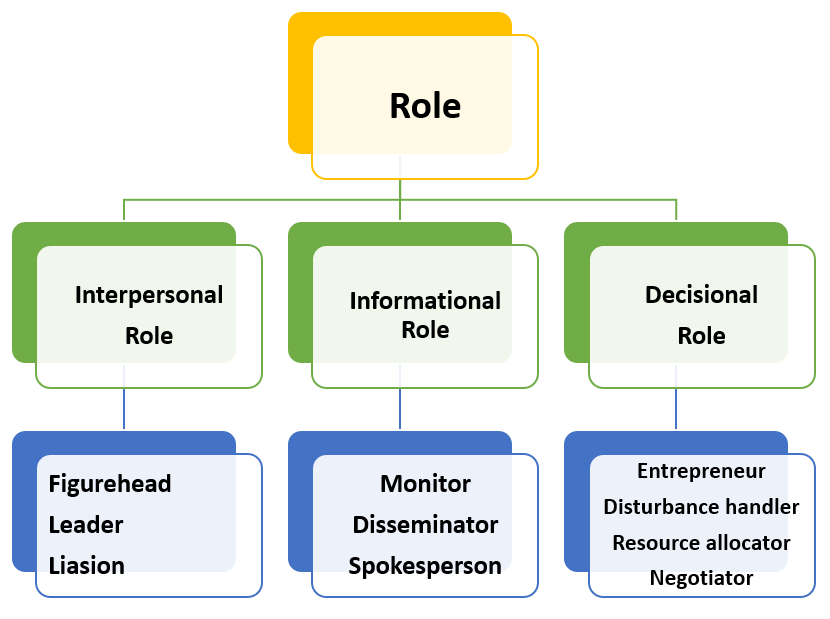
After studying several managers at work, Mintzberg classified their behaviours into three distinct areas or roles- interpersonal, informational, and decisional. Fig­ure 1.2 shows that managers have formal authority, status, personal characteristics and skills to perform these roles effectively.

  1. Interpersonal Roles:

There are three interpersonal roles inherent in the manager’s job. This set of roles derives directly from the manager’s formal position. As the figurehead for his unit, he stands as a symbol of legal authority, performing certain ceremonial duties e.g., signing documents and receiving visitors. The manager in a leader role hires, trains, and motivates his personnel. In the liaison role, manager interacts with many people outside the immedi­ate chain of command, those who are neither subordi­nates nor superiors.

Liaison:

In this role of liaison, every manager must cultivate contacts outside his vertical chain of command to collect information useful for his organization.

Leader:

As a leader, every manager must motivate and encourage his employees. He must also try to reconcile their individual needs with the goals of the organization.

Figurehead:

In this role, every manager has to perform some duties of a ceremonial nature, such as greeting the touring dignitaries, attending the wedding of an employee, taking an important customer to lunch, and so on.

  1. Informational Roles:

Informational roles are important because informa­tion is the lifeblood of organizations and the manager is the nerve center of his unit. As a monitor, the manager is a receiver and collector of information. Information is acquired through meetings, conversations, or documen­tation. In the disseminator role, managers distribute information to subordinates daily. As a spoke-person, the manager transmits information to individuals outside the organization. This role is present in all managerial jobs.

Disseminator:

In the role of a disseminator, the manager passes some of his privileged information directly to his subordinates who would otherwise have no access to it.

Monitor:

As monitor, the manager has to perpetually scan his environment for information, interrogate his liaison contacts and his subordinates, and receive unsolicited information, much of it as result of the network of personal contacts he has developed.

Spokesman:

In this role, the manager informs and satisfies various groups and people who influence his organization. Thus, he advises shareholders about financial performance, assures consumer groups that the organization is fulfilling its social responsibilities and satisfies government that the origination is abiding by the law.

  1. Decisional Roles:

To get the work done, managers have to make decisions. In performing the decision-making role, man­agers act as entrepreneur, disturbance handler, resource allocator, and negotiator. In playing the entrepreneurial role, managers actively design and initiate changes within the organization. It involves some improvements.

As a disturbance handler, the manager handles difficult prob­lems and non-routine situations such as strikes, energy shortages etc. As resource allocator, the manager decides how resources are distributed, and with whom he will work most closely. The fourth decisional role is that of negotiator. Managers negotiate with suppliers, custom­ers, unions, individual employees, the government, and other groups.

It is important to note that neither the functional (process) nor the role approach provides complete insight into many aspects of a manager’s daily routine. Managers should integrate the role-oriented approach with the traditional process approach, because it is, as Jon Pierce says, through the interpersonal, informational, and deci­sional roles that managers execute the planning, organiz­ing, directing and controlling functions.

Disturbance Handler:

In this role, the manager has to work like a fire-fighter. He must seek solutions of various unanticipated problems – a strike may loom large a major customer may go bankrupt; a supplier may renege on his contract, and so on.

Entrepreneur:

In this role, the manager constantly looks out for new ideas and seeks to improve his unit by adapting it to changing conditions in the environment.

In addition, managers in any organization work with each other to establish the organization’s long-range goals and to plan how to achieve them. They also work together to provide one another with the accurate information needed to perform tasks. Thus, managers act as channels of communication with the organization.

Negotiator:

The manager has to spend considerable time in negotiations. Thus, the chairman of a company may negotiate with the union leaders a new strike issue; the foreman may negotiate with the workers a grievance problem, and so on.

error: Content is protected !!