Production, Meaning, Objectives, Types, Factors

Production refers to the process of creating goods and services by transforming inputs into outputs that satisfy human wants. It involves the use of various factors of production such as land, labor, capital, and entrepreneurship to produce finished products or services. The objective of production is to add utility or value to goods so they can meet consumer needs effectively.

Production is not limited to just manufacturing physical goods; it also includes the provision of services like banking, education, and transportation. It encompasses all economic activities that increase the utility of products, either by changing their form (form utility), placing them where they are needed (place utility), or making them available when required (time utility).

In economics, production is broadly classified into three types: primary (e.g., agriculture, mining), secondary (e.g., manufacturing, construction), and tertiary (e.g., services). Effective production is essential for economic development as it leads to increased income, employment, and wealth generation in an economy.

Production plays a central role in business and economics by ensuring that scarce resources are efficiently utilized to meet consumer demand and contribute to the overall growth of an economy.

Objectives of Production:

  • Maximizing Output

One of the primary objectives of production is to maximize output from the available resources. This involves using raw materials, labor, and capital efficiently to produce the highest quantity of goods or services possible. By maximizing output, businesses can reduce per-unit production costs, increase supply, and meet market demand effectively. It ensures better utilization of resources and contributes to overall productivity. This goal helps firms become more competitive in the market and achieve long-term sustainability through increased sales and profitability.

  • Ensuring Quality

Maintaining and improving product quality is a crucial objective of production. Consumers demand reliable, durable, and standardized products that meet certain specifications. By focusing on quality, businesses enhance customer satisfaction, brand loyalty, and reputation. Quality assurance also reduces waste, rework, and the cost of defects. This involves strict monitoring of raw materials, the production process, and the final output. Continuous improvement and adherence to quality standards such as ISO certifications are vital for businesses operating in highly competitive environments.

  • Cost Reduction

Another essential objective is to minimize production costs without compromising on quality. By reducing costs, businesses can set competitive prices, increase profit margins, and improve market share. Cost efficiency can be achieved by adopting modern technology, reducing wastage, optimizing labor productivity, and ensuring efficient use of inputs. Lower production costs give firms a pricing advantage and enable them to reinvest savings into innovation or expansion. Therefore, cost control and waste reduction are central strategies in any successful production system.

  • Meeting Consumer Demand

The production process is geared towards satisfying current and anticipated consumer demand. Understanding market needs and producing the right quantity and variety of goods is vital. If production aligns with consumer preferences, businesses experience higher sales and customer retention. Forecasting tools and demand analysis help firms plan production effectively. Meeting demand also avoids underproduction, which leads to lost sales, and overproduction, which results in unsold inventory and storage costs. Thus, demand-driven production ensures business viability and customer satisfaction.

  • Optimum Utilization of Resources

An important production objective is to make the best use of available resources like land, labor, capital, and machinery. Optimum resource utilization reduces wastage, improves efficiency, and supports sustainable growth. Idle capacity, underused labor, or surplus raw materials can result in increased costs. Efficient scheduling, automation, and capacity planning contribute to better resource management. This objective not only ensures profitability but also supports environmental and economic sustainability by conserving scarce resources and minimizing harmful externalities.

  • Innovation and Improvement

Production aims to support continuous innovation and product improvement. Businesses must regularly adapt to changing technology, consumer preferences, and market trends. Innovation in the production process can lead to better product designs, higher efficiency, and lower costs. It also includes improving workflows, adopting lean manufacturing, and upgrading equipment. Encouraging innovation helps businesses stay competitive, enter new markets, and respond to disruptions more effectively. This objective ensures long-term survival and leadership in the industry.

  • Timely Delivery

Producing goods or services within a set timeframe is critical for business success. Timely delivery ensures that customer orders are fulfilled on schedule, which builds trust and improves satisfaction. Delays can lead to loss of clients, penalties, and reduced market credibility. Effective production planning, supply chain coordination, and inventory management are essential to achieve this objective. Meeting delivery deadlines is particularly important in sectors like retail, hospitality, and manufacturing where timing directly affects revenue.

  • Profit Maximization

Ultimately, production aims to contribute to profit maximization. Efficient production processes lower costs, increase output, and enhance product quality—all of which drive profitability. When production aligns with market demand and cost structures, businesses can optimize pricing strategies and improve margins. Profit maximization allows firms to invest in growth, pay returns to shareholders, and maintain financial stability. Therefore, production is not just a technical activity but a strategic one that directly supports the financial health of an enterprise.

Types of Production:

1. Primary Production

Primary production involves the extraction of natural resources directly from the earth. It includes activities like agriculture, fishing, forestry, and mining. These industries provide raw materials essential for further processing in manufacturing and other sectors. Primary production forms the base of the production chain and plays a crucial role in supplying inputs for secondary industries. It often relies on natural conditions like climate and geography. As the foundation of economic development, primary production supports food security, export earnings, and employment in rural areas.

2. Secondary Production

Secondary production refers to the transformation of raw materials into finished or semi-finished goods through manufacturing and construction. This type includes industries like textile, automobile, steel, and construction. It adds value to raw materials and converts them into usable products for consumers and businesses. Secondary production contributes significantly to industrialization, urbanization, and economic growth. It requires capital investment, skilled labor, and technology. This sector acts as a bridge between primary production and the service sector, enabling the creation of consumer goods and infrastructure.

3. Tertiary Production

Tertiary production includes services that support the production and distribution of goods. It involves activities like transportation, banking, education, healthcare, retail, and entertainment. Although no tangible goods are produced, this type adds value by facilitating trade, communication, and customer satisfaction. It is vital for the smooth functioning of the economy and supports both primary and secondary sectors. In modern economies, the tertiary sector has grown substantially due to increased consumer demand for services and technological advancements in service delivery.

4. Mass Production

Mass production is the manufacturing of large quantities of standardized products, often using assembly lines or automated systems. It is highly efficient, reduces per-unit costs, and enables economies of scale. Industries such as automotive, electronics, and packaged foods rely heavily on mass production. This method minimizes labor time and maximizes consistency in quality. However, it offers little flexibility for product variation. Mass production is ideal for high-demand markets and helps businesses meet large-scale needs quickly and cost-effectively.

5. Batch Production

Batch production involves producing goods in groups or batches where each batch undergoes one stage of the process before moving to the next. It allows for a mix of standardization and flexibility, making it suitable for industries like bakery, pharmaceuticals, and clothing. This method reduces waste, lowers setup costs, and accommodates changes in product types between batches. Batch production is ideal for firms that produce seasonal or varied products in moderate volumes, allowing them to adjust to market demand effectively.

6. Job Production

Job production refers to creating custom products tailored to specific customer requirements. Each product is unique, and the production process is labor-intensive and time-consuming. Examples include shipbuilding, interior design, and bespoke tailoring. This method focuses on high-quality output and personal attention to detail. While it allows for maximum customization, it is less efficient for large-scale production due to high costs and long lead times. Job production is ideal for specialized industries that prioritize customer specifications and craftsmanship.

7. Continuous Production

Continuous production is a non-stop, 24/7 manufacturing process typically used for standardized products with constant demand. Examples include oil refineries, cement plants, and chemical manufacturing. This method is highly automated and capital-intensive, aiming to minimize downtime and maximize output. Continuous production reduces cost per unit and is ideal for producing large volumes efficiently. However, it lacks flexibility and requires significant investment in infrastructure. It is best suited for products where consistency and uninterrupted production are critical.

8. Project-Based Production

Project-based production involves complex, one-time efforts that have defined goals, budgets, and timelines. Each project is unique and requires coordinated planning and resource management. Examples include construction of buildings, film production, and software development. This type of production focuses on achieving specific outcomes and often involves multidisciplinary teams. It allows for customization and innovation but requires detailed scheduling and monitoring. Project production is suitable for businesses that manage large-scale, individual client-based assignments with long durations.

Factors of Production:

  • Land

Land is a natural factor of production that includes all natural resources used to produce goods and services. This encompasses not only soil but also water, forests, minerals, and climate. Land is passive in nature and cannot be moved or increased at will. It provides the raw materials essential for agricultural and industrial activities. Unlike other factors, land is a free gift of nature, and its supply is fixed. However, its productivity can be improved through irrigation, fertilization, and better land management techniques.

  • Labor

Labor refers to the human effort, both physical and mental, used in the production of goods and services. It includes workers at all levels—from manual laborers to skilled professionals. The efficiency of labor depends on education, training, health, and motivation. Labor is an active factor of production that directly participates in converting raw materials into finished goods. Unlike capital, labor cannot be stored and is perishable. Proper utilization of labor through division of work and specialization increases productivity and economic output.

  • Capital

Capital includes all man-made resources used in the production process, such as tools, machinery, equipment, and buildings. It is not consumed directly but aids in further production. Capital is a produced factor, meaning it must be created through savings and investment. It enhances labor productivity by enabling faster and more efficient production. Capital can be classified into fixed capital (e.g., machinery) and working capital (e.g., raw materials). Its accumulation is crucial for industrial growth and technological advancement in any economy.

  • Entrepreneurship

Entrepreneurship is the ability to organize the other factors of production—land, labor, and capital—to create goods and services. Entrepreneurs take on the risk of starting and managing a business. They make critical decisions, innovate, and coordinate resources to achieve production goals. Successful entrepreneurs contribute to economic development by generating employment, increasing productivity, and introducing new products. Unlike the other factors, entrepreneurship involves risk-taking and vision. It is rewarded with profits, while poor decision-making may result in losses.

  • Knowledge

Knowledge has become an increasingly important factor of production in the modern economy. It includes expertise, skills, research, and technological know-how. Knowledge allows for smarter decision-making, innovation, and process optimization. In knowledge-based industries such as IT, pharmaceuticals, and finance, it drives value more than physical inputs. With rapid advancements in science and technology, knowledge is now recognized as a core input that enhances productivity and supports competitive advantage. It is often embedded in human capital and intellectual property.

  • Technology

Technology refers to the application of scientific knowledge and tools to improve production efficiency. It transforms how land, labor, and capital are used by automating processes and enhancing precision. Advanced technology reduces production time, lowers costs, and improves product quality. It is a dynamic factor, continually evolving and reshaping industries. Whether through machinery, software, or communication systems, technology is critical to innovation and scalability. Companies investing in technology gain a competitive edge and adapt better to changing market conditions.

  • Time

Time, though often overlooked, plays a vital role in production. It affects the availability and cost of resources, speed of output, and delivery to market. In seasonal industries like agriculture or tourism, time is crucial to productivity. Managing time efficiently through proper planning and scheduling enhances overall production performance. Delays in production lead to cost overruns and customer dissatisfaction. Thus, time is an intangible yet essential input that influences the success of all production processes.

  • Human Capital

Human capital refers to the collective skills, education, talent, and health of the workforce. It is an enriched form of labor where individuals contribute more than just physical effort. Investment in human capital through training and education increases employee productivity and innovation. Unlike basic labor, human capital includes problem-solving abilities, creativity, and decision-making skills. Economies with higher human capital are more adaptable and competitive. It plays a crucial role in service sectors and knowledge-driven industries.

Buying Decision Process and its Implication on Retailing

Buying decision process, also known as the consumer decision-making process, is a series of steps that individuals go through when making purchasing choices. Understanding this process is crucial for retailers as it helps them tailor their marketing strategies, enhance customer experiences, and influence consumers at each stage of the journey.

The buying decision process typically involves five stages: Problem recognition, Information search, Evaluation of alternatives, Purchase decision, and Post-purchase behavior.

Understanding the intricacies of the buying decision process is fundamental for retailers aiming to succeed in a competitive marketplace. By aligning marketing strategies, product offerings, and customer experiences with the various stages of consumer decision-making, retailers can enhance their appeal, build customer loyalty, and drive sustainable business growth. The integration of technology, the emphasis on personalization, and a commitment to ethical practices further contribute to a positive and impactful retailing experience.

1. Problem Recognition

This is the initial stage where consumers recognize a need or problem that can be satisfied by making a purchase. It could be triggered by internal stimuli (e.g., running out of a product) or external stimuli (e.g., advertising).

Implications for Retailing:

  • Retailers must understand the factors influencing problem recognition and identify triggers that prompt consumers to consider a purchase.
  • Effective advertising, promotions, and product displays can stimulate the recognition of needs.

2. Information Search

Once the need is recognized, consumers seek information to find possible solutions. This can involve internal sources (memory, past experiences) and external sources (friends, family, online reviews).

Implications for Retailing:

  • Retailers should provide accessible and relevant information through multiple channels, including websites, social media, and in-store displays.
  • Reviews and recommendations play a crucial role, so encouraging and showcasing positive customer feedback is beneficial.

3. Evaluation of Alternatives

Consumers evaluate various product options based on attributes such as quality, price, brand reputation, and features. They create a consideration set of alternatives.

Implications for Retailing:

  • Retailers need to ensure their products or services stand out in terms of quality, value, and uniqueness.
  • Creating product bundles, offering discounts, or providing personalized recommendations can influence the evaluation process.

4. Purchase Decision

At this stage, the consumer makes the final decision and selects a particular product or service. Factors like pricing, availability, and promotions influence this decision.

Implications for Retailing:

  • Retailers should optimize pricing strategies, provide transparent information about costs, and offer convenient purchasing options (online, in-store, mobile).
  • Promotions, discounts, and loyalty programs can be effective in nudging consumers towards a purchase.

5. Post-Purchase Behavior

After the purchase, consumers assess their satisfaction. If expectations are met or exceeded, it leads to positive post-purchase behavior; otherwise, dissatisfaction may occur.

Implications for Retailing:

  • Ensuring a positive post-purchase experience is critical for customer loyalty and repeat business.
  • Effective customer service, easy returns, and follow-up communication can enhance customer satisfaction.

Additional Considerations:

Digital and Omnichannel Influences:

  • The digital landscape has transformed the buying decision process. Consumers often use online channels for information search, reviews, and comparisons.
  • Retailers must have a strong online presence, ensuring that their websites are user-friendly and mobile-optimized.

Social Media Influence:

  • Social media platforms play a significant role in shaping consumer perceptions and decisions.
  • Retailers should engage with customers on social media, use influencers, and leverage user-generated content to enhance brand image.

Personalization and Customer Relationship Management (CRM):

  • Personalized experiences cater to individual preferences, enhancing the overall customer journey.
  • Retailers can use CRM systems to track customer interactions, personalize marketing messages, and offer targeted promotions.

Supply Chain and Inventory Management:

  • An efficient supply chain ensures product availability, reducing the likelihood of consumers choosing alternatives due to stockouts.
  • Retailers need robust inventory management systems to optimize stock levels and fulfill customer demands promptly.

Post-Purchase Communication:

  • Continued communication post-purchase, through newsletters or loyalty programs, can reinforce the customer’s decision.
  • Retailers should encourage customer feedback and address any concerns promptly to build trust.

Customer Reviews and Ratings:

  • Online reviews heavily influence the evaluation stage of the buying process.
  • Retailers should actively manage and respond to customer reviews, showcasing a commitment to customer satisfaction.

Sustainability and Ethical Considerations:

  • Growing consumer awareness about sustainability and ethical practices impacts purchasing decisions.
  • Retailers adopting sustainable practices and communicating these efforts can appeal to environmentally conscious consumers.

Challenges and Opportunities for Retailers

  • Increased Consumer Empowerment

Consumers now have access to vast information and options, making it challenging for retailers to influence decisions. However, it also provides opportunities to engage and educate consumers through effective marketing and communication.

  • Rise of E-commerce

The growing prominence of online shopping has altered traditional retail dynamics. Retailers must invest in seamless online experiences and omnichannel strategies to remain competitive.

  • Data Privacy Concerns

While personalized experiences can enhance the buying process, concerns about data privacy and security are on the rise. Retailers need to be transparent about data usage and implement robust security measures.

  • Globalization and Cultural Sensitivity

Retailers expanding internationally must be mindful of cultural differences and adapt their strategies to resonate with diverse consumer preferences.

  • Dynamic Consumer Trends

Rapid changes in consumer preferences and trends require retailers to stay agile and responsive. Regular market research and monitoring of industry trends are essential.

Tele-Marketing, Scope, Types, Advantages, Disadvantages

Telemarketing Concept is a marketing approach where companies use telephone calls to directly connect with potential or existing customers for promoting products, services, or ideas. It involves both inbound telemarketing (customers initiating calls for inquiries or purchases) and outbound telemarketing (sales representatives calling prospects to create awareness or generate sales). This concept helps businesses reach a large audience quickly, build personal connections, provide instant feedback, and generate qualified leads. Telemarketing is also used for customer support, surveys, and follow-ups, making it a versatile tool in modern marketing. However, it requires skilled communication and careful handling to avoid customer annoyance, ensuring the interaction remains professional, ethical, and customer-focused for long-term effectiveness.

Scope of Telemarketing:

  • Lead Generation

Telemarketing is widely used to generate potential customer leads by reaching out to prospects and collecting information about their needs, interests, and purchasing ability. This helps businesses identify qualified buyers who are more likely to convert into customers. By engaging directly over the phone, marketers can gather valuable insights, clarify customer doubts, and build interest in the product or service. Lead generation through telemarketing ensures that sales teams focus only on high-potential customers, improving efficiency and productivity. It is especially useful for industries like insurance, banking, and real estate, where personal interaction influences decision-making.

  • Direct Selling

Telemarketing enables businesses to sell products and services directly to customers without the need for physical stores or face-to-face meetings. Sales representatives explain product features, highlight benefits, and offer promotions to persuade customers to purchase immediately. This direct approach reduces distribution costs and allows companies to expand their reach beyond geographical limits. For example, subscription services, telecom companies, and financial institutions rely heavily on telemarketing for direct sales. Customers benefit from convenience, while businesses gain immediate feedback. When executed ethically and professionally, telemarketing creates quick conversions and enhances sales performance, making it a powerful selling strategy.

  • Customer Relationship Management (CRM)

Telemarketing plays an important role in building and maintaining strong customer relationships. Companies use it to follow up with existing clients, provide after-sales service, resolve complaints, and share updates about new offers. Personalized communication through phone calls helps in strengthening trust and loyalty, as customers feel valued and supported. For example, banks and telecom providers frequently use telemarketing to address customer concerns or offer upgrades. By maintaining consistent contact, businesses can reduce churn rates, increase repeat purchases, and gain customer referrals. Thus, telemarketing acts as a key tool for effective customer relationship management and long-term business success.

  • Market Research and Surveys

Businesses use telemarketing to conduct market research by gathering customer feedback, preferences, and opinions through structured calls. Surveys conducted over the phone provide insights into consumer behavior, satisfaction levels, and expectations. This helps companies improve their products, services, and marketing strategies. Telemarketing surveys are faster and more interactive than written forms, as representatives can clarify questions and record detailed responses. For example, hotels may call customers for feedback on services, or companies may survey buying patterns before launching a new product. Such research ensures businesses stay aligned with market trends and continuously improve customer satisfaction.

  • Promotion of New Products and Services

Telemarketing is an effective way to introduce new products or services to a targeted audience. Companies can directly explain unique features, answer customer questions, and even offer trial packages or discounts. This personalized communication ensures customers understand the product better and feel encouraged to try it. For instance, telecom operators often promote new data plans or devices through outbound calls. Compared to traditional advertising, telemarketing provides two-way interaction, which allows immediate clarification of doubts. This helps in creating awareness, building interest, and driving initial sales, making telemarketing a cost-effective and impactful promotional tool.

  • Fundraising

Telemarketing is extensively used by non-profit organizations, charities, and social institutions to raise funds. Through personalized calls, representatives explain the cause, its importance, and how contributions will make an impact. This direct communication builds trust, encourages empathy, and motivates donors to contribute. Fundraising through telemarketing is cost-effective compared to large-scale events or advertisements, as it allows targeting specific donor groups. Additionally, organizations can maintain long-term donor relationships by following up with updates and gratitude calls. When handled with transparency and sincerity, telemarketing becomes a powerful tool to mobilize financial support for social, educational, and environmental causes.

  • Appointment Setting

In industries like healthcare, real estate, and financial services, telemarketing is used to schedule appointments with clients or prospects. Representatives contact potential customers, provide initial information, and fix a suitable time for detailed discussions or consultations. This saves time for sales teams and ensures meetings with qualified leads who are genuinely interested. For example, insurance companies often use telemarketing to set appointments between agents and clients. It enhances productivity by filtering uninterested prospects in advance and allows businesses to focus on more meaningful interactions. Appointment setting through telemarketing also strengthens professionalism and builds customer confidence.

  • BusinesstoBusiness (B2B) Networking

Telemarketing is highly effective in the B2B sector for creating partnerships, building supplier relationships, and expanding networks. Companies use telemarketing to introduce their services to other businesses, discuss collaboration opportunities, and arrange meetings for further negotiations. For example, a software company may use telemarketing to pitch its solutions to corporate clients. This direct interaction helps businesses present their value propositions clearly and address queries in real time. B2B telemarketing also facilitates lead nurturing, enabling long-term relationships and repeat business. It provides a cost-efficient method for firms to expand their reach and establish strong professional networks.

Types of Telemarketing:

  • Inbound Telemarketing

Inbound telemarketing occurs when customers initiate contact with a company by calling for inquiries, placing orders, or seeking assistance. It is customer-driven and often linked to toll-free numbers, customer care centers, or product helplines. Inbound telemarketing focuses on providing information, resolving issues, and encouraging purchases through professional communication. For example, customers calling a bank to learn about loan schemes or contacting an e-commerce site for order details are cases of inbound telemarketing. Its success depends on well-trained representatives who can handle queries effectively and convert interest into sales. This type emphasizes customer service, satisfaction, and relationship-building while also generating revenue opportunities.

  • Outbound Telemarketing

Outbound telemarketing involves sales representatives making calls to potential or existing customers to promote products, services, or offers. Unlike inbound telemarketing, which is customer-initiated, outbound telemarketing is company-driven and proactive. Its purpose is to generate leads, boost sales, conduct surveys, or create awareness about new launches. For instance, telecom companies often call customers to promote new data packs or credit card companies may advertise offers via outbound calls. While it allows businesses to reach a large audience quickly, it must be carried out ethically and professionally to avoid irritating customers. Successful outbound telemarketing requires persuasive skills, targeting the right audience, and offering genuine value.

  • Business-to-Consumer (B2C) Telemarketing

B2C telemarketing focuses on reaching individual consumers directly to sell products, promote offers, or provide services. Companies use this type to influence buying decisions by explaining product benefits and creating urgency through discounts or limited-time offers. For example, retail brands, insurance firms, and e-commerce platforms commonly use B2C telemarketing to expand their customer base. It offers personalized interaction, allowing representatives to understand consumer needs and adjust their approach accordingly. While B2C telemarketing can generate immediate sales, its success depends on maintaining professionalism and avoiding aggressive selling tactics. Proper targeting and customer-centric communication help businesses build trust and long-term relationships with consumers.

  • BusinesstoBusiness (B2B) Telemarketing

B2B telemarketing involves contacting other businesses to promote products, services, or partnerships rather than selling to individual consumers. It is widely used by companies offering software solutions, consultancy, industrial goods, or wholesale products. The aim is to build strong professional relationships, set appointments, and nurture long-term collaborations. Unlike B2C, B2B telemarketing requires more detailed discussions, as business decisions involve multiple stakeholders and longer sales cycles. For example, an IT company may call other firms to offer cybersecurity solutions. Effective B2B telemarketing requires a consultative approach, strong product knowledge, and professional communication. When executed properly, it leads to valuable contracts, partnerships, and recurring revenue streams.

  • Digital Telemarketing

Digital telemarketing combines traditional phone-based marketing with modern digital tools such as emails, SMS, chatbots, and CRM systems. Instead of relying only on cold calls, businesses integrate telemarketing with online campaigns to reach customers more effectively. For example, a customer may first see an online advertisement, then receive a follow-up call for detailed information or offers. This approach improves targeting, as data analytics help identify the right audience. It also ensures smoother communication by blending digital reminders with personal conversations. Digital telemarketing is highly effective in today’s connected world, as it balances convenience, personalization, and technology to engage customers while reducing costs and improving efficiency.

  • Retention Telemarketing

Retention telemarketing focuses on maintaining relationships with existing customers and reducing churn. Instead of only acquiring new clients, businesses use this approach to ensure loyalty by addressing customer concerns, offering exclusive deals, and encouraging repeat purchases. For example, telecom providers or subscription-based companies call existing users to prevent cancellations or promote renewal plans. Retention telemarketing is more cost-effective than acquiring new customers, as it strengthens long-term trust and maximizes lifetime customer value. This approach relies heavily on personalized communication, proactive problem-solving, and incentives. When implemented correctly, retention telemarketing builds customer loyalty, increases satisfaction, and creates brand advocates who promote the business organically.

Advantages of Telemarketing:

  • Direct Customer Interaction

Telemarketing provides businesses with direct, personal communication with customers. Unlike mass advertising, it allows two-way interaction, where customers can ask questions, clarify doubts, and receive instant responses. This builds trust and gives businesses valuable insights into customer behavior, preferences, and expectations. By listening carefully, telemarketers can adjust their approach to meet customer needs, increasing the chances of conversion. Such personal engagement not only enhances customer satisfaction but also creates opportunities for long-term relationship-building. This advantage makes telemarketing highly effective in industries like banking, insurance, and telecom, where trust and personal assistance strongly influence purchasing decisions.

  • CostEffective Marketing Tool

Compared to traditional marketing methods like TV, print, or outdoor advertising, telemarketing is relatively cost-effective. It requires fewer resources to reach a wide audience, making it especially beneficial for small and medium businesses. Telemarketing also saves costs by eliminating the need for physical outlets or extensive distribution channels. By targeting specific customers directly, companies reduce wasted efforts and focus on qualified leads. Additionally, outbound calls can be scaled up or down depending on business needs, offering flexibility. With proper planning, telemarketing delivers measurable results at a fraction of the cost of traditional promotional campaigns, ensuring better return on investment.

  • Immediate Feedback

One key advantage of telemarketing is the ability to receive instant feedback from customers. During calls, businesses can understand customer reactions, concerns, and opinions in real time, allowing them to quickly adjust their strategies or offerings. For example, if customers show disinterest in a product feature, businesses can modify their pitch accordingly. This direct feedback loop helps in product improvement, service refinement, and better decision-making. Unlike surveys or digital ads, telemarketing provides deeper insights into customer sentiment through personal interaction. As a result, businesses can respond proactively, improve customer satisfaction, and enhance the overall effectiveness of their marketing campaigns.

  • Effective Lead Generation

Telemarketing is highly effective in identifying and nurturing potential leads. By speaking directly to prospects, businesses can evaluate their interest levels, purchasing power, and readiness to buy. This helps sales teams prioritize high-quality leads and avoid wasting resources on uninterested customers. Telemarketing also enables businesses to build databases of potential buyers for future campaigns. For example, real estate companies use telemarketing to generate appointments with prospective clients. By engaging customers with personalized communication, businesses increase the likelihood of conversions. This advantage makes telemarketing a vital tool for industries that rely heavily on qualified leads for consistent growth.

  • Flexibility and Scalability

Telemarketing campaigns are highly flexible and scalable, making them suitable for businesses of all sizes. Companies can easily adjust the number of calls, target areas, or product focus depending on their goals and budgets. For example, a business launching a new product can temporarily expand outbound calling efforts, while later scaling down once awareness is built. Telemarketing also allows testing of different sales pitches and offers to see which resonates best with customers. This adaptability ensures efficient use of resources and provides valuable insights. Its scalability makes telemarketing one of the most versatile tools for modern marketing campaigns.

Disadvantages of Telemarketing:

  • Intrusive and Annoying Nature

One of the biggest disadvantages of telemarketing is that unsolicited calls often disturb customers at inconvenient times, making them feel irritated. Many people perceive these calls as spam, which damages the company’s reputation and reduces the chances of successful interaction. If customers are repeatedly contacted, it can create frustration and even hostility toward the brand. In the long run, this may lead to negative word-of-mouth publicity, which harms the business image. Therefore, companies must carefully plan call timing and frequency, ensuring they respect customer privacy and focus only on genuinely interested audiences.

  • High Operational Costs

Running a telemarketing campaign requires a significant investment in hiring, training, and retaining skilled telemarketers. Additionally, businesses need infrastructure like call centers, software, and communication systems, which add to expenses. Unlike automated digital marketing, telemarketing involves human resources, making it more expensive per customer interaction. Furthermore, employee turnover in telemarketing is often high due to stress and repetitive tasks, leading to additional training costs. If the conversion rate is low, the overall return on investment may not justify the expenses. Hence, without efficient management and targeting, telemarketing can become a costly and unsustainable marketing approach.

  • Negative Brand Image

Overly aggressive selling techniques in telemarketing may result in a negative perception of the company. Customers often associate telemarketing with pushy sales calls that prioritize profit over their needs. This reduces trust and credibility, harming the brand’s long-term image. For instance, insurance or loan companies that make excessive calls often face customer complaints and regulatory scrutiny. A damaged brand image can make it harder to attract and retain loyal customers, even when offering good products. Therefore, companies must adopt ethical practices and focus on building relationships rather than forcing sales, to protect their reputation.

  • Regulatory Restrictions

Telemarketing is subject to strict government rules and regulations, such as “Do Not Call” (DNC) or “Do Not Disturb” (DND) registries, which limit access to potential customers. Companies violating these guidelines may face penalties, fines, or even legal action. These restrictions reduce the number of people businesses can contact, limiting the effectiveness of campaigns. In addition, compliance requires businesses to invest in monitoring systems, which increases costs. Such regulations, while protecting consumer rights, make it difficult for telemarketers to reach a broad audience freely. As a result, regulatory barriers pose a constant challenge for telemarketing practices worldwide.

  • Low Conversion Rates

Despite reaching a large number of people, telemarketing often suffers from low conversion rates. Many customers reject calls, hang up immediately, or show little interest in the offerings. This means that a high volume of calls results in only a small number of successful sales or leads. Low conversion rates waste time, money, and effort, reducing the overall efficiency of campaigns. For example, if hundreds of calls generate only a handful of sales, the business may struggle to justify telemarketing as a viable strategy. Hence, poor targeting and ineffective communication significantly weaken the outcomes of telemarketing.

Concept of New Product Development

New Product Development (NPD) is the process of bringing a new product to market, involving a series of stages from idea generation to commercialization. It includes researching customer needs, creating innovative product concepts, designing and testing prototypes, and launching the final product. NPD is crucial for companies to stay competitive, meet changing customer demands, and drive growth. The process ensures that the product is technically feasible, financially viable, and well-suited to the market. By following structured stages like idea screening, concept development, and market testing, businesses can minimize risks and enhance the chances of a successful launch.

Stages of New Product Development:

  • Idea Generation

This stage involves systematically searching for new product ideas. A company must generate a wide range of ideas to find those worth pursuing. Major sources include internal sources, customers, competitors, distributors, and suppliers. Approximately 55% of new product ideas come from internal sources, where employees are encouraged to contribute ideas through incentive programs. Around 28% come from customers, often through observing or engaging with them. For example, Pillsbury’s Bake-Off has provided several new product ideas that became part of their cake mix line.

  • Idea Screening

The purpose of idea screening is to filter out ideas generated in the first stage, retaining only those with genuine potential. Companies may use product review committees or formal market research for this process. A checklist can help evaluate each idea based on key success factors. This ensures management can assess how well each idea aligns with the company’s capabilities and resources before moving forward with the most promising options.

  • Concept Development and Testing

An attractive idea must be developed into a product concept. While a product idea is an initial notion, a product concept presents it in detailed terms that are meaningful to consumers. Once concepts are developed, they are tested with consumers through symbolic or physical presentations. Companies gather consumer feedback, asking them to respond to the concept and project potential market sales based on this input.

  • Marketing Strategy Development

The next step involves developing a marketing strategy. This strategy is typically divided into three parts: first, the target market and product positioning along with sales, market share, and profit goals; second, the planned product price, distribution, and marketing budget; and third, long-term goals and marketing mix strategies to ensure the product’s success over time.

  • Business Analysis

After developing a marketing strategy, business analysis reviews projected sales, costs, and profits to evaluate the business potential of the product. If these financial projections meet the company’s objectives, the product proceeds to development. This analysis helps the company gauge the overall viability of the product.

  • Product Development

In this stage, R&D or engineering teams develop the concept into a physical product. This involves significant investment and tests whether the product idea can become a practical, marketable solution. Prototypes are created and tested for safety, functionality, and consumer appeal. Laboratory and field testing ensures the product performs effectively before moving forward.

  • Test Marketing

Once the product passes development tests, it enters test marketing, where the product and marketing strategy are tested in real market settings. Test marketing helps refine the marketing mix before a full launch. While test marketing can be expensive, it provides valuable insights. However, some companies bypass this stage to avoid competitor intervention or reduce costs.

  • Commercialization

The final stage is commercialization, where the product is officially launched in the market. High costs are associated with manufacturing, advertising, and promotion. The company decides on the timing and location of the launch based on market readiness and distribution capabilities. Many companies now use a simultaneous development approach, where different departments collaborate to speed up the process, enhancing flexibility and effectiveness in product development.

Laws of Returns to Scale

Laws of Returns to Scale explain how output changes in response to a proportionate change in all inputs in the long run, where all factors of production (land, labor, capital, etc.) are variable. Unlike the Law of Variable Proportions which operates in the short run and changes only one input, returns to scale analyze the effect of changing all inputs simultaneously.

On the basis of these possibilities, law of returns can be classified into three categories:

  • Increasing returns to scale
  • Constant returns to scale
  • Diminishing returns to scale

1. Increasing Returns to Scale:

If the proportional change in the output of an organization is greater than the proportional change in inputs, the production is said to reflect increasing returns to scale. For example, to produce a particular product, if the quantity of inputs is doubled and the increase in output is more than double, it is said to be an increasing returns to scale. When there is an increase in the scale of production, the average cost per unit produced is lower. This is because at this stage an organization enjoys high economies of scale.

Figure-1 shows the increasing returns to scale:

In Figure-1, a movement from a to b indicates that the amount of input is doubled. Now, the combination of inputs has reached to 2K+2L from 1K+1L. However, the output has Increased from 10 to 25 (150% increase), which is more than double. Similarly, when input changes from 2K-H2L to 3K + 3L, then output changes from 25 to 50(100% increase), which is greater than change in input. This shows increasing returns to scale.

There a number of factors responsible for increasing returns to scale.

Some of the factors are as follows:

(i) Technical and managerial indivisibility

Implies that there are certain inputs, such as machines and human resource, used for the production process are available in a fixed amount. These inputs cannot be divided to suit different level of production. For example, an organization cannot use the half of the turbine for small scale of production.

Similarly, the organization cannot use half of a manager to achieve small scale of production. Due to this technical and managerial indivisibility, an organization needs to employ the minimum quantity of machines and managers even in case the level of production is much less than their capacity of producing output. Therefore, when there is increase in inputs, there is exponential increase in the level of output.

(ii) Specialization

Implies that high degree of specialization of man and machinery helps in increasing the scale of production. The use of specialized labor and machinery helps in increasing the productivity of labor and capital per unit. This results in increasing returns to scale.

(iii) Concept of Dimensions

Refers to the relation of increasing returns to scale to the concept of dimensions. According to the concept of dimensions, if the length and breadth of a room increases, then its area gets more than doubled.

For example, length of a room increases from 15 to 30 and breadth increases from 10 to 20. This implies that length and breadth of room get doubled. In such a case, the area of room increases from 150 (15*10) to 600 (30*20), which is more than doubled.

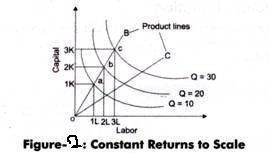
2. Constant Returns to Scale:

The production is said to generate constant returns to scale when the proportionate change in input is equal to the proportionate change in output. For example, when inputs are doubled, so output should also be doubled, then it is a case of constant returns to scale.

Figure-2 shows the constant returns to scale:

In Figure-2, when there is a movement from a to b, it indicates that input is doubled. Now, when the combination of inputs has reached to 2K+2L from IK+IL, then the output has increased from 10 to 20.

Similarly, when input changes from 2Kt2L to 3K + 3L, then output changes from 20 to 30, which is equal to the change in input. This shows constant returns to scale. In constant returns to scale, inputs are divisible and production function is homogeneous.

3. Diminishing Returns to Scale:

Diminishing returns to scale refers to a situation when the proportionate change in output is less than the proportionate change in input. For example, when capital and labor is doubled but the output generated is less than doubled, the returns to scale would be termed as diminishing returns to scale.

Figure 3 shows the diminishing returns to scale:

In Figure-3, when the combination of labor and capital moves from point a to point b, it indicates that input is doubled. At point a, the combination of input is 1k+1L and at point b, the combination becomes 2K+2L.

However, the output has increased from 10 to 18, which is less than change in the amount of input. Similarly, when input changes from 2K+2L to 3K + 3L, then output changes from 18 to 24, which is less than change in input. This shows the diminishing returns to scale.

Diminishing returns to scale is due to diseconomies of scale, which arises because of the managerial inefficiency. Generally, managerial inefficiency takes place in large-scale organizations. Another cause of diminishing returns to scale is limited natural resources. For example, a coal mining organization can increase the number of mining plants, but cannot increase output due to limited coal reserves.

Monopolistic Competition, Concepts, Meaning, Definitions, Characteristics, Price Determination, Advantages and Disadvantages

Monopolistic competition is a market structure that combines elements of both monopoly and perfect competition. In this system, a large number of firms operate in the market, each producing a product that is similar but not identical to others. Product differentiation is the core concept of monopolistic competition. Firms attempt to distinguish their products through branding, quality, design, packaging, or services. Although firms enjoy some degree of monopoly power over their own products, this power is limited due to the presence of close substitutes.

Meaning of Monopolistic Competition

Monopolistic competition refers to a market situation where many sellers sell differentiated products to a large number of buyers. Each firm acts independently and has limited control over price. Consumers perceive differences among products, even though they serve the same basic purpose. Because of differentiation, firms face downward-sloping demand curves. Entry and exit of firms are relatively free, which ensures that abnormal profits exist only in the short run, while in the long run firms earn normal profits.

Definitions of Monopolistic Competition

  • Edward Chamberlin’s Definition

According to Edward Chamberlin, “Monopolistic competition is a market structure in which there are many sellers selling differentiated products. Each firm has a certain degree of monopoly power over its own product due to differentiation, but close substitutes are available in the market, limiting excessive pricing.”

  • Joan Robinson’s Definition

Joan Robinson defined monopolistic competition as “a market structure where many firms produce similar but not identical products, and each firm competes independently with limited control over price.”

  • Leftwich’s Definition

According to Leftwich, “Monopolistic competition is a market structure in which there are many firms producing differentiated products, and there is freedom of entry and exit in the long run.”

Characteristics of Monopolistic Competition

  • Large Number of Buyers and Sellers

Monopolistic competition involves many buyers and sellers operating in the market. However, unlike perfect competition, each firm holds a relatively small market share and operates independently. No single firm has enough influence to affect overall market supply or pricing significantly. The presence of numerous sellers ensures that customers have multiple choices. Each firm faces competition from others offering close substitutes, although products are not identical. This structure encourages innovation and marketing strategies to capture consumer attention and retain a loyal customer base.

  • Product Differentiation

One of the most defining features of monopolistic competition is product differentiation. Firms sell products that are similar but not identical, which gives consumers the perception of uniqueness. Differentiation can be based on quality, packaging, features, branding, style, or customer service. This perceived uniqueness allows firms to charge slightly higher prices than competitors. For example, different brands of toothpaste or clothing are essentially the same but marketed differently. Product differentiation creates brand loyalty and gives firms a degree of pricing power in the market.

  • Freedom of Entry and Exit

Monopolistic competition allows free entry and exit of firms in the long run. New firms can enter the market when existing firms are earning supernormal profits, increasing competition and reducing profit margins over time. Conversely, firms that incur losses can leave without major obstacles. This flexibility ensures that no single firm dominates the market permanently. As firms enter or exit, the number of sellers stabilizes, and long-run equilibrium is achieved where each firm earns normal profit. This characteristic promotes healthy competition and market dynamism.

  • Some Degree of Price Control

Firms in monopolistic competition have some pricing power due to product differentiation. Unlike perfect competition, where firms are price takers, here each firm faces a downward-sloping demand curve, allowing them to set prices independently within a certain range. However, the presence of close substitutes limits this power. If a firm charges significantly higher prices, consumers may shift to competing products. Thus, while firms can influence prices to a limited extent, their pricing decisions are closely tied to how well they differentiate their product.

  • Non-Price Competition

In monopolistic competition, firms often engage in non-price competition to attract and retain customers. Since raising prices can drive customers to competitors, businesses focus on marketing tactics such as advertising, sales promotions, improved packaging, customer service, or introducing new features. These strategies build brand identity and customer loyalty without directly altering the price. For instance, mobile phone brands emphasize camera quality or screen resolution over price cuts. Non-price competition is vital in this market structure to maintain customer base and market share.

  • Independent Decision Making

Each firm in monopolistic competition makes its own independent business decisions regarding pricing, output, marketing, and product design. There is no formal coordination among firms as seen in oligopolies. The strategic decisions are based on individual cost structures, market analysis, and competitive positioning. Although firms are aware of competitors’ actions, they don’t engage in collective behavior like price fixing. This autonomy allows firms to experiment, innovate, and adopt different business strategies tailored to their product and target customers.

  • Elastic Demand Curve

A firm in monopolistic competition faces a highly elastic but not perfectly elastic demand curve. Because there are many close substitutes available, a small increase in price may lead to a significant decrease in quantity demanded. However, due to product differentiation, the firm retains some customers who are loyal to the brand or specific features. This elasticity reflects the balance between customer preference and market competition. Firms must therefore carefully assess the price sensitivity of their consumers to maintain sales volume and revenue.

  • High Selling and Promotional Costs

Advertising, promotional campaigns, and other selling efforts are prominent in monopolistic competition. Since products are differentiated, firms spend heavily on selling costs to inform, persuade, and remind customers of their product’s uniqueness. These costs are necessary to sustain brand loyalty and attract new buyers in a highly competitive environment. Companies may invest in social media, endorsements, packaging innovations, or after-sale services. Though these expenses don’t directly enhance production, they significantly impact consumer perception and play a central role in business success.

Price Determination under Monopolistic Competition

Price determination under monopolistic competition explains how firms fix prices in a market where many sellers offer similar but differentiated products. Each firm has limited control over price because its product is unique, yet close substitutes restrict excessive pricing. Price is not decided by the entire industry but by individual firms based on demand, cost, and competition. This pricing mechanism combines elements of monopoly power and competitive pressure, making it highly relevant to real-world markets.

  • Nature of Demand Curve

In monopolistic competition, each firm faces a downward-sloping demand curve. This is because product differentiation creates brand loyalty, allowing firms to reduce prices to increase sales. However, demand is relatively elastic since consumers can switch to close substitutes if prices rise. The downward slope indicates that firms must lower prices to sell more units, which directly influences how price is determined in the market.

  • Role of Product Differentiation

Product differentiation plays a crucial role in price determination. Firms differentiate products through quality, design, packaging, brand image, and services. Greater differentiation reduces price sensitivity and gives firms more control over pricing. Consumers are willing to pay higher prices for preferred brands. However, differentiation does not eliminate competition, as substitute products limit excessive price increases. Entrepreneurs rely on differentiation to influence demand and pricing flexibility.

  • Cost Conditions and Pricing

Cost conditions strongly influence price determination under monopolistic competition. Firms analyze average cost and marginal cost before fixing prices. Profit maximization occurs where marginal cost equals marginal revenue. The price is then determined from the demand curve at that output level. If production or selling costs increase, firms may raise prices, provided consumers accept the increase. Efficient cost management is therefore essential for competitive pricing.

  • Short-Run Price Determination

In the short run, firms under monopolistic competition may earn supernormal profits, normal profits, or incur losses. When demand is high and costs are low, firms can charge prices above average cost. Price is determined where marginal cost equals marginal revenue. Short-run profits attract new firms, increasing competition. Thus, short-run price determination reflects temporary market conditions rather than long-term equilibrium.

  • Long-Run Price Determination

In the long run, free entry of firms eliminates supernormal profits. New firms introduce close substitutes, reducing the demand for existing firms. The demand curve shifts leftward until it becomes tangent to the average cost curve. At this point, firms earn only normal profits. Price equals average cost but remains higher than marginal cost, reflecting product differentiation and excess capacity.

  • Role of Selling Costs

Selling costs such as advertising and promotion influence price determination under monopolistic competition. Firms incur selling costs to shift the demand curve to the right by increasing brand awareness and loyalty. These costs raise total cost and often lead to higher prices. While selling costs strengthen competitive position, excessive advertising increases prices without proportionate consumer benefit, affecting overall efficiency.

  • Impact of Competition on Pricing

Competition limits price control under monopolistic competition. Firms must consider competitor prices and consumer reactions before fixing prices. Excessive pricing may lead to loss of customers to substitutes. At the same time, price wars are uncommon because firms prefer non-price competition. This balanced competitive pressure ensures moderate prices, innovation, and product variety while preventing monopolistic exploitation.

Advantages of Monopolistic Competition

  • Wide Variety of Products

One of the major advantages of monopolistic competition is the availability of a wide variety of products. Firms differentiate their goods based on quality, design, packaging, branding, and features. This variety satisfies diverse consumer tastes and preferences. Consumers can choose products that best match their needs, income levels, and lifestyles. Unlike perfect competition, where products are homogeneous, monopolistic competition enhances consumer satisfaction through choice and diversity.

  • Consumer Satisfaction

Monopolistic competition increases consumer satisfaction by offering differentiated products and improved services. Firms focus on customer needs to maintain brand loyalty. Better after-sales services, warranties, and attractive packaging enhance consumer experience. Consumers are not forced to buy a single standardized product and can switch brands easily. This freedom of choice empowers consumers and encourages firms to continuously improve product quality and customer service.

  • Freedom of Entry and Exit

Another important advantage is the freedom of entry and exit of firms. New firms can easily enter the market if they perceive profit opportunities. Similarly, inefficient firms can exit without major barriers. This flexibility promotes healthy competition and innovation. It prevents long-term monopolistic profits and ensures efficient resource allocation. Free entry and exit also make the market dynamic and adaptable to changing consumer preferences.

  • Encouragement to Innovation

Monopolistic competition strongly encourages innovation and creativity. Firms continuously introduce new designs, features, and improvements to differentiate their products from competitors. Innovation helps firms attract consumers and gain a competitive edge. This leads to technological advancement and improved product quality over time. Continuous innovation benefits consumers and contributes to overall economic development by promoting research and development activities.

  • Limited Price Control

Firms under monopolistic competition enjoy limited price control due to product differentiation. They can set prices slightly above competitors without losing all customers. However, this control is not absolute because close substitutes exist. This balance allows firms to recover costs and earn normal profits while protecting consumers from excessive pricing. Thus, price stability is maintained through competitive pressure.

  • Role of Non-Price Competition

Non-price competition is a significant advantage of monopolistic competition. Firms compete through advertising, branding, quality improvement, and customer service rather than aggressive price wars. This reduces the risk of destructive competition and encourages market stability. Non-price competition enhances product awareness and helps consumers make informed choices. It also strengthens brand identity and long-term customer relationships.

  • Better Quality and Services

Under monopolistic competition, firms focus on improving quality and services to retain customers. Since consumers can easily switch to substitutes, firms strive to maintain high standards. Better quality, innovation, and customer-oriented services become essential survival strategies. This results in overall improvement in market offerings and enhances consumer welfare.

  • Balanced Market Structure

Monopolistic competition provides a balanced market structure by combining competition and monopoly elements. It avoids the extremes of perfect competition and pure monopoly. Consumers enjoy choice and quality, while firms benefit from product differentiation and reasonable pricing power. This balance makes monopolistic competition suitable for real-world markets such as retail, clothing, restaurants, and consumer goods industries.

Disadvantages of monopolistic competition

  • Inefficiency in Resource Allocation

Monopolistic competition often leads to inefficient allocation of resources. Firms do not produce at the minimum point of their average cost curve, unlike in perfect competition. Since each firm has some market power due to product differentiation, they charge a higher price than marginal cost, causing underproduction and inefficiency. This misallocation leads to deadweight loss and limits overall welfare. It implies that the economy does not make the best use of its resources, resulting in reduced productivity and consumer surplus.

  • Excess Capacity

Firms in monopolistic competition often operate with excess capacity, meaning they do not produce at full potential or minimum average cost. Due to downward-sloping demand curves and market saturation, firms can’t maximize their scale. This inefficiency results from the competitive pressure to differentiate and maintain uniqueness. Firms intentionally avoid producing large quantities to preserve price control. This leads to wasted resources, higher unit costs, and underutilization of infrastructure and labor, which ultimately reflects a less-than-optimal economic output for the industry.

  • Higher Prices for Consumers

Due to product differentiation, firms in monopolistic competition have some price-setting power, leading to higher prices than in perfect competition. Consumers end up paying more for essentially similar products just because of perceived differences. This pricing strategy reduces consumer welfare, especially when the higher price is not justified by proportional quality improvements. In the long run, although supernormal profits are eroded by new entrants, prices still remain above marginal cost, resulting in persistent market inefficiency and higher expenditure for consumers.

  • Wastage on Advertising and Selling Costs

Firms in monopolistic competition incur excessive costs on advertising, branding, packaging, and other selling expenses to differentiate their products. These selling costs are not directly related to improving product quality or quantity but aim to manipulate consumer perception. This results in a significant portion of resources being used for persuasive rather than productive purposes. From a societal point of view, this is considered wasteful, as these expenditures could have been used for more value-adding activities or price reductions.

  • Misleading Product Differentiation

Product differentiation in monopolistic competition is often more artificial than real. Firms use branding, slogans, and packaging to create a false sense of uniqueness. This may lead consumers to believe one product is significantly better than another, even if the actual difference is minimal. Such strategies may manipulate customer decisions rather than improve the product itself. It can also promote consumerism and irrational buying behavior, where choices are driven more by image than by real value or utility.

  • Lack of Long-Term Innovation

Firms in monopolistic competition may lack incentives for long-term innovation. Since the market is crowded and profits are normal in the long run, firms often focus on short-term promotional gains rather than investing in research and development. Innovation may be limited to superficial changes like packaging or color variants. In contrast to monopolies that can invest in technological advancement due to sustained profits, monopolistic firms are under constant pressure and may avoid risky, long-term improvements that require substantial capital.

  • Unstable Market Structure

The ease of entry and exit in monopolistic competition creates a dynamic yet unstable market structure. Continuous entry of new firms erodes existing profits, while poorly performing firms frequently exit. This causes fluctuating market shares, inconsistent pricing strategies, and unpredictable consumer loyalty. The lack of stability makes it difficult for firms to plan for long-term investments or build lasting competitive advantages. This volatility can also confuse consumers due to rapidly changing product varieties and brands.

  • Duplication of Resources

Due to multiple firms offering similar yet differentiated products, there is often a duplication of efforts and resources. Each firm invests separately in advertising, packaging, distribution, and retail space for products that fulfill nearly the same function. This redundancy leads to higher production and operating costs industry-wide. It also creates environmental and logistical inefficiencies, such as excess packaging waste or transport emissions, which could be reduced in a more centralized or coordinated market structure like perfect competition or monopoly.

Cost of Production

Cost of Production refers to the total expenditure incurred by a business in the process of producing goods or services. It includes the monetary value of all inputs used during production, such as raw materials, labor, machinery, utilities, and overheads. Understanding production costs is crucial for determining pricing, profitability, and operational efficiency.

Cost of production is a fundamental concept in both micro and macroeconomics. It helps firms evaluate resource allocation, set competitive prices, and measure profitability. Lower production costs often lead to a higher competitive edge in the market.

Cost of production serves as a cornerstone for analyzing business operations, planning budgets, and making long-term strategic decisions, especially in a competitive and dynamic business environment.

Concept of Costs:

The concept of costs refers to the monetary value of resources sacrificed or expenses incurred in the process of producing goods or services. In economics and business, cost is a fundamental concept that helps firms make informed decisions related to production, pricing, budgeting, and profitability.

Costs are broadly classified based on purpose and perspective:

1. Short-Run and Long-Run Costs

Short-run costs refer to the costs incurred when at least one factor of production is fixed. Typically, capital or plant size is fixed in the short run, while labor and raw materials are variable. As a result, businesses face both fixed and variable costs in the short run. Short-run cost behavior includes increasing or decreasing returns due to limited flexibility in resource adjustment.

Long-run costs are incurred when all factors of production are variable. In the long run, firms can change plant size, technology, and resource combinations to achieve optimal efficiency. There are no fixed costs in the long run. Long-run cost curves represent the least-cost method of producing each output level, and they are derived from short-run average cost curves.

Understanding these concepts helps firms make strategic decisions. In the short run, businesses focus on maximizing output with limited resources, while in the long run, they plan capacity expansion, technology upgrades, and cost minimization.

2. Average and Marginal Costs

Average Cost is the cost per unit of output, calculated by dividing the total cost (TC) by the number of units produced. It indicates the efficiency of production at various output levels and helps in pricing decisions. There are different types of average costs: average total cost, average fixed cost, and average variable cost.

Marginal Cost is the additional cost incurred by producing one more unit of output. It is calculated as the change in total cost when output increases by one unit. Marginal cost plays a crucial role in decision-making, especially in determining optimal production level. If the price of the product is greater than marginal cost, firms increase production; if it’s lower, they reduce it.

The relationship between average cost and marginal cost is important:

  • When MC is less than AC, AC falls.
  • When MC is greater than AC, AC rises.
  • When MC equals AC, AC is at its minimum.

These cost concepts help firms evaluate profitability, determine output levels, and set appropriate prices for sustainability and competitiveness.

3. Total, Fixed, and Variable Costs

Total Cost refers to the overall expense incurred in the production of goods or services. It is the sum of Fixed Costs (FC) and Variable Costs (VC).
TC = FC + VC

Fixed Costs are those costs that do not vary with the level of output. They remain constant even if production is zero. Examples include rent, salaries of permanent staff, and insurance. Fixed costs are unavoidable in the short run and must be paid regardless of production volume.

Variable Costs, on the other hand, change with the level of output. The more a firm produces, the higher the variable cost. Examples include raw materials, hourly wages, and utility charges. These costs are directly proportional to the quantity of production.

Understanding these components is critical for firms to analyze cost behavior and manage operations efficiently. Total cost helps in calculating average and marginal costs, which are essential for decision-making. Fixed costs highlight the burden a firm carries regardless of activity, while variable costs help in adjusting expenses according to production scale.

MC as change in TVC:

Marginal cost for the nth unit may be expressed as

Since fixed cost remains unchanged at all levels of output up to capacity we can write FC = FCn-1 in which case MC may be expressed as:

MCn = VCn – VCn-1

Thus marginal cost refers to marginal variable cost. In other words, MC has no relation to fixed cost.

National income Analysis and Measurement

National income refers to the total monetary value of all final goods and services produced within a country’s borders over a specific period, typically a year. It serves as a crucial indicator of a country’s economic performance and standard of living. In India, national income is measured using various methods, including the production approach, income approach, and expenditure approach.

A. Gross Domestic Product (GDP)

Gross Domestic Product (GDP) is the most commonly used measure of national income and represents the total value of all final goods and services produced within a country’s borders during a specified period, usually a year. In India, GDP is calculated using both production and expenditure approaches.

Key Features of GDP:

  • Domestic Focus: It includes only the goods and services produced within the country, regardless of the nationality of the producer.

  • Final Goods Only: It counts only final goods and services to avoid double counting (intermediate goods are excluded).

  • Market Value: Goods and services are evaluated at current market prices.

  • Time-bound: GDP is always measured over a specific time period (quarterly or annually).

  • Inclusive of All Sectors: It includes the output of the agriculture, industrial, and service sectors.

Methods of Calculating GDP:

There are three main methods to calculate GDP:

1. Production (Output) Method

  • Measures the total value added at each stage of production across all sectors.
  • GDP = Gross Value of Output – Value of Intermediate Consumption

2. Income Method

  • Sums up all incomes earned by factors of production (wages, rent, interest, profit).
  • GDP = Compensation to employees + Operating surplus + Mixed income

Expenditure Method

  • Adds up all expenditures made on final goods and services.
  • GDP = C + I + G + (X – M)
    Where:
    C = Consumption
    I = Investment
    G = Government Expenditure
    X = Exports
    M = Imports

Types of GDP:

1. Nominal GDP

  • Measured at current market prices, without adjusting for inflation.

  • It reflects price changes and not actual growth.

2. Real GDP

  • Adjusted for inflation or deflation.

  • Shows the true growth in volume of goods and services.

3. GDP at Market Price (GDPMP)

  • Includes indirect taxes and excludes subsidies.

4. GDP at Factor Cost (GDPFC)

  • GDPMP – Indirect Taxes + Subsidies

  • Reflects the income earned by the factors of production.

Significance of GDP:

  • Indicator of Economic Health: Higher GDP indicates a growing economy.

  • Comparison Tool: Enables comparison of economies across countries or time periods.

  • Policy Planning: Governments use GDP data to design fiscal and monetary policies.

  • Investment Decisions: Investors rely on GDP trends for market analysis and forecasting.

Limitations of GDP:

  • Ignores Income Distribution: Doesn’t show inequality or poverty levels.

  • Non-Market Activities Excluded: Housework or informal sector contributions are not counted.

  • Environmental Degradation: GDP growth may come at the cost of resource depletion.

  • Underground Economy: Unrecorded economic activities are not included.

Components of GDP:

In India, GDP is composed of several components, including:

  • Consumption (C)

Expenditure on goods and services by households, including spending on food, housing, healthcare, education, and other consumer goods.

  • Investment (I)

Expenditure on capital goods such as machinery, equipment, construction, and infrastructure, including both private and public sector investment.

  • Government Spending (G)

Expenditure by the government on goods and services, including salaries, public infrastructure, defense, and social welfare programs.

  • Net Exports (NX)

The difference between exports and imports of goods and services. A positive value indicates a trade surplus, while a negative value indicates a trade deficit.

Sectorial Composition of GDP:

India’s GDP is composed of several sectors:

  • Agriculture

This sector includes farming, forestry, fishing, and livestock, and contributes to food security, rural livelihoods, and raw material supply for industries.

  • Industry

The industrial sector encompasses manufacturing, mining, construction, and utilities. It drives economic growth, employment generation, and technological advancement.

  • Services

The services sector includes trade, transport, communication, finance, real estate, professional services, and government services. It accounts for a significant share of GDP and employment and plays a crucial role in supporting other sectors.

B. Gross National Product (GNP)

Gross National Product (GNP) is the total monetary value of all final goods and services produced by the residents (nationals) of a country in a given period (usually a year), regardless of where the production takes place—whether within the domestic economy or abroad.

In other words, GNP = GDP + Net Factor Income from Abroad (NFIA).

Net Factor Income from Abroad (NFIA) includes:

  • Income earned by residents abroad (wages, dividends, interest, etc.)

  • Minus income earned by foreigners within the domestic territory

GNP = GDP + (Income earned from abroad − Income paid to foreigners)

Key Characteristics of GNP:

  • Nationality-Based: Focuses on ownership, not geography. It includes income earned by citizens and businesses of a country, even if earned outside its borders.

  • Includes Net Factor Income: Takes into account factor incomes (wages, rent, interest, profits) earned internationally.

  • Reflects Economic Strength Globally: Measures a nation’s economic contribution globally, especially helpful for countries with high overseas employment or investments.

  • Measured Annually or Quarterly: Like GDP, GNP is also calculated over a specific time period.

Example to Understand GNP

Suppose:

  • India’s GDP = ₹250 lakh crore

  • Income earned by Indian citizens abroad = ₹15 lakh crore

  • Income earned by foreigners in India = ₹10 lakh crore

Then:

GNP = ₹250 + ₹15 − ₹10 = ₹255 lakh crore

Types of GNP:

  • GNP at Market Prices (GNPMP): Includes indirect taxes and excludes subsidies.

  • GNP at Factor Cost (GNPFC):

    GNP at Factor Cost = GN at Market Price − Indirect Taxes + Subsidies

Importance of GNP:

  • Measures National Income Globally: Indicates the economic strength of a nation including overseas activities.

  • Helps in Policy Formulation: Useful for countries with significant remittances or foreign business operations.

  • Comparative Analysis: Helpful for comparing resident income versus domestic production (GNP vs GDP).

  • Better Measure for Some Economies: For countries with many overseas workers (e.g., Philippines, India), GNP may reflect actual income inflow more accurately than GDP.

Limitations of GNP:

  • Neglects Domestic Productivity: May overstate or understate true economic strength if NFIA is volatile.

  • Difficulties in Measuring NFIA: Tracking international incomes can be inaccurate or delayed.

  • Not a Welfare Indicator: Like GDP, GNP doesn’t reflect inequality, environmental damage, or well-being.

  • Ignores Informal Economy: Unregistered businesses and informal work are excluded.

C. Net National Product (NNP)

Net National Product (NNP) is the monetary value of all final goods and services produced by the residents of a country in a given period (usually one year), after accounting for depreciation (also known as capital consumption allowance).

It is derived from Gross National Product (GNP) by subtracting the depreciation of capital goods.

NNP = GNP − Depreciation

Features of NNP:

  • Reflects Net Output: It shows the net production of an economy after maintaining the existing capital stock.

  • Depreciation-Adjusted: More accurate than GNP or GDP because it adjusts for capital consumption.

  • Residents’ Contribution: Includes production by nationals both domestically and abroad.

  • Indicates Sustainability: Provides insight into how sustainable a country’s production is over time.

Example

Let’s say:

  • GNP of a country = ₹280 lakh crore

  • Depreciation = ₹30 lakh crore

Then:

NNP = ₹280 − ₹30 = ₹250 lakh crore

If Indirect Taxes = ₹12 lakh crore, Subsidies = ₹2 lakh crore:

Then:

NNPFC = ₹250 − ₹12 + ₹2 = ₹240 lakh crore

This ₹240 lakh crore is also called the National Income.

D. Personal Income (PI)

Personal Income refers to the total income received by individuals or households in a country from all sources before the payment of personal taxes. It includes all earnings from wages, salaries, investments, rents, interest, and transfer payments such as pensions, unemployment benefits, and subsidies.

In simple terms, Personal Income is the income available to individuals before paying taxes, but after adding transfer incomes and excluding undistributed profits and other non-receivable incomes.

Formula to Calculate Personal Income

Personal Income = National Income − Corporate Taxes − Undistributed Corporate Profits + Transfer Payments

Where:

  • National Income (NI) is the total income earned by a country’s residents.
  • Corporate Taxes are taxes paid by companies on their profits.
  • Undistributed Corporate Profits are profits retained by companies.
  • Transfer Payments include pensions, subsidies, and social security benefits.

Components of Personal Income:

  • Wages and Salaries: Earnings from employment.

  • Rent: Income from letting out property or land.

  • Interest: Returns from savings or investments in bonds.

  • Dividends: Income from shares in corporations.

  • Transfer Payments: Pensions, unemployment benefits, welfare payments, etc.

  • Proprietors’ Income: Profits from unincorporated businesses.

Importance of Personal Income:

  • Indicator of Economic Well-Being: Personal Income reflects how much money people actually receive, indicating living standards and household purchasing power.
  • Guides Taxation Policies: Governments use PI to design progressive tax policies and to decide on tax brackets for individuals.
  • Helps in Consumption Analysis: Since consumption is closely linked with income, PI helps in forecasting demand patterns and consumer spending trends.
  • Useful in Social Welfare Planning: Helps to identify income disparities and plan welfare programs such as subsidies or unemployment benefits.

E. Personal Disposable Income (PDI)

Personal Disposable Income (PDI) refers to the amount of money left with individuals or households after paying all personal direct taxes such as income tax. It is the net income available for consumption and savings.

In simple terms, PDI = Personal Income – Personal Taxes.

It represents the real purchasing power of households and is a crucial indicator of consumer behavior and economic demand.

Components of PDI:

  • Wages and Salaries – After-tax income from employment.

  • Transfer Payments – Net of any taxes (e.g., pensions, unemployment benefits).

  • Investment Income – Interest, dividends, and rent received after taxes.

  • Proprietors’ Income – Profits earned by individuals in business, minus personal tax.

Importance of Personal Disposable Income:

  • Measures Purchasing Power: PDI directly reflects how much individuals can spend or save, making it a key driver of consumer demand in the economy.
  • Helps in Demand Forecasting: Analysts use PDI trends to predict changes in consumption patterns, which guide production and marketing strategies.
  • Supports Economic Planning: Government can design policies like stimulus packages or tax reliefs based on changes in PDI to boost spending.
  • Indicates Economic Welfare: Rising PDI is a sign of improved living standards, while declining PDI may indicate growing tax burdens or inflation effects.

F. Gross Value Added (GVA)

Gross Value Added (GVA) is a measure of the value added by various sectors of the economy in the production process. It represents the difference between the value of output and the value of intermediate consumption. GVA provides insights into the contribution of different sectors to the overall economy.

G. Gross National Income (GNI)

Gross National Income (GNI) measures the total income earned by a country’s residents, including both domestic and international sources. It includes GDP plus net income from abroad, such as remittances, interest, dividends, and other payments received from overseas.

H. Net National Income (NNI)

Net National Income (NNI) is derived from GNI by subtracting depreciation or the value of capital consumption. NNI reflects the net income generated by a country’s residents after accounting for the depreciation of capital assets.

I. Per Capita Income

Per Capita Income is calculated by dividing the total national income (such as GDP or GNI) by the population of the country. It represents the average income earned per person and serves as a measure of the standard of living and economic welfare.

Trends and Challenges:

India’s national income and its aggregates have witnessed significant growth and transformation over the years. However, the country faces various challenges:

  • Income Inequality

Disparities in income distribution persist, with a significant portion of the population facing poverty and economic deprivation.

  • Sectoral Disparities

There are wide gaps in development and productivity across different sectors and regions, with disparities between rural and urban areas.

  • Unemployment and Underemployment

India grapples with high levels of unemployment and underemployment, particularly among youth and marginalized communities.

  • Infrastructure Deficit

Inadequate infrastructure, including transportation, energy, and digital connectivity, hampers economic growth and competitiveness.

  • Environmental Sustainability

Rapid economic growth has led to environmental degradation, pollution, and resource depletion, necessitating sustainable development practices.

  • Policy Reforms

Structural reforms and policy initiatives are required to address bottlenecks, promote investment, boost productivity, and enhance competitiveness.

Government Initiatives:

The Indian government has introduced various policies and initiatives to promote economic growth, employment generation, and inclusive development:

  • Make in India

A flagship initiative aimed at boosting manufacturing, promoting investment, and enhancing competitiveness.

  • Digital India

A program focused on digital infrastructure, e-governance, and digital empowerment to drive technological advancement and digital inclusion.

  • Skill India

A skill development initiative aimed at enhancing the employability of the workforce and bridging the skills gap.

  • Pradhan Mantri Jan Dhan Yojana (PMJDY)

A financial inclusion program aimed at expanding access to banking services, credit, and insurance for marginalized communities.

  • Goods and Services Tax (GST)

A comprehensive indirect tax reform aimed at simplifying the tax structure, promoting transparency, and boosting tax compliance.

Methods of Measuring National Income

  • Product Approach

In product approach, national income is measured as a flow of goods and services. Value of money for all final goods and services is produced in an economy during a year. Final goods are those goods which are directly consumed and not used in further production process. In our economy product approach benefits various sectors like forestry, agriculture, mining etc to estimate gross and net value.

  • Income Approach

In income approach, national income is measured as a flow of factor incomes. Income received by basic factors like labor, capital, land and entrepreneurship are summed up. This approach is also called as income distributed approach.

  • Expenditure Approach

This method is known as the final product method. In this method, national income is measured as a flow of expenditure incurred by the society in a particular year. The expenditures are classified as personal consumption expenditure, net domestic investment, government expenditure on goods and services and net foreign investment.

These three approaches to the measurement of national income yield identical results. They provide three alternative methods of measuring essentially the same magnitude.

Meaning, Nature and Scope of Economics

Economics is a social science that studies how individuals, businesses, and governments allocate limited resources to satisfy unlimited wants. It deals with the production, distribution, and consumption of goods and services. The core focus of economics is the problem of scarcity—resources such as land, labor, and capital are limited, while human desires are endless. This mismatch forces societies to make choices about what to produce, how to produce, and for whom to produce.

Economics is broadly divided into two branches: Microeconomics and Macroeconomics. Microeconomics examines individual units like consumers, firms, and markets, focusing on demand, supply, and price determination. Macroeconomics, on the other hand, analyzes the economy as a whole, dealing with national income, inflation, unemployment, and economic growth.

Economics also involves studying incentives and behaviors. It tries to explain how people respond to changes in prices, income, and government policies. For example, if the price of a good rises, demand may fall—this behavioral aspect is central to economic analysis.

Modern economics is applied across various fields such as healthcare, finance, environmental studies, and business strategy. It aids in policy formulation, business planning, and efficient resource utilization.

In essence, economics provides the tools to understand and respond to complex real-world issues, making it essential for making informed decisions in both personal and professional contexts.

Nature of Economics:

  • Economics as a Social Science

Economics is considered a social science because it studies human behavior in relation to the allocation of scarce resources. Like other social sciences, it analyzes patterns, choices, and decisions people make under constraints. Economics deals with real-life issues such as consumption, production, employment, and trade. It uses scientific methods to study human actions in the economic domain and formulates theories based on observation and reasoning to understand how people respond to incentives and constraints.

  • Study of Scarcity and Choice

Economics centers around the problem of scarcity, which arises due to limited resources and unlimited wants. Because not all desires can be satisfied, individuals and organizations must make choices. Economics studies how these choices are made and how resources are allocated efficiently. This nature of economics is vital in understanding trade-offs, prioritization, and opportunity costs. It helps determine the best use of available resources to maximize utility, output, or welfare.

  • Economics is Both a Science and an Art

Economics is a science because it develops principles and laws based on systematic observations, analysis, and logic. It explains cause-and-effect relationships in economic phenomena. Simultaneously, economics is also an art as it involves the practical application of knowledge to achieve economic objectives such as reducing poverty or controlling inflation. It guides individuals, businesses, and governments in decision-making and problem-solving, making it both theoretical and practical in nature.

  • Economics is Dynamic

Economics is not static—it evolves with changes in social, political, and technological environments. As consumer preferences, market conditions, and resource availability change, economic theories and practices also adapt. This dynamic nature makes economics relevant across eras, allowing it to address emerging issues like digital currencies, climate change, and global pandemics. It responds to current challenges and continuously redefines strategies for efficient economic management and sustainable development.

  • Economics is Normative and Positive

Economics has both positive and normative aspects. Positive economics deals with facts and describes what is happening in the economy—like “an increase in interest rates reduces borrowing.” Normative economics, on the other hand, involves value judgments—such as “the government should increase healthcare spending.” The nature of economics lies in balancing both perspectives: it explains real-world situations and suggests what ought to be done for better societal outcomes.

  • Economics is Concerned with Human Welfare

A core nature of economics is its concern for human welfare. Classical and modern economists view economics not just as a wealth-generating activity but also as a means to enhance the standard of living. It studies how resources can be allocated efficiently to fulfill basic needs, reduce inequality, and improve social well-being. Development economics, for example, focuses on uplifting poor communities through policy reforms and sustainable economic strategies.

  • Economics is Abstract and Quantitative

Economics often uses abstract models and assumptions to simplify complex real-world situations. Concepts like demand curves, equilibrium, and elasticity are built on theoretical frameworks. At the same time, economics is quantitative—it uses data, statistics, and mathematical tools to analyze trends and forecast outcomes. This dual nature of being both conceptual and measurable helps economists evaluate policies and make informed decisions based on empirical evidence.

  • Universal Applicability of Economics

The principles of economics apply universally across individuals, businesses, industries, and nations. Whether in a household managing a monthly budget or a multinational corporation planning global investments, economic reasoning is essential. From pricing strategies to resource allocation, the scope of economics covers all levels of decision-making. Its universal applicability makes it a valuable tool for solving diverse problems in finance, governance, marketing, and international trade.

Scope of Economics:

  • Consumption

Consumption is a fundamental area in the scope of economics. It deals with how individuals and households use goods and services to satisfy their wants. Economics studies consumer behavior, utility maximization, and demand patterns. Understanding consumption helps businesses predict buying behavior, while governments use this knowledge to design tax policies and welfare programs. Consumption analysis explains how income, price changes, and preferences affect demand and is crucial for pricing, production planning, and marketing strategies.

  • Production

Production involves the transformation of inputs (land, labor, capital, entrepreneurship) into output. Economics examines how these resources are combined efficiently to maximize output and profits. It also studies the laws of production, economies of scale, and production functions. The scope of production analysis helps businesses in cost minimization, resource allocation, and technology adoption. Efficient production is key to competitiveness and sustainability in business operations and national economic growth.

  • Distribution

Distribution refers to how income and wealth are shared among the factors of production—landowners, laborers, capitalists, and entrepreneurs. Economics studies how wages, rent, interest, and profits are determined. The fairness and efficiency of income distribution impact economic stability, social equity, and standard of living. Understanding distribution helps policymakers address inequality through taxation, welfare schemes, and labor laws. For businesses, it affects cost structures, employee compensation, and investment decisions.

  • Exchange

Exchange is the process by which goods and services are traded. Economics explores market structures (perfect competition, monopoly, oligopoly), pricing mechanisms, and trade practices. It helps understand how value is determined, how markets operate, and how supply meets demand. Exchange analysis guides businesses in setting prices, identifying competitors, and evaluating market opportunities. It also includes the role of money, banking, and credit systems in facilitating smooth transactions.

  • Public Finance

Public finance falls within the scope of economics by analyzing government income and expenditure. It includes taxation, public spending, budgeting, and debt management. Economics studies how government policies affect economic growth, inflation, employment, and income distribution. It provides tools to evaluate the impact of fiscal policies on the economy. Businesses are also affected by public finance through taxation policies, subsidies, infrastructure development, and government procurement strategies.

  • Economic Growth and Development

Economics examines both short-term growth and long-term development. Growth refers to an increase in national income, while development includes improvements in health, education, infrastructure, and living standards. Economics studies factors that promote or hinder development, such as investment, innovation, political stability, and resource management. This area is essential for policymakers and global institutions to create strategies for poverty reduction, inclusive growth, and sustainable development.

  • International Trade and Economics

International trade is a vital part of economics that deals with the exchange of goods, services, and capital across borders. It studies comparative advantage, trade policies, tariffs, exchange rates, and global economic organizations like WTO and IMF. Understanding international economics helps countries and businesses develop trade strategies, expand markets, and respond to global economic shifts. It also explains the effects of globalization, balance of payments, and international competition.

  • Economic Planning and Policy Making

Economics provides the foundation for policy formulation and planning at national and organizational levels. It assists governments in framing monetary, fiscal, and industrial policies based on economic objectives. It also helps businesses in strategic planning, risk analysis, and market forecasting. This area includes planning resource allocation, managing economic cycles, and addressing social challenges. Economics thus plays a critical role in achieving stability, growth, and sustainable development.

Market Segmentation

Market Segmentation is the process of dividing a broad consumer base into smaller, more manageable groups based on shared characteristics like demographics, behavior, geography, or psychographics. This helps businesses tailor products, messaging, and strategies to meet specific customer needs, improving targeting, efficiency, and customer satisfaction. Effective segmentation enhances marketing ROI and competitive advantage.

Market Segmentation

  • Market segmentation is a marketing concept which divides the complete market set up into smaller subsets comprising of consumers with a similar taste, demand and preference.
  • A market segment is a small unit within a large market comprising of like minded individuals.
  • One market segment is totally distinct from the other segment.
  • A market segment comprises of individuals who think on the same lines and have similar interests.
  • The individuals from the same segment respond in a similar way to the fluctuations in the market.

Basis of Market Segmentation

1. Gender

  • The marketers divide the market into smaller segments based on gender. Both men and women have different interests and preferences, and thus the need for segmentation.
  • Organizations need to have different marketing strategies for men which would obviously not work in case of females.
  • A woman would not purchase a product meant for males and vice a versa.
  • The segmentation of the market as per the gender is important in many industries like cosmetics, footwear, jewellery and apparel industries.

2. Age Group

Division on the basis of age group of the target audience is also one of the ways of market segmentation.

The products and marketing strategies for teenagers would obviously be different than kids.

  • Age group (0 – 10 years) – Toys, Nappies, Baby Food, Prams
  • Age Group (10 – 20 years) – Toys, Apparels, Books, School Bags
  • Age group (20 years and above) – Cosmetics, Anti-Ageing Products, Magazines, apparels and so on

3. Income

Marketers divide the consumers into small segments as per their income. Individuals are classified into segments according to their monthly earnings.

The three categories are:

  • High income Group
  • Mid Income Group
  • Low Income Group

Stores catering to the higher income group would have different range of products and strategies as compared to stores which target the lower income group.

Pantaloon, Carrefour, Shopper’s stop target the high income group as compared to Vishal Retail, Reliance Retail or Big bazaar who cater to the individuals belonging to the lower income segment.

4. Marital Status

Market segmentation can also be as per the marital status of the individuals. Travel agencies would not have similar holiday packages for bachelors and married couples.

5. Occupation

Office goers would have different needs as compared to school / college students.

A beach house shirt or a funky T Shirt would have no takers in a Zodiac Store as it caters specifically to the professionals.

Types of Market Segmentation

  • Psychographic segmentation

The basis of such segmentation is the lifestyle of the individuals. The individual’s attitude, interest, value help the marketers to classify them into small groups.

  • Behaviouralistic Segmentation

The loyalties of the customers towards a particular brand help the marketers to classify them into smaller groups, each group comprising of individuals loyal towards a particular brand.

  • Geographic Segmentation

Geographic segmentation refers to the classification of market into various geographical areas. A marketer can’t have similar strategies for individuals living at different places.

Nestle promotes Nescafe all through the year in cold states of the country as compared to places which have well defined summer and winter season.

McDonald’s in India does not sell beef products as it is strictly against the religious beliefs of the countrymen, whereas McDonald’s in US freely sells and promotes beef products.

Not all individuals have similar needs. A male and a female would have varied interests and liking towards different products. A kid would not require something which an adult needs. A school kid would have a different requirement than an office goer. Market Segmentation helps the marketers to bring together individuals with similar choices and interests on a common platform.

  • Market Segmentation helps the marketers to devise appropriate marketing strategies and promotional schemes according to the tastes of the individuals of a particular market segment. A male model would look out of place in an advertisement promoting female products. The marketers must be able to relate their products to the target segments.
  • Market segmentation helps the marketers to understand the needs of the target audience and adopt specific marketing plans accordingly. Organizations can adopt a more focussed approach as a result of market segmentation.
  • Market segmentation also gives the customers a clear view of what to buy and what not to buy. A Rado or Omega watch would have no takers amongst the lower income group as they cater to the premium segment. College students seldom go to a Zodiac or Van Heusen store as the merchandise offered by these stores are meant mostly for the professionals. Individuals from the lower income group never use a Blackberry. In simpler words, the segmentation process goes a long way in influencing the buying decision of the consumers.

An individual with low income would obviously prefer a Nano or Alto instead of Mercedes or BMW.

  • Market segmentation helps the organizations to target the right product to the right customers at the right time. Geographical segmentation classifies consumers according to their locations. A grocery store in colder states of the country would stock coffee all through the year as compared to places which have defined winter and summer seasons.
  • Segmentation helps the organizations to know and understand their customers better. Organizations can now reach a wider audience and promote their products more effectively. It helps the organizations to concentrate their hard work on the target audience and get suitable results.

Steps in Market Segmentation

1. Identify the target market

The first and foremost step is to identify the target market. The marketers must be very clear about who all should be included in a common segment. Make sure the individuals have something in common. A male and a female can’t be included in one segment as they have different needs and expectations.

Burberry stocks separate merchandise for both men and women. The management is very clear on the target market and has separate strategies for product promotion amongst both the segments.

A Garnier men’s deodorant would obviously not sell if the company uses a female model to create awareness.

Segmentation helps the organizations decide on the marketing strategies and promotional schemes.

Maruti Suzuki has adopted a focused approach and wisely created segments within a large market to promote their cars.

  • Lower Income Group – Maruti 800, Alto.
  • Middle Income Group – Wagon R, Swift, Swift Dzire, Ritz.
  • High Income Group – Maruti Suzuki Kizashi, Suzuki Grand Vitara.

Suzuki Grand Vitara would obviously have no takers amongst the lower income group.

The target market for Rado, Omega or Tag Heuer is the premium segment as compared to Maxima or a Sonata watch.

2. Identify expectations of Target Audience

Once the target market is decided, it is essential to find out the needs of the target audience. The product must meet the expectations of the individuals. The marketer must interact with the target audience to know more about their interests and demands.

Kellogg’s K special was launched specifically for the individuals who wanted to cut down on their calorie intake.

Marketing professionals or individuals exposed to sun rays for a long duration need something which would protect their skin from the harmful effects of sun rays. Keeping this in mind, many organizations came with the concept of sunscreen lotions and creams with a sun protection factor especially for men.

3. Create Subgroups

The organizations should ensure their target market is well defined. Create subgroups within groups for effective results.

Cosmetics for females now come in various categories.

  • Creams and Lotions for girls between 20-25 years would focus more on fairness.
  • Creams and lotions for girls between 25 to 35 years promise to reduce the signs of ageing.

4. Review the needs of the target audience

It is essential for the marketer to review the needs and preferences of individuals belonging to each segment and sub-segment. The consumers of a particular segment must respond to similar fluctuations in the market and similar marketing strategies.

5. Name your market Segment

Give an appropriate name to each segment. It makes implementation of strategies easier.

A kids section can have various segments namely new born, infants, toddlers and so on.

6. Marketing Strategies

Devise relevant strategies to promote brands amongst each segment. Remember you can’t afford to have same strategies for all the segments. Make sure there is a connect between the product and the target audience. Advertisements promoting female toiletries can’t afford to have a male model, else the purpose gets nullified.

A model promoting a sunscreen lotion has to be shown roaming or working in sun for the desired impact.

7. Review the behavior

Review the behavior of the target audience frequently. It is not necessary individuals would have the same requirement (demand) all through the year. Demands vary, perceptions change and interests differ. A detailed study of the target audience is essential.

8. Size of the Target Market

It is essential to know the target market size. Collect necessary data for the same. It helps in sales planning and forecasting.

error: Content is protected !!
