Physical Distribution Channels refer to the path or route through which goods and services travel from the producer or manufacturer to the final consumer. These channels include intermediaries such as wholesalers, retailers, agents, or distributors, who play an essential role in making the product available to the target market. The goal of distribution channels is to ensure that products reach the right place, at the right time, and in the right condition. Effective distribution channel management helps companies expand market reach, enhance product availability, and optimize costs, contributing to overall business success.
Role of Physical Distribution Channels:
(i) Distribution channels provide time, place, and ownership utility
They make the product available when, where, and in which quantities the customer wants. But other than these transactional functions, marketing channels are also responsible to carry out the following functions:
(ii) Logistics and Physical Distribution
Marketing channels are responsible for assembly, storage, sorting, and transportation of goods from manufacturers to customers.
(iii) Facilitation
Channels of distribution even provide pre-sale and post-purchase services like financing, maintenance, information dissemination and channel coordination.
(iv) Creating Efficiencies
This is done in two ways: bulk breaking and creating assortments. Wholesalers and retailers purchase large quantities of goods from manufacturers but break the bulk by selling few at a time to many other channels or customers. They also offer different types of products at a single place which is a huge benefit to customers as they don’t have to visit different retailers for different products.
(v) Sharing Risks
Since most of the channels buy the products beforehand, they also share the risk with the manufacturers and do everything possible to sell it.
(vi) Marketing
Distribution channels are also called marketing channels because they are among the core touch points where many marketing strategies are executed. They are in direct contact with the end customers and help the manufacturers in propagating the brand message and product benefits and other benefits to the customers.
Role Determining the Choice of Distribution Channels:
Selection of the perfect marketing channel is tough. It is among those few strategic decisions which either make or break your company.
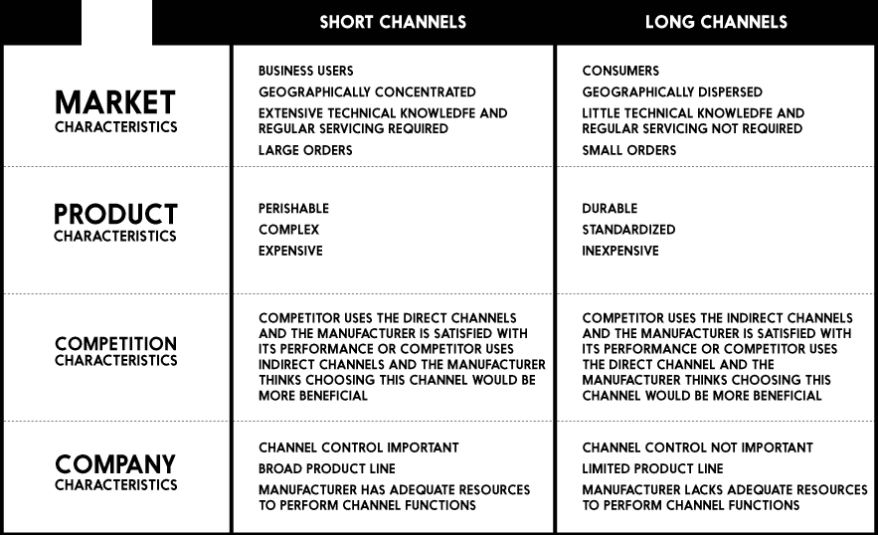
Even though direct selling eliminates the intermediary expenses and gives more control in the hands of the manufacturer, it adds up to the internal workload and raises the fulfilment costs. Hence these four factors should be considered before deciding whether to opt for the direct or indirect distribution channel.
Importance of Physical Distribution Channels:
Physical distribution channels ensure products are available to customers at the right place and time. They bridge the gap between production and consumption, making goods accessible in various markets. Efficient distribution minimizes stockouts and ensures continuous supply. By strategically placing products where demand exists, businesses can serve customers promptly, increase satisfaction, and build loyalty. This availability directly influences purchase decisions and repeat sales, especially in competitive markets. Without effective physical distribution, even high-quality products may fail to reach intended customers, resulting in lost opportunities and reduced profitability.
Efficient physical distribution channels optimize transportation routes, load capacity, and storage facilities to minimize costs. By consolidating shipments and using appropriate warehousing strategies, businesses can lower expenses while maintaining timely deliveries. Cost reduction also improves pricing competitiveness in the market. Advanced logistics systems, such as just-in-time (JIT) inventory management, help reduce the need for large storage facilities, saving rent and maintenance costs. Moreover, bulk transportation through well-managed channels reduces per-unit freight charges. These cost efficiencies ultimately increase profitability and allow companies to offer competitive prices to customers without compromising service quality.
Physical distribution channels help businesses reach diverse geographic areas, including rural, urban, and international markets. Well-established networks of wholesalers, distributors, and retailers ensure products penetrate deeper into different customer segments. This expansion enables companies to serve untapped markets, increasing overall sales volume and market share. Global brands often rely on sophisticated distribution systems to ensure consistent product availability across countries. Additionally, local adaptation of distribution strategies allows businesses to cater to specific market needs. By extending reach effectively, companies can strengthen their brand presence and establish dominance over competitors in multiple regions simultaneously.
An efficient physical distribution channel ensures fast, reliable, and damage-free delivery of products, directly contributing to customer satisfaction. Customers value convenience and timely service, and a strong distribution network fulfills these expectations. Quick product availability enhances trust in the brand and encourages repeat purchases. In industries like FMCG, electronics, and e-commerce, seamless delivery is a major factor in customer retention. Furthermore, prompt handling of returns and exchanges through distribution networks adds to a positive buying experience. Overall, smooth distribution strengthens customer relationships and boosts long-term loyalty, which is crucial for business sustainability.
A strong distribution system gives companies a competitive edge by ensuring products reach markets faster than competitors. Businesses that can deliver products promptly gain an advantage in customer preference and loyalty. Efficient logistics also allow companies to respond quickly to changing market demands or seasonal fluctuations. By maintaining a wide and reliable network, businesses can secure better shelf space in retail outlets and negotiate favorable terms with distributors. This operational strength often translates into a dominant market position, higher sales volumes, and stronger brand visibility, making it harder for competitors to match performance.
Physical distribution channels are a crucial link in the supply chain, ensuring smooth movement of goods from manufacturers to end-users. Well-coordinated channels improve communication between producers, wholesalers, retailers, and customers, leading to better inventory control and demand forecasting. This reduces delays, stock imbalances, and wastage. Integration with technology like GPS tracking and warehouse management systems further enhances efficiency. By aligning supply with demand in real-time, companies can avoid overproduction or shortages. Smooth supply chain operations also improve overall productivity and operational efficiency, which directly benefits profitability and customer satisfaction.
Effective physical distribution channels directly contribute to higher sales by ensuring wide product availability and convenience for customers. Products that are easy to find and purchase naturally sell more, leading to increased revenue. Distributors and retailers often promote products within their networks, providing additional marketing support. Furthermore, consistent supply to high-demand areas maximizes sales potential and minimizes lost opportunities. Seasonal products, in particular, benefit from quick and efficient distribution to capture peak demand. Ultimately, a robust distribution network is a strategic driver for sustainable business growth and long-term market expansion.
Types of Distribution Channels:
Distribution channels refer to the pathways through which products move from the producer to the final consumer. The choice of distribution channel impacts the product’s availability, cost, and customer experience. There are several types of distribution channels, each suited to different business models and customer needs.
In a direct distribution channel, the producer sells the product directly to the consumer without involving intermediaries. This can be done through physical stores, company-owned retail outlets, or online platforms. Direct channels allow businesses to have full control over the pricing, branding, and customer experience. They are commonly used for high-value, customized products, or when a business wants to establish direct relationships with customers, as seen in industries like luxury goods, technology, and exclusive services.
Indirect distribution channels involve intermediaries between the producer and the consumer. These intermediaries can be wholesalers, distributors, or retailers who help move the product through the market. Indirect channels are common for mass-market products where reaching a larger audience efficiently is crucial. For example, a manufacturer of consumer electronics may sell its products to wholesalers, who then distribute them to various retailers, making the product available in multiple locations.
A dual distribution channel, also known as a hybrid channel, combines both direct and indirect methods. A company uses direct sales to reach some customers while also using intermediaries to sell through other channels. This type of distribution is useful for companies that want to diversify their sales efforts or reach different market segments. For example, a company might sell directly to large corporate clients but rely on retailers to reach individual consumers. This approach increases market coverage and flexibility.
Intensive distribution aims to make the product available in as many locations as possible. This type of channel is used for products with high demand, low unit cost, and frequent purchases, such as consumer packaged goods, snacks, or toiletries. The goal is to saturate the market and make the product widely accessible. The product is sold through multiple retailers, wholesalers, and other outlets to ensure it is readily available for customers.
Selective distribution involves using a limited number of outlets or intermediaries to distribute products. The company selectively chooses the intermediaries based on their ability to provide quality service, reach specific customer segments, or meet certain brand standards. This approach is often used for moderately priced products such as electronics or appliances. It allows the producer to maintain some control over the product’s distribution while still reaching a broad audience.
Exclusive distribution channels are characterized by a highly selective approach where the producer only sells the product through a few specific intermediaries. This type of channel is often used for luxury or high-end products, where exclusivity and prestige are critical. By limiting the number of distributors or retailers, the brand can control its image and ensure that the product is positioned correctly in the market. For example, a high-end automobile manufacturer may only sell its cars through a select network of authorized dealerships.
Choosing the Right Distribution Channel:
Choosing the right distribution channel is a crucial decision that can significantly impact a company’s success in reaching its target market. The process involves evaluating various options based on the product type, target customer preferences, cost considerations, and competitive environment.
The nature of the product plays a vital role in determining the best distribution channel. For example, perishable goods like fresh food products may require direct distribution to maintain freshness, while durable goods can be sold through wholesalers or retailers. Similarly, high-end, luxury products may be best suited for exclusive distribution channels, while mass-market items benefit from extensive channel networks.
The level of market coverage needed for the product influences the choice of distribution channel. If the goal is to achieve intensive distribution (wide availability in as many outlets as possible), using intermediaries like wholesalers or retailers is essential. On the other hand, exclusive distribution may require fewer intermediaries to maintain control and exclusivity, which works well for high-end products.
Understanding how customers prefer to buy products is critical when selecting a distribution channel. In the digital age, many customers prefer purchasing products online, while others prefer a traditional in-store experience. Businesses need to assess the purchasing behavior and preferences of their target market to choose a channel that aligns with their customers’ expectations.
The cost of using a particular distribution channel is an important factor. Direct distribution, such as selling through a company-owned retail outlet or an e-commerce platform, may involve higher operational costs but provides more control. Indirect channels like wholesalers and retailers may reduce operational costs but may result in lower profit margins due to commissions and markups. Companies need to balance cost considerations with revenue goals to make the most cost-effective choice.
When a company chooses a distribution channel, it also determines the level of control it will have over its products and brand. Direct distribution allows a company to maintain more control over product presentation, pricing, and customer experience. However, indirect channels offer less control, as they rely on intermediaries to sell the product. If maintaining control over branding and customer experience is a priority, a company may opt for a direct distribution channel.
The distribution strategy should also consider competitors’ actions. If competitors are using particular distribution channels, entering the same channels could help a company maintain its competitive edge. Alternatively, choosing unique or innovative channels can provide differentiation in the marketplace.
The geographical scope of the target market also affects the choice of distribution channels. If a company plans to reach international or distant markets, using a distribution network that includes international agents or global e-commerce platforms might be necessary. Alternatively, for a local or regional target market, a more localized approach with regional wholesalers or retailers may be sufficient.
The time it takes for products to reach customers is another consideration. If the market demands fast delivery, a direct distribution channel, such as e-commerce with quick fulfillment services or direct sales through retail stores, may be ideal. In contrast, some customers may be willing to wait for their products, in which case a slower, but more cost-effective, channel may suffice.
Like this:
Like Loading...
 by
by