Doctrine of Ultra-vires

The Doctrine of Ultra Vires is a fundamental principle of Company Law. It defines the legal boundaries within which a company must operate. The term “Ultra Vires” is derived from Latin, meaning “beyond the powers.” In legal terms, any act conducted by a company beyond the scope of its objectives defined in the Memorandum of Association (MOA) is termed as Ultra Vires and hence is void ab initio (invalid from the outset). This doctrine is a key safeguard for investors and creditors, ensuring that the company acts only within its legal capacity.

Origin of the Doctrine:

The doctrine was first established in the landmark English case Ashbury Railway Carriage and Iron Co. Ltd. v. Riche (1875). In this case, the company entered into a contract to finance the construction of a railway in Belgium, which was outside the scope of its MOA. The court held that since the contract was Ultra Vires the company, it was void, even if all shareholders agreed.

Legal Framework in India:

In India, the Doctrine of Ultra Vires is recognized under the Companies Act, 2013, especially concerning the MOA (Memorandum of Association). As per Section 4(1)(c) of the Act, the objects clause must define the main and ancillary objectives of the company. Any act beyond these objectives is deemed Ultra Vires and cannot be legally ratified.

Purpose of the Doctrine:

The main objectives of the Doctrine of Ultra Vires include:

  1. Protecting Investors: It ensures that the capital contributed by shareholders is used only for lawful and intended purposes.

  2. Protecting Creditors: Lenders and creditors are protected by ensuring the company does not engage in unauthorized ventures that could risk insolvency.

  3. Preventing Misuse of Power: Directors and officers are restricted from using company funds or authority for unintended activities.

Types of Ultra Vires Acts:

  • Ultra Vires the Company (Beyond MOA):

Any act not authorized by the MOA is completely void. Neither the shareholders nor directors can ratify such an act.

  • Ultra Vires the Directors but Intra Vires the Company:

If an act is within the MOA but beyond the authority of the directors, it can be ratified by the shareholders.

  • Ultra Vires the Articles but Intra Vires the Company:

Acts beyond the Articles of Association (AOA) but within the MOA can be altered by a special resolution.

Key Implications of the Doctrine:

  • Void and Inoperative

Ultra Vires contracts are void ab initio. No rights, liabilities, or obligations arise from such acts.

  • Directors’ Personal Liability

If directors engage in ultra vires acts, they can be held personally liable for the losses caused.

  • Injunction

Shareholders can apply for an injunction to prevent the company from performing ultra vires acts.

  • Property Acquired Ultra Vires

If a company acquires property under an ultra vires transaction, it can retain the property unless restitution is possible.

  • Borrowing Powers

If a company borrows funds beyond its authorized powers, it must repay the amount if it still possesses the money or assets bought.

Examples of Ultra Vires Acts:

  • A company whose MOA limits its business to textile manufacturing enters into real estate development — this is ultra vires the company.

  • If the directors enter into a foreign partnership without board approval, it is ultra vires the directors but not the company, and can be ratified.

Criticism of the Doctrine:

  • Too Rigid

It does not allow flexibility for businesses to respond to dynamic market conditions or diversify into new ventures.

  • Outdated in Modern Practice

Modern companies often include very broad objects clauses to avoid the constraints of ultra vires.

  • Can Lead to Inequity

Innocent third parties may suffer even when they act in good faith, as ultra vires contracts are unenforceable.

Current Position in India:

The Companies Act, 2013, has made the objects clause more flexible. Companies now often include broad objectives to reduce the risk of ultra vires actions. Section 245 also allows shareholders to file a class action suit if the company or its management acts beyond its authority.

Furthermore, Section 13 of the Act allows companies to alter the MOA through special resolutions, enabling them to expand their object clause to accommodate new activities — subject to approval from the Registrar of Companies (ROC).

Safeguards Against Ultra Vires Acts:

  • Well-Drafted MOA

Including a wide range of business objectives helps reduce ultra vires risk.

  • Legal Due Diligence

Companies should ensure all contracts and operations are in line with their registered objectives.

  • Board Oversight

Directors must stay updated and ensure compliance with the company’s charter documents.

  • Stakeholder Vigilance

Shareholders and creditors should monitor company actions through AGMs and audits.

Meaning, Contents, Forms and Alteration of Memorandum of Association

Memorandum of Association (MoA) is a fundamental legal document required for the incorporation of a company. It serves as the company’s constitution, defining its relationship with the external world and outlining the scope of its operations. Every company in India, whether public or private, must have a Memorandum of Association to be registered under the Companies Act, 2013. The MoA sets the foundation for a company’s legal existence and binds the company, its shareholders, and all those who interact with the company to the terms contained within it.

Meaning of Memorandum of Association:

Memorandum of Association is essentially a charter or a framework that outlines the objectives, powers, and scope of the company. It defines the company’s boundaries and specifies what the company can and cannot do. The MoA acts as a contract between the company and the shareholders, as well as between the company and the external parties it deals with.

The purpose of the MoA is to ensure that the company operates within its defined objectives, and it provides clarity to shareholders, creditors, and third parties regarding the nature and scope of the company’s business. Any action taken by the company beyond the scope of the MoA is considered ultra vires (beyond the powers) and may be deemed invalid.

Contents of the Memorandum of Association:

Companies Act, 2013, specifies the mandatory contents of the MoA, and each clause plays a significant role in determining the company’s structure and operational framework. The key components of a Memorandum of Association are:

1. Name Clause

The name clause specifies the name of the company. The name must be unique and not identical or similar to any existing registered company. The name must also comply with naming guidelines under the Companies Act:

  • For a Private Limited Company, the name must end with “Private Limited.”
  • For a Public Limited Company, the name must end with “Limited.”

Additionally, the name should not infringe on any trademarks or offend public morality.

2. Registered Office Clause

This clause specifies the registered office of the company, which serves as its official address. It is the location where legal documents, notices, and other communications can be sent. The company must provide the complete address of the registered office upon incorporation, and any changes to the address must be notified to the Registrar of Companies (RoC).

3. Object Clause

The object clause is one of the most critical sections of the MoA, as it outlines the main objectives for which the company is formed. The object clause is divided into:

  • Main Objects: The primary activities the company will undertake. Any business conducted by the company must be aligned with these objects.
  • Ancillary or Incidental Objects: Activities necessary to achieve the main objects.

The object clause restricts the company’s activities to those mentioned in the MoA. Any business conducted outside the scope of this clause is considered ultra vires.

4. Liability Clause

This clause defines the extent of the liability of the company’s shareholders. In a company limited by shares, the liability of shareholders is limited to the unpaid amount on their shares. If the company is limited by guarantee, the liability is limited to the amount each member agrees to contribute in the event of liquidation.

5. Capital Clause

The capital clause specifies the company’s authorized share capital. It mentions the total amount of capital with which the company is registered and the division of this capital into shares of a fixed value. This clause sets a limit on the amount of share capital that the company can issue unless it is altered through a formal process.

6. Subscription Clause

Subscription clause lists the names of the initial subscribers to the Memorandum, who agree to take up shares in the company. It also indicates the number of shares each subscriber agrees to take. Each subscriber must sign the MoA in the presence of at least one witness.

7. Association or Declaration Clause

This clause includes a declaration by the original members, stating their intent to form the company and agree to become its first shareholders. The subscribers to the MoA declare that they wish to associate themselves with the company.

Forms of Memorandum of Association:

Under the Companies Act, 2013, companies can be formed in various categories, and the MoA must reflect the company’s type. The MoA can be drafted in different forms depending on the type of company:

  • Table A: For companies limited by shares.
  • Table B: For companies limited by guarantee but not having share capital.
  • Table C: For companies limited by guarantee and having share capital.
  • Table D: For unlimited companies.
  • Table E: For unlimited companies having share capital.

Each form provides a template for the drafting of the MoA according to the specific type of company being incorporated.

Alteration of Memorandum of Association:

Although the MoA is a rigid document that outlines the company’s operational limits, it can be altered under specific circumstances. The process for altering the MoA is governed by the provisions of the Companies Act, 2013. The alteration is allowed only if it is approved by a special resolution of the shareholders and is registered with the RoC.

1. Alteration of the Name Clause

The name of the company can be changed by passing a special resolution in the general meeting. However, if the company is changing its status from a private company to a public company or vice versa, it must also obtain approval from the National Company Law Tribunal (NCLT). The change must be registered with the RoC, and a fresh certificate of incorporation must be issued.

2. Alteration of the Registered Office Clause

The registered office can be changed:

  • Within the same city or town: By passing a board resolution and informing the RoC.
  • From one city or town to another within the same state: By passing a special resolution and informing the RoC.
  • From one state to another: Requires approval from both the shareholders and the Regional Director, and a special resolution must be passed. After approval, the RoC must be notified, and the alteration registered.

3. Alteration of the Object Clause

The object clause can be altered by passing a special resolution in the general meeting. Additionally, if the alteration affects the rights of existing creditors, their consent is required. The revised object clause must be filed with the RoC within 30 days of passing the resolution.

4. Alteration of the Liability Clause

The liability clause can be altered only if the company is converting from an unlimited liability company to a limited liability company, or vice versa. Such a change requires the approval of shareholders through a special resolution and must be registered with the RoC.

5. Alteration of the Capital Clause

The authorized share capital of the company can be increased by passing an ordinary resolution at the general meeting. The company must file the relevant forms with the RoC and pay the requisite fees. The change is effective once the alteration is registered.

Appointment of Directors, Legal Position

SECTION 152 OF THE COMPANIES ACT, 2013: APPOINTMENT OF DIRECTOR

Director is an individual appointed to the Board of a company who is responsible for managing and supervising its affairs. Directors act as agents and trustees of the company, and they are accountable for ensuring good governance and compliance with statutory regulations. The appointment of directors is governed by Sections 149 to 172 of the Companies Act, 2013.

A director is a person who is appointed to perform the duties and functions of a company in accordance with the provisions of The Company Act, 2013.

As per Section 149(1): Every Company shall have a Board of Directors consisting of Individuals as director.

They play a very important role in managing the business and other affairs of Company. Appointment of Directors is very crucial for the growth and management of Company.

Types of Appointment of Directors:

1. First Directors (Section 152)

  • Appointed at the time of incorporation.

  • Names are mentioned in the Articles of Association.

  • If not named, all subscribers to the memorandum become first directors.

2. Appointment by Shareholders (Section 152(2))

  • Directors are usually appointed by the shareholders in a general meeting through an ordinary resolution.

  • Must file Form DIR-12 within 30 days with the Registrar of Companies (RoC).

3. Appointment by Board of Directors (Section 161)

  • Board can appoint additional, alternate, or casual vacancy directors.

  • These appointments are valid until the next Annual General Meeting (AGM).

4. Appointment by Central Government / Tribunal (Section 242)

  • The National Company Law Tribunal (NCLT) or Central Government may appoint directors in case of oppression or mismanagement.

5. Appointment by Proportional Representation (Section 163)

  • Companies may adopt this method if stated in their articles to ensure minority shareholder representation.

Procedure for Appointment of Directors:

  • Obtain Director Identification Number (DIN) – Mandatory under Section 153.

  • Consent in Form DIR-2 – Director must give written consent to act.

  • Filing with ROC (Form DIR-12) – Within 30 days of appointment.

  • Entry in Register – Director’s details must be entered in the Register of Directors.

Minimum Number of Directors (Section 149)

Company Type Minimum Directors
Private Company 2
Public Company 3
One Person Company (OPC) 1

Disqualifications (Section 164)

  • A person cannot be appointed as a director if:
  • Declared insolvent.

  • Convicted of an offense involving moral turpitude (imprisonment ≥ 6 months).

  • Disqualified by a court or tribunal.

  • Fails to obtain DIN.

APPOINTMENT OF DIRECTORS UNDER COMPANIES ACT 2013:

TYPE OF COMPANY APPOINTMENT MADE
Public Company or a Private Company subsidiary of a public company
  • 2/3 of the total Directors appointed by the shareholders.
  • Remaining 1/3 appointment is made as per Articles and failing which, shareholders shall appoint the remaining.
Private Company which is not a subsidiary of a public company
  • Articles prescribe manner of appointment of any or all the Directors.
  • In case, Articles are silent, Directors must be appointed by the shareholders

REQUIREMENT OF A COMPANY TO HAVE BOARD OF DIRECTORS:

Private Limited Company Minimum Two Directors
Public Limited Company Minimum Three Directors
one person Company Minimum One Director
  • A company may appoint more than (15) fifteen Directors after passing a special resolution.
  • Further, every Company should have one Resident Director (i.e. a person who has lived at least 182 days in India during the financial year)
  • Director’s appointment is covered under section 152 of Companies Act, 2013, along with Rule 8 of the Companies (Appointment and Qualification of Directors) Rules, 2014.

QUALIFICATIONS FOR DIRECTORS:

According to The Companies Act no qualifications for being the Director of any company is prescribed. The Companies Act does, however, limit the specified share qualification of Directors which can be prescribed by a public company or a private company that is a subsidiary of a public company, to be five thousand rupees (Rs. 5,000/-).

New Categories of Director:

  • Resident Director

This is one of the most important changes made in the new regime, particularly in respect of the appointment of Directors under section 149 of the Companies Act, 2013. It states that every Company should have at least one resident Director i.e. a person who has stayed in India for not less than 182 days in the previous calendar year.

  • Woman Director

Now the legislature has made mandatory for certain class of the company to appoint women as director. As per section 149, prescribes for the certain class of the company their women strength in the board should not be less than 1/3. Such companies either listed company and any public company having-

  • Paid up capital of Rs. 100 cr. or more, or
  • Turnover of Rs. 300 cr. or more.

Foreign National as a Director under Companies Act, 2013

Under Indian Companies Act, 2013, there is no restriction to appoint a foreign national as a director in Indian Companies along with six types of Directors which are appointed in a company, i.e., Women Director, Independent Director, Small Shareholders Director, Additional Director, Alternative and Nominee Director. By complying with the Companies Act, 2013 (hereinafter referred as “The Act”) read along with the Companies (Appointment and Qualifications of Directors) Rules, 2014 (hereinafter referred as “The Rules”)

Restrictions on number of Directorships:

  • The Companies Act prevents a Director from being a Director, at the same time, in more than fifteen (15) companies. For the purposes of establishing this maximum number of companies in which a person can be a Director, the following companies are excluded:
  • A “pure” private company;
  • An association not carrying on its business for profit, or one that prohibits the payment of any dividends; and
  • A company in which he or she is only appointed as an Alternate Director.
  • Failure of the Director to comply with these regulations will result in a fine of fifty thousand rupees (Rs. 50,000/-) for every company that he or she is a Director of, after the first fifteen (15) so determined.

Meeting of Board of Directors

Director’s meetings, commonly referred to as Board Meetings, are formal gatherings of a company’s board of directors to deliberate and decide upon matters concerning the company’s governance, strategy, policies, financial performance, and regulatory compliance. These meetings are a legal and administrative requirement for companies under the Companies Act, 2013 in India and similar corporate laws globally.

The primary objective of a director’s meeting is to ensure that directors fulfill their fiduciary duties by participating in key decision-making processes. Typical agenda items include approval of financial statements, declaration of dividends, appointment or removal of key managerial personnel, policy formulation, reviewing compliance reports, and evaluating the company’s performance. The board also approves mergers, acquisitions, and major investments.

As per legal requirements, the first board meeting of a company must be held within 30 days of incorporation, and thereafter, at least four board meetings must be conducted every financial year, with not more than 120 days gap between two meetings. A quorum—usually one-third of the total number of directors or two directors, whichever is higher—is necessary for a meeting to be valid.

Proper notice of at least 7 days is to be given to all directors, and minutes of the meeting are recorded for future reference and legal compliance. Decisions made are documented in resolutions, which become binding on the company. These meetings enhance corporate governance by promoting accountability, transparency, and collective decision-making among directors.

Objectives of Director’s Meetings:

  • Strategic Planning and Policy Formulation

One of the key objectives of director’s meetings is to formulate the company’s strategic direction and develop effective policies. The board reviews internal and external business environments to make informed long-term decisions. Directors collaborate to set goals, define performance standards, and ensure the company’s vision aligns with current market conditions. This strategic oversight enables the business to maintain competitiveness and adaptability. By regularly revisiting policies and strategic goals, directors ensure the company moves forward efficiently and sustainably in a dynamic business environment.

  • Monitoring Financial Performance

Director’s meetings are held to evaluate and monitor the company’s financial performance regularly. The board examines financial reports, income statements, balance sheets, and cash flow statements to assess profitability, liquidity, and solvency. Financial review helps in identifying discrepancies, controlling expenditures, and ensuring proper fund allocation. These discussions enable directors to maintain fiscal discipline and make decisions based on accurate data. Ensuring transparency in financial matters also fosters investor confidence and compliance with statutory obligations, thus promoting long-term financial health and sustainability of the organization.

  • Ensuring Legal and Regulatory Compliance

A vital objective of director’s meetings is to ensure that the company operates within the legal and regulatory framework. Directors review and verify compliance with the Companies Act, taxation laws, labor laws, environmental regulations, and other applicable legislation. Non-compliance can lead to penalties and reputational damage. Hence, the board evaluates reports from the compliance officer, legal advisors, and auditors. Regular updates on changes in regulations are discussed to keep the company aligned with legal standards. These meetings act as checkpoints to ensure corporate accountability and ethical governance.

  • Decision-Making on Major Corporate Actions

Director’s meetings facilitate decision-making on significant corporate matters like mergers, acquisitions, capital restructuring, or launching new ventures. These decisions typically involve high risk and long-term implications, requiring thorough deliberation and consensus. The board discusses pros and cons, consults experts if needed, and ensures that such actions align with shareholder interests and the company’s mission. These meetings offer a structured platform for collaborative decision-making, balancing opportunity with responsibility. Final decisions are passed as board resolutions and implemented through appropriate managerial channels, reflecting corporate prudence and planning.

  • Risk Management and Crisis Handling

Another objective is to identify, assess, and mitigate business risks. Directors discuss potential operational, financial, legal, and reputational risks that may affect the company. Risk management strategies such as diversification, insurance, and internal controls are formulated and periodically reviewed. In times of crisis—like economic downturns, cyberattacks, or regulatory issues—the board meets to evaluate the situation and design appropriate response mechanisms. These meetings help in establishing robust contingency plans and resilience frameworks to safeguard the organization’s interests and minimize disruptions to business operations.

  • Reviewing Performance of Top Management

Director’s meetings provide an opportunity to assess the performance of the CEO and other key managerial personnel. The board evaluates leadership effectiveness, goal achievement, and decision-making capabilities. Constructive feedback and necessary course corrections are provided to improve efficiency. In some cases, decisions related to promotions, compensation, or replacements are made based on performance appraisals. This oversight ensures accountability and aligns management’s performance with organizational goals. It also promotes meritocracy and motivates senior executives to perform effectively, thus enhancing overall corporate performance.

  • Enhancing Corporate Governance

A fundamental objective of director’s meetings is to strengthen corporate governance practices. The board ensures transparency, fairness, and accountability in all decisions and actions taken by the company. Ethical conduct, shareholder engagement, and stakeholder welfare are emphasized during discussions. The board formulates governance policies, monitors their implementation, and ensures adherence to ethical standards. These meetings help build a strong governance framework that fosters trust among investors, regulators, and the public. Enhanced governance leads to sustainable growth, risk reduction, and long-term success of the organization.

Board Meetings

Board Meetings are formal gatherings of a company’s Board of Directors, convened to discuss, deliberate, and decide upon key matters affecting the organization. These meetings are fundamental to corporate governance and serve as the primary platform through which directors exercise their powers and fulfill their responsibilities. Board meetings are legally mandated under corporate laws such as the Companies Act, 2013 in India, and must follow a structured process, including issuance of notice, preparation of an agenda, and recording of minutes.

The primary purpose of board meetings is to make collective decisions on strategic, financial, legal, and operational matters. Topics often discussed include approval of budgets, review of financial statements, declaration of dividends, appointment or removal of key personnel, corporate restructuring, compliance updates, and risk management. These meetings help ensure transparency, accountability, and alignment of the company’s actions with its goals and legal obligations.

Board meetings must meet quorum requirements, typically involving at least one-third of the total directors or two directors, whichever is higher. The frequency of board meetings is also regulated; for instance, at least four board meetings must be held every financial year, with no more than 120 days between any two meetings.

Committee Meetings

Committee meetings are formal gatherings of a specific subset of members from a larger governing body, such as the Board of Directors, formed to focus on particular areas of concern or responsibility within an organization. These committees are established to improve efficiency by allowing detailed examination of specific issues like audit, finance, remuneration, risk management, or corporate social responsibility (CSR). Committee meetings enable more specialized, informed, and focused discussions than would be possible in full board meetings.

Each committee is typically composed of directors or officers with relevant expertise or interest, and it operates under a defined charter or terms of reference. Committee meetings are held regularly or as needed to review performance, compliance, or ongoing issues, and they recommend actions to the main board for final approval. For example, an audit committee meeting may examine internal financial controls and auditor reports before advising the board on financial disclosures.

These meetings follow formal procedures, including circulation of agendas, maintaining minutes, and complying with regulatory standards. The outcomes of committee meetings are critical in shaping board decisions, ensuring better governance, transparency, and risk oversight.

Notice of Board Meeting

The notice of Board Meeting refers to a document that is sent to all directors of the company. This document informs the members about the venue, date, time, and agenda of the meeting. All types of companies are required to give notice at least 7 days before the actual day of the meeting.

Quorum for the Board Meeting

The quorum for the Board Meeting refers to the minimum number of members of the Board to conduct a valid Board Meeting. According to Section 174 of Companies Act, 2013, the minimum number of members of the board required for a meeting is 1/3rd of a total number of directors.

At any rate, a minimum of two directors must be present. However, in the case of One Person Company, the rules of Section 174, do not apply.

Participation in Board Meeting

All directors are encouraged to actively attend board meetings and in case that’s not possible at least attend the meetings through a video conference. This is so that all directors can take part in the decision-making process.

Requirements for Conducting a Valid Board Meeting:

  • Right Convening Authority 

The board meeting must be held under the direction of proper authority. Usually, the company secretary (CS) is there to authorize the board meeting. In case the company secretary is unavailable, the predetermined authorized person shall act as the authority to conduct the board meeting.

  • Adequate Quorum 

The proper requirements of the quorum or the minimum number of Directors required to conduct a Board meeting must be present for it to be considered a valid board meeting.

  • Proper Notice 

Proper notice is one of the major requirements to be fulfilled when planning a board meeting. Formal notice has to be served to all members before conducting a board meeting.

  • Proper Presiding Officer 

The meeting must always be conducted in the presence of a chairman of the board.

  • Proper Agenda

Every board meeting has a set agenda that must be followed. The agenda refers to the topic of discussion of the board meeting. No other business, which is not mentioned in the meeting must be considered.

Winding Up, Introduction, Meaning and Modes of Winding up

Winding up refers to the process of closing a company’s operations, settling its debts, and distributing its remaining assets to shareholders or creditors. It marks the end of a company’s existence. The process involves liquidating the company’s assets, paying off liabilities, and distributing any surplus to the owners. Winding up can be voluntary, initiated by the shareholders or creditors, or compulsory, ordered by the court. The goal is to dissolve the company, ensuring that all financial obligations are met, and any remaining funds are fairly distributed to the stakeholders.

Modes of Winding up of a Company

1. Voluntary Winding Up

  • Shareholders’ Voluntary Winding Up: Initiated by the shareholders when the company is solvent (able to pay its debts). A special resolution is passed, and a liquidator is appointed to wind up the company’s affairs. The company’s assets are sold, and the proceeds are used to settle liabilities. Any surplus is distributed among the shareholders.
  • Creditors’ Voluntary Winding Up: This occurs when the company is insolvent (unable to pay its debts). The shareholders pass a resolution to wind up the company, and a meeting of creditors is called to appoint a liquidator. The liquidator’s responsibility is to pay off the company’s debts with the available assets.

2. Compulsory Winding Up (Court-ordered)

This type of winding up is ordered by a court when a petition is filed, usually by creditors, shareholders, or the company itself. Grounds for compulsory winding up include insolvency, inability to pay debts, or the company being inactive. The court appoints a liquidator to manage the process, and all assets are liquidated to pay creditors.

3. Winding Up Subject to Supervision by Court

Winding up subject to supervision by court is a special mode of liquidation in which a company is first wound up voluntarily, but later the court (now NCLT) places the process under its supervision. In this method, the winding up proceedings continue as a voluntary winding up, yet the Tribunal monitors and controls the activities of the liquidator to protect the interests of creditors and shareholders.

This method is adopted when the Tribunal feels that voluntary winding up alone is not sufficient to safeguard stakeholders, or when disputes, mismanagement, or irregularities arise during voluntary liquidation.

The Tribunal may order supervision when creditors or contributories (shareholders) file a petition stating that their interests are not properly protected in voluntary winding up. It may also intervene when the liquidator is suspected of negligence, fraud, or improper handling of company assets.

Thus, instead of completely cancelling voluntary winding up, the Tribunal allows it to continue but under legal monitoring and authority.

4. Winding Up under the Insolvency and Bankruptcy Code (IBC), 2016

For companies that are facing financial distress and are unable to pay their debts, the IBC provides a framework for insolvency resolution. If the company cannot be rescued through a resolution plan, the company may be wound up. The resolution process under IBC aims to maximize the value of assets and ensure an equitable distribution to creditors.

Procedure for Voluntary Winding Up

The procedure for voluntary winding up of a company involves several steps, depending on whether the company is solvent (Shareholders’ Voluntary Winding Up) or insolvent (Creditors’ Voluntary Winding Up).

1. Board Meeting

The first step involves the board of directors calling a meeting to pass a resolution for the winding up of the company. This decision must be based on the company’s solvency. The board must prepare and sign a declaration stating that the company has no debts or is able to pay its debts in full within a specified period (usually 12 months).

2. Passing a Special Resolution

A general meeting (usually the Annual General Meeting) is called to pass a special resolution for winding up the company. This resolution must be approved by at least 75% of the shareholders present at the meeting.

3. Appointment of Liquidator

The company appoints a liquidator to oversee the winding-up process. The liquidator may be a chartered accountant, a company secretary, or a licensed insolvency professional. The liquidator’s primary responsibilities include liquidating the company’s assets, settling debts, and distributing the remaining assets to the shareholders.

4. Filing with the Registrar of Companies (RoC)

  • Once the special resolution is passed, the company must file a notice of the resolution along with the declaration of solvency with the Registrar of Companies (RoC) within 30 days.
  • The filing should also include the minutes of the meeting and the names of the appointed liquidators.
  • A copy of the resolution must also be sent to the creditors within 14 days.

5. Public Notice

A public notice is published in a widely circulated newspaper and in the Official Gazette to inform the creditors and the public about the winding-up process. This is intended to allow any creditor who may have a claim against the company to come forward.

6. Liquidation Process

The liquidator proceeds with the liquidation of the company’s assets, settles all the company’s liabilities, and distributes any remaining funds among the shareholders. The liquidator must also notify the creditors and shareholders about the status of the liquidation process.

7. Final Meeting of the Company

After the liquidation is completed, a final general meeting is called by the liquidator to present the final accounts of the winding up process. The liquidator submits a final report on the liquidation process, including the distribution of assets, settlements with creditors, and any remaining surplus.

8. Filing of Final Documents with RoC

  • Once the final meeting is held and the final accounts are approved, the liquidator must submit the following documents to the Registrar of Companies (RoC):
    • A copy of the final accounts approved by the shareholders.
    • A declaration that the company has been fully wound up and its affairs are closed.
  • The RoC will then issue a certificate confirming that the company has been officially dissolved.

9. Dissolution

Once the Registrar of Companies is satisfied with the completion of all formalities, it will strike off the company’s name from the register of companies, effectively dissolving the company. The company is considered legally dissolved after the RoC issues the certificate of dissolution.

Air Prevention and Control of Pollution Act 1981

Air (Prevention and Control of Pollution) Act, 1981 was enacted in India to address the pressing issue of air pollution and to provide a framework for the prevention, control, and abatement of air pollution. The Act aims to protect and improve the quality of air in the country and to prevent and control air pollution that may harm human health, flora, fauna, and property.

Objectives of the Air (Prevention and Control of Pollution) Act, 1981

The primary objectives of the Air (Prevention and Control of Pollution) Act are as follows:

  1. Prevention of Air Pollution:

Act aims to prevent air pollution by regulating emissions from industrial sources, vehicles, and other activities that may contribute to air quality degradation.

  1. Control of Air Quality:

It establishes standards for the quality of air to ensure that the atmosphere remains safe for human health and the environment.

  1. Establishment of Regulatory Authorities:

Act mandates the establishment of Central and State Pollution Control Boards (CPCB and SPCBs) to monitor air quality, enforce standards, and implement pollution control measures.

  1. Promotion of Sustainable Practices:

It encourages industries and individuals to adopt sustainable practices that minimize emissions and contribute to a cleaner environment.

  1. Public Awareness and Participation:

Act aims to create public awareness about air pollution and its effects, encouraging citizen participation in monitoring and reporting pollution.

  1. Legal Framework for Action:

It provides a legal framework for taking action against offenders who violate air quality standards and engage in practices that contribute to air pollution.

Important Provisions of the Air (Prevention and Control of Pollution) Act, 1981

Act includes several important provisions that outline the responsibilities of various stakeholders, define pollution control measures, and establish penalties for non-compliance.

  • Definition of Key Terms:

Act defines important terms such as “air pollutant,” “emission,” and “pollution control equipment,” providing clarity for enforcement and compliance.

  • Establishment of Pollution Control Boards:

Act mandates the establishment of the Central Pollution Control Board (CPCB) and State Pollution Control Boards (SPCBs) to monitor air quality, set standards, and enforce compliance.

  • Powers of the Pollution Control Boards:

CPCB and SPCBs are empowered to inspect premises, collect samples, and conduct investigations to assess compliance with air quality standards.

  • Standards for Air Quality:

Act empowers the CPCB to set and revise standards for air quality, taking into account scientific research and technological advancements.

  • Consent for Emissions:

Industries and other entities that emit air pollutants are required to obtain prior consent from the relevant Pollution Control Board. This consent specifies the permissible limits of emissions.

  • Emission Control Measures:

Act mandates industries to install pollution control devices and adopt best practices to minimize emissions. Failure to comply may lead to penalties and legal actions.

  • Penalties for Violations:

Act prescribes penalties for non-compliance, including fines and imprisonment for individuals or entities that violate air quality standards or fail to obtain necessary consents.

  • Research and Development:

Act encourages research and development in pollution control technologies and practices to promote sustainable air quality management.

  • Public Participation and Awareness:

Act emphasizes the importance of public involvement in monitoring air quality and reporting violations, fostering a sense of community responsibility towards pollution control.

  • Appeals and Legal Proceedings:

Act provides a mechanism for appealing against the orders of the Pollution Control Boards. Affected parties can approach the National Green Tribunal (NGT) or other judicial forums for redressal.

Implementation Mechanism

To ensure effective implementation of the Air (Prevention and Control of Pollution) Act, the following mechanisms are in place:

  • Central and State Pollution Control Boards:

CPCB and SPCBs are responsible for monitoring air quality, setting standards, conducting inspections, and enforcing compliance across different sectors.

  • Environmental Impact Assessment (EIA):

Industries are required to conduct an Environmental Impact Assessment before establishing new projects, evaluating the potential impact on air quality and the environment.

  • Monitoring and Reporting:

Regular monitoring of air quality in urban and rural areas is conducted to assess compliance with standards. Industries must submit periodic reports on emissions and pollution control measures.

  • Capacity Building:

The government and pollution control boards conduct training programs and workshops to enhance the capacity of industries, local bodies, and communities in managing air quality sustainably.

Challenges in Air Quality Management

Despite the comprehensive framework established by the Air (Prevention and Control of Pollution) Act, several challenges persist in effectively managing air quality in India:

  • Rapid Urbanization:

Rapid urbanization and industrial growth have led to increased emissions from vehicles and industries, exacerbating air quality issues in many regions.

  • Lack of Awareness:

Many industries and communities remain unaware of their responsibilities under the Act, leading to non-compliance and environmental degradation.

  • Insufficient Infrastructure:

Inadequate monitoring infrastructure and resources within pollution control authorities can hinder effective air quality management.

  • Coordination Among Stakeholders:

Fragmented responsibilities among various government agencies can result in inefficiencies in managing air quality issues.

  • Emerging Pollutants:

The rise of emerging pollutants, such as particulate matter and volatile organic compounds (VOCs), poses new challenges that require updated regulatory frameworks and innovative solutions.

Recent Developments and Amendments

In response to the growing challenges of air pollution, the Air (Prevention and Control of Pollution) Act has been amended and updated over the years. Recent developments include:

  • National Clean Air Programme (NCAP):

Launched in 2019, the NCAP aims to reduce air pollution levels across Indian cities through a multi-sectoral approach, including regulatory measures, public awareness, and technology promotion.

  • Strengthening of Pollution Control Boards:

The government has been working towards strengthening the capabilities of CPCB and SPCBs by providing them with additional resources, training, and infrastructure to enhance their effectiveness.

  • Focus on Compliance:

Increased emphasis on compliance and enforcement measures has been introduced, with stricter penalties for violations and a focus on monitoring emissions from both industries and vehicles.

Theories of International Trade

International trade allows countries to expand their markets for both goods and services that otherwise may not have been available domestically. As a result of international trade, the market contains greater competition, and therefore more competitive prices, which brings a cheaper product home to the consumer.

International trade gives rise to a world economy, in which supply and demand, and therefore prices, both affect and are affected by global events. Political change in Asia, for example, could result in an increase in the cost of labor, thereby increasing the manufacturing costs for an American sneaker company based in Malaysia, which would then result in an increase in the price charged at your local mall. A decrease in the cost of labor, on the other hand, would likely result in you having to pay less for your new shoes.

A product that is sold to the global market is called an export, and a product that is bought from the global market is an import. Imports and exports are accounted for in a country’s current account in the balance of payments.

Theories of International Trade

Classical Country- Based Theories

Modern Firm-Based Theories

Mercantilism Country Similarity
Absolute Advantages Product lifecycles
Comparative Advantage Global Strategic Rivalry
Heckscher-Ohlin Porter’s National Competitive Advantages

Mercantilism

According to Wild, 2000, the trade theory that state that nations ought to accumulate money wealth, typically within the style of gold, by encouraging exports and discouraging imports is termed mercantilism. In line with this theory different measures of countries’ well being, like living standards or human development, area unit tangential mainly Great britain, France, Holland, Portuguese Republic and Spain used mercantilism throughout the 1500s to the late 1700s.

Mercantilistic countries experienced the alleged game, that meant that world wealth was restricted which countries solely may increase their share at expense of their neighbours. The economic development was prevented once the mercantilistic countries paid the colonies very little for export and charged them high value for import. The most downside with mercantilism is that every one country engaged in export however was restricted from import, another hindrance from growth of international trade.

Absolute Advantage

The Scottish social scientist Smith developed the trade theory of absolute advantage in 1776. A rustic that has associate absolute advantage produces larger output of a decent or service than different countries mistreatment an equivalent quantity of resources. Smith declared that tariffs and quotas mustn’t limit international trade it ought to be allowed to flow in step with economic process. Contrary to mercantilism Smith argued that a rustic ought to focus on production of products within which it holds associate absolute advantage. No country then ought to turn out all the products it consumed. The speculation of absolute advantage destroys the mercantilistic concept that international trade could be a game. In step with absolutely the advantage theory, international trade could be a positive-sum game, as a result of there are gains for each countries to associate exchange. In contrast to mercantilism this theory measures the nation’s wealth by the living standards of its folks and not by gold and silver.

There’s a possible drawback with absolute advantage. If there’s one country that doesn’t have associate absolute advantage within the production of any product, can there still be profit to trade, and can trade even occur. The solution is also found within the extension of absolute advantage, the speculation of comparative advantage.

Comparative Advantage

The most basic idea within the whole of international trade theory is that the principle of comparative advantage, first introduced by economist David Ricardo in 1817. It remains a serious influence on a lot of international foreign policy and is thus necessary in understanding the fashionable international economy. The principle of comparative advantage states that a rustic ought to specialize in manufacturing and exportation those merchandise during which is includes a comparative, or relative price, advantage compared with different countries and will import those merchandise during which it’s a comparative disadvantage. Out of such specialization, it’s argued, can accrue larger profit for all.

During this theory there square measure many assumptions that limit the real-world application. The idea that countries square measure driven solely by the maximization of production and consumption and not by problems out of concern for employees or customers may be a mistake.

Heckscher-Ohlin theory

In the early decade a world trade theory referred to as issue proportions theory emerged by two Swedish economists, Eli Heckscher and Bertil Ohlin. This theory is additionally referred to as the Heckscher-Ohlin theory. The Heckscher-Ohlin theory stress that countries ought to turn out and export merchandise that need resources that area unit well endowed and import merchandise that need resources in brief provide. This theory differs from the theories of comparative advantage and absolute advantage since these theory focuses on the production of the assembly method for a selected smart. On the contrary, the Heckscher-Ohlin theory states that a rustic ought to specialize production and export victimization the factors that area unit most well endowed, and so the most cost effective. Not turn out, as earlier theories declared, the products it produces most expeditiously.

The Heckscher-Ohlin theory is most well-liked to the Ricardo theory by several economists, as a result of it makes fewer simplifying assumptions. In 1953, economic expert revealed a study, wherever he tested the validity of the Heckscher-Ohlin theory. The study showed that the U.S was additional well endowed in capital compared to alternative countries, thus the U.S would export capital- intensive merchandise and import labor-intensive merchandise. Wassily Leontief observed that the U.S’s export was less capital intensive than import.

Modern or Firm-Based Trade Theories

In contrast to classical, country-based trade theories, the category of modern, firm-based theories emerged after World War II and was developed in large part by business school professors, not economists. The firm-based theories evolved with the growth of the multinational company (MNC). The country-based theories couldn’t adequately address the expansion of either MNCs or intraindustry trade, which refers to trade between two countries of goods produced in the same industry. For example, Japan exports Toyota vehicles to Germany and imports Mercedes-Benz automobiles from Germany.

Unlike the country-based theories, firm-based theories incorporate other product and service factors, including brand and customer loyalty, technology, and quality, into the understanding of trade flows.

(i) Country Similarity Theory

Swedish economist Steffan Linder developed the country similarity theory in 1961, as he tried to explain the concept of intraindustry trade. Linder’s theory proposed that consumers in countries that are in the same or similar stage of development would have similar preferences. In this firm-based theory, Linder suggested that companies first produce for domestic consumption. When they explore exporting, the companies often find that markets that look similar to their domestic one, in terms of customer preferences, offer the most potential for success. Linder’s country similarity theory then states that most trade in manufactured goods will be between countries with similar per capita incomes, and intraindustry trade will be common. This theory is often most useful in understanding trade in goods where brand names and product reputations are important factors in the buyers’ decision-making and purchasing processes.

(ii) Product Life Cycle Theory

Raymond Vernon, a Harvard Business School professor, developed the product life cycle theory in the 1960s. The theory, originating in the field of marketing, stated that a product life cycle has three distinct stages: (1) new product, (2) maturing product, and (3) standardized product. The theory assumed that production of the new product will occur completely in the home country of its innovation. In the 1960s this was a useful theory to explain the manufacturing success of the United States. US manufacturing was the globally dominant producer in many industries after World War II.

It has also been used to describe how the personal computer (PC) went through its product cycle. The PC was a new product in the 1970s and developed into a mature product during the 1980s and 1990s. Today, the PC is in the standardized product stage, and the majority of manufacturing and production process is done in low-cost countries in Asia and Mexico.

The product life cycle theory has been less able to explain current trade patterns where innovation and manufacturing occur around the world. For example, global companies even conduct research and development in developing markets where highly skilled labor and facilities are usually cheaper. Even though research and development is typically associated with the first or new product stage and therefore completed in the home country, these developing or emerging-market countries, such as India and China, offer both highly skilled labor and new research facilities at a substantial cost advantage for global firms.

(iii) Global Strategic Rivalry Theory

Global strategic rivalry theory emerged in the 1980s and was based on the work of economists Paul Krugman and Kelvin Lancaster. Their theory focused on MNCs and their efforts to gain a competitive advantage against other global firms in their industry. Firms will encounter global competition in their industries and in order to prosper, they must develop competitive advantages. The critical ways that firms can obtain a sustainable competitive advantage are called the barriers to entry for that industry. The barriers to entry refer to the obstacles a new firm may face when trying to enter into an industry or new market. The barriers to entry that corporations may seek to optimize include:

  • Research and development,
  • The ownership of intellectual property rights,
  • Economies of scale,
  • Unique business processes or methods as well as extensive experience in the industry, and
  • The control of resources or favorable access to raw materials.

(iv) Porter’s National Competitive Advantage Theory

In the continuing evolution of international trade theories, Michael Porter of Harvard Business School developed a new model to explain national competitive advantage in 1990. Porter’s theory stated that a nation’s competitiveness in an industry depends on the capacity of the industry to innovate and upgrade. His theory focused on explaining why some nations are more competitive in certain industries. To explain his theory, Porter identified four determinants that he linked together. The four determinants are, local market resources and capabilities, local market demand conditions, local suppliers and complementary industries, and local firm characteristics.

  • Local market resources and capabilities (factor conditions). Porter recognized the value of the factor proportions theory, which considers a nation’s resources (e.g., natural resources and available labor) as key factors in determining what products a country will import or export. Porter added to these basic factors a new list of advanced factors, which he defined as skilled labor, investments in education, technology, and infrastructure. He perceived these advanced factors as providing a country with a sustainable competitive advantage.
  • Local market demand conditions. Porter believed that a sophisticated home market is critical to ensuring ongoing innovation, thereby creating a sustainable competitive advantage. Companies whose domestic markets are sophisticated, trendsetting, and demanding forces continuous innovation and the development of new products and technologies. Many sources credit the demanding US consumer with forcing US software companies to continuously innovate, thus creating a sustainable competitive advantage in software products and services.
  • Local suppliers and complementary industries. To remain competitive, large global firms benefit from having strong, efficient supporting and related industries to provide the inputs required by the industry. Certain industries cluster geographically, which provides efficiencies and productivity.
  • Local firm characteristics. Local firm characteristics include firm strategy, industry structure, and industry rivalry. Local strategy affects a firm’s competitiveness. A healthy level of rivalry between local firms will spur innovation and competitiveness.

In addition to the four determinants of the diamond, Porter also noted that government and chance play a part in the national competitiveness of industries. Governments can, by their actions and policies, increase the competitiveness of firms and occasionally entire industries.

Porter’s theory, along with the other modern, firm-based theories, offers an interesting interpretation of international trade trends. Nevertheless, they remain relatively new and minimally tested theories.

EXIM Bank, ECGC and other Institutions in Financing of Foreign Trade

Once our economy opened up post liberalization and globalization, the import and export industry became a huge sector in our economy. Even today India is one of the largest exporters of agricultural goods. So to provide financial support to importers and exporters the government set up the EXIM Bank.

EXPORT AND IMPORT BANK OF INDIA (EXIM)

The Export and Import Bank of India, popularly known as the EXIM Bank was set up in 1982. It is the principal financial institution in India for foreign and international trade. It was previously a branch of the IDBI, but as the foreign trade sector grew, it was made into an independent body.

The main function of the Export and Import Bank of India is to provide financial and other assistance to importers and exporters of the country. And it oversees and coordinates the working of other institutions that work in the import-export sector. The ultimate aim is to promote foreign trade activities in the country.

The management of the EXIM bank is done by a board, headed by the Managing Director. There are 17 other Directors on the board. The whole paid-up capital of the bank (100 crores currently) is subscribed by the Central Government exclusively.

Functions of the EXIM Bank

Let us take a look at some of the main functions of Export and Import Bank of India bank:

  1. Finances import and export of goods and services from India.
  2. It also finances the import and export of goods and services from countries other than India.
  3. It finances the import or export of machines and machinery on lease or hires purchase basis as well.
  4. Provides refinancing services to banks and other financial institutes for their financing of foreign trade.
  5. EXIM bank will also provide financial assistance to businesses joining a joint venture in a foreign country.
  6. The bank also provides technical and other assistance to importers and exporters. Depending n the country of origin there are a lot of processes and procedures involved in the import-export of goods. The EXIM bank will provide guidance and assistance in administrative matters as well.
  7. Undertakes functions of a merchant bank for the importer or exporter in transactions of foreign trade.
  8. Will also underwrite shares/debentures/stocks/bonds of companies engaged in foreign trade.
  9. Will offer short-term loans or lines of credit to foreign banks and governments.
  10. EXIM bank can also provide business advisory services and expert knowledge to Indian exporters in respect of multi-funded projects in foreign countries

Importance of the EXIM Bank

Other than providing financial assistance, the Export and Import Bank of India bank is always looking for ways to promote the foreign trade sector in India. In the early 1990s, EXIM introduced a program in India known as the Clusters of Excellence.

The aim was to improve the quality standards of our imports and exports. It also has a tie-up with the European Bank for Reconstruction and Development. It has agreed to co-finance programs with them in eastern Europe.

In order to promote exports EXIM bank also has schemes such as production equipment finance program, export marketing finance, vendor development finance, etc.

ECGC (Export Credit Guarantee Corporation of India)

The ECGC Limited (Formerly Export Credit Guarantee Corporation of India Ltd) is a company wholly owned by the Government of India based in Mumbai, Maharashtra. It provides export credit insurance support to Indian exporters and is controlled by the Ministry of Commerce. Government of India had initially set up Export Risks Insurance Corporation (ERIC) in July 1957. It was transformed into Export Credit and Guarantee Corporation Limited (ECGC) in 1964 and to Export Credit Guarantee Corporation of India in 1983.

Functions of ECGC

  • Provides a range of credit risk insurance covers to exporters against loss in export of goods and services as well.
  • Offers guarantees to banks and financial institutions to enable exporters to obtain better facilities from them.
  • Provides Overseas Investment Insurance to Indian companies investing in joint ventures abroad in the form of equity or loan and advances.

Facilities by ECGC

  • Offers insurance protection to exporters against payment risks
  • Provides guidance in export-related activities
  • Makes available information on different countries with its own credit ratings
  • Makes it easy to obtain export finance from banks/financial institutions
  • Assists exporters in recovering bad debt
  • Provides information on credit-worthiness of overseas buyers

Institutions in Financing of Foreign Trade

Business activities are conducted on a global level and even between nations. There is an emergence of global markets. To keep the trade fair and manage trade-related issues on a global level, various International Institutions and Trade Agreements were established.

International Trade Associations

The nations were influenced financially because of World War 1 and World War 2. The reconstruction couldn’t happen as there was an interruption in the financial system furthermore there was a shortage of resources. At this crossroads, the prominent economist J. M. Keynes with Bretton Woods establish an association with 44 countries to meet this and to reestablish commonship on the planet.

This gathering brought forth the International Monetary Fund (IMF) International bank Of Reconstruction and Development (IBRD) and the International Trade Organization (ITO). These three associations were considered as three columns for the improvement of the global economy.

World Bank

The International Bank of Reconstruction and Development (IBRD) is usually known as the World Bank. The fundamental point of IBRD is to remake the war influenced the economies of Europe and help the improvement of underdeveloped economies of the world. The World Bank after 1950 focused more on financially unstable nations and invested heavily into social segments like health and education of such immature nations.

Currently, the World Bank includes five universal bodies responsible for offering fund to various countries. These bodies and its partners are headquartered in Washington DC taking into account diverse financial requirements and necessities.

As specified before, the World Bank has been allocated the undertaking of financial development and expanding the extent of the international business. Amid its underlying years of foundation, it gave more significance on creating facilitates like transportation, health, energy and others.

This has profited the underdeveloped nations too, without doubt, however, because of poor regulatory structure, the absence of institutional system and absence of accessibility of skilled labour in these nations has prompted disappointment. World Bank and its Affiliates Institutions:

  • International Bank for Reconstruction and Development (IBRD) 1945
  • International Financial Corporation (IFC) 1956
  • Multilateral Investment Guarantee Agency (MIGA) 1988
  • International Development Association (IDA) 1960
  • International Centre for Settlement of Investment Disputes (ICSID) 1966

The World Bank is no longer limited to simply offering money related help for infrastructure development, agriculture, industry, health and sanitation. It is somewhat significantly engaged with regions like reducing rural poverty, increasing income of the rural poor, offering specialized help, and beginning research schemes.

International Development Association (IDA)

International Development Association (IDA) was set up in 1960 as a partner of the World Bank. IDA was set up essentially to offer fund to the less developed countries on a soft loan basis. It is because of its intention of providing soft loans that it is called the Soft Loan Window of the IBRD. The objectives of IDA are as follows,

  • To help the underdeveloped countries by giving loans in simple terms.
  • Help at the end of poverty in the poorest nations
  • Give macroeconomics services such as, for example, those relating to health, nutrition, education, human resource advancement and control of the population.
  • To offer loans at marked down interests in order to energize economic development, the increment in manufacturing limit and good expectations for standard of living in the underdeveloped nations.

International Finance Corporation (IFC)

Established in July 1956, IFC was aimed to assist in terms of finance to the private sector of developing nations. IFC is also an associate of the World Bank, but it has its own separate legal entity, functions and funds. All the members of the World Bank are entitled to become members of IFC.

Multinational Investment Guarantee Agency (MIGA)

Established in April 1988, The Multinational Investment Guarantee Agency’s aim was to support the task of the World Bank and IFC. Some objectives of the MIGA are:-

  • Advance the stream of direct foreign investment into less developed member countries.
  • Give protection cover to fund supplier against political risks.
  • Guarantee extension of current investment, privatization and economic reconstruction.
  • Provide assurance against noncommercial perils, for example, dangers engaged in currency transfer, war and domestic clashes, and infringement of agreement.

Recent World Trade Scenario of Trading

The global economy has been on a subdued growth path since the advent of ‘Financial Crisis’ of 2008, and has now started to show signs of global recovery. In October 2017, the IMF projected world GDP growth to pick up from 3.2% in 2016 to 3.6% in 2017, and further to 3.7% in 2018. Economic activity has also picked up in developed market economies such as the US, UK, and Europe. There is a rise in global demand, which is expected to remain buoyant. The developing and emerging market economies have seen mixed economic performance. The pickup in momentum of global demand has been led by investment demand. More specifically, production of both consumer durables and capital goods have rebounded since the second half of 2016. Some factors that have contributed to these developments include global recovery in investments, led by infrastructure and real estate investment in China; firming global commodity prices; and end of an inventory cycle in US.

On the back of this global recovery, the world is witnessing a pickup in global trade. The Asian Development Bank, in its recent update1, noted that most of the emerging economies (excluding China) are witnessing a rebound in manufacturing exports, “particularly in electronics, where foreign direct investment has been strengthening”. The economies of south-east Asia are also gaining from increased activity along cross-border manufacturing supply chains. The World Trade Organization (WTO), has recently in its September 2017 press release upgraded the growth forecast for global trade in the year 2017, from 2.4% to 3.6%. Particularly, in the first half of 2017, world trade rose by a robust 4.2% (year on year), driven by exports of developing economies which grew by 5.9 percent as compared to a growth of 3.1 percent witnessed in exports of developed economies. Imports by developed and developing economies also increased by 2.1% and 6.9%, respectively. Moreover, the ratio of trade growth to world GDP growth is also set to recover and reach around 1.3, which will be at a highest level in last 5 years.

This pickup in global growth which has boosted demand for imports, spurred intra-Asia-trade as demand was transmitted through global value chains. In this current scenario, even though India is witnessing a mild rebound in its exports, there are concerns that merchandise exports in Asia’s second largest economy are lagging behind other major Asian economies. Today global attention is riveted on emerging and developing economies and especially Asia, driven by the continent’s growing appetite for industrial investment, burgeoning infrastructural requirements and its quest for expanding trade.

Indian economy and its trade scenario

India’s growth story, especially since the start of the 21st century has been remarkable. The Indian economy has come a long way since its economic liberalisation, and is amongst the fastest growing major economies of the world today. While India witnessed a relatively moderate growth during the period 2011-12 to 2013-14, on account of the global economic slowdown, the economy recorded a robust growth averaging 7.5 percent during the period 2014-15 to 2016-17, much above the growth rate of other emerging and developing economies. In the last one year, it has seen major economic policy developments with the introduction of Goods and Services Tax (GST) and demonetization of higher currency notes.

Even though the GDP growth in the first quarter of current fiscal has fallen down to a low of 5.7%, its lowest since March 2014, it is widely believed that the economy has bottomed out and it can only rise from here. According to the IMF, India is expected to grow at 7.2% in this fiscal year, aided by higher government spending and a pickup in the service sector performance.

Fueling India’s growth through international trade

In recent years, India’s robust growth has been driven by the dynamic private sector. An encouraging phenomenon that has been witnessed has been the emergence of a large number of investment driven small and medium enterprises with immense potential for growth. A large number of such enterprises have also endeavoured to expand their business operations overseas. The Indian economy is more globalized than we could imagine. As a result, India’s foreign trade has seen a multi-fold increase, since liberalization of the economy.

Accordingly, there have been significant structural shifts not only in the product basket, but also in the geographical composition of India’s foreign trade. The opening up of Indian economy led to a massive increase in the foreign trade, which aided in sustained GDP growth over last two decades. During the last 25 years Indian exports have increased by 17 times and imports by 19 times. India’s share in global merchandise exports has risen from 0.6 percent in early 1990s to 1.7 percent in 2016, and similarly the share of imports has risen from 0.6 percent to 2.4 percent during the same period. India’s trade to GDP ratio, a measure of an economy’s openness and integration into the global economy, has witnessed a phenomenal increase over the last few decades. Foreign trade which constituted around 13-15 percent of India’s GDP in the early nineties, peaked at 55 percent in 2012- 13 and today accounts for around 40 percent in 2016-17. India also, ranked as the 20th largest exporter and 14th largest importer in the world in 2016.

Concomitantly, India’s engagement with Global Value Chains (GVCs), which have become dominant feature of world trade, has increased significantly since 1990s. In manufacturing sector, especially for electrical and optical equipment, India is more integrated with the south east Asian region, while for services the integration in GVCs is with western countries like the US and UK. According to an OECD estimate, developing economies with fastest growing GVC participation have experienced a GDP per capita growth rate percent above average.

India has set an ambitious target of achieving exports worth US $ 900 billion by 2020, while accounting for a share of 3.5 percent of global exports4. In the current global macroeconomic scenario, while it seems like a challenging task, concerted efforts would need to be made for India to be able to achieve its trade target and realign its foreign trade policy with the new global trading system.

While the global economic scenario is crucial, the domestic factors are no less important, when it comes to trade. India’s overall trade policy faces certain challenges viz. inadequate export diversification in terms of products and geographical distribution; insignificant involvement of a majority of states in exports; rationalisation of the tariff regime and export promotion schemes; and factor market reforms which are critically linked with export performance. These challenges not only affect the productivity and competitiveness of domestic firms but also restrict them from participating in global production networks.

(i) Integrating into and moving up the value chain

Most manufactured products, often high technology manufactured products, that are part of GVCs are infrastructure critical products whose parts are manufactured in several countries. A robust transport and connectivity network supported by fast entry/exit through port/customs is a precondition to making such products as delay may disrupt the entire value chain. There is a need for India to focus on expanding production capacity along with value addition, and moving up the value chain,while creating an enabling environment to account for a sizeable share in major leading global exports. This gain seven more significance given that India’s labour force is projected to swell by about 110 mn by 2020. The biggest challenge is to employ the surplus labour coming out of agriculture into industry and services.

(ii) Upscaling Manufacturing

The Make in India initiative is an important initiative of the Government of India, which envisages to promote India as a manufacturing hub and investment destination. There is need for highlighting the potential and stimulating the manufacturing sector through supporting mechanisms and conducive policy measures, including support for R&D, technology orientation and investment incentives. A Higher expenditure on R&D generally correlates with increase in high-technology exports, and increased local value addition. R&D expenditure as a percentage share of GDP in India has remained extremely low at less than1 percent, much lower even in comparison to other developing economies. Also, while we lay emphasis on the manufacturing sector and thereby on manufactured exports, it is also important to ensure an enabling environment and improving our competitiveness by investing in infrastructure such as better connectivity through roads and ports, coal availability, labour reforms and flexibility in factor markets.

(iii) Aligning India’s Export Capability in-Line with Global Import Demand

With regard to India’s exports, while merchandise exports have more than doubled over the period 2006-07 to 2016-17 from US$ 126 billion to more than US$276 billion, there remains huge potential for exports of select products to select countries in line with India’s export capability and import demand. There is need for identifying and aligning India’s export capability vis-à-vis global import demand. Such in-depth analysis has been the focus of research studies in Exim Bank. Comparative analyses of global trends in trade, undertaken in such studies have yielded interesting results.

To Conclude

All in all, a pick-up in global growth is expected to contribute to the revival of international trade, but the downside risks such as the possible adoption of protectionist trade policies by especially developed market economies, around the world weigh on the recovery of trade. As a result, there is an increasing need for India and other emerging market economies, relying on export led economic growth, to take a proactive stand for globalization and international trade.

There is a need to shift our focus from exporting what we can (or supply based), to items that are globally demanded. A demand-based export basket diversification approach could give a big push to exports. While India has made remarkable progress in the recent past, it facesan even more challenging global environment today. Itis certainly a daunting, yet possible, task to ensure that India repositions itself as an important driver of global economic growth.

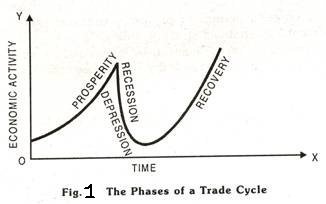
Various Phases of Trade Cycle

Trade Cycle, also known as the business cycle, refers to the recurring fluctuations in economic activity characterized by periods of expansion, peak, contraction, and trough. These cycles reflect the natural rhythm of economic growth and contraction within a market economy. During expansion phases, economic output, employment, and consumer spending increase, leading to prosperity. Peaks mark the highest point of economic activity. Contractions, or recessions, follow, characterized by decreased production, rising unemployment, and reduced consumer spending. Finally, troughs represent the lowest point of the cycle, before the economy begins to recover. Understanding trade cycles is crucial for policymakers, businesses, and investors to anticipate and manage the impacts of economic fluctuations on various sectors and stakeholders.

Four Phases of a Trade cycle are:

  1. Prosperity phase: Expansion or the upswing.
  2. Recessionary phase: A turn from prosperity to depression (or upper turning point).
  3. Depressionary phase: Contraction or downswing.
  4. Revival or recovery phase: The turn from depression to prosperity (or lower turning point).

The above four phases of a trade cycle are shown in Fig. 1. These phases are recurrent and follow a regular sequence.

Phases of a Trade Cycle

1. Expansion Phase:

The expansion phase marks the beginning of the trade cycle. It is characterized by increasing economic activity across various sectors of the economy. During this phase, several key indicators typically show positive trends:

  • Gross Domestic Product (GDP) Growth:

GDP, which measures the total value of goods and services produced within a country’s borders, tends to rise during the expansion phase. Increased production, consumer spending, and investment contribute to this growth.

  • Employment:

As economic activity expands, businesses experience rising demand for goods and services. This often leads to increased hiring to meet the growing demand, resulting in lower unemployment rates.

  • Consumer Spending:

Consumers tend to have more disposable income during periods of economic expansion, leading to increased spending on goods and services. This increased consumer demand further fuels economic growth.

  • Business Investment:

Businesses are more likely to invest in capital goods, such as machinery and equipment, during the expansion phase. Higher confidence in future economic prospects encourages firms to expand their productive capacity to meet growing demand.

  • Stock Market Performance:

Stock prices typically rise during the expansion phase as investors anticipate higher corporate profits and economic growth. Bull markets, characterized by rising stock prices, are common during this phase.

2. Peak Phase:

The peak phase represents the highest point of economic activity within the trade cycle. It is characterized by several key features:

  • Full Capacity Utilization:

During the peak phase, resources such as labor and capital are fully utilized as demand for goods and services reaches its highest levels. Production may be operating at or near maximum capacity.

  • Inflationary Pressures:

As demand outstrips supply during the peak phase, prices tend to rise, leading to inflationary pressures. This can be reflected in higher consumer prices, wage growth, and increased production costs.

  • Tight Labor Market:

With low unemployment rates and high demand for labor, competition for workers intensifies during the peak phase. This can lead to wage increases and labor shortages in certain industries.

  • Business Confidence:

Businesses may become increasingly optimistic about future economic prospects during the peak phase, leading to higher levels of investment and expansion plans.

  • Stock Market Volatility:

While stock prices may continue to rise during the peak phase, volatility often increases as investors become more cautious about the sustainability of economic growth.

3. Contraction Phase:

Following the peak phase, the economy enters the contraction phase, also known as a recession or downturn. This phase is characterized by declining economic activity and several negative trends:

  • GDP Contraction:

Economic output, as measured by GDP, begins to decline during the contraction phase as demand for goods and services weakens. This can be driven by factors such as reduced consumer spending, declining investment, and falling exports.

  • Rising Unemployment:

As businesses cut back on production and investment in response to weakening demand, unemployment rates tend to rise. Layoffs and hiring freezes become more common as companies adjust to the downturn.

  • Decreased Consumer Spending:

Consumer confidence often declines during the contraction phase, leading to reduced spending on discretionary goods and services. Consumers may prioritize essential purchases and cut back on non-essential items.

  • Declining Business Investment:

Businesses become more cautious about investing in new capital projects and expansion plans during the contraction phase. Uncertainty about future economic conditions and weak demand can lead to a decrease in business investment.

  • Stock Market Decline:

Stock prices typically fall during the contraction phase as investors react to negative economic news and uncertainty about future earnings prospects. Bear markets, characterized by falling stock prices, are common during recessions.

4. Trough Phase:

The trough phase represents the lowest point of the trade cycle and marks the end of the contraction phase. While economic conditions remain challenging, there are signs of stabilization and the beginning of recovery:

  • Stabilization of Economic Indicators:

Economic indicators such as GDP, employment, and consumer spending may stabilize or show signs of improvement during the trough phase. The rate of decline in economic activity begins to slow down.

  • Policy Responses:

Governments and central banks often implement monetary and fiscal policies to stimulate economic growth during the trough phase. These may include interest rate cuts, fiscal stimulus measures, and efforts to restore confidence in the financial system.

  • Inventory Rebuilding:

Businesses may start to rebuild inventories during the trough phase in anticipation of future demand. This can contribute to a gradual increase in production and economic activity.

  • Bottoming Out of Stock Market:

While stock prices may still be volatile during the trough phase, there may be signs that the market is bottoming out as investors anticipate a recovery in corporate earnings and economic growth.

  • Early Signs of Recovery:

Some sectors of the economy may begin to show signs of improvement during the trough phase, signaling the start of the recovery process. These early indicators can include increased consumer confidence, rising business investment, and stabilization in housing markets.

error: Content is protected !!