Role of Promoters, Nominee Directors and Mismanagement

A promoter is someone, who has been connected with the business from the start. He can also be referred to as the starter of a business or the founder. He is responsible for raising capital from various sources and entering into the first agreements for the start of a business and incorporation of a company.

SEBI’s Substantial Acquisition of Share Takeover Rules state that a Promoter is

  • He is someone at the cusp of a company
  • A person whose name is there in any of the filing papers of the company or according to the shareholding pattern filed by the company.

The concept of promoters is explained in the Indian Companies Act, 2013. Before 2013 there was no legal position defined in the Old Version of the Act of 1956. In the Old Act, the subscribers to the M.o.A was regarded as the promoters since they had subscribed to the company from its inception.

Role of Promoters

  1. Duty to disclose secret profits

He is allowed to make profits but not secretly which will be harmful to the company. He can profit only with the consent of the company which makes this a fiduciary relationship as that of a principal-agent.

  1. The duty of Disclosure of Interest

He must also declare his interest in every transaction that the company and he himself enters into. He must also request the company’s consent when he shows his interest.

  1. Duty under the Indian Contract Act

As said by the courts in due course of time, there is a business relationship between a company and a promoter, therefore a contract before incorporation with a promoter shouldn’t be depended upon. Thus his liabilities come within the purview of the ICA, 1872.

  1. Termination of the Promoter’s Duties

The duty of a promoter doesn’t end even after he has appointed the Board of Directors or he himself is on the board. It ends when the capital has been acquired (First Call) and the BoD have taken the control and have started managing. That is when his fiduciary relationship with the company ends.

Nominee Directors

A nominee director is an individual nominated by an institution, including banks and financial institutions, on the board of companies where such institutions have some ‘interest’. The ‘interest’ can either be in form of financial assistance such as loans or investment into shares. Such strategic investment may have a direct bearing on the profitability of a nominator and therefore, the appointment of nominee director becomes essential to facilitate monitoring of the operations and business of the investee company.

The main purpose of appointment of such person(s) is to safeguard the interest of the nominator, without conflicting with his/ her fiduciary duty as a director. Such a director has several roles and responsibilities, including adequate disclosure of interest, reporting to the nominator and protection of the interest of the company in its entirety. In case of holding such a position in widely held companies or publicly listed/traded companies,, the person should act in accordance with the operations of such entities, guided by industry specific statutory provisions in addition to the general roles and responsibilities expected of them.

Roles and Responsibilities of Nominee Director

  1. Act as a ‘watchdog’

A nominee director needs to oversee the operations of the investee company and ensure the policy decisions are based on sound commercial lines, rationale and adequate safeguards and also act as liaison between the investee company and the nominator.

  1. Participation and decision making

A nominee director is a non-executive director; however, he should be actively involved in decisions pertaining to financial performance of the investee company, fund-raising plans including debt-raising, investments, etc. He should make his presence felt by placing his expertise at the disposal of the Board of the investee company and actively participate in such meetings, which have a bearing on the interests of the nominator. He should also not abstain from voting on resolutions considered at the meetings of the Board of the investee company, involving the nominator, unless involving any personal interest of the nominee director.

  1. Maintain Confidentiality

A nominee director should exercise adequate care and caution while dealing with unpublished price sensitive information, in case of listed entity, having come to know of the same or being in a position where he is likely to be aware of such information. The nominee director is always required to abide by the code of conduct to regulate, monitor and report trading by insiders framed by the listed entity.

  1. One who safeguards the interests of the nominator

A nominee director oversees the operations of the company, to ensure that the policy decisions are based on sound commercial lines and rationality, with adequate safeguards such that the interests of the nominator are not jeopardized;

  1. An Information Bridge

The nominee director also acts as liaison between the investee company and the nominator for regular flow of information. Here, it must be noted that the question of confidential information being shared by the Nominee Director would crop up.

In this regard, reference may be made to guiding judicial principles which suggest that while the Nominee Director has the right to receive information about the Company, a nominee director is not bound to share information with the nominator merely by virtue of such nomination; rather, such duty of sharing information may arise out of separate agreement entered into between the nominator and the nominee. The said principle was also appreciated in Hawkes v Cuddy.

  1. Participation in decision making

The nominee director actively involves in discussions pertaining to the financial performance of the company, future plans, fund raising, etc. The objective is to apply his/her expertise on the matters placed before the board with the intent to protect the interests of the nominator.

  1. Maintenance of confidentiality

Though a nominee director has allegiance towards the nominator, the nominee director is always expected to abide the code of conduct for directors & key managerial personnel. The responsibility adds up where the investee company is a listed entity, as there are compliance requirements in respect of un-published price sensitive information.

Mismanagement

The process or practice of managing ineptly, incompetently, or dishonestly.

The value of the firm’s stock fell precipitously when word leaked out that officers of the company were under investigation for gross mismanagement.

Corporate governance has been defined as “a set of systems, processes and principles, which ensure that a company is governed in the best interest of all stakeholders.” Its objective is to ensure commitment to values and ethical conduct of business, transparency in business transactions; statutory and legal compliances, adequate disclosures and effective decision making to achieve corporate objectives. Good governance is simply good business, but, the moot question is as to whether the Indian companies are really, in spirit, committed to corporate governance or it is only a superficial compliance in letter and cost. The regulators are forcing the corporate governance regulations on the Indian Companies without measuring its benefits and advantages commensurate the cost in terms of resources of money, man hour and paper consumption. Importance, necessity and quality of corporate governance that Indian Companies needs cannot be undermined. Indian Companies are very intelligent and comply with all requirements of corporate governance in full, in letter, without meaning it in most cases. Ministry of Corporate Affairs, SEBI or stock exchanges have not yet put any mechanism in place to weigh and measure the effectiveness, usefulness or benefits of compliance of corporate governance commensurate with cost spent on its compliance.

Role of Shareholders & Other Stakeholders in Corporate Governance

A shareholder can be a person, company, or organization that holds stocks in a given company. A shareholder must own a minimum of one share in a company’s stock or mutual fund to make them a partial owner. Shareholders typically receive declared dividends if the company does well and succeeds.

Also called a stockholder, they have the right to vote on certain matters with regard to the company and to be elected to a seat on the board of directors.

If the company is getting liquidated and its assets are sold, the shareholder may receive a portion of that money, provided that the creditors have already been paid. When such a situation arises, the advantage of being a stockholder lies in the fact that they are not obliged to shoulder the debts and financial obligations incurred by the company, which means creditors cannot compel stockholders to pay them.

Roles of a Shareholder

Being a shareholder isn’t all just about receiving profits, as it also includes other responsibilities. Let’s look at some of these responsibilities.

  • Brainstorming and deciding the powers they will bestow upon the company’s directors, including appointing and removing them from office
  • Deciding on how much the directors receive for their salary. The practice is very tricky because stockholders must make sure that the amount they will give will compensate for the expenses and cost of living in the city where the director lives, without compromising the company’s coffers.
  • Making decisions on instances the directors have no power over, including making changes to the company’s constitution
  • Checking and making approvals of the financial statements of the company

The shareholders are the owners of the company and provide financial backing in return for potential dividends over the lifetime of the company. A person or corporation can become a shareholder of a company in three ways:

  • By subscribing to the memorandum of the company during incorporation
  • By investing in return for new shares in the company
  • By obtaining shares from an existing shareholder by purchase, by gift or by will

The Role of Stakeholders in Corporate Governance

The rights of shareholders, investors and all other stakeholders that are established by law or through mutual agreements are to be respected.

Performance-enhancing mechanisms for employee participation shall be permitted to develop.

Where stakeholders participate in the corporate governance process, the Company shall ensure them access to relevant, sufficient and reliable information on a timely and regular basis, as by law and Company’s governing documents.

Shareholders, employees and all other stakeholders shall be able to freely communicate their concerns about illegal or unethical practices to the Management Board, and their rights shall not be compromised for doing this.

The corporate governance framework the Company shall complement by an effective, efficient insolvency framework and by effective enforcement of creditor rights

Theories of Corporate Governance

Corporate Governance theories encompass various perspectives and frameworks that guide the structure, processes, and relationships within corporations to ensure accountability, transparency, and fairness. These theories have evolved over time in response to changes in business environments, regulatory frameworks, and societal expectations.

  • Agency Theory

Developed in the 1970s, agency theory addresses the principal-agent problem, which arises when the interests of shareholders (principals) diverge from those of managers (agents). According to this theory, managers may act in their own interests rather than maximizing shareholder value. Mechanisms such as executive compensation, board oversight, and disclosure requirements are employed to align the interests of managers with those of shareholders.

  • Stewardship Theory

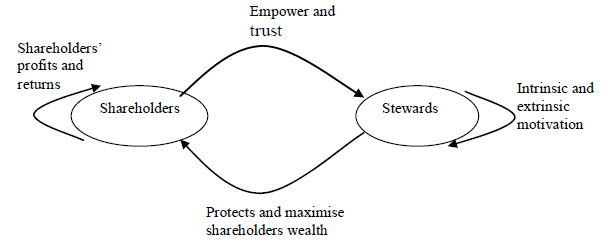
In contrast to agency theory, stewardship theory suggests that managers are inherently trustworthy and will act in the best interests of shareholders. It emphasizes the importance of building trust between managers and shareholders, as well as fostering a sense of stewardship and responsibility among managers. Stewardship theory advocates for less monitoring and control mechanisms, relying instead on shared values and long-term relationships.

  • Stakeholder Theory:

Stakeholder theory expands the focus of corporate governance beyond shareholders to include all stakeholders who are affected by or can affect the corporation, such as employees, customers, suppliers, communities, and the environment. It argues that corporations should consider the interests of all stakeholders and seek to create value for them, not just shareholders. Stakeholder theory emphasizes corporate social responsibility (CSR) and sustainable business practices.

  • Resource Dependence Theory:

Resource dependence theory examines how corporations interact with their external environment to acquire the resources they need for survival and growth. It suggests that corporations are dependent on various stakeholders for resources such as capital, labor, technology, and information. Effective corporate governance involves managing these dependencies through strategic relationships, alliances, and diversification strategies.

  • Transaction Cost Economics:

Transaction cost economics (TCE) focuses on the costs associated with conducting economic transactions within organizations. It suggests that firms exist to minimize transaction costs, which include the costs of negotiating, monitoring, and enforcing contracts. Corporate governance mechanisms such as vertical integration, outsourcing, and the choice of organizational structure are influenced by TCE principles to mitigate transaction costs.

  • Institutional Theory:

Institutional theory examines how corporations are influenced by social, cultural, and institutional contexts. It suggests that corporate governance practices are shaped not only by economic factors but also by institutional norms, regulations, and societal expectations. Institutional theorists argue that corporations conform to prevailing institutional norms to gain legitimacy and support from stakeholders.

  • Ethical Leadership Theory:

Ethical leadership theory emphasizes the role of leaders in shaping the ethical culture of organizations. It suggests that ethical leaders who demonstrate integrity, transparency, and accountability set the tone for ethical behavior throughout the organization. Corporate governance mechanisms such as codes of conduct, ethics training, and whistleblower protection aim to promote ethical leadership and decision-making.

  • Dynamic Capabilities Theory:

Dynamic capabilities theory focuses on a firm’s ability to adapt and innovate in response to changing market conditions and competitive pressures. It suggests that corporate governance should facilitate the development of dynamic capabilities by fostering a culture of learning, experimentation, and risk-taking. Flexibility, agility, and responsiveness are key principles of dynamic capabilities theory.

  • Legitimacy Theory:

Legitimacy theory argues that corporations must maintain legitimacy in the eyes of society to secure their continued existence and success. It suggests that corporate governance practices are influenced by the need to gain and maintain legitimacy through compliance with legal, ethical, and social norms. Transparency, accountability, and corporate social responsibility are central to legitimacy theory.

  • Network Theory:

Network theory explores the relationships and interdependencies among actors within corporate networks, such as boards of directors, executive teams, investors, and other stakeholders. It suggests that corporate governance effectiveness depends on the strength and quality of these networks, as well as the flow of information and resources among network members. Network theory emphasizes the importance of social capital and relational governance mechanisms.

Objective and Need of Corporate Governance

Corporate Governance encompasses the systems, processes, and practices by which companies are directed and controlled. It aims to safeguard shareholders’ interests, enhance transparency and accountability, manage risks, foster ethical conduct, improve decision-making, and promote long-term sustainability, thereby ensuring the company’s success and stakeholders’ trust.

Objective of Corporate Governance:

  • Enhancing Transparency:

Corporate governance aims to ensure that all stakeholders have access to accurate, relevant, and timely information about the company’s performance, financial condition, and decision-making processes.

  • Promoting Accountability:

It seeks to establish clear lines of responsibility and accountability throughout the organization, ensuring that decision-makers are held responsible for their actions and outcomes.

  • Safeguarding Shareholder Interests:

Corporate governance aims to protect the rights and interests of shareholders by ensuring fair treatment, equitable access to information, and mechanisms for recourse in case of misconduct or negligence.

  • Managing Risk:

It involves implementing effective risk management processes to identify, assess, and mitigate risks that may impact the company’s operations, finances, reputation, and stakeholders.

  • Fostering Ethical Conduct:

Corporate governance promotes a culture of integrity, honesty, and ethical behavior within the organization, setting standards for acceptable conduct and enforcing compliance with laws, regulations, and ethical principles.

  • Improving Decision-making:

By establishing clear structures, processes, and mechanisms for decision-making, corporate governance aims to facilitate informed and strategic decision-making that aligns with the company’s objectives and creates long-term value.

  • Enhancing Long-term Sustainability:

Corporate governance focuses on ensuring the company’s long-term sustainability and resilience by balancing short-term interests with the needs of future generations, considering environmental, social, and governance (ESG) factors, and fostering responsible business practices.

Need of Corporate Governance:

  • Protection of Shareholder Interests:

Corporate governance ensures that the rights and interests of shareholders, who have invested their capital in the company, are protected. This includes mechanisms for fair treatment, equitable access to information, and safeguards against abuse of power by management.

  • Enhanced Transparency and Accountability:

Good corporate governance promotes transparency by providing stakeholders with accurate, timely, and relevant information about the company’s performance, financial health, and decision-making processes. It also fosters accountability by establishing clear lines of responsibility and consequences for actions.

  • Effective Risk Management:

Corporate governance frameworks help identify, assess, and mitigate risks that may affect the company’s operations, finances, reputation, and stakeholders. By implementing robust risk management practices, companies can enhance their resilience and ability to navigate challenges.

  • Ethical Conduct and Compliance:

Ethical behavior is fundamental to corporate governance, as it ensures that the company operates with integrity, honesty, and respect for laws, regulations, and ethical standards. By fostering a culture of ethics and compliance, corporate governance helps prevent misconduct and promotes trust among stakeholders.

  • Improved Decision-making Processes:

Clear governance structures and processes facilitate informed and strategic decision-making within the organization. By defining roles, responsibilities, and decision-making authorities, corporate governance enables efficient and effective decision-making that aligns with the company’s objectives and values.

  • Long-term Sustainability and Value Creation:

Corporate governance emphasizes the long-term sustainability and value creation of the company. By considering environmental, social, and governance (ESG) factors, companies can mitigate risks, identify opportunities, and create value for all stakeholders over the long term.

  • Stakeholder Engagement and Trust:

Good corporate governance fosters constructive engagement with stakeholders, including employees, customers, suppliers, and communities. By listening to stakeholders’ concerns, addressing their interests, and building trust through transparent and accountable actions, companies can enhance their reputation and resilience.

Company Liquidation Meaning, Modes

According to the Companies Act, 2013, a meeting refers to a formal gathering of members, directors, or shareholders of a company, held to discuss, deliberate, and make decisions on specific matters related to the business of the company. The meeting must follow proper procedures, including notice, quorum, agenda, and other requisites to be legally valid. Meetings can include Board meetings, General meetings, Annual General Meetings (AGM), Extraordinary General Meetings (EGM), and committee meetings, each with distinct purposes and legal requirements.

Nature of Liquidation:

  • Formal Process:

Liquidation is a formal legal procedure governed by the Companies Act, 2013. It must be conducted following specific rules and regulations, ensuring that all stakeholders are treated fairly. It can be voluntary (initiated by shareholders) or compulsory (ordered by a court).

  • Cessation of Business:

Once liquidation starts, the company ceases its business operations, except for those necessary to complete the liquidation process. The company no longer carries out its primary business activities but focuses on settling liabilities and distributing assets.

  • Appointment of Liquidator:

Liquidator is appointed to oversee the process, manage the company’s assets, and ensure debts are paid off. The liquidator acts in the interest of creditors and shareholders, ensuring the orderly liquidation of the company.

  • Sale of Assets:

The company’s assets are sold or realized to generate cash, which is used to repay creditors. The liquidator handles the sale and distribution of assets, making sure the proceeds are maximized for the benefit of creditors and other stakeholders.

  • Priority of Payments:

In liquidation, creditors have priority over shareholders. Secured creditors are paid first, followed by unsecured creditors. Shareholders receive any remaining balance after all debts and liabilities have been settled, often receiving little or nothing.

  • Insolvency:

Liquidation is often the result of insolvency, where the company cannot meet its financial obligations. It provides a legal remedy for creditors to recover dues from the company’s assets.

  • Dissolution of Company:

The final step in liquidation is the dissolution of the company, meaning it ceases to exist as a legal entity. After the liquidation process is completed and all obligations are settled, the company is officially struck off the register of companies.

  • Distribution to Shareholders:

If any surplus remains after paying creditors, it is distributed among shareholders in accordance with their shareholding rights. Typically, preference shareholders are paid before equity shareholders.

Causes of Liquidation:

  • Insolvency:

One of the most common causes of liquidation is insolvency, where a company is unable to pay its debts as they fall due. When liabilities exceed assets and the company cannot meet its financial obligations, it may be forced into liquidation to repay creditors through asset sales.

  • Lack of Profitability:

Company that continually operates at a loss may not be able to sustain its business operations in the long term. If the company fails to generate enough profit to cover its expenses, it may opt for voluntary liquidation to avoid further financial decline.

  • Statutory Requirements:

The Companies Act, 2013, allows creditors or shareholders to petition for liquidation when specific statutory conditions are met, such as non-compliance with filing requirements, failure to hold meetings, or significant operational issues.

  • Court Order:

Compulsory liquidation may be initiated by a court order due to a petition filed by creditors, shareholders, or regulatory authorities. A court may order liquidation if the company has engaged in fraudulent activities, mismanagement, or violations of the law.

  • Creditors’ Pressure:

In cases where the company owes large sums of money to creditors and fails to meet repayment deadlines, creditors may push for liquidation to recover their dues. Creditors may initiate winding-up proceedings to force the company to sell off its assets and settle outstanding debts.

  • Voluntary Decision by Shareholders:

In some cases, shareholders may choose to voluntarily liquidate the company even when it is solvent. This may happen due to changes in market conditions, business restructuring, or a decision to exit the market while assets still hold value.

  • Mergers and Acquisitions:

If a company is acquired by another entity or merges with another firm, the original company may be liquidated to allow the new entity to take over its operations, assets, and liabilities. In such cases, the liquidation is a strategic decision rather than a financial necessity.

  • Operational Mismanagement:

Poor management practices, such as inefficiencies, lack of strategic planning, or fraud, can lead to the company’s failure. Over time, these factors can erode a company’s financial health, making liquidation the only viable option to pay off debts and close the business.

Types of Liquidation:

Liquidation is the process by which a company’s assets are sold off to pay its debts, and the company is ultimately dissolved. There are different types of liquidation based on the circumstances and the parties initiating the process. The two main types of liquidation are Voluntary liquidation and Compulsory liquidation.

  1. Voluntary Liquidation

Voluntary liquidation occurs when the company’s directors or shareholders decide to wind up the company. It can be initiated even when the company is solvent or insolvent. Voluntary liquidation is further divided into two types:

Members’ Voluntary Liquidation (MVL):

  • This type of liquidation is initiated by the members (shareholders) when the company is solvent, meaning it can pay off its debts in full.
  • The company’s directors declare a solvency statement, stating that the company will be able to pay all its debts within a specified period, usually 12 months.
  • After all debts are settled, the remaining assets are distributed among the shareholders.
  • MVL is typically used when the company no longer has a business purpose, the owners wish to retire, or a restructuring is planned.

Creditors’ Voluntary Liquidation (CVL):

  • This type of liquidation is initiated by the company’s directors or shareholders when the company is insolvent and unable to pay its debts.
  • The creditors are involved in the process as they are likely to receive payment from the proceeds of asset sales.
  • A liquidator is appointed to manage the liquidation, sell the company’s assets, and distribute the proceeds to the creditors in a predetermined order of priority.
  1. Compulsory Liquidation

Compulsory liquidation is ordered by a court, usually upon a petition from a creditor, the company, or certain stakeholders. This occurs when the company is unable to pay its debts or has committed serious legal violations.

Court-Ordered Liquidation:

  • This type of liquidation happens when a creditor, regulatory authority, or even the company itself files a petition in the court for winding up due to insolvency or legal breaches.
  • The court may issue a winding-up order if the company cannot meet its financial obligations or has violated legal norms.
  • A liquidator is appointed by the court to take control of the company’s assets and distribute them according to the priority of claims, with secured creditors being paid first.
  1. Voluntary Winding-Up Under Supervision

This type of liquidation occurs when a company begins a voluntary liquidation process, but the court steps in to supervise the proceedings. The court’s supervision ensures that the liquidation follows proper procedures and that creditors’ interests are protected.

  1. Provisional Liquidation

In this type of liquidation, a court appoints a provisional liquidator to safeguard the company’s assets before a winding-up order is made. This may happen if there is concern that the company’s assets might be misused, removed, or wasted before the final court decision is made.

FPO (follow-on public offering)

A follow-on public offering (FPO) is the issuance of shares to investors by a company listed on a stock exchange. A follow-on offering is an issuance of additional shares made by a company after an initial public offering (IPO). Follow-on offerings are also known as secondary offerings.

FPO is an abbreviation of a Follow-On Public Offer. The process of FPO starts after an IPO. FPO is a public issue of shares to investors at large by a publicly listed company. In FPO, the company goes for a further issue of shares to the general public with a view to diversifying its equity base. A prospectus is offered by the company.

There are two types of FPO:

  • Dilutive offering: In dilutive FPO, the company issues an additional number of shares in the market for the public to buy however the value of the company remains the same. This reduces the price of shares and automatically reduces the earnings per share also.
  • Non-Dilutive offering: Non-dilutive IPO takes place when the larger shareholders of the company like the board of directors or founders sell their privately held shares in the market. This technique does not increase the number of shares for the company, just the number of shares available for the public increases. Unlike dilutive FPO, since this method is not doing anything to the number of shares of the company, it does not do anything to the company’s EPS.

How follow-on Public offering is different from initial public offering.

  • IPO is made when company seeks to raise capital via public investment while FPO is subsequent public contribution.
  • First issue of shares by the company is made through IPO when company first becoming a publicly traded company on a national exchange while Follow on Public Offering is the public issue of shares for an already listed company.

IPO vs FPO


IPO

FPO

1. Meaning The first issue of shares by a company Issuance of shares by a company to raise additional capital after IPO
2. Price Fixed or variable price range Price is market-driven and dependent on number of shares increasing or decreasing
3. Share capital Increases because the company issues fresh capital to the public for listing. Number of shares increases in dilutive FPO and remains the same in non-dilutive FPO
4. Value Expensive Cheaper in most cases because the value of the company is getting further diluted.
5. Risk Riskier Comparatively less risky
6. Status of the company An unlisted company issues an IPO An already listed company issues an FPO


Issue of Shares at Par, Premium and Discount

Companies raise capital by issuing shares, and the method of issuance determines how these shares are distributed among investors. The three main types of share issues are Initial Public Offering (IPO), Follow-on Public Offering (FPO), and Private Placement.

  1. Initial Public Offering (IPO): An IPO is when a private company offers its shares to the public for the first time, transitioning into a publicly traded company. This method helps businesses raise funds for expansion, debt repayment, or operational growth. IPOs can be priced either through a fixed-price method, where a pre-determined price is set, or a book-building process, where investors bid for shares within a price range. Once issued, shares are listed on stock exchanges for trading. Regulatory authorities such as SEBI (in India) oversee IPOs to ensure transparency.

  2. Follow-on Public Offering (FPO): After an IPO, companies may issue additional shares through an FPO to raise more capital. This can be dilutive, where new shares are created, reducing the ownership percentage of existing shareholders, or non-dilutive, where existing shareholders sell their shares to new investors. Companies use FPOs to fund expansion, acquisitions, or improve financial stability.

  3. Private Placement: Instead of offering shares to the general public, companies may issue them to specific investors such as venture capitalists, institutional investors, or high-net-worth individuals. This method is quicker and avoids regulatory complexities, making it a preferred option for raising capital efficiently.

Issue of Shares at Par

When shares are issued at par, they are sold at their nominal value (also called face value). The nominal value is the price printed on the share certificate, typically set at ₹10, ₹100, or another standard amount. This means investors pay exactly the face value of the share without any additional premium or discount.

For example, if a company issues 1,000 shares with a face value of ₹10 each, the total capital raised will be ₹10,000.

Features of Shares Issued at Par:

  1. Fair Valuation: The share price is neither inflated nor reduced, reflecting its actual worth as per the company’s books.

  2. Common for New Companies: Startups and newly established firms often issue shares at par because they do not have a market reputation to justify a premium.

  3. No Capital Gains for the Company: Since shares are issued at their face value, the company does not earn any extra capital beyond the nominal value.

  4. Lower Investor Risk: Investors do not overpay, reducing risks associated with stock market volatility.

  5. Transparency in Pricing: The fixed price prevents speculation and manipulation.

Shares issued at par are considered a straightforward and risk-free way to raise capital, especially for companies that are just entering the market.

Issue of Shares at Premium

When shares are issued at a premium, they are sold at a price higher than their nominal value. This happens when a company has strong financial performance, a good reputation, or high demand for its shares. The extra amount over the face value is called the securities premium and is credited to the company’s Securities Premium Account.

For example, if a company issues shares with a face value of ₹10 at ₹50 per share, the ₹40 excess is the premium.

Reasons for Issuing Shares at a Premium:

  1. Strong Market Reputation: Companies with good earnings history can charge a premium due to high investor confidence.

  2. Demand Exceeds Supply: If many investors want the shares, companies set higher prices.

  3. Profitability and Growth Prospects: Companies with consistent profits and expansion plans attract investors willing to pay a premium.

  4. Reserves for Future Needs: The premium amount can be used for writing off expenses, issuing bonus shares, or funding business expansion.

  5. Enhances Market Perception: A higher issue price reflects strong company fundamentals, boosting investor trust.

Issuing shares at a premium benefits both the company (by raising more capital) and investors (who gain ownership in a promising business). However, it also carries risks, as the stock price may fluctuate post-issue, affecting investor returns.

Issue of Shares at Discount

When shares are issued at a discount, they are sold at a price lower than their nominal value. Companies generally avoid this method, as issuing shares below face value indicates financial instability. However, in special cases, businesses may offer discounted shares to attract investors.

For example, if a company issues shares with a face value of ₹10 at ₹8 per share, the ₹2 difference is the discount.

Reasons for Issuing Shares at a Discount:

  1. Financial Difficulties: Companies struggling to raise funds may offer discounts to attract investors.

  2. Encouraging Subscription: If there is low demand, a discount helps ensure the shares are fully subscribed.

  3. Compensating Initial Investors: Sometimes, early investors or employees are given discounted shares as incentives.

  4. Clearing Unsold Shares: Companies that fail to sell shares in an IPO or FPO may offer discounts to encourage purchases.

  5. Special Approvals Required: In many countries, issuing shares at a discount requires regulatory approval to prevent misuse.

Pro-rata basis Allotment of Share

Pro-rata Allotment of Shares refers to the proportional distribution of shares among applicants when the number of shares applied for exceeds the shares available for issuance, typically in cases of oversubscription. Under this system, each applicant receives shares in proportion to the amount they applied for. For example, if an investor applies for 1,000 shares in an issue that is oversubscribed by 200%, they may receive only 500 shares (i.e., half of their application). Pro-rata allotment ensures a fair and equitable distribution of shares to all applicants.

Reasons of Pro-rata basis Allotment of Shares:

  1. Fair Distribution:

Pro-rata allotment ensures a fair and equitable distribution of shares among applicants. When demand exceeds supply, this method allows each applicant to receive shares in proportion to their applications, minimizing feelings of unfairness among investors.

  1. Equity Among Investors:

By allotting shares on a pro-rata basis, companies uphold the principle of equity. Each applicant receives an opportunity to invest in proportion to their interest, regardless of the size of their application, thus maintaining investor confidence in the fairness of the process.

  1. Mitigation of Oversubscription issues:

In cases where a public offering is oversubscribed, pro-rata allotment provides a structured way to address the excess demand. This method simplifies the allocation process and helps manage investor expectations, as they know they will receive a portion of their requested shares.

  1. Transparency:

Pro-rata allotment promotes transparency in the share allocation process. The method is straightforward, and investors can easily understand how many shares they will receive based on their application size, enhancing trust in the company’s operations.

  1. Encourages Participation:

Knowing that shares will be allotted fairly encourages more investors to participate in future offerings. This can lead to a more extensive shareholder base, which can be beneficial for companies in terms of stability and market presence.

  1. Simplified Accounting:

From an accounting perspective, pro-rata allotment simplifies the share issuance process. Companies can easily calculate the number of shares to be allotted to each applicant based on the total number of shares applied for, streamlining record-keeping and reporting.

  1. Reduced Administrative Burden:

By adopting a pro-rata approach, companies can reduce the administrative burden associated with managing oversubscriptions. Instead of handling individual requests and conducting lotteries or other complex allocation methods, a pro-rata system simplifies the process.

  1. Legal Compliance:

Pro-rata allotment can help companies comply with regulatory requirements. Many jurisdictions have guidelines regarding fair allotment processes, and adhering to a pro-rata system can help ensure compliance with these rules, minimizing legal risks.

Accounting of Pro-rata basis Allotment of Shares:

Accounting for pro-rata allotment of shares involves recording the applications, allotment, and any refund due to oversubscription.

Example Scenario:

  • A company issued 10,000 shares at ₹10 each.
  • Applications were received for 15,000 shares, resulting in oversubscription.
  • The company refunds 5,000 shares and allots the remaining 10,000 shares on a pro-rata basis.

Accounting Entries for Pro-rata Allotment:

Transaction Journal Entry

Amount (₹)

1. On receipt of application Money: Bank A/c Dr. 1,50,000
To Share Application A/c 1,50,000
(Being application money received for 15,000 shares @ ₹10 per share)
2. On transfer of application money to share Capital: Share Application A/c Dr. 1,00,000
To Share Capital A/c 1,00,000
(Being application money for 10,000 shares transferred to share capital)
3. On refund of excess application Money: Share Application A/c Dr. 50,000
To Bank A/c 50,000
(Being refund made to applicants for 5,000 shares on pro-rata basis)
4. On allotment of Shares: Share Allotment A/c Dr. 50,000
To Share Capital A/c 50,000
(Being allotment of 10,000 shares at ₹10 each)

Re-issue of Shares

Requirements of Companies Act

The following are the requirements of the Companies Act regarding the reissue of forfeited shares:

  1. The forfeited shares are generally issued at a price lesser than their face value. But the discount so allowed to the new buyers should not exceed the amount already paid by the defaulting member.
  2. A resolution sanctioning the reissue must be passed in the Board Meeting.
  3. The forfeited shares are to be transferred in the name of the buyer and his name should be entered in the Register of Members.
  4. A public notice in newspapers should be given stating that such and such shares have been forfeited due to the non-payment of calls.

Re-issue of Forfeited Shares

Forfeited shares are available with the company for sale. After the forfeiture of shares, the company is under an obligation to dispose off the forfeited shares.

The company requires to pass a resolution in its Board Meeting for the re-issue of forfeited shares. Re-issue of forfeited shares is a mere sale of shares for the company. A company does not make allotment of these shares.

The company auctions the forfeited shares and disposes them off. A company can re-issue these shares at any price but the total amount received on these shares should not be less than the amount in arrears on these shares. Here, total amount refers to the amount received from the original allottee and the second purchaser.

Notes:

  • We show the Forfeited shares A/c under the heading ‘Share Capital’.
  • When a company re-issues only a part of the forfeited shares, then it will transfer only the profit relating to this part to the capital reserve.
  • When a company re-issues shares at a price more than their face value, it needs to transfer the excess amount to the Securities Premium A/c.

(a) Reissue of forfeited Share Originally Issued at Par:

When the forfeited shares are reissued at a discount, the amount of discount should not exceed the amount credited to Share Forfeited Account. If the discount allowed on reissue of shares is less than the forfeited amount, there will be some balance left in the Forfeited Account, which should be transferred to capital reserve, because it is a profit of capital nature.

Accounting entries:

On reissue of shares at discount:

Bank A/c … Dr. (With reissue price)

Share Forfeited A/c …Dr. (With the discount allowed on reissue)

To Share Capital A/c (With the amount called up)

Transfer to Capital Reserve:

The balance remaining in share forfeited account is in the nature of capital gain and would be closed by transfer to the capital reserve account.

The necessary journal entry will be:

Share forfeited a/c Dr. (with credit balance left in share forfeited account after reissue)

To Capital reserve a/c

(Being share forfeited account transferred)

(b) Reissue of forfeited shares originally issued at discount:

If the shares which were originally issued at a discount are forfeited and reissued, then on reissue the new allottee would get the advantage of discount, besides getting some additional discount from share forfeited account.

The requisite entry in this case will be:

Bank a/c Dr. (with amount received on reissue)

Discount on issue of shares a/c Dr. (with normal discount)

Share forfeited a/c Dr. (with extra discount on reissue)

To Share capital a/c Dr. (with total amount)

(Being forfeited shares reissued, originally issued at discount)

Journal Entries for Re-issue of Forfeited Shares:

Date Particulars   Amount (Dr.) Amount (Cr.)
1. On re-issue of shares Bank A/c (Actual amount received) Dr.  XXX
Forfeited Shares A/c (loss on re-issue) Dr.  XXX
     To Share Capital A/c Cr.  XXX
(Being ….. forfeited shares re-issued @ ₹…each as per the Board’s Resolution no… dated….)
2. On transfer of profit on re-issue Forfeited Shares A/c Dr.  XXX
     To Capital Reserve A/c Cr.  XXX
(Being profit on re-issue of the shares transferred to capital reserve)  

Auditor’s Duty regarding reissue of forfeited shares

  1. The auditor should ascertain whether the Articles authorize the Board of Directors to reissue the forfeited shares.
  2. He should examine the resolution passed by the Board of Directors at their meeting under which the forfeited shares have been re-allotted.
  3. He should vouch the entries made for re-allotment in the Cash Book.
  4. He should see that the balance remaining in the forfeited shares account has been transferred to the Capital Reserve Account.
  5. In case the shares were reissued at a price above par value, he should see that the excess has been transferred to the Share Premium Account.
  6. He should vouch the copy of the return of allotment filed with the Registrar of Joint Stock Companies.

Accounting of Bonus Shares

Section 81 of the Companies Act requires that a public limited company, whenever it proposes to increase its subscribed capital after the expiry of two years from the date of its incorporation or after the expiry of one year from the date of allotment of shares in that company, made for the first time after its formation, whichever is earlier, shall be required to offer those shares to the existing equity shareholders in the proportion of paid-up capital as nearly as possible. Such shares are known as rights shares.

From an accounting perspective, a bonus issue is a simple reclassification of reserves which causes an increase in the share capital of the company on the one hand and an equal decrease in other reserves. The total equity of the company therefore remains the same although its composition is changed.

The price at which these shares are offered to the existing shareholders is normally below the market price of the shares. The existing shareholders thus have a specific advantage in the sense that market price of the shares offered is more than its issue price. This specific advantage has a money value called as value of the right.

The value of the right can be calculated as follows:

  1. Ascertain the total market value of the shares which a shareholder is required to possess in order to get additional shares from of the fresh issue.
  2. Add to the above market price, the amount to be paid to the company for additional shares of the fresh issue.
  3. Find average price. This can be calculated by dividing the total prices calculated under step 2 by the total number of shares.
  4. Deduct average price from market price. This difference is called value of the right.

The accounting entries in each of these cases would be as follows:

(A) For converting partly paid shares into fully paid shares

(i) Equity share final call a/c Dr.

  To equity capital a/c

(Being call money due on … shares)

(ii) P&L a/c Dr.

Securities Premium a/c

Reserve a/c Dr.

  To bonus to shareholders a/c

(Being bonus declared)

(iii) Bonus to shareholders a/c Dr.

  To equity share final call a/c

(Conversion of partly paid equity shares into fully paid equity shares)

(B) For fully paid bonus shares

(i) P&L a/c

Securities Premium a/c

Reserve a/c Dr.

  To bonus to shareholders a/c

(ii) Bonus to shareholders a/c Dr.

  To equity share capital a/c

(Being bonus utilised to issue fully paid up bonus shares)

Following journal entries are required to account for a bonus issue:

Debit Undistributed Profit Reserves / Share Premium Reserve / or Other reserves Number of bonus shares × nominal value of 1 share
Credit Share Capital Account Number of bonus shares × nominal value of 1 share

Advantages

  • Cash-starved companies can issue bonus shares instead of cash dividends to provide temporary relief to shareholders.
  • Issuing bonus shares improves the perception of company’s size by increasing the issued share capital of the company.
  • When distributable reserves (e.g. un-appropriated profits) are used to account for a bonus issue, it decreases the risk to creditors as it reduces the amount of reserves available for distribution to the shareholders of the company.

Disadvantages

  • It is not a meaningful alternative to cash dividends for shareholders as selling the bonus shares to meet liquidity requirements would lower their percentage stake in the company.
  • Bonus issue does not generate cash for the company.
  • As bonus shares increase the issued share capital of the company without any cash consideration to the company, it could cause a decline in the dividends per share in the future which may not be interpreted rationally by all market participants.

Case 1

When new fully paid up bonus shares are issued

a) for providing amount of bonus

Capital reserve account debit xxxx

share premium account debit xxxx

Capital redemption reserve account debit xxxx

Other general reserve account debit xxxx

Profit and loss account debit xxxx

Bonus to shareholder account credit xxxx

b) for issue of bonus

Bonus to equity shareholder account debit

Equity share capital account credit

error: Content is protected !!