Holding Company, Types, Benefits, Functions, Legal Requirements

Holding Company is an entity that has control over one or more companies, known as subsidiaries. Control is typically exercised by owning more than 50% of the subsidiary’s equity share capital or by having the power to appoint or remove a majority of its directors. The holding–subsidiary structure allows the parent entity to influence strategic decisions, manage resources, and oversee operations without being directly involved in day-to-day activities.

Under the Companies Act, 2013, the definition is provided in Section 2(46). A holding company may be incorporated in India or abroad. It must comply with specific legal provisions relating to subsidiary relationships, financial reporting, corporate governance, and restrictions on layers of subsidiaries. This structure is often used for group companies, diversification, risk management, and regulatory benefits, while enabling centralized control over multiple business entities.

Types of Holding Companies

  1. Pure

A holding company is described as pure if it was formed for the sole purpose of owning stock in other companies. Essentially, the company does not participate in any other business other than controlling one or more firms.

  1. Mixed

A mixed holding company not only controls another firm but also engages in its own operations. It’s also known as a holding-operating company.

Holding companies that take part in completely unrelated lines of business from their subsidiaries are referred to as conglomerates.

  1. Immediate

An immediate holding company is one that retains voting stock or control of another company, in spite of the fact that the company itself is already controlled by another entity. Put simply, it’s a type of holding company that is already a subsidiary of another.

  1. Intermediate

An intermediate holding is a firm that is both a holding company of another entity and a subsidiary of a larger corporation. An intermediate holding firm might be exempted from publishing financial records as a holding company of the smaller group.

Benefits of a Holding Company

  1. Greater control for a smaller investment

It gives the holding company owner a controlling interest in another without having to invest much. When the parent company purchases 51% or more of the subsidiary, it automatically gains control of the acquired firm. By not purchasing 100% of each subsidiary, a small business owner gains control of multiple entities using a very small investment.

  1. Independent entities

If a holding company exercises control over several companies, each of the subsidiaries is considered an independent legal entity. It means that if one of the subsidiaries were to face a lawsuit, the plaintiffs have no right to claim the assets of the other subsidiaries. In fact, if the subsidiary being sued acted independently, then it’s highly unlikely that the parent company will be held liable.

  1. Management continuity

Whenever a parent company acquires other subsidiaries, it almost always retains the management. It is an important factor for many owners of subsidiaries-to-be who are deciding whether to agree to the acquisition or not. The holding firm can choose not to be involved in the activities of the subsidiary except when it comes to strategic decisions and monitoring the subsidiary’s performance.

It means that the managers of the subsidiary firm retain their previous roles and continue conducting business as usual. On the other hand, the holding company owner benefits financially without necessarily adding to his management duties.

  1. Tax effects

Holding companies that own 80% or more of every subsidiary can reap tax benefits by filing consolidated tax returns. A consolidated tax return is one that combines the financial records of all the acquired firms together with that of the parent company. In such a case, should one of subsidiary encounter losses, they will be offset by the profits of the other subsidiaries. In addition, the net effect of filing a consolidated return is a reduced tax liability.

Functions of a Holding Company

Successful entrepreneurs with multiple small businesses are typically concerned with limiting liability, streamlining management and retaining ownership control over each entity. Using a holding company can sometimes be the solution to all three concerns. The company works as an umbrella to give you centralized control over your endeavors while maintaining the liability firewall between each business.

  1. Parent Company

A holding company is a corporation or limited liability company that holds a controlling ownership interest in other companies or the assets that those companies use. Typically, a holding company simply holds equity interests or assets, rather than actively engaging in business, such as selling goods or services. Another name for a holding company is a parent, and the companies under it are called operating companies or subsidiaries.

  1. Centralized Control

Entrepreneurs who want to open multiple small businesses can use a holding company to centralize control. The entrepreneur can set up the holding company and designate himself as the sole owner. Each business can be set up separately with the holding company as the owner. In this way, the holding company is the central repository of the equity interests in those companies, and the entrepreneur can select executive management for each company while retaining the ability to direct each entity.

  1. Limiting Investment

Using a holding company also enables you to raise money and create partnerships for each individual entity without losing overarching control of the business conglomerate. An equity investor can invest in one of the companies under the holding company without interfering with any of the others. If you had simply created a single company with multiple divisions or projects, an investor would take an interest in your whole business empire instead of just a single project that is set up as its own business.

  1. Limiting Liability

One of the best uses of a holding company for small-business owners is to further limit liability. Creditors of a corporation or an LLC can go after anything that the entity owns. If you’re in a high-risk business, you can use a holding company to own all of the assets that your business needs to operate, such as real property, vehicles and equipment. The holding company leases those assets to the operating company, so if the operating company gets sued, it owns very little that can be used to satisfy a judgment. The operating company can easily be closed and declared bankrupt, and you can set up another business that leases the exact same assets from the holding company.

  1. Considerations

Creating an interlocking ownership structure for multiple small businesses using a holding company is a sophisticated endeavor with significant tax consequences that are tied to your legal structure choices and tax elections. For example, special personal holding company tax rules apply to corporations but not necessarily LLCs that are used as holding companies. Consult with qualified legal and tax professionals before setting up your businesses.

Holding Companies Legal Requirements under Companies Act, 2013:

The Companies Act, 2013 lays down the following legal requirements:

  1. Definition (Section 2(46)): A holding company includes any body corporate controlling a subsidiary.

  2. Restriction on Layers (Section 2(87) & Rules): A holding company cannot have more than two layers of subsidiaries, except in certain cases (e.g., foreign subsidiaries).

  3. Consolidated Financial Statements (Section 129): Must prepare and present consolidated accounts for itself and all subsidiaries.

  4. Disclosure in Accounts: Details of subsidiaries’ performance must be disclosed in the Board’s Report.

  5. Restriction on Loans & Investments (Section 186): Compliance required for inter-corporate loans, guarantees, and investments.

  6. Related Party Transactions (Section 188): Deals with subsidiaries are treated as related party transactions, requiring approvals.

  7. Annual Return (Section 92): Must include details of subsidiaries, associates, and joint ventures.

  8. Audit Requirements: Subsidiaries’ accounts must be audited and considered in consolidated reports.
Subsidiary Company, Types, Structure, Work, Legal Requirements

Subsidiary Company is an entity that is controlled by another company, known as the holding company. Control is generally established when the holding company owns more than 50% of the subsidiary’s equity share capital or has the power to appoint or remove a majority of its directors. This control can be direct or indirect, including through another subsidiary (step-down subsidiary). The relationship allows the holding company to influence key decisions and policies of the subsidiary without necessarily being involved in its daily operations.

Under the Companies Act, 2013 (Section 2(87)), subsidiaries are subject to specific legal requirements relating to structure, reporting, and compliance. A company cannot have more than two layers of subsidiaries, except in certain permitted cases, such as foreign subsidiaries with overseas holdings. Subsidiaries must prepare their own financial statements, which are then consolidated into the holding company’s accounts. This structure is widely used for business expansion, risk segregation, and managing diverse operations under a single corporate group.

Types of Subsidiary Company

  1. Partly Owned

The parent company owns 50% or more but less than 100% shares in the holding company. Such a subsidiary is partly owned. Here parent company does not get full control over the subsidiary company.

  1. Wholly Owned

The parent company holds 100% shares & controls in the subsidiary company. Though, A wholly-owned subsidiary company is not a merger.

A holding company can have more than one subsidiary company. But a subsidiary company can have one and only one holding company. However, a subsidiary can have a subsidiary or more of its own.

The parent company can be larger or smaller than the subsidiary. It need not be more powerful than the subsidiary. The size of the firm or employees does not decide the relationship. The only control over ownership is the key factor.

Also, the location or type of business of both companies does not matter.  They may or may not be in the same location or same business line.

Structure of Subsidiary Company

  1. Formation

The parent company has to register with the state registrar of the state in which the company operates. The ownership & stake details are to be defined during this process.

  1. Operation

Normally, the parent company just oversees the operations of the subsidiary company. However, in certain cases, the parent company may supervise day to day operations of a subsidiary company.

Subsidiaries are separate legal entities. They have their own concerns regarding the handling of taxation, regulations & liabilities. Subsidiary companies can sue & be sued separate from the parent company. the obligations of a subsidiary may or may not be obligations of the parent company. One of these companies can be undergoing legal proceedings, bankruptcy, tax delinquency or be under investigation without affecting other companies directly. though affecting public image is altogether an intangible thing.

How Does a Subsidiary Work?

Subsidiaries are common in some industries, particularly real estate. A company that owns real estate and has several properties with apartments for rent may form an overall holding company, with each property as a subsidiary. The rationale for doing this is to protect the assets of the various properties from each other’s liabilities. For example, if Company A owns Companies B, C, and D (each a property) and Company D is sued, the other companies can not be held liable for the actions of Company D.

A subsidiary is formed by registering with the state in which the company operates. The ownership of the subsidiary and the type of corporate entity such as a limited liability company (LLC) are spelled out in the registration.

How Are Subsidiaries Accounted For?

From an accounting standpoint, a subsidiary is a separate company, so it keeps its own financial records and bank accounts and track its assets and liabilities. Any transactions between the parent company and the subsidiary must be recorded.

A subsidiary may also be its own separate entity for taxation purposes. Each subsidiary has its own employer identification number and may pay its own taxes, according to its business type.

However, many public companies file consolidated financial statements, including the balance sheet and income statement, showing the parent and all subsidiaries combined. And if a parent company owns 80% or more of shares and voting rights for its subsidiaries, it can submit a consolidated income tax return that can take advantage of offsetting the profits of one subsidiary with losses from another. Each subsidiary must consent to being included in this consolidated tax return by filing IRS Form 1122.

Holding Company vs. Parent Company

Most holding companies’ sole purpose is to hold ownership of subsidiaries. If that’s the case, the company is referred to as a “pure” holding company. If it also conducts business operations of its own, it’s called a “mixed holding company.5 One example of a pure holding company is publicly traded Alphabet Inc., whose purpose is to hold Google and other, lesser-known subsidiaries like Calico and Life Sciences.6 YouTube is, in turn, a subsidiary of Google.

Subsidiary vs. Branch or Division

You may have seen the terms “branch” or “division” used as synonyms for “subsidiary,” but they are not one and the same. A subsidiary is a separate legal entity, while a branch or division is a part of a company that is not considered to be a separate entity.

A branch is usually defined as a separate location within the company, like the Pittsburgh branch of a company whose headquarters is in New York. A division is part of a company that performs a specific activity, such as the wealth management division of a larger financial services company.

Subsidiary Companies Legal Requirements under Companies Act, 2013:

  • Definition (Section 2(87))

A subsidiary company is one in which another company (holding company) controls more than 50% of the total share capital or has the right to control the composition of its board of directors. This control may be direct or through another subsidiary. The definition also includes step-down subsidiaries. The Companies (Restriction on Number of Layers) Rules, 2017 limit the number of subsidiary layers, ensuring transparency. This definition is crucial for determining compliance obligations, reporting requirements, and corporate governance rules applicable to both the holding and subsidiary.

  • Restriction on Layers

Under the Companies (Restriction on Number of Layers) Rules, 2017, a company cannot have more than two layers of subsidiaries. This restriction is aimed at preventing complex corporate structures that could hide ownership and financial transactions. Exceptions are allowed if the subsidiary is a foreign company with subsidiaries outside India. The rule promotes corporate transparency, facilitates regulatory oversight, and ensures that ownership structures remain simple, making it easier for stakeholders and regulators to trace control and financial relationships within the corporate group.

  • Financial Statement Requirements (Section 129)

A subsidiary must prepare its own standalone financial statements as per Schedule III and applicable accounting standards. The holding company is required to consolidate these statements into consolidated financial statements (CFS). This ensures a complete financial picture of the group as a whole. The subsidiary must share its financial data promptly with the holding company for consolidation. The board of the holding company is responsible for ensuring accuracy and compliance with Indian Accounting Standards (Ind AS) or other applicable accounting rules.

  • Disclosure in Board’s Report

A subsidiary’s performance, major decisions, and overall contribution to the group must be disclosed in the holding company’s Board’s Report. This includes financial highlights, operations, and any significant events affecting the subsidiary. Such disclosures enable shareholders and investors to assess the subsidiary’s role and performance within the group structure. The requirement improves transparency, accountability, and trust among stakeholders by giving them access to vital subsidiary-related information as part of the holding company’s annual reporting obligations under the Companies Act, 2013.

  • Audit Requirements

Every subsidiary company must get its financial statements audited annually by a statutory auditor appointed under the provisions of the Companies Act. The audit ensures the accuracy, fairness, and compliance of accounts with legal and accounting standards. The audited financials are then shared with the holding company for consolidation. For certain classes of companies, internal audit may also be mandatory. The audit process enhances stakeholder confidence, ensures regulatory compliance, and safeguards against financial irregularities within the subsidiary company’s operations.

  • Related Party Transactions (Section 188)

Transactions between a holding company and its subsidiary are considered related party transactions. These include the sale or purchase of goods, services, property, or any other arrangements. Such transactions require prior board approval, and in some cases, shareholders’ approval, especially if they exceed prescribed limits. The purpose is to prevent conflict of interest and ensure fairness in dealings between related entities. Proper disclosure of these transactions in financial statements is mandatory to promote transparency and protect minority shareholders’ interests.

Accounting Treatment in the Books of Lessor

Lessor is the party that owns the asset and grants the lessee the right to use it for a specific period in exchange for periodic payments. The accounting treatment in the books of the lessor is essential to correctly reflect the transaction’s financial position, and it primarily follows the standards outlined by Ind AS 17 (now replaced by Ind AS 116) and IFRS 16 in certain cases. This treatment involves various entries for lease income, depreciation, and asset management.

1. Recognition of Lease Income

For a lessor, the primary income generated is the lease rent paid by the lessee. The lease income recognition follows the systematic approach over the lease term. There are two main categories of lease income, depending on the type of lease: operating lease and finance lease.

A. Operating Lease

An operating lease is one where the risks and rewards of ownership remain with the lessor. In this type of lease, the lessor continues to recognize the asset on its balance sheet and records the income over the lease term.

  • Journal Entries for Operating Lease Income:
    • Receipt of lease rent:
      • Debit: Bank/Cash Account (for the amount received)
      • Credit: Lease Income Account (for the amount of lease rent)
    • Recognizing lease income: The lessor records income on a straight-line basis unless another systematic and rational method is more representative of the time pattern of the lessee’s benefit.
      • Debit: Lease Income Account
      • Credit: Unearned Rent Account (in case of advance receipts or deferred income)

This means that the lessor earns consistent revenue during the lease term, irrespective of the actual payment schedule (unless it is variable in nature).

B. Finance Lease

In a finance lease, the risks and rewards of ownership are transferred to the lessee. The lessor, therefore, recognizes the lease as a receivable equal to the net investment in the lease (i.e., the present value of lease payments plus the unguaranteed residual value). It is treated as a financing arrangement rather than a rental agreement.

  • Journal Entries for Finance Lease Income:
    • Recognition of Lease Receivable (at the start of the lease):
      • Debit: Lease Receivable Account (net investment in the lease)
      • Credit: Asset Account (for the cost of the asset or its carrying amount)
    • Recognizing Interest Income (Interest on Lease Receivable):
      • Debit: Lease Receivable Account (reducing principal)
      • Credit: Interest Income Account (recognizing interest earned)
    • Lease Payments Received:
      • Debit: Bank/Cash Account (for the amount received)
      • Credit: Lease Receivable Account (reducing the principal balance)

In a finance lease, the lessor earns both interest income and lease principal payments over the lease term. This results in a front-loaded interest income pattern.

2. Depreciation of Asset

In the case of an operating lease, the lessor retains ownership of the leased asset and is responsible for depreciating the asset over its useful life. The depreciation method and the estimated useful life of the asset should comply with the lessor’s accounting policies, following standard depreciation methods like straight-line or declining balance method.

  • Journal Entry for Depreciation:
    • Debit: Depreciation Expense (in the Income Statement)
    • Credit: Accumulated Depreciation (on the Balance Sheet)

The depreciation charge is recorded by the lessor for each period until the asset’s useful life is exhausted or it is sold or disposed of.

In a finance lease, the lessor may not record depreciation on the asset as the lease effectively transfers the ownership risks to the lessee. However, some lessors might continue to depreciate the asset if they do not transfer ownership entirely or have a residual interest.

3. Initial Direct Costs

In the case of a lease agreement, the lessor may incur certain initial direct costs that are directly attributable to negotiating and arranging the lease. These costs could include legal fees, commissions, and any other expenses directly related to the lease agreement.

  • Journal Entry for Initial Direct Costs:
    • Debit: Lease Receivable (in case of finance lease)
    • Debit: Expense Account (in case of operating lease)
    • Credit: Bank/Cash Account

These initial direct costs are recognized over the lease term. In an operating lease, they are amortized on a straight-line basis unless a different systematic basis is appropriate.

4. Recognition of Residual Value

In both operating and finance leases, the lessor may expect to receive a residual value of the asset at the end of the lease term. If the lease has a guaranteed residual value, it is included in the lease receivable. For an operating lease, the lessor will revalue the asset based on its estimated residual value and take appropriate measures for depreciation.

5. Sale and Leaseback Transactions

In cases where a lessor sells an asset and leases it back, the transaction is treated as a sale and leaseback. The accounting treatment in this case depends on whether the transaction is classified as a finance lease or operating lease. If it is an operating lease, the sale is recognized and the leaseback terms are accounted for as a lease.

Meaning, Features, Merits, Demerits, Types of Single-Entry System

The Single-Entry System is an accounting method where only one aspect of each transaction is recorded, typically focusing on cash and personal accounts. Unlike the double-entry system, it does not maintain complete records of all business transactions. It is often used by small businesses due to its simplicity and low cost. However, it lacks accuracy, completeness, and fails to provide a true financial position of the business. This system makes it difficult to detect errors or fraud and does not conform to accounting standards.

Features of Single-Entry System:

  • Incomplete System:

The Single-Entry System does not record all aspects of financial transactions. It mainly records only cash transactions and personal accounts, omitting real and nominal accounts like expenses, incomes, assets, and liabilities. Because of this, it is considered an incomplete and unscientific method of accounting. It does not provide a full double-entry trail, making it difficult to prepare proper financial statements or detect errors and fraud accurately.

  • Lack of Uniformity:

There is no fixed or standardized format in the single-entry system. Different businesses may follow different practices based on their convenience. This lack of uniformity leads to inconsistency and limits comparability between businesses or over different periods. Without a consistent structure, financial data becomes less reliable, and decision-making suffers. Moreover, it fails to meet professional accounting standards, making it unsuitable for larger or regulated entities.

  • Maintenance of Personal and Cash Accounts Only:

Under the Single-Entry System, generally only personal accounts (such as those of debtors and creditors) and the cash book are maintained. Other accounts like purchases, sales, expenses, and assets are not systematically recorded. This narrow focus results in the loss of crucial financial data, making it hard to track business performance comprehensively. Hence, businesses cannot prepare a full trial balance or assess the profitability accurately.

  • Unsuitable for Large Businesses:

Due to its limited scope and lack of comprehensive record-keeping, the Single-Entry System is unsuitable for large businesses or organizations that require detailed financial reporting. It cannot meet the legal and regulatory requirements for audit, taxation, or disclosure. The absence of proper records may result in poor financial control and higher risk of mismanagement. Hence, only very small businesses or sole proprietors with minimal transactions might find it suitable.

Merits of Single-Entry System:

  • Simplicity:

The single-entry system is simple and easy to understand, making it ideal for small business owners with little or no accounting knowledge. It does not require specialized training or the use of complex accounting principles. Transactions are recorded in a straightforward manner, primarily focusing on cash and personal accounts. This simplicity reduces the need for hiring professional accountants and helps business owners maintain basic financial records without much effort. For small-scale businesses, this simplicity can be an advantage in managing day-to-day operations effectively and cost-efficiently.

  • Cost-Effective:

The single-entry system is less expensive to maintain compared to the double-entry system. Since it requires minimal record-keeping and does not involve complex accounting procedures, businesses can avoid the costs of hiring trained accountants or purchasing accounting software. It is particularly suitable for sole proprietors, small traders, and startups that operate with limited resources. The low operational cost makes it an attractive choice for those who need only a basic method of recording transactions for internal tracking without the financial burden of a full-fledged accounting setup.

  • Saves Time:

Maintaining records under the single-entry system requires less time compared to the double-entry system. Since only key transactions, such as cash flow and personal accounts, are recorded, the volume of bookkeeping work is significantly reduced. This allows small business owners to focus more on operations and customer service rather than being occupied with detailed accounting work. The time-saving benefit makes it a practical choice for small-scale enterprises where quick and minimal bookkeeping is sufficient to meet their basic information needs.

  • Useful for Small Businesses:

For small businesses, particularly those with few transactions and limited resources, the single-entry system serves as a practical accounting method. It provides a basic overview of personal accounts and cash flow without the need for complex accounting procedures. Although it doesn’t provide full financial statements, it is sufficient for managing daily business activities, such as tracking cash balances and outstanding dues. Many small vendors, shopkeepers, and service providers use this system due to its relevance to their scale of operations and its ease of use.

  • Flexible Method:

The single-entry system offers a high degree of flexibility as there are no strict rules or formats to follow. Businesses can maintain records according to their convenience, adjusting the system to suit their specific needs. This adaptability makes it easy to implement and modify without restructuring the entire accounting process. The flexibility also allows business owners to focus only on essential data, which can be customized based on their operations. For small firms without regulatory obligations, this informal structure can be both convenient and practical.

Demerits of Single-Entry System:

  • Incomplete and Unreliable Records:

The single-entry system fails to maintain a complete set of accounting records. It omits many important accounts such as expenses, incomes, and assets, making it difficult to track the financial performance or position accurately. Due to the lack of double-entry principles, errors or fraud may go undetected. The system provides insufficient data for financial analysis, and the results derived—such as profit or loss—are merely estimates, not reliable figures.

  • No Trial Balance Possible:

In a single-entry system, since both aspects of transactions are not recorded, a trial balance cannot be prepared. Without a trial balance, it is nearly impossible to check the arithmetic accuracy of accounts. This increases the chances of undetected errors or manipulation. The inability to match debits and credits also makes it difficult to reconcile books, identify mistakes, or ensure the correctness of balances, leading to unreliable financial statements.

  • Difficult to Detect Fraud and Errors:

The absence of systematic record-keeping in a single-entry system makes it hard to detect fraud, misappropriation, or clerical errors. Since real and nominal accounts are not recorded in detail, there is no clear audit trail or internal control mechanism. This creates vulnerabilities in financial data and can result in significant financial misstatements. Businesses using this system are at greater risk of financial loss due to undetected irregularities or manipulation.

  • Unsuitable for Auditing and Legal Compliance:

Single-entry systems do not comply with accounting standards and legal requirements. As a result, businesses using this system cannot present their accounts for statutory audit, which is mandatory for companies and larger entities. Since it lacks detailed records and does not follow the double-entry principle, it fails to meet tax authority or government regulatory requirements, making it legally unacceptable for most organizations and institutions. Hence, it is unsuitable for formal financial reporting.

Types of Single-Entry System:

  • Pure Single-Entry System:

In the Pure Single-Entry System, only personal accounts (such as debtors and creditors) are maintained, and all other accounts—including cash, sales, purchases, assets, and liabilities—are completely ignored. There is no record of the dual aspect of transactions, making the system highly incomplete and unreliable. Since cash transactions and real/nominal accounts are not recorded, it becomes extremely difficult to prepare even basic financial statements. This type is rarely used today due to its serious limitations and is mostly seen in very small, informal businesses that operate on a minimal scale without the need for detailed financial records.

  • Simple Single-Entry System:

The Simple Single-Entry System is a more practical and slightly organized form, where both personal accounts and cash book are maintained. Though other subsidiary records like sales and purchases may not be systematically recorded, occasional summaries may be created. While it still doesn’t follow the double-entry principle, it allows for some estimation of profit or loss using a statement of affairs. This type is more common among small businesses, as it provides a basic understanding of financial position and performance, although it is still insufficient for complete financial analysis, auditing, or compliance with legal reporting standards.

Corporate Social Responsibility (CSR), Components, Importance, Stakeholders

Corporate Social Responsibility (CSR) refers to the ethical obligation of companies to contribute positively to society beyond their financial interests. It is a business model in which companies integrate social, environmental, and ethical concerns into their operations, decision-making processes, and interactions with stakeholders, such as employees, customers, investors, and communities. CSR is based on the idea that businesses should not only focus on generating profits but also consider their impact on society and the environment.

The concept of CSR has evolved from a simple philanthropic activity to a comprehensive approach where businesses strive to be responsible corporate citizens. Today, CSR encompasses a wide range of activities aimed at enhancing the well-being of communities, reducing environmental harm, promoting fair labor practices, and ensuring ethical business practices.

Components of CSR

  • Environmental Responsibility:

A significant component of CSR is the responsibility of companies to reduce their environmental footprint. This includes efforts to reduce pollution, conserve natural resources, manage waste, promote sustainable practices, and minimize the ecological impact of their operations. Many companies implement practices such as reducing carbon emissions, using renewable energy, recycling materials, and adopting sustainable sourcing practices to contribute positively to environmental protection.

  • Social Responsibility:

CSR also involves a company’s commitment to society and its people. Social responsibility focuses on improving the quality of life of employees, customers, and communities. This could include providing fair wages, promoting diversity and inclusion, supporting local community projects, and ensuring access to education and healthcare. Social responsibility is about companies engaging in ethical practices that benefit society at large.

  • Economic Responsibility:

CSR extends to ethical business practices, such as ensuring fair trade, avoiding corruption, and providing fair wages to employees. Economic responsibility also involves transparency in financial reporting, paying taxes, and fostering economic development through innovation and job creation. Companies are expected to generate profit in a manner that is ethical, fair, and sustainable for all stakeholders.

  • Ethical Responsibility:

Ethical responsibility in CSR involves conducting business in an honest, transparent, and fair manner. This includes ensuring that products and services are safe, treating employees and customers with respect, and adhering to legal and moral standards. It is also about ensuring that the company’s practices do not harm individuals or communities and that they operate with integrity.

  • Philanthropy:

Many companies engage in philanthropic activities such as charitable donations, volunteering, and sponsoring community development initiatives. While this is just one aspect of CSR, it plays a key role in improving the social and economic well-being of the communities where businesses operate.

  • Stakeholder Engagement:

A key element of CSR is maintaining good relationships with all stakeholders, including employees, customers, suppliers, investors, and local communities. By engaging stakeholders and addressing their concerns, companies can better understand societal expectations and improve their CSR strategies.

Importance of CSR:

  • Building Brand Reputation and Trust:

Companies that actively engage in CSR build a strong reputation as responsible corporate citizens. This enhances their brand image and fosters trust among consumers, investors, and other stakeholders. A positive reputation can lead to increased customer loyalty, improved employee morale, and better relationships with government and regulatory bodies.

  • Attracting and Retaining Talent:

Today’s workforce is increasingly attracted to companies that align with their values. Companies with strong CSR practices are more likely to attract top talent who want to work for organizations that are committed to making a positive impact. Employees who feel that their employer is socially responsible are also more likely to stay with the company long-term, leading to lower turnover rates.

  • Customer Loyalty:

Consumers are becoming more socially conscious and prefer to purchase from companies that share their values and demonstrate a commitment to social and environmental responsibility. CSR initiatives such as ethical sourcing, fair trade, and environmental sustainability can lead to greater customer loyalty and support for a company’s products and services.

  • Financial Performance:

Contrary to the belief that CSR is a financial burden, many studies have shown that companies that invest in CSR programs can achieve better financial performance over time. Engaging in ethical and socially responsible practices can lead to cost savings (e.g., through energy efficiency and waste reduction), enhanced brand value, and increased consumer demand.

  • Risk Management:

CSR can help companies mitigate risks related to their operations. By addressing social and environmental concerns, companies can avoid negative publicity, fines, and legal challenges. Proactively managing CSR helps businesses avoid potential controversies that could damage their reputation and harm their financial stability.

  • Sustainable Development:

CSR plays a crucial role in promoting sustainable development. By taking a long-term view of their impact on society and the environment, companies can contribute to sustainable economic development. CSR initiatives such as promoting renewable energy, reducing waste, and improving labor standards all support the global goal of sustainability.

CSR and Its Stakeholders:

  • Employees:

A company’s commitment to CSR enhances employee morale and job satisfaction. Employees tend to feel proud to work for an organization that is socially responsible and committed to ethical practices. CSR programs can also offer employees opportunities for personal involvement, such as volunteer work or engagement in community initiatives.

  • Customers:

Customers are increasingly seeking products and services that are produced ethically and sustainably. Companies that prioritize CSR are likely to attract socially conscious consumers who care about the origins and environmental impact of the products they purchase. CSR initiatives enhance customer loyalty and retention.

  • Shareholders and Investors:

Investors are placing greater emphasis on companies that adopt CSR practices. Many institutional investors look for businesses that not only promise financial returns but also adhere to environmental, social, and governance (ESG) principles. A strong CSR program can make a company more attractive to investors, leading to increased funding and support.

  • Communities:

CSR helps to improve the social and economic conditions of the communities where a company operates. Whether through donations, community development programs, or local environmental initiatives, businesses can directly contribute to improving the standard of living and well-being in the regions they serve.

  • Government and Regulatory Bodies:

Governments are increasingly requiring businesses to adhere to CSR-related regulations, especially in areas like environmental protection, labor rights, and corporate governance. Companies that proactively adopt CSR policies can reduce their exposure to regulatory risks and improve their relationship with government bodies.

Applicability of CSR as per Section 135 of Companies Act 2013:

Section 135 of the Companies Act, 2013 mandates Corporate Social Responsibility (CSR) for companies meeting specific financial thresholds. The provision applies to every company, including its holding or subsidiary and foreign companies having a branch office or project office in India, that satisfies any one of the following criteria in the immediately preceding financial year:

Applicability Criteria (Any one of the following):

  1. Net worth of ₹500 crore or more,

  2. Turnover of ₹1,000 crore or more, or

  3. Net profit of ₹5 crore or more.

Requirements for Applicable Companies

  1. CSR Committee:
    Companies to whom CSR is applicable must constitute a CSR Committee of the Board with:

    • At least 3 directors (including 1 independent director),

    • (Private companies need only 2 directors; unlisted/public companies with no independent director are exempt from appointing one).

  2. CSR Policy:
    The CSR Committee shall:

    • Formulate and recommend a CSR Policy to the Board,

    • Recommend the amount of expenditure,

    • Monitor the CSR policy implementation.

  3. Minimum CSR Expenditure:
    The Board must ensure that the company spends at least 2% of the average net profits (before tax) made during the three immediately preceding financial years on CSR activities.

  4. Disclosure:

CSR policy and initiatives must be disclosed in the Board’s report and on the company website, if any.

CSR Activities (Schedule VII)

CSR initiatives must fall under activities specified in Schedule VII, such as:

  • Eradicating hunger and poverty,

  • Promoting education and gender equality,

  • Environmental sustainability,

  • Protection of national heritage,

  • Support to armed forces veterans,

  • PM’s National Relief Fund, etc.

Penalty for Non-Compliance (Post Amendment):

As per the Companies (Amendment) Act, 2019:

  • If the required amount is not spent, the company must transfer the unspent amount to a specified fund (like PM CARES) within a stipulated time.

  • Non-compliance attracts penalty:

    • Company: Twice the unspent amount or ₹1 crore (whichever is less),

    • Officers in default: 1/10th of the unspent amount or ₹2 lakh (whichever is less).

Stock Valuation

Stock Valuation refers to the process of determining the value of inventory held by a business at the end of an accounting period. Accurate stock valuation is crucial for financial reporting, profit calculation, and proper cost management. Inventory is classified as a current asset on the balance sheet, and its valuation directly affects both the cost of goods sold (COGS) and the net income of the business.

Objectives of Stock Valuation:

  • Accurate Profit Determination

Proper valuation of inventory ensures accurate determination of COGS and, consequently, the correct profit or loss for the period.

  • True Financial Position

Inventory is a significant asset, and its correct valuation is essential for presenting a true and fair financial position of the company.

  • Efficient Cost Control

Stock valuation helps in monitoring and controlling production and operational costs by providing insights into material consumption and wastage.

  • Compliance with Accounting Standards

Accurate stock valuation ensures adherence to accounting principles and standards, such as the Generally Accepted Accounting Principles (GAAP) and International Financial Reporting Standards (IFRS).

Methods of Stock Valuation:

There are several methods for valuing stock, depending on the nature of the business and accounting policies adopted. The commonly used methods are:

1. First-In, First-Out (FIFO)

The FIFO method assumes that the oldest inventory items are sold first. Therefore, the ending inventory consists of the most recent purchases.

Advantages:

  • Provides a realistic view of ending inventory value, as it is based on the most recent prices.
  • Useful in periods of inflation, as the cost of goods sold is lower, resulting in higher profits.

Disadvantages:

  • Higher profits may result in higher tax liability during inflationary periods.

Example:

Date Units Purchased Cost per Unit (₹) Total Cost (₹)
1 Jan 100 10 1,000
5 Jan 200 12 2,400
Total Units Sold = 150

COGS for 150 units:

  • 100 units @ ₹10 = ₹1,000
  • 50 units @ ₹12 = ₹600

Total COGS = ₹1,600

2. Last-In, First-Out (LIFO)

LIFO method assumes that the most recent inventory items are sold first, and the ending inventory consists of the oldest purchases.

Advantages:

  • In periods of inflation, LIFO results in higher COGS and lower profits, which can reduce tax liability.

Disadvantages:

  • The ending inventory may be undervalued since it consists of older costs, which may not reflect current market prices.
  • LIFO is not permitted under IFRS.

Example:

Using the same data as in the FIFO example:
COGS for 150 units:

  • 150 units @ ₹12 = ₹1,800

    Total COGS = ₹1,800

3. Weighted Average Cost (WAC)

WAC method calculates the cost of ending inventory and COGS based on the average cost of all units available for sale during the period.

Formula:

Weighted Average Cost per Unit = Total Cost of Inventory / Total Units

Example:

Using the same data:

Total units = 100 + 200 = 300

Total cost = ₹1,000 + ₹2,400 = ₹3,400

Weighted average cost per unit = ₹3,400 ÷ 300 = ₹11.33

COGS for 150 units = 150 × ₹11.33 = ₹1,699.50

Comparison of Methods

Criteria FIFO LIFO WAC
Cost Flow Assumption Oldest items sold first Newest items sold first Average cost
Ending Inventory Value Higher during inflation Lower during inflation Moderate
Profit Impact Higher profit Lower profit Average profit
Permitted by IFRS Yes No Yes

Importance of Consistency

Once a method of stock valuation is adopted, it should be consistently applied across accounting periods. Changing methods frequently can distort financial results and reduce comparability. However, any change in the valuation method must be disclosed, along with its financial impact, as per accounting standards.

Valuation of Preference Shares

Preference Shares are a type of share capital that provides shareholders a preferential right over equity shareholders in two key aspects: (1) Receiving dividends at a fixed rate before equity shareholders, and (2) Repayment of capital during winding up of the company. They usually do not carry voting rights, except in special cases. Preference shares may be cumulative, non-cumulative, redeemable, or convertible. They are considered a hybrid security, combining features of both equity and debt, offering stability to investors and flexible financing to companies.

Valuation of Preference Shares:

Valuation depends on whether preference shares are irredeemable or redeemable.

A. Irredeemable Preference Shares

  • These shares have no maturity date; holders get a fixed dividend forever.

  • Value is calculated as the present value of perpetual dividends.

Formula:

Value of Irredeemable Preference Share = Annual Preference Dividend / Required Rate of Return

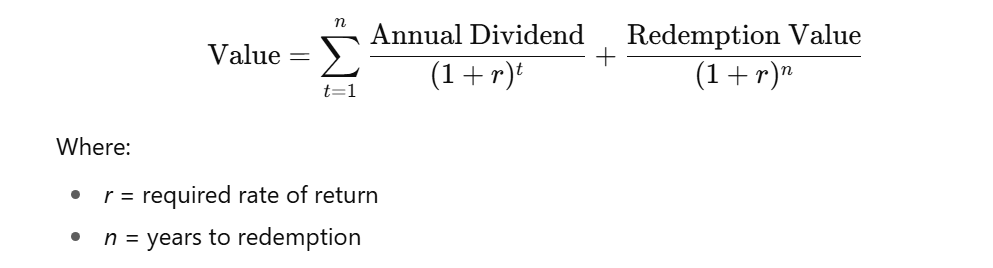
B. Redeemable Preference Shares

  • These shares are repayable after a fixed period (say 5 or 10 years).

  • Value is based on the present value of dividends for n years plus present value of redemption value.

Formula:

Need of  Valuation of Preference Shares:

  • Investment Decision-Making

Valuation of preference shares helps investors decide whether to buy, hold, or sell such securities. Since preference shareholders receive fixed dividends and priority over equity shareholders, knowing the fair value ensures they do not overpay or undervalue their investment. By comparing the intrinsic value with the market price, investors can judge potential returns and risks. This process builds confidence in investment decisions, especially for risk-averse investors who prefer stable returns rather than uncertain equity dividends.

  • Corporate Financing Decisions

Companies issue preference shares as a source of capital, combining features of both debt and equity. Before issuing or redeeming such shares, firms must know their value to ensure cost-effective financing. Valuation helps management compare preference shares with other funding sources like debentures or equity. It also influences dividend payout policies and redemption strategies. Thus, correct valuation ensures balanced capital structure, reduces financing costs, and maintains investor trust, which is essential for smooth business operations and long-term sustainability.

  • Regulatory and Legal Requirements

Valuation of preference shares becomes necessary during mergers, acquisitions, liquidation, or restructuring of a company. Laws and accounting standards often require that shareholders, including preference shareholders, receive fair value for their holdings. Accurate valuation ensures compliance with statutory provisions and prevents disputes among stakeholders. It also helps in calculating compensation payable to preference shareholders when the company decides to redeem or convert their shares. Thus, valuation ensures transparency, fairness, and legal compliance in corporate financial transactions and governance.

  • Redemption and Conversion Decisions

Preference shares are often redeemable after a fixed period or convertible into equity shares. In both cases, valuation plays a vital role. For redemption, it helps determine the repayment amount and its impact on company finances. For conversion, valuation ensures fair exchange ratios between preference and equity shares, avoiding shareholder conflicts. This process safeguards the interests of both the company and investors. Therefore, proper valuation ensures smooth redemption or conversion, maintains fairness, and supports effective long-term financial planning.

error: Content is protected !!