Computation of Fire Insurance Claims

Calculating a fire insurance claim involves several steps to ensure that the policyholder is compensated fairly for the loss or damage caused by fire. The process includes assessing the loss, verifying policy coverage, applying relevant clauses, and finally calculating the claim amount.

Notification of Fire Incident

The first step after a fire occurs is for the insured to notify the insurer about the fire incident. Prompt notification is crucial as it initiates the claim process and allows the insurer to assess the damage as early as possible. Most insurance policies specify a timeline within which the fire incident must be reported.

Assessment of Loss

After the insurer has been notified, a loss assessor or surveyor is appointed to inspect the property and estimate the extent of damage caused by the fire. The surveyor assesses:

  • The condition of the property before the fire.
  • The extent of damage to stock, machinery, and other assets.
  • The salvage value of any damaged goods or property. The assessment forms the basis of the claim, determining how much of the property has been destroyed or damaged.

Calculation of the Value of Stock or Assets Lost:

In the case of businesses, the value of the stock lost in the fire is calculated. The insured needs to provide details of the stock on hand before the fire occurred. This can be derived from:

  • Stock registers or accounts.
  • Invoices and purchase records.
  • Valuation of finished goods and raw materials.

The valuation of assets or stock is often done at cost price or market value, depending on the terms of the policy. If the stock was insured at invoice price, any profit margin already added is also considered.

Application of Policy Coverage Limits:

Every fire insurance policy has a maximum coverage limit or sum insured, which is the maximum amount the insurer is liable to pay. If the loss exceeds this limit, the policyholder will not be compensated for the excess. In such cases, the claim amount will be restricted to the sum insured.

Deduction of Salvage Value:

Salvage value refers to the residual value of any goods, property, or assets that can still be used or sold after the fire. The insurer reduces the claim amount by the salvage value, as the policyholder can recover some amount by selling or reusing salvageable items. This is essential for fair compensation as the insured should not be paid for goods that still retain some value.

Formula:

Net Loss = Total Loss − Salvage Value

Application of the Average Clause (if applicable)

Average clause is a provision in fire insurance that applies if the insured sum is less than the actual value of the property. In such cases, the policyholder is considered to have underinsured the property, and the insurer reduces the claim payout proportionally.

Formula for Average Clause:

Claim Amount = (Sum Insured / Actual Value of Property) × Net Loss

For example, if a property worth ₹10,00,000 is insured for ₹6,00,000 and suffers a loss of ₹4,00,000, the claim is reduced as follows:

Claim Amount = (₹6,00,000 / ₹10,00,000) × ₹4,00,000 = ₹2,40,000

The policyholder will only receive ₹2,40,000, instead of the full ₹4,00,000, because of underinsurance.

Consideration of Deductibles

Fire insurance policies often include deductibles or excess clauses, which are amounts the policyholder must bear out of pocket before the insurance coverage kicks in. For example, if the deductible is ₹50,000, and the total loss is ₹3,00,000, the insurer will pay only ₹2,50,000. Deductibles encourage policyholders to avoid making small claims and to take preventive measures.

Calculation of Business Interruption Loss (if applicable)

In cases where the policy covers loss of profit due to business interruption, the insurer compensates for the reduction in gross profit caused by the fire. To calculate business interruption loss, the following factors are considered:

  • Historical profit trends.
  • Fixed operating expenses (e.g., rent, salaries).
  • The duration of business disruption. The amount paid for business interruption is based on the financial data provided by the insured, and it helps maintain financial stability while the business recovers from the fire.

Claim Settlement by Insurer

After assessing all the factors value of the loss, salvage, deductibles, and the average clause the insurer arrives at the final claim amount. Once agreed upon, the insurer pays the policyholder the claim, restoring them to their pre-loss financial position as closely as possible.

Example: Calculation of Fire Insurance Claim

  • Value of stock before the fire: ₹15,00,000
  • Loss of stock due to fire: ₹5,00,000
  • Salvage value of remaining stock: ₹50,000
  • Sum insured: ₹12,00,000
  • Deductible: ₹25,000
  • Actual value of stock: ₹15,00,000

Steps:

  1. Calculate the Net Loss:

Net Loss = ₹5,00,000 − ₹50,000 = ₹4,50,000

  1. Apply the Average Clause:

Since the sum insured (₹12,00,000) is less than the actual value (₹15,00,000), the average clause applies:

Claim Amount = (₹12,00,000 / ₹15,00,000) × ₹4,50,000 = ₹3,60,000

  1. Apply the Deductible:

The final claim amount after deducting the policy deductible (₹25,000):

Final Claim = ₹3,60,000 − ₹25,000 = ₹3,35,000

The final payout by the insurer would be ₹3,35,000.

Journal Entries and Ledger Accounts Including Minimum Rent Account

Journal entries are systematic records of business transactions made in the journal (or book of original entry), capturing the date, accounts involved, debit, and credit amounts. They ensure that every financial event is properly documented and aligned with the double-entry system, where total debits always equal total credits. Each entry reflects the nature of the transaction, such as rent payments, royalties, sales, purchases, or adjustments.

Once journal entries are recorded, they are posted to ledger accounts. A ledger is the principal book where transactions related to each account (like cash, sales, rent, royalties, minimum rent) are grouped, showing cumulative balances. This structured organization helps businesses track account-wise financial activities and prepare financial statements accurately.

Minimum Rent (also known as Dead Rent) is a guaranteed payment that the lessee (tenant) must make to the lessor (landlord) irrespective of the actual production or sales. If the actual royalty based on production or sales exceeds the minimum rent, the lessee will pay the higher amount. However, if the royalty is lower than the minimum rent, short workings occur, which may be recouped in future periods when the actual royalty exceeds the minimum rent.

Specifically, in royalty agreements, the Minimum Rent Account comes into play when the agreed minimum rent or dead rent is higher than the actual royalty based on production or sales. The lessee is obligated to pay this minimum amount even if actual output is low. If the royalties fall short, the shortfall is recorded as a shortworkings expense, often carried forward for recoupment in future years.

Journal entries for such cases typically include:

  • Debit: Royalty Expense / Production Account

  • Debit (if applicable): Shortworkings Account

  • Credit: Minimum Rent Account or Landlord’s Account

Key Terms:

1. Minimum Rent (Dead Rent)

Minimum Rent, also known as Dead Rent, is the fixed minimum amount that a lessee (tenant or user) agrees to pay to the lessor (owner) under a royalty agreement, regardless of the actual level of production or sales. This concept is commonly used in mining leases, publishing contracts, or patents where the lessee uses a resource or intellectual property that generates royalties.

The idea behind minimum rent is to ensure that the lessor receives a guaranteed minimum income even if the lessee’s production or sales are low in a particular year. It acts as a safeguard for the lessor’s financial security, providing them with a fixed return for granting the lease or usage rights.

For example, if a mining company leases land to extract minerals, the owner wants assurance that even if the mining output is low, they will still receive a minimum payment. So, if the royalty based on production is less than the agreed minimum rent, the lessee must still pay the minimum rent amount.

2. Actual Royalty

Actual Royalty refers to the amount calculated and payable by the lessee (user) to the lessor (owner) based on the real quantity of production or sales during a specific period, according to the agreed royalty rate. It is the variable part of the payment in a royalty agreement and directly depends on how much the lessee produces, extracts, sells, or earns from the leased asset, property, or right.

For example, in a mining lease, the lessee agrees to pay the lessor a royalty of ₹50 per ton of coal extracted. If they extract 2,000 tons in a year, the actual royalty would be ₹100,000. Similarly, in a publishing agreement, an author may receive a royalty of 10% on book sales, so if ₹500,000 worth of books are sold, the actual royalty will be ₹50,000.

3. Short Workings

Short Workings refer to the excess amount paid by the lessee (tenant or user) to the lessor (owner) when the minimum rent (dead rent) payable under a royalty agreement exceeds the actual royalty earned during a given period. It represents the difference between the minimum rent and the actual royalty when actual production or sales fall short.

In simple terms, when a lessee is obligated to pay a guaranteed minimum amount (minimum rent) regardless of production, but their actual production or sales generate a smaller royalty, they still pay the minimum rent. This excess payment is known as short workings. Importantly, many contracts allow the lessee to recoup or recover these short workings in future years when actual royalties exceed the minimum rent.

Example

  • Minimum Rent: ₹150,000

  • Actual Royalty (based on production): ₹120,000

  • Short Workings = ₹150,000 – ₹120,000 = ₹30,000

The lessee pays ₹150,000 to the lessor but has an excess payment of ₹30,000, recorded as short workings. This amount may be recouped in future periods if actual royalty exceeds minimum rent, subject to the contract terms.

4. Recoupment of Short Workings

Recoupment of Short Workings refers to the process where a lessee (user) recovers the excess payments (short workings) made in earlier years under a royalty agreement when actual royalties fall below the minimum rent. This recovery is done in future periods when the actual royalty exceeds the minimum rent, allowing the lessee to adjust or offset the earlier shortfall.

In a typical royalty agreement, if the lessee pays more than the actual royalty (due to minimum rent obligations), the extra amount is recorded as short workings. Many agreements give the lessee a right to recoup these short workings within a specified period (usually 2–3 years). If, during that period, the lessee’s actual royalties rise above the minimum rent, the surplus can be used to recoup the past excess payments.

Example

  • Year 1: Minimum Rent ₹150,000, Actual Royalty ₹120,000 → Short Workings ₹30,000

  • Year 2: Minimum Rent ₹150,000, Actual Royalty ₹180,000 → Excess Royalty ₹30,000

In Year 2, the lessee can recoup ₹30,000 of short workings from Year 1 by adjusting it against the excess royalty. The lessee now pays only the minimum rent, as the extra royalty offsets the past shortfall.

Example Scenario:

  • Minimum Rent: ₹100,000
  • Actual Royalty for Year 1: ₹80,000 (Short Workings: ₹20,000)
  • Actual Royalty for Year 2: ₹120,000 (Recoupment of Short Workings: ₹20,000)

Journal Entries in the Books of Lessee:

Year 1: Actual Royalty is Less than Minimum Rent (Short Workings)

Date Particulars Debit (₹) Credit (₹)
Year 1 Royalty Account Dr. 80,000
To Lessor’s Account 80,000
(Being actual royalty payable to lessor)
Minimum Rent Account Dr. 100,000
To Lessor’s Account 100,000
(Being minimum rent payable)
Short Workings Account Dr. 20,000
To Minimum Rent Account 20,000
(Being short workings transferred)
Lessor’s Account Dr. 100,000
To Bank Account 100,000
(Being payment made to the lessor)

Year 2: Actual Royalty Exceeds Minimum Rent (Recoupment of Short Workings)

Date Particulars Debit (₹) Credit (₹)
Year 2 Royalty Account Dr. 120,000
To Lessor’s Account 120,000
(Being actual royalty payable to lessor)
Minimum Rent Account Dr. 100,000
To Lessor’s Account 100,000
(Being minimum rent payable)
Short Workings Recouped Account Dr. 20,000
To Short Workings Account 20,000
(Being short workings recouped)
Lessor’s Account Dr. 120,000
To Bank Account 120,000
(Being payment made to the lessor)

Ledger Accounts in the Books of Lessee:

1. Minimum Rent Account

Date Particulars Debit (₹) Credit (₹)
Year 1 Lessor’s Account 100,000
Year 1 Short Workings Account 20,000
Year 2 Lessor’s Account 100,000

2. Royalty Account

Date Particulars Debit (₹) Credit (₹)
Year 1 Lessor’s Account 80,000
Year 2 Lessor’s Account 120,000

3. Short Workings Account

Date Particulars Debit (₹) Credit (₹)
Year 1 Minimum Rent Account 20,000
Year 2 Short Workings Recouped Account 20,000

4. Lessor’s Account

Date Particulars Debit (₹) Credit (₹)
Year 1 Bank Account 100,000
Year 1 Royalty Account 80,000
Year 1 Minimum Rent Account 100,000
Year 2 Bank Account 120,000
Year 2 Royalty Account 120,000
Year 2 Minimum Rent Account 100,000

5. Short Workings Recouped Account

Date Particulars Debit (₹) Credit (₹)
Year 2 Short Workings Account 20,000

6. Bank Account

Date Particulars Debit (₹) Credit (₹)
Year 1 Lessor’s Account 100,000
Year 2 Lessor’s Account 120,000

Explanation of Journal Entries:

1. Year 1 (Short Workings)

    • The Royalty Account is debited with the actual royalty amount (₹80,000), and the Lessor’s Account is credited.
    • The Minimum Rent Account is debited with the guaranteed minimum rent (₹100,000), and the lessor is credited again.
    • The shortfall of ₹20,000 (short workings) is recorded by debiting the Short Workings Account and crediting the Minimum Rent Account.
    • The total amount due to the lessor is paid by debiting the Lessor’s Account and crediting the Bank Account.

2. Year 2 (Recoupment of Short Workings)

    • The actual royalty exceeds the minimum rent, so ₹120,000 is debited to the Royalty Account and credited to the Lessor’s Account.
    • The Minimum Rent Account is debited with ₹100,000, reflecting the minimum amount payable.
    • The Short Workings Recouped Account is debited with ₹20,000 (the amount of short workings recouped), and the Short Workings Account is credited.
    • Finally, the total payment of ₹120,000 is made to the lessor.

Accounting Treatment in the Books of Lessee

In a royalty agreement, the lessee (tenant) pays the lessor (landlord) for the use of land, property, or other resources. The lessee records journal entries for royalty payments, minimum rent (also known as dead rent), short workings, and recoupment of short workings in their books of accounts. These transactions are reflected in both the Journal Entries and Ledger Accounts.

Key Components in Lessee’s Books:

  • Lease Liability

In the lessee’s books, lease liability refers to the present value of future lease payments the lessee is obligated to make under the lease contract. This liability is recorded at the inception of the lease and reflects the financial obligation over the lease term. It includes fixed payments, variable payments based on an index or rate, and amounts expected under residual guarantees. Lease liability is subsequently measured by reducing it through lease payments and increasing it by the accretion of interest expense.

  • Right-of-Use (ROU) Asset

The right-of-use (ROU) asset represents the lessee’s right to control and use the leased asset for the lease term. This asset is initially measured at the amount of the lease liability, adjusted for initial direct costs, lease incentives, or advance payments. Over time, the ROU asset is depreciated systematically, typically on a straight-line basis, over the shorter of the lease term or the asset’s useful life. The ROU asset ensures the lessee properly reflects the economic benefit derived from the leased asset.

  • Lease Payments

Lease payments in the lessee’s books refer to the regular periodic payments made to the lessor, covering the use of the leased asset. These payments usually include both principal and interest components. The principal portion reduces the lease liability, while the interest portion is charged as an expense to the profit and loss account. The schedule of lease payments is crucial for managing cash flow and ensuring compliance with contractual obligations over the entire lease term.

  • Interest Expense

Interest expense arises from the unwinding of the discount on the lease liability over time. As lease liabilities are measured on a present value basis, each lease payment reduces the liability and incurs an interest cost. The interest expense is recognized in the profit and loss account and gradually decreases over the lease term as the liability reduces. This accounting treatment ensures the lessee’s financial statements reflect the time value of money related to future lease obligations.

  • Depreciation Expense

Depreciation expense refers to the systematic allocation of the cost of the right-of-use (ROU) asset over the lease term. In the lessee’s books, depreciation is charged to the profit and loss account, usually on a straight-line basis, unless another method better reflects the asset’s consumption pattern. The depreciation period is typically the lease term, or the useful life of the underlying asset if ownership transfers. This expense ensures the gradual write-down of the asset’s value over time.

  • Initial Direct Costs

Initial direct costs are the incremental costs directly attributable to negotiating and securing the lease agreement, such as legal fees or commissions. In the lessee’s books, these costs are included as part of the ROU asset’s initial measurement. Instead of expensing these costs immediately, they are capitalized and amortized over the lease term through the depreciation of the ROU asset. Proper treatment of initial direct costs ensures accurate representation of the total cost of obtaining the lease.

  • Lease Modifications

Lease modifications involve changes to the lease terms, such as extending the lease, changing payment amounts, or modifying the asset’s scope. In the lessee’s books, lease modifications may require remeasurement of both the lease liability and the ROU asset, depending on whether they create a separate lease or adjust the existing agreement. Accounting standards provide specific guidance on recognizing and adjusting for modifications, ensuring that financial records remain accurate and reflect current contractual terms.

  • Disclosures in Financial Statements

Lessee’s books must include detailed disclosures about leases in the financial statements, such as the nature of the leases, total lease liabilities, maturity analysis, lease expenses, and any significant assumptions or judgments used. These disclosures provide transparency to stakeholders, helping them understand the impact of leasing activities on the company’s financial position and performance. Proper disclosure ensures compliance with accounting standards like IFRS 16 or ASC 842 and improves the reliability of reported financial information.

Example Scenario:

Consider a situation where:

  • Minimum Rent (Dead Rent) = ₹100,000
  • Actual Royalty (based on production) = ₹80,000 in Year 1, ₹120,000 in Year 2
  • Short Workings in Year 1 = ₹20,000 (₹100,000 – ₹80,000)
  • Recoupment of Short Workings in Year 2 = ₹20,000

Journal Entries in the Books of Lessee:

Date Particulars Debit (₹) Credit (₹)
Year 1
Royalty Account Dr. 80,000
To Lessor’s Account 80,000
(Being actual royalty payable to lessor)
Minimum Rent Account Dr. 100,000
To Lessor’s Account 100,000
(Being minimum rent payable)
Short Workings Account Dr. 20,000
To Minimum Rent Account 20,000
(Being short workings transferred)
Lessor’s Account Dr. 100,000
To Bank Account 100,000
(Being payment made to lessor)
Year 2
Royalty Account Dr. 120,000
To Lessor’s Account 120,000
(Being actual royalty payable to lessor)
Minimum Rent Account Dr. 100,000
To Lessor’s Account 100,000
(Being minimum rent payable)
Lessor’s Account Dr. 120,000
To Bank Account 120,000
(Being payment made to lessor)
Short Workings Recouped Account Dr. 20,000
To Short Workings Account 20,000
(Being short workings recouped)

Ledger Accounts in the Books of Lessee:

1. Royalty Account

Date

Particulars Debit (₹) Credit (₹)
Year 1 Lessor’s Account 80,000
Year 2 Lessor’s Account 120,000

2. Minimum Rent Account

Date Particulars Debit (₹) Credit (₹)
Year 1 Lessor’s Account 100,000
Year 1 Short Workings Account 20,000
Year 2 Lessor’s Account 100,000

3. Short Workings Account

Date Particulars Debit (₹) Credit (₹)
Year 1 Minimum Rent Account 20,000
Year 2 Short Workings Recouped Account 20,000

4. Lessor’s Account

Date Particulars Debit (₹) Credit (₹)
Year 1 Bank Account 100,000
Year 1 Royalty Account 80,000
Year 1 Minimum Rent Account 100,000
Year 2 Bank Account 120,000
Year 2 Royalty Account 120,000
Year 2 Minimum Rent Account 100,000

5. Short Workings Recouped Account

Date Particulars Debit (₹) Credit (₹)
Year 2 Short Workings Account 20,000

6. Bank Account

Date Particulars Debit (₹) Credit (₹)
Year 1 Lessor’s Account 100,000
Year 2 Lessor’s Account 120,000

Explanation of Journal Entries:

1. Year 1 Entries

    • The first entry records the royalty amount based on actual production.
    • The second entry records the minimum rent payable to the lessor.
    • The short workings are recorded when the actual royalty is less than the minimum rent.
    • Finally, the payment to the lessor is recorded by crediting the bank account.

2. Year 2 Entries

    • The actual royalty exceeds the minimum rent, so no short workings are created.
    • The short workings from Year 1 are recouped by reducing the royalty payment in Year 2.

Explanation of Ledger Accounts:

  • Royalty Account reflects the actual royalty amounts based on production.
  • Minimum Rent Account shows the minimum rent payable each year.
  • Short Workings Account records the shortfall between minimum rent and actual royalty.
  • Lessor’s Account tracks payments made to the lessor and any amounts owed.
  • Short Workings Recouped Account tracks the amount of short workings recovered in subsequent years.
  • Bank Account reflects the cash payments made to the lessor.

Journal Entries and Ledger Accounts in the Book of Hire Purchase and Hire Vendor

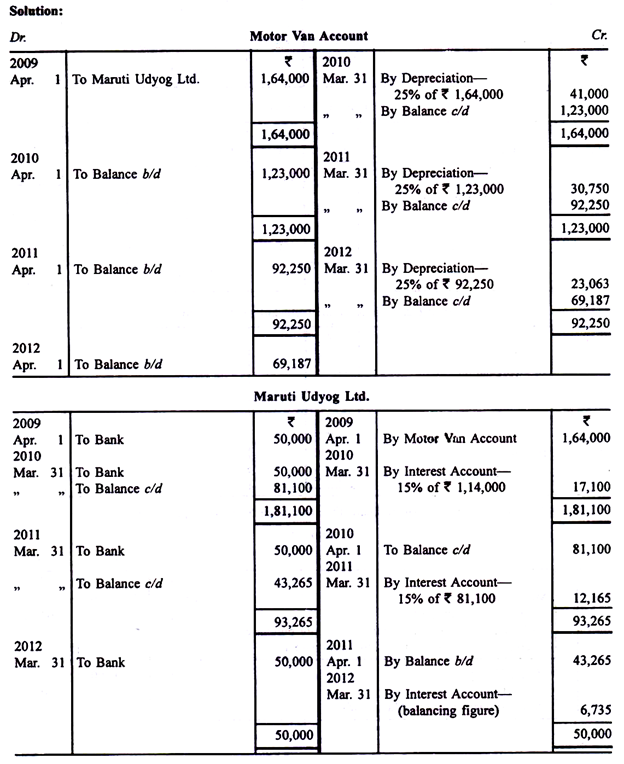
There are two methods for entering hire purchase transactions in the books of the hire- purchaser. The first is to enter transactions like ordinary purchases with the difference that interest is to be provided. This method recognizes the fact that the intention of the parties is to complete the purchase and to pay all the instalments. Hence, on purchase of machinery, machinery is debited and the hire vendor is credited with the cash price. When payment is made, the hire vendor is debited. At the end of each financial year, interest is credited to the hire vendor and debited to Interest Account. Depreciation is charged in the ordinary manner.

illustration 1:

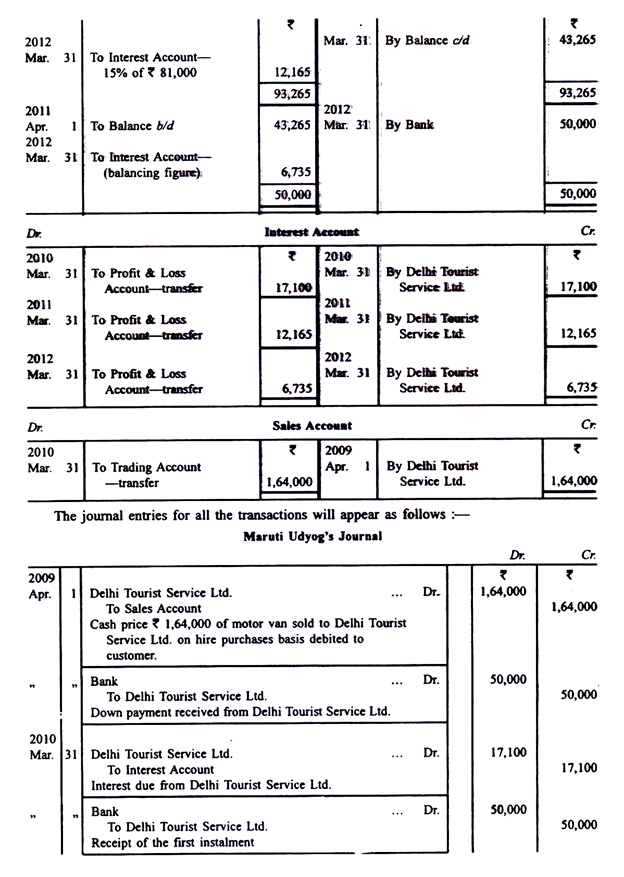
Delhi Tourist Service Ltd. purchased from Maruti Udyog Ltd. a motor van on 1st April, 2009 the cash price being Rs 1,64,000. The purchase was on hire purchase basis, Rs 50,000 being paid on the signing of the contract and, thereafter, Rs 50,000 being paid annually on 31st March, for three years, Interest was charged at 15% per annum. Depreciation was written off at the rate of 25 per cent per annum on the reducing instalment system. Delhi Tourist Service Ltd. closes its books every year on 31st March. Prepare the necessary ledger accounts in the books of Delhi Tourist Service Ltd.

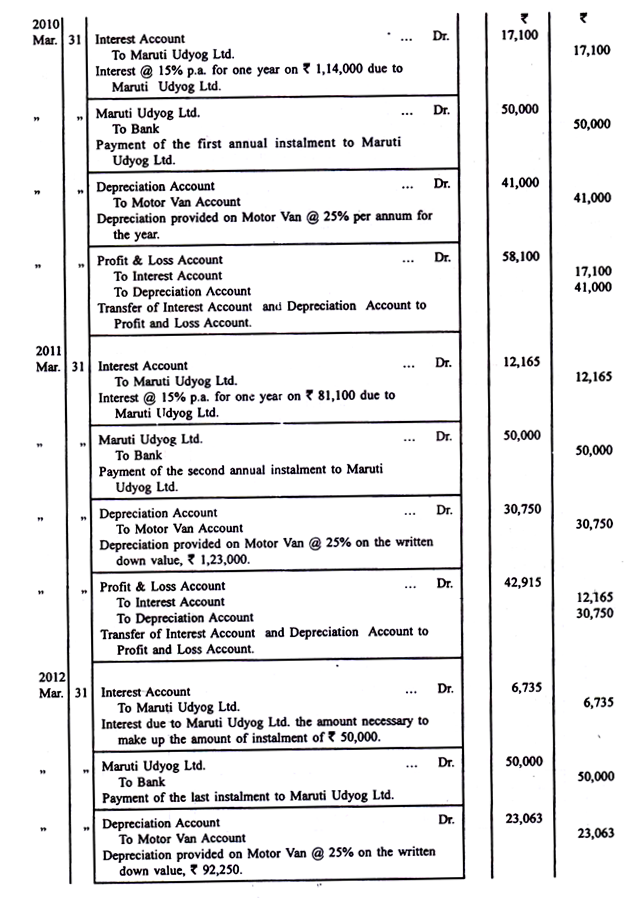
The other method of passing entries in the books of the hire purchaser seeks to recognize the fact that no property passes to the hire-purchaser till the final payment is made. Hence, no entry is passed when the contract is signed.

Entries are made at the time of payment of each instalment. The interest included in the instalment is debited to the interest account; the remaining amount is debited to the asset. Thus, if a payment is made down, the entry is to debit the asset and credit Bank, there being no interest when payment is made on the signing of the contract.

When the next instalment is paid, the entries will be:

1. Debit Asset Account

  • Debit Interest Account
  • Credit Hire Vendor; and

2. Debit Hire Vendor Credit Bank

Depreciation must be allowed on the basis of the full cash price. This is because the whole asset is being used and because ultimately the asset must be paid for wholly.

The journal entries for the illustration number 3 given above, under this method will be as under:

Entries in Interest Account, Depreciation Account and Profit & Loss Account will be the same as have been passed under the first method.

Books of Hire-Vendor:

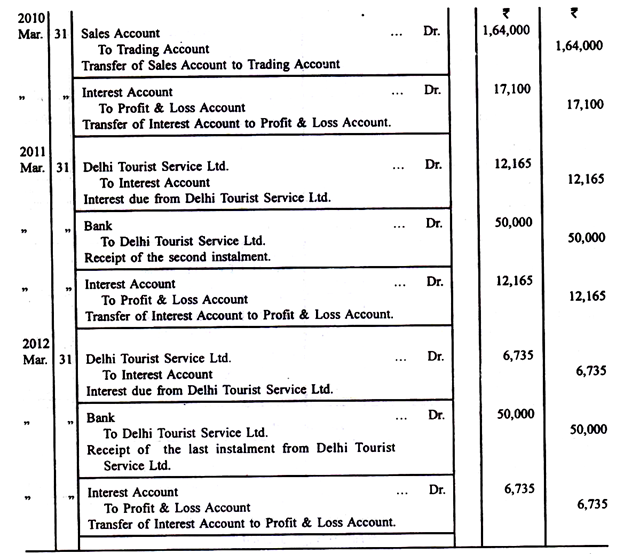
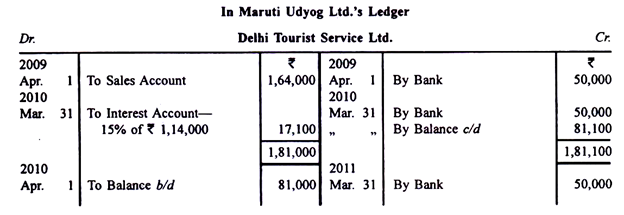
The hire-vendor treats the hire purchase sale like an ordinary sale. He debits the hire purchaser with the full cash price and credits the Sales Account. Interest is debited to the hire purchaser when instalments become due. Cash received is, of course, credited to the hire purchaser.

In the books of the hire-vendor, the accounts pertaining to the above illustration will be as follows:

Illustration 2:

On 1st April, 2008, Ashok acquired machinery on hire purchase system from Modmac Ltd., agreeing to pay four annual instalments of Rs 60,000 each payable at the end of each year. There is no down payment. Interest is charged @ 20% per annum and is included in the annual instalments.

Because of financial difficulties, Ashok, after having paid the first and second instalments, could not pay the third yearly instalment due on 31st March, 2011, whereupon the hire vendor repossessed the machinery. Ashok provides depreciation on the Machinery @ 10% per annum according to the written down value method. He closes his books of account every year on 31st March. Show Machinery Account and the account of Modmac Ltd. for all the years in the books of Ashok. All workings should form part of your answer. [B.Com. (Hons.) Delhi, 1995 Modified]

error: Content is protected !!