EBIT-EPS analysis for Capital Structure Decision

EBIT-EPS Analysis is a financial tool used to determine the impact of different financing options (debt and equity) on a company’s Earnings Per Share (EPS) at various levels of Earnings Before Interest and Taxes (EBIT). It helps in capital structure decision-making, allowing firms to choose between debt financing (which increases financial leverage) and equity financing (which avoids fixed interest costs but dilutes ownership). The analysis involves computing EPS for different EBIT levels to identify the indifference point, where EPS remains the same regardless of financing choice. Companies aim to maximize EPS while managing financial risk and shareholder value.

Meaning of EBIT

Earnings Before Interest and Taxes (EBIT) refers to the operating profit of the firm.
It is the income earned from business operations before deducting interest on loans and income tax.

EBIT = OperatingRevenue – OperatingExpenses

It measures the earning capacity of the firm independent of financing decisions.

Meaning of EPS

Earnings Per Share (EPS) represents the earnings available to each equity shareholder.
It indicates the profitability of the company from the shareholders’ point of view.

EPS = Earnings available to equity shareholders / Number of equity shares

Higher EPS means higher return to shareholders and increased market value of shares.

Financial Leverage and EBIT–EPS

The analysis is closely related to financial leverage.

Financial leverage means the use of debt in capital structure to increase return to equity shareholders.

  • If EBIT is high → Debt financing increases EPS

  • If EBIT is low → Debt financing decreases EPS

Therefore, proper use of debt can increase shareholders’ wealth.

Advantages of EBIT-EPS Analysis

  • Helps in Selecting Optimum Capital Structure

EBIT–EPS analysis helps management compare different financing alternatives such as equity shares, preference shares and debt. By calculating earnings per share under each plan, the company can identify the most profitable financing option. The plan that provides higher EPS at a particular level of EBIT is selected. Thus, it guides the finance manager in designing an optimum capital structure that balances cost and return while improving the financial performance of the organization.

  • Maximizes Shareholders’ Earnings

The main objective of financial management is to maximize the wealth of equity shareholders. EBIT–EPS analysis directly focuses on earnings available to shareholders. It shows how different financing plans affect EPS and helps management select the alternative that produces higher earnings per share. By choosing the plan with the highest EPS, the firm increases returns to shareholders, enhances investor confidence and improves the market value of shares.

  • Measures the Effect of Financial Leverage

EBIT–EPS analysis clearly explains the effect of financial leverage on shareholders’ earnings. It shows how the use of borrowed funds can increase EPS when operating profits are high. At the same time, it also reveals the negative impact when profits decline. Therefore, it helps management understand both benefits and dangers of debt financing. This knowledge assists in maintaining a proper balance between risk and return while planning the capital structure.

  • Useful in Financial Planning

The analysis is very helpful in financial planning and forecasting. It enables the company to estimate the level of operating profit required to meet interest and dividend obligations. Management can predict future earnings and evaluate the financial viability of proposed financing plans. This makes planning more systematic and reduces uncertainty in financial decision-making. As a result, the company can arrange funds in advance and avoid financial difficulties.

  • Facilitates Comparison of Financing Alternatives

A company often has several alternatives for raising funds, such as issuing shares or taking loans. EBIT–EPS analysis provides a numerical comparison of these alternatives. It presents the impact of each option on EPS in a clear and measurable form. This makes decision-making logical and objective rather than based on assumptions. Hence, management can select the most beneficial financing source after evaluating all possible alternatives.

  • Identifies the Indifference Point

EBIT–EPS analysis helps determine the indifference point, which is the level of EBIT where EPS remains the same under two financing plans. This point guides management in understanding the level of operating income required for debt financing to become advantageous. Above this level, debt financing is preferable, while below it equity financing is safer. Therefore, the indifference point provides a clear basis for selecting suitable financial strategies.

  • Improves Decision-Making

The technique promotes scientific and rational financial decision-making. Instead of relying on guesswork, management uses calculated figures of EPS to choose financing sources. It provides a clear picture of expected returns and financial obligations. This reduces uncertainty and improves confidence in financial decisions. Consequently, the organization can adopt policies that are more effective, practical and aligned with long-term business goals.

  • Assists in Profit Planning

EBIT–EPS analysis also helps in profit planning. By analyzing different EBIT levels, the firm can set profit targets required to achieve desired EPS. Management can evaluate whether expected operating profits are sufficient to cover fixed financial charges. This enables better budgeting and performance evaluation. Therefore, the analysis acts as a useful tool for planning profitability and monitoring the financial performance of the business.

Limitations of EBIT-EPS Analysis


Although EBIT–EPS analysis is a useful technique for selecting an appropriate financing plan and capital structure, it is not free from defects. The analysis mainly concentrates on earnings per share and ignores several practical aspects of financial decision-making. Therefore, it should not be used as the only basis for financing decisions.

The major limitations of EBIT–EPS analysis are explained below:

  • Ignores Business Risk

EBIT–EPS analysis assumes that the operating income (EBIT) is known and stable. In reality, business earnings fluctuate due to changes in demand, competition, economic conditions and technology. If EBIT decreases unexpectedly, the company may not be able to meet interest obligations on debt. Hence, the analysis does not properly consider business risk, which is an important factor in financial planning.

  • Focuses Only on EPS

The technique gives importance only to earnings per share. However, maximizing EPS does not always mean maximizing shareholders’ wealth. Shareholders are also concerned with share price, dividends, safety of investment and future growth. A plan with higher EPS may involve higher risk and may reduce the market value of shares. Therefore, EPS alone is not a complete measure of financial performance.

  • Neglects Financial Risk

EBIT–EPS analysis encourages the use of debt because it often increases EPS at higher levels of EBIT. However, excessive debt increases financial risk and the possibility of insolvency. The company must pay interest regardless of profit. The analysis does not give adequate weight to the risk arising from heavy borrowing, which may endanger the long-term stability of the firm.

  • Assumes Constant Interest and Tax Rates

The analysis assumes that interest rates and tax rates remain constant. In actual business conditions, interest rates change due to market fluctuations and government policies. Similarly, tax rates may also vary. Changes in these rates directly affect EPS and the cost of capital. Hence, results of the analysis may become unrealistic or misleading.

  • Ignores Market Conditions

EBIT–EPS analysis does not consider the condition of the capital market. Sometimes it may not be possible to issue shares or debentures due to unfavorable market situations. Investor preferences, economic recession and stock market trends also affect financing decisions. Since these practical aspects are ignored, the analysis may not always be applicable in real situations.

  • No Consideration of Control

Issue of equity shares reduces the ownership control of existing shareholders. Many companies avoid issuing new shares to maintain management control. EBIT–EPS analysis does not consider this important aspect. It only compares EPS and ignores the effect of financing decisions on voting rights and managerial control.

  • Unrealistic Assumption of Fixed EBIT Levels

The technique compares financing plans at different EBIT levels, but predicting exact EBIT in advance is difficult. Business profits are uncertain and affected by several external factors. If the actual EBIT differs from estimated EBIT, the selected financing plan may not be suitable. Therefore, the analysis may lead to wrong decisions when profit estimates are inaccurate.

  • Does Not Consider Cash Flow Position

EBIT–EPS analysis is based on accounting profits rather than cash flows. However, interest and loan repayments require actual cash payments. A firm may show high EPS but may still face cash shortage. Ignoring liquidity position may create financial difficulties and even bankruptcy.

  • Short-Term Perspective

The analysis mainly focuses on immediate effect on EPS and does not consider long-term consequences such as growth opportunities, financial flexibility and sustainability. A financing plan beneficial in the short run may harm the company in the long run. Therefore, it provides only a partial view of financial decision-making.

Indifference Points:

The indifference point, often called as a breakeven point, is highly important in financial planning because, at EBIT amounts in excess of the EBIT indifference level, the more heavily levered financ­ing plan will generate a higher EPS. On the other hand, at EBIT amounts below the EBIT indifference points the financing plan involving less leverage will generate a higher EPS.

Indifference points refer to the EBIT level at which the EPS is same for two alternative financial plans. According to J. C. Van Home, ‘Indifference point refers to that EBIT level at which EPS remains the same irrespective of debt equity mix’. The management is indifferent in choosing any of the alternative financial plans at this level because all the financial plans are equally desirable. The indifference point is the cut-off level of EBIT below which financial leverage is disadvanta­geous. Beyond the indifference point level of EBIT the benefit of financial leverage with respect to EPS starts operating.

The indifference level of EBIT is significant because the financial planner may decide to take the debt advantage if the expected EBIT crosses this level. Beyond this level of EBIT the firm will be able to magnify the effect of increase in EBIT on the EPS.

In other words, financial leverage will be favorable beyond the indifference level of EBIT and will lead to an increase in the EPS. If the expected EBIT is less than the indifference point then the financial planners will opt for equity for financing projects, because below this level, EPS will be more for less levered firm.

  • Computation:

We have seen that indifference point refers to the level of EBIT at which EPS is the same for two different financial plans. So the level of that EBIT can easily be computed. There are two approaches to calculate indifference point: Mathematical approach and graphical approach.

  • Graphical Approach:

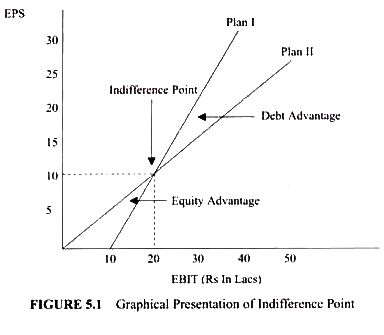
The indifference point may also be obtained using a graphical approach. In Figure 5.1 we have measured EBIT along the horizontal axis and EPS along the vertical axis. Suppose we have two financial plans before us: Financing by equity only and financing by equity and debt. Dif­ferent combinations of EBIT and EPS may be plotted against each plan. Under Plan-I the EPS will be zero when EBIT is nil so it will start from the origin.

The curve depicting Plan I in Figure 5.1 starts from the origin. For Plan-II EBIT will have some positive figure equal to the amount of interest to make EPS zero. So the curve depicting Plan-II in Figure 5.1 will start from the positive intercept of X axis. The two lines intersect at point E where the level of EBIT and EPS both are same under both the financial plans. Point E is the indifference point. The value corresponding to X axis is EBIT and the value corresponding to 7 axis is EPS.

These can be found drawing two perpendiculars from the indifference point—one on X axis and the other on Taxis. Similarly we can obtain the indifference point between any two financial plans having various financing options. The area above the indifference point is the debt advantage zone and the area below the indifference point is equity advantage zone.

Above the indifference point the Plan-II is profitable, i.e. financial leverage is advantageous. Below the indifference point Plan I is advantageous, i.e. financial leverage is not profitable. This can be found by observing Figure 5.1. Above the indifference point EPS will be higher for same level of EBIT for Plan II. Below the indifference point EPS will be higher for same level of EBIT for Plan I. The graphical approach of indifference point gives a better understanding of EBIT-EPS analysis.

Financial Breakeven Point:

In general, the term Breakeven Point (BEP) refers to the point where the total cost line and sales line intersect. It indicates the level of production and sales where there is no profit and no loss because here the contribution just equals to the fixed costs. Similarly financial breakeven point is the level of EBIT at which after paying interest, tax and preference dividend, nothing remains for the equity shareholders.

In other words, financial breakeven point refers to that level of EBIT at which the firm can satisfy all fixed financial charges. EBIT less than this level will result in negative EPS. Therefore EPS is zero at this level of EBIT. Thus financial breakeven point refers to the level of EBIT at which financial profit is nil.

Financial Break Even Point (FBEP) is expressed as ratio with the following equation:

Calculation of Weighted Cost of Capital

Weighted average Cost of Capital (WACC) is a financial metric used to determine the cost of financing a company’s operations. It reflects the average cost of all sources of financing, including debt and equity, weighted by their proportion in the company’s capital structure. The WACC is an important factor in determining a company’s value and profitability, and is used in various financial analysis and decision-making processes.

Components of WACC:

The WACC is composed of two main components:

  • Cost of equity
  • Cost of debt

Cost of Equity:

The cost of equity is the return required by investors in exchange for owning a company’s stock. It reflects the risk associated with owning the stock and is influenced by factors such as market conditions, the company’s financial performance, and the company’s growth prospects. The cost of equity can be calculated using various models, including the dividend discount model, the capital asset pricing model (CAPM), and the arbitrage pricing theory.

Cost of Debt:

The cost of debt is the interest rate paid by a company on its debt financing. It reflects the creditworthiness of the company and market conditions, and is typically lower than the cost of equity. The cost of debt can be calculated using the yield to maturity of the company’s existing debt or by estimating the interest rate the company would have to pay on new debt.

Calculation of WACC:

WACC is calculated by weighting the cost of equity and cost of debt based on their proportion in the company’s capital structure.

WACC = (E/V x Re) + (D/V x Rd x (1 – Tc))

Where:

E = Market value of equity

D = Market value of debt

V = Total market value of the company (E + D)

Re = Cost of equity

Rd = Cost of debt

Tc = Corporate tax rate

The first part of the equation (E/V x Re) represents the cost of equity weighted by the proportion of equity in the company’s capital structure. The second part of the equation (D/V x Rd x (1 – Tc)) represents the cost of debt weighted by the proportion of debt in the company’s capital structure, adjusted for the tax deductibility of interest payments.

Advantages of WACC:

  • Considers all Sources of Financing:

WACC considers the cost of all sources of financing, including debt and equity, which provides a more comprehensive view of the company’s cost of capital.

  • Useful in Decision-making:

WACC is used in various financial analysis and decision-making processes, such as determining whether to undertake a new project or make an acquisition.

  • Reflects Market Conditions:

WACC reflects current market conditions, such as interest rates and the risk premium for equity, which helps companies make informed financial decisions.

  • Easy to Calculate:

WACC is a relatively simple calculation that can be easily understood and communicated to stakeholders.

Limitations of WACC:

  • Assumes constant Capital Structure:

WACC assumes a constant capital structure, which may not be realistic for companies that frequently issue or retire debt or equity.

  • Sensitive to input assumptions:

WACC is sensitive to input assumptions, such as the cost of debt and equity, which can vary depending on the method used to calculate them.

  • Ignores other factors:

WACC does not consider other factors that may affect a company’s cost of capital, such as market risk and company-specific risk.

  • Does not account for Project risk:

WACC is based on the company’s overall risk, and may not accurately reflect the risk associated with a specific project or investment.

Cost Accounting, Meaning, Definitions, Objectives, Scope, Functions, Uses, Advantages and Limitations

Cost Accounting is a specialized branch of accounting that deals with the classification, recording, allocation, and analysis of costs associated with the production of goods and services. Its main objective is to ascertain the cost of a product, process, job, or service and to help management in cost control, cost reduction, and decision-making.

Cost Accounting collects cost data from financial accounts and other sources, analyzes it systematically, and presents it in a meaningful manner to management. It helps in determining cost per unit, fixing selling prices, measuring efficiency, and improving profitability. Unlike financial accounting, which focuses on overall profit and loss, cost accounting focuses on detailed cost information for internal management use.

In modern business, cost accounting plays a vital role in planning, budgeting, standard costing, and variance analysis, enabling management to take corrective actions and improve operational efficiency.

Definitions of Cost Accounting

  • According to the Institute of Cost and Management Accountants (ICMA), London

“Cost accounting is the process of accounting for costs from the point at which expenditure is incurred or committed to the establishment of its ultimate relationship with cost centres and cost units.”

  • According to CIMA (Chartered Institute of Management Accountants)

“Cost accounting is the application of costing and cost accounting principles, methods and techniques to the science, art and practice of cost control and the ascertainment of profitability.”

  • According to Wheldon

“Cost accounting is the classifying, recording and appropriate allocation of expenditure for the determination of costs of products or services, and for the presentation of suitably arranged data for purposes of control and guidance of management.”

  • According to J. Batty

“Cost accounting is the application of costing and cost accounting methods and techniques for the purpose of ascertaining costs and providing information to management for decision-making.”

Objectives of Cost Accounting

  • Ascertainment of Cost

One of the main objectives of cost accounting is to ascertain the accurate cost of products, services, jobs, or processes. It involves systematic collection and analysis of data relating to material, labour, and overheads. Determination of cost per unit helps management understand the actual expenditure incurred in production. This information is useful for comparing costs with estimates or standards and forms a sound basis for pricing, profit measurement, and efficiency evaluation.

  • Cost Control

Cost control is an important objective of cost accounting which aims at keeping costs within predetermined limits. This is achieved through techniques such as standard costing, budgetary control, and variance analysis. By comparing actual costs with standard or budgeted costs, deviations can be identified quickly. Management can then take corrective action to reduce wastage, inefficiency, and unnecessary expenses, thereby improving overall cost efficiency and profitability.

  • Cost Reduction

Cost accounting also aims at reducing the cost of production on a continuous basis. Cost reduction focuses on lowering unit costs permanently without affecting quality or performance. By analyzing cost data in detail, areas of inefficiency and avoidable expenditure can be identified. Improved methods of production, better use of materials, and effective utilization of labour and machinery help in achieving sustainable cost reduction.

  • Fixation of Selling Price

Another key objective of cost accounting is to assist management in fixing appropriate selling prices. Accurate cost information enables management to determine a fair price by adding a reasonable margin of profit to the cost of production. This is especially useful in competitive markets, tender pricing, and government contracts. Proper pricing ensures recovery of costs while remaining competitive and profitable.

  • Measurement of Efficiency

Cost accounting helps in measuring the efficiency of labour, machinery, and production processes. Through performance reports and variance analysis, it highlights idle time, wastage, and inefficiencies. Management can evaluate whether resources are being used optimally. Identifying inefficient areas allows corrective steps to be taken, leading to improved productivity, better utilization of resources, and enhanced operational performance.

  • Profit Planning and Decision Making

Cost accounting provides valuable information for profit planning and managerial decision making. Decisions such as make or buy, continuation or shutdown of operations, product mix selection, and expansion plans depend on accurate cost data. Techniques like marginal costing, break-even analysis, and contribution analysis help management choose the most profitable alternatives and ensure effective financial planning.

  • Preparation of Budgets and Forecasts

Cost accounting assists in preparing budgets, estimates, and forecasts for future periods. Past cost records are used to predict future expenses and revenues. Budgeting helps in planning and controlling business activities by setting targets and standards. It ensures proper allocation of resources and provides a basis for comparing actual performance with planned performance for effective control.

  • Aid to Management and Policy Formulation

Cost accounting acts as an important tool for management in policy formulation and strategic planning. It supplies detailed cost information required for framing pricing, production, and cost control policies. By presenting data in a systematic and understandable manner, cost accounting enables management to evaluate performance, improve decision making, and achieve long-term organizational objectives efficiently.

Scope of Cost Accounting

  • Cost Ascertainment

The scope of cost accounting includes the systematic ascertainment of costs related to products, services, jobs, or processes. It involves identifying, classifying, and recording various elements of cost such as material, labour, and overheads. Accurate cost ascertainment helps management know the exact cost of production per unit. This forms the basis for pricing decisions, profitability analysis, and comparison with standard or estimated costs for effective cost management.

  • Cost Control

Cost control is an important area within the scope of cost accounting. It ensures that actual costs incurred do not exceed predetermined standards or budgets. Techniques such as standard costing, budgetary control, and variance analysis are used to monitor expenses. By identifying deviations and inefficiencies, management can take timely corrective actions to reduce wastage and control unnecessary expenditure, leading to improved operational efficiency.

  • Cost Reduction

Cost accounting covers continuous cost reduction by identifying areas where costs can be minimized without affecting quality or productivity. Detailed cost analysis helps in improving methods of production, better utilization of resources, and elimination of avoidable expenses. Cost reduction focuses on long-term efficiency and profitability, making it an essential part of the scope of cost accounting in a competitive business environment.

  • Budgeting and Forecasting

Preparation of budgets and forecasts is another significant aspect of cost accounting. Past cost data is used to estimate future costs and revenues. Budgets act as a plan of action and a tool for control by setting cost limits and performance standards. Forecasting helps management anticipate future conditions and allocate resources effectively, ensuring smooth and efficient business operations.

  • Decision Making Support

Cost accounting provides valuable information to management for decision making. Decisions related to make or buy, acceptance of special orders, product mix, pricing, and shutdown of operations rely heavily on cost data. Techniques like marginal costing, break-even analysis, and contribution analysis fall within this scope. Accurate cost information ensures rational and informed managerial decisions.

  • Measurement of Efficiency

The scope of cost accounting includes measuring the efficiency of labour, machines, and production processes. Through cost reports, ratios, and variance analysis, it helps identify idle time, waste, and inefficiencies. Management can evaluate departmental and individual performance and take corrective measures. Improved efficiency leads to reduced costs, higher productivity, and better utilization of organizational resources.

  • Profitability Analysis

Cost accounting helps in analyzing the profitability of different products, departments, processes, or markets. By comparing costs and revenues, management can identify profitable and unprofitable areas. This information is useful for expansion, discontinuation of products, or reallocation of resources. Profitability analysis supports effective planning and helps maximize overall business profits.

  • Cost Reporting and Record Keeping

Maintaining cost records and preparing cost reports is an important part of the scope of cost accounting. These reports provide detailed cost information in a clear and systematic manner for management use. Proper cost records ensure transparency, accountability, and effective monitoring of costs. They also help in internal control and provide a basis for audit and performance evaluation.

Functions of Cost Accounting

  • Collection of Cost Data

One of the primary functions of cost accounting is the collection of cost data relating to materials, labour, and overheads. This data is gathered from various departments and cost records in a systematic manner. Proper collection ensures accuracy and reliability of cost information. It forms the foundation for further analysis, classification, and allocation of costs, enabling management to understand the cost structure of products and services.

  • Classification and Analysis of Costs

Cost accounting involves classification of costs into different categories such as fixed and variable, direct and indirect, and controllable and uncontrollable costs. Analysis of costs helps management understand the behavior of costs under different levels of activity. Proper classification and analysis assist in effective cost control, decision making, and application of suitable costing techniques for various business situations.

  • Allocation and Apportionment of Costs

Another important function is the allocation and apportionment of overhead costs to different cost centers and cost units. Allocation assigns whole costs directly to a cost center, while apportionment distributes common costs on a suitable basis. Accurate distribution of overheads ensures correct cost determination and prevents under or over-absorption of costs in products or services.

  • Ascertainment of Cost per Unit

Cost accounting helps in determining the cost per unit of product or service. By compiling all elements of cost and assigning them to cost units, management can know the exact cost of production. Cost per unit information is essential for pricing decisions, profit calculation, cost comparison, and evaluation of operational efficiency across different periods or departments.

  • Cost Control and Cost Reduction

A key function of cost accounting is to control and reduce costs. This is achieved by comparing actual costs with standards or budgets and analyzing variances. Areas of inefficiency, wastage, and excess expenditure are identified, allowing management to take corrective actions. Continuous cost reduction improves productivity, profitability, and competitive strength of the organization.

  • Preparation of Cost Statements and Reports

Cost accounting involves preparation of various cost statements and reports for management use. These reports present cost data in a clear and meaningful form, helping management monitor performance and control expenses. Cost reports may relate to material usage, labour efficiency, overhead absorption, and departmental performance, supporting informed decision making and effective internal control.

  • Assistance in Decision Making

Cost accounting provides relevant cost information required for managerial decision making. Decisions such as make or buy, acceptance of special orders, product mix selection, pricing, and continuation or shutdown of operations depend on cost analysis. Techniques like marginal costing and break-even analysis help management evaluate alternatives and choose the most profitable course of action.

  • Support in Planning and Budgeting

Cost accounting plays a significant role in planning and budgeting. It helps in setting cost standards, preparing budgets, and forecasting future costs and revenues. Budgetary control ensures coordination among departments and efficient use of resources. This function supports management in achieving organizational objectives through systematic planning and financial discipline.

Uses of Cost Accounting

  • Determination of Cost and Profit

Cost accounting is used to determine the accurate cost of products, services, jobs, or processes. By analyzing material, labour, and overhead costs, it helps in calculating cost per unit and overall cost of production. This information enables management to ascertain profit or loss for each product or activity, ensuring better control over expenses and improving overall profitability.

  • Fixation of Selling Price

One of the important uses of cost accounting is in fixing selling prices. Accurate cost data helps management add a suitable margin of profit to the cost of production. This ensures that prices are neither too high nor too low. Proper pricing based on cost information is essential in competitive markets, tenders, and government contracts to ensure profitability and market acceptance.

  • Cost Control and Reduction

Cost accounting is widely used for controlling and reducing costs. By comparing actual costs with standard or budgeted costs, inefficiencies and wastages can be identified. Management can take corrective measures to control excessive expenditure. Continuous cost reduction helps in improving operational efficiency, increasing productivity, and maintaining competitiveness in the long run.

  • Planning and Budgeting

Cost accounting provides a sound basis for planning and budgeting. Past cost records are used to prepare budgets and cost estimates for future periods. Budgets help in setting performance targets and allocating resources efficiently. Cost accounting ensures that business activities are planned in advance and carried out within the limits set by management.

  • Managerial Decision Making

Cost accounting is an important aid in managerial decision making. Decisions such as make or buy, acceptance of special orders, product mix selection, and continuation or shutdown of operations depend on cost information. Techniques like marginal costing and break-even analysis help management evaluate alternatives and choose the most profitable option.

  • Measurement of Efficiency

Cost accounting is used to measure the efficiency of labour, machinery, and production processes. Through variance analysis and performance reports, it highlights inefficiencies, idle time, and wastage. Management can assess departmental and individual performance and take corrective action, leading to improved productivity and better utilization of resources.

  • Profit Planning and Control

Cost accounting helps in profit planning and control by providing detailed cost and revenue data. Management can analyze contribution, break-even point, and margin of safety to plan profits. Regular monitoring of costs ensures that profit targets are achieved. This use of cost accounting supports sound financial management and business stability.

  • Formulation of Policies and Strategies

Cost accounting is useful in formulating pricing, production, and cost control policies. It provides reliable cost information required for strategic planning and long-term decision making. By analyzing cost trends and profitability, management can frame effective business strategies to improve efficiency, growth, and competitive strength.

Advantages of Cost Accounting

  • Enhanced Cost Control

Cost accounting helps monitor and control costs by identifying inefficiencies and waste. Through techniques like standard costing and variance analysis, managers can compare actual costs with predefined standards, identify deviations, and take corrective actions. This ensures optimal resource utilization and minimizes unnecessary expenses.

  • Accurate Pricing Decisions

Cost accounting provides precise cost data that supports effective pricing strategies. By determining the cost of production and adding a suitable profit margin, businesses can set competitive prices. It also helps in revising prices based on changes in cost structures, ensuring profitability while maintaining market competitiveness.

  • Improved Profitability Analysis

Analyzing profitability at different levels, such as product lines, services, or departments, is a significant advantage of cost accounting. It helps businesses identify high-performing and underperforming areas, guiding decisions on product mix, resource allocation, and market focus. Contribution margin and break-even analysis further enhance profitability insights.

  • Facilitation of Decision-Making

Cost accounting equips managers with critical data for informed decision-making. Whether it’s a make-or-buy decision, selecting the most profitable product line, or determining optimal production levels, cost accounting provides actionable insights. Cost-volume-profit analysis and relevant costing are key tools in this context.

  • Efficient Budgeting and Planning

Cost accounting aids in preparing detailed budgets by analyzing past cost trends and forecasting future expenses. Budgets for labor, materials, and overheads ensure financial discipline and resource allocation align with organizational goals. It also provides a roadmap for achieving operational and strategic objectives.

  • Supports Cost Reduction

Cost accounting identifies opportunities to reduce costs systematically without compromising quality or efficiency. By analyzing workflows, processes, and resource utilization, it highlights areas for improvement. Techniques like value analysis and process optimization contribute to sustained cost savings and increased competitiveness.

  • Better Performance Evaluation

Cost accounting facilitates effective performance evaluation by comparing actual results with planned targets and standards. It provides detailed reports on material usage, labour efficiency, and overhead control for different departments and responsibility centers. This helps management assess individual and departmental performance objectively. Timely identification of deviations enables corrective measures, motivates employees to improve efficiency, and ensures accountability across various levels of the organization.

  • Improved Internal Control and Transparency

Another important advantage of cost accounting is improved internal control and transparency in operations. Proper cost records, regular reporting, and systematic analysis reduce the chances of errors, fraud, and misuse of resources. Management gets clear and reliable cost information, which enhances coordination between departments. Strong internal control systems ensure accuracy in cost data and support sound managerial and financial decision-making.

Limitations of Cost Accounting

  • Costly and Time-Consuming

Implementing and maintaining a cost accounting system requires significant financial and human resources. From setting up systems to training personnel and generating detailed reports, it can be expensive and time-consuming, particularly for small businesses with limited resources.

  • Complex and Difficult to Understand

Cost accounting involves intricate methods, classifications, and terminologies that can be difficult for non-specialists to understand. Techniques such as process costing, activity-based costing, and variance analysis require a high degree of expertise, making it challenging for managers without a strong accounting background to interpret the results effectively.

  • Subjectivity in Allocation of Costs

The allocation of indirect costs, such as overheads, is often subjective and based on arbitrary assumptions. Different methods of cost allocation can produce varying results, potentially leading to inaccuracies and misinterpretation. This subjectivity reduces the reliability of cost accounting data for decision-making.

  • Limited Focus on Non-Monetary Factors

Cost accounting primarily focuses on monetary aspects of business operations, often neglecting non-monetary factors such as employee morale, customer satisfaction, and market trends. These qualitative aspects are equally important for overall business success but are not addressed by cost accounting methods.

  • Historical Data Dependence

Cost accounting relies heavily on historical data for analysis and decision-making. While it provides insights into past performance, it may not always reflect current market conditions or future trends. This dependence on outdated information can limit its relevance in dynamic business environments.

  • Not a Substitute for Financial Accounting

Cost accounting is designed for internal decision-making and does not replace financial accounting, which is essential for statutory reporting and compliance. This limitation means that businesses must maintain separate accounting systems, leading to duplication of effort.

  • Limited Applicability Across Industries

The applicability of cost accounting methods varies across industries. While manufacturing firms benefit significantly, service-based industries often face challenges in accurately allocating costs, limiting the effectiveness of cost accounting in such sectors.

  • Lack of Uniformity and Standardization

There is no universally accepted system or method of cost accounting applicable to all organizations. Different firms adopt different costing techniques based on their nature, size, and management needs. This lack of uniformity makes comparison of cost data between companies or industries difficult. Absence of standard procedures may also lead to inconsistency in cost records and reduce the usefulness of cost information for external comparison.

  • Possibility of Inaccurate Data and Misleading Results

Cost accounting depends heavily on accurate data collection and proper recording of costs. Any errors in data entry, estimation, or classification can lead to inaccurate cost information. Inaccurate cost data may mislead management and result in wrong decisions regarding pricing, production, or cost control. Thus, the effectiveness of cost accounting is limited by the quality and reliability of the data used.

Installation of Cost Accounting System

Cost Accounting System (CAS) is a structured framework used by organizations to record, analyze, and allocate costs to products, services, or activities. It helps in tracking expenses, controlling costs, and determining profitability. The system includes methods for collecting cost data, classifying costs (fixed, variable, direct, indirect), and assigning them to cost centers or units.

There are two main types of cost accounting systems:

  1. Job Costing System: Tracks costs for specific jobs or projects.

  2. Process Costing System: Allocates costs to continuous production processes.

Basic Consideration or Requisites of a Good Costing System:

  • Suitability to Business

A good costing system should be tailored to the nature and size of the business. It must align with the production process, organizational structure, and operational requirements. For example, job costing is suitable for customized production, while process costing fits mass production industries. A system that does not match business needs may lead to inaccurate cost determination, poor cost control, and ineffective decision-making. Thus, the system should be flexible and adaptable to industry-specific requirements.

  • Simplicity and Clarity

The system should be easy to understand and operate. Complex or overly technical costing systems can lead to errors and inefficiencies. A simple system ensures that employees can easily follow procedures without extensive training. Clarity in cost classification, allocation, and reporting enhances accuracy and transparency. A well-designed, user-friendly system minimizes errors, saves time, and increases efficiency in cost management, ensuring that even non-experts can interpret cost data effectively.

  • Accuracy and Reliability

A good costing system must provide precise and reliable cost data. Inaccurate cost information can mislead management and result in poor financial decisions. To ensure reliability, costs should be recorded systematically, with well-defined allocation methods for direct and indirect expenses. Regular audits and reconciliations should be conducted to verify data accuracy. Reliable cost data helps businesses in budgeting, pricing, and cost control, leading to better financial planning and profitability.

  • Cost Control and Reduction

An effective costing system must help in monitoring, controlling, and reducing costs. It should highlight areas where costs exceed budgets and provide insights into cost-saving opportunities. Tools such as standard costing, variance analysis, and budgetary control assist in identifying inefficiencies. By analyzing cost behavior and trends, businesses can implement corrective actions to minimize wastage, improve productivity, and enhance profitability. A system that lacks cost control measures may fail to support long-term financial sustainability.

  • Timeliness and Quick Reporting

Cost information should be provided promptly to facilitate quick decision-making. Delayed cost reports can lead to missed opportunities or incorrect strategic decisions. A well-structured costing system enables real-time tracking of expenses and generates timely reports for management. With advancements in technology, automated costing software enhances efficiency by reducing manual effort and ensuring fast processing. Quick access to cost data supports effective planning, pricing strategies, and operational adjustments, keeping the business competitive.

  • Integration with Financial Accounting

A good costing system should complement the financial accounting system to ensure consistency and accuracy. Integration helps in reconciling cost accounts with financial statements, reducing discrepancies. It also ensures compliance with accounting standards and regulatory requirements. A disconnected costing system can create confusion and errors in financial reporting. Proper synchronization between cost and financial accounts enhances overall financial control and provides a complete picture of the company’s financial health.

Steps Involved in the Installation of Costing System:

  • Study of Business Requirements

Before installing a costing system, a thorough analysis of the business structure, nature of operations, and cost elements is necessary. Understanding production processes, cost centers, and financial reporting needs ensures that the system is aligned with business goals. This step also identifies whether job costing, process costing, or activity-based costing is suitable. A system that does not fit the business model may lead to inefficiencies and inaccurate cost tracking.

  • Defining Cost Objectives

The purpose of the costing system must be clearly defined to ensure it meets business needs. Objectives may include cost control, pricing decisions, profitability analysis, or financial planning. Defining cost objectives helps in structuring the system appropriately, ensuring that it captures relevant cost data for decision-making. Without clear objectives, the system may collect unnecessary data, leading to complexity and inefficiencies in cost management.

  • Classification of Costs

Proper cost classification is crucial for meaningful cost analysis. Costs should be categorized into direct and indirect, fixed and variable, controllable and uncontrollable to facilitate accurate allocation. Standardizing classifications ensures consistency in recording and analyzing cost data. A lack of clear classification may result in incorrect cost allocation, affecting pricing decisions and financial planning. This step helps in setting up a framework for effective cost measurement and reporting.

  • Determination of Cost Centers

A cost center refers to a department, section, or unit where costs are incurred and recorded. Identifying cost centers helps in assigning costs accurately, improving cost control and performance evaluation. Different cost centers, such as production, administration, sales, and distribution, must be clearly defined. Without well-established cost centers, it becomes difficult to track expenses, analyze profitability, and implement cost reduction strategies.

  • Selection of Costing Method and Techniques

The appropriate costing method must be chosen based on business operations. For example, job costing is used for customized orders, while process costing is suitable for mass production. Techniques such as marginal costing, standard costing, and activity-based costing should also be considered. Selecting an inappropriate method may lead to misallocation of costs, affecting pricing and financial decisions. Proper selection ensures accurate cost determination and effective cost management.

  • Design and Implementation of Costing System

After selecting the method, the costing system is designed, incorporating necessary documents, reports, and software. Forms for material requisition, labor time tracking, and overhead allocation must be prepared. The system should be automated using cost accounting software to enhance efficiency. Poor system design may lead to errors and inefficiencies. Implementing the system with proper workflows ensures smooth operations and effective cost control.

  • Employee Training and Awareness

For successful implementation, employees handling the costing system must be well-trained. Training should cover cost classification, data recording, report generation, and system usage. Without proper training, employees may struggle with cost data entry and analysis, leading to errors. Regular workshops and refresher courses help in improving efficiency. A well-trained workforce ensures that the costing system functions accurately and delivers reliable cost information.

  • Continuous Monitoring and Improvement

Once installed, the system must be regularly reviewed to identify gaps, inefficiencies, and areas for improvement. Changes in business operations, costs, or technology may require modifications in the system. Regular audits ensure accuracy and reliability. Without continuous monitoring, the system may become outdated and ineffective in cost control. Adapting to evolving business needs enhances the system’s effectiveness and ensures long-term cost efficiency.

Requisite of Good Costing System:

  • Suitability to Business Operations

A good costing system must be designed according to the nature and scale of the business. It should align with production processes, financial requirements, and organizational structure. A system unsuitable for the industry may lead to inefficiencies and incorrect cost allocation. It should be flexible enough to adapt to changing business needs while ensuring that cost data remains relevant and accurate for decision-making and performance evaluation.

  • Simplicity and Ease of Use

The system should be simple, easy to understand, and user-friendly. A complex system may lead to confusion, errors, and inefficiencies. Employees should be able to use the system without extensive training. Standardized procedures for cost collection, classification, and reporting enhance clarity. Simplicity ensures smooth operations, quick decision-making, and better cost control. If a system is too complicated, employees may resist using it, reducing its effectiveness in cost tracking and financial planning.

  • Accuracy and Reliability

A costing system should provide precise and reliable cost data to support management decisions. Errors in cost calculations can lead to incorrect pricing, budgeting, and financial planning. To ensure accuracy, systematic cost recording and allocation methods should be followed. Regular audits and reconciliations should be conducted to verify data consistency. Reliable cost data helps businesses in evaluating profitability, optimizing resource utilization, and ensuring financial stability over the long term.

  • Cost Control and Efficiency

The system should help in monitoring, controlling, and reducing costs. It must identify cost overruns, inefficiencies, and wastage in operations. Techniques such as standard costing, variance analysis, and budgetary control should be integrated into the system. A good costing system provides cost-saving opportunities by highlighting areas of excess spending. Without effective cost control mechanisms, businesses may experience financial losses and reduced competitiveness in the market.

  • Timely Cost Reporting

A good costing system should generate cost reports promptly to support quick decision-making. Delays in cost data reporting can lead to missed opportunities or financial mismanagement. Real-time tracking of expenses through automated systems improves efficiency. The system should be capable of producing regular reports for management, ensuring transparency and accountability. Timely access to cost information helps in formulating pricing strategies, production planning, and budget adjustments as per market conditions.

  • Integration with Financial Accounting

The costing system should be well-integrated with the financial accounting system to ensure consistency and accuracy in reporting. Proper coordination between cost and financial accounts eliminates discrepancies and enhances financial analysis. Integration ensures compliance with accounting standards and regulatory requirements. A system that operates separately from financial records may create confusion and lead to incorrect financial statements. A well-synchronized costing system improves overall financial control and decision-making.

Stock Levels, Calculation, Reasons

Stock Level refers to the different levels of stock which are required for an efficient and effective control of materials and to avoid over and under-stocking of materials. The purpose of materials control is to maintain the sock of raw materials as low as possible and at the same time they may be available as and when required. To avoid over and under-stocking, the storekeeper must fix the inventory level, which is also known as a demand and supply method of stock control. In a scientific system of inventory control the following levels of materials are fixed.

Re-order Level

Re-order level is a level of material at which the storekeeper should initiate the purchase requisition for fresh supplies. When the stock-in-hand comes down to the re-ordering level, it is an indication that an action should be taken for replenishment or purchase.

The re-order level is calculated as follows:

Re-order Level = Minimum Level(Safety stock) + (Average lead time x Average consumption)

Re-order Level = Maximum Consumption x Maximum Re-ordering Period

Minimum Level Or Safety Level

Minimum level or safety stock level is the level of inventory, below which the stock of materials should not be fall. If the stock goes below minimum level, there is a possibility that the production may be interrupted due to shortage of materials. In other words, the minimum level represents the minimum quantity of the stock that should be held at all times.

The minimum level is determined by using the following formula:

Minimum Level = Re-order level -(Normal consumption x Normal Re-order Point)

Calculation OF Minimum Level Or Safety Stock

Illustration

Re-order Period = 8 to 12 days

Daily consumption = 400 to 600 units

Minimum Level = ?

Solution,

Minimum Level = Re-order Level – (Normal Consumption x Normal Re-order Point)

= 7200 – (500 x 10)

= 2200 units.

Working Notes:

1. Re-order Level = Maximum consumption x Maximum Re-order Point = 600 x 12 = 7200 units

  1. Normal consumption = (Maximum Consumption + Minimum Consumption)/2

    = (600+400)/2 = 1000/2= 500 units

  2. Normal Re-order Period = (Maximum Re-order Period + Minimum Re-order Period)/2

    = (12+8)/2 = 10 days.

Average stock Level

Average Stock level shows the average stock held by a firm. The average stock level can be calculated with the help of following formula.

Average Stock Level = Minimum Level + (1/2Re-order Quantity)

OR

Average Stock Level = (Minimum Level + Maximum Level) / 2

Illustration

Re-order quantity = 2000 units
Minimum Level = 500 units
Average stock level = ?

Solution,

Average stock level = Minimum level + 1/2 x Re-order quantity
= 500 + 1/2 x 2000
= 500+ 1000
= 1500 units.

Danger Level

Danger level is a level of fixed usually below the minimum level. When the stock reaches danger level, an urgent action for purchase is initiated. When stock reaches the minimum level, the storekeeper must make special arrangements to get fresh materials, so that the production may not be interrupted due to the shortage of materials.

The formula for calculating the danger level is:

Danger Level = Normal consumption x Maximum re-order period for emergency purchase

illustration,

Daily Consumption = 100 to 200 units

Maximum re-order period for emergency purchase = 5 days

Danger Level = ?

Solution,

Danger Level = Normal consumption x Maximum re-order period for emergency purchase = 150 x 5 = 750 units.

Maximum Level

Maximum level is that level of stock, which is not normally allowed to be exceeded. Beyond the maximum stock level, a blockage of capital should be exercised to check unnecessary stock. The factory should not keep materials more than the maximum stock level. It increases the carrying cost of holding unnecessary inventory level. It is the opportunity cost of holding inventory.

The maximum stock level can be calculated by using the following formula:

Maximum Level = Re-order Level + Re-order quantity – (Minimum consumption x Minimum Delivery Time)

illustration

Re-order quantity = 1000 units

Re-order Level = 1500 units

Re-ordering period = 4 to 6 days

Daily consumption = 150 to 250 units

Maximum Level = ?

Solution,

Maximum Level = Re-order level + Re-order quantity – (Minimum consumption x Minimum Re-ordering period)

= 1500+1000(150 x 4)

= 1900 units.

Reasons of Maintaining Optimal Stock Level:

  • Avoiding Stockouts and Production Delays

Maintaining an optimal stock level ensures that raw materials and finished goods are always available when needed, preventing production stoppages and order fulfillment delays. Stockouts can lead to missed sales opportunities, customer dissatisfaction, and reduced profitability. By keeping adequate inventory, businesses avoid disruptions in manufacturing, maintain a steady supply chain, and enhance customer trust. Inventory management techniques like Just-in-Time (JIT) and Economic Order Quantity (EOQ) help maintain the right balance of stock without overburdening storage capacity.

  • Reducing Excess Inventory Costs

Holding excess stock increases costs related to storage, insurance, depreciation, and obsolescence. Overstocking ties up capital, which could be used for other business operations. It also increases the risk of damage, spoilage, or products becoming outdated, especially for perishable or technology-based goods. By maintaining optimal stock levels, businesses reduce warehousing costs, handling expenses, and potential write-offs while improving cash flow and financial efficiency. Demand forecasting and inventory turnover analysis help in maintaining appropriate stock levels.

  • Enhancing Customer Satisfaction

Customers expect quick and reliable deliveries, and maintaining an optimal stock level ensures that orders are fulfilled on time. A lack of stock can lead to lost sales and customers switching to competitors. On the other hand, having excess stock can lead to outdated products that customers may no longer want. A well-managed inventory system ensures that products are available as per market demand, strengthening customer relationships and enhancing brand loyalty.

  • Improving Supply Chain Efficiency

An optimized stock level streamlines procurement, production, and distribution processes. It prevents disruptions caused by supply chain issues such as delayed shipments, supplier shortages, or transportation bottlenecks. Proper inventory control ensures a smooth material flow, reducing lead times and ensuring uninterrupted operations. Techniques like Vendor-Managed Inventory (VMI) and Just-in-Time (JIT) help maintain balance in the supply chain, reducing waste and increasing overall operational efficiency.

  • Preventing Material Wastage and Obsolescence

Overstocking increases the risk of perishable goods expiring, raw materials deteriorating, or finished products becoming obsolete due to changes in demand or technology. Maintaining optimal stock levels helps minimize waste, ensuring that older stock is utilized first through FIFO (First-In-First-Out) or LIFO (Last-In-First-Out) techniques. This is particularly crucial for industries dealing with food, pharmaceuticals, and electronics, where outdated inventory results in significant financial losses.

  • Enhancing Working Capital Management

Inventory represents a significant portion of a company’s working capital, and excessive stock ties up funds that could be used for other critical business operations. Maintaining the right stock levels ensures that money is not locked in unsold goods, improving liquidity and financial flexibility. Proper inventory management allows businesses to reinvest in product development, marketing, and operational growth, leading to higher profitability and financial stability.

  • Reducing Ordering and Carrying Costs

Ordering too frequently increases procurement costs, administrative work, and supplier dependency, while carrying excess stock raises storage, insurance, and handling costs. An optimal stock level strikes a balance, reducing both ordering and holding expenses. Inventory control techniques like EOQ (Economic Order Quantity), reorder point methods, and demand-based replenishment help in minimizing unnecessary expenses while ensuring a consistent supply of materials and goods.

Just in Time (JIT), Features, Components, Challenges

Just-in-Time (JIT) is an inventory management system that focuses on reducing waste by ordering and receiving materials only when they are needed in the production process. This minimizes holding costs, improves efficiency, and enhances cash flow. JIT relies on accurate demand forecasting and strong supplier coordination to avoid delays. It is widely used in industries like manufacturing and retail to maintain lean operations. While JIT reduces excess inventory, it also poses risks if there are supply chain disruptions. Successful JIT implementation requires efficient logistics, reliable suppliers, and a flexible workforce to meet production demands efficiently.

Features of Just in Time (JIT):

  • Elimination of Waste

JIT focuses on reducing waste in inventory, time, and resources by producing only what is required, when it is needed. Waste in the form of excess inventory, overproduction, defective products, and waiting time is minimized. By streamlining operations, businesses can optimize resource utilization and lower costs. This lean approach ensures that raw materials, work-in-progress, and finished goods do not pile up unnecessarily, leading to better efficiency. Companies using JIT aim for a zero-waste production system, making operations more sustainable and cost-effective.

  • Demand-Driven Production

JIT operates on a pull-based system, meaning production is initiated only when there is actual customer demand. Unlike traditional systems that rely on forecasts, JIT ensures that goods are produced based on real-time orders, reducing the risk of overproduction. This approach helps businesses align supply with demand, improving responsiveness to market changes. It also minimizes unsold inventory, ensuring that resources are allocated effectively. By adopting demand-driven production, companies can enhance customer satisfaction while avoiding excessive stockpiling of goods.

  • Strong Supplier Relationships

JIT requires timely and reliable deliveries of raw materials and components, making strong supplier relationships essential. Businesses must work closely with their suppliers to ensure a steady supply of materials without delays. Long-term partnerships, frequent communication, and trust are key to a successful JIT system. Companies often choose local or strategically located suppliers to reduce lead time and transportation costs. A well-integrated supply chain helps in maintaining smooth production flow without the need for large safety stocks.

  • Continuous Improvement (Kaizen)

JIT is closely linked with the philosophy of Kaizen, or continuous improvement. Businesses using JIT constantly strive to enhance their processes by identifying inefficiencies and making incremental improvements. This ensures higher quality, better productivity, and cost reduction. Employees at all levels are encouraged to participate in problem-solving and innovation. Regular performance evaluations, training programs, and lean management techniques help companies achieve operational excellence while maintaining flexibility in production.

  • Small Lot Production

JIT emphasizes producing in small batches rather than in large quantities. This reduces inventory holding costs and allows businesses to quickly adapt to changing customer demands. Small lot production minimizes storage space requirements and reduces the risk of defects going unnoticed. It also improves cash flow, as businesses do not have to invest heavily in raw materials upfront. By keeping batch sizes small, companies can be more agile and responsive to shifts in the market.

  • Zero Inventory Concept

JIT aims to maintain minimal inventory levels by ensuring that raw materials arrive just in time for production and finished goods are dispatched immediately after manufacturing. This reduces storage costs and prevents capital from being tied up in unused stock. While complete zero inventory may not always be practical, the goal is to keep inventory levels as low as possible without disrupting production. Businesses implementing JIT must have accurate demand forecasting and a reliable supply chain to avoid stockouts.

  • High Product Quality

Since JIT operates with minimal stock, businesses must maintain high-quality standards to prevent defects and rework. There is little room for errors, as defects can cause delays and production stoppages. JIT promotes a “right first time” approach, where quality control is integrated into every stage of the production process. Companies use techniques like Total Quality Management (TQM) and Six Sigma to ensure consistent quality. By focusing on defect prevention rather than correction, JIT helps in reducing waste and improving overall efficiency.

Components of Just in Time (JIT):

  • Continuous Improvement (Kaizen)

Kaizen, meaning “continuous improvement”, is a key component of JIT that focuses on incremental improvements in processes, products, and workflows. It involves identifying inefficiencies, reducing waste, and enhancing productivity through employee participation and innovation. Continuous monitoring, feedback loops, and performance evaluations help ensure that businesses achieve operational excellence while minimizing costs.

  • Waste Elimination (Muda)

JIT emphasizes reducing waste (Muda) in various forms, including overproduction, excess inventory, unnecessary transportation, defects, waiting time, and inefficient processes. The goal is to create a lean system where only the required materials are used, ensuring smooth and cost-effective operations. Businesses use lean manufacturing techniques to identify and eliminate waste.

  • Demand-Pull System

Unlike traditional push systems where production is based on forecasts, JIT operates on a pull system, where production is triggered by actual customer demand. This minimizes overproduction, reduces inventory costs, and ensures that only necessary goods are produced. Companies use real-time data, market trends, and customer orders to optimize production schedules.

  • Supplier Integration

JIT requires a strong relationship with reliable suppliers to ensure timely delivery of high-quality materials. Businesses often adopt long-term contracts, just-in-time delivery agreements, and vendor-managed inventory (VMI) systems to streamline procurement. Effective communication and coordination with suppliers help maintain a steady supply chain without excessive stockpiling.

  • Total Quality Management (TQM)

Quality is crucial in JIT since there is no buffer stock to compensate for defects. TQM ensures that every stage of production maintains high quality through continuous monitoring, process standardization, employee training, and defect prevention techniques. Companies use statistical process control (SPC) and six sigma methodologies to minimize errors.

  • Flexible Workforce

A skilled and adaptable workforce is essential for JIT to function effectively. Employees must be trained in multiple roles, problem-solving techniques, and quick decision-making to handle fluctuations in demand. Cross-training and team collaboration enhance efficiency and prevent bottlenecks in production.

  • Cellular Manufacturing

JIT promotes cellular manufacturing, where machines and workstations are arranged in a way that minimizes movement and handling. This layout increases efficiency, reduces setup time, and ensures a seamless flow of materials and products through the production process.

Challenges of Just in Time (JIT):

  • Supply Chain Disruptions

JIT heavily depends on a smooth and uninterrupted supply chain, making it vulnerable to disruptions. Any delay in the delivery of raw materials can halt production, leading to missed deadlines and customer dissatisfaction. Factors like natural disasters, supplier failures, political instability, and transportation issues can severely impact operations. Unlike traditional systems that maintain buffer stock, JIT has minimal inventory, leaving no room for error. Businesses using JIT must establish strong supplier relationships and contingency plans to mitigate risks and avoid production stoppages.

  • High Dependence on Reliable Suppliers

JIT requires frequent and timely deliveries of materials, making supplier reliability crucial. If a supplier fails to meet the required quality standards, quantity, or delivery schedule, production can be severely affected. Companies must carefully select and monitor suppliers, ensuring they adhere to strict performance standards. A single unreliable supplier can disrupt the entire production process. To minimize risk, businesses often establish long-term partnerships, use multiple suppliers, or implement backup supply strategies to maintain a steady flow of materials.

  • Increased Production Pressure

Since JIT minimizes inventory, production processes must be highly efficient and error-free. Employees often face pressure to meet strict deadlines, leading to stress and potential burnout. The system requires continuous monitoring, coordination, and quick decision-making to ensure smooth operations. Any minor mistake can cause delays, leading to significant losses. Businesses must train employees, invest in process automation, and implement effective workflow management to handle the fast-paced production environment without compromising quality or worker well-being.

  • Demand Fluctuations

JIT works best in a stable demand environment, but unexpected demand fluctuations can create challenges. If customer demand suddenly increases, companies may struggle to fulfill orders due to limited raw material availability. On the other hand, a sudden drop in demand can lead to wasted resources and operational inefficiencies. Accurate demand forecasting is essential, but predicting market trends is never foolproof. Businesses must adopt flexible production strategies and data-driven forecasting techniques to manage fluctuating demand effectively.

  • High Implementation Costs

Setting up a JIT system requires significant investment in technology, supplier relationships, and process optimization. Businesses need advanced inventory tracking systems, real-time data analytics, and skilled personnel to implement JIT successfully. Small and medium-sized enterprises (SMEs) may struggle with the initial costs and complexity of integrating JIT into their operations. While JIT can lead to long-term savings, companies must assess their financial capabilities and ensure they have the necessary infrastructure before transitioning to a JIT model.

  • Quality Control Challenges

JIT requires strict quality control because there is no buffer stock to compensate for defective products. Any defects in materials or production errors can halt operations, delay shipments, and increase costs. Unlike traditional systems that allow room for minor quality issues, JIT demands a “zero-defect” approach to avoid disruptions. Companies must implement robust quality control measures, conduct frequent inspections, and train employees in quality management techniques to ensure smooth production without defects affecting output.

  • Risk of Over-Reliance on Technology

JIT relies on real-time data, automated systems, and digital supply chain management for efficiency. Any technical failure, cyberattack, or system malfunction can disrupt the entire workflow, leading to production delays and financial losses. Companies must ensure strong IT security, regular system maintenance, and backup solutions to prevent data breaches or operational failures. Over-reliance on technology also means businesses must continuously upgrade their systems, which can be costly and require specialized expertise.

Optimal uses of Limited Resources

Limited resources are the essential inputs required for production or providing services. These include natural resources (land, water, minerals), human resources (labor, expertise), capital resources (machinery, buildings, technology), and financial resources (money, credit). Due to their scarcity, organizations face the challenge of deciding how to best allocate these resources to achieve their objectives.

In an economic context, limited resources exist because there is always more demand for them than the available supply. This creates the necessity for careful planning and decision-making, ensuring that resources are used efficiently, effectively, and in the right combination.

Principles of Optimal Resource Allocation

  • Maximizing Output

The primary objective of optimal resource use is to generate the highest possible output. Organizations should ensure that each resource—whether human, material, or financial—produces the maximum benefit. This involves careful production planning, workforce management, and adopting technologies that increase productivity.

Example: A manufacturing plant may use advanced machinery to improve the speed and quality of production, thus maximizing the output of each worker and minimizing waste.

  • Cost Efficiency

Organizations aim to minimize costs while maximizing output. This can be achieved by reducing wastage, eliminating inefficiencies, and utilizing resources in the most cost-effective manner.

Example: A company may implement lean manufacturing principles to minimize waste in its production processes, using fewer materials and labor to achieve the same output.

  • Prioritization of Resource Use

Limited resources must be allocated to areas that provide the greatest return. This involves identifying the most profitable and critical areas for investment or production. Prioritization ensures that resources are not wasted on less important tasks.

Example: A firm facing budget constraints may choose to allocate more resources to a high-margin product line rather than an unprofitable one, thereby ensuring a better return on investment.

  • Balancing Short-term and Long-term Goals

Organizations must balance immediate needs with long-term sustainability. Focusing only on short-term profits can lead to resource depletion and long-term negative consequences. Conversely, long-term sustainability may involve initial sacrifices in resource allocation.

Example: A company may invest in renewable energy technologies that require upfront capital investment but will result in long-term cost savings and environmental benefits.

  • Flexibility and Adaptability

Optimal use of resources requires the ability to adapt to changing circumstances. Economic conditions, technological advancements, and consumer preferences can alter the demand for resources. Flexible resource allocation allows organizations to respond quickly to new opportunities or challenges.

Example: During a period of economic downturn, a company may reduce spending on luxury products and shift resources toward basic essentials that consumers still demand.

Tools for Optimizing Resource Use

  • Cost-Benefit Analysis (CBA)

A cost-benefit analysis helps organizations weigh the potential benefits against the costs of utilizing a resource. It provides a quantitative framework for making resource allocation decisions, ensuring that the benefits derived from a resource exceed its associated costs.

Example: A company may conduct a CBA to determine whether investing in new technology will yield a higher return on investment compared to the cost of acquiring and maintaining the equipment.

  • Resource Allocation Models

Models like the Economic Order Quantity (EOQ) or Linear Programming help businesses determine the optimal allocation of resources under specific constraints, such as budget limits or production capacities.

Example: A company could use linear programming to determine the optimal mix of products to produce, ensuring that the use of raw materials and labor is maximized without exceeding resource constraints.

  • Budgeting and Forecasting

Budgeting is a crucial tool for planning the use of limited resources. Accurate forecasting and creating a budget allow organizations to anticipate resource needs and allocate funds appropriately.

Example: A manufacturing company may prepare an annual budget that allocates capital for new machinery, labor costs, and materials, ensuring that resources are allocated to areas that will generate the most value.

  • Supply Chain Optimization

Efficient supply chain management is vital for ensuring the timely availability of resources without overstocking or incurring unnecessary costs. Optimizing the supply chain ensures that materials and products are available when needed and at the lowest possible cost.

Example: A retailer may use a just-in-time inventory system to ensure that products are replenished precisely when needed, avoiding the cost of holding excessive inventory.

Challenges in Optimizing Limited Resources

  • Uncertainty and Risk

The future is often uncertain, making it difficult to predict resource requirements accurately. Changes in market conditions, consumer behavior, or external factors (e.g., economic downturns, geopolitical events) can disrupt resource plans.

Example: A company that relies heavily on imported raw materials may face supply chain disruptions due to trade restrictions, requiring quick adaptations in resource allocation.

  • Competing Priorities

Organizations often face competing demands for limited resources, making it difficult to decide how to allocate them. Balancing the needs of various departments, projects, and stakeholders can create conflicts.

Example: A firm may need to decide whether to invest in research and development for future products or focus on increasing the capacity of its existing product line.

  • Technological Constraints

Even with advanced technology, limitations in production capacity, human resources, or infrastructure may restrict the optimal use of resources.

Example: A company may have access to advanced machinery but face constraints in terms of skilled labor, limiting the amount of output that can be produced.

Pricing decisions

Pricing decisions play a crucial role in the success of a product or service. Setting the right price is essential for generating revenue, maximizing profits, and capturing customer value. Effective pricing strategies take into account various factors, including market conditions, customer perceptions, competitive landscape, and cost considerations.

Pricing Objectives:

Before determining the specific pricing strategy, businesses must establish their pricing objectives. These objectives can vary depending on the company’s goals and market positioning.

  • Profit Maximization:

Setting prices to maximize profitability by achieving the highest possible margins.

  • Market Penetration:

Setting low initial prices to gain market share and attract a large customer base.

  • Revenue Growth:

Setting prices to maximize total revenue by considering sales volume and pricing elasticity.

  • Competitive Pricing:

Setting prices in line with or slightly below competitors’ prices to gain a competitive advantage.

  • Value-based Pricing:

Setting prices based on the perceived value of the product or service to customers.

  • Premium Pricing:

Setting higher prices to position the product as a luxury or high-end offering.

Pricing Strategies:

Once pricing objectives are established, businesses can adopt various pricing strategies to achieve their goals. Some common pricing strategies:

  • Cost-Based Pricing:

Setting prices based on the production and distribution costs, including materials, labor, and overhead expenses. A markup or desired profit margin is added to the costs to determine the final price.

  • Market-Based Pricing:

Setting prices based on market conditions, customer demand, and competitor pricing. This strategy considers factors such as perceived value, customer preferences, and willingness to pay.

  • Value-Based Pricing:

Setting prices based on the perceived value of the product or service to customers. This strategy focuses on the benefits, quality, and uniqueness of the offering and prices it accordingly.

  • Skimming Pricing:

Setting high initial prices for innovative or unique products to capture early adopters and maximize revenue before competitors enter the market.

  • Penetration Pricing:

Setting low initial prices to quickly gain market share and attract price-sensitive customers. The goal is to stimulate demand and establish a strong customer base.

  • Bundle Pricing:

Offering multiple products or services as a package at a discounted price compared to purchasing them individually. This strategy encourages customers to buy more and increases overall sales.

  • Psychological Pricing:

Setting prices based on customer psychology and perceptions. Strategies include using odd or charm prices (e.g., $9.99) or prestige pricing to create an impression of value or exclusivity.

Factors affecting Pricing:

When making pricing decisions, businesses should consider various factors that influence the pricing strategy:

  • Market Demand:

Understanding the demand for the product or service is essential. Higher demand may allow for higher prices, while lower demand may require competitive pricing or promotional strategies.

  • Competition:

Analyzing the competitive landscape helps determine the appropriate pricing strategy. Factors such as the number of competitors, their pricing strategies, and product differentiation impact pricing decisions.

  • Customer Perceptions:

Customers’ perceived value, quality expectations, and willingness to pay are crucial factors in setting prices. Businesses must understand customer segments and their price sensitivity.

  • Cost Analysis:

Calculating the production costs, overhead expenses, and desired profit margins is essential to ensure that prices cover costs and generate profits. Businesses must consider economies of scale, cost structures, and cost efficiencies.

  • Legal and Ethical Considerations:

Pricing decisions must comply with legal regulations, including price-fixing laws and fair trade practices. Ethical considerations, such as avoiding price discrimination or exploiting vulnerable customers, should also be taken into account.

Pricing Tactics:

  • Psychological Pricing:

Utilizing pricing strategies that take advantage of customers’ psychological perceptions and behaviors. Tactics include using charm prices (e.g., $9.99 instead of $10), prestige pricing, or reference pricing (e.g., highlighting a higher “original” price to make the current price seem like a bargain).

  • Price Bundling:

Offering multiple products or services together at a discounted price compared to purchasing them separately. This tactic encourages customers to buy more and increases the overall perceived value.

  • Price Skimming:

Initially setting a high price for a new or innovative product and gradually reducing it over time to capture different segments of the market. This tactic allows businesses to maximize revenue from early adopters and then target price-sensitive customers as the product matures.

  • Price Discrimination:

Charging different prices to different customer segments based on their willingness to pay or other factors such as geographic location or purchasing power. This tactic allows businesses to capture more value from customers with a higher willingness to pay while still attracting price-sensitive customers.

  • Price Matching:

Offering to match or beat competitors’ prices to assure customers that they are getting the best deal. This tactic helps businesses remain competitive and retain customers.

  • Dynamic Pricing:

Adjusting prices in real-time based on demand, market conditions, or other factors. This tactic is commonly used in industries such as airlines, hotels, and ride-sharing services to optimize revenue.

Price Monitoring and Adjustments:

Pricing decisions should not be static; they require continuous monitoring and adjustment. Businesses should regularly evaluate their pricing strategy’s effectiveness, considering factors such as customer feedback, market trends, and changes in costs or competition. Pricing adjustments may be necessary to remain competitive, maximize profitability, or respond to market dynamics.

  • Pricing Objectives

Pricing objectives refer to the specific goals and outcomes that a company aims to achieve through its pricing strategy. These objectives guide the pricing decisions and help align them with the overall business strategy. Pricing objectives can vary based on factors such as market conditions, competition, product positioning, and company goals. Let’s explore some common pricing objectives:

  • Profit Maximization

One of the primary objectives of pricing is to maximize profitability. This objective focuses on setting prices that generate the highest possible profits for the company. It involves analyzing costs, market demand, and competition to determine the optimal price that balances revenue and expenses. Profit maximization can be achieved by setting prices that allow for higher profit margins, considering factors such as production costs, overhead expenses, and market dynamics.

  • Revenue Growth

Another important pricing objective is to drive revenue growth. This objective aims to increase the total revenue generated by the company. It involves setting prices that encourage higher sales volumes or higher prices per unit. Strategies such as premium pricing, product bundling, and upselling can be employed to increase revenue. The focus is on maximizing sales and expanding the customer base while maintaining profitability.

  • Market Penetration

Market penetration is a pricing objective that focuses on gaining a significant market share. The goal is to attract a large number of customers by offering competitive prices that are lower than the competition. Lower prices can create an incentive for customers to switch to the company’s products or services. This objective is commonly used in the introduction stage of a product or when entering a new market. The aim is to establish a strong customer base and gain a competitive advantage.

  • Price Leadership

Price leadership refers to becoming the market leader by setting prices that other competitors follow. The objective is to establish the company as a leader in terms of pricing strategy and gain a competitive advantage. This can be achieved by consistently setting prices lower or higher than competitors while delivering value to customers. Price leadership can help the company attract price-sensitive customers or position itself as a premium brand depending on the target market and product positioning.

  • Customer Value and Satisfaction

Pricing decisions can also be guided by a focus on customer value and satisfaction. The objective is to set prices that align with the perceived value of the product or service from the customer’s perspective. This approach emphasizes the importance of meeting customer expectations, providing quality products or services, and delivering value for the price charged. Pricing strategies such as value-based pricing or customer-centric pricing can be employed to ensure that customers feel they are receiving a fair exchange of value.

  • Competitive Advantage

Pricing objectives can also revolve around gaining a competitive advantage in the market. This involves setting prices that differentiate the company from competitors and position it as offering superior value. Strategies such as premium pricing or price differentiation can be used to create a perception of higher quality, exclusivity, or unique features. The objective is to establish a competitive edge that attracts customers and allows the company to command higher prices.

  • Survival

In certain situations, the pricing objective may be focused on survival. This occurs when a company is facing significant challenges, such as intense competition, economic downturns, or disruptive market conditions. The objective is to set prices that cover costs and generate enough revenue to sustain the business. The focus is on maintaining profitability or minimizing losses to survive in the short term until conditions improve.

Advantages of Pricing:

  • Revenue Generation

Pricing directly impacts the revenue generated by a business. By setting prices strategically, a company can maximize its sales revenue and profitability. Effective pricing strategies can help capture customer value and generate higher revenues.

  • Competitive Advantage

Pricing can be used as a tool to gain a competitive edge in the market. By offering competitive prices or unique pricing strategies, a company can differentiate itself from competitors. This can attract customers, increase market share, and enhance the company’s position in the industry.

  • Market Penetration

Lowering prices or using pricing strategies such as promotional pricing can help penetrate new markets or gain market share. Lower prices can attract price-sensitive customers and encourage them to try a product or service. This can be particularly effective in the early stages of a product life cycle or when entering new markets.

  • Increased Sales and Demand

Appropriate pricing strategies can stimulate demand and drive sales. By offering discounts, promotions, or bundle pricing, companies can incentivize customers to make purchases. This can lead to increased sales volume, higher customer acquisition, and greater market penetration.

  • Customer Perception of Value

Pricing plays a significant role in shaping customer perceptions of value. When prices align with customers’ perceived value of a product or service, it enhances their willingness to pay and satisfaction. Proper pricing strategies can create a perception of quality, exclusivity, or affordability, depending on the target market and positioning.

Disadvantages of Pricing:

  • Profitability Constraints

Pricing decisions must balance revenue generation with profitability. Setting prices too low may lead to reduced profit margins or even losses. On the other hand, setting prices too high may deter customers and limit sales. It’s essential to consider costs, market dynamics, and pricing elasticity to ensure pricing decisions are profitable.

  • Price Wars and Intense Competition

Aggressive pricing strategies can trigger price wars among competitors. Engaging in price competition without careful consideration can lead to eroded profit margins and a devaluation of the product or service. Price wars can harm the overall industry and make it challenging for businesses to differentiate themselves based on factors other than price.

  • Perception of Quality

Pricing can create a perception of quality in the minds of customers. Setting prices too low may lead customers to question the quality or value of a product. Conversely, setting prices too high may create expectations of premium quality, and failure to deliver on those expectations can damage the brand’s reputation.

  • Price Elasticity

The price elasticity of demand refers to the responsiveness of customer demand to changes in price. Some products or services may have highly elastic demand, meaning that even small changes in price can significantly impact customer demand. Pricing decisions must consider price elasticity to avoid overpricing or underpricing and to optimize sales and revenue.

  • Market Perception and Positioning

Pricing decisions can influence how a product or service is perceived in the market. If prices are set too low, customers may perceive the offering as low-quality or lacking value. On the other hand, setting prices too high may position the product as exclusive or only accessible to a niche market. Finding the right balance between pricing and market positioning is crucial.

  • Legal and Ethical Considerations

Pricing decisions must comply with legal regulations, including anti-competitive practices, price-fixing laws, and fair trade regulations. Pricing strategies that exploit vulnerable customers, engage in price discrimination, or mislead customers can damage a company’s reputation and lead to legal consequences.

Special order, Addition, Deletion of Product and Services

Special Order refers to a one-time order that is outside the regular business operations or sales channels. It typically involves a request for a product or service at a price that may differ from the standard selling price. Special orders are usually considered when a customer requests a large quantity or specific customization that doesn’t align with the business’s regular market segment.

Key Considerations in Special Orders:

  • Pricing Decisions

Special orders often come with a lower price than the standard price. However, the organization must ensure that the price covers at least the variable cost of production and contributes to fixed costs. The goal is to avoid making a loss on the special order, even if the price is lower than the usual selling price.

  • Capacity and Resource Allocation

Before accepting a special order, businesses need to assess their production capacity. If the company is already operating at full capacity, it may need to evaluate whether fulfilling the special order would affect regular orders. Resource allocation becomes crucial, especially if fulfilling the special order involves reallocating production time, labor, or materials.

  • Contribution Margin

The contribution margin for the special order is a critical factor in decision-making. Since fixed costs typically remain the same, the contribution margin from the special order will help cover these fixed costs and improve the overall profitability.

  • Impact on Long-term Relationships

Special orders should be assessed for their long-term impact on the company’s market positioning and customer relationships. For instance, offering a lower price on a special order may set an undesirable precedent that could undermine the regular pricing structure.

  • Opportunity Costs

It is essential to consider opportunity costs before accepting a special order. The business must analyze whether the resources used for the special order could be more profitably employed in other areas, such as fulfilling regular orders or expanding business capacity.

Addition or Deletion of Products and Services

The decision to add or delete products or services is part of a company’s strategic planning process. It involves evaluating whether a product or service line is profitable and aligns with the business’s long-term goals. The addition of products or services can diversify the company’s offerings, while the deletion may streamline operations and improve focus on core competencies.

Addition of Products and Services:

When deciding to add new products or services, the company must evaluate various factors:

  • Market Demand

The business must assess whether there is sufficient market demand for the new product or service. This involves market research to understand customer needs, preferences, and purchasing behavior.

  • Cost of Development and Marketing

New products or services require investment in research and development (R&D), marketing, distribution, and customer support. The company must ensure that the expected returns from the new offerings justify these upfront costs.

  • Fit with Existing Products

The new product or service should complement the existing product line and customer base. Offering something completely outside of the company’s current offerings could create challenges in terms of branding, marketing, and customer loyalty.

  • Competitive Advantage

Adding a new product or service can help the company differentiate itself from competitors. The organization should ensure that it can achieve a competitive advantage in terms of quality, pricing, or customer service to make the new product a success.

Deletion of Products and Services:

Decreasing or eliminating certain products or services is often a difficult decision but may be necessary when resources need to be redirected to more profitable areas. The following considerations are important:

  • Low Profitability

If certain products or services consistently perform poorly in terms of profitability, it might be wise to discontinue them. This could free up resources for more lucrative offerings.

  • Declining Demand

If market trends show a significant drop in demand for a product or service, the business may need to cut it from the portfolio. Continuing to invest in declining products can result in resource waste and missed opportunities.

  • Focus on Core Competencies

By deleting underperforming products or services, the company can focus on its core competencies and areas that offer the highest return on investment. This can lead to better operational efficiency and a clearer market positioning.

  • Impact on Brand Image

The deletion of products or services should be carefully considered in terms of its impact on the company’s brand. For example, discontinuing a well-known product line could affect customer loyalty, while removing a low-demand item could improve the overall image.

  • Cost Savings

Eliminating certain products or services can lead to cost savings, particularly if they are resource-intensive or require significant investment in production or marketing. These savings can then be redirected to more profitable or strategic areas.

  • Customer Retention

When discontinuing products or services, it is important to communicate clearly with customers who may be affected. Providing alternatives, offering incentives, or gradually phasing out the offering can help maintain customer loyalty.

Key Decision-Making Criteria for Both Special Orders and Product Adjustments

  • Profitability Analysis

The company must carefully analyze whether the decision to accept a special order or add/remove products will improve profitability in the long term.

  • Resource Utilization

The effective use of resources is central to all these decisions. Efficient allocation of labor, capital, and time must be considered when assessing both special orders and changes to the product/service line.

  • Strategic Fit

Both decisions must align with the company’s overall business strategy. For instance, the introduction of a new product must fit the company’s brand identity, and the deletion of a product should be in line with long-term objectives.

  • Market and Consumer Response

Understanding the market dynamics and consumer preferences is key to making informed decisions. Special orders and product/service additions or deletions should be based on clear market insights.

Standard Costing introduction

Standard Costing is a cost accounting method that involves setting predetermined, standard costs for direct materials, direct labor, and manufacturing overhead. It is used to establish a benchmark for comparing actual costs to expected costs and to identify any variances that may occur during production.

Standard costing, costs are recorded in the accounting system at standard rates, and variances are identified and analyzed to understand the reasons for deviations from the standard. This information is then used to adjust future cost estimates and improve cost control.

Standard costing is commonly used in manufacturing industries where products are produced in large quantities and costs can be accurately predicted based on historical data and experience. It is also used in service industries where costs can be assigned to individual products or services.

Process of Standard Costing:

  • Establishing standard costs for direct materials, direct labor, and manufacturing overhead
  • Recording actual costs incurred during production
  • Calculating and analyzing variances between actual and standard costs
  • Investigating and explaining the reasons for variances
  • Adjusting future cost estimates based on the information gathered from the analysis.

Advantages of standard costing:

  • It helps to identify inefficiencies in production processes.
  • It provides a framework for cost control.
  • It enables management to identify areas for improvement.
  • It facilitates the calculation of variances that can be used for performance evaluation.
  • It provides a consistent basis for decision-making.

Disadvantages of Standard Costing:

  • It can be time-consuming and expensive to set up.
  • It may not accurately reflect the actual costs of production.
  • It may not be suitable for businesses that operate in rapidly changing markets.
  • It can lead to a focus on cost reduction at the expense of quality and customer service.
  • It may not take into account non-financial factors that can impact production costs, such as employee morale and motivation.

The main formulas used in standard costing are:

  • Standard Cost per unit = Direct materials standard cost per unit + Direct labor standard cost per unit + Manufacturing overhead standard cost per unit
  • Total Standard cost = Standard cost per unit × Number of units produced
  • Variance = Actual cost – Standard cost
  • Material price variance = (Actual price – Standard price) × Actual quantity
  • Material quantity variance = (Actual quantity – Standard quantity) × Standard price
  • Labor rate variance = (Actual rate – Standard rate) × Actual hours
  • Labor efficiency variance = (Actual hours – Standard hours) × Standard rate
  • Overhead spending variance = (Actual overhead – Budgeted overhead) × Actual activity
  • Overhead efficiency variance = (Actual activity – Standard activity) × Standard overhead rate.

Standard Costing example question with solution

ABC Ltd. produces and sells widgets. The company’s budgeted production for the year is 10,000 units, with a budgeted overhead of $50,000. The budgeted direct materials and direct labor cost per unit are $20 and $10 respectively. The budgeted fixed overhead per unit is $5. The standard overhead rate per direct labor hour is $5.

During the year, ABC Ltd. produced 9,800 units, and incurred actual overhead of $49,500. The actual direct materials cost was $195,000, while actual direct labor cost was $98,000.

Required:

  • Calculate the standard cost per unit for direct materials, direct labor, and overhead.
  • Calculate the total standard cost per unit.
  • Prepare a standard cost card.
  • Calculate the overhead variance and the overhead cost applied.

Solution:

  • Calculation of standard cost per unit:

Direct materials cost per unit = Budgeted direct materials cost per unit = $20

Direct labor cost per unit = Budgeted direct labor cost per unit = $10

Variable overhead cost per unit = Standard overhead rate per direct labor hour * Budgeted direct labor hours per unit = $5 * 1 = $5

Fixed overhead cost per unit = Budgeted fixed overhead cost per unit = $5

Total standard cost per unit = Direct materials cost per unit + Direct labor cost per unit + Variable overhead cost per unit + Fixed overhead cost per unit

= $20 + $10 + $5 + $5 = $40

  • Calculation of total standard cost per unit:

Total standard cost per unit = Standard cost per unit * Budgeted production per year = $40 * 10,000 = $400,000

  • Preparation of standard cost card:

Direct materials: $20 per unit

Direct labor: $10 per unit

Variable overhead: $5 per unit

Fixed overhead: $5 per unit

Total: $40 per unit

  • Calculation of overhead variance and overhead cost applied:

Actual overhead = $49,500

Actual direct labor cost = $98,000

Standard overhead rate per direct labor hour = $5

Budgeted direct labor hours = Budgeted production * Budgeted direct labor hours per unit = 10,000 * 1 = 10,000 hours

Overhead cost applied = Standard overhead rate per direct labor hour * Actual direct labor hours

= $5 * 9,800 = $49,000

Overhead variance = Actual overhead – Overhead cost applied

= $49,500 – $49,000 = $500 (favorable)

The favorable variance suggests that the company’s actual overhead cost was less than the overhead cost applied based on the standard rate.

Setting of Standard

Standard costing is a method of accounting that uses standard costs and variances to evaluate performance and control costs. In standard costing, a standard is set for each cost element, such as direct materials, direct labor, and overhead. The standard represents the expected cost for a unit of product or service, based on historical data or estimates.

Setting standards in standard costing is an important process that allows businesses to control costs and evaluate performance. By setting standards for each cost element, businesses can compare actual costs to expected costs and identify variances. Variances may be favorable (actual costs are lower than expected) or unfavorable (actual costs are higher than expected), and can provide insights into areas where cost control measures may be necessary. By analyzing variances and taking corrective action, businesses can improve their performance and profitability.

Steps in setting standards in Standard Costing:

  • Identify cost elements:

The first step in setting standards is to identify the cost elements that will be included in the standard cost. This typically includes direct materials, direct labor, and overhead.

  • Determine standard quantity and price:

For each cost element, the standard quantity and price are determined. The standard quantity is the amount of a cost element that is required to produce one unit of product or service, while the standard price is the expected cost per unit of the cost element.

  • Establish standard costs:

The standard cost for each cost element is calculated by multiplying the standard quantity by the standard price. For example, if the standard quantity for direct materials is 2 pounds per unit and the standard price is $5 per pound, the standard cost for direct materials is $10 per unit.

  • Review and update standards:

Standards should be reviewed and updated regularly to ensure they remain accurate and relevant. This includes considering changes in market conditions, technology, and production processes that may affect costs.

Applications of Standard Costing:

  • Budgeting and Forecasting:

Standard costing is integral to the budgeting process, providing a basis for estimating future costs. It helps management forecast the costs of materials, labor, and overheads, which allows for better financial planning and resource allocation. By using standard costs, companies can predict profitability and set realistic financial goals for the upcoming periods.

  • Cost Control:

One of the primary applications of standard costing is in cost control. By comparing actual costs with standard costs, management can identify variances and investigate their causes. Favorable variances indicate cost savings, while unfavorable variances signal inefficiencies or wastage. This helps managers take corrective actions to maintain cost efficiency.

  • Performance Evaluation:

Standard costing helps in evaluating the performance of departments, cost centers, and employees. Managers can assess whether workers and departments are operating efficiently by comparing actual performance with standards. Variances provide insight into areas where performance may need improvement, and they can also be used to reward or penalize employees based on their contributions to cost management.

  • Inventory Valuation:

Standard costs are often used to value inventories in the balance sheet. This simplifies the process of determining the cost of goods sold (COGS) and ending inventory, as actual costs do not need to be tracked continuously. Inventory is recorded at standard cost, and any variances are recognized separately, improving financial reporting efficiency.

  • Pricing Decisions:

Standard costing helps in setting competitive yet profitable prices. By having a clear understanding of the standard cost of producing goods or delivering services, businesses can make informed pricing decisions that cover costs while maintaining profitability. Standard costs provide a baseline for determining the minimum price at which a product should be sold.

  • Variance Analysis:

One of the most significant applications of standard costing is variance analysis. Variances between actual and standard costs are analyzed to understand deviations in material usage, labor efficiency, and overheads. This analysis helps management pinpoint problem areas and make informed decisions to improve efficiency and reduce costs.

  • Motivation and Benchmarking:

Standard costs serve as benchmarks that motivate employees and departments to achieve cost efficiency. When realistic and attainable, standard costs create targets that guide operational activities. Employees strive to meet or beat these standards, driving productivity and cost-saving initiatives across the organization.

error: Content is protected !!