Market Area Analysis

Evaluation of Retail Trade Area

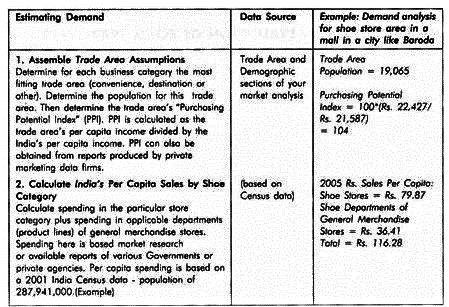
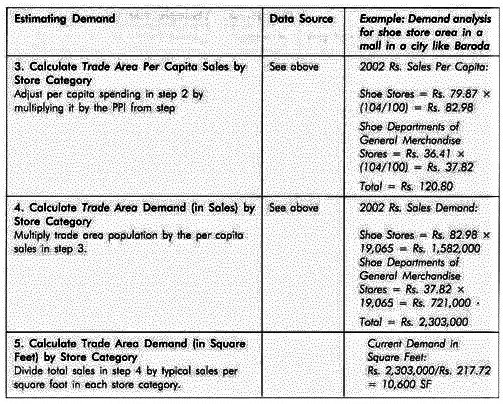
To begin the evaluation of retail opportunities, the market analysis study should be done to understand demand and supply of major catego­ries to determine market potential. Demand refers to the amount of retail space (in square feet) that could be supported by consumers residing in the trade area, based on estimates of their spending potential.

Supply refers to the actual square feet of retail space, sometimes called Gross Leasable Area (GLA), that currently exists in the trade area. A comparison of demand and supply by store type can help identify gaps (demand exceeds supply).

After considering other more qualitative market factors including how and where local residents/people shop, conclusions can be drawn regarding potential business categories worthy of business expan­sion or recruitment efforts.

A flowchart describing this method is presented below:

Estimating Retail Demand:

Estimating Retail Supply

To analyze supply, a database of existing businesses needs to be con­structed for each of the store categories under investigation. The database for each store category should include all of the retail businesses within the trade area used to calculate demand. The database should include a list of the names and addresses of all the current retailers in the primary trade area.

For each retail store, include a reasonable estimate of store size in square feet. For general merchandise stores, include the approxi­mate number of square feet devoted to that product line. While calcula­tions of retail space in a market area are often based on observation and rough estimates, they do provide a reasonable and important “ballpark” figure for this analysis.

Square feet of store space is often called gross leasable area (GLA). It can be estimated by actual measurement of a building’s street-front width and estimate of its depth.

Other Market Considerations

Examining quantitative aspects of demand and supply is only part of the analysis. There are also a number of qualitative considerations that require local knowledge and insight about the market. The previously calculated differences in retail space demand and supply need to be analyzed in context of other market factors.

The following provide additional consid­erations that add to the analysis of each category.

  1. Survey and Focus Group Findings

What have we learned from local research about consumer behaviour and perceptions of the downtown? We must use findings from “Study of Con­sumer Attitudes”.

  1. Trade Area Demographic and Lifestyle Findings

Does lifestyle segmentation data indicate that local residents are more likely to purchase goods within this store category? Use findings from “Study Customer Demographics and Lifestyles”.

  1. Analysis of Non-Local Market Segments

Is there significant market potential from non-resident customer segments such as tourists and commuters?

  1. Retail Mix Analysis

How many businesses in the category are located in the downtown areas of comparison communities?

  1. Competitiveness of Existing Stores in Trade Area

Are existing stores/markets/malls in this category providing the merchan­dise and service local shoppers demand?

  1. Competitiveness of Existing Stores Outside of the Trade Area

Do surrounding communities with regional shopping centers and big box stores siphon business in this category out of the trade area?

  1. Consumer Behaviour and Trends in Store Category

Are purchases driven by convenience or comparison-shopping? Do stores of this type locate in downtown districts anymore?

  1. Drawing Conclusions

The quantitative comparison or retail space demand and supply by store type provide an initial measure of market opportunities (i.e. demand greater than supply). However, demand and supply must be analyzed in combi­nation with many other market considerations.

If there appears to be a significant amount of unmet demand, there may be opportunity for an existing business to expand or a new business to be recruited. Business development opportunities may also exist in areas where supply is greater than demand, especially in those communities that are successful in draw­ing customers from outside their trade area because of a special product niche they have created.

Analyzing Trade Area

A trade area is simply the geographic area that generates the majority of the customers for a community, business district or downtown. Knowing the boundaries of the trade area defines the number of potential custom­ers that may patronage your downtown.

Furthermore, knowing the trade area allows for demographic and lifestyle information to be gathered from a variety of public and private sources. This information provides insight into the people in the trade area and eventually will allow consumer demand for products and services to be calculated.

Therefore, defining the trade area is an important step in market analysis. A trade area often extends beyond the municipal boundaries of a community. Defining this extent is important, but it is also necessary to recognize how a trade area can vary.

In other words, a downtown may have a number of different trade areas depending on a variety of factors. Often, the variability can be attributed to either different types of products and businesses, or different market segments of customers.

How Trade Areas Differ?

Different business types will have different trade areas, that is, people will travel from greater distances to purchase certain goods and services than others. While each individual store may have its own unique trade area, these areas can often be generalized into two different types: convenience shopping trade areas and comparison shopping trade areas.

Local convenience trade areas are based on the ease of access to these types of products. That is, people will obtain these products (apparel, groceries, etc.) based on travel distances or travel time.

Conversely, comparison shopping trade areas are based on price, selec­tion, quality and style. People are more likely to compare these types of goods (appliances, furniture, etc.) as well as travel longer distances for their purchase. Subsequently, the trade area will shrink or grow depending on the products sold. In addition to different types of shopping goods, there are also different types, or market segments, of customers frequent­ing a downtown.

Three common market segments are local residents, day­time employees and tourists. Local residents live within the trade area. As they reside year-round, they provide the majority of spending potential for most downtowns. Daytime employees may live in the trade area, but may also commute from other outside areas.

However, while these employees are in the downtown, they provide the potential to stay and make pur­chases. Furthermore, depending on the community, tourists can provide a large amount of spending potential. While they are not permanent cus­tomers, tourists make purchases while they visit the area.

Simple Methods of Trade Area Definition:

Even though trade areas vary by store type and market segment, one or possibly two general trade areas are needed to proceed with the market analysis. To define these trade areas, there are several techniques avail­able. These techniques have different uses as well as their own advantages and disadvantages.

Each of these methods is described in detail below.

  1. Reilly’s Law of Gravitation:

Reilly’s Law of Retail Gravitation is a theoretical means of trade area definition. It is based on the premise that that people are attracted to larger places to do their shopping, but the time and distance they must travel influence their willingness to shop in a given city.

In other words, people are more likely to travel shorter distances when possible. Addition­ally, customers are more likely to shop in larger communities, as they provide a greater opportunity for goods and services.

Reilly’s Law provides a mathematical formula that can be used to calculate hard numbers relating the distance people will travel. However, a simple map and commonsense can be combined to use the concepts behind Reilly’s Law and generate general trade area boundaries.

  1. Pin code Tabulation:

Another simple method for trade area definition is to tabulate the number of customers by their pin codes. As later explained, pin code data can be collected using a variety of methods and sources.

However, regardless of how the data is obtained, there are a number of advantages to the pin code tabulation method:

  1. Collecting information from customers allows the trade area to be based on real business data, instead of created from a theoretical basis.
  2. Comparing the trade area maps of different businesses can identify opportunities to increase market size and penetration. For instance, the trade areas for businesses that primarily sell convenience items can be compared with each other to identify differences. These differences could indicate potential market expansion opportunities for some of the businesses. The same can be done for comparising shopping businesses.

iii. Trade areas for different market segments can be compared. Businesses serving residents can be compared to the origins of employees at a major employer. Furthermore, pin codes are ideal for tracking the origins of non-local tourists.

While tabulating customer zip codes has the ability to capture trade area variability, an appropriate sample of participating businesses must be incorporated. For instance, stores that serve both convenience and com­parison shopping segments are necessary to understand the local market. Businesses that serve tourists are needed to examine the tourist market

Factors Influencing Location of Store

Where you choose to locate your retail business will have a major impact on your public presence, walk-in traffic, the potential for future income, and other elements. Choosing a location that does not account for such factors may limit the business’s ability to succeed and grow.

Before choosing a retail store location, define how you see your business now and in the future.

  • What are the demographics of your core customers?
  • Can you visualize your building?
  • Do you know what you want to sell and what you want your business to be known for?
  • Have you determined how much retail space, storage area, or the size of the office you need?

If you do not answer these basic questions, it will be hard to find the perfect location for generating the maximum amount of profit for your retail store.

  1. Type of Goods Sold

Examine what kind of products you sell, as some goods will require certain types of locations. Would your store be considered a convenience store, a specialty shop or a shopping store?

Convenience goods require easy access to let the customer quickly make a purchase. These products are also of general interest among consumers. A mall might not be a good location for convenience goods because this product type may be priced on a different scale compared with other retailers on the property. Consumers might be inclined to patronize convenience stores located on the path of their daily commutes. This can mean occupying space situated in or near a transit hub or along heavily trafficked routes.

Specialty goods fulfill more unique needs than general purpose products. Customers generally won’t mind traveling out of their way to purchase this type of product because they cannot procure them through convenience or general goods retailers. This type of store may perform well near other shopping locations because their offerings may complement each other.

A big-ticket shopping store usually sells items at a higher price that are bought infrequently by the customer. Furniture, cars, and upscale clothing are examples of goods found at a big-ticket shopping store. Because the prices of these items are higher, this type of customer will want to compare prices before making a purchase. Retailers in this segment will do well to locate their stores far away from their rivals.

  1. Population and Your Customer

When choosing a city or state to locate your retail store, research the area thoroughly before making a final decision. Read local papers and speak to other small businesses in the area. Obtain location demographics from the local library, chamber of commerce or the Census Bureau. Specialty research firms that cater to retailers could also provide demographic information. Any of these sources should have information on the area’s population, income brackets, and median age. You know who your customers are, so make sure you find a location near where your customers live, work and shop.

  1. Accessibility, Visibility, and Traffic

Don’t confuse a lot of traffic for a lot of customers. Retailers want to be located where there are many shoppers but only if those shoppers meet the definition of their target market. Small retail stores may benefit from the traffic generated by nearby larger stores. There are several aspects retailers should consider along these lines.

  • How many people walk or drive past the location?
  • How well is the area served by public transportation?
  • Can customers and delivery trucks easily get in and out of the parking lot?
  • Is there adequate parking?

Depending on the type of business, it would be wise to have somewhere between 5 to 8 parking spaces per 1,000 square feet of retail space.

When considering visibility, look at the location from the customer’s viewpoint. In many cases, the better visibility your retail store has, the less advertising is needed. A specialty retail store located six miles out of town in a free-standing building will need more marketing than a shopping store located in a mall.

  1. Signage, Zoning, and Planning

Before signing a lease, be sure you understand all the rules, policies and procedures related to your retail store location. Contact the local city hall and zoning commission for information on regulations regarding signage. There may be limits on the size and imagery used in signs that advertise your business. Ask about any restrictions that may affect your retail operation and any future planning that could change traffic, such as highway construction.

  1. Competition and Neighbors

Other area businesses in your prospective location can actually help or hurt your retail shop. Determine if the types of businesses nearby are compatible with your store. For example, a high-end fashion boutique may not be successful next door to a discount variety store. Position it next to a nail or hair salon, which tend to draw the same demographic of customers, to more optimal results.

  1. Location Costs

Along with the base rent, consider all location-based costs involved when choosing a retail store location.

  • Who pays for lawn care and security?
  • Who pays for the upkeep and repair of the heating/air units?
  • Will you need to do any painting or remodeling to have the location fit your needs?
  • Will the retailer be responsible for property taxes?

The location you can afford now and what you can afford in the future may vary. It is difficult to create sales projections for a new business. One way to determine how much rent you can pay is to find out how much sales similar retail businesses generate and how much rent they pay.

  1. Personal Factors

If you plan to work in your store, think about work-life balance issues such as the distance from the shop to home and other personal considerations. If you spend much of your time traveling to and from work, the commute may overshadow the benefits of being your own boss. Also, many restrictions placed on a tenant by a landlord, management company, or community can hamper a retailer’s independence.

Final Considerations

Your retail shop may require additional handling when it comes to choosing a location. Make a list of any special characteristic of your business that may need to be addressed.

  • Will the store require distinct lighting, fixtures or other hardware installed?
  • Are restrooms for staff and customers available?
  • Is there adequate fire and police protection for the area?
  • Is there a sanitation service available?
  • Does the building have a canopy that provides shelter if raining?
  • Are there (blue laws) restrictions on Sunday sales?

Don’t feel rushed into making a decision on where to put your retail store. Take your time and research the area. If you have to change your schedule and push back the date of the store’s opening, then do so. Waiting to find the perfect store location is better than just settling for the first place that comes along.

Implementation

Implementation is the process that turns strategies and plans into actions in order to accomplish strategic objectives and goals. Implementing your strategic plan is as important, or even more important, than your strategy. The video The Secret to Strategic Implementation is a great way to learn how to take your implementation to the next level.

Critical actions move a strategic plan from a document that sits on the shelf to actions that drive business growth. Sadly, the majority of companies who have strategic plans fail to implement them. According to Fortune Magazine, nine out of ten organizations fail to implement their strategic plan for many reasons:

  • 60% of organizations don’t link strategy to budgeting
  • 75% of organizations don’t link employee incentives to strategy
  • 86% of business owners and managers spend less than one hour per month discussing strategy
  • 95% of the typical workforce doesn’t understand their organization’s strategy.

A strategic plan provides a business with the roadmap it needs to pursue a specific strategic direction and set of performance goals, deliver customer value, and be successful. However, this is just a plan; it doesn’t guarantee that the desired performance is reached any more than having a roadmap guarantees the traveler arrives at the desired destination.

Getting Your Strategy Ready for Implementation

For those businesses that have a plan in place, wasting time and energy on the planning process and then not implementing the plan is very discouraging.  Although the topic of implementation may not be the most exciting thing to talk about, it’s a fundamental business practice that’s critical for any strategy to take hold.

The strategic plan addresses the what and why of activities, but implementation addresses the who, where, when, and how. The fact is that both pieces are critical to success. In fact, companies can gain competitive advantage through implementation if done effectively.  In the following sections, you’ll discover how to get support for your complete implementation plan and how to avoid some common mistakes.

Avoiding the Implementation Pitfalls

Because you want your plan to succeed, heed the advice here and stay away from the pitfalls of implementing your strategic plan.

Here are the most common reasons strategic plans fail:

  • Lack of ownership: The most common reason a plan fails is lack of ownership. If people don’t have a stake and responsibility in the plan, it’ll be business as usual for all but a frustrated few.
  • Lack of communication: The plan doesn’t get communicated to employees, and they don’t understand how they contribute.
  • Getting mired in the day-to-day: Owners and managers, consumed by daily operating problems, lose sight of long-term goals.
  • Out of the ordinary: The plan is treated as something separate and removed from the management process.
  • An overwhelming plan: The goals and actions generated in the strategic planning session are too numerous because the team failed to make tough choices to eliminate non-critical actions. Employees don’t know where to begin.
  • A meaningless plan: The vision, mission, and value statements are viewed as fluff and not supported by actions or don’t have employee buy-in.
  • Annual strategy: Strategy is only discussed at yearly weekend retreats.
  • Not considering implementation: Implementation isn’t discussed in the strategic planning process. The planning document is seen as an end in itself.
  • No progress report: There’s no method to track progress, and the plan only measures what’s easy, not what’s important. No one feels any forward momentum.
  • No accountability: Accountability and high visibility help drive change. This means that each measure, objective, data source, and initiative must have an owner.
  • Lack of empowerment: Although accountability may provide strong motivation for improving performance, employees must also have the authority, responsibility, and tools necessary to impact relevant measures. Otherwise, they may resist involvement and ownership.

It’s easier to avoid pitfalls when they’re clearly identified. Now that you know what they are, you’re more likely to jump right over them!

Covering All Your Bases

As a business owner, executive, or department manager, your job entails making sure you’re set up for a successful implementation. Before you start this process, evaluate your strategic plan and how you may implement it by answering a few questions to keep yourself in check.

Take a moment to honestly answer the following questions:

  • How committed are you to implementing the plan to move your company forward?
  • How do you plan to communicate the plan throughout the company?
  • Are there sufficient people who have a buy-in to drive the plan forward?
  • How are you going to motivate your people?
  • Have you identified internal processes that are key to driving the plan forward?
  • Are you going to commit money, resources, and time to support the plan?
  • What are the roadblocks to implementing and supporting the plan?
  • How will you take available resources and achieve maximum results with them?

Factors to Consider in Preparing a Business Plan

Whether you have just started your business or developing it day-by-day, a business plan is what you would need throughout your journey. The crucial factors that you would write down on a piece of paper will help you going towards your desired success. So, the question that arises here is How to write an effective business plan that will take your company to the expected height?

Basically, your business plan should be nothing but your answers to a comprehensive question list. To begin with, ask yourself:

Where do you want your business to go?

Find out how would you like to see your business in the next five, ten, or fifteen years down the lines?

What is your expected revenue and profit in future?

How many employees will you hire?

How would you like to expand your business?

And the list goes on.

Similar to the plan of long-term, create a short-term plan that would be applied to a shorter period of time, particularly a year. For example: What are your goals for the current year? What are the targets that you must accomplish to reach that ultimate goal?

Seven important factors to consider before starting a business

  1. A great idea

“No business can develop in the absence of a great idea. A great and a practical idea is the only thing on which the development of your business will depend. Moreover, as a lot of companies are involved in the market, you need to have a unique idea that stands out.”

Not sure what your great idea is? Explore our business ideas hub and get inspired.

  1. Funding and budget

“The next important factor that should be considered involves the funding of your business. You need to properly identify the sources through which you will be able to get the funding for your business. Moreover, it is better to have a plan so that the budget of a company can be properly maintained.”

What are the options for funding your business? Discover the different ways of raising finance.

  1. Analysis of competitors

“You need to know what your competitors are doing and what are their strategies? With this knowledge, you will be able to take appropriate decisions about your company. It will also help you in developing a much more effective strategy for your business.”

  1. An effective business plan

“No business can develop fully in the absence of a business plan. Writing a business plan can help you determine if your idea is feasible and provide direction. With a business plan, you will be able to know every next step that should be taken.”

  1. Legal documentation

“The next factor that needs to be considered is the completion of legal documents. For the sale of some specific products and services, there are some requirements for the preparation of legal documents. Make sure you have already done all the legal documentations for your business.”

Our legal issues section can help you to understand some of the common concerns.

  1. Positive attitude

“It is one of the most important things that will help you in passing all the challenges and difficulties. There will be a lot of risks and hurdles you will face in this process and the only thing that can save you will be your positive attitude. You will have to work hard to develop a company of your own.”

  1. Know when you need help

“The development of a business is not a matter of seconds, it will involve a lot of time that is spent with hard work. However, in this process, you will be needing the help of some experts. Make sure you already have an adviser who can provide you with the best advice at the hour of need.

“These are the seven most important factors you need to consider while starting a business of your own.”

Retail Planning Process

In the retail planning process, a retailer decides about the planning strategies of the retail business, learn about the competition in the market, and create and implement strategies accordingly.

Retail planning is crucial for every retail business. Otherwise, you will always find yourself to dilemma while making decisions for your store.

Seven Steps involved in Retail Planning Process

  1. Set objectives

Setting Objectives is important for the success of the business. It is not necessary that the goal of a business is to maximize sales. An organization can pursue multiple goals at the same for example, expansion of business in a year, revenue generation, and more product lines, etc. it is apparent that all goals mentioned above are focused on multiplying sales.

Broadly the objective of an organization can be divided into two categories:

(i) External Objectives

The external objectives of an organization include the performance of the organization in an external environment focused on customers.

Such as providing customer satisfaction and increasing their loyalty for the products, selling quality products at lower prices, providing better customer service, etc.

(ii) Internal Objectives

On the other hand, internal objectives consist of sales goals, revenue generation, maximizing the sales using existing resources, etc.

Both objectives are important for an organization. But only clear objectives can be easy to achieve, and planning can be done accordingly to attain these objectives. Therefore, it is important for a retailer to set annual objectives to ensure success and to measure it.

  1. Analysis of the market

After the objective for the organization is defined. The next step is to analyze the situation of the market you are planning to enter.

The analysis can help you to make an effective decision. you can learn about the competitors’ strategies and plan your strategies accordingly, what are the expectations of your customers and how you can fulfill them, how you can stay ahead in competition in the market, etc.

The analysis can help you to learn about the threats and opportunities in the market and what actions you should take. In addition to this, analysis can help you to learn about the strengths and weaknesses of your own business.

In this way, you can work on to strengthen your strengths and work on your weaknesses to turn them into your strengths. You can make decisions about how you can use your resources such as financial resources, human resources, intangible and physical resources, etc.

  1. Analysis of Customers

Analysis of customers is the most important activity of the retail planning process. You can’t simply like a product, design it and throw in the market and expect customers to buy it and like it.

By analyzing the customers, you need that what are the expectations and requirements of customers and you select a segment of potential customers who are most likely to buy your products. You can plan your business strategies better if you know your customers.

You can optimize your marketing mix to satisfy your customers. Customers analysis helps the organization to innovate and create services to satisfy its customers and retain them for a long period.

Hence, you avoid the chances of getting out of fashion as you keep updating your strategies with the changing demands and requirements of customers.

  1. Frame Retail Strategies

After you have decided key objectives and learned about the market situation and customers’ requirement, next, you should prepare your retail strategy for marketing positioning and retail mix.

The market strategies should be prepared based on kind of products sold in your store or the segmentation of the market you are dealing with.

The meaning of retail mix is to have the balanced amalgamation of retail activities, and the meaning of retail positioning is the strategy of the retailer to enter the target market and establish his business to compete with the competitors.

It is important to pay attention to these processes to grab the attention of your potential customers and make establish a positive image of your retail business.

You need to prepare effective retail strategies to stay ahead in the game of retailing. Work on various elements such as the location of the store, pricing policy, merchandise assortment, advertisement, customer service, etc. for example, you can attract customers by offering good quality of products at lower prices than your competitors or central location of the store can be a key element to attract more customers.

  1. Strategic Short-term Planning

In the next step, the retailer must think and plan about the short-term plans to grow your business. For example, you can attract more customers in your store during the festive season by using tactic advertising and marketing strategies.

You can run a short-term TV advertisement or can circulate advertising pamphlets in the local market. Strategic short-term plans are important for boosting sales instantly. Therefore, you should start planning short-term plans before the beginning of the festive season.

Your planning should be as per the requirement of the event. For example, an advertisement plan for valentine’s day can’t be the same as the advertisement plan for Christmas.

  1. Implementation of the Strategies

Once you have decided strategies, the final step is to implement those strategies and control them. In this step, you will also check whether your strategies are working or not and how much they have helped in boosting the sales.

Implementing strategies is not easy, it requires thorough planning, and you need to make changes in the store, and you may also need to change the role of your employees.

You might face some reluctance from your employees but if you plan smartly. You can divide the work among your employees in such a way so that they don’t feel burdened. In addition to this, you can also give them a bonus if their work pays off.

  1. Analyzing the performance of the strategies

Your job does not end with the implementation of strategies. You should analyze its performance and see where did you face most difficulties and what kind of issues did you face. Learn about them and take your lessons and implement them in your future strategy planning.

Customer Service

Customer satisfaction (CSAT) is a metric used to quantify the degree to which a customer is happy with a product, service, or experience. This metric is usually calculated by deploying a customer satisfaction survey that asks on a five or seven-point scale how a customer feels about a support interaction, purchase, or overall customer experience, with answers between “highly unsatisfied” and “highly satisfied” to choose from.

Customer service is the direct one-on-one interaction between a consumer making a purchase and a representative of the company that is selling it. Most retailers see this direct interaction as a critical factor in ensuring buyer satisfaction and encouraging repeat business.

Even today, when much of customer care is handled by automated self-service systems, the option to speak to a human being is seen as necessary to most businesses. It is a key aspect of servant-leadership.

Basics of Good Customer Service

Successful small business owners understand the need for good customer service instinctively. Larger businesses study the subject in-depth, and they have some basic conclusions about the key components:

  • Timely attention to issues raised by customers is critical. Requiring a customer to wait in line or sit on hold sours an interaction before it begins.
  • Customer service should be a single-step process for the consumer. If a customer calls a helpline, the representative should whenever possible follow the problem through to its resolution.
  • If a customer must be transferred to another department, the original representative should follow up with the customer to ensure that the problem was solved.

Customer Services Job Requirements

Much is expected of customer service representatives. Yet the pay for the job is low. The average salary in 2018 was about $33,750, according to the Bureau of Labor Statistics.

Some of the job expectations:

  • Customer service representatives must be accessible, knowledgeable, and courteous. They require excellent listening skills and a willingness to talk through a resolution. Training in conflict resolution can be beneficial.
  • Strong speaking skills are important. For phone staff, this means speaking clearly and slowly while maintaining a calm demeanor even if the customer doesn’t.

Employer Responsibilities

Poor management can doom any customer service operation. A couple of important tips for managers:

  • Make sure your customer service representatives are fully informed and have the latest information and the company’s products and policies.
  • Periodically assess the customer service experience you are providing to ensure that it’s an asset to the company.
  • Consider conducting regular surveys to give customers the chance to provide feedback about the service they receive and suggest areas for improvement.

Using Mobile Services Effectively

In recent years, studies of customer service have centered on creating the perfect online experience.

The first and most difficult factor is the multiplicity of channels. Today’s customers expect to get service through whatever app or device they happen to be using at the moment. That may be a mobile device or a laptop, a social media site, text app, or live chat.

Once again, the focus has been on packaging how-to content and related resources that are designed for self-service. Increasingly sophisticated data analytics also are being used to identify dissatisfied or low-engagement customers.

But, as always, the most effective customer service apps need to incorporate human contact, if only as a last resort.

  • Customer service is the interaction between the buyer of a product and the company that sells it.
  • Good customer service is critical to business success, ensuring brand loyalty one customer at a time.
  • Recent innovations have focused on automating customer service systems but the human element is, in some cases, indispensable.

Customer Shopping Behaviour

Consumer Buying Behavior refers to the actions taken (both on and offline) by consumers before buying a product or service. This process may include consulting search engines, engaging with social media posts, or a variety of other actions. It is valuable for businesses to understand this process because it helps businesses better tailor their marketing initiatives to the marketing efforts that have successfully influenced consumers to buy in the past.

A variety of factors go into the consumer buyer behavior process, but here we offer just a few. Taken separately, they may not result in a purchase. When put together in any number of combinations, the likelihood increases that someone will connect with a brand and make a purchase. Four factors influencing consumer buying behavior are:

  • Cultural Factors: Culture is not always defined by a person’s nationality. It can also be defined by their associations, their religious beliefs or even their location.
  • Social Factors: Elements in a person’s environment that impact the way they see products.
  • Personal Factors: These may include someone’s age, marital status, budget, personal beliefs, values, and morals.
  • Psychological Factors: A person’s state of mind when they are approached with a product will often determine how they feel not only about the item itself but the brand as a whole.

Studying consumer behavior is important because this way marketers can understand what influences consumers’ buying decisions. By understanding how consumers decide on a product they can fill in the gap in the market and identify the products that are needed and the products that are obsolete. Studying consumer behaviour also helps marketers decide how to present their products in a way that generates maximum impact on consumers. Understanding consumer buying behaviour is the key secret to reaching and engaging your clients, and convert them to purchase from you.

A consumer behavior analysis should reveal:

  • What consumers think and how they feel about various alternatives (brands, products, etc.);
  • What influences consumers to choose between various options;
  • Consumers’ behavior while researching and shopping;
  • How consumers’ environment (friends, family, media, etc.) influences their behavior.

Consumer behavior is often influenced by different factors. Marketers should study consumer purchase patterns and figure out buyer trends. In most cases, brands influence consumer behavior only with the things they can control; like how IKEA seems to compel you to spend more than what you intended to every time you walk into the store.

Factors affects consumer behavior

Many things can affect consumer behavior, but the most frequent factors influencing consumer behavior are:

  1. Marketing campaigns

Marketing campaigns influence purchasing decisions a lot. If done right and regularly, with the right marketing message, they can even persuade consumers to change brands or opt for more expensive alternatives. Marketing campaigns can even be used as reminders for products/services that need to be bought regularly but are not necessarily on customers’ top of mind (like insurance for example). A good marketing message can influence impulse purchases.

  1. Economic conditions

For expensive products especially (like houses or cars) economic conditions play a big part. A positive economic environment is known to make consumers more confident and willing to indulge in purchases irrespective of their personal financial liabilities. Consumers make decisions in a longer time period for expensive purchases and the buying process can be influenced by more personal factors at the same time.

  1. Personal preferences

Consumer behavior can also be influenced by personal factors, likes, dislikes, priorities, morals, and values. In industries like fashion or food personal opinions are especially powerful. Advertisement can, of course, help but at the end of the day consumers’ choices are greatly influenced by their preferences. If you’re vegan, it doesn’t matter how many burger joint ads you see, you’re probably not gonna start eating meat because of that.

  1. Group influence

Peer pressure also influences consumer behavior. What our family members, classmates, immediate relatives, neighbors, and acquaintances think or do can play a significant role in our decisions. Social psychology impacts consumer behaviour. Choosing fast food over home-cooked meals, for example, is just one of such situations. Education levels and social factors can have an impact.

Four types of Buyers

  1. The Analytical Buyer

Motivated by logic and information, this buyer will look at all the data on competing brands and products before making an informed decision.

  1. The Amiable Buyer

Warm and friendly, this buyer just wants everyone to be happy. That is why they are often paralyzed by big decisions when there is the perception of a win/lose outcome.

  1. The Driver Buyer

Drivers are most concerned with how others view them and whether they follow. The trendsetters, Drivers are most concerned with their appearance rather than the relationships that are formed during a transaction.

  1. The Expressive Buyer

Relationships are key to the Expressive Buyer. They cannot stand feeling isolated or ignored during a transaction. Instead, they want to feel like your most important asset.

It’s hard to distill something as complex as consumer buying behavior into four neat and tidy categories. Most people will find they are a combination of these types of consumer buying behavior.

Influence of Group on Buying Decisions Process

Consumers are a tribal bunch, and the groups they choose to belong to are significant to how those consumers view themselves and live their lives. Much the way they pick like-minded friends, consumers also purchase brands they believe represent standards they relate to. This is a key component of reference group marketing. Convincingly associating your product or service with a group your target market admires is how you can use group influence to boost your brand’s sales.

Consumers Trust Reference Groups

Consumers are influenced by different types of reference groups they believe they are a part of or aspire to be. Group influence goes both ways; sometimes, consumers avoid brands they believe would put them into a group they don’t want to be included in. People buy things to help form and express their self-concept and their connections with like-minded people. Many things a person buys, especially showy items such as clothing, accessories, vehicles, restaurants or club memberships, are symbolic of what he thinks is acceptable to a certain reference group such as his family, social circle, workplace, community or culture.

An individual buyer might make purchases that appeal to a few different types of reference groups. For example, a consumer who wants to appear eco-friendly may purchase a Toyota Prius. That same consumer might also feel connected to Nintendo’s gaming community and opt to buy Nintendo consoles over Sony or Microsoft products. Group influence comes from many directions and in most cases, different types of reference groups do not clash in the buyer’s mind because the products that signify them are in completely separate categories.

Branded Upbringings Make Lifetime Buyers

Kids influence their parents’ purchases, and reference group marketing can be quite effective with children and teenagers. Marketers aim their messages at children via television, apps and internet to establish early brand familiarity and inspire direct sales. While parents may refer to other parents and groups for the final decision on household purchases, teens and children are typically driving forces behind their parents’ purchasing decisions.

Consumers Buy Peer Status

Wealthy consumers influence non-wealthy consumers. Certain brands keep luxury consumers believing they’re part of an elite club. The trick for marketers of high-end luxury goods and services is to appeal to the wealthier consumers who want to feel distinguished from the non-wealthy while at the same time appealing to the larger audience of consumers who want to emulate the wealthy, according to research on consumer behavior. For example, a high-end watchmaker may release a limited edition luxury watch for its targeted consumers followed by a more affordable version of the product, under the same brand name, for a wider market.

Cause Affiliations and Purchasing

Movements in society can influence consumer behavior. Media reports associated with a brand can fuel consumer activism for or against it, making social media an important asset for any brand engaging in reference group marketing. For example, an injustice involving a manufacturer that is publicized in the media may trigger a consumer to join a boycott of the manufacturer’s brand. Conversely, a company’s association with a charitable cause or heroic deed may compel the consumer to purchase the company’s brand just to show support. People favor brands that resonate with what they believe in and what they think like-minded believers accept.

Influencing Factors Present: Indian Retail Scenario

Retail Business today is one of the quickly growing channels & playing an important role in emerging economic growth of the country. In the recent times customers are getting more & more attracted towards Retail Markets. Change in income structure, consumer tastes & preference, demographic & geographic profile are some of the key factors that are driving towards growth in Retail Business.

Some other main factors responsible for the growth in Retail Industry are as follows:

  1. Growth of Consumers

Nowadays there is tremendous growth in number of consumers in India, especially the middle class. Consumer demand & income structure has also increased further raising their expectations for quality products at reasonable prices. Retail outlets offer a wide variety of products & services to the customers to meet their demands thus resulting into the growth of Retail Sector.

  1. Working Population

In recent times the graph of working population has seen a steep increase in urban as well as rural areas thus changing their spending habits & income structure. It becomes very difficult for the working people to spend enough time in shopping at different locations. This enables a retailer to provide them various products at one place, creating a platform for development.

  1. Value for Money

Big & organized retail outlets basically deal in volumes & can offer a good range of products at reasonable price thus attracting customers at a very large scale. This in return also creates a good opportunity for retailers to get more profits & enables new business groups to enter into this sector.

  1. Rural Market

Today’s Indian Retail market has entered in rural areas creating a big competition, as the rural population has become more literate & quality conscious. These high potential rural populations have thus enabled the retailers to enter rural market & develop new products & strategies to meet their demands. Also it has created employment opportunities for the rural people thus heading towards growth & development.

  1. Corporate Sector

Corporate sectors have also entered into the retail business to cater the customers demand & provide them better quality products at reasonable price. This is one of the reasons that have brought revolution to the retail sector thus driving it towards the growth.

  1. Foreign Retailers

Rapid expansion & the race to cater the demand of every customer is catching the interest of foreign retailers to enter the market &provide good quality products & services through joint ventures or franchising. This will further boost the retail sector & will help in developing economy of the country.

  1. Technological Impact

Advance technology has made it easier for the retailers to handle large scale business & cater the needs of consumers. With the introduction of computerized billing system, electronic media & marketing techniques, barcode system has changed the face of retailing in providing products & services to customers. Also the use of online market has driven the retail sector towards advanced growth structure.

  1. Income Structure

Increase in the number of working population has resulted in increase in the income structure in cities as well as remote areas. This has further led to increase in the demand for quality products & services. People nowadays tend to try new things & improve their look thus increasing the spending habits & giving an opportunity to grow & expand their business.

The rise and growth of the Indian retail industry

Over the years, retailing in India has been one of the most dynamic and fast paced industries, which has travelled through different phases. Origins of retailing in India can be traced back to the emergence of kirana and mom & pop stores, but with Indian economy getting liberalised in early 1990s, many indigenous franchise stores propped up. Many domestic players like Raymond, Bombay Dyeing etc. started to forward integrate from manufacturing to retailing thereby catering to a larger base of customers.

In the backdrop of evolutionary times coupled with day to day disruptions, retail outlets like Shoppers Stop, Planet M, Crosswords, Pantaloons etc. entered the market in the 1990s, followed by a few shopping malls, department stores and supermarkets. Thus, from early 90s to about 2005, shoots of organized retail started emerging in India. 2005 onwards marked a phase of growth and stabilization where large corporates like Reliance, Aditya Birla, Godrej etc. entered and grew their retail business. Retail became the ‘buzzword’ and the industry to be in. In the decade the industry saw many ups and downs and a few groups also exited retail who were not being able to grow and compete in the sector. A large number of International brands and retailers also entered India during this phase, many of them like Zara and H&M becoming extremely successful while the others still struggle to find a foothold.

Currently, driven by strong macroeconomic factors, India is one of the fastest growing economies globally and the fourth largest retail market in the world. It thus holds a very strong position as far as its market potential is concerned. It provides a strong platform for consumers, distributors, manufacturers and ancillary sectors like transportation, logistics, cold chains etc. Retailers are continuously trying to fully tap the depth of this potential by making use of latest technologies along with next gen tools like data analytics, social commerce, CRM solutions etc. which form the backbone of modern retailing.

The burgeoning millennial population, growing middle income households and increasing women workforce provide a highly positive outlook for the retail businesses in India. Fuelled by these factors, the Indian retail industry is expected to grow from US$ 790 billion in FY 2019 to US$ 1400 billion by FY 2024, as the overall economy crosses the US$ 5 trillion mark.

As internet penetration increases, more international retailers set up shops in India and established Indian brands and retailers set themselves on a high growth trajectory, the share of organised retail market is expected to increase from 12 percent in FY 2019 to 25 percent in FY 2024.The e-commerce market itself is estimated to grow from US$ 24 billion in FY 2019 to US$ 98 billion in FY 2024. Going forward, given the strong retail and consumer outlook, India is expected to witness redefining trends which will shape the future of the retail market.

Consumer experience will be the key focus of the retailers, while technology will play an important part in increasing sales as well as facilitating the enhancement of consumer experience throughout their shopping journey. The next 10-12 years will be the defining years for Indian retail as the market will mature and organized retail will penetrate deeper into smaller cities and towns. While on one side more international brands and retailers across categories and formats will aggressively enter and grow the Indian business, India will become the key growth market for the ones already present. Technology will replace many ‘human roles’ in retail and new ways to emotionally connect with consumer will evolve. New markets will develop, and new channels will disrupt and reshape the markets.

This article focuses on the some of the above points and throws light on trends expected to disrupt Indian retail industry in the near future.

Growth of Indian Economy & Consumption

Just days after coming to power, the current government spelt out its key priorities, which were focused on laying the foundation for making India a US$ 5 trillion economy by FY 2024. As per IMF too, India’s GDP will grow at 7.4 percent in FY 2020, with medium term growth projection expected to remain strong at 8 percent due to ongoing structural reforms and a favourable demographic dividend.

These factors are largely scripted on the strength of India’s growing domestic consumption. This high rate of growth in consumption is accompanied by a substantial decline in India’s poverty rate and increase in formal employment, due to growing proportion of jobs in services and declining share of employment in agriculture. The growing contribution of services sector towards India’s overall GDP, has resulted in creating improved working conditions and better income for Indian households. As a result of this, India’s GDP per capita has crossed US$ 2,000 mark in FY 2019.

The government now intends to focus on the manufacturing sector to create new jobs and has launched many initiatives like “Make in India” for this. This will further help in increasing the GDP per capita, thereby putting more money into the hands of people to improve their lifestyle, thereby supporting consumption and the retail market.

It has been seen in the case of China that when the per capita GDP reaches US$ 2,000 mark and the basic requirements of shelter, food and clothing are met, people start spending many other categories and the retail market consumption prospects improve and investment momentum increases significantly. At this level of per capita income, basic needs are met and income available for discretionary spend increases. As India has crossed this US$ 2,000 mark in FY 2019, it can be expected that Indian retail has reached its inflexion point. With rapidly growing economy and higher GDP per capita, it can be assumed that Indian retail industry has started to change its gears, just like China did in the last 15 years.

Indian retail is thus expected to reach US$ 1400 billion by FY 2024 from US$ 790 billion in FY 2019, growing at a CAGR of 12 percent.

Growth of Organized Retail

Due to the sharp rise and changing consumption pattern of Indian consumers, share of organized segment is growing rapidly. While traditional formats or unorganized retail formats continue to dominate the retail market, organized retail is growing at a faster pace and eating up into traditional retail. A major driver of this high growth trajectory has been online retail which is projected to grow at a CAGR of 33 percent between FY 2019-24. Growth in online retail is majorly attributed to factors including:-

  • Increasing internet penetration
  • Growth in number of smartphone users
  • Growing number of online shoppers

Although mobile, tablets and electronics as a category continue to be the dominant one in the online market of India, new breed of online players are targeting other categories like food & grocery, pharmacy etc. These will be the categories where we will see 40 percent plus year on year growth in the online space.

Factors Driving the Growth of Indian Retail Market

Indian consumption and retail market growth is largely supported by the following factors:

  1. Burgeoning Millennial Population and Changing Outlook towards Spending

With median age of 27 years, India is home to world’s largest Millennial population. With 440 million of them, they make 34 percent of the total population in India. Further, their contribution to the Indian workforce is significantly higher at nearly 48 percent in FY 2019.

This set of consumers are more confident of future success and earning at a much younger age than their parents. As they are more urban in their approach, these consumers are career driven and well-travelled people. They aspire high, with fewer things seems to be out of bound for them. Millennials no longer feel guilty about spending too much on self, instead they believe in investing towards fulfilling their needs more thoroughly. They spend on things that make them look good in a “selfie” world. They also spend on things that improve their lives and their “image”. The focus is shifting from high capex items like house and cars that the last generation saved and spent on, to spending more on experiences and on day to day things, buying better products and brands in a more convienent way.

Also, Millennials are known to be marrying late, with average age of marriage for women in urban India increasing from 20-22 years to 25-26 years, while for men it has increased from 25-26 years to 29-30 years in the past few years. This has resulted in young Millenials having more disposable income to spend on “self”, therby growing various categories like personal gadgets, solo holidays etc.

  1. Increasing Women Workforce

With changing societal mind set and increasing gender equality at office, women entering workforce has been on the rise in past few years. From FY 2014 to FY 2019, women workforce in India has increased from 5 million to 7 million respectively and is expected to reach 10 million by FY 2024. This has led to the increase in earning members and family income, thereby giving rise to discretionary spending. Today, women in India are getting independent in terms of their purchase decisions. This coupled with increasing time pressures and aspirations to spend on self-development, is giving rise to the consumption of new categories like personal care, readymade products etc.‘ Convenience’ is again a theme that comes up very strongly here. Across categories, products and brands that can make the consumer life more convenient will continue to grow very rapidly.

  1. Growing Wallet Share and Price Trade-Off

With growing GDP per capita and higher disposable incomes, consumers have become more aspirational and are open to buying new categories. This hasled to a change in wallet share of Indian consumers. Earlier wallet share of Indian consumers was largely dominated by food and clothing only, but with evolving buying behaviour, new categories like mobile and communication, beauty & grooming, personal gadgets etc. have now become a part of Indian consumer’s wallet share.

Many new categories of spend have thus emerged in the last few years and many others have redefined themselves.

Consumers have traded “durability” for “price” and “fashion”. E.g. in the 80s and 90s, consumers purchased a TV or a refrigerator or furniture only once or twice in their lifetime, largely when the older product became irrepairable. However, Millenials buy these products every 5-7 years as products with new features and designs are launched. Thus, the market for these products has grown tremendously as first-time buyers purchase these products driven by greater affordability and there is a high replacement driven demand. There is also a great growth in the second-hand market, which is also becoming online with many online players entering the market.

  1. Growth of Markets

With online players now delivering to the smallest of towns, consumers in these cities are aware of many international and indigenous brands available in the market. This spells a big opportunity for the modern retailers who are looking to enter into Tier III & IV markets. Many consumers living in Tier III &IV towns have now experienced the brands, through online purchases. Leading national brands are now looking at 500 plus cities as their market and are already opening stores. Other international and indigenous brands are planning expansion into these cities based on factors like changing lifestyle, digital connectivity etc.

  1. Growth of Malls

With wide variety of international and domestic brands available and with growing consumer desire to own these brands at a more organised, better and bigger destinations, there has been a sharp rise in the number of malls operating in India. Earlier the mall development was confined to top tier cities like Delhi- NCR, Mumbai, Hyderabad, Chennai, Pune etc. However the next round of mall development is expected to come from Tier III cities like Allahabad, Coimbatore, Jamshedpur, Panaji, Udaipur etc.

Malls have also progressively become bigger and are considered to be destinations or experience centres instead of just shopping or transactional places. Today, malls are focusing more to become a community or public interaction centres by creating meeting places, entertainment areas, providing better shopping experiences through enhanced ambience, brand selection etc. By bidding farewell to the categories like books and music, and mobile, that have moved online, malls have started to focus on the growing significance of offering a good line-up of experiential categories like food and beverage, entertainment options like multiplexes, gaming centres along with other amusement options to encourage greater footfalls and more return visits.

Retail business in India

Most Profitable Retail Business in India For 2020

If you are looking for the most profitable retail business in India for 2020 and beyond, you are on the right page. We have identified 10 retail businesses that are extremely profitable as well as easy to start with. So, stay tuned.

Retail business generally refers to the items that are required for daily consumption or daily use. Hence retail outlets are needed for every company. However, on an initial basis, it is not possible to spend a lot of money or invest a lot of money to set up a retail business. This can hence be started with low investment, with the objective to earn some good profit.

Top 10 Most Profitable Retail Business in India

Out of all the forms of businesses, the retail business is one of the most profitable ideas of business in a metropolitan city like that of India. People require commodities on a daily basis and they search for shops located nearby.

So, retail companies would best help to employ a large number of people under the outlets and they would really be able to work and seek service better. In such a scenario, it will help the market segment to seek profits better.

On the other hand, the employees get happy to work and provide efficient services by working next to their doorstep. India also has an agrarian economy. So, many of the retail businesses are best suitable here.

Based on these criteria, this article will mainly focus on some of the most profitable forms of retail businesses in India. Some of the most profitable retail business in India is the distribution of fertilizers, Setting up a car washing zone, Setting up a fuel station or pump station for servicing of vehicles or servicing, Setting up of a blouse shop for women, Setting up of laundry, to name a few.

Apart from this, they should think about Setting up of convenience store or a book store for students to procure school, college books, Setting up a tuition center, Setting up a nursing training center are yet again very important.

  1. Setting up of medicine store

An important retail business is that of a medicine shop. People often do not live near a doctor’s residence and hence a medicine shop is required for people so as to help them during any emergency or illness.

On average, the profit earned by selling important medicines can stand as 60000-80000 profit by investing in around 3-4 lacs in medicines, hence there can be overall earnings of 20-30 percent of the overall value.

So, a medicine company can earn huge profits if it is earned in the right way. However, it entirely depends upon the kind of drugs being sold by a particular medical store upon how much profit it can earn.

This is no doubt one of the most profitable retail business that you can start right now.

  1. Setting up of seed store

The second most important retail business can be set up a seed store. This is important for a large number of farmers as farmers require seeds to grow plants and earn money. On an average basis, one can earn an average profit of at least 8-10 percent of the overall business.

However in this case too, the overall profit deeds upon the quality of seeds that one is using for business. Obviously, if the quality of seeds is good, and then there would be more demand to buy such seeds. This will raise profit further. Hence one can expect a minimum of 10-20,000 INR profit to start with.

  1. Setting up of fertilizer store

The third is the utilization and sale of fertilizers. Farmers can buy fertilizers from outlets at a convenient price and prevent the plants’ groom pesticides, insecticides and other harmful things.

In recent days, there are more than 300-400 dealers selling fertilizers in various rural areas. People need to decide on how they can invest in Organic fertilizers. Currently fertilizer business is popular in over 160 countries and hence India can even proper by investing in this area.

  1. Setting up of car washing zone

The fourth retail business is that of the car washing zone. The car washing zone is a very popular retail business in areas like Australia, New Zealand and other parts of the world. In India also, with growing numbers of private cars, the necessity of washing cars daily has become a common scenario.

Under such a situation, people are constantly in a lookout where cars can be washed instantly without having to cost much. So the automobile industry is growing in large numbers in India and people are constantly buying new cars.

They are constantly searching for some trustworthy outlets where they can wash their cars are get their cars checked. For each car wash, one can earn an average of 500 INR  to 1500 INR and hence, more than a number of cars, more than the number of profits earned by that washing zone.

  1. Setting up of ladies garment store

The fifth entity in the retail business in India is that of the ladies’ garments store. Women are completely fascinated to buy new dresses for themselves almost. They can wear these dresses in their workplaces, colleges, and universities or for other professional or personal parties. So a retail business can be a help to them.

A garment store in the form of a retail business can be a necessity for every woman. Men and women living in India are culturally bound to each other and in such a situation, a retail-based garment store can be a source of connecting people and their culture together.

If one decides to set up a retail outlet in India, then it would definitely be much profitable. Next to a ladies’ garment store, the next is that of a leather fashion store. In cities, towns as well as in villages, people are constantly in search of leather items, and leather jackets, leather belts, for leather bags.

These are in fashion. One can also think of developing a retail outlet that consists of several items like that of a leather jacket, leather gloves, leather bags and other items that men and women require every day. One can step inside and select some of the best leather-based utility items for his/her family partner.

In such cases, people also do not think of the price criteria as they are ready to buy leather items that are unique and that is a specialty of the country. A number of reports suggest that this business can earn from 4-5 percent to 14-15th percent of the overall income.

  1. Setting up of perfume store

The sixth important unit in the retail segment is that of a perfume shop. This can offer excellent smell for the shop owner of this kind of retail shop. For customers too, it is an interesting thing to buy and start a day fresh.

So perfume again a very important area and a perfume retailing business can work quite well in this country. However, business managers have to first understand the requirements of people and then develop their market segment accordingly. If a perfume store can work well, then it can earn at least 3-4 lacs per month.

  1. Setting up of mobile store

The seventh important retail business is that of setting up a shop equipped with mobile phone-based accessories. The mobile phone is a requirement of each and every people and hence setting up a mobile phone-based shop would be highly profitable.

By selling mobile phones to customers by being located in some well-populated urban place, a mobile store can earn around one-two lakh per month out of the total sale. However, this might reach crores, depending upon the products being sold and other factors.

  1. Setting up of laundry store

The eighth important retail business is that of a laundry. This is a basic requirement of a city, village or town. Every civilized person requires laundry where their dresses can be cleaned. People also do not have time to clean their dresses regularly.

So a laundry can be set up in prime areas where the population is high. So people can give their clothes and get them washed.

  1. Setting up of furniture store

The ninth important retail business is that of a furniture shop. Furniture is quite important for housing, and people need furniture for personal spaces as well as workspaces in order to decorate their flats or offices. The recent rates for profit earned in the furniture sector are around forty-five percent in India.

This shows that there have been fewer opportunities for furniture and demand is also moderate. Hence under such a scenario, furniture owners should take this as a challenge and develop this area for more profit. They would face much less competition from other competitors.

  1. Setting up a convenience store

This kind of store is extremely useful for a country like India, where people want to get useful things under the same shelter. They can acquire things from a convenience store.

These stores can easily earn a profit of around 2-4 lakh per month if the owner of the convenience store can handle the store well. This is also based on the location of the store and urban places will earn more people to purchase.

So you can buy coffee, snacks, groceries or anything that you require for your monthly consumption from a convenience store placed near your residence.

error: Content is protected !!